Psalms 7:9

Hebrew (Westminster Leningrad Codex) Psalms 7:9 appears in the Hebrew Old Testament. The text above is from the Westminster Leningrad Codex. Each word links to its Strong’s number, a concise gloss, and parsing drawn from the Open Scriptures Hebrew Bible morphology. Click any word for its full Brown-Driver-Briggs (BDB) entry.
Download image
Cite this verse

Psalms 7:9 (World English Bible). Public Domain. Lemma interlinear Bible study tool, https://lemma.gebible.app/v/psalms/7/9.

Show BibTeX & RIS
BibTeX
RIS
English Translation
Oh let the wickedness of the wicked come to an end, But establish the righteous; Their minds and hearts are searched by the righteous God.
World English Bible · Public Domain
Highlights
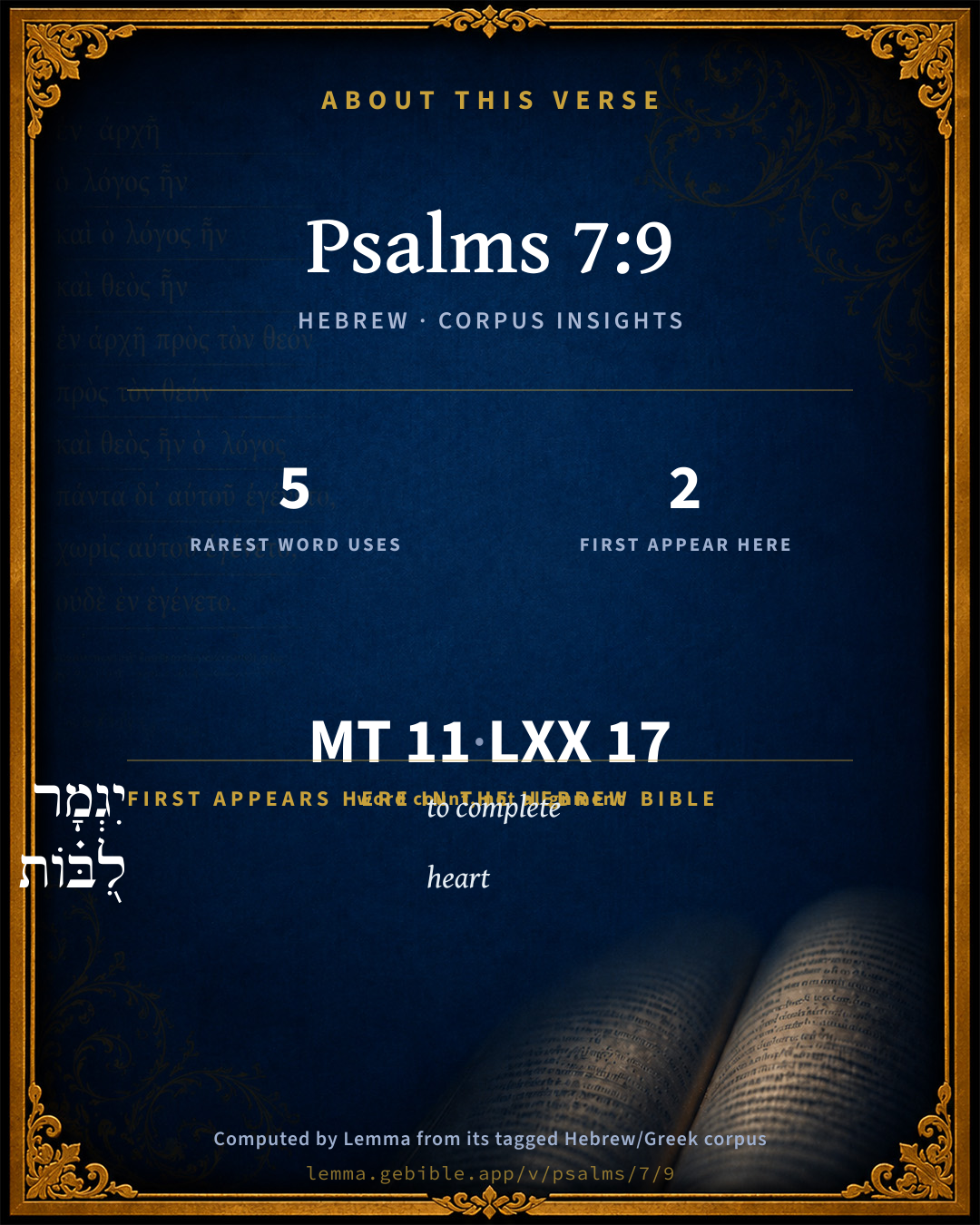
  • 2 first appearances in the Hebrew Bible
Full analysis ↓
Download a study sheet

One document with this verse’s original text, its word-by-word gloss line, the meaning frame, cross-references with their text, attributed commentary, and full source and license credits — printable, and it pastes into notes with its structure intact.

This verse Autodidact and up

Study sheet (.html) Plain text (.txt)

A passage Seminary Student

Up to 50 verses in one chapter. A passage sheet keeps up to 6 commentary sources and 12 cross-references per verse, in the order this page ranks them, and says so on the sheet whenever that leaves anything out. Ask for a single verse and you get the Autodidact verse sheet above.

Everything on this page stays free to read, with no account — the sheet is a download of what is already on screen, not access to it.

Want to remove ads? Support Godless Engineer
Compare translations 3

The same verse in 3 English versions, stacked beneath the original-language interlinear above. Click any original word for its lexicon entry.

Each is an independent rendering of the whole verse — the interlinear is not word-aligned to these translations.

Highlighted words mark where these versions differ — a whole-verse word diff, not a word-by-word alignment.

  • World English Bible Public Domain
    Oh let the wickedness of the wicked come to an end, But establish the righteous; Their minds and hearts are searched by the righteous God.
  • King James Version Public Domain
    Oh let the wickedness of the wicked come to an end; but establish the just: for the righteous God trieth the hearts and reins.
  • unfoldingWord Literal Text CC BY-SA 4.0
    May the evil of the wicked end, and you establish the righteous. The righteous God examines hearts and kidneys.

unfoldingWord Literal Text — © unfoldingWord, licensed CC BY-SA 4.0. Word-aligned USFM3 via Door43 (git.door43.org/unfoldingWord/en_ult).

Versions to compare (up to 4)

3 of 4 selected

Show all 18 translations

Every available English version of this verse, each an independent rendering of the whole verse.

  • World English Bible Public Domain
    Oh let the wickedness of the wicked come to an end, But establish the righteous; Their minds and hearts are searched by the righteous God.
  • Berean Standard Bible Public Domain
    Put an end to the evil of the wicked, but establish the righteous, O righteous God who searches hearts and minds.
  • Majority Standard Bible Public Domain
    Put an end to the evil of the wicked, but establish the righteous, O righteous God who searches hearts and minds.
  • King James Version Public Domain
    Oh let the wickedness of the wicked come to an end; but establish the just: for the righteous God trieth the hearts and reins.
  • American Standard Version (1901) Public Domain
    O let the wickedness of the wicked come to an end, but establish thou the righteous: For the righteous God trieth the minds and hearts.
  • Revised Version (1885) Public Domain
    Oh let the wickedness of the wicked come to an end, but establish thou the righteous: for the righteous God trieth the hearts and reins.
  • Geneva Bible (1599) Public Domain
    Oh let the malice of the wicked come to an ende: but guide thou the iust: for the righteous God trieth the hearts and reines.
  • Douay-Rheims (1899) Public Domain
    The Lord judgeth the people. Judge me, O Lord, according to my justice, and according to my innocence in me.
  • Young's Literal Translation Public Domain
    Let, I pray Thee be ended the evil of the wicked, And establish Thou the righteous, And a trier of hearts and reins is the righteous God.
  • Literal Standard Version CC BY-SA 4.0
    Please let the evil of the wicked be ended, || And establish the righteous, || And a trier of hearts and reins is the righteous God.
  • Unlocked Literal Bible CC BY-SA 4.0
    May the evil deeds of the wicked come to an end, but establish the righteous people, righteous God, you who examine hearts and minds.
  • unfoldingWord Literal Text CC BY-SA 4.0
    May the evil of the wicked end, and you establish the righteous. The righteous God examines hearts and kidneys.
  • Darby Bible Public Domain
    Oh let the wrong of the wicked come to an end, and establish thou the righteous [man]; even thou that triest the hearts and reins, the righteous God.
  • World Messianic Bible Public Domain
    Oh let the wickedness of the wicked come to an end, but establish the righteous; their minds and hearts are searched by the righteous God.
  • Webster's Bible Public Domain
    \\7:8\\The LORD shall judge the people: judge me, O LORD, according to my righteousness, and according to my integrity that is in me.
  • Free Bible Version CC BY-SA 4.0
    Please bring an end to the evil done by the wicked; vindicate those who do good, for you are the God of right who examines hearts and minds.
  • Bible in Basic English Public Domain
    O let the evil of the evil-doer come to an end, but give strength to the upright: for men's minds and hearts are tested by the God of righteousness.
  • JPS Tanakh (1917) Public Domain
    (7-10) Oh that a full measure of evil might come upon the wicked, and that Thou wouldest establish the righteous; for the righteous God trieth the heart and reins.

Literal Standard Version (2020), Covenant Press — licensed CC BY-SA 4.0. Text via the HelloAO Bible API (eBible.org). Unlocked Literal Bible (unfoldingWord) — licensed CC BY-SA 4.0. Text via the HelloAO Bible API (eBible.org). unfoldingWord Literal Text — © unfoldingWord, licensed CC BY-SA 4.0. Word-aligned USFM3 via Door43 (git.door43.org/unfoldingWord/en_ult). Free Bible Version, Dr. Jonathan Gallagher — licensed CC BY-SA 4.0. Text via the HelloAO Bible API (eBible.org).

Word by word

More ways to search: Search by grammar → Find every occurrence → Compare this word →

Practice this passage: Drill this verse → Learn its vocabulary →

יִגְמָר
gâmar
H1584
“to complete”
Verb, Qal, Jussive, 3rd Person, Masculine, Singular
Part of Speech
Verb
Stem
Qal
Form
Jussive
Person
3rd Person
Gender
Masculine
Number
Singular
Full BDB Definition

Origin: a primitive root

TWOT: 363

to end, come to an end, complete, cease - (Qal) - to come to an end, be no more - to bring to an end, complete - (TWOT) to fail, perfect, perform
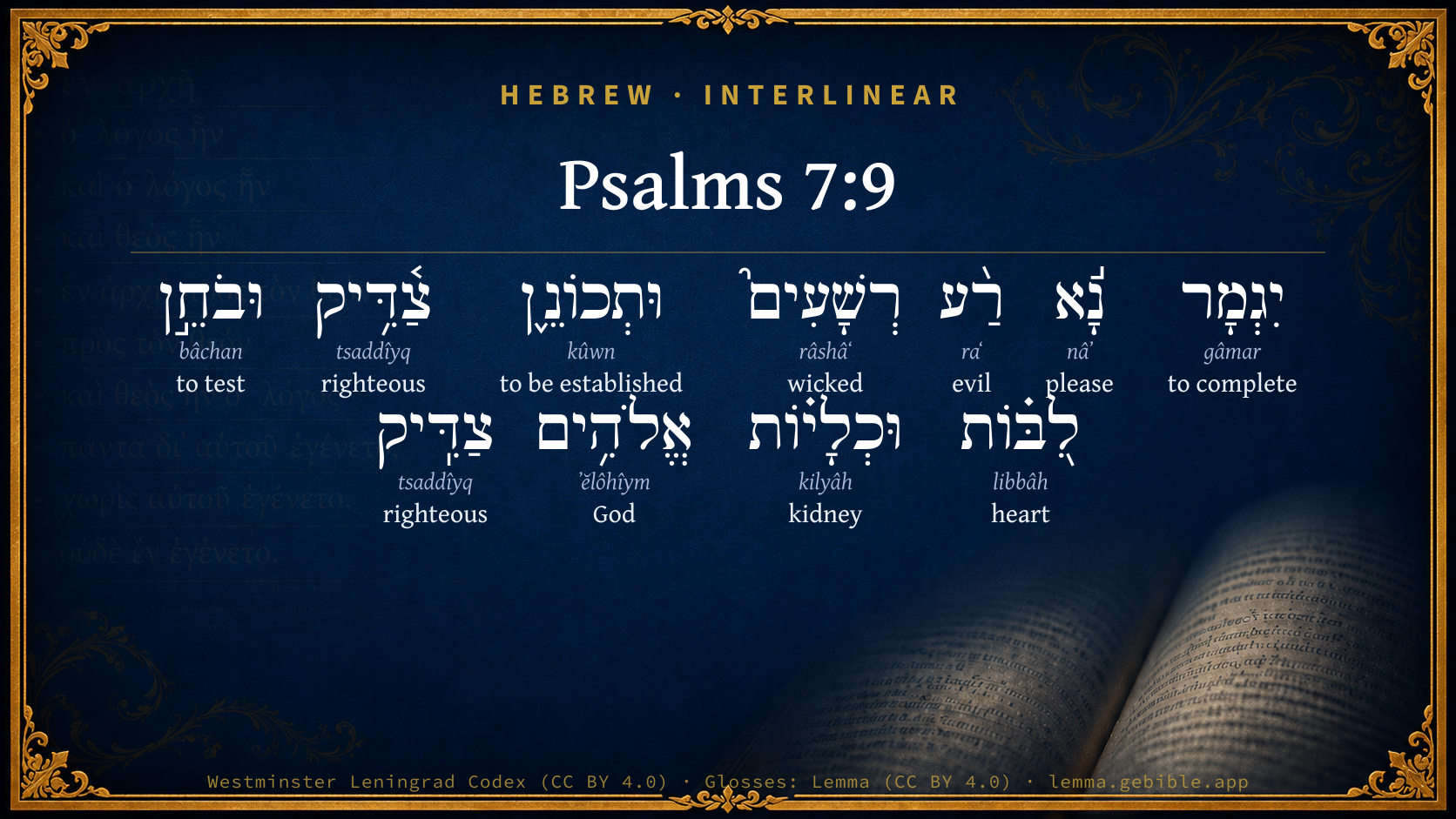
  1. נָ֬א nâʼ H4994 “please” Particle, Exhortation
  2. רַ֨ע raʻ H7451 “evil of” Adjective, Adjective, Masculine, Singular, Construct
  3. רְשָׁעִים֮ râshâʻ H7563 “wicked” Adjective, Adjective, Masculine, Plural, Absolute
  4. וּתְכוֹנֵ֪ן kûwn H3559 “and · to be established” Conjunction + Verb, Polel, Imperfect, 2nd Person, Masculine, Singular
  5. צַ֫דִּ֥יק tsaddîyq H6662 “righteous” Adjective, Adjective, Masculine, Singular, Absolute
  6. וּבֹחֵ֣ן bâchan H974 “and · testing” Conjunction + Verb, Qal, Participle Active, Masculine, Singular, Absolute
  7. לִ֭בּ֗וֹת libbâh H3826 “hearts” Noun, Common, Feminine, Plural, Absolute
  8. וּכְלָי֗וֹת kilyâh H3629 “and · kidneys” Conjunction + Noun, Common, Feminine, Plural, Absolute
  9. אֱלֹהִ֥ים ʼĕlôhîym H430 “God(s)” Noun, Common, Masculine, Plural, Absolute
  10. צַדִּֽיק tsaddîyq H6662 “righteous” Adjective, Adjective, Masculine, Singular, Absolute

About this verse

These counts appear in no published source. They are computed here, from the morphology-tagged text and Lemma’s own curated glosses. What Lemma adds →

11
words
10
distinct lemmas
Wisdom
section

Notable vocabulary

The rarest word here is יִגְמָר to complete H1584 — appearing just 5 times in the whole Hebrew Bible.

First appearance in Scripture

These words make their first canonical appearance in the Hebrew Bible here:

  • יִגְמָר to complete H1584
  • לִ֭בּ֗וֹת heart H3826

Shared distinctive vocabulary

יִגְמָר to complete H1584 occurs in 5 verses of the Hebrew Bible. Also found in:

Grammatical profile

  • 3 verbs
  • 3 nouns
  • 4 adjectives
  • 1 particle

Verb forms

  • יִגְמָר Qal · Jussive
  • וּתְכוֹנֵ֪ן Polel · Imperfect
  • וּבֹחֵ֣ן Qal · Participle Active

Repetition

A word recurs within this verse — often emphatic in Hebrew:

  • צַ֫דִּ֥יק righteous H6662 ×2

Hebrew & Septuagint length

In English translation the verse runs 25 words from the Hebrew and 25 from the Septuagint (LXX English) — the same length.

A rough comparison of the two English renderings, which tokenize alike — not a word-level alignment.

Word counts can differ between the Hebrew and the Greek without any difference in meaning — e.g. the Hebrew direct-object marker אֵת has no separate Greek word, and Greek often adds the article ὁ.

In the original languages it is 11 Hebrew tokens and 17 Greek tokens — but the two are counted differently (Hebrew bundles its prefixes and suffixes into one token; the Greek is in lemma form), so that isn’t a like-for-like length.

Cross-references

26

Topical passages linked to Psalms 7:9 in the Treasury of Scripture Knowledge — connected by theme and wording, ordered by reader-vote popularity; previews shown in the World English Bible.

  • Jeremiah 11:20 But, Yahweh of Hosts, who judge righteously, who try the heart and the mind, I shall see your vengeance on them; for to you have I revealed my cause.
  • Jeremiah 17:10 I, Yahweh, search the mind, I try the heart, even to give every man according to his ways, according to the fruit of his doings.
  • Jeremiah 20:12 But, Yahweh of Hosts, who tests the righteous, who sees the heart and the mind, let me see your vengeance on them; for to you have I revealed my cause.
  • 1 Samuel 16:7 But Yahweh said to Samuel, "Don't look on his face, or on the height of his stature; because I have rejected him: for [Yahweh sees] not as man sees; for man looks at the outward appearance, but Yahweh looks at the heart."
  • 1 Chronicles 28:9 You, Solomon my son, know the God of your father, and serve him with a perfect heart and with a willing mind; for Yahweh searches all hearts, and understands all the imaginations of the thoughts: if you seek him, he will be found of you; but if you forsake him, he will cast you off forever.
  • Psalms 10:15 Break the arm of the wicked. As for the evil man, seek out his wickedness until you find none.
  • Psalms 11:5 Yahweh examines the righteous, But the wicked and him who loves violence his soul hates.
  • Psalms 26:2 Examine me, Yahweh, and prove me. Try my heart and my mind.
  • Psalms 37:23 A man's goings are established by Yahweh. He delights in his way.
  • Psalms 44:21 Won't God search this out? For he knows the secrets of the heart.
  • Psalms 139:1 Yahweh, you have searched me, And you know me.
  • Romans 16:25
  • Revelation 2:23 I will kill her children with Death, and all the assemblies will know that I am he who searches the minds and hearts. I will give to each one of you according to your deeds.
  • Psalms 17:3 You have proved my heart; you have visited me in the night; You have tried me, and found nothing; I have resolved that my mouth shall not disobey.
  • Acts 12:23 Immediately an angel of the Lord struck him, because he didn't give God the glory, and he was eaten by worms and died.
  • 1 Samuel 2:9 He will keep the feet of his holy ones; But the wicked shall be put to silence in darkness; For by strength shall no man prevail.
  • Psalms 10:18 To judge the fatherless and the oppressed, That man who is of the earth may terrify no more.
  • Psalms 58:6 Break their teeth, God, in their mouth. Break out the great teeth of the young lions, Yahweh.
  • Psalms 9:5–6 You have rebuked the nations. You have destroyed the wicked. You have blotted out their name forever and ever.
  • Psalms 40:2 He brought me up also out of a horrible pit, Out of the miry clay. He set my feet on a rock, And gave me a firm place to stand.
  • Psalms 74:10–11 How long, God, shall the adversary reproach? Shall the enemy blaspheme your name forever?
  • Psalms 74:22–23 Arise, God! Plead your own cause. Remember how the foolish man mocks you all day.
  • Isaiah 37:36–38 The angel of Yahweh went forth, and struck in the camp of the Assyrians one hundred and eighty-five thousand; and when men arose early in the morning, behold, these were all dead bodies.
  • Daniel 11:45 He shall plant the tents of his palace between the sea and the glorious holy mountain; yet he shall come to his end, and none shall help him.
  • 1 Thessalonians 3:13 to the end he may establish your hearts blameless in holiness before our God and Father, at the coming of our Lord Jesus with all his saints.
  • 1 Peter 5:10 But may the God of all grace, who called you to his eternal glory by Christ Jesus, after you have suffered a little while, perfect, establish, strengthen, and settle you.

Cross-references courtesy of OpenBible.info (CC BY 4.0).

Hebrew and Greek witnesses Masoretic Hebrew ↔ Greek Septuagint

The same verse in the two great witnesses to the Old Testament, shown verse-for-verse.

You’re reading Greek Psalm 7 (Hebrew Psalm 7). The Septuagint counts the superscription, so verse numbers can differ from the Hebrew — chapter-level alignment, not verse-by-verse. Numbering follows Rahlfs.

These are two independent witnesses, not word-aligned to each other, and the Septuagint is shown in lemma (dictionary) form.

Hebrew Psalms 7:9 Masoretic · Westminster Leningrad Codex

יִגְמָר נָ֬א רַ֨ע רְשָׁעִים֮ וּתְכוֹנֵ֪ן צַ֫דִּ֥יק וּבֹחֵ֣ן לִ֭בּ֗וֹת וּכְלָי֗וֹת אֱלֹהִ֥ים צַדִּֽיק

Oh let the wickedness of the wicked come to an end, But establish the righteous; Their minds and hearts are searched by the righteous God.

World English Bible · Public Domain

Greek LXX Greek Psalm 7:9 Septuagint · lemma form

κύριος κρίνω λαός κρίνω ἐγώ κύριος κατά ὁ δικαιοσύνη ἐγώ καί κατά ὁ ἀκακία ἐγώ ἐπί ἐγώ

Oh let the wickedness of sinners come to an end; and then you shall direct the righteous, O God that search the hearts and reins.

LXX2012 (modern English Septuagint) · Public Domain

On this verse, The Cambridge Bible for Schools and Colleges discusses the Septuagint’s reading. Read the note in Commentary ↓

Hebrew: Westminster Leningrad Codex (CC BY 4.0). Greek: Septuagint (public domain); English from LXX2012 (modern English Septuagint) (Public Domain). How the Septuagint differs from the Hebrew →

Commentary

Notes on Psalms 7:9 from classic Christian and Jewish commentators (each source and its license shown beneath its notes). The classic Christian expositions comment on the surrounding passage and are grouped to its opening verse, so a note may address several verses; the Jewish commentaries on the Tanakh (Rashi and others) are per-verse, so they appear only where the commentator wrote on this verse.

Lemma curates 59 commentaries, every one of them public domain or Creative Commons licensed, each selected and text-cleaned for this edition rather than reprinted as found. About our sources →

Trapp's Complete Commentary

John Trapp

Psa 7:9 Oh let the wickedness of the wicked come to an end; but establish the just: for the righteous God trieth the hearts and reins.

Ver. 9. Oh let the wickedness, &c.] Put a stop to their rage and rancour.

But establish the just] The overthrow of the one will be a strengthening to the other; as it was between the house of Saul and David, 2Sa 3:1. But who are just?

The righteous God trieth the hearts and reins] i.e. The thoughts and affections or lusts of people, and accordingly esteemeth of them; for Mens cuiusque is est quisque; and God judgeth a man according to the hidden man of his heart, Cogitationum et cupiditatum (Junius).

John Trapp, A Commentary or Exposition upon All the Books of the Old and New Testament (1647–1656) — public domain. Text from a community e-Sword module.

The Biblical Illustrator

Joseph S. Exell

Psa_7:9-16

Let the wickedness of the wicked come to an end.

The self-destroying power of wickedness

The accents require Psa_7:9 to be rendered, Let wickedness make an end of the wicked, but that introduces an irrelevant thought of the suicidal nature of evil. It may be significant that the Psalmists prayer is not for the destruction of the wicked, but of their wickedness. Such annihilation of evil is the great end of Gods judgment, and its consequence will be the establishment of the righteous. Again, the prayer strengthens itself by the thought of God as righteous, and as trying the hearts and reins (the seat of feeling). In the presence of rampant, and all but triumphant evil, a man needs to feed hopes of its overthrow, that would else seem vainest dreams, by gazing on the righteousness and searching power of God The last section is a vision of the judgment prayed for, and may be supposed to be addressed to the enemy. If so, the hunted man towers above them, and becomes a rebuker. The character of God underlies the fact of judgment, as it had encouraged the prayer for it. What he had said to himself when his head drooped he now, as a prophet, peals out to men as making retribution sure: God is a righteous judge, yea, a God that hath indignation every day. The absence of an object specified for the indignation makes its inevitable flow wherever there is evil the more vividly certain. If He is such, then of course follows the destruction of everyone who turns not. Retribution is set forth with solemn vigour under four figures.

1. God is as an armed enemy sharpening His sword in preparation for action, a work of time which in the Hebrew is represented as in process, and bending His bow, which is represented as a completed act. Another second and the arrow will whiz. So the stern picture is drawn of God as in the moment before the outburst of His punitive energy--the sword sharpened, the bow bent, the arrows fitted, the burning stuff being smeared on their tips. What will happen when all this preparation blazes into action?

2. Verse 14: A figure of the automatic action of evil in bringing punishment. It is the Old Testament version of Sin when it is finished bringeth forth death. The evil-doer is boldly represented as travailing with iniquity, and that metaphor is broken up into two parts, He hath conceived mischief, and He hath brought forth falsehood. The falsehood, which is the thing actually produced, is so called, not because it deceives others, but because it mocks its producer with false hopes, and never fulfils his purposes. This is but the highly metaphorical way of saying that a sinner never does what he means to do, but that the end of all his plans is disappointment. The law of the universe condemns him to feed on ashes, and to make and trust in lies.

3. The idea in falsehood, namely, the failure of evil to accomplish its doers purpose. Crafty attempts to trap others have an ugly habit of snaring the contriver. The irony of fortune tumbles the hunter into the pitfall dug by him for his prey.

4. Verse 16: The incidence of his evil on the evil-doer as being certain as the fall of a stone thrown straight up, which will infallibly come back in the line of its ascent. Retribution is as sure as gravitation, especially if there is an Unseen Hand above, which adds impetus and direction to the falling weight. All these metaphors, dealing with the natural consequences of evil, are adduced as guarantees of Gods judgment, whence it is clear both that the Psalmist is thinking not of some final future judgment, but of the continuous one of daily providence, and that he made no sharp line of demarcation between the supernatural and the natural. The qualities of things and the play of natural events are Gods working. (A. Maclaren, D. D.)

A prayer for the ending of wickedness

I. The wickedness of the wicked.

1. It is the genuine fruit of a depraved nature.

2. It displays itself in various forms.

3. It presses into its service the whole man.

4. It has abounded in all ages of the world.

II. When may this wickedness come to an end? The end of a thing is its termination.

1. It comes to an end partially in the individual conversion of sinners to God.

2. It will come to an end generally by the conversion of the world to God.

III. This is a most desirable object.

1. On Gods account.

2. On our own account.

3. On account of those who are the immediate subjects of this wickedness.

IV. What means can be adopted to put an end to it?

1. Give no countenance to wickedness.

2. Warn the wicked of their danger.

3. Pray that their wickedness may come to an end. Wrestle with God in their behalf. (Sketches of Four Hundred Sermons.)

Prayer for the termination of sin

Our text is a prayer, and teaches us--

1. To pray against all sin; to pray it, if possible, out of the world.

2. To pray for all saints, for all good people. If we would be on the Lords side in the day of inquiry, we must by our prayers act in concert with the just.

I. What we are to desire and pray for.

1. That wickedness may come to an end. That wicked principles may be exploded and abandoned. That wicked practices may be prevented and restrained; that though Balsam be still the same, yet he may not be suffered to curse Israel; though Sennacherib has still an inveterate rage against God, yet he may be made to feel that God has a hook in his nose and a bridle in his jaws. Thus let wickedness be ashamed and hide itself, and that it may not be propagated and spread so as to infect others.

2. That God would establish the just in their integrity and retain them in it, is their comfort and hope. In their undertaking against wickedness: that they may not be shaken by any discouragements they meet with.

II. Why this is and ought to be the desire of all good people. Because--

1. Such have concern for the honour of God; and

2. They have tender love to the souls of men.

3. They have great value for the grace of God, for what it has done and is promised to do; and

4. They are hearty well-wishers to their native land.

III. For application of what has been said.

1. Let us address ourselves to God in prayer that He would further the reformation of manners in our land. Let ministers thus pray, and those who are engaged in the societies for reformation support their undertakings by their prayers.

2. And let us follow prayer with endeavour. You who are rich and of station in the world be favoured to appear in person to uphold this work. Your influence is a talent you must account for. Assure yourselves that the cause of religion and piety is the cause of God and must prevail. (Matthew Henry.)

For the righteous God trieth the hearts and reins.

The searching Divine test

The one thought of Gods judgment seems to run through the Psalm. To understand the Psalm aright we must refer it altogether to the assurance that God will ultimately clear those who are falsely accused of anything in this world, which they feel and know that they have never committed. Often evil does seem to prevail over good. In the end God will justify the righteous, and condemn the wicked. This assurance may uphold faithful men in all times of difficulty, trial, and persecution. Oftentimes God brings it to pass upon wicked men that they perish by the very way and means they designed for the destruction of the righteous. It is not merely that God knows every way of all men; it is not merely that His eye readeth, as it does, the very thoughts and intents of every heart amongst us: it is that He trieth each separate thought and intent of that heart, He weighs every word; He marks every little variation and complexion of mans thoughts, and words, and works, and intents. He registers it all, because He will one day judge the world in righteousness. To say to ourselves, The righteous God trieth the very heart and reins, will make us think more of what we call little sins, and it will make us value more and more every greater or less opportunity of receiving grace or of doing good. It will make us also watch more carefully the springs and intents of our hearts. (W. J. Stracey, M. A.)

The Biblical Illustrator, edited by Joseph S. Exell (c. 1880s–1900s) — public domain. Text from a community e-Sword module.

Joseph Benson's Commentary

Psa 7:9. Let the wickedness of the wicked come to an end — Let the malice of mine enemies cease: put a stop to their wicked practices, either by changing their hearts or tying their hands: say to it as thou dost to the sea, Hitherto hast thou gone, but thou shalt advance no further. Hebrew, The wickedness of the wicked shall have an end; it shall cease: it shall be rooted out and destroyed. But establish the just — Or, And thou wilt establish, or confirm, or uphold the just, all just persons and causes; which is opposed to wickedness coming to an end, last mentioned. For the righteous God trieth the hearts and reins — And, therefore, he knows the secret wickedness of the wicked, and how to bring it to an end; and he is a witness to the secret sincerity of the just, and has secret ways of establishing them in it. “It is predicted, that wickedness will, in the end, be abolished, and the just immoveably established, by Him who knoweth intimately the very thoughts and desires of both good and bad men, and will give to each their due reward. How can we doubt of this when it has pleased God to afford so many examples and preludes to it in his dispensations of old time? The righteous cause hath already triumphed in Christ; let us not doubt that it will do so in the church. Happy the man whose hope is therefore in God, because he saveth the upright in heart.” — Horne.

Joseph Benson's Commentary on the Old and New Testaments (1811–1818) — public domain. Text from a community e-Sword module.

Whedon's Commentary on the Bible

Daniel D. Whedon

9. Oh let the wickedness of… come to an end—A prayer for universal right and justice in the earth, with calm faith in the result, finds expression in Psa_7:9-10. It is not against men, but against wickedness, that David prays: and this is the true key to all the imprecatory psalms.

Daniel D. Whedon (gen. ed.), Commentary on the Old and New Testaments (1874–1909) — public domain. Text from a community e-Sword module.

J. A. Alexander on Psalms

Joseph Addison Alexander

10. (Psa 7:9). Let cease, I pray, the badness of wicked (men). The future has an optative meaning given to it by the Hebrew particle (xnA), which is often rendered now, not as an adverb of time, but of entreaty. Between man and. man, it is frequently equivalent to if you please in modern parlance. When addressed to God, it scarcely admits of any other version than I pray. The assonance or paronomasia in the common version, wickedness of the wicked, is not found in the original, where two words, not akin to one another, are employed. The plural form of wicked is also lost or left ambiguous in the common version. And thou wilt confirm, or establish, a righteous (man), and a trier of hearts and reins, constantly used in Scripture for the internal dispositions, (is the) righteous God, or (art thou) O righteous God, which last agrees best with the direct address to God in the preceding clauses. This does not merely mean that God is omniscient, and therefore able thus to try the hearts and reins, but that he actually does it. Here he is specially appealed to, as a judge or umpire between Saul, or "the wicked" whom he represented, and "the righteous," of whom David was the type and champion.

Joseph Addison Alexander, The Psalms Translated and Explained (1850) — public domain. Text from a community e-Sword module.

Tyndale Open Study Notes

Tyndale Open Resources

7:9 God examines the mind and heart of each person (see 11:3-4; 26:2; 139:1, 23).

Tyndale Open Study Notes — © Tyndale Open Resources, licensed CC BY-SA 4.0. Text via the HelloAO Bible API.

Geneva Bible (1599)

Geneva Bible translators

Though they pretend a just cause against me: yet God shall judge their hypocrisy.

Geneva Bible (1599) marginal notes — public domain. Text via Bolls.life.

Jamieson, Fausset & Brown

Robert Jamieson, A. R. Fausset & David Brown

the hearts and reins--the affections and motives of men, or the seat of them (compare Psa 16:7; Psa 26:2); as we use heart and bosom or breast.

Jamieson, Fausset & Brown — Commentary Critical and Explanatory on the Whole Bible (1871) — public domain (CC PDM 1.0). Text via the HelloAO Bible API.

Adam Clarke's Commentary

Verse 9. The wickedness of the wicked] The iniquity of Saul's conduct.

But establish the just] Show the people my uprightness.

Adam Clarke's Commentary on the Bible (1810–1826) — public domain. Text from a community e-Sword/MySword module.

John Calvin's Commentaries

9 Let the malice of the wicked come to an endow I beseech thee. David, in the first place, prays that God would restrain the malice of his enemies, and bring it to an end; from which it follows, that his affliction had been of long duration. Others suppose that this is rather a dreadful imprecation, and they explain the Hebrew word גמר, gamar, somewhat differently. Instead of rendering it to cease, and to come to an end, as I have done, they understand it to make to cease, which is equivalent to destroy or to consume. “Les autres estiment plustost que ce soit une vehemente imprecation, et exposent ce mot Hebrieu un peu autrement. Car en lieu que nous le traduisons Cesser et Prendre fin, ils le prenent pour Faire cesser, qui est Destruire et Consumer.”—Fr.

“Il se peut faire aussi qu’il parle ainsi pour oster toutes ces belles apparances bien fardees dont ils se servoyent pour abuser les hommes et ce leur estoit assez.”—Fr.

John Calvin's Commentaries (1540-1563) — public domain. Text from the Calvin Translation Society English edition (1840s-50s) via the Christian Classics Ethereal Library (ccel.org). Calvin's coverage is partial (roughly two-thirds of the Bible); uncommented books and verses are honest gaps, never fabricated. The 19th-century editor's footnotes and remarks are omitted so the notes are faithfully Calvin's own voice.

Ellicott's Commentary for English Readers

(9) Establish.—Literally, let him stand erect.

For the righteous God trieth.—Better, thou trier of hearts and reins, thou just God. The Hebrew word translated try is used, like it, for testing metals (Psa_12:6; Pro_17:3).

A Bible Commentary for English Readers, edited by Charles John Ellicott (1878–1897) — public domain. Text from a community e-Sword module.

The Cambridge Bible for Schools and Colleges

gen. ed. J. J. S. Perowne

9. More exactly:

O that the evil of wicked men might come to an end, and that thou wouldest establish the righteous;

For a trier of hearts and reins is God the righteous.

The last clause adds the ground upon which the hope and prayer of the first clause is based. God is righteous, and He is a discerner of hearts; there can therefore be no doubt of His will and His ability to distinguish between the righteous and the wicked by an impartial judgement. Cp. 1Sa_16:7; Isa_11:3-4. According to the ancient exegetical tradition represented by the Hebrew accents (Wickes’ Treatise on the Accentuation &c., p. 43), the first clause should be rendered, O let evil make an end of the wicked, and it is certainly a striking truth that the punishment of the wicked springs out of their own misdeeds: comp. Psa_7:14 ff., and perhaps Psa_34:21 : but the sense given by the LXX, Jerome, and the English Versions is probably right.

trieth the hearts and reins] A favourite thought with Jeremiah: see ch. Jer_11:20, Jer_17:10, Jer_20:12; cp. Rev_2:23. The heart is regarded in the O.T. as the organ of thought and will, which determines the man’s moral and religious character, the reins (kidneys) as the seat of the emotions: see Delitzsch, Biblical Psychology, § xiii.; and Oehler, Old Testament Theology, § 71.

9, 10. His own personal need is but one small part of the great cause, and he passes on to pray for the larger hope of the universal destruction of evil and triumph of the righteous.

The Cambridge Bible for Schools and Colleges (gen. ed. J. J. S. Perowne; Cambridge University Press, 1878–1918) — public domain. Text from a community e-Sword module.

John Gill's Exposition

Oh, let the wickedness of the wicked come to an end,.... Which will not be till the measure of it is fully up, and that will not be till the wicked are no more; for, as long as they are in the world they will be committing wickedness, and like the troubled sea continually cast up the mire and dirt of sin; and they will remain to the end of the world, till the new Jerusalem church state shall take place, when all the Lord's people will be righteous, and there will not be a Canaanite in the house of the Lord of hosts, nor a pricking brier or grieving thorn in all the land; for, in the new earth will no sinner be, but righteous persons only; and for this state the psalmist may be thought to pray; however by this petition and the following he expresses his hatred of sin and love of righteousness: some choose to render the words (c), "let wickedness now consume the wicked"; as in the issue it will, unless the grace of God takes place; some sins consume the bodies, others the estates of wicked men, and some both; and all are the means of destroying both body and soul in hell, if grace prevent not; this may be considered as a declaration of what will be, being a prophetic petition (d);

but establish the just; or righteous one; meaning himself, and every other who is made righteous, not by his own righteousness, but by the righteousness of Christ imputed to him; and who needs not to have his righteousness established, which is in itself stable, firm, and sure, and cannot be more so; it is an everlasting one, and cannot be abolished, but abides for ever, and will answer for him in a time to come; but his faith to be established more and more in its exercise on this righteousness: nor do the persons of the just need establishing, or can they be more stable than they are, as considered in Christ, as they are the objects of God's everlasting love, secured in the covenant of grace, and built on Christ the foundation; but the graces of faith, hope, and love, need daily establishing on their proper object, they being weak, fickle, and inconstant in their acts; and the saints need more and more establishing in the doctrines of the Gospel, and in their adherence to the cause of God and Christ and true religion; and it is God's work to establish them, to whom the psalmist applies; see Pe1 5:10;

for the righteous God trieth the hearts and reins; he is righteous himself in his nature, and in all his works, and he knows who are righteous and who are wicked; he knows the hearts, thoughts, affections, and inward principles of all men, and the springs of all their actions; he looks not at outward appearances, but at the heart; and as he can distinguish between the one and the other, he is capable of punishing the wicked and of confirming the righteous, consistent with the truth of his perfections.

(c) "consumat nunc vel quaeso malum impios", Muscuius, Vatablus, so Jarchi, Kimchi, & Ben Melech. (d) "Consumat nunc malum impios", Pagninus, Montanus, Hammond; so Obadiah Gaon.

John Gill's Exposition of the Whole Bible (1746–1763) — public domain (CC PDM 1.0). Text via the HelloAO Bible API.

Albert Barnes' Notes on the Bible

Oh let the wickedness of the wicked come to and end - Of all the wicked; wickedness not in this particular case only, but wickedness of all forms, and in all lands. The prayer here is a natural one; when a man becomes impressed with a sense of the evil of sin in one form, he wishes that the world may be delivered from it in all forms and altogether.

But establish the just - The righteous. This stands in contrast with his desire in regard to the wicked. He prays that the righteous may be confirmed in their integrity, and that their plans may succeed. This prayer is as universal as the former, and is, in fact, a prayer that the world may come under the dominion of the principles of truth and holiness.

For the righteous God trieth the hearts and reins - That is, the hearts and reins of all people. He understands the character of all people; he is intimately acquainted with all their thoughts, and purposes, and feelings. To search or try “the heart and the reins” is an expression frequently used in the Bible to denote that God is intimately acquainted with all the thoughts and feelings of people; that is, that he thoroughly understands the character of all people. The word “heart” in the Scriptures is often used to denote the seat of the “thoughts;” and the word “reins” seems to be used to denote the most secret feelings, purposes, and devices of the soul - as if lodged deep in our nature, or covered in the most hidden and concealed portions of the man. The word “reins,” with us, denotes the kidneys. In the Scriptures the word seems to be used, in a general sense, to denote the inward parts, as the seat of the affections and passions.

The Hebrew word כליה kilyâh, means the same as the word “reins” with us - the kidneys, Exo 29:13, Exo 29:22; Job 16:13; Isa 34:6; Deu 32:14. From some cause, the Hebrews seem to have regarded the “reins” as the seat of the affections and passions, though perhaps only in the sense that they thus spoke of the “inward” parts, and meant to denote the deepest purposes of the soul - as if utterly concealed from the eye. These deep thoughts and feelings, so unknown to other people, are all known intimately to God, and thus the character of every man is clearly understood by him, and he can judge every man aright. The phrase used here - of trying the hearts and reins - is one that is often employed to describe the Omniscience of God. Compare Jer 11:20; Jer 17:10; Jer 20:12; Psa 26:2; Psa 139:13; Rev 2:23. The particular idea here is, that as God searches the hearts of all people, and understands the secret purposes of the soul, he is able to judge aright, and to determine correctly in regard to their character, or to administer his government on the principles of exact justice. Such is the ground of the prayer in this case, that God, who knew the character of all people, would confirm those who are truly righteous, and would bring the wickedness of the ungodly to an end.

Albert Barnes' Notes on the Bible (1834–1885) — public domain. Text from a community e-Sword/MySword module.

Matthew Poole's English Annotations

Let the malice of mine enemies cease, put a stop to their wicked practices, either by changing their hearts, or by tying their hands, or some other way; say to it, as thou dost to the sea, Hitherto hast thou gone, but thou shalt go no further, and here shall thy proud waves be stayed. Or,

The wickedness of the wicked shall have an end; not an end of perfection, which is to be accomplished; but all end of termination, it shall cease; and an end of destruction, it shall be rooted out. Or, Let, I pray thee, wickedness consume the wicked, i.e. those that are maliciously and incorrigibly such. And so this prayer is opposed to that following prayer for the just. And such prayers against some wicked men we find used by prophetical persons, which are not rashly to be drawn into precedent by ordinary persons.

Establish; or, and thou wilt establish, or confirm, or uphold; which is opposed to that coming to an end or consuming last mentioned.

The just; all just persons and causes, and mine in particular, which is so.

The righteous God trieth the heart and reins; and therefore he knows that I have not so much as a thought or a desire of that mischief which Cush and others report I am designing against Saul.

Matthew Poole's English Annotations on the Holy Bible (1683–1685) — public domain. Text from a community e-Sword/MySword module.

The Treasury of David

Charles H. Spurgeon

Ver. 9. He sees a smile of complacency upon the face of the King, and in the name of all the assembled congregation he cries aloud,

Oh let the wickedness of the wicked come to an end; but establish the just. Is not this the universal longing of the whole company of the elect? When shall we be delivered from the filthy conversation of these men of Sodom? When shall we escape from the filthiness of Mesech and the blackness of the tents of Kedar? What a solemn and weighty truth is contained in the last sentence of the ninth verse! How deep is the divine knowledge!

He trieth. How strict, how accurate, how intimate his search!

he trieth the hearts, the secret thoughts,

and reins, the inward affections. "All things are naked and opened to the eyes of him with whom we have to do."

Ver. 9. The righteous God trieth the hearts and reins. As common experience shows that the workings of the mind, particularly the passions of joy, grief, and fear, have a very remarkable effect on the reins or kidneys. (See Pr 23:16; Ps 73:21), so from their retired situation in the body, and their being hid in fat, they are often used to denote the most secret workings and affections of the soul. And to "see or examine the reins," is to see or examine those most secret thoughts or desires of the soul. John Parkhurst, 1762.

Ver. 9. (last clause). "The righteous God trieth the hearts and reins."

"I that alone am infinite, can try How deep within itself thine heart doth lie.

Thy seamen's plummet can but reach the ground, I find that which thine heart itself ne'er found.

Francis Quarles, 1592-1644.

Ver. 9. The heart, may signify the cogitations, and the reins the affections. Henry Ainsworth.

Ver. 9. (first clause).

(1) By changing their hearts; or (2) by restraining their wills, (3) or depriving them of power, (4) or removing them.

Show the times when, the reasons why, such a prayer should be offered, and how, in the first sense, we may labour for its accomplishment.

Ver. 9. This verse contains two grand prayers, and a noble proof that the Lord can grant them.

Ver. 9. The period of sin, and the perpetuity of the righteous. Matthew Henry.

Ver. 9. Establish the just. By what means and in what sense the just are established, or, the true established church.

Ver. 9. (last clause). God's trial of men's hearts.

Charles H. Spurgeon's The Treasury of David (1869–1885) — public domain. Psalms only. Text from a community e-Sword/MySword module.

The Pulpit Commentary

Oh let the wickedness of the wicked come to an end. It is not the removal of the wicked, but the removal of their wickedness, that David desires. (comp. Psa_10:15) But establish the just; i.e. protect strengthen, and sustain him. For the righteous God trieth the hearts and reins. (comp. Jer_11:20 Jer_17:10 Jer_20:12) "The heart, as the seat of the understanding and the will, the reins of natural impulses and affections" ("Speaker"s Commentary").

The Pulpit Commentary (1880–1919), ed. H.D.M. Spence-Jones & Joseph S. Exell — public domain. Text from a community e-Sword module.

John Wesley's Explanatory Notes

O - Put a stop to their wicked practices.

John Wesley, Explanatory Notes Upon the Whole Bible (1754–1765) — public domain. Text via the GEBible commentary corpus.

Keil & Delitzsch

C. F. Keil & F. Delitzsch

(Heb.: 7:10-11) In this strophe we hear the calm language of courageous trust, to which the rising and calmly subsiding caesural schema is particularly adapted. He is now concerned about the cessation of evil: Oh let it come to an end (גּמר intransitive as in Psa 12:2; Psa 77:9).... His prayer is therefore not directed against the individuals as such but against the wickedness that is in them. This Psalm is the key to all Psalms which contain prayers against one's enemies. Just in the same manner וּתכונן is intended to express a wish; it is one of the comparatively rare voluntatives of the 2 pers. (Ew. 229): and mayst Thou be pleased to establish.... To the termination of evil which is desired corresponds, in a positive form of expression, the desired security and establishment of the righteous, whom it had injured and whose continuance was endangered by it. וּבחן is the beginning of a circumstantial clause, introduced by ו, but without the personal pronoun, which is not unfrequently omitted both in the leading participial clause, as in Isa 29:8 (which see), and in the minor participial clause as here (cf. Psa 55:20): cum sis = quoniam es. The reins are the seat of the emotions, just as the heart is the seat of the thoughts and feelings. Reins and heart lie naked before God-a description of the only kardiognoo'stees, which is repeated in Jer 11:20; Jer 20:12, Rev 2:23. In the thesis the adjective is used with אלהים in the sing. as in Psa 78:56, cf. Ps 58:12. God is the righteous God, and by his knowledge of the inmost part He is fully capable of always showing Himself both righteous in anger and righteous in mercy according to the requirements and necessity of the case. Therefore David can courageously add על־אלהים מגנּי, my shield doth God carry; ל Psa 89:19) would signify: He has it, it (my shield) belongs to Him, על (Ch1 18:7) signifies: He bears it, or if one takes shield in the sense of protection: He has taken my protection upon Himself, has undertaken it (as in Psa 62:8, cf. Jdg 19:20), as He is in general the Saviour of all who are devoted to Him with an upright heart, i.e., a heart sincere, guileless (cf. Psa 32:1 with Psa 7:2). צדּים is intentionally repeated at the end of the first two lines - the favourite palindrome, found more especially in Isa 40:1. And to the mixed character of this Psalm belongs the fact of its being both Elohimic and Jehovic. From the calm language of heartfelt trust in God the next strophe passes over into the language of earnest warning, which is again more excited and somewhat after the style of didactic poetry.

Keil & Delitzsch — Biblical Commentary on the Old Testament (1861–1891) — public domain (CC PDM 1.0). Text via the HelloAO Bible API. (Old Testament only.)

Rashi

Rabbi Shlomo Yitzchaki (Rashi)

May the Lord judge the peoples Reverse the sentence from upon us and place it upon the nations.

judge An expression of chastisements.

judge me, O Lord, according to my righteousness But judge Israel according to the good deeds they have done and not according to the sins.

Rashi on the Tanakh — English translations: “The Judaica Press complete Tanach with Rashi, translated by A. J. Rosenberg” (CC BY 4.0); “Pentateuch with Rashi's commentary by M. Rosenbaum and A.M. Silbermann, 1929-1934” (public domain); “The Metsudah Tanach series, Lakewood, N.J” (CC BY 4.0); and “The Book of Joshua, Metsudah Publications, 1997” (CC BY 4.0). Text via Sefaria.

Radak

Rabbi David Kimhi (Radak)

The Lord ministereth judgment to the peoples: – i.e. Israel, as I have explained לאמים (in the previous verse); and the interpretation of ידין (ministereth judgment) (is) that he will exact my vengeance and my judgment from them. And this is what he says:

Judge me, Lord, according to my righteousness, and according to my integrity be it unto me: – for as for me, there is no iniquity in me nor have I sinned against them that they should hate me. He does not speak of all of them, but of the wicked among them who hated David without cause. And of them he says, let the wickedness of the wicked bring to an end; for the greater part of Israel loved David; for he it was who used to bring them out and lead them in while he was with Saul; and they were acting under compulsion while they pursued him at the command of Saul. Also of the tribe of Benjamin many loved him, as is written (i Chron. xii. 1:2) of those “who came to David to Ziklag.”

Radak on the Tanakh — English translations: “Sefaria Community Translation” (CC0 1.0 (public-domain dedication)); “Eliyahu Munk, HaChut Hameshulash” (CC BY 4.0); “Rabbi Mike Feuer, Jerusalem Anthology” (CC BY 4.0); and “R. David Kimhi on the first book of Psalms, Translated by R.G. Finch, London, 1919” (public domain). Text via Sefaria.

Lesson kit

Teaching starters — assembled from the data on this page, not authored interpretation. Every prompt links to the verse data it draws on. Edit before teaching.

Psalms, in the Wisdom, opens this verse with 11 words (10 distinct Hebrew lemmas). Its most distinctive word is gâmar (“to complete”). A historical commentator’s framing appears above. Read the whole chapter for the surrounding context.

Discussion questions

  1. The word gâmar carries the sense “to complete.” How does it shape the verse?
  2. 2 words here appear for the first time in Scripture. What is being introduced at this debut?
  3. Psalms 12:1 shares the word «to complete» with this verse. How do the two illuminate each other?
  4. “righteous” occurs 2× in this one verse. What is the effect of the repetition?
  5. These translations render this verse differently; the difference is in the English rendering, not the original. What questions does that raise?
  6. The verb «יִגְמָר» is Qal Jussive. How does its form color the action?
  7. Reading how Trapp's Complete Commentary and The Biblical Illustrator read this verse, where do the two commentators agree and where do they part?

Things to notice

Reading settings

Reading text

Shown beneath each verse's original-language words.

Old Testament
Old Testament edition

Read the OT as the Masoretic Hebrew (MT) or the Greek Septuagint (LXX).

English shown for the Greek Septuagint (in the Hebrew ↔ Greek comparison).

Comparing translations? Open the Compare panel on any verse page to stack up to four side by side.