Psalms 11:6

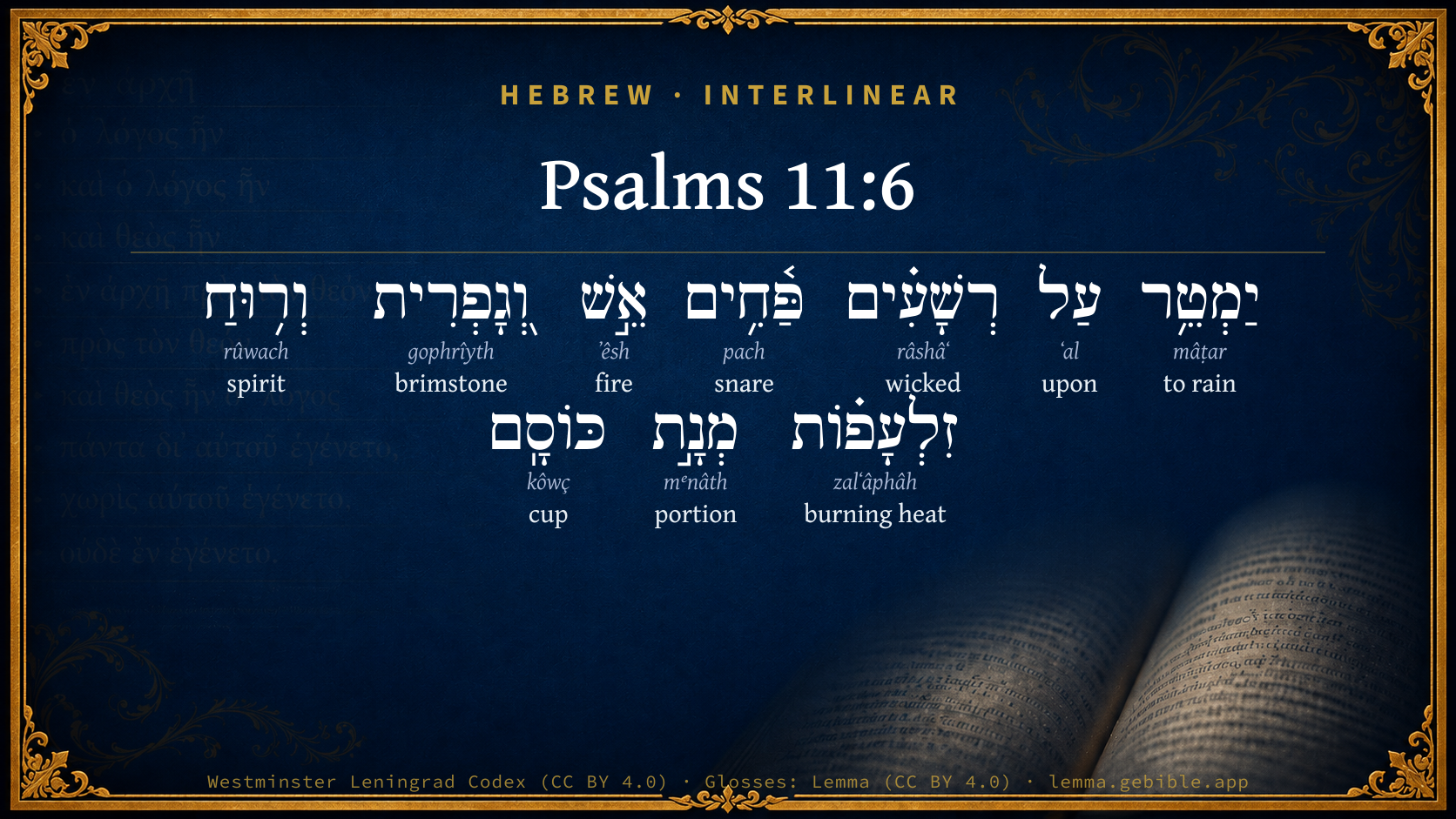
Hebrew (Westminster Leningrad Codex) Psalms 11:6 appears in the Hebrew Old Testament. The text above is from the Westminster Leningrad Codex. Each word links to its Strong’s number, a concise gloss, and parsing drawn from the Open Scriptures Hebrew Bible morphology. Click any word for its full Brown-Driver-Briggs (BDB) entry.
Download image
Cite this verse

Psalms 11:6 (World English Bible). Public Domain. Lemma interlinear Bible study tool, https://lemma.gebible.app/v/psalms/11/6.

Show BibTeX & RIS
BibTeX
RIS
English Translation
On the wicked he will rain blazing coals; Fire, sulfur, and scorching wind shall be the portion of their cup.
World English Bible · Public Domain
Highlights
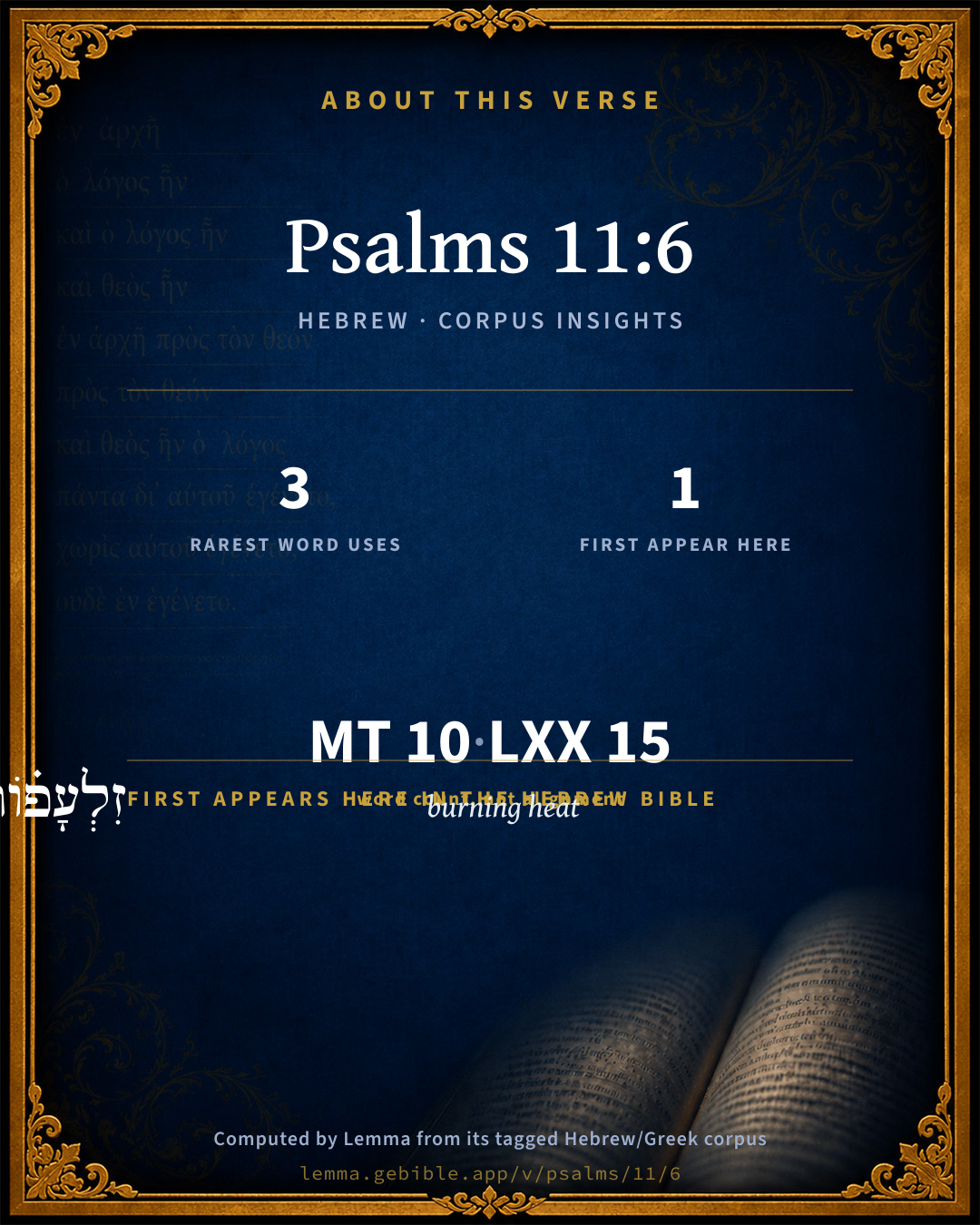
  • 1 first appearance in the Hebrew Bible
Full analysis ↓
Download a study sheet

One document with this verse’s original text, its word-by-word gloss line, the meaning frame, cross-references with their text, attributed commentary, and full source and license credits — printable, and it pastes into notes with its structure intact.

This verse Autodidact and up

Study sheet (.html) Plain text (.txt)

A passage Seminary Student

Up to 50 verses in one chapter. A passage sheet keeps up to 6 commentary sources and 12 cross-references per verse, in the order this page ranks them, and says so on the sheet whenever that leaves anything out. Ask for a single verse and you get the Autodidact verse sheet above.

Everything on this page stays free to read, with no account — the sheet is a download of what is already on screen, not access to it.

Want to remove ads? Support Godless Engineer
Compare translations 3

The same verse in 3 English versions, stacked beneath the original-language interlinear above. Click any original word for its lexicon entry.

Each is an independent rendering of the whole verse — the interlinear is not word-aligned to these translations.

Highlighted words mark where these versions differ — a whole-verse word diff, not a word-by-word alignment.

  • World English Bible Public Domain
    On the wicked he will rain blazing coals; Fire, sulfur, and scorching wind shall be the portion of their cup.
  • King James Version Public Domain
    Upon the wicked he shall rain snares, fire and brimstone, and an horrible tempest: this shall be the portion of their cup.
  • unfoldingWord Literal Text CC BY-SA 4.0
    May he rain snares upon the wicked; fire and brimstone and a scorching wind the portion of their cup!

unfoldingWord Literal Text — © unfoldingWord, licensed CC BY-SA 4.0. Word-aligned USFM3 via Door43 (git.door43.org/unfoldingWord/en_ult).

Versions to compare (up to 4)

3 of 4 selected

Show all 17 translations

Every available English version of this verse, each an independent rendering of the whole verse.

  • World English Bible Public Domain
    On the wicked he will rain blazing coals; Fire, sulfur, and scorching wind shall be the portion of their cup.
  • Berean Standard Bible Public Domain
    On the wicked He will rain down fiery coals and sulfur; a scorching wind will be their portion.
  • Majority Standard Bible Public Domain
    On the wicked He will rain down fiery coals and sulfur; a scorching wind will be their portion.
  • King James Version Public Domain
    Upon the wicked he shall rain snares, fire and brimstone, and an horrible tempest: this shall be the portion of their cup.
  • American Standard Version (1901) Public Domain
    Upon the wicked he will rain snares; Fire and brimstone and burning wind shall be the portion of their cup.
  • Revised Version (1885) Public Domain
    Upon the wicked he shall rain snares; fire and brimstone and burning wind shall be the portion of their cup.
  • Geneva Bible (1599) Public Domain
    Vpon the wicked he shall raine snares, fire, and brimstone, and stormie tempest: this is the porcion of their cup.
  • Young's Literal Translation Public Domain
    He poureth on the wicked snares, fire, and brimstone, And a horrible wind `is' the portion of their cup.
  • Literal Standard Version CC BY-SA 4.0
    He pours on the wicked snares, fire, and brimstone, || And a horrible wind [is] the portion of their cup.
  • Unlocked Literal Bible CC BY-SA 4.0
    He rains burning coals and brimstone upon the wicked; a scorching wind will be their portion from his cup!
  • unfoldingWord Literal Text CC BY-SA 4.0
    May he rain snares upon the wicked; fire and brimstone and a scorching wind the portion of their cup!
  • Darby Bible Public Domain
    Upon the wicked he shall rain snares, fire and brimstone; and scorching wind shall be the portion of their cup.
  • World Messianic Bible Public Domain
    On the wicked he will rain blazing coals; fire, sulfur, and scorching wind shall be the portion of their cup.
  • Webster's Bible Public Domain
    Upon the wicked he shall rain snares, fire and brimstone, and a horrible tempest: this shall be the portion of their cup.
  • Free Bible Version CC BY-SA 4.0
    He will make blazing coals and sulfur rain down on the wicked; a scorching wind is what's coming on them.
  • Bible in Basic English Public Domain
    On the evil-doer he will send down fire and flames, and a burning wind; with these will their cup be full.
  • JPS Tanakh (1917) Public Domain
    Upon the wicked He will cause to rain coals; fire and brimstone and burning wind shall be the portion of their cup.

Literal Standard Version (2020), Covenant Press — licensed CC BY-SA 4.0. Text via the HelloAO Bible API (eBible.org). Unlocked Literal Bible (unfoldingWord) — licensed CC BY-SA 4.0. Text via the HelloAO Bible API (eBible.org). unfoldingWord Literal Text — © unfoldingWord, licensed CC BY-SA 4.0. Word-aligned USFM3 via Door43 (git.door43.org/unfoldingWord/en_ult). Free Bible Version, Dr. Jonathan Gallagher — licensed CC BY-SA 4.0. Text via the HelloAO Bible API (eBible.org).

Word by word

More ways to search: Search by grammar → Find every occurrence → Compare this word →

Practice this passage: Drill this verse → Learn its vocabulary →

About this verse

These counts appear in no published source. They are computed here, from the morphology-tagged text and Lemma’s own curated glosses. What Lemma adds →

10
words
10
distinct lemmas
Wisdom
section

Notable vocabulary

The rarest word here is זִלְעָפ֗וֹת burning heat H2152 — appearing just 3 times in the whole Hebrew Bible.

First appearance in Scripture

This word makes its first canonical appearance in the Hebrew Bible here:

  • זִלְעָפ֗וֹת burning heat H2152

Shared distinctive vocabulary

זִלְעָפ֗וֹת burning heat H2152 occurs in 3 verses of the Hebrew Bible. Also found in:

Grammatical profile

  • 1 verb
  • 7 nouns
  • 1 adjective
  • 1 preposition

Verb forms

  • יַמְטֵ֥ר Hiphil · Imperfect

Hebrew & Septuagint length

In English translation the verse runs 20 words from the Hebrew and 17 from the Septuagint (LXX English) — closely comparable.

A rough comparison of the two English renderings, which tokenize alike — not a word-level alignment.

Word counts can differ between the Hebrew and the Greek without any difference in meaning — e.g. the Hebrew direct-object marker אֵת has no separate Greek word, and Greek often adds the article ὁ.

In the original languages it is 10 Hebrew tokens and 15 Greek tokens — but the two are counted differently (Hebrew bundles its prefixes and suffixes into one token; the Greek is in lemma form), so that isn’t a like-for-like length.

Cross-references

21

Topical passages linked to Psalms 11:6 in the Treasury of Scripture Knowledge — connected by theme and wording, ordered by reader-vote popularity; previews shown in the World English Bible.

  • Ezekiel 38:22 With pestilence and with blood will I enter into judgment with him; and I will rain on him, and on his hordes, and on the many peoples who are with him, an overflowing shower, and great hailstones, fire, and sulfur.
  • Genesis 19:24 Then Yahweh rained on Sodom and on Gomorrah sulfur and fire from Yahweh out of the sky.
  • Ezekiel 13:13 Therefore thus says the Lord Yahweh: I will even tear it with a stormy wind in my wrath; and there shall be an overflowing shower in my anger, and great hailstones in wrath to consume it.
  • Luke 17:29 but in the day that Lot went out from Sodom, it rained fire and sulfur from the sky, and destroyed them all.
  • Psalms 75:8 For in the hand of Yahweh there is a cup, Full of foaming wine mixed with spices. He pours it out. Indeed the wicked of the earth drink and drink it to its very dregs.
  • Job 18:15 There shall dwell in his tent that which is none of his. Sulfur shall be scattered on his habitation.
  • Job 20:23 When he is about to fill his belly, God will cast the fierceness of his wrath on him. It will rain on him while he is eating.
  • Job 27:13–23 "This is the portion of a wicked man with God, The heritage of oppressors, which they receive from the Almighty.
  • Psalms 105:32 He gave them hail for rain, With lightning in their land.
  • Jeremiah 25:15–17 For thus says Yahweh, the God of Israel, to me: take this cup of the wine of wrath at my hand, and cause all the nations, to whom I send you, to drink it.
  • Habakkuk 2:16 You are filled with shame, and not glory. You will also drink, and be exposed! The cup of Yahweh's right hand will come around to you, and disgrace will cover your glory.
  • John 18:11 Jesus therefore said to Peter, "Put the sword into its sheath. The cup which the Father has given me, shall I not surely drink it?"
  • Exodus 9:23–24 Moses stretched forth his rod toward the heavens, and Yahweh sent thunder, hail, and lightning flashed down to the earth. Yahweh rained hail on the land of Egypt.
  • Psalms 16:5 Yahweh assigned my portion and my cup. You made my lot secure.
  • Isaiah 24:17–18 Fear, and the pit, and the snare, are on you, O inhabitant of the earth.
  • Isaiah 51:17 Awake, awake, stand up, Jerusalem, that have drunk at the hand of Yahweh the cup of his wrath; you have drunken the bowl of the cup of staggering, and drained it.
  • Jeremiah 4:11–12 At that time shall it be said to this people and to Jerusalem, A hot wind from the bare heights in the wilderness toward the daughter of my people, not to winnow, nor to cleanse;
  • Isaiah 51:22 Thus says your Lord Yahweh, and your God who pleads the cause of his people, Behold, I have taken out of your hand the cup of staggering, even the bowl of the cup of my wrath; you shall no more drink it again:
  • Genesis 43:34 He sent portions to them from before him, but Benjamin's portion was five times as much as any of theirs. They drank, and were merry with him.
  • 1 Samuel 1:4 When the day came that Elkanah sacrificed, he gave to Peninnah his wife, and to all her sons and her daughters, portions:
  • 1 Samuel 9:23 Samuel said to the cook, Bring the portion which I gave you, of which I said to you, Set it by you.

Cross-references courtesy of OpenBible.info (CC BY 4.0).

Hebrew and Greek witnesses Masoretic Hebrew ↔ Greek Septuagint

The same verse in the two great witnesses to the Old Testament, shown verse-for-verse.

You’re reading Greek Psalm 10 (Hebrew Psalm 11). The Septuagint counts the superscription, so verse numbers can differ from the Hebrew — chapter-level alignment, not verse-by-verse. Numbering follows Rahlfs.

These are two independent witnesses, not word-aligned to each other, and the Septuagint is shown in lemma (dictionary) form.

Hebrew Psalms 11:6 Masoretic · Westminster Leningrad Codex

יַמְטֵ֥ר עַל רְשָׁעִ֗ים פַּ֫חִ֥ים אֵ֣שׁ וְ֭גָפְרִית וְר֥וּחַ זִלְעָפ֗וֹת מְנָ֣ת כּוֹסָֽם

On the wicked he will rain blazing coals; Fire, sulfur, and scorching wind shall be the portion of their cup.

World English Bible · Public Domain

Greek LXX Greek Psalm 10:6 Septuagint · lemma form

ἐπιβρέχω ἐπί ἁμαρτωλός παγίς πῦρ καί θεῖος καί πνεῦμα καταιγίς ὁ μερίς ὁ ποτήριον αὐτός

The Lord tries the righteous and the ungodly: and he that loves unrighteousness hates his own soul.

LXX2012 (modern English Septuagint) · Public Domain

Hebrew: Westminster Leningrad Codex (CC BY 4.0). Greek: Septuagint (public domain); English from LXX2012 (modern English Septuagint) (Public Domain). How the Septuagint differs from the Hebrew →

Commentary

Notes on Psalms 11:6 from classic Christian and Jewish commentators (each source and its license shown beneath its notes). The classic Christian expositions comment on the surrounding passage and are grouped to its opening verse, so a note may address several verses; the Jewish commentaries on the Tanakh (Rashi and others) are per-verse, so they appear only where the commentator wrote on this verse.

Lemma curates 59 commentaries, every one of them public domain or Creative Commons licensed, each selected and text-cleaned for this edition rather than reprinted as found. About our sources →

Trapp's Complete Commentary

John Trapp

Psa 11:6 Upon the wicked he shall rain snares, fire and brimstone, and an horrible tempest: [this shall be] the portion of their cup.

Ver. 6. Upon the wicked he shall rain snares] His soul hateth them; and as revenge is the next effect of hatred, he will exercise horrible judgmeuts upon them. Go on they may in their wicked ways for a time, and happily think to outrun wrath, but it shall easily overtake them, and inevitably: for the first thing that God shall rain upon them is snares, to catch and hold them fast, that they may surely suffer the rest that follow. "Take him, and lead him away safely," saith Judas concernmg Jesus to the soldiers, Mar 14:44. And the same in effect saith God to his judgments concerning the wicked, on whom for that purpose he raineth snares, i.e. he suddenly surpriseth them; as by unexpected foul weather.

Fire and brimstone] Hell from heaven, as once upon Sodom and her sisters, figuring the vengeance of eternal fire, Jdg 1:7 Rev 20:10, where the sacrifice is salted with fire, Mar 9:49, that is, burneth, but consumeth not, fire being of a burning, but salt of a preserving nature, Perdit sed non disperdit, et cruciat ita ut nunquam perimat (Camero.). Tophet is of the most tormenting temper, the fuel thereof is fire, and much wood; the breath of the Lord, like a stream of fire, doth kindle it, Isa 30:33. Utinam ubique, de Gehenna dissereretur, saith a Father, Oh that men would think and talk much of hell! Oh that they would take a turn in it; and, taking a view of that formidable fire fed with a river of brimstone, and blown by the breath of the Almighty, they would hasten out of their natural condition, as Lot did out of Sodom; since there is the smell of the fire and brimstone already upon them!

And an horrible tempest] Ventus procellosissimus, a most terrible blasting whirlwind, such as the Greeks call Prester; whereof see Plin. lib. 2, c. 48, and the Evangelist calleth Euroclydon, Act 27:14, the mariner’s mischief.

This shall be the portion of their cup] Vel, portio partis eorum, id est, ipsissima eorum portio; duplicatur idem sensus duobus verbis, saith R. David. He seemeth to allude to the custom at feasts, where each had his cup, his demensum, or measure of meat and drink. Wicked ones shall drink up the cup of God’s wrath (worse than that cup of boiling lead poured down the drunken Turk’s throat by the command of the bashaw), though it be brimful, and have eternity to the bottom, Psa 75:8.

John Trapp, A Commentary or Exposition upon All the Books of the Old and New Testament (1647–1656) — public domain. Text from a community e-Sword module.

The Biblical Illustrator

Joseph S. Exell

Psa_11:6

Upon the wicked He shall rain snares.

Divine rectitude in punishing sin

I. Hell is now annihilation. Many would wish it were. Gods plans and purposes are not to be affected by what men wish.

II. Hell is an abode of misery.

1. Possibly physical suffering. It is called everlasting fire, outer darkness.

2. Spiritual misery. It is spoken of as, a prison, the blackness of despair.

3. Wretched reflections. Son, remember.

III. Hell is of eternal duration. Its worm dieth not, and its fire is not quenched. If hell could change we might justly judge that heaven also might change.

IV. Hell is consistent with divine attributes. Nay, more than that, it is a very necessity of His existence. Upon the wicked He shall rain snares, for the righteous Lord loveth righteousness. God does not punish men from passion--passion passes away; but He punishes from fixed, unalterable principle. Neither does He punish from pleasure (Eze_18:23). He is essentially benevolent. (Homilist.)

The Biblical Illustrator, edited by Joseph S. Exell (c. 1880s–1900s) — public domain. Text from a community e-Sword module.

Joseph Benson's Commentary

Psa 11:6. Upon the wicked he shall rain snares, &c. — The wicked may think themselves very secure, because they are so politic, crafty, and strong; but how can they defend themselves against God, who hath innumerable ways to destroy them, when they least think of it; and can as unexpectedly overthrow all their power as, when the heavens are most serene, a sudden storm of thunder and lightning and tempestuous wind arises and spreads destruction far and near? Dr. Waterland reads the verse thus: Upon the wicked he shall rain snares: fire and brimstone, and a tempestuous wind shall be the portion of their cup. The psalmist alludes to the fire and brimstone which fell upon the cities of Sodom and Gomorrah. By snares are meant grievous plagues or calamities, which are called snares, because wicked men are often surprised with them when they least expect it, and because they cannot escape them, or extricate themselves from them; but are held fast and destroyed by them. And God is said to rain them, to denote his sending them plentifully, swiftly, and suddenly, as rain commonly falls from heaven. And a horrible tempest — Dreadful judgments, so called in allusion to the destruction of the forementioned cities by these means. But he seems to intend this, not so much of present calamities, as of eternal punishments, to commence at the judgment of the last day. “Then the children of faithful Abraham shall behold a prospect, like that which once presented itself to the eyes of their father; when, rising early in the morning, and looking toward Sodom and Gomorrah, he beheld, and lo, the smoke of the country went up as the smoke of a furnace! Gen 19:28. Such must be the portion of their cup who have dashed from them the cup of salvation. He, therefore, who enjoys the prosperity of the wicked here, must take with it their torment hereafter; as he who is ambitious of wearing the crown of righteousness in heaven must be content to endure tribulation upon earth.” — Horne. The reader will observe, that this expression, the portion of their cup, is a proverbial phrase in Scripture: God’s gifts and dispensations, whether pleasing or painful, consolatory or afflictive, especially the latter, being ordinarily expressed by a cup, poured out and given men to drink.

Joseph Benson's Commentary on the Old and New Testaments (1811–1818) — public domain. Text from a community e-Sword module.

J. A. Alexander on Psalms

Joseph Addison Alexander

6. (Psa 11:6) He will rain on wicked (men) snares, fire and brimstone, and a raging wind, the portion of their cup. The mixed metaphors shew that the whole description is a tropical one, in which the strongest figures elsewhere used, to signify destruction as an effect of the divine wrath, are combined. Rain is a natural and common figure for any copious communication from above, whether of good or evil. Snares are a favourite metaphor of David for inextricable difficulties. See above, Psa 7:16 (15), Psa 9:16 (15), Psa 10:9.—Fire and brimstone are familiar types of sudden and complete destruction, with constant reference to the great historical example of Sodom and Gomorrah. See Gen 19:24, and compare Eze 38:22, Job 23:15.—Raging wind, literally wind (or blast) of furies, is another natural but independent emblem of sudden irresistible inflictions. The second Hebrew word is elsewhere used for strong indignation (Psa 119:53), and is once applied to the ragings (or ravages) of famine. (Lam 5:10.)—The portion of their cup, or their cup-portion, something measured out for them to drink, according to the frequent Scriptural representation, both of God's wrath and favour, as a draught, or as the cup containing it. Compare Psa 16:5; Psa 23:5, with Mat 20:22-23; Mat 26:39. The meaning of the whole verse is that, notwithstanding the present security of the ungodly, they shall, sooner or later, be abundantly visited with every variety of destructive judgment.

Joseph Addison Alexander, The Psalms Translated and Explained (1850) — public domain. Text from a community e-Sword module.

Tyndale Open Study Notes

Tyndale Open Resources

11:6 God rained blazing coals and burning sulfur on Sodom and Gomorrah (Gen 19) as symbols of judgment (Pss 18:8; 120:4; 140:10).

Tyndale Open Study Notes — © Tyndale Open Resources, licensed CC BY-SA 4.0. Text via the HelloAO Bible API.

Geneva Bible (1599)

Geneva Bible translators

Which they shall drink even to the dregs, Ezek. 23:34.

As in the destruction of Sodom and Gomorrah.

Geneva Bible (1599) marginal notes — public domain. Text via Bolls.life.

Jamieson, Fausset & Brown

Robert Jamieson, A. R. Fausset & David Brown

Their punishment is described by vivid figures denoting abundant, sudden, furious, and utter destruction (compare Gen 19:24; Job 18:15; Psa 7:15; Psa 9:15).

cup--is a frequent figure for God's favor or wrath (Psa 16:5; Psa 23:5; Mat 20:22-23).

Jamieson, Fausset & Brown — Commentary Critical and Explanatory on the Whole Bible (1871) — public domain (CC PDM 1.0). Text via the HelloAO Bible API.

Adam Clarke's Commentary

Verse 6. Upon the wicked he shall rain] This is a manifest allusion to the destruction of Sodom and Gomorrah.

Snares] Judgments shall fall upon them suddenly and unawares.

Fire] Such as shall come immediately from God, and be inextinguishable.

Brimstone] Melted by the fire, for their drink! This shall be the portion of their cup.

A horrible tempest] רוח זלעפות ruach zilaphoth, "the spirit of terrors." Suffering much, and being threatened with more, they shall be filled with confusion and dismay. My old MS. has gost of stormis. See at the end. See Clarke on Ps 11:7. Or, the blast of destructions. This may refer to the horribly suffocating Arabian wind, called [Arabic] Smum.

Mohammed, in describing his hell, says, "The wicked shall drink nothing there but hot stinking water; breathe nothing but burning winds; and eat nothing but the fruit of the tree zakon, which shall be in their bellies like burning pitch." Hell enough!

The portion of their cup.] Cup is sometimes put for plenty, for abundance; but here it seems to be used to express the quantum of sorrow and misery which the wicked shall have on the earth. See Ps 75:8; Isa 51:17, Isa 51:21-23; Jer 25:15; Jer 49:12; La 4:21-22. It is also used in reference to the afflictions of the righteous, Mt 20:22; Mt 26:39, Mt 26:42; Joh 18:11.

We find a similar metaphor among the heathens. The following, from Homer, Il. xxiv., ver. 525, is in point: -

Ὡς γαρ επεκλωσαντο θεοι δειλοισι βροτοισι,

Ζωειν αχνυμενους· αυτοι δε τ' ακηδεες εισι,

Δοιοι γαρ τε πιθοι κατακειαται εν Διος ουδει

Δωρων, οια διδωσι, κακων· ἑτερος δε εαων·

Ὡ μεν καμμιξας δῳη Ζευς τερπικεραυνος,

αλλοτε μεν τε κακῳ ὁγε κυρεται, Αλλοτε δ' εσθλῳ.

Such is, alas! the god's severe decree,

They, only they are bless'd, and only free.

Two urns by Jove's high throne have ever stood,

The source of evil one, and one of good.

From thence the CUP of mortal man he fills:

Blessings to these; to those distributes ills.

To most he mingles both: the wretch decreed

To taste the bad unmixed, is curs'd indeed.

- POPE.

Adam Clarke's Commentary on the Bible (1810–1826) — public domain. Text from a community e-Sword/MySword module.

John Calvin's Commentaries

6. He will rain upon the ungodly. David now, in the last place, lays it down as a certain truth, that although God, for a time, may be still and delay his judgments, yet the hour of vengeance will assuredly come. Thus we see how by degrees he rises up to the hope of a happy issue to his present affliction, and he uses his efforts to attain this, that the social and moral disorder, which he saw prevailing around him, might not weaken his faith. As the tribunal of God remains firm and immovable, he, in the first place, sustains and comforts himself from the consideration, that God from on high beholds all that is done here below. In the next place, he considers what the office of judge requires, from which he concludes, that the actions of men cannot escape the inspection of God’s omniscient eye, and that although he does not immediately punish their evil deeds, he hates all the wicked. Finally, he adds, that since God is armed with power, this hatred will not be in vain or ineffectual. Thus while God defers the infliction of punishment, the knowledge of his justice will have a powerful influence in maintaining our faith, until he actually show that he has never departed from his watch-tower, from which he beholds the actions of men. “De la quelle il contemple les faits des hommes.” — Fr.

“Et qu’ils diront paix et asseurance mort soudaine leur advient h’a.” — Fr.

Horsley reads, “glowing embers.” Lowth renders the word “live coals,” and observes, that פתים, pachim, means globes of fire, or simply the lightning. “This,” says he, “is certainly more agreeable to the context than snares. The root is puach, which, though it sometimes means to ensnare, yet more frequently means to breathe forth, or emit, fire, for instance. Ezekiel 21:31, ‘In the fire of my wrath I will blow upon thee.’ The Ammonites are spoken of as thrown into the furnace of the divine wrath: compare Ezekiel 22:21, where almost the same words occur, except that the corresponding (and in this case synonymous) verb apach is made use of, whence mapnach, a bellows, Jeremiah 6:29. In the same sense the verb puach is introduced, Proverbs 29:8, ‘Scorners will inflame a city.’ From this explication of the root puach, the word pach, a coal blown up, is rightly derived.” — Sacred Poetry of the Hebrews, volume. 1, pp. 194, 195. Lowth also states, that the Orientals sometimes call the lightning snares or chains, probably from the continual coruscations of the lightning in its passage through the air, which seem to be connected with each other like a chain. Hengstenberg, however, opposes this exposition, and adopts and defends that which Calvin has given. “פחים,” says he, “must here, according to most expositors, be taken as a figurative designation of lightning, which is alleged to be called also by the Arabians, in prose and poetry, by the name of chains. But it is a sufficient objection to this meaning, that פח does not signify cord, in general, but specially, gin, snare, trap.” In proof of this, he quotes Psalm 9:15; Job 18:9; 22:10; Isaiah 24:17, 18; Proverbs 22:5. “The expression, that he will rain,” says he, “can present no proper difficulty, as it simply points to the fullness of God’s retributive judgments, noticed already by Luther, when he says, that by it the prophet indicates the great variety and multitude of the evils threatened.”

“Ainsi que des chevaux desbridez.” — Fr.

Dr Adam Clarke renders the words רוה זלעפות, ruach zilaphoth, “the spirit of terrors,” and states, that “this may refer to the horribly suffocat ing Arabian wind called Sinurn.” Bishop Lowth translates the words, “a burning storm,” upon which Michaelis observes, “This is an admirable image, and is taken from the school of nature. The wind zilgaphoth, which blows from the east, is very pestilential, and, therefore, almost proverbial among the Orientals Many wonderful stories are related of its effects by the Arabians, and their poets feign that the wicked, in their place of eternal torment, are to breathe this pestiferous wind as their vital air.” — Lowth’s Sacred Poetry, vol. 1, p. 193. Hengstenberg translates the words wrath-wind, and explains them as simply meaning the divine anger which breaks forth as a tempest; and observes, that the vehemence of the anger is denoted by the plural number. In opposition to the rendering burning wind, and to the opinion that there is an allusion to the Arabian Samurn, he states, “The root, זעפ has, in Hebrew, the signification of being angry, no other; and that of being hot, is not once to be found in the dialects.”

The portion of their cup. By this expression he testifies that the judgments of God will certainly take effect, although ungodly men may delude themselves by deceitful flattery. This metaphor is frequently to be met with in the Scriptures. As the carnal mind believes nothing with greater difficulty than that the calamities and miseries which seem to be fortuitous, happen according to a just distribution from God, he represents himself under the character of a householder, who distributes to each member his portion or allowance. David, therefore, here intimates that there is certainly a reward laid up for the ungodly; that it will be in vain for them to resist, when the Lord shall reach to them the cup of his wrath to drink; and that the cup prepared for them is not such as they may sip drop by drop, but a cup, the whole of which they will be compelled to drink, as the prophet threatens,

(Ezekiel 23:34) “Thou shalt drink it off even to the dregs.”

John Calvin's Commentaries (1540-1563) — public domain. Text from the Calvin Translation Society English edition (1840s-50s) via the Christian Classics Ethereal Library (ccel.org). Calvin's coverage is partial (roughly two-thirds of the Bible); uncommented books and verses are honest gaps, never fabricated. The 19th-century editor's footnotes and remarks are omitted so the notes are faithfully Calvin's own voice.

Ellicott's Commentary for English Readers

(6) Rain snares.—Or nooses. (Comp. 1Co_7:35.) This is certainly an extraordinary figure, and various emendations have been suggested. Ewald’s “coals of fire” (pecham for pachîm) is the best (comp. Psa_18:13, where the Hebrew word, however, is gechalîm, “live, or red coals”; while pecham is used in Pro_26:21 as fuel for fire, in contrast with live coals: but in Isa_44:12; Isa_54:16 it is itself plainly burning coal.) He arranges the clauses thus: “Causeth to rain upon wicked men coals of fire with brimstone; a glowing blast is the portion of their cup.”

“Put we our quarrel to the will of Heaven,

Who, when he sees the hours ripe on earth,

Will rain hot vengeance on offenders’ heads.”

—SHAKESPEARE: Rich. II., i. 2.

Horrible tempest.—Literally, wind of heats; “Vulg., spiritus procellarum; Targum, storm and whirlwind; as in Latin, aestus combines the ideas of heat and violent motion; so the Hebrew word here. Probably, therefore, we must think of a hot, poisonous wind—the simoom.

Or may we see one more reminiscence of the fate of Sodom and Gomorrha stamped indelibly on the Hebrew mind?

A Bible Commentary for English Readers, edited by Charles John Ellicott (1878–1897) — public domain. Text from a community e-Sword module.

The Cambridge Bible for Schools and Colleges

gen. ed. J. J. S. Perowne

6. Literally:

Let him rain snares upon the wicked!

Fire and brimstone and scorching blast be the portion of their cup!

A wish takes the place of the simple statement (he shall rain) which might have been expected. Cp. Psa_12:3. May the wicked meet the fate of Sodom, so often alluded to as the typical example of signal judgment upon gross and defiant sin. The language is borrowed from Gen_19:24. Cp. Deu_29:23; Eze_38:22. The ‘snares’ are to entangle them so that they cannot escape from the fire which consumes, and the fatal simoom which suffocates. But possibly we should follow the version of Symmachus in reading coals of fire for snares. So Cheyne and others. Cp. Psa_18:12; and Psa_140:10 (a psalm containing other allusions to this psalm).

The Cambridge Bible for Schools and Colleges (gen. ed. J. J. S. Perowne; Cambridge University Press, 1878–1918) — public domain. Text from a community e-Sword module.

John Gill's Exposition

Upon the wicked,.... The wicked one, the man of sin, antichrist, and upon all that worship the beast and his image, on all persecutors, and upon all wicked men in general:

he shall rain snares, fire, and brimstone, and an horrible tempest; this will be in hell, as Jarchi observes. The allusion is to the Lord's raining fire and brimstone from heaven upon Sodom and Gomorrah, which was an example and emblem of eternal fire; see Gen 19:24. For the beast and the false prophet, and all the antichristian party, and all wicked men, will have their part in the lake which burns with fire and brimstone. The phrases used express the dreadfulness and horribleness of their punishment; the suddenness, violence, and force, with which it will come; and the rise of it, it will be from heaven; God himself will rain this shower of wrath upon them, Job 20:23; nor will there be any escaping it, it will be inevitable: therefore "snares" are said to be "rained"; the wicked will be snared in the works of their own hands; they will be taken and held in the cords of their own sins; and full and deserved punishment will be inflicted on them, which will be very severe and terrible. All that is dreadful in a storm is here expressed, even in a storm of fire. The word rendered "snares" is by some thought to be the same with "burning coals"; and may signify burning stones, hot thunderbolts; see Psa 18:13; "fire" may signify lightning, with its dreadful flashes, and which burn and consume in an instant; and "brimstone" the nauseous scent and smell, which always attend lightning and thunder, as naturalists observe (x): and the words for "an horrible tempest" signify a burning wind: so that they all serve to convey horrible ideas of the punishment of the wicked in hell. The Targum calls them "showers of vengeance";

this shall be the portion of their cup; which will be measured out to them in proportion to their sins, and which God, in righteous judgment, has appointed for them; and which they shall all drink of, and wring out the very dregs of it.

(x) Senecae Nat. Quaest. l. 2. c. 21, 53. Plin. Nat. Hist. l. 35. c. 15.

John Gill's Exposition of the Whole Bible (1746–1763) — public domain (CC PDM 1.0). Text via the HelloAO Bible API.

Albert Barnes' Notes on the Bible

Upon the wicked - Upon all the wicked.

He shall rain - He shall pour down as in a furious tempest.

Snares - It seems rather incongruous to speak of raining down “snares, “ - understanding by the word snares, as it is used with us, that which entangles, as the snares by which we catch a bird, or by which a wild animal is taken. Compare the notes at Job 18:8-10. The word used here, however, seems to refer to anything by which one is taken in his career or course, or is involved in difficulties; and the meaning is, that God would arrest or seize upon the wicked, as a wild beast is secured by the snares or the toils of the hunter. By their being sent down as in a “rain,” is denoted that such means of their arrest and punishment would exist in abundance, so that they could not escape.

Fire and brimstone - There is probably an allusion here to the destruction of Sodom and Gomorrah, Gen 19:24. As those cities were eminent for their wickedness, and were destroyed on account of their guilt, they furnished an illustration of the manner in which God would treat the wicked in all future times. As they were destroyed on account of their wickedness, so will all the wicked be destroyed.

And an horrible tempest - As a furious blast of wind sweeps away houses and trees, spreading wide desolation, so will the wicked be swept away by the manifestation of the wrath of God.

This shall be the portion of their cup - That is, this shall be what they shall drink. See the note at Isa 51:17. The idea is, that the Lord holds out to them a cup for them to drink - a cup containing a deadly mixture. The allusion is to the mode of administering punishment by a poisonous draught - not an unfrequent mode of punishment in ancient times. The idea in the whole verse is, that the wicked would be destroyed, and that, therefore, there was nothing ultimately to be apprehended from them. God would protect his own friends, and would destroy all those that sought their hurt. In these circumstances the righteous should confide in him as their protector, and not “flee.”

Albert Barnes' Notes on the Bible (1834–1885) — public domain. Text from a community e-Sword/MySword module.

Matthew Poole's English Annotations

He shall rain; which notes their original to be extraordinary, and from God’s hand; and withal, that they should come plentifully, swiftly, and suddenly, violently and unavoidably, as rain commonly doth fall from heaven.

Snares, i.e. grievous plagues or judgments, which are called snares here, as also Job 18:9,10; 22:10; Isa 8:14; 24:17,18; partly because wicked men are ofttimes surprised with them when they least expect them, Luk 21:35; and partly because they cannot escape them, nor get out of them, but are held fast and destroyed by them.

Fire and brimstone, and a horrible tempest, i.e. dreadful judgments, so called metaphorically, and by allusion to the destruction of Sodom and other places by these means. But this he seems to speak not so much of present and temporal calamities, as of their future and eternal punishments, because he manifestly speaks of those miseries which are peculiar to wicked men; whereas David knew very well, both by his own experience, and by the history of Job, and of Israel’s bondage in Egypt, that all things here came alike to all men, good or bad, Ecc 9:2, and that wicked men had many times a greater share of worldly prosperity than God’s own people; as David acknowledgeth and complaineth of it, Psa 73.

This shall be the portion of their cup; this is their portion, and as it were the meat and drink appointed to them by God. This shall certainly and unavoidably be their state or condition; which is oft called a man’s part or portion, as Psa 16:5; 63:10; 75:8; Mat 24:51. He alludes to the ancient custom of masters of families, or of feasts, who used to distribute the several portions of meat to their domestics or guests.

Matthew Poole's English Annotations on the Holy Bible (1683–1685) — public domain. Text from a community e-Sword/MySword module.

The Treasury of David

Charles H. Spurgeon

Ver. 6. But the wicked and him that loveth violence his soul hateth: why, then, shall I flee from these wicked men? If God hateth them, I will not fear them. Haman was very great in the palace until he lost favour, but when the king abhorred him, how bold were the meanest attendants to suggest the gallows for the man at whom they had often trembled! Look at the black mark upon the faces of our persecutors, and we shall not run away from them. If God is in the quarrel as well as ourselves, it would be foolish to question the result, or avoid the conflict. Sodom and Gomorrah perished by a fiery hail, and by a brimstone shower from heaven; so shall all the ungodly. They may gather together like Gog and Magog to battle, but the Lord will rain upon them "an overflowing rain, and great hailstones, fire, and brimstone:" Eze 38:22. Some expositors think that in the term "horrible tempest, "there is in the Hebrew an allusion to that burning, suffocating wind, which blows across the Arabian deserts, and is known by the name of Simoom. "A burning storm, "Lowth calls it, while another great commentator reads it "wrath wind; "in either version the language is full of terrors. What a tempest will that be which shall overwhelm the despisers of God! Oh! what a shower will that be which shall pour out itself for ever upon the defenceless heads of impenitent sinners in hell! Repent, ye rebels, or this fiery deluge shall soon surround you. Hell's horrors shall be your inheritance, your entailed estate,

the portion of your cup. The dregs of that cup you shall wring out, and drink for ever. A drop of hell is terrible, but what must a full cup of torment be? Think of it a cup of misery, but not a drop of mercy. O people of God, how foolish is it to fear the faces of men who shall soon be faggots in the fire of hell! Think of their end, their fearful end, and all fear of them must be changed into contempt of their threatenings, and pity for their miserable estate.

Ver. 6. Upon the wicked he shall rain snares. Snares to hold them; then if they be not delivered, follow fire and brimstone, and they cannot escape. This is the case of a sinner if he repent not; if God pardon not, he is in the snare of Satan's temptation, he is in the snare of divine vengeance; let him therefore cry aloud for his deliverance, that he may have his feet in a large room. The wicked lay snares for the righteous, but God either prevents them that their souls ever escape them, or else he subverts them: "The snares are broken and we are delivered." No snares hold us so fast as those of our own sins; they keep down our heads, and stoop us that we cannot look up: a very little ease they are to him that hath not a seared conscience. Samuel Page, 1646.

Ver. 6. He shall rain snares. As in hunting with the lasso, the huntsman casts a snare from above upon his prey to entangle its head or feet, so shall the Lord from above with many twistings of the line of terror, surround, bind, and take captive the haters of his law. C.H.S.

Ver. 6. He shall rain snares, etc. He shall rain upon them when they least think of it, even in the midst of their jollity, as rain falls on a fair day. Or, he shall rain down the vengeance when he sees good, for it rains not always. Though he defers it, yet it will rain. William Nicholson, Bishop of Gloucester, in "David's Harp Strung and Tuned", 1662.

Ver. 6. Upon the wicked he shall rain snares, fire and brimstone, and an horrible tempest. The strange dispensation of affairs in this world is an argument which doth convincingly prove that there shall be such a day wherein all the involucra and entanglements of providence shall be clearly unfolded. Then shall the riddle be dissolved, why God hath given this and that profane wretch so much wealth, and so much power to do mischief: is it not that they might be destroyed for ever? Then shall they be called to a strict account for all that plenty and prosperity for which they are now envied; and the more they have abused, the more dreadful will their condemnation be. Then it will be seen that God gave them not as mercies, but as "snares." It is said that God "will rain on the wicked snares, fire and brimstone, and an horrible tempest:" when he scatters abroad the desirable things of this world, riches, honours, pleasures, etc., then he rains "snares" upon them; and when he shall call them to an account for these things, then he will rain upon them "fire and brimstone, and an horrible tempest" of his wrath and fury. Dives, who caroused on earth, yet, in hell could not obtain so much as one poor drop of water to cool his scorched and flaming tongue: had not his excess and intemperance been so great in his life, his fiery thirst had not been so tormenting after death; and therefore, in that sad item that Abraham gives him (Lu 16:25), he bids him "remember that thou, in thy lifetime, receivedst thy good things, and likewise Lazarus evil things; but now he is comforted, and thou art tormented." I look upon this as a most bitter and a most deserved sarcasm; upbraiding him for his gross folly, in making the trifles of this life his good things. Thou hast received thy good things, but now thou art tormented. Oh, never call Dive's purple and delicious fare good things, if they thus end in torments! Was it good for him to be wrapped in purple who is now wrapped in flames? Was it good for him to fare deliciously who was only thereby fatted up against the day of slaughter? Ezekiel Hopkins.

Ver. 6. Snares, fire and brimstone, storm and tempest: this shall be the portion of their cup. After the judgment follows the condemnation: prefigured as we have seen, by the overthrow of Sodom and Gomorrah. "Snares:" because the allurements of Satan in this life will be their worst punishments in the next; the fire of anger, the brimstone of impurity, the tempest of pride, the lust of the flesh, the lust of the eyes, and the pride of life. "This shall be their portion; "compare it with the psalmist's own saying, "The Lord himself is the portion of my inheritance and my cup." Ps 16:5. Cassidorus, in J. M. Neale's Commentary.

Ver. 6. The portion of their cup. Hebrew, the allotment of their cup. The expression has reference to the custom of distributing to each guest his mess of meat. William French and George Skinner, 1842.

Ver. 6. He shall rain. Gracious rain and destroying rain.

Ver. 6. The portion of the impenitent.

Charles H. Spurgeon's The Treasury of David (1869–1885) — public domain. Psalms only. Text from a community e-Sword/MySword module.

Whedon's Commentary on the Bible

Daniel D. Whedon

6. Rain snares, fire and brim-stone—A plain allusion to the overthrow of Sodom, Gen_19:24-25. The overthrow of the wicked shall, like that of Sodom, be sudden, manifestly the judgment of God, and terrible.

Horrible tempest—Literally, hot wind. Probably an allusion to the sirocco. Thomson: “The eyes inflame, the lips blister, and the moisture of the body evaporates under the ceaseless application of this persecuting wind; you become languid, nervous, irritable, and despairing.” The destruction of Sodom became early an emblem of the doom of the wicked, as did afterward gehenna, or tophet. See Deu_29:23-25; Isa_30:33; Isa_34:9-10; Eze_38:22; Jud_1:7. To deny the application of these figures to the life to come is to deny that the Old Testament gives any allusion to a future state; that is, that the Hebrews knew as much of that subject as the heathen. Conformably to the same laws of language, before our Lord’s time the Greek παραδεισος, (grove, pleasure garden,) became the emblem of the abode of the blessed after death.

The portion of their cup—An idiomatic expression, (see Job_21:20,) denoting that award or portion which God himself has accurately measured out to the wicked as their just desert. Psa_75:8; Rev_14:10. It is also used in a good sense in Psa_16:5; Psa_116:13

Daniel D. Whedon (gen. ed.), Commentary on the Old and New Testaments (1874–1909) — public domain. Text from a community e-Sword module.

The Pulpit Commentary

Upon the wicked he shall rain snares. On Divine displeasure follows Divine punishment not always speedy, but sure. Those who have plotted against David will have" snares rained" upon them. God is said to "rain" on men both his blessings and his curses, when he gives them abundantly. (comp. Job_20:23 Hos_10:12 Eze_34:26) By "snares" are meant any difficulties or troubles in which men are entangled by the action of Divine providence. Fire and brimstone. The punishment of Sodom and Gomorrah was the typical example of God"s vengeance to the Israelites generally. And a horrible tempest; literally, a breath of horrors. (comp. Psa_119:53 Lam_5:10) It is thought that the simoom may be intended. But none of the threats are to be taken literally. All that the psalmist means is that God"s vengeance, in some shape or ether, will overtake his persecutors. This shall be the portion of their cup. This is probably the earliest place where the metaphor of a "cup" for man"s lot in life is employed. Other instances are Psa_16:5 Psa_23:5 Psa_73:10 Psa_75:8 Isa_51:17, 22 Jer_25:15 Eze_23:31, 32 Mat_20:22, 23 26:39 Joh_18:11.

The Pulpit Commentary (1880–1919), ed. H.D.M. Spence-Jones & Joseph S. Exell — public domain. Text from a community e-Sword module.

John Wesley's Explanatory Notes

Rain - Send them plentifully, swiftly, and suddenly, as rain commonly falls from heaven. Snares - Grievous plagues or judgments, which are called snares, because wicked men are often surprized with them when they least expect them. And because they cannot escape them, or get out of them; but are held fast and destroyed by them. Horrible tempests - Dreadful judgments so called, in allusion to the destruction of Sodom by these means. But this he seems to speak not so much of present calamities, as of eternal punishments. This - Is their portion, and as it were the meat and drink appointed them by God.

John Wesley, Explanatory Notes Upon the Whole Bible (1754–1765) — public domain. Text via the GEBible commentary corpus.

Rashi

Rabbi Shlomo Yitzchaki (Rashi)

charcoal Heb. פחים, an expression of charcoal (פחם).

burning Heb. זלעפות, an expression of burning. Menachem (p. 79) interprets it as an expression of (Isa. 28:2) “a storm of destruction (שער קטב).” Likewise, (in Lam. 5:10), “because of the heat of (זלעפות) hunger”; (below 119:53), “burning (זלעפה) seized me.” That is to say, (as in Ezek. 27:35), “became greatly alarmed (שערו שער).” (The quotation from Menachem appears only in several early printed editions, and not in any manuscript.)

Rashi on the Tanakh — English translations: “The Judaica Press complete Tanach with Rashi, translated by A. J. Rosenberg” (CC BY 4.0); “Pentateuch with Rashi's commentary by M. Rosenbaum and A.M. Silbermann, 1929-1934” (public domain); “The Metsudah Tanach series, Lakewood, N.J” (CC BY 4.0); and “The Book of Joshua, Metsudah Publications, 1997” (CC BY 4.0). Text via Sefaria.

Lesson kit

Teaching starters — assembled from the data on this page, not authored interpretation. Every prompt links to the verse data it draws on. Edit before teaching.

Psalms, in the Wisdom, opens this verse with 10 words (10 distinct Hebrew lemmas). Its most distinctive word is zalʻâphâh (“burning heat”). A historical commentator’s framing appears above. Read the whole chapter for the surrounding context.

Discussion questions

  1. What does “burning heat” (zalʻâphâh) contribute to the verse as a whole?
  2. The word “burning heat” first appears here in Scripture. What is being introduced at this debut?
  3. Psalms 119:53 shares the word «burning heat» with this verse. How do the two illuminate each other?
  4. These translations render this verse differently. What is at stake in choosing one wording over another?
  5. The verb «יַמְטֵ֥ר» is Hiphil Imperfect. How does its form color the action?
  6. Reading how Trapp's Complete Commentary and The Biblical Illustrator read this verse, where do the two commentators agree and where do they part?

Things to notice

Reading settings

Reading text

Shown beneath each verse's original-language words.

Old Testament
Old Testament edition

Read the OT as the Masoretic Hebrew (MT) or the Greek Septuagint (LXX).

English shown for the Greek Septuagint (in the Hebrew ↔ Greek comparison).

Comparing translations? Open the Compare panel on any verse page to stack up to four side by side.