
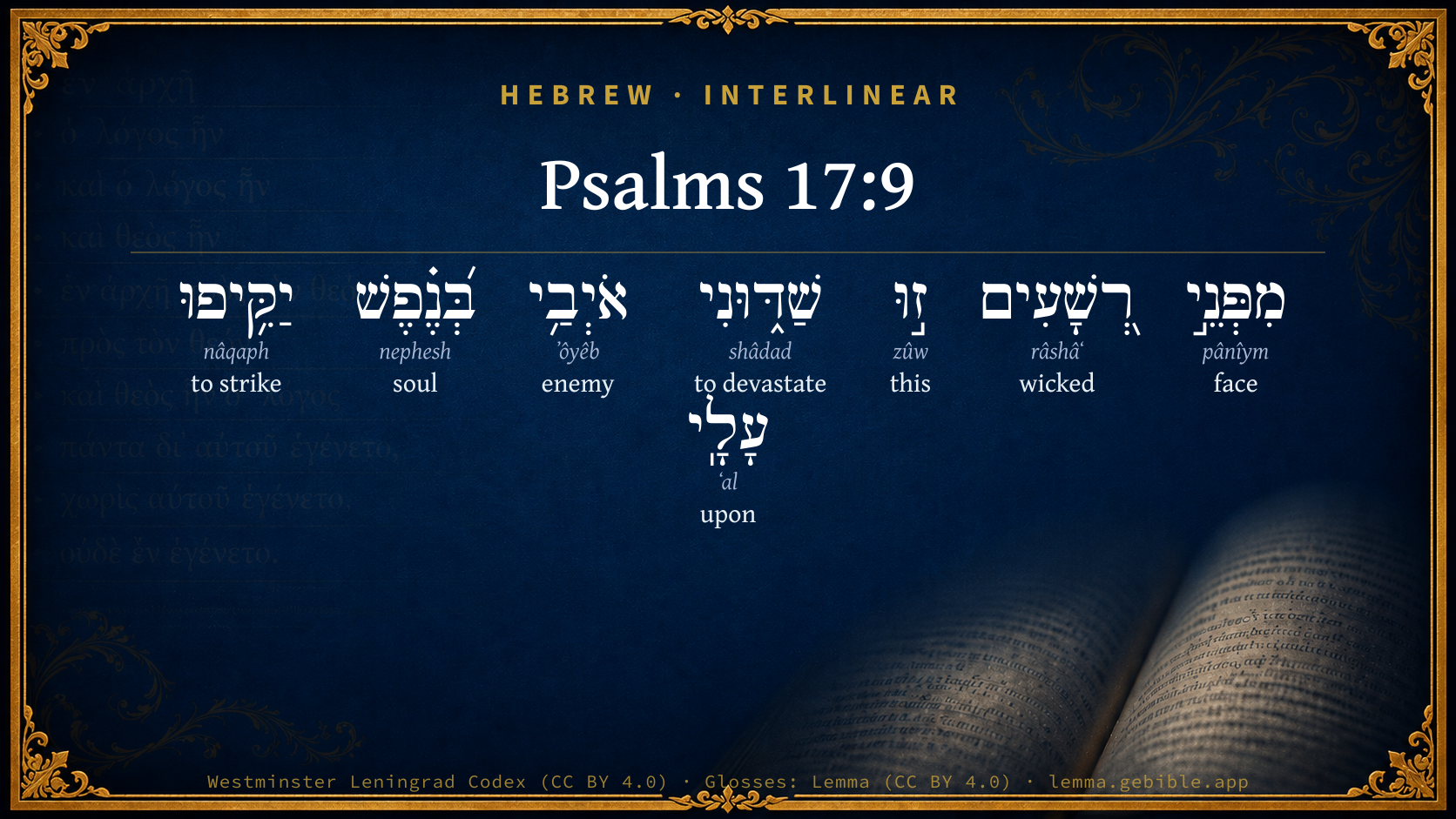
Psalms 17:9

Hebrew (Westminster Leningrad Codex) Psalms 17:9 appears in the Hebrew Old Testament. The text above is from the Westminster Leningrad Codex. Each word links to its Strong’s number, a concise gloss, and parsing drawn from the Open Scriptures Hebrew Bible morphology. Click any word for its full Brown-Driver-Briggs (BDB) entry.
Download image
Cite this verse

Psalms 17:9 (World English Bible). Public Domain. Lemma interlinear Bible study tool, https://lemma.gebible.app/v/psalms/17/9.

Show BibTeX & RIS
BibTeX
RIS
English Translation
From the wicked who oppress me, My deadly enemies, who surround me.
World English Bible · Public Domain
Download a study sheet

One document with this verse’s original text, its word-by-word gloss line, the meaning frame, cross-references with their text, attributed commentary, and full source and license credits — printable, and it pastes into notes with its structure intact.

This verse Autodidact and up

Study sheet (.html) Plain text (.txt)

A passage Seminary Student

Up to 50 verses in one chapter. A passage sheet keeps up to 6 commentary sources and 12 cross-references per verse, in the order this page ranks them, and says so on the sheet whenever that leaves anything out. Ask for a single verse and you get the Autodidact verse sheet above.

Everything on this page stays free to read, with no account — the sheet is a download of what is already on screen, not access to it.

Want to remove ads? Support Godless Engineer
Compare translations 3

The same verse in 3 English versions, stacked beneath the original-language interlinear above. Click any original word for its lexicon entry.

Each is an independent rendering of the whole verse — the interlinear is not word-aligned to these translations.

Highlighted words mark where these versions differ — a whole-verse word diff, not a word-by-word alignment.

  • World English Bible Public Domain
    From the wicked who oppress me, My deadly enemies, who surround me.
  • King James Version Public Domain
    From the wicked that oppress me, from my deadly enemies, who compass me about.
  • unfoldingWord Literal Text CC BY-SA 4.0
    from the faces of the wicked who deal violently with me, the ones being hostile against my soul, they surround me.

unfoldingWord Literal Text — © unfoldingWord, licensed CC BY-SA 4.0. Word-aligned USFM3 via Door43 (git.door43.org/unfoldingWord/en_ult).

Versions to compare (up to 4)

3 of 4 selected

Show all 18 translations

Every available English version of this verse, each an independent rendering of the whole verse.

  • World English Bible Public Domain
    From the wicked who oppress me, My deadly enemies, who surround me.
  • Berean Standard Bible Public Domain
    from the wicked who assail me, from my mortal enemies who surround me.
  • Majority Standard Bible Public Domain
    from the wicked who assail me, from my mortal enemies who surround me.
  • King James Version Public Domain
    From the wicked that oppress me, from my deadly enemies, who compass me about.
  • American Standard Version (1901) Public Domain
    From the wicked that oppress me, My deadly enemies, that compass me about.
  • Revised Version (1885) Public Domain
    From the wicked that spoil me, my deadly enemies, that compass me about.
  • Geneva Bible (1599) Public Domain
    From the wicked that oppresse mee, from mine enemies, which compasse me round about for my soule.
  • Douay-Rheims (1899) Public Domain
    From the face of the wicked who have afflicted me. My enemies have surrounded my soul:
  • Young's Literal Translation Public Domain
    From the face of the wicked who spoiled me. Mine enemies in soul go round against me.
  • Literal Standard Version CC BY-SA 4.0
    From the face of the wicked who spoiled me, || [From] my enemies in soul who go around against me.
  • Unlocked Literal Bible CC BY-SA 4.0
    from the presence of the wicked ones who assault me, my enemies who surround me.
  • unfoldingWord Literal Text CC BY-SA 4.0
    from the faces of the wicked who deal violently with me, the ones being hostile against my soul, they surround me.
  • Darby Bible Public Domain
    From the wicked that destroy me, my deadly enemies, who compass me about.
  • World Messianic Bible Public Domain
    from the wicked who oppress me, my deadly enemies, who surround me.
  • Webster's Bible Public Domain
    From the wicked that oppress me, from my deadly enemies, who encompass me,
  • Free Bible Version CC BY-SA 4.0
    Protect me from the attacks of the wicked who want to destroy me, from my enemies who surround me, intent on killing me.
  • Bible in Basic English Public Domain
    From the evil-doers who are violent to me, and from those who are round me, desiring my death.
  • JPS Tanakh (1917) Public Domain
    From the wicked that oppress, my deadly enemies, that compass me about.

Literal Standard Version (2020), Covenant Press — licensed CC BY-SA 4.0. Text via the HelloAO Bible API (eBible.org). Unlocked Literal Bible (unfoldingWord) — licensed CC BY-SA 4.0. Text via the HelloAO Bible API (eBible.org). unfoldingWord Literal Text — © unfoldingWord, licensed CC BY-SA 4.0. Word-aligned USFM3 via Door43 (git.door43.org/unfoldingWord/en_ult). Free Bible Version, Dr. Jonathan Gallagher — licensed CC BY-SA 4.0. Text via the HelloAO Bible API (eBible.org).

Word by word

More ways to search: Search by grammar → Find every occurrence → Compare this word →

Practice this passage: Drill this verse → Learn its vocabulary →

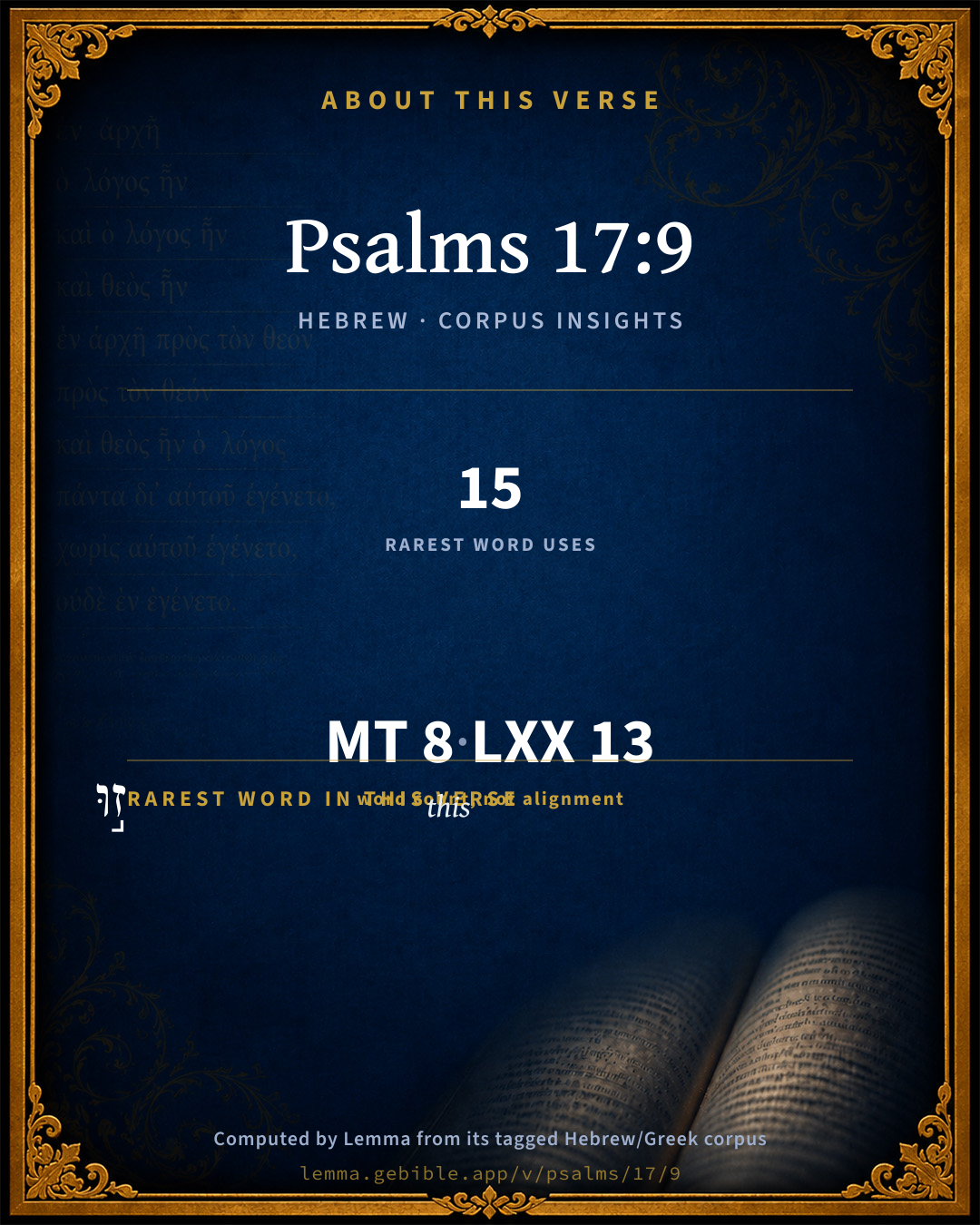
About this verse

These counts appear in no published source. They are computed here, from the morphology-tagged text and Lemma’s own curated glosses. What Lemma adds →

8
words
8
distinct lemmas
Wisdom
section

Notable vocabulary

The rarest word here is ז֣וּ this H2098 — appearing just 15 times in the whole Hebrew Bible.

Shared distinctive vocabulary

ז֣וּ this H2098 occurs in 15 verses of the Hebrew Bible. Also found in:

Grammatical profile

  • 3 verbs
  • 2 nouns
  • 1 adjective
  • 1 preposition
  • 1 particle

Verb forms

  • שַׁדּ֑וּנִי Qal · Perfect
  • אֹיְבַ֥י Qal · Participle Active
  • יַקִּ֥יפוּ Hiphil · Imperfect

Hebrew & Septuagint length

In English translation the verse runs 12 words from the Hebrew and 17 from the Septuagint (LXX English) — closely comparable.

A rough comparison of the two English renderings, which tokenize alike — not a word-level alignment.

Word counts can differ between the Hebrew and the Greek without any difference in meaning — e.g. the Hebrew direct-object marker אֵת has no separate Greek word, and Greek often adds the article ὁ.

In the original languages it is 8 Hebrew tokens and 13 Greek tokens — but the two are counted differently (Hebrew bundles its prefixes and suffixes into one token; the Greek is in lemma form), so that isn’t a like-for-like length.

Cross-references

7

Topical passages linked to Psalms 17:9 in the Treasury of Scripture Knowledge — connected by theme and wording, ordered by reader-vote popularity; previews shown in the World English Bible.

  • Psalms 35:4 Let those who seek after my soul be disappointed and brought to dishonor. Let those who plot my ruin be turned back and confounded.
  • Psalms 35:7 For without cause they have hidden their net in a pit for me. Without cause they have dug a pit for my soul.
  • 1 Samuel 24:11 Moreover, my father, behold, yes, see the skirt of your robe in my hand; for in that I cut off the skirt of your robe, and didn't kill you, know you and see that there is neither evil nor disobedience in my hand, and I have not sinned against you, though you hunt after my life to take it.
  • 1 Chronicles 17:9 I will appoint a place for my people Israel, and will plant them, that they may dwell in their own place, and be moved no more; neither shall the children of wickedness waste them any more, as at the first,
  • Psalms 7:5 Let the enemy pursue my soul, and overtake it; Yes, let him tread my life down to the earth, And lay my glory in the dust. Selah.
  • Psalms 31:20 In the shelter of your presence you will hide them from the plotting of man. You will keep them secretly in a dwelling away from the strife of tongues.
  • Psalms 35:12 They reward me evil for good, To the bereaving of my soul.

Cross-references courtesy of OpenBible.info (CC BY 4.0).

Hebrew and Greek witnesses Masoretic Hebrew ↔ Greek Septuagint

The same verse in the two great witnesses to the Old Testament, shown verse-for-verse.

You’re reading Greek Psalm 16 (Hebrew Psalm 17). The Septuagint counts the superscription, so verse numbers can differ from the Hebrew — chapter-level alignment, not verse-by-verse. Numbering follows Rahlfs.

These are two independent witnesses, not word-aligned to each other, and the Septuagint is shown in lemma (dictionary) form.

Hebrew Psalms 17:9 Masoretic · Westminster Leningrad Codex

מִפְּנֵ֣י רְ֭שָׁעִים ז֣וּ שַׁדּ֑וּנִי אֹיְבַ֥י בְּ֝נֶ֗פֶשׁ יַקִּ֥יפוּ עָלָֽי

From the wicked who oppress me, My deadly enemies, who surround me.

World English Bible · Public Domain

Greek LXX Greek Psalm 16:9 Septuagint · lemma form

ἀπό πρόσωπον ἀσεβής ὁ ταλαιπωρέω ἐγώ ὁ ἐχθρός ἐγώ ὁ ψυχή ἐγώ περιἔχω

from the face of the ungodly that have afflicted me: my enemies have compassed about my soul.

LXX2012 (modern English Septuagint) · Public Domain

Hebrew: Westminster Leningrad Codex (CC BY 4.0). Greek: Septuagint (public domain); English from LXX2012 (modern English Septuagint) (Public Domain). How the Septuagint differs from the Hebrew →

Commentary

Notes on Psalms 17:9 from classic Christian and Jewish commentators (each source and its license shown beneath its notes). The classic Christian expositions comment on the surrounding passage and are grouped to its opening verse, so a note may address several verses; the Jewish commentaries on the Tanakh (Rashi and others) are per-verse, so they appear only where the commentator wrote on this verse.

Lemma curates 59 commentaries, every one of them public domain or Creative Commons licensed, each selected and text-cleaned for this edition rather than reprinted as found. About our sources →

Trapp's Complete Commentary

John Trapp

Psa 17:9 From the wicked that oppress me, [from] my deadly enemies, [who] compass me about.

Ver. 9. From the wicked that oppress me] Heb. that waste me, i. e. that cast me out into banishmeat, despoiled of all. This hard usage of his enemies drove David into God’s blessed bosom; as children misused abroad run home to their parents.

From my deadly enemies] Heb. my enemies against the soul, i. e. the life at least, if not the soul, which they would gladly destroy. Some malice is so mischievous, that it would ruin body and soul together; as that monster of Milan, the enemies of John Huss, and Jerome of Prague, whose bodies they delivered to the fire, and their souls to the devil. David elsewhere complaineth of his enemies, that they did Satanically hate him, Psa 55:4. "Beware of men," saith our Saviour, Mat 10:17, for one man is a devil to another.

John Trapp, A Commentary or Exposition upon All the Books of the Old and New Testament (1647–1656) — public domain. Text from a community e-Sword module.

J. A. Alexander on Psalms

Joseph Addison Alexander

9. (Psa 17:9) From the face of the wicked who have wasted me; mine enemies to the soul will surround me. The preceding sentence is continued, with a more particular description of the objects of his dread. "Thou wilt hide me from the face, sight, or presence of the wicked." Wasted, desolated, destroyed, with allusion perhaps to the siege of a town or the invasion of a country. The same term is applied to a dead man in Jdg 5:27. The enemies of the last clause are identical with the wicked of the first. Enemies in soul may mean cordial haters, or enemies who seek the soul or life, called deadly enemies in the English version. Or it may be construed: surround me eagerly (with craving appetite); or surround me against my soul or life, i.e. with a view to take it.—The future form suggests that the danger which the first clause had described as past, was still present, and likely to continue. As if he had said, "from my wicked foes who have already wasted me, and will no doubt still continue to surround me." In this description present danger is included, whereas if we substitute the present form, we lose the obvious allusion to the future and the past.

Joseph Addison Alexander, The Psalms Translated and Explained (1850) — public domain. Text from a community e-Sword module.

Geneva Bible (1599)

Geneva Bible translators

For their cruelty cannot be satisfied but with my death.

Geneva Bible (1599) marginal notes — public domain. Text via Bolls.life.

Jamieson, Fausset & Brown

Robert Jamieson, A. R. Fausset & David Brown

compass me--(compare Psa 118:10-12).

Jamieson, Fausset & Brown — Commentary Critical and Explanatory on the Whole Bible (1871) — public domain (CC PDM 1.0). Text via the HelloAO Bible API.

Adam Clarke's Commentary

Verse 9. From my deadly enemies, who compass me about.] This is a metaphor taken from huntsmen, who spread themselves around a large track of forest, driving in the deer from every part of the circumference, till they are forced into the nets or traps which they have set for them in some particular narrow passage. The metaphor is carried on in the following verses.

Adam Clarke's Commentary on the Bible (1810–1826) — public domain. Text from a community e-Sword/MySword module.

John Calvin's Commentaries

9. From the face of the ungodly. The Psalmist, by again accusing his enemies, intends to set forth his own innocence, as an argument for his obtaining the favor of God. At the same time, he complains of their cruelty, that God may be the more inclined to aid him. First, he says that they burn with an enraged desire to waste and to destroy him; secondly, he adds, that they besiege him in his soul, by which he means, that they would never rest satisfied until they had accomplished his death. The greater, therefore, the terror with which we are stricken by the cruelty of our enemies, the more ought we to be quickened to ardor in prayer. God, indeed, does not need to receive information and incitement from us; but the use and the end of prayer is, that the faithful, by freely declaring to God the calamities and sorrows which oppress them, and in disburdening them, as it were, into his bosom, may be assured beyond all doubt that he has a regard to their necessities.

John Calvin's Commentaries (1540-1563) — public domain. Text from the Calvin Translation Society English edition (1840s-50s) via the Christian Classics Ethereal Library (ccel.org). Calvin's coverage is partial (roughly two-thirds of the Bible); uncommented books and verses are honest gaps, never fabricated. The 19th-century editor's footnotes and remarks are omitted so the notes are faithfully Calvin's own voice.

Ellicott's Commentary for English Readers

(9) Deadly.—Literally, with the soul, or life, or better, as in the Syriac, “against the life,” and so deadly. Others take it adverbially with the verb, “eagerly compass.”

A Bible Commentary for English Readers, edited by Charles John Ellicott (1878–1897) — public domain. Text from a community e-Sword module.

The Cambridge Bible for Schools and Colleges

gen. ed. J. J. S. Perowne

9. that oppress me] R.V., that spoil me. Cp. Psa_12:5. (R.V.).

my deadly enemies] Nothing but his life will satisfy them. Cp. 1Sa_24:11. This is the sense, whether the exact meaning is enemies in soul, i.e. with murderous intent (Psa_27:12; Psa_41:2), or enemies against (my) soul.

The Cambridge Bible for Schools and Colleges (gen. ed. J. J. S. Perowne; Cambridge University Press, 1878–1918) — public domain. Text from a community e-Sword module.

John Gill's Exposition

From the wicked that oppress me,.... Or "waste" or "destroy" (g); as wild beasts do a field or vineyard when they get into it; and such havoc do persecutors and false teachers make of the church and people of God, when they are suffered to get in among them, Psa 80:13; wherefore from such wicked and unreasonable men protection is desired, Th2 3:2;

from my deadly enemies; enemies against his soul or life, who sought to take it away, nothing would satisfy them but this;

who compass me about; on all sides, in order to obtain their desire; such were the enemies of Christ, and so they are described, Psa 22:12.

(g) "quid vastant", Vatablus, Junius & Tremellius, Piscator; "qui vastaverunt", Pagninus, Montanus, Cocceius, Michaelis.

John Gill's Exposition of the Whole Bible (1746–1763) — public domain (CC PDM 1.0). Text via the HelloAO Bible API.

Albert Barnes' Notes on the Bible

From the wicked that oppress me - Margin, “That waste me.” The margin expresses the sense of the Hebrew. The idea is that of being wasted, desolated, destroyed, as a city or country is by the ravages of war. The psalmist compares himself in his troubles with such a city or country. The “effect” of the persecutions which he had endured had been like cities and lands thus laid waste by fire and sword.

From my deadly enemies - Margin, “My enemies against the soul.” The literal idea is, “enemies against my life.” The common translation expresses the idea accurately. The sense is, that his enemies sought his life.

Who compass me about - Who surround me on every side, as enemies do who besiege a city.

Albert Barnes' Notes on the Bible (1834–1885) — public domain. Text from a community e-Sword/MySword module.

Matthew Poole's English Annotations

From the wicked; or, because of the wicked. From my deadly enemies; Heb. from those who are mine enemies in, or for, or against my (which pronoun is easily supplied out of the foregoing word, where it is expressed) soul or life, i.e. whom nothing but my blood and life will satisfy.

Who compass me about; which shows both their extreme malice and his great danger.

Matthew Poole's English Annotations on the Holy Bible (1683–1685) — public domain. Text from a community e-Sword/MySword module.

The Treasury of David

Charles H. Spurgeon

Ver. 9. From the wicked that oppress me, from my deadly enemies, who compass me about. The foes from whom David sought to be rescued were

wicked men. It is hopeful for us when our enemies are God's enemies. They were

deadly enemies, whom nothing but his death would satisfy. The foes of a believer's soul are mortal foes most emphatically, for they who war against our faith aim at the very life of our life. Deadly sins are deadly enemies, and what sin is there which hath not death in its bowels? These foes oppressed David, they laid his spirit waste, as invading armies ravage a country, or as wild beasts desolate a land. He likens himself to a besieged city, and complains that his foes

compass him about. It may well quicken our business upward, when all around us, every road, is blockaded by deadly foes. This is our daily position, for all around us dangers and sins are lurking. O God, do thou protect us from them all.

Ver. 9. From the wicked: as though he had said, "They are equally enemies to thee and me; not more opposite to me by their cruelty, than by their wickedness they are to thee. Vindicate then, at once, thyself, and deliver me." John Howe.

None.

Psalms 17:10*

Charles H. Spurgeon's The Treasury of David (1869–1885) — public domain. Psalms only. Text from a community e-Sword/MySword module.

The Pulpit Commentary

From the wicked that oppress me; or, lay me waste treat me as invaders treat an enemy"s territory. (see Isa_15:1) From my deadly enemies, who compass me about; literally, my enemies in soul those who in heart and mind are wholly set against me. When hunted by Saul upon the mountains, David was often "compassed about" with foes. (1Sa_23:14, 1Sa_23:15, 26 26:20)

The Pulpit Commentary (1880–1919), ed. H.D.M. Spence-Jones & Joseph S. Exell — public domain. Text from a community e-Sword module.

Rashi

Rabbi Shlomo Yitzchaki (Rashi)

who have robbed me Because of this: my enemies, who encompass me to take my life, rob me.

Rashi on the Tanakh — English translations: “The Judaica Press complete Tanach with Rashi, translated by A. J. Rosenberg” (CC BY 4.0); “Pentateuch with Rashi's commentary by M. Rosenbaum and A.M. Silbermann, 1929-1934” (public domain); “The Metsudah Tanach series, Lakewood, N.J” (CC BY 4.0); and “The Book of Joshua, Metsudah Publications, 1997” (CC BY 4.0). Text via Sefaria.

Radak

Rabbi David Kimhi (Radak)

From the wicked that spoil me: – Keep me from the enemies who spoil me. The word זוּ is in meaning the same as אשר; and so (we find): “He against whom (זוּ) we have sinned” (Isaiah 42:24).

My soul's enemies that compass me about: – Keep me from my enemies who encompass and surround me against my soul, meaning, “to take my life.”

Radak on the Tanakh — English translations: “Sefaria Community Translation” (CC0 1.0 (public-domain dedication)); “Eliyahu Munk, HaChut Hameshulash” (CC BY 4.0); “Rabbi Mike Feuer, Jerusalem Anthology” (CC BY 4.0); and “R. David Kimhi on the first book of Psalms, Translated by R.G. Finch, London, 1919” (public domain). Text via Sefaria.

Lesson kit

Teaching starters — assembled from the data on this page, not authored interpretation. Every prompt links to the verse data it draws on. Edit before teaching.

Psalms, in the Wisdom, opens this verse with 8 words (8 distinct Hebrew lemmas). Its most distinctive word is zûw (“this”). A historical commentator’s framing appears above. Read the whole chapter for the surrounding context.

Discussion questions

  1. What does “this” (zûw) contribute to the verse as a whole?
  2. How does Exodus 15:13, which shares the word «this», read alongside this verse?
  3. These translations render this verse differently; the difference is in the English rendering, not the original. What questions does that raise?
  4. «שַׁדּ֑וּנִי» is a Qal Perfect verb. How does that grammatical form shape the action described?
  5. Compare how Trapp's Complete Commentary and J. A. Alexander on Psalms read this verse. Where do they agree or differ?

Things to notice

Reading settings

Reading text

Shown beneath each verse's original-language words.

Old Testament
Old Testament edition

Read the OT as the Masoretic Hebrew (MT) or the Greek Septuagint (LXX).

English shown for the Greek Septuagint (in the Hebrew ↔ Greek comparison).

Comparing translations? Open the Compare panel on any verse page to stack up to four side by side.