
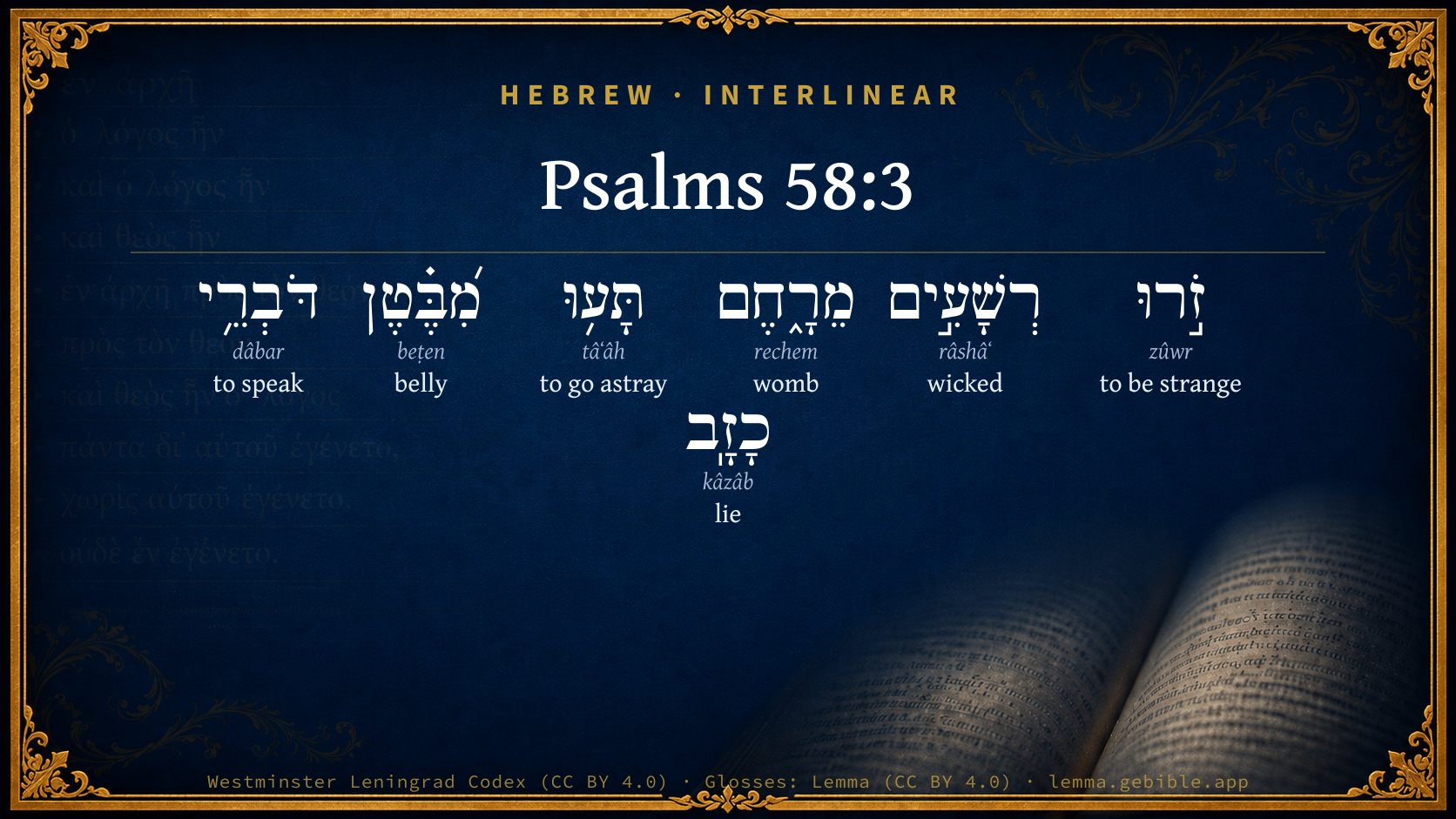
Psalms 58:3

Hebrew (Westminster Leningrad Codex) Psalms 58:3 appears in the Hebrew Old Testament. The text above is from the Westminster Leningrad Codex. Each word links to its Strong’s number, a concise gloss, and parsing drawn from the Open Scriptures Hebrew Bible morphology. Click any word for its full Brown-Driver-Briggs (BDB) entry.
Download image
Cite this verse

Psalms 58:3 (World English Bible). Public Domain. Lemma interlinear Bible study tool, https://lemma.gebible.app/v/psalms/58/3.

Show BibTeX & RIS
BibTeX
RIS
English Translation
The wicked go astray from the womb. They are wayward as soon as they are born, speaking lies.
World English Bible · Public Domain
Download a study sheet

One document with this verse’s original text, its word-by-word gloss line, the meaning frame, cross-references with their text, attributed commentary, and full source and license credits — printable, and it pastes into notes with its structure intact.

This verse Autodidact and up

Study sheet (.html) Plain text (.txt)

A passage Seminary Student

Up to 50 verses in one chapter. A passage sheet keeps up to 6 commentary sources and 12 cross-references per verse, in the order this page ranks them, and says so on the sheet whenever that leaves anything out. Ask for a single verse and you get the Autodidact verse sheet above.

Everything on this page stays free to read, with no account — the sheet is a download of what is already on screen, not access to it.

Want to remove ads? Support Godless Engineer
Compare translations 3

The same verse in 3 English versions, stacked beneath the original-language interlinear above. Click any original word for its lexicon entry.

Each is an independent rendering of the whole verse — the interlinear is not word-aligned to these translations.

Highlighted words mark where these versions differ — a whole-verse word diff, not a word-by-word alignment.

  • World English Bible Public Domain
    The wicked go astray from the womb. They are wayward as soon as they are born, speaking lies.
  • King James Version Public Domain
    The wicked are estranged from the womb: they go astray as soon as they be born, speaking lies.
  • unfoldingWord Literal Text CC BY-SA 4.0
    The wicked turn aside from the womb; they stray from the belly, speaking falsehood.

unfoldingWord Literal Text — © unfoldingWord, licensed CC BY-SA 4.0. Word-aligned USFM3 via Door43 (git.door43.org/unfoldingWord/en_ult).

Versions to compare (up to 4)

3 of 4 selected

Show all 18 translations

Every available English version of this verse, each an independent rendering of the whole verse.

  • World English Bible Public Domain
    The wicked go astray from the womb. They are wayward as soon as they are born, speaking lies.
  • Berean Standard Bible Public Domain
    The wicked are estranged from the womb; the liars go astray from birth.
  • Majority Standard Bible Public Domain
    The wicked are estranged from the womb; the liars go astray from birth.
  • King James Version Public Domain
    The wicked are estranged from the womb: they go astray as soon as they be born, speaking lies.
  • American Standard Version (1901) Public Domain
    The wicked are estranged from the womb: They go astray as soon as they are born, speaking lies.
  • Revised Version (1885) Public Domain
    The wicked are estranged from the womb: they go astray as soon as they be born, speaking lies.
  • Geneva Bible (1599) Public Domain
    The wicked are strangers from ye wombe: euen from the belly haue they erred, and speake lyes.
  • Douay-Rheims (1899) Public Domain
    For in your heart you work iniquity: your hands forge injustice in the earth.
  • Young's Literal Translation Public Domain
    The wicked have been estranged from the womb, They have erred from the belly, speaking lies.
  • Literal Standard Version CC BY-SA 4.0
    The wicked have been estranged from the womb, || They have erred from the belly, speaking lies.
  • Unlocked Literal Bible CC BY-SA 4.0
    The wicked go astray even when they are in the womb; they go astray from birth, speaking lies.
  • unfoldingWord Literal Text CC BY-SA 4.0
    The wicked turn aside from the womb; they stray from the belly, speaking falsehood.
  • Darby Bible Public Domain
    The wicked go astray from the womb; they err as soon as they are born, speaking lies.
  • World Messianic Bible Public Domain
    The wicked go astray from the womb. They are wayward as soon as they are born, speaking lies.
  • Webster's Bible Public Domain
    \\58:2\\Yes, in heart ye work wickedness; ye weigh the violence of your hands in the earth.
  • Free Bible Version CC BY-SA 4.0
    The wicked are sinners from birth; from the moment they're born they tell lies.
  • Bible in Basic English Public Domain
    The evil-doers are strange from the first; from the hour of their birth they go out of the true way, saying false words.
  • JPS Tanakh (1917) Public Domain
    (58-4) The wicked are estranged from the womb; the speakers of lies go astray as soon as they are born.

Literal Standard Version (2020), Covenant Press — licensed CC BY-SA 4.0. Text via the HelloAO Bible API (eBible.org). Unlocked Literal Bible (unfoldingWord) — licensed CC BY-SA 4.0. Text via the HelloAO Bible API (eBible.org). unfoldingWord Literal Text — © unfoldingWord, licensed CC BY-SA 4.0. Word-aligned USFM3 via Door43 (git.door43.org/unfoldingWord/en_ult). Free Bible Version, Dr. Jonathan Gallagher — licensed CC BY-SA 4.0. Text via the HelloAO Bible API (eBible.org).

Word by word

More ways to search: Search by grammar → Find every occurrence → Compare this word →

Practice this passage: Drill this verse → Learn its vocabulary →

About this verse

These counts appear in no published source. They are computed here, from the morphology-tagged text and Lemma’s own curated glosses. What Lemma adds →

7
words
7
distinct lemmas
Wisdom
section

Shared distinctive vocabulary

מֵרָ֑חֶם womb H7358 occurs in 25 verses of the Hebrew Bible. Also found in:

Grammatical profile

  • 3 verbs
  • 3 nouns
  • 1 adjective

Verb forms

  • זֹ֣רוּ Qal · Perfect
  • תָּע֥וּ Qal · Perfect
  • דֹּבְרֵ֥י Qal · Participle Active

Hebrew & Septuagint length

In English translation the verse runs 18 words from the Hebrew and 16 from the Septuagint (LXX English) — closely comparable.

A rough comparison of the two English renderings, which tokenize alike — not a word-level alignment.

Word counts can differ between the Hebrew and the Greek without any difference in meaning — e.g. the Hebrew direct-object marker אֵת has no separate Greek word, and Greek often adds the article ὁ.

Cross-references

7

Topical passages linked to Psalms 58:3 in the Treasury of Scripture Knowledge — connected by theme and wording, ordered by reader-vote popularity; previews shown in the World English Bible.

  • Psalms 51:5 Behold, I was brought forth in iniquity. In sin my mother conceived me.
  • Isaiah 48:8 Yes, you didn't hear; yes, you didn't know; yes, from of old your ear was not opened: for I knew that you did deal very treacherously, and was called a transgressor from the womb.
  • Proverbs 22:15 Folly is bound up in the heart of a child: The rod of discipline drives it far from him.
  • Job 15:14 What is man, that he should be clean? He who is born of a woman, that he should be righteous?
  • Ephesians 2:3 among whom we also all once lived in the lust of our flesh, doing the desires of the flesh and of the mind, and were by nature children of wrath, even as the rest.
  • Psalms 22:10 I was thrown on you from my mother's womb. You are my God since my mother bore me.
  • Isaiah 46:3 Listen to me, house of Jacob, and all the remnant of the house of Israel, that have been borne [by me] from their birth, that have been carried from the womb;

Cross-references courtesy of OpenBible.info (CC BY 4.0).

Hebrew and Greek witnesses Masoretic Hebrew ↔ Greek Septuagint

The same verse in the two great witnesses to the Old Testament, shown verse-for-verse.

You’re reading Greek Psalm 57 (Hebrew Psalm 58). The Septuagint counts the superscription, so verse numbers can differ from the Hebrew — chapter-level alignment, not verse-by-verse. Numbering follows Rahlfs.

These are two independent witnesses, not word-aligned to each other, and the Septuagint is shown in lemma (dictionary) form.

Hebrew Psalms 58:3 Masoretic · Westminster Leningrad Codex

זֹ֣רוּ רְשָׁעִ֣ים מֵרָ֑חֶם תָּע֥וּ מִ֝בֶּ֗טֶן דֹּבְרֵ֥י כָזָֽב

The wicked go astray from the womb. They are wayward as soon as they are born, speaking lies.

World English Bible · Public Domain

Greek LXX Greek Psalm 57:3 Septuagint · lemma form

καί γάρ ἐν καρδία ἀνομία ἐργάζομαι ἐν ὁ γῆ ἀδικία ὁ χείρ σύ συνπλέκω

Sinners have gone astray from the womb: they go astray from the belly: they speak lies.

LXX2012 (modern English Septuagint) · Public Domain

On this verse, J. A. Alexander on Psalms discusses the Septuagint’s reading. Read the note in Commentary ↓

Hebrew: Westminster Leningrad Codex (CC BY 4.0). Greek: Septuagint (public domain); English from LXX2012 (modern English Septuagint) (Public Domain). How the Septuagint differs from the Hebrew →

Commentary

Notes on Psalms 58:3 from classic Christian and Jewish commentators (each source and its license shown beneath its notes). The classic Christian expositions comment on the surrounding passage and are grouped to its opening verse, so a note may address several verses; the Jewish commentaries on the Tanakh (Rashi and others) are per-verse, so they appear only where the commentator wrote on this verse.

Lemma curates 59 commentaries, every one of them public domain or Creative Commons licensed, each selected and text-cleaned for this edition rather than reprinted as found. About our sources →

Trapp's Complete Commentary

John Trapp

Psa 58:3 The wicked are estranged from the womb: they go astray as soon as they be born, speaking lies.

Ver. 3. The wicked are estranged from the womb] q.d. These enemies of mine are old sinners; hardened and habituated in wickedness from the very womb; it hath also grown up with them, and quite turned away their hearts from God and goodness, whereunto they stand utterly across, and have an innate antipathy; they are not only averse thereto, but adverse also; yea, to their sinews of iron they have added brows of brass, Isa 48:4. Sinful, indeed, we are all by nature, and a birth blot we bring into the world with us, making us strangers to and strayers from God. But some God sanctifieth even from the womb, as he did Jeremiah; and some by the light of nature, not altogether extinct, and by God’s restraining grace, are reined in from notorious outrage in sin. Whereas others, cast off by God, and suffered to walk after their own heart’s lusts, in pesus indies proficiunt, wax every day worse and worse, as the apostle speaketh, till their iniquity be full, and so wrath come upon them to the utmost. But as young nettles sting straight, and young crab fish go backward, and young urchins are rough; so naughty nature soon appeareth in little ones. Valezatha, the youngest of Haman’s sons, is by the Hebrews said to be the most malicious; and hath therefore one letter å in his name bigger than the rest. {Hebrew Text Note}

They go astray as soon as they be born] Heb. from the belly; Partus sequitur ventrem, no sooner could they do anything but they were doing evil, lisping out lies and slanders very early.

John Trapp, A Commentary or Exposition upon All the Books of the Old and New Testament (1647–1656) — public domain. Text from a community e-Sword module.

Joseph Benson's Commentary

Psa 58:3. The wicked are estranged — From God, and from all goodness; from the womb — From their tender years, or, rather, strictly and properly, from their birth: their very natures and principles are corrupt even from their infancy: they are the wicked offspring of sinful parents. They go astray by actual sins, the fruit of their original corruption; as soon as they are born — As soon as ever they are capable of the exercise of reason, and the practice of sinning.

Joseph Benson's Commentary on the Old and New Testaments (1811–1818) — public domain. Text from a community e-Sword module.

J. A. Alexander on Psalms

Joseph Addison Alexander

4. (Psa 58:3). Estranged are the wicked from the womb; they go astray from, (their) birth, speaking lies. The first verb in Hebrew is not a passive but a neuter form, denoting the condition of estrangement, alienation, from God and from all goodness. The wicked thus described are the whole class, of which his persecutors formed a part. The preterite tense is used in the original (were estranged, went astray) on account of the retrospective reference to the beginning of life. The verb translated go astray is one frequently applied to moral aberrations. From their birth, literally from the belly. See above, Psa 22:10. Speaking lies, or with closer adherence to the form of the original, speakers of falsehood, i.e. habitual liars. The other version seems to mean that they begin to lie as soon as they are born, a hyperbolical expression, of which some interpreters relieve the sentence by making this the subject of the proposition and parallel to wicked in the other clause. Speakers of falsehood go astray from (their) birth. In this description of the wicked there is nothing inconsistent with the doctrine of universal depravity, as recognised in Psa 14:1; Psa 51:5 above, and in Gen 8:21, Job 14:4, because the holiness of some men is a mere exception to the general rule, produced by the distinguishing grace of God, which frees them from the paramount influence of that corruption to which others still continue subject.

5., 6. (Psa 58:4-5). There is poison to them like the poison of a serpent, as a deaf adder stops its ear, which will not hearken to the voice of enchanters, of (one) charming charms, (of one) most wise. The first words are equivalent to the English construction, they have poison, The Hebrew noun originally signifies heat, and especially the heat of anger, in which sense it repeatedly occurs above, Psa 6:1; Psa 37:8; Psa 38:1. The same sense is retained here by the ancient versions (furor), and agrees well with the popular idea of vindictive spite, as a natural instinct of this class of animals. But most interpreters explain the word, here and in Deu 32:24, as meaning venom, animal poison, so called from its inflammatory effects upon the person bitten. The Hebrew phrase translated like means strictly after (or according to) the likeness of. Compare its use in Gen 1:26. It may be here employed, instead of the simple particle of comparison, for the sake of emphasis, as we say like, but more emphatically just like. As to the species of serpent mentioned in the second clause of Psa 58:4, all that is necessary to a correct interpretation of the verse is to understand it as denoting a variety regarded as peculiarly malignant, and therefore resisting the incantations by which other species were subdued, especially in Egypt. See the allusions to this practice in Ecc 10:11, Jer 8:17. This clause admits of a different construction, like the deaf adder he stops his ear, which some interpreters prefer because an adder cannot stop its ears, and need not stop them if naturally deaf, whereas it is by stopping his that the wicked man becomes like a deaf adder. The word translated enchanters properly means whisperers or mutterers, in allusion to familiar practices of the ancient wizards. Charming charms, laying spells, or as the Hebrew words are commonly supposed to signify originally, tying knots with a magical design. The last word in Psa 58:5, is a passive participle, analogous to our word learned, and here meaning skilful. The English versions and the Vulgate make it an adverb (sapienter, never so wisely); but the Septuagint and Jerome give it its proper meaning as an adjective, in which case it is probably in apposition with the nouns preceding, and connected in like manner with the voice of the first clause. The general idea of the verse, however construed, is that the malice of his enemies is stubborn and inexorable.

Joseph Addison Alexander, The Psalms Translated and Explained (1850) — public domain. Text from a community e-Sword module.

Tyndale Open Study Notes

Tyndale Open Resources

58:3 All human beings are born sinners (see 51:5); however, whereas the wicked indulge their sinful nature, the godly fight against it (Rom 7:19-23; Jas 4:1-10).

Tyndale Open Study Notes — © Tyndale Open Resources, licensed CC BY-SA 4.0. Text via the HelloAO Bible API.

Geneva Bible (1599)

Geneva Bible translators

That is, enemies to the people of God even from their birth.

Geneva Bible (1599) marginal notes — public domain. Text via Bolls.life.

Jamieson, Fausset & Brown

Robert Jamieson, A. R. Fausset & David Brown

describe the wicked generally, who sin naturally, easily, malignantly, and stubbornly.

Jamieson, Fausset & Brown — Commentary Critical and Explanatory on the Whole Bible (1871) — public domain (CC PDM 1.0). Text via the HelloAO Bible API.

Adam Clarke's Commentary

Verse 3. The wicked are estranged from the womb] "This," says Dr. Kennicott, "and the next two verses, I take to be the answer of Jehovah to the question in the two first verses, as the 6th, 7th, and 8th, are the answer of the psalmist, and the remainder contains the decree of Jehovah." He calls these wicked men, men who had been always wicked, originally and naturally bad, and brought up in falsehood, flattery, and lying. The part they acted now was quite in character.

Adam Clarke's Commentary on the Bible (1810–1826) — public domain. Text from a community e-Sword/MySword module.

John Calvin's Commentaries

3. They are estranged, being wicked from the womb. He adduces, in aggravation of their character, the circumstance, that they were not sinners of recent date, but persons born to commit sin. We see some men, otherwise not so depraved in disposition, who are drawn into evil courses through levity of mind, or bad example, or the solicitation of appetite, or other occasions of a similar kind; but David accuses his enemies of being leavened with wickedness from the womb, alleging that their treachery and cruelty were born with them. We all come into the world stained with sin, possessed, as Adam’s posterity, of a nature essentially depraved, and incapable, in ourselves, of aiming at anything which is good; but there is a secret restraint upon most men which prevents them from proceeding all lengths in iniquity. The stain of original sin cleaves to the whole humanity without exception; but experience proves that some are characterised by modesty and decency of outward deportment; that others are wicked, yet, at the same time, within bounds of moderation; while a third class are so depraved in disposition as to be intolerable members of society. Now, it is this excessive wickedness — too marked to escape detestation even amidst the general corruption of mankind — which David ascribes to his enemies. He stigmatises them as monsters of iniquity.

John Calvin's Commentaries (1540-1563) — public domain. Text from the Calvin Translation Society English edition (1840s-50s) via the Christian Classics Ethereal Library (ccel.org). Calvin's coverage is partial (roughly two-thirds of the Bible); uncommented books and verses are honest gaps, never fabricated. The 19th-century editor's footnotes and remarks are omitted so the notes are faithfully Calvin's own voice.

Ellicott's Commentary for English Readers

(3) The Wicked.—The poet passes from his indignant challenge to the unjust judges to speak of the wicked generally. He finds that such maturity of vice points to very early depravity. Such hardened sinners must have been cradled in wickedness.

A Bible Commentary for English Readers, edited by Charles John Ellicott (1878–1897) — public domain. Text from a community e-Sword module.

The Cambridge Bible for Schools and Colleges

gen. ed. J. J. S. Perowne

3. are estranged] From God and His laws. Cp. Eph_4:18, “alienated from the life of God”: Col_1:21, “alienated and enemies in your mind in your evil works,” where St Paul uses the word (ἀπῃλλοτριωμένοι) employed by the LXX here.

“The imagination of man’s heart is evil from his youth” (Gen_8:21); but these men have shewn a more than ordinary aptitude for wickedness. It has become to them a second nature.

3–5. A description of the class to which these wicked judges belong; the deliberately wicked, who are deaf to remonstrance and incapable of reformation.

The Cambridge Bible for Schools and Colleges (gen. ed. J. J. S. Perowne; Cambridge University Press, 1878–1918) — public domain. Text from a community e-Sword module.

John Gill's Exposition

The wicked are estranged from the womb,.... Which original corruption of nature accounts for all the wickedness done by men: they are conceived in sin, shapen in iniquity, and are transgressors from the womb; they are alienated from God, and from that godly life which is agreeable to him, and he requires; and from the knowledge and fear of him, and love to him; and they desire not the knowledge of him nor his ways; they are far from his law, and averse to it; and still more so to the Gospel of Christ; the doctrines of which, as well as the great things written in the law, are strange things to them; and they are aliens from the commonwealth of Israel, estranged from the people of God, know nothing of them, neither of their joys, nor of their sorrows;

they go astray as soon as they be born, speaking lies; they are wicked from their infancy, from their youth upward; and sin, which is meant by "going astray", as soon as they are capable of it, and which is very early. Sin soon appears in the temper and actions of then; they go out of God's way, and turn everyone to their own way, and walk in the broad road which leads to destruction: and particularly they are very early guilty of lying; as soon as they can speak, and before they can speak plain, they lisp out lies, which they learn from their father the devil, who is the father of lies; and so they continue all their days strangers to divine things, going astray from God, the God of truth, continually doing abominations and speaking lies; which continuance in these things makes the difference between reprobate men and God's elect; for though the latter are the same by nature as the former, yet their natures are restrained, before conversion, from going into all the sins they are inclined to; and if not, yet at conversion a stop is put to their progress in iniquity.

John Gill's Exposition of the Whole Bible (1746–1763) — public domain (CC PDM 1.0). Text via the HelloAO Bible API.

Albert Barnes' Notes on the Bible

The wicked are estranged from the womb - The allusion here undoubtedly is to the persons principally referred to in the psalm - the enemies of David. But their conduct toward him suggests a more general reflection in regard to “all” the wicked as having the same characteristics. The psalmist, therefore, instead of confining his remarks to them, makes his observations general, on the principle that all wicked men have essentially the same character, and especially in respect to the thing here affirmed, that they go astray early; that they are apostate and alienated from God from their very birth. The words, “the wicked,” here do not necessarily refer to the whole human family (though what is thus affirmed is true of all the human race), but to people who in their lives develop a wicked character; and the affirmation in regard to them is that they go astray early in life - from their very infancy.

Strictly speaking, therefore, it cannot be shown that the psalmist in this declaration had reference to the whole human race, or that he meant to make a universal declaration in regard to man as being early estranged or alienated from God; and the passage, therefore, cannot directly, and with exact propriety, be adduced to prove the doctrine that “original sin” pertains to all the race - whatever may be true on that point. If, however, it is demonstrated from “other” passages, and from facts, that all men “are” “wicked” or depraved, then the assertion here becomes a proof that this is from the womb - from their very birth - that they begin life with a propensity to evil - and that all their subsequent acts are but developments of the depravity or corruption with which they are born. It is only, therefore, after it is proved that people “are” depraved or “wicked,” that this passage can be cited in favor of the doctrine of original sin.

The word rendered are “estranged” - זרוּ zorû - means properly, “to go off, to turn aside,” or “away, to depart;” and then it comes to mean “to be strange,” or “a stranger.” The proper idea in the word is that one is a stranger, or a foreigner, and the word would be properly applied to one of another tribe or nation, like the Latin “hostis,” and the Greek ξείνος xeinos. Exo 30:33; Isa 1:7; Isa 25:2; Isa 29:5; Psa 44:20. The meaning of the term as thus explained is, that, from earliest childhood, they are “as if” they belonged to another people than the people of God; they manifest another spirit; they are governed by other principles than those which pertain to the righteous. Compare Eph 2:19. Their first indications of character are not those of the children of God, but are “alien, strange, hostile” to him. The phrase “from the womb,” refers, undoubtedly, to their birth; and the idea is, that as soon as they begin to act they act wrong; they show that they are strangers to God. Strictly speaking, this passage does not affirm anything directly of what exists in the heart “before” people begin to act, for it is by their “speaking lies” that they show their estrangement; yet it is proper to “infer” that where this is universal, there “is” something lying back of this which makes it certain that they “will” act thus - just as when a tree always bears the same kind of fruit, we infer that there is something “in” the tree, back of the actual “bearing” of the fruit, which makes it certain that it “will” bear such fruit and no other. This “something” in the heart of a child is what is commonly meant by “original sin.”

They go astray - The Hebrew word used here means to go astray, to wander, to err. It is used in reference to drunken persons who reel, Isa 28:7; and to the soul, as erring or wandering from the paths of truth and piety, Eze 48:11; Psa 95:10; Psa 119:110; Pro 21:16. The “manner” in which the persons here referred to did this, is indicated here by their “speaking lies.”

As soon as they be born - Margin, as in Hebrew, “from the belly.” The meaning is, not that they speak lies “as soon as” they are born, which could not be literally true, but that this is the “first act.” The first thing “done” is not an act of holiness, but an act of sin - showing what is in the heart.

Speaking lies - They are false in their statements; false in their promises; false in their general character. This is one of the forms of sin, indicating original depravity; and it is undoubtedly selected here because this was particularly manifested by the enemies of David. They were false, perfidious, and could not be trusted. If it be proved, therefore, that all people are wicked, then “this” passage becomes a proper and an important text to demonstrate that this wickedness is not the result of temptation or example, but that it is the expression of the depravity of the heart by nature; that the tendency of man by nature is not to goodness, but to sin; that the first developments of character are sinful; that there is something lying of sinful acts in people which makes it certain that they will act as they do; and that this always manifests itself in the first acts which they perform.

Albert Barnes' Notes on the Bible (1834–1885) — public domain. Text from a community e-Sword/MySword module.

Matthew Poole's English Annotations

Estranged, to wit, from God, Eph 4:18, and from all goodness.

From the womb; either,

1. Hyperbolically; even from their tender years. Or,

2. Strictly and properly. So the sense is, No wonder they act so unrighteously, for their very natures and principles are corrupt, even from their birth; they are the wicked offspring of sinful parents. And this hereditary and native corruption, though too common to all men, he particularly ascribes to these men; either because their immediate parents were such as did not only convey a corrupt nature to them, but greatly improved it by wicked counsel and example; or because they themselves had improved that stock of original corruption, and instead of mortifying it, had made it their great design and constant business to gratify and obey it.

They go astray, by actual sins, the fruit of their original sin, as soon as they be born; from their childhood, as soon as ever they were capable of the exercise of reason, and the practice of sinning.

Matthew Poole's English Annotations on the Holy Bible (1683–1685) — public domain. Text from a community e-Sword/MySword module.

The Treasury of David

Charles H. Spurgeon

Ver. 3. The wicked are estranged from the womb. It is small wonder that some men persecute the righteous seed of the woman, since all of them are of the serpent's brood, and enmity is set between them. No sooner born than alienated from God--what a condition to be found in! Do we so early leave the right track? Do we at the same moment begin to be men and commence to be sinners?

They go astray as soon as they be born, speaking lies. Every observer may see how very soon infants act lies. Before they can speak they practise little deceptive arts. This is especially the case in those who grow up to be adept in slander, they begin their evil trade early, and there is no marvel that they become adept in it. He who starts early in the morning will go far before night. To be untruthful is one of the surest proofs of a fallen state, and since falsehood is universal, so also is human depravity.

Ver. 3. The wicked are estranged from the womb, etc. How early men do sin! How late they do repent! As soon as they are born "they go astray, "but if left to themselves they will not return till they die; they will never return. Children can neither go nor speak as soon as born, but as soon as born they can "go astray" and "speak lies; "that is, their first speaking is lying, and their first going is straying; yea, when they cannot go naturally, they can go astray morally or metaphorically: the first step they are able to take is a step out of the way. Joseph Caryl.

Ver. 3. They go astray as soon as they be born, speaking lies. Of all sins, no sin can call Satan father like to lying. All the corruption that is in us came from Satan, but yet this sin of forging and lying is from the devil more than any; tastes of the devil more than any. Hence every man is a liar (Ro 3:4), and so every man is every sinner else; but in a special manner every man is a liar; for that the very first depravation of our nature came in by lying, and our nature doth taste much still of this old block to be given to lying, the devil also breathing into us a strong breath to stir us up to lying. Hence no sooner do we speak but we lie. As we are in body, subject to all diseases, but yet, some to one sickness rather than to another: so in the soul, all are apt enough to all sin, and some rather to one vice than to another; but all are much inclined to lying. A liar then is as like the devil as ever he can look: as unlike to God as ever he can be. Richard Capel, 1586-1656, in "Tentations, their Nature, Danger, Cure."

Ver. 3. The figure of the wicked going astray as soon as they are born, seems to be taken from the disposition and power of a young serpent soon after its birth. The youngest serpent can convey poison to anything which it bites; and the suffering in all cases is great, though the bite is seldom fatal. Place a stick near the reptile whose age does not amount to many days, and he will immediately snap at it. The offspring of the tiger and of the alligator are equally fierce in their earliest habits. Joseph Roberts, in "Oriental Illustrations of the Sacred Scriptures, "1844.

Ver. 3.

I. The natural effects of original sin are seen in early

suffering and death.

II. Its moral effects are seen in the early commission of

actual sin.

III. Early depravity is evinced in the conscious guilt of

telling lies. G. R.

Ver. 3. (first clause). The inner pandemonium, or the calendar of the heart's crime.

Psalms 58:4*

Charles H. Spurgeon's The Treasury of David (1869–1885) — public domain. Psalms only. Text from a community e-Sword/MySword module.

Whedon's Commentary on the Bible

Daniel D. Whedon

3. Estranged from the womb—Alienated from God and his righteousness from birth. The same doctrine of original or birth sinfulness is taught in the next member. Sin thus springs from the depth of our nature, and is the fruit of the unregenerate heart. See on Psa_51:5; Isa_48:8.Speaking lies—Falsehood is here put down as the characteristic of all sin, as truth is for the genus of piety, Psa_51:6

Daniel D. Whedon (gen. ed.), Commentary on the Old and New Testaments (1874–1909) — public domain. Text from a community e-Sword module.

The Pulpit Commentary

The wicked are estranged from the womb: they go astray as soon as they be born, speaking lies. This is the language of hyperbole, and is certainly not the profession of the doctrine of original sin. What the psalmist means is that those who ultimately become heinous sinners, for the most part show, even from their early childhood, a strong tendency towards evil. He implies that with others the case is different. Though there may be in them a corruption of nature, (Psa_51:6) yet, on the whole, they have good dispositions, and present a contrast to the ungodly ones whom he is describing.

The Pulpit Commentary (1880–1919), ed. H.D.M. Spence-Jones & Joseph S. Exell — public domain. Text from a community e-Sword module.

John Wesley's Explanatory Notes

Estranged - From God, and from all goodness. Their very natures are corrupt, even from their birth: they are the wicked offspring of sinful parents. Astray - By actual sins, from their childhood, as soon as ever they were capable of the exercise of reason.

John Wesley, Explanatory Notes Upon the Whole Bible (1754–1765) — public domain. Text via the GEBible commentary corpus.

Keil & Delitzsch

C. F. Keil & F. Delitzsch

After this bold beginning the boldest figures follow one another rapidly; and the first of these is that of the serpent, which is kept up longer than any of the others. The verb זוּר (cogn. סוּר) is intentionally written זור in this instance in a neuter, not an active sense, plural זרוּ lar, like בּשׁוּ, טבוּ. Bakius recognises a retrospective reference to this passage in Isa 48:8. In such passages Scripture bears witness to the fact, which is borne out by experience, that there are men in whom evil from childhood onwards has a truly diabolical character, i.e., a selfish character altogether incapable of love. For although hereditary sinfulness and hereditary sin (guilt) are common to all men, yet the former takes the most manifold combinations and forms; and, in fact, the inheriting of sin and the complex influence of the power of evil and of the power of grace on the propagation of the human race require that it should be so. The Gospel of John more particularly teaches such a dualism of the natures of men. חמת־למו (with Rebia, as in Joh 18:18) is not the subject: the poison belonging to them, etc., but a clause by itself: poison is to them, they have poison; the construct state here, as in Lam 2:18; Eze 1:27, does not express a relation of actual union, but only a close connection. יאטּם (with the orthophonic Dagesh which gives prominence to the Teth as the commencement of a syllable) is an optative future form, which is also employed as an indicative in the poetic style, e.g., Psa 18:11. The subject of this attributive clause, continuing the adjective, is the deaf adder, such an one, viz., as makes itself deaf; and in this respect (as in their evil serpent nature) it is a figure of the self-hardening evil-doer. Then with אשׁר begins the more minute description of this adder. There is a difference even among serpents. They belong to the worst among them that are inaccessible to any kind of human influence. All the arts of sorcery are lost upon them. מלחשׁים are the whisperers of magic formulae (cf. Arabic naffathât, adjurations), and חובר חברים is one who works binding by spells, exorcism, and tying fast by magic knots (cf. חבר, to bind = to bewitch, cf. Arab. ‛qqd, ‛nn, Persic bend = κατάδεσμος, vid., Isaiah, i. 118, ii. 242). The most inventive affection and the most untiring patience cannot change their mind. Nothing therefore remains to David but to hope for their removal, and to pray for it.

Keil & Delitzsch — Biblical Commentary on the Old Testament (1861–1891) — public domain (CC PDM 1.0). Text via the HelloAO Bible API. (Old Testament only.)

unfoldingWord translationNotes

Door43 World Missions Community

The wicked go astray even when they are in the womb ... they go astray from birth

This is the same idea expressed in two different ways. (See: Parallelism)

they go astray

Doing wrong things is spoken of as if people are walking on a road, and they turn off and go the wrong way. AT: "they do wrong things" (See: Metaphor)

Their poison is like a snake's poison

The wicked things people say are spoken of as if they were poison. AT: "Their wicked words cause trouble as a snake's poison harms people" (See: Metaphor and Simile)

they are like a deaf adder that stops up its ears

Wicked people who do not listen to advice or rebukes are spoken of as if they were snakes that do not respond to a charmer's music. AT: "they refuse to listen like a deaf adder that stops up its ears" (See: Simile)

a deaf adder that stops up its ears

An adder that does not respond to a charmer's music is spoken of as as if it could put something in its ears so that it will not hear. AT: "an adder that does not listen" (See: Personification)

adder

a kind of poisonous snake

charmers

people who play or sing music in order to control snakes

no matter how skillful they are

What the snake charmers were skillful at can be stated clearly. AT: "no matter how skillful the charmers are at controlling snakes" (See: Assumed Knowledge and Implicit Information)

translationWords

evil

womb

astray

serpent

voice

unfoldingWord translationNotes — © Distant Shores Media and the Door43 World Missions Community, licensed CC BY-SA 4.0. Source: git.door43.org/Door43/en_tn.

Rashi

Rabbi Shlomo Yitzchaki (Rashi)

Even in your heart, you plot injustice And not only that, but in your heart you plot evil, to do injustice.

injustice lit. wrongs, like עַוָלוֹת as one says from שוֹר, שורים, and from עיר, עירים (Jud. 10: 4): “and they had thirty cities (עירים),” which is an expression of עיר, a city.

in the earth, you weigh down the violence of your hands Inside the earth, you weigh down the violence of your hands until it is very heavy. תְפַלֵּסוּן is contrepesez or contrepezeres in Old French, you outweigh. (See Isa. 26:7.)

Rashi on the Tanakh — English translations: “The Judaica Press complete Tanach with Rashi, translated by A. J. Rosenberg” (CC BY 4.0); “Pentateuch with Rashi's commentary by M. Rosenbaum and A.M. Silbermann, 1929-1934” (public domain); “The Metsudah Tanach series, Lakewood, N.J” (CC BY 4.0); and “The Book of Joshua, Metsudah Publications, 1997” (CC BY 4.0). Text via Sefaria.

Lesson kit

Teaching starters — assembled from the data on this page, not authored interpretation. Every prompt links to the verse data it draws on. Edit before teaching.

Psalms, in the Wisdom, opens this verse with 7 words (7 distinct Hebrew lemmas). Its most distinctive word is rechem (“womb”). A historical commentator’s framing appears above. Read the whole chapter for the surrounding context.

Discussion questions

  1. How does “womb” (rechem) shape what this verse is saying?
  2. Genesis 20:18 shares the word «womb» with this verse. How do the two illuminate each other?
  3. The translations on this page render this verse differently — a whole-verse word diff, not a word-by-word alignment. What might account for the different wordings?
  4. The verb «זֹ֣רוּ» is Qal Perfect. How does its form color the action?
  5. Reading how Trapp's Complete Commentary and Joseph Benson's Commentary read this verse, where do the two commentators agree and where do they part?

Things to notice

Reading settings

Reading text

Shown beneath each verse's original-language words.

Old Testament
Old Testament edition

Read the OT as the Masoretic Hebrew (MT) or the Greek Septuagint (LXX).

English shown for the Greek Septuagint (in the Hebrew ↔ Greek comparison).

Comparing translations? Open the Compare panel on any verse page to stack up to four side by side.