
Proverbs 18:5

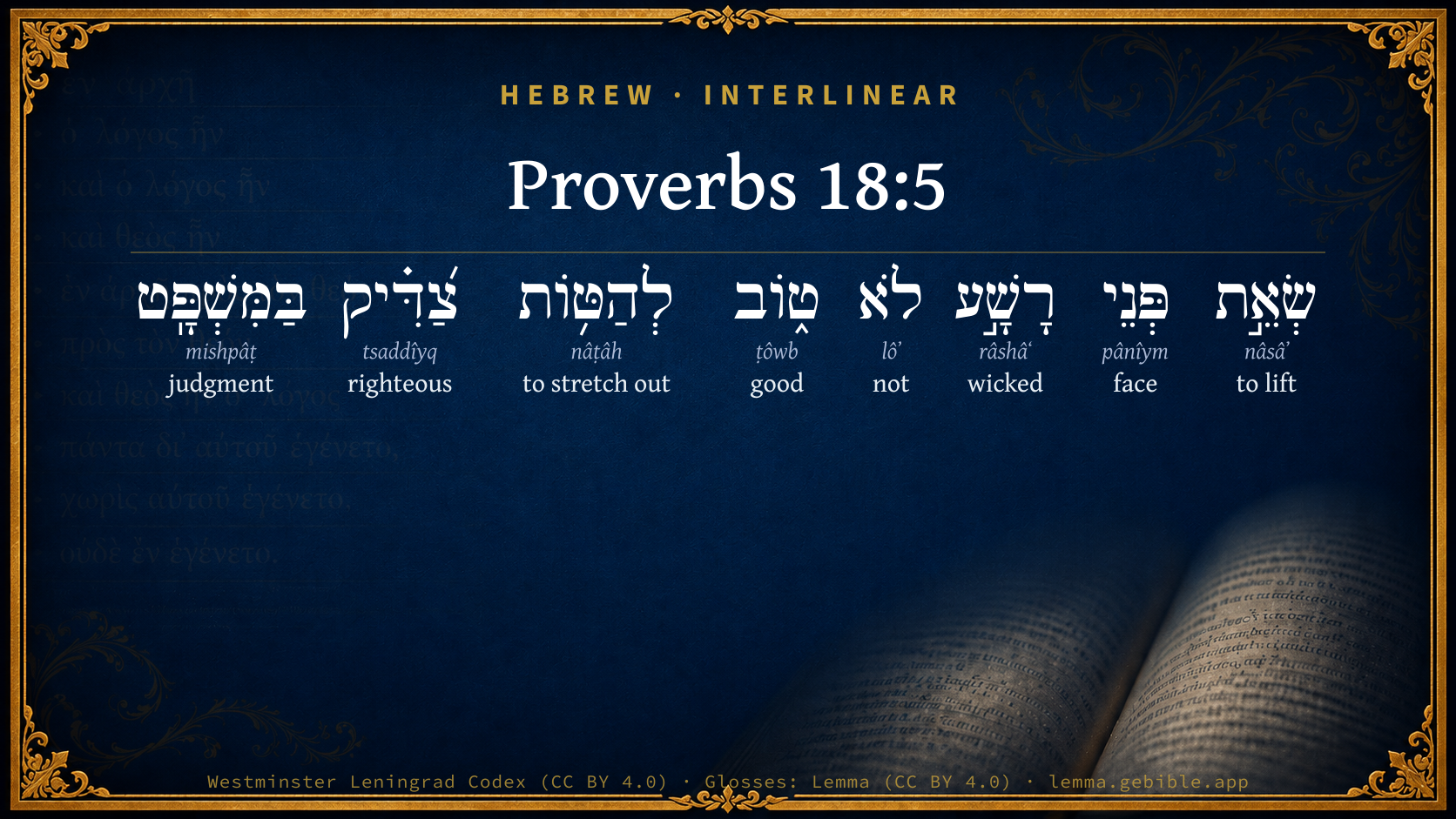
Hebrew (Westminster Leningrad Codex) Proverbs 18:5 appears in the Hebrew Old Testament. The text above is from the Westminster Leningrad Codex. Each word links to its Strong’s number, a concise gloss, and parsing drawn from the Open Scriptures Hebrew Bible morphology. Click any word for its full Brown-Driver-Briggs (BDB) entry.
Download image
Cite this verse

Proverbs 18:5 (World English Bible). Public Domain. Lemma interlinear Bible study tool, https://lemma.gebible.app/v/proverbs/18/5.

Show BibTeX & RIS
BibTeX
RIS
English Translation
To be partial to the faces of the wicked is not good, Nor to deprive the innocent of justice.
World English Bible · Public Domain
Download a study sheet

One document with this verse’s original text, its word-by-word gloss line, the meaning frame, cross-references with their text, attributed commentary, and full source and license credits — printable, and it pastes into notes with its structure intact.

This verse Autodidact and up

Study sheet (.html) Plain text (.txt)

A passage Seminary Student

Up to 50 verses in one chapter. A passage sheet keeps up to 6 commentary sources and 12 cross-references per verse, in the order this page ranks them, and says so on the sheet whenever that leaves anything out. Ask for a single verse and you get the Autodidact verse sheet above.

Everything on this page stays free to read, with no account — the sheet is a download of what is already on screen, not access to it.

Want to remove ads? Support Godless Engineer
Compare translations 3

The same verse in 3 English versions, stacked beneath the original-language interlinear above. Click any original word for its lexicon entry.

Each is an independent rendering of the whole verse — the interlinear is not word-aligned to these translations.

Highlighted words mark where these versions differ — a whole-verse word diff, not a word-by-word alignment.

  • World English Bible Public Domain
    To be partial to the faces of the wicked is not good, Nor to deprive the innocent of justice.
  • King James Version Public Domain
    It is not good to accept the person of the wicked, to overthrow the righteous in judgment.
  • unfoldingWord Literal Text CC BY-SA 4.0
    not good to lift the face of the wicked, to turn aside the righteous in the judgment.

unfoldingWord Literal Text — © unfoldingWord, licensed CC BY-SA 4.0. Word-aligned USFM3 via Door43 (git.door43.org/unfoldingWord/en_ult).

Versions to compare (up to 4)

3 of 4 selected

Show all 18 translations

Every available English version of this verse, each an independent rendering of the whole verse.

  • World English Bible Public Domain
    To be partial to the faces of the wicked is not good, Nor to deprive the innocent of justice.
  • Berean Standard Bible Public Domain
    Showing partiality to the wicked is not good, nor is depriving the innocent of justice.
  • Majority Standard Bible Public Domain
    Showing partiality to the wicked is not good, nor is depriving the innocent of justice.
  • King James Version Public Domain
    It is not good to accept the person of the wicked, to overthrow the righteous in judgment.
  • American Standard Version (1901) Public Domain
    To respect the person of the wicked is not good, `Nor' to turn aside the righteous in judgment.
  • Revised Version (1885) Public Domain
    To accept the person of the wicked is not good, nor to turn aside the righteous in judgment.
  • Geneva Bible (1599) Public Domain
    It is not good to accept the person of the wicked, to cause ye righteous to fall in iudgement.
  • Douay-Rheims (1899) Public Domain
    It is not good to accept the person of the wicked, to decline from the truth of judgment.
  • Young's Literal Translation Public Domain
    Acceptance of the face of the wicked `is' not good, To turn aside the righteous in judgment.
  • Literal Standard Version CC BY-SA 4.0
    Favoring of the face of the wicked [is] not good, || To turn aside the righteous in judgment.
  • Unlocked Literal Bible CC BY-SA 4.0
    It is not good to be partial to the wicked person, nor to deny justice to the righteous person.
  • unfoldingWord Literal Text CC BY-SA 4.0
    not good to lift the face of the wicked, to turn aside the righteous in the judgment.
  • Darby Bible Public Domain
    It is not good to accept the person of the wicked, to wrong the righteous in judgment.
  • World Messianic Bible Public Domain
    To be partial to the faces of the wicked is not good, nor to deprive the innocent of justice.
  • Webster's Bible Public Domain
    It is not good to accept the person of the wicked, to overthrow the righteous in judgment.
  • Free Bible Version CC BY-SA 4.0
    It's not right to show favoritism to the guilty and rob the innocent of justice.
  • Bible in Basic English Public Domain
    To have respect for the person of the evil-doer is not good, or to give a wrong decision against the upright.
  • JPS Tanakh (1917) Public Domain
    It is not good to respect the person of the wicked, so as to turn aside the righteous in judgment.

Literal Standard Version (2020), Covenant Press — licensed CC BY-SA 4.0. Text via the HelloAO Bible API (eBible.org). Unlocked Literal Bible (unfoldingWord) — licensed CC BY-SA 4.0. Text via the HelloAO Bible API (eBible.org). unfoldingWord Literal Text — © unfoldingWord, licensed CC BY-SA 4.0. Word-aligned USFM3 via Door43 (git.door43.org/unfoldingWord/en_ult). Free Bible Version, Dr. Jonathan Gallagher — licensed CC BY-SA 4.0. Text via the HelloAO Bible API (eBible.org).

Word by word

More ways to search: Search by grammar → Find every occurrence → Compare this word →

Practice this passage: Drill this verse → Learn its vocabulary →

About this verse

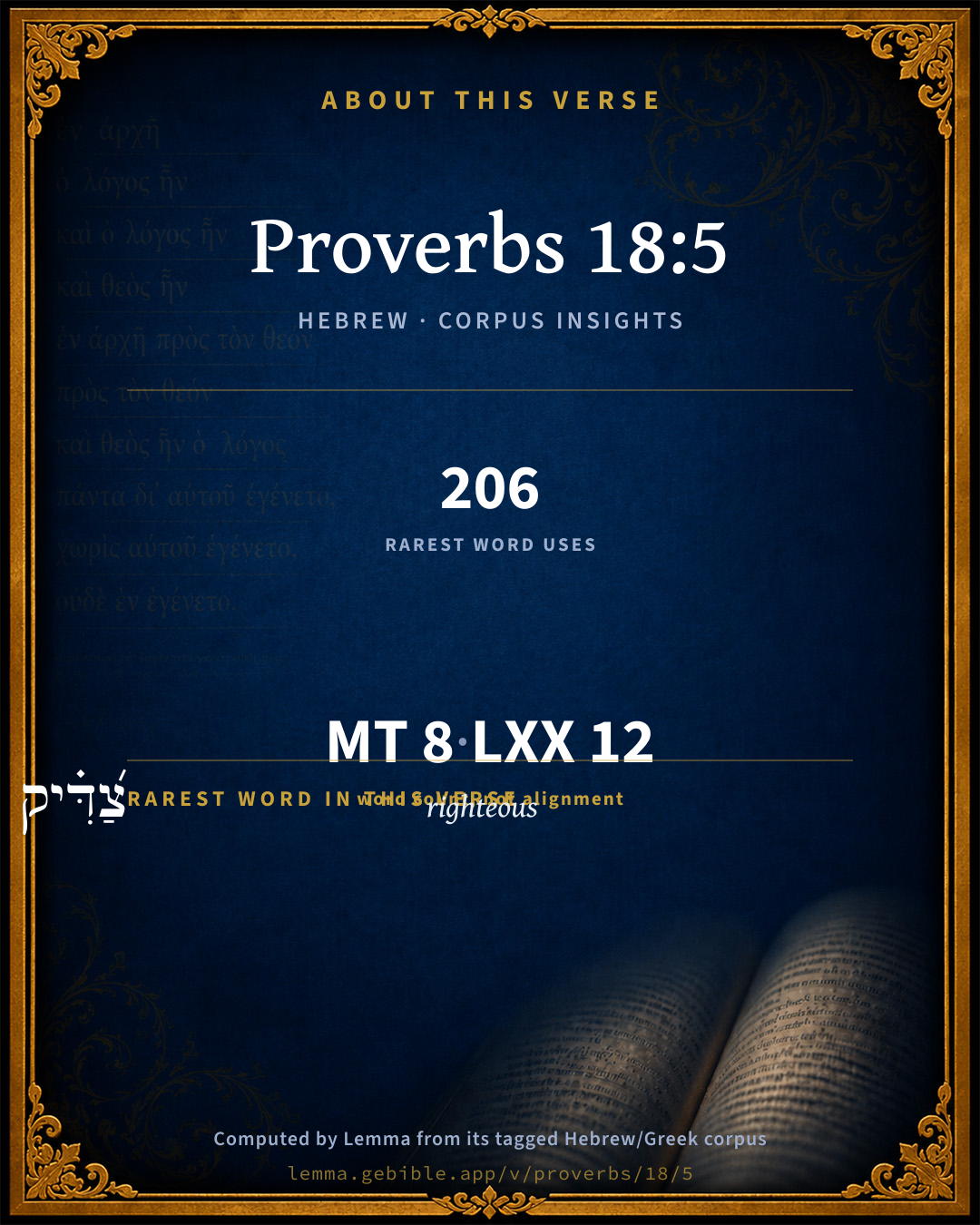
These counts appear in no published source. They are computed here, from the morphology-tagged text and Lemma’s own curated glosses. What Lemma adds →

8
words
8
distinct lemmas
Wisdom
section

Grammatical profile

  • 2 verbs
  • 2 nouns
  • 3 adjectives
  • 1 particle

Verb forms

  • שְׂאֵ֣ת Qal · Infinitive Construct
  • לְהַטּ֥וֹת Hiphil · Infinitive Construct

Hebrew & Septuagint length

In English translation the verse runs 19 words from the Hebrew and 20 from the Septuagint (LXX English) — closely comparable.

A rough comparison of the two English renderings, which tokenize alike — not a word-level alignment.

Word counts can differ between the Hebrew and the Greek without any difference in meaning — e.g. the Hebrew direct-object marker אֵת has no separate Greek word, and Greek often adds the article ὁ.

In the original languages it is 8 Hebrew tokens and 12 Greek tokens — but the two are counted differently (Hebrew bundles its prefixes and suffixes into one token; the Greek is in lemma form), so that isn’t a like-for-like length.

Cross-references

13

Topical passages linked to Proverbs 18:5 in the Treasury of Scripture Knowledge — connected by theme and wording, ordered by reader-vote popularity; previews shown in the World English Bible.

  • Leviticus 19:15 "'You shall do no injustice in judgment: you shall not be partial to the poor, nor show favoritism to the great; but in righteousness shall you judge your neighbor.
  • Deuteronomy 16:19 You shall not wrest justice: you shall not respect persons; neither shall you take a bribe; for a bribe does blind the eyes of the wise, and pervert the words of the righteous.
  • Psalms 82:2 "How long will you judge unjustly, And show partiality to the wicked?" Selah.
  • Proverbs 28:21 To show partiality is not good; Yet a man will do wrong for a piece of bread.
  • Proverbs 17:15 He who justifies the wicked, and he who condemns the righteous, Both of them alike are an abomination to Yahweh.
  • Proverbs 24:23 These also are sayings of the wise. To show partiality in judgment is not good.
  • Deuteronomy 1:16–17 I charged your judges at that time, saying, Hear [the causes] between your brothers, and judge righteously between a man and his brother, and the foreigner who is living with him.
  • Isaiah 5:23 Who acquit the guilty for a bribe, But deny justice for the innocent!
  • Matthew 22:16 They sent their disciples to him, along with the Herodians, saying, "Teacher, we know that you are honest, and teach the way of God in truth, no matter who you teach, for you aren't partial to anyone.
  • 1 Kings 21:9–14 She wrote in the letters, saying, Proclaim a fast, and set Naboth on high among the people:
  • Job 34:19 Who doesn't respect the persons of princes, Nor regards the rich more than the poor; For they all are the work of his hands.
  • Job 13:7–8 Will you speak unrighteously for God, And talk deceitfully for him?
  • Micah 7:3 Their hands are on that which is evil to do it diligently. The ruler and judge ask for a bribe; And the powerful man dictates the evil desire of his soul. Thus they conspire together.

Cross-references courtesy of OpenBible.info (CC BY 4.0).

Hebrew and Greek witnesses Masoretic Hebrew ↔ Greek Septuagint

The same verse in the two great witnesses to the Old Testament, shown verse-for-verse.

These are two independent witnesses, not word-aligned to each other, and the Septuagint is shown in lemma (dictionary) form.

Hebrew Proverbs 18:5 Masoretic · Westminster Leningrad Codex

שְׂאֵ֣ת פְּנֵי רָשָׁ֣ע לֹא ט֑וֹב לְהַטּ֥וֹת צַ֝דִּ֗יק בַּמִּשְׁפָּֽט

To be partial to the faces of the wicked is not good, Nor to deprive the innocent of justice.

World English Bible · Public Domain

Greek LXX Proverbs 18:5 Septuagint · lemma form

θαυμάζω πρόσωπον ἀσεβής οὐ καλός οὐδέ ὅσιος ἐκκλίνω ὁ δίκαιος ἐν κρίσις

It is not good to accept the person of the ungodly, nor is it holy to pervert justice in judgment.

LXX2012 (modern English Septuagint) · Public Domain

On this verse, The Pulpit Commentary discusses the Septuagint’s reading. Read the note in Commentary ↓

Hebrew: Westminster Leningrad Codex (CC BY 4.0). Greek: Septuagint (public domain); English from LXX2012 (modern English Septuagint) (Public Domain). How the Septuagint differs from the Hebrew →

Commentary

Notes on Proverbs 18:5 from classic Christian and Jewish commentators (each source and its license shown beneath its notes). The classic Christian expositions comment on the surrounding passage and are grouped to its opening verse, so a note may address several verses; the Jewish commentaries on the Tanakh (Rashi and others) are per-verse, so they appear only where the commentator wrote on this verse.

Lemma curates 59 commentaries, every one of them public domain or Creative Commons licensed, each selected and text-cleaned for this edition rather than reprinted as found. About our sources →

Trapp's Complete Commentary

John Trapp

Pro 18:5 [It is] not good to accept the person of the wicked, to overthrow the righteous in judgment.

Ver. 5. It is not good to accept the person of the wicked.] Indeed, it is so bad as can hardly be expressed, and is therefore here set forth by the figure liptote; which is, say grammarians, cum minus dicitur, plus intelligitur, when little is said, but more is understood. {a} This accepting of persons, declared here to be so very naught, is either in passing sentence of judgment, of which see Lev 19:15; {See Trapp on "Lev 19:15"} or otherwise in common conversation, of which read Jas 2:1-4. {See Trapp on "Jas 2:1"} {See Trapp on "Jas 2:2"} {See Trapp on "Jas 2:3"} {See Trapp on "Jas 2:4"}

To overthrow the righteous in judgment.] Which is the easilier done, because they cannot quarrel and contend as the wicked can. "The fool’s lips enter into contentions"; {Pro 18:6} they have an art in it; they are dexterous at it; it is their trade and study to brabble and wrangle, to set a good face upon an ill matter, to rail and out brave, to set men further at odds, and to embitter their spirits one against another. This is a trick they have learned of their father the devil; and this their graceless speeches do as directly tend unto, as if they had legs to go into contention.

{a} Ut apud Virgil. Nec nulla innata est inaratae gratia terrae. - Georg., ii.

John Trapp, A Commentary or Exposition upon All the Books of the Old and New Testament (1647–1656) — public domain. Text from a community e-Sword module.

Keil & Delitzsch

C. F. Keil & F. Delitzsch

5 To favour the person of the godless is not good,

And to oppress the righteous in judgment.

As Pro 18:4 has one subject, so Pro 18:5 has one predicate. The form is the same as Pro 17:26. שׂאת פּני (cf. Pro 24:23), προσωποληψία, acceptio personae, is this, that one accepts the פני, i.e. the personal appearance of any one (πρόσωπον λαμβάνει), i.e., regards it as acceptable, respectable, agreeable, which is a thing in itself not wrong; but in a judge who ought to determine according to the facts of the case and the law, it becomes sinful partiality. הטּות, in a forensic sense, with the accus. of the person, may be regarded in a twofold way: either as a turning aside, מדּין, Isa 10:2, from following and attaining unto the right, or as an oppression, for the phrase הטּה משׁפּט [to pervert justice] (cf. Pro 17:23) is transferred to the person who experiences the oppression = perversion of the law; and this idea perhaps always underlies the expression, wherever, as e.g., Mal 3:5, no addition brings with it the other. Under Pro 17:15 is a fuller explanation of לא־טוב.

Keil & Delitzsch — Biblical Commentary on the Old Testament (1861–1891) — public domain (CC PDM 1.0). Text via the HelloAO Bible API. (Old Testament only.)

Geneva Bible (1599)

Geneva Bible translators

That is, to favor him and support him.

Geneva Bible (1599) marginal notes — public domain. Text via Bolls.life.

Matthew Henry's Commentary

This justly condemns those who, being employed in the administration of justice, pervert judgment, 1. By conniving at men's crimes, and protecting and countenancing them in oppression and violence, because of their dignity, or wealth, or some personal kindness they have for them. Whatever excuses men may make for it, certainly it is not good thus to accept the person of the wicked; it is an offence to God, an affront to justice, a wrong to mankind, and a real service done to the kingdom of sin and Satan. The merits of the cause must be regarded, not the person. 2. By giving a cause against justice and equity, because the person is poor and low in the world, or not of the same party or persuasion, or a stranger of another country. This is overthrowing the righteous in judgment, who ought to be supported, and whom God will make to stand.

Matthew Henry's Commentary on the Whole Bible (1708–1710) — public domain (CC PDM 1.0). Text via the HelloAO Bible API.

Jamieson, Fausset & Brown

Robert Jamieson, A. R. Fausset & David Brown

accept the person--(Compare Psa 82:2). "It is not good" is to be supplied before "to overthrow."

Jamieson, Fausset & Brown — Commentary Critical and Explanatory on the Whole Bible (1871) — public domain (CC PDM 1.0). Text via the HelloAO Bible API.

Adam Clarke's Commentary

Verse 5. To accept the person of the wicked] We must not, in judicial cases, pay any attention to a man's riches, influence, friends, offices, &c., but judge the case according to its own merits. But when the wicked rich man opposes and oppresses the poor righteous, then all those things should be utterly forgotten.

Adam Clarke's Commentary on the Bible (1810–1826) — public domain. Text from a community e-Sword/MySword module.

The Cambridge Bible for Schools and Colleges

gen. ed. J. J. S. Perowne

5. to overthrow] i.e. so as to, or with a view to, overthrow. See R.V. marg. Better perhaps with R.V. text, nor to turn aside.

The Cambridge Bible for Schools and Colleges (gen. ed. J. J. S. Perowne; Cambridge University Press, 1878–1918) — public domain. Text from a community e-Sword module.

John Gill's Exposition

It is not good to accept the person of the wicked,.... For a judge to have respect to a wicked man in a cause before him, and to favour him, because he is a rich man, or a relation, or he has received some kindness from him; none of these things should have any influence upon him

to overthrow the righteous in judgment: though he may be a poor man and a stranger, and to whom the judge is under no private and personal obligation; yet justice ought to be done without any respect to persons; to do otherwise is not only not good, but very bad, very sinful and criminal; it is contrary to law and justice; it is doing injury to men, and is repugnant to the will of God, and offensive to him, Lev 19:15.

John Gill's Exposition of the Whole Bible (1746–1763) — public domain (CC PDM 1.0). Text via the HelloAO Bible API.

Matthew Poole's English Annotations

It is not good, i.e. it is a most wicked and hateful thing. See Poole "Pro 17:15,26.

To accept the person; to favour his unrighteous cause.

Matthew Poole's English Annotations on the Holy Bible (1683–1685) — public domain. Text from a community e-Sword/MySword module.

Whedon's Commentary on the Bible

Daniel D. Whedon

5. It is not good — That is, it is bad, wrong. (See on Pro_17:26.)

To accept the person — Or face; to show partiality to the wicked on account of his wealth, respectability, or other like reason. (Comp. Pro_19:15; Deu_10:17.)

To overthrow… in judgment — In a judicial proceeding. Compare Pro_17:15; Isa_10:2; Pro_17:23; Pro_24:23; Psa_82:2; Deu_1:17; Deu_16:19, last cause.

Daniel D. Whedon (gen. ed.), Commentary on the Old and New Testaments (1874–1909) — public domain. Text from a community e-Sword module.

The Pulpit Commentary

It is not good to accept the person of the wicked. To "accept the person" is to show partiality, to be guided in judgment, not by the facts of a case, or the abstract principles of right or wrong, but by extraneous considerations, as a man"s appearance, manners, fortune, family. (For the expression, comp. Lev_19:15 Deu_1:17; and in our Pro_24:23 Pro_28:21) The Septuagint phrase is yaumasai proswpon , which St. Jude adopts book (ver. 16). Other writers in the New Testament use lambanein proswton in the same sense; e.g. (Gal_2:6) To overthrow (turn aside) the righteous in judgment is not good. (comp. Isa_10:2 Luk_20:21) The construction is the same as in Pro_17:26. The LXX adds in the second clause, oude osion , which makes the sentence clear; not seeing this, the Vulgate renders, ut declines a veritate judicii. The offence censured is the perversion of justice in giving sentence against a righteous man whose cause the judge has reason to know is just.

The Pulpit Commentary (1880–1919), ed. H.D.M. Spence-Jones & Joseph S. Exell — public domain. Text from a community e-Sword module.

Bridges on Proverbs

Charles Bridges

Were not "the foundations of the earth out of course," should we hear of so gross a violation of the rule of right? (Psa 82:2-5 .) But in a world, of which Satan is "the god and the prince," injustice is a natural principle of administration. The godly king of Judah pointed his judges to the Divine example — ’Look — and be like Him.’ (2Ch 19:7 .) Everything revolting is connected with wickedness. There is no one so noble, that it does not degrade; so lovely, that it does not deform; so learned, that it does not befool. To accept therefore his person, is indeed not good.†1 "Abomination," is its true name — the stamp of God.†2 ’Whatever excuses man may make for its course, it is an offense to God, an affront to justice, a wrong to mankind, and a real service done to the kingdom of sin and Satan.’†3 In judgment let the cause be heard, not the person. Let the person be punished for his wickedness, not the wickedness be covered for the person’s sake. When, as in the case of Naboth, the person of the wicked was accepted, to overthrow the righteous in judgment, it overthrows the throne of judgment in the land. The Shechemites were sharply punished for their sin, in accepting Abimelech to the overthrow of the righteous claims of Gideon’s house. (Jdg 9:1-54 .) No wonder. In such wickedness the rights of God are despised; the claims of his justice are cast off. "He that ruleth over men must be just, ruling in the fear of God." (2Sa 23:3 .) Such was our Divine pattern in the flesh: "of quick understanding in the fear of the LORD," and therefore "judging in righteousness." (Isa 11:4 .) Such will be his judgment, when "he shall judge the world in righteousness." (Act 17:31 .) His decision will be exact; his sentence unchangeable.

Footnotes:

†1 Pro 17:26; Pro 24:23 ; Pro 28:21 .

†2 Pro 17:15. Compare Lev 19:15 ; Deu 1:16-17 .

†3 Henry.

Charles Bridges, An Exposition of the Book of Proverbs (1846) — public domain. Text from a community e-Sword module.

Kretzmann's Popular Commentary

Paul E. Kretzmann

v. 5. It is not good to accept the person of the wicked, to favor him in any way, especially in a court case, to overthrow the righteous in judgment, so that he loses his case on account of the partiality of the judge.

Paul E. Kretzmann, Popular Commentary of the Bible (1921–1924) — public domain. Text from a community e-Sword module.

unfoldingWord translationNotes

Door43 World Missions Community

It is not good to ... to the righteous person

These phrases can be written in positive form. AT: "It is good to treat the wicked person as he deserves, and to be just to the righteous person" (See: Litotes)

A fool's lips bring

Here the fool is referred to by his "lips" to emphasize what he says. AT: "what a fool says brings" (See: Synecdoche)

bring

"cause"

his mouth invites a beating

This speaks of the fool saying things that cause people to want to beat him as if he were inviting them to beat him. AT: "his mouth makes people want to beat him" (See: Metaphor)

his mouth

Here what the fool says is referred to as his "mouth." AT: "what he says" (See: Metonymy)

translationWords

partial

evil

just

fool

unfoldingWord translationNotes — © Distant Shores Media and the Door43 World Missions Community, licensed CC BY-SA 4.0. Source: git.door43.org/Door43/en_tn.

Rashi

Rabbi Shlomo Yitzchaki (Rashi)

It is not good to be partial to the wicked As our Sages explained: It is not good for the wicked, that they are favored in this world and are requited in the next world.

to subvert the righteous in judgment It is good for the righteous that the scale is weighed down for them to make them guilty in this world, where they are requited during their lifetime, and they merit the world to come. Its simple meaning, however, is according to its apparent meaning.

Rashi on the Tanakh — English translations: “The Judaica Press complete Tanach with Rashi, translated by A. J. Rosenberg” (CC BY 4.0); “Pentateuch with Rashi's commentary by M. Rosenbaum and A.M. Silbermann, 1929-1934” (public domain); “The Metsudah Tanach series, Lakewood, N.J” (CC BY 4.0); and “The Book of Joshua, Metsudah Publications, 1997” (CC BY 4.0). Text via Sefaria.

Lesson kit

Teaching starters — assembled from the data on this page, not authored interpretation. Every prompt links to the verse data it draws on. Edit before teaching.

Proverbs, in the Wisdom, opens this verse with 8 words (8 distinct Hebrew lemmas). Its most distinctive word is tsaddîyq (“righteous”). A historical commentator’s framing appears above. Read the whole chapter for the surrounding context.

Discussion questions

  1. The word tsaddîyq carries the sense “righteous.” How does it shape the verse?
  2. How does Leviticus 19:15, which shares this passage’s theme, read alongside this verse?
  3. These translations render this verse differently; the difference is in the English rendering, not the original. What questions does that raise?
  4. «שְׂאֵ֣ת» is a Qal Infinitive Construct verb. How does that grammatical form shape the action described?
  5. Compare how Trapp's Complete Commentary and Keil & Delitzsch read this verse. Where do they agree or differ?

Things to notice

Reading settings

Reading text

Shown beneath each verse's original-language words.

Old Testament
Old Testament edition

Read the OT as the Masoretic Hebrew (MT) or the Greek Septuagint (LXX).

English shown for the Greek Septuagint (in the Hebrew ↔ Greek comparison).

Comparing translations? Open the Compare panel on any verse page to stack up to four side by side.