
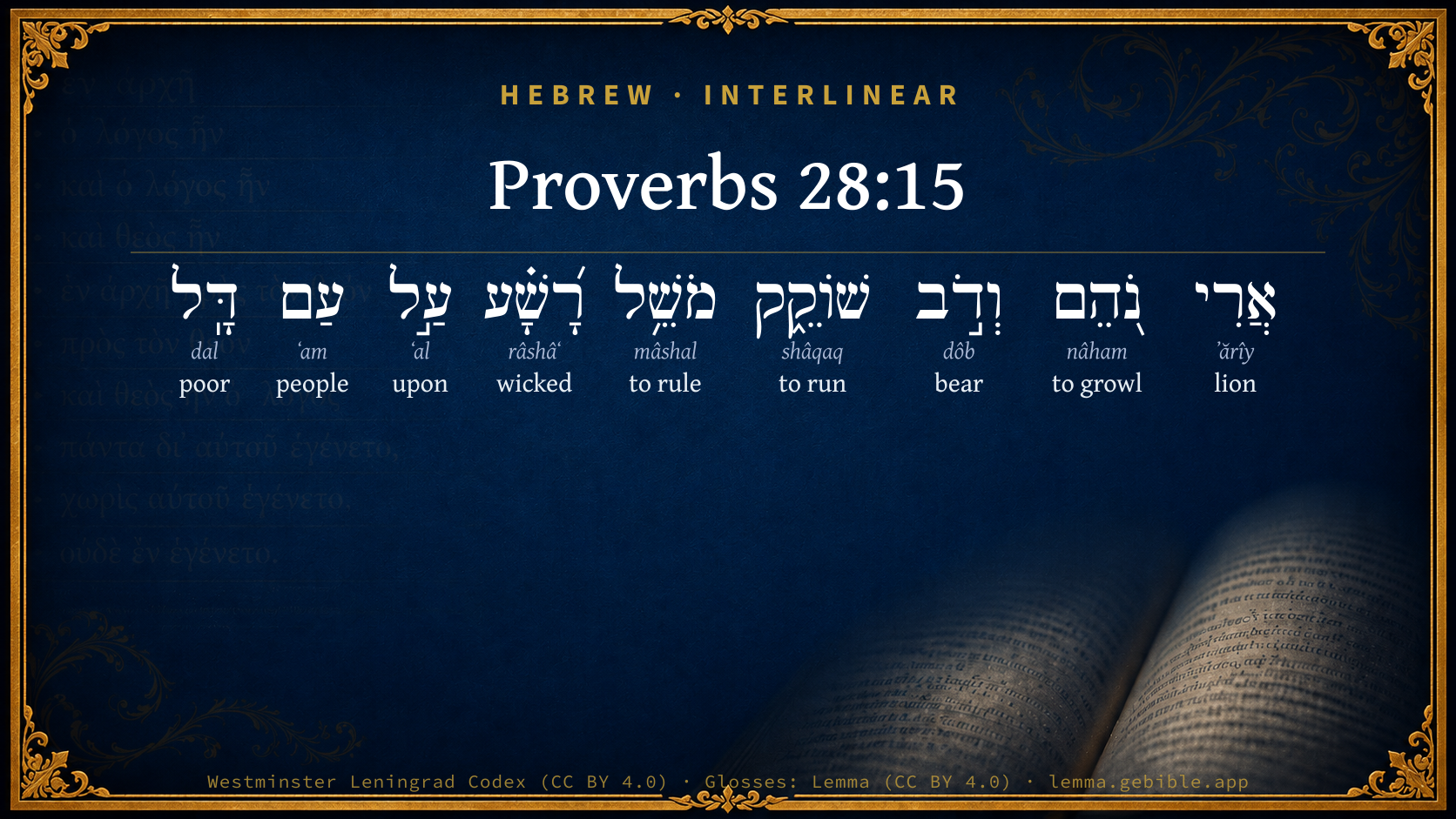
Proverbs 28:15

Hebrew (Westminster Leningrad Codex) Proverbs 28:15 appears in the Hebrew Old Testament. The text above is from the Westminster Leningrad Codex. Each word links to its Strong’s number, a concise gloss, and parsing drawn from the Open Scriptures Hebrew Bible morphology. Click any word for its full Brown-Driver-Briggs (BDB) entry.
Download image
Cite this verse

Proverbs 28:15 (World English Bible). Public Domain. Lemma interlinear Bible study tool, https://lemma.gebible.app/v/proverbs/28/15.

Show BibTeX & RIS
BibTeX
RIS
English Translation
As a roaring lion or a charging bear, So is a wicked ruler over helpless people.
World English Bible · Public Domain
Download a study sheet

One document with this verse’s original text, its word-by-word gloss line, the meaning frame, cross-references with their text, attributed commentary, and full source and license credits — printable, and it pastes into notes with its structure intact.

This verse Autodidact and up

Study sheet (.html) Plain text (.txt)

A passage Seminary Student

Up to 50 verses in one chapter. A passage sheet keeps up to 6 commentary sources and 12 cross-references per verse, in the order this page ranks them, and says so on the sheet whenever that leaves anything out. Ask for a single verse and you get the Autodidact verse sheet above.

Everything on this page stays free to read, with no account — the sheet is a download of what is already on screen, not access to it.

Want to remove ads? Support Godless Engineer
Compare translations 3

The same verse in 3 English versions, stacked beneath the original-language interlinear above. Click any original word for its lexicon entry.

Each is an independent rendering of the whole verse — the interlinear is not word-aligned to these translations.

Highlighted words mark where these versions differ — a whole-verse word diff, not a word-by-word alignment.

  • World English Bible Public Domain
    As a roaring lion or a charging bear, So is a wicked ruler over helpless people.
  • King James Version Public Domain
    As a roaring lion, and a ranging bear; so is a wicked ruler over the poor people.
  • unfoldingWord Literal Text CC BY-SA 4.0
    A lion growling and a bear charging a wicked ruler over a lowly people.

unfoldingWord Literal Text — © unfoldingWord, licensed CC BY-SA 4.0. Word-aligned USFM3 via Door43 (git.door43.org/unfoldingWord/en_ult).

Versions to compare (up to 4)

3 of 4 selected

Show all 18 translations

Every available English version of this verse, each an independent rendering of the whole verse.

  • World English Bible Public Domain
    As a roaring lion or a charging bear, So is a wicked ruler over helpless people.
  • Berean Standard Bible Public Domain
    Like a roaring lion or a charging bear is a wicked ruler over a helpless people.
  • Majority Standard Bible Public Domain
    Like a roaring lion or a charging bear is a wicked ruler over a helpless people.
  • King James Version Public Domain
    As a roaring lion, and a ranging bear; so is a wicked ruler over the poor people.
  • American Standard Version (1901) Public Domain
    `As' a roaring lion, and a ranging bear, `So is' a wicked ruler over a poor people.
  • Revised Version (1885) Public Domain
    As a roaring lion, and a ranging bear; so is a wicked ruler over a poor people.
  • Geneva Bible (1599) Public Domain
    As a roaring lyon, and an hungry beare, so is a wicked ruler ouer the poore people.
  • Douay-Rheims (1899) Public Domain
    As a roaring lion, and a hungry bear, so is a wicked prince over the poor people.
  • Young's Literal Translation Public Domain
    A growling lion, and a ranging bear, `Is' the wicked ruler over a poor people.
  • Literal Standard Version CC BY-SA 4.0
    A growling lion, and a ranging bear, || [Is] the wicked ruler over a poor people.
  • Unlocked Literal Bible CC BY-SA 4.0
    Like a roaring lion or a charging bear is a wicked ruler over poor people.
  • unfoldingWord Literal Text CC BY-SA 4.0
    A lion growling and a bear charging a wicked ruler over a lowly people.
  • Darby Bible Public Domain
    A roaring lion, and a ranging bear, is a wicked ruler over a poor people.
  • World Messianic Bible Public Domain
    As a roaring lion or a charging bear, so is a wicked ruler over helpless people.
  • Webster's Bible Public Domain
    As a roaring lion, and a ranging bear; so is a wicked ruler over the poor people.
  • Free Bible Version CC BY-SA 4.0
    A wicked ruler lording it over poor people is like a roaring lion or a charging bear.
  • Bible in Basic English Public Domain
    Like a loud-voiced lion and a wandering bear, is an evil ruler over a poor people.
  • JPS Tanakh (1917) Public Domain
    As a roaring lion, and a ravenous bear; so is a wicked ruler over a poor people.

Literal Standard Version (2020), Covenant Press — licensed CC BY-SA 4.0. Text via the HelloAO Bible API (eBible.org). Unlocked Literal Bible (unfoldingWord) — licensed CC BY-SA 4.0. Text via the HelloAO Bible API (eBible.org). unfoldingWord Literal Text — © unfoldingWord, licensed CC BY-SA 4.0. Word-aligned USFM3 via Door43 (git.door43.org/unfoldingWord/en_ult). Free Bible Version, Dr. Jonathan Gallagher — licensed CC BY-SA 4.0. Text via the HelloAO Bible API (eBible.org).

Word by word

More ways to search: Search by grammar → Find every occurrence → Compare this word →

Practice this passage: Drill this verse → Learn its vocabulary →

About this verse

These counts appear in no published source. They are computed here, from the morphology-tagged text and Lemma’s own curated glosses. What Lemma adds →

9
words
9
distinct lemmas
Wisdom
section

Notable vocabulary

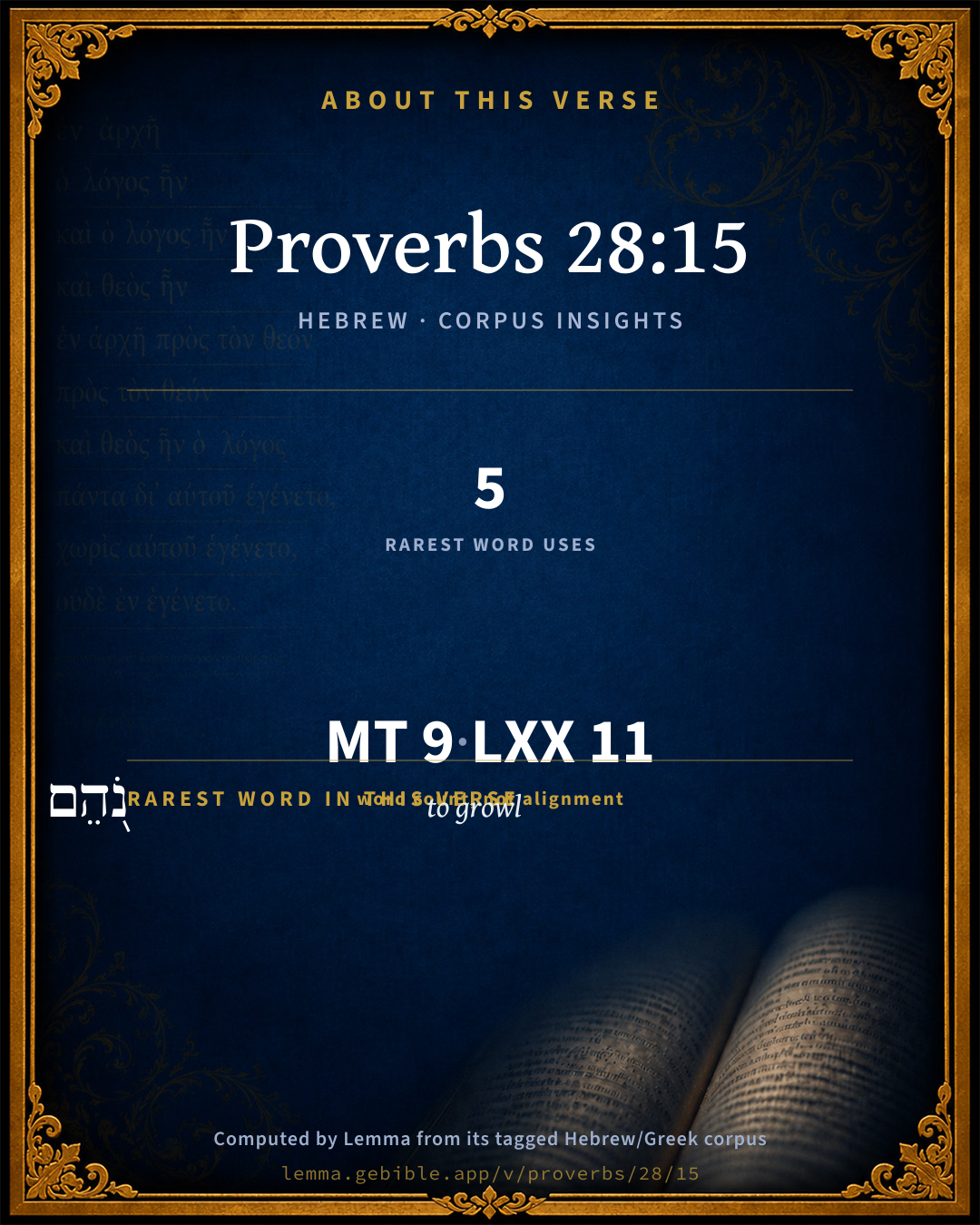
The rarest word here is נֹ֭הֵם to growl H5098 — appearing just 5 times in the whole Hebrew Bible.

Shared distinctive vocabulary

נֹ֭הֵם to growl H5098 occurs in 5 verses of the Hebrew Bible. Also found in:

Grammatical profile

  • 3 verbs
  • 3 nouns
  • 2 adjectives
  • 1 preposition

Verb forms

  • נֹ֭הֵם Qal · Participle Active
  • שׁוֹקֵ֑ק Qal · Participle Active
  • מֹשֵׁ֥ל Qal · Participle Active

Hebrew & Septuagint length

In English translation the verse runs 16 words from the Hebrew and 17 from the Septuagint (LXX English) — closely comparable.

A rough comparison of the two English renderings, which tokenize alike — not a word-level alignment.

Word counts can differ between the Hebrew and the Greek without any difference in meaning — e.g. the Hebrew direct-object marker אֵת has no separate Greek word, and Greek often adds the article ὁ.

In the original languages it is 9 Hebrew tokens and 11 Greek tokens — but the two are counted differently (Hebrew bundles its prefixes and suffixes into one token; the Greek is in lemma form), so that isn’t a like-for-like length.

Cross-references

14

Topical passages linked to Proverbs 28:15 in the Treasury of Scripture Knowledge — connected by theme and wording, ordered by reader-vote popularity; previews shown in the World English Bible.

  • 1 Peter 5:8 Be sober and self-controlled. Be watchful. Your adversary the devil, walks around like a roaring lion, seeking whom he may devour.
  • Matthew 2:16 Then Herod, when he saw that he was mocked by the wise men, was exceedingly angry, and sent out, and killed all the male children who were in Bethlehem and in all the surrounding countryside, from two years old and under, according to the exact time which he had learned from the wise men.
  • Exodus 1:22 Pharaoh charged all his people, saying, "You shall cast every son who is born into the river, and every daughter you shall save alive."
  • Proverbs 19:12 The king's wrath is like the roaring of a lion, But his favor is like dew on the grass.
  • Proverbs 20:2 The terror of a king is like the roaring of a lion: He who provokes him to anger forfeits his own life.
  • Exodus 1:14–16 and they made their lives bitter with hard service, in mortar and in brick, and in all manner of service in the field, all their service, in which they ruthlessly made them serve.
  • 1 Samuel 22:17–19 The king said to the guard who stood about him, Turn, and kill the priests of Yahweh; because their hand also is with David, and because they knew that he fled, and didn't disclose it to me. But the servants of the king wouldn't put forth their hand to fall on the priests of Yahweh.
  • 2 Kings 21:16 Moreover Manasseh shed innocent blood very much, until he had filled Jerusalem from one end to another; besides his sin with which he made Judah to sin, in doing that which was evil in the sight of Yahweh.
  • 2 Kings 2:24 He looked behind him and saw them, and cursed them in the name of Yahweh. There came forth two she-bears out of the wood, and mauled forty-two lads of them.
  • 2 Kings 15:16 Then Menahem struck Tiphsah, and all who were therein, and the borders of it, from Tirzah: because they didn't open to him, therefore he struck it; and all the women therein who were with child he ripped up.
  • Esther 3:6–10 But he scorned the thought of laying hands on Mordecai alone; for they had made known to him the people of Mordecai: therefore Haman sought to destroy all the Jews who were throughout the whole kingdom of Ahasuerus, even the people of Mordecai.
  • Proverbs 17:12 Let a bear robbed of her cubs meet a man, Rather than a fool in his folly.
  • Hosea 5:11 Ephraim is oppressed, He is crushed in judgment; Because he is intent in his pursuit of idols.
  • Hosea 13:8 I will meet them like a bear that is bereaved of her cubs, And will tear the covering of their heart. And there I will devour them like a lioness. The wild animal will tear them.

Cross-references courtesy of OpenBible.info (CC BY 4.0).

Hebrew and Greek witnesses Masoretic Hebrew ↔ Greek Septuagint

The same verse in the two great witnesses to the Old Testament, shown verse-for-verse.

These are two independent witnesses, not word-aligned to each other, and the Septuagint is shown in lemma (dictionary) form.

Hebrew Proverbs 28:15 Masoretic · Westminster Leningrad Codex

אֲרִי נֹ֭הֵם וְדֹ֣ב שׁוֹקֵ֑ק מֹשֵׁ֥ל רָ֝שָׁ֗ע עַ֣ל עַם דָּֽל

As a roaring lion or a charging bear, So is a wicked ruler over helpless people.

World English Bible · Public Domain

Greek LXX Proverbs 28:15 Septuagint · lemma form

λέων πεινάω καί λύκος διψάω ὅς τυραννέω πτωχός εἰμί ἔθνος πενιχρός

A hungry lion and a thirsty wolf is he, who, being poor, rules over a poor nation.

LXX2012 (modern English Septuagint) · Public Domain

On this verse, The Cambridge Bible for Schools and Colleges discusses the Septuagint’s reading. Read the note in Commentary ↓

Hebrew: Westminster Leningrad Codex (CC BY 4.0). Greek: Septuagint (public domain); English from LXX2012 (modern English Septuagint) (Public Domain). How the Septuagint differs from the Hebrew →

Commentary

Notes on Proverbs 28:15 from classic Christian and Jewish commentators (each source and its license shown beneath its notes). The classic Christian expositions comment on the surrounding passage and are grouped to its opening verse, so a note may address several verses; the Jewish commentaries on the Tanakh (Rashi and others) are per-verse, so they appear only where the commentator wrote on this verse.

Lemma curates 59 commentaries, every one of them public domain or Creative Commons licensed, each selected and text-cleaned for this edition rather than reprinted as found. About our sources →

Trapp's Complete Commentary

John Trapp

Pro 28:15 [As] a roaring lion, and a ranging bear; [so is] a wicked ruler over the poor people.

Ver. 15. As a roaring llon, and a ranging bear.] Regimen without righteousness turns into tyranny, and becomes no better than robbery by authority. {a} Look how the lion frightens the poor beasts with his roaring, so that they have no power to stir, and then preys upon them with his teeth; and as the bear searches them out and tears them limb from limb: so deal tyrants with their poor subjects. "Her princes within her are roaring lions, her judges evening wolves; they gnaw not the bones till the morrow." {Zep 3:3} Such were those cannibals in David’s days, that "eat up God’s people as they eat bread"; {Psa 14:4} such those miscreants in Micah, who did eat the flesh of God’s people, and flayed their skin, that brake their bones, and chopped them in pieces as for the pot. {Mic 3:3-7} Much like those American cannibals, who, when they take a prisoner, feed upon him alive, and by degrees, cutting off from his body now a meal and then a meal, which they roast before his eyes, searing up the wounded place with a firebrand to staunch the blood, to the unutterable aggravation of his horror and torment. Such a lion rampant was Nero; "I was delivered," saith St Paul, "out of the mouth of the lion." {2Ti 4:17} Tertullian calls him the dedicator of the condemnation of the Christians; whom he used as badly almost as the Spaniards at this day do the poor Indians, under pretence of converting them to the faith. Their own writers tell us that within forty years twenty-seven million people were killed, and that with such cruelties as never were heard of before. Let every good man bless himself out of the paws and jaws of these bloody Catholics, more savage and fierce than the wild beasts, as they soon show when armed with power, as were easy to instance. See the Babylonian cruelty graphically described, Jer 51:34, and see whether it be not matched and over matched by mystical Babylon. The ranging lion and ravening bear is nothing to that man of sin that hath dyed all Christendom with the blood of God’s saints, and dunged it with their carcases. This ostrich can digest any metal, especially money: witness his incredible exactions here in England, anciently called the Pope’s ass. This cannibal is a pickerel in a pond, or shark in the sea, devours the poorer, as they the lesser fishes: not unlike that cruel prince mentioned by Melanchthon, who, to get money from his miserable subjects, used to send for them, and if they refused to furnish him with such sums of money as he demanded, he would first knock out one of their teeth, and then another, threatening to leave them none at all.

{a} Latrocinium cum privilegio.

John Trapp, A Commentary or Exposition upon All the Books of the Old and New Testament (1647–1656) — public domain. Text from a community e-Sword module.

Joseph Benson's Commentary

Pro 28:15. As a roaring lion and a ranging bear — Always cruel and greedy in their natures, and especially so when they are hungry and want prey; in which case the lions roar, and bears range about for it; so is a wicked ruler — Instead of being a nursing father, and a faithful and tender shepherd, as he ought to be, he is a cruel and insatiable oppressor of his subjects; over the poor people — Whom he particularly mentions to aggravate this wicked ruler’s sin, in devouring them whom the laws of God and common humanity bound him to relieve and protect; or to express the effect of his bad government, in making the people poor by his frauds and rapines.

Joseph Benson's Commentary on the Old and New Testaments (1811–1818) — public domain. Text from a community e-Sword module.

The Preacher's Complete Homiletical Commentary

Joseph S. Exell (gen. ed.)

CRITICAL NOTES.—

Pro_28:16. Ewald, Zöckler, Delitzsch, and others read this verse, “O prince devoid of understanding, he that hateth unjust gain continueth long.”

Pro_28:17. First clause. “A man laden with the blood of a soul.”

Pro_28:18. Perverse ways. Rather “double ways.”

Pro_28:21. Zöckler reads the last clause, “And (yet) even for a piece of bread (many) a man will transgress”

Pro_28:22. Rather “The man of an evil eye hasteth, etc.

Pro_28:23. Delitzsch reads this verse, “He that reproveth a man that is going backwards,” etc.

MAIN HOMILETICS OF THE PARAGRAPH.—Pro_28:15-17

VICE AND VIRTUE IN HIGH PLACES

I. A cruel ruler is on a level with the most cruel of the brute creation. The more power a man holds in his hand over the destinies of his fellow-creatures the greater is his responsibility, and the blacker is his crime if he abuses his opportunities of blessing them. In proportion to the unlimited character of his authority ought to be his care not to overstep the limits of the strictest justice, and he is bound to lean rather to the side of mercy than to severity. The less reason he has to fear any retaliation from those whom he rules, the more is he bound to mingle much gentleness and forbearance with his government, for it is the act of a coward to act towards the weak and defenceless as we should fear to act towards one who is our equal in strength. The man who can be capable of such cowardice no longer deserves the name of a man, but puts himself on a level with those beasts of prey from whom we shrink in terror, knowing that in them there is no reason, or conscience, or pity to which we can appeal.

II. Incapacity in a ruler may work almost as much misery as cruelty. A mother may not be guilty of positive acts of cruelty towards her children, and yet they may suffer very keenly and very seriously from her unfitness to train their souls and her ignorance as to how to take care of their bodies. Her neglect may in the end bring consequences as fatal as the greatest severity would have done. This rule holds good wherever one human creature has others dependent upon him, and the more entire the dependence the more miserable will be the results of his or her incapacity. In countries where rulers do not bear absolute sway, a “prince who wanteth understanding” is not so great a curse as where his will is the only or the supreme law, but the history of our own country contains instances of monarchs who, although they would have been harmless in private life, were, from lack of capacity to rule, very great oppressors of the people.

III. The curse which rests upon all such oppressors of their kind. Like Jehoram of old, they depart undesired. (2Ch_21:20). The blood of their brothers crieth out for vengeance upon their heads, and no man puts forth a hand to arrest their doom. Even those who pity as well as blame, if they wish well to the body politic, feel it is a blessing when such tyrants are removed from the earth—when their power of doing violence to the rights of their fellow-creatures is at an end. “Let no man stay him” for the sake of those whom he leaves behind, and let no man hinder his departure for his own sake, for his continuance in his place upon the earth would but give him opportunity to add to his crimes, and thus increase the weight of his punishment. (For illustrations of this subject and additional Homiletics see on chap. Pro_11:17, page 220—also page 208.)

OUTLINES AND SUGGESTIVE COMMENTS

Pro_28:15. But these emblems were insufficient to represent the monstrous barbarities that have been often exercised by those that were at the head of the Roman empire in its pagan or antichristian state; and, therefore, Daniel and John represent them under the figure of monsters more dreadful than any that were ever beheld by the eyes of man. (Jer_31:18; Dan_7:10; Revelation 13) The language of inspiration could not furnish out more terrible images for the devil himself, than those which have been used to represent the wickedness of tyrannical and persecuting powers. We ought to be thankful for the wounds that have been given to the beast with seven heads and ten horns, and for the civil and religious liberties which we enjoy.—Lawson.

Pro_28:16. As want of understanding maketh a man an oppressor, so to be an oppressor sheweth a want of understanding in him. But the special want at which the verse seems to aim is the greedy want of covetousness. For as a covetous man wanteth understanding, because he seeketh that so eagerly which he cannot keep, so a covetous prince wanteth understanding, because he seeketh that so earnestly which he hath already.—Jermin.

Pro_28:17. God’s jealous regard for the life of man was strongly expressed at the second outset of our world’s history; and expressed in terms of evident allusion to the early and awful violation of its sacredness in the antediluvian period:—“And surely your blood of your lives will I require; at the hand of every beast will I require it, and at the hand of man; at the hand of every man’s brother will I require the life of man. Whoso sheddeth man’s blood, by man shall his blood be shed: for in the image of God made he man” (Gen_9:5-6). For my own part, having examined the various principles of interpretation by which those who are for doing away all capital punishments have explained these words, I have not been able to satisfy myself with any one of them. They seem to be all forced and unnatural, and, on different critical grounds, inadmissible. I cannot but regard the language as bearing no fair and natural interpretation, but that which makes it a Divine requisition, on the part of man, of blood for blood—that is, of life for life; and as thus affording more than a sanction, as laying down a requirement. Though I am far from conceiving that we are bound by Jewish criminal law, yet in the law regarding murder there is so evident an allusion to this original and universal injunction, and the language withal is so very pointed and emphatically reiterated, that I cannot go the length of those who would include murder among crimes to be punished with infliction short of death. When set beside the original and universal law it serves, by its very emphasis and peremptoriness, to confirm the ordinary interpretation of that charge to the second progenitors of our race as the just one, and to show, therefore, the universality of its obligation.—Wardlaw.

Even the heathen judged this awful transgressor to be under the Divine vengeance. (Act_28:4.) The death therefore of the murderer is an imperative obligation. It is miscalled philanthropy that protests against all capital punishments. Shall man pretend to be more merciful than God? Pity is misplaced here. The murderer therefore of his brother is his own murderer.—Bridges.

This is not directly an admonition against that which is immoral; it may also be a declaration of that which is impossible.—Delitzsch.

The subjects of the next six verses have all been treated before. For Homiletics on Pro_28:18, see on chaps. Pro_10:9 and Pro_11:3, pages 153 and 195. Pro_28:19 is almost a verbal repetition of chap. Pro_12:11, see page 266. On the main subject of Pro_28:20; Pro_28:22, see on chaps. Pro_13:11 and Pro_21:5, pages 306 and 609. On Pro_28:21 see on chap. Pro_17:23, page 524, and on Pro_28:23 chap. Pro_27:5-6, page 728.

The Preacher's Complete Homiletical Commentary (gen. ed. Joseph S. Exell; Funk & Wagnalls, c. 1892) — public domain (pre-1929). A full-Bible homiletical/sermon-outline anthology covering 65 of 66 books (2 John is absent from the source module). Text from a community e-Sword module.

Tyndale Open Study Notes

Tyndale Open Resources

28:15 A wicked ruler will not help the poor because his rule is not just. Like a roaring lion or an attacking bear, he destroys their lives.

Tyndale Open Study Notes — © Tyndale Open Resources, licensed CC BY-SA 4.0. Text via the HelloAO Bible API.

Geneva Bible (1599)

Geneva Bible translators

For he can never be satisfied, but ever oppresseth and spoileth.

Geneva Bible (1599) marginal notes — public domain. Text via Bolls.life.

Matthew Henry's Commentary

It is written indeed, Thou shalt not speak evil of the ruler of thy people; but if he be a wicked ruler, that oppresses the people, especially the poor people, robbing them of the little they have and making a prey of them, whatever we may call him, this scripture calls him a roaring lion and a ranging bear. 1. In respect of his character. He is brutish, barbarous, and blood-thirsty; he is rather to be put among the beasts of prey, the wildest and most savage, than to be reckoned of that noble rank of beings whose glory is reason and humanity. 2. In respect of the mischief he does to his subjects. He is dreadful as the roaring lion, who makes the forest tremble; he is devouring as a hungry bear, and the more necessitous he is the more mischief he does and the more greedy of gain he is.

Matthew Henry's Commentary on the Whole Bible (1708–1710) — public domain (CC PDM 1.0). Text via the HelloAO Bible API.

Jamieson, Fausset & Brown

Robert Jamieson, A. R. Fausset & David Brown

The rapacity and cruelty of such beasts well represent some wicked men (compare Psa 7:2; Psa 17:12).

Jamieson, Fausset & Brown — Commentary Critical and Explanatory on the Whole Bible (1871) — public domain (CC PDM 1.0). Text via the HelloAO Bible API.

Ellicott's Commentary for English Readers

(15) A ranging bear—i.e., wandering hungrily in great want of food.

Over the poor people—i.e., a people too weak to resist him, over whom he can tyrannise without fear.

A Bible Commentary for English Readers, edited by Charles John Ellicott (1878–1897) — public domain. Text from a community e-Sword module.

The Cambridge Bible for Schools and Colleges

gen. ed. J. J. S. Perowne

15. ranging] i.e. with a view to satisfy its hunger. The word is used in its secondary sense, hungry, Psa_107:9. Comp. 1Pe_5:8. λέων πεινῶν καὶ λύκος διψῶν, LXX., ursus esuriens, Vulg.

The Cambridge Bible for Schools and Colleges (gen. ed. J. J. S. Perowne; Cambridge University Press, 1878–1918) — public domain. Text from a community e-Sword module.

John Gill's Exposition

As a roaring lion, and a ranging bear,.... Which are both terrible; the lion that roars for want of food, or when it is over its prey; and the hear, when it runs from place to place in quest of provision, being "hungry and very desirous" of food, has a keen appetite, as some think the word (l) signifies. The Targum and Jarchi take it to be expressive of the cry and roaring it makes at such a time, as well as the lion; see Isa 59:11; so the Tigurine version. "Roaring" is the proper epithet of a lion, and is frequently given it in Scripture, and in other writers (m); and the bear, it is to have its name, in the Oriental language, from the growling and murmuring noise it makes when hungry; hence that of Horace (n);

so is a wicked ruler over the poor people; one that rules over them in a tyrannical manner, sadly oppresses them, takes away the little from them they have, which is very cruel and barbarous; when he ought to protect and defend them, against whom they cannot stand, and whom they dare not resist; and who therefore must be as terrible to them, being as cruel and voracious as the above animals. Tyrants are frequently compared to lions, Jer 4:7; and the man of sin, the wicked ruler and great oppressor of God's poor people, is compared to both; his feet are as the feet of a bear, and his mouth as the mouth of a lion, Rev 13:2.

(l) "avidus", Pagninus, Montanus; "famelicus", Castalio, Schultens; "esuriens", V. L. Vatablus, Mercerus, Gejerus, Bochart; "adpetens", Michaelis. (m) "Leo fremit", Plin. Nat. Hist. l. 8. c. 16. "Spumat aper, fluit unda, fremit leo, sibilat anguis"; Licentius de Protheo. (n) "Nec vespertinus circumgemit ursus ovile", Epod. Ode 16. v. 51.

John Gill's Exposition of the Whole Bible (1746–1763) — public domain (CC PDM 1.0). Text via the HelloAO Bible API.

Albert Barnes' Notes on the Bible

The form of political wretchedness, when the poverty of the oppressed subjects not only embitters their sufferings, but exasperates the brutal ferocity of the ruler.

Albert Barnes' Notes on the Bible (1834–1885) — public domain. Text from a community e-Sword/MySword module.

Matthew Poole's English Annotations

The lion and

bear are always cruel and greedy in their natures, and especially when they are hungry and want prey, in which case the lions roar, Psa 104:21; Isa 31:4, and bears range about for it.

So is a wicked ruler; instead of being a nursing father, and a faithful and tender shepherd, as he ought to be, he is a cruel and insatiable oppressor and devourer of them:

Over the poor people; whom he particularly mentions, either to note his policy in oppressing them only who were unable to withstand him, or to revenge themselves of him; or to aggravate his sin in devouring them, whom the laws of God and common humanity bound him to relieve and protect; or to express the effect of his ill government, in making his people poor by his frauds and rapines.

Matthew Poole's English Annotations on the Holy Bible (1683–1685) — public domain. Text from a community e-Sword/MySword module.

Whedon's Commentary on the Bible

Daniel D. Whedon

15. Roaring lion — The word represents the growling of a lion and other like beast when they have seized their prey, rather than their “roaring” on other occasions. This peculiar growl may be observed in the common cat. It seems expressive of the fierce pleasure of possession.

Ranging bear — Rather, hungry, or raging with hunger. The imagery is very vivid, and well represents the rapacity of greedy rulers and office bearers, who make a prey of the helpless people. The picture is eminently Oriental; but, alas! not entirely unsuitable to the Occident.

Daniel D. Whedon (gen. ed.), Commentary on the Old and New Testaments (1874–1909) — public domain. Text from a community e-Sword module.

The Pulpit Commentary

A wicked ruler over the poor people; a people weak and resourceless. To such a powerful tyrant is as fatal as a roaring lion or a hungry bear prowling in quest of food. The prophets compare evil rulers to ravenous lions. (see Jer_4:7 Eze_19:6) They are like lions in strength and cruelty, like bears in craft and ferocity. Septuagint, "A hungry lion and a thirsty wolf is he, who, being poor, rules over an indigent nation." The poverty of the subjects embitters the conduct of the ruler.

Vers. 15, 16. The wicked ruler.

I THE SIMILE. (Ver. 15) He is like a fierce and devouring beast. No pity softens his bosom; no justice regulates his conduct. Complaint provokes further exactions; resistance kindles him into fury. He looks upon his people, not as a flock to be tended, but to be preyed upon. He roars around them like the nightly bear about the fold. Such monsters have often appeared in history.

II THE SOURCE OF OPPRESSION. It lies in the ignorance of the oppressor"s heart ignorance of policy, of humanity, of Divine and eternal right. The great generalization, "They know not what they do," covers, indeed, all kinds of sin, but does not exempt from guilt. Men might know better; but, without the practice of what we know, our light itself becomes darkness.

III THE GOOD RULER. (Ver. 16) The trait that "he hates covetousness" may be made general; for false or perverted desire is the real motive of all such wickedness. "Lust and desire to have" gold, territory, power, etc., is selfish and cruel, and turns every man governed by it into a being more or less resembling the non-moral brute. Politics can never be excluded from Christianity; and the immense effect for good or evil of the acts of those in power is a reason why all good Christians should take a close interest in politics, and not permit any rank or station to be exempt from criticism. J.

The Pulpit Commentary (1880–1919), ed. H.D.M. Spence-Jones & Joseph S. Exell — public domain. Text from a community e-Sword module.

Keil & Delitzsch

C. F. Keil & F. Delitzsch

This general ethical proverb is now followed by one concerning the king:

15 A roaring lion and a ravening bear

Is a foolish ruler over a poor people,

i.e., a people without riches and possessions, without lasting sources of help - a people brought low by the events of war and by calamities. To such a people a tyrant is a twofold terror, like a ravenous monster. The lxx translate מושׁל רשׁע by ὃς τυραννεῖ πτωχὸς ὤν, as if רשׁ had been transferred to this place from Pro 28:3. But their translation of רשׁע, Pro 29:7, wavers between ἀσεβής and πτωχός, and of the bear they make a wolf זאב, dialectical דּיב. שׁוקק designates a bear as lingering about, running hither and thither, impelled by extreme hunger (Venet. ἐπιοῦσα), from שׁקק = שׁוּק, to drive, which is said of nimble running, as well as of urging impulses (cf. under Gen 3:16), viz., hunger.

Keil & Delitzsch — Biblical Commentary on the Old Testament (1861–1891) — public domain (CC PDM 1.0). Text via the HelloAO Bible API. (Old Testament only.)

Bridges on Proverbs

Charles Bridges

15 As a roaring lion, and a ranging†a bear; so is a wicked ruler over the poor people. 16 The prince that wanteth understanding is also a great oppressor: but he that hateth covetousness shall prolong his days.

A godly ruler is to a land the clear sunshine of an unclouded morning; the fruitfulness of the springing grass after the rain.†1 But what a curse is a wicked ruler, where arbitrary despotism takes the place of right! We might as well live among the savage wild beasts of the forest. The lion roaring for the prey, and the bear ranging†2 in hunger — the terror of their weaker race — are apt emblems of this tyrant over a poor people.†3 ’No sentiment of pity softens this bosom. No principle of justice regulates his conduct. Complaint only provokes further exactions. Resistance kindles his unfeeling heart into savage fury. Poor and miserable indeed are the people, whom divine anger has placed under his misrule.’†4

Thus indeed injustice is suffered to reign upon a wide scale. A whole nation is afflicted by the ruthless tyranny of one man. Perhaps the scourge extends from the wicked ruler downwards, through all its gradations, to the petty minions of his caprice, delegated with the sword of power. The wise man, in pondering all the material that makes up a world of vanity, could not but take this desolating curse into his account. And so bitter was the view to his own mind, that he would have preferred even death itself or non-existence to the alternative of all virtuous sensibilities crucified by the contemplation of this remediless misery. (Ecc 4:1-3 .)

The princely oppressor may justly be charged with wanting understanding. (Isa 3:12 .) Even if he had established a previous reputation for wisdom, yet abused power, with all its alluring corruptions, is enough to infatuate his judgment. The struggle of the love of rule with the better principle often shakes the sound balance, till step by step his conduct loses all traits of wisdom, and exhibits a man — if not wholly deprived of understanding — yet — what is near akin to it — swayed by the tumult of passion. As one proof of his want of understanding, often does his foolish choice of wicked ministers alienate the affections of his people from his person, probably to the shortening of his rule. (1Ki 12:12-19 .) And thus his perverted power fearfully recoils upon himself.

Widely opposite is the character of a considerate ruler, hating covetousness, and living only for the good of his people. (Exo 18:21 .) He may usually be expected to prolong his days. ’He may hope to reign long and happily, having his throne erected in the hearts of his subjects.’†5

What need then have rulers to seek for understanding, that they may rule as the fathers of their people! (1Ki 3:6-9 .) And what cause have we to bless God for our mild and happy government; preserved as we are from wicked despots,†6 who would not stop at any tyranny, that might subserve their selfish purposes!†7

Footnotes:

†a Here (and also in the first paragraph - fourth sentence) the book has "raging," whereas the King James and other versions have "ranging." Both occurrences were changed to match the translation. It is not known if this is a printer’s error, if Mr. Bridges originally wrote "raging" by mistake, or if he felt "raging" was a legitmate translation. He has a footnote (partially in Latin) at this second occurrence, which seems to be explaining "raging" rather than "ranging," but, not knowing Latin, this is not certain. Thus, for those that do, if that footnote does not appear to be properly opening up the word "ranging", this is the reason.

†1 2Sa 23:3-4 . Compare Sir 10:4 .

†2 The name seems to be given from his growling noise when hungry.

’Nec vespertinus circumgemit ursus ovile.’

Hor. Epist. 16:51.

†3 Pro 29:2. Zep 3:3 . 2Ti 4:17 .

†4 Paxton’s Nat. Hist. Of Script. p. 333. Compare 1Ki 21:1-7 . Neh 5:15 .

†5 Scott.

†6 1Sa 22:17-19 . Dan 3:6, Dan 3:19 .

†7 Of Tyndal’s celebrated work — ’The obedience of a Christian Man.’ — Henry VIII. declared — ’This book is for me, and for all kings to read.’ He probably only adverted to those parts, that he might turn to accredit his own selfish rapacity. Well would it have been, had he pondered such important instruction as — ’The king is but a servant to execute the law of God, and not to rule after his own imagination.’ He is brought to the throne — ’to minister unto, and to serve his brethren, and must not think, that his subjects were made to minister unto his lusts.’

Charles Bridges, An Exposition of the Book of Proverbs (1846) — public domain. Text from a community e-Sword module.

unfoldingWord translationNotes

Door43 World Missions Community

Like a roaring lion or a charging bear is a wicked ruler over poor people

Poor people who are helpless against an evil ruler are compared to people who have a lion roaring at them or a bear attacking them. (See: Simile)

a charging bear

A bear is a large, furry, dangerous animal that walks on four legs and has sharp claws and teeth. (See: Translate Unknowns)

The ruler who lacks understanding

The abstract noun "understanding" can be translated as a verb. AT: "The ruler who does not understand" (See: Abstract Nouns)

oppressor

a person who treats people harshly and makes their lives very difficult

the one who hates dishonesty

The abstract noun "dishonesty" can be translated as a verb. AT: "the one who hates being dishonest" (See: Abstract Nouns)

prolong his days

Possible meanings are 1) this is an idiom that means his living for more time. AT: "live longer" or 2) this is an idiom that means extending the length of his reign. AT: "rule for a longer time" (See: Idiom)

translationWords

lions

evil

rule

unfoldingWord translationNotes — © Distant Shores Media and the Door43 World Missions Community, licensed CC BY-SA 4.0. Source: git.door43.org/Door43/en_tn.

Rashi

Rabbi Shlomo Yitzchaki (Rashi)

like a roaring lion he is to them.

and a growling bear נהימה, roaring, to a lion, and שקיקה, growling, to a bear, are both expressions of a cry.

Rashi on the Tanakh — English translations: “The Judaica Press complete Tanach with Rashi, translated by A. J. Rosenberg” (CC BY 4.0); “Pentateuch with Rashi's commentary by M. Rosenbaum and A.M. Silbermann, 1929-1934” (public domain); “The Metsudah Tanach series, Lakewood, N.J” (CC BY 4.0); and “The Book of Joshua, Metsudah Publications, 1997” (CC BY 4.0). Text via Sefaria.

Lesson kit

Teaching starters — assembled from the data on this page, not authored interpretation. Every prompt links to the verse data it draws on. Edit before teaching.

Proverbs, in the Wisdom, opens this verse with 9 words (9 distinct Hebrew lemmas). Its most distinctive word is nâham (“to growl”). A historical commentator’s framing appears above. Read the whole chapter for the surrounding context.

Discussion questions

  1. How does “to growl” (nâham) shape what this verse is saying?
  2. How does Proverbs 5:11, which shares the word «to growl», read alongside this verse?
  3. These translations render this verse differently; the difference is in the English rendering, not the original. What questions does that raise?
  4. «נֹ֭הֵם» is a Qal Participle Active verb. How does that grammatical form shape the action described?
  5. Compare how Trapp's Complete Commentary and Joseph Benson's Commentary read this verse. Where do they agree or differ?

Things to notice

Reading settings

Reading text

Shown beneath each verse's original-language words.

Old Testament
Old Testament edition

Read the OT as the Masoretic Hebrew (MT) or the Greek Septuagint (LXX).

English shown for the Greek Septuagint (in the Hebrew ↔ Greek comparison).

Comparing translations? Open the Compare panel on any verse page to stack up to four side by side.