
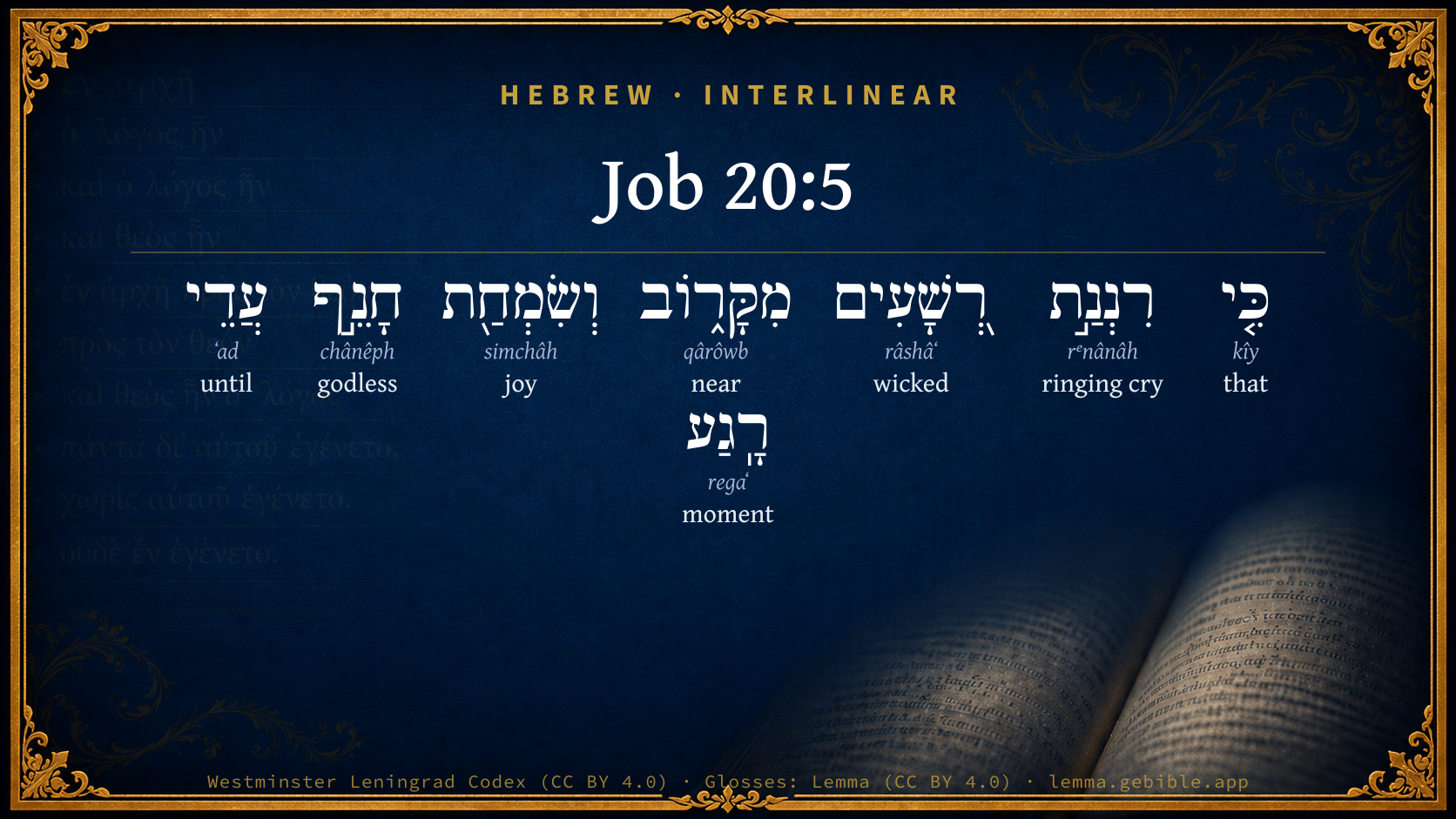
Job 20:5

Hebrew (Westminster Leningrad Codex) Job 20:5 appears in the Hebrew Old Testament. The text above is from the Westminster Leningrad Codex. Each word links to its Strong’s number, a concise gloss, and parsing drawn from the Open Scriptures Hebrew Bible morphology. Click any word for its full Brown-Driver-Briggs (BDB) entry.
Download image
Cite this verse

Job 20:5 (World English Bible). Public Domain. Lemma interlinear Bible study tool, https://lemma.gebible.app/v/job/20/5.

Show BibTeX & RIS
BibTeX
RIS
English Translation
That the triumphing of the wicked is short, The joy of the godless but for a moment?
World English Bible · Public Domain
Download a study sheet

One document with this verse’s original text, its word-by-word gloss line, the meaning frame, cross-references with their text, attributed commentary, and full source and license credits — printable, and it pastes into notes with its structure intact.

This verse Autodidact and up

Study sheet (.html) Plain text (.txt)

A passage Seminary Student

Up to 50 verses in one chapter. A passage sheet keeps up to 6 commentary sources and 12 cross-references per verse, in the order this page ranks them, and says so on the sheet whenever that leaves anything out. Ask for a single verse and you get the Autodidact verse sheet above.

Everything on this page stays free to read, with no account — the sheet is a download of what is already on screen, not access to it.

Want to remove ads? Support Godless Engineer
Compare translations 3

The same verse in 3 English versions, stacked beneath the original-language interlinear above. Click any original word for its lexicon entry.

Each is an independent rendering of the whole verse — the interlinear is not word-aligned to these translations.

Highlighted words mark where these versions differ — a whole-verse word diff, not a word-by-word alignment.

  • World English Bible Public Domain
    That the triumphing of the wicked is short, The joy of the godless but for a moment?
  • King James Version Public Domain
    That the triumphing of the wicked is short, and the joy of the hypocrite but for a moment?
  • unfoldingWord Literal Text CC BY-SA 4.0
    that the triumph of the wicked from near, and the joy of the godless for a moment?

unfoldingWord Literal Text — © unfoldingWord, licensed CC BY-SA 4.0. Word-aligned USFM3 via Door43 (git.door43.org/unfoldingWord/en_ult).

Versions to compare (up to 4)

3 of 4 selected

Show all 18 translations

Every available English version of this verse, each an independent rendering of the whole verse.

  • World English Bible Public Domain
    That the triumphing of the wicked is short, The joy of the godless but for a moment?
  • Berean Standard Bible Public Domain
    the triumph of the wicked has been brief and the joy of the godless momentary?
  • Majority Standard Bible Public Domain
    the triumph of the wicked has been brief and the joy of the godless momentary?
  • King James Version Public Domain
    That the triumphing of the wicked is short, and the joy of the hypocrite but for a moment?
  • American Standard Version (1901) Public Domain
    That the triumphing of the wicked is short, And the joy of the godless but for a moment?
  • Revised Version (1885) Public Domain
    That the triumphing of the wicked is short, and the joy of the godless but for a moment?
  • Geneva Bible (1599) Public Domain
    That the reioycing of the wicked is short, and that the ioy of hypocrites is but a moment?
  • Douay-Rheims (1899) Public Domain
    that the praise of the wicked is short, and the joy of the hypocrite but for a moment.
  • Young's Literal Translation Public Domain
    That the singing of the wicked `is' short, And the joy of the profane for a moment,
  • Literal Standard Version CC BY-SA 4.0
    That the singing of the wicked [is] short, || And the joy of the profane for a moment,
  • Unlocked Literal Bible CC BY-SA 4.0
    the triumph of a wicked man is short, and the joy of a godless man lasts only for a moment?
  • unfoldingWord Literal Text CC BY-SA 4.0
    that the triumph of the wicked from near, and the joy of the godless for a moment?
  • Darby Bible Public Domain
    The exultation of the wicked is short, and the joy of the ungodly man but for a moment?
  • World Messianic Bible Public Domain
    that the triumphing of the wicked is short, the joy of the godless but for a moment?
  • Webster's Bible Public Domain
    That the triumphing of the wicked is short, and the joy of the hypocrite but for a moment?
  • Free Bible Version CC BY-SA 4.0
    that the triumph of the wicked doesn't last long, that those who reject God are only happy for a short time?
  • Bible in Basic English Public Domain
    That the pride of the sinner is short, and the joy of the evil-doer but for a minute?
  • JPS Tanakh (1917) Public Domain
    That the triumphing of the wicked is short, and the joy of the godless but for a moment?

Literal Standard Version (2020), Covenant Press — licensed CC BY-SA 4.0. Text via the HelloAO Bible API (eBible.org). Unlocked Literal Bible (unfoldingWord) — licensed CC BY-SA 4.0. Text via the HelloAO Bible API (eBible.org). unfoldingWord Literal Text — © unfoldingWord, licensed CC BY-SA 4.0. Word-aligned USFM3 via Door43 (git.door43.org/unfoldingWord/en_ult). Free Bible Version, Dr. Jonathan Gallagher — licensed CC BY-SA 4.0. Text via the HelloAO Bible API (eBible.org).

Word by word

More ways to search: Search by grammar → Find every occurrence → Compare this word →

Practice this passage: Drill this verse → Learn its vocabulary →

About this verse

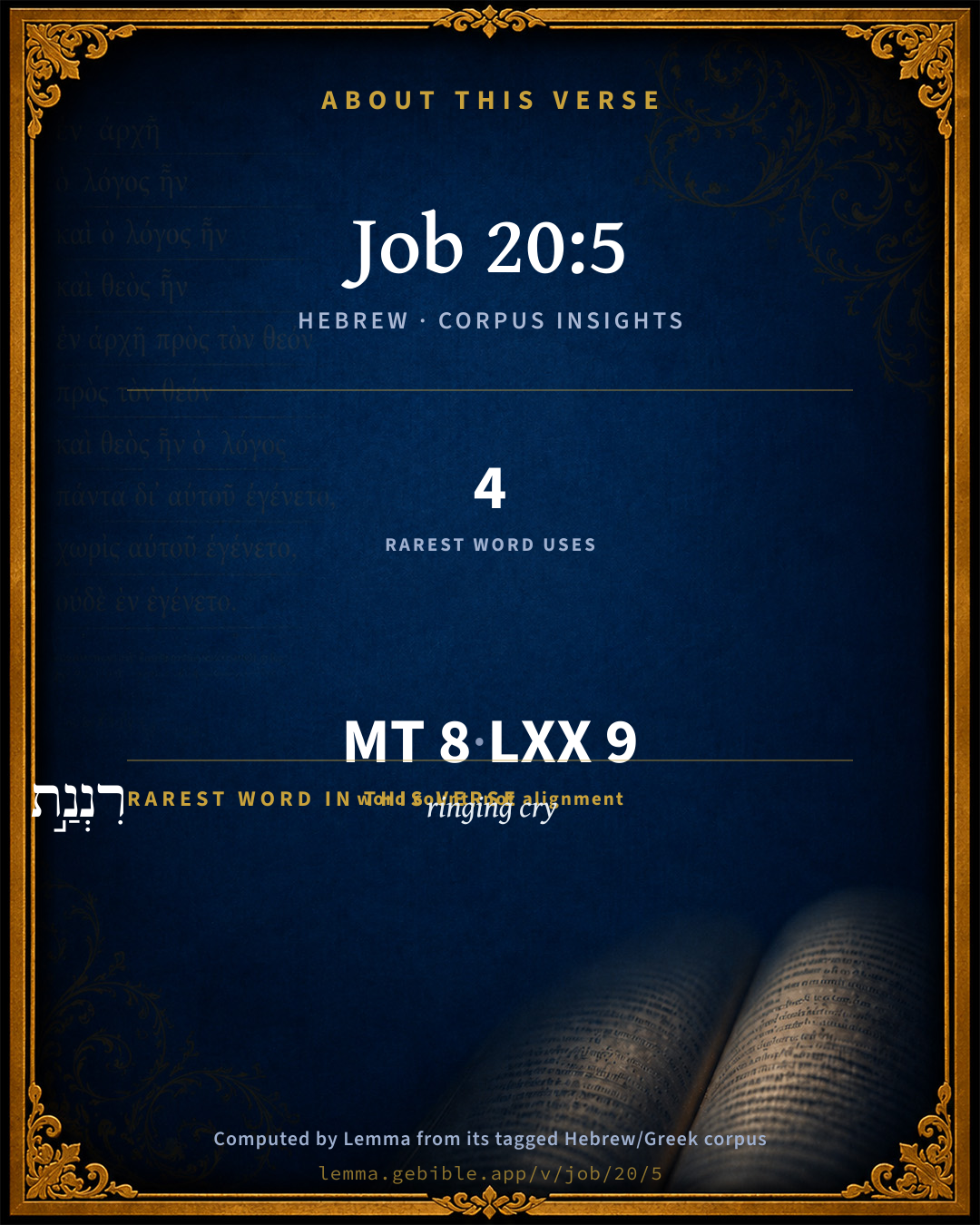
These counts appear in no published source. They are computed here, from the morphology-tagged text and Lemma’s own curated glosses. What Lemma adds →

8
words
8
distinct lemmas
Wisdom
section

Notable vocabulary

The rarest word here is רִנְנַ֣ת ringing cry H7445 — appearing just 4 times in the whole Hebrew Bible.

Shared distinctive vocabulary

רִנְנַ֣ת ringing cry H7445 occurs in 4 verses of the Hebrew Bible. Also found in:

Grammatical profile

  • 3 nouns
  • 3 adjectives
  • 1 preposition
  • 1 conjunction

Hebrew & Septuagint length

In English translation the verse runs 17 words from the Hebrew and 17 from the Septuagint (LXX English) — the same length.

A rough comparison of the two English renderings, which tokenize alike — not a word-level alignment.

Word counts can differ between the Hebrew and the Greek without any difference in meaning — e.g. the Hebrew direct-object marker אֵת has no separate Greek word, and Greek often adds the article ὁ.

In the original languages it is 8 Hebrew tokens and 9 Greek tokens — but the two are counted differently (Hebrew bundles its prefixes and suffixes into one token; the Greek is in lemma form), so that isn’t a like-for-like length.

Cross-references

18

Topical passages linked to Job 20:5 in the Treasury of Scripture Knowledge — connected by theme and wording, ordered by reader-vote popularity; previews shown in the World English Bible.

  • Psalms 37:35–36 I have seen the wicked in great power, Spreading himself like a green tree in its native soil.
  • Job 18:5–6 "Yes, the light of the wicked shall be put out, The spark of his fire shall not shine.
  • Job 5:3 I have seen the foolish taking root, But suddenly I cursed his habitation.
  • Job 8:12–13 While it is yet in its greenness, not cut down, It withers before any other reed.
  • Job 27:8 For what is the hope of the godless, when he is cut off, When God takes away his life?
  • Psalms 73:18–20 Surely you set them in slippery places. You throw them down to destruction.
  • Acts 12:22–23 The people shouted, "The voice of a god, and not of a man!"
  • Exodus 15:9–10 The enemy said, 'I will pursue, I will overtake, I will divide the spoil. My desire shall be satisfied on them. I will draw my sword, my hand shall destroy them.'
  • Judges 16:21–30 The Philistines laid hold on him, and put out his eyes; and they brought him down to Gaza, and bound him with fetters of brass; and he did grind in the prison-house.
  • Esther 5:11–12 Haman recounted to them the glory of his riches, and the multitude of his children, and all the things in which the king had promoted him, and how he had advanced him above the princes and servants of the king.
  • Esther 7:10 So they hanged Haman on the gallows that he had prepared for Mordecai. Then was the king's wrath pacified.
  • Job 8:19 Behold, this is the joy of his way: Out of the earth shall others spring.
  • Job 15:29–34 He shall not be rich, neither shall his substance continue, Neither shall their possessions be extended on the earth.
  • Job 27:13–23 "This is the portion of a wicked man with God, The heritage of oppressors, which they receive from the Almighty.
  • Matthew 7:21 Not everyone who says to me, 'Lord, Lord,' will enter into the Kingdom of Heaven; but he who does the will of my Father who is in heaven.
  • Matthew 13:20–21 What was sown on the rocky places, this is he who hears the word, and immediately with joy receives it;
  • Galatians 6:4 But let each man test his own work, and then he will take pride in himself and not in his neighbor.
  • James 4:16 But now you glory in your boasting. All such boasting is evil.

Cross-references courtesy of OpenBible.info (CC BY 4.0).

Hebrew and Greek witnesses Masoretic Hebrew ↔ Greek Septuagint

The same verse in the two great witnesses to the Old Testament, shown verse-for-verse.

These are two independent witnesses, not word-aligned to each other, and the Septuagint is shown in lemma (dictionary) form.

Hebrew Job 20:5 Masoretic · Westminster Leningrad Codex

כִּ֤י רִנְנַ֣ת רְ֭שָׁעִים מִקָּר֑וֹב וְשִׂמְחַ֖ת חָנֵ֣ף עֲדֵי רָֽגַע

That the triumphing of the wicked is short, The joy of the godless but for a moment?

World English Bible · Public Domain

Greek LXX Job 20:5 Septuagint · lemma form

εὐφροσύνη γάρ ἀσεβής πτῶμα ἐξαίσιος χαρμονή δέ παράνομος ἀπώλεια

But the mirth of the ungodly is a signal downfall, and the joy of transgressors is destruction:

LXX2012 (modern English Septuagint) · Public Domain

Hebrew: Westminster Leningrad Codex (CC BY 4.0). Greek: Septuagint (public domain); English from LXX2012 (modern English Septuagint) (Public Domain). How the Septuagint differs from the Hebrew →

Commentary

Notes on Job 20:5 from classic Christian and Jewish commentators (each source and its license shown beneath its notes). The classic Christian expositions comment on the surrounding passage and are grouped to its opening verse, so a note may address several verses; the Jewish commentaries on the Tanakh (Rashi and others) are per-verse, so they appear only where the commentator wrote on this verse.

Lemma curates 59 commentaries, every one of them public domain or Creative Commons licensed, each selected and text-cleaned for this edition rather than reprinted as found. About our sources →

Trapp's Complete Commentary

John Trapp

Job 20:5 That the triumphing of the wicked [is] short, and the joy of the hypocrite [but] for a moment?

Ver. 5. That the triumphing of the wicked is short] Heb. That the shouting of the wicked is from near, it is of no long standing, but like a blaze of thorns, that is quickly extinct, or as a bubble in the water, that is soon down; the pleasure of sin is but for a season. Huius sententiae exemptum habes in Goliath, saith Brentius here. An example of this sentence we have in Goliath, 1Sa 17:42-44; and another in his countrymen, the Philistines, who had twice beaten the Israelites, and taken the ark, 1Sa 5:1-12, but this triumph was soon at an end; and so was that of the Jews when they had crucified Christ, and now danced upon his grave, as the proverb is; but he arose in despite of them, and set up his trophies. Say that the triumph of the wicked should last as long as life, what is that to the Infinite? Punctum est quod vivimus, et puncto minus. But wicked men commonly die before their time, as Solomon phraseth it, Ecc 7:17; that is, by an untimely death, they live not half their days, Psa 55:23. God cuts them off, that others may live more quietly; and while they live, their comforts are not sincere, but mixed with many molestations. Little knoweth the world where their new shoes pinch them, as that Roman said. One little drop of an evil conscience can trouble a whole sea of the wicked man’s triumphs.

The joy of the hypocrite but for a moment?] Zophar had a strong conceit that Job was but a hypocrite, one that was wicked before God in heart, notwithstanding his fair pretences and professions of piety, and should therefore be led forth with the workers of iniquity, Psa 125:5, as cattle led to the slaughter, or as bulls led to the altar, with garlands on their horns, and music by their sides, Act 14:13, but suddenly they feel and fall under the murdering axe. Such is the hypocrite’s joy, and Zophar would he should know so much, being sensible of this that himself was the party in speech; since his prosperity had ended in misery, and God had dashed all his comforts.

John Trapp, A Commentary or Exposition upon All the Books of the Old and New Testament (1647–1656) — public domain. Text from a community e-Sword module.

Jamieson, Fausset & Brown

Robert Jamieson, A. R. Fausset & David Brown

the hypocrite--literally, "the ungodly" (Psa 37:35-36).

Jamieson, Fausset & Brown — Commentary Critical and Explanatory on the Whole Bible (1871) — public domain (CC PDM 1.0). Text via the HelloAO Bible API.

Ellicott's Commentary for English Readers

(5) The triumphing of the wicked is short.—He affirms that the destruction of the wicked is not only certain, but speedy. (Comp. Psa_103:16 and Job_7:8; Job_7:10.)

A Bible Commentary for English Readers, edited by Charles John Ellicott (1878–1897) — public domain. Text from a community e-Sword module.

John Gill's Exposition

That the triumphing of the wicked is short,.... Their outward prosperity and felicity, of which they make their boast, and in which they glory and triumph for a while; at first Job's friends set out with this notion, that the wicked never flourished and prospered, but it always went ill with them in Providence; but being beat out of that, they own they may be for a small time in flourishing and prosperous circumstances, but it is but for a small time; which may be true in many instances, but it is not invariable and without exception the case: the sense is, it is but a little while that they are in so much mirth and jollity, and triumph over their neighbours, as being in more advantageous circumstances than they; this is said in the original text to be "from near" (h); it is but a little while ago when it began; and; as the Targum paraphrases it, it will be quickly ended:

and the joy of the hypocrite but for a moment; the word "wicked", in the former clause, may signify the same person here called the "hypocrite"; but inasmuch as that signifies one restless and troublesome, one that is ungodly, and destitute of the fear of God, that has nothing in him but wickedness, who is continually committing it, and is abandoned to it; it might be thought not to apply to the character of Job, whom Zophar had in his view, and therefore this is added as descriptive of him: an hypocrite is one who seems to be that he is not, holy, righteous, good, and godly; who professes to have what he has not, the true grace of God, and pretends to worship God, but does not do it cordially, and from right principles; and who seeks himself in all he does, and not the glory of God: now there may be a joy in such sort of persons; they may hear ministers gladly, as Herod heard John, and receive the word with joy, as the stony ground hearers did, Mar 6:20; they may seem to delight in the ways and ordinances of God, and even have some tastes of the powers of the world to come, and some pleasing thoughts and hopes of heaven and happiness; as well as they triumph in and boast of their profession of religion and performance of duties, and rejoice in their boastings, which is evil; but then this is like the pleasures of sin, which are but for a season, or like the crackling of thorns under a pot, which make a great noise and blaze, but soon over, Ecc 7:6; and so their joy in civil as well as religious, things. It is possible Zophar might be so ill natured as to have reference to Job's triumph of faith, Job 19:25; and by this would suggest, that his faith in a living Redeemer, and the joy of it he professed, would be soon over and no more; which shows what spirit he was of.

(h) "de propinquo", Pagninus, Montanus, &c.

John Gill's Exposition of the Whole Bible (1746–1763) — public domain (CC PDM 1.0). Text via the HelloAO Bible API.

Albert Barnes' Notes on the Bible

That the triumphing - The word “triumphing” here (רננה renânâh),” shouting, rejoicing” - such a shouting as people make after a victory, or such as occurred at the close of harvesting. Here it means that the occasion which the wicked had for rejoicing would be brief. It would be but for a moment, and he then would be overwhelmed with calamity or cut off by death.

Short - Margin, as in Hebrew “from near.” That is, it would be soon over.

And the joy of the hypocrite but for a moment? - This probably means, as used by Zophar, that the happiness of a hypocrite would be brief - referring to the happiness arising from the possession of health, life, property, friends, reputation. Soon God would take away all these, and leave him to sorrow. This, he said, was the regular course of events as they had been observed from the earliest times. But the “language” conveys most important truths in reference to the spiritual joys of the hypocrite at all times, though it is not certain that Zophar used it in this sense. The truths are these.

(1) There is a kind of joy which a hypocrite may have - the counterfeit of that which a true Christian possesses. The word “hypocrite” may be used in a large sense to denote the man who is a professor of religion, but who has none, as well as him who intentionally imposes on others, and who makes pretensions to piety which he knows he has not. Such a man may have joy. He supposes that his sins are forgiven, and that he has a well-founded hope of eternal life. He may have been greatly distressed in view of his sin and danger, and when he supposes that his heart is changed, and that the danger is passed, from the nature of the case he will have a species of enjoyment. A man is confined in a dungeon under sentence of death. A forged instrument of pardon is brought to him. He does not know that it is forged, and supposes the danger is past, and his joy will be as real as though the pardon were genuine. So with the man who “supposes” that his sins are forgiven.

(2) The joy of the self-deceiver or the hypocrite will be short. There is no genuine religion to sustain it, and it soon dies away. It may be at first very elevated, just as the joy of the man who supposed that he was pardoned would fill him with exultation. But in the case of the hypocrite it soon dies away. He has no true love to God; he has never been truly reconciled to him; he has no real faith in Christ; he has no sincere love of prayer, of the Bible, or of Christians and soon the temporary excitement dies away, and he lives without comfort or peace. He may be a professor of religion, but with him it is a matter of form, and he has neither love nor zeal in the cause of his professed Master. Motives of pride, or the desire of a reputation for piety, or some other selfish aim may keep him in the church, and he lives to shed blighting on all around him. Or if, under the illusion, he should be enabled to keep up some emotions of happiness in his bosom, they must soon cease, for to the hypocrite death will soon end it all. How much does it become us, therefore, to inquire whether the peace which we seek and which we may possess in religion, is the genuine happiness which results from true reconciliation to God and a well founded hope of salvation. Sad will be the disappointment of him who has cherished a hope of heaven through life, should he at last sink down to hell! Deep the condemnation of him who has professed to be a friend of God, and who has been at heart his bitter foe; who has endeavored to keep up the forms of religion, but who has been a stranger through life to the true peace which religion produces!

Albert Barnes' Notes on the Bible (1834–1885) — public domain. Text from a community e-Sword/MySword module.

Matthew Poole's English Annotations

Is short, Heb. is from near, i.e. from or for a little time; they have not long enjoyed it, and it will shortly vanish.

The joy of the hypocrite: this he adds by way of reflection upon Job, who though he did clear himself from gross wickedness, yet might be guilty of deep hyprocrisy.

Matthew Poole's English Annotations on the Holy Bible (1683–1685) — public domain. Text from a community e-Sword/MySword module.

Whedon's Commentary on the Bible

Daniel D. Whedon

5. Hypocrite — Ungodly. Job’s triumphant faith is but “the triumphing of the wicked,” and “the joy of the ungodly.” These are the rough, spiteful stones which Zophar hurls at the exultant confession chiseled upon the everlasting rock.

Moment — Literally, the twinkling of an eye. Compare 1Co_15:52. The Hebrew rega’h corresponds to our word moment. A moment, philologically, is simply a movement.

Daniel D. Whedon (gen. ed.), Commentary on the Old and New Testaments (1874–1909) — public domain. Text from a community e-Sword module.

The Pulpit Commentary

That the triumphing of the wicked is short. (comp. Psa_37:35, 36 51:1-5 73:17-19, etc.) This is one of the main points of dispute between Job and his opponents. It has been previously maintained by Eliphaz (Job_4:8-11 Job_5:3-5 Job_15:21, Job_15:29) and by Bildad, (Job_8:11-19) as it is now by Zophar, and may be regarded as the traditional belief of the time, which scarcely any ventured to question. His own observation, however, has convinced Job that the fact is otherwise. He has seen the wicked "live, become old, and remain mighty in power"; (Job_21:7) he has seen them "spend their days in wealth," and die quietly, as "in a moment". (Job_21:13) In Job_24:2-24 he seems to argue that this is the general, if not universal, lot of such persons. Later on, however, in Job_27:13-23, he retracts this view, or, at any rate, greatly modifies it, admitting that usually retribution does even in this life overtake the wicked. And this seems to be the general sentiment of mankind. "Raro antecedentem scelestum, Deseruit pede poena claudlo. (Horace, "Od.," 3:2, ll. 31, 32.) There remains, however, the question whether the triumphing of the wicked can fairly be considered "short," and the joy of the hypocrite but for a moment. When we consider the lives of Dionysius the elder, Sylla, Marius, Tiberius, Louis XIV, Napoleon, it is difficult to answer this question in the affirmative.

HOMILIES BY R. GREEN Vers. 5-20. The temporary triumph of the wicked.

Zophar now comes forth with wise words; but they are as arrows, slender, strong, and sharp, which, though drawn upon a strong bow, yet miss their mark. Only too true is his assertion of the brevity of the triumph of the evildoer, the momentary joy of the hypocrite; only too accurate his forcible setting forth of the state and portion of the ungodly. Job has to hear again cruel words. His patient faith has yet to be further tested; his final triumph is postponed.

I HIS HONOR IS TEMPORARY. If he raise himself so that "his head reach unto the clouds, yet he shall perish for ever;" "he shall fly away as a dream," so short is his grasp of any position of honour.

II HIS FAMILY PROSPERITY IS BUT BRIEF. The goods he has gained by his ungodliness "his hands shall restore," and his children crouch to appease the poor. Ill-gotten gain is held by uncertain hands. For a time the ungodly seems to prosper, but it is that he may be consumed out of his place.

III HIS LIFE IS WASTED AND PASSETH AWAY. Even his youthful vigour fails him. it shall speedily "lie down with him in the dust." The practice of wickedness brings punishment on hint who offends. The tendency of wrong-doing is ever to prey upon the strength of the life.

IV THE PLEASURES OF SIN TO HIM ABE BUT FOR A SEASON. Though he "hide" wickedness "under his tongue," though it be "sweet in his mouth," yet shall it be turned to "the gall of asps within him.

V THE POSSESSION OF RICHES IS PERMITTED ONLY FOR A BRIEF PERIOD. Though he swallow them down, "he shall vomit them up again." Nothing has permanence with him. Changes come over him from sources he cannot trace and certainly could not foresee. His toil is fruitless. "That which he laboured for shall he restore... he shall not rejoice therein." Wickedness eats into the strength and joy of life. It exposes life to innumerable evils and robs it of its chief good. The wicked man has no pledge of permanent blessing. "He shall not save of that which he desired." Truly "the triumphing of the wicked is short. R.G.

HOMILIES BY W.F ADENEY Ver. 5. The short triumphing of the wicked.

Zophar"s superficial view has truth in it as far as it goes. He is a man of the world, and he has kept his eyes open. What he has seen has been no illusion. It is not enough to explain the deeper mysteries of Job"s experience. Yet it has an obvious truth in it.

I THERE IS A TRIUMPHING OF THE WICKED.

1. This is seen in experience. Even Zophar, who finds it not exactly in accordance with his ideas of providence, still cannot but admit that it exists. A swindler fattens on the spoils of the robbery of widows and orphans. A Napoleon dominates Europe.

2. It is important to recognize the fact. We must make our theories accord with our experience and observation of the world. It is useless to comfort ourselves in the seclusion of our private meditation with an easy optimism, if this will not fit in with the events of everyday life. If we are not prepared to expect the triumph of the wicked, the sight of it will strike us with a shock of dismay.

3. The triumphing of the wicked does present a difficulty. It is contrary to our notion of justice. No doubt the narrow, conventional notion of the three friends was founded on a genuine sense of right and fitness. If there is to be no future judgment, and if this temporal state is typical of the whole course of life, here is an instance of gross injustice. We must therefore face it, and inquire what it means.

II THIS TRIUMPH IS SHORT. Zophar"s explanation is that the triumph will soon pass away, and will give place to overthrow and ruin.

1. This is seen on earth. As a rule, the swindler does not die rich. He usually outlives his gains. Great wickedness generally disappoints its owner. Napoleon finishing his career as an exile at St. Helena is typical of the most frequent end of a very bad course. But this is by no means a universal principle. The whole of a bad man"s life may be externally prosperous, right on to death.

2. This will be seen after death. We must extend our contemplation of the course of the wicked man. He dies, leaving wealth, pleasure, power, triumph, behind him. None of these can accompany him through the dark doors of death. He has laid up no treasures in the unseen world. There he is certainly beggared, and he has good ground for expecting the infliction of well meted punishment. His short earthly life, but a moment when compared to eternity, is over, and with it all his triumphing has ceased.

III THE SHORT TRIUMPH OF THE WICKED IS FALLACIOUS.

1. It is fallacious because its brevity is hidden. The foolish man who glories in it does not see how swiftly it is slipping away from him. A triumph which must soon give place to shame is not worth much to its owner.

2. It is fallacious because it gives no solid satisfaction. The wicked glee of triumphing in sin is quite superficial. Often its very excitement is only a result of restless discordant passions. It wears a bold front, but it covers a weary spirit. If there is a spark of conscience left there must be a haunting fear like the mummy at the Egyptian feast that spoils the pleasure.

IV THE ONLY ENDURING TRIUMPH IS THAT WHICH FOLLOWS A TRULY CHRISTIAN LIFE.

1. This is solid. It begins with victory over sin and self, our greatest enemies.

2. It is assured. It is brought about by the work of Christ; it is just sharing in his victory; and Christ must triumph.

3. I t is eternal. On earth there may be shame and humiliation, but in heaven Christians are called to the joy of victory to be "more than conquerors". W.F.A. (Rom_8:37)

The Pulpit Commentary (1880–1919), ed. H.D.M. Spence-Jones & Joseph S. Exell — public domain. Text from a community e-Sword module.

Rashi

Rabbi Shlomo Yitzchaki (Rashi)

that the triumph of the wicked throughout all its duration, has come but recently, and will not last for any length of time.

and the joy of the flatterers is but a moment in a short time, it will end.

Rashi on the Tanakh — English translations: “The Judaica Press complete Tanach with Rashi, translated by A. J. Rosenberg” (CC BY 4.0); “Pentateuch with Rashi's commentary by M. Rosenbaum and A.M. Silbermann, 1929-1934” (public domain); “The Metsudah Tanach series, Lakewood, N.J” (CC BY 4.0); and “The Book of Joshua, Metsudah Publications, 1997” (CC BY 4.0). Text via Sefaria.

Lesson kit

Teaching starters — assembled from the data on this page, not authored interpretation. Every prompt links to the verse data it draws on. Edit before teaching.

Job, in the Wisdom, opens this verse with 8 words (8 distinct Hebrew lemmas). Its most distinctive word is rᵉnânâh (“ringing cry”). A historical commentator’s framing appears above. Read the whole chapter for the surrounding context.

Discussion questions

  1. The word rᵉnânâh carries the sense “ringing cry.” How does it shape the verse?
  2. Job 3:7 shares the word «ringing cry» with this verse. How do the two illuminate each other?
  3. These translations render this verse differently. What is at stake in choosing one wording over another?
  4. Reading how Trapp's Complete Commentary and Jamieson, Fausset & Brown read this verse, where do the two commentators agree and where do they part?

Things to notice

Reading settings

Reading text

Shown beneath each verse's original-language words.

Old Testament
Old Testament edition

Read the OT as the Masoretic Hebrew (MT) or the Greek Septuagint (LXX).

English shown for the Greek Septuagint (in the Hebrew ↔ Greek comparison).

Comparing translations? Open the Compare panel on any verse page to stack up to four side by side.