

Proverbs 11:18

Hebrew (Westminster Leningrad Codex) Proverbs 11:18 appears in the Hebrew Old Testament. The text above is from the Westminster Leningrad Codex. Each word links to its Strong’s number, a concise gloss, and parsing drawn from the Open Scriptures Hebrew Bible morphology. Click any word for its full Brown-Driver-Briggs (BDB) entry.
Download image
Cite this verse

Proverbs 11:18 (World English Bible). Public Domain. Lemma interlinear Bible study tool, https://lemma.gebible.app/v/proverbs/11/18.

Show BibTeX & RIS
BibTeX
RIS
English Translation
Wicked people earn deceitful wages, But one who sows righteousness reaps a sure reward.
World English Bible · Public Domain
Highlights
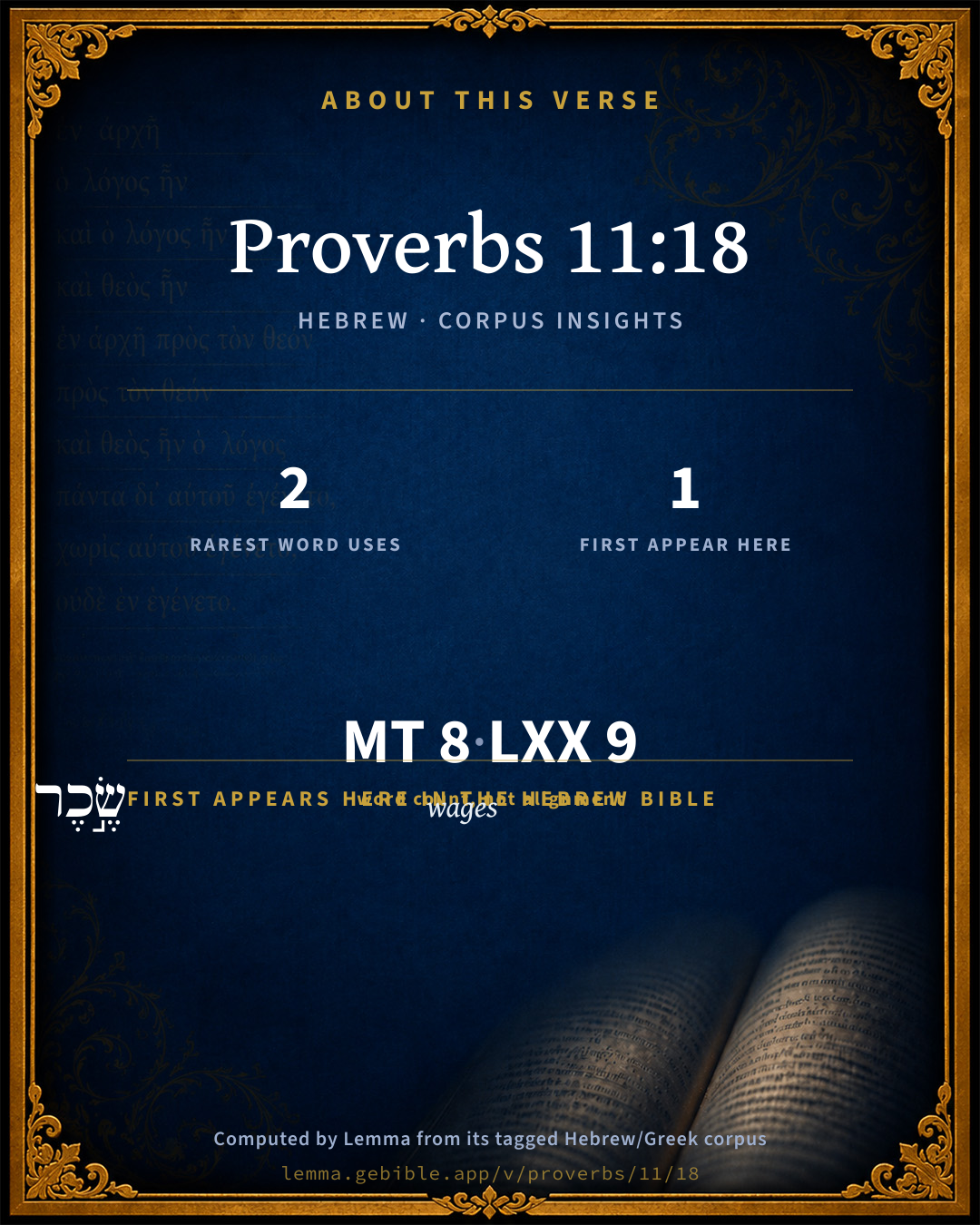
  • 1 first appearance in the Hebrew Bible
Full analysis ↓
Download a study sheet

One document with this verse’s original text, its word-by-word gloss line, the meaning frame, cross-references with their text, attributed commentary, and full source and license credits — printable, and it pastes into notes with its structure intact.

This verse Autodidact and up

Study sheet (.html) Plain text (.txt)

A passage Seminary Student

Up to 50 verses in one chapter. A passage sheet keeps up to 6 commentary sources and 12 cross-references per verse, in the order this page ranks them, and says so on the sheet whenever that leaves anything out. Ask for a single verse and you get the Autodidact verse sheet above.

Everything on this page stays free to read, with no account — the sheet is a download of what is already on screen, not access to it.

Want to remove ads? Support Godless Engineer
Compare translations 3

The same verse in 3 English versions, stacked beneath the original-language interlinear above. Click any original word for its lexicon entry.

Each is an independent rendering of the whole verse — the interlinear is not word-aligned to these translations.

Highlighted words mark where these versions differ — a whole-verse word diff, not a word-by-word alignment.

  • World English Bible Public Domain
    Wicked people earn deceitful wages, But one who sows righteousness reaps a sure reward.
  • King James Version Public Domain
    The wicked worketh a deceitful work: but to him that soweth righteousness shall be a sure reward.
  • unfoldingWord Literal Text CC BY-SA 4.0
    A wicked makes a wage of falsehood, but sowing righteousness, a wage of truth.

unfoldingWord Literal Text — © unfoldingWord, licensed CC BY-SA 4.0. Word-aligned USFM3 via Door43 (git.door43.org/unfoldingWord/en_ult).

Versions to compare (up to 4)

3 of 4 selected

Show all 18 translations

Every available English version of this verse, each an independent rendering of the whole verse.

  • World English Bible Public Domain
    Wicked people earn deceitful wages, But one who sows righteousness reaps a sure reward.
  • Berean Standard Bible Public Domain
    The wicked man earns an empty wage, but he who sows righteousness reaps a true reward.
  • Majority Standard Bible Public Domain
    The wicked man earns an empty wage, but he who sows righteousness reaps a true reward.
  • King James Version Public Domain
    The wicked worketh a deceitful work: but to him that soweth righteousness shall be a sure reward.
  • American Standard Version (1901) Public Domain
    The wicked earneth deceitful wages; But he that soweth righteousness `hath' a sure reward.
  • Revised Version (1885) Public Domain
    The wicked earneth deceitful wages: but he that soweth righteousness hath a sure reward.
  • Geneva Bible (1599) Public Domain
    The wicked worketh a deceitful worke: but hee that soweth righteousnes, shall receiue a sure rewarde.
  • Douay-Rheims (1899) Public Domain
    The wicked maketh an unsteady work: but to him that soweth justice, there is a faithful reward.
  • Young's Literal Translation Public Domain
    The wicked is getting a lying wage, And whoso is sowing righteousness -- a true reward.
  • Literal Standard Version CC BY-SA 4.0
    The wicked is getting a lying wage, || And whoever is sowing righteousness—a true reward.
  • Unlocked Literal Bible CC BY-SA 4.0
    The wicked person lies to get his wages, but one who sows what is right reaps the wages of truth.
  • unfoldingWord Literal Text CC BY-SA 4.0
    A wicked makes a wage of falsehood, but sowing righteousness, a wage of truth.
  • Darby Bible Public Domain
    The wicked worketh a deceitful work; but he that soweth righteousness hath a sure reward.
  • World Messianic Bible Public Domain
    Wicked people earn deceitful wages, but one who sows righteousness reaps a sure reward.
  • Webster's Bible Public Domain
    The wicked worketh a deceitful work: but to him that soweth righteousness shall be a sure reward.
  • Free Bible Version CC BY-SA 4.0
    The wicked earn wages that cheat them, but those who sow goodness reap a genuine reward.
  • Bible in Basic English Public Domain
    The sinner gets the payment of deceit; but his reward is certain who puts in the seed of righteousness.
  • JPS Tanakh (1917) Public Domain
    The wicked earneth deceitful wages; but he that soweth righteousness hath a sure reward.

Literal Standard Version (2020), Covenant Press — licensed CC BY-SA 4.0. Text via the HelloAO Bible API (eBible.org). Unlocked Literal Bible (unfoldingWord) — licensed CC BY-SA 4.0. Text via the HelloAO Bible API (eBible.org). unfoldingWord Literal Text — © unfoldingWord, licensed CC BY-SA 4.0. Word-aligned USFM3 via Door43 (git.door43.org/unfoldingWord/en_ult). Free Bible Version, Dr. Jonathan Gallagher — licensed CC BY-SA 4.0. Text via the HelloAO Bible API (eBible.org).

Word by word

More ways to search: Search by grammar → Find every occurrence → Compare this word →

Practice this passage: Drill this verse → Learn its vocabulary →

About this verse

These counts appear in no published source. They are computed here, from the morphology-tagged text and Lemma’s own curated glosses. What Lemma adds →

8
words
8
distinct lemmas
Wisdom
section

Notable vocabulary

The rarest word here is שֶׂ֣כֶר wages H7938 — appearing just 2 times in the whole Hebrew Bible.

First appearance in Scripture

This word makes its first canonical appearance in the Hebrew Bible here:

  • שֶׂ֣כֶר wages H7938

Shared distinctive vocabulary

שֶׂ֣כֶר wages H7938 occurs in 2 verses of the Hebrew Bible. Also found in:

Grammatical profile

  • 2 verbs
  • 5 nouns
  • 1 adjective

Verb forms

  • עֹשֶׂ֥ה Qal · Participle Active
  • וְזֹרֵ֥עַ Qal · Participle Active

Hebrew & Septuagint length

In English translation the verse runs 14 words from the Hebrew and 17 from the Septuagint (LXX English) — closely comparable.

A rough comparison of the two English renderings, which tokenize alike — not a word-level alignment.

Word counts can differ between the Hebrew and the Greek without any difference in meaning — e.g. the Hebrew direct-object marker אֵת has no separate Greek word, and Greek often adds the article ὁ.

In the original languages it is 8 Hebrew tokens and 9 Greek tokens — but the two are counted differently (Hebrew bundles its prefixes and suffixes into one token; the Greek is in lemma form), so that isn’t a like-for-like length.

Cross-references

11

Topical passages linked to Proverbs 11:18 in the Treasury of Scripture Knowledge — connected by theme and wording, ordered by reader-vote popularity; previews shown in the World English Bible.

  • Galatians 6:8–9 For he who sows to his own flesh will from the flesh reap corruption. But he who sows to the Spirit will from the Spirit reap eternal life.
  • Ecclesiastes 10:8 He who digs a pit may fall into it; and whoever breaks through a wall may be bitten by a snake.
  • Hosea 10:12–13 Sow to yourselves in righteousness, Reap according to kindness. Break up your fallow ground; For it is time to seek Yahweh, Until he comes and rains righteousness on you.
  • James 3:18 Now the fruit of righteousness is sown in peace by those who make peace.
  • Psalms 126:5–6 Those who sow in tears will reap in joy.
  • Proverbs 22:8 He who sows wickedness reaps trouble, And the rod of his fury will be destroyed.
  • Proverbs 1:18 But these lay wait for their own blood. They lurk secretly for their own lives.
  • Proverbs 5:22 The evil deeds of the wicked ensnare him. The cords of his sin hold him firmly.
  • Job 27:13–23 "This is the portion of a wicked man with God, The heritage of oppressors, which they receive from the Almighty.
  • Isaiah 59:5–8 They hatch adders' eggs, and weave the spider's web: he who eats of their eggs dies; and that which is crushed breaks out into a viper.
  • Ephesians 4:22 that you put away, as concerning your former way of life, the old man, that grows corrupt after the lusts of deceit;

Cross-references courtesy of OpenBible.info (CC BY 4.0).

Hebrew and Greek witnesses Masoretic Hebrew ↔ Greek Septuagint

The same verse in the two great witnesses to the Old Testament, shown verse-for-verse.

These are two independent witnesses, not word-aligned to each other, and the Septuagint is shown in lemma (dictionary) form.

Hebrew Proverbs 11:18 Masoretic · Westminster Leningrad Codex

רָשָׁ֗ע עֹשֶׂ֥ה פְעֻלַּת שָׁ֑קֶר וְזֹרֵ֥עַ צְ֝דָקָ֗ה שֶׂ֣כֶר אֱמֶֽת

Wicked people earn deceitful wages, But one who sows righteousness reaps a sure reward.

World English Bible · Public Domain

Greek LXX Proverbs 11:18 Septuagint · lemma form

ἀσεβής ποιέω ἔργον ἄδικος σπέρμα δέ δίκαιος μισθός ἀλήθεια

An ungodly man performs unrighteous works: but the seed of the righteous is a reward of truth.

LXX2012 (modern English Septuagint) · Public Domain

On this verse, The Pulpit Commentary discusses the Septuagint’s reading. Read the note in Commentary ↓

Hebrew: Westminster Leningrad Codex (CC BY 4.0). Greek: Septuagint (public domain); English from LXX2012 (modern English Septuagint) (Public Domain). How the Septuagint differs from the Hebrew →

Commentary

Notes on Proverbs 11:18 from classic Christian and Jewish commentators (each source and its license shown beneath its notes). The classic Christian expositions comment on the surrounding passage and are grouped to its opening verse, so a note may address several verses; the Jewish commentaries on the Tanakh (Rashi and others) are per-verse, so they appear only where the commentator wrote on this verse.

Lemma curates 59 commentaries, every one of them public domain or Creative Commons licensed, each selected and text-cleaned for this edition rather than reprinted as found. About our sources →

Trapp's Complete Commentary

John Trapp

Pro 11:18 The wicked worketh a deceitful work: but to him that soweth righteousness [shall be] a sure reward.

Ver. 18. The wicked worketh a deceitful work.] By defrauding his genius, and afflicting his flesh, {as Pro 11:17} he thinks he doth a very good work. Some emperors have left their thrones, and thrust [themselves] into a monastery, there to macerate themselves with much fasting and coarse clothing, out of an opinion of promoting their soul’s health thereby. But "bodily exercise profiteth little." {1Ti 4:8} And as the pride of virginity is as foul a sin as impurity, {a} so is it in this case. The formal faster loseth his labour. {Isa 58:3 Zec 7:5} In seventy years they kept seven score fasts in Babylon; yet among them all not one fast to God. There are that render it thus, Improbus comparat praemium falsum. The wicked get a false reward: all that he hath is but the things of this life, quae nec vera sunt, nec vestra. For the very fashion of this world passeth away and "surely every man walketh in a vain show," or shadow, "surely he disquieteth himself in vain he heapeth up riches, and knows not who shall gather them." {Psa 39:6} They that dig in mines, or labour in mints, have gold enough about them, but are little the better for it. A sumpter horse bears much treasure on his back all day, but is eased of it at night, and turned into the stable with his back full of galls and bruises. So shall it be with wicked rich men at death; so that they have no great bargain of it.

But to him that soweth righteousness.] And so soweth upon blessings {b} - as the apostle’s Greek hath it; {2Co 9:6} {See Trapp on "2Co 9:6"} Gal 6:7-8 - upon well watered places {c} {Ecc 11:1} To such shall be a sure reward: only he must have patience, and not look to sow and reap all in one day. {Jas 5:7} {See Trapp on "Jas 5:7"}

{a} Augustine.

{b} ο σπειρων επ ευλογιας.

{c} In locis irriguis.

John Trapp, A Commentary or Exposition upon All the Books of the Old and New Testament (1647–1656) — public domain. Text from a community e-Sword module.

The Biblical Illustrator

Joseph S. Exell

Pro_11:18

The wicked worketh a deceitful work.

The wicked and the just

There is here a startling contrast between them, in their work and in their reward.

I. Their work.

1. There is intentionally set before us a good specimen of a bad man. He is a man who works, and works hard in his own way. Some evil-doers are idle, profligate, sensual, devilish. Such seldom deceive themselves, and but rarely deceive others. But here is described a man who is very likely to deceive both himself and others. Wicked men are often shrewd men of the world and clever. They are zealous and laborious men, though the objects they aim at may be unworthy and bad. Their mistake is not in the way they work, but in the thing they work for. If all Christians were as eager in their pursuit of truth and charity and all good works as worldly men are in their search after riches and pleasures, what a difference it would make! Whilst the wicked man works in earnest fashion for time, does he attempt any like efforts for eternity? It is a mistake to think the bad man does not care for eternity at all. Multitudes attempt to serve two masters. A man who works with all his strength for worldly success often persuades himself that he will be able to work for eternity too. Does he then labour for the meat that endureth unto eternal life? Nay, at this point his wisdom is at fault, the deceitfulness of his work begins to appear. He is no better than a spiritual impostor and spendthrift. He knows nothing of the faith which awakens the generous and noble impulses of humanity, which touches the heart and makes the life holy. He is altogether ignorant of the quickening and sanctifying grace of the Holy Ghost.

2. Not such is the work of the righteous. He soweth righteousness. The sowing of the seed is the crowning act of the husbandmans preparation for a crop. All his other work goes for nothing unless it be consummated by this work. The wicked is said to work, but the just sows righteousness. The text describes a work of faith. He who sows righteousness does it in order that he may hereafter gather in the harvest. What is the seed he sows? (compare Hos_10:12). To sow righteousness, to sow in righteousness, and to sow to the Spirit, all means the same thing. It is to live righteously, to do righteous actions, to perform acts of devotion and piety to God, and to do works of truth and justice and charity towards our neighbour. It is to learn to do the will of God, looking forward to a future harvest, having respect unto the recompense of the reward. Righteousness in Scripture is a universal virtue, containing in itself all other virtues. A man must gather his seed before he can sow it. He who is to sow righteousness must first obtain a supply of the precious fruit of righteousness. Whence can this supply be fetched?

II. Their reward.

1. Working a deceitful work means working so as to deceive others. There is no real truth in a bad man. He is sure to deceive, whenever deceit will serve his ends. He will cast truth to the winds whenever truth calls upon him to suffer, either in his own person, or in his purse, or in the good opinion of others. Another rendering is, the wicked winneth deceitful wages. His work will betray him to his ruin, and will in the end utterly disappoint his own hopes. His work will break down just where it ought to stand, and fail altogether when his need is the greatest.

2. Mark well the bright and refreshing contrast. To him that soweth righteousness shall be a sure reward. The seed which has been sown in hope may lie for a long time beneath the clods, and may seem to be dead as well as buried. But as surely as Gods Word is true, it will spring up and grow, and ripen for a harvest of unspeakable joy. The reward of the righteous is a reward of grace and mercy. He that has sown righteousness most plentifully will look for his sure reward only from the mercy of God, through Jesus Christ. We live in difficult times, no doubt, but every age has its own trials, and the men of every age are ready to believe that no trials are as bad as theirs. The only safe way is the same in every age. It is to sow righteousness. (W. Bonner Hopkins, B.D.)

To him that soweth righteousness shall be a sure reward.--

The spiritual tillage

The husbandry and harvest of the righteous:--This is a counter-plea to that profane principle of the atheists, who say, It is in vain to serve God.

I. What it is to sow righteousness. It is the same as to sow to the Spirit. The gracious course of consecrating a mans self unto God in the practice of godliness. There is likeness betwixt the practice of godliness and the sowing of seed.

1. In some things which go before sowing--the preparation and fitting of the ground, and the choice of seed to put in the ground. In like manner there must be in the practice of godliness the preparation of the heart and the choice of particulars belonging to a Christian course.

2. In the act of sowing, which may include the time of sowing and the plenty of sowing. In the spiritual business the seed-time for righteousness is in this life; the opportunity must be taken when it comes. And to sow righteousness is to be rich in good works.

3. In the things that follow after sowing. The fields must be hedged, the cattle shut out, the birds driven away, the stones picked out, and the field watched to see how it goes on. In spiritual matters it is vain to have entered into a good course if it be not continued. The signs of the practice of godliness are--

(1) The submitting a mans self to have his heart broken up by the power of Gods Word;

(2) a diligent inquiry into the best way of pleasing God;

(3) a pressing forward amid many encumbrances;

(4) a striving and caring to be fruitful in good works;

(5) a watching over a mans course with a continued diligence.

II. What is the sure reward? This is either in the life present or in that which is to come. Rewards in this life are both outward and inward: outward so far forth as the wisdom of God shall see it fitting. The inward is peace of conscience, arising out of the comfortable assurance of Gods favour. This is a joy working even in afflictions. The reward in the life to come cannot be expressed. Scripture reasoneth concerning the certainty of this reward by a proverbial speech, Whatsoever a man soweth that shall he also reap. Holiness in the seed, happiness in the harvest. And by the truth of Gods promise. There is a double reward--a reward of favour and a reward of debt. The doctrines to be collected are--

1. That the practice of godliness is a matter which requireth great industry.

2. That the full reward of religion is not to be looked for immediately on the practice of religion. Sowing and reaping come not at once.

3. That the Lord will surely reward those which faithfully labour in His service. Though there be many a storm after our sowing, the harvest will come, and we shall be comforted. Farmers pay their workmen straight after their labour, before the corn be ripe, but the payments are of far less value than the corn. God bestoweth upon His all that they have sown, and the hire shall far exceed the travail. (S. Hieron.)

The two pursuits with their respective ends

Denunciations of wrath against the wicked are no less common in Scripture than declarations of mercy to the penitent. The promises of almighty love are often repeated; no less frequent are the proclamations of almighty justice. The doom of the impenitent is no less certain than the rewards of the righteous. Solomon seems to place before us in these words the life of the righteous and the life of the ungodly contrasted with the respective objects which they have in view and the different ends to which they lead.

I. The wicked worketh a deceitful work. The object which he pursues seems to promise him great things, but it generally fills him with disappointment and chagrin. The characters of the wicked are various, but in one point they all agree--they forget God. They practically forget Him. They salve over their own consciences by thoughts of impunity. They have no love to Gods name, no inclination to obey His laws; they are by consequence without the strongest bond of duty in man, which is love. The law of God is hateful to them, because it puts constraint upon their appetites and evil designs. And they are without the bond of fear. As Gods judgments are out of sight, so they are out of mind. The pursuit of evil cannot minister to happiness even here below. It is attended with manifold woes, even upon earth. Sin, in most cases, is connected with punishment. He that pursueth evil pursueth it to his death. It is the death of hope, peace, reputation, and a good conscience. It is often the cause of a premature temporal death. The pursuit of evil is the necessary school and preparation for eternal death.

II. The different ends to which the life of the righteous and the life of the ungodly lead. What is righteousness? Other terms are godliness, holiness, the new man. What is meant is not the righteousness of forms, but an inward disposition manifested by corresponding conduct, the new heart and the new life. It is the godliness which is opposed to the bodily exercise that profiteth little. Such righteousness tendeth to life. It has a natural and necessary tendency to promote present peace and eternal glory. In Scripture the words life and death are used for happiness and misery. The righteous are necessarily training themselves for eternal happiness, independently of that promise which secures to them the crown of glory that fadeth not away. There must be a fitness for heaven, a character acquired upon earth which is suitable to the abode of the just. The righteousness of which we speak is conformity of heart and life to Jesus Christ; it is union of soul with Him, a likeness to His example; it has a measure of His holiness and perfection. Righteousness disposes and fits a man for the enjoyment of God, for it cultivates those faculties of the soul which are called into exercise in heaven. Righteousness rests upon the basis of love. The acquiring of this righteousness is the preparation for the enjoyment of God. Already the righteous have communion with the Father of their spirits and with the spirits of the just made perfect. This being so, the passage for them is easy from this world to eternity. But righteousness also has a tendency to promote present happiness. The righteous live in the favour of God. They have peace of conscience. They fear no evil. They can look on death without alarm. Righteousness has a natural tendency to promote our welfare by conciliating the favour of the good and the respect of all And the reward laid up in heaven is sure. In conclusion, address two classes: Those who are seeking after righteousness--a word of cheer. Those who are working a deceitful work--a word of warning. (H. J. Hastings, M.A.)

The deceitfulness of sin

Opposites illustrate each other. Of this principle considerable use is made in the sacred Scriptures.

I. Opposite characters. The idea of righteousness is equality, as the equilibrium of a pair of scales. Applied to moral or religious natures it means a correspondence between our obligations on the one hand and our performance on the other. So it becomes obedience or conformity to the law. The radical meaning of the word wicked is inequality, unfairness. In a moral sense a want of correspondence between duty and performance, or nonconformity to righteous laws. Wickedness is disorder, incongruity, deception, an unsound principle, naturally producing a deceitful work.

II. Opposite practices. Righteousness renders to all their due. Where wrong sentiments are indulged wrong dispositions and practices naturally follow. Hence result--

1. Treachery towards friends.

2. Fraud and falsehood in business.

3. Extortion and oppression.

4. Maladministration; a never-ceasing theme of complaint.

In all such cases the work is a deceitful work--deceitful in its nature, operation, and results.

III. Opposite results.

1. God convinces the sinner of his unrighteousness.

2. Enlightens, transforms, and renews the soul.

The renewed begins to sow righteousness. To him there is a sure reward. Pause and inquire whether such a change has been effected in you. Pray for convincing and converting grace. Persevere through evil and through good report. (Sketches of Four Hundred Sermons.)

The reward of lowing righteousness

In the Bible a righteous person is one who loves and serves God, i.e., one who is a true Christian. When people become true Christians themselves they want to do all they can to try to make other people Christians. All the good things that such people do in this way the Bible calls righteousness. Sowing, in the text, means doing. Righteousness, in the text, means kind acts, good works of any kind, that Christian people do out of love to Jesus and from a desire to make others love Him. And thus we find out that sowing righteousness means doing good. Righteousness is the best seed in the world to sow.

1. Because of the size of the field in which this sowing may be carried on.

2. Because of the number and kind of sowers. Farmers are only one class of men. All classes of persons may be sowers of righteousness.

3. Because of the certainty of the reward. Farmers hope for harvest, but cannot be quite sure. The reward of sowing righteousness is made up of pleasure and profit. Sometimes the profit is found in this life. But the best part of the reward is in heaven. (R. Newton, D.D.)

The evil and the good

Men separate morally into two great divisions. See them--

I. As they appear at work.

1. Evil works deceitfully. It deceives the individual possessor; it makes his very life fiction. It deceives others. It fabricates and propagates falsehood.

2. The good works righteously. Being righteous in heart, he is charged with righteous principles, which he sows as seed in the social circle to which he belongs.

II. As they appear in retribution. All works, the bad as well as the good, bring results to the worker. These results are the retribution; they are Gods return for labour.

1. The righteous reap life. Life of the highest kind--spiritual. Life of the highest degree--immortal blessedness.

2. The wicked reap death--the death of all usefulness, nobility, and enjoyment.

III. As they appear before God.

1. God observes moral distinctions.

2. God is affected by moral distinctions. What He sees He feels. (D. Thomas, D.D.)

The Biblical Illustrator, edited by Joseph S. Exell (c. 1880s–1900s) — public domain. Text from a community e-Sword module.

Joseph Benson's Commentary

Pro 11:18-19. The wicked worketh a deceitful work — A work which will deceive his expectation of that good for which he works. But to him that soweth righteousness — That worketh righteousness with constancy, diligence, and hope of a recompense, resembling the labour and hope of those who sow in seed-time; shall be a sure reward — For, he that sows to the Spirit, shall of the Spirit reap life everlasting; so he that pursueth evil — That lives in known sin, that sows to the flesh; pursueth it to his own death — Shall of the flesh reap corruption.

Joseph Benson's Commentary on the Old and New Testaments (1811–1818) — public domain. Text from a community e-Sword module.

The Preacher's Complete Homiletical Commentary

Joseph S. Exell (gen. ed.)

CRITICAL NOTES.—

Pro_11:18. “The wicked gaineth a deceptive result, but he that soweth righteousness a sure reward” (Zöckler).

MAIN HOMILETICS OF THE PARAGRAPH—Pro_11:18-20

SOWING AND REAPING

I. The life-work of the wicked contains within itself the germs of a threefold bane, A deception, a death, and an abomination.

1. A deception. The wicked man expects from his life-work that which it cannot possibly yield. It is against the moral constitution of the universe that a life of wickedness, or an evil undertaking in that life should yield satisfaction or any degree of real comfort to the worker. If a man sowed darnel in his field and expected to get a crop of wheat, he would be “working a deceitful work,” that is, he would be a victim of self-deception. Nature cannot go out of her way to gratify his desires, to prevent his disappointment. The ungodly man lives a life of ungodliness—he “pursues evil,” (Pro_11:19), he perversely chooses his own course, in other words, he “is of a froward heart,” (Pro_11:20), and he promises himself some kind of advantage. But it cannot be, he is doomed to disappointment. However much he lies to work his work, the issue of his work will not lie. The earth will not lie concerning what kind of seed is placed in her furrows. If wheat is hidden there she will not disappoint the husbandman by returning him tares—if tares are sown she will render back of what has been entrusted to her care. She will speak the truth about the sowing by giving according to that which she has received. The sinner wants to make God a liar. “In the day that thou eatest thereof thou shalt surely die,” is the Divine sentence. “Ye shall not surely die,” is the assurance of the great deceiver. But the end will ever be what it was when man first suffered himself to entertain a doubt upon the matter. The man who builds himself a house upon the side of a volcano may promise himself, or may be promised by others, safety and peace, but unless he can quench the internal fires, that promise cannot be kept. The elements of destruction are ever at work under his very feet, the day will come when the devouring flame will burst forth and consume the work and the worker together.

2. Death. There are three kinds of death which are all the fruit of sin and which are developed out of one another as the blade, the corn in the ear, and the fall corn are successive developments of one seed. There is that preseut paralysis of all the spiritual capabilities of the man which the Bible calls carnal mindedness. (Rom_8:6). Into this condition Adam came at once as soon as he worked his wicked work, and every son of his who lives a life of opposition to the Divine will is even now “dead” in this sense. The death of the body is but the outcome of this spiritual death, and although it is the portion of those who have been made spiritually alive, its character is changed from a curse into a blessing. But the consummation of both these “deaths,” is that irrecoverable paralysis of spirit, and that correspondent condition of body known as the “second death.” This is what the man “pursues” who “pursues evil.”

3. An abomination. A musical soul hates discord, a honest man hates dishonesty, the pure-minded turn with loathing from all impurity. Although God loves His creatures, He holds in abomination all that is unholy; a persistent frowardness—a constant refusal to fall in with the Divine plan of separating sin from the human soul will—it is here and elsewhere declared—result in the very creature whom He has made becoming an offence to his Divine Creator.

II. The life-work of the righteous will meet the certain reward of a Divine character and Divine delight.

1. A Divine character. He is now a partaker of spiritual life. A man’s present healthy life is in itself a reward for any self-denial he may practise in observing the laws of health. There is a joy in living which a diseased man knows nothing of. So there is a present joy in being in a state of spiritual health, in the exercise of all the graces which are the fruit of the spirit, (Gal_5:22), to which a man who is morally diseased and dead is an entire stranger. The spiritual life which is the harvest of “sowing righteousness” or uprightness, is a present reward. But the present spiritual life and health is a prophecy and an earnest of a completed and perfected life in the city of God. Righteousness is the very life of God, and in proportion as His children attain perfection of character they attain a more perfect life. (See Homiletics on chap. Pro_7:1; Pro_7:4).

2. Divine delight. God is the Author and Fountain of all the righteousness in the universe, and He can but take pleasure in the work of His own hands. He delights in men of uprightness because He sees in them a reproduction of His own character. His “soul delighted,” (Isa_42:1), in the work and character of His elected servant, His only-begotten Son, because He was, pre-eminently “the Righteous.” (1 Isa_2:1). He delights also in His created sons in proportion as their character comes up to that perfect standard.

OUTLINES AND SUGGESTIVE COMMENTS

Pro_11:18.

1. Opposite characters, The radical idea of the word righteousness seems to be that of equality, as the equilibrium of a pair of scales, etc. Hence, applied to moral or religious matters, it means a correspondence between our obligations on the one hand, and our performance on the other. But as the rightful claims of God and man are embodied in the Divine law, righteousness is considered as obedience and conformity to that law (Deu_6:25). And as this rule rather declares what it enjoins to be fit and proper, than makes it so, righteousness, in relation to the arrangement and constitution of things, is order, fitness, reality, truth. The radical meaning of the word here employed to denote the wicked man appears to be that of inequality, unfairness. Hence wicked, that is, unequal, balances (Mic_6:11). Agreeably to this idea, the word, when used in a moral sense, means a want of correspondence between duty and performance—nonconformity to the law of God. As righteousness is order, etc., so that which is the essence of wickedness, is disorder, incongruity, deception, a lie, an unsound principle.

2. Opposite practices. As is the tree, so is the fruit. Righteousness renders to God and to man their due. The unrighteous man robs God (Mal_3:8-9) of time and talents which should have been devoted to His service. His work is—Deceitful (often) in its intention. Deception is the very object proposed. Deceitful (always) in its nature. Weighed in the balances, it is found wanting.

3. Opposite results. The deceiver himself often becomes the dupe of his own delusions. By abuse the moral sense becomes blunted, etc., then follows what is described Isa_44:18; Isa_44:20; 2Ti_3:13. Deceitful in its results—generally in this world. A tradesman who makes a point of telling profitable lies, is detected and disbelieved even when he speaks the truth, and, being deserted, comes to ruin.—Certainly in the world to come. Every man loves happiness; but sin will leave the sinner to weeping and wailing, etc. On the contrary, the righteous has a sure reward. His reward is—

1. Certain. The perfections and word of God assure this.

2. Suitable; a reward of truth, a reward in kind, an increase of correct and pious feeling (Mat_5:6; Mat_5:8). Hence,

3. Satisfying (Psa_17:15).

4. Abiding (Psa_19:9).—Adapted from Sketches of Sermons.

Although the ungodly person labour much, yet he doth a work which neither shall continue, nor bring any fruit unto him. The hypocrite giveth alms oftentimes to be seen by men, but he shall never be rewarded for his liberality by the Lord. The transgressor of God’s law buildeth himself upon the show of an outward profession: such a house will fall. The vain teacher delivereth the straw and the stubble of error and vanity for true doctrine and sound divinity. This work cannot abide; the day will reveal it, and the fire will consume it.—Muffet.

None would be so rich and happy as the servants of Satan, were his promises all performed; but the misery is, that he will promise kingdoms, though he cannot, like Chaldean robbers, have a single sheep without the Divine permission; and what is worst of all, those that trust his promises are paid with fire and brimstone. The devil was a liar from the beginning, yet so infatuated are men, that they will trust him more than a God that cannot lie. The devil places pleasure and profit before them; God, by the threatenings of His word, sets an everlasting hell before them. But they will venture through it, in order to enjoy the vanities with which the great tempter allures them.—Lawson.

By necessity of his condition, every man’s life, and every moment of it, is a sowing. The machine is continually moving over the field and shaking; it cannot, even for a moment, be made to stand still, so as not to sow. It is not an open question at all whether I shall sow or not to-day; the only question to be decided is, Shall I sow good seed or bad?—Arnot.

If righteousness be our main end, God will make it our best friend; nor will He, as the world has done, reward us with ciphers instead of gold.—Bridges.

Nothing is durable that a wicked man does except his crimes.—A Clarke.

Our wage is better than ordinary, the whole crop that we sow is given us for our labour, and therefore let us not be too hasty to reap it before it be ready. Good farmers indeed pay the ploughman sooner than the corn is ripe, but cheaper than the corn is worth: Whereas God bestoweth freely upon his labourers all that they have sown, it is their own, and therefore let them tarry till harvest, and they shall find their hire will far surmount their travail.—Dod.

Let us inquire why this gracious course of consecrating a man’s self to God in the practice of godliness is called a sowing of righteousness. It is because of the likeness which is betwixt the practice of godliness, and the sowing of the seed—

(1) in some things which do go before the sowing. Two things, then, have to be looked after, viz., the preparation of the ground and the choice of seed. In the sowing of righteousness the like to these two are of great behoof. The preparation of the heart and the choice of particulars belonging to a Christian course.

(2) In some things which do accompany the sowing, viz., the time of souring and the plenty of sowing. When the season comes, the husbandman falls to his work, though, perhaps, it be not so seasonable as he could desire. So in spiritual business—the seed time for righteousness is this life: the opportunity must be taken when it comes. If I meet with many encumbrances, shall I cease sowing and tarry for a calmer season? God forbid. Through with it I must, in season, and out of season. If I look for a better time, upon a sudden, there will be no time at all. Then the seedsman casts not in one seed alone, but a handful at once, one handful after another. To sow righteousness is to be rich in good works, to do good once and again, to join with faith virtue; with virtue knowledge, etc. Some do now and then drop out a good work, some little devotion to God, some petty office of mercy to men, but it is to no purpose in the world; no plenty in sowing, no fulness in reaping.

(3) In things which follow after sowing. Great is the care that the seed put into the ground may thrive and prosper; the fields be hedged, the cattle be shut out, etc. It is ever and anon looked to, to see how it be going on. So it is in vain to have entered upon a good course if it be not continued. (Php_4:1; Thess. Pro_4:1; 2Pe_3:18; Heb_6:1). Thus we see that to sow righteousness is—

1. The submitting a man’s self to have his heart broken up by the power of God’s word.

2. A diligent inquiry into the best way of pleasing God.

3. A pressing forward amid many encumbrances.

4. A striving to be fruitful in good works.

5. A watching with continued diligence.—Hieron.

Pro_11:19. The course of rivers is to return to the sea, from whence they issue, and so righteousness, coming from the ocean of life, thither tendeth again, and evil, coming from the black sea of darkness, bendeth thither also. The difference which the passengers find is this: that in the waters of righteousness all the tempests and rough waves are in the river, but going on with it to the sea, there is nothing but calmness, security, and pleasantness, in which they bathe themselves for evermore. In the waters of wickedness the passengers find the river to be easy often, and smoothly to carry them along, but following the course of it, when they come to the sea, there are nothing but horrid storms, raging winds, and gaping gulfs of death, wherein they are for ever swallowed up.—Jermin.

Our principal pay will be in life, whereof we have part in hand by grace in our souls in this world, and the rest is behind until the pay day in the world to come. So that a sinner cannot discern the happiness of a Christian, nor conceive how God dealeth with him. For the comfort of a heart is a thing unknown to him, and the glorious life is hid with Christ in God, and shall not fully be seen before we appear with Him in glory.—Dod.

If righteousness is a seed, and is sown, and has a certain crop, then, in this way, “righteousness is unto life,” but he that pursues evil does so to his death; that is, he grows in spiritual corruption, and that eternally. He grows in spiritual corruption, not because creatures are self-subsistent, and advance by laws implanted in themselves; but because sin is the punishment of sin, and advance by laws implanted in the Almighty. Eternal justice declares that sin must be given up to an advance in sin.—Miller.

It is frequently possible for men to screen themselves from the penalty of human laws, but no man can be ungrateful or unjust without suffering for his crime; hence I conclude that these laws must have proceeded from a more excellent legislator than man.—Socrates.

Pro_11:20. Uprightness is a noble quality, for the Lord greatly delights in it. He boasted, if we may speak so, to the devil of Job’s invincible integrity. Christ speaks of an upright Nathaniel as a wonder in the world. How wonderful is the grace of God, that takes such kind notice of grace so imperfect as that which may be found on earth.—Lawson.

“An abomination to Jehovah,” as taught in this book, is a thing so radically full of mischief that it must be forced out of the way some day, by the very necessities of the universe.—Miller.

Not only those that pursue and practise wickedness, but they also that harbour it in their hearts, are hated of God. (Luk_16:15). A man may die of inward bleeding; a man may be damned for contemplative wickedness. The antithesis requires that he should say, such as are upright in heart. But He chooseth rather to say, in their way, not only because a good heart ever makes a good life, but to meet with such as brag of the goodness of their hearts when their lives are altogether loose and licentious. Whereas holiness in the heart, as the candle in the lantern, well appears in the body.—Trapp.

A pearl upon a dunghill is worth stooping for, and a gracious man or woman is worth looking after. Sure it is that God looks on them as His jewels, as a chosen generation, a royal priesthood, His delight, His dear children, and what not. It much concerns us then, to set a true value upon them, make a true estimate of them, and (as much as lieth in us) to be mindful of them, comfortable to them, and willing on all occasions to do them good.—Spencer’s Things New and Old.

The Preacher's Complete Homiletical Commentary (gen. ed. Joseph S. Exell; Funk & Wagnalls, c. 1892) — public domain (pre-1929). A full-Bible homiletical/sermon-outline anthology covering 65 of 66 books (2 John is absent from the source module). Text from a community e-Sword module.

Matthew Henry's Commentary

Note, 1. Sinners put a most fatal cheat upon themselves: The wicked works a deceitful work, builds himself a house upon the sand, which will deceive him when the storm comes, promises himself that by his sin which he will never gain; nay, it is cutting his throat when it smiles upon him. Sin deceived me, and by it slew me. 2. Saints lay up the best securities for themselves: He that sows righteousness, that is good, and makes it his business to do good, with an eye to a future recompence, he shall have a sure reward; it is made as sure to him as eternal truth can make it. If the seedness fail not, the harvest shall not, Gal 6:8.

Matthew Henry's Commentary on the Whole Bible (1708–1710) — public domain (CC PDM 1.0). Text via the HelloAO Bible API.

Jamieson, Fausset & Brown

Robert Jamieson, A. R. Fausset & David Brown

a deceitful work--or, "wages," which fail to satisfy, or flee away (Pro 10:2; Pro 23:5).

sure reward--or, "gain," as from trading (Hos 10:12; Gal 6:8-9).

Jamieson, Fausset & Brown — Commentary Critical and Explanatory on the Whole Bible (1871) — public domain (CC PDM 1.0). Text via the HelloAO Bible API.

Adam Clarke's Commentary

Verse 18. Worketh a deceitful work] An unstable work; nothing is durable that he does, except his crimes.

Adam Clarke's Commentary on the Bible (1810–1826) — public domain. Text from a community e-Sword/MySword module.

Ellicott's Commentary for English Readers

(18) Worketh a deceitful work—i.e., which ends in nothing, deceiving his hopes. (Comp. Pro_11:7.)

But to him that soweth righteousness shall be a sure reward.—Rather, he that soweth righteousness (worketh) a sure reward for himself. (For “righteousness,” see above on Pro_10:2.)

A Bible Commentary for English Readers, edited by Charles John Ellicott (1878–1897) — public domain. Text from a community e-Sword module.

The Cambridge Bible for Schools and Colleges

gen. ed. J. J. S. Perowne

18. deceitful wages] Lit. wages of falsehood, i.e. transitory and disappointing, in contrast to a sure reward of the second clause, lit. a reward of truth, i.e. real and lasting.

shall be] he that soweth … hath R.V. But there is no need to supply anything. The word worketh [earneth R.V.), governs both clauses.

The Cambridge Bible for Schools and Colleges (gen. ed. J. J. S. Perowne; Cambridge University Press, 1878–1918) — public domain. Text from a community e-Sword module.

John Gill's Exposition

The wicked worketh a deceitful work,.... Such a wicked man as before described; that neither enjoys the good things of life he has, nor suffers others to enjoy them; and all to accumulate riches, which are deceitful and perishing; and who abstains from meats, which God has created for use, under a pretence of religion, and so deceives his own soul; and indeed every sin which a wicked man commits is a deceitful work; it promises him that pleasure, or profit, or liberty, which it does not give him, and in the issue is the ruin of him; and so all false doctrines, propagated by deceitful workers, are deceitful works, by which they deceive the simple, and at last themselves; they "obtain a deceitful reward of their work", as Gussetius (w) renders it;

but to him that soweth righteousness; does acts of beneficence and liberality; see Co2 9:9; and all other good works, or works of righteousness,

shall be a sure reward; according to what a man sows, and the manner in which he sows, so shall he reap, Co2 9:6; or, "a reward of truth"; instead of being given up to believe a lie, he shall receive the love of the truth, and abide in it, which will bring him to eternal glory and happiness; he being chosen to it through sanctification of the Spirit, and belief of the truth, Th2 2:10; and, instead of a deceitful reward, shall have a true, real, solid, and substantial one.

(w) Ebr. Comment. p. 692.

John Gill's Exposition of the Whole Bible (1746–1763) — public domain (CC PDM 1.0). Text via the HelloAO Bible API.

Albert Barnes' Notes on the Bible

Deceitful work - Work which deceives and disappoints the worker; in contrast with the “sure reward” of the second clause.

Omit “shall be” and render, “but he that soweth righteousness worketh a sure reward.”

Albert Barnes' Notes on the Bible (1834–1885) — public domain. Text from a community e-Sword/MySword module.

Matthew Poole's English Annotations

A deceitful work; a work which will deceive his expectation of that good for which he worketh.

That soweth; that worketh it with constancy, and diligence, and hope of recompence, as they do who sow in seed-time.

Righteousness; good works, acts of piety towards God, and charity to men.

Matthew Poole's English Annotations on the Holy Bible (1683–1685) — public domain. Text from a community e-Sword/MySword module.

Whedon's Commentary on the Bible

Daniel D. Whedon

18. A deceitful work — The wicked man makes fallacious work, and gains “a deceptive result.” — Zockler. פעלת, (pe’hullath,) means labour, or the wages of labour.

To him that soweth righteousness — Is upright in all his dealings.

Shall be… reward — In accordance with that well known rule, “What a man soweth that shall he also reap.” The truth taught is, that the wicked man fails to realize what he expects from his labour; the good man makes “a sure thing.” Compare Pro_10:16; Jas_3:18; Gal_6:8; Job_4:8; Hos_10:12.

Daniel D. Whedon (gen. ed.), Commentary on the Old and New Testaments (1874–1909) — public domain. Text from a community e-Sword module.

The Pulpit Commentary

A deceitful work; work that brings no reward or profit, belying hope, like "fundus mendax" of Horace, "Od.," 3:1, 30. The Septuagint has, "unrighteous works," which seems a jejune rendering, and does not bring out the contrast of the sure reward in the second member. (Pro_10:2, Pro_10:16) To him that soweth righteousness. (comp. Hos_10:12 Gal_6:8, Gal_6:9) To "sow righteousness" is to act righteously, to live in such a way that the result is holiness. The "reward," in a Jew"s eyes, would be a long life in which to enjoy the fruits of his good conduct. We Christians have a better hope, which is, perhaps, adumbrated by this analogy: as the seed sown in the field does not produce its fruit till the time of harvest, so righteousness meets with its full recompense only in the great harvest at the end of all things. The Revised Version renders, The wicked earneth deceitful wages: but he that soweth righteousness hath a sure reward. This makes a good antithesis. The Septuagint renders the last clause, "but the seed of the righteous is a true reward (misyoav ).

The principle of recompense.

I EVERY ACTION IS A SECONDARY CAUSE AND IS FOLLOWED BY ITS CORRESPONDING EFFECT.

II THE EFFECT CORRESPONDS IN KIND AND IN DEGREE TO THE CAUSE.

III HUMAN CONDUCT MAY THUS BE VIEWED AS A SOWING FOLLOWED BY REAPING WORK BY WAGES, ACTION BY REACTION.

IV THE GAIN OF THE WICKED IS DECEPTION ILLUSORY. Illustrations: Pharaoh"s attempt to decrease Israel resulted in their increase and his own destruction. Caiaphas seeking by murderous expediency to save the nation brought about its ruin. The persecution of the Church at Jerusalem led to the greater diffusion of the gospel. (Ac 8)

V THE REWARD OF THE RIGHTEOUS IS STABLE AND SURE. Illustrations: The patient continuance in well doing of Noah, Abraham, Joseph. Compare the sowing of St. Paul in tears, e.g. at Philippi, (Ac 16) with his joyous reaping, as his Epistle to the Philippians witnesses. The reward is eternal crown of righteousness that. fadeth not away." "What we weave in time we shall wear in eternity. J.

The Pulpit Commentary (1880–1919), ed. H.D.M. Spence-Jones & Joseph S. Exell — public domain. Text from a community e-Sword module.

John Wesley's Explanatory Notes

Worketh - A work which will deceive his expectation. Soweth - That worketh it with constancy, and diligence.

John Wesley, Explanatory Notes Upon the Whole Bible (1754–1765) — public domain. Text via the GEBible commentary corpus.

Keil & Delitzsch

C. F. Keil & F. Delitzsch

Man consists of body and soul. In regard to both, benevolence brings its reward, and hatred its punishment.

The godless acquires deceptive gain;

But he that soweth righteousness, a true reward.

Jerome makes 18b an independent clause, for he translates it as if the word were written וּלזרע; the Syr. and Targ. also, as if אמתּו שׂכרו (his fidelity is his reward). But according to the text as it stands, עשׂה extends its regimen to both parts of the verse; to make is here equivalent to, to work out, to acquire, περιποιεῖσθαι, as Gen 31:1; Jer 17:1, etc. The labour of the godless has selfishness as its motive, and what he acquires by his labour is therefore "delusive gain," - it is no blessing, it profits him not (Pro 10:2), and it brings him no advantage (Pro 10:16). He, on the contrary, acquires truth, i.e., a truly profitable and enduring reward, who sows right-doing, or better: good-doing, by which we also, as the biblical moral in צדקה, think principally of well-doing, unselfish activity and self-sacrificing love. Hos 10:12 speaks of sowing which has only צדקה as the norm; and how צדקה is understood is seen from the parallel use of חסד [piety]. The "true reward" is just the harvest by which the sowing of the good seed of noble benevolent actions is rewarded.

Keil & Delitzsch — Biblical Commentary on the Old Testament (1861–1891) — public domain (CC PDM 1.0). Text via the HelloAO Bible API. (Old Testament only.)

Bridges on Proverbs

Charles Bridges

Both the Masters that claim the heart put forth their promise of reward. Did Satan fulfill all his promises, truly his servants would be abundantly enriched. (Gen 3:4-5 . Mat 4:8-9 .) But the wicked worketh a deceitful work, ending in disappointment. (Heb 3:13 . Rom 6:21 .) Pharaoh’s exterminating project against Israel deceived him in its result, issuing in their increase, and the ruin of himself and his people. (Act 7:19 . Exo 1:20 .) Abimelech doubtless expected peace as the result of his murderous work. (Jdg 9:22-51 .) But he pursued evil to his own death. Ahab anticipated rest from the riddance of Naboth. But the words of his troublesome reprover were to him as the "piercings of a sword." (1Ki 21:19 .) How little did Gehazi contemplate the plague of the leprosy, as the issue of his well-contrived plan! (2Ki 5:27 .) Were the temptation presented in a naked form — ’For this pleasure sell thy soul — thy God — thy heaven’ — who would not fly with horror from the most enticing bait? But the tempter worketh a deceitful work, painting the present pleasure, and hiding the certain reality of ruin. (Pro 1:15-18 .) Oh! it is affecting to see his poor victim eagerly pursuing evil (Pro 4:16-17 ) — yet to his own death. Not only his open acts, but his thoughts, motions, pursuits, ends — all tend to death. (Pro 5:1-5 ; Pro 9:18 .) God has no place in his heart. And what else can be the end of a life without God? Thus the religious professor deceives others, perhaps himself. But his deceitful work will be the delusion of a moment, an eternity of confusion.

The sure reward of righteousness stands out in bright contrast. The "seed is precious;" and "the sheaves shall doubtless" follow. (Psa 126:6 .) No sinner since the fall of man has ever known the full reward of righteousness even in this life. It may be given as an afflictive dispensation — grace to support under trouble, and to triumph in the issue of it. It will probably be given as the harvest to the sower — after trying and anxious waiting. (Jas 5:7-8 .) But whenever vouchsafed, or however delayed, it is a sure reward. Righteousness is the seed. Happiness is the harvest. The reward indeed is not from cause, but by consequence; not of debt, but of grace; depending upon a free promise; mercifully, yet surely, linked with Christian perseverance. (Ecc 11:6 . Hos 10:12 . 1Co 15:58 . Gal 6:7-8 .) It must however be true righteousness — not according to man’s profession, but according to the Divine Standard. A routine of duties may skirt the borders of religion, at the utmost distance from the Spirit of God, and equally remote from the vital principle of the heart. But righteousness not only "delivereth from death" (Pro 11:4 ) (a special mercy even with the loss of all) (Gen 19:16 . Jer 45:5 ); but it tendeth to life (Pro 10:16 . Isa 3:10 . Rom 2:7 . Gal 6:8 ); full of living enjoyment, of infinite, eternal pleasure. What importance then attaches to every godly principle! All have reference to eternity. If righteousness be our main end, God will make it our best friend; nor will he, as the world has done, reward us with ciphers instead of gold. Who will not love and serve thee when "in keeping thy commandments there is a sure reward"? (Psa 19:11 ; Psa 37:3-6 . Isa 32:17 .) Irresistible will be the conviction of the wicked at the last. — ’Had I but sown righteousness in the service of God, it would have been infinitely happy for me to eternity!’ But inconceivably joyous will be the great consummation to the righteous — "Behold, I come quickly, and my reward is with me, to give every man according as his work shall be." (Rev 22:12 .)

Charles Bridges, An Exposition of the Book of Proverbs (1846) — public domain. Text from a community e-Sword module.

Kretzmann's Popular Commentary

Paul E. Kretzmann

v. 18. The wicked worketh a deceitful work, the acquisitions which he gains are delusive, they are neither real nor lasting; but to him that soweth righteousness shall be a sure reward, for in scattering the seed of a righteous conduct he prepares for the harvest of God’s merciful reward.

Paul E. Kretzmann, Popular Commentary of the Bible (1921–1924) — public domain. Text from a community e-Sword module.

Rashi

Rabbi Shlomo Yitzchaki (Rashi)

A wicked man earns illusory wages The wage of a wicked man lies to him. He thinks that his prosperity will remain, but all is lost.

but he who sows charity [receives] a true reward But he who sows charity, it is a wage of truth, for he is surely confident that he will receive his wage at the end.

שכר cornial in Old French. [This appears to mean a weir in several dialects; i.e., a fence placed in the water to catch fish.] Manuscripts of Rashi yield: eclusse or esklusa, which is e’cluse [in modern French]; in German wasserschleuse, a lock or a sluice gate). Like a man who locks a canal in order to gather fish, and he is confident that he will find many fish there. A similar instance is (Isa. 19:10): “all who make dams (שכר) for still ponds.”

Rashi on the Tanakh — English translations: “The Judaica Press complete Tanach with Rashi, translated by A. J. Rosenberg” (CC BY 4.0); “Pentateuch with Rashi's commentary by M. Rosenbaum and A.M. Silbermann, 1929-1934” (public domain); “The Metsudah Tanach series, Lakewood, N.J” (CC BY 4.0); and “The Book of Joshua, Metsudah Publications, 1997” (CC BY 4.0). Text via Sefaria.

Lesson kit

Teaching starters — assembled from the data on this page, not authored interpretation. Every prompt links to the verse data it draws on. Edit before teaching.

Proverbs, in the Wisdom, opens this verse with 8 words (8 distinct Hebrew lemmas). Its most distinctive word is seker (“wages”). A historical commentator’s framing appears above. Read the whole chapter for the surrounding context.

Discussion questions

  1. The word seker carries the sense “wages.” How does it shape the verse?
  2. The word “wages” first appears here in Scripture. What is being introduced at this debut?
  3. Isaiah 19:10 shares the word «wages» with this verse. How do the two illuminate each other?
  4. The translations on this page render this verse differently — a whole-verse word diff, not a word-by-word alignment. What might account for the different wordings?
  5. The verb «עֹשֶׂ֥ה» is Qal Participle Active. How does its form color the action?
  6. Reading how Trapp's Complete Commentary and The Biblical Illustrator read this verse, where do the two commentators agree and where do they part?

Things to notice

Reading settings

Reading text

Shown beneath each verse's original-language words.

Old Testament
Old Testament edition

Read the OT as the Masoretic Hebrew (MT) or the Greek Septuagint (LXX).

English shown for the Greek Septuagint (in the Hebrew ↔ Greek comparison).

Comparing translations? Open the Compare panel on any verse page to stack up to four side by side.