
Proverbs 11:31

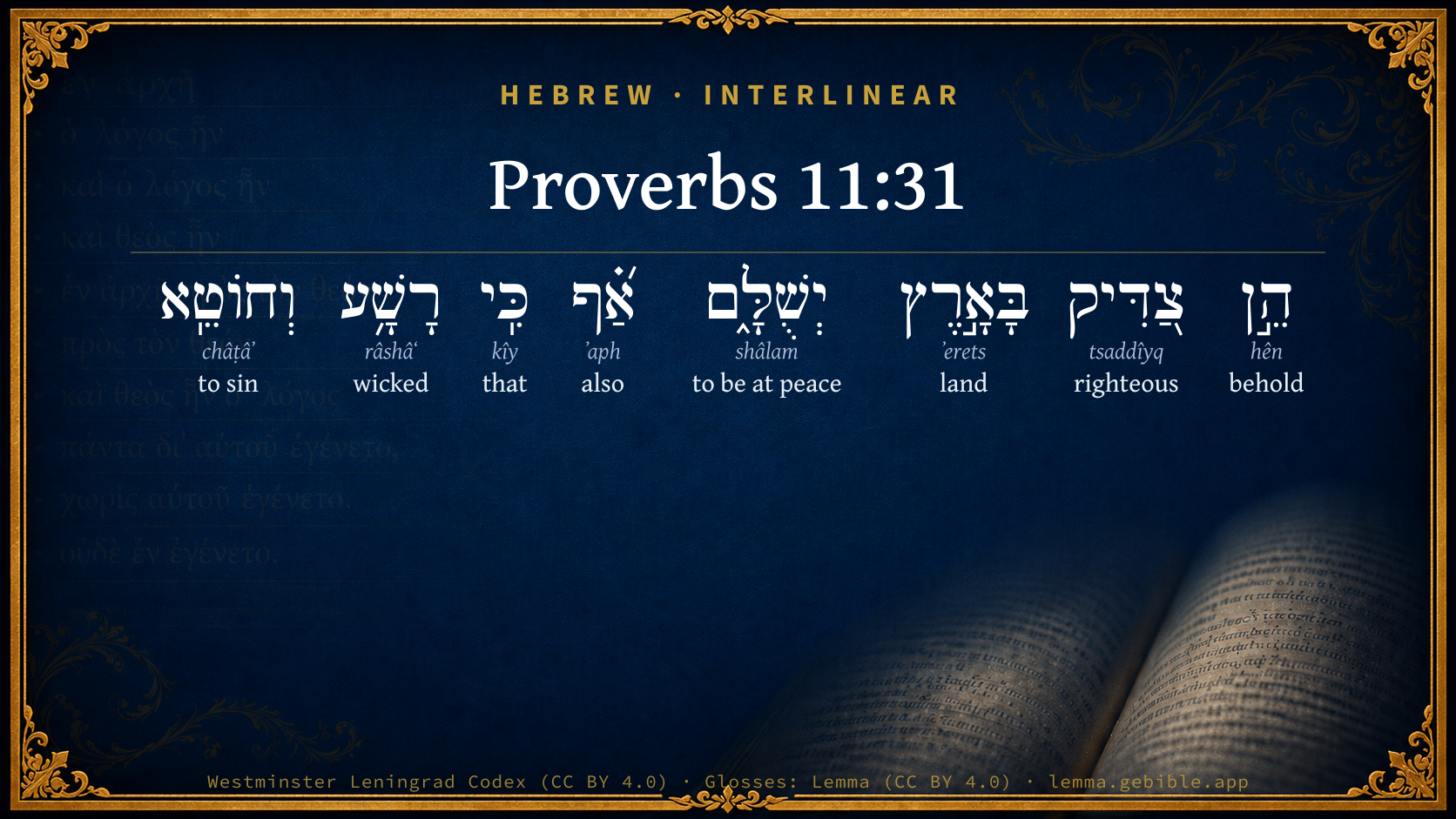
Hebrew (Westminster Leningrad Codex) Proverbs 11:31 appears in the Hebrew Old Testament. The text above is from the Westminster Leningrad Codex. Each word links to its Strong’s number, a concise gloss, and parsing drawn from the Open Scriptures Hebrew Bible morphology. Click any word for its full Brown-Driver-Briggs (BDB) entry.
Download image
Cite this verse

Proverbs 11:31 (World English Bible). Public Domain. Lemma interlinear Bible study tool, https://lemma.gebible.app/v/proverbs/11/31.

Show BibTeX & RIS
BibTeX
RIS
English Translation
Behold, the righteous shall be repaid in the earth; How much more the wicked and the sinner!
World English Bible · Public Domain
Download a study sheet

One document with this verse’s original text, its word-by-word gloss line, the meaning frame, cross-references with their text, attributed commentary, and full source and license credits — printable, and it pastes into notes with its structure intact.

This verse Autodidact and up

Study sheet (.html) Plain text (.txt)

A passage Seminary Student

Up to 50 verses in one chapter. A passage sheet keeps up to 6 commentary sources and 12 cross-references per verse, in the order this page ranks them, and says so on the sheet whenever that leaves anything out. Ask for a single verse and you get the Autodidact verse sheet above.

Everything on this page stays free to read, with no account — the sheet is a download of what is already on screen, not access to it.

Want to remove ads? Support Godless Engineer
Compare translations 3

The same verse in 3 English versions, stacked beneath the original-language interlinear above. Click any original word for its lexicon entry.

Each is an independent rendering of the whole verse — the interlinear is not word-aligned to these translations.

Highlighted words mark where these versions differ — a whole-verse word diff, not a word-by-word alignment.

  • World English Bible Public Domain
    Behold, the righteous shall be repaid in the earth; How much more the wicked and the sinner!
  • King James Version Public Domain
    Behold, the righteous shall be recompensed in the earth: much more the wicked and the sinner.
  • unfoldingWord Literal Text CC BY-SA 4.0
    Behold, a righteous in the land will be repaid, how much more a wicked and a sinner!

unfoldingWord Literal Text — © unfoldingWord, licensed CC BY-SA 4.0. Word-aligned USFM3 via Door43 (git.door43.org/unfoldingWord/en_ult).

Versions to compare (up to 4)

3 of 4 selected

Show all 18 translations

Every available English version of this verse, each an independent rendering of the whole verse.

  • World English Bible Public Domain
    Behold, the righteous shall be repaid in the earth; How much more the wicked and the sinner!
  • Berean Standard Bible Public Domain
    If the righteous receive their due on earth, how much more the ungodly and the sinner!
  • Majority Standard Bible Public Domain
    If the righteous receive their due on earth, how much more the ungodly and the sinner!
  • King James Version Public Domain
    Behold, the righteous shall be recompensed in the earth: much more the wicked and the sinner.
  • American Standard Version (1901) Public Domain
    Behold, the righteous shall be recompensed in the earth: How much more the wicked and the sinner!
  • Revised Version (1885) Public Domain
    Behold, the righteous shall be recompensed in the earth: how much more the wicked and the sinner!
  • Geneva Bible (1599) Public Domain
    Beholde, the righteous shalbe recompensed in the earth: howe much more the wicked and the sinner?
  • Douay-Rheims (1899) Public Domain
    If the just man receive in the earth, how much more the wicked and the sinner.
  • Young's Literal Translation Public Domain
    Lo, the righteous in the earth is recompensed, Surely also the wicked and the sinner!
  • Literal Standard Version CC BY-SA 4.0
    Behold, the righteous is repaid in the earth, || Surely also the wicked and the sinner!
  • Unlocked Literal Bible CC BY-SA 4.0
    Behold! The righteous person receives what he deserves; how much more the wicked and the sinner!
  • unfoldingWord Literal Text CC BY-SA 4.0
    Behold, a righteous in the land will be repaid, how much more a wicked and a sinner!
  • Darby Bible Public Domain
    Behold, the righteous shall be requited on the earth: how much more the wicked and the sinner.
  • World Messianic Bible Public Domain
    Behold, the righteous shall be repaid in the earth, how much more the wicked and the sinner!
  • Webster's Bible Public Domain
    Behold, the righteous shall be recompensed upon the earth: much more the wicked and the sinner.
  • Free Bible Version CC BY-SA 4.0
    If the good are repaid here on earth, how much more will the wicked who sin be repaid!
  • Bible in Basic English Public Domain
    If the upright man is rewarded on earth, how much more the evil-doer and the sinner!
  • JPS Tanakh (1917) Public Domain
    Behold, the righteous shall be requited in the earth; how much more the wicked and the sinner!

Literal Standard Version (2020), Covenant Press — licensed CC BY-SA 4.0. Text via the HelloAO Bible API (eBible.org). Unlocked Literal Bible (unfoldingWord) — licensed CC BY-SA 4.0. Text via the HelloAO Bible API (eBible.org). unfoldingWord Literal Text — © unfoldingWord, licensed CC BY-SA 4.0. Word-aligned USFM3 via Door43 (git.door43.org/unfoldingWord/en_ult). Free Bible Version, Dr. Jonathan Gallagher — licensed CC BY-SA 4.0. Text via the HelloAO Bible API (eBible.org).

Word by word

More ways to search: Search by grammar → Find every occurrence → Compare this word →

Practice this passage: Drill this verse → Learn its vocabulary →

יְשֻׁלָּ֑ם
shâlam
H7999
“to be at peace”
Verb, Pual, Imperfect, 3rd Person, Masculine, Singular
Part of Speech
Verb
Stem
Pual
Form
Imperfect
Person
3rd Person
Gender
Masculine
Number
Singular
Full BDB Definition

Origin: a primitive root

TWOT: 2401c

to be in a covenant of peace, be at peace - (Qal) - to be at peace - peaceful one (participle) - (Pual) one in covenant of peace (participle) - (Hiphil) - to make peace with - to cause to be at peace - (Hophal) to live in peace - to be complete, be sound - (Qal) - to be complete, be finished, be ended - to be sound, be uninjured - (Piel) - to complete, finish - to make safe - to make whole or good, restore, make compensation - to make good, pay - to requite, recompense, reward - (Pual) - to be performed - to be repaid, be requited - (Hiphil) - to complete, perform - to make an end of
  1. הֵ֣ן hên H2005 “behold” Particle, Demonstrative
  2. צַ֭דִּיק tsaddîyq H6662 “righteous” Adjective, Adjective, Masculine, Singular, Absolute
  3. בָּאָ֣רֶץ ʼerets H776 “in/at the · land” Preposition, Determined + Noun, Common, Both, Singular, Absolute
  4. אַ֝֗ף ʼaph H637 “also” Particle, Accusative
  5. כִּֽי kîy H3588 “that” Conjunction
  6. רָשָׁ֥ע râshâʻ H7563 “wicked” Adjective, Adjective, Masculine, Singular, Absolute
  7. וְחוֹטֵֽא châṭâʼ H2398 “and · sinning” Conjunction + Verb, Qal, Participle Active, Masculine, Singular, Absolute

About this verse

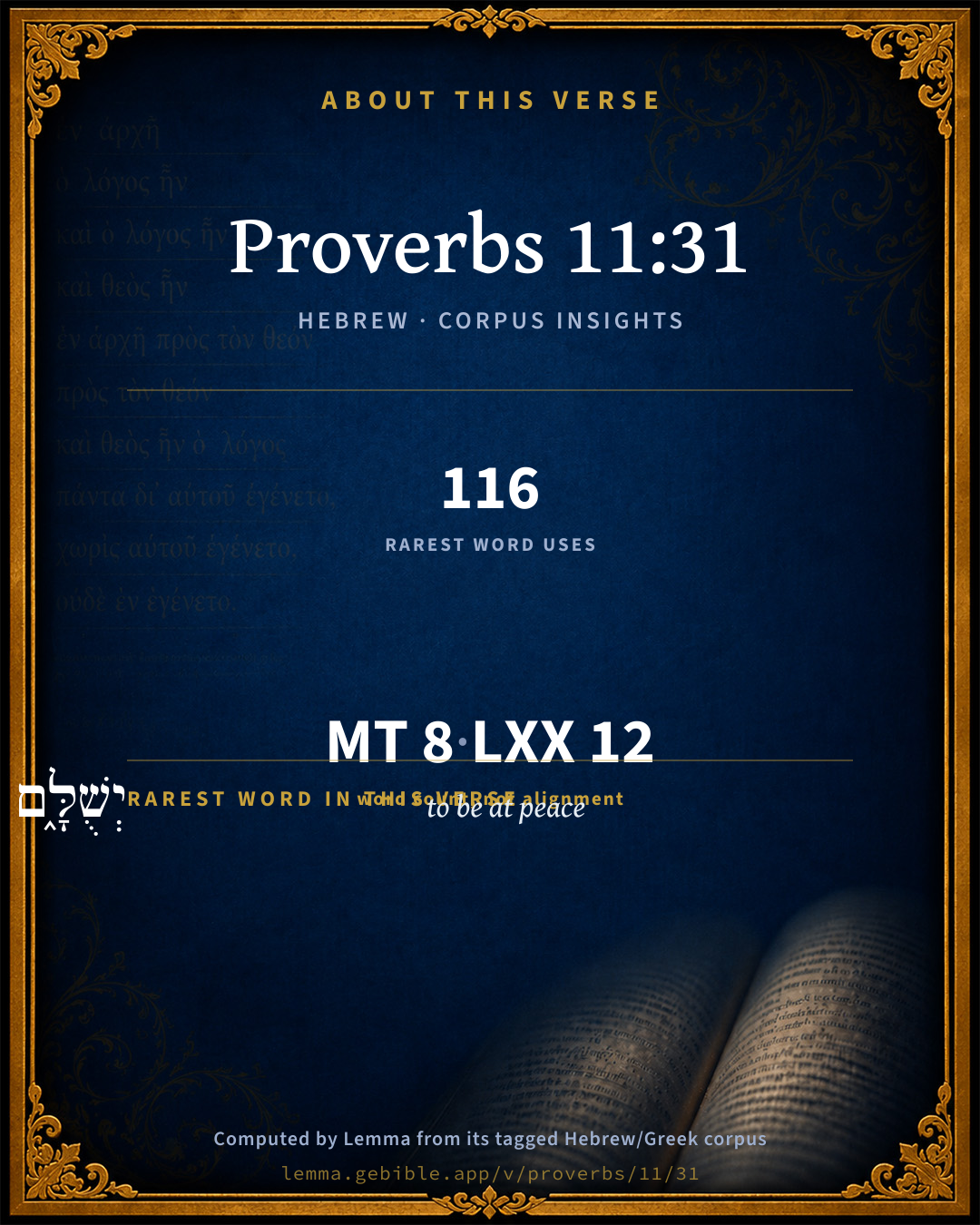
These counts appear in no published source. They are computed here, from the morphology-tagged text and Lemma’s own curated glosses. What Lemma adds →

8
words
8
distinct lemmas
Wisdom
section

Grammatical profile

  • 2 verbs
  • 1 noun
  • 2 adjectives
  • 1 conjunction
  • 2 particles

Verb forms

  • יְשֻׁלָּ֑ם Pual · Imperfect
  • וְחוֹטֵֽא Qal · Participle Active

Hebrew & Septuagint length

In English translation the verse runs 17 words from the Hebrew and 14 from the Septuagint (LXX English) — closely comparable.

A rough comparison of the two English renderings, which tokenize alike — not a word-level alignment.

Word counts can differ between the Hebrew and the Greek without any difference in meaning — e.g. the Hebrew direct-object marker אֵת has no separate Greek word, and Greek often adds the article ὁ.

In the original languages it is 8 Hebrew tokens and 12 Greek tokens — but the two are counted differently (Hebrew bundles its prefixes and suffixes into one token; the Greek is in lemma form), so that isn’t a like-for-like length.

Cross-references

7

Topical passages linked to Proverbs 11:31 in the Treasury of Scripture Knowledge — connected by theme and wording, ordered by reader-vote popularity; previews shown in the World English Bible.

  • 1 Peter 4:17–18 For the time has come for judgment to begin at the house of God. If it begins first with us, what will happen to those who don't obey the Gospel of God?
  • Jeremiah 25:29 For, behold, I begin to work evil at the city which is called by my name; and should you be utterly unpunished? You shall not be unpunished; for I will call for a sword on all the inhabitants of the earth, says Yahweh of Hosts.
  • 1 Corinthians 11:30–32 For this cause many among you are weak and sickly, and not a few sleep.
  • 2 Samuel 12:9–12 Why have you despised the word of Yahweh, to do that which is evil in his sight? You have struck Uriah the Hittite with the sword, and have taken his wife to be your wife, and have slain him with the sword of the children of Ammon.
  • Proverbs 13:21 Misfortune pursues sinners, But prosperity rewards the righteous.
  • 2 Samuel 7:14–15 I will be his father, and he shall be my son: if he commit iniquity, I will chasten him with the rod of men, and with the stripes of the children of men;
  • 1 Kings 13:24 When he was gone, a lion met him by the way, and killed him: and his body was cast in the way, and the donkey stood by it; the lion also stood by the body.

Cross-references courtesy of OpenBible.info (CC BY 4.0).

Hebrew and Greek witnesses Masoretic Hebrew ↔ Greek Septuagint

The same verse in the two great witnesses to the Old Testament, shown verse-for-verse.

These are two independent witnesses, not word-aligned to each other, and the Septuagint is shown in lemma (dictionary) form.

Hebrew Proverbs 11:31 Masoretic · Westminster Leningrad Codex

הֵ֣ן צַ֭דִּיק בָּאָ֣רֶץ יְשֻׁלָּ֑ם אַ֝֗ף כִּֽי רָשָׁ֥ע וְחוֹטֵֽא

Behold, the righteous shall be repaid in the earth; How much more the wicked and the sinner!

World English Bible · Public Domain

Greek LXX Proverbs 11:31 Septuagint · lemma form

εἰ ὁ μέν δίκαιος μόλις σώζω ὁ ἀσεβής καί ἁμαρτωλός ποῦ φαίνω

If the righteous scarcely be saved, where shall the ungodly and the sinner appear?

LXX2012 (modern English Septuagint) · Public Domain

On this verse, Bridges on Proverbs discusses the Septuagint’s reading. Read the note in Commentary ↓

Hebrew: Westminster Leningrad Codex (CC BY 4.0). Greek: Septuagint (public domain); English from LXX2012 (modern English Septuagint) (Public Domain). How the Septuagint differs from the Hebrew →

Commentary

Notes on Proverbs 11:31 from classic Christian and Jewish commentators (each source and its license shown beneath its notes). The classic Christian expositions comment on the surrounding passage and are grouped to its opening verse, so a note may address several verses; the Jewish commentaries on the Tanakh (Rashi and others) are per-verse, so they appear only where the commentator wrote on this verse.

Lemma curates 59 commentaries, every one of them public domain or Creative Commons licensed, each selected and text-cleaned for this edition rather than reprinted as found. About our sources →

Trapp's Complete Commentary

John Trapp

Pro 11:31 Behold, the righteous shall be recompensed in the earth: much more the wicked and the sinner.

Ver. 31. The righteous shall be recompensed,] i.e., Chastened, afflicted, "judged of the Lord, that they may not be condemned with the world," for their sufferings are not penal, but medicinal or probational; and they have it here in the earth, which is their house of correction, not in hell.

Much more the wicked.] Nah 1:9. Non surget hic afflictio. These shall be totally and finally consumed at once. {See Trapp on "1Pe 4:17"} {See Trapp on "1Pe 4:18"} see also my "Love Tokens," page 69, &c.

John Trapp, A Commentary or Exposition upon All the Books of the Old and New Testament (1647–1656) — public domain. Text from a community e-Sword module.

The Biblical Illustrator

Joseph S. Exell

Pro_11:31

Behold, the righteous shall be recompensed in the earth.

Judgment here

Two ways of explaining this text.

1. Of the happiness which God has appointed for goodness, it has pleased Him that some portion should accrue in this world; and of the misery which is the wages of sin, a much more abundant portion.

2. Even the righteous shall be recompensed (that is, punished) for their sins, in the earth, much more the wicked, with a sorer punishment. The argument is, if the good and pious often suffer for the faults they fall into, for the wicked to expect an exemption from suffering is a most vain and absurd expectation. The first is the more natural and obvious sense of the passage. This world is not a place of retribution. It is a place where men may suffer for their virtues and escape for their wickedness; and this so frequently as even to afford some ground and pretence for questioning which course a man had best take if this life were his all. A man might say, Let us live to ourselves, and seize all the good within our reach, whatever be the consequences to others. Such a plan the wise king pronounced to be foolish and shortsighted, even on the principles of worldly prudence, and without taking another life into the account. After all the arguments from suffering virtue and successful wickedness have been urged and admitted, the balance of good will be found to be with the good, and evil unknown to them, to beset the path and track the steps of the wicked. The words imply that any one may see this who will attend carefully to what passes around him. It is in every ones mouth that honesty is the best policy. The upright and regular part of the community is too sagacious and too strong for the schemer at last. The honest and good gain upon them and pass them, even in the career of worldly success. There is a reward in this life for a strict adherence to temperance and all the other branches and laws of self-government. But this doctrine is apparently opposed to such teachings as are found in Ecc_9:11. But it may be noticed that in Proverbs the rule is dealt with, and in Ecclesiastes the exceptions to the rule. Such exceptions there will always be. Part of the text declares that the punishment of sin in this world is more certain than the reward of virtue. And the fact is so. The recompense of the wicked does not tarry. Their course is soon interrupted by evil and suffering. We can generally predict the end of the wicked in this world. Licentiousness and debauchery lead to disease and embarrassment. Of dishonesty it may be said, its resources are soon dried up, and the plenty it procures is but for a moment. From the laws of nature and the appointments of Divine providence there is no escape. The true end and design of all the Divine afflictions and all earthly sufferings is our improvement. He adapts His methods to our wants, and appoints us such trials as we can bear. But the promise of recompense in the earth is perceived to belong to them; is fulfilled in them in many respects. (A. Gibson, M.A.)

The Biblical Illustrator, edited by Joseph S. Exell (c. 1880s–1900s) — public domain. Text from a community e-Sword module.

Joseph Benson's Commentary

Pro 11:31. Behold, the righteous shall be recompensed — That is, chastised, or punished for his sins; which the next clause shows to be Solomon’s meaning here; in the earth — Whereby he intimates, that all the righteous man’s sufferings are confined to this world, which is an unspeakable felicity; much more the wicked and the sinner — They shall be punished much more certainly and severely, either in this life, or in the life to come; or rather, in both. Compare this verse with 1Pe 4:18, which is a good comment upon it.

Joseph Benson's Commentary on the Old and New Testaments (1811–1818) — public domain. Text from a community e-Sword module.

The Preacher's Complete Homiletical Commentary

Joseph S. Exell (gen. ed.)

CRITICAL NOTES.—

Pro_11:31. Miller transposes this verse and reads, “Behold the righteous on earth shall be recompensed,” etc. On earth may be placed either with “the righteous,” or with “recompensed.”

MAIN HOMILETICS OF Pro_11:31

THE RECOMPENSE OF THE RIGHTEOUS AND THE WICKED

I. The righteous man will receive a present chastisement for his sins—

1. Because of his near relation to God. “You only have I known of all the families of the earth: therefore I will punish you for all your iniquities” (Amo_3:2). Is this a strange principle of action? Is it not one which is, or ought to be, acted upon among men? If the son of a king commits a crime, is it not felt that his high position and his special privileges make him more deserving of punishment? Our Lord recognised this truth when He said, “To whom men have committed much of him they will ask the more” (Luk_12:48). Those who stand in a special relation to God are expected to show it by a holy life, and when they fall into sin greater dishonour is brought upon the name of God than by many sins of the ungodly. Hence the necessity for their chastisement.

2. Because he will not be punished in the next world. The whole tenor of Bible teaching recognises this truth, and Paul asserts it: “We are chastened of the Lord, that we should not be condemned with the world” (1Co_11:32).

3. To overthrow that doctrine of devils—“Let us sin that grace may abound” (Rom_6:1; Rom_6:15). Many false doctrines have gone abroad in the so-called church, but surely none is so manifestly from the devil as this which proclaims that the more a child of God sins the more God is glorified! Will the man whose wound has been closed and whose bleeding has been stanched by the surgeon, tear off the bandage and reopen the wound in order to afford the physician another opportunity of displaying his skill? May he not, by such an act, be guilty of suicide? May he not so incur the anger of his doctor as to make him refuse to re-dress the wound? If any man thinks that the abounding mercy of God is a licence for sin, let him read the history of David, and ask himself if it does not prove that he is wofully mistaken. David himself most certainly was, if he presumed upon his high standing with the God whose “gentleness had made him great” (Psa_18:35) when he sinned the great sin which was the curse of all his after life. The God whom men fancy will be thus indulgent is not the God of the Bible—the God of Sinai—the God who visited the sin even of His servant Moses. “Let us sin that grace may abound” came from the forger of the oldest lie in human history. Mount Hor, Mount Nebo, and Mount Zion, each of which was the scene of a penalty inflicted on a distinguished saint of God for a particular and specified sin, bear witness to the truth that the “righteous will be recompensed on the earth.” And of these instances that of Moses is, perhaps, the most striking. Here is the chastisement, of the greatest man in the Old Testament dispensation—the specially elected leader and lawgiver of the chosen people. And though he had been and still was—yea, because he was the most honoured of Old Testament saints, he was shut out of the land to which he had been journeying for forty years for assuming a Divine prerogative—“die in the mount whither thou goest up, and be gathered to thy people, as Aaron thy brother died at Mount Hor, and was gathered to his people: because ye trespassed against me among the children of Israel at the waters of Meribah-Kadesh, in the wilderness of Zin; because ye sanctified me not in the midst of the children of Israel” (Deu_32:50-51). Such a sentence testifies that God is a consuming fire to sin, in the righteous as well as in the wicked.

II. If God’s friends are chastised, His enemies must be.—For they not only sin but make light of sin, either denying the fact or blaming their circumstances, their temperament, or their tempters, laying the blame anywhere except upon themselves, and this increases their guilt. If those who acknowledge and confess their sin must yet be chastised for it, how much more those who refuse to do either! The sin of the righteous is the exception of his life, but the entire life of the ungodly man is a course of opposition to the law of God. If, therefore, the isolated instances are visited, how much more such an accumulation of moral debt! The very justice of God demands that if He punish the saint He shall also punish the sinner. This is New Testament teaching as well as Old. “For the time is come that judgment must begin at the house of God; and if it first begin at us, what shall be the end of them that obey not the Gospel of God?” (1Pe_4:17).

OUTLINES AND SUGGESTIVE COMMENTS

But where is the righteous person thus scourged, judged, and recompensed? On the earth, even in this life, and in the world. The earth is not that seat which the Lord hath properly appointed for judgment or vengeance, neither is this life the day of the great assize; yet rather than sin shall be unpunished, yea, even in the elect, the Lord will keep a petty sessions in this life, and make the earth a house of correction.—Muffet.

The righteous are under the discipline though not under the curse, of the rod.—Bridges.

The best must look for stripes, if they will take liberty to sin against God. True it is that the Lord taketh not advantage of infirmities, He passeth by them, He smiteth not His children for them: but when they grow too bold, He will nurture and awe them with correction. In this sense He may be said to be no respecter of persons, that as He will not endure the sinfulness of the wicked, though they be never so great, so He will not allow of the sins of the godly, though they be never so good. First, God herein respecteth His own glory, who will have His people to know that He doth look for service at their hands. And the wicked see by this that He is neither remiss towards all nor partial towards any. Second, He respecteth the good. How wanton, how froward, how stubborn would children be, into what perils would they cast themselves should they be altogether exempted from the rod. They could never feel comfort of their parents’ favour unless they sometimes found the smart of their displeasure … And the tribulation and afflictions of good men do not bring them behind the wicked, but show that the plagues and punishments of the wicked are yet behind.—Dod.

The righteous Lord shall pay His debts even to the righteous. Sin makes God a debtor.—Jermin.

The Preacher's Complete Homiletical Commentary (gen. ed. Joseph S. Exell; Funk & Wagnalls, c. 1892) — public domain (pre-1929). A full-Bible homiletical/sermon-outline anthology covering 65 of 66 books (2 John is absent from the source module). Text from a community e-Sword module.

Bridges on Proverbs

Charles Bridges

(Pro 11:31 quoted in the NT: 1Pe 4:18 )

The inspired application of this proverb infallibly expounds the mind of God.†1 It is introduced to us with a special call to attention — Behold! Let the righteous expect from their relation to God — not immunity, but strict recompense. (Amo 3:2 . 1Pe 4:17 .) They are under the discipline, though not under the curse, of the rod. Such is our too high estimation of the world, conformity to its ways and spirit, and forgetfulness of our inheritance and home; that but for the rod, we should soon backslide to our stubborn wantonness. The righteous therefore are recompensed in the earth.†2 Every perfection of God is glorified in this dispensation. As a wise Father, he will not indulge them in sin. As a holy God, he must show in them his abhorrence of it. As a faithful God, he will make the chastisements of his rod the means of their restoration. (Psa 89:30-32 .) But — blessed be God — all the penal curse is subtracted. We are recompensed in the earth; not, as we deserve to be, in hell. Nay — "we are chastened of the Lord, that we might not be condemned with the world" (1Co 11:32 ); punished here, that we might be spared for ever; recompensed in the earth, to be made meet for heaven. (Heb 12:10 .)

Much more then will the wicked and the sinner be recompensed. If the children be scourged, much more the rebels. If the fatherly corrections be so terrible, even when the child be accepted; what must be the unmingled wrath for the willful sinner? "If the righteous scarcely be saved; where shall the ungodly and the sinner appear?" (1Pe 4:18 .) "If they do these things in the green tree, what shall be done in the dry?" (Luk 23:31 .) "Behold the day of the LORD cometh, that shall burn as an oven; and all that do wickedly shall be as stubble." (Mal 4:1 .) Let the wicked tremble. Let the child of God be humbled in the dust — "My flesh trembleth for fear of thee, and I am afraid of thy judgments." (Psa 119:120 .)

Footnotes:

†1 1Pe 4:18, is verbatim, LXX translation of this version — So also the Syriac — ’Si justus vix vivit, impius et peccator — ubi reperietur?’

†2 Jacob, Genesis 27 with 33. Moses and Aaron, Num 20:12, with Deu 3:23-26 ; Deu 33:48-52 . Psa 99:6-8 . Eli, 1Sa 2:27-36 . David, 2Sa 12:9-12 . Psa 32:3-4 ; 38:1-5. Solomon, 1Ki 11:9-13 . The disobedient prophet, 1Ki 13:21-24 . Hezekiah, Isa 39:1-7 .

Charles Bridges, An Exposition of the Book of Proverbs (1846) — public domain. Text from a community e-Sword module.

Tyndale Open Study Notes

Tyndale Open Resources

11:31 The implied answer is that wicked sinners will be punished on earth.

Tyndale Open Study Notes — © Tyndale Open Resources, licensed CC BY-SA 4.0. Text via the HelloAO Bible API.

Geneva Bible (1599)

Geneva Bible translators

Shall be punished as he deserveth, 1 Pet. 4:18.

Geneva Bible (1599) marginal notes — public domain. Text via Bolls.life.

Matthew Henry's Commentary

This, I think, is the only one of Solomon's proverbs that has that note of attention prefixed to it, Behold! which intimates that it contains not only an evident truth, which may be beheld, but an eminent truth, which must be considered. 1. Some understand both parts of a recompence in displeasure: The righteous, if they do amiss, shall be punished for their offences in this world; much more shall wicked people be punished for theirs, which are committed, not through infirmity, but with a high hand. If judgment begin at the house of God, what will become of the ungodly? Pe1 4:17, Pe1 4:18; Luk 23:31. 2. I rather understand it of a recompence of reward to the righteous and punishment to sinners. Let us behold providential retributions. There are some recompences in the earth, in this world, and in the things of this world, which prove that verily there is a God that judges in the earth (Psa 58:11); but they are not universal; many sins go unpunished in the earth, and services unrewarded, which indicates that there is a judgment to come, and that there will be more exact and full retributions in the future state. Many times the righteous are recompensed for their righteousness here in the earth, though that is not the principal, much less the only reward either intended for them or intended by them; but whatever the word of God has promised them, or the wisdom of God sees good for them, they shall have in the earth. The wicked also, and the sinner, are sometimes remarkably punished in this life, nations, families, particular persons. And if the righteous, who do not deserve the least reward, yet have part of their recompence here on earth, much more shall the wicked, who deserve the greatest punishment, have part of their punishment on earth, as an earnest of worse to come. Therefore stand in awe and sin not. If those have two heavens that merit none, much more shall those have two hells that merit both.

Matthew Henry's Commentary on the Whole Bible (1708–1710) — public domain (CC PDM 1.0). Text via the HelloAO Bible API.

Jamieson, Fausset & Brown

Robert Jamieson, A. R. Fausset & David Brown

Behold--Thus calling attention to the illustrations (compare Pro 11:23), the sentiment of which is confirmed even in time, not excluding future rewards and punishments.

Next: Proverbs Chapter 12

Jamieson, Fausset & Brown — Commentary Critical and Explanatory on the Whole Bible (1871) — public domain (CC PDM 1.0). Text via the HelloAO Bible API.

Adam Clarke's Commentary

Verse 31. Behold, the righteous shall be recompensed in the earth, c.] The Septuagint, Syrian, and Arabic read this verse as follows: "And if the righteous scarcely be saved, where shall the ungodly and the sinner appear?" And this St. Peter quotes literatim, 1Pe 4:18, where see the note. "See Clarke "1Pe 4:18".

Adam Clarke's Commentary on the Bible (1810–1826) — public domain. Text from a community e-Sword/MySword module.

Ellicott's Commentary for English Readers

(31) Behold the righteous shall be recompensed in the earth.—That is, even he shall be punished for his misdeeds, as were Jacob, Moses, David; how much more shall “the wicked and the sinner.” The LXX. translates freely, “If the righteous scarcely be saved, where shall the ungodly and the sinner appear?” a rendering adopted in 1Pe_4:18.

A Bible Commentary for English Readers, edited by Charles John Ellicott (1878–1897) — public domain. Text from a community e-Sword module.

The Cambridge Bible for Schools and Colleges

gen. ed. J. J. S. Perowne

31. shall be recompensed] This might mean, shall receive, in each case, the return due to him; the righteous shall be rewarded (as the same Heb. word is rendered in Pro_13:13) and the wicked punished (comp. recompense evil, the Heb. word being again the same, Jer_18:20). But then it is difficult to understand why the law of retribution should obtain “much more” in the second case than in the first. “Recompensed” has therefore been understood to mean “punished” in both cases: The righteous shall be punished for his sins (“for there is no man that sinneth not,” 1Ki_8:46); how much more, &c. The LXX. paraphrase of this latter interpretation is adopted by St Peter: “If the righteous is scarcely saved, where shall the ungodly and the sinner appear?” 1Pe_4:18, R.V.

The Cambridge Bible for Schools and Colleges (gen. ed. J. J. S. Perowne; Cambridge University Press, 1878–1918) — public domain. Text from a community e-Sword module.

John Gill's Exposition

Behold, the righteous shall be recompensed in the earth,.... Which Aben Ezra understands of the recompence of their good works. There is a reward for the righteous, and which they have now in keeping, though not "for" keeping, the commandments of God; they have the promise of this life, as well as of that which is to come, and which is made good to them; they have every good thing now which is proper and convenient for them; and they shall be recompensed in the new earth, in which only righteous persons will dwell. But it seems better, with Jarchi, to interpret it of the recompence of their sins and transgressions; that is, of their chastisements and afflictions, with which they are chastised by their heavenly Father, when they sin against him; which are all in love and for their good; and which they have only here on earth, while they are in this world; they will be all over in another, when there will be no more sin, and no more chastisement for it, much less condemnation; see Co1 11:32;

much more the wicked and the sinner; who shall not only be punished on earth as they often are, but in hell to all eternity. The Septuagint, Syriac, and Arabic versions, render the whole thus; "if the righteous be scarcely saved, where shall the ungodly and the sinner appear?" Which words are used by the Apostle Peter, to show, that if judgment or chastisement begin at the house of God, or with the righteous, that the end of the wicked must be very bad; which entirely agrees with the sense of this passage; see Pe1 4:17; a "behold" is prefixed to the whole, as a note, either of admiration, or rather of attention to what is sure and certain, and worthy of regard and consideration. The Targum is,

"behold, the righteous are strengthened in the earth; but the wicked and the sinners shall be consumed out of the earth;''

which seems to agree with Aben Ezra's sense of the words; see Psa 104:35.

Next: Proverbs Chapter 12

John Gill's Exposition of the Whole Bible (1746–1763) — public domain (CC PDM 1.0). Text via the HelloAO Bible API.

Albert Barnes' Notes on the Bible

The sense would appear to be, “The righteous is requited, i. e., is punished for his lesser sins, or as a discipline; much more the wicked, etc.” Compare 1Pe 4:18.

Albert Barnes' Notes on the Bible (1834–1885) — public domain. Text from a community e-Sword/MySword module.

Haydock's Catholic Bible Commentary

Receive. Punishment, for almost inevitable faults, or be treated according to his deserts. Septuagint, Syriac, and Arabic, "if the just be hardly saved, where shall the impious and the sinner appear?" (1 Peter iv. 18.) (Calmet) --- Afflictions attend the just in this life. Shall the wicked escape? (Menochius)

George Leo Haydock (1774–1849), Haydock's Catholic Family Bible and Commentary, 1859 edition — public domain. Excludes Psalms (Douay-Rheims chapter numbering differs from Protestant) and Deuterocanonical books (Catholic canon only).

Matthew Poole's English Annotations

The righteous shall be recompensed, i.e. punished for his sins, as appears from the next clause; the general word being here used of this one particular, by a synecdoche. In the earth; whereby he intimates that all his sufferings are confined to this world, which is an unspeakable felicity.

Much more, they shall be punished more certainly and more severely, either in this life or in the next,

the wicked and the sinner; those who make sin their great study, and daily and most delightful exercise. Compare this verse with 1Pe 4:18, which is a good comment upon it.

Matthew Poole's English Annotations on the Holy Bible (1683–1685) — public domain. Text from a community e-Sword/MySword module.

Whedon's Commentary on the Bible

Daniel D. Whedon

31. Righteous shall be recompensed; (or requited;) much more (or even so,) the wicked and the sinner — Luther renders the former clause, “The righteous must suffer on the earth,” which, Zockler says, hits the meaning.

The sense then would be: Even the righteous man suffers on the earth for those sins which he occasionally commits through infirmity and temptation; how much more the wicked man for his deliberate and habitual transgressions. The argument is a fortiori, from the less to the greater. This sense is preferred by many commentators. Miller translates thus: “Behold, the man who is righteous on the earth shall be recompensed:” and makes this note: “Not recompensed on the earth, for that is not true. Above all would the second clause not be true, for Solomon takes care to tell us (Ecc_9:2) that ‘there is one event to all.’ It is not true that the wicked are punished ‘on earth’ ‘much more,’ or much less, than any other class. ‘On earth’ has such a location as to be placed with either word, and the sense directs that it marks the arena of trial and not of reward.” Conant translates the first clause substantially as Miller, but retains the “much more” of the second. Stuart: “If the righteous shall be recompensed on the earth, surely, then, the wicked and the sinner.” Compare 1Pe_4:16. On the whole, our Authorized Version here may be permitted to stand. It agrees with the Septuagint and Peter.

Daniel D. Whedon (gen. ed.), Commentary on the Old and New Testaments (1874–1909) — public domain. Text from a community e-Sword module.

The Pulpit Commentary

The righteous shall be recompensed in the earth. Them are two ways of understanding this verse. The word rendered "recompensed," lv (shalam), is a vox media, and can be taken either in a good or bad sense. So the meaning will be, "The righteous meets with his reward upon earth, much more the sinner," the "reward" of the latter being, of course, punishment. But the versions lead to another interpretation, by which "recompensed" is rendered "chastised;" and the meaning is if even the righteous shall be punished for their trespasses, as Moses, David, etc., how much more the wicked! The Septuagint, quoted exactly by St. Peter (1Pe_4:18) has, "If the righteous scarcely be saved, where shall the ungodly and the sinner appear?"

The Pulpit Commentary (1880–1919), ed. H.D.M. Spence-Jones & Joseph S. Exell — public domain. Text from a community e-Sword module.

John Wesley's Explanatory Notes

Recompensed - Punished for his sins.

John Wesley, Explanatory Notes Upon the Whole Bible (1754–1765) — public domain. Text via the GEBible commentary corpus.

Keil & Delitzsch

C. F. Keil & F. Delitzsch

The following proverbs are especially directed, as connected with this כן, against the contradiction of the external appearance and of the masked internal nature.

20 An abomination to Jahve are the crookedly dishonest of heart,

And they who are of honest walk are his delight.

Keil & Delitzsch — Biblical Commentary on the Old Testament (1861–1891) — public domain (CC PDM 1.0). Text via the HelloAO Bible API. (Old Testament only.)

Kretzmann's Popular Commentary

Paul E. Kretzmann

v. 31. Behold, the righteous shall be recompensed in the earth, that is, if even he will not reach a stage when he will be free from suffering in this world, much more the wicked and the sinner, the ungodly will assuredly be subject to much severer punishment and will deserve the full measure of retribution which will strike them. It is a strong argument and admonition for righteousness of life.

Paul E. Kretzmann, Popular Commentary of the Bible (1921–1924) — public domain. Text from a community e-Sword module.

Rashi

Rabbi Shlomo Yitzchaki (Rashi)

Behold! The righteous man will be requited on earth Why should the wicked man feel confident when he prospers? Does he not see that the righteous man is requited the payment of the sins he has committed while he is still on earth, during his lifetime?

surely a wicked man and a sinner Surely the wicked will ultimately be requited, either during his lifetime or after his death.

Rashi on the Tanakh — English translations: “The Judaica Press complete Tanach with Rashi, translated by A. J. Rosenberg” (CC BY 4.0); “Pentateuch with Rashi's commentary by M. Rosenbaum and A.M. Silbermann, 1929-1934” (public domain); “The Metsudah Tanach series, Lakewood, N.J” (CC BY 4.0); and “The Book of Joshua, Metsudah Publications, 1997” (CC BY 4.0). Text via Sefaria.

Lesson kit

Teaching starters — assembled from the data on this page, not authored interpretation. Every prompt links to the verse data it draws on. Edit before teaching.

Proverbs, in the Wisdom, opens this verse with 8 words (8 distinct Hebrew lemmas). Its most distinctive word is shâlam (“to be at peace”). A historical commentator’s framing appears above. Read the whole chapter for the surrounding context.

Discussion questions

  1. What does “to be at peace” (shâlam) contribute to the verse as a whole?
  2. How does 1 Peter 4:17–18, which shares this passage’s theme, read alongside this verse?
  3. These translations render this verse differently; the difference is in the English rendering, not the original. What questions does that raise?
  4. «יְשֻׁלָּ֑ם» is a Pual Imperfect verb. How does that grammatical form shape the action described?
  5. Compare how Trapp's Complete Commentary and The Biblical Illustrator read this verse. Where do they agree or differ?

Things to notice

Reading settings

Reading text

Shown beneath each verse's original-language words.

Old Testament
Old Testament edition

Read the OT as the Masoretic Hebrew (MT) or the Greek Septuagint (LXX).

English shown for the Greek Septuagint (in the Hebrew ↔ Greek comparison).

Comparing translations? Open the Compare panel on any verse page to stack up to four side by side.