
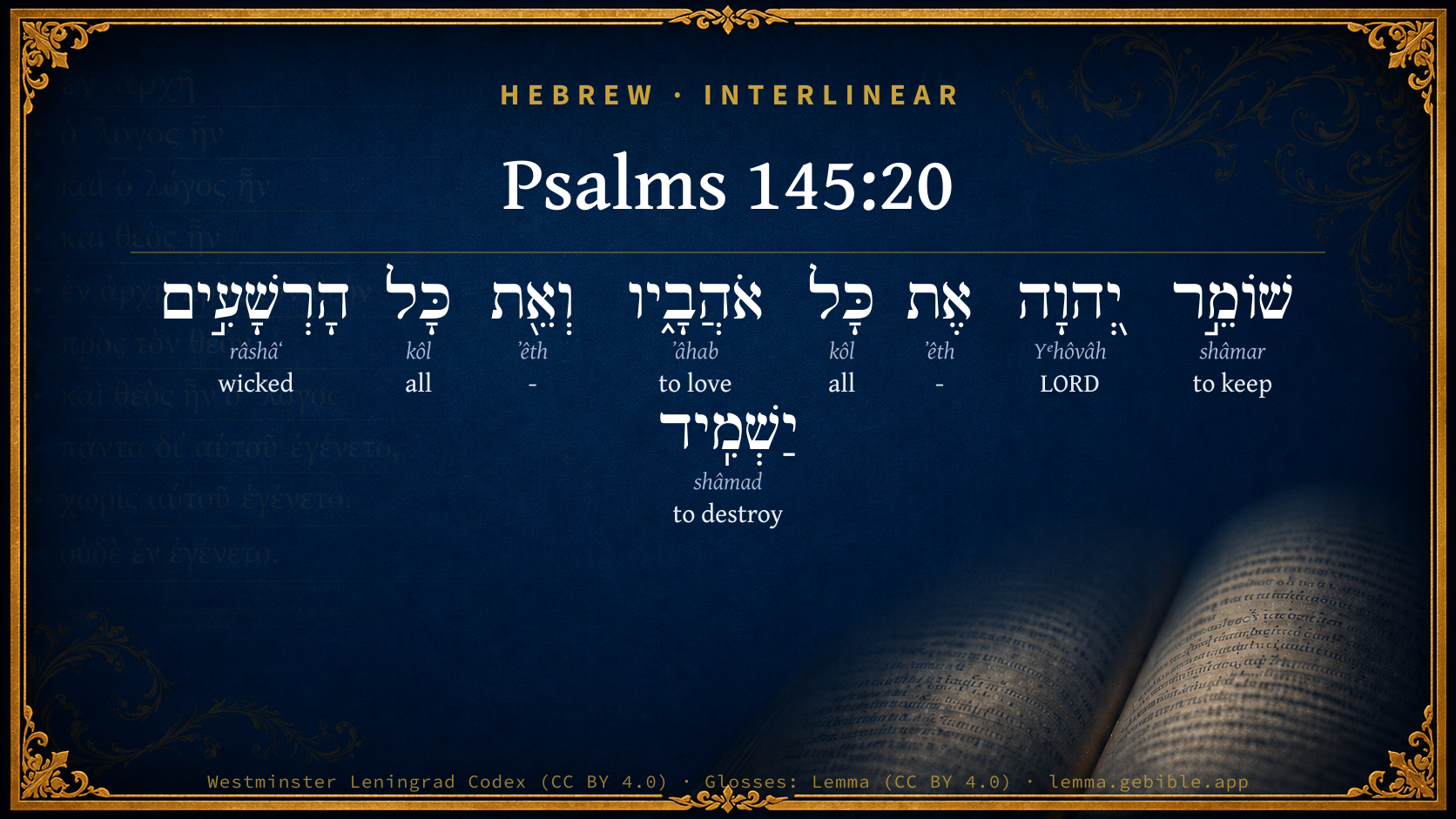
Psalms 145:20

Hebrew (Westminster Leningrad Codex) Psalms 145:20 appears in the Hebrew Old Testament. The text above is from the Westminster Leningrad Codex. Each word links to its Strong’s number, a concise gloss, and parsing drawn from the Open Scriptures Hebrew Bible morphology. Click any word for its full Brown-Driver-Briggs (BDB) entry.
Download image
Cite this verse

Psalms 145:20 (World English Bible). Public Domain. Lemma interlinear Bible study tool, https://lemma.gebible.app/v/psalms/145/20.

Show BibTeX & RIS
BibTeX
RIS
English Translation
Yahweh preserves all those who love him, But all the wicked he will destroy.
World English Bible · Public Domain
Download a study sheet

One document with this verse’s original text, its word-by-word gloss line, the meaning frame, cross-references with their text, attributed commentary, and full source and license credits — printable, and it pastes into notes with its structure intact.

This verse Autodidact and up

Study sheet (.html) Plain text (.txt)

A passage Seminary Student

Up to 50 verses in one chapter. A passage sheet keeps up to 6 commentary sources and 12 cross-references per verse, in the order this page ranks them, and says so on the sheet whenever that leaves anything out. Ask for a single verse and you get the Autodidact verse sheet above.

Everything on this page stays free to read, with no account — the sheet is a download of what is already on screen, not access to it.

Want to remove ads? Support Godless Engineer
Compare translations 3

The same verse in 3 English versions, stacked beneath the original-language interlinear above. Click any original word for its lexicon entry.

Each is an independent rendering of the whole verse — the interlinear is not word-aligned to these translations.

Highlighted words mark where these versions differ — a whole-verse word diff, not a word-by-word alignment.

  • World English Bible Public Domain
    Yahweh preserves all those who love him, But all the wicked he will destroy.
  • King James Version Public Domain
    The LORD preserveth all them that love him: but all the wicked will he destroy.
  • unfoldingWord Literal Text CC BY-SA 4.0
    Yahweh is keeping all of the ones loving him, but he destroys all of the wicked.

unfoldingWord Literal Text — © unfoldingWord, licensed CC BY-SA 4.0. Word-aligned USFM3 via Door43 (git.door43.org/unfoldingWord/en_ult).

Versions to compare (up to 4)

3 of 4 selected

Show all 17 translations

Every available English version of this verse, each an independent rendering of the whole verse.

  • World English Bible Public Domain
    Yahweh preserves all those who love him, But all the wicked he will destroy.
  • Berean Standard Bible Public Domain
    The LORD preserves all who love Him, but all the wicked He will destroy.
  • Majority Standard Bible Public Domain
    The LORD preserves all who love Him, but all the wicked He will destroy.
  • King James Version Public Domain
    The LORD preserveth all them that love him: but all the wicked will he destroy.
  • American Standard Version (1901) Public Domain
    Jehovah preserveth all them that love him; But all the wicked will he destroy.
  • Revised Version (1885) Public Domain
    The LORD preserveth all them that love him; but all the wicked will he destroy.
  • Geneva Bible (1599) Public Domain
    The Lord preserueth all them that loue him: but he will destroy all the wicked.
  • Young's Literal Translation Public Domain
    Jehovah preserveth all those loving Him, And all the wicked He destroyeth.
  • Literal Standard Version CC BY-SA 4.0
    YHWH preserves all those loving Him, || And He destroys all the wicked.
  • Unlocked Literal Bible CC BY-SA 4.0
    Yahweh watches over all those who love him, but he will destroy all the wicked.
  • unfoldingWord Literal Text CC BY-SA 4.0
    Yahweh is keeping all of the ones loving him, but he destroys all of the wicked.
  • Darby Bible Public Domain
    Jehovah keepeth all that love him, and all the wicked will he destroy.
  • World Messianic Bible Public Domain
    The LORD preserves all those who love him, but he will destroy all the wicked.
  • Webster's Bible Public Domain
    The LORD preserveth all them that love him: but all the wicked will he destroy.
  • Free Bible Version CC BY-SA 4.0
    The Lord takes care of all those who love him, but he will destroy all those who are wicked.
  • Bible in Basic English Public Domain
    The Lord will keep all his worshippers from danger; but he will send destruction on all sinners.
  • JPS Tanakh (1917) Public Domain
    The LORD preserveth all them that love Him; but all the wicked will He destroy.

Literal Standard Version (2020), Covenant Press — licensed CC BY-SA 4.0. Text via the HelloAO Bible API (eBible.org). Unlocked Literal Bible (unfoldingWord) — licensed CC BY-SA 4.0. Text via the HelloAO Bible API (eBible.org). unfoldingWord Literal Text — © unfoldingWord, licensed CC BY-SA 4.0. Word-aligned USFM3 via Door43 (git.door43.org/unfoldingWord/en_ult). Free Bible Version, Dr. Jonathan Gallagher — licensed CC BY-SA 4.0. Text via the HelloAO Bible API (eBible.org).

Word by word

More ways to search: Search by grammar → Find every occurrence → Compare this word →

Practice this passage: Drill this verse → Learn its vocabulary →

יַשְׁמִֽיד
shâmad
H8045
“to destroy”
Verb, Hiphil, Imperfect, 3rd Person, Masculine, Singular
Part of Speech
Verb
Stem
Hiphil
Form
Imperfect
Person
3rd Person
Gender
Masculine
Number
Singular
Full BDB Definition

Origin: a primitive root

TWOT: 2406

to destroy, exterminate, be destroyed, be exterminated - (Niphal) - to be annihilated, be exterminated - to be destroyed, be devastated - (Hiphil) - to annihilate, exterminate - to destroy
  1. שׁוֹמֵ֣ר shâmar H8104 “keeping” Verb, Qal, Participle Active, Masculine, Singular, Absolute
  2. יְ֭הוָה Yᵉhôvâh H3068 “LORD” Noun, Proper
  3. אֶת ʼêth H853 “-” Particle, Direct Object
  4. כָּל kôl H3605 “all of” Noun, Common, Masculine, Singular, Construct
  5. אֹהֲבָ֑יו ʼâhab H157 “loving · him” Verb, Qal, Participle Active, Masculine, Plural, Construct + Suffix, Personal, 3rd Person, Masculine, Singular
  6. וְאֵ֖ת ʼêth H853 “and · -” Conjunction + Particle, Direct Object
  7. כָּל kôl H3605 “all of” Noun, Common, Masculine, Singular, Construct
  8. הָרְשָׁעִ֣ים râshâʻ H7563 “the · wicked” Particle, Definite Article + Adjective, Adjective, Masculine, Plural, Absolute

About this verse

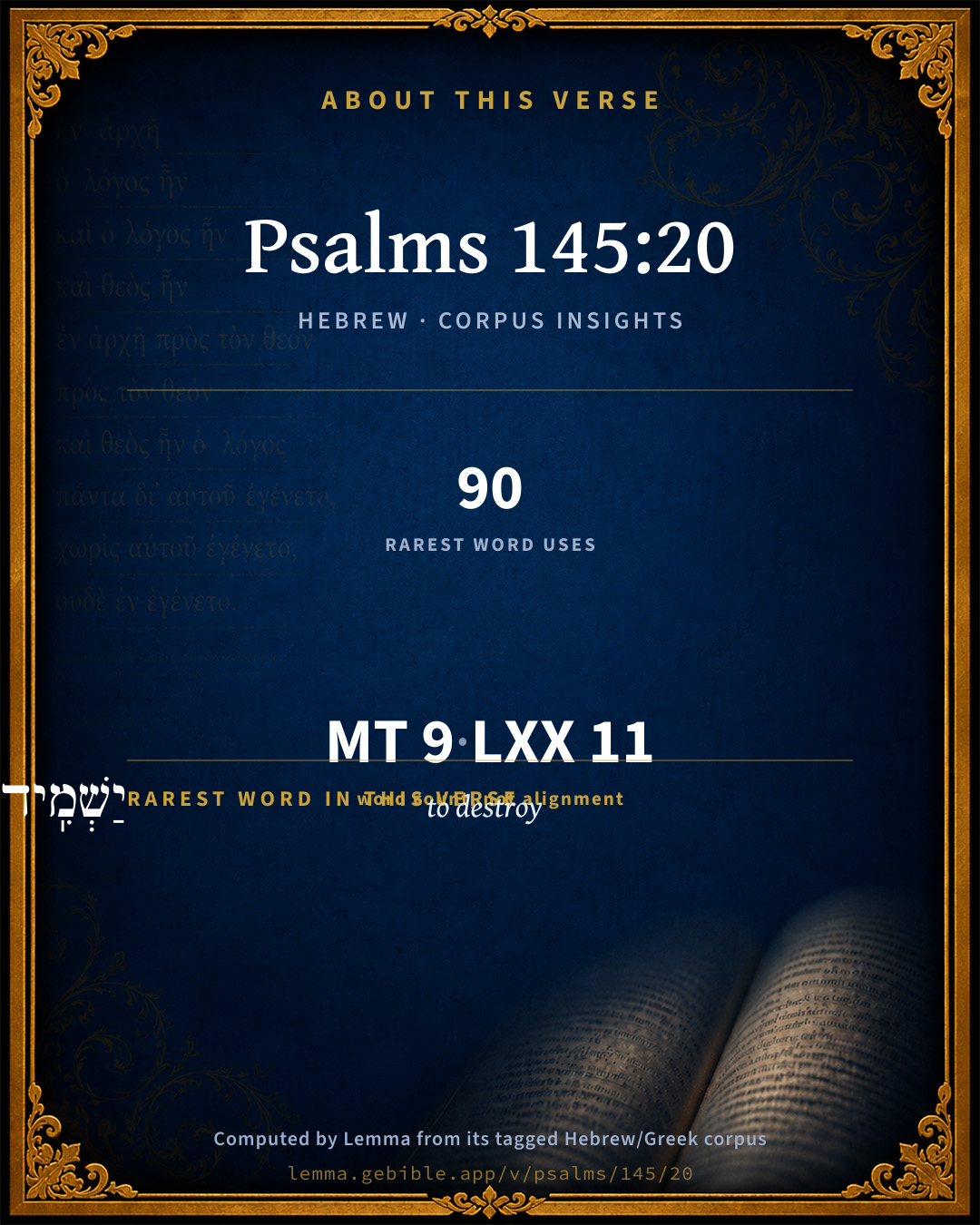
These counts appear in no published source. They are computed here, from the morphology-tagged text and Lemma’s own curated glosses. What Lemma adds →

9
words
7
distinct lemmas
Wisdom
section

Grammatical profile

  • 3 verbs
  • 3 nouns
  • 1 adjective
  • 2 particles

Verb forms

  • שׁוֹמֵ֣ר Qal · Participle Active
  • אֹהֲבָ֑יו Qal · Participle Active
  • יַשְׁמִֽיד Hiphil · Imperfect

Repetition

A word recurs within this verse — often emphatic in Hebrew:

Hebrew & Septuagint length

In English translation the verse runs 14 words from the Hebrew and 14 from the Septuagint (LXX English) — the same length.

A rough comparison of the two English renderings, which tokenize alike — not a word-level alignment.

Word counts can differ between the Hebrew and the Greek without any difference in meaning — e.g. the Hebrew direct-object marker אֵת has no separate Greek word, and Greek often adds the article ὁ.

In the original languages it is 9 Hebrew tokens and 11 Greek tokens — but the two are counted differently (Hebrew bundles its prefixes and suffixes into one token; the Greek is in lemma form), so that isn’t a like-for-like length.

Cross-references

12

Topical passages linked to Psalms 145:20 in the Treasury of Scripture Knowledge — connected by theme and wording, ordered by reader-vote popularity; previews shown in the World English Bible.

  • Exodus 20:6 and showing loving kindness to thousands of those who love me and keep my commandments.
  • John 10:27–29 My sheep hear my voice, and I know them, and they follow me.
  • Romans 8:28–30 We know that all things work together for good for those who love God, to those who are called according to his purpose.
  • Psalms 97:10 You who love Yahweh, hate evil. He preserves the souls of his saints. He delivers them out of the hand of the wicked.
  • Psalms 31:23 Oh love Yahweh, all you his saints! Yahweh preserves the faithful, And pays back him who deals proudly in full.
  • Psalms 1:6 For Yahweh knows the way of the righteous, But the way of the wicked shall perish.
  • Psalms 9:5 You have rebuked the nations. You have destroyed the wicked. You have blotted out their name forever and ever.
  • Psalms 9:17 The wicked shall be turned back to Sheol, Even all the nations that forget God.
  • James 2:5 Listen, my beloved brothers. Didn't God choose those who are poor in this world to be rich in faith, and heirs of the Kingdom which he promised to those who love him?
  • Psalms 37:28 For Yahweh loves justice, And doesn't forsake his saints. They are preserved forever, But the children of the wicked shall be cut off.
  • Matthew 25:41 Then he will say also to those on the left hand, 'Depart from me, you cursed, into the eternal fire which is prepared for the devil and his angels;
  • 1 Peter 1:5–8 who by the power of God are guarded through faith for a salvation ready to be revealed in the last time.

Cross-references courtesy of OpenBible.info (CC BY 4.0).

Hebrew and Greek witnesses Masoretic Hebrew ↔ Greek Septuagint

The same verse in the two great witnesses to the Old Testament, shown verse-for-verse.

You’re reading Greek Psalm 144 (Hebrew Psalm 145). The Septuagint counts the superscription, so verse numbers can differ from the Hebrew — chapter-level alignment, not verse-by-verse. Numbering follows Rahlfs.

These are two independent witnesses, not word-aligned to each other, and the Septuagint is shown in lemma (dictionary) form.

Hebrew Psalms 145:20 Masoretic · Westminster Leningrad Codex

שׁוֹמֵ֣ר יְ֭הוָה אֶת כָּל אֹהֲבָ֑יו וְאֵ֖ת כָּל הָרְשָׁעִ֣ים יַשְׁמִֽיד

Yahweh preserves all those who love him, But all the wicked he will destroy.

World English Bible · Public Domain

Greek LXX Greek Psalm 144:20 Septuagint · lemma form

φυλάσσω κύριος πᾶς ὁ ἀγαπάω αὐτός καί πᾶς ὁ ἁμαρτωλός ἐκὀλεθρεύω

The Lord preserves all that love him: but all sinners he will utterly destroy.

LXX2012 (modern English Septuagint) · Public Domain

Hebrew: Westminster Leningrad Codex (CC BY 4.0). Greek: Septuagint (public domain); English from LXX2012 (modern English Septuagint) (Public Domain). How the Septuagint differs from the Hebrew →

Commentary

Notes on Psalms 145:20 from classic Christian and Jewish commentators (each source and its license shown beneath its notes). The classic Christian expositions comment on the surrounding passage and are grouped to its opening verse, so a note may address several verses; the Jewish commentaries on the Tanakh (Rashi and others) are per-verse, so they appear only where the commentator wrote on this verse.

Lemma curates 59 commentaries, every one of them public domain or Creative Commons licensed, each selected and text-cleaned for this edition rather than reprinted as found. About our sources →

Trapp's Complete Commentary

John Trapp

Psa 145:20 The LORD preserveth all them that love him: but all the wicked will he destroy.

Ver. 20. The Lord preserveth all them that love him] See Psa 91:14-16. {See Trapp on "Psa 91:14"} {See Trapp on "Psa 91:15"} {See Trapp on "Psa 91:16"}

But all the wicked] That love not God, but their base lusts.

John Trapp, A Commentary or Exposition upon All the Books of the Old and New Testament (1647–1656) — public domain. Text from a community e-Sword module.

The Biblical Illustrator

Joseph S. Exell

Psa_145:20

All them that love Him.

Love to God

I. On what account God is to be loved, and is loved by His saints.

1. For Himself (Psa_8:1).

2. As their chief, yea, only good (Psa_73:25).

3. For the blessings of His goodness communicated to them (Psa_6:9).

4. For the various relations in which they stand toward Him (Psa_18:1).

5. For His great love to them (1Jn_4:19).

II. How, and in what way and manner, love to God manifests itself.

1. In a desire to be like Him (Eph_5:1).

2. In making His glory the supreme end of all their actions (1Co_10:31).

3. In desiring of, and delighting in, communion with God (1Jn_1:3).

4. In a carefulness not to offend Him by sinning against Him (Psa_97:10).

5. In parting with, and bearing, all, for His sake.

6. In a regard to His house, worship, and ordinances (Psa_84:1).

7. By a value for His Word, His Gospel, and the truths of it.

8. In love and affection to the people of God.

III. The nature and properties of the love of God.

1. It is universal; a love of all that is in God and belongs unto Him; of all His attributes and perfections, not of His goodness, grace, and mercy, and of Him for them only: but of His holiness, justice, and truth; and of all His commandments, which are to be respected (Eph_6:23-24).

2. It is superlative; exceeds all other love, or love to all other persons and things.

3. It is hearty and sincere; a love without dissimulation; not in word, nor in tongue, but in deed and in truth.

4. Should be constant; such is the love of God to His people, He rests in His love towards them.

5. It may be increased; the apostle prays for an increase of it, and he thanks God for it that it did abound (1Th_3:12; 2Th_1:3).

IV. The happiness of such that love the Lord.

1. They are loved by Him (Psa_63:3).

2. They are known of God (1Co_8:3; 2Ti_2:19).

3. They are preserved by Him (Psa_145:20; Psa_31:23).

4. They have many instances of mercy, kindness, and respect shown them (Exo_20:6). Hence David prays (Psa_119:123; Pro_8:21).

5. All things that occur unto them in the present life are for their good (Rom_8:28).

6. Great things are laid up and reserved for them that love Him. (T. Hannam.)

.

Psa_146:1-10

The Biblical Illustrator, edited by Joseph S. Exell (c. 1880s–1900s) — public domain. Text from a community e-Sword module.

Joseph Benson's Commentary

Psa 145:20-21. The Lord preserveth all that love him — They lie exposed to many dangers in this world from men and things, from visible and invisible foes; but he, by preserving them in their integrity, and enabling them to continue in his love, (Joh 15:9,) effectually secures them, so that no real evil befalls them. But all the wicked will he destroy — Frequently in this world, and infallibly in the next. To protect and save his subjects and destroy their enemies is the finishing part of the regal character as here exemplified in the King of saints. “By his grace he now preserves us from innumerable dangers and temptations, and gradually destroys sin in us; and by his power he will hereafter execute, in the fullest and most extensive sense, this part of his office, when the wicked shall be consumed with the spirit of his mouth, and destroyed with the brightness of his coming.” My mouth shall speak the praise of the Lord, &c. — “Having now given the reasons why he had resolved to extol his God and King, and to bless his name for ever and ever, the psalmist concludes with repeating his resolution, and exhorts all the world to follow his example in time and in eternity.” — Horne.

Joseph Benson's Commentary on the Old and New Testaments (1811–1818) — public domain. Text from a community e-Sword module.

J. A. Alexander on Psalms

Joseph Addison Alexander

20. (Psa 145:20) Jehovah keeps all that love him, and all the wicked will he destroy. The fearers of Psa 145:19 and the lovers of this verse are identical, which shews that godly fear and love are not incompatible. Keeps, literally keeping, as in Psa 145:15, from all danger and distress, preserving.

Joseph Addison Alexander, The Psalms Translated and Explained (1850) — public domain. Text from a community e-Sword module.

Tyndale Open Study Notes

Tyndale Open Resources

145:20 The Lord cares for those who love him and fear him. God-fearers love the Lord and find refuge in him (5:11); they seek him as their only true Savior (40:16; 70:4). They will experience a grand future (69:36), as well as God’s peace (119:165).

Tyndale Open Study Notes — © Tyndale Open Resources, licensed CC BY-SA 4.0. Text via the HelloAO Bible API.

Jamieson, Fausset & Brown

Robert Jamieson, A. R. Fausset & David Brown

Those who fear Him (Psa 145:19) are those who are here said to love Him.

Jamieson, Fausset & Brown — Commentary Critical and Explanatory on the Whole Bible (1871) — public domain (CC PDM 1.0). Text via the HelloAO Bible API.

Adam Clarke's Commentary

Verse 20. The Lord preserveth] He is the keeper of all them that love him.

But all the wicked will he destroy.] They call not upon him; they fight against him, and he will confound and destroy them. There is something curious in the שומר shomer, the keeper or guardian of the pious; he is שמיד shamid, the destroyer of the wicked. The first word implies he is continually keeping them; the second, that he causes the others to be destroyed.

Adam Clarke's Commentary on the Bible (1810–1826) — public domain. Text from a community e-Sword/MySword module.

John Calvin's Commentaries

20. Jehovah preserves, etc. He insists upon the same truth, — that God is near to his people to help them in the time of need; this being a sure proof of his presence, that by his mercy they come safe and unhurt out of every danger which befalls them. It is worthy of our notice, that, instead of fear, he now speaks of love; for, in distinguishing believers by this title, that they love God, he intimates it to be the root of true godliness, that they submit themselves to him voluntarily, which again is the effect of faith. Till God draw us by the attractions of his grace, this placid submission will never follow. The love spoken of by David, however, is perhaps more extensive, as God’s people not only attach themselves to him in the way of obedience to his authority, but knowing that union to him is of all other things most desirable, aspire with their whole soul after this happiness. Still there can be no doubt, that the reference is to it here as the chief part of holiness and righteousness, as was said by Moses,

“And now, O Israel, what does the Lord thy God require of thee,” etc. (Deuteronomy 10:12.)

This effect of godliness in securing our safety and preservation under the divine guardianship, David exemplifies by an opposition clause, declaring, that all the wicked shall, in the just judgment of God, miserably perish. That he might close as he had begun, he again affirms, that he will publish the praises of God, and urges all to the same duty by his example. Some would read, every living thing shall bless, but this does not seem to me a proper reading. When Moses, speaking of the flood, says, that “all flesh in which was the breath of life perished,” I grant that the term comprehends the brute creation, but wherever “flesh” is mentioned without any addition, the reference is only to men. Nor is David here stating what they would, but what they should do, declaring all men bound by the great and inexhaustible goodness of God constantly and for ever to praise him.

John Calvin's Commentaries (1540-1563) — public domain. Text from the Calvin Translation Society English edition (1840s-50s) via the Christian Classics Ethereal Library (ccel.org). Calvin's coverage is partial (roughly two-thirds of the Bible); uncommented books and verses are honest gaps, never fabricated. The 19th-century editor's footnotes and remarks are omitted so the notes are faithfully Calvin's own voice.

Ellicott's Commentary for English Readers

(20) Preserveth . . . destroy.—Notice this recurrent thought, that the guardianship of the good implies the destruction of the wicked.

A Bible Commentary for English Readers, edited by Charles John Ellicott (1878–1897) — public domain. Text from a community e-Sword module.

The Cambridge Bible for Schools and Colleges

gen. ed. J. J. S. Perowne

20. all the wicked will he destroy] See note on Psa_143:12. The victory of good must ultimately involve the defeat and destruction of evil.

The Cambridge Bible for Schools and Colleges (gen. ed. J. J. S. Perowne; Cambridge University Press, 1878–1918) — public domain. Text from a community e-Sword module.

John Gill's Exposition

The Lord preserveth all them that love him,.... All do not love Christ, none but those that are born again, and believe in him: love to Christ is a fruit of the Spirit, and accompanies faith in him; it flows from the love of Christ shed into the heart, and from a view of his loveliness, and a sense of his benefits; and, where it is true and genuine, it is superlative and sincere, and shows itself by a regard to its truths and ordinances, to his people, ways, and worship: and such the Lord preserves often in times of public calamity; and from the evil of sin, the dominion of it; from Satan's temptations, from being devoured and destroyed by him; and from a final and total falling away; he preserves them to his kingdom and glory, which is promised to them that love him;

but all the wicked will he destroy; he will consume them from off the earth, so that the wicked shall be no more; he will destroy the man of sin, and all his adherents; all the enemies of Christ, those that do not love him, but oppose him, his Gospel, kingdom, and interest; the beast and false prophet, with all that attend them, shall be cut off; the day of the Lord, like an oven, shall burn up all that do wickedly, and shall leave them neither root nor branch: this will especially be true at the day of judgment, when the wicked shall be ordered to everlasting fire; and they shall go into eternal punishment, when they shall be turned into hell; and all the nations that forget God. Kimchi interprets this of future time, when there shall not be a wicked man left in the world, and compares it with Mal 4:1.

John Gill's Exposition of the Whole Bible (1746–1763) — public domain (CC PDM 1.0). Text via the HelloAO Bible API.

Albert Barnes' Notes on the Bible

The Lord preserveth all them that love him - He keeps them; watches over them; defends them; makes them the object of his care. See Psa 31:20, note, Psa 31:23, note; Psa 97:10, note.

But all the wicked will he destroy - All that are found ultimately to be wicked; all that on the final trial deserve to be classed with the wicked. See Psa 9:17, note; Psa 11:6, note; Mat 25:46, note.

Albert Barnes' Notes on the Bible (1834–1885) — public domain. Text from a community e-Sword/MySword module.

Matthew Poole's English Annotations

Frequently in this world, but infallibly in the next.

Matthew Poole's English Annotations on the Holy Bible (1683–1685) — public domain. Text from a community e-Sword/MySword module.

The Treasury of David

Charles H. Spurgeon

Ver. 20. The LORD preserveth all them that love him. They keep him in their love, and he keeps them by his love. See how these favoured ones have advanced from fearing the Lord and crying to him, even to loving him, and in that love they are secure from all danger. Mark the number of "alls" in these later verses of the Psalm. In each of these God is all in all. But all the wicked will he destroy. Wickedness is an offence to all holy beings, and therefore those who are determined to continue in it must be weeded out. As good sanitary laws remove all creators of pest and plague, so does the moral government of God mark every evil thing for destruction; it cannot be tolerated in the presence of a perfectly holy God. What ruins wicked men frequently become in this life! What monuments of wrath will they be in the world to come! Like Nineveh and Babylon, and other destroyed places, they shall only exist to declare how thoroughly God fulfils his threatenings.

Ver. 20. The Lord preserveth, etc. God's mercy and God's justice; he preserves and he destroys. Philip IV of France, surnamed the Beautiful, on his escutcheon emblazoned a sword and an olive branch, with the motto, Utrumque, i.e. "one or the other." A truly great king is master of either artwar and peace. Thomas Le Blanc.

Ver. 20. Those who were called "them that fear him" are now denominated "them that love him." Simon de Muis.

Ver. 20. All the wicked will he destroy. God has so many different, unsearchable ways of taking wicked men out of the world, and sending them to hell, that there is nothing to make it appear that God had need to be at the expense of a miracle, or go out of the ordinary course of his providence, to destroy any wicked man at any moment. Jonathan Edwards.

Ver. 20. All the wicked will he destroy. It must not be overlooked that this declaration occurs in a song of praise. The whole of the context is utterly inconsistent with the expression of emotions of anger or revenge. Speaker's Commentary.

Ver. 20. All the wicked will he destroy. Prayer Book Version, "scattereth abroad."] Like the ruins of a demolished building; or rather, like an army, which the enemy has completely routed. William Keatinge Clay.

Ver. 20. Preserveth...destroy. Notice this recurrent the guardianship of the good implies the destruction of the wicked. A. S. Aglen.

Ver. 20. Those who love God are preserved from excessive temptation, falling into sin, despair, apostasy, remorse, famishing; preserved in trial, persecution, depression, death; preserved to activity, holiness, victory, glory.

Ver. 20. Solemn Contrasts.

1. Between human characters. "Them that love him." "The wicked."

2. Between human destinies. "Preserveth." "Destroy." C. A. D.

Ver. 20. How the love of God is the opposite of wickedness, and wickedness inconsistent with the love of God.

Psalms 145:21*

Charles H. Spurgeon's The Treasury of David (1869–1885) — public domain. Psalms only. Text from a community e-Sword/MySword module.

The Pulpit Commentary

The Lord preserveth all them that love him. (comp. Psa_31:23 Psa_97:10) But all the wicked will he destroy. The "severity" of God is always set against his "goodness" in Holy Scripture, lest men should misunderstand, and think to obtain salvation though they continue in wickedness. (see Exo_34:6, 7 Rom_2:2-11 Rom_11:22, etc.)

Preservation and destruction.

One or other of these lies before us all; the Bible gives no hint of a third condition or destiny. How important, therefore, to know whither we are tending, and what awaits us at the hand of God!

I THE TRUTH HERE DECLARED.

1. As to those that love God. He will preserve them. He does this:

(1) In the order of his providence. It is generally well with those that love him.

(2) In their spiritual history it is certainly true (see Romans 8., at end).

(3) In his eternal kingdom. No harm can reach them there.

2. As to the wicked. He will destroy them.

(1) Now and again we see such doom come upon individual transgressors. History recounts the destruction of nations, and their sin has ever been their destroyer. Where are the great empires of olden time?

(2) But often and often, blessed be his Name! He destroys the wicked by destroying their wickedness, turning their hearts to himself. The King"s arrows are sharp in the hearts of the King"s enemies.

(3) But God"s final doom on the ungodly is what is mainly meant in this Scripture that awful sentence of "everlasting destruction from the presence of the Lord," which must come on all those who will not allow that God should separate them from their sin. And this is no arbitrary sentence; for note

II THE NEEDS-BE FOR IT.

1. In the preservation of those that love God. It is so for the Lord"s own sake; his love could not otherwise be satisfied, nor his promises fulfilled. And for the world"s sake; they who love the Lord are the salt of the earth, and are his witnesses to men. And for their own sake, that they may be eternally blessed.

2. In the destruction of the wicked. If it be only a temporal destruction, it is needed for the vindication of the Divine Law; for the reformation of the guilty; (cf. 1Co_11:32) for witness to men that verily there is a God who judgeth. And if the destruction be other than temporal, it is still necessary, for how else can heaven be heaven? Earth is the sad place it too often is only because of the presence of sin. Is sin, then, to have place in heaven, as it will if the wicked come there?

III ITS WORD OF HOLY COUNSEL.

1. Pray: for so is our will strengthened to choose the right and refuse the wrong.

2. Act: break away from wickedness and commit yourself on the side of God.

3. Trust: day by day, yea, continually, give yourself up "to him who is able to keep you from falling, and to present you faultless," etc. "Help, Lord, that we may come To thy saints" happy home, Where a thousand years As one day appears; Nor go, Where one day appears As a thousand years, In woe. (Arudt) S.C.

The Pulpit Commentary (1880–1919), ed. H.D.M. Spence-Jones & Joseph S. Exell — public domain. Text from a community e-Sword module.

unfoldingWord translationNotes

Door43 World Missions Community

My mouth will speak

Here the words "My mouth" represent the one speaking. AT: "I will speak" (See: Synecdoche)

will speak out the praise of Yahweh

"tell everyone how good Yahweh is"

let all mankind bless his holy name

The word "name" is a metonym for Yahweh himself. See how "may his glorious name be blessed" is translated in Psalms 72:19. AT: "let all people bless him" or "let all people do what makes him happy" (See: Metonymy)

translationWords

watch

love

evil

holy

name

unfoldingWord translationNotes — © Distant Shores Media and the Door43 World Missions Community, licensed CC BY-SA 4.0. Source: git.door43.org/Door43/en_tn.

Lesson kit

Teaching starters — assembled from the data on this page, not authored interpretation. Every prompt links to the verse data it draws on. Edit before teaching.

Psalms, in the Wisdom, opens this verse with 9 words (7 distinct Hebrew lemmas). Its most distinctive word is shâmad (“to destroy”). A historical commentator’s framing appears above. Read the whole chapter for the surrounding context.

Discussion questions

  1. The word shâmad carries the sense “to destroy.” How does it shape the verse?
  2. Exodus 20:6 shares this passage’s theme. How do the two illuminate each other?
  3. “all” occurs 2× in this one verse. What is the effect of the repetition?
  4. These translations render this verse differently. What is at stake in choosing one wording over another?
  5. The verb «שׁוֹמֵ֣ר» is Qal Participle Active. How does its form color the action?
  6. Reading how Trapp's Complete Commentary and The Biblical Illustrator read this verse, where do the two commentators agree and where do they part?

Things to notice

Reading settings

Reading text

Shown beneath each verse's original-language words.

Old Testament
Old Testament edition

Read the OT as the Masoretic Hebrew (MT) or the Greek Septuagint (LXX).

English shown for the Greek Septuagint (in the Hebrew ↔ Greek comparison).

Comparing translations? Open the Compare panel on any verse page to stack up to four side by side.