
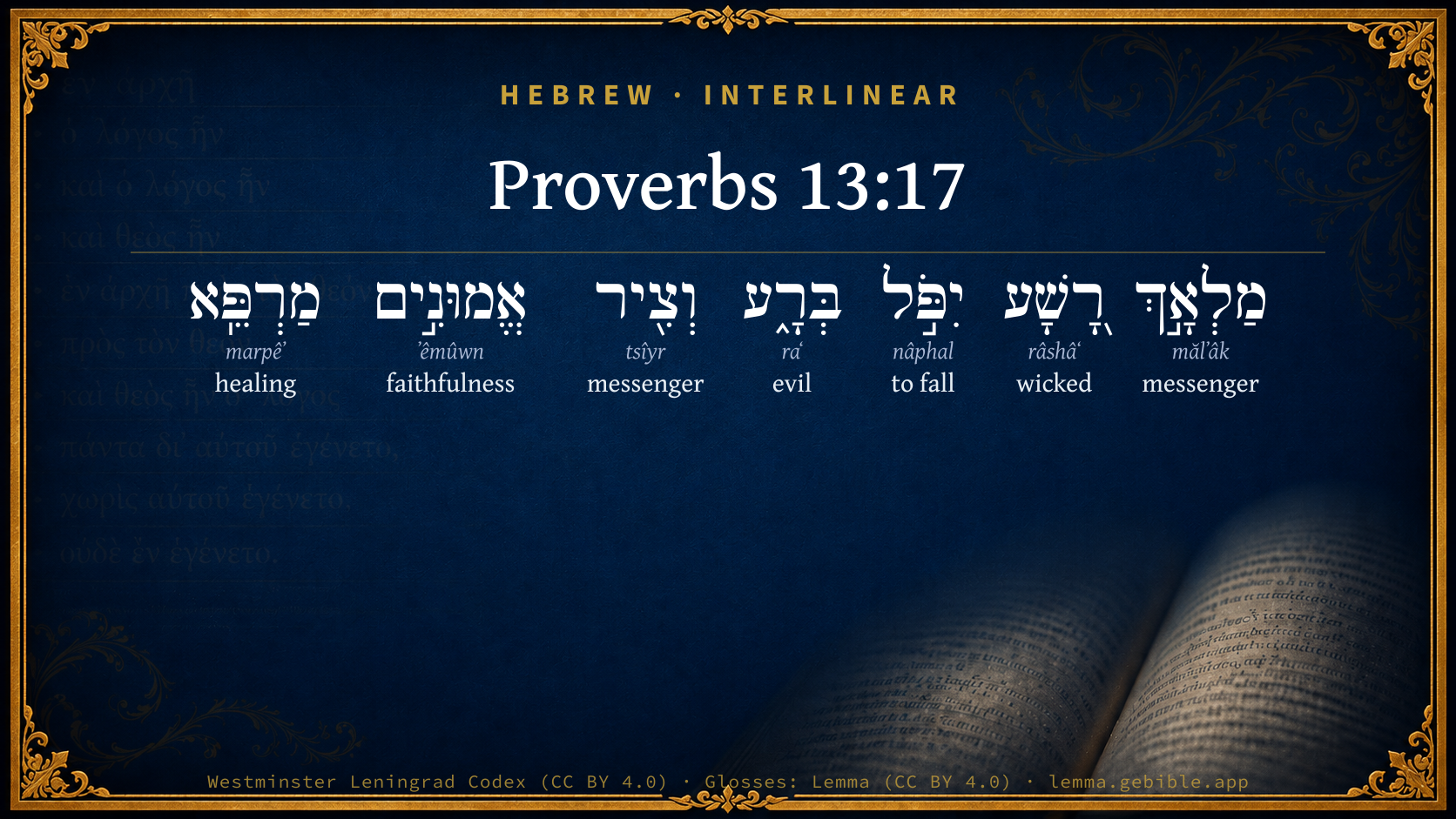
Proverbs 13:17

Hebrew (Westminster Leningrad Codex) Proverbs 13:17 appears in the Hebrew Old Testament. The text above is from the Westminster Leningrad Codex. Each word links to its Strong’s number, a concise gloss, and parsing drawn from the Open Scriptures Hebrew Bible morphology. Click any word for its full Brown-Driver-Briggs (BDB) entry.
Download image
Cite this verse

Proverbs 13:17 (World English Bible). Public Domain. Lemma interlinear Bible study tool, https://lemma.gebible.app/v/proverbs/13/17.

Show BibTeX & RIS
BibTeX
RIS
English Translation
A wicked messenger falls into trouble, But a trustworthy envoy gains healing.
World English Bible · Public Domain
Download a study sheet

One document with this verse’s original text, its word-by-word gloss line, the meaning frame, cross-references with their text, attributed commentary, and full source and license credits — printable, and it pastes into notes with its structure intact.

This verse Autodidact and up

Study sheet (.html) Plain text (.txt)

A passage Seminary Student

Up to 50 verses in one chapter. A passage sheet keeps up to 6 commentary sources and 12 cross-references per verse, in the order this page ranks them, and says so on the sheet whenever that leaves anything out. Ask for a single verse and you get the Autodidact verse sheet above.

Everything on this page stays free to read, with no account — the sheet is a download of what is already on screen, not access to it.

Want to remove ads? Support Godless Engineer
Compare translations 3

The same verse in 3 English versions, stacked beneath the original-language interlinear above. Click any original word for its lexicon entry.

Each is an independent rendering of the whole verse — the interlinear is not word-aligned to these translations.

Highlighted words mark where these versions differ — a whole-verse word diff, not a word-by-word alignment.

  • World English Bible Public Domain
    A wicked messenger falls into trouble, But a trustworthy envoy gains healing.
  • King James Version Public Domain
    A wicked messenger falleth into mischief: but a faithful ambassador is health.
  • unfoldingWord Literal Text CC BY-SA 4.0
    A wicked messenger falls into evil, but an envoy of faithfulness healing.

unfoldingWord Literal Text — © unfoldingWord, licensed CC BY-SA 4.0. Word-aligned USFM3 via Door43 (git.door43.org/unfoldingWord/en_ult).

Versions to compare (up to 4)

3 of 4 selected

Show all 18 translations

Every available English version of this verse, each an independent rendering of the whole verse.

  • World English Bible Public Domain
    A wicked messenger falls into trouble, But a trustworthy envoy gains healing.
  • Berean Standard Bible Public Domain
    A wicked messenger falls into trouble, but a faithful envoy brings healing.
  • Majority Standard Bible Public Domain
    A wicked messenger falls into trouble, but a faithful envoy brings healing.
  • King James Version Public Domain
    A wicked messenger falleth into mischief: but a faithful ambassador is health.
  • American Standard Version (1901) Public Domain
    A wicked messenger falleth into evil; But a faithful ambassador is health.
  • Revised Version (1885) Public Domain
    A wicked messenger falleth into evil: but a faithful ambassador is health.
  • Geneva Bible (1599) Public Domain
    A wicked messenger falleth into euill: but a faithfull ambassadour is preseruation.
  • Douay-Rheims (1899) Public Domain
    The messenger of the wicked shall fall into mischief: but a faithful ambassador is health.
  • Young's Literal Translation Public Domain
    A wicked messenger falleth into evil, And a faithful ambassador is healing.
  • Literal Standard Version CC BY-SA 4.0
    A wicked messenger falls into evil, || And a faithful ambassador is healing.
  • Unlocked Literal Bible CC BY-SA 4.0
    A wicked messenger falls into trouble, but a faithful envoy brings reconciliation.
  • unfoldingWord Literal Text CC BY-SA 4.0
    A wicked messenger falls into evil, but an envoy of faithfulness healing.
  • Darby Bible Public Domain
    A wicked messenger falleth into evil; but a faithful ambassador is health.
  • World Messianic Bible Public Domain
    A wicked messenger falls into trouble, but a trustworthy envoy gains healing.
  • Webster's Bible Public Domain
    A wicked messenger falleth into mischief: but a faithful embassador is health.
  • Free Bible Version CC BY-SA 4.0
    A bad messenger creates trouble, but a faithful representative brings healing.
  • Bible in Basic English Public Domain
    A man taking false news is a cause of trouble, but he who gives news rightly makes things well.
  • JPS Tanakh (1917) Public Domain
    A wicked messenger falleth into evil; but a faithful ambassador is health.

Literal Standard Version (2020), Covenant Press — licensed CC BY-SA 4.0. Text via the HelloAO Bible API (eBible.org). Unlocked Literal Bible (unfoldingWord) — licensed CC BY-SA 4.0. Text via the HelloAO Bible API (eBible.org). unfoldingWord Literal Text — © unfoldingWord, licensed CC BY-SA 4.0. Word-aligned USFM3 via Door43 (git.door43.org/unfoldingWord/en_ult). Free Bible Version, Dr. Jonathan Gallagher — licensed CC BY-SA 4.0. Text via the HelloAO Bible API (eBible.org).

Word by word

More ways to search: Search by grammar → Find every occurrence → Compare this word →

Practice this passage: Drill this verse → Learn its vocabulary →

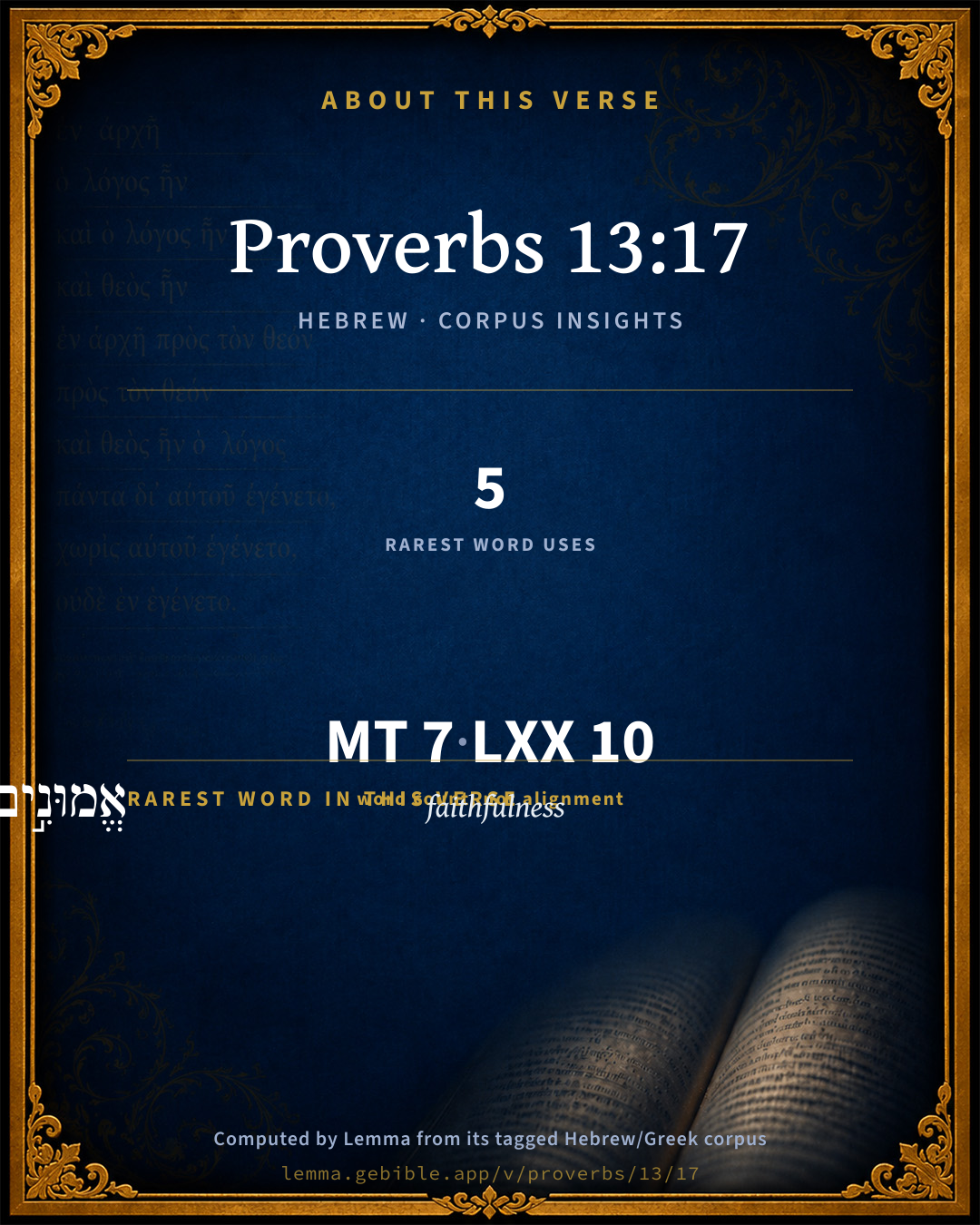
About this verse

These counts appear in no published source. They are computed here, from the morphology-tagged text and Lemma’s own curated glosses. What Lemma adds →

7
words
7
distinct lemmas
Wisdom
section

Notable vocabulary

The rarest word here is אֱמוּנִ֣ים faithfulness H529 — appearing just 5 times in the whole Hebrew Bible.

Shared distinctive vocabulary

אֱמוּנִ֣ים faithfulness H529 occurs in 5 verses of the Hebrew Bible. Also found in:

Grammatical profile

  • 1 verb
  • 4 nouns
  • 2 adjectives

Verb forms

  • יִפֹּ֣ל Qal · Imperfect

Hebrew & Septuagint length

In English translation the verse runs 12 words from the Hebrew and 14 from the Septuagint (LXX English) — closely comparable.

A rough comparison of the two English renderings, which tokenize alike — not a word-level alignment.

Word counts can differ between the Hebrew and the Greek without any difference in meaning — e.g. the Hebrew direct-object marker אֵת has no separate Greek word, and Greek often adds the article ὁ.

In the original languages it is 7 Hebrew tokens and 10 Greek tokens — but the two are counted differently (Hebrew bundles its prefixes and suffixes into one token; the Greek is in lemma form), so that isn’t a like-for-like length.

Cross-references

13

Topical passages linked to Proverbs 13:17 in the Treasury of Scripture Knowledge — connected by theme and wording, ordered by reader-vote popularity; previews shown in the World English Bible.

  • Proverbs 25:13 As the cold of snow in the time of harvest, So is a faithful messenger to those who send him; For he refreshes the soul of his masters.
  • Ezekiel 33:7–8 So you, son of man, I have set you a watchman to the house of Israel; therefore hear the word at my mouth, and give them warning from me.
  • 1 Corinthians 4:2 Here, moreover, it is required of stewards, that they be found faithful.
  • 2 Corinthians 5:20 We are therefore ambassadors on behalf of Christ, as though God were entreating by us. We beg you on behalf of Christ, be reconciled to God.
  • Ezekiel 3:18 When I tell the wicked, You shall surely die; and you give him no warning, nor speak to warn the wicked from his wicked way, to save his life; the same wicked man shall die in his iniquity; but his blood will I require at your hand.
  • 1 Timothy 1:12 And I thank him who enabled me, Christ Jesus our Lord, because he counted me faithful, appointing me to service;
  • 2 Timothy 2:2 The things which you have heard from me among many witnesses, commit the same to faithful men, who will be able to teach others also.
  • Proverbs 10:26 As vinegar to the teeth, and as smoke to the eyes, So is the sluggard to those who send him.
  • Proverbs 25:23 The north wind brings forth rain: So a backbiting tongue brings an angry face.
  • Proverbs 26:6 One who sends a message by the hand of a fool Is cutting off feet and drinking violence.
  • Jeremiah 23:13–16 I have seen folly in the prophets of Samaria; they prophesied by Baal, and caused my people Israel to err.
  • Jeremiah 23:28 The prophet who has a dream, let him tell a dream; and he who has my word, let him speak my word faithfully. What is the straw to the wheat? says Yahweh.
  • 2 Corinthians 2:17 For we are not as so many, peddling the word of God. But as of sincerity, but as of God, in the sight of God, we speak in Christ.

Cross-references courtesy of OpenBible.info (CC BY 4.0).

Hebrew and Greek witnesses Masoretic Hebrew ↔ Greek Septuagint

The same verse in the two great witnesses to the Old Testament, shown verse-for-verse.

These are two independent witnesses, not word-aligned to each other, and the Septuagint is shown in lemma (dictionary) form.

Hebrew Proverbs 13:17 Masoretic · Westminster Leningrad Codex

מַלְאָ֣ךְ רָ֭שָׁע יִפֹּ֣ל בְּרָ֑ע וְצִ֖יר אֱמוּנִ֣ים מַרְפֵּֽא

A wicked messenger falls into trouble, But a trustworthy envoy gains healing.

World English Bible · Public Domain

Greek LXX Proverbs 13:17 Septuagint · lemma form

βασιλεύς θρασύς ἐκπίπτω εἰς κακός ἄγγελος δέ πιστός ῥύομαι αὐτός

A rash king shall fall into mischief: but a wise messenger shall deliver him.

LXX2012 (modern English Septuagint) · Public Domain

On this verse, Keil & Delitzsch discusses the Septuagint’s reading. Read the note in Commentary ↓

Hebrew: Westminster Leningrad Codex (CC BY 4.0). Greek: Septuagint (public domain); English from LXX2012 (modern English Septuagint) (Public Domain). How the Septuagint differs from the Hebrew →

Commentary

Notes on Proverbs 13:17 from classic Christian and Jewish commentators (each source and its license shown beneath its notes). The classic Christian expositions comment on the surrounding passage and are grouped to its opening verse, so a note may address several verses; the Jewish commentaries on the Tanakh (Rashi and others) are per-verse, so they appear only where the commentator wrote on this verse.

Lemma curates 59 commentaries, every one of them public domain or Creative Commons licensed, each selected and text-cleaned for this edition rather than reprinted as found. About our sources →

Trapp's Complete Commentary

John Trapp

Pro 13:17 A wicked messenger falleth into mischief: but a faithful ambassador [is] health.

Ver. 17. A wicked messenger falleth into mischief.] Incurs the displeasure and just revenge of them that sent him, or, at least, of God, in case of his slackness. How much more then wicked ministers, those "messengers of the Churches," {2Co 8:23} that do the Lord’s work "negligently," {Jer 48:10} that "corrupt" {a} his message, {2Co 2:17} that huckster it and handle it craftily and covetously, calling good evil, and evil good, &c.? "Who is blind but my servant? or deaf as my messenger?" {Isa 42:19} Such an ambassador was once worthily derided in the Roman state. As at another time, a certain stranger coming on embassy to the senators of Rome, and colouring his hoary hair and pale cheeks with vermilion hue, a grave senator, espying the deceit, stood up and said, ‘What sincerity are we to expect at this man’s hands, whose locks, and looks, and lips do lie?’ It was an honest complaint of a Popish writer, We, saith he, handle the Scripture, tantum ut nos pascat et vestiat, that we may pick a living out of it, and are therefore fain to preach placentia, pleasingly and so to put men into a fool’s paradise. But "shall they" thus "escape by iniquity?" {Psa 56:7} have they no better doctors?

But a faithful ambassador is health.] To him that sendeth him, to those he is sent to, and to himself. So is a faithful minister that delivers "the whole counsel of God"; all that he hath in commission. {Jer 1:17 Eze 3:17}

{a} καπηλενειν.

John Trapp, A Commentary or Exposition upon All the Books of the Old and New Testament (1647–1656) — public domain. Text from a community e-Sword module.

The Biblical Illustrator

Joseph S. Exell

Pro_13:17

A wicked messenger falleth into mischief: but a faithful ambassador is health.

Ministers are ambassadors

I. Justify the comparison of the Ambassador and the minister of the gospel. Observe--

1. The high commission under which they act. The ambassador is invested with authority to perform business of the utmost importance to the well-being of both countries with which he is concerned. Is not this true of those servants of the Most High God who show to men the way of salvation? The office of the ministry is not of human, but of Divine origin.

2. Their required qualifications. An ambassador must be particularly instructed for his work; he must accurately know the mind and will of his employer, and the claims of the respective parties in reference to whom he treats. And a minister should be a man whose mind has been thoroughly enlightened by the truths of the gospel. He is set for the defence of the gospel, so he must show himself a scribe well instructed in the kingdom of heaven--one able rightly to divide the Word of truth.

3. The peculiar character of their transactions. The ambassador is often sent to arrange terms of peace. And in this sense, ministers are ambassadors for Christ.

4. The issue of their negotiations. A faithful ambassador is health. This refers to three things--the healing of those breaches and contentions which had previously broken forth and prevailed; the excellency of the benefits which accrue to the reconciled party; and the promotion to honour and prosperity of the successful ambassador. Each of these ideas is applicable to the higher exercises of the holy ambassadorship.

II. Considerations to urge you to accede to the proposals we advance.

1. It is derived from the expensive preparation made by the offended party to effect the desired conciliation.

2. The second consideration is drawn from the imminent peril of rejecting the proposals which we advance.

3. Think of the countless advantages of conciliation.

4. Reflect on the transitoriness of the period during which these negotiators must fulfil all the important ends of their embassy. Happy, thrice happy, are they who have been brought into a state of reconciliation with God. (John Clayton.)

The Biblical Illustrator, edited by Joseph S. Exell (c. 1880s–1900s) — public domain. Text from a community e-Sword module.

Joseph Benson's Commentary

Pro 13:17. A wicked messenger — Who is unfaithful in the execution of the business committed to his charge; falleth into mischief — Shall not escape punishment from God, or from them who sent him; but a faithful ambassador is health — Procures safety and benefit, as to his master, so also to himself.

Joseph Benson's Commentary on the Old and New Testaments (1811–1818) — public domain. Text from a community e-Sword module.

The Preacher's Complete Homiletical Commentary

Joseph S. Exell (gen. ed.)

MAIN HOMILETICS OF Pro_13:17

A SOCIAL LINK

I. An important link in human society—a messenger. This link may or may not be important in himself. He may belong to the highest or to the lowest stratum of human life. He may be a princely ambassador, or he may be a telegraph boy. The link which holds two bodies together may be of great intrinsic value. It may be of wrought gold, and much skill may have been expended on its workmanship; but what it is in itself is not of so much importance as what it is as a link. Its beauty and costliness will not avail much if it gives way when it is subject to strain, and thereby causes loss and vexation to its owner. The link that holds the cable to the anchor is not in itself worth much; but when it holds an ironclad off a rocky coast, there hangs upon it half a million of money, and the sorrow or joy of many human hearts for years to come. Untold loss or gain depend upon whether that ring of iron can bear the strain or not. So it is with a messenger. He may be a person of great intellectual powers, and of great social importance, or he may not have either. But he is always of value in his relative position. Like the link in a cable, he always holds in his keeping more than he is. He may be the bearer of the secrets of one who has hanging upon his will an army of many thousands, and a nation of as many millions may be interested in the message which he bears. Whether he be prince or peasant is of no importance in comparison with the fact that he bears a message.

II. The one all-important qualification in a messenger—faithfulness. No greater praise can be given to a man than to say that he is faithful, yet nothing less will make him worth anything in human life. All men’s hopes for time and eternity rest upon the faithfulness of God. This is the sheet-anchor of humanity that He is “a faithful Creator” (1Pe_4:19). That He is faithful that promised (Heb_10:10). It is for faithfulness, not for success, that He gives the “well done” (Mat_25:21), to His servants. In a messenger it is the one thing needful, and its importance is increased in proportion to what hangs upon his message. Life or death may depend upon it, and often not the fate of an individual merely, but the destiny of a nation. An unfaithful messenger “falleth into mischief himself.” He who betrays his trust injures himself. He goes down in the moral scale. He loses his reputation, and is not trusted again. If the link in the cable gives way, it is itself broken. But this is not all, nor the worst. He is the cause of mischief falling upon others. How true is this in social life. A message, coloured in its delivery, to gratify some selfish purpose, may divide men who would have been friends, if it had not been for the third person. And its omission, through carelessness, may bring about a like mischief. And it is also true in national relationships. The ambassador, who is entrusted to express a nation’s will, may be a fruitful source of mischief if he is negligent or unwary when war and peace hang in the balance. Millions of hearts may be made sad by an under or an over statement of facts. “But a faithful messenger is health,” or “healing.” He is health in himself. A faithful messenger, apart from his official or representative character, is an embodiment of moral health, and when he is entrusted to make peace where there has been war, he is “healing.” He may be only a counsellor of peace between individual men who have been at strife, or he may be the bearer of terms of peace between hostile nations. But, whether in the one case or the other, the faithful discharge of his duties will bring healing: for all real peace must be founded on a truthful statement of facts. This verse is especially true of an ambassador of Christ. He who is truly sent of God will be faithful in the delivery of his message, and will thus bring healing to many. He will “not walk in craftiness, nor handle the Word of God deceitfully, but by manifestation of the truth commend himself to every man’s conscience in the sight of God.” And so he will be the means of bringing moral health (2Co_4:2; 1Co_6:11).

OUTLINES AND SUGGESTIVE COMMENTS

Every man is a “messenger,” and has an errand, and that is as a witness for God (chap. Pro_14:25). The word for “messenger” is the word for “angel.” How soon did the wicked angel fall, when he became of no use? and men, how long do they tolerate a false messenger? The soul sent out by the Almighty, if wicked, shall fall; but a soul that is “faithful” is needed, and will hold its place.—Miller.

A wicked messenger hath no sooner a business committed unto him than he falleth into mischief, by betraying the trust reposed in him, and therefore justly doth mischief fall on him. He that is a faithful ambassador is, indeed, the ambassador of truth itself. He, being sent, hath healing under his wings, whereby he giveth soundness and health unto his business, whereby he giveth soundness and health to those that employed him. The proverbial sense is, That the good or bad success of a business proceedeth much from the goodness or badness of him that is employed in it.—Jermin.

How much more then, wicked ministers, those “messengers of the churches” (2Co_8:23) that do the Lord’s work negligently (Jer_48:10), that corrupt His message (2Co_2:17). Who is blind but my servant, or deaf as my messenger? (Isa_42:19).—Trapp.

While the wicked messenger prepares misfortune for himself, as well as for his master, the faithful makes good even his Lord’s mistakes.—Von Gerlach.

The Preacher's Complete Homiletical Commentary (gen. ed. Joseph S. Exell; Funk & Wagnalls, c. 1892) — public domain (pre-1929). A full-Bible homiletical/sermon-outline anthology covering 65 of 66 books (2 John is absent from the source module). Text from a community e-Sword module.

Keil & Delitzsch

C. F. Keil & F. Delitzsch

17 A godless messenger falls into trouble;

But a faithful messenger is a cordial.

The traditional text, which the translations also give (except Jerome, nuntius impii, and leaving out of view the lxx, which makes of Pro 13:17 a history of a foolhardy king and a wise messenger), has not מלאך, but מלאך; the Masora places the word along with המלאך, Gen 48:16. And יפל is likewise testified to by all translators; they all read it as Kal, as the traditional text punctuates it; Luther alone departs from this and translates the Hiph.: "a godless messenger bringeth misfortune." Indeed, this conj. יפּל presses itself forward; and even though one read יפּל, the sense intended by virtue of the parallelism could be no other than that a godless messenger, because no blessing rests on his godlessness, stumbles into disaster, and draws him who gave the commission along with him. The connection מלאך רשׁע is like אדם רשׁע, Pro 11:7 (cf. the fem. of this adj., Eze 3:18). Instead of בּרע is בּרעה, Pro 17:20; Pro 28:14, parallels (cf. also Pro 11:5) which the punctuators may have had in view in giving the preference to Kal. With מלאך, from לאך, R. לך, to make to go = to send, is interchanged ציר, from צוּר, to turn, whence to journey (cf. Arab. ṣar, to become, to be, as the vulg. "to be to Dresden = to journey" is used). The connection ציר אמוּנים (cf. the more simple ציר נאמן, Pro 25:13) is like Pro 14:15, עד אמונים; the pluralet. means faithfulness in the full extent of the idea. Regarding מרפּא, the means of healing, here to strength, refreshment, vid., Pro 4:22; Pro 12:18.

Keil & Delitzsch — Biblical Commentary on the Old Testament (1861–1891) — public domain (CC PDM 1.0). Text via the HelloAO Bible API. (Old Testament only.)

Tyndale Open Study Notes

Tyndale Open Resources

13:17 Oral messages were the primary form of communication, so an unreliable messenger delivering the wrong message could incite all kinds of trouble.

Tyndale Open Study Notes — © Tyndale Open Resources, licensed CC BY-SA 4.0. Text via the HelloAO Bible API.

Geneva Bible (1599)

Geneva Bible translators

Bringeth many inconveniences both to himself and to others.

Geneva Bible (1599) marginal notes — public domain. Text via Bolls.life.

Matthew Henry's Commentary

Here we have, 1. The ill consequences of betraying a trust. A wicked messenger, who, being sent to negotiate any business, is false to him that employed him, divulges his counsels, and so defeats his designs, cannot expect to prosper, but will certainly fall into some mischief or other, will be discovered and punished, since nothing is more hateful to God and man than the treachery of those that have a confidence reposed in them. 2. The happy effects of fidelity: An ambassador who faithfully discharges his trust, and serves the interests of those who employ him, is health; he is health to those by whom and for whom he is employed, heals differences that are between them, and preserves a good understanding; he is health to himself, for he secures his own interest. This is applicable to ministers, Christ's messengers and ambassadors; those that are wicked and false to Christ and the souls of men do mischief and fall into mischief, but those that are faithful will find sound words to be healing words to others and themselves.

Matthew Henry's Commentary on the Whole Bible (1708–1710) — public domain (CC PDM 1.0). Text via the HelloAO Bible API.

Jamieson, Fausset & Brown

Robert Jamieson, A. R. Fausset & David Brown

A wicked--or, "unfaithful"

messenger falleth into mischief--or, "by mischief," or "evil," and so his errand fails. Contrasted is the character of the faithful, whose faithfulness benefits others.

Jamieson, Fausset & Brown — Commentary Critical and Explanatory on the Whole Bible (1871) — public domain (CC PDM 1.0). Text via the HelloAO Bible API.

Adam Clarke's Commentary

Verse 17. A wicked messenger] The Septuagint: βασιλευς θρασυες, a bold king; instead of מלאך malach, a messenger, they had read מלך melech, a king: but they are singular in this rendering; none of the other versions have it so. He that betrays the counsels of his government, or the interests of his country, will sooner or later fall into mischief; but he that faithfully and loyally fulfils his mission, shall produce honour and safety to the commonwealth.

Adam Clarke's Commentary on the Bible (1810–1826) — public domain. Text from a community e-Sword/MySword module.

Ellicott's Commentary for English Readers

(17) Falleth into mischief.—And brings those also who sent him into trouble; but “a faithful messenger is health” both to himself and his employers.

A Bible Commentary for English Readers, edited by Charles John Ellicott (1878–1897) — public domain. Text from a community e-Sword module.

The Cambridge Bible for Schools and Colleges

gen. ed. J. J. S. Perowne

17. falleth] Hitzig and others, by a slight change of vowels, read bringeth, sc. those who sent him, which contrasts better with the bringing of health, or well-being by the faithful messenger. Comp. Pro_25:13.

mischief] Rather, evil, R.V.

This proverb must be read in the light of the then common employment of messengers charged with verbal tidings or instructions. The message would in such case depend greatly for its colour and consequences upon the character of the messenger.

The Cambridge Bible for Schools and Colleges (gen. ed. J. J. S. Perowne; Cambridge University Press, 1878–1918) — public domain. Text from a community e-Sword module.

John Gill's Exposition

A wicked messenger falleth into mischief,.... That does not do his errand right, nor deliver his message faithfully; such an one falls from the degree of honour in which he was into disgrace; he loses his master's favour that sent him; he is degraded from his post and office: he falls "by evil", or "into evil" (r); by the evil of sin, into the evil of punishment. So wicked ministers and false teachers, such who transform themselves into the apostles of Christ and into angels of light, who corrupt the word of God, and handle it deceitfully; these shall receive their just condemnation; since they do a deal of mischief to the souls of men, and therefore shall fall into mischief themselves, even into everlasting perdition;

but a faithful ambassador is health; or, "an ambassador of truths" (s); one that performs his embassy well and truly, he is salutary, useful, and profitable to himself, and to them that send him: the word for ambassador is translated an "hinge", Pro 26:14; and he is so called, because upon his negotiations abroad the hinge of political affairs turn at home. An ambassador of Christ, who does his work faithfully, keeps back nothing that is profitable, but declares the whole counsel of God; the sound doctrines he delivers are health to the souls of men; as well as he is approved of God and Christ; and so it turns to his own health and advantage, who will hear one day said unto him, "Well done, good and faithful servant", Mat 25:23.

(r) "in malum", V. L. Pagninus, Montanus, Tigurine version, Junius & Tremellius, Pisccator, &c. (s) "legatus veritatum", Montanus, Vatablus.

John Gill's Exposition of the Whole Bible (1746–1763) — public domain (CC PDM 1.0). Text via the HelloAO Bible API.

Haydock's Catholic Bible Commentary

Of the. Hebrew, "a wicked ambassador." A king generally chooses people like himself. (Menochius) --- Septuagint have read melec. "A rash king shall," &c.

George Leo Haydock (1774–1849), Haydock's Catholic Family Bible and Commentary, 1859 edition — public domain. Excludes Psalms (Douay-Rheims chapter numbering differs from Protestant) and Deuterocanonical books (Catholic canon only).

Matthew Poole's English Annotations

A wicked messenger, who is unfaithful in the execution of that which is committed to his charge, as appears by the opposite clause,

falleth into mischief; shall not escape punishment from God, or from them who sent him.

Is health; or, wholesome; procureth safety and benefit, as to his master, so also to himself.

Matthew Poole's English Annotations on the Holy Bible (1683–1685) — public domain. Text from a community e-Sword/MySword module.

Whedon's Commentary on the Bible

Daniel D. Whedon

17. A wicked messenger… mischief — A bad one, either ignorant or neglectful, makes trouble for himself and those who send him.

But a faithful ambassador — Hebrew, messenger of fidelities, is health, or healing. Heals differences and removes difficulties, procuring safety to himself and good to his principal. Comp. Pro_25:13; Pro_12:18; Pro_10:26; 1Sa_22:17-18; with Psalms 52, title; 2Ki_1:9-14.

Daniel D. Whedon (gen. ed.), Commentary on the Old and New Testaments (1874–1909) — public domain. Text from a community e-Sword module.

The Pulpit Commentary

A wicked messenger falleth into mischief; misfortune, calamity. (Pro_17:20) A messenger who is false to his employer shall be detected and punished. The LXX, reading melek for malak, renders, "A rash king shall fall into evils." Such a one adopts inconsiderate measures, makes war unadvisedly, etc. A faithful ambassador (literally, an ambassador of faithfulness, Pro_25:13) is health. One who faithfully performs his errand is a source of comfort and satisfaction both to his employer and to those to whom he is sent. Septuagint, "But a wise messenger shall deliver him the king.

A faithful messenger.

In early times, when no public postal arrangements existed, and when reading and writing were not generally cultivated, communications were more often sent by verbal messages and personal messengers. Great mischief would then accrue through unfaithfulness on the part of one of these agents of business or friendship. But important as would be the social effects arising out of this condition of affairs, far more momentous consequences must flow from the action of messengers between God and man. They indeed need to be faithful.

I THE CHRISTIAN PREACHER IS A MESSENGER.

1. He carries a message. He has to declare the truth of God as he has received it. He is the custodian of a gospel. The prophet has to utter the word of inspiration, and the apostle to proclaim the kingdom of heaven, and Christ as its King. Something of the prophet and apostle must be found in every Christian preacher. He is to go forth with the message that God has given him.

2. He delivers his message in person. The message is not posted; it is carried personally, and delivered by the mouth of the messenger. It is not enough that God"s truth is recorded in the Bible, and that the Bible is circulated throughout the world. The living voice of the living man is needed. The missionary is God"s messenger so also is every true preacher of the gospel.

II THE MESSENGER IS REQUIRED TO BE FAITHFUL.

1. He must deliver his message. The missionary must travel; the preacher at home must work among his people. Jonah was unfaithful in fleeing to Tarshish. Mere silence is unfaithfulness when one is entrusted with a message to deliver.

2. He must give it intact. He may neither add to it nor detract from it. Faithfulness in a Christian preacher means not shunning to declare the whole counsel of God, and not adding "vain philosophy" or "traditions of men" thereto. Of course, there is room for thought, reasoning, imagination, adaptation of the truth to the hearer, but not so as to modify the essential message.

3. He must disregard consequences. It may seem to him that the message is useless. Men may reject it; they may resent his offer of it; they may turn upon him and rend him. Yet it is just his duty to give the message that is entrusted to him.

III THE FIDELITY OF THE MESSAGE SECURES HEALTH OF SOUL. Elsewhere we read, "The tongue of the wise is health". (Pro_12:18)

1. It is an evidence of honesty and moral courage. The existence of messengers who are faithful even under the most trying circumstances proves that honour and right are regarded. It is for the health of a community at large that such virile qualities should be found among the leaders of thought.

2. It secures the presentation of truth to men. All lies and delusions are noxious poisons. Truth is food and medicine for the soul. A community that is fed on truth, though the truth be tough or bitter, is nourished with wholesome diet. That is indeed a healthy society in which all the citizens are led by honest teachers to unsophisticated truth.

3. It brings the most needful messages to the world. The Christian teacher is called upon to preach Christ to show the need of Christ in the ruin of sin, the grace of Christ to save, and the right of Christ to rule. These are health-giving truths; they constitute the direct antidote to the deadly poison of sin. He who honestly proclaims them makes for the health of his fellow men.

The Pulpit Commentary (1880–1919), ed. H.D.M. Spence-Jones & Joseph S. Exell — public domain. Text from a community e-Sword module.

John Wesley's Explanatory Notes

A messenger - Who is unfaithful in the execution of that which is committed to his charge. Is health - Procures benefit, as to his master, so to himself.

John Wesley, Explanatory Notes Upon the Whole Bible (1754–1765) — public domain. Text via the GEBible commentary corpus.

Bridges on Proverbs

Charles Bridges

A messenger proves his character by his neglect or discharge of his trust. A wicked messenger betrays his trust (Luk 16:1 ), damages his master (Pro 10:26 . Mat 25:26 ), and, as a just recompense, falls into mischief. Faithfulness is the servant’s glory, and his master’s gain. He brings and receives a blessing. Gehazi’s unfaithfulness brought him into mischief. (2Ki 5:26-27 .) Eliezer, "shewing all good fidelity," was blessed himself, and health to his master. (Gen 24:33-56 .)

But to speak of the messenger and ambassador of the LORD. (Mal 2:7 . 2Co 5:20 .) What words can tell the awful mischief of the wicked messenger, ignorant of the worth of his commission, and utterly careless in the discharge of it! Yet the mischief returns upon his own head; laden as he is with the guilt of the blood of souls; himself overwhelmed in the eternal damnation of those, who have perished through his neglect. (Eze 3:17-18 . 1Co 9:16 .) Faithfulness marks the true ambassador. (1Co 4:1-2 . 1Th 2:3-6 .) He "shuns not to declare the whole counsel of God." (Act 20:27 ); not obtruding offensive truths in unnatural prominence; but not withholding them in their just scriptural proportion. He condescends to the capacities of his people: but he will not humour their prejudices or antipathies. He "handles not the word of God deceitfully; but by manifestation of the truth he commends himself to every man’s conscience in the sight of God." (2Co 4:2 ; 2Co 2:17 .) "The tongue of such an ambassador" is health (Pro 12:18 ) both to himself and to his people. (Job 33:23-26 .) "The wilderness rejoices" under his fertilizing blessing (Isa 35:1 ); and the burst of joy and peace is heard on every side — "How beautiful upon the mountains are the feet of him, that bringeth good tidings, that publisheth peace!"

Charles Bridges, An Exposition of the Book of Proverbs (1846) — public domain. Text from a community e-Sword module.

Kretzmann's Popular Commentary

Paul E. Kretzmann

v. 17. A wicked messenger falleth into mischief, causing his errand to fail; but a faithful ambassador is health, like healing medicine to a smarting wound or like a tonic to the weary person, his faithful energy yielding such pleasant benefits.

Paul E. Kretzmann, Popular Commentary of the Bible (1921–1924) — public domain. Text from a community e-Sword module.

unfoldingWord translationNotes

Door43 World Missions Community

falls into trouble

"is unreliable" or "does something evil"

a faithful envoy

"a faithful messenger" or "a faithful diplomat"

learns from correction

The abstract noun "correction" can be stated as an action. AT: "learns when someone corrects him" (See: Abstract Nouns)

translationWords

evil

trouble

faithful

reconcile

shame

honor

unfoldingWord translationNotes — © Distant Shores Media and the Door43 World Missions Community, licensed CC BY-SA 4.0. Source: git.door43.org/Door43/en_tn.

Rashi

Rabbi Shlomo Yitzchaki (Rashi)

A wicked messenger falls into evil like Balaam, to whom the Holy One, blessed be He, said (Num. 22:35): “Go with the men,” but he dealt wickedly to entice Balak to follow his evil counsel; therefore, he fell by the sword.

but a faithful emissary brings healing This is Moses, our teacher.

Rashi on the Tanakh — English translations: “The Judaica Press complete Tanach with Rashi, translated by A. J. Rosenberg” (CC BY 4.0); “Pentateuch with Rashi's commentary by M. Rosenbaum and A.M. Silbermann, 1929-1934” (public domain); “The Metsudah Tanach series, Lakewood, N.J” (CC BY 4.0); and “The Book of Joshua, Metsudah Publications, 1997” (CC BY 4.0). Text via Sefaria.

Lesson kit

Teaching starters — assembled from the data on this page, not authored interpretation. Every prompt links to the verse data it draws on. Edit before teaching.

Proverbs, in the Wisdom, opens this verse with 7 words (7 distinct Hebrew lemmas). Its most distinctive word is ʼêmûwn (“faithfulness”). A historical commentator’s framing appears above. Read the whole chapter for the surrounding context.

Discussion questions

  1. What does “faithfulness” (ʼêmûwn) contribute to the verse as a whole?
  2. How does Deuteronomy 32:20, which shares the word «faithfulness», read alongside this verse?
  3. The translations on this page render this verse differently — a whole-verse word diff, not a word-by-word alignment. What might account for the different wordings?
  4. «יִפֹּ֣ל» is a Qal Imperfect verb. How does that grammatical form shape the action described?
  5. Compare how Trapp's Complete Commentary and The Biblical Illustrator read this verse. Where do they agree or differ?

Things to notice

Reading settings

Reading text

Shown beneath each verse's original-language words.

Old Testament
Old Testament edition

Read the OT as the Masoretic Hebrew (MT) or the Greek Septuagint (LXX).

English shown for the Greek Septuagint (in the Hebrew ↔ Greek comparison).

Comparing translations? Open the Compare panel on any verse page to stack up to four side by side.