1 Samuel 2:9

Hebrew (Westminster Leningrad Codex) 1 Samuel 2:9 appears in the Hebrew Old Testament. The text above is from the Westminster Leningrad Codex. Each word links to its Strong’s number, a concise gloss, and parsing drawn from the Open Scriptures Hebrew Bible morphology. Click any word for its full Brown-Driver-Briggs (BDB) entry.
Download image
Cite this verse

1 Samuel 2:9 (World English Bible). Public Domain. Lemma interlinear Bible study tool, https://lemma.gebible.app/v/1-samuel/2/9.

Show BibTeX & RIS
BibTeX
RIS
English Translation
He will keep the feet of his holy ones; But the wicked shall be put to silence in darkness; For by strength shall no man prevail.
World English Bible · Public Domain
Download a study sheet

One document with this verse’s original text, its word-by-word gloss line, the meaning frame, cross-references with their text, attributed commentary, and full source and license credits — printable, and it pastes into notes with its structure intact.

This verse Autodidact and up

Study sheet (.html) Plain text (.txt)

A passage Seminary Student

Up to 50 verses in one chapter. A passage sheet keeps up to 6 commentary sources and 12 cross-references per verse, in the order this page ranks them, and says so on the sheet whenever that leaves anything out. Ask for a single verse and you get the Autodidact verse sheet above.

Everything on this page stays free to read, with no account — the sheet is a download of what is already on screen, not access to it.

Want to remove ads? Support Godless Engineer
Compare translations 3

The same verse in 3 English versions, stacked beneath the original-language interlinear above. Click any original word for its lexicon entry.

Each is an independent rendering of the whole verse — the interlinear is not word-aligned to these translations.

Highlighted words mark where these versions differ — a whole-verse word diff, not a word-by-word alignment.

  • World English Bible Public Domain
    He will keep the feet of his holy ones; But the wicked shall be put to silence in darkness; For by strength shall no man prevail.
  • King James Version Public Domain
    He will keep the feet of his saints, and the wicked shall be silent in darkness; for by strength shall no man prevail.
  • unfoldingWord Literal Text CC BY-SA 4.0
    He will keep the feet of his faithful ones, but the wicked will be silenced in darkness. For not by strength does a man prevail.

unfoldingWord Literal Text — © unfoldingWord, licensed CC BY-SA 4.0. Word-aligned USFM3 via Door43 (git.door43.org/unfoldingWord/en_ult).

Versions to compare (up to 4)

3 of 4 selected

Show all 18 translations

Every available English version of this verse, each an independent rendering of the whole verse.

  • World English Bible Public Domain
    He will keep the feet of his holy ones; But the wicked shall be put to silence in darkness; For by strength shall no man prevail.
  • Berean Standard Bible Public Domain
    He guards the steps of His faithful ones, but the wicked perish in darkness; for by his own strength shall no man prevail.
  • Majority Standard Bible Public Domain
    He guards the steps of His faithful ones, but the wicked perish in darkness; for by his own strength shall no man prevail.
  • King James Version Public Domain
    He will keep the feet of his saints, and the wicked shall be silent in darkness; for by strength shall no man prevail.
  • American Standard Version (1901) Public Domain
    He will keep the feet of his holy ones; But the wicked shall be put to silence in darkness; For by strength shall no man prevail.
  • Revised Version (1885) Public Domain
    He will keep the feet of his holy ones, but the wicked shall be put to silence in darkness; for by strength shall no man prevail.
  • Geneva Bible (1599) Public Domain
    Hee will keepe the feete of his Saintes, and the wicked shall keepe silence in darkenes: for in his owne might shall no man be strong.
  • Douay-Rheims (1899) Public Domain
    He will keep the feet of his saints, and the wicked shall be silent in darkness, because no man shall prevail by his own strength.
  • Young's Literal Translation Public Domain
    The feet of His saints He keepeth, And the wicked in darkness are silent, For not by power doth man become mighty.
  • Literal Standard Version CC BY-SA 4.0
    He keeps the feet of His saints, || And the wicked are silent in darkness, || For man does not become mighty by power.
  • Unlocked Literal Bible CC BY-SA 4.0
    He will guard the feet of his faithful people, but the wicked will be put to silence in darkness, for no one will prevail by strength.
  • unfoldingWord Literal Text CC BY-SA 4.0
    He will keep the feet of his faithful ones, but the wicked will be silenced in darkness. For not by strength does a man prevail.
  • Darby Bible Public Domain
    He keepeth the feet of his saints, but the wicked are silenced in darkness; for by strength shall no man prevail.
  • World Messianic Bible Public Domain
    He will keep the feet of his holy ones, but the wicked will be put to silence in darkness; for no man will prevail by strength.
  • Webster's Bible Public Domain
    He will keep the feet of his saints, and the wicked shall be silent in darkness; for by strength shall no man prevail.
  • Free Bible Version CC BY-SA 4.0
    He will take care of those who trust him, but the wicked vanish into the darkness, for people don't succeed through their own strength.
  • Bible in Basic English Public Domain
    He will keep the feet of his holy ones, but the evil-doers will come to their end in the dark night, for by strength no man will overcome.
  • JPS Tanakh (1917) Public Domain
    He will keep the feet of His holy ones, but the wicked shall be put to silence in darkness; for not by strength shall man prevail.

Literal Standard Version (2020), Covenant Press — licensed CC BY-SA 4.0. Text via the HelloAO Bible API (eBible.org). Unlocked Literal Bible (unfoldingWord) — licensed CC BY-SA 4.0. Text via the HelloAO Bible API (eBible.org). unfoldingWord Literal Text — © unfoldingWord, licensed CC BY-SA 4.0. Word-aligned USFM3 via Door43 (git.door43.org/unfoldingWord/en_ult). Free Bible Version, Dr. Jonathan Gallagher — licensed CC BY-SA 4.0. Text via the HelloAO Bible API (eBible.org).

Word by word

More ways to search: Search by grammar → Find every occurrence → Compare this word →

Practice this passage: Drill this verse → Learn its vocabulary →

יִגְבַּר
gâbar
H1396
“to be strong”
Verb, Qal, Imperfect, 3rd Person, Masculine, Singular
Part of Speech
Verb
Stem
Qal
Form
Imperfect
Person
3rd Person
Gender
Masculine
Number
Singular
Full BDB Definition

Origin: a primitive root

TWOT: 310

to prevail, have strength, be strong, be powerful, be mighty, be great - (Qal) - to be strong, mighty - to prevail - (Piel) to make strong, strengthen - (Hiphil) - to confirm, give strength - to confirm (a covenant) - (Hithpael) - to show oneself mighty - to act proudly (toward God)
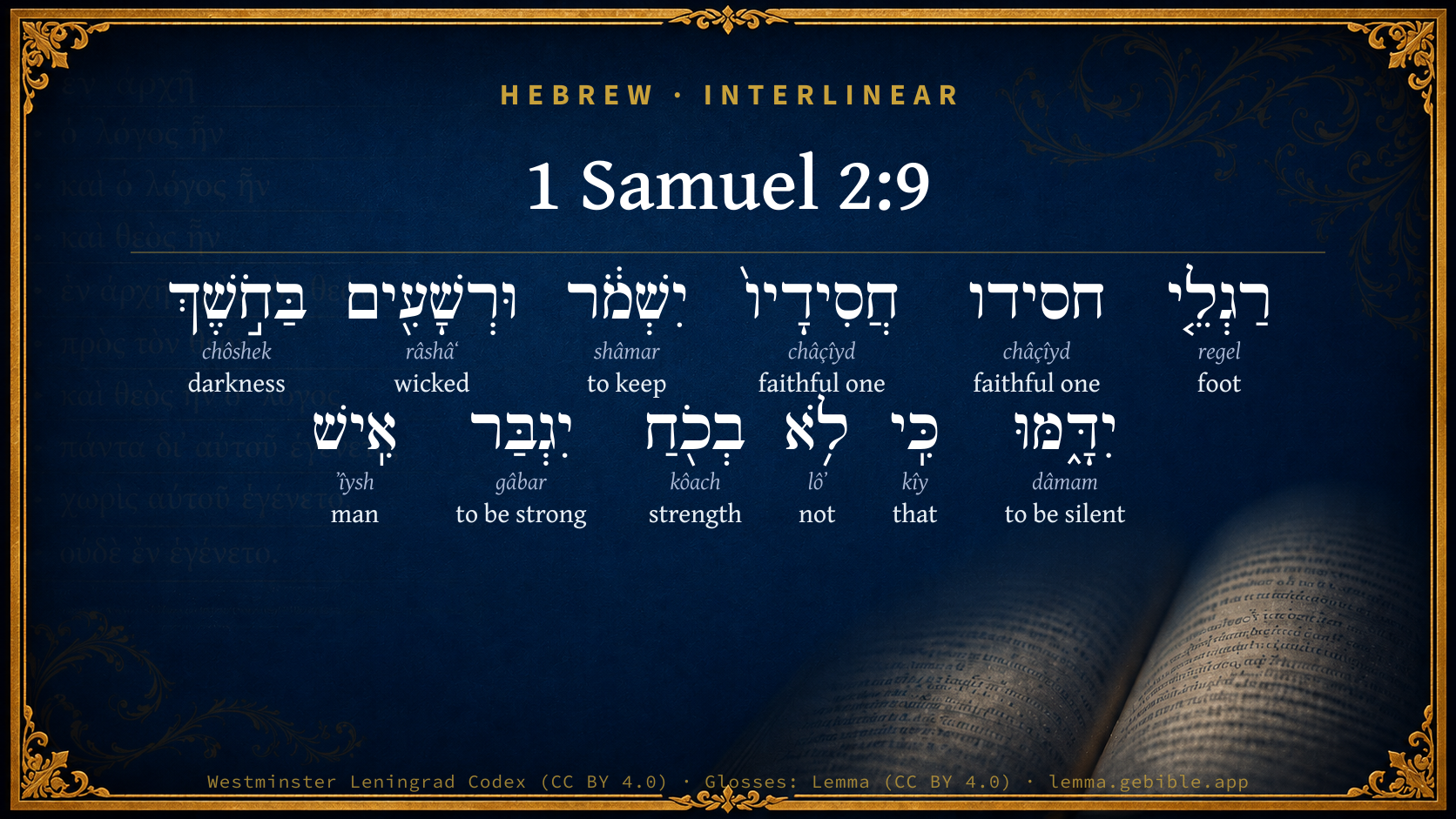
  1. רַגְלֵ֤י regel H7272 “feet of” Noun, Common, Feminine, Dual, Construct
  2. חסידו châçîyd H2623 “faithful one · his” Adjective, Adjective, Masculine, Singular, Construct + Suffix, Personal, 3rd Person, Masculine, Singular
  3. חֲסִידָיו֙ châçîyd H2623 “faithful one · his” Adjective, Adjective, Masculine, Plural, Construct + Suffix, Personal, 3rd Person, Masculine, Singular
  4. יִשְׁמֹ֔ר shâmar H8104 “to keep” Verb, Qal, Imperfect, 3rd Person, Masculine, Singular
  5. וּרְשָׁעִ֖ים râshâʻ H7563 “and · wicked” Conjunction + Adjective, Adjective, Masculine, Plural, Absolute
  6. בַּחֹ֣שֶׁךְ chôshek H2822 “in/at the · darkness” Preposition, Determined + Noun, Common, Masculine, Singular, Absolute
  7. יִדָּ֑מּוּ dâmam H1826 “to be silent” Verb, Niphal, Imperfect, 3rd Person, Masculine, Plural
  8. כִּֽי kîy H3588 “that” Conjunction
  9. לֹ֥א lôʼ H3808 “not” Particle, Negative
  10. בְכֹ֖חַ kôach H3581 “in/at · strength” Preposition + Noun, Common, Masculine, Singular, Absolute
  11. אִֽישׁ ʼîysh H376 “man” Noun, Common, Masculine, Singular, Absolute

About this verse

These counts appear in no published source. They are computed here, from the morphology-tagged text and Lemma’s own curated glosses. What Lemma adds →

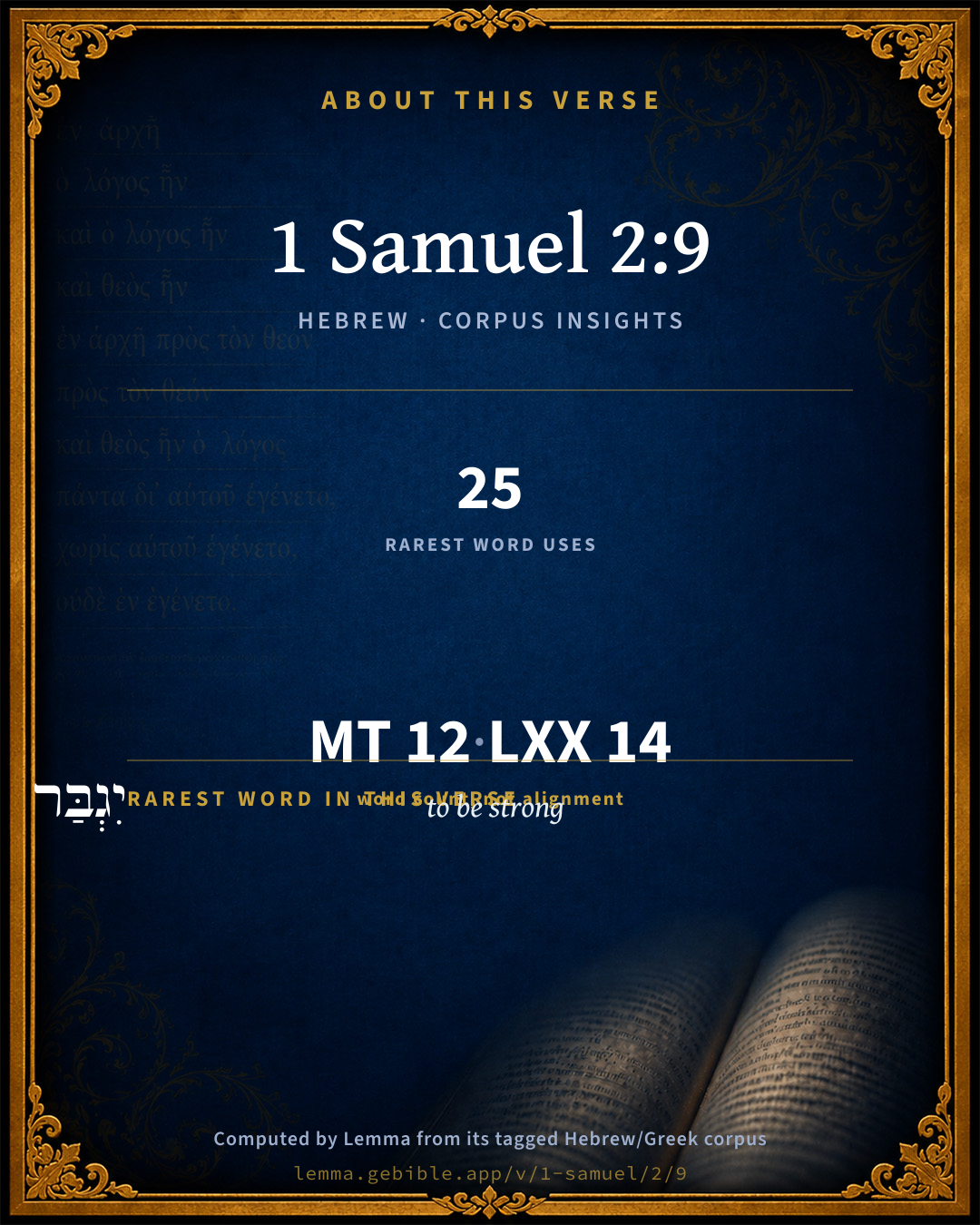
12
words
11
distinct lemmas
Historical
section

Notable vocabulary

The rarest word here is יִגְבַּר to be strong H1396 — appearing just 25 times in the whole Hebrew Bible.

Shared distinctive vocabulary

יִגְבַּר to be strong H1396 occurs in 24 verses of the Hebrew Bible. Also found in:

Grammatical profile

  • 3 verbs
  • 4 nouns
  • 3 adjectives
  • 1 conjunction
  • 1 particle

Verb forms

  • יִשְׁמֹ֔ר Qal · Imperfect
  • יִדָּ֑מּוּ Niphal · Imperfect
  • יִגְבַּר Qal · Imperfect

Repetition

A word recurs within this verse — often emphatic in Hebrew:

  • חסידו faithful one H2623 ×2

Hebrew & Septuagint length

In English translation the verse runs 26 words from the Hebrew and 21 from the Septuagint (LXX English) — closely comparable.

A rough comparison of the two English renderings, which tokenize alike — not a word-level alignment.

Word counts can differ between the Hebrew and the Greek without any difference in meaning — e.g. the Hebrew direct-object marker אֵת has no separate Greek word, and Greek often adds the article ὁ.

In the original languages it is 12 Hebrew tokens and 14 Greek tokens — but the two are counted differently (Hebrew bundles its prefixes and suffixes into one token; the Greek is in lemma form), so that isn’t a like-for-like length.

Cross-references

25

Topical passages linked to 1 Samuel 2:9 in the Treasury of Scripture Knowledge — connected by theme and wording, ordered by reader-vote popularity; previews shown in the World English Bible.

  • Psalms 91:11–12 For he will give his angels charge over you, To guard you in all your ways.
  • Psalms 121:3 He will not allow your foot to be moved. He who keeps you will not slumber.
  • Psalms 33:16–17 There is no king saved by the multitude of a host. A mighty man is not delivered by great strength.
  • 1 Peter 1:5 who by the power of God are guarded through faith for a salvation ready to be revealed in the last time.
  • Job 5:24 You shall know that your tent is in peace. You shall visit your fold, and shall miss nothing.
  • Psalms 37:28 For Yahweh loves justice, And doesn't forsake his saints. They are preserved forever, But the children of the wicked shall be cut off.
  • Psalms 94:18 When I said, "My foot is slipping!" Your loving kindness, Yahweh, held me up.
  • Psalms 97:10 You who love Yahweh, hate evil. He preserves the souls of his saints. He delivers them out of the hand of the wicked.
  • Zechariah 4:6 Then he answered and spoke to me, saying, "This is the word of Yahweh to Zerubbabel, saying, 'Not by might, nor by power, but by my Spirit,' says Yahweh of Hosts.
  • Deuteronomy 33:3 Yes, he loves the people; All his saints are in your hand: They sat down at your feet; [Everyone] shall receive of your words.
  • Psalms 37:23–24 A man's goings are established by Yahweh. He delights in his way.
  • Psalms 121:8 Yahweh will keep your going out and your coming in, From this time forth, and forevermore.
  • Proverbs 16:9 A man's heart plans his course, But Yahweh directs his steps.
  • Proverbs 3:26 For Yahweh will be your confidence, And will keep your foot from being taken.
  • Ecclesiastes 9:11 I returned, and saw under the sun, that the race is not to the swift, nor the battle to the strong, neither yet bread to the wise, nor yet riches to men of understanding, nor yet favor to men of skill; but time and chance happen to them all.
  • Zephaniah 1:15 That day is a day of wrath, a day of distress and anguish, a day of trouble and ruin, a day of darkness and gloom, a day of clouds and blackness,
  • Matthew 8:12 but the children of the Kingdom will be thrown out into the outer darkness. There will be weeping and the gnashing of teeth."
  • 2 Peter 2:17 These are wells without water, clouds driven by a storm; for whom the blackness of darkness has been reserved forever.
  • 1 Samuel 17:49–50 David put his hand in his bag, and took there a stone, and slang it, and struck the Philistine in his forehead; and the stone sank into his forehead, and he fell on his face to the earth.
  • Psalms 121:5 Yahweh is your keeper. Yahweh is your shade on your right hand.
  • Proverbs 2:8 That he may guard the paths of justice, And preserve the way of his saints.
  • Ecclesiastes 5:17 All his days he also eats in darkness, he is frustrated, and has sickness and wrath.
  • Jeremiah 9:23 Thus says Yahweh, Don't let the wise man glory in his wisdom, neither let the mighty man glory in his might, don't let the rich man glory in his riches;
  • Jude 1:1 Jude, a servant of Jesus Christ, and brother of James, to those who are called, sanctified by God the Father, and kept for Jesus Christ:
  • Jude 1:3 Beloved, while I was very eager to write to you about our common salvation, I was constrained to write to you exhorting you to contend earnestly for the faith which was once for all delivered to the saints.

Cross-references courtesy of OpenBible.info (CC BY 4.0).

Hebrew and Greek witnesses Masoretic Hebrew ↔ Greek Septuagint

The same verse in the two great witnesses to the Old Testament, shown verse-for-verse.

These are two independent witnesses, not word-aligned to each other, and the Septuagint is shown in lemma (dictionary) form.

Hebrew 1 Samuel 2:9 Masoretic · Westminster Leningrad Codex

רַגְלֵ֤י חסידו חֲסִידָיו֙ יִשְׁמֹ֔ר וּרְשָׁעִ֖ים בַּחֹ֣שֶׁךְ יִדָּ֑מּוּ כִּֽי לֹ֥א בְכֹ֖חַ יִגְבַּר אִֽישׁ

He will keep the feet of his holy ones; But the wicked shall be put to silence in darkness; For by strength shall no man prevail.

World English Bible · Public Domain

Greek LXX 1 Samuel 2:9 Septuagint · lemma form

δίδωμι εὐχή ὁ εὔχομαι καί εὐλογέω ἔτος δίκαιος ὅτι οὐ ἐν ἰσχύς δυνατός ἀνήρ

granting his petition to him that prays; and he blesses the years of the righteous, for by strength can’t man prevail.

LXX2012 (modern English Septuagint) · Public Domain

On this verse, John Gill's Exposition discusses the Septuagint’s reading. Read the note in Commentary ↓

Hebrew: Westminster Leningrad Codex (CC BY 4.0). Greek: Septuagint (public domain); English from LXX2012 (modern English Septuagint) (Public Domain). How the Septuagint differs from the Hebrew →

Targum (Aramaic paraphrase)

1

The Targum is the ancient Jewish Aramaic paraphrase of the Hebrew Scriptures — an interpretive translation, not the Hebrew text itself. Onkelos (literal) and Pseudo-Jonathan (expansive) render the Torah, and Jonathan the Prophets. Coverage is partial: where no permissively-licensed English translation exists for a verse, only the Aramaic is shown. This is verse-level text, not a word-by-word alignment to the Hebrew.

  1. Targum Jonathan Prophets (Joshua–Malachi)
    וּגְוִיַת עַבְדוֹהִי צַדִיקַיָא יִטַר מִגֵהִנָם וְרַשִׁיעַיָא בְגֵהִנָם בַּחֲשׁוֹכָא יִתְדְנוּן לְהוֹדָעָא אֲרֵי לָא מַן דְאִית בֵּיהּ חֵילָא זַכֵּי לְיוֹם דִינָא:

    (no public-domain English translation for this verse)

    Targum Jonathan — Aramaic: “Mikraot Gedolot” (public domain). English: “Sefaria Community Translation” (CC0 1.0 (public-domain dedication)); “London "Chaldee Paraphrase," 1871” (public domain). Text via Sefaria.

Commentary

Notes on 1 Samuel 2:9 from classic Christian and Jewish commentators (each source and its license shown beneath its notes). The classic Christian expositions comment on the surrounding passage and are grouped to its opening verse, so a note may address several verses; the Jewish commentaries on the Tanakh (Rashi and others) are per-verse, so they appear only where the commentator wrote on this verse.

Lemma curates 59 commentaries, every one of them public domain or Creative Commons licensed, each selected and text-cleaned for this edition rather than reprinted as found. About our sources →

Ellicott's Commentary for English Readers

(9) He will keep the feet.—This was the comforting deduction Hannah drew from the circumstances of her life: this the grave moral reflection the Spirit of the Lord bade her put down for the support and solace of all true servants of the Eternal in coming ages. Seeing that Jehovah of Israel governs the world, the righteous have nothing really to fear; it is only the wicked and rebellious who have reason to be afraid. The Babylonian Talmud has the following comment on these words:—“If any man has passed the greater part of his years without sin, he will sin no more. If a man has been able to resist the same temptation once or twice, he will sin no more; for it is said (1Sa_2:9), ‘He will keep the feet of his saints.’”—Treatise Yoma, fol. 38, Colossians 2.

By strength shall no man prevail.—The same thought is expressed very grandly by the prophet, “Not by might, nor by power, but by my Spirit, saith the Lord of hosts” (Zec_4:6). The Holy Ghost, in one of the sublime visions of St. Paul, taught the suffering apostle the same great truth, “My grace is sufficient for thee: for my strength is made perfect in weakness” (2Co_12:9).

A Bible Commentary for English Readers, edited by Charles John Ellicott (1878–1897) — public domain. Text from a community e-Sword module.

John Gill's Exposition

The adversaries of the Lord shall be broken to pieces,.... Or Jehovah, Father, Son, and Spirit, "shall break in pieces those that contend with him"; with the Lord, or with his people, or with Samuel particularly; for this may be considered as a prophecy of Hannah concerning her son, what God would do for him against his enemies, that should rise up, contend, and fight with him, as the Philistines; of whom Ben Gersom interprets it, whom the Lord discomfited and broke to pieces; see the literal fulfilment of this prophecy in Sa1 7:1 in a spiritual sense all wicked men are the enemies of God, and of his people, and sooner or later shall be broken to pieces. Some, in a good sense; when they are smitten with the words of his mouth, cut to the heart, and made contrite; are humbled and brought into subjection to him, and their enmity slain and abolished, and they filled with love to him; and are so broken to pieces, that they have nothing to depend upon, or trust in for life or salvation, but apply to Christ alone for it. Others, in an ill sense; and the meaning is, that the wicked shall be utterly destroyed by the Lord, with an everlasting destruction, with an incurable and irreparable one; shall be broken in pieces like a potter's vessel, which can never be put together again, see Psa 2:9.

out of heaven shall he thunder upon them: as the Lord did upon the Philistines in the times of Samuel, when Israel were engaged in war with them, Sa1 7:10. And the last vial of the wrath of God, poured out upon his adversaries the antichristian states, will be attended with thunders and lightnings, Rev 16:17, it denotes the terrible manner in which God will destroy his adversaries; the Septuagint version is, "the Lord ascended to heaven and thundered"; hence Procopius Gazaeus, following this version, says, Hannah prophesied of the taking up of the Saviour, and of the mission of the Holy Ghost, and of the preaching of the apostles, and of the second coming of Christ, as follows: the Lord shall judge the ends of the earth; not of the land of Israel by Samuel, as some interpret it, see Sa1 7:15 but of the whole world, and may refer to the government of it in general by the Lord, or to the judgment of it by his Son; for he judges none, but has committed all judgment to him; who at his first coming judged the world, by the ministry of the word in Judea and in the Gentile world, by setting up ordinances, and by qualifying and constituting persons to act in the government of his church under him; and at his spiritual coming he will take to himself his great power and reign, and judge the whore of Babylon; and at his last or second coming he will judge the whole world, quick and dead, righteous and wicked:

and he shall give strength unto his king: either who was made king in the times of Samuel, Saul, who was the first of the kings of Israel, or David, whom Samuel anointed; and it is true of them both, that the Lord gave them strength to fight with and conquer their enemies; or rather the King Messiah, who in the next clause is called the Lord's anointed, or Messiah:

and exalt the horn of his anointed; and so the Targum paraphrases the words,"he shall give strength to his king and enlarge the kingdom of his Messiah.''with which Kimchi agrees, and says, the thing is doubled or repeated, for the King is the Messiah; and to him the words are applied by other Jewish writers (p), ancient and modern. Christ is King over all, angels and men, particularly he is King of saints; he is Jehovah's King, set up and anointed by him from everlasting; was in time promised as such, and in the fulness of time came in that character, and at his ascension to heaven was made and declared Lord and Christ; and through the success of his Gospel in the world has appeared yet more so, and will be still more manifest in the latter day, when he shall be King over all the earth, and especially in his personal reign. Now when "strength" is said to be given him, this must be understood either of strength given to him in human nature, to perform the great work of our redemption and salvation, which required great strength; as a divine Person he needed none, as man he did; or of that strength communicated to him as Mediator, to give unto his people, in whom they have both righteousness and strength; or rather of that power and dominion given him as King particularly; all power in heaven and in earth were given him at his resurrection, and will appear more fully hereafter, when his kingdom will be from sea to sea, and his dominion from the river to the ends of the earth, see Dan 7:13. And the same thing is meant by "horn", which is an emblem of strength, power, dominion, and glory; hence he himself is called the horn of David, and the horn of salvation; it is a name and title given to kings, Dan 7:24 in allusion to the horns of beasts, in which their strength lies to defend themselves, and annoy their enemies; and the exaltation of him prophesied of may respect and include his resurrection from the dead, ascension to heaven, session at the right hand of God, the judgment of all committed to him, and the glorious exercise of his kingly office in the spiritual and personal reigns. This is the first time we meet with the word Messiah, or anointed, as ascribed to a divine Person, the Son of God; who has this name or title from his being anointed, not with material oil, but with the oil of gladness, with the Holy Ghost, and his gifts and graces without measure; and who is called the Lord's anointed, because he was anointed by his Father to be prophet, priest, and King, or invested by him with those offices even from eternity, see Psa 2:6 and which was more manifestly declared at his birth, his baptism, and ascension to heaven; see Luk 2:40.

(p) Zohar in Gen. fol. 58. 4. Midrash Echa Rabbati, fol. 53. 3. R. Saadiah Gaon, Comment. in Dan. vii. 13.

John Gill's Exposition of the Whole Bible (1746–1763) — public domain (CC PDM 1.0). Text via the HelloAO Bible API.

Trapp's Complete Commentary

John Trapp

1Sa 2:9 He will keep the feet of his saints, and the wicked shall be silent in darkness; for by strength shall no man prevail.

Ver. 9. He will keep the feet of his saints.] This is a lower love and courtesy than to keep their hands. {Joh 13:5-6} He keepeth them from utter prolapsion, from devoratory evils, as Tertullian speaketh, so as that either they fall not at all, - stumble they may, but they get ground by their stumbling, - or if they fall, they shall arise; for the Lord putteth under his hand. {Psa 37:24} There is still a supporting grace, below which they cannot possibly fall.

The wicked shall be silent in darkness.] They may fall whither they will or can, for any care God taketh of them: they shall fall and never rise again. {Zep 1:3} They have been silent in darkness, making no moan, neither humbling themselves in their distress; they "cried not when God bound them," {Job 35:12} therefore they shall be silent, sore frightened and astonished at their horrible calamities here, and tortures in hell.

For by strength shall no man prevail.] Or, Obtain his enterprise. Augustine striving against his headstrong corruptions in his own strength, heard a voice saying, In te stas, et non stas. Thou wouldst stand by thyself, and therefore fallest. See thyself weak as water, and run to Christ: rely on him alone; for God "hath laid help on One that is mighty"; he hath given "strength unto his King, and exalted the horn of his Messiah," as it is in the next verse.

John Trapp, A Commentary or Exposition upon All the Books of the Old and New Testament (1647–1656) — public domain. Text from a community e-Sword module.

The Biblical Illustrator

Joseph S. Exell

1Sa_2:9

He will keep the feet of His saints, and the wicked shall be silent in darkness; for by strength shall no man prevail.

The security of the saints and the ruin of the wicked

I. The security of the saints of God.

1. The title, saints, although used by a profane world as a term of contempt, is of all names the most honourable. It literally signifies the Holy Ones. And must not that be indeed an honourable title which associates the servant of God with his Maker, whose name is Holy? with his Redeemer, the Holy One of Israel? and with the Holy Ghost?--not to mention those holy angels, who veil their faces before his throne.

2. The security of all such is here declared: He will keep the feet of his saints.

(1) It is a security from outward distress. Like the three children, they may enter the fiery furnace: but the Son of God will be with them in the fire.

(2) It is a security from spiritual evil, which forms their greatest privilege.

II. The certain rule of the wicked. They shall be silent in darkness.

1. The persona here intended are manifestly all such as do not come under the former description of saints.

2. Awful portion! They shalt be silent! Here on earth, the wicked have a great deal to say for themselves, but in the world to come all their present high language will be mute as death. Moreover, they shall be silent in darkness. And what is darkness? It is the absence of light--of comfort,--of hope--of all possibility of deliverance. (J. Jowett, M. A.)

Heavenly preservation

Alpine guides often blindfold the traveller who seeks to ascend to those awful heights where dwell eternal frost and ice. When the danger is past the bandage is removed, and the traveller sees for the first time the slippery path along which he has been led. In like manner our Heavenly Father mercifully conceals the future, with its trials and dangers, till we are safely past. All that He hides is hidden in mercy; and all that He reveals is revealed in love. I would not know all, my Father. It is known to Thee, and that is enough. We walk by faith, and not by sight. (C. Perren.)

The custody of God over His people

I. The state and condition of the persons consisting of two branches. He will keep the feet of His saints. And first of all to consider it in spirituals, ye shall see Gods custody of His people in protecting them from those sins and temptations, and snares which they are subject unto. (Psa_121:7.) (2Ti_4:18.) (Psa_37:28.) For the opening of this a little unto us we may take it in these explications. First, by the prevention of evil and sinful occasion, God keeps the feet of His people. Secondly, by preventing of the occasions of sin, so by fortifying and strengthening the heart and mind against closing with them. (Luk_22:32.) (2Co_12:9.) There are four graces amongst the rest, which are especially conducing hereunto. First of all, the grace of fear, and spiritual watchfulness. Blessed is the man that feareth always. Secondly, the grace of faith, thats another supporter likewise. Faith lays hold upon all the promises of assistance, and strengthening. (1Pe_1:5.) Thirdly, God keeps the feet of His saints from progress and proceedings in sin, when they fall. Thus (Psa_94:18). Lastly, He keeps the feet of His saints from relapse, and returning to sin again. Now to make this point pertinent indeed to ourselves, we must have a care of two things. The first is the qualification of our persons. Observe here whose feet it is that He here keeps. They must be saints whose feet God will keep. Saints, and His saints too, saints of His making, and saints of His calling, and saints of His owning. Secondly, it is not enough for us to be right for our persons in the general qualifications of them; but we must be right likewise for our carriage and the behaviour of ourselves. Those which are the saints of God may sometimes by their own wilful heedlessness provoke God for a time at least to suspend this safeguard of them. But so much of the first reference of these words, as they may be taken spiritually, and in relation to the inward man. Now further, secondly, we may likewise take them in reference to temporals, and Gods Providence as to the things of this life. First, He will bless them in their ways. Take notice of that. This is one way to keep their feet. (Psa_121:8.) Again, further, He names the feet, as those which are most exposed to danger, and hurt of all other. Secondly, in regard of their works, whatsoever they do. This is said of a godly man. (Psa_1:3.) (Gen_39:8.)

II. The second is the state of the wicked in these. But the wicked shall be silent in darkness. As theres a difference betwixt the wicked and the godly in regard of their disposition, so is there likewise in regard of their condition. First, a state of darkness. First, for this life present as the way. Wicked men they are here in darkness. First, in the ignorance of their minds. (Eph_4:18.) Secondly, in the inordinancy of their affections, theres darkness in them from thence also. (1Jn_2:11.) Malice shades the mind, and so any other unruly passion in them. Thirdly, in the practice of all other sins whatsoever, besides works of wickedness, are works of darkness, and so they are still called. The unfruitful works of darkness. (Eph_5:11.) Lastly, in that spiritual blindness which they are given up to. The second is the darkness of the end. That darkness which they are subject unto in another world. This is of two sorts, either the darkness of death, or judgment. The second is the state of silence, in order to this darkness. They shall be silent in darkness. First, that grief, and horror, and perplexity of mind, which shall seize upon them in this condition. Silence is an attendant upon grief and atonement in the extremities of it. Secondly, silence is a note of conviction. They shall be silent, that is, they shall have nothing to say for themselves. Wicked men, as they shall be full of grief, so likewise of confusion. Thirdly, it is a note of abode and of continuance in this miserable condition. They shall be kept and bound up in it. Now (to join them both together) they are such as do very fitly agree to such kind of persons. Both darkness and also silence in it are very suitable to wicked men. First, the darkness of condition answerable to the darkness of sin. Wicked men they abhor the light, because their deeds are evil. Secondly, silence in evil, answerable to silence from good: Wicked men they care not to speak anything which may be to the honour of God. We begin with the first, viz., as it refers to the first clause. He shall keep the feet of His saints, that is, by taking it exclusively, He and He alone. Well reduce it briefly to three heads. First, the strength of body and human power with the appurtenances thereof. Secondly, the strength of parts and the improvements of wit and understanding, the strength of grace in the mere purpose of it. Therefore, let none trust to this, whosoever they be. Secondly, not by strength against Him, in reference especially to the second clause. The wicked shall be silent in darkness. Ungodly men shall not escape punishment, because they cannot be too strong for God, who is a God of power and might. First, thankfulness and acknowledgment of the great mercy and goodness of God to us in this particular. Secondly, as to matter of faith, we are to improve it to that likewise, having had experience of Gods goodness hitherto, to be ready to expect as much from Him for time to come. Thirdly, and specially, to fruitfulness and obedience. God having done so great things for us, we should endeavour to do somewhat for him. Now further, secondly, for the wickeds silence in darkness, in the disappointment of his enemies, we may observe the parallel in this also. Here was both darkness and silence in darkness. Darkness there was in the very letter. It was a work in the dark. And that both as to place, and time, in which it was wrought. (T. Herren, D. D.)

The conduct of the Lord towards saints and sinners

I. The Lord will keep the feet of his saints.

1. The word saint signifies a holy one.

2. Saints are on a journey through this world of sin and sorrow to a better country. (Heb_11:14-16.)

3. The Lord Himself keeps their feet. He guides and directs them by His counsel. (Psa_73:24.)

II. The wicked shall be silent in darkness.

1. The wicked are without God in the world. (Eph_2:12.)

2. These are noisy and clamorous, boasting of themselves, and prone to speak evil of God and religion; but the time is at hand when they shall be put to silence. (Psa_31:17.)

3. Darkness shall encompass them about on every side. They are sometimes brought into darkness in the present world, by the judgments of God. (Isa_8:22.)

III. For by strength no man shall prevail. Wicked men fight against God, and truth, but they cannot prevail. (Sketches of Four Hundred Sermons.)

The Biblical Illustrator, edited by Joseph S. Exell (c. 1880s–1900s) — public domain. Text from a community e-Sword module.

Joseph Benson's Commentary

1Sa 2:9. He will keep the feet of his saints — That is, will both uphold their steps or paths, and direct their counsels and actions, that they may not fall into ruin, nor wander into those fatal errors into which wicked men daily run. The wicked shall be silent in darkness — They who used to open their mouths wide in speaking against heaven and against the saints, shall be so confounded with the unexpected disappointment of all their hopes, and with God’s glorious appearance and operations for his people, that they shall be put to silence, and have their mouths quite stopped: and this in darkness, both internal, in their own minds, not knowing what to do or say; and external, through outward troubles, distress, and calamities. For by strength shall no man prevail — Namely, against God, or against his saints, as the wicked are ready to think they shall do, because of their great power, wealth, and numbers.

Joseph Benson's Commentary on the Old and New Testaments (1811–1818) — public domain. Text from a community e-Sword module.

Adam Clarke's Commentary

Verse 9. He will keep the feet of his saints] He will order and direct all their goings, and keep them from every evil way.

The wicked shall be silent in darkness] The Targum understands this of their being sent to the darkness of hell; they shall be slain.

By strength shall no man prevail.] Because God is omnipotent, and no power can be successfully exerted against him.

Adam Clarke's Commentary on the Bible (1810–1826) — public domain. Text from a community e-Sword/MySword module.

The Cambridge Bible for Schools and Colleges

gen. ed. J. J. S. Perowne

9. It is Jehovah who guards His chosen ones from stumbling in their walk through life (Psa_56:13; Psa_91:12); It is He who leaves the wicked to languish in adversity (Job_5:14) or perish miserably (Psa_31:17; Psa_55:23); for apart from Him or in opposition to Him human strength is impotence (Zec_4:6).

his saints] Rather, His beloved, or, His chosen. The Heb. word means (a) one who is the object of mercy, and does not in itself imply holiness of character, but is used of Israel as the covenant people, the objects of Jehovah’s lovingkindness: (b) in an active sense, merciful, of God (Jer_3:12): of men (2Sa_22:26).

shall be silent] “Shall be silenced,” or, “perish.”

The Cambridge Bible for Schools and Colleges (gen. ed. J. J. S. Perowne; Cambridge University Press, 1878–1918) — public domain. Text from a community e-Sword module.

Haydock's Catholic Bible Commentary

Saints. Hebrew, "kind, merciful, pious ones;" (Calmet) those to whom he shews mercy, and who comply with his will in assisting others. Septuagint, "Granting their petition to those who ask him, and he has blessed the years of the just, because man is not strong by his own strength." (Haydock) --- Silent: condemned to death. Mox etiam Lemures animas dixere silentes. (Ovid, Fast. v.) Loca nocte silentia late. (Virgil, [Æneid?] vi.) Unable to act as they had done, and ashamed of themselves, (Calmet) they seek for the most obscure retreat, where they may not behold the glory of those whom they have despised. They will pray that the hills would fall upon them, and hide them from the indignation of the Lamb. (Haydock)

George Leo Haydock (1774–1849), Haydock's Catholic Family Bible and Commentary, 1859 edition — public domain. Excludes Psalms (Douay-Rheims chapter numbering differs from Protestant) and Deuterocanonical books (Catholic canon only).

Matthew Poole's English Annotations

The feet, i.e. the steps or paths, their counsels and actions, he will

keep, i.e. both uphold, that they may not fall, at least, into mischief or utter ruin; and direct and preserve from wandering, and from those fatal mistakes and errors that wicked men daily run into.

Shall be silent; shall be put to silence: they who used to open their mouths wide against heaven, and against the saints, shall be so confounded with the unexpected disappointment of all their hopes, and with God’s glorious appearance and operations for his people, that they shall have their months quite stopped, and sit down in silent amazement and consternation: see Isa 15:1; Jer 8:14; 47:5,6.

In darkness; both inward, in their own minds, which are wholly in the dark, perplexed by their own choice and counsels, not knowing what to say or do; and outward, in a state of deepest distress and misery.

By strength shall no man prevail, to wit, against God, or against his saints, as the wicked were confident they should do, because of their great power, and wealth, and numbers; whereas God’s people were mean, and impotent, and helpless. And particularly, Peninnah shall not prevail against me by that strength which she hath, or thinks to have, from her numerous offspring. But it is to bc observed, that although Hannah takes the rise of this song from her own condition, yet she extends her thoughts and words further, even to the usual methods of God’s providence in the government of the world.

Matthew Poole's English Annotations on the Holy Bible (1683–1685) — public domain. Text from a community e-Sword/MySword module.

Whedon's Commentary on the Bible

Daniel D. Whedon

9. The feet of his pious ones he will guard — That they may not wander into fatal errors.

Shall be dumb — Filled with confusion of face, confounded, and destroyed.

Not by strength shall a man become mighty — Not by his own strength, whether it consist in great physical force, deadly weapons, wealth, or influence among men. Goliath assumed to be mighty in himself, but David’s mightiness was in Jehovah. 1Sa_17:45.

Daniel D. Whedon (gen. ed.), Commentary on the Old and New Testaments (1874–1909) — public domain. Text from a community e-Sword module.

The Pulpit Commentary

The feet of his saints. The Hebrews written text (ch"tib) has his saint, sing.; but the word really means not saint, i.e. one sanctified and holy, but pious, i.e. one lovingly disposed towards God. The sense, therefore, is not affected by the number, but the sing. is more forcible "He will guard the steps, the earthly course, of each one that loveth him;" while over against this watchful providence, ever exerted for the safe keeping of all who love the light, stands God"s punitive justice, whereby the wicked are finally brought down to the dark silence of the grave. For they had only human strength and prowess upon which to depend, and no man can sustain himself in the manifold conflict of life without help from above.

Ver. 9. (SHILOH.)

God"s guardianship of his saints.

"He will keep the feet of his saints." Who are his saints?

1. The term is sometimes used as one of reproach, by persons who aredestitute of religious life, concerning those who bear the Christian name. Pointing to the inconsistency of some of the latter, they would thereby fain persuade themselves and others that there is no such thing as true godliness to be found in the world. There are, doubtless, many who "profess to know God, but in works deny him." But there would be no counterfeit money unless there were some genuine coin

2. The word is also used to designate those who have been "canonised;" and who, having gone into heaven, are supposed to have influence with God in the granting of petitions presented on earth. But such a use of it is unscriptural, and the doctrine is false and injurious.

3. The saints of God are those who have been accepted by him throughfaith in Christ, who do his will and walk in the way to heaven. Their way, indeed, is often difficult and painful, like the uneven, intricate, and stony paths of Palestine, and beset by numerous dangers. But, for their consolation and encouragement, it is promised that "he that keepeth Israel" will "keep their feet" firm and safe, so that they may not fall and perish. The promise is directly of preservation from temporal calamity, but it may be regarded as including also preservation from spiritual failure and destruction. Consider

I THE DANGER FROM WHICH HE WILL KEEP THEM.

1. From wandering out of the way. Obscurity may gather over it. Other ways may appear plainer, easier, and more pleasant, and tempt them to leave it. Or they may seem more direct and shorter than the circuitous and wearisome path they have to pursue. But kept by him they will not go astray.

2. From stumbling in the way. "It must needs be that offences (or occasions of stumbling) come." Some of them consist of

(1) The difficulties of Divine revelation: "things hard to be understood.

(2) The mysteries of Divine providence, which have led many to say, "As for me," etc.. (Psa_73:2)

(3) Direct solicitations to evil.

(4) "Afflictions and persecutions that arise for the word, whereby many are offended." But "great peace have they that love thy law, and nothing shall cause them to stumble" (Psa_119:165)

3. From failing to reach the end of the way. Some start with bright hopes which are not afterwards altogether fulfilled in their experience: storms gather, enemies threaten, severe conflict must be waged; and they become weary and desponding, and ready to halt. "But the righteous shall hold on his way" (Job_17:1-9; Isa_40:31)

II THE MANNER IN WHICH HE WILL KEEP THEM. By

1. Providing means of help for them: the word, which is an instrument of guidance, refreshment, and defence; prayer; the fellowship of those who are travelling in the same way; the ministration of angels (Psa_91:11; Heb_1:14)

2. Watching over them at every step. They are not alone; but he is with them; and they are kept by the power of God". (1Pe_1:5)

3. Imparting grace and strength to them according to their need. "As thy day," etc. It matters not how great the need if "the supply of the Spirit" (Php_1:19) be equal to it. And, "My grace," he says, "is sufficient for thee.

III THE CERTAINTY WITH WHICH HE WILL KEEP THEM.

1. He has a special interest in them, for they are his saints," "the portion of his inheritance.

2. He has already done much for them, which is an earnest of continued preservation.

3. He has high purposes to accomplish in them and through them. And,

4. He has solemnly promised "never to leave them", (Heb_13:5) and "he is faithful that promised. (Heb_10:23)

1. Rely upon the promise.

2. Presume not upon your security, nor think that without fulfilling hiscommandments you can receive his promises.

3. Use the appointed means of grace with all diligence. D.

The Pulpit Commentary (1880–1919), ed. H.D.M. Spence-Jones & Joseph S. Exell — public domain. Text from a community e-Sword module.

John Wesley's Explanatory Notes

Feet - That is, the steps or paths, their counsels and actions; he will keep; that is, both uphold, that they may not fall into ruin; and direct and preserve from wandering, and from those fatal errors that wicked men daily run into. Silent - Shall be put to silence: they who used to open their mouths wide against heaven, and against the saints, shall be so confounded with the unexpected disappointment of all their hopes, and with God's glorious appearance and operations for his people, that they shall have their mouths quite stopped. Darkness - Both inward, in their own minds, not knowing what to say or do; and outward, in a stat e of deep distress. Prevail - Namely, against God, or against his saints, as the wicked were confident they should do, because of their great power, and wealth, and numbers.

John Wesley, Explanatory Notes Upon the Whole Bible (1754–1765) — public domain. Text via the GEBible commentary corpus.

unfoldingWord translationNotes

Door43 World Missions Community

Connecting Statement:

Hannah continues to recite a song to Yahweh. (See: Parallelism)

guard the feet of his faithful people

Here "feet" is a metonym for the way a person walks, which in turn is a metaphor for the way a person decides how to live his life. AT: "keep his faithful people from making foolish decisions" or "enable his faithful people to make wise decisions" (See: Metonymy and Metaphor)

the wicked will be put to silence in darkness

This polite way of saying that Yahweh will kill the wicked can be stated in active form. AT: "Yahweh will put the wicked to silence in darkness" or "Yahweh will put the wicked in the dark and silent world of the dead" (See: Euphemism)

the wicked will be put to silence

The words "be put to silence" are an idiom for "be made silent." This can be stated in active form. AT: "Yahweh will make them silent" (See: Idiom and Active or Passive)

by strength

"because he is strong"

translationWords

faithful

evil

darkness

unfoldingWord translationNotes — © Distant Shores Media and the Door43 World Missions Community, licensed CC BY-SA 4.0. Source: git.door43.org/Door43/en_tn.

Rashi

Rabbi Shlomo Yitzchaki (Rashi)

His pious ones. It is spelled חֲסִידוֹ "His pious one" but read חֲסִידָיו "His pious ones," [meaning] whether a single one or many. Similarly "may His adversaries be broken." [The reading is מְרִיבָיו "His adversaries" but] the spelling is מְרִיבוֹ "His adversary," meaning whether a single adversary or many.

Rashi on the Tanakh — English translations: “The Judaica Press complete Tanach with Rashi, translated by A. J. Rosenberg” (CC BY 4.0); “Pentateuch with Rashi's commentary by M. Rosenbaum and A.M. Silbermann, 1929-1934” (public domain); “The Metsudah Tanach series, Lakewood, N.J” (CC BY 4.0); and “The Book of Joshua, Metsudah Publications, 1997” (CC BY 4.0). Text via Sefaria.

Radak

Rabbi David Kimhi (Radak)

His faithful: It is written without a [letter,] yod, but is read with a yod. And likewise (in I Samuel 2:10), "His enemies, upon him." And the matter is the same, since the yod of the plural sometimes drops out.

He guards: That he should not be struck.

Will be still: Will be silent from their outbursts and their evil. Or the explanation is, they will be cut off - and likewise (Jeremiah 51:6), "do not be still in its iniquity." And the explanation of, "in darkness," is like a man that walks in darkness, such that he will fall.

For not by strength shall a man prevail: It will not be [like] what they thought, that they would prevail with their power and with their strength. For when it will be the will of God to place them in darkness - and that is the trouble that will come upon them - their might and their wealth will not help them.

Radak on the Tanakh — English translations: “Sefaria Community Translation” (CC0 1.0 (public-domain dedication)); “Eliyahu Munk, HaChut Hameshulash” (CC BY 4.0); “Rabbi Mike Feuer, Jerusalem Anthology” (CC BY 4.0); and “R. David Kimhi on the first book of Psalms, Translated by R.G. Finch, London, 1919” (public domain). Text via Sefaria.

Lesson kit

Teaching starters — assembled from the data on this page, not authored interpretation. Every prompt links to the verse data it draws on. Edit before teaching.

1 Samuel, in the Historical, opens this verse with 12 words (11 distinct Hebrew lemmas). Its most distinctive word is gâbar (“to be strong”). A historical commentator’s framing appears above. Read the whole chapter for the surrounding context.

Discussion questions

  1. The word gâbar carries the sense “to be strong.” How does it shape the verse?
  2. How does Genesis 7:18, which shares the word «to be strong», read alongside this verse?
  3. What does the repetition of “faithful one” (2× in this one verse) do in this verse?
  4. These translations render this verse differently; the difference is in the English rendering, not the original. What questions does that raise?
  5. «יִשְׁמֹ֔ר» is a Qal Imperfect verb. How does that grammatical form shape the action described?
  6. Compare how Ellicott's Commentary for English Readers and John Gill's Exposition read this verse. Where do they agree or differ?

Things to notice

Reading settings

Reading text

Shown beneath each verse's original-language words.

Old Testament
Old Testament edition

Read the OT as the Masoretic Hebrew (MT) or the Greek Septuagint (LXX).

English shown for the Greek Septuagint (in the Hebrew ↔ Greek comparison).

Comparing translations? Open the Compare panel on any verse page to stack up to four side by side.