
Psalms 75:10

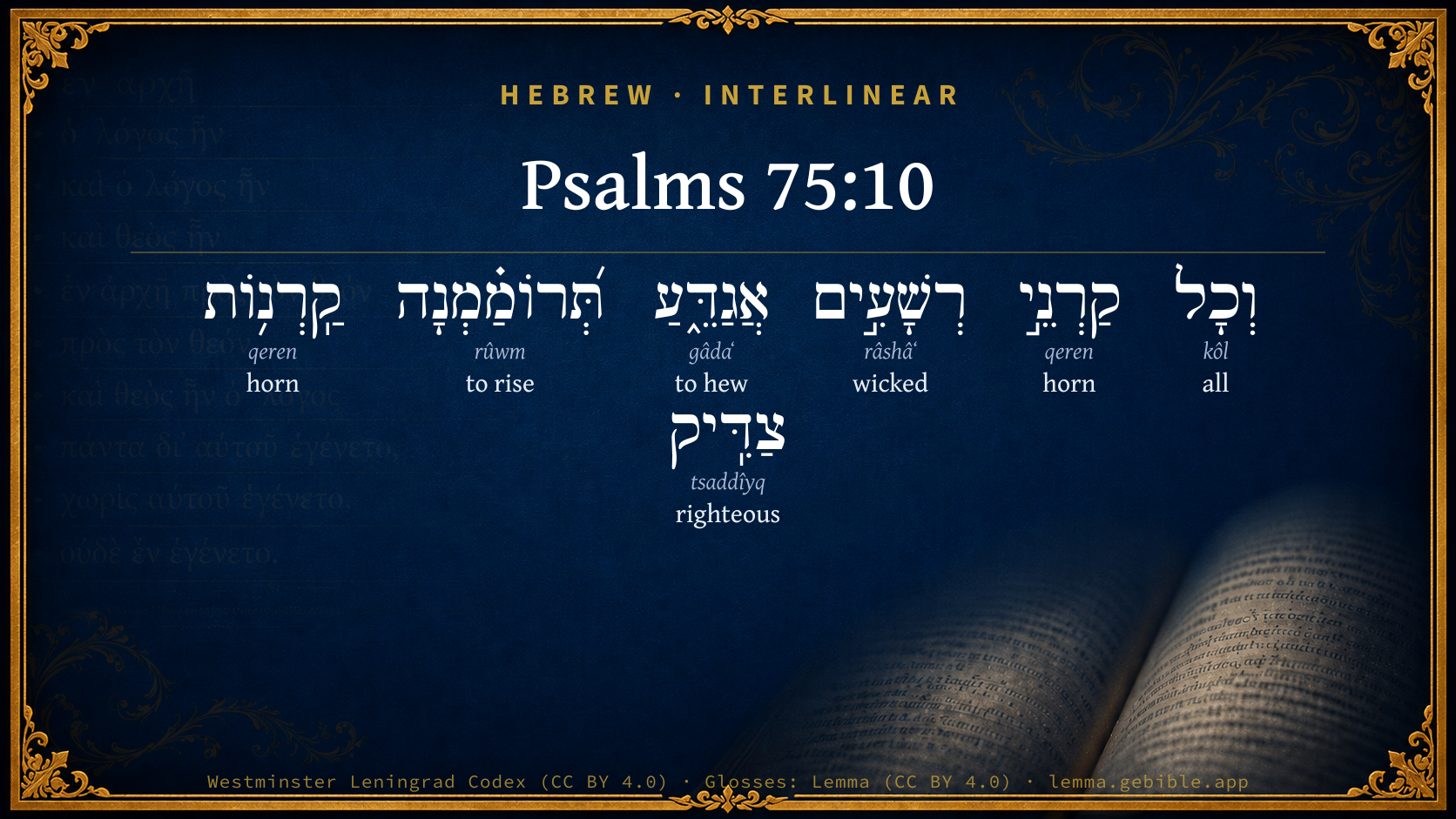
Hebrew (Westminster Leningrad Codex) Psalms 75:10 appears in the Hebrew Old Testament. The text above is from the Westminster Leningrad Codex. Each word links to its Strong’s number, a concise gloss, and parsing drawn from the Open Scriptures Hebrew Bible morphology. Click any word for its full Brown-Driver-Briggs (BDB) entry.
Download image
Cite this verse

Psalms 75:10 (World English Bible). Public Domain. Lemma interlinear Bible study tool, https://lemma.gebible.app/v/psalms/75/10.

Show BibTeX & RIS
BibTeX
RIS
English Translation
I will cut off all the horns of the wicked, But the horns of the righteous shall be lifted up.
World English Bible · Public Domain
Download a study sheet

One document with this verse’s original text, its word-by-word gloss line, the meaning frame, cross-references with their text, attributed commentary, and full source and license credits — printable, and it pastes into notes with its structure intact.

This verse Autodidact and up

Study sheet (.html) Plain text (.txt)

A passage Seminary Student

Up to 50 verses in one chapter. A passage sheet keeps up to 6 commentary sources and 12 cross-references per verse, in the order this page ranks them, and says so on the sheet whenever that leaves anything out. Ask for a single verse and you get the Autodidact verse sheet above.

Everything on this page stays free to read, with no account — the sheet is a download of what is already on screen, not access to it.

Want to remove ads? Support Godless Engineer
Compare translations 3

The same verse in 3 English versions, stacked beneath the original-language interlinear above. Click any original word for its lexicon entry.

Each is an independent rendering of the whole verse — the interlinear is not word-aligned to these translations.

Highlighted words mark where these versions differ — a whole-verse word diff, not a word-by-word alignment.

  • World English Bible Public Domain
    I will cut off all the horns of the wicked, But the horns of the righteous shall be lifted up.
  • King James Version Public Domain
    All the horns of the wicked also will I cut off; but the horns of the righteous shall be exalted.
  • unfoldingWord Literal Text CC BY-SA 4.0
    “And all the horns of the wicked I will cut off; the horns of the righteous will be lifted up.”

unfoldingWord Literal Text — © unfoldingWord, licensed CC BY-SA 4.0. Word-aligned USFM3 via Door43 (git.door43.org/unfoldingWord/en_ult).

Versions to compare (up to 4)

3 of 4 selected

Show all 18 translations

Every available English version of this verse, each an independent rendering of the whole verse.

  • World English Bible Public Domain
    I will cut off all the horns of the wicked, But the horns of the righteous shall be lifted up.
  • Berean Standard Bible Public Domain
    “All the horns of the wicked I will cut off, but the horns of the righteous will be exalted.”
  • Majority Standard Bible Public Domain
    “All the horns of the wicked I will cut off, but the horns of the righteous will be exalted.”
  • King James Version Public Domain
    All the horns of the wicked also will I cut off; but the horns of the righteous shall be exalted.
  • American Standard Version (1901) Public Domain
    All the horns of the wicked also will I cut off; But the horns of the righteous shall be lifted up. Psalm 76 For the Chief Musician; on stringed instruments. A Psalm of Asaph, a song.
  • Revised Version (1885) Public Domain
    All the horns of the wicked also will I cut off; but the horns of the righteous shall be lifted up.
  • Geneva Bible (1599) Public Domain
    All the hornes of the wicked also will I breake: but the hornes of the righteous shalbe exalted.
  • Douay-Rheims (1899) Public Domain
    But I will declare for ever: I will sing to the God of Jacob.
  • Young's Literal Translation Public Domain
    And all horns of the wicked I cut off, Exalted are the horns of the righteous!
  • Literal Standard Version CC BY-SA 4.0
    And I cut off all horns of the wicked, || The horns of the righteous are exalted!
  • Unlocked Literal Bible CC BY-SA 4.0
    He says, “I will cut off all the horns of the wicked, but the horns of the righteous will be raised up.”
  • unfoldingWord Literal Text CC BY-SA 4.0
    “And all the horns of the wicked I will cut off; the horns of the righteous will be lifted up.”
  • Darby Bible Public Domain
    And all the horns of the wicked will I cut off; [but] the horns of the righteous shall be exalted.
  • World Messianic Bible Public Domain
    I will cut off all the horns of the wicked, but the horns of the righteous shall be lifted up.
  • Webster's Bible Public Domain
    \\75:9\\But I will declare for ever; I will sing praises to the God of Jacob.
  • Free Bible Version CC BY-SA 4.0
    For God says, “I will break the power of the wicked; but I will give my support to those who do what is good.”
  • Bible in Basic English Public Domain
    By him will all the horns of the sinners be cut off; but the horns of the upright will be lifted up.
  • JPS Tanakh (1917) Public Domain
    (75-11) All the horns of the wicked also will I cut off; but the horns of the righteous shall be lifted up.

Literal Standard Version (2020), Covenant Press — licensed CC BY-SA 4.0. Text via the HelloAO Bible API (eBible.org). Unlocked Literal Bible (unfoldingWord) — licensed CC BY-SA 4.0. Text via the HelloAO Bible API (eBible.org). unfoldingWord Literal Text — © unfoldingWord, licensed CC BY-SA 4.0. Word-aligned USFM3 via Door43 (git.door43.org/unfoldingWord/en_ult). Free Bible Version, Dr. Jonathan Gallagher — licensed CC BY-SA 4.0. Text via the HelloAO Bible API (eBible.org).

Word by word

More ways to search: Search by grammar → Find every occurrence → Compare this word →

Practice this passage: Drill this verse → Learn its vocabulary →

About this verse

These counts appear in no published source. They are computed here, from the morphology-tagged text and Lemma’s own curated glosses. What Lemma adds →

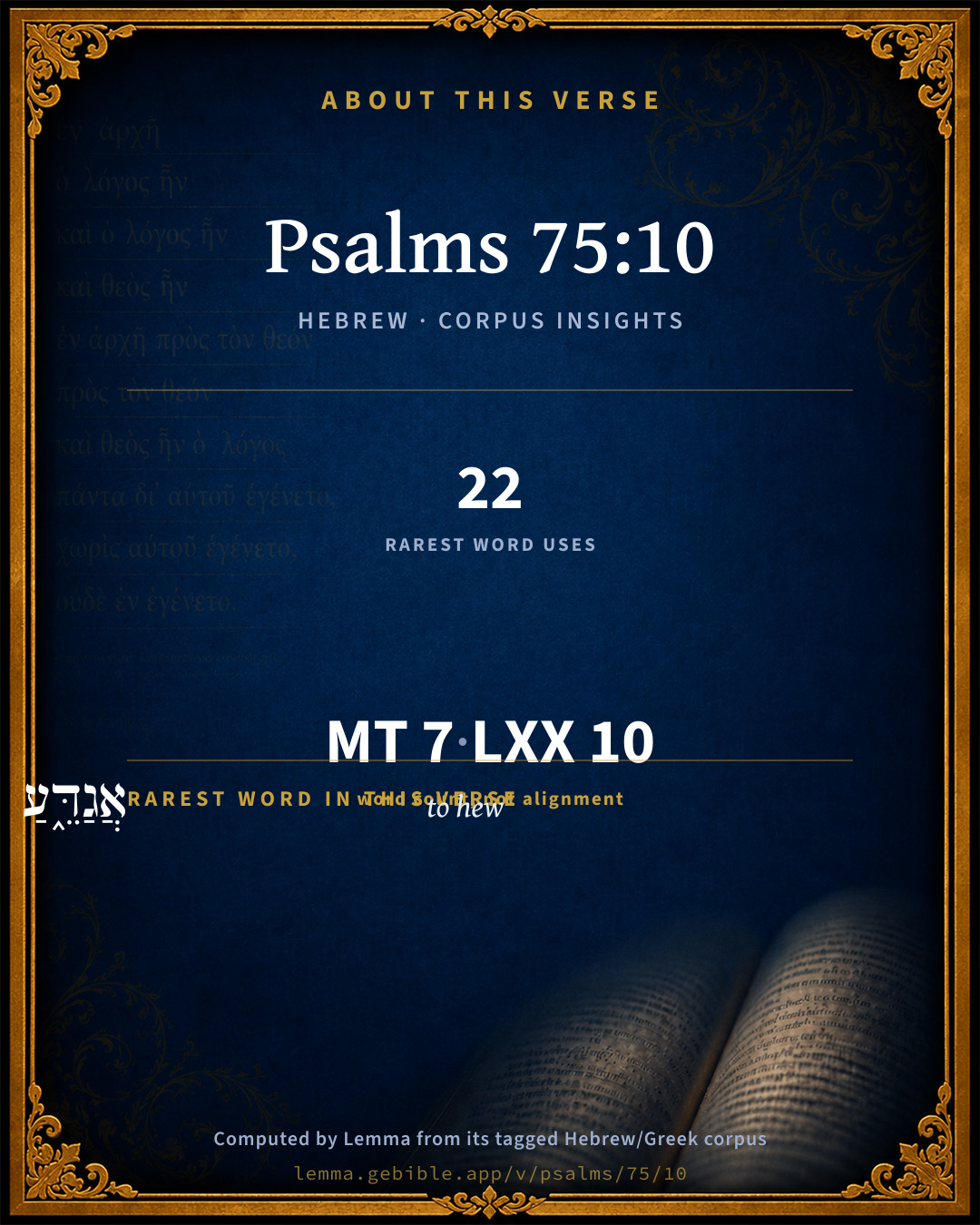
7
words
6
distinct lemmas
Wisdom
section

Notable vocabulary

The rarest word here is אֲגַדֵּ֑עַ to hew H1438 — appearing just 22 times in the whole Hebrew Bible.

Shared distinctive vocabulary

אֲגַדֵּ֑עַ to hew H1438 occurs in 22 verses of the Hebrew Bible. Also found in:

Grammatical profile

  • 2 verbs
  • 3 nouns
  • 2 adjectives

Verb forms

  • אֲגַדֵּ֑עַ Piel · Imperfect
  • תְּ֝רוֹמַ֗מְנָה Polal · Imperfect

Repetition

A word recurs within this verse — often emphatic in Hebrew:

  • קַרְנֵ֣י horn H7161 ×2

Hebrew & Septuagint length

In English translation the verse runs 20 words from the Hebrew and 19 from the Septuagint (LXX English) — closely comparable.

A rough comparison of the two English renderings, which tokenize alike — not a word-level alignment.

Word counts can differ between the Hebrew and the Greek without any difference in meaning — e.g. the Hebrew direct-object marker אֵת has no separate Greek word, and Greek often adds the article ὁ.

In the original languages it is 7 Hebrew tokens and 10 Greek tokens — but the two are counted differently (Hebrew bundles its prefixes and suffixes into one token; the Greek is in lemma form), so that isn’t a like-for-like length.

Cross-references

8

Topical passages linked to Psalms 75:10 in the Treasury of Scripture Knowledge — connected by theme and wording, ordered by reader-vote popularity; previews shown in the World English Bible.

  • Psalms 89:17 For you are the glory of their strength. In your favor, our horn will be exalted.
  • Psalms 92:10 But you have exalted my horn like that of the wild ox. I am anointed with fresh oil.
  • Psalms 101:8 Morning by morning, I will destroy all the wicked of the land; To cut off all the workers of iniquity from Yahweh's city.
  • Psalms 148:14 He has lifted up the horn of his people, The praise of all his saints; Even of the children of Israel, a people near to him. Praise Yah!
  • Jeremiah 48:25 The horn of Moab is cut off, and his arm is broken, says Yahweh.
  • Zechariah 1:20–21 Yahweh showed me four craftsmen.
  • 1 Samuel 2:1 Hannah prayed, and said: My heart exults in Yahweh; My horn is exalted in Yahweh; My mouth is enlarged over my enemies; Because I rejoice in your salvation.
  • Luke 1:69 And has raised up a horn of salvation for us in the house of his servant David

Cross-references courtesy of OpenBible.info (CC BY 4.0).

Hebrew and Greek witnesses Masoretic Hebrew ↔ Greek Septuagint

The same verse in the two great witnesses to the Old Testament, shown verse-for-verse.

You’re reading Greek Psalm 74 (Hebrew Psalm 75). The Septuagint counts the superscription, so verse numbers can differ from the Hebrew — chapter-level alignment, not verse-by-verse. Numbering follows Rahlfs.

These are two independent witnesses, not word-aligned to each other, and the Septuagint is shown in lemma (dictionary) form.

Hebrew Psalms 75:10 Masoretic · Westminster Leningrad Codex

וְכָל קַרְנֵ֣י רְשָׁעִ֣ים אֲגַדֵּ֑עַ תְּ֝רוֹמַ֗מְנָה קַֽרְנ֥וֹת צַדִּֽיק

I will cut off all the horns of the wicked, But the horns of the righteous shall be lifted up.

World English Bible · Public Domain

Greek LXX Greek Psalm 74:10 Septuagint · lemma form

ἐγώ δέ ἀγαλλιάομαι εἰς ὁ αἰών ψάλλω ὁ θεός ἰακώβ

And I will break all the horns of sinners; but the horns of the righteous one shall be exalted.

LXX2012 (modern English Septuagint) · Public Domain

Hebrew: Westminster Leningrad Codex (CC BY 4.0). Greek: Septuagint (public domain); English from LXX2012 (modern English Septuagint) (Public Domain). How the Septuagint differs from the Hebrew →

Commentary

Notes on Psalms 75:10 from classic Christian and Jewish commentators (each source and its license shown beneath its notes). The classic Christian expositions comment on the surrounding passage and are grouped to its opening verse, so a note may address several verses; the Jewish commentaries on the Tanakh (Rashi and others) are per-verse, so they appear only where the commentator wrote on this verse.

Lemma curates 59 commentaries, every one of them public domain or Creative Commons licensed, each selected and text-cleaned for this edition rather than reprinted as found. About our sources →

Adam Clarke's Commentary

Verse 10. All the horns of the wicked] All their power and influence, will I cut off; and will exalt and extend the power of the righteous. The psalmist is said to do these things, because he is as the mouth of God to denounce them. All was punctually fulfilled: the wicked - the Babylonians, were all cut off; the righteous - the Jews, called so from the holy covenant, which required righteousness, were delivered and exalted.

ANALYSIS OF THE SEVENTY-FIFTH PSALM

Bishop Nicholson supposes that David was the author of this Psalm; and that he composed it on his inauguration or entrance upon the kingdom; and by it he gives us an example of a good king.

There are three chief parts in this Psalm: -

I. A doxology, Ps 75:1; repeated, Ps 75:9.

II. His profession how to perform the regal office, Ps 75:2-3; Ps 75:10.

III. His rebuke of foolish men for mistakes occasioned, -

1. Partly by their pride when they rise to great places, Ps 75:4-5.

2. That they do not consider whence their preferment comes, Ps 75:6-7.

3. That they judge not rightly of afflictions, Ps 75:8.

I. The doxology or thanksgiving.

1. He doubles it to show that it should be frequently done: "Unto thee do we give thanks; unto thee," c.

2. His reason for it: "For that thy name is near," - thy help is always at hand. "The Lord is nigh to all that call upon him."

3. Of which he had experience in his exaltation to the kingdom, which he calls God's "wondrous works."

II. How the office of a good king is to be discharged.

1. I will judge uprightly.

2. To rectify disorders. They had need of a just and upright king. 1. The land and its inhabitants were disorganized. 2. He was the only stay and support of the state: "I bear up the pillars."

III. His rebuke of bad men.

1. They were fools, and dealt unjustly.

2. Wicked, and vaunted their wealth and power.

3. They used their power to oppress.

4. They were obstinate in their oppression of the poor. He refers to their false judgments.

1. They supposed that their authority and influence came by their own merit and for them they were accountable to none.

2. They did not consider that God was the author of power, c.

3. Their third mistake was, they imputed afflictions to a wrong cause, and did not consider that they came from God.

To show this, the Psalmist uses an elegant comparison, comparing God to the master of a feast, who invites and entertains all kinds of men at his table who has a cup of mixed wine in his hand, by which he represents the miseries of this life. To all God reaches this cup; and every one drinks of it, some more, some less.

1. "In the hand of the Lord there is a cup." He apportions the afflictions of men.

2. "The wine is red." The high-coloured feculent wine, i.e., afflictions.

3. "It is full of mixture," not all sour, nor sweet, nor bitter. The strength of it is tempered by God to the circumstances of his creatures.

4. "He poureth out of the same." He gives to all, some even to his own children. ALL must drink of this cup.

5. But the lees or dregs of it "all the wicked of the earth shall wring out." Those who are incorrigible have afflictions without benefit; they wring the dregs out. On them God's judgments fall without mitigation.

He concludes the Psalm with -

1. A repetition of his thanks: "I will declare for ever; I will sing praises to the God of Jacob."

2. A protestation of his duty: 1. "I will cut off the horns of the wicked." 2. "I will exalt the horns of the righteous." Those who exalt themselves shall be abased: those who humble themselves shall be exalted.

Tu regere imperio populos, Romane, memento,

(Hae tibi erunt artes) pacisque imponere morem;

Parcere subjectis, et debellare superbos.

VIRG. AEn. lib. vi., ver. 851.

"But, Rome, 'tis thine alone, with awful sway

To rule mankind, and make the world obey,

Disposing peace and war thy own majestic way:

To tame the proud, the fettered slave to free:

These are imperial arts, and worthy thee."

DRYDEN.

These lines of the Roman poet contain precisely the same sentiment that is expressed in the tenth verse of the Psalm. And thus God acts in the government of the world, dealing with nations as they have dealt with others: so the conquerors are conquered; the oppressed, raised to honour and dominion.

Adam Clarke's Commentary on the Bible (1810–1826) — public domain. Text from a community e-Sword/MySword module.

Trapp's Complete Commentary

John Trapp

Psa 75:10 All the horns of the wicked also will I cut off; [but] the horns of the righteous shall be exalted.

Ver. 10. All the horns of the wicked also will I cut off] By promising the due administration of vindictive and remunerative justice, he seeks to insinuate into the people’s affections, who, after Isbosheth’s death, came in to make him king.

But the horns of the righteous shall be exalted] Dignity shall wait upon desert, which shall cause it again to be waited upon by respect. Thus it should be in the courts of all princes. In Cyrus’s court, though a man should seek or choose blindfold, he could not miss of a good man, saith Xenophon (Cyropaed. l. 8).

John Trapp, A Commentary or Exposition upon All the Books of the Old and New Testament (1647–1656) — public domain. Text from a community e-Sword module.

J. A. Alexander on Psalms

Joseph Addison Alexander

11. (Psa 75:10). And all horns of wicked ones will I cut of; lifted up shall be the horns of the righteous. The same noun and verb, that were used in Psa 75:4-5, to denote the self-exaltation of the wicked, are here used in a good sense to denote God's gracious exaltation of the righteous. Compare Mat 23:12, Luk 14:11; Luk 23:14. In the first clause, to the simple correlative idea of humiliation is superadded that of violent destruction. While the horns of the righteous are to be exalted, those of the wicked are not only to be lowered but cut off. The change from the plural (wicked men) to the singular (a righteous man), if meant to be significant at all, may have reference to the speaker as an ideal individual. The construction of these words as those of God himself is a gratuitous and harsh one. They are rather uttered by the Church, as representing him, or acting in his strength and under his authority.

Joseph Addison Alexander, The Psalms Translated and Explained (1850) — public domain. Text from a community e-Sword module.

Geneva Bible (1599)

Geneva Bible translators

The godly shall better prosper by their innocent simplicity, than the wicked shall by all their craft and subtlety.

Geneva Bible (1599) marginal notes — public domain. Text via Bolls.life.

Ellicott's Commentary for English Readers

(10) Will I cut.—The Divine speaker again abruptly takes up the word in this verse. (For the abruptness, comp. Isa_48:15.) The “cutting off of the horns” recalls Zec_1:18 seq.; Lam_2:3.

A Bible Commentary for English Readers, edited by Charles John Ellicott (1878–1897) — public domain. Text from a community e-Sword module.

The Cambridge Bible for Schools and Colleges

gen. ed. J. J. S. Perowne

10. will I cut off] If the poet is the speaker, he speaks in the name of Israel, confident that in God’s strength they will be able to complete the humiliation of their proud foes. Cp. Mic_4:13. But the speaker may be God, answering the vow of praise with a fresh promise. Cp. Psa_46:10. For the figure cp. Zec_1:18 ff.

shall be exalted] Shall be lifted up (R.V.). Cp. 1Sa_2:10. ‘The righteous one’ is Israel, righteous by contrast with the wicked Assyrians. Cp. Hab_1:13.

The Cambridge Bible for Schools and Colleges (gen. ed. J. J. S. Perowne; Cambridge University Press, 1878–1918) — public domain. Text from a community e-Sword module.

John Gill's Exposition

All the horns of the wicked also will I cut off,.... Therefore let them not lift up the horn on high: "horns" denote the power and authority of wicked men, their kingdoms and states; both Rome Pagan and Rome Papal are said to have ten horns, which are interpreted of ten kings or kingdoms; and which will be cut off when the vials of God's wrath are poured out on the antichristian states; which vials will be filled from the cup which is in the hand of the Lord, Rev 12:1, the Jews (b) interpret this of the ten horns of the nations of the world, that shall be cut off in future time; and Jarchi particularly of the horns of Esau, by whom he means Rome, or the Roman empire:

but the horns of the righteous shall be exalted; either of the righteous one Christ, for the word is in the singular number; he who is the Lord our righteousness, whose power and authority, kingdom and government, shall be enlarged and increased, signified by the budding of the horn of David, and the exaltation of the horn of his Messiah, Sa1 2:10 or of everyone of the righteous, which will be when the kingdom and dominion, and the greatness of the kingdom under the whole heaven, shall be given to the people of the saints of the most High, and they shall reign with Christ on earth a thousand years, Dan 7:27. Kimchi says this will be in the war of Gog and Magog, which is expected by the Jews.

(b) Vid. Yalkut in loc.

Next: Psalms Chapter 76

John Gill's Exposition of the Whole Bible (1746–1763) — public domain (CC PDM 1.0). Text via the HelloAO Bible API.

Albert Barnes' Notes on the Bible

All the horns of the wicked ... - See the notes at Psa 75:4. The meaning is, I will destroy all their power. This, too, may refer to the author of the psalm, supposed to be a prince or ruler about to ascend the throne, and to assert his rightful authority. This indicates his purpose in regard to his administration (compare Psa 75:2); the principles on which he would administer his government. It would be an administration under which the wicked would be punished, and where the righteous would be protected. In this manner it would be an emblem of the administration of God. All just human governments are founded on the same principles as the government of God. People have only to apply to the affairs of civil society the principles on which God governs the universe, to constitute the most perfect human administration. Those which come nearest to that, most nearly approximate perfection; and civil governments will reach their end, and accomplish their design, only when those principles shall be universally applied among people.

Albert Barnes' Notes on the Bible (1834–1885) — public domain. Text from a community e-Sword/MySword module.

Matthew Poole's English Annotations

The horns of the wicked; their honour and power, which they made an instrument of mischief to oppress good men. A metaphor from horned and mischievous beasts.

I will cut off, when I shall be advanced to the throne, and have power and authority to do what now I can only desire and pray for.

The horns of the righteous shall be exalted; good men shall be encouraged and promoted, and intrusted with the management of all public affairs, which will be a great blessing to all my people.

Matthew Poole's English Annotations on the Holy Bible (1683–1685) — public domain. Text from a community e-Sword/MySword module.

The Treasury of David

Charles H. Spurgeon

Ver. 10. All the horns of the wicked also will I cut off. Power and liberty being restored to Israel, she begins again to execute justice, by abasing the godless who had gloried in the reign of oppression. Their power and pomp are to be smitten down. Men wore horns in those days as a part of their state, and these, both literally and figuratively, were to be lopped off; fir since God abhors the proud, his church will not tolerate them any longer.

But the horns of the righteous shall be exalted. In a rightly ordered society, good men are counted great men, virtue confers true rank, and grace is more esteemed than gold. Being saved from unrighteous domination, the chief among the chosen people here promises to rectify the errors which had crept into the commonwealth, and after the example of the Lord himself, to abase the haughty and elevate the humble. This memorable ode may be sung in times of great depression, when prayer has performed her errand at the mercyseat, and when faith is watching for speedy deliverance. It is a song of the second advent, CONCERNING THE NEARNESS OF THE JUDGE WITH THE CUP OF WRATH.

Charles H. Spurgeon's The Treasury of David (1869–1885) — public domain. Psalms only. Text from a community e-Sword/MySword module.

Whedon's Commentary on the Bible

Daniel D. Whedon

10. All the horns of the wicked… will I cut off—Conforming my administration to thine, I also will break off “the horns”—destroy the official power of such wicked persons as rise contemptuously against thee, thus setting at defiance all the laws of the commonwealth, as well as the religion established by thy authority, and will cherish and promote such as faithfully keep thy laws. This breaking the horns of the wicked and setting up the righteous, is a Davidic vow and maxim of government, (see Psalms 101,) and purely theocratic. The reader must not take this as a declared purpose to persecute men for want of religious faith, but a statement of the psalmist’s settled policy not to honour with office in the government, men whose loose principles and vicious habits will make them hurtful to the liberty and virtue of others, and unfit them to administer impartial law.

Daniel D. Whedon (gen. ed.), Commentary on the Old and New Testaments (1874–1909) — public domain. Text from a community e-Sword module.

The Pulpit Commentary

All the horns of the wicked also will I cut off. Besides declaring God"s judgments and singing his praises, the psalmist adds that he will, as far as lies in his power, seek to advance God"s cause, and establish his kingdom, by checking, controlling, and putting down the wicked. This he expresses by the metaphor, "I will cut off their horns;" i.e. bring down their haughtiness, and deprive them of the power of doing mischief. But the horns of the righteous shall be exalted. Then, as a necessary consequence, "the horns of the righteous their power and might and glory will be exalted.

Horns cut off.

"All the horns of the wicked also will I cut off." A lifted horn well represents the insolent boasting of Rabshakeh, the Assyrian officer (see Isaiah 36). The Divine answer was the cutting off of Rabshakeh"s uplifted horn. God dealt in this way with proud Rabshakeh: "Behold, I will send a blast upon him, and he shall hear a rumour, and return to his own land; and I will cause him to fall by the sword in his own land". (Isa_37:7) Or, if Sennacherib be chiefly in mind, we may see that his vain confidences of capturing Jerusalem were destroyed, his "purposes were broken off," his horn was brought low. "So Sennacherib returned," a humiliated and disgraced man; "and it came to pass, as he was worshipping in the house of Nisroch his god, that Adrammelech and Sharezer his sons smote him with the sword". (Isa_37:37, Isa_37:38) Some think that Antiochus Epiphanes is in the mind of the psalmist; and, certainly, further illustration may be taken from his case. (Dan_8:9) The confidence Hezekiah has in God"s deliverance enables him to declare that he shall humble the pride of his foes. And God"s intervention would confirm the king in his regular work of humbling the wicked and exalting the righteous, in the exercise of his authority.

I GOD"S HUMBLING OF THE WICKED. The wicked here are more especially those who scorn his claims and insult his majesty, as did the Assyrian general, saying, "Let not thy God in whom thou trustest deceive thee, saying, Jerusalem shall not be given into the hand of the King of Assyria." God is jealous of the honour of his Name. "The lofty looks of man must be bowed down, and the Lord alone exalted." Show what state of mind and heart is indicated by the offering of such insult to Jehovah. That state of mind and heart is ruin to any man.

II GOD"S HUMBLING, ENCOURAGING GOD"S PEOPLE TO HUMBLE THE WICKED. Hezekiah will do it, in his official position, because God does it. Apply to all positions of authority. But there is no more difficult duty committed to us than this humbling the proud. It has to be done. It is both right and kind to do it. But we may harden, not humble. We may act in passion rather than in the calmness of holy love. We should humble because God does. But we must only humble as God does; wounding in the hope of healing. R.T.

The Pulpit Commentary (1880–1919), ed. H.D.M. Spence-Jones & Joseph S. Exell — public domain. Text from a community e-Sword module.

John Wesley's Explanatory Notes

Horns - Their honour and power, which they made an instrument of mischief. Will - When I shall be advanced to the throne. But - Good men shall be encouraged and promoted.

John Wesley, Explanatory Notes Upon the Whole Bible (1754–1765) — public domain. Text via the GEBible commentary corpus.

Rashi

Rabbi Shlomo Yitzchaki (Rashi)

And I shall recite forever From then on, [I will recite] His vengeance and His might.

Rashi on the Tanakh — English translations: “The Judaica Press complete Tanach with Rashi, translated by A. J. Rosenberg” (CC BY 4.0); “Pentateuch with Rashi's commentary by M. Rosenbaum and A.M. Silbermann, 1929-1934” (public domain); “The Metsudah Tanach series, Lakewood, N.J” (CC BY 4.0); and “The Book of Joshua, Metsudah Publications, 1997” (CC BY 4.0). Text via Sefaria.

Lesson kit

Teaching starters — assembled from the data on this page, not authored interpretation. Every prompt links to the verse data it draws on. Edit before teaching.

Psalms, in the Wisdom, opens this verse with 7 words (6 distinct Hebrew lemmas). Its most distinctive word is gâdaʻ (“to hew”). A historical commentator’s framing appears above. Read the whole chapter for the surrounding context.

Discussion questions

  1. The word gâdaʻ carries the sense “to hew.” How does it shape the verse?
  2. How does Deuteronomy 7:5, which shares the word «to hew», read alongside this verse?
  3. What does the repetition of “horn” (2× in this one verse) do in this verse?
  4. These translations render this verse differently. What is at stake in choosing one wording over another?
  5. «אֲגַדֵּ֑עַ» is a Piel Imperfect verb. How does that grammatical form shape the action described?
  6. Compare how Adam Clarke's Commentary and Trapp's Complete Commentary read this verse. Where do they agree or differ?

Things to notice

Reading settings

Reading text

Shown beneath each verse's original-language words.

Old Testament
Old Testament edition

Read the OT as the Masoretic Hebrew (MT) or the Greek Septuagint (LXX).

English shown for the Greek Septuagint (in the Hebrew ↔ Greek comparison).

Comparing translations? Open the Compare panel on any verse page to stack up to four side by side.