
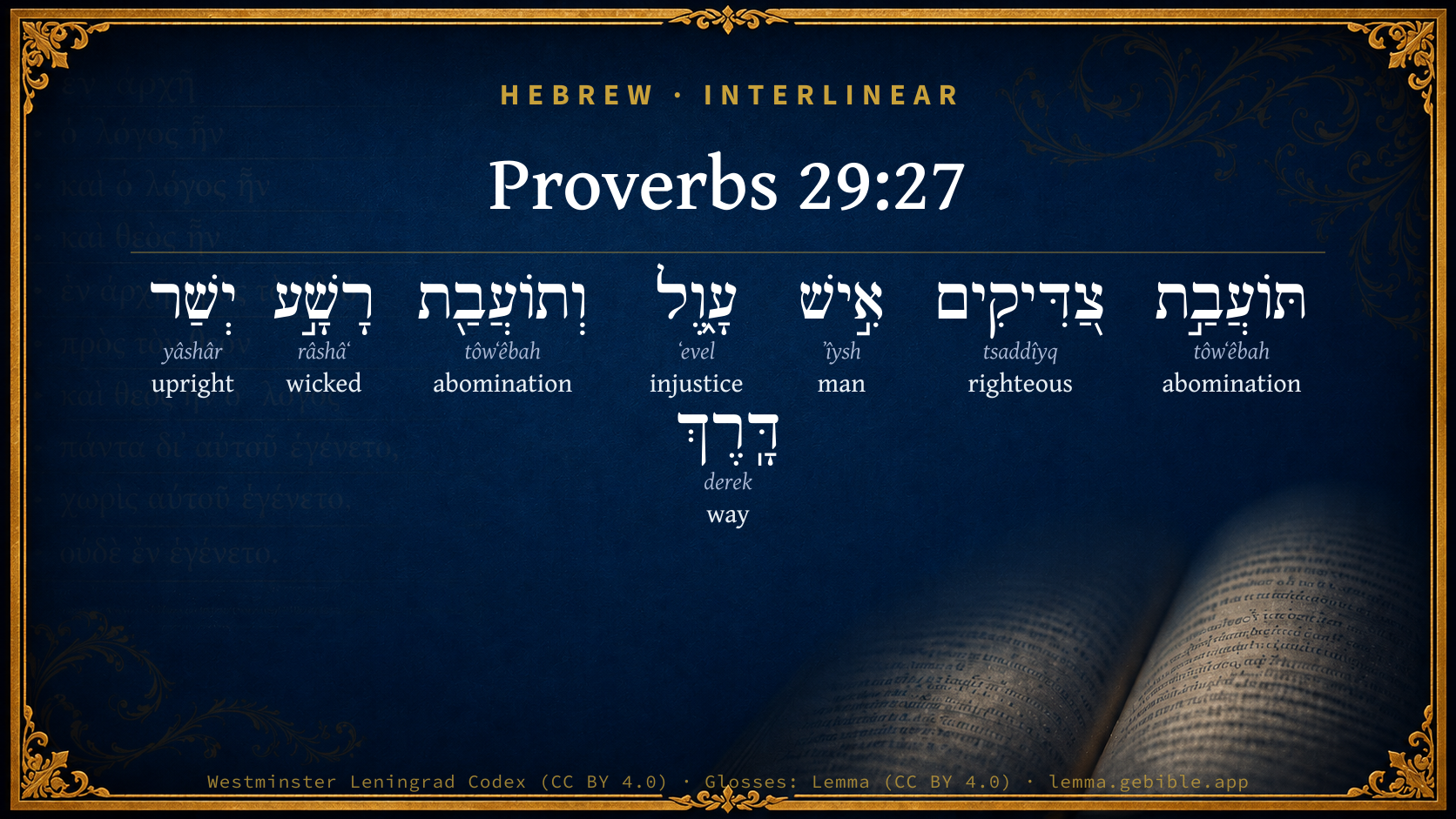
Proverbs 29:27

Hebrew (Westminster Leningrad Codex) Proverbs 29:27 appears in the Hebrew Old Testament. The text above is from the Westminster Leningrad Codex. Each word links to its Strong’s number, a concise gloss, and parsing drawn from the Open Scriptures Hebrew Bible morphology. Click any word for its full Brown-Driver-Briggs (BDB) entry.
Download image
Cite this verse

Proverbs 29:27 (World English Bible). Public Domain. Lemma interlinear Bible study tool, https://lemma.gebible.app/v/proverbs/29/27.

Show BibTeX & RIS
BibTeX
RIS
English Translation
A dishonest man detests the righteous, And the upright in their ways detest the wicked.
World English Bible · Public Domain
Download a study sheet

One document with this verse’s original text, its word-by-word gloss line, the meaning frame, cross-references with their text, attributed commentary, and full source and license credits — printable, and it pastes into notes with its structure intact.

This verse Autodidact and up

Study sheet (.html) Plain text (.txt)

A passage Seminary Student

Up to 50 verses in one chapter. A passage sheet keeps up to 6 commentary sources and 12 cross-references per verse, in the order this page ranks them, and says so on the sheet whenever that leaves anything out. Ask for a single verse and you get the Autodidact verse sheet above.

Everything on this page stays free to read, with no account — the sheet is a download of what is already on screen, not access to it.

Want to remove ads? Support Godless Engineer
Compare translations 3

The same verse in 3 English versions, stacked beneath the original-language interlinear above. Click any original word for its lexicon entry.

Each is an independent rendering of the whole verse — the interlinear is not word-aligned to these translations.

Highlighted words mark where these versions differ — a whole-verse word diff, not a word-by-word alignment.

  • World English Bible Public Domain
    A dishonest man detests the righteous, And the upright in their ways detest the wicked.
  • King James Version Public Domain
    An unjust man is an abomination to the just: and he that is upright in the way is abomination to the wicked.
  • unfoldingWord Literal Text CC BY-SA 4.0
    An abomination to the righteous a man of injustice, but an abomination to the wicked upright of way.

unfoldingWord Literal Text — © unfoldingWord, licensed CC BY-SA 4.0. Word-aligned USFM3 via Door43 (git.door43.org/unfoldingWord/en_ult).

Versions to compare (up to 4)

3 of 4 selected

Show all 18 translations

Every available English version of this verse, each an independent rendering of the whole verse.

  • World English Bible Public Domain
    A dishonest man detests the righteous, And the upright in their ways detest the wicked.
  • Berean Standard Bible Public Domain
    An unjust man is detestable to the righteous, and one whose way is upright is detestable to the wicked.
  • Majority Standard Bible Public Domain
    An unjust man is detestable to the righteous, and one whose way is upright is detestable to the wicked.
  • King James Version Public Domain
    An unjust man is an abomination to the just: and he that is upright in the way is abomination to the wicked.
  • American Standard Version (1901) Public Domain
    An unjust man is an abomination to the righteous; And he that is upright in the way is an abomination to the wicked.
  • Revised Version (1885) Public Domain
    An unjust man is an abomination to the righteous: and he that is upright in the way is an abomination to the wicked.
  • Geneva Bible (1599) Public Domain
    A wicked man is abomination to the iust, and he that is vpright in his way, is abomination to the wicked.
  • Douay-Rheims (1899) Public Domain
    The just abhor the wicked man: and the wicked loathe them that are in the right way. The son that keepeth the word, shall be free from destruction.
  • Young's Literal Translation Public Domain
    An abomination to the righteous `is' the perverse man, And an abomination to the wicked `is' the upright in the way!
  • Literal Standard Version CC BY-SA 4.0
    The perverse man [is] an abomination to the righteous, || And the upright in the way [is] an abomination to the wicked!
  • Unlocked Literal Bible CC BY-SA 4.0
    An unjust man is an abomination to righteous people, but the one whose way is upright is detestable to the wicked person.
  • unfoldingWord Literal Text CC BY-SA 4.0
    An abomination to the righteous a man of injustice, but an abomination to the wicked upright of way.
  • Darby Bible Public Domain
    An unjust man is an abomination to the righteous; and he that is of upright way is an abomination to the wicked [man].
  • World Messianic Bible Public Domain
    A dishonest man detests the righteous, and the upright in their ways detest the wicked.
  • Webster's Bible Public Domain
    An unjust man is an abomination to the just: and he that is upright in the way is abomination to the wicked.
  • Free Bible Version CC BY-SA 4.0
    Good people hate those who are unjust; the wicked hate those who do what's right.
  • Bible in Basic English Public Domain
    An evil man is disgusting to the upright, and he who is upright is disgusting to evil-doers.
  • JPS Tanakh (1917) Public Domain
    An unjust man is an abomination to the righteous; and he that is upright in the way is an abomination to the wicked.

Literal Standard Version (2020), Covenant Press — licensed CC BY-SA 4.0. Text via the HelloAO Bible API (eBible.org). Unlocked Literal Bible (unfoldingWord) — licensed CC BY-SA 4.0. Text via the HelloAO Bible API (eBible.org). unfoldingWord Literal Text — © unfoldingWord, licensed CC BY-SA 4.0. Word-aligned USFM3 via Door43 (git.door43.org/unfoldingWord/en_ult). Free Bible Version, Dr. Jonathan Gallagher — licensed CC BY-SA 4.0. Text via the HelloAO Bible API (eBible.org).

Word by word

More ways to search: Search by grammar → Find every occurrence → Compare this word →

Practice this passage: Drill this verse → Learn its vocabulary →

About this verse

These counts appear in no published source. They are computed here, from the morphology-tagged text and Lemma’s own curated glosses. What Lemma adds →

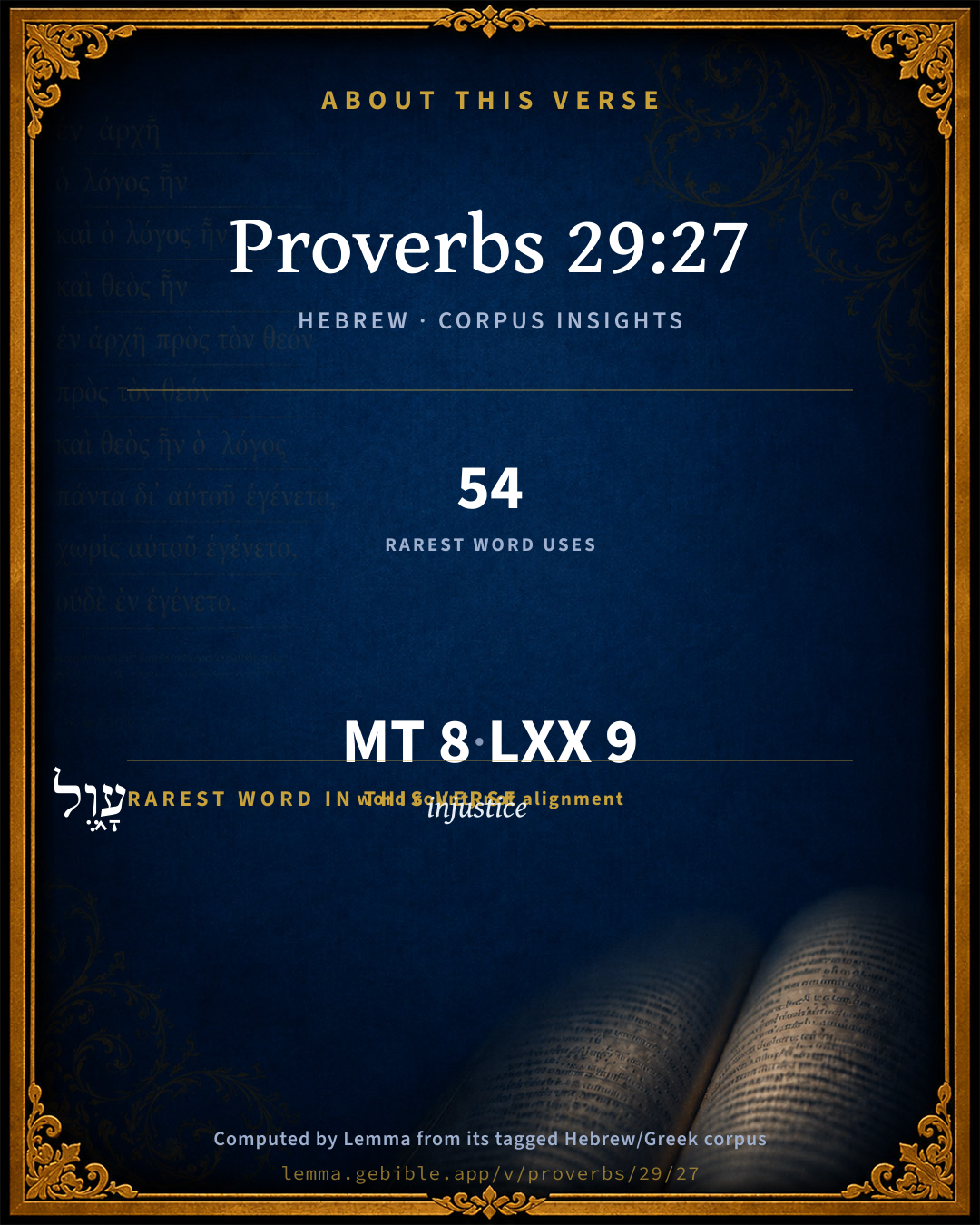
8
words
7
distinct lemmas
Wisdom
section

Shared distinctive vocabulary

עָ֑וֶל injustice H5766 occurs in 51 verses of the Hebrew Bible. Also found in:

Grammatical profile

  • 5 nouns
  • 3 adjectives

Repetition

A word recurs within this verse — often emphatic in Hebrew:

  • תּוֹעֲבַ֣ת abomination H8441 ×2

Hebrew & Septuagint length

In English translation the verse runs 15 words from the Hebrew and 20 from the Septuagint (LXX English) — closely comparable.

A rough comparison of the two English renderings, which tokenize alike — not a word-level alignment.

Word counts can differ between the Hebrew and the Greek without any difference in meaning — e.g. the Hebrew direct-object marker אֵת has no separate Greek word, and Greek often adds the article ὁ.

In the original languages it is 8 Hebrew tokens and 9 Greek tokens — but the two are counted differently (Hebrew bundles its prefixes and suffixes into one token; the Greek is in lemma form), so that isn’t a like-for-like length.

Cross-references

9

Topical passages linked to Proverbs 29:27 in the Treasury of Scripture Knowledge — connected by theme and wording, ordered by reader-vote popularity; previews shown in the World English Bible.

  • 1 John 3:13 Don't be surprised, my brothers, if the world hates you.
  • Psalms 139:21 Yahweh, don't I hate those who hate you? Am I not grieved with those who rise up against you?
  • John 15:17–19 "I command these things to you, that you may love one another.
  • John 7:7 The world can't hate you, but it hates me, because I testify about it, that its works are evil.
  • John 15:23 He who hates me, hates my Father also.
  • Proverbs 29:10 The bloodthirsty hate a man of integrity; And they seek the life of the upright.
  • Proverbs 24:9 The schemes of folly are sin. The mocker is detested by men.
  • Zechariah 11:8 I cut off the three shepherds in one month; for my soul was weary of them, and their soul also loathed me.
  • Psalms 119:115 Depart from me, you evildoers, That I may keep the commandments of my God.

Cross-references courtesy of OpenBible.info (CC BY 4.0).

Hebrew and Greek witnesses Masoretic Hebrew ↔ Greek Septuagint

The same verse in the two great witnesses to the Old Testament, shown verse-for-verse.

These are two independent witnesses, not word-aligned to each other, and the Septuagint is shown in lemma (dictionary) form.

Hebrew Proverbs 29:27 Masoretic · Westminster Leningrad Codex

תּוֹעֲבַ֣ת צַ֭דִּיקִים אִ֣ישׁ עָ֑וֶל וְתוֹעֲבַ֖ת רָשָׁ֣ע יְשַׁר דָּֽרֶךְ

A dishonest man detests the righteous, And the upright in their ways detest the wicked.

World English Bible · Public Domain

Greek LXX Proverbs 29:27 Septuagint · lemma form

βδέλυγμα δίκαιος ἀνήρ ἄδικος βδέλυγμα δέ ἄνομος καταεὐθύνω ὁδός

A righteous man is an abomination to an unrighteous man, and the direct way is an abomination to the sinner.

LXX2012 (modern English Septuagint) · Public Domain

On this verse, The Pulpit Commentary discusses the Septuagint’s reading. Read the note in Commentary ↓

Hebrew: Westminster Leningrad Codex (CC BY 4.0). Greek: Septuagint (public domain); English from LXX2012 (modern English Septuagint) (Public Domain). How the Septuagint differs from the Hebrew →

Commentary

Notes on Proverbs 29:27 from classic Christian and Jewish commentators (each source and its license shown beneath its notes). The classic Christian expositions comment on the surrounding passage and are grouped to its opening verse, so a note may address several verses; the Jewish commentaries on the Tanakh (Rashi and others) are per-verse, so they appear only where the commentator wrote on this verse.

Lemma curates 59 commentaries, every one of them public domain or Creative Commons licensed, each selected and text-cleaned for this edition rather than reprinted as found. About our sources →

Trapp's Complete Commentary

John Trapp

Pro 29:27 An unjust man [is] an abomination to the just: and [he that is] upright in the way [is] abomination to the wicked.

Ver. 27. An unjust man is an abomination to the just.] Who yet hates, non virum sed vitium, not the person of a wicked man, but his sin - as the physician hates the disease, but loves the patient, and strives to recover him - he abhors that which is evil, perfectly hates it, {Psa 139:22} hates it as hell so the Greek word {a} signifies; {Rom 12:9} hates it in his dearest friends, as Asa did in his mother Maachah; hates it most of all in himself, as having the divine nature transfused into him, whereby he resembles God, and that life of God, whereunto sin, he knows, is a destructive poison, a sickness unto death. {1Jn 5:16} Hence his implacable and no less impartial hatred of all as well as any sin, for all hatred is προς τα γενη, as Aristotle {b} hath it, to the whole kind. It was said of Antony that he hated a tyrant, not tyranny; it cannot be said of a saint he hates sinners, not sin, but the contrary.

And he that is upright in the way, is abomination to the wicked.] So there is no love lost between them. The devil hath set his limbs in all wicked people; they are a serpentine seed, a viperous brood, and the old enmity continues. {Gen 3:15} {See Trapp on "Gen 3:15"} Antipathies there are in nature, as between the elephant and boar, the lion and cock, the horse and the stone called taraxippe, &c. But this is nothing to that between the godly and the wicked; and why? but because the one’s works are good, and the other’s evil; and because the just man condemns the unjust by his contrary courses; yea, he frightens his heart, and terrifies him with his presence and company.

{a} αποστυγουντες.

{b} Arist. Rhetor.

John Trapp, A Commentary or Exposition upon All the Books of the Old and New Testament (1647–1656) — public domain. Text from a community e-Sword module.

Matthew Henry's Commentary

This expresses not only the innate contrariety that there is between virtue and vice, as between light and darkness, fire and water, but the old enmity that has always been between the seed of the woman and the seed of the serpent, Gen 3:15. 1. All that are sanctified have a rooted antipathy to wickedness and wicked people. They have a good will to the souls of all (God has, and would have none perish); but they hate the ways and practices of those that are impious towards God and injurious towards men; they cannot hear of them nor speak of them without a holy indignation; they loathe the society of the ungodly and unjust, and dread the thought of giving them any countenance, but do all they can to bring the wickedness of the wicked to an end. Thus an unjust man makes himself odious to the just, and it is one part of his present shame and punishment that good men cannot endure him. 2. All that are unsanctified have a like rooted antipathy to godliness and godly people: He that is upright in the way, that makes conscience of what he says and does, is an abomination to the wicked, whose wickedness is restrained perhaps and suppressed, or, at least, shamed and condemned, by the uprightness of the upright. Thus Cain did, who was of his father the devil. And this is not only the wickedness of the wicked, that they hate those whom God loves, but their misery too, that they hate those whom them shall shortly see in everlasting bliss and honour, and who shall have dominion over them in the morning, Psa 49:14.

Matthew Henry's Commentary on the Whole Bible (1708–1710) — public domain (CC PDM 1.0). Text via the HelloAO Bible API.

Jamieson, Fausset & Brown

Robert Jamieson, A. R. Fausset & David Brown

(Compare Pro 3:32). On last clause, compare Pro 29:16; Psa 37:12.

Next: Proverbs Chapter 30

Jamieson, Fausset & Brown — Commentary Critical and Explanatory on the Whole Bible (1871) — public domain (CC PDM 1.0). Text via the HelloAO Bible API.

Adam Clarke's Commentary

Verse 27. And he that is upright in the way] "But as for those that be in the right waye, the wicked hate them."-COVERDALE.

To this verse the VULGATE adds the following: Verbum custodiens filius extra perditionem erit; "The son that keeps the word shall not fall into perdition." This is not in all copies of the Vulgate: but it was in that from which my old MS. Bible was made, where it is thus translated: The sone keping the worde schal ben out of perdicyon. I believe verbum here is intended for the Divine word; the revelation from God.

Adam Clarke's Commentary on the Bible (1810–1826) — public domain. Text from a community e-Sword/MySword module.

The Cambridge Bible for Schools and Colleges

gen. ed. J. J. S. Perowne

27. the just] Rather, the righteous, R.V.

The Cambridge Bible for Schools and Colleges (gen. ed. J. J. S. Perowne; Cambridge University Press, 1878–1918) — public domain. Text from a community e-Sword module.

John Gill's Exposition

An unjust man is an abomination to the just,.... Not his person, but his actions, his unrighteous actions, his ungodly life and conversation; which a man, holy, just, and good, loathes and abhors, and cannot forbear expressing his abhorrence of; and therefore shuns his company, and will have no fellowship with him. And, on the other hand,

he that is upright in the way is abomination to the wicked; that man that is upright in heart and life, that walks according to the rule of the divine word, in the path of holiness, in the way of truth and righteousness, he is abhorred by a wicked man; he cannot have any pleasure in his company; he is under some awe and restraint which is disagreeable to him; and he cannot bear the reproofs he gives him; besides, if he is silent, his whole life and conversation carries in it a tacit reproof, conviction, and condemnation of him. There always has been a mutual enmity between the seed of the woman and the seed of the serpent, Gen 3:15.

Next: Proverbs Chapter 30

John Gill's Exposition of the Whole Bible (1746–1763) — public domain (CC PDM 1.0). Text via the HelloAO Bible API.

Albert Barnes' Notes on the Bible

The words point out not only the antagonism between the doers of good and evil, but the instinctive antipathy which the one feels toward the other.

Albert Barnes' Notes on the Bible (1834–1885) — public domain. Text from a community e-Sword/MySword module.

Matthew Poole's English Annotations

Is an abomination to the just, because such men, as such, are hated by God, and haters of and enemies unto God and all goodness, and public plagues to the church and state in which they live; and therefore he who loves these must needs hate them, as true friends hate those who are enemies to their friends.

Is abomination to the wicked; of which See Poole "Pro 29:10".

Matthew Poole's English Annotations on the Holy Bible (1683–1685) — public domain. Text from a community e-Sword/MySword module.

Whedon's Commentary on the Bible

Daniel D. Whedon

27. Unjust… just — There is a perfect antipathy between virtue and vice. Comp. Psalm 39:14.

Daniel D. Whedon (gen. ed.), Commentary on the Old and New Testaments (1874–1909) — public domain. Text from a community e-Sword module.

The Pulpit Commentary

An unjust man is an abomination to the just. This great moral contrast, marked and universal, is a fitting close of the book. The word "abomination" (toebah) occurs more than twenty times in the Proverbs; it is appropriate here because the good man looks upon the sinner as the enemy of God, as the psalmist says, "Do not I hate them, O Lord, that hate thee? and am not I grieved with those that rise up against thee? I hate them with perfect hatred: I count them thine enemies". (Psa_139:21, etc.) He that is upright in the way is abomination to the wicked; because he is a standing reproach to him, and by every tone and look and action seems to express his condemnation. (see on Pro_21:15, and the Septuagint Version there; and comp. 1Ki_21:20 Isa_53:3 Mat_8:34 Joh_15:19) Septuagint, "A direct way is an abomination to the lawless." The Vulgate ends the chapter with a paragraph which is found in some manuscripts of the Septuagint after Pro_24:22 (where see note), Verbum custodiens filius extra perditionem erit.

How to hate the wicked.

There is a hatred we have to endure, and there is also a hatred which we have to cherish. The question of any difficulty is What is the feeling we should cultivate in our hearts towards the guilty? We may glance at

I THE HATRED OF US BY THE WICKED. "He that is upright in the way is abomination to the wicked.

1. This is a well-verified fact, attested by Scripture, by history, by observation, probably by experience.

2. Its explanation is at hand.

(1) Wicked men are utterly out of sympathy with the righteous. Their tastes, inclinations, habits, are all at variance with those of the good and pure.

(2) The upright are obliged to condemn them, either in private or in public.

(3) The life of the one is a standing reflection upon the conduct of the other.

3. There is one right way to meet it; viz.

(1) to endure it as Jesus Christ endured it, (Heb_12:3 1Pe_2:23) and as seeing the invisible but present and approving Lord; (Heb_11:27)

(2) to make an honest effort to remove it by winning those who indulge it. But the more difficult question is how we are to bear ourselves toward those whose conduct we reprobate, whose character we detest, whose persons we are not willing to admit into our homes. How shall we order

II OUR HATRED OF THE WICKED? That there is a very strong feeling against the wrong doer in the minds of the holy is obvious enough. It is a fact that "an unjust man is an abomination to the just." "Do not I hate them that hate thee?... I hate them with perfect hatred: I count them mine enemies," said David. (Psa_139:21, Psa_139:22) Jesus Christ "looked round about on them with anger". (Mar_3:5) God is "angry with the wicked every day". (Psa_7:11) He "hateth all the workers of iniquity". (Psa_5:5) Our feeling, therefore, is the reflection of that which is in the heart of the Holy One himself. Of what elements should it be composed?

1. One element that should be absent. There should be no trace of personal ill will, of a desire for the suffering of the man himself; for the soul of the sinful we should wish well, and we fall into a mistake, if not into a sin, when we allow ourselves to find a pleasure in witnessing or in dwelling upon the humiliation or the sorrow of the wicked. We ought only to wish for that as a means of their purification and recovery.

2. The elements that should be present.

(1) Pure resentment, such as God feels, such as our Lord felt when he lived amongst us, (see Mt 23) a feeling of strong reprobation, which we are obliged to direct against them as the doers of unrighteousness.

(2) Faithful but measured condemnation. There is, in this view, a time to speak as well as a time to keep silence; and both publicly and privately it behoves us to blame the blameworthy, cud even to denounce the shamefully unjust or cruel. But here we are bound to take care that we are well acquainted with the matter on which we speak, and that our judgment is an impartial one.

(3) Fearless and unflinching opposition. We must actively and steadfastly oppose ourselves to the iniquitous, and do our best to bring their purposes to the ground.

(4) Sincere and practical compassion. With all this that is adverse, we may and should conjoin such pity as our Divine Saviour has felt for ourselves, and such honest and earnest endeavour to win them to the truth and to the practice of righteousness as he put forth when he came to redeem us from sin and to raise us to the likeness and restore us to the kingdom of God. C.

The Pulpit Commentary (1880–1919), ed. H.D.M. Spence-Jones & Joseph S. Exell — public domain. Text from a community e-Sword module.

Keil & Delitzsch

C. F. Keil & F. Delitzsch

27 An abomination to a righteous man is a villanous man;

And an abomination to the godless is he who walketh uprightly.

In all the other proverbs which begin with תועבת, e.g., Pro 11:20, יהוה follows as genit., here צדּיקים, whose judgment is like that of God. אישׁ עול is an abhorrence to them, not as a man, but just as of such a character; עול is the direct contrast to ישׁר. The righteous sees in the villanous man, who boldly does that which is opposed to morality and to honour, an adversary of his God; on the other hand, the godless sees in the man that walketh uprightly (ישׁר־דּרך, as at Psa 37:14) his adversary, and the condemnation of himself.

With this doubled ת the Book of Proverbs, prepared by the men of Hezekiah, comes to an end. It closes, in accordance with its intention announced at the beginning, with a proverb concerning the king, and a proverb of the great moral contrasts which are found in all circles of society up to the very throne itself.

Keil & Delitzsch — Biblical Commentary on the Old Testament (1861–1891) — public domain (CC PDM 1.0). Text via the HelloAO Bible API. (Old Testament only.)

Bridges on Proverbs

Charles Bridges

Here is the oldest, the most rooted, the most universal quarrel in the world. It was the first-fruit of the fall. (Gen 3:15 .) It has continued ever since, and will last to the end of the world. It is always kept up at the highest point. Each party is an abomination to the other. It is not only, that they are as contrary in character, as light is to darkness; but there is a mutual antipathy, that can never be softened down.

Let us look at each of the parties in this open opposition to each other. An unjust man is an abomination to the just. Is it then his sin to be at such contraries with his fellow-sinner? No rather — it is the very holiness of his character and profession. If he have any apprehensions of the holiness of God: if through grace he is delivered from the love and dominion of sin, is not the sight of sin hateful to him? And while he abhors it most of all in himself, yet does not the watching of the evil in his own heart deepen his abhorrence and detestation of it in those around him? He would not spare it in those most dear to him. He appeals to his God in the burst of holy indignation. "Do not I hate them, O LORD, that hate thee? and am not I grieved with those that rise up against thee? I hate them with a perfect hatred: I count them mine enemies."†1

Looking at the other party — the wicked hold the upright in equal abomination. (Pro 29:10 .) "The carnal mind is enmity against God," and cannot therefore bear his image in his children. (Rom 8:7 .)†2 Gladly would the wicked, were not their enmity restrained, "root them out of the face of the earth;" as they never rested, till they had nailed the Son of God to the tree. Here however is the main difference. The enmity of the just is against the sins, not the persons, of the wicked . How do they with all this principle love their souls, and pray for them! (Rom 9:1 ; Rom 10:1 .) How gladly would they win them to Christ and salvation! The enmity of the wicked is against the persons — the ways of the upright — all that belongs to them. ’This is that strong poison in the serpent’s seed,’†3 the murderous spirit of their father the devil!

The soul is wearied with the unceasing struggles with the enemies of truth. How can one forbear the wish for the "wings of a dove to fly away, and be at rest!" (Psa 55:6 .) And how could we hold on the contest, but for the blessed hope — Oh Lord! hasten it in thy time — when the woman’s conquering "seed shall bruise the Serpent’s Head," and the head of all†4 his seed, finally and for ever; and he shall reign King and Savior over his redeemed people.

Footnotes:

†1 Psa 139:21-22. Compare Pro 28:4 .

†2 Joh 15:17-19. 1Jn 3:12-13 .

†3 Leighton on 1Pe 3:14 .

†4 Psa 45:3-4. Rev 19:11-16 .

Charles Bridges, An Exposition of the Book of Proverbs (1846) — public domain. Text from a community e-Sword module.

unfoldingWord translationNotes

Door43 World Missions Community

detestable

a person who should be hated. See how you translated this in Proverbs 3:32.

translationWords

just

abomination

evil

unfoldingWord translationNotes — © Distant Shores Media and the Door43 World Missions Community, licensed CC BY-SA 4.0. Source: git.door43.org/Door43/en_tn.

Rashi

Rabbi Shlomo Yitzchaki (Rashi)

whose way is straight A man who is straight in his ways.

Rashi on the Tanakh — English translations: “The Judaica Press complete Tanach with Rashi, translated by A. J. Rosenberg” (CC BY 4.0); “Pentateuch with Rashi's commentary by M. Rosenbaum and A.M. Silbermann, 1929-1934” (public domain); “The Metsudah Tanach series, Lakewood, N.J” (CC BY 4.0); and “The Book of Joshua, Metsudah Publications, 1997” (CC BY 4.0). Text via Sefaria.

Lesson kit

Teaching starters — assembled from the data on this page, not authored interpretation. Every prompt links to the verse data it draws on. Edit before teaching.

Proverbs, in the Wisdom, opens this verse with 8 words (7 distinct Hebrew lemmas). Its most distinctive word is ʻevel (“injustice”). A historical commentator’s framing appears above. Read the whole chapter for the surrounding context.

Discussion questions

  1. What does “injustice” (ʻevel) contribute to the verse as a whole?
  2. How does Leviticus 19:15, which shares the word «injustice», read alongside this verse?
  3. What does the repetition of “abomination” (2× in this one verse) do in this verse?
  4. The translations on this page render this verse differently — a whole-verse word diff, not a word-by-word alignment. What might account for the different wordings?
  5. Compare how Trapp's Complete Commentary and Matthew Henry's Commentary read this verse. Where do they agree or differ?

Things to notice

Reading settings

Reading text

Shown beneath each verse's original-language words.

Old Testament
Old Testament edition

Read the OT as the Masoretic Hebrew (MT) or the Greek Septuagint (LXX).

English shown for the Greek Septuagint (in the Hebrew ↔ Greek comparison).

Comparing translations? Open the Compare panel on any verse page to stack up to four side by side.