
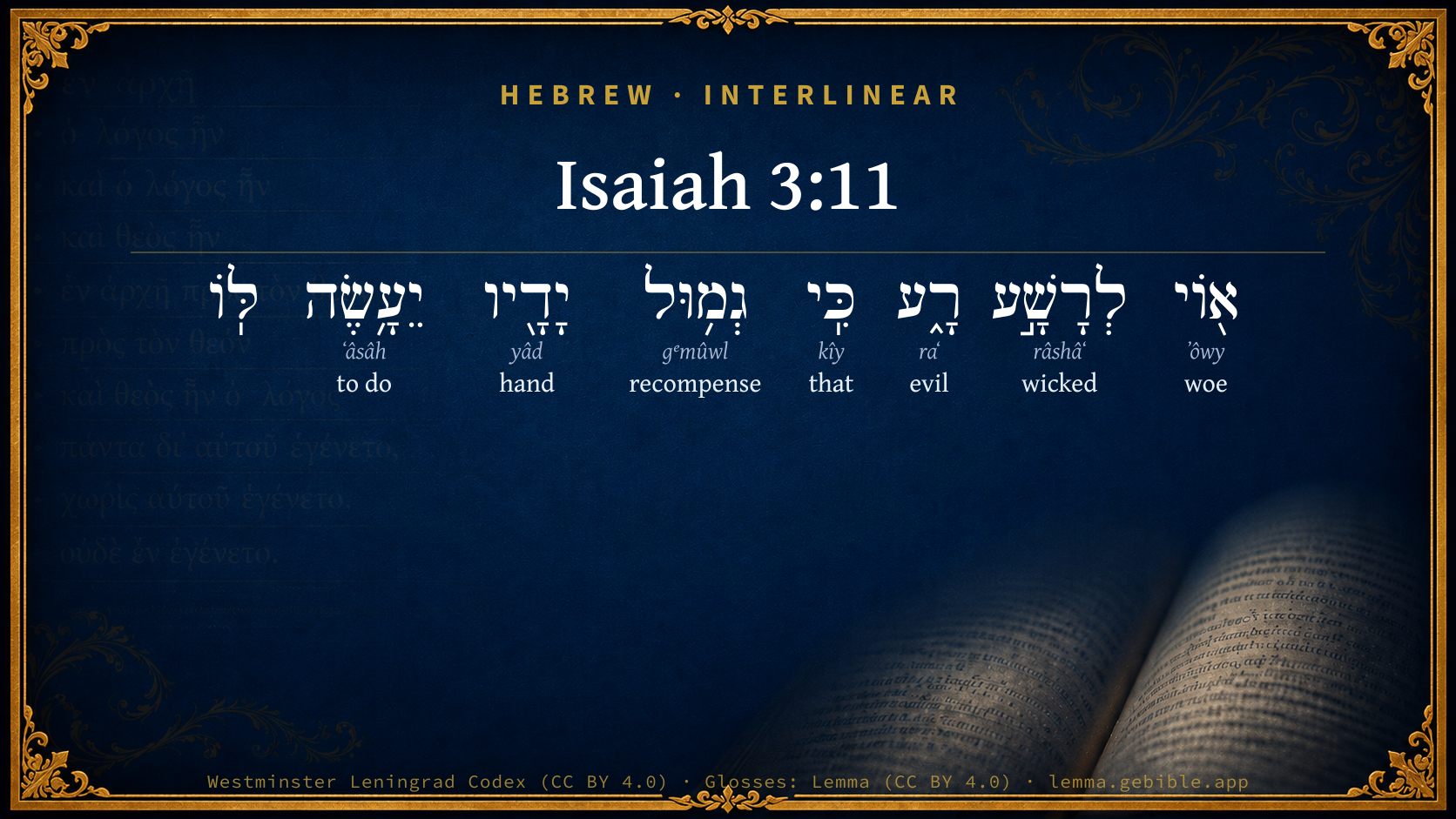
Isaiah 3:11

Hebrew (Westminster Leningrad Codex) Isaiah 3:11 appears in the Hebrew Old Testament. The text above is from the Westminster Leningrad Codex. Each word links to its Strong’s number, a concise gloss, and parsing drawn from the Open Scriptures Hebrew Bible morphology. Click any word for its full Brown-Driver-Briggs (BDB) entry.
Download image
Cite this verse

Isaiah 3:11 (World English Bible). Public Domain. Lemma interlinear Bible study tool, https://lemma.gebible.app/v/isaiah/3/11.

Show BibTeX & RIS
BibTeX
RIS
English Translation
Woe to the wicked! Disaster is upon them; For the deeds of his hands will be paid back to him.
World English Bible · Public Domain
Download a study sheet

One document with this verse’s original text, its word-by-word gloss line, the meaning frame, cross-references with their text, attributed commentary, and full source and license credits — printable, and it pastes into notes with its structure intact.

This verse Autodidact and up

Study sheet (.html) Plain text (.txt)

A passage Seminary Student

Up to 50 verses in one chapter. A passage sheet keeps up to 6 commentary sources and 12 cross-references per verse, in the order this page ranks them, and says so on the sheet whenever that leaves anything out. Ask for a single verse and you get the Autodidact verse sheet above.

Everything on this page stays free to read, with no account — the sheet is a download of what is already on screen, not access to it.

Want to remove ads? Support Godless Engineer
Compare translations 3

The same verse in 3 English versions, stacked beneath the original-language interlinear above. Click any original word for its lexicon entry.

Each is an independent rendering of the whole verse — the interlinear is not word-aligned to these translations.

Highlighted words mark where these versions differ — a whole-verse word diff, not a word-by-word alignment.

  • World English Bible Public Domain
    Woe to the wicked! Disaster is upon them; For the deeds of his hands will be paid back to him.
  • King James Version Public Domain
    Woe unto the wicked! it shall be ill with him: for the reward of his hands shall be given him.
  • unfoldingWord Literal Text CC BY-SA 4.0
    Woe to the wicked— harm, for the recompense of his hands will be done to him.

unfoldingWord Literal Text — © unfoldingWord, licensed CC BY-SA 4.0. Word-aligned USFM3 via Door43 (git.door43.org/unfoldingWord/en_ult).

Versions to compare (up to 4)

3 of 4 selected

Show all 18 translations

Every available English version of this verse, each an independent rendering of the whole verse.

  • World English Bible Public Domain
    Woe to the wicked! Disaster is upon them; For the deeds of his hands will be paid back to him.
  • Berean Standard Bible Public Domain
    Woe to the wicked; disaster is upon them! For they will be repaid with what their hands have done.
  • Majority Standard Bible Public Domain
    Woe to the wicked; disaster is upon them! For they will be repaid with what their hands have done.
  • King James Version Public Domain
    Woe unto the wicked! it shall be ill with him: for the reward of his hands shall be given him.
  • American Standard Version (1901) Public Domain
    Woe unto the wicked! `it shall be' ill `with him'; for what his hands have done shall be done unto him.
  • Revised Version (1885) Public Domain
    Woe unto the wicked! it shall be ill with him: for the reward of his hands shall be given him.
  • Geneva Bible (1599) Public Domain
    Woe be to the wicked, it shalbe euill with him: for the reward of his handes shalbe giuen him.
  • Douay-Rheims (1899) Public Domain
    Woe to the wicked unto evil: for the reward of his hands shall be given him.
  • Young's Literal Translation Public Domain
    Wo to the wicked -- evil, Because the deed of his hand is done to him.
  • Literal Standard Version CC BY-SA 4.0
    Woe to the wicked—evil, || Because the deed of his hand is done to him.
  • Unlocked Literal Bible CC BY-SA 4.0
    Woe to the wicked! It will go badly for him, for the recompense of his hands will be done to him.
  • unfoldingWord Literal Text CC BY-SA 4.0
    Woe to the wicked— harm, for the recompense of his hands will be done to him.
  • Darby Bible Public Domain
    Woe unto the wicked! it shall be ill [with him], because the desert of his hands shall be rendered unto him.
  • World Messianic Bible Public Domain
    Woe to the wicked! Disaster is upon them, for the deeds of their hands will be paid back to them.
  • Webster's Bible Public Domain
    Woe to the wicked! it shall be ill with him: for the reward of his hands shall be given him.
  • Free Bible Version CC BY-SA 4.0
    But tragedy comes to the wicked, for what they did will be done to them.
  • Bible in Basic English Public Domain
    Unhappy is the sinner! for the reward of his evil doings will come on him.
  • JPS Tanakh (1917) Public Domain
    Woe unto the wicked! it shall be ill with him; for the work of his hands shall be done to him.

Literal Standard Version (2020), Covenant Press — licensed CC BY-SA 4.0. Text via the HelloAO Bible API (eBible.org). Unlocked Literal Bible (unfoldingWord) — licensed CC BY-SA 4.0. Text via the HelloAO Bible API (eBible.org). unfoldingWord Literal Text — © unfoldingWord, licensed CC BY-SA 4.0. Word-aligned USFM3 via Door43 (git.door43.org/unfoldingWord/en_ult). Free Bible Version, Dr. Jonathan Gallagher — licensed CC BY-SA 4.0. Text via the HelloAO Bible API (eBible.org).

Word by word

More ways to search: Search by grammar → Find every occurrence → Compare this word →

Practice this passage: Drill this verse → Learn its vocabulary →

About this verse

These counts appear in no published source. They are computed here, from the morphology-tagged text and Lemma’s own curated glosses. What Lemma adds →

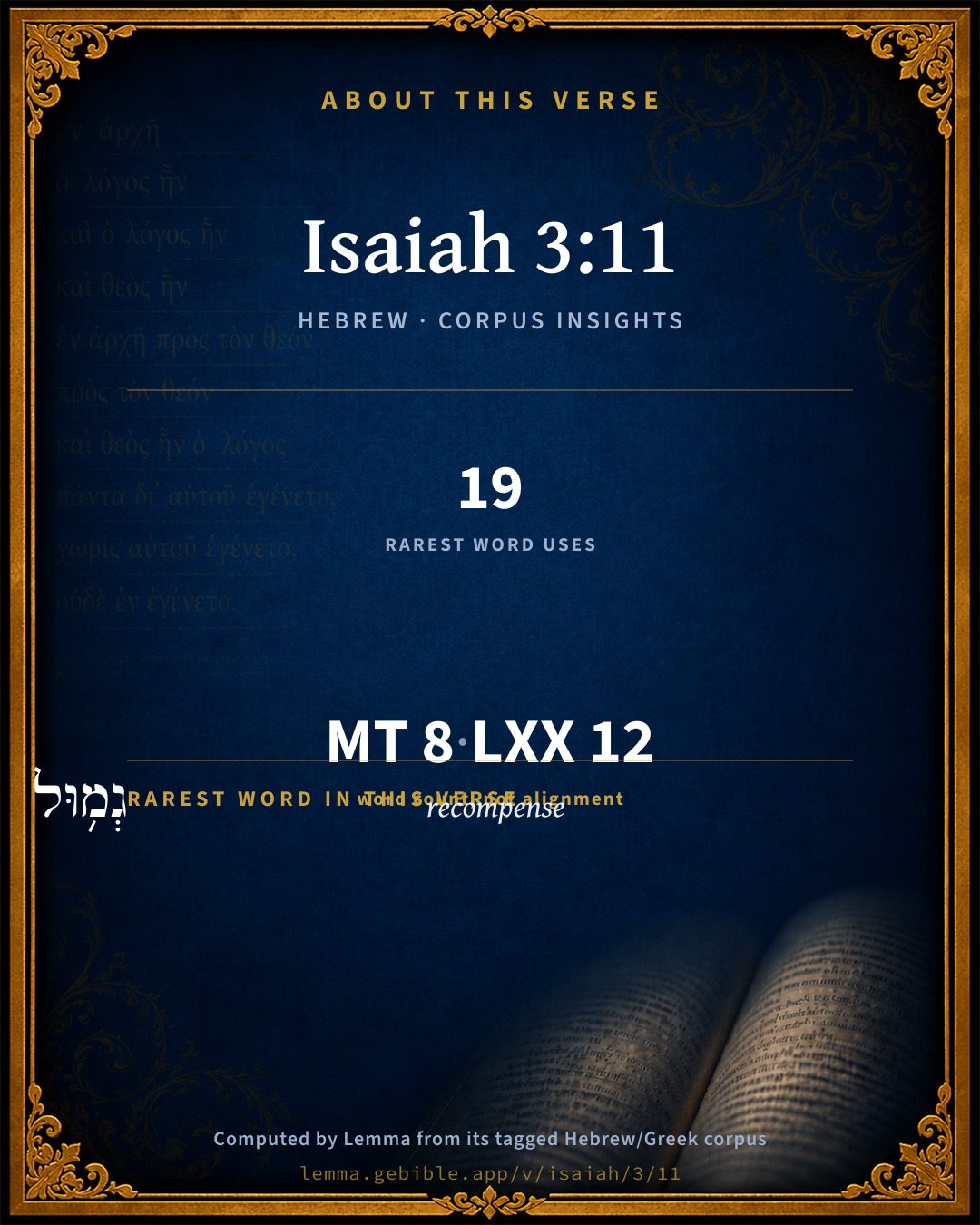
8
words
7
distinct lemmas
Prophets
section

Notable vocabulary

The rarest word here is גְמ֥וּל recompense H1576 — appearing just 19 times in the whole Hebrew Bible.

Shared distinctive vocabulary

גְמ֥וּל recompense H1576 occurs in 17 verses of the Hebrew Bible. Also found in:

Grammatical profile

  • 2 verbs
  • 2 nouns
  • 1 adjective
  • 1 preposition
  • 1 conjunction
  • 1 particle

Verb forms

  • רָ֑ע Qal · Perfect
  • יֵעָ֥שֶׂה Niphal · Imperfect

Hebrew & Septuagint length

In English translation the verse runs 20 words from the Hebrew and 16 from the Septuagint (LXX English) — closely comparable.

A rough comparison of the two English renderings, which tokenize alike — not a word-level alignment.

Word counts can differ between the Hebrew and the Greek without any difference in meaning — e.g. the Hebrew direct-object marker אֵת has no separate Greek word, and Greek often adds the article ὁ.

In the original languages it is 8 Hebrew tokens and 12 Greek tokens — but the two are counted differently (Hebrew bundles its prefixes and suffixes into one token; the Greek is in lemma form), so that isn’t a like-for-like length.

Cross-references

14

Topical passages linked to Isaiah 3:11 in the Treasury of Scripture Knowledge — connected by theme and wording, ordered by reader-vote popularity; previews shown in the World English Bible.

  • Ecclesiastes 8:13 But it shall not be well with the wicked, neither shall he lengthen days like a shadow; because he doesn't fear God.
  • James 2:13 For judgment is without mercy to him who has shown no mercy. Mercy triumphs over judgment.
  • Psalms 120:3–4 What will be given to you, and what will be done more to you, You deceitful tongue?
  • Psalms 28:4 Give them according to their work, and according to the wickedness of their doings. Give them according to the operation of their hands. Bring back on them what they deserve.
  • Psalms 62:12 Also to you, Lord, belongs loving kindness, For you reward every man according to his work.
  • Proverbs 1:31 Therefore they will eat of the fruit of their own way, And be filled with their own schemes.
  • Isaiah 48:22 There is no peace, says Yahweh, to the wicked.
  • Isaiah 65:13–15 Therefore thus says the Lord Yahweh, Behold, my servants shall eat, but you shall be hungry; behold, my servants shall drink, but you shall be thirsty; behold, my servants shall rejoice, but you shall be disappointed;
  • Isaiah 65:20 There shall be no more there an infant of days, nor an old man who has not filled his days; for the child shall die one hundred years old, and the sinner being one hundred years old shall be accursed.
  • Deuteronomy 28:15–68 But it shall come to pass, if you will not listen to the voice of Yahweh your God, to observe to do all his commandments and his statutes which I command you this day, that all these curses shall come on you, and overtake you.
  • Psalms 1:3–5 He will be like a tree planted by the streams of water, That brings forth its fruit in its season, Whose leaf also does not wither. Whatever he does shall prosper.
  • Psalms 11:5–6 Yahweh examines the righteous, But the wicked and him who loves violence his soul hates.
  • Isaiah 57:20–21 But the wicked are like the troubled sea; for it can't rest, and its waters cast up mire and dirt.
  • 2 Corinthians 5:10 For we must all be revealed before the judgment seat of Christ; that each one may receive the things in the body, according to what he has done, whether good or bad.

Cross-references courtesy of OpenBible.info (CC BY 4.0).

Hebrew and Greek witnesses Masoretic Hebrew ↔ Greek Septuagint

The same verse in the two great witnesses to the Old Testament, shown verse-for-verse.

These are two independent witnesses, not word-aligned to each other, and the Septuagint is shown in lemma (dictionary) form.

Hebrew Isaiah 3:11 Masoretic · Westminster Leningrad Codex

א֖וֹי לְרָשָׁ֣ע רָ֑ע כִּֽי גְמ֥וּל יָדָ֖יו יֵעָ֥שֶׂה לּֽוֹ

Woe to the wicked! Disaster is upon them; For the deeds of his hands will be paid back to him.

World English Bible · Public Domain

Greek LXX Isaiah 3:11 Septuagint · lemma form

οὐαί ὁ ἄνομος πονηρός κατά ὁ ἔργον ὁ χείρ αὐτός συνβαίνω αὐτός

Woe to the transgressor! evils shall happen to him according to the works of his hands.

LXX2012 (modern English Septuagint) · Public Domain

Hebrew: Westminster Leningrad Codex (CC BY 4.0). Greek: Septuagint (public domain); English from LXX2012 (modern English Septuagint) (Public Domain). How the Septuagint differs from the Hebrew →

Targum (Aramaic paraphrase)

1

The Targum is the ancient Jewish Aramaic paraphrase of the Hebrew Scriptures — an interpretive translation, not the Hebrew text itself. Onkelos (literal) and Pseudo-Jonathan (expansive) render the Torah, and Jonathan the Prophets. Coverage is partial: where no permissively-licensed English translation exists for a verse, only the Aramaic is shown. This is verse-level text, not a word-by-word alignment to the Hebrew.

  1. Targum Jonathan Prophets (Joshua–Malachi)
    וַי לְרַשִׁיעַיָא דְעוֹבָדֵיהוֹן בִּישִׁין אֲרֵי גֻמְלָא דִידֵיהוֹן יִתְּתֵב לְהוֹן:

    Woe to the wicked, whose works are evil; because the reward of their hands shall be returned to them.

    Targum Jonathan — Aramaic: “Mikraot Gedolot” (public domain). English: “Sefaria Community Translation” (CC0 1.0 (public-domain dedication)); “London "Chaldee Paraphrase," 1871” (public domain). Text via Sefaria.

Commentary

Notes on Isaiah 3:11 from classic Christian and Jewish commentators (each source and its license shown beneath its notes). The classic Christian expositions comment on the surrounding passage and are grouped to its opening verse, so a note may address several verses; the Jewish commentaries on the Tanakh (Rashi and others) are per-verse, so they appear only where the commentator wrote on this verse.

Lemma curates 59 commentaries, every one of them public domain or Creative Commons licensed, each selected and text-cleaned for this edition rather than reprinted as found. About our sources →

Trapp's Complete Commentary

John Trapp

Isa 3:11 Woe unto the wicked! [it shall be] ill [with him]: for the reward of his hands shall be given him.

Ver. 11. Woe to the wicked.] This sentence should ever sound in the wicked man’s ears for a powerful retentive from wickedness, considering the evil consequence thereof, that doleful ουαι ουαι; woe and alas for evermore! And when thou art making, saith one, a covenant with sin, say to thy soul, as Boaz said to his kinsman, "At what time thou buyest it, thou must have Ruth with it." {Rth 4:4} If thou wilt have the pleasure of sin, the ways of wickedness, thou must also have the vengeance and wrath of God with it, and let thy soul answer as he here doth: No, I may not do it; I shall mar and spoil a better inheritance; I shall inherit a curse, &c. Look, saith Mr Bradford, {a} martyr, to the tag tied to God’s law, the malediction, which is such as cannot but make us to cast our currish tails between our legs, if we believe it.

It shall go ill with him.] Utcunque sibi de rebus praesentibus gratuletur. {b} Though he stroke himself on the head, saying, I shall have peace, though I walk in the imaginations of my heart, to add drunkenness to thirst. {Deu 29:19} Tell him from me, saith God, Evil, sc., shall betide him; yea, "an evil, an only evil," awaiteth him, {Eze 7:5} let him look for it.

The reward of his hands shall be given him.] He shall reap as he sowed, drink as he brewed. {Gal 6:7-8}

“ Mox ant poena manet miseros, ant palma beatos;

Quisque sum vitae semina iacta metet. ”

{a} Serm. of Repentance, pp. 57, 58.

{b} Jun.

John Trapp, A Commentary or Exposition upon All the Books of the Old and New Testament (1647–1656) — public domain. Text from a community e-Sword module.

The Biblical Illustrator

Joseph S. Exell

Isa_3:11

Woe unto the wicked!--

All things conspire for evil to the sinner

As all events are to be made public under Gods moral government, it is for His own interest, as well as for the interest of His creatures, that He should apprise them fully of His character and of the principles of His government.

As all events are to be made known, both for the vindication of Gods character and for the instruction of all moral agents, it follows that the destruction of the wicked will be aggravated by every accession of light to their minds. Every new revelation of Gods works or ways which is made to them must conspire,

(1) to enlighten their minds, and,

(2) by consequence, to deepen their guilt and enhance and aggravate their doom.

1. Men will be held responsible for mercies abused. Hence those things which most please sinners, and which they call their good things, are charged to their account, and they must be held to the strictest accountability for their use or abuse of all their good things.

2. If these are facts, then sinners are getting deeply in debt. Everything, therefore, that now pleases the sinner so much will swell the mass of things that shall agonise him at the judgment day, and throughout his eternal existence.

3. The same principle applies to the entire course of Gods discipline towards you, embracing the various rebukes of His providence. All these are measures taken for your good, but if you will not improve them, they will only work out your deeper ruin. How marvellous that wicked men should suppose that these light afflictions are the proper punishment of sin! No; these are only Gods means of discipline, employed here in this life for the good of mens souls. Instead of being themselves the retribution due for sin, they are only the guarantees sent on beforehand by the great King, involving His pledge that He will punish sin unless He can secure repentance.

4. All your infirmities and all your sins; also the sins of those who live near you so that you can see the course of Gods dealings with them; indeed, the whole history of sin in the universe so far as known to you,--all conspire to heighten your responsibility and aggravate the guilt of your sin. For all these things serve to show you the real evil and wrong of sin; they serve to reveal Gods hatred of sin, and to assure you that He must and will punish it. Remarks:--

(1) All things work together for good to the Christian, and ultimately, when he comes to see how all things have had this result, he will regret nothing he has ever done, although he may greatly blame himself for all his sins. It is often the case that Christians here learn lessons of deep experience under their sins. They are deeply affected when they see how God overrules even their sins for good to themselves and to others. But nothing of this sort happens to sinners. They are not of those that love God, and they have no reason to expect that God will make all things work together for their good. Hence they must both blame themselves and also regret everything they have ever done.

(2) Sinners have never any good reasons for joy.

(3) Sinners procure this result to themselves. God gave you voluntary powers, that, on your own responsibility, you might use them for your own welfare. He gave you His Son, and in Him an offered salvation, that you might lay hold of everlasting life. He gave you a Bible, that you might read it and become wise unto salvation. He gave you these and a thousand other blessings, that they might be improved, and if you will not improve them, you have no right to complain of God.

(4) Sinners need not be stumbled by any calamities whatever which befall Gods real children. Let them not trouble themselves about this matter. The

Lord knoweth them that are His, and they shall never lack His constant care.

(5) All events that transpire in this world or the next will only make the great gulf fixed between saints and sinners the deeper and the broader--will only make the saints more holy and more happy, the sinners more sinful and more wretched.

(6) What an infinite folly is it to judge of things only by their relations to this life!

(7) Gods conduct in all this is just and righteous altogether. (C. G. Finny.)

The wicked man digs his own hell

We must not think of hell as a Divine invention; may we not say it reverently? it is an invention totally human. All evil digs and eats its own perdition; all evil chokes its throat with brimstone of its own finding. (J. Parker, D. D.)

Presumptuous disobedience

Steel-headed hammers are not allowed to be used inside powder mills, copper ones being used instead, there being no fear of drawing fires with them. Two carpenters, going into a powder mill to do some repairs, though fully acquainted with the regulations, persisted in using a steel hammer, with the result that a spark flew from the hammer head, and in a moment, with a dull, heavy roar, the mill and the men were blown to atoms.

The Biblical Illustrator, edited by Joseph S. Exell (c. 1880s–1900s) — public domain. Text from a community e-Sword module.

Tyndale Open Study Notes

Tyndale Open Resources

3:11 The wicked who practice and execute injustice will receive God’s just punishment.

Tyndale Open Study Notes — © Tyndale Open Resources, licensed CC BY-SA 4.0. Text via the HelloAO Bible API.

Jamieson, Fausset & Brown

Robert Jamieson, A. R. Fausset & David Brown

ill--antithesis to "well" (Isa 3:10); emphatic ellipsis of the words italicized. "Ill!"

hands--his conduct; "hands" being the instrument of acts (Ecc 8:12-13).

Jamieson, Fausset & Brown — Commentary Critical and Explanatory on the Whole Bible (1871) — public domain (CC PDM 1.0). Text via the HelloAO Bible API.

Adam Clarke's Commentary

Verse 11. Wo unto the wicked] לרשע lerasha, the man who is,

1. Evil in his heart.

2. Evil in his purposes.

3. Evil in his life.

As he is wicked, he does that which is wicked; and is influenced by the wicked one, of whom he is the servant and the son. It shall be ill with him, רע ra; in a single word say to him - evil! Of him you can speak no good; and to him you can speak no good - all is evil, in him - before him - after him - round about him - above him - below him. Evil in time - evil through eternity!

The reward of his hands.] What he has deserved he shall get. He shall be paid that for which he has laboured, and his reward shall be in proportion to his work. O, what a lot is that of the wicked! Cursed in time, and accursed through eternity!

Adam Clarke's Commentary on the Bible (1810–1826) — public domain. Text from a community e-Sword/MySword module.

John Gill's Exposition

Woe unto the wicked! it shall be ill with him,.... In time, and to eternity, in times of public calamity, and under all afflictions, and adverse dispensations of Providence; he has no God to go to; all that befalls him is in wrath; at death he is driven away in his wickedness; at judgment he will be bid to depart as cursed, and his portion will be in the lake of fire, with devils and damned spirits for ever. Some (l) render it, "woe to the wicked, evil"; or who is evil, who is exceedingly bad, a very great sinner, the chief of sinners, such as the Sodomites were, sinners before the Lord exceedingly, Gen 13:13 to whom these men are compared, Isa 3:9. So the Targum,

"woe to the ungodly, whose works are evil:''

the Jews, as they distinguish between a good man and a righteous man, so between a wicked man and an evil man; there are, say they (m), a righteous good man, and a righteous man that is not good; but he that is good to God, and good to men, he is a righteous good man; he that is good to God, and not good to men, he is a righteous man, that is not good; and there are a wicked evil man, and a wicked man that is not evil; he that is evil to God, and evil to men, he is a wicked evil man; he that is evil to God, and not evil to men, he is a wicked man that is not evil. See Rom 5:7.

for the reward of his hands shall be given him; in righteous judgment, in strict justice, as a just recompense of reward; nor shall he have reason to complain of unrighteousness in God.

(l) "vae impio malo", Munster, Vatablus; so Ben Melech. (m) T. Bab. Kiddushin, fol. 40. 1.

John Gill's Exposition of the Whole Bible (1746–1763) — public domain (CC PDM 1.0). Text via the HelloAO Bible API.

Albert Barnes' Notes on the Bible

Wo unto the wicked - To all the wicked - but here having particular reference to the Jews whom Isaiah was addressing.

It shall be ill with him - The word “ill” is the only word here in the original. It is an emphatic mode of speaking - expressing deep abhorrence and suddenness of denunciation. ‘Woe to the impious! Ill!’

For the reward of his hands - Of his conduct. The hands are the instruments by which we accomplish anything, and hence, they are put for the whole man.

Shall be given him - That is, shall be repaid to him; or he shall be justly recompensed for his crimes. This is the principle on which God rules the world. It shall be well here and hereafter, with those who obey God; it shall be ill here and forever, with those who disobey him.

Albert Barnes' Notes on the Bible (1834–1885) — public domain. Text from a community e-Sword/MySword module.

Matthew Poole's English Annotations

Woe unto the wicked! these heavy judgments are designed against them, and shall certainly find them out, though here they be mixed with the righteous.

Matthew Poole's English Annotations on the Holy Bible (1683–1685) — public domain. Text from a community e-Sword/MySword module.

J. A. Alexander on Isaiah

Joseph Addison Alexander

This is the converse of the foregoing proposition, a threatening corresponding to the promise. “Woe unto the wicked, (it shall be) ill (with him), for the thing done by his hand shall be done to him.”

Joseph Addison Alexander, The Prophecies of Isaiah (1846–1847; New York: Scribner, 1870–1878) — public domain. Text from a community e-Sword module.

Rashi

Rabbi Shlomo Yitzchaki (Rashi)

Woe to the wicked [who does] evil For he is bad to himself and to others; he brings about harm to himself and to others. [This is found] in Tanchuma (Emor 5). This verse refers back to: Say to the righteous that he is good and woe is to the wicked [who does evil].

Rashi on the Tanakh — English translations: “The Judaica Press complete Tanach with Rashi, translated by A. J. Rosenberg” (CC BY 4.0); “Pentateuch with Rashi's commentary by M. Rosenbaum and A.M. Silbermann, 1929-1934” (public domain); “The Metsudah Tanach series, Lakewood, N.J” (CC BY 4.0); and “The Book of Joshua, Metsudah Publications, 1997” (CC BY 4.0). Text via Sefaria.

Ibn Ezra

Rabbi Abraham ibn Ezra

רע. Bad. According to some it is in apposition to אוי woe. Woe, evil, etc. I take it rather as an attribute to רשע woe to the hardened sinner.

Ibn Ezra on the Tanakh — English translations: “Sefaria Community Translation” (CC0 1.0 (public-domain dedication)); “Yalkut, Sifsei Chachomim Chumash, Metsudah Publications, 2009” (CC BY 4.0); and “Commentary of Ibn Ezra on Isaiah - trans. by M. Friedlander, 1873” (public domain). Text via Sefaria.

Lesson kit

Teaching starters — assembled from the data on this page, not authored interpretation. Every prompt links to the verse data it draws on. Edit before teaching.

Isaiah, in the Prophets, opens this verse with 8 words (7 distinct Hebrew lemmas). Its most distinctive word is gᵉmûwl (“recompense”). A historical commentator’s framing appears above. Read the whole chapter for the surrounding context.

Discussion questions

  1. What does “recompense” (gᵉmûwl) contribute to the verse as a whole?
  2. Judges 9:16 shares the word «recompense» with this verse. How do the two illuminate each other?
  3. These translations render this verse differently. What is at stake in choosing one wording over another?
  4. The verb «רָ֑ע» is Qal Perfect. How does its form color the action?
  5. Reading how Trapp's Complete Commentary and The Biblical Illustrator read this verse, where do the two commentators agree and where do they part?

Things to notice

Reading settings

Reading text

Shown beneath each verse's original-language words.

Old Testament
Old Testament edition

Read the OT as the Masoretic Hebrew (MT) or the Greek Septuagint (LXX).

English shown for the Greek Septuagint (in the Hebrew ↔ Greek comparison).

Comparing translations? Open the Compare panel on any verse page to stack up to four side by side.