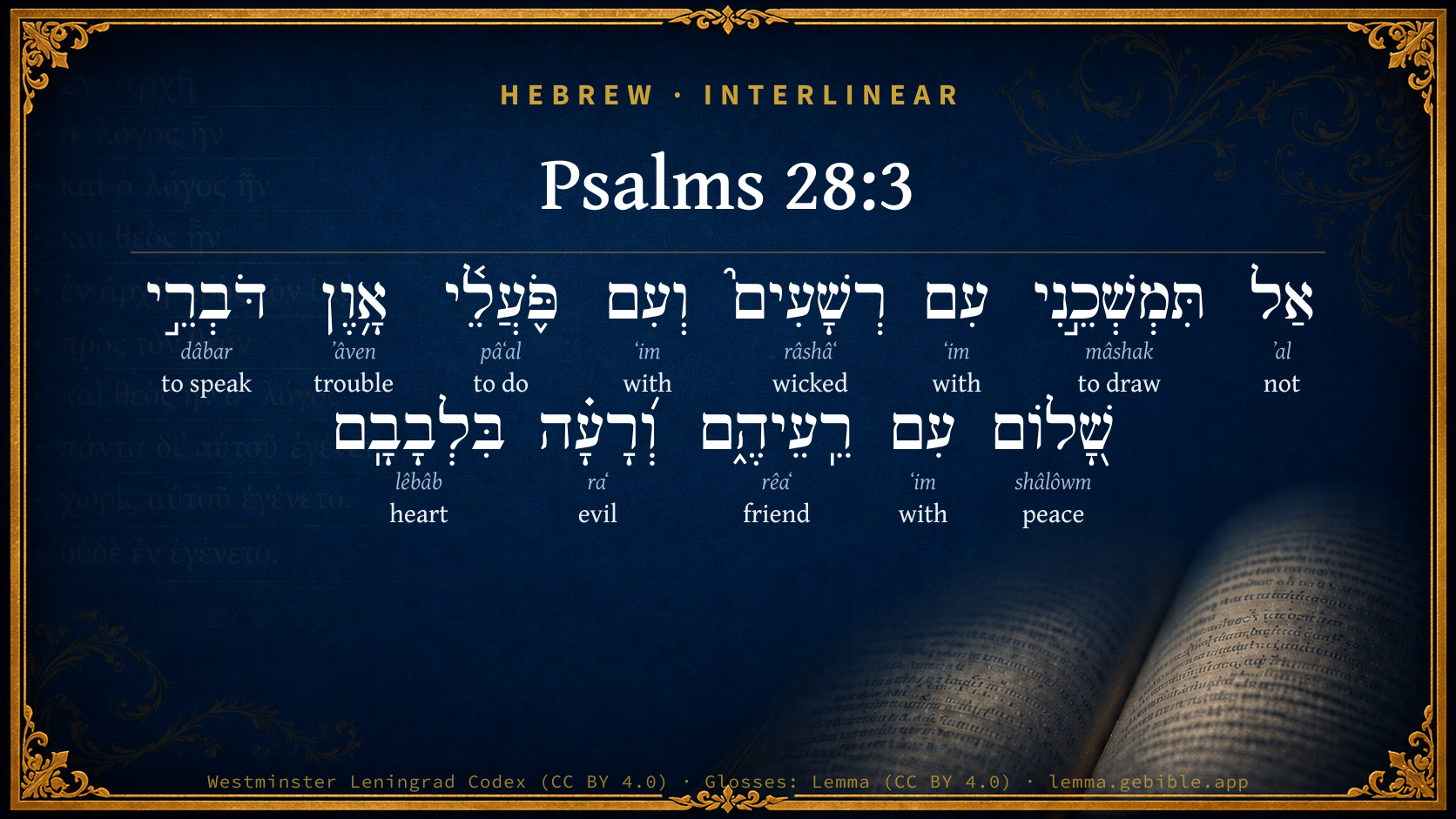
Psalms 28:3

Hebrew (Westminster Leningrad Codex) Psalms 28:3 appears in the Hebrew Old Testament. The text above is from the Westminster Leningrad Codex. Each word links to its Strong’s number, a concise gloss, and parsing drawn from the Open Scriptures Hebrew Bible morphology. Click any word for its full Brown-Driver-Briggs (BDB) entry.
Download image
Cite this verse

Psalms 28:3 (World English Bible). Public Domain. Lemma interlinear Bible study tool, https://lemma.gebible.app/v/psalms/28/3.

Show BibTeX & RIS
BibTeX
RIS
English Translation
Don't draw me away with the wicked, With the workers of iniquity who speak peace with their neighbors, But mischief is in their hearts.
World English Bible · Public Domain
Download a study sheet

One document with this verse’s original text, its word-by-word gloss line, the meaning frame, cross-references with their text, attributed commentary, and full source and license credits — printable, and it pastes into notes with its structure intact.

This verse Autodidact and up

Study sheet (.html) Plain text (.txt)

A passage Seminary Student

Up to 50 verses in one chapter. A passage sheet keeps up to 6 commentary sources and 12 cross-references per verse, in the order this page ranks them, and says so on the sheet whenever that leaves anything out. Ask for a single verse and you get the Autodidact verse sheet above.

Everything on this page stays free to read, with no account — the sheet is a download of what is already on screen, not access to it.

Want to remove ads? Support Godless Engineer
Compare translations 3

The same verse in 3 English versions, stacked beneath the original-language interlinear above. Click any original word for its lexicon entry.

Each is an independent rendering of the whole verse — the interlinear is not word-aligned to these translations.

Highlighted words mark where these versions differ — a whole-verse word diff, not a word-by-word alignment.

  • World English Bible Public Domain
    Don't draw me away with the wicked, With the workers of iniquity who speak peace with their neighbors, But mischief is in their hearts.
  • King James Version Public Domain
    Draw me not away with the wicked, and with the workers of iniquity, which speak peace to their neighbours, but mischief is in their hearts.
  • unfoldingWord Literal Text CC BY-SA 4.0
    Do not drag me away with the wicked and with the workers of iniquity, the ones speaking of peace with their neighbors while evil is in their hearts.

unfoldingWord Literal Text — © unfoldingWord, licensed CC BY-SA 4.0. Word-aligned USFM3 via Door43 (git.door43.org/unfoldingWord/en_ult).

Versions to compare (up to 4)

3 of 4 selected

Show all 18 translations

Every available English version of this verse, each an independent rendering of the whole verse.

  • World English Bible Public Domain
    Don't draw me away with the wicked, With the workers of iniquity who speak peace with their neighbors, But mischief is in their hearts.
  • Berean Standard Bible Public Domain
    Do not drag me away with the wicked, and with the workers of iniquity, who speak peace to their neighbors while malice is in their hearts.
  • Majority Standard Bible Public Domain
    Do not drag me away with the wicked, and with the workers of iniquity, who speak peace to their neighbors while malice is in their hearts.
  • King James Version Public Domain
    Draw me not away with the wicked, and with the workers of iniquity, which speak peace to their neighbours, but mischief is in their hearts.
  • American Standard Version (1901) Public Domain
    Draw me not away with the wicked, And with the workers of iniquity; That speak peace with their neighbors, But mischief is in their hearts.
  • Revised Version (1885) Public Domain
    Draw me not away with the wicked, and with the workers of iniquity; which speak peace with their neighbours, but mischief is in their hearts.
  • Geneva Bible (1599) Public Domain
    Drawe mee not away with the wicked, and with the woorkers of iniquitie: which speake friendly to their neighbours, when malice is in their hearts.
  • Douay-Rheims (1899) Public Domain
    Draw me not away together with the wicked; and with the workers of iniquity destroy me not: Who speak peace with their neighbour, but evils are in their hearts.
  • Young's Literal Translation Public Domain
    Draw me not with the wicked, And with workers of iniquity, Speaking peace with their neighbours, And evil in their heart.
  • Literal Standard Version CC BY-SA 4.0
    Do not draw me with the wicked, || And with workers of iniquity, || Speaking peace with their neighbors, || And evil in their heart.
  • Unlocked Literal Bible CC BY-SA 4.0
    Do not drag me away with the wicked, those who do iniquity, who speak peace with their neighbors but have evil in their hearts.
  • unfoldingWord Literal Text CC BY-SA 4.0
    Do not drag me away with the wicked and with the workers of iniquity, the ones speaking of peace with their neighbors while evil is in their hearts.
  • Darby Bible Public Domain
    Draw me not away with the wicked, and with the workers of iniquity, who speak peace to their neighbours, and mischief is in their heart.
  • World Messianic Bible Public Domain
    Don’t draw me away with the wicked, with the workers of iniquity who speak peace with their neighbors, but mischief is in their hearts.
  • Webster's Bible Public Domain
    Draw me not away with the wicked, and with the workers of iniquity, who speak peace to their neighbors, but mischief is in their hearts.
  • Free Bible Version CC BY-SA 4.0
    Don't drag me off with the wicked, with those who do evil, who speak nicely to their neighbors while in their minds they're plotting evil.
  • Bible in Basic English Public Domain
    Do not take me away with the sinners and the workers of evil, who say words of peace to their neighbours, but evil is in their hearts.
  • JPS Tanakh (1917) Public Domain
    Draw me not away with the wicked, and with the workers of iniquity; who speak peace with their neighbours, but evil is in their hearts.

Literal Standard Version (2020), Covenant Press — licensed CC BY-SA 4.0. Text via the HelloAO Bible API (eBible.org). Unlocked Literal Bible (unfoldingWord) — licensed CC BY-SA 4.0. Text via the HelloAO Bible API (eBible.org). unfoldingWord Literal Text — © unfoldingWord, licensed CC BY-SA 4.0. Word-aligned USFM3 via Door43 (git.door43.org/unfoldingWord/en_ult). Free Bible Version, Dr. Jonathan Gallagher — licensed CC BY-SA 4.0. Text via the HelloAO Bible API (eBible.org).

Word by word

More ways to search: Search by grammar → Find every occurrence → Compare this word →

Practice this passage: Drill this verse → Learn its vocabulary →

תִּמְשְׁכֵ֣נִי
mâshak
H4900
“to draw · me”
Verb, Qal, Jussive, 2nd Person, Masculine, Singular + Suffix, Personal, 1st Person, Common, Singular
Part of Speech
Verb
Stem
Qal
Form
Jussive
Person
2nd Person
Gender
Masculine
Number
Singular
Full BDB Definition

Origin: a primitive root

TWOT: 1257

to draw, drag, seize - (Qal) - to draw (and lift out), drag along, lead along, drag or lead off, draw down - to draw (the bow) - to proceed, march - to draw out or give (a sound) - to draw out, prolong, continue - to trail (seed in sowing) - to cheer, draw, attract, gratify - (Niphal) to be drawn out - (Pual) - to be drawn out, be postponed, be deferred - to be tall
  1. אַל ʼal H408 “not” Particle, Negative
  2. עִם ʻim H5973 “with” Preposition
  3. רְשָׁעִים֮ râshâʻ H7563 “wicked” Adjective, Adjective, Masculine, Plural, Absolute
  4. וְעִם ʻim H5973 “and · with” Conjunction + Preposition
  5. פֹּ֪עֲלֵ֫י pâʻal H6466 “doing” Verb, Qal, Participle Active, Masculine, Plural, Construct
  6. אָ֥וֶן ʼâven H205 “trouble” Noun, Common, Masculine, Singular, Absolute
  7. דֹּבְרֵ֣י dâbar H1696 “speaking” Verb, Qal, Participle Active, Masculine, Plural, Construct
  8. שָׁ֭לוֹם shâlôwm H7965 “peace” Noun, Common, Masculine, Singular, Absolute
  9. עִם ʻim H5973 “with” Preposition
  10. רֵֽעֵיהֶ֑ם rêaʻ H7453 “friends · their” Noun, Common, Masculine, Plural, Construct + Suffix, Personal, 3rd Person, Masculine, Plural
  11. וְ֝רָעָ֗ה raʻ H7451 “and · evil” Conjunction + Noun, Common, Feminine, Singular, Absolute
  12. בִּלְבָבָֽם lêbâb H3824 “in/at · heart · their” Preposition + Noun, Common, Masculine, Singular, Construct + Suffix, Personal, 3rd Person, Masculine, Plural

About this verse

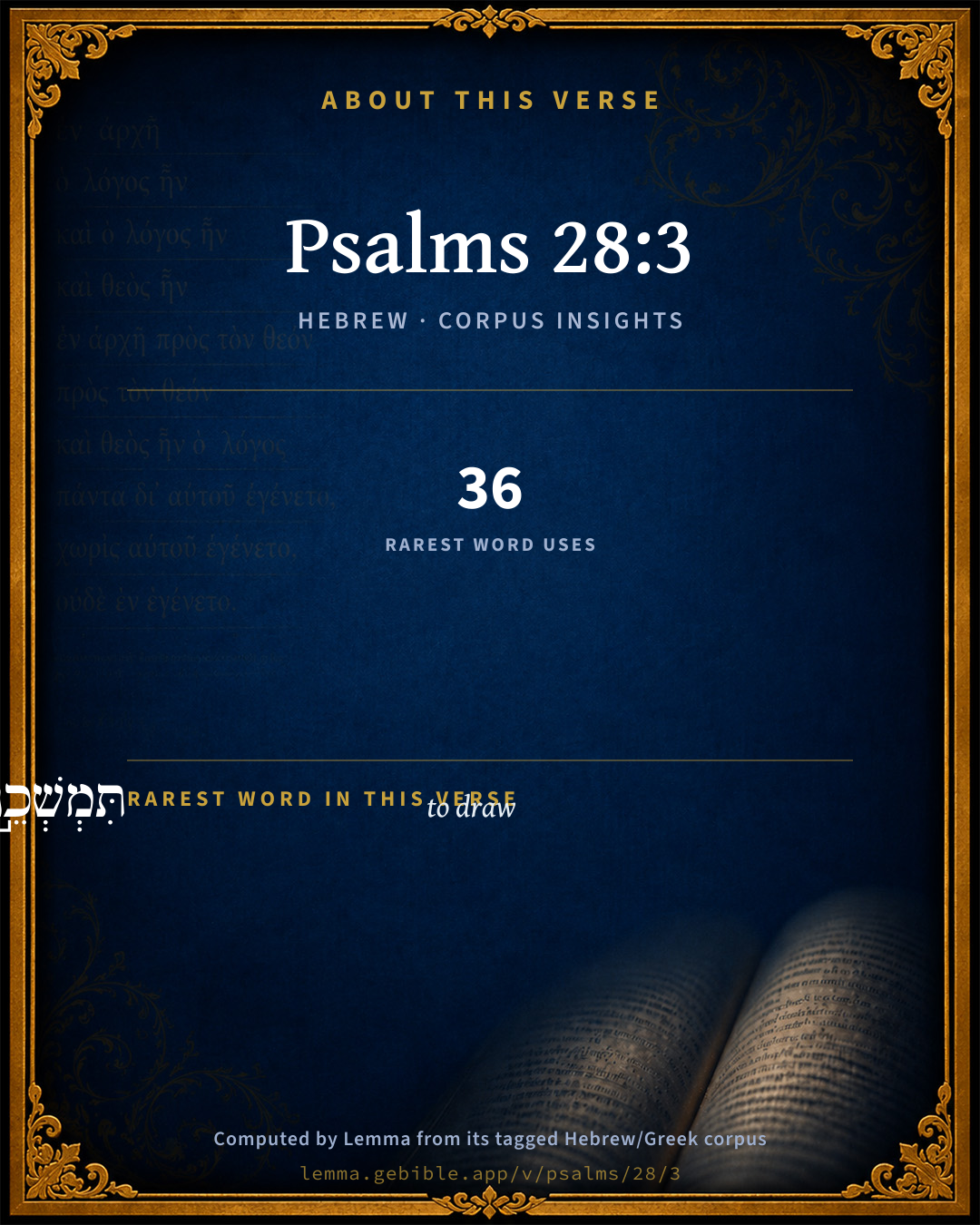
These counts appear in no published source. They are computed here, from the morphology-tagged text and Lemma’s own curated glosses. What Lemma adds →

13
words
11
distinct lemmas
Wisdom
section

Shared distinctive vocabulary

תִּמְשְׁכֵ֣נִי to draw H4900 occurs in 36 verses of the Hebrew Bible. Also found in:

Grammatical profile

  • 3 verbs
  • 5 nouns
  • 1 adjective
  • 3 prepositions
  • 1 particle

Verb forms

  • תִּמְשְׁכֵ֣נִי Qal · Jussive
  • פֹּ֪עֲלֵ֫י Qal · Participle Active
  • דֹּבְרֵ֣י Qal · Participle Active

Repetition

A word recurs within this verse — often emphatic in Hebrew:

Hebrew & Septuagint length

In English translation the verse runs 24 words from the Hebrew and 28 from the Septuagint (LXX English) — closely comparable.

A rough comparison of the two English renderings, which tokenize alike — not a word-level alignment.

Word counts can differ between the Hebrew and the Greek without any difference in meaning — e.g. the Hebrew direct-object marker אֵת has no separate Greek word, and Greek often adds the article ὁ.

Cross-references

16

Topical passages linked to Psalms 28:3 in the Treasury of Scripture Knowledge — connected by theme and wording, ordered by reader-vote popularity; previews shown in the World English Bible.

  • Psalms 55:21 His mouth was smooth as butter, But his heart was war. His words were softer than oil, Yet they were drawn swords.
  • Psalms 12:2 Everyone lies to his neighbor. They speak with flattering lips, and with a double heart.
  • Psalms 26:9 Don't gather my soul with sinners, Nor my life with bloodthirsty men;
  • Jeremiah 9:8–9 Their tongue is a deadly arrow; it speaks deceit: one speaks peaceably to his neighbor with his mouth, but in his heart he lays wait for him.
  • Micah 3:5 Thus says Yahweh concerning the prophets who lead my people astray; for those who feed their teeth, they proclaim, "Peace!" and whoever doesn't provide for their mouths, they prepare war against him:
  • Psalms 62:4 They fully intend to throw him down from his lofty place. They delight in lies. They bless with their mouth, but they curse inwardly. Selah.
  • Proverbs 26:23–26 Like silver dross on an earthen vessel Are the lips of a fervent one with an evil heart.
  • Matthew 25:41 Then he will say also to those on the left hand, 'Depart from me, you cursed, into the eternal fire which is prepared for the devil and his angels;
  • Psalms 7:14 Behold, he travails with iniquity; Yes, he has conceived mischief, And brought forth falsehood.
  • Psalms 10:14 But you do see trouble and grief; You consider it to take it into your hand. You help the victim and the fatherless.
  • Psalms 36:4 He plots iniquity on his bed. He sets himself in a way that is not good; He doesn't abhor evil.
  • Numbers 16:26 He spoke to the congregation, saying, Depart, I pray you, from the tents of these wicked men, and touch nothing of theirs, lest you be consumed in all their sins.
  • Psalms 10:7 His mouth is full of cursing, deceit, and oppression. Under his tongue is mischief and iniquity.
  • Psalms 52:1 Why do you boast of mischief, mighty man? God's loving kindness endures continually.
  • Matthew 22:15–18 Then the Pharisees went and took counsel how they might entrap him in his talk.
  • Matthew 25:46 These will go away into eternal punishment, but the righteous into eternal life."

Cross-references courtesy of OpenBible.info (CC BY 4.0).

Hebrew and Greek witnesses Masoretic Hebrew ↔ Greek Septuagint

The same verse in the two great witnesses to the Old Testament, shown verse-for-verse.

You’re reading Greek Psalm 27 (Hebrew Psalm 28). The Septuagint counts the superscription, so verse numbers can differ from the Hebrew — chapter-level alignment, not verse-by-verse. Numbering follows Rahlfs.

These are two independent witnesses, not word-aligned to each other, and the Septuagint is shown in lemma (dictionary) form.

Hebrew Psalms 28:3 Masoretic · Westminster Leningrad Codex

אַל תִּמְשְׁכֵ֣נִי עִם רְשָׁעִים֮ וְעִם פֹּ֪עֲלֵ֫י אָ֥וֶן דֹּבְרֵ֣י שָׁ֭לוֹם עִם רֵֽעֵיהֶ֑ם וְ֝רָעָ֗ה בִּלְבָבָֽם

Don't draw me away with the wicked, With the workers of iniquity who speak peace with their neighbors, But mischief is in their hearts.

World English Bible · Public Domain

Greek LXX Greek Psalm 27:3 Septuagint · lemma form

μή συνἕλκω μετά ἁμαρτωλός ὁ ψυχή ἐγώ καί μετά ἐργάζομαι ἀδικία μή συν ἀποὄλλυμι ἐγώ ὁ λαλέω εἰρήνη μετά ὁ πλησίον αὐτός κακός δέ ἐν ὁ καρδία αὐτός

Draw not away my soul with sinners, and destroy me not with the workers of iniquity, who speak peace with their neighbors, but evils are in their hearts.

LXX2012 (modern English Septuagint) · Public Domain

On this verse, John Calvin's Commentaries discusses the Septuagint’s reading. Read the note in Commentary ↓

Hebrew: Westminster Leningrad Codex (CC BY 4.0). Greek: Septuagint (public domain); English from LXX2012 (modern English Septuagint) (Public Domain). How the Septuagint differs from the Hebrew →

Commentary

Notes on Psalms 28:3 from classic Christian and Jewish commentators (each source and its license shown beneath its notes). The classic Christian expositions comment on the surrounding passage and are grouped to its opening verse, so a note may address several verses; the Jewish commentaries on the Tanakh (Rashi and others) are per-verse, so they appear only where the commentator wrote on this verse.

Lemma curates 59 commentaries, every one of them public domain or Creative Commons licensed, each selected and text-cleaned for this edition rather than reprinted as found. About our sources →

Trapp's Complete Commentary

John Trapp

Psa 28:3 Draw me not away with the wicked, and with the workers of iniquity, which speak peace to their neighbours, but mischief [is] in their hearts.

Ver. 3. Draw me not away with the wicked] Who seek to draw me away from my settled purpose of attending upon thee, απερισπαστως, 1Co 7:35, and are therefore likely to be drawn away by thee to execution, as malefactors are drawn, hanged, and quartered (there wanteth but a hurdle, a horse, and a halter, said Belknapp, to do me right), as Sisera was drawn by God to the river Kishon to be ruined, Jdg 4:7. - Ducunt volentem fata, nolentem trahunt (Sen.).

Which speak peace to their neighbours, but mischief is in their hearts] Saul and his courtiers are here noted.

Astutam vapido servantes pectore vulpem (Pers.).

The Florentine secretary (Machiavel) was not born of many years after; but the devil was as great a master then as afterwards; and David oft complaineth of it.

John Trapp, A Commentary or Exposition upon All the Books of the Old and New Testament (1647–1656) — public domain. Text from a community e-Sword module.

Joseph Benson's Commentary

Psa 28:3. Draw me not away with the wicked — The sense is, either, 1st, Do not suffer me to be drawn away, by their counsel or example, to imitate them in their evil courses. For God is often said to do that which he doth not effect, but only permits. Or, 2d, Do not drag me, as thou dost or wilt these evil-doers, to execution and destruction. Let me not die the death of the wicked. This seems best to suit with the following context, wherein he foretels that destruction to be coming upon his enemies which he deprecates for himself. Mischief is in their heart — They are hypocritical and perfidious persons: while I, through thy grace, am sincere and upright before thee. Seeing, then, I am unlike them in disposition and practice, let me not be made like them in their ruin.

Joseph Benson's Commentary on the Old and New Testaments (1811–1818) — public domain. Text from a community e-Sword module.

J. A. Alexander on Psalms

Joseph Addison Alexander

3. (Psa 28:3) Draw me not away with wicked (men), and with workers of iniquity, speaking peace with their neighbours, and evil (is) in their heart. This is the prayer for which he bespeaks audience and acceptance in the foregoing verse. Draw me not away, i.e. to punishment or out of life. Compare Ps. 26:9, where the parallel expression is gather me not. In both cases he prays that he may not be confounded in his death with those whose life he abhors. The last clause exhibits a particular trait in the character of the wicked men and evil doers of the other clause. This trait is hypocritical dissimulation, the pretence of friendship as a mask to hatred. The simple construction with the copulative and is equivalent to our expressions, but, though, while, etc.

Joseph Addison Alexander, The Psalms Translated and Explained (1850) — public domain. Text from a community e-Sword module.

Tyndale Open Study Notes

Tyndale Open Resources

28:3-5 The psalmist curses his enemies, asking God for retribution and vindication.

Tyndale Open Study Notes — © Tyndale Open Resources, licensed CC BY-SA 4.0. Text via the HelloAO Bible API.

Geneva Bible (1599)

Geneva Bible translators

Destroy not the good with the bad.

Geneva Bible (1599) marginal notes — public domain. Text via Bolls.life.

Jamieson, Fausset & Brown

Robert Jamieson, A. R. Fausset & David Brown

Draw me not away--implies punishment as well as death (compare Psa 26:9). Hypocrisy is the special wickedness mentioned.

Jamieson, Fausset & Brown — Commentary Critical and Explanatory on the Whole Bible (1871) — public domain (CC PDM 1.0). Text via the HelloAO Bible API.

Adam Clarke's Commentary

Verse 3. Draw me not away] Let me not be involved in the punishment of the wicked.

Adam Clarke's Commentary on the Bible (1810–1826) — public domain. Text from a community e-Sword/MySword module.

John Calvin's Commentaries

3. Draw me not away with wicked men. The meaning is, that in circumstances so dissimilar, God should not mingle the righteous with the wicked in the same indiscriminate destruction. The verb משך, mashak, here rendered draw, “signifies,” as Hammond observes, “both to draw and apprehend,” and may “be best rendered here, Seize not on me, as he that seizeth on any to carry or drag him to execution. The Septuagint, after having literally rendered the Hebrew by Μὴ συνελκύσὟς την ψυχήν μου, draw not my soul together with, etc., adds Κίαν μὴ συναπολέσὟς με etc., and destroy me not together with, etc. Calvin here evidently takes the same view; though he does not express it in the form of criticism.

“Que ceste finesse de renard, quand on use de beaux semblans pour avoir occasion de nuire.” — Fr.

John Calvin's Commentaries (1540-1563) — public domain. Text from the Calvin Translation Society English edition (1840s-50s) via the Christian Classics Ethereal Library (ccel.org). Calvin's coverage is partial (roughly two-thirds of the Bible); uncommented books and verses are honest gaps, never fabricated. The 19th-century editor's footnotes and remarks are omitted so the notes are faithfully Calvin's own voice.

Ellicott's Commentary for English Readers

(3) Draw me not.—Better, Drag me not. In Eze_32:18 seq., we have a magnificent vision of judgment, in which the wicked nations are represented as being dragged to death and destruction. In the person of the poet, Israel prays not to be involved in such a punishment. The words “which speak peace “may refer to some overture of alliance from such, or it may be generally those who “hide hatred with lying lips” (Pro_10:18).

A Bible Commentary for English Readers, edited by Charles John Ellicott (1878–1897) — public domain. Text from a community e-Sword module.

The Cambridge Bible for Schools and Colleges

gen. ed. J. J. S. Perowne

3. Draw me not away] Cp. Psa_26:9. But the word here is stronger, suggesting the idea of criminals being dragged off to execution. He prays that he may not share the fate of the wicked in the judgment now being executed.

which speak peace to &c.] Rather, as R.V., with. Double-hearted hypocrites; cp. Psa_12:2; Jer_9:8; and contrast Psa_15:2.

3–5. The Psalmist’s prayer that he may be distinguished from the wicked, and that they may be judged as they deserve.

The Cambridge Bible for Schools and Colleges (gen. ed. J. J. S. Perowne; Cambridge University Press, 1878–1918) — public domain. Text from a community e-Sword module.

John Gill's Exposition

Draw me not away with the wicked,.... That is, with those who are notoriously wicked; who are inwardly and outwardly wicked; whose inward part is very wickedness, and who sell themselves and give up themselves to work wickedness: the sense is, that God would not suffer him to be drawn away, or drawn aside by wicked men, but that he would deliver him from temptation; or that he would not give him up into their hands, to be at their mercy; who he knew would not spare him, if they had him in their power; or that he might not die the death of the wicked, and perish with them; see Psa 26:9;

and with the workers of iniquity; who make it the trade and business of their lives to commit sin; and which may be applied, not only to profane sinners, but to professors of religion, Mat 7:23; since it follows,

which speak peace to their neighbours, but mischief is in their hearts; hypocrites, double minded men, who have a form of godliness, but deny the power of it; pretend to religion, and have none; and speak fair to the face, but design mischief and ruin; as Saul and his servants did to David, Sa1 18:17.

John Gill's Exposition of the Whole Bible (1746–1763) — public domain (CC PDM 1.0). Text via the HelloAO Bible API.

Albert Barnes' Notes on the Bible

Draw me not away with the wicked - See the notes at Psa 26:9. The prayer here, as well as the prayer in Psa 26:9, expresses a strong desire not to be united with wicked people in feeling or in destiny - in life or in death - on earth or in the future world. The reason of the prayer seems to have been that the psalmist, being at this time under a strong temptation to associate with wicked persons, and feeling the force of the temptation, was apprehensive that he should be left to “yield” to it, and to become associated with them. Deeply conscious of this danger, he earnestly prays that he may not be left to yield to the power of the temptation, and fall into sin. So the Saviour Mat 6:13 has taught us to pray, “And lead us not into temptation.” None who desire to serve God can be insensible to the propriety of this prayer. The temptations of the world are so strong; the amusements in which the world indulges are so brilliant and fascinating; they who invite us to partake of their pleasures are often so elevated in their social position, so refined in their manners, and so cultivated by education; the propensities of our hearts for such indulgences are so strong by nature; habits formed before our conversion are still so powerful; and the prospect of worldly advantages from compliance with the customs of those around us are often so great - that we cannot but feel that it is proper for us to go to the throne of grace, and to plead earnestly with God that he will keep us and not suffer us to fall into the snare.

Especially is this true of those who before they were converted had indulged in habits of intemperance, or in sensual pleasures of any kind, and who are invited by their old companions in sin again to unite with them in their pursuits. Here all the power of the former habit returns; here often there is a most fierce struggle between conscience and the old habit for victory; here especially those who are thus tempted need the grace of God to keep them; here there is special appropriateness in the prayer, “Draw me not away with the wicked.”

And with the workers of iniquity - In any form. With those who do evil.

Which speak peace to their neighbours - Who speak words of friendliness. Who “seem” to be persuading you to do that which is for your good. Who put on plausible pretexts. They appear to be your friends; they profess to be so. They use flattering words while they tempt you to go astray.

But mischief is in their hearts - They are secretly plotting your ruin. They wish to lead you into such courses of life in order that you may fall into sin; that you may dishonor religion; that you may disgrace your profession; or that they may in some way profit by your compliance with their counsels. So the wicked, under plausible pretences, would allure the good; so the corrupt would seduce the innocent; so the enemies of God would entice his friends, that they may bring shame and reproach upon the cause of religion.

Albert Barnes' Notes on the Bible (1834–1885) — public domain. Text from a community e-Sword/MySword module.

Matthew Poole's English Annotations

Draw me not away with the wicked: the sense is, either,

1. Do not suffer me to be drawn away by their counsel or example to imitate their evil courses. For God is oft said to do that which he doth not effect, but only permit and order, as 2Sa 12:12. Or,

2. Do not draw me into the same snares and mischief with them; do not drag me, as thou dost or wilt do all these malefactors, to execution and destruction. Let me not die the death of the wicked. Compare Psa 26:9. Thus drawing is used for drawing to death, Job 21:33; Eze 32:20. This seems best to suit with the following context, wherein he imprecateth and foretelleth that destruction upon his enemies which he deprecated for himself.

Mischief is in their heart; which are hypocritical and perfidious persons, whilst I, through thy grace, am upright and sincere. Seeing then I am so unlike them in disposition and practice, let me not be made like them in their ruin.

Matthew Poole's English Annotations on the Holy Bible (1683–1685) — public domain. Text from a community e-Sword/MySword module.

The Treasury of David

Charles H. Spurgeon

Ver. 3. Draw me not away with the wicked. They shall be dragged off to hell like felons of old drawn on a hurdle to Tyburn, like logs drawn to the fire, like fagots to the oven. David fears lest he should be bound up in their bundle, drawn to their doom; and the fear is an appropriate one for every godly man. The best of the wicked are dangerous company in time, and would make terrible companions for eternity; we must avoid them in their pleasures, if we would not be confounded with them in their miseries. And with the workers of iniquity. These are overtly sinful, and their judgment will be sure; Lord, do not make us to drink of their cup. Activity is found with the wicked even if it be lacking to the righteous. Oh! to be "workers" for the Lord. Which speak peace to their neighbours, but mischief is in their hearts. They have learned the manners of the place to which they are going: the doom of liars is their portion for ever, and lying is their conversation on the road. Soft words, oily with pretended love, are the deceitful meshes of the infernal net in which Satan catches the precious life; many of his children are learned in his abominable craft, and fish with their father's nets, almost as cunningly as he himself could do it. It is a sure sign of baseness when the tongue and the heart do not ring to the same note. Deceitful men are more to be dreaded than wild beasts: it were better to be shut up in a pit with serpents than to be compelled to live with liars. He who cries "peace" too loudly, means to sell it if he can get his price. "Good wine need no bush:" if he were so very peaceful he would not need to say so; he means mischief, make sure of that.

Ver. 3. Draw me not away with the wicked...which speak peace to their neighbours, but mischief is in their hearts. The godly man abhors dissimulation towards men; his heart goes along with his tongue, he cannot flatter and hate, commend and censure. "Let love be without dissimulation." Ro 12:9. Dissembled love is worse than hatred; counterfeiting of friendship is no better than a lie Ps 78:36, for there is a pretence of that which is not. Many are like Joab: "He took Amasa by the beard to kiss him, and smote him with his sword in the fifth rib, that he died." There is a river in Spain, where the fish seem to be of a golden colour, but take them out of the water, and they are like other fish. All is not gold that glitters; there are some pretend much kindness, but they are like great veins which have little blood; if you lean upon them they are as a leg out of joint. For my part, I much question his truth towards God, that will flatter and lie to his friend. "He that hideth hatred with lying lips, and he that uttereth a slander is a fool." Pr 10:18. Thomas Watson.

Ver. 3. Draw me not out with. An allusion, I conceive, to a shepherd selecting out a certain portion of his flock. "Reckon me not among." Professor Lee.

Ver. 3. Draw me not away. (ynkvmt-la) from (Kvm); that signifies, both to draw and apprehend, will be best rendered here, seize not on me, as he that seizes on any to carry or drag him to execution. Henry Hammond.

Ver. 3. The characters to be avoided, the doom to be dreaded, the grace to keep us from both.

Psalms 28:4*

Charles H. Spurgeon's The Treasury of David (1869–1885) — public domain. Psalms only. Text from a community e-Sword/MySword module.

Whedon's Commentary on the Bible

Daniel D. Whedon

3. Draw me not away with the wicked—The same thought is conveyed in Psa_26:9, where see note. David prays not to be involved in the punishment of the wicked, which in human eyes would seem to be done if he was subjected to their power, or to treatment similar to theirs. See Gen_18:25; Eze_22:20-21

Daniel D. Whedon (gen. ed.), Commentary on the Old and New Testaments (1874–1909) — public domain. Text from a community e-Sword module.

The Pulpit Commentary

Draw me not away with the wicked, and with the workers of iniquity. (comp. Psa_26:9) The metaphor implied in "draw me not away "is that of a hunter, drawing prey of all kinds to him enclosed within a net. The psalmist prays that he may not share the fate of the workers of iniquity, over whom he seems to see some terrible judgment impending.

Which speak peace to their neighbours, but mischief is in their hearts. (For extreme instances of this kind of wickedness, see 2Sa_3:27 2Sa_20:9, 2Sa_20:10; and for the wide prevalence of such treacherous dealing, comp. Jer_9:8)

The Pulpit Commentary (1880–1919), ed. H.D.M. Spence-Jones & Joseph S. Exell — public domain. Text from a community e-Sword module.

John Wesley's Explanatory Notes

Draw not - Do not drag me; as thou dost these, to execution and destruction.

John Wesley, Explanatory Notes Upon the Whole Bible (1754–1765) — public domain. Text via the GEBible commentary corpus.

unfoldingWord translationNotes

Door43 World Missions Community

Do not drag me away

God punishing people is spoken of as if he physically drags them away. In this metaphor Yahweh may be dragging them to prison, exile, or death. AT: "Do not remove me" (See: Metaphor)

who speak peace with their neighbors

Here "neighbors" refers to people in general. AT: "who speak peacefully with other people"

but have evil in their hearts

Here "hearts" represents a person's mind or thoughts. AT: "but are thinking something evil about them" (See: Metonymy)

Give them what their deeds deserve ... repay them what their wickedness demands

These two phrases mean the same thing. They are used together to emphasize that they deserve for God to punish them. (See: Parallelism)

the work of their hands

Here "hands" represent what the person has done. AT: "the things they have done" (See: Metonymy)

render to them their due

"give them what they deserve"

Because they do not understand ... never rebuild them

Possible meanings are 1) David is confident about what God will do to wicked people or 2) David is asking God to destroy the wicked people.

they do not understand the deeds of Yahweh

It is implied that "do not understand" means they ignore or do not honor Yahweh's works. AT: "they do not regard with honor what Yahweh has done" (See: Assumed Knowledge and Implicit Information)

the work of his hands

Here "hands" represents what Yahweh has done or created. AT: "what he has created" (See: Metonymy)

he will tear them down and never rebuild them

The punishment of the wicked people is spoken of as if they were a building or a city that God would destroy. (See: Metaphor)

translationWords

evil

iniquity

peace

neighbor

heart

works

unfoldingWord translationNotes — © Distant Shores Media and the Door43 World Missions Community, licensed CC BY-SA 4.0. Source: git.door43.org/Door43/en_tn.

Rashi

Rabbi Shlomo Yitzchaki (Rashi)

Do not cause me to be drawn Heb. תמשכני, do not draw me with the wicked; treras moy in Old French.

Rashi on the Tanakh — English translations: “The Judaica Press complete Tanach with Rashi, translated by A. J. Rosenberg” (CC BY 4.0); “Pentateuch with Rashi's commentary by M. Rosenbaum and A.M. Silbermann, 1929-1934” (public domain); “The Metsudah Tanach series, Lakewood, N.J” (CC BY 4.0); and “The Book of Joshua, Metsudah Publications, 1997” (CC BY 4.0). Text via Sefaria.

Lesson kit

Teaching starters — assembled from the data on this page, not authored interpretation. Every prompt links to the verse data it draws on. Edit before teaching.

Psalms, in the Wisdom, opens this verse with 13 words (11 distinct Hebrew lemmas). Its most distinctive word is mâshak (“to draw”). A historical commentator’s framing appears above. Read the whole chapter for the surrounding context.

Discussion questions

  1. What does “to draw” (mâshak) contribute to the verse as a whole?
  2. How does Genesis 37:28, which shares the word «to draw», read alongside this verse?
  3. What does the repetition of “with” (3× in this one verse) do in this verse?
  4. These translations render this verse differently. What is at stake in choosing one wording over another?
  5. «תִּמְשְׁכֵ֣נִי» is a Qal Jussive verb. How does that grammatical form shape the action described?
  6. Compare how Trapp's Complete Commentary and Joseph Benson's Commentary read this verse. Where do they agree or differ?

Things to notice

Reading settings

Reading text

Shown beneath each verse's original-language words.

Old Testament
Old Testament edition

Read the OT as the Masoretic Hebrew (MT) or the Greek Septuagint (LXX).

English shown for the Greek Septuagint (in the Hebrew ↔ Greek comparison).

Comparing translations? Open the Compare panel on any verse page to stack up to four side by side.