
Job 27:13

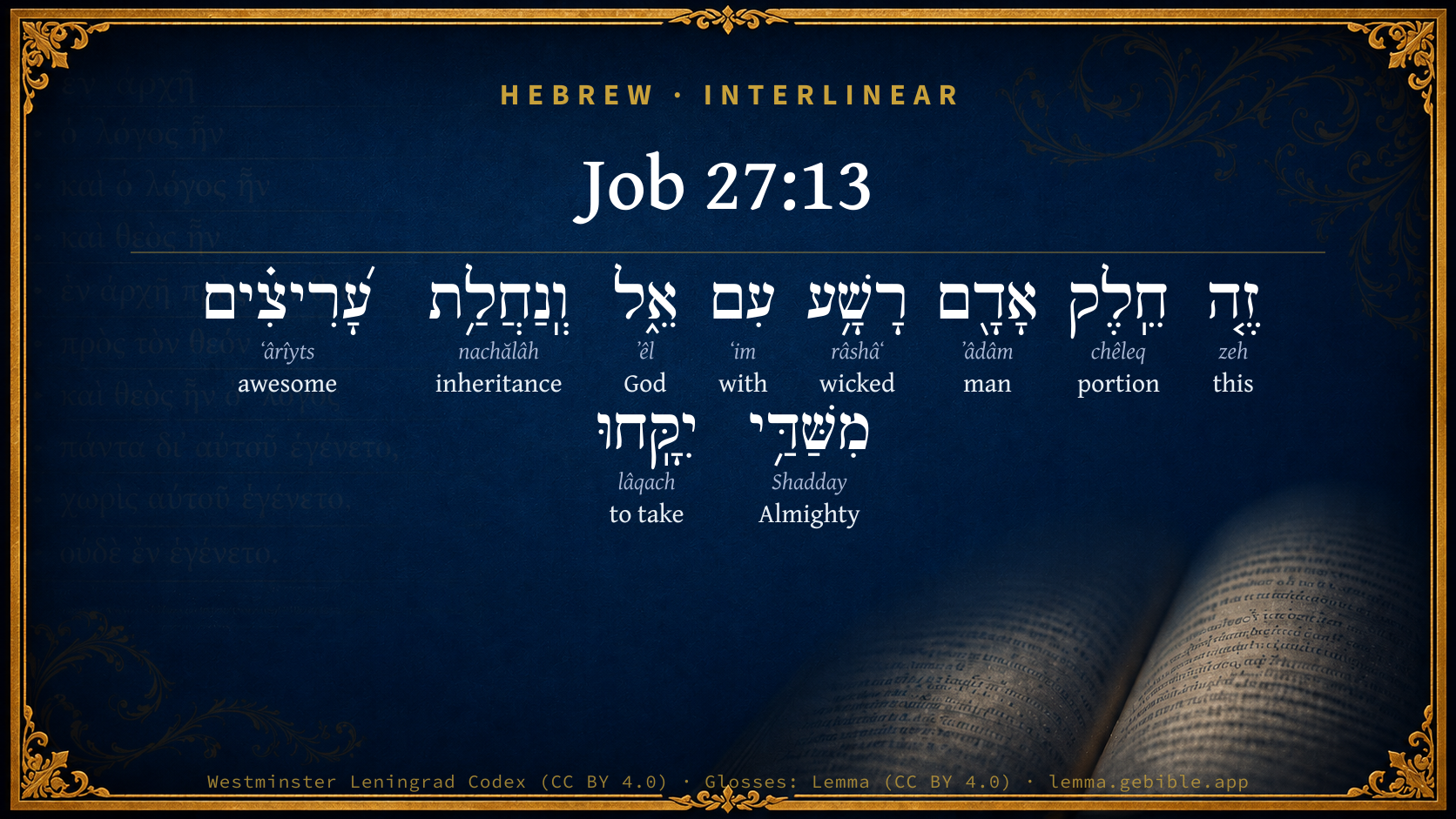
Hebrew (Westminster Leningrad Codex) Job 27:13 appears in the Hebrew Old Testament. The text above is from the Westminster Leningrad Codex. Each word links to its Strong’s number, a concise gloss, and parsing drawn from the Open Scriptures Hebrew Bible morphology. Click any word for its full Brown-Driver-Briggs (BDB) entry.
Download image
Cite this verse

Job 27:13 (World English Bible). Public Domain. Lemma interlinear Bible study tool, https://lemma.gebible.app/v/job/27/13.

Show BibTeX & RIS
BibTeX
RIS
English Translation
"This is the portion of a wicked man with God, The heritage of oppressors, which they receive from the Almighty.
World English Bible · Public Domain
Download a study sheet

One document with this verse’s original text, its word-by-word gloss line, the meaning frame, cross-references with their text, attributed commentary, and full source and license credits — printable, and it pastes into notes with its structure intact.

This verse Autodidact and up

Study sheet (.html) Plain text (.txt)

A passage Seminary Student

Up to 50 verses in one chapter. A passage sheet keeps up to 6 commentary sources and 12 cross-references per verse, in the order this page ranks them, and says so on the sheet whenever that leaves anything out. Ask for a single verse and you get the Autodidact verse sheet above.

Everything on this page stays free to read, with no account — the sheet is a download of what is already on screen, not access to it.

Want to remove ads? Support Godless Engineer
Compare translations 3

The same verse in 3 English versions, stacked beneath the original-language interlinear above. Click any original word for its lexicon entry.

Each is an independent rendering of the whole verse — the interlinear is not word-aligned to these translations.

Highlighted words mark where these versions differ — a whole-verse word diff, not a word-by-word alignment.

  • World English Bible Public Domain
    "This is the portion of a wicked man with God, The heritage of oppressors, which they receive from the Almighty.
  • King James Version Public Domain
    This is the portion of a wicked man with God, and the heritage of oppressors, which they shall receive of the Almighty.
  • unfoldingWord Literal Text CC BY-SA 4.0
    This the portion of a wicked man with God, and the heritage of oppressors, they receive from the Almighty:

unfoldingWord Literal Text — © unfoldingWord, licensed CC BY-SA 4.0. Word-aligned USFM3 via Door43 (git.door43.org/unfoldingWord/en_ult).

Versions to compare (up to 4)

3 of 4 selected

Show all 18 translations

Every available English version of this verse, each an independent rendering of the whole verse.

  • World English Bible Public Domain
    "This is the portion of a wicked man with God, The heritage of oppressors, which they receive from the Almighty.
  • Berean Standard Bible Public Domain
    This is the wicked man’s portion from God—the heritage the ruthless receive from the Almighty.
  • Majority Standard Bible Public Domain
    This is the wicked man’s portion from God—the heritage the ruthless receive from the Almighty.
  • King James Version Public Domain
    This is the portion of a wicked man with God, and the heritage of oppressors, which they shall receive of the Almighty.
  • American Standard Version (1901) Public Domain
    This is the portion of a wicked man with God, And the heritage of oppressors, which they receive from the Almighty:
  • Revised Version (1885) Public Domain
    This is the portion of a wicked man with God, and the heritage of oppressors, which they receive from the Almighty.
  • Geneva Bible (1599) Public Domain
    This is the portion of a wicked man with God, and the heritage of tyrants, which they shall receiue of the Almightie.
  • Douay-Rheims (1899) Public Domain
    This is the portion of a wicked man with God, and the inheritance of the violent, which they shall receive of the Almighty.
  • Young's Literal Translation Public Domain
    This `is' the portion of wicked man with God, And the inheritance of terrible ones From the Mighty they receive.
  • Literal Standard Version CC BY-SA 4.0
    This [is] the portion of wicked man with God, || And the inheritance of terrible ones || They receive from the Mighty.
  • Unlocked Literal Bible CC BY-SA 4.0
    This is the portion of a wicked man with God, the heritage of the oppressor that he receives from the Almighty:
  • unfoldingWord Literal Text CC BY-SA 4.0
    This the portion of a wicked man with God, and the heritage of oppressors, they receive from the Almighty:
  • Darby Bible Public Domain
    This is the portion of the wicked man with ùGod, and the heritage of the violent, which they receive from the Almighty: --
  • World Messianic Bible Public Domain
    “This is the portion of a wicked man with God, the heritage of oppressors, which they receive from the Almighty.
  • Webster's Bible Public Domain
    This is the portion of a wicked man with God, and the heritage of oppressors, which they shall receive of the Almighty.
  • Free Bible Version CC BY-SA 4.0
    This is what God provides as the destiny for the wicked, this is the inheritance that the ruthless will receive from the Almighty —
  • Bible in Basic English Public Domain
    This is the punishment of the evil-doer from God, and the heritage given to the cruel by the Ruler of all.
  • JPS Tanakh (1917) Public Domain
    This is the portion of a wicked man with God, and the heritage of oppressors, which they receive from the Almighty.

Literal Standard Version (2020), Covenant Press — licensed CC BY-SA 4.0. Text via the HelloAO Bible API (eBible.org). Unlocked Literal Bible (unfoldingWord) — licensed CC BY-SA 4.0. Text via the HelloAO Bible API (eBible.org). unfoldingWord Literal Text — © unfoldingWord, licensed CC BY-SA 4.0. Word-aligned USFM3 via Door43 (git.door43.org/unfoldingWord/en_ult). Free Bible Version, Dr. Jonathan Gallagher — licensed CC BY-SA 4.0. Text via the HelloAO Bible API (eBible.org).

Word by word

More ways to search: Search by grammar → Find every occurrence → Compare this word →

Practice this passage: Drill this verse → Learn its vocabulary →

About this verse

These counts appear in no published source. They are computed here, from the morphology-tagged text and Lemma’s own curated glosses. What Lemma adds →

10
words
10
distinct lemmas
Wisdom
section

Notable vocabulary

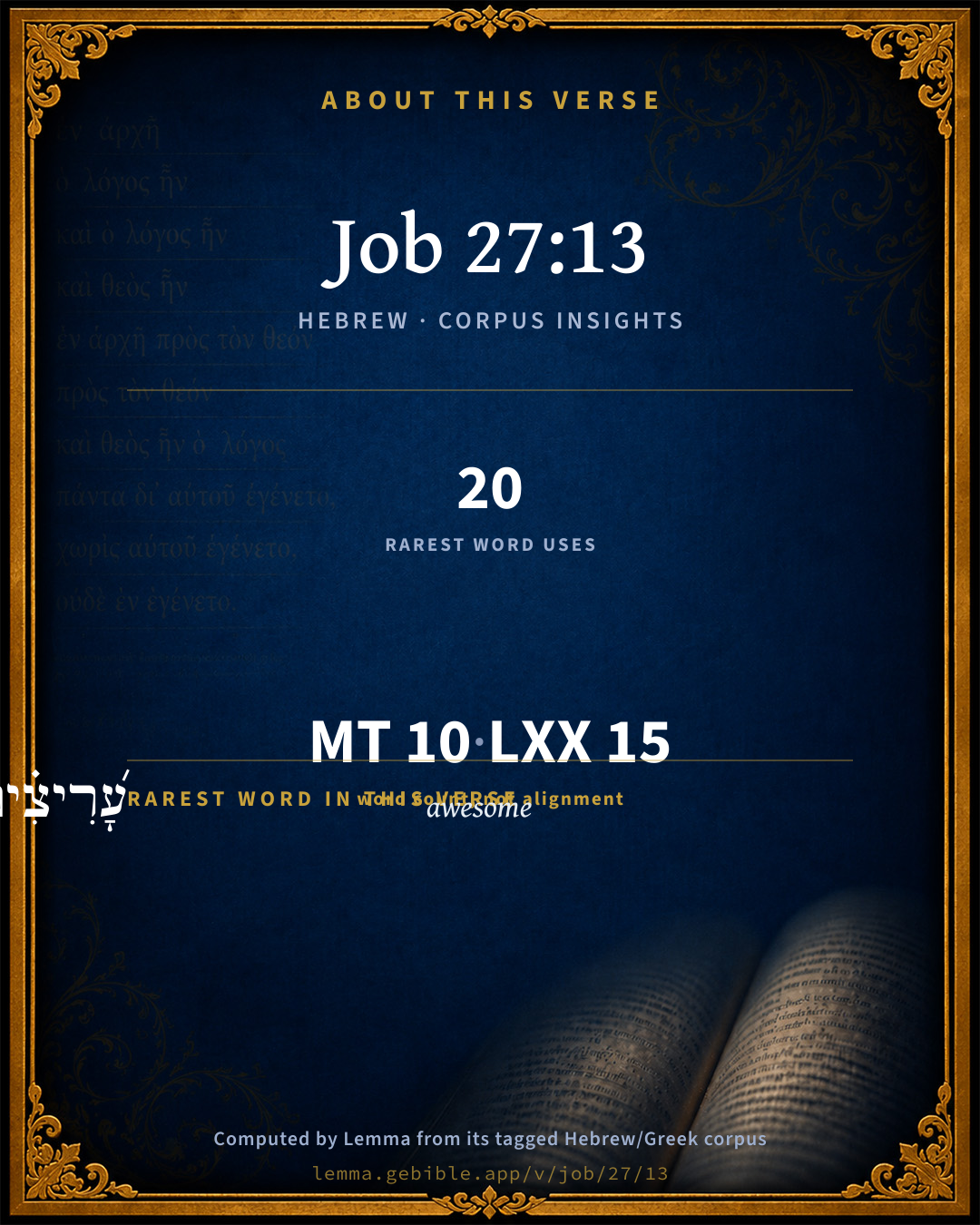
The rarest word here is עָ֝רִיצִ֗ים awesome H6184 — appearing just 20 times in the whole Hebrew Bible.

Shared distinctive vocabulary

עָ֝רִיצִ֗ים awesome H6184 occurs in 20 verses of the Hebrew Bible. Also found in:

Grammatical profile

  • 1 verb
  • 5 nouns
  • 2 adjectives
  • 1 pronoun
  • 1 preposition

Verb forms

  • יִקָּֽחוּ Qal · Imperfect

Hebrew & Septuagint length

In English translation the verse runs 20 words from the Hebrew and 23 from the Septuagint (LXX English) — closely comparable.

A rough comparison of the two English renderings, which tokenize alike — not a word-level alignment.

Word counts can differ between the Hebrew and the Greek without any difference in meaning — e.g. the Hebrew direct-object marker אֵת has no separate Greek word, and Greek often adds the article ὁ.

In the original languages it is 10 Hebrew tokens and 15 Greek tokens — but the two are counted differently (Hebrew bundles its prefixes and suffixes into one token; the Greek is in lemma form), so that isn’t a like-for-like length.

Cross-references

11

Topical passages linked to Job 27:13 in the Treasury of Scripture Knowledge — connected by theme and wording, ordered by reader-vote popularity; previews shown in the World English Bible.

  • Job 20:19–29 For he has oppressed and forsaken the poor. He has violently taken away a house, and he shall not build it up.
  • Job 15:20–35 The wicked man travails with pain all his days, Even the number of years that are laid up for the oppressor.
  • Isaiah 3:11 Woe to the wicked! Disaster is upon them; For the deeds of his hands will be paid back to him.
  • 2 Peter 2:9 the Lord knows how to deliver the godly out of temptation and to keep the unrighteous under punishment for the day of judgment;
  • Job 31:3 Is it not calamity to the unrighteous, And disaster to the workers of iniquity?
  • Psalms 11:6 On the wicked he will rain blazing coals; Fire, sulfur, and scorching wind shall be the portion of their cup.
  • Psalms 12:5 "Because of the oppression of the weak and because of the groaning of the needy, I will now arise," says Yahweh; "I will set him in safety from those who malign him."
  • Proverbs 22:22–23 Don't exploit the poor, because he is poor; And don't crush the needy in court;
  • Ecclesiastes 8:13 But it shall not be well with the wicked, neither shall he lengthen days like a shadow; because he doesn't fear God.
  • Malachi 3:5 I will come near to you to judgment; and I will be a swift witness against the sorcerers, and against the adulterers, and against the perjurers, and against those who oppress the hireling in his wages, the widow, and the fatherless, and who deprive the foreigner of justice, and don't fear me," says Yahweh of Hosts.
  • James 5:4–6 Behold, the wages of the laborers who mowed your fields, which you have kept back by fraud, cry out, and the cries of those who reaped have entered into the ears of the Lord of Hosts.

Cross-references courtesy of OpenBible.info (CC BY 4.0).

Hebrew and Greek witnesses Masoretic Hebrew ↔ Greek Septuagint

The same verse in the two great witnesses to the Old Testament, shown verse-for-verse.

These are two independent witnesses, not word-aligned to each other, and the Septuagint is shown in lemma (dictionary) form.

Hebrew Job 27:13 Masoretic · Westminster Leningrad Codex

זֶ֤ה חֵֽלֶק אָדָ֖ם רָשָׁ֥ע עִם אֵ֑ל וְֽנַחֲלַ֥ת עָ֝רִיצִ֗ים מִשַּׁדַּ֥י יִקָּֽחוּ

"This is the portion of a wicked man with God, The heritage of oppressors, which they receive from the Almighty.

World English Bible · Public Domain

Greek LXX Job 27:13 Septuagint · lemma form

οὗτος ὁ μερίς ἄνθρωπος ἀσεβής παρά κύριος κτῆμα δέ δυνάστης ἔρχομαι παρά παντοκράτωρ ἐπί αὐτός

This is the portion of an ungodly man from the Lord, and the possession of oppressors shall come upon them from the Almighty.

LXX2012 (modern English Septuagint) · Public Domain

Hebrew: Westminster Leningrad Codex (CC BY 4.0). Greek: Septuagint (public domain); English from LXX2012 (modern English Septuagint) (Public Domain). How the Septuagint differs from the Hebrew →

Commentary

Notes on Job 27:13 from classic Christian and Jewish commentators (each source and its license shown beneath its notes). The classic Christian expositions comment on the surrounding passage and are grouped to its opening verse, so a note may address several verses; the Jewish commentaries on the Tanakh (Rashi and others) are per-verse, so they appear only where the commentator wrote on this verse.

Lemma curates 59 commentaries, every one of them public domain or Creative Commons licensed, each selected and text-cleaned for this edition rather than reprinted as found. About our sources →

The Cambridge Bible for Schools and Colleges

gen. ed. J. J. S. Perowne

13–23. The utter destruction of the wicked man is exhibited in three turns: his children and descendants are destined for the sword, and become the prey of famine and pestilence (Job_27:13-15); his wealth and possessions pass into the hands of the righteous, and his home perishes (Job_27:16-18); and he himself is cut off suddenly by awful calamities at the hand of God, and amidst the execrations of men (Job_27:19-23).

The Cambridge Bible for Schools and Colleges (gen. ed. J. J. S. Perowne; Cambridge University Press, 1878–1918) — public domain. Text from a community e-Sword module.

Trapp's Complete Commentary

John Trapp

Job 27:13 This [is] the portion of a wicked man with God, and the heritage of oppressors, [which] they shall receive of the Almighty.

Ver. 13. This is the portion of a wicked man with God] q.d. So ye say, and so I say too; for herein I will not deny to comply and to chime in with you. Zophar had said the same in effect, and used the selfsame expressions that Job here doth, Job 20:29. See the notes there. But must Job therefore be a hypocrite, though he continue to hope, and pray, and delight in God amidst all his miseries? Job 27:8-10. Negatur. He had spoken much before of the wicked man’s prosperity; now, to prevent mistakes, he discourseth largely of his punishment, and how ill he beareth it.

And the heritage of oppressors, &c.] Of fierce and formidable tyrants, that are a terror to others. These are the rewards they shall receive from the God of recompences, the Almighty, who can well enough deal with them, and delights to get him a name in their just destruction.

John Trapp, A Commentary or Exposition upon All the Books of the Old and New Testament (1647–1656) — public domain. Text from a community e-Sword module.

Albert Barnes' Notes on the Bible

This is the portion of a wicked man with God - There has been much diversity of view in regard to the remainder of this chapter. The difficulty is, that Job seems here to state the same things which had been maintained by his friends, and against which he had all along contended. This difficulty has been felt to be very great, and is very great. It cannot be denied, that there is a great resemblance between the sentiments here expressed and those which had been maintained by his friends, and that this speech, if offered by them, would have accorded entirely with their main position. Job seems to abandon all which he had defended, and to concede all which he had so warmly condemned. One mode of explaining the difficulty has been suggested in the “Analysis” of the chapter. It was proposed by Noyes, and is plausible, but, perhaps, will not be regarded as satisfactory to all. Dr. Kennicott supposes that the text is imperfect, and that these verses constituted the third speech of Zophar. His arguments for this opinion are:

(1) That Eliphaz and Bildad had each spoken three times, and that we are naturally led to expect a third speech from Zophar; but, according to the present arrangement, there is none.

(2) That the sentiments accord exactly with what Zophar might be expected to advance, and are exactly in his style; that they are expressed in “his fierce manner of accusation,” and are “in the very place where Zophar’s speech is naturally expected.”

But the objections to this view are insuperable. They are:

(1) The entire lack of any authority in the manuscripts, or ancient versions, for such an arrangement or supposition. All the ancient versions and manuscripts make this a part of the speech of Job.

(2) If this had been a speech of Zophar, we should have expected a reply to it, or an allusion to it, in the speech of Job which follows. But no such reply or allusion occurs.

(3) If the form which is usual on the opening of a speech, “And Zophar answered and said,” had ever existed here, it is incredible that it should have been removed. But it occurs in no manuscript or version; and it is not allowable to make such an alteration in the Scripture by conjecture.

Wemyss, in his translation of Job, accords with the view of Kennicott, and makes these verses Job 27:13-23 to be the third speech of Zophar. For this, however, he alleges no authority, and no reasons except such as had been suggested by Kennicott. Coverdale, in his translation of the Bible (1553 a.d.), has inserted the word “saying” at the close of Job 27:12, and regards what follows to the end of the chapter as an enumeration or recapitulation of the false sentiments which they had maintained, and which Job regards as the “vain” things Job 27:12 which they had maintained. In support of this view the following reasons may be alleged:

(1) It avoids all the difficulty of transposition, and the necessity of inserting an introduction, as we must do, if we suppose it to be a speech of Zophar.

(2) It avoids the difficulty of supposing that Job had here contradicted the sentiments which he had before advanced, or of conceding all that his friends had maintained.

(3) It is in accordance with the practice of the speakers in this book, and the usual practice of debaters, who enumerate at considerable length the sentiments which they regard as erroneous and which they design to oppose.

(4) It is the most simple and natural supposition, and, therefore, most likely to be the true one. Still, it must be admitted, that the passage is attended with difficulty; but the above solution is, it seems to me, the most plausible.

This is the portion - This is what he receives; to wit, what he states in the following verses, that his children would be cut off.

And the heritage of oppressors - What tyrants and cruel people must expect to receive at the hand of God.

Albert Barnes' Notes on the Bible (1834–1885) — public domain. Text from a community e-Sword/MySword module.

Joseph Benson's Commentary

Job 27:13. This is the portion of a wicked man — Namely, that which is mentioned in the following verses; with God — Either laid up with God, namely, in his counsel and appointment; or, which he shall have from God, as the next words explain it; and the heritage of oppressors — Who are mighty, fierce, terrible, and mischievous, as the word עריצים, gnaritzim, implies; whom, therefore, men cannot destroy, but God will.

Joseph Benson's Commentary on the Old and New Testaments (1811–1818) — public domain. Text from a community e-Sword module.

Whedon's Commentary on the Bible

Daniel D. Whedon

13. In chapters 21 and 24 Job had, in glowing terms, portrayed the prosperity of the wicked; he now (Job_27:13-23) guards his statement by conceding that wickedness is punished, though not uniformly. His argument before seemed to deny punishment in this present life. Now that he has silenced his adversaries he desires to leave the argument in a condition more satisfactory, lest the wicked be emboldened to sin without restraint. He employs against the friends the very terms they had used, gathering them up like so many weapons, which in their disastrous defeat they had left on the field, Job_20:29. Delitzsch suggests “that Job holds up the end of the evildoer before the friends that they may infer from it that he is not an evildoer, whereas the friends held it up before Job that he might infer from it that he is an evildoer.” A.B. Davidson and others regard “the passage in question as a kind of summary by Job of the views of the friends on providence, which views he characterizes as הבל, (Job_27:12,) “utter vanity,” and quite insufficient to explain the facts. Having run over these views (Job_27:13-23) he proceeds to controvert them.” Such an estimate is, however, erroneous, since Job distinctly declares (Job_27:11-12) his determination to set forth his own views. The speech stands forth in its rugged grandeur, self-declaratory of its Jobesque origin, and is in itself a refutation of those who would sacrilegiously ascribe it to the feeblest of the three, the passionate, parrot-like Zophar.

Portion… heritage — The passage is taken almost verbatim from Zophar; Job_20:29.

Daniel D. Whedon (gen. ed.), Commentary on the Old and New Testaments (1874–1909) — public domain. Text from a community e-Sword module.

Geneva Bible (1599)

Geneva Bible translators

Thus will God order the wicked, and punish him even unto his posterity.

Geneva Bible (1599) marginal notes — public domain. Text via Bolls.life.

Jamieson, Fausset & Brown

Robert Jamieson, A. R. Fausset & David Brown

(See on Job 27:11).

Jamieson, Fausset & Brown — Commentary Critical and Explanatory on the Whole Bible (1871) — public domain (CC PDM 1.0). Text via the HelloAO Bible API.

Adam Clarke's Commentary

Verse 13. This is the portion of a wicked man] Job now commences his promised teaching; and what follows is a description of the lot or portion of the wicked man and of tyrants. And this remuneration shall they have with God in general, though the hand of man be not laid upon them. Though he does not at all times show his displeasure against the wicked, by reducing them to a state of poverty and affliction, yet he often does it so that men may see it; and at other times he seems to pass them by, reserving their judgment for another world, that men may not forget that there is a day of judgment and perdition for ungodly men, and a future recompense for the righteous.

Adam Clarke's Commentary on the Bible (1810–1826) — public domain. Text from a community e-Sword/MySword module.

Ellicott's Commentary for English Readers

(13) This is the portion of a wicked man.—Some have thought that the remainder of this chapter, if not Job 28 also, constitutes the missing third speech of Zophar, and that the usual words, “Then answered Zophar the Naamathite, and said,” have dropped out; but whatever may so be gained in symmetry seems to be lost in dramatic effect. We have seen that Bildad had but little to say, and that was only a few truisms; it is not surprising, therefore, that when it came to the turn of Zophar he had nothing more to say, and Job was left virtually master of the field. It is, however, a little remarkable that, supposing these words to be rightly ascribed to Job, he should precisely adopt those with which Zophar had concluded (Job_20:29). Perhaps Job is willing to show how completely he is prepared to accept the facts of his friends, although he will not admit their inferences. He, like them, is quite ready to allow that the prosperity of the wicked must be seeming rather than real, and that it must eventually come to nought.

A Bible Commentary for English Readers, edited by Charles John Ellicott (1878–1897) — public domain. Text from a community e-Sword module.

John Gill's Exposition

If his children be multiplied,.... As it is possible they may; this is one external blessing common to good men and bad men. Haman, that proud oppressor, left ten sons behind him, and wicked Ahab had seventy, Est 9:12,

it is for the sword; for them that kill with the sword, as the Targum; to be killed with it, as in the two instances above; Haman's ten sons were slain by the sword of the Jews, Est 9:13, and Ahab's seventy sons by the sword of Jehu, or those he ordered to slay them, Kg2 10:7. The children of such wicked persons are oftentimes put to death, either by the sword of the enemy, fall in battle in an hostile way, which is one of God's four sore judgments, Eze 14:21; or, leading a most wicked life, commit such capital crimes as bring them into the hand of the civil magistrate, who bears not the sword in vain, but is the minister of God, a revengeful executioner of wrath on wicked men; or else they die by the sword of the murderer, being brought into the world for such, and through their riches become their prey, Hos 9:13; or if neither of these is the case, yet they at last, let them prosper as they will, fall a sacrifice to the glittering sword of divine justice, whetted and drawn in wrath against them; the sword of the enemy seems chiefly intended:

and his offspring shall not be satisfied with bread; such of them as die not by the sword shall perish by famine, which is another of God's sore judgments; though this may respect the grandchildren of wicked men, whom God visits to the third and fourth generation; the Targum paraphrases it, his children's children, and so Sephorno; to which agrees the Vulgate Latin version: the sense is, that the posterity of such wicked men, when they are dead and gone, shall be so reduced as to beg their bread, and shall not have a sufficiency of that for the support of nature, but shall die for want of food.

John Gill's Exposition of the Whole Bible (1746–1763) — public domain (CC PDM 1.0). Text via the HelloAO Bible API.

Haydock's Catholic Bible Commentary

Portion. This you have repeatedly asserted; and (Haydock) I acknowledge it is generally, but not always, the case. (Calmet)

George Leo Haydock (1774–1849), Haydock's Catholic Family Bible and Commentary, 1859 edition — public domain. Excludes Psalms (Douay-Rheims chapter numbering differs from Protestant) and Deuterocanonical books (Catholic canon only).

Matthew Poole's English Annotations

This is the portion of a wicked man; that which is mentioned in the following verses; in which Job delivers either,

1. The opinion of his friends, in whose person he utters them, and afterwards declares his dissent from them. Or rather,

2. His own opinion, and how far he agreeth with them; for his sense differs but little from what Zophar said, Job 20:29.

With God; either laid up with God, or in his counsel and appointment; or which he shall have from God, as the next words explain it.

Of oppressors; who are mighty, and fierce, and terrible, and mischievous to mankind, as this word implies, whom therefore men cannot destroy, but God will.

Matthew Poole's English Annotations on the Holy Bible (1683–1685) — public domain. Text from a community e-Sword/MySword module.

The Pulpit Commentary

This is the portion of a wicked men with God. In "this" Job includes all that follows from ver. 14 to ver. 23 which I am going to lay down." He pointedly takes up the words of Zophar in Job_20:29, admitting their general truth. And the heritage of oppressors, which they shall receive of the Almighty. Retribution is "their portion "their heritage i.e. the natural result and consequence of their precedent sin.

Vers. 13-23. The reward of iniquity.

Job"s eye had been open to behold the ways of God with men. He had seen the effects of righteous living and of wickedness. His own suffering, coupled with his consciousness of integrity, would quicken his inquiries and his observations on the relative results of these two methods of living. He now pronounces his judgment on the fruits of ungodly living: "This is the portion of a wicked man." Whatever may be the temporary prosperity of the wicked (and of such prosperity Job had already spoken), yet it lacks permanence, and it is associated with much sorrow. He traces the sorrow in the following particulars.

I AFFLICTION UPON HIS FAMILY. A curse is upon his home. The sword, the famine, the pestilence, carry off his children, even if they be multiplied.

II INSECURITY OF HIS WEALTH. Yea, "though he heap up silver as the dust." The Divine retributions are everywhere acknowledged to extend to ill-gotten gain. Job is speaking of "the wicked man" and of "oppressors." They have an earthly "heritage," but there is a God that judgeth in the earth, and there is a "heritage" also which they shall receive of the Almighty.

III THE INSTABILITY OF HIS HOUSE. That in which man takes so great a pride. To establish a name in the earth, to be distinguished as a family, a house, is a marked aim on the part of most men. The effort and hope of the wicked are cut off. The very "name of the wicked shall rot.

IV HE IS THE VICTIM OF SORROW, UNHAPPINESS, AND FEAR. That which sustains the righteous in his afflictions, viz. his conscious integrity, is wanting in the wicked, and he becomes filled with fear.

V HE IS FINALLY UPROOTED AND CAST AWAY. He leaves no permanent memorial. His name, his works, his memory, are not cherished by any. "The east wind carrieth him away," and he is hurled "out of his place." He is judged of God; he is despised of man (vers. 22, 23). This, in Job"s view, is the lot of the ungodly; and though he himself has Suffered many things at the hands of the Lord, he is conscious of his righteousness, and has confident hope of final vindication. R.G.

Vers. 13-23. The portion of a wicked man.

Job seems to be echoing the teaching of his friends which he has previously repudiated. Now he urges that the wicked man does meet with trouble as the wages of his misdeeds. But Job looks further than his friends. He does not associate particular and immediate troubles with guilt as they do; he takes a large view of life; he embraces the whole career; and from that he draws his conclusions. The striking thing about this picture is that success is converted into disappointment. The wicked man prospers. He is not poor and miserable, as the old, conventional, orthodox creed assumed. But his very wealth and success are turned to failure and wretchedness.

I FAMILY DISAPPOINTMENTS. (Vers. 13-15) The wicked man is not childless. He has children who are to be regarded as "a heritage from the Lord." His family grows up about him. But wait for the end. Clouds gather and break over the home. Brave sons are slain by the sword. Famine visits the land, or business failure impoverishes the store, and then many children only mean many mouths to feed. If the calamity does not always come in this visible way, in some way or other the bad man must miss the true blessings of family life, for he has not the pure and generous spirit out of which they are produced.

II USELESS WEALTH. (Vers. 16, 17) He may heap up silver as the dust, but he will not be able to enjoy it. Mere money is not happiness. Money may be married to misery, while peace may dwell with poverty. The wealth may not be forfeited; yet the life of its owner is but brief. After he has gone another will enjoy the product of his labours, Thus, while he has it, it will not satisfy his deepest wants, and at best his tenure of it is temporary and hazardous.

III DANGER IN THE MIDST OF SECURITY. (Vers. 18, 19) He has built him a house. But in the day of trial this will prove flimsy as a silken cocoon spun by a moth, frail as a booth of green boughs. Thus he deceives himself. If he had not been prosperous he would have been more ready to confess his helplessness. But his very success has blinded him, and lulled him to sleep in a false sense of ease and safety. Yet his ruin is preparing for him, and it will burst over him when he least expects it. Such a sudden and startling surprise must be overwhelming. The miserable man will be crushed by it.

IV TERRORS AND IRRESISTIBLE DESTRUCTION. (Vers. 20, 21) When the day of reckoning comes there will be no possibility of mistaking it. All signs of prosperity now disappear. There is only an awakening to terror and tempest. The fierce east wind sweeps the wicked man away. No one can resist the judgment of God. It is sudden, swift, complete, like the desolating hurricane.

V REPROBATION INSTEAD OF POPULARITY. (Vers. 22, 23) In his prosperity the wicked man was fawned upon by flatterers. Then he had society and admirers. Now he has lost all, and is desolate. God is against him. Men mock at him. A miserable, hunted creature, he has no hope and no refuge. Around and before him are only foes and dangers. He can but despair. This awful fate is set forth as a warning. It is possible for the wicked man to repeat and find deliverance in the grace of Christ. W.F.A.

The Pulpit Commentary (1880–1919), ed. H.D.M. Spence-Jones & Joseph S. Exell — public domain. Text from a community e-Sword module.

Keil & Delitzsch

C. F. Keil & F. Delitzsch

13 This is the lot of the wicked man with God,

And the heritage of the violent which they receive from the Almighty:

14 If his children multiply, it is for the sword,

And his offspring have not bread enough.

15 His survivors shall be buried by the pestilence,

And his widows shall not weep.

16 If he heapeth silver together as dust,

And prepareth garments for himself as mire:

17 He prepareth it, and the righteous clothe themselves,

And the innocent divide the silver among themselves.

18 He hath built as a moth his house,

And as a hut that a watchman setteth up.

We have already had the combination אדם רשׁע for אישׁ רשׁע in Job 20:29; it is a favourite expression in Proverbs, and reminds one of ἄνθρωπος ὁδίτης in Homer, and ἄνθρωπος σπείρωϚ, ἐχθρός, ἔμπορος, in the parables Matt 13. Psik (Pasek) stands under רשׁע, to separate the wicked man and God, as in Pro 15:29 (Norzi). למו, exclusively peculiar to the book of Job in the Old Testament (here and Job 29:21; Job 38:40; Job 40:4), is ל rendered capable of an independent position by means of מו = מה, Arab. mâ. The sword, famine, and pestilence are the three punishing powers by which the evil-doer's posterity, however numerous it may be, is blotted out; these three, חרב, רעב, and מות, appear also side by side in Jer 15:2; מות, instead of ממותי, diris mortibus, is (as also Jer 18:21) equivalent to דּבר in the same trio, Jer 14:12; the plague is personified (as when it is called by an Arabian poet umm el-farit, the mother of death), and Vavassor correctly observes: Mors illos sua sepeliet, nihil praeterea honoris supremi consecuturos. Bttcher (de inferis, 72) asserts that במות can only signify pestilentiae tempore, or better, ipso mortis momento; but since בּ occurs by the passive elsewhere in the sense of ab or per, e.g., Num 36:2; Hos 14:4, it can also by נקבר denote the efficient cause. Olshausen's correction במות לא יקברו, they will not be buried when dead (Jer 16:4), is still less required; "to be buried by the pestilence" is equivalent to, not to be interred with the usual solemnities, but to be buried as hastily as possible.

Job 27:15 (common to our poet and the psalm of Asaph, 78:64, which likewise belongs to the Salomonic age) is also to be correspondingly interpreted: the women that he leaves behind do not celebrate the usual mourning rites (comp. Gen 23:2), because the decreed punishment which, stroke after stroke, deprives them of husbands and children, prevents all observance of the customs of mourning, and because the shock stifles the feeling of pity. The treasure in gold which his avarice has heaped up, and in garments which his love of display has gathered together, come into the possession of the righteous and the innocent, who are spared when these three powers of judgment sweep away the evil-doer and his family. Dust and dirt (i.e., of the streets, חוצות) are, as in Zac 9:3, the emblem of a great abundance that depreciates even that which is valuable. The house of the ungodly man, though a palace, is, as the fate of the fabric shows, as brittle and perishable a thing, and can be as easily destroyed, as the fine spinning of a moth, עשׁ (according to the Jewish proverb, the brother of the סס), or even the small case which it makes from remnants of gnawed articles, and drags about with it; it is like a light hut, perhaps for the watchman of a vineyard (Isa 1:8), which is put together only for the season during which the grapes are ripening.

(Note: The watchman's hut, for the protection of the vineyards and melon and maize fields against thieves, herds, or wild beasts, is now called either ‛arı̂she and mantara (מנטרה) if it is only slightly put together from branches of trees, or chême (הימה) if it is built up high in order that the watcher may see a great distance. The chême is the more frequent; at harvest it stands in the midst of the threshing-floors (bejâdir) of a district, and it is constructed in the following manner: - Four poles (‛awâmı̂d) are set up so as to form the corners of a square, the sides of which are about eight feet in length. Eight feet above the ground, four cross pieces of wood ('awrid) are tightly bound to these with cords, on which planks, if they are to be had, are laid. Here is the watcher's bed, which consists of a litter. Six or seven feet above this, cross-beams are again bound to the four poles, on which boughs, or reeds (qasab), or a mat (hası̂ra, חצירה) forms a roof (sath, שׂטח), from which the chême has its name; for the Piel-forms ערּשׁ, חיּם, and שׂטּח signify, "to be stretched over anything after the manner of a roof." Between the roof and the bed, three sides of the che=me are hung round with a mat, or with reeds or straws (qashsh, קשׁ) bound together, in order both to keep off the cold night-winds, and also to keep the thieves in ignorance as to the number of the watchers. A small ladder, sullem (סלּם), frequently leads to the bed-chamber. The space between the ground and this chamber is closed only on the west side to keep off the hot afternoon sun, for through the day the watcher sits below with his dog, upon the ground. Here is also his place of reception, if any passers-by visit him; for, like the village shepherd, the field-watcher has the right of showing a humble hospitality to any acquaintances. When the fruits have been gathered in, the chême is removed. The field-watchman is now called nâtûr (Arab. nâṭûr), and the verb is natar, נטר, "to keep watch," instead of which the quadriliteral nôtar, נוטר (from the plur. Arab. nwâṭı̂r, "the watchers"), has also been formed. In one part of Syria all these forms are written with צ (d) instead of ט fo da, and pronounced accordingly. The נצר in this passage is similarly related to the נטר in Sol 1:6; Sol 8:11-12. - Wetzst.)

Keil & Delitzsch — Biblical Commentary on the Old Testament (1861–1891) — public domain (CC PDM 1.0). Text via the HelloAO Bible API. (Old Testament only.)

unfoldingWord translationNotes

Door43 World Missions Community

This is the portion of a wicked man with God

"This is what God has planned for the wicked man"

the heritage of the oppressor that he receives from the Almighty

Here "the heritage of the oppressor" is a metaphor representing what will happen to the oppressor. What God will do to him is spoken of as if it were an inheritance that God will give him. AT: "what the Almighty will do to the oppressor" (See: Metaphor)

it is for the sword

Here "the sword" represents dying in battle. AT: "they will die in battle" (See: Metonymy)

translationWords

destine

evil

inherit

oppress

receive

children

sword

offspring

unfoldingWord translationNotes — © Distant Shores Media and the Door43 World Missions Community, licensed CC BY-SA 4.0. Source: git.door43.org/Door43/en_tn.

Lesson kit

Teaching starters — assembled from the data on this page, not authored interpretation. Every prompt links to the verse data it draws on. Edit before teaching.

Job, in the Wisdom, opens this verse with 10 words (10 distinct Hebrew lemmas). Its most distinctive word is ʻârîyts (“awesome”). A historical commentator’s framing appears above. Read the whole chapter for the surrounding context.

Discussion questions

  1. What does “awesome” (ʻârîyts) contribute to the verse as a whole?
  2. Job 6:23 shares the word «awesome» with this verse. How do the two illuminate each other?
  3. These translations render this verse differently. What is at stake in choosing one wording over another?
  4. The verb «יִקָּֽחוּ» is Qal Imperfect. How does its form color the action?
  5. Reading how The Cambridge Bible for Schools and Colleges and Trapp's Complete Commentary read this verse, where do the two commentators agree and where do they part?

Things to notice

Reading settings

Reading text

Shown beneath each verse's original-language words.

Old Testament
Old Testament edition

Read the OT as the Masoretic Hebrew (MT) or the Greek Septuagint (LXX).

English shown for the Greek Septuagint (in the Hebrew ↔ Greek comparison).

Comparing translations? Open the Compare panel on any verse page to stack up to four side by side.