Job 9:24

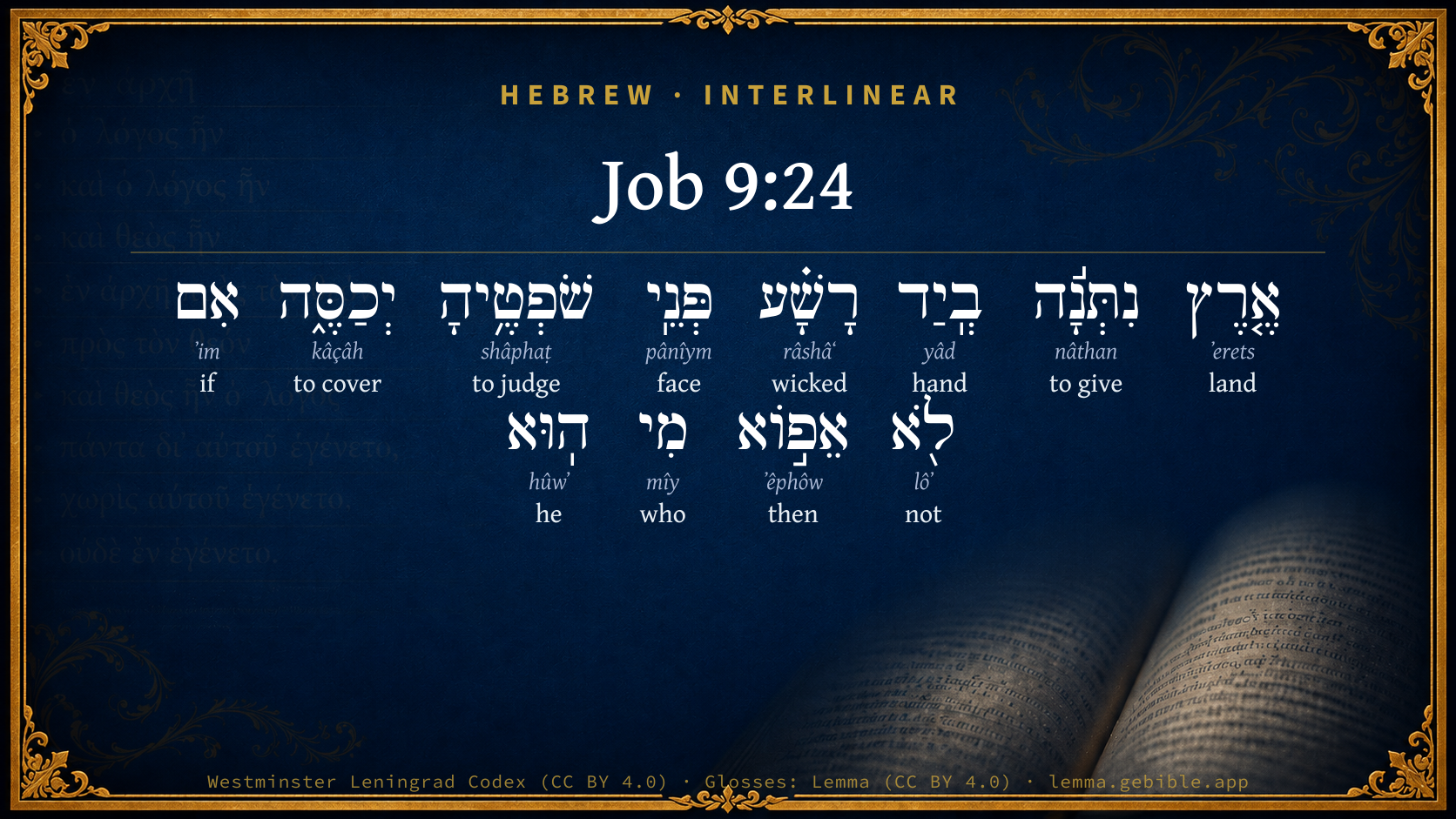
Hebrew (Westminster Leningrad Codex) Job 9:24 appears in the Hebrew Old Testament. The text above is from the Westminster Leningrad Codex. Each word links to its Strong’s number, a concise gloss, and parsing drawn from the Open Scriptures Hebrew Bible morphology. Click any word for its full Brown-Driver-Briggs (BDB) entry.
Download image
Cite this verse

Job 9:24 (World English Bible). Public Domain. Lemma interlinear Bible study tool, https://lemma.gebible.app/v/job/9/24.

Show BibTeX & RIS
BibTeX
RIS
English Translation
The earth is given into the hand of the wicked. He covers the faces of the judges of it. If not he, then who is it?
World English Bible · Public Domain
Download a study sheet

One document with this verse’s original text, its word-by-word gloss line, the meaning frame, cross-references with their text, attributed commentary, and full source and license credits — printable, and it pastes into notes with its structure intact.

This verse Autodidact and up

Study sheet (.html) Plain text (.txt)

A passage Seminary Student

Up to 50 verses in one chapter. A passage sheet keeps up to 6 commentary sources and 12 cross-references per verse, in the order this page ranks them, and says so on the sheet whenever that leaves anything out. Ask for a single verse and you get the Autodidact verse sheet above.

Everything on this page stays free to read, with no account — the sheet is a download of what is already on screen, not access to it.

Want to remove ads? Support Godless Engineer
Compare translations 3

The same verse in 3 English versions, stacked beneath the original-language interlinear above. Click any original word for its lexicon entry.

Each is an independent rendering of the whole verse — the interlinear is not word-aligned to these translations.

Highlighted words mark where these versions differ — a whole-verse word diff, not a word-by-word alignment.

  • World English Bible Public Domain
    The earth is given into the hand of the wicked. He covers the faces of the judges of it. If not he, then who is it?
  • King James Version Public Domain
    The earth is given into the hand of the wicked: he covereth the faces of the judges thereof; if not, where, and who is he?
  • unfoldingWord Literal Text CC BY-SA 4.0
    The earth is given into the hand of the wicked. He covers the faces of its judges. If not, then who it?

unfoldingWord Literal Text — © unfoldingWord, licensed CC BY-SA 4.0. Word-aligned USFM3 via Door43 (git.door43.org/unfoldingWord/en_ult).

Versions to compare (up to 4)

3 of 4 selected

Show all 18 translations

Every available English version of this verse, each an independent rendering of the whole verse.

  • World English Bible Public Domain
    The earth is given into the hand of the wicked. He covers the faces of the judges of it. If not he, then who is it?
  • Berean Standard Bible Public Domain
    The earth is given into the hand of the wicked; He blindfolds its judges. If it is not He, then who is it?
  • Majority Standard Bible Public Domain
    The earth is given into the hand of the wicked; He blindfolds its judges. If it is not He, then who is it?
  • King James Version Public Domain
    The earth is given into the hand of the wicked: he covereth the faces of the judges thereof; if not, where, and who is he?
  • American Standard Version (1901) Public Domain
    The earth is given into the hand of the wicked; He covereth the faces of the judges thereof: If `it be' not `he', who then is it?
  • Revised Version (1885) Public Domain
    The earth is given into the hand of the wicked: he covereth the faces of the judges thereof; if it be not he, who then is it?
  • Geneva Bible (1599) Public Domain
    The earth is giuen into the hand of ye wicked: he couereth the faces of the iudges therof: if not, where is he? or who is he?
  • Douay-Rheims (1899) Public Domain
    The earth is given into the hand of the wicked, he covereth the face of the judges thereof: and if it be not he, who is it then?
  • Young's Literal Translation Public Domain
    Earth hath been given Into the hand of the wicked one. The face of its judges he covereth, If not -- where, who `is' he?
  • Literal Standard Version CC BY-SA 4.0
    Earth has been given || Into the hand of the wicked. He covers the faces of her judges, || If not—where, who [is] he?
  • Unlocked Literal Bible CC BY-SA 4.0
    The earth is given into the hand of wicked people; God covers the faces of its judges. If it is not he who does it, then who is it?
  • unfoldingWord Literal Text CC BY-SA 4.0
    The earth is given into the hand of the wicked. He covers the faces of its judges. If not, then who it?
  • Darby Bible Public Domain
    The earth is given over into the hand of the wicked [man]; he covereth the faces of its judges. If not, who then is it?
  • World Messianic Bible Public Domain
    The earth is given into the hand of the wicked. He covers the faces of its judges. If not he, then who is it?
  • Webster's Bible Public Domain
    The earth is given into the hand of the wicked: he covereth the faces of its judges; if not, where, and who is he?
  • Free Bible Version CC BY-SA 4.0
    The earth has been handed over to the wicked; he blinds the eyes of the judges —if it's not him who does this, then who is it?
  • Bible in Basic English Public Domain
    The land is given into the power of the evil-doer; the faces of its judges are covered; if not by him, then who has done it?
  • JPS Tanakh (1917) Public Domain
    The earth is given into the hand of the wicked; he covereth the faces of the judges thereof; if it be not He, who then is it?

Literal Standard Version (2020), Covenant Press — licensed CC BY-SA 4.0. Text via the HelloAO Bible API (eBible.org). Unlocked Literal Bible (unfoldingWord) — licensed CC BY-SA 4.0. Text via the HelloAO Bible API (eBible.org). unfoldingWord Literal Text — © unfoldingWord, licensed CC BY-SA 4.0. Word-aligned USFM3 via Door43 (git.door43.org/unfoldingWord/en_ult). Free Bible Version, Dr. Jonathan Gallagher — licensed CC BY-SA 4.0. Text via the HelloAO Bible API (eBible.org).

Word by word

More ways to search: Search by grammar → Find every occurrence → Compare this word →

Practice this passage: Drill this verse → Learn its vocabulary →

About this verse

These counts appear in no published source. They are computed here, from the morphology-tagged text and Lemma’s own curated glosses. What Lemma adds →

12
words
12
distinct lemmas
Wisdom
section

Notable vocabulary

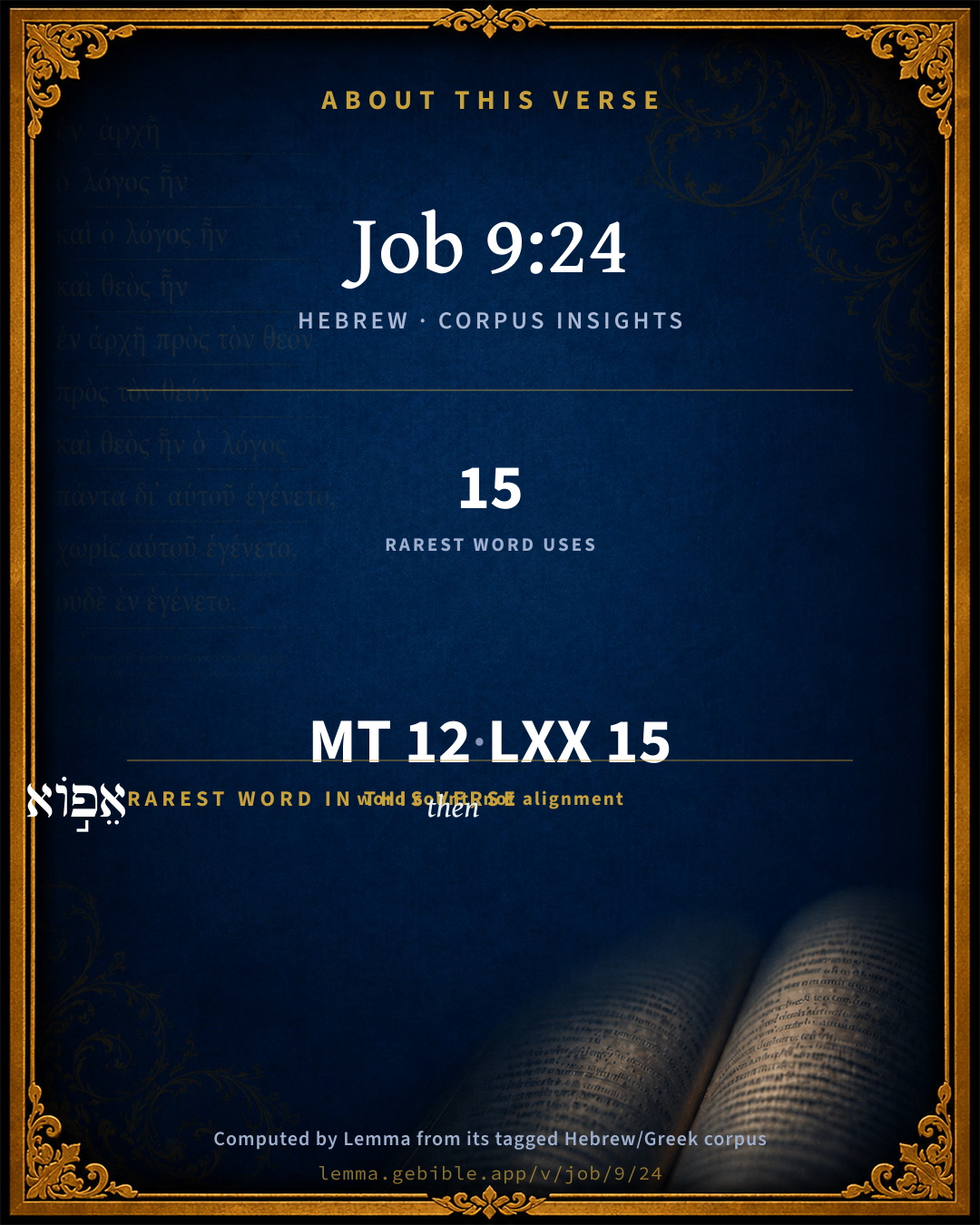
The rarest word here is אֵפ֣וֹא then H645 — appearing just 15 times in the whole Hebrew Bible.

Shared distinctive vocabulary

אֵפ֣וֹא then H645 occurs in 15 verses of the Hebrew Bible. Also found in:

Grammatical profile

  • 3 verbs
  • 3 nouns
  • 1 adjective
  • 1 pronoun
  • 1 conjunction
  • 1 adverb
  • 2 particles

Verb forms

  • נִתְּנָ֬ה Niphal · Perfect
  • שֹׁפְטֶ֥יהָ Qal · Participle Active
  • יְכַסֶּ֑ה Piel · Imperfect

Hebrew & Septuagint length

In English translation the verse runs 26 words from the Hebrew and 30 from the Septuagint (LXX English) — closely comparable.

A rough comparison of the two English renderings, which tokenize alike — not a word-level alignment.

Word counts can differ between the Hebrew and the Greek without any difference in meaning — e.g. the Hebrew direct-object marker אֵת has no separate Greek word, and Greek often adds the article ὁ.

In the original languages it is 12 Hebrew tokens and 15 Greek tokens — but the two are counted differently (Hebrew bundles its prefixes and suffixes into one token; the Greek is in lemma form), so that isn’t a like-for-like length.

Cross-references

19

Topical passages linked to Job 9:24 in the Treasury of Scripture Knowledge — connected by theme and wording, ordered by reader-vote popularity; previews shown in the World English Bible.

  • Job 10:3 Is it good to you that you should oppress, That you should despise the work of your hands, And smile on the counsel of the wicked?
  • Psalms 73:3–7 For I was envious of the arrogant, When I saw the prosperity of the wicked.
  • Jeremiah 12:1–2 Righteous are you, Yahweh, when I contend with you; yet would I reason the cause with you: why does the way of the wicked prosper? why are all they at ease who deal very treacherously?
  • 2 Samuel 15:30 David went up by the ascent of the [Mount of] Olives, and wept as he went up; and he had his head covered, and went barefoot: and all the people who were with him covered every man his head, and they went up, weeping as they went up.
  • Job 21:7–15 "Why do the wicked live, Become old, yes, and grow mighty in power?
  • 2 Samuel 19:4 The king covered his face, and the king cried with a loud voice, my son Absalom, Absalom, my son, my son!
  • Esther 6:12 Mordecai came again to the king's gate. But Haman hurried to his house, mourning and having his head covered.
  • Esther 7:8 Then the king returned out of the palace garden into the place of the banquet of wine; and Haman was fallen on the couch whereon Esther was. Then said the king, Will he even force the queen before me in the house? As the word went out of the king's mouth, they covered Haman's face.
  • Job 12:6–10 The tents of robbers prosper, Those who provoke God are secure; Who carry their God in their hands.
  • Job 12:17 He leads counselors away stripped. He makes judges fools.
  • Job 16:11 God delivers me to the ungodly, And casts me into the hands of the wicked.
  • Job 24:25 If it isn't so now, who will prove me a liar, And make my speech worth nothing?"
  • Job 32:2 Then the wrath of Elihu the son of Barachel, the Buzite, of the family of Ram, was kindled against Job. His wrath was kindled because he justified himself rather than God.
  • Psalms 17:14 From men by your hand, Yahweh, From men of the world, whose portion is in this life. You fill the belly of your cherished ones. Your sons have plenty, And they store up wealth for their children.
  • Jeremiah 14:4 Because of the ground which is cracked, because no rain has been in the land, the plowmen are disappointed, they cover their heads.
  • Daniel 4:17 The sentence is by the decree of the watchers, and the demand by the word of the holy ones; to the intent that the living may know that the Most High rules in the kingdom of men, and gives it to whoever he will, and sets up over it the lowest of men.
  • Daniel 5:18–21 You king, the Most High God gave Nebuchadnezzar your father the kingdom, and greatness, and glory, and majesty:
  • Daniel 7:7–28 After this I saw in the night-visions, and, behold, a fourth animal, awesome and powerful, and strong exceedingly; and it had great iron teeth; it devoured and broke in pieces, and stamped the residue with its feet: and it was diverse from all the animals that were before it; and it had ten horns.
  • Habakkuk 1:14–17 and make men like the fish of the sea, like the creeping things, that have no ruler over them?

Cross-references courtesy of OpenBible.info (CC BY 4.0).

Hebrew and Greek witnesses Masoretic Hebrew ↔ Greek Septuagint

The same verse in the two great witnesses to the Old Testament, shown verse-for-verse.

These are two independent witnesses, not word-aligned to each other, and the Septuagint is shown in lemma (dictionary) form.

Hebrew Job 9:24 Masoretic · Westminster Leningrad Codex

אֶ֤רֶץ נִתְּנָ֬ה בְֽיַד רָשָׁ֗ע פְּנֵֽי שֹׁפְטֶ֥יהָ יְכַסֶּ֑ה אִם לֹ֖א אֵפ֣וֹא מִי הֽוּא

The earth is given into the hand of the wicked. He covers the faces of the judges of it. If not he, then who is it?

World English Bible · Public Domain

Greek LXX Job 9:24 Septuagint · lemma form

παραδίδωμι γάρ εἰς χείρ ἀσεβής πρόσωπον κριτής αὐτός συνκαλύπτω εἰ δέ μή αὐτός τίς εἰμί

For they are delivered into the hands of the unrighteous man: he covers the faces of the judges of the earth: but if it be not he, who is it?

LXX2012 (modern English Septuagint) · Public Domain

Hebrew: Westminster Leningrad Codex (CC BY 4.0). Greek: Septuagint (public domain); English from LXX2012 (modern English Septuagint) (Public Domain). How the Septuagint differs from the Hebrew →

Commentary

Notes on Job 9:24 from classic Christian and Jewish commentators (each source and its license shown beneath its notes). The classic Christian expositions comment on the surrounding passage and are grouped to its opening verse, so a note may address several verses; the Jewish commentaries on the Tanakh (Rashi and others) are per-verse, so they appear only where the commentator wrote on this verse.

Lemma curates 59 commentaries, every one of them public domain or Creative Commons licensed, each selected and text-cleaned for this edition rather than reprinted as found. About our sources →

The Cambridge Bible for Schools and Colleges

gen. ed. J. J. S. Perowne

24. The same illustrated on the widest scale. Job_9:23 spoke of particular calamities afflicting portions of the earth. At the despair of the innocent under these God mocks, distant and indifferent. Now Job makes the sweeping statement that the earth is one scene of injustice. The wicked prevail in it, it is given into their hand, to rule and dominate within it. Comp. ch. 24.

covereth the faces of the judges] that they cannot see the right, to give the innocent justice. It is God who covereth their faces; He not only does not hinder wrong, He ensures that it prevail and have the upper hand.

if not, where, and who is he] Rather, if not He, who then is it—who does all this (Job_9:24), if it is not He? Others besides Job have asked such questions.

In this passage Job’s spirit reaches the lowest abyss of its alienation from God. From this time onwards his mind is calmer and the moral idea of God begins to reassert its place in his thoughts. Here God appears to him as a mere omnipotent power, with a bias, if He have one, to evil and cruelty, and he speaks of Him distantly as “he” (cf. ch. Job_3:20). His conception is but the reflection of his own case, as he conceived it, flung over the world, though his conception of his own case was false. To a Shemitic mind who had no conception of second causes or of general laws or of a scheme of providence, but regarded God as the immediate author of every single occurrence, the danger must always have been imminent of being driven to conclude that God was the author of the misery and wrong and cruel hardship under which men groaned.

In these verses Job traverses directly the maxim of his friends in regard to the discriminating righteousness of God, and the examples which he cites he might have used to demolish their theory. But he is little concerned with their theory here; later he does use his examples to drive them from the field. But here he is occupied with himself, with the impossibility of making his innocence which he is conscious of to appear and be admitted; for, of course, to himself and to all others his afflictions were the testimony of God to his guilt. And thus, though in the last verses his view extends to the world in general, he comes back in Job_9:25 to himself.

The Cambridge Bible for Schools and Colleges (gen. ed. J. J. S. Perowne; Cambridge University Press, 1878–1918) — public domain. Text from a community e-Sword module.

Trapp's Complete Commentary

John Trapp

Job 9:24 The earth is given into the hand of the wicked: he covereth the faces of the judges thereof; if not, where, [and] who [is] he?

Ver. 24. The earth is given into the hand of the wicked] God many times suffereth the wicked most licentiously to reign in the world, Jer 27:6 Dan 5:18-19. And it is thought by some that Job, speaking here in the singular number, aims at some famous tyrant in those parts, known both to himself and to his friends; such as was Phocas the emperor, who, when he had slain his master Mauritius, and was set up in his stead, there was an honest poor man (saith Cedrenus) who was wonderfully importunate at the throne of grace to know a reason why that wicked man prospered so in his design? he was answered again by a voice, that there could not be a worse man found; and that the sins of Christians and of the city of Constantinople did require it.

He covereth the faces of the judges thereof] i.e. That tyrant, above mentioned, subverteth all order of justice, condemneth and putteth to death even the judges themselves, if they will not pervert justice, as Bassianus did Papinian (Spartian). The covering of the face was the mark of a condemned man, Est 7:8 Job 40:8 Isa 8:17 Mar 14:65. Or thus, God blindeth the judges by giving them over to error, or permitting them to take bribes, so that they cannot discern right from wrong, &c. Some by judges here understand the saints who shall one day judge the world, but are in the mean while grievously afflicted by the wicked.

If not, where, and who is he?] Which things, if we say they are done, besides the will and foreknowledge of God, we shall thrust God out of the world, and set up fate and blind fortune; or thus, it is even so; or if not, where is he, and who is he {see Est 7:5 Mal 2:17} that can disprove what I have asserted? prodeat, siquis me potest falsi arguere, I would fain see the man that can convince me of error (Mercer, Pagnin., Vatab.).

John Trapp, A Commentary or Exposition upon All the Books of the Old and New Testament (1647–1656) — public domain. Text from a community e-Sword module.

Joseph Benson's Commentary

Job 9:24. The earth is given into the hand of the wicked — Hebrew, רשׁע, rashang, of the wicked man. The possession and dominion of a large portion of it are frequently given, by the great Lord and Proprietor of all, in the course of his providence, into the power of a wicked man. He covereth the faces of the judges thereof — The wicked man, by his power, or by gifts, corrupts the officers of justice, and thereby blinds their eyes, that they cannot discern between truth and falsehood, justice and unrighteousness. Thus Bishop Patrick: “So false is your discourse,” (the discourse of Job’s friends,) “that we see the government of the earth given into the hands of a wicked prince, who blinds the eyes of his judges.” The bishop conjectures Job meant some noted tyrant then living in those parts, whose great wickedness and great prosperity were well known, both to Job and his friends. Many commentators, however, think, that Job’s words are not to be considered as referring to any particular man, but as asserting this general truth, that as good men are often scourged, (Job 9:23,) so the wicked are often advanced to great riches and power in the world. And they understand the next clause, He covereth the faces of the judges thereof, as intended of God’s blinding the eyes of the rulers and magistrates, that is, suffering them to be blinded, by withdrawing abused light and grace, and means of information, in which only sense can God be ever said to blind the minds of any. Indeed, as a learned writer justly observes, this expression, He covereth the faces, &c, means the same in Scripture phrase, as, The faces of the judges are covered, which, indeed, is the literal version of both the Syriac and Arabic interpreters. Thus, την ψυχην σου απαιτουσιν, (Luk 12:20,) which is literally, They shall require thy soul of thee, is properly rendered, Thy soul shall be required, &c. The meaning, however, of the phrase of covering the faces of the judges, is understood by many, not of blinding their eyes, but of concealing their persons in obscurity. Thus Henry interprets the passage: “God, in his providence, advanceth wicked men, while he covers the faces of those who are fit to be judges, who are wise and good, and qualified for government, and buries them alive in obscurity; perhaps suffers them to be run down and condemned, and to have their faces covered as criminals, by those wicked ones, into whose hands the earth is given. We daily see this done; if it be not God that doth it, where, and who is he that doth it? To whom can it be ascribed, but to him that rules in the kingdoms of men, and gives them to whom he will?” Dan 4:32.

Joseph Benson's Commentary on the Old and New Testaments (1811–1818) — public domain. Text from a community e-Sword module.

Geneva Bible (1599)

Geneva Bible translators

That they cannot see to do justice.

That can show the contrary?

Geneva Bible (1599) marginal notes — public domain. Text via Bolls.life.

Jamieson, Fausset & Brown

Robert Jamieson, A. R. Fausset & David Brown

Referring to righteous "judges," in antithesis to "the wicked" in the parallel first clause, whereas the wicked oppressor often has the earth given into his hand, the righteous judges are led to execution--culprits had their faces covered preparatory to execution (Est 7:8). Thus the contrast of the wicked and righteous here answers to that in Job 9:23.

if not, where and who?--If God be not the cause of these anomalies, where is the cause to be found, and who is he?

Jamieson, Fausset & Brown — Commentary Critical and Explanatory on the Whole Bible (1871) — public domain (CC PDM 1.0). Text via the HelloAO Bible API.

Adam Clarke's Commentary

Verse 24. The earth is given into the hand of the wicked] Is it not most evident that the worst men possess most of this world's goods, and that the righteous are scarcely ever in power or affluence? This was the case in Job's time; it is the case still. Therefore prosperity and adversity in this life are no marks either of God's approbation or disapprobation.

He covereth the faces of the judges thereon] Or, The faces of its decisions he shall cover. God is often stated in Scripture as doing a thing which he only permits to be done. So he permits the eyes of judgment to be blinded; and hence false decisions. Mr. Good translates the verse thus: -

"The earth is given over to the hand of INJUSTICE;

She hoodwinketh the faces of its judges.

Where every one liveth is it not so?"

And vindicates the translation in his learned notes: but I think the Hebrew will not bear this rendering; especially that in the third line.

Where, and who is he?] If this be not the case, who is he that acts in this way, and where is he to be found? If God does not permit these things, who is it that orders them?

Coverdale translates, As for the worlde, he geveth it over into the power of the wicked, such as the rulers be wherof all londes are full. Is it not so? Where is there eny, but he is soch one? This sense is clear enough, if the original will bear it. The last clause is thus rendered by the Syriac and Arabic, Who can bear his indignation?

Adam Clarke's Commentary on the Bible (1810–1826) — public domain. Text from a community e-Sword/MySword module.

John Gill's Exposition

Now my days are swifter than a post,.... Or "than a runner" (a) in a race, in order to obtain the prize; or than one that rides post, or runs on foot to carry a message, such as were Cushi and Ahimaaz; and such are generally swift of foot, or ride on swift horses, who are so employed; and yet Job says his days are swifter, or passed away more swiftly thorn such; meaning either his days in general; or rather particularly his prosperous days, as Mr. Broughton interprets it; these no sooner came but they were gone:

they flee away; like a shadow, or a dream, or a tale that is told:

they see no good; or he saw, perceived, or enjoyed no good in them; not but that he did see and enjoy much good, even much temporal good, which is what is intended; but this was no sooner had than it was taken away, that it was as if it had never been; the evil days of trouble and sorrow, in which he had no pleasure, came so quick upon him.

(a) "cursore", Pagninus, Montanus, Junius & Tremellius, Piscator, &c.

John Gill's Exposition of the Whole Bible (1746–1763) — public domain (CC PDM 1.0). Text via the HelloAO Bible API.

Albert Barnes' Notes on the Bible

The earth is given into the hand of the wicked - This is evidently designed as an illustration of the sentiment that Job was maintaining - that there was not a distribution of rewards and punishments in this life according to character. In illustration of this, he says that the wicked are raised to places of trust and power. They exercise a wide dominion over the earth, and the world is under their control. Of the truth of this there can be no doubt. Rulers have been, in general, eminent for wickedness, and the affairs of nations have thus far been almost always under the control of those who are strangers to God. At the present time there is scarcely a pious man on any throne in the world, and the rulers of even Christian nations are in general eminent for anything rather than for personal religion.

He covereth the faces of the judges thereof - There has been considerable variety in the exposition of this expression. Some suppose that it refers to the wicked, meaning that they cover the faces of the judges under them so that they connive at and tolerate crime. Others, that it means that God blinds the eyes of wicked rulers, so that they connive at crime, and are partial and unjust in their decisions. Others, that it means that God covers the faces of the judges of the earth with shame and confusion, that though he admits them to prosperity and honor for a time, yet that he overwhelms them at length with calamities and sorrows. Dr. Good supposes it to mean that the earth is given over into the hands of injustice, and that this hoodwinks the faces of the judges. The phrase properly means, to hoodwink, to blind, to conceal the face. It seems to me that the true sense is not expressed by either of the views above. The parallelism requires us to understand it as meaning that while the wicked had dominion over the earth, the righteous were in obscurity, or were not advanced to honor and power. The word “judges,” therefore, I think, is to be understood of the righteous judges, of those who are qualified to administer justice. Their face is covered. They are kept in concealment. The wicked have the sway, and they are doomed to shame, obscurity, and dishonor. This interpretation accords with the tenor of the argument, and may be sustained by the Hebrew, though I have not found it in any of the commentaries which I have consulted.

If not, where, and who is he - If this is not a just view, who is God? What are his dealings? Where is he to be seen, and how is he to be known? Or, it may mean, “if it is not God who does these strange things, who is it that does them?” Rosenmuller. But I prefer the former interpretation. “Tell me who and what God is, if this is not a fair and just account of him. These things in fact are done, and if the agency of God is not employed in them, who is God? And where is his agency seen?

Albert Barnes' Notes on the Bible (1834–1885) — public domain. Text from a community e-Sword/MySword module.

Haydock's Catholic Bible Commentary

Wicked one, (Haydock) the devil, (Menochius) or any impious person who enjoys prosperity. He, (Calmet) or even God permissively, covered the face, (Haydock) by bribes; so that judges pass sentence unjustly. --- Then. If it be not the devil, (Menochius) or God. (Calmet)

George Leo Haydock (1774–1849), Haydock's Catholic Family Bible and Commentary, 1859 edition — public domain. Excludes Psalms (Douay-Rheims chapter numbering differs from Protestant) and Deuterocanonical books (Catholic canon only).

Matthew Poole's English Annotations

The earth, i.e. the possession and dominion of men and things on earth.

Is given, to wit, by God, the great Lord and Disposer of it, by his providence.

Into the hand of the wicked; into their power. As good men are scourged, Job 9:23, so the wicked are advanced and prospered, in this world.

He covereth the faces of the judges thereof, i.e. he blinds their eyes, that they cannot discern between truth and falsehood, justice and unrighteousness. He. Who? Either,

1. The wicked last mentioned, who either by power or by gifts corrupts the officers of justice. Or rather,

2. God, whom the pronoun he designed all along this chapter; who is oft said to blind the minds of men, which he doth not positively, by making them blind, but privatively, by withdrawing his own light, and leaving them to their own mistakes and lusts. Or by judges he may hear mean those who are worthy of that name, and duly administer that office; whose faces God may be said to cover, because he removeth them from their high places into obscurity, and covers them with contempt, and in a manner passeth a sentence of condemnation and destruction upon them; covering of the face being the usual posture of condemned persons, and of men in great misery; of which see Est 7:8; Psa 44:15; Isa 22:17; Jer 14:4. So the sense of this verse is, God commonly advanceth wicked men into power and honour, and casteth down men of true worth and virtue from their seats. If not; if it be not as I say, if God do not these things. Where, and who is he? either,

1. Who will confute me by solid arguments? Or,

2. Who doth these things? Who but God doth dispose of the world in this manner?

Matthew Poole's English Annotations on the Holy Bible (1683–1685) — public domain. Text from a community e-Sword/MySword module.

Whedon's Commentary on the Bible

Daniel D. Whedon

24. “In this second illustration there is an advance in the thought, in so far as here a part, at least, of the wicked are excepted from the general ruin: nay, appear even as threatening the same to the pious.” — Schlottmann.

Covereth the faces — Criminals had their faces covered prior to execution. Est_7:8. A like custom prevailed among the Greeks and Romans. (Quintus Curtius, 6:8; Livy, 1:26.) God, Job might say, treats the judges, who are presumed to be the best of men, as malefactors, as in my case. The Chaldee paraphrase, however, furnishes a better meaning: “He hideth justice from the face of the judges thereof,” so that they cannot distinguish right from wrong, and, therefore, judge unjustly. Unjust judges, like wicked kings, are sent for the punishment of men. In illustration, Drusius cites Menander: “Every wife is from God: the good from God, benevolent; the bad from God, angry.”

If not, where, and who is he — If (it is) not (so) now, who then does it? If God be not the author of this state of affairs, who, then, is?

Daniel D. Whedon (gen. ed.), Commentary on the Old and New Testaments (1874–1909) — public domain. Text from a community e-Sword module.

The Pulpit Commentary

The earth is given into the hand of the wicked. As a further proof of God"s indifference to the sufferings of the innocent, Job adduces the fact that, in the high places of the earth, are mostly set wicked persons, who oppress and persecute the righteous. This has probably been true, in the East at any rate, at all times. He covereth the faces of the judges thereof. God covers up the eyes of those who have to judge between the oppressors and the oppressed, so that they pervert judgment, and side with the oppressors. He does this, since he permits it to be done. Corrupt judges are among the perennial curses of the East. If not, where, and who is he? rather, If it be not he who then is it? (see the Revised Version). Job argues that the established condition of things in human society must be ascribed to God, since (at least) he allows it. There is no one else to whom it can be ascribed.

The Pulpit Commentary (1880–1919), ed. H.D.M. Spence-Jones & Joseph S. Exell — public domain. Text from a community e-Sword module.

John Wesley's Explanatory Notes

The earth - The dominion over it. Into - Into their power. As good men are frequently scourged, so the wicked are advanced. Faces - Meantime he covers the faces of wise and good men, fit to be Judges, and buries them alive in obscurity, perhaps suffers them to be condemned, and their faces covered as criminals, by those to whom the earth is given. This is daily done: if it be not God that doth it, where and who is he that doth?

John Wesley, Explanatory Notes Upon the Whole Bible (1754–1765) — public domain. Text via the GEBible commentary corpus.

Rashi

Rabbi Shlomo Yitzchaki (Rashi)

into the hands of a wicked one Referring to the Adversary.

he covers the faces of its judges from discerning and comprehending the truth of the matter.

If not, then If this [interpretation] is not the truth of the matter, who is it that destroys the innocent?

Rashi on the Tanakh — English translations: “The Judaica Press complete Tanach with Rashi, translated by A. J. Rosenberg” (CC BY 4.0); “Pentateuch with Rashi's commentary by M. Rosenbaum and A.M. Silbermann, 1929-1934” (public domain); “The Metsudah Tanach series, Lakewood, N.J” (CC BY 4.0); and “The Book of Joshua, Metsudah Publications, 1997” (CC BY 4.0). Text via Sefaria.

Lesson kit

Teaching starters — assembled from the data on this page, not authored interpretation. Every prompt links to the verse data it draws on. Edit before teaching.

Job, in the Wisdom, opens this verse with 12 words (12 distinct Hebrew lemmas). Its most distinctive word is ʼêphôw (“then”). A historical commentator’s framing appears above. Read the whole chapter for the surrounding context.

Discussion questions

  1. The word ʼêphôw carries the sense “then.” How does it shape the verse?
  2. Genesis 27:33 shares the word «then» with this verse. How do the two illuminate each other?
  3. These translations render this verse differently; the difference is in the English rendering, not the original. What questions does that raise?
  4. The verb «נִתְּנָ֬ה» is Niphal Perfect. How does its form color the action?
  5. Reading how The Cambridge Bible for Schools and Colleges and Trapp's Complete Commentary read this verse, where do the two commentators agree and where do they part?

Things to notice

Reading settings

Reading text

Shown beneath each verse's original-language words.

Old Testament
Old Testament edition

Read the OT as the Masoretic Hebrew (MT) or the Greek Septuagint (LXX).

English shown for the Greek Septuagint (in the Hebrew ↔ Greek comparison).

Comparing translations? Open the Compare panel on any verse page to stack up to four side by side.