
Proverbs 14:11

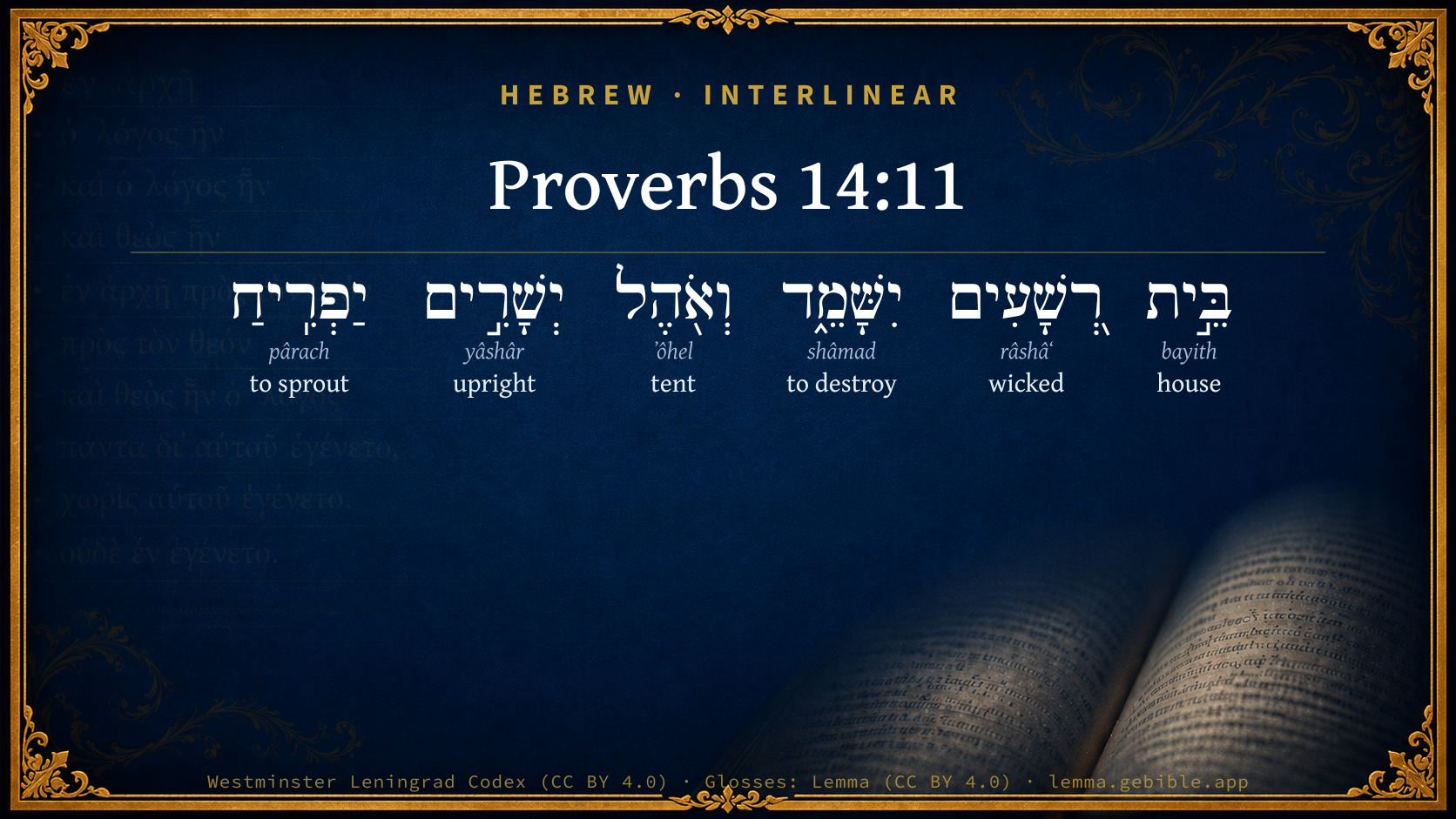
Hebrew (Westminster Leningrad Codex) Proverbs 14:11 appears in the Hebrew Old Testament. The text above is from the Westminster Leningrad Codex. Each word links to its Strong’s number, a concise gloss, and parsing drawn from the Open Scriptures Hebrew Bible morphology. Click any word for its full Brown-Driver-Briggs (BDB) entry.
Download image
Cite this verse

Proverbs 14:11 (World English Bible). Public Domain. Lemma interlinear Bible study tool, https://lemma.gebible.app/v/proverbs/14/11.

Show BibTeX & RIS
BibTeX
RIS
English Translation
The house of the wicked will be overthrown, But the tent of the upright will flourish.
World English Bible · Public Domain
Download a study sheet

One document with this verse’s original text, its word-by-word gloss line, the meaning frame, cross-references with their text, attributed commentary, and full source and license credits — printable, and it pastes into notes with its structure intact.

This verse Autodidact and up

Study sheet (.html) Plain text (.txt)

A passage Seminary Student

Up to 50 verses in one chapter. A passage sheet keeps up to 6 commentary sources and 12 cross-references per verse, in the order this page ranks them, and says so on the sheet whenever that leaves anything out. Ask for a single verse and you get the Autodidact verse sheet above.

Everything on this page stays free to read, with no account — the sheet is a download of what is already on screen, not access to it.

Want to remove ads? Support Godless Engineer
Compare translations 3

The same verse in 3 English versions, stacked beneath the original-language interlinear above. Click any original word for its lexicon entry.

Each is an independent rendering of the whole verse — the interlinear is not word-aligned to these translations.

Highlighted words mark where these versions differ — a whole-verse word diff, not a word-by-word alignment.

  • World English Bible Public Domain
    The house of the wicked will be overthrown, But the tent of the upright will flourish.
  • King James Version Public Domain
    The house of the wicked shall be overthrown: but the tabernacle of the upright shall flourish.
  • unfoldingWord Literal Text CC BY-SA 4.0
    The house of the wicked will be destroyed, but the tent of the upright will flourish.

unfoldingWord Literal Text — © unfoldingWord, licensed CC BY-SA 4.0. Word-aligned USFM3 via Door43 (git.door43.org/unfoldingWord/en_ult).

Versions to compare (up to 4)

3 of 4 selected

Show all 18 translations

Every available English version of this verse, each an independent rendering of the whole verse.

  • World English Bible Public Domain
    The house of the wicked will be overthrown, But the tent of the upright will flourish.
  • Berean Standard Bible Public Domain
    The house of the wicked will be destroyed, but the tent of the upright will flourish.
  • Majority Standard Bible Public Domain
    The house of the wicked will be destroyed, but the tent of the upright will flourish.
  • King James Version Public Domain
    The house of the wicked shall be overthrown: but the tabernacle of the upright shall flourish.
  • American Standard Version (1901) Public Domain
    The house of the wicked shall be overthrown; But the tent of the upright shall flourish.
  • Revised Version (1885) Public Domain
    The house of the wicked shall be overthrown: but the tent of the upright shall flourish.
  • Geneva Bible (1599) Public Domain
    The house of the wicked shalbe destroyed: but the tabernacle of the righteous shall florish.
  • Douay-Rheims (1899) Public Domain
    The house of the wicked shall be destroyed: but the tabernacles of the just shall flourish.
  • Young's Literal Translation Public Domain
    The house of the wicked is destroyed, And the tent of the upright flourisheth.
  • Literal Standard Version CC BY-SA 4.0
    The house of the wicked is destroyed, || And the tent of the upright flourishes.
  • Unlocked Literal Bible CC BY-SA 4.0
    The house of wicked people will be destroyed, but the tent of upright people will flourish.
  • unfoldingWord Literal Text CC BY-SA 4.0
    The house of the wicked will be destroyed, but the tent of the upright will flourish.
  • Darby Bible Public Domain
    The house of the wicked shall be overthrown; but the tent of the upright shall flourish.
  • World Messianic Bible Public Domain
    The house of the wicked will be overthrown, but the tent of the upright will flourish.
  • Webster's Bible Public Domain
    The house of the wicked shall be overthrown: but the tabernacle of the upright shall flourish.
  • Free Bible Version CC BY-SA 4.0
    The house of wicked people will be destroyed, but the tent of good people will prosper.
  • Bible in Basic English Public Domain
    The house of the sinner will be overturned, but the tent of the upright man will do well.
  • JPS Tanakh (1917) Public Domain
    The house of the wicked shall be overthrown; but the tent of the upright shall flourish.

Literal Standard Version (2020), Covenant Press — licensed CC BY-SA 4.0. Text via the HelloAO Bible API (eBible.org). Unlocked Literal Bible (unfoldingWord) — licensed CC BY-SA 4.0. Text via the HelloAO Bible API (eBible.org). unfoldingWord Literal Text — © unfoldingWord, licensed CC BY-SA 4.0. Word-aligned USFM3 via Door43 (git.door43.org/unfoldingWord/en_ult). Free Bible Version, Dr. Jonathan Gallagher — licensed CC BY-SA 4.0. Text via the HelloAO Bible API (eBible.org).

Word by word

More ways to search: Search by grammar → Find every occurrence → Compare this word →

Practice this passage: Drill this verse → Learn its vocabulary →

About this verse

These counts appear in no published source. They are computed here, from the morphology-tagged text and Lemma’s own curated glosses. What Lemma adds →

6
words
6
distinct lemmas
Wisdom
section

Shared distinctive vocabulary

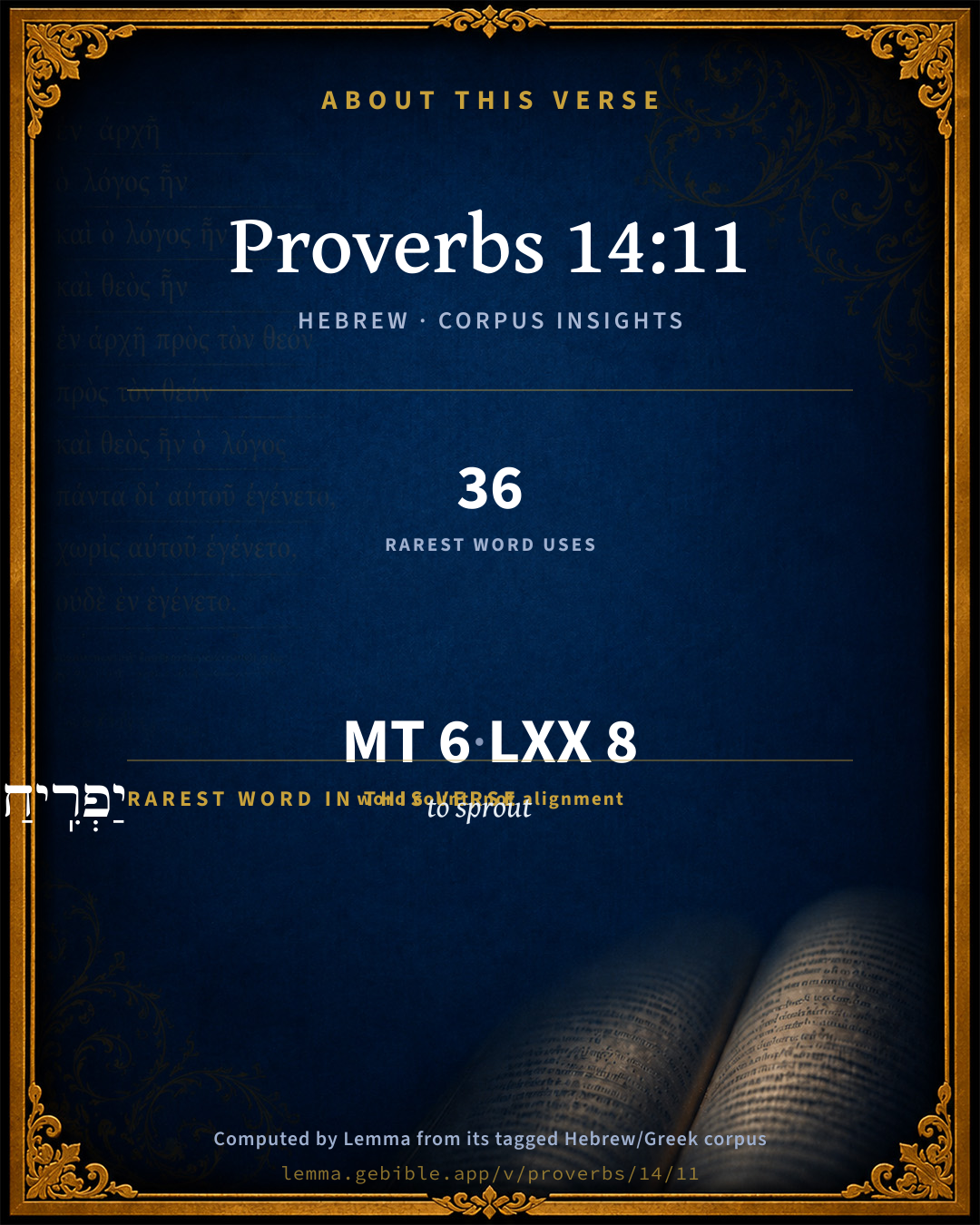
יַפְרִֽיחַ to sprout H6524 occurs in 33 verses of the Hebrew Bible. Also found in:

Grammatical profile

  • 2 verbs
  • 2 nouns
  • 2 adjectives

Verb forms

  • יִשָּׁמֵ֑ד Niphal · Imperfect
  • יַפְרִֽיחַ Hiphil · Imperfect

Hebrew & Septuagint length

In English translation the verse runs 16 words from the Hebrew and 19 from the Septuagint (LXX English) — closely comparable.

A rough comparison of the two English renderings, which tokenize alike — not a word-level alignment.

Word counts can differ between the Hebrew and the Greek without any difference in meaning — e.g. the Hebrew direct-object marker אֵת has no separate Greek word, and Greek often adds the article ὁ.

In the original languages it is 6 Hebrew tokens and 8 Greek tokens — but the two are counted differently (Hebrew bundles its prefixes and suffixes into one token; the Greek is in lemma form), so that isn’t a like-for-like length.

Cross-references

18

Topical passages linked to Proverbs 14:11 in the Treasury of Scripture Knowledge — connected by theme and wording, ordered by reader-vote popularity; previews shown in the World English Bible.

  • Proverbs 3:33 Yahweh's curse is in the house of the wicked, But he blesses the habitation of the righteous.
  • Proverbs 12:7 The wicked are overthrown, and are no more, But the house of the righteous shall stand.
  • Matthew 7:26–27 Everyone who hears these words of mine, and doesn't do them will be like a foolish man, who built his house on the sand.
  • Job 21:28 For you say, 'Where is the house of the prince? Where is the tent in which the wicked lived?'
  • Proverbs 21:12 The Righteous One considers the house of the wicked, And brings the wicked to ruin.
  • Zechariah 5:4 I will cause it to go out," says Yahweh of Hosts, "and it will enter into the house of the thief, and into the house of him who swears falsely by my name; and it will remain in the midst of his house, and will destroy it with its timber and its stones."
  • Job 18:14–15 He shall be rooted out of his tent where he trusts. He shall be brought to the king of terrors.
  • Job 8:15 He shall lean on his house, but it shall not stand. He shall cling to it, but it shall not endure.
  • Proverbs 11:28 He who trusts in his riches will fall, But the righteous shall flourish as the green leaf.
  • Proverbs 21:20 There is precious treasure and oil in the dwelling of the wise; But a foolish man swallows it up.
  • Isaiah 58:11–12 and Yahweh will guide you continually, and satisfy your soul in dry places, and make strong your bones; and you shall be like a watered garden, and like a spring of water, whose waters don't fail.
  • Job 8:6 If you were pure and upright, Surely now he would awaken for you, And make the habitation of your righteousness prosperous.
  • Job 15:34 For the company of the godless shall be barren, And fire shall consume the tents of bribery.
  • Job 18:21 Surely such are the dwellings of the unrighteous, This is the place of him who doesn't know God."
  • Psalms 128:3 Your wife will be as a fruitful vine, In the innermost parts of your house; Your children like olive plants, Around your table.
  • Job 20:26–28 All darkness is laid up for his treasures. An unfanned fire shall devour him. It shall consume that which is left in his tent.
  • Job 27:13–23 "This is the portion of a wicked man with God, The heritage of oppressors, which they receive from the Almighty.
  • Psalms 112:2–3 His seed will be mighty in the land. The generation of the upright will be blessed.

Cross-references courtesy of OpenBible.info (CC BY 4.0).

Hebrew and Greek witnesses Masoretic Hebrew ↔ Greek Septuagint

The same verse in the two great witnesses to the Old Testament, shown verse-for-verse.

These are two independent witnesses, not word-aligned to each other, and the Septuagint is shown in lemma (dictionary) form.

Hebrew Proverbs 14:11 Masoretic · Westminster Leningrad Codex

בֵּ֣ית רְ֭שָׁעִים יִשָּׁמֵ֑ד וְאֹ֖הֶל יְשָׁרִ֣ים יַפְרִֽיחַ

The house of the wicked will be overthrown, But the tent of the upright will flourish.

World English Bible · Public Domain

Greek LXX Proverbs 14:11 Septuagint · lemma form

οἰκία ἀσεβής ἀπο ἀναἵζω σκηνή δέ καταὀρθόω ἵστημι

The houses of ungodly men shall be utterly destroyed; but the tabernacles of them that walk uprightly shall stand.

LXX2012 (modern English Septuagint) · Public Domain

On this verse, The Pulpit Commentary discusses the Septuagint’s reading. Read the note in Commentary ↓

Hebrew: Westminster Leningrad Codex (CC BY 4.0). Greek: Septuagint (public domain); English from LXX2012 (modern English Septuagint) (Public Domain). How the Septuagint differs from the Hebrew →

Commentary

Notes on Proverbs 14:11 from classic Christian and Jewish commentators (each source and its license shown beneath its notes). The classic Christian expositions comment on the surrounding passage and are grouped to its opening verse, so a note may address several verses; the Jewish commentaries on the Tanakh (Rashi and others) are per-verse, so they appear only where the commentator wrote on this verse.

Lemma curates 59 commentaries, every one of them public domain or Creative Commons licensed, each selected and text-cleaned for this edition rather than reprinted as found. About our sources →

Trapp's Complete Commentary

John Trapp

Pro 14:11 The house of the wicked shall be overthrown: but the tabernacle of the upright shall flourish.

Ver. 11. The house of the wicked shall be overthrown.] As Phoca’s high walls were, because sin was at the bottom: "Brimstone also shall be scattered on his habitation"; {Job 18:15} as it befell Dioclesian, whose house was wholly consumed with fire from heaven; wherewith himself also was so terrified, that he died within a while after. {a}

But the tabernacle of the upright shall flourish.] The wicked have "houses," and are called the "inhabitants of the earth." {Rev 12:12} The upright have "tabernacles," or tents that were transportative and taken down at pleasure; here they "have no continuing city," no mansion place; and yet what they have shall flourish: "Our bed is green, the beams of our house are cedar, and our rafters of fir." {Son 1:16-17} See 2Sa 23:5.

{a} Euseb. de vit. Const., lib. v.

John Trapp, A Commentary or Exposition upon All the Books of the Old and New Testament (1647–1656) — public domain. Text from a community e-Sword module.

Tyndale Open Study Notes

Tyndale Open Resources

14:11 Although a house is typically more stable than a tent, wickedness destroys and tears down, while godliness builds up (14:1).

Tyndale Open Study Notes — © Tyndale Open Resources, licensed CC BY-SA 4.0. Text via the HelloAO Bible API.

Matthew Henry's Commentary

Note, 1. Sin is the ruin of great families: The house of the wicked, though built ever so strong and high, shall be overthrown, shall be brought to poverty and disgrace, and at length be extinct. His hope for heaven, the house on which he leans, shall not stand, but fail in the storm; the deluge that comes will sweep it away. 2. Righteousness is the rise and stability even of mean families: Even the tabernacle of the upright, though movable and despicable as a tent, shall flourish, in outward prosperity if Infinite Wisdom see good, at all events in graces and comfort, which are true riches and honours.

Matthew Henry's Commentary on the Whole Bible (1708–1710) — public domain (CC PDM 1.0). Text via the HelloAO Bible API.

Jamieson, Fausset & Brown

Robert Jamieson, A. R. Fausset & David Brown

(Compare Pro 12:7). The contrast of the whole is enhanced by that of house and tabernacle, a permanent and a temporary dwelling.

Jamieson, Fausset & Brown — Commentary Critical and Explanatory on the Whole Bible (1871) — public domain (CC PDM 1.0). Text via the HelloAO Bible API.

Ellicott's Commentary for English Readers

(11) The house of the wicked shall be overthrown.—Observe the contrast between the “house” and “tabernacle” (tent); the slighter one shall stand, while the more strongly built one shall perish. (Comp. Pro_3:33.)

A Bible Commentary for English Readers, edited by Charles John Ellicott (1878–1897) — public domain. Text from a community e-Sword module.

John Gill's Exposition

The house of the wicked shall be overthrown,.... Houses built to perpetuate their names and eternize their memory; and which, though built high and stately, strong and firm, yet by one accident or another shall come to ruin, when they imagined they would continue for ever, and their dwelling places to all generations, Psa 49:11; or their families shall become extinct, none to be their heirs and inherit their estates, and transmit their name to posterity; or the substance of their house, their riches and wealth, especially that gotten dishonestly, shall waste away: and in a spiritual sense the house or hope of such, as to eternal salvation, being built on the sand, or something of their own, their external duties, or an outward profession of religion, shall not stand; though they lean upon it and would hold it fast, but it shall fall, and great shall be the fall of it; and particularly the apostate church of Rome, that synagogue of Satan, that habitation of devils, that hold of every foul spirit, and cage of every unclean bird, shall be overthrown with an utter overthrow, shall fall and never rise more, Rev 18:2;

but the tabernacle of the upright shall flourish: their low and mean cottages, which are put up quickly, like tents movable from place to place, yet shall be established, Pro 15:25; their families shall become numerous like a flock of sheep, Psa 107:41; and their substance increase; they shall flourish in worldly things and grow rich, or however in spirituals, in girls and grace; shall flourish in the courts of the Lord, and tabernacles of the most High, like palm trees and cedars; for the allusion is to the flourishing of trees, Psa 92:13; especially they will be in such flourishing circumstances in the latter day, when antichrist will be destroyed, and when the tabernacle of God will be with men, Psa 72:8.

John Gill's Exposition of the Whole Bible (1746–1763) — public domain (CC PDM 1.0). Text via the HelloAO Bible API.

Matthew Poole's English Annotations

The house; their dwelling and family.

The tabernacle; which is a weak, and poor, and unstable thing, soon reared up, and soon taken down, and is here opposed to the large, and strong, and magnificent house of wicked men.

Matthew Poole's English Annotations on the Holy Bible (1683–1685) — public domain. Text from a community e-Sword/MySword module.

Whedon's Commentary on the Bible

Daniel D. Whedon

11. Overthrown — Smitten, destroyed. Compare Pro_12:7. House…

tabernacle — By metonymy for family, household. Compare Job_8:15; Job_15:34; Job_18:14-15; Pro_3:33; Pro_12:7; Pro_21:12; Zec_5:4; Mat_7:27.

Daniel D. Whedon (gen. ed.), Commentary on the Old and New Testaments (1874–1909) — public domain. Text from a community e-Sword module.

The Pulpit Commentary

The house... the tabernacle. The house of the wicked, which they build and beautify and love, and which they look upon as a lasting home, shall perish; the hope which they founded upon it shall come to a speedy end; (Pro_12:7) but the righteous rear only a tent on earth, as becomes those who are strangers and pilgrims; and yet this abode is more secure, the hopes founded upon it are more lasting, for it continues unto everlasting life. The text in its first sense probably means that sinners take great pains to increase their material prosperity, and to leave heirs to carry on their name and family, but Providence defeats their efforts: good men do their duty in their state of life, try to please God and benefit their neighbour, leaving anxious care for the future, and God prospers them beyond all that they thought or wished. (comp. Pro_3:33) Shall flourish. The word applies metaphorically to the growth, vigour, and increase of a family under the blessing of God. Septuagint, "The tents of the upright shall stand." There is a cognate proverb at Pro_12:7.

The Pulpit Commentary (1880–1919), ed. H.D.M. Spence-Jones & Joseph S. Exell — public domain. Text from a community e-Sword module.

Keil & Delitzsch

C. F. Keil & F. Delitzsch

11 The house of the wicked is overthrown;

But the tent of the upright flourishes.

In the cogn. proverb, Pro 12:7, line 2 begins with וּבית, but here the apparently firmly-founded house is assigned to the godless, and on the contrary the tent, easily destroyed, and not set up under the delusion of lasting for ever, is assigned to the righteous. While the former is swept away without leaving a trace behind (Isa 14:23), the latter has blossoms and shoots (הפריח as inwardly transitive, like Job 14:9; Psa 92:14); the household of such remains not only preserved in the same state, but in a prosperous, happy manner it goes forward and upward.

Keil & Delitzsch — Biblical Commentary on the Old Testament (1861–1891) — public domain (CC PDM 1.0). Text via the HelloAO Bible API. (Old Testament only.)

Bridges on Proverbs

Charles Bridges

The feeblest state of the upright is more stable than the prosperity of the wicked. They build a house. The earth is their home, where they would settle, and take their rest. The upright — knowing the uncertainly of earth, and seeking a better house — only set up a tabernacle (Heb 11:9 ) — weak and trembling. Yet the house is overthrown, and the tabernacle flourishes. (Pro 3:33 ; Pro 12:7 .) The strongest support of man totters. (Job 8:15 . Psa 49:12 .) The support of God to the weakest is Omnipotence. (Isa 40:29 ; Isa 41:10 .) The eye of sense seems however to see the contrary — the flourishing of the wicked, and the overthrow of the upright. And a sore trial is it to the servant of God. (Jer 12:1 .) But "we must walk by faith, not by sight." (2Co 5:7 .) "The sanctuary" — the word of God — will explain. (Psa 73:16-17 . Job 18:14-21 .) Wait awhile. The great day will set all in order before us, and show that "the Judge of all the earth doeth right." (Gen 18:25 . Psa 58:11 .) Meanwhile let us leave him to do his own work, and to fulfil his own word in his own time.

Charles Bridges, An Exposition of the Book of Proverbs (1846) — public domain. Text from a community e-Sword module.

Kretzmann's Popular Commentary

Paul E. Kretzmann

v. 11. The house of the wicked shall be overthrown, no matter how permanent they believe it to be; but the tabernacle of the upright, their tent, their temporary dwelling, for they do not regard it as their permanent home, shall flourish, the blessing of the Lord resting upon it.

Paul E. Kretzmann, Popular Commentary of the Bible (1921–1924) — public domain. Text from a community e-Sword module.

unfoldingWord translationNotes

Door43 World Missions Community

the tent

The word "tent" represents everything that happens within it. AT: "the household" (See: Metonymy)

flourish

The word "flourish" means vigorous blooming of flowers and so represents anything that grows strongly. AT: "to do well and last long" or "to be healthy" or "to be very successful" (See: Metaphor)

There is a way that seems right to a man

The word "way" represents the conduct of life a person follows. AT: "People think that the way they are living is the right way" (See: Metaphor)

translationWords

house

righteous

evil

tent

die

unfoldingWord translationNotes — © Distant Shores Media and the Door43 World Missions Community, licensed CC BY-SA 4.0. Source: git.door43.org/Door43/en_tn.

Lesson kit

Teaching starters — assembled from the data on this page, not authored interpretation. Every prompt links to the verse data it draws on. Edit before teaching.

Proverbs, in the Wisdom, opens this verse with 6 words (6 distinct Hebrew lemmas). Its most distinctive word is pârach (“to sprout”). A historical commentator’s framing appears above. Read the whole chapter for the surrounding context.

Discussion questions

  1. The word pârach carries the sense “to sprout.” How does it shape the verse?
  2. Genesis 40:10 shares the word «to sprout» with this verse. How do the two illuminate each other?
  3. The translations on this page render this verse differently — a whole-verse word diff, not a word-by-word alignment. What might account for the different wordings?
  4. The verb «יִשָּׁמֵ֑ד» is Niphal Imperfect. How does its form color the action?
  5. Reading how Trapp's Complete Commentary and Tyndale Open Study Notes read this verse, where do the two commentators agree and where do they part?

Things to notice

Reading settings

Reading text

Shown beneath each verse's original-language words.

Old Testament
Old Testament edition

Read the OT as the Masoretic Hebrew (MT) or the Greek Septuagint (LXX).

English shown for the Greek Septuagint (in the Hebrew ↔ Greek comparison).

Comparing translations? Open the Compare panel on any verse page to stack up to four side by side.