
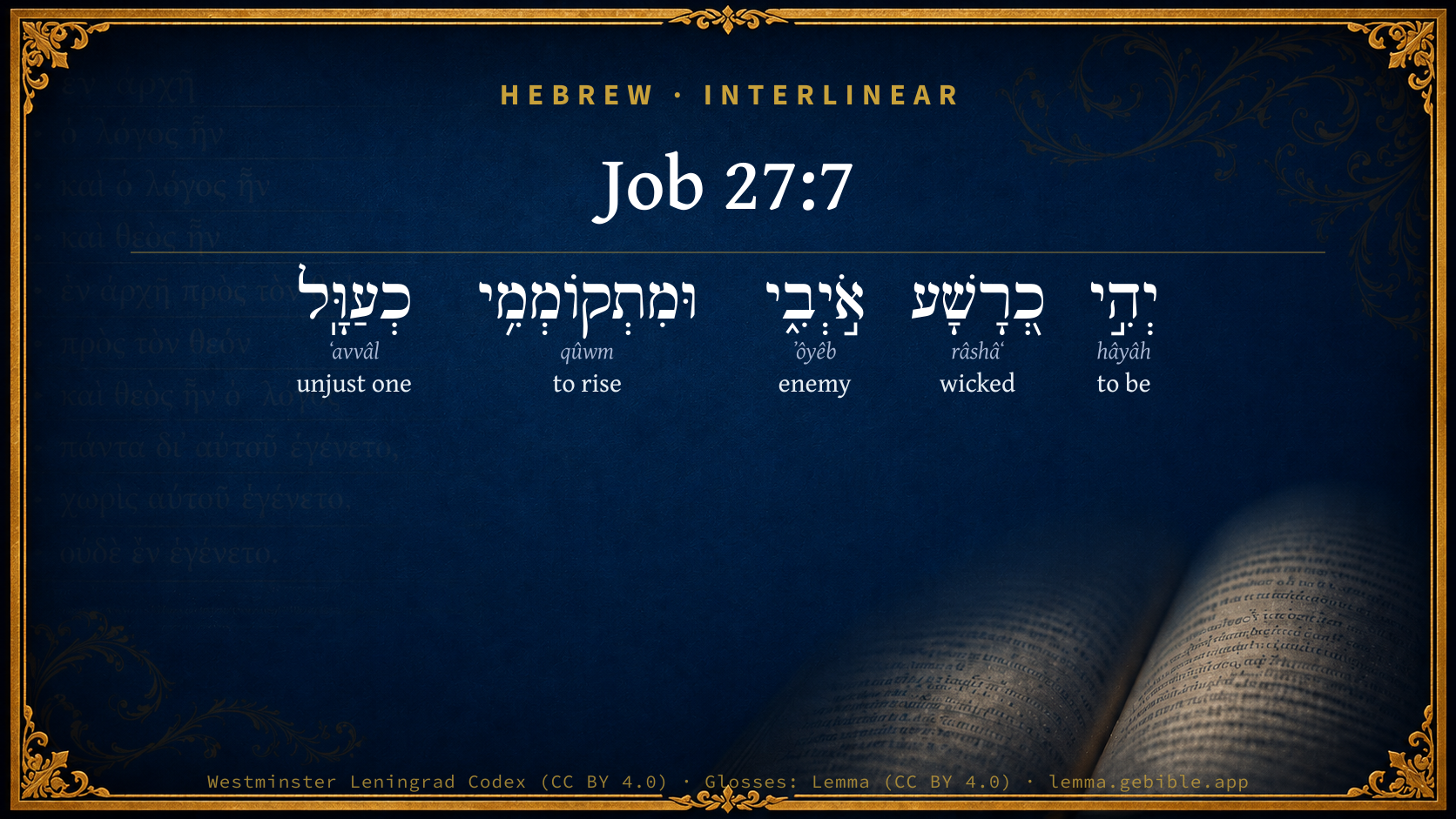
Job 27:7

Hebrew (Westminster Leningrad Codex) Job 27:7 appears in the Hebrew Old Testament. The text above is from the Westminster Leningrad Codex. Each word links to its Strong’s number, a concise gloss, and parsing drawn from the Open Scriptures Hebrew Bible morphology. Click any word for its full Brown-Driver-Briggs (BDB) entry.
Download image
Cite this verse

Job 27:7 (World English Bible). Public Domain. Lemma interlinear Bible study tool, https://lemma.gebible.app/v/job/27/7.

Show BibTeX & RIS
BibTeX
RIS
English Translation
"Let my enemy be as the wicked, Let him who rises up against me be as the unrighteous.
World English Bible · Public Domain
Download a study sheet

One document with this verse’s original text, its word-by-word gloss line, the meaning frame, cross-references with their text, attributed commentary, and full source and license credits — printable, and it pastes into notes with its structure intact.

This verse Autodidact and up

Study sheet (.html) Plain text (.txt)

A passage Seminary Student

Up to 50 verses in one chapter. A passage sheet keeps up to 6 commentary sources and 12 cross-references per verse, in the order this page ranks them, and says so on the sheet whenever that leaves anything out. Ask for a single verse and you get the Autodidact verse sheet above.

Everything on this page stays free to read, with no account — the sheet is a download of what is already on screen, not access to it.

Want to remove ads? Support Godless Engineer
Compare translations 3

The same verse in 3 English versions, stacked beneath the original-language interlinear above. Click any original word for its lexicon entry.

Each is an independent rendering of the whole verse — the interlinear is not word-aligned to these translations.

Highlighted words mark where these versions differ — a whole-verse word diff, not a word-by-word alignment.

  • World English Bible Public Domain
    "Let my enemy be as the wicked, Let him who rises up against me be as the unrighteous.
  • King James Version Public Domain
    Let mine enemy be as the wicked, and he that riseth up against me as the unrighteous.
  • unfoldingWord Literal Text CC BY-SA 4.0
    May my enemy be like the wicked, and the one rising up against me like the unrighteous!

unfoldingWord Literal Text — © unfoldingWord, licensed CC BY-SA 4.0. Word-aligned USFM3 via Door43 (git.door43.org/unfoldingWord/en_ult).

Versions to compare (up to 4)

3 of 4 selected

Show all 18 translations

Every available English version of this verse, each an independent rendering of the whole verse.

  • World English Bible Public Domain
    "Let my enemy be as the wicked, Let him who rises up against me be as the unrighteous.
  • Berean Standard Bible Public Domain
    May my enemy be like the wicked and my opponent like the unjust.
  • Majority Standard Bible Public Domain
    May my enemy be like the wicked and my opponent like the unjust.
  • King James Version Public Domain
    Let mine enemy be as the wicked, and he that riseth up against me as the unrighteous.
  • American Standard Version (1901) Public Domain
    Let mine enemy be as the wicked, And let him that riseth up against me be as the unrighteous.
  • Revised Version (1885) Public Domain
    Let mine enemy be as the wicked, and let him that riseth up against me be as the unrighteous.
  • Geneva Bible (1599) Public Domain
    Mine enemie shall be as the wicked, and he that riseth against me, as the vnrighteous.
  • Douay-Rheims (1899) Public Domain
    Let my enemy be as the ungodly, and my adversary as the wicked one.
  • Young's Literal Translation Public Domain
    As the wicked is my enemy, And my withstander as the perverse.
  • Literal Standard Version CC BY-SA 4.0
    My enemy is as the wicked, || And my withstander as the perverse.
  • Unlocked Literal Bible CC BY-SA 4.0
    Let my enemy be like a wicked man; let him who rises up against me be like an unrighteous man.
  • unfoldingWord Literal Text CC BY-SA 4.0
    May my enemy be like the wicked, and the one rising up against me like the unrighteous!
  • Darby Bible Public Domain
    Let mine enemy be as the wicked, and he that riseth up against me as the unrighteous.
  • World Messianic Bible Public Domain
    “Let my enemy be as the wicked. Let him who rises up against me be as the unrighteous.
  • Webster's Bible Public Domain
    Let my enemy be as the wicked, and he that riseth up against me as the unrighteous.
  • Free Bible Version CC BY-SA 4.0
    May my enemy become like the wicked; may those who oppose me become like those who do evil.
  • Bible in Basic English Public Domain
    Let my hater be like the evil man, and let him who comes against me be as the sinner.
  • JPS Tanakh (1917) Public Domain
    Let mine enemy be as the wicked, and let him that riseth up against me be as the unrighteous.

Literal Standard Version (2020), Covenant Press — licensed CC BY-SA 4.0. Text via the HelloAO Bible API (eBible.org). Unlocked Literal Bible (unfoldingWord) — licensed CC BY-SA 4.0. Text via the HelloAO Bible API (eBible.org). unfoldingWord Literal Text — © unfoldingWord, licensed CC BY-SA 4.0. Word-aligned USFM3 via Door43 (git.door43.org/unfoldingWord/en_ult). Free Bible Version, Dr. Jonathan Gallagher — licensed CC BY-SA 4.0. Text via the HelloAO Bible API (eBible.org).

Word by word

More ways to search: Search by grammar → Find every occurrence → Compare this word →

Practice this passage: Drill this verse → Learn its vocabulary →

About this verse

These counts appear in no published source. They are computed here, from the morphology-tagged text and Lemma’s own curated glosses. What Lemma adds →

5
words
5
distinct lemmas
Wisdom
section

Notable vocabulary

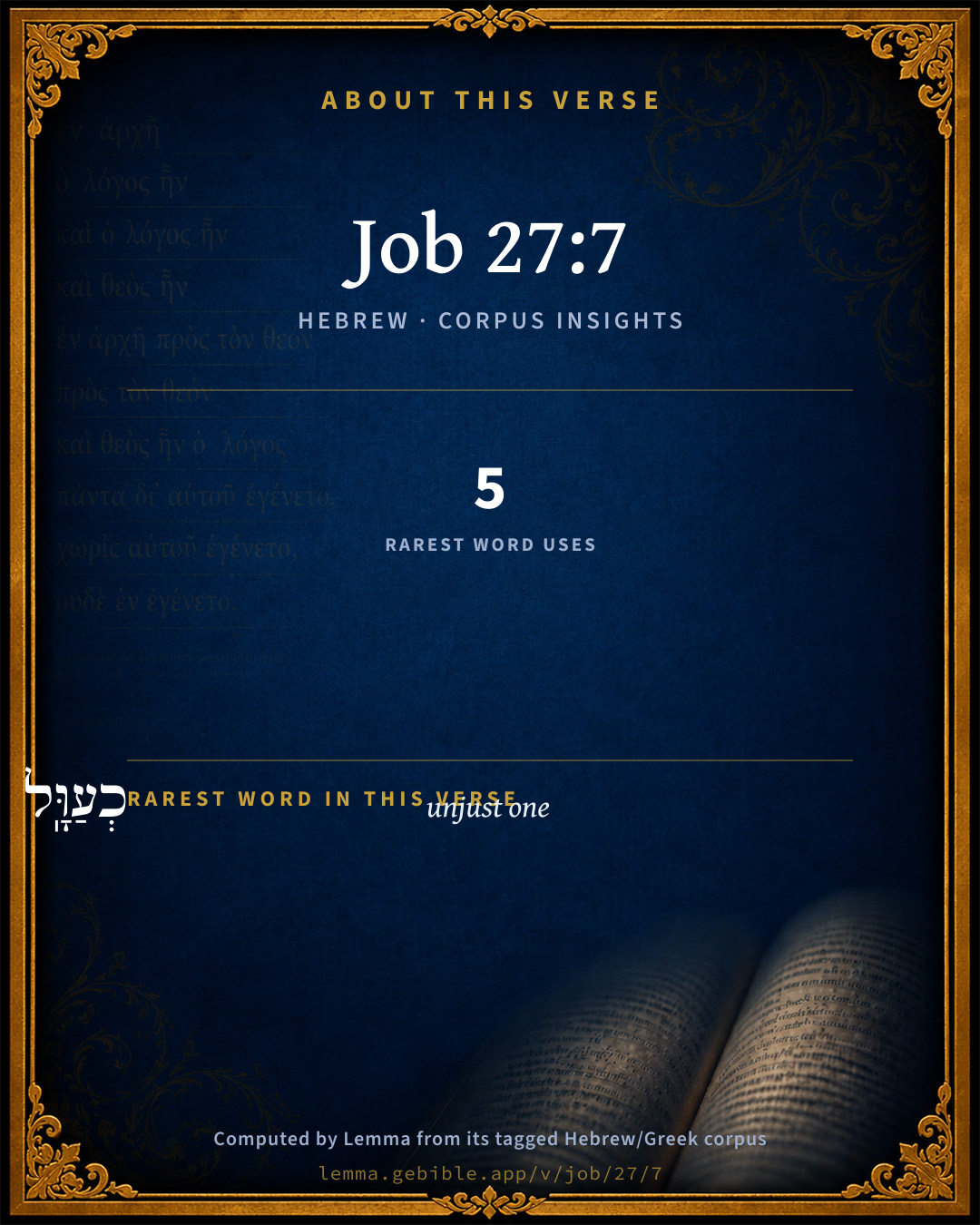
The rarest word here is כְעַוָּֽל unjust one H5767 — appearing just 5 times in the whole Hebrew Bible.

Shared distinctive vocabulary

כְעַוָּֽל unjust one H5767 occurs in 5 verses of the Hebrew Bible. Also found in:

Grammatical profile

  • 3 verbs
  • 1 noun
  • 1 adjective

Verb forms

  • יְהִ֣י Qal · Imperfect
  • אֹ֣יְבִ֑י Qal · Participle Active
  • וּמִתְקוֹמְמִ֥י Hithpolel · Participle Active

Hebrew & Septuagint length

In English translation the verse runs 18 words from the Hebrew and 25 from the Septuagint (LXX English) — closely comparable.

A rough comparison of the two English renderings, which tokenize alike — not a word-level alignment.

Word counts can differ between the Hebrew and the Greek without any difference in meaning — e.g. the Hebrew direct-object marker אֵת has no separate Greek word, and Greek often adds the article ὁ.

Cross-references

3

Topical passages linked to Job 27:7 in the Treasury of Scripture Knowledge — connected by theme and wording, ordered by reader-vote popularity; previews shown in the World English Bible.

  • Daniel 4:19 Then Daniel, whose name was Belteshazzar, was stricken mute for a while, and his thoughts troubled him. The king answered, Belteshazzar, don't let the dream, or the interpretation, trouble you. Belteshazzar answered, My lord, the dream be to those who hate you, and the interpretation of it to your adversaries.
  • 1 Samuel 25:26 Now therefore, my lord, as Yahweh lives, and as your soul lives, seeing Yahweh has withheld you from blood guiltiness, and from avenging yourself with your own hand, now therefore let your enemies, and those who seek evil to my lord, be as Nabal.
  • 2 Samuel 18:32 The king said to the Cushite, Is it well with the young man Absalom? The Cushite answered, The enemies of my lord the king, and all who rise up against you to do you hurt, be as that young man is.

Cross-references courtesy of OpenBible.info (CC BY 4.0).

Hebrew and Greek witnesses Masoretic Hebrew ↔ Greek Septuagint

The same verse in the two great witnesses to the Old Testament, shown verse-for-verse.

These are two independent witnesses, not word-aligned to each other, and the Septuagint is shown in lemma (dictionary) form.

Hebrew Job 27:7 Masoretic · Westminster Leningrad Codex

יְהִ֣י כְ֭רָשָׁע אֹ֣יְבִ֑י וּמִתְקוֹמְמִ֥י כְעַוָּֽל

"Let my enemy be as the wicked, Let him who rises up against me be as the unrighteous.

World English Bible · Public Domain

Greek LXX Job 27:7 Septuagint · lemma form

οὐ μήν δέ ἀλλά εἰμί ὁ ἐχθρός ἐγώ ὥσπερ ὁ καταστροφή ὁ ἀσεβής καί ὁ ἐπί ἐγώ ἐπιανίστημι ὥσπερ ὁ ἀπώλεια ὁ παράνομος

Nay rather, but let my enemies be as the overthrow of the ungodly, and they that rise up against me, as the destruction of transgressors.

LXX2012 (modern English Septuagint) · Public Domain

On this verse, John Gill's Exposition discusses the Septuagint’s reading. Read the note in Commentary ↓

Hebrew: Westminster Leningrad Codex (CC BY 4.0). Greek: Septuagint (public domain); English from LXX2012 (modern English Septuagint) (Public Domain). How the Septuagint differs from the Hebrew →

Commentary

Notes on Job 27:7 from classic Christian and Jewish commentators (each source and its license shown beneath its notes). The classic Christian expositions comment on the surrounding passage and are grouped to its opening verse, so a note may address several verses; the Jewish commentaries on the Tanakh (Rashi and others) are per-verse, so they appear only where the commentator wrote on this verse.

Lemma curates 59 commentaries, every one of them public domain or Creative Commons licensed, each selected and text-cleaned for this edition rather than reprinted as found. About our sources →

Matthew Henry's Commentary

Job having solemnly protested the satisfaction he had in his integrity, for the further clearing of himself, here expresses the dread he had of being found a hypocrite.

I. He tells us how he startled at the thought of it, for he looked upon the condition of a hypocrite and a wicked man to be certainly the most miserable condition that any man could be in (Job 27:7): Let my enemy be as the wicked, a proverbial expression, like that (Dan 4:19), The dream be to those that hate thee. Job was so far from indulging himself in any wicked way, and flattering himself in it, that, if he might have leave to wish the greatest evil he could think of to the worst enemy he had in the world, he would wish him the portion of a wicked man, knowing that worse he could not wish him. Not that we may lawfully wish any man to be wicked, or that any man who is not wicked should be treated as wicked; but we should all choose to be in the condition of a beggar, an out-law, a galley-slave, any thing, rather that in the condition of the wicked, though in ever so much pomp and outward prosperity.

II. He gives us the reasons of it.

1. Because the hypocrite's hopes will not be crowned (Job 27:8): For what is the hope of the hypocrite? Bildad had condemned it (Job 8:13, Job 8:14), and Zophar (Job 11:20), and Job here concurs with them, and reads the death of the hypocrite's hope with as much assurance as they had done; and this fitly comes in as a reason why he would not remove his integrity, but still hold it fast. Note, The consideration of the miserable condition of wicked people, and especially hypocrites, should engage us to be upright (for we are undone, for ever undone, if we be not) and also to get the comfortable evidence of our uprightness; for how can we be easy if the great concern lie at uncertainties? Job's friends would persuade him that all his hope was but the hope of the hypocrite, Job 4:6. "Nay," says he, "I would not, for all the world, be so foolish as to build upon such a rotten foundation; for what is the hope of the hypocrite?" See here, (1.) The hypocrite deceived. He has gained, and he has hope; this is his bright side. It is allowed that he has gained by his hypocrisy, has gained the praise and applause of men and the wealth of this world. Jehu gained a kingdom by his hypocrisy and the Pharisees many a widow's house. Upon this gain he builds his hope, such as it is. He hopes he is in good circumstances for another world, because he finds he is so for this, and he blesses himself in his own way. (2.) The hypocrite undeceived. He will at last see himself wretchedly cheated; for, [1.] God shall take away his soul, sorely against his will. Luk 12:20, Thy soul shall be required of thee. God, as the Judge, takes it away to be tried and determined to its everlasting state. He shall then fall into the hands of the living God, to be dealt with immediately. [2.] What will his hope be then? It will be vanity and a lie; it will stand him in no stead. The wealth of this world, which he hoped in, he must leave behind him, Psa 49:17. The happiness of the other world, which he hoped for, he will certainly miss of. He hoped to go to heaven, but he will be shamefully disappointed; he will plead his external profession, privileges, and performances, but all his pleas will be overruled as frivolous: Depart from me, I know you not. So that, upon the whole, it is certain that a formal hypocrite, with all his gains and all his hopes, will be miserable in a dying hour.

2. Because the hypocrite's prayer will not be heard (Job 27:9): Will God hear his cry when trouble comes upon him? No, he will not; it cannot be expected he should. If true repentance come upon him, God will hear his cry and accept him (Isa 1:18); but, if he continue impenitent and unchanged, let him not think to find favour with God. Observe, (1.) Trouble will come upon him, certainly it will. Troubles in the world often surprise those that are most secure of an uninterrupted prosperity. However, death will come, and trouble with it, when he must leave the world and all his delights in it. The judgment of the great day will come; fearfulness will surprise the hypocrites, Isa 33:14. (2.) Then he will cry to God, will pray, and pray earnestly. Those who in prosperity slighted God, either prayed not at all or were cold and careless in prayer, when trouble comes will make their application to him and cry as men in earnest. But, (3.) Will God hear him then? In the troubles of this life, God has told us that he will not hear the prayers of those who regard iniquity in their hearts (Psa 66:19) and set up their idols there (Eze 14:4), nor of those who turn away their ear from hearing the law, Pro 28:9. Get you to the gods whom you have served, Jdg 10:14. In the judgment to come, it is certain, God will not hear the cry of those who lived and died in their hypocrisy. Their doleful lamentations will all be unpitied. I will laugh at your calamity. Their importunate petitions will all be thrown out and their pleas rejected. Inflexible justice cannot be biassed, nor the irreversible sentence revoked. See Mat 7:22, Mat 7:23; Luk 13:26, and the case of the foolish virgins, Mat 25:11.

3. Because the hypocrite's religion is neither comfortable nor constant (Job 27:10): Will he delight himself in the Almighty? No, not at any time (for his delight is in the profits of the world and the pleasures of the flesh, more than in God), especially not in the time of trouble. Will he always call upon God? No, in prosperity he will not call upon God, but slight him; in adversity he will not call upon God but curse him; he is weary of his religion when he gets nothing by it, or is in danger of losing. Note, (1.) Those are hypocrites who, though they profess religion, neither take pleasure in it nor persevere in it, who reckon their religion a task and a drudgery, a weariness, and snuff at it, who make use of it only to serve a turn, and lay it aside when the turn is served, who will call upon God while it is in fashion, or while the pang of devotion lasts, but leave it off when they fall into other company, or when the hot fit is over. (2.) The reason why hypocrites do not persevere in religion is because they have no pleasure in it. Those that do not delight in the Almighty will not always call upon him. The more comfort we find in our religion the more closely we shall cleave to it. Those who have no delight in God are easily inveigled by the pleasures of sense, and so drawn away from their religion; and they are easily run down by the crosses of this life, and so driven away from their religion, and will not always call upon God.

Matthew Henry's Commentary on the Whole Bible (1708–1710) — public domain (CC PDM 1.0). Text via the HelloAO Bible API.

The Cambridge Bible for Schools and Colleges

gen. ed. J. J. S. Perowne

7. In Job_27:2-6 Job protested his sincerity in affirming his innocence. With Job_27:7 commences a description of the misery of mind, and the outward destruction at the hand of God, which are the portion of the unrighteous. The “wicked” is the subject throughout to the end of the chapter; therefore in the words “let mine enemy be as the wicked” the emphasis falls on “wicked.” The words express the speaker’s abhorrence of the “wicked,” they do not imprecate evil on his “enemy.” It it understood that he wishes his “enemy” ill, and he can wish him nothing worse than that he should be as the “wicked”—so much does he himself shrink from the thought of being as the wicked are. Others (e.g. Delitzsch) put the emphasis on “enemy,” taking that expression to mean “him who accuses me of iniquity”—mine enemy must appear an evil-doer, inasmuch as he charges me falsely. This makes the verse a mere parenthetical imprecation by Job on his friends, for the words taken in this sense have no connexion with Job_27:8-10. The speaker, rather, repudiates the idea of his being one of the wicked, and he does so because he shudders to think that the condition of the mind of the wicked man, who has no hope in God, should be his—his condition of mind is very different (Job_27:8-10). Still even when taken in this, their only natural sense, the words of Job_27:7 have no strict logical connexion with Job_27:2-6. The connexion is: “I will never cease to maintain that I am a righteous man, for how comfortless in calamity is the condition of the wicked!” while strictly it should be: “I will never cease holding on to the way of righteousness, for how comfortless in affliction is the wicked man, having no hope in God!” So far as the mere language of Job_27:5-6 is concerned, the expressions “I will not remove mine integrity from me,” “and my righteousness I hold fast,” might have the meaning “I will continue to live a righteous life” (comp. ch. Job_2:9), but such a meaning is absolutely excluded here by the connexion and general scope of Job_27:2-6.

7–10. The dreary and desolate condition of the mind of the wicked man in affliction.

The Cambridge Bible for Schools and Colleges (gen. ed. J. J. S. Perowne; Cambridge University Press, 1878–1918) — public domain. Text from a community e-Sword module.

Trapp's Complete Commentary

John Trapp

Job 27:7 Let mine enemy be as the wicked, and he that riseth up against me as the unrighteous.

Ver. 7. Let mine enemy be as the wicked] q.d. I need wish my greatest enemy no greater harm than to be as the wicked, for then he is sure to be wretched. So far am I from saying that God favoureth the wicked, or that he always suffereth them to escape unpunished.

And he that riseth up against me, as the unrighteous] Or, froward and perverse. This is the same again in other words; and it is well noted to be a popular manner of speaking, wherein when men express an abomination of a thing, they wish it to their enemies; taking it for granted that the power of malice is so great that no man can express it in the wish of any particular evil. See the like phrase 2Sa 8:2-3 1Sa 25:26 Dan 4:27.

John Trapp, A Commentary or Exposition upon All the Books of the Old and New Testament (1647–1656) — public domain. Text from a community e-Sword module.

Joseph Benson's Commentary

Job 27:7. Let mine enemy be as the wicked — I am so far from loving and practising wickedness, whereof you accuse me, that I abhor the thoughts of it; and if I might and should wish to be revenged of mine enemy, I could wish him no greater mischief than to be a wicked man. This does not imply that we may lawfully wish any man to be wicked, or that any man who is not wicked should be treated as wicked; but we ought all rather to choose to be in the condition of a beggar, an outlaw, a galley-slave, any thing rather than in the condition of the wicked, though in ever so much outward pomp and prosperity.

Joseph Benson's Commentary on the Old and New Testaments (1811–1818) — public domain. Text from a community e-Sword module.

Jamieson, Fausset & Brown

Robert Jamieson, A. R. Fausset & David Brown

Let . . . be--Let mine enemy be accounted as wicked, that is, He who opposes my asseveration of innocence must be regarded as actuated by criminal hostility. Not a curse on his enemies.

Jamieson, Fausset & Brown — Commentary Critical and Explanatory on the Whole Bible (1871) — public domain (CC PDM 1.0). Text via the HelloAO Bible API.

Adam Clarke's Commentary

Verse 7. Let mine enemy be as the wicked] Let my accuser be proved a lying and perjured man, because he has laid to my charge things which he cannot prove, and which are utterly false.

Adam Clarke's Commentary on the Bible (1810–1826) — public domain. Text from a community e-Sword/MySword module.

Ellicott's Commentary for English Readers

(7) Let mine enemy be as the wicked.—While, however, he admits that the wicked is often a prosperous man, he declares that he has no envy for him, but would have only his adversaries to be like him.

A Bible Commentary for English Readers, edited by Charles John Ellicott (1878–1897) — public domain. Text from a community e-Sword module.

John Gill's Exposition

Let mine enemy be as the wicked,.... Job in this, and some following verses, shows, that he was not, and could not, and would not be a wicked man and an hypocrite, or however had no opinion and liking of such persons; for whatever his friends might think of him, because he had said so much of their outward prosperity in this world; yet he was far from approving of or conniving at their wickedness and hypocrisy, or choosing them for his companions, and joining with them in their actions, or imagining they were really happy persons; so far from it, that he would not be in their condition and circumstances for all the world: for if he was to wish a bad thing to the greatest enemy he had, he could not wish him any worse than to be as a wicked and unrighteous man; that is, to be a wicked and unrighteous man; which it is impossible for a good man to wish, and indeed would be a needless wish, since all that are enemies to good men, as such, must be wicked; and such were Job's enemies, as the Chaldeans and Sabeans; but that they might be as such, in their state and circumstances, or rather as they will be in the consequence of things, most wretched and miserable; for they are always under the displeasure of God, and hated by him; and whatever fulness they may have of the things of this world, they have them with a curse, and they are curses to them, and their end will be everlasting ruin and destruction; wherefore the Septuagint version is,

"as the overthrow of the ungodly, and as the perdition of transgressors;''

though some take this to be a kind of an ironic imprecation, and that by the wicked man here, and unrighteous in the next clause, he means himself, whom his friends reckoned a wicked and unrighteous man; and then the sense is, I wish you all, my friends, and even the worst enemies I have, were but as wicked Job is, as you call him; not that he wished they might be afflicted in body, family, and estate, as he was, but that they were as good men as he was, and partook of as much of the grace of God as he did, and had the same integrity and righteousness as he had, see Act 26:29; and such a wish as this, as it serves to illustrate his own character, so it breathes charity and good will to others; and indeed it cannot be thought the words are to be taken in such a sense as that he wished the same evils might be retorted upon his enemies, whether open or secret, which they were the means of bringing upon him, which was contrary to the spirit of Job, Job 31:29. Some consider them not as an imprecation, but as a prediction, "mine enemy shall be as the wicked" (e); and may have respect to his friends, who were so ready to charge him with wickedness, and suggests that in the issue of thin; they would be found, and not he, guilty of sin folly, and to have said the things that were not right, neither of God, nor of him, which had its accomplishment, Job 42:7;

and he that riseth up against me as the unrighteous; which is but another way of expressing the same thing; for an enemy, and one that rises up against a man, is the same person; only this the better explains what enemy is intended, even an open one, that rises up in an hostile manner, full of rage and fury; and so a wicked and an unrighteous man are the same, and are frequently put together as describing the same sort of persons, see Isa 55:7.

(e) "erit ut impius inimieus meus", Pagninus, Montanus, Boldacius; so Junius & Tremellius, Broughton, & Ramban.

John Gill's Exposition of the Whole Bible (1746–1763) — public domain (CC PDM 1.0). Text via the HelloAO Bible API.

Albert Barnes' Notes on the Bible

Let mine enemy be as the wicked - This is probably said that he might show that it was not his intention to justify the wicked, and that in all that he had said it was no part of his purpose to express approbation of their course. His friends had charged him with this; but he now solemnly disclaims it, and says that he had no such design. To show how little he meant to justify the wicked, he says that the utmost that he could desire for an enemy would be, that he would be treated as he believed the wicked would be. A similar expression occurs in Dan 4:19, “My lord, the dream be to them that hate thee, and the interpretation thereof to thine enemies;” that is, calamities are coming upon thee indicated by the dream, such as you would desire on your foes; so in Jdg 5:31. After the mother of Sisera had anxiously looked for the return of her son from the battle, though he was then slain, the sacred writer adds, “So let all thine enemies perish, O Lord.” Thus, when a traitor is executed it is common for the executioner to hold up his head and say, “So let all the enemies of the king die.” Job means to say that he had no sympathy with wicked people, and that he believed that they would be punished as certainly and as severely as one could desire his enemy to suffer. Schnurrer supposes that by the enemy here he refers to his friends with whom he had been disputing; but this is to give an unnecessarily harsh construction to the passage.

Albert Barnes' Notes on the Bible (1834–1885) — public domain. Text from a community e-Sword/MySword module.

Haydock's Catholic Bible Commentary

Enemy, or opponent. Hebrew, "my enemy shall be," &c. (Haydock) --- In effect, those who maintained the contrary to what Job taught, favoured the cause of impiety, as they represented God never punishing his servants, &c., (Calmet) which is contrary to experience; (Haydock) though it was not so evident at that time. (Houbigant) --- Job is so far from thinking riches a proof of sanctity, that he rather would wish his enemy to have them, (Menochius) as they are too frequently an incentive to sin. (Haydock)

George Leo Haydock (1774–1849), Haydock's Catholic Family Bible and Commentary, 1859 edition — public domain. Excludes Psalms (Douay-Rheims chapter numbering differs from Protestant) and Deuterocanonical books (Catholic canon only).

Matthew Poole's English Annotations

I am so far from loving and practising wickedness, whereof you accuse me, that I abhor the thoughts of it; and if I might and would wish to be revenged of mine enemy, I could wish him no greater mischief than to be a wicked man.

He that riseth up against me; either,

1. You my friends, who, instead of comforting me, are risen up to torment me. Or rather,

2. My worst enemies.

Matthew Poole's English Annotations on the Holy Bible (1683–1685) — public domain. Text from a community e-Sword/MySword module.

Whedon's Commentary on the Bible

Daniel D. Whedon

7. Let mine enemy be, etc. — Rather, Mine enemy must appear as the wicked, etc. The sentiments his antagonists have expressed are such as are held by the wicked. They who counsel to acts of hypocrisy as these had done, should be regarded as wicked. There is here no imprecation. It is simply the announcement of an important truth: he who consciously antagonizes truth must be himself accounted as untrue.

Daniel D. Whedon (gen. ed.), Commentary on the Old and New Testaments (1874–1909) — public domain. Text from a community e-Sword module.

The Pulpit Commentary

Let mine enemy be as the wicked. The nexus of this passage with what goes before is uncertain. Some suppose Job"s full thought to have been, "Ye try to persuade me to act wickedly by making a false representation of my feelings and convictions; but I absolutely refuse to do so. Let that rather be the act of my enemy." Others regard him as simply so vexed by his pretended friends, who are his real enemies, that he is driven to utter an imprecation against them. And he that riseth up against me as the unrighteous. This is another instance of a mere pleonastic hemistich a repetition of the preceding clause in different words.

The Pulpit Commentary (1880–1919), ed. H.D.M. Spence-Jones & Joseph S. Exell — public domain. Text from a community e-Sword module.

John Wesley's Explanatory Notes

Let - I am so far from practicing wickedness, that I abhor the thoughts of it, and if I would wish to be revenged of my enemy, I could wish him no greater mischief than to be a wicked man.

John Wesley, Explanatory Notes Upon the Whole Bible (1754–1765) — public domain. Text via the GEBible commentary corpus.

Lesson kit

Teaching starters — assembled from the data on this page, not authored interpretation. Every prompt links to the verse data it draws on. Edit before teaching.

Job, in the Wisdom, opens this verse with 5 words (5 distinct Hebrew lemmas). Its most distinctive word is ʻavvâl (“unjust one”). A historical commentator’s framing appears above. Read the whole chapter for the surrounding context.

Discussion questions

  1. What does “unjust one” (ʻavvâl) contribute to the verse as a whole?
  2. How does Job 18:21, which shares the word «unjust one», read alongside this verse?
  3. These translations render this verse differently. What is at stake in choosing one wording over another?
  4. «יְהִ֣י» is a Qal Imperfect verb. How does that grammatical form shape the action described?
  5. Compare how Matthew Henry's Commentary and The Cambridge Bible for Schools and Colleges read this verse. Where do they agree or differ?

Things to notice

Reading settings

Reading text

Shown beneath each verse's original-language words.

Old Testament
Old Testament edition

Read the OT as the Masoretic Hebrew (MT) or the Greek Septuagint (LXX).

English shown for the Greek Septuagint (in the Hebrew ↔ Greek comparison).

Comparing translations? Open the Compare panel on any verse page to stack up to four side by side.