
Proverbs 3:25

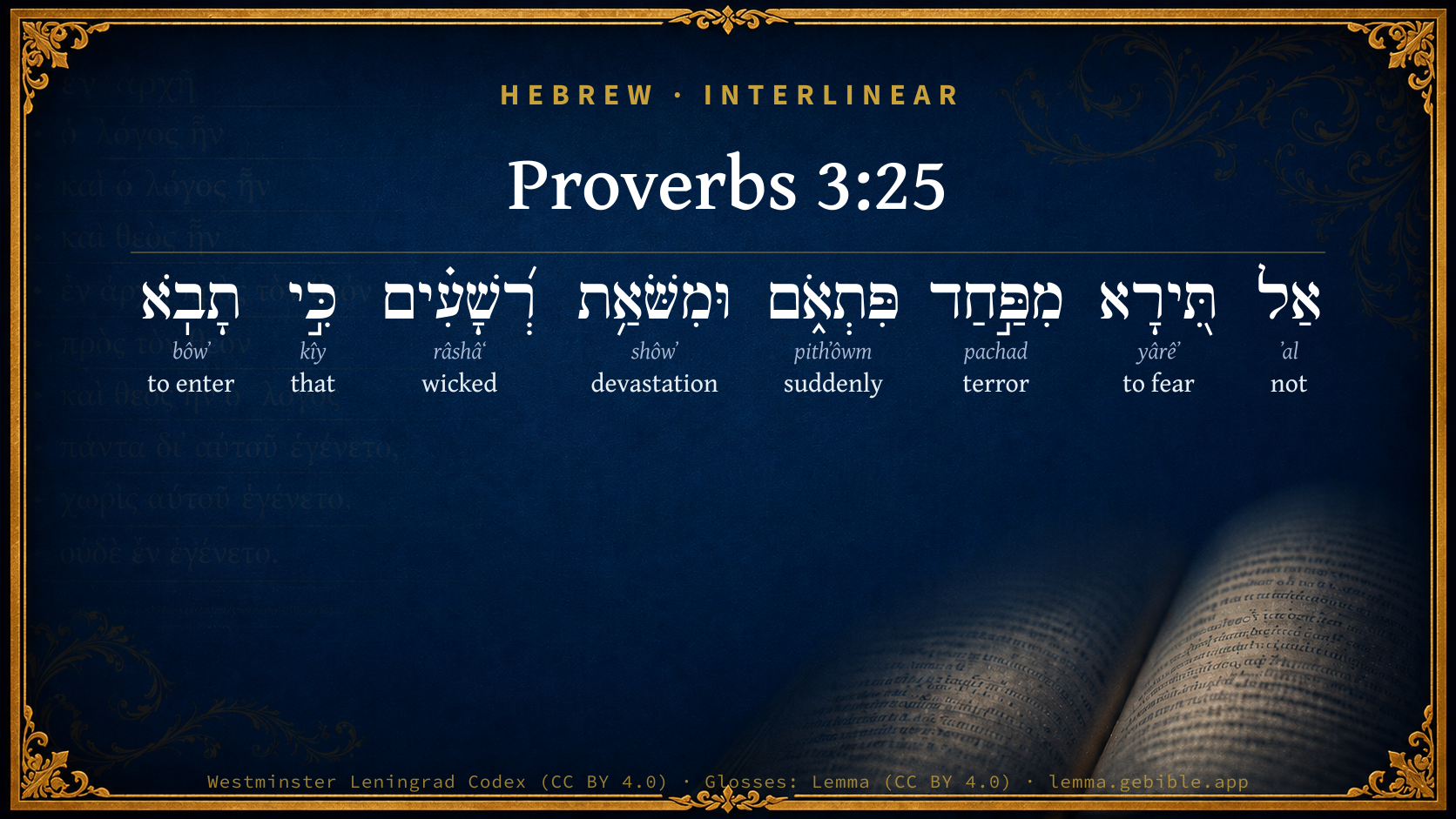
Hebrew (Westminster Leningrad Codex) Proverbs 3:25 appears in the Hebrew Old Testament. The text above is from the Westminster Leningrad Codex. Each word links to its Strong’s number, a concise gloss, and parsing drawn from the Open Scriptures Hebrew Bible morphology. Click any word for its full Brown-Driver-Briggs (BDB) entry.
Download image
Cite this verse

Proverbs 3:25 (World English Bible). Public Domain. Lemma interlinear Bible study tool, https://lemma.gebible.app/v/proverbs/3/25.

Show BibTeX & RIS
BibTeX
RIS
English Translation
Don't be afraid of sudden fear, Neither of the desolation of the wicked, when it comes:
World English Bible · Public Domain
Download a study sheet

One document with this verse’s original text, its word-by-word gloss line, the meaning frame, cross-references with their text, attributed commentary, and full source and license credits — printable, and it pastes into notes with its structure intact.

This verse Autodidact and up

Study sheet (.html) Plain text (.txt)

A passage Seminary Student

Up to 50 verses in one chapter. A passage sheet keeps up to 6 commentary sources and 12 cross-references per verse, in the order this page ranks them, and says so on the sheet whenever that leaves anything out. Ask for a single verse and you get the Autodidact verse sheet above.

Everything on this page stays free to read, with no account — the sheet is a download of what is already on screen, not access to it.

Want to remove ads? Support Godless Engineer
Compare translations 3

The same verse in 3 English versions, stacked beneath the original-language interlinear above. Click any original word for its lexicon entry.

Each is an independent rendering of the whole verse — the interlinear is not word-aligned to these translations.

Highlighted words mark where these versions differ — a whole-verse word diff, not a word-by-word alignment.

  • World English Bible Public Domain
    Don't be afraid of sudden fear, Neither of the desolation of the wicked, when it comes:
  • King James Version Public Domain
    Be not afraid of sudden fear, neither of the desolation of the wicked, when it cometh.
  • unfoldingWord Literal Text CC BY-SA 4.0
    Do not be afraid of sudden dread and of the devastation of the wicked when it comes.

unfoldingWord Literal Text — © unfoldingWord, licensed CC BY-SA 4.0. Word-aligned USFM3 via Door43 (git.door43.org/unfoldingWord/en_ult).

Versions to compare (up to 4)

3 of 4 selected

Show all 18 translations

Every available English version of this verse, each an independent rendering of the whole verse.

  • World English Bible Public Domain
    Don't be afraid of sudden fear, Neither of the desolation of the wicked, when it comes:
  • Berean Standard Bible Public Domain
    Do not fear sudden danger or the ruin that overtakes the wicked,
  • Majority Standard Bible Public Domain
    Do not fear sudden danger or the ruin that overtakes the wicked,
  • King James Version Public Domain
    Be not afraid of sudden fear, neither of the desolation of the wicked, when it cometh.
  • American Standard Version (1901) Public Domain
    Be not afraid of sudden fear, Neither of the desolation of the wicked, when it cometh:
  • Revised Version (1885) Public Domain
    Be not afraid of sudden fear, neither of the desolation of the wicked, when it cometh:
  • Geneva Bible (1599) Public Domain
    Thou shalt not feare for any sudden feare, neither for the destruction of the wicked, when it commeth.
  • Douay-Rheims (1899) Public Domain
    Be not afraid of sudden fear, nor of the power of the wicked falling upon thee.
  • Young's Literal Translation Public Domain
    Be not afraid of sudden fear, And of the desolation of the wicked when it cometh.
  • Literal Standard Version CC BY-SA 4.0
    Do not be afraid of sudden fear, || And of the desolation of the wicked when it comes.
  • Unlocked Literal Bible CC BY-SA 4.0
    Do not be afraid of sudden terror or devastation caused by the wicked, when it comes,
  • unfoldingWord Literal Text CC BY-SA 4.0
    Do not be afraid of sudden dread and of the devastation of the wicked when it comes.
  • Darby Bible Public Domain
    Be not afraid of sudden fear, neither of the destruction of the wicked, when it cometh;
  • World Messianic Bible Public Domain
    Don’t be afraid of sudden fear, neither of the desolation of the wicked, when it comes;
  • Webster's Bible Public Domain
    Be not afraid of sudden fear, neither of the desolation of the wicked, when it cometh.
  • Free Bible Version CC BY-SA 4.0
    You won't be afraid of a sudden panic, or of disasters that hit the wicked,
  • Bible in Basic English Public Domain
    Have no fear of sudden danger, or of the storm which will come on evil-doers:
  • JPS Tanakh (1917) Public Domain
    Be not afraid of sudden terror, neither of the destruction of the wicked, when it cometh;

Literal Standard Version (2020), Covenant Press — licensed CC BY-SA 4.0. Text via the HelloAO Bible API (eBible.org). Unlocked Literal Bible (unfoldingWord) — licensed CC BY-SA 4.0. Text via the HelloAO Bible API (eBible.org). unfoldingWord Literal Text — © unfoldingWord, licensed CC BY-SA 4.0. Word-aligned USFM3 via Door43 (git.door43.org/unfoldingWord/en_ult). Free Bible Version, Dr. Jonathan Gallagher — licensed CC BY-SA 4.0. Text via the HelloAO Bible API (eBible.org).

Word by word

More ways to search: Search by grammar → Find every occurrence → Compare this word →

Practice this passage: Drill this verse → Learn its vocabulary →

About this verse

These counts appear in no published source. They are computed here, from the morphology-tagged text and Lemma’s own curated glosses. What Lemma adds →

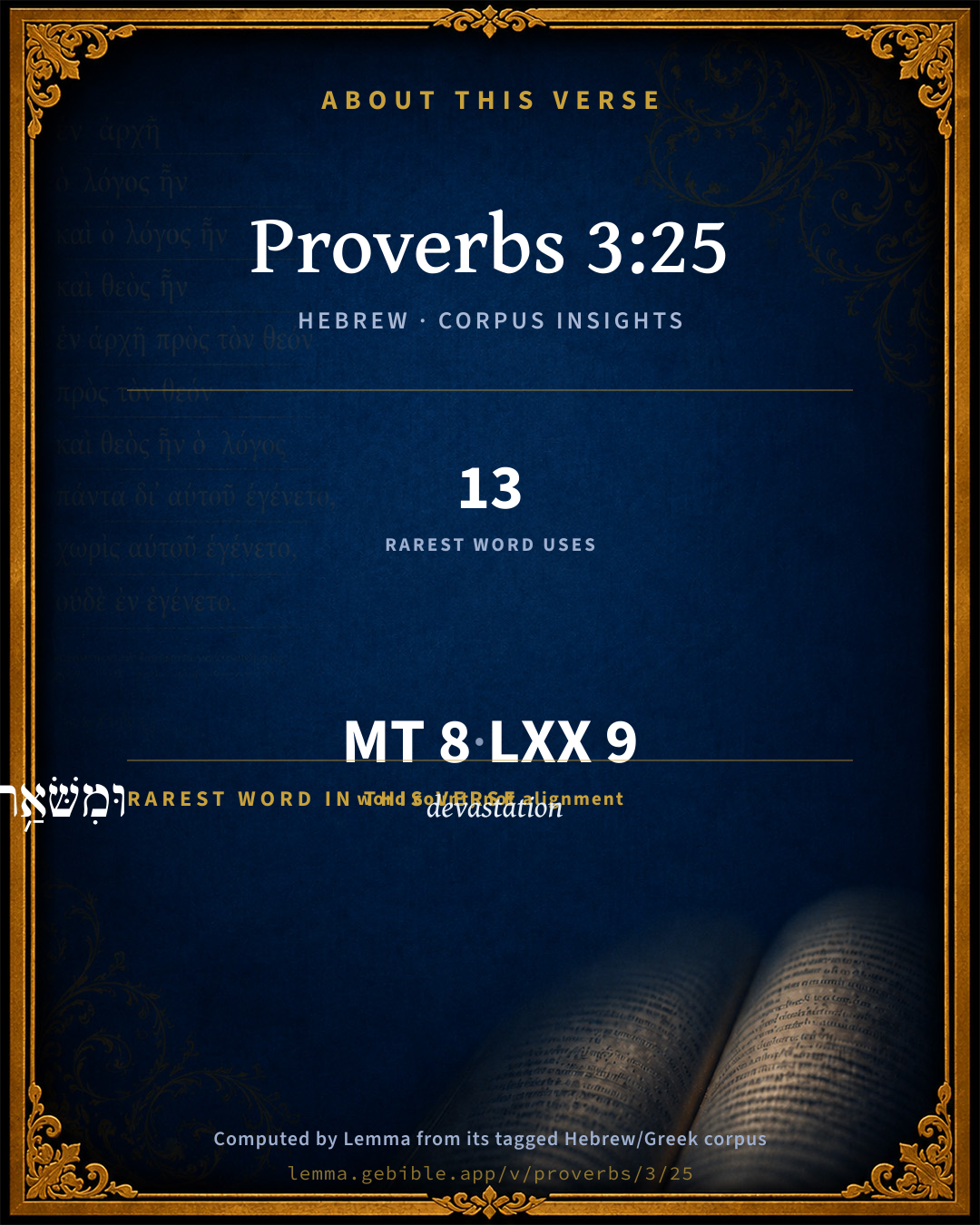
8
words
8
distinct lemmas
Wisdom
section

Notable vocabulary

The rarest word here is וּמִשֹּׁאַ֥ת devastation H7722 — appearing just 13 times in the whole Hebrew Bible.

Shared distinctive vocabulary

וּמִשֹּׁאַ֥ת devastation H7722 occurs in 12 verses of the Hebrew Bible. Also found in:

Grammatical profile

  • 2 verbs
  • 2 nouns
  • 1 adjective
  • 1 conjunction
  • 1 adverb
  • 1 particle

Verb forms

  • תִּ֭ירָא Qal · Jussive
  • תָבֹֽא Qal · Imperfect

Hebrew & Septuagint length

In English translation the verse runs 16 words from the Hebrew and 18 from the Septuagint (LXX English) — closely comparable.

A rough comparison of the two English renderings, which tokenize alike — not a word-level alignment.

Word counts can differ between the Hebrew and the Greek without any difference in meaning — e.g. the Hebrew direct-object marker אֵת has no separate Greek word, and Greek often adds the article ὁ.

In the original languages it is 8 Hebrew tokens and 9 Greek tokens — but the two are counted differently (Hebrew bundles its prefixes and suffixes into one token; the Greek is in lemma form), so that isn’t a like-for-like length.

Cross-references

19

Topical passages linked to Proverbs 3:25 in the Treasury of Scripture Knowledge — connected by theme and wording, ordered by reader-vote popularity; previews shown in the World English Bible.

  • Isaiah 41:10–14 Don't you be afraid, for I am with you; don't be dismayed, for I am your God; I will strengthen you; yes, I will help you; yes, I will uphold you with the right hand of my righteousness.
  • Psalms 112:7 He will not be afraid of evil news. His heart is steadfast, trusting in Yahweh.
  • Psalms 91:5 You shall not be afraid of the terror by night, Nor of the arrow that flies by day;
  • 1 Peter 3:14 But even if you should suffer for righteousness' sake, you are blessed. "Don't fear what they fear, neither be troubled."
  • Isaiah 8:12–13 Don't you say, "A conspiracy!" concerning all about which this people shall say, "A conspiracy!" neither fear their fear, nor be in dread [of it].
  • Job 11:13–15 "If you set your heart aright, Stretch out your hands toward him.
  • Psalms 46:1–3 God is our refuge and strength, A very present help in trouble.
  • Matthew 8:24–26 Behold, a great tempest arose in the sea, so much that the boat was covered with the waves, but he was asleep.
  • Matthew 24:6 You will hear of wars and rumors of wars. See that you aren't troubled, for all this must happen, but the end is not yet.
  • Luke 21:18–28 And not a hair of your head will perish.
  • Psalms 27:1–2 Yahweh is my light and my salvation. Whom shall I fear? Yahweh is the strength of my life. Of whom shall I be afraid?
  • Psalms 73:19 How they are suddenly destroyed! They are completely swept away with terrors.
  • Daniel 3:17–18 If it be [so], our God whom we serve is able to deliver us from the burning fiery furnace; and he will deliver us out of your hand, O king.
  • Mark 4:40 He said to them, "Why are you so afraid? How is it that you have no faith?"
  • John 14:1 "Don't let your heart be troubled. Believe in God. Believe also in me.
  • Job 5:21–22 You shall be hidden from the scourge of the tongue, Neither shall you be afraid of destruction when it comes.
  • Proverbs 1:27 When calamity overtakes you like a storm, When your disaster comes on like a whirlwind; When distress and anguish come on you.
  • Matthew 24:15 "When, therefore, you see the abomination of desolation, which was spoken of through Daniel the prophet, standing in the holy place (let the reader understand),
  • Luke 21:9 When you hear of wars and disturbances, don't be terrified, for these things must happen first, but the end won't come immediately."

Cross-references courtesy of OpenBible.info (CC BY 4.0).

Hebrew and Greek witnesses Masoretic Hebrew ↔ Greek Septuagint

The same verse in the two great witnesses to the Old Testament, shown verse-for-verse.

These are two independent witnesses, not word-aligned to each other, and the Septuagint is shown in lemma (dictionary) form.

Hebrew Proverbs 3:25 Masoretic · Westminster Leningrad Codex

אַל תִּ֭ירָא מִפַּ֣חַד פִּתְאֹ֑ם וּמִשֹּׁאַ֥ת רְ֝שָׁעִ֗ים כִּ֣י תָבֹֽא

Don't be afraid of sudden fear, Neither of the desolation of the wicked, when it comes:

World English Bible · Public Domain

Greek LXX Proverbs 3:25 Septuagint · lemma form

καί οὐ φοβέω πτόησις ἐπιἔρχομαι οὐδέ ὁρμή ἀσεβής ἐπιἔρχομαι

And you shall not be afraid of alarm coming upon you, neither of approaching attacks of ungodly men.

LXX2012 (modern English Septuagint) · Public Domain

On this verse, The Pulpit Commentary discusses the Septuagint’s reading. Read the note in Commentary ↓

Hebrew: Westminster Leningrad Codex (CC BY 4.0). Greek: Septuagint (public domain); English from LXX2012 (modern English Septuagint) (Public Domain). How the Septuagint differs from the Hebrew →

Commentary

Notes on Proverbs 3:25 from classic Christian and Jewish commentators (each source and its license shown beneath its notes). The classic Christian expositions comment on the surrounding passage and are grouped to its opening verse, so a note may address several verses; the Jewish commentaries on the Tanakh (Rashi and others) are per-verse, so they appear only where the commentator wrote on this verse.

Lemma curates 59 commentaries, every one of them public domain or Creative Commons licensed, each selected and text-cleaned for this edition rather than reprinted as found. About our sources →

The Cambridge Bible for Schools and Colleges

gen. ed. J. J. S. Perowne

25. Be not afraid] Dean Plumptre (Speaker’s Comm.) points out that, “under the form of this strong prohibition there is of course an equally strong promise,” so that these two verses add yet another to the advantages to be gained from Wisdom: it confers both strength and beauty (Pro_3:22); it preserves alike in action and in repose (Pro_3:23-24); it is equal to every emergency of life (Pro_3:25-26).

desolation] or, storm, R.V. marg.

of the wicked] This may mean, brought upon thee by the wicked. So Maurer, who compares, “rescue my soul from their destructions.” Psa_35:17; and Vulg. irruentes tibi potentias impiorum. But it is perhaps better to understand it of the desolation or storm which comes upon the wicked. Comp. Psa_91:8.

Pro_3:27-35. There is a marked change of style in these verses, and they are regarded by Maurer (who describes them as singularia aliqua prœcepta) and others as a separate section. The continuous address is exchanged for the concise sentences or “proverbs,” which form the bulk of the Book.

The Cambridge Bible for Schools and Colleges (gen. ed. J. J. S. Perowne; Cambridge University Press, 1878–1918) — public domain. Text from a community e-Sword module.

Trapp's Complete Commentary

John Trapp

Pro 3:25 Be not afraid of sudden fear, neither of the desolation of the wicked, when it cometh.

Ver. 25. Be not afraid.] Or, Thou shalt not be afraid. Nec si fractus illabatur orbis. Sudden evils do commonly disspirit people, and expectorate their abilities; they be at their wits’ end. But let a David "walk through the vale of the shadow of death," that is, the darkest side of death - death in its most horrid and hideous representations, he will not fear, no though he should go back again the same way; "for thou art with me," saith he. {Psa 23:4} He had God by the hand, and so long he feared no colours.

John Trapp, A Commentary or Exposition upon All the Books of the Old and New Testament (1647–1656) — public domain. Text from a community e-Sword module.

The Biblical Illustrator

Joseph S. Exell

Pro_3:25-26

Be not afraid of sudden fear, neither of the desolation of the wicked, when it cometh.

For the Lord shall be thy confidence.

Confident attitude of Gods people

When God is abroad in judgments, He would not have His people alarmed. He has not come forth to harm, but to defend the righteous.

I. He would have them manifest courage. We who enjoy the presence of God ought to display presence of mind. Since the Lord Himself may suddenly come, we ought not to be surprised at anything sudden. Serenity under the rush and roar of unexpected evils is a precious gift of Divine love.

II. The Lord would have His chosen display discrimination, so that they may see that the desolation of the wicked is not a real calamity to the universe. Sin alone is evil; the punishment which follows thereupon is as a preserving salt to keep society from putrefying. We should be far more hocked at the sin which deserves hell than at the hell which comes out of sin.

III. So, too, should the Lords people exhibit great quietness of spirit. Satan and his serpent seed are full of all subtilty; but those who walk with God shall not be taken in their deceitful snares. Go on, believe in Jesus, and let the Lord be thy confidence. (C. H. Spurgeon.)

The Biblical Illustrator, edited by Joseph S. Exell (c. 1880s–1900s) — public domain. Text from a community e-Sword module.

Geneva Bible (1599)

Geneva Bible translators

For when God destroyeth the wicked, he will save his as he did Lot in Sodom.

Geneva Bible (1599) marginal notes — public domain. Text via Bolls.life.

Jamieson, Fausset & Brown

Robert Jamieson, A. R. Fausset & David Brown

Be not--or, "You shall not be."

sudden fear--what causes it (Pro 1:27), any unlooked-for evil (Psa 46:3; Psa 91:12; Pe1 3:14).

desolation-- (Pro 1:27).

Jamieson, Fausset & Brown — Commentary Critical and Explanatory on the Whole Bible (1871) — public domain (CC PDM 1.0). Text via the HelloAO Bible API.

Ellicott's Commentary for English Readers

(25) Desolation of the wicked.—That is, the storm which overwhelms them.

A Bible Commentary for English Readers, edited by Charles John Ellicott (1878–1897) — public domain. Text from a community e-Sword module.

John Gill's Exposition

Be not afraid of sudden fear,.... Of anything terrible that comes unawares, unthought of, by any of the above things mentioned in the preceding note; or by any rumours and reports of danger being near at hand; always think thyself safe in the arms of Wisdom, and under the care of Israel's keeper, who neither slumbers nor sleeps;

neither of the desolation of the wicked when it cometh; either of the desolation which wicked men threaten to bring, and are suffered to bring, upon the godly for the sake of religion; either on their persons or goods, since suffering at their hands in such a cause is to the honour of saints, and for the glory of God; or of the desolation which comes upon the godly, for God is able to deliver him from it, as Noah and his family from the universal deluge, and Lot and his family from Sodom and Gomorrah; or if they promiscuously fall in it, nevertheless it will be well with them to all eternity.

John Gill's Exposition of the Whole Bible (1746–1763) — public domain (CC PDM 1.0). Text via the HelloAO Bible API.

Albert Barnes' Notes on the Bible

Under the form of this strong prohibition there is an equally strong promise. So safe will all thy ways be that to fear will be a sin.

Albert Barnes' Notes on the Bible (1834–1885) — public domain. Text from a community e-Sword/MySword module.

Matthew Poole's English Annotations

Be not afraid, i.e. thou shalt not be afraid. For that it is a promise, seems most probable from the context; only it is for greater emphasis delivered in the form of a precept; I allow thee and require thee not to be afraid, which is both thy duty and privilege.

Of sudden fear; for sudden and unexpected evils are most frightful and grievous. And fear is here put for the evils feared, as Pro 1:26,27, and oft elsewhere. The desolation of the wicked; either,

1. Actively, which they bring upon thee. Or, rather

2. Passively, which befalls them, when the Lord cometh out of his place to punish the inhabitants of the earth for their iniquity, as it is expressed, Isa 26:21; and thou mayst be apt to fear lest thou shouldst be involved in the common calamity; but fear not, for God will then hide thee in his chambers, as he promised, Isa 26:20.

Matthew Poole's English Annotations on the Holy Bible (1683–1685) — public domain. Text from a community e-Sword/MySword module.

Whedon's Commentary on the Bible

Daniel D. Whedon

25. Be not afraid — The imperative form here is put for a strong indicative. Thou shalt not, or needest not, be afraid of any sudden fear, or object of terror. Desolation of… wicked may mean either the desolation which the wicked produce, or that which befalls them. The latter, or passive sense, is here preferred by most: be not afraid of being involved in the overthrow of the wicked.

Daniel D. Whedon (gen. ed.), Commentary on the Old and New Testaments (1874–1909) — public domain. Text from a community e-Sword module.

The Pulpit Commentary

Be not afraid; al-tirah, is literally "fear thou not," the future with al preceding being used for the imperative in a dehortative sense, as in Gen 46:3Jo Gen_3:4, Gen_3:6, 7 (see Gesenius, "Gram.," 3, c); Vulgate, ne paveas. Others, however, render, as the LXX, ou fobhyhsh , "Thou shalt not be afraid," in the sense of a promise. The verb yare, from which tirah, is here followed by min, as in Psa_3:7 Psa_27:1, and properly means "to be afraid from or before" some person or thing. Sudden; pithom, an adverb used adjectively. (cf. like use of adverb khinnam in Pro_26:2) Fear (pakhad ); as in Pro_1:16, the object which excites terror or fear, as any great disaster. The desolation of the wicked (shoath r"shaim) may be taken either

(1) as the desolation made by the violence of the wicked, the desolation or strum which they raise against the righteous (so the LXX, Vulgate, Mariana, Michaelis, Hitzig, and others); or

(2) the desolation which overtakes the wicked, the desolating vengeance executed upon them (so Doderlein, Lapide, Stuart, Muensch., Delitzsch, Wardlaw). The latter is probably the right interpretation, and agrees with the threatening language of Wisdom against her despisers, in Pro_1:27, where shdath also occurs. Iu the desolation which shall overwhelm the wicked he who has made Wisdom his guide shall be undismayed, for the Lord is his confidence. The passage was probably suggested by Pro_5:21, "Neither shalt thou be afraid of desolation when it cometh." Lee, in loc. cit., says the places are almost innumerable where this sentiment occurs. Compare the fearlessness of the man of integrity and justice, in Horace"Si fractus illabatur orbis, Impavidum ferient ruinae. (Horace, "Od.," 3:3, 7, 8.) "Let Jove"s dread arm with thunders rend the spheres, Beneath the crush of worlds undaunted he appears. (Francis"s Trans.)

The Pulpit Commentary (1880–1919), ed. H.D.M. Spence-Jones & Joseph S. Exell — public domain. Text from a community e-Sword module.

John Wesley's Explanatory Notes

Be not - Thou shalt not be afraid. Sudden - For sudden and unexpected evils are most frightful. And fear is here put for the evils feared. Desolation - Which cometh upon the wicked.

John Wesley, Explanatory Notes Upon the Whole Bible (1754–1765) — public domain. Text via the GEBible commentary corpus.

unfoldingWord translationNotes

Door43 World Missions Community

devastation caused by the wicked, when it comes

This can be stated in active form. AT: "when the wicked cause devastation" (See: Active or Passive)

Yahweh will be on your side

"Yahweh will be by your side." A person standing by another person's side is an idiom that means that the one person will help and support the other. AT: "Yahweh will support and defend you" (See: Idiom)

will keep your foot from being caught in a trap

The writer speaks of a person experiencing harm from "terror" and "devastation" as if the person were caught in a trap. The word "foot" represents the whole person. AT: "will protect you from those who want to harm you" (See: Metaphor and Synecdoche)

translationWords

fear

terror

devastate

evil

Yahweh

unfoldingWord translationNotes — © Distant Shores Media and the Door43 World Missions Community, licensed CC BY-SA 4.0. Source: git.door43.org/Door43/en_tn.

Rashi

Rabbi Shlomo Yitzchaki (Rashi)

or of the darkness when it comes upon the wicked.

Rashi on the Tanakh — English translations: “The Judaica Press complete Tanach with Rashi, translated by A. J. Rosenberg” (CC BY 4.0); “Pentateuch with Rashi's commentary by M. Rosenbaum and A.M. Silbermann, 1929-1934” (public domain); “The Metsudah Tanach series, Lakewood, N.J” (CC BY 4.0); and “The Book of Joshua, Metsudah Publications, 1997” (CC BY 4.0). Text via Sefaria.

Lesson kit

Teaching starters — assembled from the data on this page, not authored interpretation. Every prompt links to the verse data it draws on. Edit before teaching.

Proverbs, in the Wisdom, opens this verse with 8 words (8 distinct Hebrew lemmas). Its most distinctive word is shôwʼ (“devastation”). A historical commentator’s framing appears above. Read the whole chapter for the surrounding context.

Discussion questions

  1. The word shôwʼ carries the sense “devastation.” How does it shape the verse?
  2. How does Job 30:3, which shares the word «devastation», read alongside this verse?
  3. These translations render this verse differently. What is at stake in choosing one wording over another?
  4. «תִּ֭ירָא» is a Qal Jussive verb. How does that grammatical form shape the action described?
  5. Compare how The Cambridge Bible for Schools and Colleges and Trapp's Complete Commentary read this verse. Where do they agree or differ?

Things to notice

Reading settings

Reading text

Shown beneath each verse's original-language words.

Old Testament
Old Testament edition

Read the OT as the Masoretic Hebrew (MT) or the Greek Septuagint (LXX).

English shown for the Greek Septuagint (in the Hebrew ↔ Greek comparison).

Comparing translations? Open the Compare panel on any verse page to stack up to four side by side.