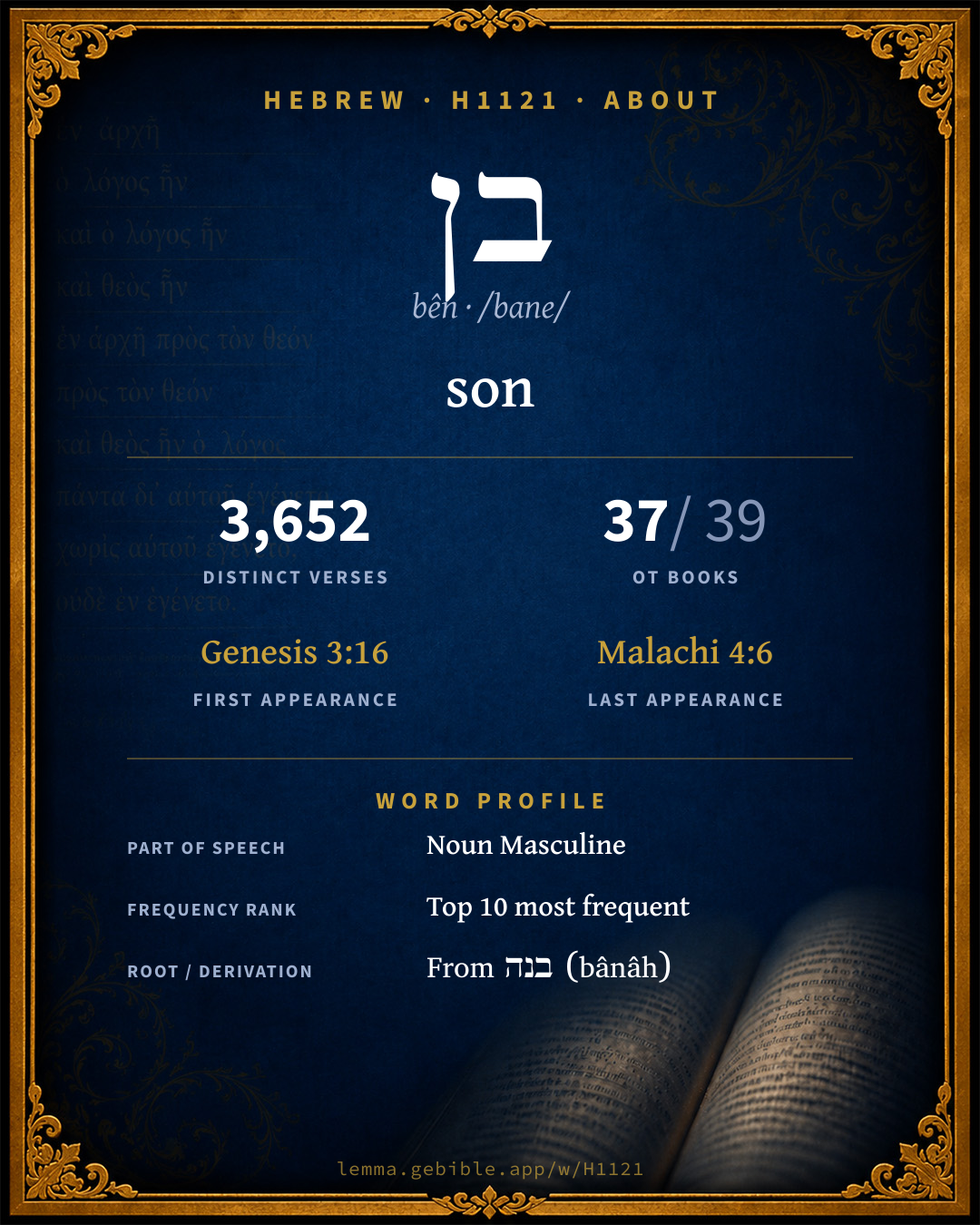
בֵּן
son
also: grandson, child fuller range ↓
Full lexicon entry — Brown-Driver-Briggs (BDB)
From Brown-Driver-Briggs (BDB)
Where this word appears
See every Construct-state word in the Hebrew Bible →
Grammar key — what these labels mean
Part of speech
- Noun
- A naming word — a person, place, thing, or idea.
Noun type
- Common
- A common noun — a general class of person, place, or thing (“king,” “city,” “water”), not a specific name.
- Proper
- A name of a specific person, place, or people (e.g. Abraham, Zion, Israel).
- Gentilic
- A noun naming a member of a people, tribe, or region of origin (e.g. an Israelite, a Moabite).
State
- Construct
- A noun bound to a following noun in a possessive / “of” relationship (the construct chain).
- Absolute
- The independent form of a noun, not bound to a following word.
Gender
- Masculine
- Grammatically masculine.
Number
- Plural
- More than one (in Hebrew, generally three or more).
- Singular
- One.
Grammatical forms
- Noun, Common, Masculine, Plural, Construct 2,597 times (53%)
- Noun, Common, Masculine, Singular, Construct 2,040 times (41%)
- Noun, Common, Masculine, Plural, Absolute 174 times (4%)
- Noun, Common, Masculine, Singular, Absolute 118 times (2%)
- Noun, Proper 10 times (0%)
- Noun, Gentilic, Masculine, Plural, Construct 1 time (0%)
- Noun, Gentilic, Masculine, Singular, Absolute 1 time (0%)
Parsed forms decoded from the imported morphology (morphhb / Westminster Leningrad Codex — WLC text public domain, morphhb tagging CC BY 4.0), counted across 4,941 parsed occurrences — not distinct verses.
Page 11 of 19 — showing verses 2,001–2,200 of 3,652 distinct verses where H1121 appears, across 37 books. Click any verse to open its interlinear word-by-word view. Verse text shown in the World English Bible for context — . Each verse’s Hebrew form is shown with its reference; the English is not keyword-highlighted, since the data carries no word-level English alignment. Use “Compare translations” on any verse to read it across multiple English versions. This concordance covers the Hebrew Bible; Septuagint (Greek Old Testament) occurrences are not indexed here.
2 Kings 174 verses
- 2 Kings 10:13 בְּנֵֽי וּ/בְנֵ֥י n c mp cs conj + n c mp cs Jehu met with the brothers of Ahaziah king of Judah, and said, Who are you? They answered, We are the brothers of Ahaziah: and we go down to Greet the children of the king and the children of the queen.
- 2 Kings 10:15 בֶּן n c ms cs When he was departed there, he lighted on Jehonadab the son of Rechab coming to meet him; and he greeted him, and said to him, Is your heart right, as my heart is with your heart? Jehonadab answered, It is. If it be, give me your hand. He gave him his hand; and he took him up to him into the chariot.
- 2 Kings 10:23 בֶּן n c ms cs Jehu went, and Jehonadab the son of Rechab, into the house of Baal; and he said to the worshippers of Baal, Search, and look that there be here with you none of the servants of Yahweh, but the worshippers of Baal only.
- 2 Kings 10:29 בֶּן n c ms cs However from the sins of Jeroboam the son of Nebat, with which he made Israel to sin, Jehu didn't depart from after them, [to wit], the golden calves that were in Bethel, and that were in Dan.
- 2 Kings 10:30 בְּנֵ֣י n c mp cs Yahweh said to Jehu, Because you have done well in executing that which is right in my eyes, [and] have done to the house of Ahab according to all that was in my heart, your sons of the fourth generation shall sit on the throne of Israel.
- 2 Kings 10:35 בְּנ֖/וֹ n c ms cs + sfx pers 3ms Jehu slept with his fathers; and they buried him in Samaria. Jehoahaz his son reigned in his place.
- 2 Kings 11:1 בְּנָ֑/הּ n c ms cs + sfx pers 3fs Now when Athaliah the mother of Ahaziah saw that her son was dead, she arose and destroyed all the seed royal.
- 2 Kings 11:2 בֶּן בְּנֵֽי n c ms cs n c mp cs But Jehosheba, the daughter of king Joram, sister of Ahaziah, took Joash the son of Ahaziah, and stole him away from among the king's sons who were slain, even him and his nurse, [and put them] in the bedchamber; and they hid him from Athaliah, so that he was not slain;
- 2 Kings 11:4 בֶּן n c ms cs In the seventh year Jehoiada sent and fetched the captains over hundreds of the Carites and of the guard, and brought them to him into the house of Yahweh; and he made a covenant with them, and took an oath of them in the house of Yahweh, and shown them the king's son.
- 2 Kings 11:12 בֶּן n c ms cs Then he brought out the king's son, and put the crown on him, and [gave him] the testimony; and they made him king, and anointed him; and they clapped their hands, and said, [Long] live the king.
- 2 Kings 11:21 בֶּן n c ms cs Jehoash was seven years old when he began to reign.
- 2 Kings 12:21 בֶּן בֶּן בְנ֖/וֹ n c ms cs n c ms cs n c ms cs + sfx pers 3ms For Jozacar the son of Shimeath, and Jehozabad the son of Shomer, his servants, struck him, and he died; and they buried him with his fathers in the city of David: and Amaziah his son reigned in his place.
- 2 Kings 13:1 בֶּן בֶּן n c ms cs n c ms cs In the three and twentieth year of Joash the son of Ahaziah, king of Judah, Jehoahaz the son of Jehu began to reign over Israel in Samaria, [and reigned] seventeen years.
- 2 Kings 13:2 בֶּן n c ms cs He did that which was evil in the sight of Yahweh, and followed the sins of Jeroboam the son of Nebat, with which he made Israel to sin; he didn't depart from it.
- 2 Kings 13:3 בֶּן n c ms cs The anger of Yahweh was kindled against Israel, and he delivered them into the hand of Hazael king of Syria, and into the hand of Benhadad the son of Hazael, continually.
- 2 Kings 13:5 בְנֵֽי n c mp cs (Yahweh gave Israel a savior, so that they went out from under the hand of the Syrians; and the children of Israel lived in their tents as before.
- 2 Kings 13:9 בְּנ֖/וֹ n c ms cs + sfx pers 3ms Jehoahaz slept with his fathers; and they buried him in Samaria: and Joash his son reigned in his place.
- 2 Kings 13:10 בֶּן n c ms cs In the thirty-seventh year of Joash king of Judah began Jehoash the son of Jehoahaz to reign over Israel in Samaria, [and reigned] sixteen years.
- 2 Kings 13:11 בֶּן n c ms cs He did that which was evil in the sight of Yahweh; he didn't depart from all the sins of Jeroboam the son of Nebat, with which he made Israel to sin; but he walked therein.
- 2 Kings 13:24 בְּנ֖/וֹ n c ms cs + sfx pers 3ms Hazael king of Syria died; and Benhadad his son reigned in his place.
- 2 Kings 13:25 בֶּן בֶּן n c ms cs n c ms cs Jehoash the son of Jehoahaz took again out of the hand of Benhadad the son of Hazael the cities which he had taken out of the hand of Jehoahaz his father by war. Three times did Joash strike him, and recovered the cities of Israel.
- 2 Kings 14:1 בֶּן בֶן n c ms cs n c ms cs In the second year of Joash son of Joahaz king of Israel began Amaziah the son of Joash king of Judah to reign.
- 2 Kings 14:2 בֶּן n c ms cs He was twenty-five years old when he began to reign; and he reigned twenty-nine years in Jerusalem: and his mother's name was Jehoaddin of Jerusalem.
- 2 Kings 14:6 בְּנֵ֥י בָּנִים֙ וּ/בָנִים֙ n c mp cs n c mp conj + n c mp but the children of the murderers he didn't put to death; according to that which is written in the book of the law of Moses, as Yahweh commanded, saying, The fathers shall not be put to death for the children, nor the children be put to death for the fathers; but every man shall die for his own sin.
- 2 Kings 14:8 בֶּן בֶּן n c ms cs n c ms cs Then Amaziah sent messengers to Jehoash, the son of Jehoahaz son of Jehu, king of Israel, saying, Come, let us look one another in the face.
- 2 Kings 14:9 לִ/בְנִ֖/י prep + n c ms cs + sfx pers 1cs Jehoash the king of Israel sent to Amaziah king of Judah, saying, The thistle that was in Lebanon sent to the cedar that was in Lebanon, saying, Give your daughter to my son as wife: and there passed by a wild animal that was in Lebanon, and trod down the thistle.
- 2 Kings 14:13 בֶּן בֶּן n c ms cs n c ms cs Jehoash king of Israel took Amaziah king of Judah, the son of Jehoash the son of Ahaziah, at Beth-shemesh, and came to Jerusalem, and broke down the wall of Jerusalem from the gate of Ephraim to the corner gate, four hundred cubits.
- 2 Kings 14:14 בְּנֵ֣י n c mp cs He took all the gold and silver, and all the vessels that were found in the house of Yahweh, and in the treasures of the king's house, the hostages also, and returned to Samaria.
- 2 Kings 14:16 בְּנ֖/וֹ n c ms cs + sfx pers 3ms Jehoash slept with his fathers, and was buried in Samaria with the kings of Israel; and Jeroboam his son reigned in his place.
- 2 Kings 14:17 בֶן בֶּן n c ms cs n c ms cs Amaziah the son of Joash king of Judah lived after the death of Jehoash son of Jehoahaz king of Israel fifteen years.
- 2 Kings 14:21 בֶּן n c ms cs All the people of Judah took Azariah, who was sixteen years old, and made him king in the room of his father Amaziah.
- 2 Kings 14:23 בֶן בֶּן n c ms cs n c ms cs In the fifteenth year of Amaziah the son of Joash king of Judah Jeroboam the son of Joash king of Israel began to reign in Samaria, [and reigned] forty-one years.
- 2 Kings 14:24 בֶּן n c ms cs He did that which was evil in the sight of Yahweh: he didn't depart from all the sins of Jeroboam the son of Nebat, with which he made Israel to sin.
- 2 Kings 14:25 בֶן n c ms cs He restored the border of Israel from the entrance of Hamath to the sea of the Arabah, according to the word of Yahweh, the God of Israel, which he spoke by his servant Jonah the son of Amittai, the prophet, who was of Gath Hepher.
- 2 Kings 14:27 בֶּן n c ms cs Yahweh didn't say that he would blot out the name of Israel from under the sky; but he saved them by the hand of Jeroboam the son of Joash.
- 2 Kings 14:29 בְנ֖/וֹ n c ms cs + sfx pers 3ms Jeroboam slept with his fathers, even with the kings of Israel; and Zechariah his son reigned in his place.
- 2 Kings 15:1 בֶן n c ms cs In the twenty-seventh year of Jeroboam king of Israel began Azariah son of Amaziah king of Judah to reign.
- 2 Kings 15:2 בֶּן n c ms cs Sixteen years old was he when he began to reign; and he reigned fifty-two years in Jerusalem: and his mother's name was Jecoliah of Jerusalem.
- 2 Kings 15:5 בֶּן n c ms cs Yahweh struck the king, so that he was a leper to the day of his death, and lived in a separate house. Jotham the king's son was over the household, judging the people of the land.
- 2 Kings 15:7 בְּנ֖/וֹ n c ms cs + sfx pers 3ms Azariah slept with his fathers; and they buried him with his fathers in the city of David: and Jotham his son reigned in his place.
- 2 Kings 15:8 בֶן n c ms cs In the thirty-eighth year of Azariah king of Judah did Zechariah the son of Jeroboam reign over Israel in Samaria six months.
- 2 Kings 15:9 בֶּן n c ms cs He did that which was evil in the sight of Yahweh, as his fathers had done: he didn't depart from the sins of Jeroboam the son of Nebat, with which he made Israel to sin.
- 2 Kings 15:10 בֶּן n c ms cs Shallum the son of Jabesh conspired against him, and struck him before the people, and killed him, and reigned in his place.
- 2 Kings 15:12 בְּנֵ֣י n c mp cs This was the word of Yahweh which he spoke to Jehu, saying, Your sons to the fourth generation shall sit on the throne of Israel. So it came to pass.
- 2 Kings 15:13 בֶּן n c ms cs Shallum the son of Jabesh began to reign in the nine and thirtieth year of Uzziah king of Judah; and he reigned the space of a month in Samaria.
- 2 Kings 15:14 בֶּן בֶּן n c ms cs n c ms cs Menahem the son of Gadi went up from Tirzah, and came to Samaria, and struck Shallum the son of Jabesh in Samaria, and killed him, and reigned in his place.
- 2 Kings 15:17 בֶּן n c ms cs In the nine and thirtieth year of Azariah king of Judah began Menahem the son of Gadi to reign over Israel, [and reigned] ten years in Samaria.
- 2 Kings 15:18 בֶּן n c ms cs He did that which was evil in the sight of Yahweh: he didn't depart all his days from the sins of Jeroboam the son of Nebat, with which he made Israel to sin.
- 2 Kings 15:22 בְנ֖/וֹ n c ms cs + sfx pers 3ms Menahem slept with his fathers; and Pekahiah his son reigned in his place.
- 2 Kings 15:23 בֶן n c ms cs In the fiftieth year of Azariah king of Judah Pekahiah the son of Menahem began to reign over Israel in Samaria, [and reigned] two years.
- 2 Kings 15:24 בֶּן n c ms cs He did that which was evil in the sight of Yahweh: he didn't depart from the sins of Jeroboam the son of Nebat, with which he made Israel to sin.
- 2 Kings 15:25 בֶּן מִ/בְּנֵ֣י n c ms cs prep + n c mp cs Pekah the son of Remaliah, his captain, conspired against him, and struck him in Samaria, in the castle of the king's house, with Argob and Arieh; and with him were fifty men of the Gileadites: and he killed him, and reigned in his place.
- 2 Kings 15:27 בֶּן n c ms cs In the two and fiftieth year of Azariah king of Judah Pekah the son of Remaliah began to reign over Israel in Samaria, [and reigned] twenty years.
- 2 Kings 15:28 בֶּן n c ms cs He did that which was evil in the sight of Yahweh: he didn't depart from the sins of Jeroboam the son of Nebat, with which he made Israel to sin.
- 2 Kings 15:30 בֶּן בֶּן בֶּן n c ms cs n c ms cs n c ms cs Hoshea the son of Elah made a conspiracy against Pekah the son of Remaliah, and struck him, and killed him, and reigned in his place, in the twentieth year of Jotham the son of Uzziah.
- 2 Kings 15:32 בֶּן בֶּן n c ms cs n c ms cs In the second year of Pekah the son of Remaliah king of Israel began Jotham the son of Uzziah king of Judah to reign.
- 2 Kings 15:33 בֶּן n c ms cs He was twenty-five years old when he began to reign; and he reigned sixteen years in Jerusalem: and his mother's name was Jerusha the daughter of Zadok.
- 2 Kings 15:37 בֶּן n c ms cs In those days Yahweh began to send against Judah Rezin the king of Syria, and Pekah the son of Remaliah.
- 2 Kings 15:38 בְּנ֖/וֹ n c ms cs + sfx pers 3ms Jotham slept with his fathers, and was buried with his fathers in the city of David his father: and Ahaz his son reigned in his place.
- 2 Kings 16:1 בֶּן בֶּן n c ms cs n c ms cs In the seventeenth year of Pekah the son of Remaliah Ahaz the son of Jotham king of Judah began to reign.
- 2 Kings 16:2 בֶּן n c ms cs Twenty years old was Ahaz when he began to reign; and he reigned sixteen years in Jerusalem: and he didn't do that which was right in the eyes of Yahweh his God, like David his father.
- 2 Kings 16:3 בְּנ/וֹ֙ בְּנֵ֥י n c ms cs + sfx pers 3ms n c mp cs But he walked in the way of the kings of Israel, yes, and made his son to pass through the fire, according to the abominations of the nations, whom Yahweh cast out from before the children of Israel.
- 2 Kings 16:5 בֶּן n c ms cs Then Rezin king of Syria and Pekah son of Remaliah king of Israel came up to Jerusalem to war: and they besieged Ahaz, but could not overcome him.
- 2 Kings 16:7 וּ/בִנְ/ךָ֖ conj + n c ms cs + sfx pers 2ms So Ahaz sent messengers to Tiglath Pileser king of Assyria, saying, I am your servant and your son: come up, and save me out of the hand of the king of Syria, and out of the hand of the king of Israel, who rise up against me.
- 2 Kings 16:20 בְנ֖/וֹ n c ms cs + sfx pers 3ms Ahaz slept with his fathers, and was buried with his fathers in the city of David: and Hezekiah his son reigned in his place.
- 2 Kings 17:1 בֶּן n c ms cs In the twelfth year of Ahaz king of Judah began Hoshea the son of Elah to reign in Samaria over Israel, [and reigned] nine years.
- 2 Kings 17:7 בְנֵֽי n c mp cs It was so, because the children of Israel had sinned against Yahweh their God, who brought them up out of the land of Egypt from under the hand of Pharaoh king of Egypt, and had feared other gods,
- 2 Kings 17:8 בְּנֵ֣י n c mp cs and walked in the statutes of the nations, whom Yahweh cast out from before the children of Israel, and of the kings of Israel, which they made.
- 2 Kings 17:9 בְנֵֽי n c mp cs The children of Israel did secretly things that were not right against Yahweh their God: and they built them high places in all their cities, from the tower of the watchmen to the fortified city;
- 2 Kings 17:17 בְּנֵי/הֶ֤ם n c mp cs + sfx pers 3mp They caused their sons and their daughters to pass through the fire, and used divination and enchantments, and sold themselves to do that which was evil in the sight of Yahweh, to provoke him to anger.
- 2 Kings 17:21 בֶּן n c ms cs For he tore Israel from the house of David; and they made Jeroboam the son of Nebat king: and Jeroboam drove Israel from following Yahweh, and made them sin a great sin.
- 2 Kings 17:22 בְּנֵ֣י n c mp cs The children of Israel walked in all the sins of Jeroboam which he did; they didn't depart from them;
- 2 Kings 17:24 בְּנֵ֣י n c mp cs The king of Assyria brought men from Babylon, and from Cuthah, and from Avva, and from Hamath and Sepharvaim, and placed them in the cities of Samaria instead of the children of Israel; and they possessed Samaria, and lived in the cities of it.
- 2 Kings 17:31 בְּנֵי/הֶם֙ n c mp cs + sfx pers 3mp and the Avvites made Nibhaz and Tartak; and the Sepharvites burnt their children in the fire to Adrammelech and Anammelech, the gods of Sepharvaim.
- 2 Kings 17:34 בְּנֵ֣י n c mp cs To this day they do after the former manner: they don't fear Yahweh, neither do they after their statutes, or after their ordinances, or after the law or after the commandment which Yahweh commanded the children of Jacob, whom he named Israel;
- 2 Kings 17:41 בְּנֵי/הֶ֣ם וּ/בְנֵ֣י בְנֵי/הֶ֗ם n c mp cs + sfx pers 3mp conj + n c mp cs n c mp cs + sfx pers 3mp So these nations feared Yahweh, and served their engraved images; their children likewise, and their children's children, as did their fathers, so do they to this day.
- 2 Kings 18:1 בֶּן בֶן n c ms cs n c ms cs Now it happened in the third year of Hoshea son of Elah king of Israel, that Hezekiah the son of Ahaz king of Judah began to reign.
- 2 Kings 18:2 בֶּן n c ms cs He was twenty-five years old when he began to reign; and he reigned twenty-nine years in Jerusalem: and his mother's name was Abi the daughter of Zechariah.
- 2 Kings 18:4 בְנֵֽי n c mp cs He removed the high places, and broke the pillars, and cut down the Asherah: and he broke in pieces the brazen serpent that Moses had made; for to those days the children of Israel did burn incense to it; and he called it Nehushtan.
- 2 Kings 18:9 בֶּן n c ms cs It happened in the fourth year of king Hezekiah, which was the seventh year of Hoshea son of Elah king of Israel, that Shalmaneser king of Assyria came up against Samaria, and besieged it.
- 2 Kings 18:18 בֶּן בֶּן n c ms cs n c ms cs When they had called to the king, there came out to them Eliakim the son of Hilkiah, who was over the household, and Shebnah the scribe, and Joah the son of Asaph the recorder.
- 2 Kings 18:26 בֶּן n c ms cs Then said Eliakim the son of Hilkiah, and Shebnah, and Joah, to Rabshakeh, Please speak to your servants in the Syrian language; for we understand it: and don't speak with us in the Jews' language, in the ears of the people who are on the wall.
- 2 Kings 18:37 בֶּן בֶּן n c ms cs n c ms cs Then came Eliakim the son of Hilkiah, who was over the household, and Shebna the scribe, and Joah the son of Asaph the recorder, to Hezekiah with their clothes torn, and told him the words of Rabshakeh.
- 2 Kings 19:2 בֶּן n c ms cs He sent Eliakim, who was over the household, and Shebna the scribe, and the elders of the priests, covered with sackcloth, to Isaiah the prophet the son of Amoz.
- 2 Kings 19:3 בָנִים֙ n c mp They said to him, Thus says Hezekiah, This day is a day of trouble, and of rebuke, and of rejection; for the children are come to the birth, and there is not strength to bring forth.
- 2 Kings 19:12 וּ/בְנֵי conj + n c mp cs Have the gods of the nations delivered them, which my fathers have destroyed, Gozan, and Haran, and Rezeph, and the children of Eden that were in Telassar?
- 2 Kings 19:20 בֶן n c ms cs Then Isaiah the son of Amoz sent to Hezekiah, saying, Thus says Yahweh, the God of Israel, Whereas you have prayed to me against Sennacherib king of Assyria, I have heard [you].
- 2 Kings 19:37 בָּנָי/ו֙ בְּנ֖/וֹ n c mp cs + sfx pers 3ms n c ms cs + sfx pers 3ms It happened, as he was worshipping in the house of Nisroch his god, that Adrammelech and Sharezer struck him with the sword: and they escaped into the land of Ararat. Esar Haddon his son reigned in his place.
- 2 Kings 20:1 בֶן n c ms cs In those days was Hezekiah sick to death. Isaiah the prophet the son of Amoz came to him, and said to him, Thus says Yahweh, Set your house in order: for you shall die, and not live.
- 2 Kings 20:12 בֶּֽן n c ms cs At that time Berodach-baladan the son of Baladan, king of Babylon, sent letters and a present to Hezekiah; for he had heard that Hezekiah had been sick.
- 2 Kings 20:18 וּ/מִ/בָּנֶ֜י/ךָ conj + prep + n c mp cs + sfx pers 2ms Of your sons who shall issue from you, whom you shall father, shall they take away; and they shall be eunuchs in the palace of the king of Babylon.
- 2 Kings 20:21 בְנ֖/וֹ n c ms cs + sfx pers 3ms Hezekiah slept with his fathers; and Manasseh his son reigned in his place.
- 2 Kings 21:1 בֶּן n c ms cs Manasseh was twelve years old when he began to reign; and he reigned fifty-five years in Jerusalem: and his mother's name was Hephzibah.
- 2 Kings 21:2 בְּנֵ֥י n c mp cs He did that which was evil in the sight of Yahweh, after the abominations of the nations whom Yahweh cast out before the children of Israel.
- 2 Kings 21:6 בְּנ/וֹ֙ n c ms cs + sfx pers 3ms He made his son to pass through the fire, and practiced sorcery, and used enchantments, and dealt with those who had familiar spirits, and with wizards: he worked much evil in the sight of Yahweh, to provoke him to anger.
- 2 Kings 21:7 בְנ֔/וֹ n c ms cs + sfx pers 3ms He set the engraved image of Asherah, that he had made, in the house of which Yahweh said to David and to Solomon his son, In this house, and in Jerusalem, which I have chosen out of all the tribes of Israel, will I put my name forever;
- 2 Kings 21:9 בְּנֵ֥י n c mp cs But they didn't listen: and Manasseh seduced them to do that which is evil more than did the nations whom Yahweh destroyed before the children of Israel.
- 2 Kings 21:18 בְּנ֖/וֹ n c ms cs + sfx pers 3ms Manasseh slept with his fathers, and was buried in the garden of his own house, in the garden of Uzza: and Amon his son reigned in his place.
- 2 Kings 21:19 בֶּן n c ms cs Amon was twenty-two years old when he began to reign; and he reigned two years in Jerusalem: and his mother's name was Meshullemeth the daughter of Haruz of Jotbah.
- 2 Kings 21:24 בְנ֖/וֹ n c ms cs + sfx pers 3ms But the people of the land killed all those who had conspired against king Amon; and the people of the land made Josiah his son king in his place.
- 2 Kings 21:26 בְנ֖/וֹ n c ms cs + sfx pers 3ms He was buried in his tomb in the garden of Uzza: and Josiah his son reigned in his place.
- 2 Kings 22:1 בֶּן n c ms cs Josiah was eight years old when he began to reign; and he reigned thirty-one years in Jerusalem: and his mother's name was Jedidah the daughter of Adaiah of Bozkath.
- 2 Kings 22:3 בֶּן בֶן n c ms cs n c ms cs It happened in the eighteenth year of king Josiah, that the king sent Shaphan, the son of Azaliah the son of Meshullam, the scribe, to the house of Yahweh, saying,
- 2 Kings 22:12 בֶּן בֶּן n c ms cs n c ms cs The king commanded Hilkiah the priest, and Ahikam the son of Shaphan, and Achbor the son of Micaiah, and Shaphan the scribe, and Asaiah the king's servant, saying,
- 2 Kings 22:14 בֶּן בֶּן n c ms cs n c ms cs So Hilkiah the priest, and Ahikam, and Achbor, and Shaphan, and Asaiah, went to Huldah the prophetess, the wife of Shallum the son of Tikvah, the son of Harhas, keeper of the wardrobe (now she lived in Jerusalem in the second quarter); and they talked with her.
- 2 Kings 23:6 בְּנֵ֥י n c mp cs He brought out the Asherah from the house of Yahweh, outside of Jerusalem, to the brook Kidron, and burned it at the brook Kidron, and beat it to dust, and cast the dust of it on the graves of the common people.
- 2 Kings 23:10 בני בֶן בְּנ֧/וֹ n Proper n Proper n c ms cs + sfx pers 3ms He defiled Topheth, which is in the valley of the children of Hinnom, that no man might make his son or his daughter to pass through the fire to Molech.
- 2 Kings 23:13 בְּנֵֽי n c mp cs The high places that were before Jerusalem, which were on the right hand of the mountain of corruption, which Solomon the king of Israel had built for Ashtoreth the abomination of the Sidonians, and for Chemosh the abomination of Moab, and for Milcom the abomination of the children of Ammon, did the king defile.
- 2 Kings 23:15 בֶּן n c ms cs Moreover the altar that was at Bethel, and the high place which Jeroboam the son of Nebat, who made Israel to sin, had made, even that altar and the high place he broke down; and he burned the high place and beat it to dust, and burned the Asherah.
- 2 Kings 23:30 בֶּן n c ms cs His servants carried him in a chariot dead from Megiddo, and brought him to Jerusalem, and buried him in his own tomb. The people of the land took Jehoahaz the son of Josiah, and anointed him, and made him king in his father's place.
- 2 Kings 23:31 בֶּן n c ms cs Jehoahaz was twenty-three years old when he began to reign; and he reigned three months in Jerusalem: and his mother's name was Hamutal the daughter of Jeremiah of Libnah.
- 2 Kings 23:34 בֶּן n c ms cs Pharaoh Necoh made Eliakim the son of Josiah king in the room of Josiah his father, and changed his name to Jehoiakim: but he took Jehoahaz away; and he came to Egypt, and died there.
- 2 Kings 23:36 בֶּן n c ms cs Jehoiakim was twenty-five years old when he began to reign; and he reigned eleven years in Jerusalem: and his mother's name was Zebidah the daughter of Pedaiah of Rumah.
- 2 Kings 24:2 בְנֵֽי n c mp cs Yahweh sent against him bands of the Chaldeans, and bands of the Syrians, and bands of the Moabites, and bands of the children of Ammon, and sent them against Judah to destroy it, according to the word of Yahweh, which he spoke by his servants the prophets.
- 2 Kings 24:6 בְּנ֖/וֹ n c ms cs + sfx pers 3ms So Jehoiakim slept with his fathers; and Jehoiachin his son reigned in his place.
- 2 Kings 24:8 בֶּן n c ms cs Jehoiachin was eighteen years old when he began to reign; and he reigned in Jerusalem three months: and his mother's name was Nehushta the daughter of Elnathan of Jerusalem.
- 2 Kings 24:18 בֶּן n c ms cs Zedekiah was twenty-one years old when he began to reign; and he reigned eleven years in Jerusalem: and his mother's name was Hamutal the daughter of Jeremiah of Libnah.
- 2 Kings 25:7 בְּנֵי֙ n c mp cs They killed the sons of Zedekiah before his eyes, and put out the eyes of Zedekiah, and bound him in fetters, and carried him to Babylon.
- 2 Kings 25:22 בֶּן בֶּן n c ms cs n c ms cs As for the people who were left in the land of Judah, whom Nebuchadnezzar king of Babylon had left, even over them he made Gedaliah the son of Ahikam, the son of Shaphan, governor.
- 2 Kings 25:23 בֶּן בֶּן בֶן בֶּן n c ms cs n c ms cs n c ms cs n c ms cs Now when all the captains of the forces, they and their men, heard that the king of Babylon had made Gedaliah governor, they came to Gedaliah to Mizpah, even Ishmael the son of Nethaniah, and Johanan the son of Kareah, and Seraiah the son of Tanhumeth the Netophathite, and Jaazaniah the son of the Maacathite, they and their men.
- 2 Kings 25:25 בֶּן בֶּן n c ms cs n c ms cs But it happened in the seventh month, that Ishmael the son of Nethaniah, the son of Elishama, of the royal seed came, and ten men with him, and struck Gedaliah, so that he died, and the Jews and the Chaldeans that were with him at Mizpah.
1 Chronicles 430 verses
- 1 Chronicles 1:5 בְּנֵ֣י n c mp cs The sons of Japheth: Gomer, and Magog, and Madai, and Javan, and Tubal, and Meshech, and Tiras.
- 1 Chronicles 1:6 וּ/בְנֵ֖י conj + n c mp cs The sons of Gomer: Ashkenaz, and Diphath, and Togarmah.
- 1 Chronicles 1:7 וּ/בְנֵ֥י conj + n c mp cs The sons of Javan: Elishah, and Tarshish, Kittim, and Rodanim.
- 1 Chronicles 1:8 בְּנֵ֖י n c mp cs The sons of Ham: Cush, and Mizraim, Put, and Canaan.
- 1 Chronicles 1:9 וּ/בְנֵ֣י וּ/בְנֵ֥י conj + n c mp cs conj + n c mp cs The sons of Cush: Seba, and Havilah, and Sabta, and Raama, and Sabteca. The sons of Raamah: Sheba, and Dedan.
- 1 Chronicles 1:17 בְּנֵ֣י n c mp cs The sons of Shem: Elam, and Asshur, and Arpachshad, and Lud, and Aram, and Uz, and Hul, and Gether, and Meshech.
- 1 Chronicles 1:19 בָנִ֑ים n c mp To Eber were born two sons: the name of the one was Peleg; for in his days the earth was divided; and his brother's name was Joktan.
- 1 Chronicles 1:23 בְּנֵ֥י n c mp cs and Ophir, and Havilah, and Jobab. All these were the sons of Joktan.
- 1 Chronicles 1:28 בְּנֵי֙ n c mp cs The sons of Abraham: Isaac, and Ishmael.
- 1 Chronicles 1:31 בְּנֵ֥י n c mp cs Jetur, Naphish, and Kedemah. These are the sons of Ishmael.
- 1 Chronicles 1:32 וּ/בְנֵ֨י וּ/בְנֵ֥י conj + n c mp cs conj + n c mp cs The sons of Keturah, Abraham's concubine: she bore Zimran, and Jokshan, and Medan, and Midian, and Ishbak, and Shuah. The sons of Jokshan: Sheba, and Dedan.
- 1 Chronicles 1:33 וּ/בְנֵ֣י בְּנֵ֥י conj + n c mp cs n c mp cs The sons of Midian: Ephah, and Epher, and Hanoch, and Abida, and Eldaah. All these were the sons of Keturah.
- 1 Chronicles 1:34 בְּנֵ֣י n c mp cs Abraham became the father of Isaac. The sons of Isaac: Esau, and Israel.
- 1 Chronicles 1:35 בְּנֵ֖י n c mp cs The sons of Esau: Eliphaz, Reuel, and Jeush, and Jalam, and Korah.
- 1 Chronicles 1:36 בְּנֵ֖י n c mp cs The sons of Eliphaz: Teman, and Omar, Zephi, and Gatam, Kenaz, and Timna, and Amalek.
- 1 Chronicles 1:37 בְּנֵ֖י n c mp cs The sons of Reuel: Nahath, Zerah, Shammah, and Mizzah.
- 1 Chronicles 1:38 וּ/בְנֵ֣י conj + n c mp cs The sons of Seir: Lotan, and Shobal, and Zibeon, and Anah, and Dishon, and Ezer, and Dishan.
- 1 Chronicles 1:39 וּ/בְנֵ֥י conj + n c mp cs The sons of Lotan: Hori, and Homam; and Timna was Lotan's sister.
- 1 Chronicles 1:40 בְּנֵ֣י וּ/בְנֵ֥י n c mp cs conj + n c mp cs The sons of Shobal: Alian, and Manahath, and Ebal, Shephi, and Onam. The sons of Zibeon: Aiah, and Anah.
- 1 Chronicles 1:41 בְּנֵ֥י וּ/בְנֵ֣י n c mp cs conj + n c mp cs The sons of Anah: Dishon. The sons of Dishon: Hamran, and Eshban, and Ithran, and Cheran.
- 1 Chronicles 1:42 בְּֽנֵי בְּנֵ֥י n c mp cs n c mp cs The sons of Ezer: Bilhan, and Zaavan, Jaakan. The sons of Dishan: Uz, and Aran.
- 1 Chronicles 1:43 לִ/בְנֵ֣י בֶּן prep + n c mp cs n c ms cs Now these are the kings who reigned in the land of Edom, before there resigned any king over the children of Israel: Bela the son of Beor; and the name of his city was Dinhabah.
- 1 Chronicles 1:44 בֶּן n c ms cs Bela died, and Jobab the son of Zerah of Bozrah reigned in his place.
- 1 Chronicles 1:46 בֶּן n c ms cs Husham died, and Hadad the son of Bedad, who struck Midian in the field of Moab, reigned in his place; and the name of his city was Avith.
- 1 Chronicles 1:49 בֶּן n c ms cs Shaul died, and Baal Hanan the son of Achbor reigned in his place.
- 1 Chronicles 2:1 בְּנֵ֣י n c mp cs These are the sons of Israel: Reuben, Simeon, Levi, and Judah, Issachar, and Zebulun,
- 1 Chronicles 2:3 בְּנֵ֣י n c mp cs The sons of Judah: Er, and Onan, and Shelah; which three were born to him of Shua's daughter the Canaanitess. Er, Judah's firstborn, was wicked in the sight of Yahweh; and he killed him.
- 1 Chronicles 2:4 בְּנֵ֥י n c mp cs Tamar his daughter-in-law bore him Perez and Zerah. All the sons of Judah were five.
- 1 Chronicles 2:5 בְּנֵי n c mp cs The sons of Perez: Hezron, and Hamul.
- 1 Chronicles 2:6 וּ/בְנֵ֣י conj + n c mp cs The sons of Zerah: Zimri, and Ethan, and Heman, and Calcol, and Dara; five of them in all.
- 1 Chronicles 2:7 וּ/בְנֵ֖י conj + n c mp cs The sons of Carmi: Achar, the troubler of Israel, who committed a trespass in the devoted thing.
- 1 Chronicles 2:8 וּ/בְנֵ֥י conj + n c mp cs The sons of Ethan: Azariah.
- 1 Chronicles 2:9 וּ/בְנֵ֥י conj + n c mp cs The sons also of Hezron, who were born to him: Jerahmeel, and Ram, and Chelubai.
- 1 Chronicles 2:10 בְּנֵ֥י n c mp cs Ram became the father of Amminadab, and Amminadab became the father of Nahshon, prince of the children of Judah;
- 1 Chronicles 2:16 וּ/בְנֵ֣י conj + n c mp cs and their sisters were Zeruiah and Abigail. The sons of Zeruiah: Abishai, and Joab, and Asahel, three.
- 1 Chronicles 2:18 בֶּן בָנֶ֔י/הָ n c ms cs n c mp cs + sfx pers 3fs Caleb the son of Hezron became the father of [children] of Azubah [his] wife, and of Jerioth; and these were her sons: Jesher, and Shobab, and Ardon.
- 1 Chronicles 2:21 בֶּן n c ms cs Afterward Hezron went in to the daughter of Machir the father of Gilead, whom he took [as wife] when he was sixty years old; and she bore him Segub.
- 1 Chronicles 2:23 בְּנֵ֖י n c mp cs Geshur and Aram took the towns of Jair from them, with Kenath, and the villages of it, even sixty cities. All these were the sons of Machir the father of Gilead.
- 1 Chronicles 2:25 בְנֵי n c mp cs The sons of Jerahmeel the firstborn of Hezron were Ram the firstborn, and Bunah, and Oren, and Ozem, Ahijah.
- 1 Chronicles 2:27 בְנֵי n c mp cs The sons of Ram the firstborn of Jerahmeel were Maaz, and Jamin, and Eker.
- 1 Chronicles 2:28 בְנֵי וּ/בְנֵ֣י n c mp cs conj + n c mp cs The sons of Onam were Shammai, and Jada. The sons of Shammai: Nadab, and Abishur.
- 1 Chronicles 2:30 וּ/בְנֵ֥י בָנִֽים conj + n c mp cs n c mp The sons of Nadab: Seled, and Appaim; but Seled died without children.
- 1 Chronicles 2:31 וּ/בְנֵ֥י וּ/בְנֵ֤י וּ/בְנֵ֥י conj + n c mp cs conj + n c mp cs conj + n c mp cs The sons of Appaim: Ishi. The sons of Ishi: Sheshan. The sons of Sheshan: Ahlai.
- 1 Chronicles 2:32 וּ/בְנֵ֤י בָנִֽים conj + n c mp cs n c mp The sons of Jada the brother of Shammai: Jether, and Jonathan; and Jether died without children.
- 1 Chronicles 2:33 וּ/בְנֵ֥י בְּנֵ֥י conj + n c mp cs n c mp cs The sons of Jonathan: Peleth, and Zaza. These were the sons of Jerahmeel.
- 1 Chronicles 2:34 בָּנִ֖ים n c mp Now Sheshan had no sons, but daughters. Sheshan had a servant, an Egyptian, whose name was Jarha.
- 1 Chronicles 2:42 וּ/בְנֵ֤י וּ/בְנֵ֥י conj + n c mp cs conj + n c mp cs The sons of Caleb the brother of Jerahmeel were Mesha his firstborn, who was the father of Ziph; and the sons of Mareshah the father of Hebron.
- 1 Chronicles 2:43 וּ/בְנֵ֖י conj + n c mp cs The sons of Hebron: Korah, and Tappuah, and Rekem, and Shema.
- 1 Chronicles 2:45 וּ/בֶן conj + n c ms cs The son of Shammai was Maon; and Maon was the father of Beth Zur.
- 1 Chronicles 2:47 וּ/בְנֵ֖י conj + n c mp cs The sons of Jahdai: Regem, and Jothan, and Geshan, and Pelet, and Ephah, and Shaaph.
- 1 Chronicles 2:50 בְּנֵ֣י בֶּן n c mp cs n c ms cs These were the sons of Caleb, the son of Hur, the firstborn of Ephrathah: Shobal the father of Kiriath Jearim,
- 1 Chronicles 2:52 בָנִים֙ n c mp Shobal the father of Kiriath Jearim had sons: Haroeh, half of the Menuhoth.
- 1 Chronicles 2:54 בְּנֵ֣י n c mp cs The sons of Salma: Bethlehem, and the Netophathites, Atroth Beth Joab, and half of the Manahathites, the Zorites.
- 1 Chronicles 3:1 בְּנֵ֣י n c mp cs Now these were the sons of David, who were born to him in Hebron: the firstborn, Amnon, of Ahinoam the Jezreelitess; the second, Daniel, of Abigail the Carmelitess;
- 1 Chronicles 3:2 בֶּֽן בֶן n c ms cs n c ms cs the third, Absalom the son of Maacah the daughter of Talmai king of Geshur; the fourth, Adonijah the son of Haggith;
- 1 Chronicles 3:9 בְּנֵ֣י בְּֽנֵי n c mp cs n c mp cs All these were the sons of David, besides the sons of the concubines; and Tamar was their sister.
- 1 Chronicles 3:10 וּ/בֶן בְנ֛/וֹ בְנ֖/וֹ בְּנֽ/וֹ conj + n c ms cs n c ms cs + sfx pers 3ms n c ms cs + sfx pers 3ms n c ms cs + sfx pers 3ms Solomon's son was Rehoboam, Abijah his son, Asa his son, Jehoshaphat his son,
- 1 Chronicles 3:11 בְּנ֛/וֹ בְנ֖/וֹ בְּנֽ/וֹ n c ms cs + sfx pers 3ms n c ms cs + sfx pers 3ms n c ms cs + sfx pers 3ms Joram his son, Ahaziah his son, Joash his son,
- 1 Chronicles 3:12 בְנ֛/וֹ בְנ֖/וֹ בְּנֽ/וֹ n c ms cs + sfx pers 3ms n c ms cs + sfx pers 3ms n c ms cs + sfx pers 3ms Amaziah his son, Azariah his son, Jotham his son,
- 1 Chronicles 3:13 בְּנ֛/וֹ בְנ֖/וֹ בְנֽ/וֹ n c ms cs + sfx pers 3ms n c ms cs + sfx pers 3ms n c ms cs + sfx pers 3ms Ahaz his son, Hezekiah his son, Manasseh his son,
- 1 Chronicles 3:14 בְּנ֖/וֹ בְנֽ/וֹ n c ms cs + sfx pers 3ms n c ms cs + sfx pers 3ms Amon his son, Josiah his son.
- 1 Chronicles 3:15 וּ/בְנֵי֙ conj + n c mp cs The sons of Josiah: the firstborn Johanan, the second Jehoiakim, the third Zedekiah, the fourth Shallum.
- 1 Chronicles 3:16 וּ/בְנֵ֖י בְנ֖/וֹ בְנֽ/וֹ conj + n c mp cs n c ms cs + sfx pers 3ms n c ms cs + sfx pers 3ms The sons of Jehoiakim: Jeconiah his son, Zedekiah his son.
- 1 Chronicles 3:17 וּ/בְנֵי֙ בְּנֽ/וֹ conj + n c mp cs n c ms cs + sfx pers 3ms The sons of Jeconiah, the captive: Shealtiel his son,
- 1 Chronicles 3:19 וּ/בְנֵ֣י וּ/בֶן conj + n c mp cs conj + n c ms cs The sons of Pedaiah: Zerubbabel, and Shimei. The sons of Zerubbabel: Meshullam, and Hananiah; and Shelomith was their sister;
- 1 Chronicles 3:21 וּ/בֶן בְּנֵ֤י בְּנֵ֣י בְּנֵ֥י בְּנֵ֥י conj + n c ms cs n c mp cs n c mp cs n c mp cs n c mp cs The sons of Hananiah: Pelatiah, and Jeshaiah; the sons of Rephaiah, the sons of Arnan, the sons of Obadiah, the sons of Shecaniah.
- 1 Chronicles 3:22 וּ/בְנֵ֥י וּ/בְנֵ֣י conj + n c mp cs conj + n c mp cs The sons of Shecaniah: Shemaiah. The sons of Shemaiah: Hattush, and Igal, and Bariah, and Neariah, and Shaphat, six.
- 1 Chronicles 3:23 וּ/בֶן conj + n c ms cs The sons of Neariah: Elioenai, and Hizkiah, and Azrikam, three.
- 1 Chronicles 3:24 וּ/בְנֵ֣י conj + n c mp cs The sons of Elioenai: Hodaviah, and Eliashib, and Pelaiah, and Akkub, and Johanan, and Delaiah, and Anani, seven.
- 1 Chronicles 4:1 בְּנֵ֖י n c mp cs The sons of Judah: Perez, Hezron, and Carmi, and Hur, and Shobal.
- 1 Chronicles 4:2 בֶן n c ms cs Reaiah the son of Shobal became the father of Jahath; and Jahath became the father of Ahumai and Lahad. These are the families of the Zorathites.
- 1 Chronicles 4:4 בְנֵי n c mp cs and Penuel the father of Gedor, and Ezer the father of Hushah. These are the sons of Hur, the firstborn of Ephrathah, the father of Bethlehem.
- 1 Chronicles 4:6 בְּנֵ֥י n c mp cs Naarah bore him Ahuzzam, and Hepher, and Temeni, and Haahashtari. These were the sons of Naarah.
- 1 Chronicles 4:7 וּ/בְנֵ֖י conj + n c mp cs The sons of Helah were Zereth, Izhar, and Ethnan.
- 1 Chronicles 4:8 בֶּן n c ms cs Hakkoz became the father of Anub, and Zobebah, and the families of Aharhel the son of Harum.
- 1 Chronicles 4:13 וּ/בְנֵ֣י וּ/בְנֵ֥י conj + n c mp cs conj + n c mp cs The sons of Kenaz: Othniel, and Seraiah. The sons of Othniel: Hathath.
- 1 Chronicles 4:15 וּ/בְנֵי֙ בֶּן וּ/בְנֵ֥י conj + n c mp cs n c ms cs conj + n c mp cs The sons of Caleb the son of Jephunneh: Iru, Elah, and Naam; and the sons of Elah; and Kenaz.
- 1 Chronicles 4:16 וּ/בְנֵ֖י conj + n c mp cs The sons of Jehallelel: Ziph, and Ziphah, Tiria, and Asarel.
- 1 Chronicles 4:17 וּ/בֶן conj + n c ms cs The sons of Ezrah: Jether, and Mered, and Epher, and Jalon; and she bore Miriam, and Shammai, and Ishbah the father of Eshtemoa.
About this entry
At a glance — auto-summarized from this page’s data, not written by a person. Every figure links to its source below. This summary describes the numbers; it doesn’t interpret them.
“son” is the headline sense of the Hebrew noun בן (bên). Where the King James Version says “son,” newer translations reach for “sons of” (unfoldingWord Literal Text); the renderings breakdown has the detail. The Hebrew Bible uses it across 3,652 verses — among the most common. First canonically at Genesis 3:16, it enters the text early. Not a single-sense word: its full sense range also takes in “grandson” and “child”. The sections below give every sense, occurrence, and version rendering.
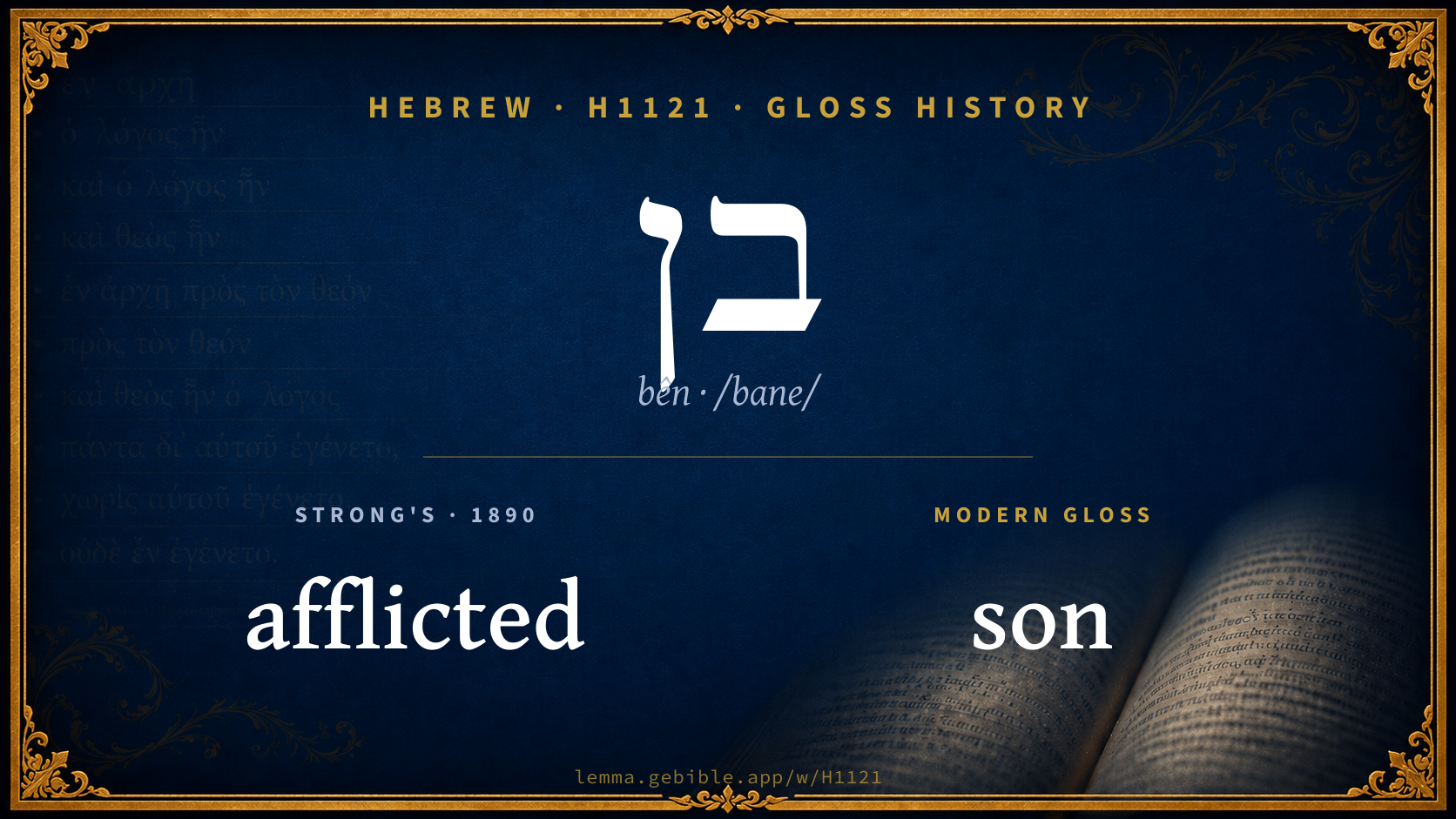
Gloss history
Strong's 1890 vs modern scholarship
About this word
Strong's H1121 catalogs a Hebrew word from the Hebrew Old Testament.
These counts are not copied from any lexicon or concordance. They are computed here, from the morphology-tagged Hebrew Old Testament. What Lemma adds →
- 3,652
- distinct verses
- The word appears in 3,652 distinct verses.
- 37 / 39
- OT books
- The word appears in 37 of 39 Old Testament books.
- #9
- by frequency
- Top 10 most frequent Hebrew words (rank 9 of 8,640 Hebrew words by occurrence).
View all 3,652 occurrences in the concordance →
Most concentrated in
- Numbers 436 verses 12%
- 1 Chronicles 430 verses 12%
- Genesis 306 verses 8%
By section of the Old Testament
By traditional corpus
Conventional, traditional groupings — biblical authorship is debated, so this is a traditional corpus grouping, not an authorship claim. Each share is this word’s portion of its verses in that division of the Hebrew canon. Each figure is a share of the word’s 3,652 distinct verses.
- Prophets (Nevi'im) 1,391 verses · 38%
- Torah (Pentateuch) 1,187 verses · 33%
- Writings (Ketuvim) 1,074 verses · 29%
How translations render this word
Counts come from each version’s own published word-to-Strong’s tagging or interlinear alignment — an approximate guide to how each version renders this word, not a word-level alignment the data otherwise carries. Because each total is that version’s own tagged count, the per-version totals vary from one another and need not match the appearance or distinct-verse counts above. These counts may also differ from a printed concordance because Lemma counts each distinctly tagged rendering and does not collapse phrase taggings into a single head-word total. This is a fixed set of word-tagged versions (KJV, ASV, BSB, ULT) and does not change with the reading translation you choose elsewhere. Each version’s license is shown beside its name below (and on Sources).
BDB lists this Strong’s number as 3 distinct words (homographs). Each count above pools all of them and is not split by sense — see the Senses section below. A low-frequency rendering may belong to a different one of those words, not the primary meaning.
- King James Version†: Son 1,757×, Children 1,289×, Sons 826×
- American Standard Version†: Son 1,622×, Children 1,204×, Sons 801×
- Berean Standard Bible†: Son 1,807×, Sons 836×, Israelites 398×
- unfoldingWord Literal Text†: Sons of 1,811×, Son of 1,212×, Son 718×
King James Version Public Domain
Renders H1121 across 4,891† tagged occurrences — most commonly:
Plus other, less common renderings. Plus 334 renderings that appear only once — usually multi-word phrases or single function words the recovered tagging swept in, not distinct renderings. Not rendered by a distinct English word in 15 further occurrences.
American Standard Version Public Domain
Renders H1121 across 4,872† tagged occurrences — most commonly:
Plus other, less common renderings. Plus 421 renderings that appear only once — usually multi-word phrases or single function words the recovered tagging swept in, not distinct renderings.
Berean Standard Bible Public Domain
Renders H1121 across 4,587† tagged occurrences — most commonly:
Plus other, less common renderings. Plus 197 renderings that appear only once — usually multi-word phrases or single function words the recovered tagging swept in, not distinct renderings. Not rendered by a distinct English word in 208 further occurrences.
unfoldingWord Literal Text CC BY-SA 4.0
Renders H1121 across 4,875† tagged occurrences — most commonly:
Plus other, less common renderings. Plus 83 renderings that appear only once — usually multi-word phrases or single function words the recovered tagging swept in, not distinct renderings.
22 senses and sub-senses in the full BDB
What do BDB’s symbols mean?
BDB uses these scholarly abbreviations:
| Symbol | Meaning |
|---|---|
| 𝔊 | the Septuagint (the ancient Greek translation, LXX) |
| 𝔙 | the Vulgate (the Latin translation) |
| 𝔖 | the Syriac version (the Peshitta) |
| 𝔗 | the Targum (the Aramaic translation) |
| ψ | the Psalms |
| √ | root (the underlying root or stem) |
| ‖ | parallel passage (a synonymous or contrasted parallel) |
| † | the dagger: every passage where the word occurs is cited |
The 22 senses and sub-senses the full Brown-Driver-Briggs lexicon distinguishes for this word, in lexicon order (not ranked by frequency), with BDB’s own verbatim wording and sub-sense lettering. Shown in Hebrew script with BDB’s own scholarly abbreviations. The condensed entry is in the Lexicon Entry tab. See also the Forms in the corpus table below.
בן I son (MI Ph. בן
- 1. son, male child, born of a woman Gn 4:25; 16:11, 15; 17:19 cf. v 16 18:10, 14; 19:37, 38 + often, cf. בֶּן־בִּטְנָהּ Is 49:15; begotten by a man Gn 5:4 f. 28; 6:10; 11:11 f. + often; ‖ בַּת (בָּנוֹת) daughter Gn 5:4, 7, 10 f. Ex 20:10 Dt 5:14; 16:11, 14 1 S 30:3, 6 Jb 1:2 42:13 +; of son as desired Gn 30:2 (cf. 15:2; 16:2; 17:17; 18:10 f. 1 S 1:5–11) 2 K 4:14, 28 ψ 127:3 +; rejoiced in Gn 30:6 +; beloved Ex 21:5 2 S 19:1, 3, 5 1 K 3:26; cared for Dt 1:31; spared Mal 3:17; disciplined & trained Dt 8:5 Pr 3:12; 13:24; 19:18; 29:17; owing reverence, obedience, etc. to parents Pr 6:20; 10:1; 13:1; בִּנְךָ בְּכוֹרְךָ thy first-born son Gn 27:32; הַבֵּן הַבְּכֹר Dt 21:15 cf. 1 S 8:2; בְּנָהּ הַגָּדֹל her elder son Gn 27:15, 42; בְּנוֹ הַגָּדֹל 27:1; בְּנָהּ הַקָּטָן her younger son Gn 27:15, 42. In partic. e.g. Genesis 4:25
- a. בֶּן־אִמּוֹ son of his mother, i.e. own (uterine) brother Gn 43:29, cf. 27:29 Ju 8:19 ψ 50:20; 69:9, & v. אֵם; בְּנֵי אָבִיךָ son of thy father = brethren Gn 49:8 (poet.) e.g. Genesis 43:29
- b. בְּנֵי דֹדֵיהֶן = cousins Nu 36:11. e.g. Numbers 36:11
- c. בְּנִי my son, as term of kindliness of endearment, used by Eli to Samuel 1 S 3:6, 16 cf. 4:16; 24:17; 26:17, 21, 25, v. also Pr 1:8, 10 2:1 +; cf. בִּנְךָ, used by Benhaded of himself to Elisha 2 K 8:9; by Ahaz to Tiglath-pileser 16:7; especially to express intimate and gracious relation with God: י׳ calls Israel בְּנִי בְכֹרִי Ex 4:22 cf. v 23 Ho 11:1, v. also ψ 80:16 (but cf. Che); בָּנִים אַתֶּם ליהוה אלהיכם Dt 14:1; בְּנֵי עֶלְיוֹן ψ 82:6 (‖ אלהים); בְּנֵי אֵל־חָ֑י Ho 2:1; cf. further Dt 32:5 (pl.) v 20 (pl.) Is 1:2, 4; 30:1, 9; Je 3:14, 22; 4:22; 31:20; of future Davidic king 2 S 7:14 = 1 Ch 17:13 cf. ψ 2:7; expressly referred to Solomon 1 Ch 22:10; 28:6; also of children (offered in fire) Ez 16:21. e.g. 1 Samuel 3:6
- d. בְּנֵי האלהים applied to supernatural beings Gn 6:2, 4; Jb 1:6; 2:1; בְּנֵי אלהים Jb 38:7; בְּנֵי אֵלִים ψ 29:1 (on which cf. Che’s note) 89:7. e.g. Genesis 6:2
- e. בֶּן־אָדָם son of man, cf. בְּנֵי א׳, v. אָדָם; †בְּנֵי אִישׁ ψ 4:3 & (‖ בני אדם) 49:3; 62:10; La 3:33. e.g. Psalms 4:3
- f. בֶּן־בִּנְךָ = thy grandson Ex 10:2; Dt 6:2; Ju 8:22 cf. Je 27:7; also pl. Ex 34:7; Dt 4:9, 25; Ju 12:14; 2 K 17:41; 1 Ch 8:40; Jb 42:16; ψ 128:6; Pr 13:22; 17:6; Ez 37:25; also בֵּן alone with similar reference Gn 29:5 (Laban son of Nahor); Laban calls his daughters’ children his own sons Gn 31:28, 43 cf. 32:1; son of Naomi Ru 4:17; בְּנֵי רְבִעִים 2 K 10:30 sons of the fourth generation, and, in general, descendants Jos 22:24, 25, 27 +; cf. 2 S 19:25 2 K 9:20; Ez 5:1. e.g. Exodus 10:2
- g. constantly, as more precise designation, added to personal name כָּלֵב בֶּן־יְפֻנֶּה Nu 14:30; 32:12; 34:19 +; יְהוֹשֻׁעַ בִּן־נוּן Nu 11:28; 14:30; 32:12, 28; 34:17 +; יָרָבְעָם בֶּן־נְבָט 1 K 12:2, 15 +, etc.; also without personal name (often with implication of contempt) בֶּן־קִישׁ 1 S 10:11; בֶּן־יִשַׁי 1 S 20:27, 30, 31; 22:7, 8, 9, 13; 25:10 2 S 20:1; בְּנֵי צְרוּיָה 2 S 16:10; בֶּן־רְמַלְיָהוּ Is 7:4, 5, 9; 8:16; בֶּן־טָֽבְאַ֑ל Is 7:6; cf. also בְּנֵי לֵוִי Nu 16:7, 8. e.g. Numbers 14:30
- h. designated as בֶּן־זְקֻנִים i.e. born in old age of father Gn 37:3; opp. בְּנֵי הַנְּעוּרִים sons of one’s youth ψ 127:4; also בֶּן־בֵּיתִי one born in my house Gn 15:3 (i.e. slave) so בְּנֵי בַיִת Ec 2:7. e.g. Genesis 37:3
- i. in various combinations: (α) as expression of contumely, בֶּן־נַעֲוַת הַמַּרְדּוּת 1 S 20:30; בֶּן־הַמְּרַצֵּחַ הַוֶּה 2 K 6:32 this son of a murderer; cf. בְּנֵי־נָבָל Jb 30:8; בְּנֵי בְלִי־שֵׁם ib.; בְּנֵי עֹנֲנָה Is 57:3 (‖ זֶרַע מְנָאֵף); cf. בֶּן־אִשָּׁה אַחֶרֶת Ju 11:2 (cf. v 1); (β) as term of respect, dignity, בֶּן־חוֹרִים son of nobles Ec 10:17 (in Aramaic = free born); בֶּן־חֲכָמִים Is 19:11; בֶּן־מַלְכֵי־קֶדֶם ib.; cf. בֶּן־מֶלֶךְ ψ 72:1 (‖ מֶלֶךְ); בֶּן־אֲמָתֶ֑ךָ ψ 86:16 in addressing י׳ (‖ עַבְדֶּ֑ךָ) & בְּנֵי־עֲבָדֶיךָ ψ 102:29; of noble appearance בְּנֵי הַמֶּלֶךְ Ju 8:18. e.g. 1 Samuel 20:30
- j. often pl. with name of ancestor, people, land, or city, to denote descendants, inhabitants, membership in a nation or family, etc.: (α) e.g. בְּנֵי־עֵבֶר Gn 10:21; בְּנֵי־חֵת Gn 23:3, 5, 7, 10(×2), 11, 16, 18, 20; 25:10; 49:32 (all P); (בְּנֵי־שֵׁת) Nu 24:17 v. sub 8); בְּנֵי־חֲמוֹר Gn 33:19 Jos 24:32; בְּנֵי עֵשָׂו Gn 36:5, 15, 19 Dt 2:4, 8, 12, 22, 29; בְּנֵי שֵׂעִיר Gn 36:20, 21; בֶּן־(בני)הִנֹּם Jos 15:8 + (cf. sub גַּיְא); בְּנֵי לוֹט Dt 2:9, 19 ψ 83:9; בְּנֵי־יוֹסֵף (lit. Gn 46:27; 48:8; 1 Ch 5:1) Nu 1:32; 26:28, 37; 34:23; 36:5 (מַטֵּה ב׳ י׳) + 6 times Jos, cf. ψ 77:16; even בְּנֵי חֲצִי שֵׁבֶט מְנַשֶּׁה 1 Ch 5:23; בְּנֵי דָוִיד (lit. 2 S 8:18 = 1 Ch 18:17, 1 Ch 3:1, 9) 2 Ch 13:8; 23:3; 32:33; בְּנֵי אָסָף 2 Ch 29:13; Ezr 2:41; 3:8 + (v. אָסָף); בְּנֵי קֹרַח in titles of ψ 42–49, 84, 85, 87, 88; especially (β) בְּנֵי־עַמּוֹן (standing designation of people of Ammon) Gn 19:38 + 81 times (cf. עַמּוֹן & NöZMG 1886, 171 DrSm 66); בְּנֵי יַעֲקֹב (lit. Gn 34:7, 13, 25, 27; 35:5, 22, 26; 49:2) 2 K 17:34 ψ 105:6 Mal 3:6 cf. ψ 77:16; & chiefly (γ) בְּנֵי יִשְׂרָאֵל (lit. Gn 42:5; 45:21; 46:5; Ex 1:1) Ex 1:7 + 613 times, incl. Hex 427 (of which 328 P, 49 E, 25 J, 25 D), Ju 6:1, SK Ch 73 (23 in ref. to ancient history, 10 in opp. to Judah); so also Vrss & var. sometimes for בֵּית יִשׂ׳, e.g. Jos 21:43 + v. Di, Ez 3:1 + v. Co; also the reverse Ez 2:3 al.; note especially עַם בּ׳ יִשְׂרָאֵל Ex 1:9; עַמִּי בּ׳ יִשְׂרָאֵל Ex 3:10; 7:4; עֲדַת בְּנֵי יִשְׂרָאֵל Ex 16:1, 2, 9, 10; 17:1 Lv 16:5; 19:2; Nu 1:2, 53; 8:9, 20; 13:26; 15:25, 26 17:6; 19:9; 25:6; 26:2; 31:12 (all P); דֹּרוֹת ב׳ יִשׂ׳ Ju 3:2; כָּל־ב׳ יִשׂ׳ וְכָל־הָעָם 20:26; ב׳ יִשׂ׳ וּבְנֵי הַלֵּוִי Ne 10:40; also (δ) בְּנֵי יְהוּדָה (lit. Gn 46:12; 26:19 1 Ch 2:3, 10; 4:1) Nu 1:26 + 18 times Nu Jos, Ju 1:8, 9, 16 (so read also v 21(×2) cf. Jos 15:53 & v. sub בנימן) 2 S 1:18 1 Ch 4:27 + 8 times Chr, Je 7:30 + 4 times Je; Ho 2:2 Jo 4:6, 8, 19 Ob 12 (not in K, of Judah or of any other tribe, except בְּנֵי לֵוִי 1 K 12:31) incl. מַטֵּה בְּנֵי יְהוּדָה Jos 15:1, 20, 21; 21:1 1 Ch 6:50; for usage with other tribes of Isr., v. the articles;—but note (ε) †בְּנֵי לֵוִי (lit. Gn 46:11 Ex 6:16 Nu 3:17 1 Ch 5:27; 6:1 cf. 23:6) Ex 32:28 Nu 3:15; 16:7, 8; 18:21 Jos 21:10 (as including sons of Aaron etc.); כָּל־בְּנֵי לֵוִי Ex 32:26; כָּל־אַחֶיךָ ב׳ ל׳ Nu 16:10; הַכֹּהֲנִים ב׳ ל׳ Dt 21:5; 31:9 cf. 1 K 12:31 & Mal 3:3; 1 Ch 23:24, 27; 24:20 Ezr 8:15 (distinguished from priests) Ne 12:23 Ez 40:46 (including בְּנֵי צָדוֹק the priests); also מַחֲנוֹת ב׳ ל׳ 1 Ch 9:18; בְּנֵי הַלֵּוִי 1 Ch 12:27 Ne 10:40; בְּנֵי הַלְּוִיִּם 1 Ch 15:15; 24:30 (cf. also לֵוִי); (ζ) בְּנֵי אַהֲרֹן (lit. Ex 28:1, 40 1 Ch 5:29; 24:1; often Aaron and his sons lit. Ex 27:21; 28:1, 4 +) Lv 3:5, 8, 13; 6:7, 11; 7:10, 33 Jos 21:10 1 Ch 6:35, 39, 42; 15:4 (+ Levites) 24:1, 31 Ne 12:47; also בְּנֵי א׳ הַכֹּהֲנִים Lv 1:5, 8, 11; 2:2; 3:2 Nu 3:3; 10:8 & Jos 21:19 2 Ch 31:19 cf. 26:18; 29:21; 35:14(×2); בְּנֵי אַהֲרֹן הַכֹּהֵן Lv 1:7 Jos 21:4 (as subdivision of Levites) v 13 cf. Lv 7:34; אֶת־כֹּהֲנֵי יהוה אֶת־בְּנֵי אַהֲרֹן וְהַלְּוִיִּם 2 Ch 13:9 cf. v 10; once in sing. הַכֹּהֵן בֶּן־אַהֲרֹן Ne 10:39; v. also sub אַהֲרֹן; (η) †בְּנֵי צָדוֹק Ez 40:26, 44:15 הכהנים הלוים בני צדוק; 48:11 הכהנים הַמְֿקֻדָּשׁ מבני צדוק (𝔊 Sm Co join מ of מבני to preceding word, making pl.); (θ) בְּנֵי with names of peoples, lands, and cities, בְּנֵי כֻשִׁיִּים Am 9:7; בְּנֵי מִצְרַיִם Ez 16:26; בְּנֵי אַשּׁוּר Ez 16:28; 23:7, 9, 12, 23; ב׳ אֶרֶץ הַבְּרִית Ez 30:5 (Co del. ארץ); ב׳ בָּבֶל Ez 23:15, 17, 23; ב׳ יְרוּשָׁלִַם Jo 4:6; ב׳ צִיּוֹן Jo 2:23 La 4:2 ψ 149:2 (cf. Zc 9:13). Vid. further (ι) בְּנֵי עַמֶּ֑ךָ Lv 19:18 cf. 20:17 Nu 22:5 Ju 14:16, 17 Ez 3:11; 33:2, 12, 17, 30; 37:18 Dn 12:1; בְּנֵי פָּרִיצֵי עַמֶּךָ Dn 11:14; (κ) קֶבֶר בְּנֵי הָעָם 2 K 23:6 2 Ch 35:5, 7, 12; קִבְרֵי בְנֵי הָעָם Je 26:23; (λ) בְּנֵי־קֶדֶם Gn 29:1 Ju 7:12; 8:10 1 K 5:10 Jb 1:3 Is 11:14 Je 49:28 Ez 25:4, 10; †(μ) בְּנֵי הַמְּדִינָה Ezr 2:1 = Ne 7:6; (ν) of bulls, בְּנֵי בָשָׁן Dt 32:14 (song) cf. KloSK 1872, 254 Di. e.g. Genesis 10:21
- 2. children (male and female) Gn 3:16; 21:7 Ex 21:5; 22:23; hence בְּנֵי מְנַשֶּׁה הַזְּכָרִים Jos 17:2 male children, בֵּן זָכָר Je 20:15. e.g. Genesis 3:16
- 3. youth, young men (pl.) Pr 7:7 Ct 2:3. e.g. Proverbs 7:7
- 4. the young of animals Lv 22:28 (שׁוֹר אוֹ שֶׂה) cf. Dt 22:6, 7 1 S 6:7, 10 Zc 9:9 Jb 4:11; 28:8; 39:4, 16;—בֶּן־בָּקָר etc. v. sub 7 b infr. e.g. Leviticus 22:28
- 5. of plant-shoots בֵּן פֹּרָת Gn 49:22(×2); also בֵּן ψ 80:16? (‖ כַּנָּה; see Che trans. & crit. n.) e.g. Genesis 49:22
- 6. fig. of lifeless things, בְּנֵי רֶשֶׁף sparks Jb 5:7; stars עַיִשׁ עַל־בָּנֶיהָ Jb 38:32; arrows בֶּן־קָ֑שֶׁת Jb 41:2; בְּנֵי אַשְׁפָּתוֹ) La 3:13; cf. בֶּן־גָּרְנִי i.e. corn of my threshing-floor Is 21:10. e.g. Job 5:7
- 7.
- a. member of a guild, order or class, †בְּנֵי הַנְּבִיאִים i.e. those belonging to the prophetic order 1 K 20:35 2 K 2:3, 5, 7, 15; 4:1, 38(×2); 5:22; 6:1; 9:1 (Hoffm RSProph. 85. 388, K 15 f.; ZehnpfundBAS i.355 comp. Assyrian mâr šipri, son of a messenger = messenger, and explains from the son’s succeeding to father’s calling) & בֶּן־נָבִיא Am 7:14; prob. also †בְּנֵי הַכֹּהֲנִים 1 Ch 9:30 Ezr 2:61; 10:18; †בְּנֵי הַשֹּׁעֲרִים Ezr 2:42; cf. בְּנֵי הַגְּדוּד 2 Ch 25:13 men of the troop, v. Palm. בני שירתא men of the caravan VogNo. 4 al.; also בְּנֵי הַגּוֹלָה = exiles †Ezr 4:1; 6:19, 20; 8:35; 10:7, 16; בֶּן־הָרַקָּחִים Ne 3:8; further, in בֶּן־נֵכָר = foreigner (only P, poet., & late) †Gn 17:12, 27 Ex 12:43 Lv 22:25 Ez 44:9(×2); ב׳־הַנּ׳ †Is 56:3; בְּנֵיִ־נֵכָר †2 S 22:45, 46 = ψ 18:45, 46 Ne 9:2 Is 60:10; 61:5; 62:8 Ez 44:7 ψ 144:7, 11, בְּנֵי־הַנּ׳ Is 56:6; also בְּנֵי הַתּוֹשָׁבִים הַגָּרִים עִמָּכֶם Lv 25:45. e.g. 1 Kings 20:35
- b. of animals, בֶּן־בָקָר son of (the) herd, i.e. young one of the herd, בָּקָר וּבְנֵי בָקָר 1 S 14:32 cf. עֵגֶל בֶּן־בָּקָר Lv 9:2 (P); then, in general, one of the herd: fit for food Gn 18:7, 8 (J), for sacrifice Nu 15:8 (P); בן הַבּ׳ Lv 12:6 Nu 15:9 (P); especially פַּר בֶּן־בָּקָר Ex 29:1 Lv 4:3, 14; 16:3; 23:18 Nu 7:15 + 16 times Nu (all P) + 2 Ch 13:9 Ez 43:19, 23, 25; 45:18; 46:6; פָּרִים בְּנֵי בָּקָר Nu 28:11, 19, 27; 29:13, 17 (P); also בְּנִי אֲתֹנוֹ Gn 49:11 (poem, J; ‖עִירֹה); בְּנֵי־צֹאן ψ 114:4, 6; בֶּן־רְאֵמִים ψ 29:6; בְּנֵי הָרַמָּכִים Est 8:10; (הַ)יּוֹנָה בְּנֵי Lv 1:14 + 7 times Lv + Nu 6:10 cf. בֶּן־יוֹנָה Lv 12:6 (all P); בְּנֵי־נָ֑שֶׁר Pr 30:17; בְּנֵי עֹרֵב ψ 147:9. e.g. 1 Samuel 14:32
- 8. ב׳ as n. relat. followed by word of quality, characteristic, etc. especially †(α) בֶּן־(בני)חַיִל = mighty man 1 S 14:52; 18:17 2 S 2:7; 13:28; 17:10(×2) 1 K 1:52 + 7 times Ch; אֲנָשִׁים בני ח׳ Ju 18:2 2 K 2:16; אֶלָף אִישׁ מִבְּנֵי הֶחָ֑יִל Ju 21:10; †(β) בְּנֵי עַוְלָה wicked men 2 S 3:34; 7:10 1 Ch 17:9 Ho 10:9; בֶּן־ע׳ ψ 89:23 (for בני בליעל v. בליעל); †(γ) בְּנֵי מֶ֑רִי rebels Nu 17:25 (cf. בַּיִת); †(δ) בְּנֵי הַתַּעֲרֻבוֹת sons of pledges = hostages 2 K 14:14 = 2 Ch 25:24; †(ε) בְּנֵי מָוֶת i.e. those deserving of death 1 S 26:16; so בֶּן־מות 2 S 12:5; בְּנֵי תְמוּתָה appointed or exposed to death ψ 79:11; 102:21; cf. †(ζ) בִּן הַכּוֹת one worthy of smiting Dt 25:2; †(η) בְּנֵי עֹ֑נִי Pr 31:5; †(θ) בְּנֵי חֲלוֹף Pr 31:8; †(ι) בְּנֵי שָׁאוֹן Je 48:45 = tumultuous ones; so also (= שֵׁאת) בְּנֵי שֵׁת Nu 24:17 cf. RV Di al.; †(κ) בְּנֵי הַיִּצְהָר Zc 4:14 i.e. anointed ones; †(λ) בֶּן־מֶשֶׁק Gn 15:2 son of possession, i.e. heir; †(μ) הֵילֵל בֶּן־שָׁ֑חַר Is 14:12 son of dawn; †(ν) of animals בְּנֵי שָׁ֑חַץ i.e. proud beasts Jb 28:8; 41:26; (ξ) of Jonah’s gourd בִּן־לַיְלָה Jon 4:10(×2); †(ο) of a fertile hill קֶרֶן בֶּן־שֶׁמֶן Is 5:1. e.g. 1 Samuel 14:52
- 9. n. relat. of age:
- a. of men, וַיְהִי נֹחַ בֶּן־חֲמֵשׁ מֵאוֹת שָׁנָה Gn 5:32 cf. 7:6 + 71 times P; Gn 50:26 Jos 14:7, 10; 24:29 (all E); Nu 32:11 (J), Dt 31:2; also Ju 2:8 1 S 4:15 2 S 4:4; 19:33, 36 1 Ch 2:21 23:3, 24, 27; 27:3 2 Ch 24:15; 25:5; 31:16, 17 Ezr 3:8 Is 65:20(×2) Je 52:1; + 41 times SK Ch of kings at accession; note especially (incl. in above) the phrase מִבֶּן עֶשְׂרִים שָׁנָה וָמָ֑עְלָה Ex 30:14; 38:26 Nu 1:3 + 21 times Nu 1–3 + 26:2, 4; 32:11 1 Ch 23:24, 27 2 Ch 25:5 Ezr 3:8; cf. Lv 27:7 Nu 8:24; 26:62 1 Ch 23:3 & without מעלה Nu 8:25; 18:16; also מִבֶּן עשׂרים שׁנה וְעַד בֶּן־שִׁשִּׁים שָׁנָה Lv 27:3 cf. v 5, 6; מִבֶּן שׁלשׁים שׁנה ומעלה ועד בן־חמשׁים שׁנה Nu 4:3(×2) + 12 times Nu 4; מבן שׁלושׁ שׁנים וּלְמַ֫עְלָה 2 Ch 31:16 cf. v 17; & לְמִבֶּן עשׂרים שׁנה וּלְמָ֑טָה 1 Ch 27:23. e.g. Genesis 5:32
- b. of animals, (Hex all P, incl. H) בֶּן־שָׁנָה Ex 12:5; 29:38 Lv 9:3; 23:18, 19 Nu 7:17 + 28 times Nu 7, 28, 29; also Mi 6:6; בֶּן־שְׁנָתוֹ Lv 12:6; 23:12 Nu 6:12, 14 + 12 times Nu 7; also Ez 46:13. Note.—בן appears perhaps abbrev. as בּ in a few cpd. n.pr.; v. בִּדְקַר (= בֶּן־דקר?), בִּלְשָׁן, בִּמְהָל, בַּעֲלִיס, בַּעֲנָה, בִּרְשַׁע, בִּשְׁלָם (so MV after Schol. Hamâsa3 ed. Freytag; Röde libr. hist. interpr. Arabic 20, 21; but this is very uncertain, cf. Ol§227 b, p. 613).—On Lag’s explan. of אבי in some n.pr. as for אבן = בן cf. LagBN 75 & v. אבינר p. 4, etc., but this is dub. e.g. Exodus 12:5
בן II m. a Levite 1 Ch 15
Senses from the full Brown-Driver-Briggs lexicon (Brown, Driver, Briggs; Oxford 1906 — public domain), digitized via Sefaria, supplemented by the OpenScriptures HebrewLexicon (CC BY 4.0). Full attribution on Sources.
Word origin
I. n.m. son (MI Ph. בן; so Sab. CISiv. No. 2, cf. בני DHMSem. Sprachforsch. 6; Arabic اِبْنٌ; Assyrian bin(u), LyonSargon 9, 1. 57; especially in bin-bin, grandson COTGloss., cf. Dl infr.; Aramaic בַּר, ܒܰܪ, pl. בְּנִין, ܒܢܺܝܢ; cf. Palm., especially VogNo. 21. 31. 36 a al.; possibly orig. connected with בנה build, so Thes, cf. Assyrian bânu, begetter (DlPr 104 & cf. BaZMG 1887, 638 ff.); but all traces of this √ lost in Heb. form; √ perhaps orig. bilit. (בִּן, בֵּן) בַּן v. Sta§ 183)—abs. בּ׳ Gn 4:25 +; בֵּֽן־ Ez 18:10; cstr. בֵּן Gn 49:22(×2); בֶּן־ Gn 5:32 +; בֶּן Est 2:5; Ne 6:18, & c. prefix Gn 17:17; Nu 8:25; 1 Ch 27:23; 2 Ch 25:5; 31:16, 17; בְּנוֹ Nu 23:18; 24:3, 15; בְּנִי Gn 49:11; בִּן Dt 25:2; בִּן־ Ex 33:11 + 32 times (29 times in combination בִּן־נוּן (ישׁוע, הושׁע) יהושׁע); sf. בְּנִי Gn 21:10 +; בִּנְךָ Ex 20:10 +; לִבֱנ֑ךָ Dt 7:3; 1 K 11:13; בְּנֵךְ Gn 30:14 +; בְּנוֹ Gn 4:17 +; בְּנָהּ Gn 21:10 +; pl. בָּנִים Gn 3:16 +; cstr. בְּנֵי Gn 6:2 +; sf. בָּנַי Gn 31:43 +; בָּנֵינוּ Jos 22:25 +; בְּנֵיכֶם Ex 3:22 +, etc.;—
II. n.pr.m. a Levite 1 Ch 15:18, but del. 𝔊 Be Öt cf. v 20.
I. 1 Ch 24:26, 27 as n.pr.m. in AV RV, but render: the sons of Jaaziah his son, & the sons of Merari by Jaaziah his son, cf. VB & Be Öt.
— Brown-Driver-Briggs (Oxford 1906, public domain), digitized via Sefaria, supplemented by the OpenScriptures HebrewLexicon (CC BY 4.0). See Sources.
Derived from בנה (bânâh) (H1129) — to build.
Jastrow Dictionary
A second Hebrew/Aramaic lexicon for comparison, covering Aramaic and post-biblical (Talmudic, Targumic, Midrashic) usage that the biblical-Hebrew BDB does not. Matched by lemma rather than by Strong’s number, so a lemma may carry more than one Jastrow headword (shown separately below), and the entries cover usage well beyond the Bible.
בֵּן
- , constr. בֶּן (b. h.; בנה) offspring, son, child. שבוע הב׳ the male child’s week, a disguise for circumcision day, adopted during the Hadrianic persecutions. Snh. 32ᵇ; Y. Keth. I, 25ᶜ; a. e.—ישוע הב׳ a disguise for פִּדְיוֹן הבן. B. Kam. 80ᵃ.—… בְּנוֹ של the son of, v. שֶׁל. בְּנָן של קדושים descendant of holy men. Ab. Zar. 50ᵃ; a. e.—Pl. בָּנִים, constr. בְּנֵי. Ab. III, 14 ב׳ למקום chosen children of God. Gen. R. s. 82 בָּנֶיהָ של תורה children (followers) of the Law.—Trnsf. belonging to, fit for &c.; e.g. בני גולה those belonging to the colony of exiles, Babylonians &c.; בני גליל Galileans; בני אכילה things fit to be eaten &c. [For such compounds as are not self-evident, see the respective determinants.] [בני פיקרין, v. בְּנִיפיקָרִין.]
A Dictionary of the Targumim, the Talmud Babli and Yerushalmi, and the Midrashic Literature (Marcus Jastrow; London, Luzac, 1903) — Public Domain. Digitized via Sefaria. Digitized via Sefaria. Full attribution on Sources.
Forms in the corpus
The 525 distinct written forms H1121 takes in the Hebrew Bible, most frequent first — each parse links to that state’s occurrences in the concordance. Hebrew forms include their vowel points and cantillation, so a single lemma takes many written forms.
The 60 most common forms are shown; 465 rarer forms follow in the full concordance.
Same root — word family
Other BDB entries built from the same root as H1121, grouped by Strong’s listed origin. These share a root / origin per the lexicon — not necessarily a shared meaning. Each links to that word’s own entry.
Derives from
Shares the same root
- אבן ʼeben H68 stone
- בית bayith H1004 house
- בנא bᵉnâʼ H1124 to build
- בניה binyâh H1140 building
- בנין binyân H1146 building
- בת bath H1323 daughter
- מבנה mibneh H4011 building
- תבן teben H8401 stubble
- תבנית tabnîyth H8403 pattern
Derived from this word
Proper names from this root
People and places named from this root — a name, not an additional meaning of the word.
- בנוי Binnûwy H1131 Binnui
- בני Bânîy H1137 Bani
- בני Bunnîy H1138 Bunni
- בניה Bᵉnâyâh H1141 Benaiah
- יבנאל Yabnᵉʼêl H2995 Jabneel
- יבנה Yabneh H2996 Jabneh
- יבניה Yibnᵉyâh H2997 Ibneiah
- יבניה Yibnîyâh H2998 Ibnijah
- מבני Mᵉbunnay H4012 Mebunnai
- בן Bên H1122 Ben
- בןאבינדב Ben-ʼĂbîynâdâb H1125 Ben-Abinadab
- בןאוני Ben-ʼÔwnîy H1126 Ben-oni
- בןגבר Ben-Geber H1127 Ben-geber
- בןדקר Ben-Deqer H1128 Ben-dekar
- בןהדד Ben-Hădad H1130 Ben-hadad
- בןזוחת Ben-Zôwchêth H1132 Ben-zoheth
- בןחור Ben-Chûwr H1133 Ben-hur
- בןחיל Ben-Chayil H1134 Ben-hail
- בןחנן Ben-Chânân H1135 Ben-hanan
- בןחסד Ben-Cheçed H1136 Ben-hesed
- בניברק Bᵉnêy-Bᵉraq H1139 Bene-barak
- בני יעקן Bᵉnêy Yaʻăqân H1142 Bene-jaakan
- בנימין Binyâmîyn H1144 Benjamin
- בנינו Bᵉnîynûw H1148 Beninu
- בןעמי Ben-ʻAmmîy H1151 Ben-ami
Compare all same-root words → Showing 4 of 38 — not the complete family. 25 of the same-root words are proper names (people or places). They share a root, not necessarily a meaning.
Septuagint verse parallels
Most of the 3,652 Hebrew verses this word occurs in also exist in the Greek Old Testament (Septuagint), so the same passages can be read in Greek by switching the Old Testament edition to the Septuagint.
Read these verses in the Septuagint
- Genesis 3:16
- Exodus 1:1
- Leviticus 1:2
- Numbers 1:2
- Deuteronomy 1:3
- Joshua 1:1
- Judges 1:1
- Ruth 1:1
- 1 Samuel 1:1
- 2 Samuel 1:4
- 1 Kings 1:5
- 2 Kings 1:17
This is a verse-level parallel only — the same verses exist in both the Hebrew and Greek Old Testaments. No word-level Hebrew↔Greek correspondence is claimed: the data carries no such alignment, so no Greek word is shown as this Hebrew word’s translation. Coverage is not total — the Septuagint omits the deuterocanon and renumbers the Psalms, so some Hebrew verses have no direct Greek parallel.