2 Kings 17:22

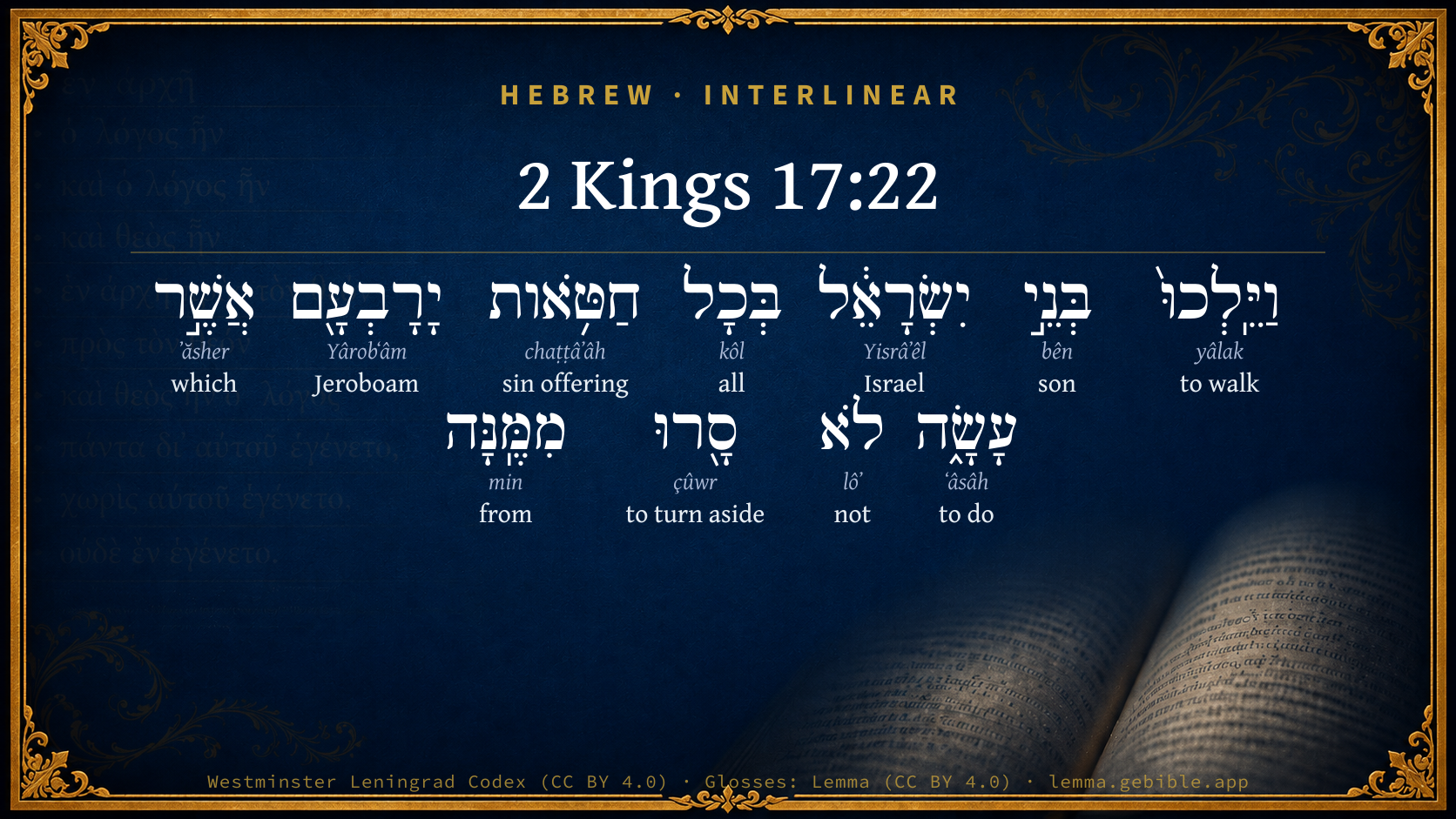
Hebrew (Westminster Leningrad Codex) 2 Kings 17:22 appears in the Hebrew Old Testament. The text above is from the Westminster Leningrad Codex. Each word links to its Strong’s number, a concise gloss, and parsing drawn from the Open Scriptures Hebrew Bible morphology. Click any word for its full Brown-Driver-Briggs (BDB) entry.
Download image
Cite this verse

2 Kings 17:22 (World English Bible). Public Domain. Lemma interlinear Bible study tool, https://lemma.gebible.app/v/2-kings/17/22.

Show BibTeX & RIS
BibTeX
RIS
English Translation
The children of Israel walked in all the sins of Jeroboam which he did; they didn't depart from them;
World English Bible · Public Domain
Download a study sheet

One document with this verse’s original text, its word-by-word gloss line, the meaning frame, cross-references with their text, attributed commentary, and full source and license credits — printable, and it pastes into notes with its structure intact.

This verse Autodidact and up

Study sheet (.html) Plain text (.txt)

A passage Seminary Student

Up to 50 verses in one chapter. A passage sheet keeps up to 6 commentary sources and 12 cross-references per verse, in the order this page ranks them, and says so on the sheet whenever that leaves anything out. Ask for a single verse and you get the Autodidact verse sheet above.

Everything on this page stays free to read, with no account — the sheet is a download of what is already on screen, not access to it.

Want to remove ads? Support Godless Engineer
Compare translations 3

The same verse in 3 English versions, stacked beneath the original-language interlinear above. Click any original word for its lexicon entry.

Each is an independent rendering of the whole verse — the interlinear is not word-aligned to these translations.

Highlighted words mark where these versions differ — a whole-verse word diff, not a word-by-word alignment.

  • World English Bible Public Domain
    The children of Israel walked in all the sins of Jeroboam which he did; they didn't depart from them;
  • King James Version Public Domain
    For the children of Israel walked in all the sins of Jeroboam which he did; they departed not from them;
  • unfoldingWord Literal Text CC BY-SA 4.0
    And the sons of Israel walked in all of the sins of Jeroboam that he did. They did not turn away from it,

unfoldingWord Literal Text — © unfoldingWord, licensed CC BY-SA 4.0. Word-aligned USFM3 via Door43 (git.door43.org/unfoldingWord/en_ult).

Versions to compare (up to 4)

3 of 4 selected

Show all 18 translations

Every available English version of this verse, each an independent rendering of the whole verse.

  • World English Bible Public Domain
    The children of Israel walked in all the sins of Jeroboam which he did; they didn't depart from them;
  • Berean Standard Bible Public Domain
    The Israelites persisted in all the sins that Jeroboam had committed and did not turn away from them.
  • Majority Standard Bible Public Domain
    The Israelites persisted in all the sins that Jeroboam had committed and did not turn away from them.
  • King James Version Public Domain
    For the children of Israel walked in all the sins of Jeroboam which he did; they departed not from them;
  • American Standard Version (1901) Public Domain
    And the children of Israel walked in all the sins of Jeroboam which he did; they departed not from them;
  • Revised Version (1885) Public Domain
    And the children of Israel walked in all the sins of Jeroboam which he did; they departed not from them;
  • Geneva Bible (1599) Public Domain
    For the children of Israel walked in all the sinnes of Ieroboam, which he did, and departed not therefrom,
  • Douay-Rheims (1899) Public Domain
    And the children of Israel walked in all the sins of Jeroboam, which he had done: and they departed not from them,
  • Young's Literal Translation Public Domain
    and the sons of Israel walk in all the sins of Jeroboam that he did, they have not turned aside therefrom,
  • Literal Standard Version CC BY-SA 4.0
    and the sons of Israel walk in all the sins of Jeroboam that he did, they have not turned aside from them,
  • Unlocked Literal Bible CC BY-SA 4.0
    The people of Israel followed all the sins of Jeroboam and they did not depart from them,
  • unfoldingWord Literal Text CC BY-SA 4.0
    And the sons of Israel walked in all of the sins of Jeroboam that he did. They did not turn away from it,
  • Darby Bible Public Domain
    And the children of Israel walked in all the sins of Jeroboam which he did; they did not depart from them:
  • World Messianic Bible Public Domain
    The children of Israel walked in all the sins of Jeroboam which he did; they didn’t depart from them
  • Webster's Bible Public Domain
    For the children of Israel walked in all the sins of Jeroboam which he did; they departed not from them;
  • Free Bible Version CC BY-SA 4.0
    The Israelites continued to practice all the sins that Jeroboam committed. They did not stop doing them,
  • Bible in Basic English Public Domain
    And the children of Israel went on with all the sins which Jeroboam did; they did not keep themselves from them;
  • JPS Tanakh (1917) Public Domain
    And the children of Israel walked in all the sins of Jeroboam which he did; they departed not from them;

Literal Standard Version (2020), Covenant Press — licensed CC BY-SA 4.0. Text via the HelloAO Bible API (eBible.org). Unlocked Literal Bible (unfoldingWord) — licensed CC BY-SA 4.0. Text via the HelloAO Bible API (eBible.org). unfoldingWord Literal Text — © unfoldingWord, licensed CC BY-SA 4.0. Word-aligned USFM3 via Door43 (git.door43.org/unfoldingWord/en_ult). Free Bible Version, Dr. Jonathan Gallagher — licensed CC BY-SA 4.0. Text via the HelloAO Bible API (eBible.org).

Word by word

More ways to search: Search by grammar → Find every occurrence → Compare this word →

Practice this passage: Drill this verse → Learn its vocabulary →

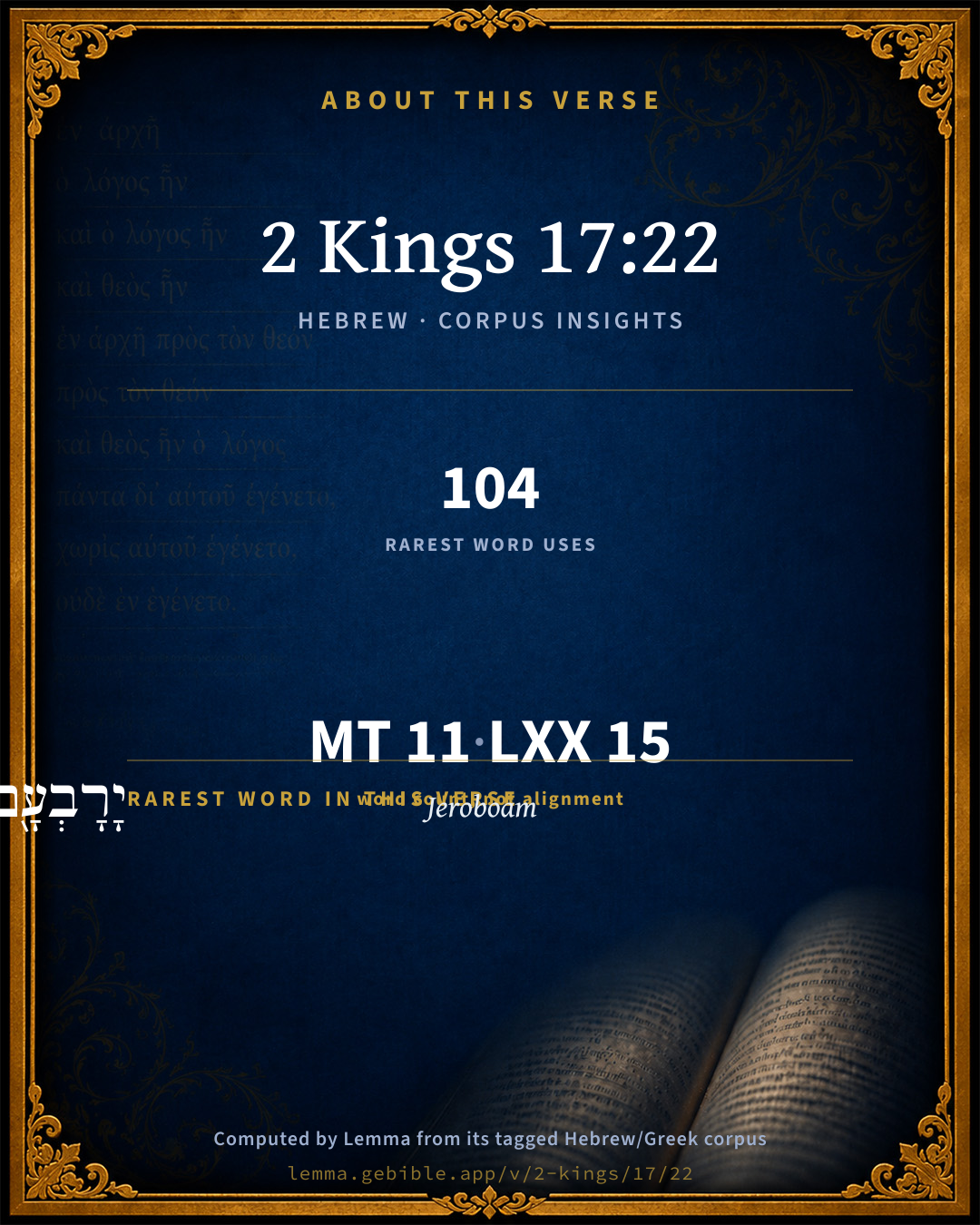
יָרָבְעָ֖ם
Yârobʻâm
H3379
“Jeroboam”
Noun, Proper
Part of Speech
Noun
Type
Proper
Full BDB Definition

Origin: from H7378 and H5971

TWOT: None

Jeroboam = "the people will contend" - the first king of the northern kingdom of Israel when the kingdom split at the death of Solomon and the 10 tribes split off from Judah and Benjamin and the kingdom under Solomon's son Rehoboam; idolatry was introduced at the beginning of his reign - the 8th king of the northern kingdom of Israel, son of Joash, and
  1. וַיֵּֽלְכוּ֙ yâlak H3212 “and · to walk” Conjunction + Verb, Qal, Sequential Imperfect, 3rd Person, Masculine, Plural
  2. בְּנֵ֣י bên H1121 “sons of” Noun, Common, Masculine, Plural, Construct
  3. יִשְׂרָאֵ֔ל Yisrâʼêl H3478 “Israel” Noun, Proper
  4. בְּכָל kôl H3605 “in/at · all of” Preposition + Noun, Common, Masculine, Singular, Construct
  5. חַטֹּ֥אות chaṭṭâʼâh H2403 “sin offerings of” Noun, Common, Feminine, Plural, Construct
  6. אֲשֶׁ֣ר ʼăsher H834 “which” Particle, Relative
  7. עָשָׂ֑ה ʻâsâh H6213 “to do” Verb, Qal, Perfect, 3rd Person, Masculine, Singular
  8. לֹא lôʼ H3808 “not” Particle, Negative
  9. סָ֖רוּ çûwr H5493 “to turn aside” Verb, Qal, Perfect, 3rd Person, Common, Plural
  10. מִמֶּֽנָּה min H4480 “from · her” Preposition + Suffix, Personal, 3rd Person, Feminine, Singular

About this verse

These counts appear in no published source. They are computed here, from the morphology-tagged text and Lemma’s own curated glosses. What Lemma adds →

11
words
11
distinct lemmas
Historical
section

Grammatical profile

  • 3 verbs
  • 5 nouns
  • 1 preposition
  • 2 particles

Verb forms

  • וַיֵּֽלְכוּ֙ Qal · Sequential Imperfect
  • עָשָׂ֑ה Qal · Perfect
  • סָ֖רוּ Qal · Perfect

Hebrew & Septuagint length

In English translation the verse runs 19 words from the Hebrew and 20 from the Septuagint (LXX English) — closely comparable.

A rough comparison of the two English renderings, which tokenize alike — not a word-level alignment.

Word counts can differ between the Hebrew and the Greek without any difference in meaning — e.g. the Hebrew direct-object marker אֵת has no separate Greek word, and Greek often adds the article ὁ.

In the original languages it is 11 Hebrew tokens and 15 Greek tokens — but the two are counted differently (Hebrew bundles its prefixes and suffixes into one token; the Greek is in lemma form), so that isn’t a like-for-like length.

Cross-references

7

Topical passages linked to 2 Kings 17:22 in the Treasury of Scripture Knowledge — connected by theme and wording, ordered by reader-vote popularity; previews shown in the World English Bible.

  • 2 Kings 3:3 Nevertheless he cleaved to the sins of Jeroboam the son of Nebat, with which he made Israel to sin; he didn't depart from it.
  • 2 Kings 10:29 However from the sins of Jeroboam the son of Nebat, with which he made Israel to sin, Jehu didn't depart from after them, [to wit], the golden calves that were in Bethel, and that were in Dan.
  • 2 Kings 10:31 But Jehu took no heed to walk in the law of Yahweh, the God of Israel, with all his heart: he didn't depart from the sins of Jeroboam, with which he made Israel to sin.
  • 2 Kings 13:2 He did that which was evil in the sight of Yahweh, and followed the sins of Jeroboam the son of Nebat, with which he made Israel to sin; he didn't depart from it.
  • 2 Kings 13:6 Nevertheless they didn't depart from the sins of the house of Jeroboam, with which he made Israel to sin, but walked therein: and there remained the Asherah also in Samaria.)
  • 2 Kings 13:11 He did that which was evil in the sight of Yahweh; he didn't depart from all the sins of Jeroboam the son of Nebat, with which he made Israel to sin; but he walked therein.
  • 2 Kings 15:9 He did that which was evil in the sight of Yahweh, as his fathers had done: he didn't depart from the sins of Jeroboam the son of Nebat, with which he made Israel to sin.

Cross-references courtesy of OpenBible.info (CC BY 4.0).

Hebrew and Greek witnesses Masoretic Hebrew ↔ Greek Septuagint

The same verse in the two great witnesses to the Old Testament, shown verse-for-verse.

These are two independent witnesses, not word-aligned to each other, and the Septuagint is shown in lemma (dictionary) form.

Hebrew 2 Kings 17:22 Masoretic · Westminster Leningrad Codex

וַיֵּֽלְכוּ֙ בְּנֵ֣י יִשְׂרָאֵ֔ל בְּכָל חַטֹּ֥אות יָרָבְעָ֖ם אֲשֶׁ֣ר עָשָׂ֑ה לֹא סָ֖רוּ מִמֶּֽנָּה

The children of Israel walked in all the sins of Jeroboam which he did; they didn't depart from them;

World English Bible · Public Domain

Greek LXX 2 Kings 17:22 Septuagint · lemma form

καί πορεύομαι ὁ υἱός ἰσραήλ ἐν πᾶς ἁμαρτία ιεροβοαμ ὅς ποιέω οὐ ἀποἵστημι ἀπό αὐτός

And the children of Israel walked in all the sin of Jeroboam which he committed; they departed not from it,

LXX2012 (modern English Septuagint) · Public Domain

Hebrew: Westminster Leningrad Codex (CC BY 4.0). Greek: Septuagint (public domain); English from LXX2012 (modern English Septuagint) (Public Domain). How the Septuagint differs from the Hebrew →

Targum (Aramaic paraphrase)

1

The Targum is the ancient Jewish Aramaic paraphrase of the Hebrew Scriptures — an interpretive translation, not the Hebrew text itself. Onkelos (literal) and Pseudo-Jonathan (expansive) render the Torah, and Jonathan the Prophets. Coverage is partial: where no permissively-licensed English translation exists for a verse, only the Aramaic is shown. This is verse-level text, not a word-by-word alignment to the Hebrew.

  1. Targum Jonathan Prophets (Joshua–Malachi)
    וַאֲזַלוּ בְּנֵי יִשְׂרָאֵל בְּכָל חוֹבֵי יָרָבְעָם דַעֲבֵד לָא סְטוֹ מִנָהּ:

    (no public-domain English translation for this verse)

    Targum Jonathan — Aramaic: “Mikraot Gedolot” (public domain). English: “Sefaria Community Translation” (CC0 1.0 (public-domain dedication)); “London "Chaldee Paraphrase," 1871” (public domain). Text via Sefaria.

Commentary

Notes on 2 Kings 17:22 from classic Christian and Jewish commentators (each source and its license shown beneath its notes). The classic Christian expositions comment on the surrounding passage and are grouped to its opening verse, so a note may address several verses; the Jewish commentaries on the Tanakh (Rashi and others) are per-verse, so they appear only where the commentator wrote on this verse.

Lemma curates 59 commentaries, every one of them public domain or Creative Commons licensed, each selected and text-cleaned for this edition rather than reprinted as found. About our sources →

Trapp's Complete Commentary

John Trapp

2Ki 17:22 For the children of Israel walked in all the sins of Jeroboam which he did; they departed not from them;

Ver. 22. Walked in the sins of Jeroboam.] And nothing would cure them of this leprosy, but captivity.

They departed not from them.] Nothing is more pertinacious than a strong corruption.

John Trapp, A Commentary or Exposition upon All the Books of the Old and New Testament (1647–1656) — public domain. Text from a community e-Sword module.

Joseph Benson's Commentary

2Ki 17:22-23. They departed not from them — But willingly and resolutely followed the wicked examples and commands of their kings, though contrary to God’s express commands. Until the Lord removed Israel — They continued to the last, obstinate and incorrigible under all the instructions and corrections which God sent to them; and therefore were justly given up by God to this dreadful captivity, which all this foregoing discourse was designed to prove.

Joseph Benson's Commentary on the Old and New Testaments (1811–1818) — public domain. Text from a community e-Sword module.

Ellicott's Commentary for English Readers

(22) The children of Israel walked . . .—Israel obstinately persisted in the sin of Jeroboam, in spite of all warning.

A Bible Commentary for English Readers, edited by Charles John Ellicott (1878–1897) — public domain. Text from a community e-Sword module.

The Cambridge Bible for Schools and Colleges

gen. ed. J. J. S. Perowne

22. they departed not from them] For among all the nineteen kings of Israel not one has a good character.

The Cambridge Bible for Schools and Colleges (gen. ed. J. J. S. Perowne; Cambridge University Press, 1878–1918) — public domain. Text from a community e-Sword module.

John Gill's Exposition

For the children of Israel walked in all the sins of Jeroboam which he did,.... They observed his injunction, not to go to Jerusalem to worship, and they worshipped the calves he did:

they departed not from them: in all succeeding reigns, until the time of their captivity.

John Gill's Exposition of the Whole Bible (1746–1763) — public domain (CC PDM 1.0). Text via the HelloAO Bible API.

Matthew Poole's English Annotations

But willingly and resolutely followed the wicked example and commands of their kings, though contrary to God’s express commands.

Matthew Poole's English Annotations on the Holy Bible (1683–1685) — public domain. Text from a community e-Sword/MySword module.

The Pulpit Commentary

For the children of Israel walked in all the sins of Jeroboam which he did. The nation, having been once persuaded to adopt Jeroboam"s innovations, continued to "walk" in them followed Jeroboam"s example in "all his sins gave up the temple-worship altogether; accepted the ministrations of priests not of the seed of Aaron (1Ki_13:33; 2Ch_13:9) brought their tithes to these idol-priests; sacrificed to the calves at Dan and Bethel; (Amo_4:4) and put their trust in the "similitude of a calf that eateth hay." They departed not from them. (comp. 1Ki_15:26, 34 16:2, 19, 26, 31; 2Ki_3:3 2Ki_10:29 2Ki_13:6, 11 14:24 15:9, 18, 28)

The Pulpit Commentary (1880–1919), ed. H.D.M. Spence-Jones & Joseph S. Exell — public domain. Text from a community e-Sword module.

Lesson kit

Teaching starters — assembled from the data on this page, not authored interpretation. Every prompt links to the verse data it draws on. Edit before teaching.

2 Kings, in the Historical, opens this verse with 11 words (11 distinct Hebrew lemmas). Its most distinctive word is Yârobʻâm (“Jeroboam”). A historical commentator’s framing appears above. Read the whole chapter for the surrounding context.

Discussion questions

  1. What does “Jeroboam” (Yârobʻâm) contribute to the verse as a whole?
  2. 2 Kings 3:3 shares this passage’s theme. How do the two illuminate each other?
  3. These translations render this verse differently. What is at stake in choosing one wording over another?
  4. The verb «וַיֵּֽלְכוּ֙» is Qal Sequential Imperfect. How does its form color the action?
  5. Reading how Trapp's Complete Commentary and Joseph Benson's Commentary read this verse, where do the two commentators agree and where do they part?

Things to notice

Reading settings

Reading text

Shown beneath each verse's original-language words.

Old Testament
Old Testament edition

Read the OT as the Masoretic Hebrew (MT) or the Greek Septuagint (LXX).

English shown for the Greek Septuagint (in the Hebrew ↔ Greek comparison).

Comparing translations? Open the Compare panel on any verse page to stack up to four side by side.