2 Kings 15:13

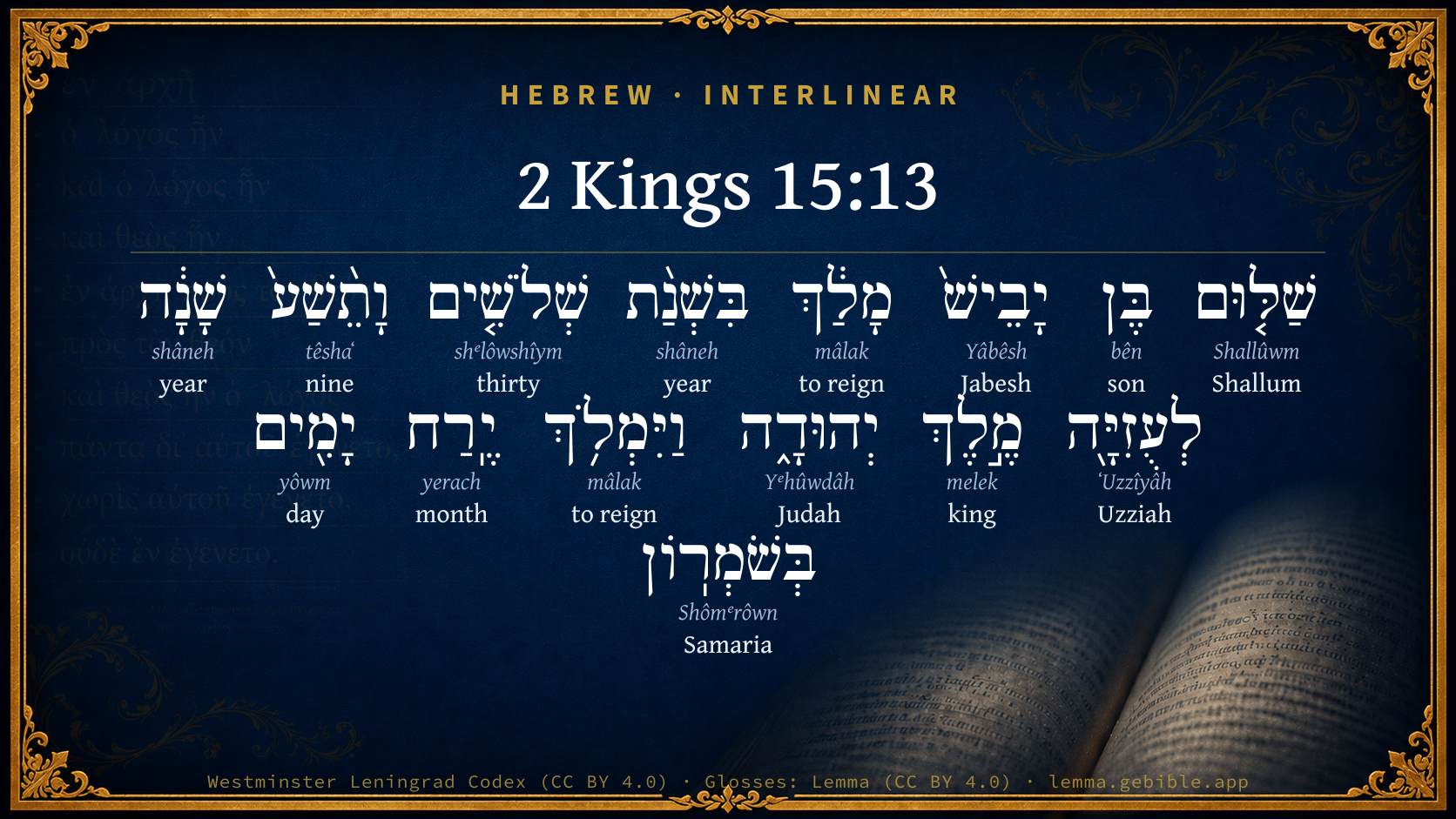
Hebrew (Westminster Leningrad Codex) 2 Kings 15:13 appears in the Hebrew Old Testament. The text above is from the Westminster Leningrad Codex. Each word links to its Strong’s number, a concise gloss, and parsing drawn from the Open Scriptures Hebrew Bible morphology. Click any word for its full Brown-Driver-Briggs (BDB) entry.
Download image
Cite this verse

2 Kings 15:13 (World English Bible). Public Domain. Lemma interlinear Bible study tool, https://lemma.gebible.app/v/2-kings/15/13.

Show BibTeX & RIS
BibTeX
RIS
English Translation
Shallum the son of Jabesh began to reign in the nine and thirtieth year of Uzziah king of Judah; and he reigned the space of a month in Samaria.
World English Bible · Public Domain
Highlights
  • 1 first appearance in the Hebrew Bible
Full analysis ↓
Download a study sheet

One document with this verse’s original text, its word-by-word gloss line, the meaning frame, cross-references with their text, attributed commentary, and full source and license credits — printable, and it pastes into notes with its structure intact.

This verse Autodidact and up

Study sheet (.html) Plain text (.txt)

A passage Seminary Student

Up to 50 verses in one chapter. A passage sheet keeps up to 6 commentary sources and 12 cross-references per verse, in the order this page ranks them, and says so on the sheet whenever that leaves anything out. Ask for a single verse and you get the Autodidact verse sheet above.

Everything on this page stays free to read, with no account — the sheet is a download of what is already on screen, not access to it.

Want to remove ads? Support Godless Engineer
Compare translations 3

The same verse in 3 English versions, stacked beneath the original-language interlinear above. Click any original word for its lexicon entry.

Each is an independent rendering of the whole verse — the interlinear is not word-aligned to these translations.

Highlighted words mark where these versions differ — a whole-verse word diff, not a word-by-word alignment.

  • World English Bible Public Domain
    Shallum the son of Jabesh began to reign in the nine and thirtieth year of Uzziah king of Judah; and he reigned the space of a month in Samaria.
  • King James Version Public Domain
    Shallum the son of Jabesh began to reign in the nine and thirtieth year of Uzziah king of Judah; and he reigned a full month in Samaria.
  • unfoldingWord Literal Text CC BY-SA 4.0
    Shallum, the son of Jabesh, reigned in the year of 39, the year to Azariah, the king of Judah, and he reigned a month of days in Samaria.

unfoldingWord Literal Text — © unfoldingWord, licensed CC BY-SA 4.0. Word-aligned USFM3 via Door43 (git.door43.org/unfoldingWord/en_ult).

Versions to compare (up to 4)

3 of 4 selected

Show all 18 translations

Every available English version of this verse, each an independent rendering of the whole verse.

  • World English Bible Public Domain
    Shallum the son of Jabesh began to reign in the nine and thirtieth year of Uzziah king of Judah; and he reigned the space of a month in Samaria.
  • Berean Standard Bible Public Domain
    In the thirty-ninth year of Uzziah’s reign over Judah, Shallum son of Jabesh became king, and he reigned in Samaria one full month.
  • Majority Standard Bible Public Domain
    In the thirty-ninth year of Uzziah’s reign over Judah, Shallum son of Jabesh became king, and he reigned in Samaria one full month.
  • King James Version Public Domain
    Shallum the son of Jabesh began to reign in the nine and thirtieth year of Uzziah king of Judah; and he reigned a full month in Samaria.
  • American Standard Version (1901) Public Domain
    Shallum the son of Jabesh began to reign in the nine and thirtieth year of Uzziah king of Judah; and he reigned the space of a month in Samaria.
  • Revised Version (1885) Public Domain
    Shallum the son of Jabesh began to reign in the nine and thirtieth year of Uzziah king of Judah; and he reigned the space of a month in Samaria.
  • Geneva Bible (1599) Public Domain
    Shallum the sonne of Iabesh began to reigne in the nine and thirtieth yeere of Vzziah King of Iudah: and he reigned the space of a moneth in Samaria.
  • Douay-Rheims (1899) Public Domain
    Sellum the son of Jabes began to reign in the nine and thirtieth year of Azarias king of Juda: and reigned one month in Samaria.
  • Young's Literal Translation Public Domain
    Shallum son of Jabesh hath reigned in the thirty and ninth year of Uzziah king of Judah, and he reigneth a month of days in Samaria;
  • Literal Standard Version CC BY-SA 4.0
    Shallum son of Jabesh has reigned in the thirty-ninth year of Uzziah king of Judah, and he reigns a month of days in Samaria;
  • Unlocked Literal Bible CC BY-SA 4.0
    Shallum son of Jabesh began to reign in the thirty-ninth year of Azariah king of Judah, and he reigned only one month in Samaria.
  • unfoldingWord Literal Text CC BY-SA 4.0
    Shallum, the son of Jabesh, reigned in the year of 39, the year to Azariah, the king of Judah, and he reigned a month of days in Samaria.
  • Darby Bible Public Domain
    Shallum the son of Jabesh began to reign in the thirty-ninth year of Uzziah king of Judah; and he reigned a full month in Samaria.
  • World Messianic Bible Public Domain
    Shallum the son of Jabesh began to reign in the thirty-ninth year of Uzziah king of Judah, and he reigned for a month in Samaria.
  • Webster's Bible Public Domain
    Shallum the son of Jabesh began to reign in the nine and thirtieth year of Uzziah king of Judah; and he reigned a full month in Samaria.
  • Free Bible Version CC BY-SA 4.0
    Shallum, son of Jabesh, became king in the thirty-ninth year of the reign of King Uzziah of Judah. He reigned in Samaria for one month.
  • Bible in Basic English Public Domain
    Shallum, the son of Jabesh, became king in the thirty-ninth year of Uzziah, king of Judah; and he was ruling in Samaria for the space of one month.
  • JPS Tanakh (1917) Public Domain
    Shallum the son of Jabesh began to reign in the nine and thirtieth year of Uzziah king of Judah; and he reigned the space of a month in Samaria.

Literal Standard Version (2020), Covenant Press — licensed CC BY-SA 4.0. Text via the HelloAO Bible API (eBible.org). Unlocked Literal Bible (unfoldingWord) — licensed CC BY-SA 4.0. Text via the HelloAO Bible API (eBible.org). unfoldingWord Literal Text — © unfoldingWord, licensed CC BY-SA 4.0. Word-aligned USFM3 via Door43 (git.door43.org/unfoldingWord/en_ult). Free Bible Version, Dr. Jonathan Gallagher — licensed CC BY-SA 4.0. Text via the HelloAO Bible API (eBible.org).

Word by word

More ways to search: Search by grammar → Find every occurrence → Compare this word →

Practice this passage: Drill this verse → Learn its vocabulary →

יֶֽרַח
yerach
H3391
“month of”
Noun, Common, Masculine, Singular, Construct
Part of Speech
Noun
Type
Common
Gender
Masculine
Number
Singular
State
Construct
Full BDB Definition

Origin: from a unused root of uncertain signification

TWOT: 913b

month (lunar cycle), moon - month - calendar month
  1. שַׁלּ֤וּם Shallûwm H7967 “Shallum” Noun, Proper
  2. בֶּן bên H1121 “son of” Noun, Common, Masculine, Singular, Construct
  3. יָבֵישׁ֙ Yâbêsh H3003 “Jabesh” Noun, Proper
  4. מָלַ֔ךְ mâlak H4427 “to reign” Verb, Qal, Perfect, 3rd Person, Masculine, Singular
  5. בִּשְׁנַ֨ת shâneh H8141 “in/at · year of” Preposition + Noun, Common, Feminine, Singular, Construct
  6. שְׁלֹשִׁ֤ים shᵉlôwshîym H7970 “thirty” Adjective, Cardinal number, Both, Plural, Absolute
  7. וָתֵ֨שַׁע֙ têshaʻ H8672 “and · nine” Conjunction + Adjective, Cardinal number, Feminine, Singular, Absolute
  8. שָׁנָ֔ה shâneh H8141 “year” Noun, Common, Feminine, Singular, Absolute
  9. לְעֻזִיָּ֖ה ʻUzzîyâh H5818 “to/for · Uzziah” Preposition + Noun, Proper
  10. מֶ֣לֶךְ melek H4428 “king of” Noun, Common, Masculine, Singular, Construct
  11. יְהוּדָ֑ה Yᵉhûwdâh H3063 “Judah” Noun, Proper
  12. וַיִּמְלֹ֥ךְ mâlak H4427 “and · to reign” Conjunction + Verb, Qal, Sequential Imperfect, 3rd Person, Masculine, Singular
  13. יָמִ֖ים yôwm H3117 “days” Noun, Common, Masculine, Plural, Absolute
  14. בְּשֹׁמְרֽוֹן Shômᵉrôwn H8111 “in/at · Samaria” Preposition + Noun, Proper

About this verse

These counts appear in no published source. They are computed here, from the morphology-tagged text and Lemma’s own curated glosses. What Lemma adds →

15
words
13
distinct lemmas
Historical
section

Notable vocabulary

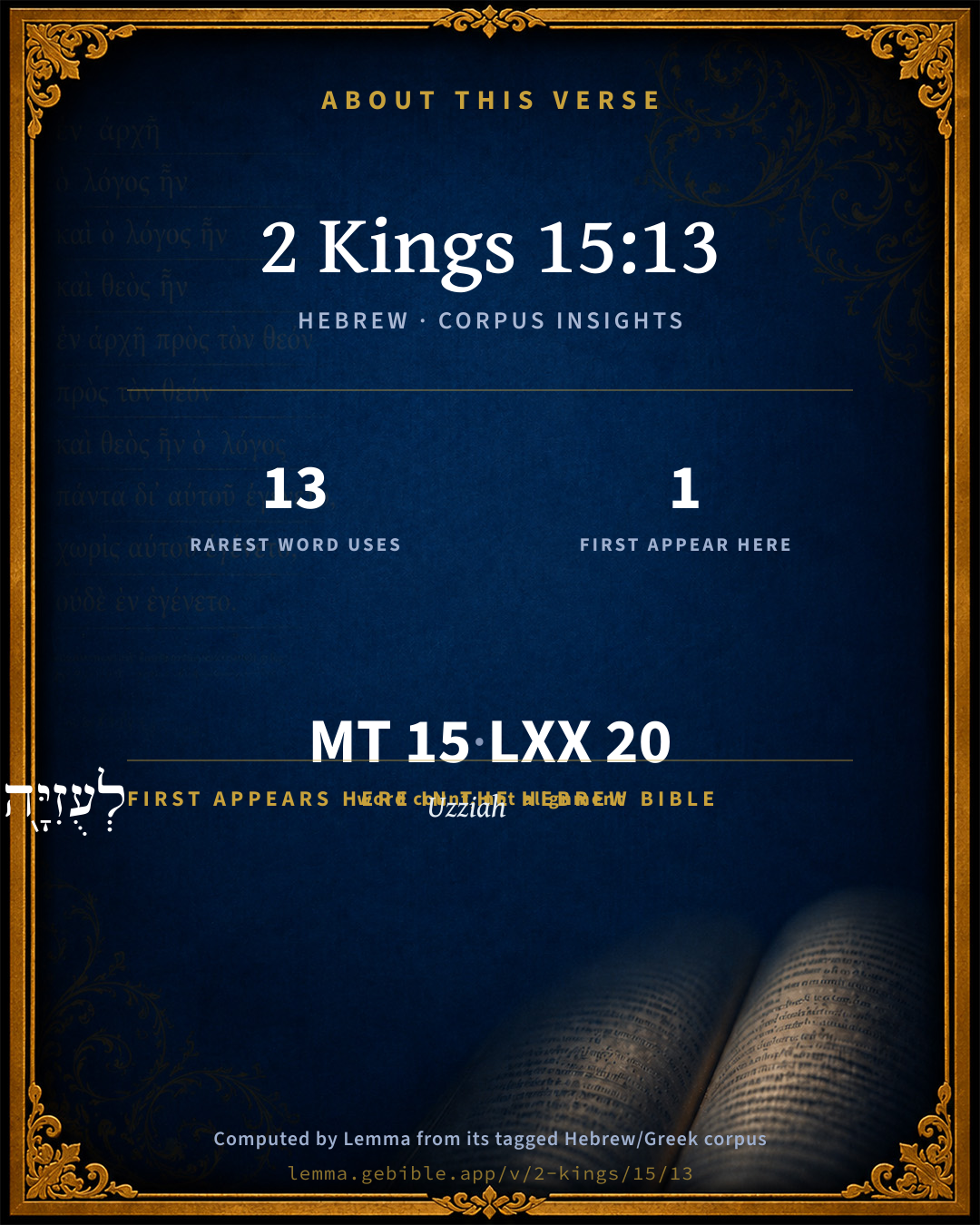
The rarest word here is יֶֽרַח month H3391 — appearing just 13 times in the whole Hebrew Bible.

First appearance in Scripture

This word makes its first canonical appearance in the Hebrew Bible here:

  • לְעֻזִיָּ֖ה Uzziah H5818

Shared distinctive vocabulary

יֶֽרַח month H3391 occurs in 13 verses of the Hebrew Bible. Also found in:

Grammatical profile

  • 2 verbs
  • 11 nouns
  • 2 adjectives

Verb forms

  • מָלַ֔ךְ Qal · Perfect
  • וַיִּמְלֹ֥ךְ Qal · Sequential Imperfect

Repetition

Words recur within this verse — often emphatic in Hebrew:

  • מָלַ֔ךְ to reign H4427 ×2
  • בִּשְׁנַ֨ת year H8141 ×2

Hebrew & Septuagint length

In English translation the verse runs 29 words from the Hebrew and 28 from the Septuagint (LXX English) — closely comparable.

A rough comparison of the two English renderings, which tokenize alike — not a word-level alignment.

Word counts can differ between the Hebrew and the Greek without any difference in meaning — e.g. the Hebrew direct-object marker אֵת has no separate Greek word, and Greek often adds the article ὁ.

In the original languages it is 15 Hebrew tokens and 20 Greek tokens — but the two are counted differently (Hebrew bundles its prefixes and suffixes into one token; the Greek is in lemma form), so that isn’t a like-for-like length.

Cross-references

9

Topical passages linked to 2 Kings 15:13 in the Treasury of Scripture Knowledge — connected by theme and wording, ordered by reader-vote popularity; previews shown in the World English Bible.

  • 2 Kings 15:1 In the twenty-seventh year of Jeroboam king of Israel began Azariah son of Amaziah king of Judah to reign.
  • 1 Kings 16:15 In the twenty-seventh year of Asa king of Judah did Zimri reign seven days in Tirzah. Now the people were encamped against Gibbethon, which belonged to the Philistines.
  • 1 Kings 16:24 He bought the hill Samaria of Shemer for two talents of silver; and he built on the hill, and called the name of the city which he built, after the name of Shemer, the owner of the hill, Samaria.
  • 2 Kings 15:8 In the thirty-eighth year of Azariah king of Judah did Zechariah the son of Jeroboam reign over Israel in Samaria six months.
  • Job 20:15 He has swallowed down riches, and he shall vomit them up again. God will cast them out of his belly.
  • Psalms 55:23 But you, God, will bring them down into the pit of destruction. Bloodthirsty and deceitful men shall not live out half their days, But I will trust in you.
  • Proverbs 28:2 In rebellion, a land has many rulers, But order is maintained by a man of understanding and knowledge.
  • Proverbs 28:17 A man who is tormented by life blood will be a fugitive until death; No one will support him.
  • Matthew 1:8–9 Asa became the father of Jehoshaphat. Jehoshaphat became the father of Joram. Joram became the father of Uzziah.

Cross-references courtesy of OpenBible.info (CC BY 4.0).

Hebrew and Greek witnesses Masoretic Hebrew ↔ Greek Septuagint

The same verse in the two great witnesses to the Old Testament, shown verse-for-verse.

These are two independent witnesses, not word-aligned to each other, and the Septuagint is shown in lemma (dictionary) form.

Hebrew 2 Kings 15:13 Masoretic · Westminster Leningrad Codex

שַׁלּ֤וּם בֶּן יָבֵישׁ֙ מָלַ֔ךְ בִּשְׁנַ֨ת שְׁלֹשִׁ֤ים וָתֵ֨שַׁע֙ שָׁנָ֔ה לְעֻזִיָּ֖ה מֶ֣לֶךְ יְהוּדָ֑ה וַיִּמְלֹ֥ךְ יֶֽרַח יָמִ֖ים בְּשֹׁמְרֽוֹן

Shallum the son of Jabesh began to reign in the nine and thirtieth year of Uzziah king of Judah; and he reigned the space of a month in Samaria.

World English Bible · Public Domain

Greek LXX 2 Kings 15:13 Septuagint · lemma form

καί σελλουμ υἱός ιαβις βασιλεύω καί ἐν ἔτος τριακοστός καί ἔνατος αζαριας βασιλεύς ιουδα βασιλεύω σελλουμ μήν ἡμέρα ἐν σαμαρεία

And Sellum the son of Jabis reigned: and in the thirty and ninth year of Azarias king of Juda began Sellum to reign a full month in Samaria.

LXX2012 (modern English Septuagint) · Public Domain

Hebrew: Westminster Leningrad Codex (CC BY 4.0). Greek: Septuagint (public domain); English from LXX2012 (modern English Septuagint) (Public Domain). How the Septuagint differs from the Hebrew →

Targum (Aramaic paraphrase)

1

The Targum is the ancient Jewish Aramaic paraphrase of the Hebrew Scriptures — an interpretive translation, not the Hebrew text itself. Onkelos (literal) and Pseudo-Jonathan (expansive) render the Torah, and Jonathan the Prophets. Coverage is partial: where no permissively-licensed English translation exists for a verse, only the Aramaic is shown. This is verse-level text, not a word-by-word alignment to the Hebrew.

  1. Targum Jonathan Prophets (Joshua–Malachi)
    שַׁלוּם בַּר יָבֵשׁ מְלַךְ בִּשְׁנַת תְּלָתִין וּתְשַׁע שְׁנִין לְעֻזִיָה מֶלֶךְ שִׁבְטָא דְבֵית יְהוּדָה וּמְלַךְ יְרַח יוֹמִין בְּשֹׁמְרוֹן:

    (no public-domain English translation for this verse)

    Targum Jonathan — Aramaic: “Mikraot Gedolot” (public domain). English: “Sefaria Community Translation” (CC0 1.0 (public-domain dedication)); “London "Chaldee Paraphrase," 1871” (public domain). Text via Sefaria.

Commentary

Notes on 2 Kings 15:13 from classic Christian and Jewish commentators (each source and its license shown beneath its notes). The classic Christian expositions comment on the surrounding passage and are grouped to its opening verse, so a note may address several verses; the Jewish commentaries on the Tanakh (Rashi and others) are per-verse, so they appear only where the commentator wrote on this verse.

Lemma curates 59 commentaries, every one of them public domain or Creative Commons licensed, each selected and text-cleaned for this edition rather than reprinted as found. About our sources →

Trapp's Complete Commentary

John Trapp

2Ki 15:13 Shallum the son of Jabesh began to reign in the nine and thirtieth year of Uzziah king of Judah; and he reigned a full month in Samaria.

Ver. 13. And he reigned a full month.] Heb., A month of days: that is, a month to a day.

John Trapp, A Commentary or Exposition upon All the Books of the Old and New Testament (1647–1656) — public domain. Text from a community e-Sword module.

Joseph Benson's Commentary

2Ki 15:13-14. He reigned a full month — That dominion seldom lasts long that is founded in blood and falsehood. Menahem, either provoked by his crime, or animated by his example, soon served him as he had served his master: he went up from Tirzah — A city in the tribe of Ephraim, where Jeroboam first dwelt; and smote Shallum — Probably he was general of the army, which then lay encamped at Tirzah, and hearing of Shallum’s treason and usurpation, he hastened to Samaria to avenge it, as Omri acted, in a like case, with regard to Zimri.

Joseph Benson's Commentary on the Old and New Testaments (1811–1818) — public domain. Text from a community e-Sword module.

Whedon's Commentary on the Bible

Daniel D. Whedon

SHALLUM’S RULE, 2Ki_15:13-15.

13. Shallum… reigned a full month — Hardly deserving to be called a reign. It was a bold usurpation, and a short and disastrous possession of ill-gotten power.

Daniel D. Whedon (gen. ed.), Commentary on the Old and New Testaments (1874–1909) — public domain. Text from a community e-Sword module.

Tyndale Open Study Notes

Tyndale Open Resources

15:13 Jabesh, which lay east of the Jordan in northern Gilead, might have been the hometown of Shallum, whose reign was even shorter than Zechariah’s. Shallum was assassinated, as he had done to Zechariah (15:10).

Tyndale Open Study Notes — © Tyndale Open Resources, licensed CC BY-SA 4.0. Text via the HelloAO Bible API.

Jamieson, Fausset & Brown

Robert Jamieson, A. R. Fausset & David Brown

Shallum . . . reigned a full month--He was opposed and slain by Menahem, who, according to JOSEPHUS, was commander of the forces, which, on the report of the king's murder, were besieging Tirzah, a town twelve miles east of Samaria, and formerly a seat of the kings of Israel. Raising the siege, he marched directly against the usurper, slew him, and reigned in his stead.

Jamieson, Fausset & Brown — Commentary Critical and Explanatory on the Whole Bible (1871) — public domain (CC PDM 1.0). Text via the HelloAO Bible API.

Adam Clarke's Commentary

Verse 13. He reigned a full month] Menahem is supposed to have been one of Zachariah's generals. Hearing of the death of his master, when he was with the troops at Tirzah, he hastened to Samaria, and slew the murderer, and had himself proclaimed in his stead. But, as the people of Tiphsah did not open their gates to him, he took the place by assault; and as the text tells us, practised the most cruel barbarities, even ripping up the women that were with child!

Adam Clarke's Commentary on the Bible (1810–1826) — public domain. Text from a community e-Sword/MySword module.

Ellicott's Commentary for English Readers

(13) A full month.—Literally, as margin. Thenius says Shallum cannot have reigned a full month, as Zec_11:8 obviously refers to the three kings Zachrriah, Shallum, and Menahem.

A Bible Commentary for English Readers, edited by Charles John Ellicott (1878–1897) — public domain. Text from a community e-Sword module.

The Cambridge Bible for Schools and Colleges

gen. ed. J. J. S. Perowne

13–15. Shallum king of Israel. He is slain, after a month, by Menahem (Not in Chronicles)

13. a full month] R.V. the space of a month. The margin of A.V. gives, ‘Heb. a month of days’. The rendering of R.V. corresponds with that of A.V. in Gen_29:7 for the same words. The Hebrew for ‘of days’ is added adverbially, as we use ‘time’ in such phrases as ‘in a month’s time’ = ‘in a month’ ‘in a year’s time’ &c.

The Cambridge Bible for Schools and Colleges (gen. ed. J. J. S. Perowne; Cambridge University Press, 1878–1918) — public domain. Text from a community e-Sword module.

John Gill's Exposition

In the nine and thirtieth year of Azariah king of Judah began Menahem the son of Gadi to reign over Israel,.... Shallum reigning but one month, both their reigns began the same year.

In the nine and thirtieth year of Azariah king of Judah began Menahem the son of Gadi to reign over Israel,.... Shallum reigning but one month, both their reigns began the same year.

2 Kings 15:18

kg2 15:18

kg2 15:18

kg2 15:18And he did that which was evil,.... The same character is given of him as of those before him, Kg2 15:9.

John Gill's Exposition of the Whole Bible (1746–1763) — public domain (CC PDM 1.0). Text via the HelloAO Bible API.

The Pulpit Commentary

Vers. 13-15. SHORT AND UNIMPORTANT REIGN OF SHALLUM. Three verses suffice for the reign of Shallum, the son of Jabesh, who held the throne for only thirty days. Hearing of his conspiracy, Menahem, the son of Gadi general," as Josephus calls him ("Ant. Jud:," 10:11. marched from Tirzah to Samaria, got Shallum into his power, and put him to death (ver. 14). The writer concludes with the usual formula (ver. 15). Shallum the son of Jabesh began to reign in the nine and thirtieth year of Uzziah King of Judah. This date follows from that of ver. 8, and must stand or fall with it. The true accession-year of Shallum was probably the twenty-seventh of Uzziah. And he reigned a fall month in Samaria; literally, a month of days days" according to Josephus.

The Pulpit Commentary (1880–1919), ed. H.D.M. Spence-Jones & Joseph S. Exell — public domain. Text from a community e-Sword module.

John Wesley's Explanatory Notes

Full moon - That dominion seldom lasts long, which is founded in blood and falsehood.

John Wesley, Explanatory Notes Upon the Whole Bible (1754–1765) — public domain. Text via the GEBible commentary corpus.

Keil & Delitzsch

C. F. Keil & F. Delitzsch

Reign of Shallum. - Shallum reigned only a full month (ירח־ימים, as in Deu 21:13; see at Gen 29:14). Menahem the son of Gadi then made war upon him from Tirzah; and by him he was smitten and slain. Menahem must have been a general or the commander-in-chief, as Josephus affirms. As soon as he became king he smote Tiphsach, - i.e., Thapsacus on the Euphrates, which has long since entirely disappeared, probably to be sought for in the neighbourhood of the present Rakka, by the ford of el Hamman, the north-eastern border city of the Israelitish kingdom in the time of Solomon (Kg1 5:4), which came into the possession of the kingdom of Israel again when the ancient boundaries were restored by Jeroboam II (Kg2 14:25 and Kg2 14:28), but which had probably revolted again during the anarchy which arose after the death of Jeroboam, - "and all that were therein, and the territory thereof, from Tirzah; because they opened not (to him), therefore he smote it, and had them that were with child ripped up." מתּרצה does not mean that Menahem laid the land or district waste from Tirzah to Tiphsach, but is to be taken in connection with יכּה in this sense: he smote Tiphsach proceeding from Tirzah, etc. The position of this notice, namely, immediately after the account of the usurpation of the throne by Menahem and before the history of his reign, is analogous to that concerning Elath in the case of Uzziah (Kg2 14:22), and, like the latter, is to be accounted for from the fact that the expedition of Menahem against Tiphsach formed the commencement of his reign, and, as we may infer from Kg2 15:19, became very eventful not only for his own reign, but also for the kingdom of Israel generally. The reason why he proceeded from Tirzah against Tiphsach, was no doubt that it was in Tirzah, the present Tallusa, which was only three hours to the east of Samaria (see at Kg1 14:17), that the army of which Menahem was commander was posted, so that he had probably gone to Samaria with only a small body of men to overthrow Shallum, the murderer of Zachariah and usurper of the throne, and to make himself king. It is possible that the army commanded by Menahem had already been collected in Tirzah to march against the city of Tiphsach, which had revolted from Israel when Shallum seized upon the throne by the murder of Zachariah; so that after Menahem had removed the usurper, he carried out at once the campaign already resolved upon, and having taken Tiphsach, punished it most cruelly for its revolt. On the cruel custom of ripping up the women with child, i.e., of cutting open their wombs, see Kg2 8:12; Amo 1:13, and Hos 14:1. Tiphsach, Thapsacus, appears to have been a strong fortress; and from its situation on the western bank of the Euphrates, at the termination of the great trade-road from Egypt, Phoenicia, and Syria to Mesopotamia and the kingdoms of Inner Asia (Movers, Phniz. ii. 2, pp. 164,165; and Ritter, Erdkunde, x. pp. 1114-15), the possession of it was of great importance to the kingdom of Israel.

(Note: There is no foundation for the view propounded by Ewald (Gesch. iii. p. 599), Simson (Hosea, pp. 20, 21), Thenius, and many others, that Tiphsach was a city between Tirzah and Samaria, which Menahem laid waste on his march from Tirzah to Samaria to dethrone Shallum; for it rests upon nothing more than the perfectly unwarrantable and ungrammatical combination of מתרצה with את־גבוליה, "its boundaries towards Tirzah" (Sims.), and upon the two worthless objections: (1) that the great distance of מתרצה from יכה precludes the rendering "going out from Tirzah;" and (2) that Menahem was not the man to be able to conquer Thapsacus on the Euphrates. But there is no foundation for the latter assertion, as we have no standard by which to estimate the strength and bravery of the Israelitish army commanded by Menahem. And the first objection falls to the ground with the correct rendering of מתרצה, viz., "proceeding from Tirzah," which is preferred even by Ewald and Thenius. With this rendering, the words by no means affirm that Menahem smote Tiphsach from Tirzah on the way to Samaria. This is merely an inference drawn from v. 13, according to which Menahem went from Tirzah to Samaria to overthrow Shallum. But this inference is open to the following objections: (1) that it is very improbable that there was a strong fortress between Tirzah and Samaria, which Menahem was obliged to take on his march before he could overthrow the usurper in the capital of the kingdom; and (2) that the name Tiphsach, trajectus, ford, is by no means a suitable one for a city situated on the mountains between Tirzah and Samaria, and therefore, in order to carry out the hypothesis in question, Thenius proposes to alter Tiphsach into Tappuach, without any critical warrant for so doing.)

Keil & Delitzsch — Biblical Commentary on the Old Testament (1861–1891) — public domain (CC PDM 1.0). Text via the HelloAO Bible API. (Old Testament only.)

Scofield Reference Notes

C. I. Scofield

Uzziah Mat 1:8; Mat 1:9 called Ozias

2Ki 15:7 called Azariah.

The Scofield Reference Bible (1917 edition), notes by C. I. Scofield — public domain. Text from a community e-Sword module.

unfoldingWord translationNotes

Door43 World Missions Community

in the thirty-ninth year of Azariah king of Judah

It can be stated clearly that this is the thirty-ninth year of his reign. AT: "in year 39 of the reign of Azariah king of Judah" (See: Assumed Knowledge and Implicit Information and Numbers)

Shallum ... Jabesh

These are the names of two men. See how you translated these names in 2 Kings 15:10. (See: How to Translate Names)

Menahem ... Gadi

These are the names of two men. (See: How to Translate Names)

he reigned only one month in Samaria

Samaria is the city that he lived in when was king of Israel. AT: "Shallum lived in Samaria and reigned over Israel for only one month" (See: Assumed Knowledge and Implicit Information)

became king in his place

The phrase "in his place" is a metaphor meaning "instead of him." AT: "became king instead of Shallum" (See: Metaphor)

translationWords

reign

Uzziah

unfoldingWord translationNotes — © Distant Shores Media and the Door43 World Missions Community, licensed CC BY-SA 4.0. Source: git.door43.org/Door43/en_tn.

Lesson kit

Teaching starters — assembled from the data on this page, not authored interpretation. Every prompt links to the verse data it draws on. Edit before teaching.

2 Kings, in the Historical, opens this verse with 15 words (13 distinct Hebrew lemmas). Its most distinctive word is yerach (“month”). A historical commentator’s framing appears above. Read the whole chapter for the surrounding context.

Discussion questions

  1. What does “month” (yerach) contribute to the verse as a whole?
  2. The word “Uzziah” first appears here in Scripture. What is being introduced at this debut?
  3. Exodus 2:2 shares the word «month» with this verse. How do the two illuminate each other?
  4. “to reign” occurs 2× in this one verse. What is the effect of the repetition?
  5. These translations render this verse differently; the difference is in the English rendering, not the original. What questions does that raise?
  6. The verb «מָלַ֔ךְ» is Qal Perfect. How does its form color the action?
  7. Reading how Trapp's Complete Commentary and Joseph Benson's Commentary read this verse, where do the two commentators agree and where do they part?

Things to notice

Reading settings

Reading text

Shown beneath each verse's original-language words.

Old Testament
Old Testament edition

Read the OT as the Masoretic Hebrew (MT) or the Greek Septuagint (LXX).

English shown for the Greek Septuagint (in the Hebrew ↔ Greek comparison).

Comparing translations? Open the Compare panel on any verse page to stack up to four side by side.