
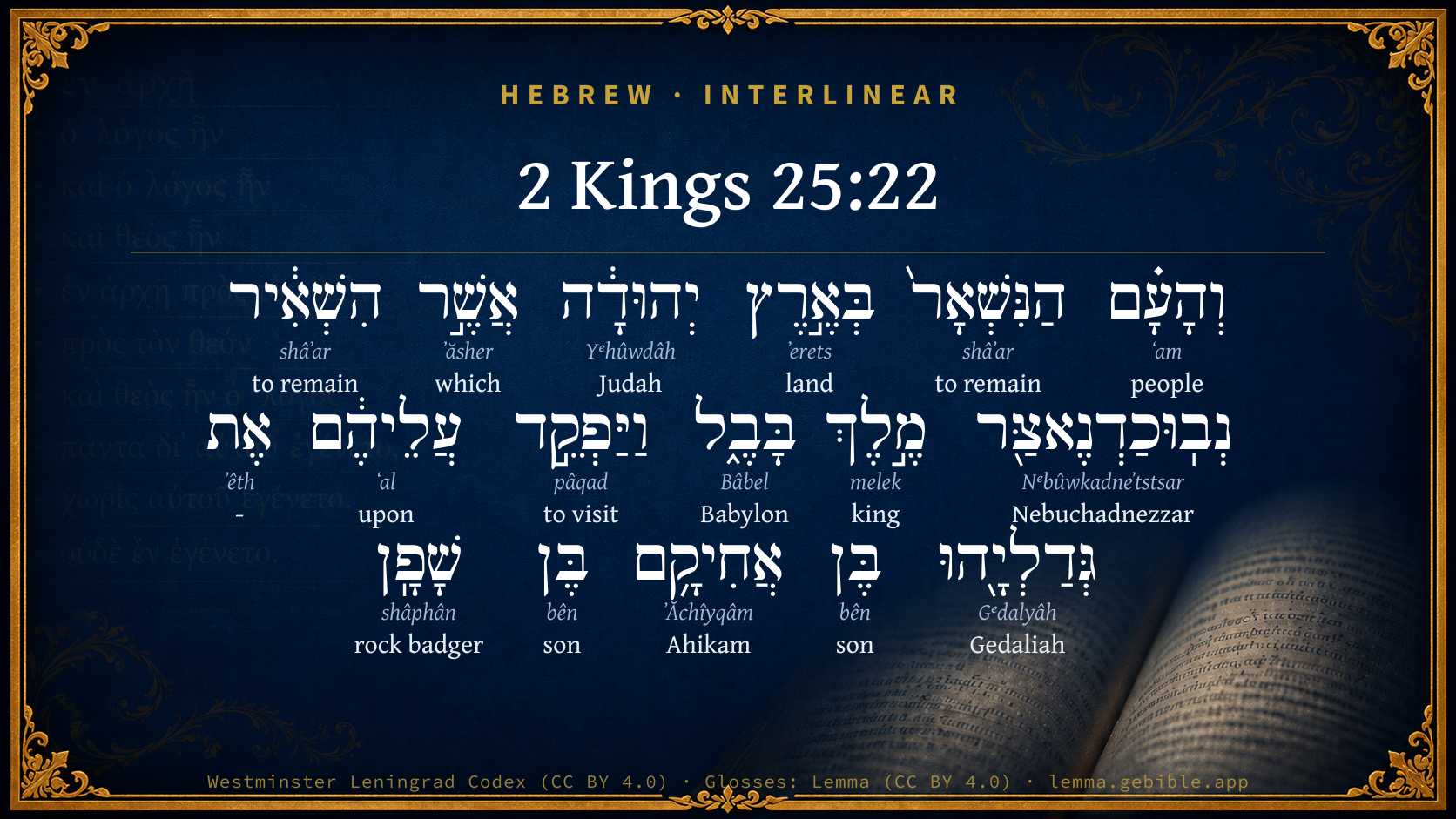
2 Kings 25:22

Hebrew (Westminster Leningrad Codex) 2 Kings 25:22 appears in the Hebrew Old Testament. The text above is from the Westminster Leningrad Codex. Each word links to its Strong’s number, a concise gloss, and parsing drawn from the Open Scriptures Hebrew Bible morphology. Click any word for its full Brown-Driver-Briggs (BDB) entry.
Download image
Cite this verse

2 Kings 25:22 (World English Bible). Public Domain. Lemma interlinear Bible study tool, https://lemma.gebible.app/v/2-kings/25/22.

Show BibTeX & RIS
BibTeX
RIS
English Translation
As for the people who were left in the land of Judah, whom Nebuchadnezzar king of Babylon had left, even over them he made Gedaliah the son of Ahikam, the son of Shaphan, governor.
World English Bible · Public Domain
Highlights
  • 1 first appearance in the Hebrew Bible
Full analysis ↓
Download a study sheet

One document with this verse’s original text, its word-by-word gloss line, the meaning frame, cross-references with their text, attributed commentary, and full source and license credits — printable, and it pastes into notes with its structure intact.

This verse Autodidact and up

Study sheet (.html) Plain text (.txt)

A passage Seminary Student

Up to 50 verses in one chapter. A passage sheet keeps up to 6 commentary sources and 12 cross-references per verse, in the order this page ranks them, and says so on the sheet whenever that leaves anything out. Ask for a single verse and you get the Autodidact verse sheet above.

Everything on this page stays free to read, with no account — the sheet is a download of what is already on screen, not access to it.

Want to remove ads? Support Godless Engineer
Compare translations 3

The same verse in 3 English versions, stacked beneath the original-language interlinear above. Click any original word for its lexicon entry.

Each is an independent rendering of the whole verse — the interlinear is not word-aligned to these translations.

Highlighted words mark where these versions differ — a whole-verse word diff, not a word-by-word alignment.

  • World English Bible Public Domain
    As for the people who were left in the land of Judah, whom Nebuchadnezzar king of Babylon had left, even over them he made Gedaliah the son of Ahikam, the son of Shaphan, governor.
  • King James Version Public Domain
    And as for the people that remained in the land of Judah, whom Nebuchadnezzar king of Babylon had left, even over them he made Gedaliah the son of Ahikam, the son of Shaphan, ruler.
  • unfoldingWord Literal Text CC BY-SA 4.0
    Now the people having been left in the land of Judah, whom Nebuchadnezzar, the king of Babylon, left, he appointed Gedaliah, the son of Ahikam, the son of Shaphan, over them.

unfoldingWord Literal Text — © unfoldingWord, licensed CC BY-SA 4.0. Word-aligned USFM3 via Door43 (git.door43.org/unfoldingWord/en_ult).

Versions to compare (up to 4)

3 of 4 selected

Show all 18 translations

Every available English version of this verse, each an independent rendering of the whole verse.

  • World English Bible Public Domain
    As for the people who were left in the land of Judah, whom Nebuchadnezzar king of Babylon had left, even over them he made Gedaliah the son of Ahikam, the son of Shaphan, governor.
  • Berean Standard Bible Public Domain
    Nebuchadnezzar king of Babylon appointed Gedaliah son of Ahikam, the son of Shaphan, over the people he had left behind in the land of Judah.
  • Majority Standard Bible Public Domain
    Nebuchadnezzar king of Babylon appointed Gedaliah son of Ahikam, the son of Shaphan, over the people he had left behind in the land of Judah.
  • King James Version Public Domain
    And as for the people that remained in the land of Judah, whom Nebuchadnezzar king of Babylon had left, even over them he made Gedaliah the son of Ahikam, the son of Shaphan, ruler.
  • American Standard Version (1901) Public Domain
    And as for the people that were left in the land of Judah, whom Nebuchadnezzar king of Babylon had left, even over them he made Gedaliah the son of Ahikam, the son of Shaphan, governor.
  • Revised Version (1885) Public Domain
    And as for the people that were left in the land of Judah, whom Nebuchadnezzar king of Babylon had left, even over them he made Gedaliah the son of Ahikam, the son of Shaphan, governor.
  • Geneva Bible (1599) Public Domain
    Howbeit there remained people in the land of Iudah, whom Nebuchad-nezzar King of Babel left, and made Gedaliah the sonne of Ahikam the sonne of Shaphan ruler ouer them.
  • Douay-Rheims (1899) Public Domain
    But over the people that remained in the land of Juda, which Nabuchodonosor king of Babylon had left, he gave the government to Godolias the son of Ahicam the son of Saphan.
  • Young's Literal Translation Public Domain
    And the people that is left in the land of Judah whom Nebuchadnezzar king of Babylon hath left -- he appointeth over them Gedaliah son of Ahikam, son of Shaphan.
  • Literal Standard Version CC BY-SA 4.0
    And the people that are left in the land of Judah whom Nebuchadnezzar king of Babylon has left—he appoints Gedaliah son of Ahikam, son of Shaphan, over them.
  • Unlocked Literal Bible CC BY-SA 4.0
    As for the people who remained in the land of Judah, those whom Nebuchadnezzar king of Babylon had left, he put Gedaliah son of Ahikam, son of Shaphan, in charge of them.
  • unfoldingWord Literal Text CC BY-SA 4.0
    Now the people having been left in the land of Judah, whom Nebuchadnezzar, the king of Babylon, left, he appointed Gedaliah, the son of Ahikam, the son of Shaphan, over them.
  • Darby Bible Public Domain
    And [as for] the people that remained in the land of Judah, whom Nebuchadnezzar king of Babylon had left behind, over them he appointed Gedaliah the son of Ahikam, the son of Shaphan.
  • World Messianic Bible Public Domain
    As for the people who were left in the land of Judah whom Nebuchadnezzar king of Babylon had left, even over them he made Gedaliah the son of Ahikam, the son of Shaphan, governor.
  • Webster's Bible Public Domain
    And as for the people that remained in the land of Judah, whom Nebuchadnezzar king of Babylon had left, even over them he made Gedaliah the son of Ahikam, the son of Shaphan, ruler.
  • Free Bible Version CC BY-SA 4.0
    Nebuchadnezzar, king of Babylon, appointed Gedaliah, son of Ahikam, son of Shaphan, as governor over the people he had left in the land of Judah.
  • Bible in Basic English Public Domain
    As for the people who were still living in the land of Judah, whom Nebuchadnezzar, king of Babylon, did not take away, he made Gedaliah, the son of Ahikam, the son of Shaphan, ruler over them.
  • JPS Tanakh (1917) Public Domain
    And as for the people that were left in the land of Judah, whom Nebuchadnezzar king of Babylon had left, even over them he made Gedaliah the son of Ahikam, the son of Shaphan, governor.

Literal Standard Version (2020), Covenant Press — licensed CC BY-SA 4.0. Text via the HelloAO Bible API (eBible.org). Unlocked Literal Bible (unfoldingWord) — licensed CC BY-SA 4.0. Text via the HelloAO Bible API (eBible.org). unfoldingWord Literal Text — © unfoldingWord, licensed CC BY-SA 4.0. Word-aligned USFM3 via Door43 (git.door43.org/unfoldingWord/en_ult). Free Bible Version, Dr. Jonathan Gallagher — licensed CC BY-SA 4.0. Text via the HelloAO Bible API (eBible.org).

Word by word

More ways to search: Search by grammar → Find every occurrence → Compare this word →

Practice this passage: Drill this verse → Learn its vocabulary →

אֲחִיקָ֥ם
ʼĂchîyqâm
H296
“Ahikam”
Noun, Proper
Part of Speech
Noun
Type
Proper
Full BDB Definition

Origin: from H251 and H6965

TWOT: None

Ahikam = "my brother has risen (arisen)" - son of Shaphan, an officer in Josiah's reign - protector of Jeremiah - father of Gedaliah
  1. וְהָעָ֗ם ʻam H5971 “and · the · people” Conjunction + Particle, Definite Article + Noun, Common, Masculine, Singular, Absolute
  2. הַנִּשְׁאָר֙ shâʼar H7604 “the · remaining” Particle, Definite Article + Verb, Niphal, Participle Active, Masculine, Singular, Absolute
  3. בְּאֶ֣רֶץ ʼerets H776 “in/at · land of” Preposition + Noun, Common, Both, Singular, Construct
  4. יְהוּדָ֔ה Yᵉhûwdâh H3063 “Judah” Noun, Proper
  5. אֲשֶׁ֣ר ʼăsher H834 “which” Particle, Relative
  6. הִשְׁאִ֔יר shâʼar H7604 “to remain” Verb, Hiphil, Perfect, 3rd Person, Masculine, Singular
  7. נְבֽוּכַדְנֶאצַּ֖ר Nᵉbûwkadneʼtstsar H5019 “Nebuchadnezzar” Noun, Proper
  8. מֶ֣לֶךְ melek H4428 “king of” Noun, Common, Masculine, Singular, Construct
  9. בָּבֶ֑ל Bâbel H894 “Babylon” Noun, Proper
  10. וַיַּפְקֵ֣ד pâqad H6485 “and · to visit” Conjunction + Verb, Hiphil, Sequential Imperfect, 3rd Person, Masculine, Singular
  11. עֲלֵיהֶ֔ם ʻal H5921 “upon · them” Preposition + Suffix, Personal, 3rd Person, Masculine, Plural
  12. אֶת ʼêth H853 “-” Particle, Direct Object
  13. גְּדַלְיָ֖הוּ Gᵉdalyâh H1436 “Gedaliah” Noun, Proper
  14. בֶּן bên H1121 “son of” Noun, Common, Masculine, Singular, Construct
  15. בֶּן bên H1121 “son of” Noun, Common, Masculine, Singular, Construct
  16. שָׁפָֽן shâphân H8227 “rock badger” Noun, Proper

About this verse

These counts appear in no published source. They are computed here, from the morphology-tagged text and Lemma’s own curated glosses. What Lemma adds →

17
words
15
distinct lemmas
Historical
section

Notable vocabulary

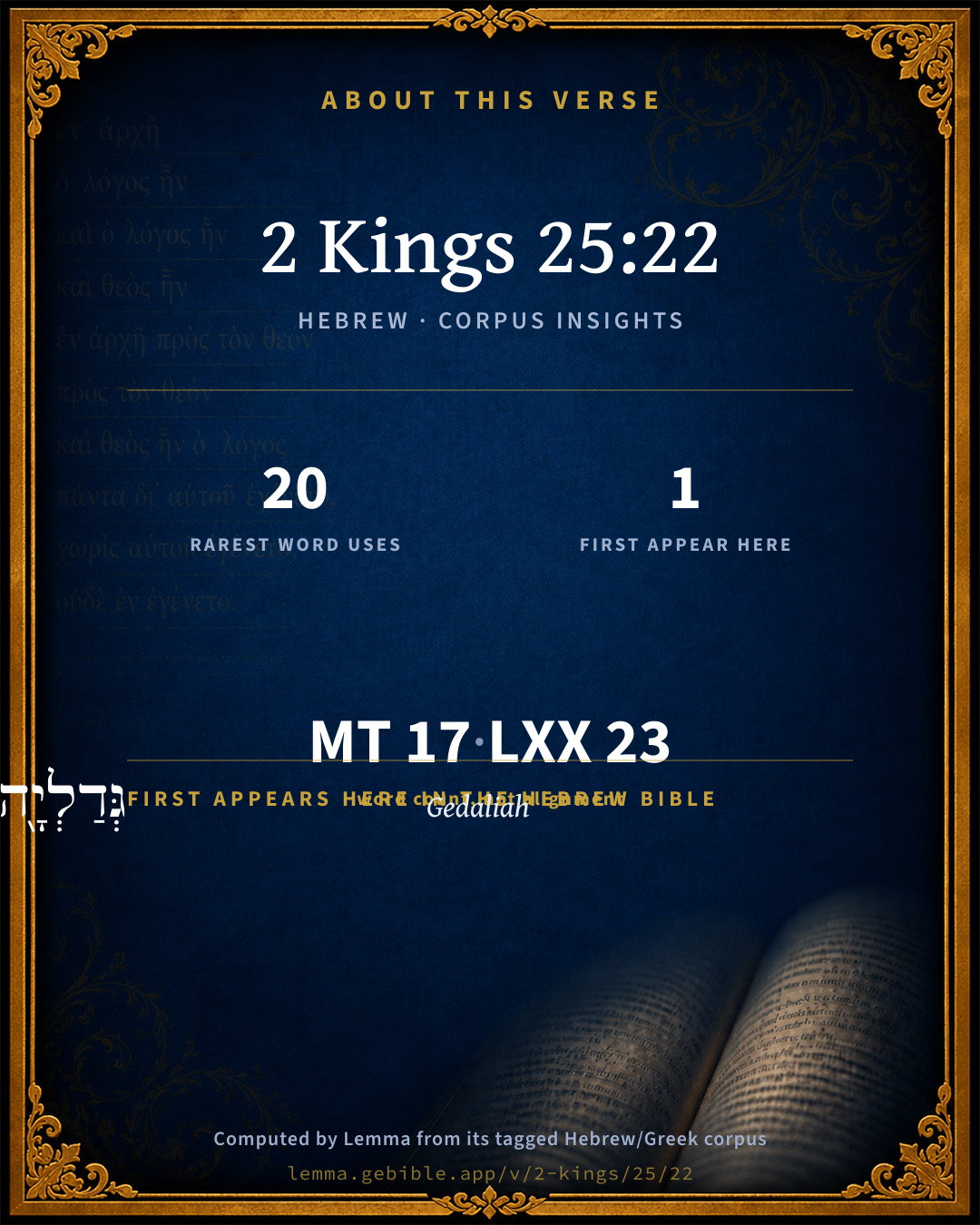
The rarest word here is אֲחִיקָ֥ם Ahikam H296 — appearing just 20 times in the whole Hebrew Bible.

First appearance in Scripture

This word makes its first canonical appearance in the Hebrew Bible here:

  • גְּדַלְיָ֖הוּ Gedaliah H1436

Shared distinctive vocabulary

אֲחִיקָ֥ם Ahikam H296 occurs in 20 verses of the Hebrew Bible. Also found in:

Grammatical profile

  • 3 verbs
  • 11 nouns
  • 1 preposition
  • 2 particles

Verb forms

  • הַנִּשְׁאָר֙ Niphal · Participle Active
  • הִשְׁאִ֔יר Hiphil · Perfect
  • וַיַּפְקֵ֣ד Hiphil · Sequential Imperfect

Repetition

Words recur within this verse — often emphatic in Hebrew:

  • הַנִּשְׁאָר֙ to remain H7604 ×2
  • בֶּן son H1121 ×2

Hebrew & Septuagint length

In English translation the verse runs 34 words from the Hebrew and 31 from the Septuagint (LXX English) — closely comparable.

A rough comparison of the two English renderings, which tokenize alike — not a word-level alignment.

Word counts can differ between the Hebrew and the Greek without any difference in meaning — e.g. the Hebrew direct-object marker אֵת has no separate Greek word, and Greek often adds the article ὁ.

In the original languages it is 17 Hebrew tokens and 23 Greek tokens — but the two are counted differently (Hebrew bundles its prefixes and suffixes into one token; the Greek is in lemma form), so that isn’t a like-for-like length.

Cross-references

7

Topical passages linked to 2 Kings 25:22 in the Treasury of Scripture Knowledge — connected by theme and wording, ordered by reader-vote popularity; previews shown in the World English Bible.

  • Jeremiah 39:14 they sent, and took Jeremiah out of the court of the guard, and committed him to Gedaliah the son of Ahikam, the son of Shaphan, that he should carry him home: so he lived among the people.
  • 2 Kings 22:12 The king commanded Hilkiah the priest, and Ahikam the son of Shaphan, and Achbor the son of Micaiah, and Shaphan the scribe, and Asaiah the king's servant, saying,
  • 2 Chronicles 34:20 The king commanded Hilkiah, and Ahikam the son of Shaphan, and Abdon the son of Micah, and Shaphan the scribe, and Asaiah the king's servant, saying,
  • Jeremiah 26:24 But the hand of Ahikam the son of Shaphan was with Jeremiah, that they should not give him into the hand of the people to put him to death.
  • Jeremiah 41:2 Then arose Ishmael the son of Nethaniah, and the ten men who were with him, and struck Gedaliah the son of Ahikam the son of Shaphan with the sword, and killed him, whom the king of Babylon had made governor over the land.
  • 2 Kings 25:25 But it happened in the seventh month, that Ishmael the son of Nethaniah, the son of Elishama, of the royal seed came, and ten men with him, and struck Gedaliah, so that he died, and the Jews and the Chaldeans that were with him at Mizpah.
  • Jeremiah 40:5–12 Now while he was not yet gone back, Go back then, [said he], to Gedaliah the son of Ahikam, the son of Shaphan, whom the king of Babylon has made governor over the cities of Judah, and dwell with him among the people; or go wherever it seems right to you to go. So the captain of the guard gave him food and a present, and let him go.

Cross-references courtesy of OpenBible.info (CC BY 4.0).

Hebrew and Greek witnesses Masoretic Hebrew ↔ Greek Septuagint

The same verse in the two great witnesses to the Old Testament, shown verse-for-verse.

These are two independent witnesses, not word-aligned to each other, and the Septuagint is shown in lemma (dictionary) form.

Hebrew 2 Kings 25:22 Masoretic · Westminster Leningrad Codex

וְהָעָ֗ם הַנִּשְׁאָר֙ בְּאֶ֣רֶץ יְהוּדָ֔ה אֲשֶׁ֣ר הִשְׁאִ֔יר נְבֽוּכַדְנֶאצַּ֖ר מֶ֣לֶךְ בָּבֶ֑ל וַיַּפְקֵ֣ד עֲלֵיהֶ֔ם אֶת גְּדַלְיָ֖הוּ בֶּן אֲחִיקָ֥ם בֶּן שָׁפָֽן

As for the people who were left in the land of Judah, whom Nebuchadnezzar king of Babylon had left, even over them he made Gedaliah the son of Ahikam, the son of Shaphan, governor.

World English Bible · Public Domain

Greek LXX 2 Kings 25:22 Septuagint · lemma form

καί ὁ λαός ὁ καταλείπω ἐν γῆ ιουδα ὅς καταλείπω ναβουχοδονοσορ βασιλεύς βαβυλών καί καταἵστημι ἐπί αὐτός ὁ γοδολιας υἱός αχικαμ υἱός σαφαν

And as for the people that were left in the land of Juda, whom Nabuchodonosor king of Babylon left, even over them he set Godolias son of Achicam son of Saphan.

LXX2012 (modern English Septuagint) · Public Domain

Hebrew: Westminster Leningrad Codex (CC BY 4.0). Greek: Septuagint (public domain); English from LXX2012 (modern English Septuagint) (Public Domain). How the Septuagint differs from the Hebrew →

Targum (Aramaic paraphrase)

1

The Targum is the ancient Jewish Aramaic paraphrase of the Hebrew Scriptures — an interpretive translation, not the Hebrew text itself. Onkelos (literal) and Pseudo-Jonathan (expansive) render the Torah, and Jonathan the Prophets. Coverage is partial: where no permissively-licensed English translation exists for a verse, only the Aramaic is shown. This is verse-level text, not a word-by-word alignment to the Hebrew.

  1. Targum Jonathan Prophets (Joshua–Malachi)
    וְעַמָא דְאִשְׁתְּאַר בְּאַרְעָא דְבֵית יְהוּדָה דְאַשְׁאַר נְבוּכַדְנֶאצַר מַלְכָּא דְבָבֶל וּמַנֵי עֲלֵיהוֹן יַת גְדַלְיָה בַר אֲחִיקָם בַּר שָׁפָן:

    (no public-domain English translation for this verse)

    Targum Jonathan — Aramaic: “Mikraot Gedolot” (public domain). English: “Sefaria Community Translation” (CC0 1.0 (public-domain dedication)); “London "Chaldee Paraphrase," 1871” (public domain). Text via Sefaria.

Commentary

Notes on 2 Kings 25:22 from classic Christian and Jewish commentators (each source and its license shown beneath its notes). The classic Christian expositions comment on the surrounding passage and are grouped to its opening verse, so a note may address several verses; the Jewish commentaries on the Tanakh (Rashi and others) are per-verse, so they appear only where the commentator wrote on this verse.

Lemma curates 59 commentaries, every one of them public domain or Creative Commons licensed, each selected and text-cleaned for this edition rather than reprinted as found. About our sources →

Matthew Henry's Commentary

In these verses we have,

I. The dispersion of the remaining people. The city of Jerusalem was quite laid waste. Some people there were in the land of Judah (Kg2 25:22) that had weathered the storm, and (which was no small favour at this time, Jer 45:5) had their lives given them for a prey. Now see, 1. What a good posture they were put into. The king of Babylon appointed Gedaliah, one of themselves, to be their governor and protector under him, a very good man, and one that would make the best of the bad, Kg2 25:22. His father Ahikam was one that countenanced and protected Jeremiah when the princes had vowed his death, Jer 26:24. It is probable that this Gedaliah, by the advice of Jeremiah, had gone over the Chaldeans, and had conducted himself so well that the king of Babylon entrusted him with the government. He resided not at Jerusalem, but at Mizpah, in the land of Benjamin, a place famous in Samuel's time. Thither those came who had fled from Zedekiah (Kg2 25:4) and put themselves under his protection (Kg2 25:23), which he assured them of if they would be patient and peaceable under the government of the king of Babylon, Kg2 25:24. Gedaliah, though he had not the pomp and power of a sovereign prince, yet might have been a greater blessing to them than many of their kings had been, especially having such a privy-council as Jeremiah, who was now with them, and interested himself in their affairs, Jer 40:5, Jer 40:6. 2. What a fatal breach was made upon them, soon afterwards, by the death of Gedaliah, within two months after he entered upon his government. The utter extirpation of the Jews, for the present, was determined, and therefore it was in vain for them to think of taking root again: the whole land must be plucked up, Jer 45:4. Yet this hopeful settlement is dashed to pieces, not by the Chaldeans, but by some of themselves. The things of their peace were so hidden from their eyes that they knew not when they were well off, nor would believe when they were told. (1.) They had a good governor of their own, and him they slew, out of spite to the Chaldeans, because he was appointed by Nebuchadnezzar, Kg2 25:25. Ishmael, who was of the royal family, envying Gedaliah's advancement and the happy settlement of the people under him, though he could not propose to set up himself, resolved to ruin him, and basely slew him and all his friends, both Jews and Chaldeans. Nebuchadnezzar would not, could not, have been a more mischievous enemy to their peace than this degenerate branch of the house of David was. (2.) They were as yet in their own good land, but they forsook it, and went to Egypt, for fear of the Chaldeans, Kg2 25:26. The Chaldeans had reason enough to be offended at the murder of Gedaliah; but if those that remained had humbly remonstrated, alleging that it was only the act of Ishmael and his party, we may suppose that those who were innocent of it, nay, who suffered greatly by it, would not have been punished for it: but, under pretence of this apprehension, contrary to the counsel of Jeremiah, they all went to Egypt, where, it is probable, they mixed with the Egyptians by degrees, and were never heard of more as Israelites. Thus was there a full end made of them by their own folly and disobedience, and Egypt had the last of them, that the last verse of that chapter of threatenings might be fulfilled, after all the rest, Deu 28:68, The Lord shall bring thee into Egypt again. These events are more largely related by the prophet Jeremiah, ch. 40 to Jer 45:1-5. Quaeque ipse miserrima vidit, et quorum pars magna fuit - Which scenes he was doomed to behold, and in which he bore a melancholy part.

II. The reviving of the captive prince. Of Zedekiah we hear no more after he was carried blind to Babylon; it is probable that he did not live long, but that when he died he was buried with some marks of honour, Jer 34:5. Of Jehoiachin, or Jeconiah, who surrendered himself (Kg2 24:12), we are here told that as soon as Evil-merodach came to the crown, upon the death of his father Nebuchadnezzar, he released him out of prison (where he had lain thirty-seven years, and was now fifty-five years old), spoke kindly to him, paid more respect to him than to any other of the kings his father had left in captivity (Kg2 25:28), gave him princely clothing instead of his prison-garments, maintained him in his own palace (Kg2 25:29), and allowed him a pension for himself and his family in some measure corresponding to his rank, a daily rate for every day as long as he lived. Consider this, 1. As a very happy change of Jehoiachin's condition. To have honour and liberty after he had been so long in confinement and disgrace, the plenty and pleasure of a court after he had been so long accustomed to the straits and miseries of a prison, was like the return of the morning after a very dark and tedious night. Let none say that they shall never see good again because they have long seen little but evil; the most miserable know not what blessed turn Providence may yet give to their affairs, nor what comforts they are reserved for, according to the days wherein they have been afflicted, Psa 90:15. However the death of afflicted saints is to them such a change as this was to Jehoiachin: it will release them out of their prison, shake off the body, that prison-garment, and open the way to their advancement; it will send them to the throne, to the table, of the King of kings, the glorious liberty of God's children. 2. As a very generous act of Evil-merodach's. He thought his father made the yoke of his captives too heavy, and therefore, with the tenderness of a man and the honour of a prince, made it lighter. It should seem all the kings he had in his power were favoured, but Jehoiachin above them all, some think for the sake of the antiquity of his family and the honour of his renowned ancestors, David and Solomon. None of the kings of the nations, it is likely, had descended from so long a race of kings in a direct lineal succession, and by a male line, as the king of Judah. The Jews say that this Evil-merodach had been himself imprisoned by his own father, when he returned from his madness, for some mismanagement at that time, and that in prison he contracted a friendship with Jehoiachin, in consequence of which, as soon as he had it in his power, he showed him this kindness as a sufferer, as a fellow-sufferer. Some suggest that Evil-merodach had learned from Daniel and his fellows the principles of the true religion, and was well affected to them, and upon that account favoured Jehoiachin. 3. As a kind dispensation of Providence, for the encouragement of the Jews in captivity, and the support of their faith and hope concerning their enlargement in due time. This happened just about the midnight of their captivity. Thirty-six of the seventy years were now past, and almost as many were yet behind, and now to see their king thus advanced would be a comfortable earnest to them of their own release in due time, in the set time. Unto the upright there thus ariseth light in the darkness, to encourage them to hope, even in the cloudy and dark day, that at evening time it shall be light; when therefore we are perplexed, let us not be in despair.

Matthew Henry's Commentary on the Whole Bible (1708–1710) — public domain (CC PDM 1.0). Text via the HelloAO Bible API.

Trapp's Complete Commentary

John Trapp

2Ki 25:22 And [as for] the people that remained in the land of Judah, whom Nebuchadnezzar king of Babylon had left, even over them he made Gedaliah the son of Ahikam, the son of Shaphan, ruler.

Ver. 22. Over them he made Gedaliah ruler.] A pious, prudent, and meek-spirited man, {a} cut down by envy, that sharp-ranged malignity, which none can stand before. {Pro 27:4}

{a} Josephus saith he was ετιεικης και δικαιος, a moderate and just man.

John Trapp, A Commentary or Exposition upon All the Books of the Old and New Testament (1647–1656) — public domain. Text from a community e-Sword module.

Joseph Benson's Commentary

2Ki 25:22. Over them he made Gedaliah, the son of Ahikam, ruler — A righteous and good man, and a friend to the Prophet Jeremiah, Jer 26:24. Ahikam, his father, was a person in such credit in all the latter reigns, that he had been able to screen Jeremiah from the resentment of the king and the fury of the people; so that it is very probable the prophet, in gratitude to the father, obtained this favour for the son, from Nebuzaradan. Or, as some think, Gedaliah, by the advice of Jeremiah, had gone over to the Chaldeans, and had approved himself so well, that on that account the king of Babylon judged it proper to intrust him with the government. Gedaliah’s good conduct, together with the obligations which Jeremiah was under to his father, was probably the motive which induced the prophet to live with him in Judea rather than go to Babylon, when the Chaldean general put it to his option, not without some considerable encouragement to invite him to the latter, Jer 39:11.

Joseph Benson's Commentary on the Old and New Testaments (1811–1818) — public domain. Text from a community e-Sword module.

Whedon's Commentary on the Bible

Daniel D. Whedon

APPOINTMENT AND ASSASSINATION OF GEDALIAH, 2Ki_25:22-26.

The events of this section are narrated with ample details in Jeremiah 40-44, and to those chapters the student must go for a fuller history of those who survived the fall of Jerusalem.

Daniel D. Whedon (gen. ed.), Commentary on the Old and New Testaments (1874–1909) — public domain. Text from a community e-Sword module.

Keil & Delitzsch

C. F. Keil & F. Delitzsch

Installation of Gedaliah the governor. His assassination, and the flight of the people to Egypt. - Much fuller accounts have been handed down to us in Jer 40-44 of the events which are but briefly indicated here.

Kg2 25:22-23

Over the remnant of the people left in the land Nebuchadnezzar placed Gedaliah as governor of the land, who took up his abode in Mizpah. Gedaliah, the son of Ahikam, who had interested himself on behalf of the prophet Jeremiah and saved his life (Jer 26:24), and the grandson of Shaphan, a man of whom nothing more is known (see at Kg2 22:12), had his home in Jerusalem, and, as we may infer from his attitude towards Jeremiah, had probably secured the confidence of the Chaldaeans at the siege and conquest of Jerusalem by his upright conduct, and by what he did to induce the people to submit to the judgment inflicted by God; so that Nebuchadnezzar entrusted him with the oversight of those who were left behind in the land-men, women, children, poor people, and even a few princesses and court-officials, whom they had not thought it necessary or worth while to carry away (Jer 40:7; Jer 41:10, Jer 41:16), i.e., he made him governor of the conquered land. Mizpah is the present Nebi Samwil, two hours to the north-west of Jerusalem (see at Jos 18:26). - On hearing of Gedaliah's appointment as governor, there came to him "all the captains of the several divisions of the army and their men," i.e., those portions of the army which had been scattered at the flight of the king (Kg2 25:5), and which had escaped from the Chaldaeans, and, as it is expressed in Jer 40:7, had dispersed themselves "in the field," i.e., about the land. Instead of והאנשׁים we have in Jer 40:7 the clearer expression ואנשׁיהם, "and their men," whilst והאנשׁים in our text receives its more precise definition from the previous word החילים. Of the military commanders the following are mentioned by name: Ishmael, etc. (the ו eht( .cte ,l before ישׁמעאל, is explic., "and indeed Ishmael"). Ishmael, son of Mattaniah and grandson of Elishama, probably of the king's secretary mentioned in Jer 36:12 and Jer 36:20, of royal blood. Nothing further is known about the other names. We simply learn from Jer 40:13. that Johanan had warned Gedaliah against the treachery of Ishmael, and that when Gedaliah was slain by Ishmael, having disregarded the warning, he put himself at the head of the people and marched with them to Egypt, notwithstanding the dissuasions of Jeremiah (Jer 41:15.). Instead of "Johanan the son of Kareah," we have in Jer 40:8 "Johanan and Jonathan the sons of Kareah;" but it is uncertain whether ויונתן has crept into the text of Jeremiah from the previous יהוחנן merely through a mistake, and this mistake has brought with it the alteration of בּן into בּני (Ewald), or whether ויונתן has dropped out of our text through an oversight, and this omission has occasioned the alteration of בני into בן (Thenius, Graf, etc.). The former supposition is favoured by the circumstance that in Jer 40:13; Jer 41:11, Jer 41:16, Johanan the son of Kareah alone is mentioned. In Jer 40:8 עופי וּבני (Chethb עיפי) stands before הנּטפתי, according to which it was not Seraiah who sprang from Netophah, but Ophai whose sons were military commanders. He was called Netophathite because he sprang from Netopha in the neighbourhood of Bethlehem (Neh 7:26; Ezr 2:22), the identity of which with Beit Nettif is by no means probable (see at Sa2 23:28). The name יאזביהוּ is written יזניהוּ in Jeremiah; he was the son of the Maachathite, i.e., his father sprang from the Syrian district of Maacah in the neighbourhood of the Hermon (see at Deu 3:14).

Kg2 25:24

As these men were afraid of the vengeance of the Chaldaeans because they had fought against them, Gedaliah assured them on oath that they had nothing to fear from them if they would dwell peaceably in the land, be submissive to the king of Babel, and cultivate the land (cf. Jer 40:9 and Jer 40:10). "Servants of the Chaldees" are Chaldaean officials who were subordinate to the governor Gedaliah.

Kg2 25:25

In the seventh month, i.e., hardly two months after the destruction of Jerusalem, came Ishmael with ten men to Gedaliah at Mizpah, and murdered him together with the Jews and Chaldaeans, whom he had with him as soldiers to do his bidding and for his protection. This occurred, according to Jer 41:1., when Gedaliah had received them hospitably and had invited them to eat with him. Ishmael was instigated to commit this murder by the Ammonitish king Baalis, and Gedaliah had previously been made acquainted with the intended crime and put upon his guard by Johanan, but had put no faith in the information (Jer 40:13-16).

Kg2 25:26

After Ishmael had performed this deed, and had also treacherously murdered a number of men, who had come to the temple with a sacrifice from Shechem, Shiloh, and Samaria, he took the Jews who were at Mizpah prisoners, with some kings' daughters among them, intending to take them over to the Ammonites; but as soon as his deed became known, he was pursued by Johanan and the rest of the military chiefs and was overtaken at Gibeon, whereupon those who had been led away by him went over to Johanan, so that he was only able to make his escape with eight men and get away to the Ammonites (Jer 41:4-15). Johanan then went with the rest of the military commanders and the people whom he had brought back into the neighbourhood of Bethlehem, with the intention of fleeing to Egypt for fear of the Chaldaeans. There they did indeed have recourse to the prophet Jeremiah, to inquire of him the word of the Lord; but they did not allow themselves to be diverted from their intention by the word of the Lord which he announced to them, that if they remained in the land they need not fear anything from the king of Babel, but if they went to Egypt they should all perish there with sword, hunger, and pestilence, or by the prediction that the Lord would also deliver Pharaoh Hophra into the hand of Nebuchadnezzar (Jer 42). They went to Egypt notwithstanding, taking the prophet himself with them, and settled in different cities of Egypt, where they gave themselves up to idolatry, and did not suffer themselves to be drawn away from it even by the severe judgments which the prophet Jeremiah predicted as sure to fall upon them (Jer 43:1-13 and 44). In the verse before us we have simply a brief allusion to the eventual result of the whole affair. "Because they were afraid of the Chaldaeans," namely, that they might possibly take vengeance upon them for the murder of the governor.

Keil & Delitzsch — Biblical Commentary on the Old Testament (1861–1891) — public domain (CC PDM 1.0). Text via the HelloAO Bible API. (Old Testament only.)

The Expositor's Bible

GEDALIAH

B.C. 586

2Ki_25:22-30

"Vedi che son un che piango."

- DANTE, "Inferno."

"No rather steel thy melting heart To act the martyr s sternest part, To watch with firm, unshrinking eye Thy darling visions as they die, Till all bright hopes and hues of day Have faded into twilight grey."

- KEBLE

IN deciding that he would not accompany Nebuchadrezzar to Babylon, Jeremiah made the choice of duty. In Chaldaea he would have lived at ease, in plenty, in security, amid universal respect. He might have helped his younger contemporary Ezekiel in his struggle to keep the exiles in Babylon faithful to their duty and their God. He regarded the exiles as representing all that was best and noblest in the nation; and he would have been safe and honored in the midst of them, under the immediate protection of the great Babylonian king. On the other hand, to return to Judaea was to return to a defenseless and a distracted people, the mere dregs of the true nation, the mere phantom of what they once had been. Surely his life had earned the blessing of repose? But no! The hopes of the Chosen People, the seed of Abraham, Gods servant, could not be dissevered from the Holy Land. Rest was not for him on this side of the grave. His only prayer must be, like that which, Senancour had inscribed over his grave, Eternite, deviens mon asile! The decision cost him a terrible struggle; but duty called him, and he obeyed. It has been supposed by some critics that the wild cry of Jer_15:10-21 expresses his: anguish at the necessity of casting in his lot with the remnant; the sense that they needed his protecting influence and prophetic guidance; and the promise of God that his sacrifice should not be ineffectual for good to the miserable fragment of his nation, even though they should continue to struggle against him.

So with breaking heart he saw Nebuzaradan at Ramah marshalling the throng of captives for their long journey to the waters of Babylon. Before them, and before the little band which returned with him to the burnt Temple, the dismantled city, the desolate house, there lay an unknown future; but in spite of the exiles doom it looked brighter for them than for him, as with tears and sobs they parted from each other. Then it was that-

"A voice was heard in Ramah, lamentation, and bitter weeping; Rachel weeping for her children refuseth to be comforted, because they are not. Thus saith the Lord, Refrain thy voice from weeping, and thine eyes from tears: for thy work shall be rewarded, saith the Lord; and they shall come again from the land of the enemy. And there is hope for thy time to come, saith the Lord, that thy children shall come again to their own border." {Jer_31:15-17}

Disappointed in the fidelity of the royal house of Judah, Nebuchadrezzar had not attempted to place another of them on the throne. He appointed Gedaliah, the son of Ahikam, the son of Shaphan, his satrap (pakid) over the poor remnant who were left in the land. In this appointment we probably trace the influence of Jeremiah. There is no one whom Nebuchadrezzar would have been so likely to consult. Gedaliah was the son of the prophets old protector, {Jer_26:24} and his grandfather Shaphan had been a trusted minister of Josiah. He thoroughly justified the confidence reposed in him, and under his wise and prosperous rule there seemed to be every prospect that there would be at least some pale gleam of returning prosperity. The Jews, who during the period of the siege had fled into all the neighboring countries, no sooner heard of his viceroyalty than they came flocking back from Moab, and Ammon, and Edom. They found themselves, perhaps for the first time in their lives, in possession of large estates, from which the exiles of Babylon had been dispossessed; and favored by an abundant harvest, "they gathered wine and summer fruits very much." {Jer_40:12}

Jerusalem-dismantled, defenseless, burnt-was no longer habitable. It was all but deserted; so that jackals and hyenas prowled even over the mountain of the Lords House. All attempt to refortify it would have been regarded as rebellion, and such a mere lodge in a garden of cucumbers would have been useless to repress the marauding incursions of the envious Moabites and Edomites, who had looked on with shouts at the destruction of the city, and exulted when her carved work was broken down with axes and hammers. Gedaliah therefore fixed his headquarters at Mizpah, about six miles north of Jerusalem, of which the lofty eminence could be easily secured. It was the watchtower from which Titus caught his first glimpses of the Holy City, as many a traveler does to this day, and the point at which Richard I averted his eyes with tears, saying that he was unworthy to look upon the city which he was unable to save. Here, then, Gedaliah lived, urging upon his subjects the policy which his friend and adviser Jeremiah had always supported, and promising them quietness and peace if they would but accept the logic of circumstances-if they would bow to the inevitable, and frankly acknowledge the suzerainty of Nebuchadrezzar. It was perhaps as a pledge of more independence in better days to come that Nebuzaradan had left Gedaliah in charge of the young daughters of King Zedekiah, who had with them some of their eunuch-attendants. As that unfortunate monarch was only thirty-two years old when he was blinded and carried away, the princesses were probably young girls; and it has been conjectured that it was part of the Chaldaean kings plan for the future that in time Gedaliah should be permitted to marry one of them, and re-establish at least a collateral branch of the old royal house of David.

How long this respite continued we do not know. The language of Jer_39:2; Jer_41:1, compared with 2Ki_25:8, might seem to imply that it only lasted two months. But since Jeremiah does not mention the year in Jer_41:1, and as there seems to have been yet another deportation of Jews by Nebuchadrezzar five years later, {Jer_52:30} which may have been in revenge for the murder of his satrap, some have supposed that Gedaliahs rule lasted four years. All is uncertain, and the latter passage is of doubtful authenticity; but it is at least possible that the vengeful atrocity committed by Ishmael followed almost immediately after the Chaldean forces were well out of sight. Respecting these last days of Jewish independence, "History, leaning semisomnous on her pyramid, muttereth something, but we know not what it is."

However this may be, there seem to have been guerilla bands wandering through the country, partly to get what they could, and partly to watch against Bedouin marauders. Johanan, the son of Kareah, who was one of the chief captains among them, came with others to Gedaliah, and warned him that Baalis, King of Ammon, was intriguing against him, and trying to induce a certain Ishmael, the son of Nethaniah, the son of Elishama-who, in some way unknown to us, represented, perhaps on the female side, the seed royal-to come and murder him. Gedaliah was of a fine, unsuspicious temperament, and with rash generosity he refused to believe in the existence of a plot so ruinous and so useless. Astonished at his noble incredulity, Johanan then had a secret interview with him and offered to murder Ishmael so secretly that no one should know of it. "Why," he asked, "should this man be suffered to ruin everything, and cause the final scattering of even the struggling handful of colonists at Mizpah and in Judah?" Gedaliah forbade his intervention. "Thou shalt not do this," he said: "thou speakest falsely of Ishmael."

But Johanans story was only too true. Shortly afterwards, Ishmael, with ten confederates, came to visit Gedaliah at Mizpah, perhaps on the pretext of seeing his kinswomen, the daughters of Zedekiah. Gedaliah welcomed this ambitious villain and his murderous accomplices with openhanded hospitality. He invited them all to a banquet in the fort of Mizpah; and after eating salt with him, Ishmael and his bravoes first murdered him, and then put promiscuously to the sword his soldiers, and the Chaldaeans who had been left to look after him. The gates of the fort were closed, and the bodies were flung into a deep well or tank, which had been constructed by Asa in the middle of the courtyard when he was fortifying Mizpah against the attacks of Baasha, King of Israel.

For two days there was an unbroken silence, and the peasants at Mizpah remained unaware of the dreadful tragedy. On the third day a sad procession was seen wending its way up the heights. There were scattered Jews in Shiloh and Samaria who still remembered Zion; and eighty pilgrims, weeping as they went, came with shaven beards and rent garments to bring a minchah and incense to the ruined shrine at Jerusalem. In the depth of their woe they had even violated a law, {Lev_19:28; Lev_21:5} of which they were perhaps unaware, by cutting themselves in sign of their misery. Mizpah would be their last halting-place on the way to Jerusalem; and the hypocrite Ishmael came out to them with an invitation to share the hospitality of the murdered satrap. No sooner had the gate of the charnel-house closed upon them, than Ishmael and his ten ruffians began to murder this unoffending company. Crimes more aimless and more brutal than those committed by this infinitely degenerate scion of the royal house it is impossible to conceive. The place swam with blood. The story "reads almost like a page from the annals of the Indian Mutiny." Seventy of the wretched pilgrims had been butchered and flung into the tank, which must have been choked with corpses, like the fatal well at Cawnpore when the ten survivors pleaded for their lives by telling Ishmael that they had large treasures of country produce stored in hidden places, which should be at his disposal, if he would spare them.

As it was useless to make any further attempt to conceal his atrocities, Ishmael now took the young princesses and the inhabitants of Mizpah with him, and tried to make good his escape to his patron the King of Ammon. But the watchful eye of Johanan, the son of Kareah, had been upon him, and assembling his band he went in swift pursuit. Ishmael had got no farther than the Pool of Gibeon, when Johanan overtook him, to the intense joy of the prisoners. A scuffle ensued; but Ishmael and eight of his bloodstained desperadoes unhappily managed to make good their escape to the Ammonites. The wretch vanishes into the darkness, and we hear of him no more.

Even now the circumstances were desperate. Nebuchadrezzar could not in honor overlook the frustration of all his plans, and the murder, not only of his viceroy, but even of his Chaldaean commissioners. He would not be likely to accept any excuses. No course seemed open but that of flight. There was no temptation to return to Mizpah with its frightful memories and its corpse-choked tank. From Gibeon the survivors made their way to Bethlehem, which lay on the road to Egypt, and where they could be sheltered in the caravanserai of Chimham. Many Jews had already taken refuge in Egypt. Colonies of them were living in Pathros, and at Migdol and Noph, under the kindly protection of Pharaoh Hophrah. Would it not be well to join them?

In utter perplexity Johanan and the other captains and all the people came to Jeremiah. How he had escaped the massacre at Mizpah we do not know; but now he seemed to be the only man left in whose prophetic guidance they could confide. They entreated him with pathetic earnestness to show them the will of Jehovah; and he promised to pray for insight, while they pledged themselves to obey implicitly his directions.

The anguish and vacillation of the prophets mind is shown by the fact that for ten whole days no light came to him. It seemed as if Judah was under an irrevocable curse. Whither could they return? What temptation was there to return? Did not return mean fresh intolerable miseries? Would they not be torn to pieces by the robber bands from across the Jordan? And what could be the end of it but another deportation to Babylon, with perhaps further massacre and starvation?

All the arguments seemed against this course; and he could see very clearly that it would be against all the wishes of the down-trodden fugitives, who longed for Egypt, "where we shall see no war, nor hear the sound of the trumpet, nor have hunger of bread."

Yet Jeremiah could only give them the message which he believed to represent the will of God. He bade them return. He assured them that they need have no fear of the King of Babylon, and that God would bless them; whereas if they went to Egypt, they would die by the sword, the famine, and the pestilence. At the same time-doomed always to thwart the hopes of the multitude-he reproved the hypocrisy which had sent them to ask Gods will when they never intended to do anything but follow their own.

Then their anger broke out against him. He was, as always, the prophet of evil, and they held him more than half responsible for being the cause of the ruin which he invariably predicted. Johanan and "all the proud men" (zedim) gave him the lie. They told him that the source of his prophecy was not Jehovah, but the meddling and pernicious Baruch. Perhaps some of them may have remembered the words of Isaiah, that a day should come when five cities, of which one should be called Kir-Cheres ("the City of Destruction")-a play on the name Kir-Heres, "the City of the Sun," On or Heliopolis-should speak the language of Canaan and swear by the Lord of hosts, and there should be an altar in the land of Egypt and a matstsebah at its border in witness to Jehovah, and that though Egypt should be smitten she should also be healed. {Isa_19:18-22}

So they settled to go to Egypt; and taking with them Jeremiah, and Baruch, and the kings daughters, and all the remnant, they made their way to Tahpanhes or Daphne (Jer_2:16; Jer_44:1; Eze_30:18; Jer_43:7; Jer_46:14; Herod. 2:30), an advanced post to guard the road to Syria. Mr. Flinders Petrie in 1886 discovered the site of the city at Tel Defenneh, and the ruins of the very palace which Pharaoh Hophrah placed at the disposal of the daughters of his ally Zedekiah. It is still known by the name of "The Castle of the Jews Daughters" - El Kasr el Bint el Jehudi.

In front of this palace was an elevated platform (mastaba) of brick, which still remains. In this brickwork Jeremiah was bidden by the word of Jehovah to place great stones, and to declare that on that very platform, over those very stones, Nebuchadrezzar should pitch his royal tent, when he came to wrap himself in the land of Egypt, as a shepherd wraps himself in his garment, and to burn the pillars of Heliopolis with fire.

Jeremiah still had to face stormy times. At some great festival assembly at Tahpanhes he bitterly reproached the exiled Jews for their idolatries. He was extremely indignant with the women who burned incense to the Queen of Heaven. The multitude, and especially the women, openly defied him. "We will not hearken to thee," they said. "We will continue to burn incense, and offer offerings to the Queen of Heaven, as we have done, we, and our fathers, our kings, and our princes, in the cities of Judah, and in the streets of Jerusalem; for then had we plenty of victuals, and were well, and saw no evil. It is only since we have left off making cakes for her and honoring her that we have suffered hunger and desolation; and our husbands were always well aware of our proceedings."

Never was there a more defiantly ostentatious revolt against God and against His prophet! Remonstrance seemed hopeless. What could Jeremiah do but menace them with the wrath of Heaven, and tell them that in sign of the truth of his words the fate of Pharaoh Hophrah should be the same as the fate of Zedekiah, King of Judah, and should be inflicted by the hand of Nebuchadrezzar.

So on the colony of fugitives the curtain of revelation rushes down in storm. The prophet went on the troubled path which, if tradition be true, led him at last to martyrdom. He is said to have been stoned by his infuriated fellow-exiles. But his name lived in the memory of his people. It was he (they believed) who had hidden from the Chaldaeans the Ark and the sacred fire, and some day he should return to reveal the place of their concealment. When Christ asked His disciples six hundred years later, "Whom say the people that I am?" one of the answers was, "Some say Jeremiah or one of the prophets." He became, so to speak, the guardian saint of the land in which he had suffered such cruel persecutions.

But the historian of the Kings does not like to leave the close of his story in unbroken gloom. He wrote during the Exile. He has narrated with tears the sad fate of Jehoiachin; and though he does not care to dwell on the Exile itself, he is glad to narrate one touch of kindness on the part of the King of Babylon, which he doubtless regarded as a pledge of mercies yet to come. Twenty-six years had elapsed since the capture of Jerusalem, and thirty-seven since the captivity of the exiled king, when Evil-Merodach, the son and successor of Nebuchadrezzar, took pity on the imprisoned heir of the House of David. He took Jehoiachin from his dungeon, changed his garments, spoke words of encouragement to him, gave him a place at his own table, assigned to him a regular allowance from his own banquet, and set his throne above the throne of all the other captive kings who were with him in Babylon. It might seem a trivial act of mercy, yet the Jews remembered in their records the very day of the month on which it had taken place, because they regarded it as a break in the clouds which overshadowed them-as "the first gleam of heavens amber in the Eastern grey."

William Robertson Nicoll, ed., The Expositor's Bible (London: Hodder & Stoughton, 1887–1910) — public domain. 65 of 66 books (1 Corinthians is not separately keyed, as that volume carries no machine-parseable verse references); section-level commentary keyed to the opening verse. Introductory and overview sections not keyed to a specific passage are excluded.

Tyndale Open Study Notes

Tyndale Open Resources

25:22-30 Two short appendices describe subsequent events. The first (25:22-26) details the area’s reorganization; the second (25:27-30) tells of the later kind treatment accorded King Jehoiachin.

25:22 Gedaliah’s father Ahikam and grandfather Shaphan had been trusted officials during Josiah’s reign (22:3, 12). Ahikam had supported Jeremiah during the reign of Jehoiakim (Jer 26:24).

Tyndale Open Study Notes — © Tyndale Open Resources, licensed CC BY-SA 4.0. Text via the HelloAO Bible API.

Jamieson, Fausset & Brown

Robert Jamieson, A. R. Fausset & David Brown

Nebuchadnezzar . . . made Gedaliah . . . ruler--The people permitted to remain were, besides the king's daughters, a few court attendants and others (Jer 40:7) too insignificant to be removed, only the peasantry who could till the land and dress the vineyards. Gedaliah was Jeremiah's friend (Jer 26:24), and having, by the prophet's counsel, probably fled from the city as abandoned of God, he surrendered himself to the conqueror (Jer 38:2, Jer 38:17), and being promoted to the government of Judea, fixed his provincial court at Mizpeh. He was well qualified to surmount the difficulties of ruling at such a crisis. Many of the fugitive Jews, as well as the soldiers of Zedekiah who had accompanied the king in his flight to the plains of Jericho, left their retreats (Jer 40:11-12) and flocked around the governor; who having counselled them to submit, promised them on complying with this condition, security on oath that they would retain their possessions and enjoy the produce of their land (Jer 40:9).

Jamieson, Fausset & Brown — Commentary Critical and Explanatory on the Whole Bible (1871) — public domain (CC PDM 1.0). Text via the HelloAO Bible API.

Adam Clarke's Commentary

Verse 22. Made Gedaliah - ruler.] This was no regal dignity; he was only a sort of hind or overseer, appointed to regulate the husbandmen.

Adam Clarke's Commentary on the Bible (1810–1826) — public domain. Text from a community e-Sword/MySword module.

Ellicott's Commentary for English Readers

(22) Gedaliah the son of Ahikam.—Ahikam was one of Josiah’s princes (2Ki_22:12). In the reign of Jehoiakim he saved the prophet Jeremiah from the popular fury (Jer_26:24). Nebuzaradan committed the prophet to the care of Gedaliah, who probably, like his father, sympathised with Jeremiah’s views (Jer_39:13-14). After hesitating whether to accompany Nebuzaradan to Babylon or not, the prophet finally decided upon repairing to Gedaliah at Mizpah (Jer_40:1-6). Gedaliah’s magnanimous behaviour in regard to Ishmael (Jer_40:16 seq.) shows that he was not a traitor and deserter as some have misnamed him. Rather he was a disciple of Jeremiah, and did his utmost to induce the remnant over which he was appointed governor to submit with patience to their divinely-ordered lot, as the prophet urged them to do.

(22-26) An extract from Jeremiah 40-63, relating to the people left in the land.

A Bible Commentary for English Readers, edited by Charles John Ellicott (1878–1897) — public domain. Text from a community e-Sword module.

The Cambridge Bible for Schools and Colleges

gen. ed. J. J. S. Perowne

22–26. Gedaliah is made governor of the people remaining in Jerusalem. He is slain, and the people flee to Egypt (Not in Chronicles. Cf. Jeremiah, chaps. 40. and 41)

22. And as for the people that remained] R.V. were left. The change is in accordance with A.V. in verse 11 above.

made Gedaliah … ruler] R.V. governor. This man was of a conspicuous family, and is described by Josephus (Ant. x. 9. 1–3) as a man gentle and just. His father Ahikam had influence enough in the evil days of Jehoiakim to be able to protect and save the life of Jeremiah (Jer_26:24). His grandfather Shaphan was one of the great personages in the court of Josiah. Beyond what is related in these verses, little is known of Gedaliah, though the history of his brief rule is somewhat expanded by Jeremiah in the two chapters 40. and 41.

The change of rendering is in conformity with A.V. in Jer_40:7, and with the verse 23 next following.

The Cambridge Bible for Schools and Colleges (gen. ed. J. J. S. Perowne; Cambridge University Press, 1878–1918) — public domain. Text from a community e-Sword module.

John Gill's Exposition

And all the people, both small and great,.... High and low, rich and poor, among whom were the king's daughters, committed to the care of Gedaliah, and also the prophets Jeremiah and Baruch, see Jer 41:16.

and the captains of the armies rose, and came to Egypt; contrary to the express command of God; these were Johanan, and the captain of the forces with him, Jer 43:4.

for they were afraid of the Chaldees; lest they should come and avenge the death of Gedaliah, appointed governor of Judea, see Jer 41:17.

John Gill's Exposition of the Whole Bible (1746–1763) — public domain (CC PDM 1.0). Text via the HelloAO Bible API.

Albert Barnes' Notes on the Bible

We may be allowed to conjecture that Jeremiah, in gratitude for Ahikam’s service to himself Jer 26:24, recommended his son Gedaliah to Nebuzaradan, and through him to Nebuchadnezzar, for the office of governor.

Albert Barnes' Notes on the Bible (1834–1885) — public domain. Text from a community e-Sword/MySword module.

Haydock's Catholic Bible Commentary

Godolias. The Rabbins say that he had gone over to the Chaldeans: Jeremias (xxxvii. 2, 17.) had advised all to do so, and Godolias was of an easy complying disposition. (Grotius) --- But God did not suffer him to collect the remnants of his unhappy people, (Calmet) at least for any long time, as he was slain by Ismael, (Jeremias xl. 12., and xli. 1.; Haydock) who probably envied his dignity. (Josephus) (Salien)

George Leo Haydock (1774–1849), Haydock's Catholic Family Bible and Commentary, 1859 edition — public domain. Excludes Psalms (Douay-Rheims chapter numbering differs from Protestant) and Deuterocanonical books (Catholic canon only).

Matthew Poole's English Annotations

A righteous and good man, and a friend to the prophet Jeremiah, Jer 26:24.

Matthew Poole's English Annotations on the Holy Bible (1683–1685) — public domain. Text from a community e-Sword/MySword module.

The Pulpit Commentary

Vers. 22-26. History of the remnant left in the land by Nebuzar-adan. Nebuchadnezzar, when he carried off Zedekiah to Babylon, appointed, as governor of Judaea, a certain Gedaliah, a Jew of good position, but not of the royal family. Gedaliah made Mizpah, near Jerusalem, his residence; and here he was shortly joined by a number of Jews of importance, who had escaped from Jerusalem and hidden themselves until the Babylonians were gone. Of these the most eminent were Johanan the son of Karcah, and Ishmael, a member of the royal house of David. Gedaliah urged the refugees to be good subjects of the King of Babylon, and to settle themselves to agricultural pursuits. His advice was accepted and at first followed; but presently a warning was given to Gedaliah by Johanan that Ishmael designed his destruction; and soon afterwards, as Gedaliah took no precautions, the murder was actually carried out. Other atrocities followed; but after a time Johanan and the other leading refugees took up arms, forced Ishmael to fly to the Ammonites, and then, fearing that Nebuchadnezzar would hold them responsible for Ishmael"s act, against Jeremiah"s remonstrances, fled, with the great mass of the Jews that had been left in the land, from Judaea into Egypt. Here our writer leaves them (ver. 26), without touching on the calamities which befell them there, according to the prophetic announcements of Jer_44:2-28.

And as for the people that remained in the land of Judah. These con-stated of Gedaliah and his court, which included Jeremiah, Baruch, and some princesses of the royal house; (Jer_43:6) the poor of the land, whom Nebuzar-adan had intentionally left behind; and a considerable number of Jewish refugees of a better class, who came in from the neighboring nations, and from places in Judaea where they had been hiding themselves. (Jer_40:7-12) For about two months all went well with this "remnant," who applied themselves to agricultural pursuits, in which they prospered greatly. Whom Nebuchadnezzar King of Babylon had left (see ver. 12), even over them he made Gedaliah the son of Ahikam. Ahikam had protected Jeremiah in his earlier days; (Jer_26:24) Gedaliah protected him in the latter part of the siege. (Jer_39:14) Nebuchadnezzar"s choice of Gedaliah for governor was probably made from some knowledge of his having sided with Jeremiah, whose persistent endeavors to make the Jews submit to the Babylonian yoke seem to have been well known, not only to the Jews, but to the Babylonians; most likely by reason of the letter he sent to his countrymen already in captivity. (Jer 29) The son of Shaphan, ruler. Probably not "Shaphan the scribe", (2Ki_22:3, 2Ki_22:12) but an unknown person of the same name.

Vers. 22-26. Rulers and their enemies.

as for the people that remained in the land of Judah, whom Nebuchadnezzar King of Babylon had left," etc. By this fragment of Jewish history two observations are suggested.

I MEN ARE SOMETIMES ELEVATED INTO RESPONSIBLE POSITIONS. Gedalaih, a friend of Jereremiah"s, and acting under the prophet"s counsel, took the government of Judaea, and fixed his court at Mizpah. He seemed on the whole qualified for the office he assumed. The people committed to his charge were those who were left in the country after Judah had been carried away into Babylonian captivity. They were, perhaps, considered too insignificant to be removed. However, being peasantry, who could till the land and dress the vineyards, he counseled them to submit to his rule, promising them that they should retain their possessions and enjoy the produce of the land. Such was the responsible position to which this Gedaliah was elevated. In every age and land there are some men thus distinguished men that rise to eminence and obtain distinction and power. Sometimes it may be by the force of their own genius and character, and sometimes by the force and patronage of others. Hence in Church and state, literature, commerce, and art, we have rulers ecclesiastical, political, scholastic, and mercantile. This arrangement in our social life has many signal advantages, although often exposed to many terrible evils.

II MALIGNANT ENMITY SOMETIMES FRUSTRATES THE PURPOSE OF SUCH MEN. "But it came to pass in the seventh month, that Ishmael the son of Nathaniah, the son of Elishama, of the seed royal, came, and ten men with him, and smote Gedaliah, that he died, and the Jews and the Chaldees that were with him at Mizpah." Thus envy is always excited by superiority, and one of the most cruel of human passions terminated the life of Gedaliah and-the purpose of his mission a few brief months after his elevation to office. Envy murdered Gedaliah, and drove back those poor scattered Jews to Egypt, which they loathed. Thus envy is ever at work, blasting the reputations and degrading the positions of distinguished men. "Envy is the daughter of Pride, the author of murder and revenge, the beginner of secret sedition, and the perpetual tormentor of virtue. Envy is the filthy slime of the soul; a worm, a poison or quicksilver which consumeth the flesh, and drieth up the marrow of the bones" (Socrates). D.T.

Vers. 22-26. Gedaliah and the remnant.

Nothing could more effectually show the hopeless condition of the people, and their unfitness for self-government, than this brief narrative of events which followed the destruction of Jerusalem. The detailed history is given in Jeremiah 40-43.

I GEDALIAH MADE GOVERNOR. It was necessary to appoint a governor over the land, and for this purpose Nebuchadnezzar chose "Gedaliah the son of Ahikam, the son of Shaphan." The country was desolate, and had been robbed of its chief elements of strength; but, had the people chosen to hold together, they might still have subsisted with a reasonable degree of comfort, and gradually again built up a prosperous community.

1. They had a good governor. Gedaliah was one of themselves, a man of an honorable and godly stock, a sincere patriot, and of a kindly and generous nature. Under his rule they had nothing to fear, and were assured of every help and encouragement.

2. They had a good company." In numbers the population was probably still not inconsiderable, and it was soon reinforced by many Jews, "who returned out of all places whither they were driven, and came to the land of Judah, to Gedaliah, unto Mizpah". (Jer_40:12) They mine from Moab; from Ammon, from Edom, and all the countries," attracted by the prospect of the fields and vineyards which were to be had for the asking. (Jer_39:10 Jer_40:11) A number of captains with their men also, who had been hiding in the fields, came to Gedaliah, and took possession of the cities (cf. Jer_40:10) Their names are given Ishmael, Johanan, Seraiah, Jaazaniah, etc. There were here the elements of a community, which, with proper cohesion, might soon have come to something.

3. They had good promises. To those who came to him, Gedaliah gave ready welcome and reassuring promises. He swore to the captains that they need fear no harm. Let them dwell in the land, and serve the King of Babylon, and it would be well with them. Let them gather wine, and summer fruits, and oil, and dwell in the cities they had occupied. (Jer_40:10) It may, indeed, be affirmed that the Bulk of the people now left in the land were better off materially than they had been for some time. Formerly they were poor and starving, ground down by oppression, and many of them bondmen; now they had liberty, land, the choice of fields and vineyards, and the advantage of keeping to themselves the fruits of their labor.

II GEDALIAH"S MURDER, AND THE FLIGHT UNTO EGYPT. What the people might have come to under Gedaliah"s benevolent rule, time was not given to show. It soon became fatally evident that the people were incapable of making the best of their situation, and of working heartily and loyally together for the general good. Among the leaders there was a want of faith, of patriotism, of principle; among the people the sense of nationality was utterly broken. This hopeless want of cohesion and absence of higher sentiment was shown:

1. In the murder of Gedaliah. Turbulent spirits were among the captains, who had no concern but for their own advantage, and were utterly unscrupulous as to the means they took to gain it. Intrigue, treachery, and violence were more congenial to them than the restraints of settled government. One of these captains, Ishmael the son of Nethaniah, was of the seed royal, and naturally resented the elevation of a commoner like Gedaliah to the position of governor. Instigated by Baalis King of the Ammonites, he formed a plot for Gedaliah"s assassination, and with the help of ten men he secretly carried it out, slaying not only the unsuspicious governor, but all the Jews and Chaldeans and men of war that were with him at Mizpah (cf. Jer_40:13-16 Jer_41:1-3) Ishmael gained nothing by his treachery, for he was immediately afterwards pursued, and his captives taken from him. (Jer_41:11-18) What a picture of thewickedness of the human heart is given in his dastardly deed, and in the manner of its accomplishment! Ishmael"s moving principle was envy, the source of, so much crime. To gratify a base grudge against one whom he regarded as his rival, he was willing to become the tool of an enemy of his people, to break sacred pledges, to repay kindness with murder, and to plunge the affairs of a community that needed nothing so much as peace into irretrievable confusion. "From whence come wars and fightings among you? etc.. (Jam_4:1, Jam_4:2)

2. The flight into Egypt. The narrative here only tells that, for fear of the vengeance of the Chaldeans, "all the people, both small and great, and the captains of the armies, arose, and came to Egypt." From Jeremiah, however, we learn, that first the leaders consulted the prophet as to what they should do, promising faithfully to abide by his directions; that he counseled them from the Lord to abide where they were, and not go down to Egypt; and that then they turned against him the proud men and said, "Thou speakest falsely: the Lord our God hath not sent thee to say, Go not into Egypt to sojourn there". (Jer 42:43:1-7) They then took their own way, and compelled Jeremiah and all the people to go with them. Here the same unchastened, wayward, stubborn spirit reveals itself which had been the cause of all their troubles. Had they obeyed Jeremiah, they were assured that it would be well with them; while, if they went down to Egypt, it was foretold that the sword and famine, which they feared, would overtake them, (Jer_42:16) as from the recently disinterred ruins at Tahpanhes we know it actually did. But through this self-willed action of their own, God"s Word was fulfilled, and the land of Judah swept clean of its remaining inhabitants J.O.

The Pulpit Commentary (1880–1919), ed. H.D.M. Spence-Jones & Joseph S. Exell — public domain. Text from a community e-Sword module.

John Wesley's Explanatory Notes

Gedaliah - A righteous and good man, and a friend to the prophet Jeremiah.

John Wesley, Explanatory Notes Upon the Whole Bible (1754–1765) — public domain. Text via the GEBible commentary corpus.

Kretzmann's Popular Commentary

Paul E. Kretzmann

Gedaliah Governor of Judah

v. 22. And as for the people that remained in the land of Judah, whom Nebuchadnezzar, king of Babylon, had left, even over them he made Gedaliah, the son of Ahikam, the son of Shaphan, ruler. Ahikam had been a man of importance under Josiah and had once, in siding with Jeremiah, saved the latter’s life, Jer 26:24. Evidently Gedaliah had followed in his father’s footsteps in siding with the prophet against the policy of Zedekiah, and therefore Nebuchadnezzar now elevated him to this position of trust and placed Jeremiah in his care, Jer 39:14; Jer 40:6.

v. 23. And when all the captains of the armies, they and their men, those who had been dispersed and scattered during the flight of the king and had been in hiding ever since, heard that the king of Babylon had made Gedahiah governor, his own representative in the conquered province, there came to Gedahiah, to Mizpah, the ancient fortified city a few miles northwest of Jerusalem, where he had established his headquarters, even Ishmael, the son of Nethaniah, and Johanan, the son of Careah, and Seraiah, the son of Tanhumeth, the Netophathite, and Jaazaniah, the son of a Maachathite, all of these being members of the nobility and men of influence, they and their men.

v. 24. And Gedahiah sware to them and to their men, in order to reassure them and make them willing to acknowledge the supremacy of the king of Babylon, and said unto them, Fear not to be the servants of the Chaldees, to yield to the new order of things and submit willingly. Dwell in the land and serve the king of Babylon, and It shall be well with you. To do so would be not merely submitting to the inevitable, but would accord with the policy which the Lord advised through Jeremiah.

v. 25. But it came to pass in the seventh month, only two months after the destruction of Jerusalem, that Ishmael, the son of Nethaniah, the grandson of the secretary of state under King Jehoiakim, Jer 36:12-20, the son of Elishama, of the seed royal, a descendant of the royal house, by virtue of which fact he thought he had a claim to the position of governor, came, and ten men with him, and smote Gedaliah that he died, and the Jews and the Clialdees that were with him at Mizpah. This was possible because Gedaliah refused to heed the warning which he received, and because Ishmael was further incited to this murder by Baalis, king of the Ammonites. The story is told in greater detail by Jeremiah, Jeremiah 41.

v. 26. And all the people, both small and great, whether powerful and influential or not, and the captains of the armies arose, and, after stopping for a while near Bethlehem, came to Egypt; for they were afraid of the Chaldees. Cf Jeremiah 42, 43.

v. 27. And it came to pass in the seven and thirtieth year of the captivity of Jehoiachin, king of Judah, in the twelfth month, on the seven and twentieth day of the month, the date being noted with great accuracy on account of the significance of the event, that Evil-merodach, son of Nebuchadnezzar, king of Babylon, in the year that he began to reign, when he came to be king, did lift up the head of Jehoiachin, king of Judah, out of prison, releasing him from his captivity with its despair and misery, Gen 40:13-20;

v. 28. and he spake kindly to him, and set his throne above the throne of the kings that were with him in Babylon, holding him in higher estimation, giving him the preference and a higher rank than the others.

v. 29. and changed his prison garments, Jehoiachin appeared in the royal garments befitting his rank; and he did eat bread continually before him all the days of his life, he partook of the king’s bounty, receiving an allowance enabling him to have attendants.

v. 30. And his allowance was a continual allowance given him of the king, a regular income upon which he could depend, a daily rate for every day, all the days of his life. This incident was a favorable sign to the captive Jews, reminding them of the fact that the Lord intended to terminate their captivity, if they would but acknowledge their sins and turn to Him in true repentance. It looked forward to the still more glorious day when the Lord would send the promised Messiah.

Paul E. Kretzmann, Popular Commentary of the Bible (1921–1924) — public domain. Text from a community e-Sword module.

unfoldingWord translationNotes

Door43 World Missions Community

Gedaliah ... Ahikam ... Shaphan ... Ishmael ... Nethaniah ... Johanan ... Kareah ... Seraiah ... Tanhumeth ... Jaazaniah

These are the names of men. (See: How to Translate Names)

Netophathite

This refers to a person who is a descendant of a man named Netophah. (See: How to Translate Names)

Maakathite

This refers to a person who comes from a place called Maakah. (See: How to Translate Names)

translationWords

Nebuchadnezzar

govern

Mizpah

oath

Chaldea

servant

unfoldingWord translationNotes — © Distant Shores Media and the Door43 World Missions Community, licensed CC BY-SA 4.0. Source: git.door43.org/Door43/en_tn.

Lesson kit

Teaching starters — assembled from the data on this page, not authored interpretation. Every prompt links to the verse data it draws on. Edit before teaching.

2 Kings, in the Historical, opens this verse with 17 words (15 distinct Hebrew lemmas). Its most distinctive word is ʼĂchîyqâm (“Ahikam”). A historical commentator’s framing appears above. Read the whole chapter for the surrounding context.

Discussion questions

  1. What does “Ahikam” (ʼĂchîyqâm) contribute to the verse as a whole?
  2. This is the first place “Gedaliah” appears in Scripture (first appears here). What does its debut here establish?
  3. How does 2 Kings 22:12, which shares the word «Ahikam», read alongside this verse?
  4. What does the repetition of “to remain” (2× in this one verse) do in this verse?
  5. The translations on this page render this verse differently — a whole-verse word diff, not a word-by-word alignment. What might account for the different wordings?
  6. «הַנִּשְׁאָר֙» is a Niphal Participle Active verb. How does that grammatical form shape the action described?
  7. Compare how Matthew Henry's Commentary and Trapp's Complete Commentary read this verse. Where do they agree or differ?

Things to notice

Reading settings

Reading text

Shown beneath each verse's original-language words.

Old Testament
Old Testament edition

Read the OT as the Masoretic Hebrew (MT) or the Greek Septuagint (LXX).

English shown for the Greek Septuagint (in the Hebrew ↔ Greek comparison).

Comparing translations? Open the Compare panel on any verse page to stack up to four side by side.