
Numbers 14:30

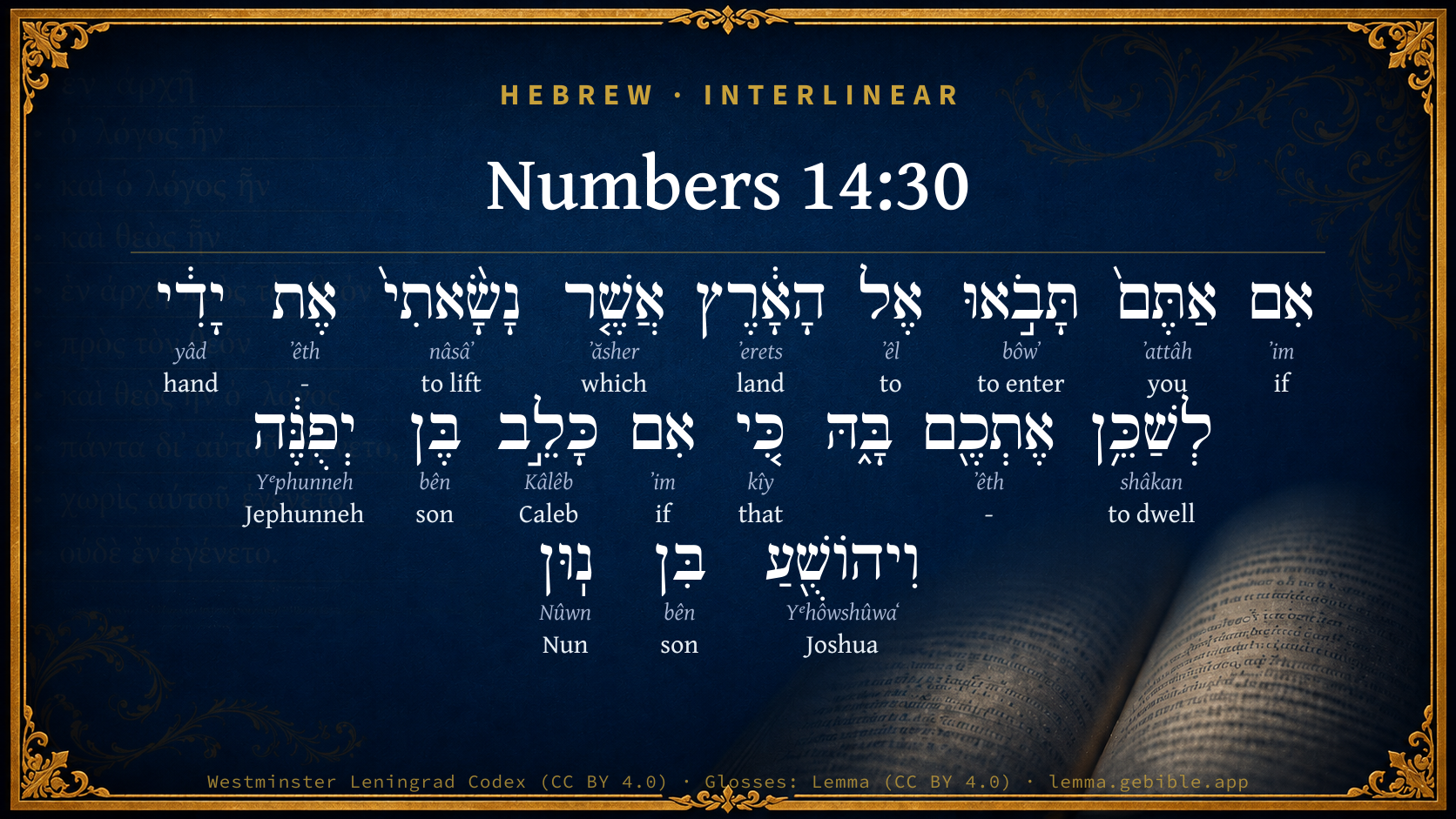
Hebrew (Westminster Leningrad Codex) Numbers 14:30 appears in the Hebrew Old Testament. The text above is from the Westminster Leningrad Codex. Each word links to its Strong’s number, a concise gloss, and parsing drawn from the Open Scriptures Hebrew Bible morphology. Click any word for its full Brown-Driver-Briggs (BDB) entry.
Download image
Cite this verse

Numbers 14:30 (World English Bible). Public Domain. Lemma interlinear Bible study tool, https://lemma.gebible.app/v/numbers/14/30.

Show BibTeX & RIS
BibTeX
RIS
English Translation
surely you shall not come into the land, concerning which I swore that I would make you dwell therein, save Caleb the son of Jephunneh, and Joshua the son of Nun.
World English Bible · Public Domain
Download a study sheet

One document with this verse’s original text, its word-by-word gloss line, the meaning frame, cross-references with their text, attributed commentary, and full source and license credits — printable, and it pastes into notes with its structure intact.

This verse Autodidact and up

Study sheet (.html) Plain text (.txt)

A passage Seminary Student

Up to 50 verses in one chapter. A passage sheet keeps up to 6 commentary sources and 12 cross-references per verse, in the order this page ranks them, and says so on the sheet whenever that leaves anything out. Ask for a single verse and you get the Autodidact verse sheet above.

Everything on this page stays free to read, with no account — the sheet is a download of what is already on screen, not access to it.

Want to remove ads? Support Godless Engineer
Compare translations 3

The same verse in 3 English versions, stacked beneath the original-language interlinear above. Click any original word for its lexicon entry.

Each is an independent rendering of the whole verse — the interlinear is not word-aligned to these translations.

Highlighted words mark where these versions differ — a whole-verse word diff, not a word-by-word alignment.

  • World English Bible Public Domain
    surely you shall not come into the land, concerning which I swore that I would make you dwell therein, save Caleb the son of Jephunneh, and Joshua the son of Nun.
  • King James Version Public Domain
    Doubtless ye shall not come into the land, concerning which I sware to make you dwell therein, save Caleb the son of Jephunneh, and Joshua the son of Nun.
  • unfoldingWord Literal Text CC BY-SA 4.0
    if you go to the land that I have lifted up my hand to make you dwell in it, except Caleb, the son of Jephunneh, and Joshua, the son of Nun,

unfoldingWord Literal Text — © unfoldingWord, licensed CC BY-SA 4.0. Word-aligned USFM3 via Door43 (git.door43.org/unfoldingWord/en_ult).

Versions to compare (up to 4)

3 of 4 selected

Show all 18 translations

Every available English version of this verse, each an independent rendering of the whole verse.

  • World English Bible Public Domain
    surely you shall not come into the land, concerning which I swore that I would make you dwell therein, save Caleb the son of Jephunneh, and Joshua the son of Nun.
  • Berean Standard Bible Public Domain
    Surely none of you will enter the land in which I swore to settle you, except Caleb son of Jephunneh and Joshua son of Nun.
  • Majority Standard Bible Public Domain
    Surely none of you will enter the land in which I swore to settle you, except Caleb son of Jephunneh and Joshua son of Nun.
  • King James Version Public Domain
    Doubtless ye shall not come into the land, concerning which I sware to make you dwell therein, save Caleb the son of Jephunneh, and Joshua the son of Nun.
  • American Standard Version (1901) Public Domain
    surely ye shall not come into the land, concerning which I sware that I would make you dwell therein, save Caleb the son of Jephunneh, and Joshua the son of Nun.
  • Revised Version (1885) Public Domain
    surely ye shall not come into the land, concerning which I lifted up my hand that I would make you dwell therein, save Caleb the son of Jephunneh, and Joshua the son of Nun.
  • Geneva Bible (1599) Public Domain
    Ye shall not doubtles come into the land, for the which I lifted vp mine hande, to make you dwell therein, saue Caleb the sonne of Iephunneh, and Ioshua the sonne of Nun.
  • Douay-Rheims (1899) Public Domain
    Shall not enter into the land, over which I lifted up my bend to make you dwell therein, except Caleb the son of Jephone, and Josue the son of Nun.
  • Young's Literal Translation Public Domain
    ye -- ye come not in unto the land which I have lifted up My hand to cause you to tabernacle in it, except Caleb son of Jephunneh, and Joshua son of Nun.
  • Literal Standard Version CC BY-SA 4.0
    you do not come into the land [for] which I have lifted up My hand to cause you to dwell in it, except Caleb son of Jephunneh and Joshua son of Nun.
  • Unlocked Literal Bible CC BY-SA 4.0
    You will certainly not go into the land that I promised to make your home, except Caleb son of Jephunneh and Joshua son of Nun.
  • unfoldingWord Literal Text CC BY-SA 4.0
    if you go to the land that I have lifted up my hand to make you dwell in it, except Caleb, the son of Jephunneh, and Joshua, the son of Nun,
  • Darby Bible Public Domain
    shall in no wise come into the land, concerning which I have lifted up my hand to make you dwell in it; save Caleb the son of Jephunneh, and Joshua the son of Nun.
  • World Messianic Bible Public Domain
    surely you shall not come into the land concerning which I swore that I would make you dwell therein, except Caleb the son of Jephunneh, and Joshua the son of Nun.
  • Webster's Bible Public Domain
    Doubtless ye shall not come into the land concerning which I swore to make you dwell therein, save Caleb the son of Jephunneh, and Joshua the son of Nun.
  • Free Bible Version CC BY-SA 4.0
    Absolutely none of you will enter the country I promised to give you to live in, except for Caleb, son of Jephunneh, and Joshua, son of Nun.
  • Bible in Basic English Public Domain
    Not one will come into the land which I gave my word you would have for your resting-place, but only Caleb, the son of Jephunneh, and Joshua, the son of Nun.
  • JPS Tanakh (1917) Public Domain
    surely ye shall not come into the land, concerning which I lifted up My hand that I would make you dwell therein, save Caleb the son of Jephunneh, and Joshua the son of Nun.

Literal Standard Version (2020), Covenant Press — licensed CC BY-SA 4.0. Text via the HelloAO Bible API (eBible.org). Unlocked Literal Bible (unfoldingWord) — licensed CC BY-SA 4.0. Text via the HelloAO Bible API (eBible.org). unfoldingWord Literal Text — © unfoldingWord, licensed CC BY-SA 4.0. Word-aligned USFM3 via Door43 (git.door43.org/unfoldingWord/en_ult). Free Bible Version, Dr. Jonathan Gallagher — licensed CC BY-SA 4.0. Text via the HelloAO Bible API (eBible.org).

Word by word

More ways to search: Search by grammar → Find every occurrence → Compare this word →

Practice this passage: Drill this verse → Learn its vocabulary →

יְפֻנֶּ֔ה
Yᵉphunneh
H3312
“Jephunneh”
Noun, Proper
Part of Speech
Noun
Type
Proper
Full BDB Definition

Origin: from H6437

TWOT: None

Jephunneh = "He will be facing" - a Kenezite and father of Caleb the spy from the tribe of Judah - son of Jether and descendant of Asher
  1. אִם ʼim H518 “if” Conjunction
  2. אַתֶּם֙ ʼattâh H859 “you” Pronoun, Personal, 2nd Person, Masculine, Plural
  3. תָּבֹ֣אוּ bôwʼ H935 “to enter” Verb, Qal, Imperfect, 2nd Person, Masculine, Plural
  4. אֶל ʼêl H413 “to” Preposition
  5. הָאָ֔רֶץ ʼerets H776 “the · land” Particle, Definite Article + Noun, Common, Both, Singular, Absolute
  6. אֲשֶׁ֤ר ʼăsher H834 “which” Particle, Relative
  7. נָשָׂ֨אתִי֙ nâsâʼ H5375 “to lift” Verb, Qal, Perfect, 1st Person, Common, Singular
  8. אֶת ʼêth H853 “-” Particle, Direct Object
  9. יָדִ֔י yâd H3027 “hand · my” Noun, Common, Both, Singular, Construct + Suffix, Personal, 1st Person, Common, Singular
  10. לְשַׁכֵּ֥ן shâkan H7931 “to dwell” Preposition + Verb, Piel, Infinitive Construct
  11. אֶתְכֶ֖ם ʼêth H853 “- · you” Particle, Direct Object + Suffix, Personal, 2nd Person, Masculine, Plural
  12. כִּ֚י kîy H3588 “that” Conjunction
  13. אִם ʼim H518 “if” Conjunction
  14. כָּלֵ֣ב Kâlêb H3612 “Caleb” Noun, Proper
  15. בֶּן bên H1121 “son of” Noun, Common, Masculine, Singular, Construct
  16. וִיהוֹשֻׁ֖עַ Yᵉhôwshûwaʻ H3091 “and · Joshua” Conjunction + Noun, Proper
  17. בִּן bên H1121 “son of” Noun, Common, Masculine, Singular, Construct
  18. נֽוּן Nûwn H5126 “Nun” Noun, Proper

About this verse

These counts appear in no published source. They are computed here, from the morphology-tagged text and Lemma’s own curated glosses. What Lemma adds →

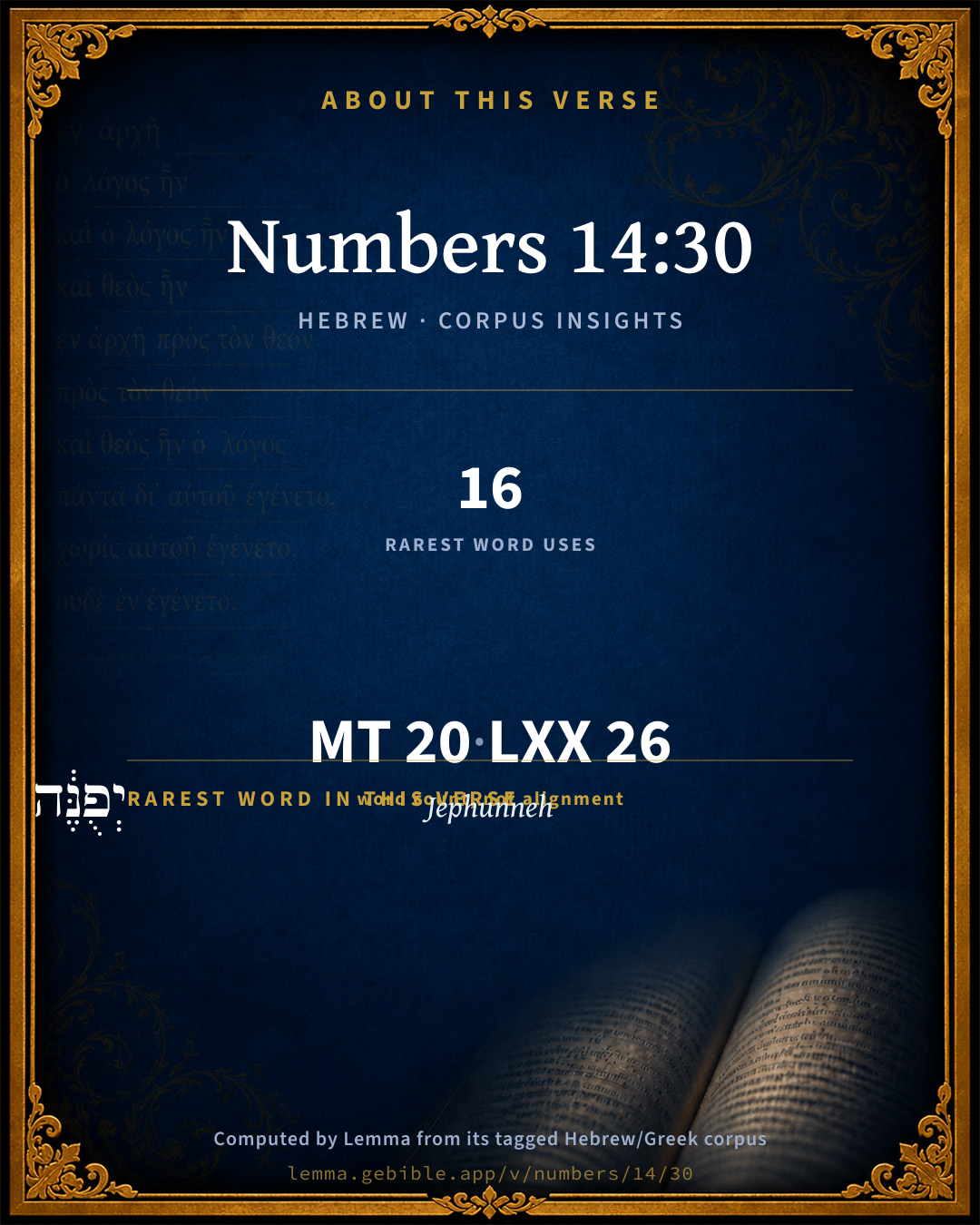
20
words
16
distinct lemmas
Pentateuch
section

Notable vocabulary

The rarest word here is יְפֻנֶּ֔ה Jephunneh H3312 — appearing just 16 times in the whole Hebrew Bible.

Shared distinctive vocabulary

יְפֻנֶּ֔ה Jephunneh H3312 occurs in 16 verses of the Hebrew Bible. Also found in:

Grammatical profile

  • 3 verbs
  • 8 nouns
  • 1 pronoun
  • 2 prepositions
  • 3 conjunctions
  • 3 particles

Verb forms

  • תָּבֹ֣אוּ Qal · Imperfect
  • נָשָׂ֨אתִי֙ Qal · Perfect
  • לְשַׁכֵּ֥ן Piel · Infinitive Construct

Repetition

Words recur within this verse — often emphatic in Hebrew:

Hebrew & Septuagint length

In English translation the verse runs 31 words from the Hebrew and 32 from the Septuagint (LXX English) — closely comparable.

A rough comparison of the two English renderings, which tokenize alike — not a word-level alignment.

Word counts can differ between the Hebrew and the Greek without any difference in meaning — e.g. the Hebrew direct-object marker אֵת has no separate Greek word, and Greek often adds the article ὁ.

In the original languages it is 20 Hebrew tokens and 26 Greek tokens — but the two are counted differently (Hebrew bundles its prefixes and suffixes into one token; the Greek is in lemma form), so that isn’t a like-for-like length.

Cross-references

5

Topical passages linked to Numbers 14:30 in the Treasury of Scripture Knowledge — connected by theme and wording, ordered by reader-vote popularity; previews shown in the World English Bible.

  • Genesis 14:22 Abram said to the king of Sodom, "I have lifted up my hand to Yahweh, God Most High, possessor of heaven and earth,
  • Numbers 14:38 But Joshua the son of Nun, and Caleb the son of Jephunneh, remained alive of those men who went to spy out the land.
  • Numbers 26:65 For Yahweh had said of them, They shall surely die in the wilderness. There was not left a man of them, save Caleb the son of Jephunneh, and Joshua the son of Nun.
  • Deuteronomy 1:36–38 save Caleb the son of Jephunneh: he shall see it; and to him will I give the land that he has trodden on, and to his children, because he has wholly followed Yahweh.
  • Numbers 32:12 save Caleb the son of Jephunneh the Kenizzite, and Joshua the son of Nun; because they have wholly followed Yahweh.

Cross-references courtesy of OpenBible.info (CC BY 4.0).

Hebrew and Greek witnesses Masoretic Hebrew ↔ Greek Septuagint

The same verse in the two great witnesses to the Old Testament, shown verse-for-verse.

These are two independent witnesses, not word-aligned to each other, and the Septuagint is shown in lemma (dictionary) form.

Hebrew Numbers 14:30 Masoretic · Westminster Leningrad Codex

אִם אַתֶּם֙ תָּבֹ֣אוּ אֶל הָאָ֔רֶץ אֲשֶׁ֤ר נָשָׂ֨אתִי֙ אֶת יָדִ֔י לְשַׁכֵּ֥ן אֶתְכֶ֖ם בָּ֑הּ כִּ֚י אִם כָּלֵ֣ב בֶּן יְפֻנֶּ֔ה וִיהוֹשֻׁ֖עַ בִּן נֽוּן

surely you shall not come into the land, concerning which I swore that I would make you dwell therein, save Caleb the son of Jephunneh, and Joshua the son of Nun.

World English Bible · Public Domain

Greek LXX Numbers 14:30 Septuagint · lemma form

εἰ σύ εἰςἔρχομαι εἰς ὁ γῆ ἐπί ὅς ἐκτείνω ὁ χείρ ἐγώ κατασκηνόω σύ ἐπί αὐτός ἀλλά ἤ χαλεβ υἱός ιεφοννη καί ἰησοῦς ὁ ὁ ναυη

you⌃ shall not enter into the land for which I stretched out my hand to establish you upon it; except only Chaleb the son of Jephonne, and Joshua the son of Naue.

LXX2012 (modern English Septuagint) · Public Domain

Hebrew: Westminster Leningrad Codex (CC BY 4.0). Greek: Septuagint (public domain); English from LXX2012 (modern English Septuagint) (Public Domain). How the Septuagint differs from the Hebrew →

Targum (Aramaic paraphrase)

2

The Targum is the ancient Jewish Aramaic paraphrase of the Hebrew Scriptures — an interpretive translation, not the Hebrew text itself. Onkelos (literal) and Pseudo-Jonathan (expansive) render the Torah, and Jonathan the Prophets. Coverage is partial: where no permissively-licensed English translation exists for a verse, only the Aramaic is shown. This is verse-level text, not a word-by-word alignment to the Hebrew.

  1. Targum Onkelos Torah (Genesis–Deuteronomy)
    אִם אַתּוּן תֵּעֲלוּן לְאַרְעָא דִי קַיֵמִית בְמֵימְרִי לְאַשְׁרָאָה יַתְכוֹן בַּהּ אֱלָהֵן כָּלֵב בַּר יְפֻנֶה וִיהוֹשֻׁעַ בַּר נוּן

    (no public-domain English translation for this verse)

    Targum Onkelos — Aramaic: “Onkelos Genesis” (public domain); “Onkelos Exodus” (public domain); “Onkelos Leviticus” (public domain); “Onkelos Numbers” (public domain); “Onkelos Deuteronomy” (public domain). English: “Sefaria Community Translation” (CC0 1.0 (public-domain dedication)); “J.W. Etheridge. The Targums of Onkelos and Jonathan Ben Uzziel on the Pentateuch. London: Longmans, Green, 1862” (public domain). Text via Sefaria.

  2. Targum Pseudo-Jonathan Torah (Genesis–Deuteronomy)
    בִּשְׁבוּעָא חֲמִירָא דְאַתּוּן לָא תֵיעֲלוּן לְאַרְעָא דְקַיֵימִית בְּמֵימְרִי לְאַשְׁרָאָה יַתְכוֹן בָּהּ אֲרוּם אֱלָהֵן כָּלֵב בַּר יְפוּנֶה וִיהוֹשֻׁעַ בַּר נוּן

    By a fast oath (have I sworn) that you shall not enter into the land which I covenanted in My Word to give you to inhabit, except Kaleb bar Jephunneh and Jehoshua bar Nun.

    Targum Pseudo-Jonathan — Aramaic: “Targum Jonathan on Genesis” (public domain); “Targum Jonathan on Exodus” (public domain); “Targum Jonathan on Leviticus” (public domain); “Targum Jonathan on Numbers” (public domain); “Targum Jonathan on Deuteronomy” (public domain). English: “The Targum of Jonathan ben Uzziel, trans. J. W. Etheridge, London, 1862” (public domain). Text via Sefaria.

Commentary

Notes on Numbers 14:30 from classic Christian and Jewish commentators (each source and its license shown beneath its notes). The classic Christian expositions comment on the surrounding passage and are grouped to its opening verse, so a note may address several verses; the Jewish commentaries on the Tanakh (Rashi and others) are per-verse, so they appear only where the commentator wrote on this verse.

Lemma curates 59 commentaries, every one of them public domain or Creative Commons licensed, each selected and text-cleaned for this edition rather than reprinted as found. About our sources →

Jamieson, Fausset & Brown

Robert Jamieson, A. R. Fausset & David Brown

save Caleb . . . and Joshua--These are specially mentioned, as honorable exceptions to the rest of the scouts, and also as the future leaders of the people. But it appears that some of the old generation did not join in the mutinous murmuring, including in that number the whole order of the priests (Jos 14:1).

Jamieson, Fausset & Brown — Commentary Critical and Explanatory on the Whole Bible (1871) — public domain (CC PDM 1.0). Text via the HelloAO Bible API.

Ellicott's Commentary for English Readers

(30) Concerning which I sware.—Literally, 1 lifted up my hand. Lifting up the hand is the attitude of swearing. (See Gen_14:22 and Note; Deu_32:40.) The reference appears to be to the original covenant made with Abraham, and renewed to Isaac and Jacob, respecting the possession of the land of Canaan. (Comp. Gen_15:7; Gen_15:18; Gen_17:8; Gen_22:16-18; Gen_26:3-4; Gen_28:13; Exo_6:8.)

A Bible Commentary for English Readers, edited by Charles John Ellicott (1878–1897) — public domain. Text from a community e-Sword module.

John Gill's Exposition

But your little ones, which ye said should be a prey,.... To the Canaanites, Num 14:3,

them will I bring in; into the land of Canaan, and so fulfil the promise made to Abraham, Isaac, and Jacob: for the unbelief of this congregation did not make the faith, or faithfulness of God, of none effect:

and they shall know the land which ye have despised; shall know what a good land it is by experience, and shall possess and enjoy it with approbation, delight, and pleasure, which they, believing the spies, rejected with, loathing and disdain.

John Gill's Exposition of the Whole Bible (1746–1763) — public domain (CC PDM 1.0). Text via the HelloAO Bible API.

Haydock's Catholic Bible Commentary

Hand, the posture of one taking an oath, Genesis xv. 18.

George Leo Haydock (1774–1849), Haydock's Catholic Family Bible and Commentary, 1859 edition — public domain. Excludes Psalms (Douay-Rheims chapter numbering differs from Protestant) and Deuterocanonical books (Catholic canon only).

Matthew Poole's English Annotations

To make you, i.e. your nation; for God did not swear to do so to these particular persons.

Matthew Poole's English Annotations on the Holy Bible (1683–1685) — public domain. Text from a community e-Sword/MySword module.

Whedon's Commentary on the Bible

Daniel D. Whedon

30. Doubtless — “Surely,” R.V. The Hebrew form of oath usually is a grammatical protasis, or condition with the apodosis or conclusion omitted; thus, If they enter into the land, (let me be untrue.) Hence it is customary to translate the if by not. Comp. Heb_3:11; Heb_4:3.

I sware — Literally, lifted up my hand. Every promise of God to man is conditioned on man’s faithfulness and obedience.

Daniel D. Whedon (gen. ed.), Commentary on the Old and New Testaments (1874–1909) — public domain. Text from a community e-Sword module.

The Pulpit Commentary

Sware. Literally, "lifted up my hand". (see on Gen_14:22) And Joshua the son of Nun. The exception in favour of his "minister," Joshua, had been taken for granted in the brief answer of God to Moses; in the fuller announcement of his purposes to the congregation it was natural that he too should be mentioned by name.

The Pulpit Commentary (1880–1919), ed. H.D.M. Spence-Jones & Joseph S. Exell — public domain. Text from a community e-Sword module.

John Wesley's Explanatory Notes

You - Your nation; for God did not swear to do so to these particular persons.

John Wesley, Explanatory Notes Upon the Whole Bible (1754–1765) — public domain. Text via the GEBible commentary corpus.

Lesson kit

Teaching starters — assembled from the data on this page, not authored interpretation. Every prompt links to the verse data it draws on. Edit before teaching.

Numbers, in the Pentateuch, opens this verse with 20 words (16 distinct Hebrew lemmas). Its most distinctive word is Yᵉphunneh (“Jephunneh”). A historical commentator’s framing appears above. Read the whole chapter for the surrounding context.

Discussion questions

  1. The word Yᵉphunneh carries the sense “Jephunneh.” How does it shape the verse?
  2. Numbers 13:6 shares the word «Jephunneh» with this verse. How do the two illuminate each other?
  3. “son” occurs 2× in this one verse. What is the effect of the repetition?
  4. These translations render this verse differently. What is at stake in choosing one wording over another?
  5. The verb «תָּבֹ֣אוּ» is Qal Imperfect. How does its form color the action?
  6. Reading how Jamieson, Fausset & Brown and Ellicott's Commentary for English Readers read this verse, where do the two commentators agree and where do they part?

Things to notice

Reading settings

Reading text

Shown beneath each verse's original-language words.

Old Testament
Old Testament edition

Read the OT as the Masoretic Hebrew (MT) or the Greek Septuagint (LXX).

English shown for the Greek Septuagint (in the Hebrew ↔ Greek comparison).

Comparing translations? Open the Compare panel on any verse page to stack up to four side by side.