Exodus 6:26

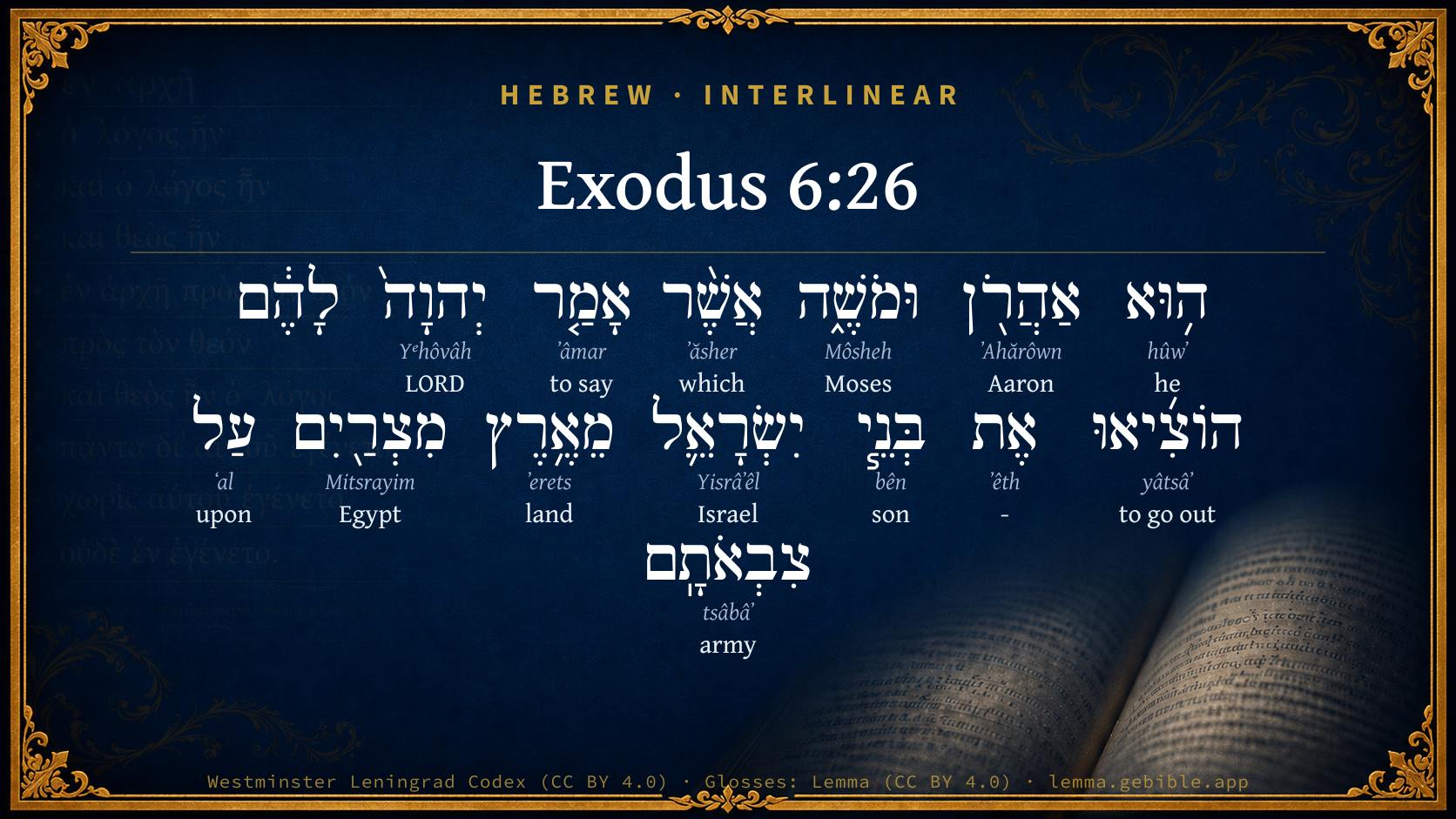
Hebrew (Westminster Leningrad Codex) Exodus 6:26 appears in the Hebrew Old Testament. The text above is from the Westminster Leningrad Codex. Each word links to its Strong’s number, a concise gloss, and parsing drawn from the Open Scriptures Hebrew Bible morphology. Click any word for its full Brown-Driver-Briggs (BDB) entry.
Download image
Cite this verse

Exodus 6:26 (World English Bible). Public Domain. Lemma interlinear Bible study tool, https://lemma.gebible.app/v/exodus/6/26.

Show BibTeX & RIS
BibTeX
RIS
English Translation
These are that Aaron and Moses, to whom Yahweh said, "Bring out the children of Israel from the land of Egypt according to their hosts."
World English Bible · Public Domain
Download a study sheet

One document with this verse’s original text, its word-by-word gloss line, the meaning frame, cross-references with their text, attributed commentary, and full source and license credits — printable, and it pastes into notes with its structure intact.

This verse Autodidact and up

Study sheet (.html) Plain text (.txt)

A passage Seminary Student

Up to 50 verses in one chapter. A passage sheet keeps up to 6 commentary sources and 12 cross-references per verse, in the order this page ranks them, and says so on the sheet whenever that leaves anything out. Ask for a single verse and you get the Autodidact verse sheet above.

Everything on this page stays free to read, with no account — the sheet is a download of what is already on screen, not access to it.

Want to remove ads? Support Godless Engineer
Compare translations 3

The same verse in 3 English versions, stacked beneath the original-language interlinear above. Click any original word for its lexicon entry.

Each is an independent rendering of the whole verse — the interlinear is not word-aligned to these translations.

Highlighted words mark where these versions differ — a whole-verse word diff, not a word-by-word alignment.

  • World English Bible Public Domain
    These are that Aaron and Moses, to whom Yahweh said, "Bring out the children of Israel from the land of Egypt according to their hosts."
  • King James Version Public Domain
    These are that Aaron and Moses, to whom the LORD said, Bring out the children of Israel from the land of Egypt according to their armies.
  • unfoldingWord Literal Text CC BY-SA 4.0
    It was Aaron and Moses to whom Yahweh said, “Bring out the sons of Israel from the land of Egypt by their hosts.”

unfoldingWord Literal Text — © unfoldingWord, licensed CC BY-SA 4.0. Word-aligned USFM3 via Door43 (git.door43.org/unfoldingWord/en_ult).

Versions to compare (up to 4)

3 of 4 selected

Show all 18 translations

Every available English version of this verse, each an independent rendering of the whole verse.

  • World English Bible Public Domain
    These are that Aaron and Moses, to whom Yahweh said, "Bring out the children of Israel from the land of Egypt according to their hosts."
  • Berean Standard Bible Public Domain
    It was this Aaron and Moses to whom the LORD said, “Bring the Israelites out of the land of Egypt by their divisions.”
  • Majority Standard Bible Public Domain
    It was this Aaron and Moses to whom the LORD said, “Bring the Israelites out of the land of Egypt by their divisions.”
  • King James Version Public Domain
    These are that Aaron and Moses, to whom the LORD said, Bring out the children of Israel from the land of Egypt according to their armies.
  • American Standard Version (1901) Public Domain
    These are that Aaron and Moses, to whom Jehovah said, Bring out the children of Israel from the land of Egypt according to their hosts.
  • Revised Version (1885) Public Domain
    These are that Aaron and Moses, to whom the LORD said, Bring out the children of Israel from the land of Egypt according to their hosts.
  • Geneva Bible (1599) Public Domain
    These are Aaron and Moses to whom the Lord said, Bring the children of Israel out of the land of Egypt, according to their armies.
  • Douay-Rheims (1899) Public Domain
    These are Aaron and Moses, whom the Lord commanded to bring forth the children of Israel out of the land of Egypt by their companies.
  • Young's Literal Translation Public Domain
    This `is' Aaron -- and Moses -- to whom Jehovah said, `Bring ye out the sons of Israel from the land of Egypt, by their hosts;'
  • Literal Standard Version CC BY-SA 4.0
    This [is] Aaron—and Moses—to whom YHWH said, “Bring out the sons of Israel from the land of Egypt, by their hosts”;
  • Unlocked Literal Bible CC BY-SA 4.0
    These two men were the Aaron and Moses to whom Yahweh said, “Bring out the Israelites from the land of Egypt, by their groups of fighting men.”
  • unfoldingWord Literal Text CC BY-SA 4.0
    It was Aaron and Moses to whom Yahweh said, “Bring out the sons of Israel from the land of Egypt by their hosts.”
  • Darby Bible Public Domain
    This is that Aaron and Moses, to whom Jehovah said, Bring out the children of Israel from the land of Egypt according to their hosts.
  • World Messianic Bible Public Domain
    These are that Aaron and Moses to whom the LORD said, “Bring out the children of Israel from the land of Egypt according to their armies.”
  • Webster's Bible Public Domain
    These are that Aaron and Moses, to whom the LORD said, Bring out the children of Israel from the land of Egypt according to their armies.
  • Free Bible Version CC BY-SA 4.0
    Aaron and Moses mentioned here are the ones the Lord told, “Lead the Israelites out of Egypt, divided up in their respective tribes.”
  • Bible in Basic English Public Domain
    These are the same Aaron and Moses to whom the Lord said, Take the children of Israel out of the land of Egypt in their armies.
  • JPS Tanakh (1917) Public Domain
    These are that Aaron and Moses, to whom the LORD said: 'Bring out the children of Israel from the land of Egypt according to their hosts.'

Literal Standard Version (2020), Covenant Press — licensed CC BY-SA 4.0. Text via the HelloAO Bible API (eBible.org). Unlocked Literal Bible (unfoldingWord) — licensed CC BY-SA 4.0. Text via the HelloAO Bible API (eBible.org). unfoldingWord Literal Text — © unfoldingWord, licensed CC BY-SA 4.0. Word-aligned USFM3 via Door43 (git.door43.org/unfoldingWord/en_ult). Free Bible Version, Dr. Jonathan Gallagher — licensed CC BY-SA 4.0. Text via the HelloAO Bible API (eBible.org).

Word by word

More ways to search: Search by grammar → Find every occurrence → Compare this word →

Practice this passage: Drill this verse → Learn its vocabulary →

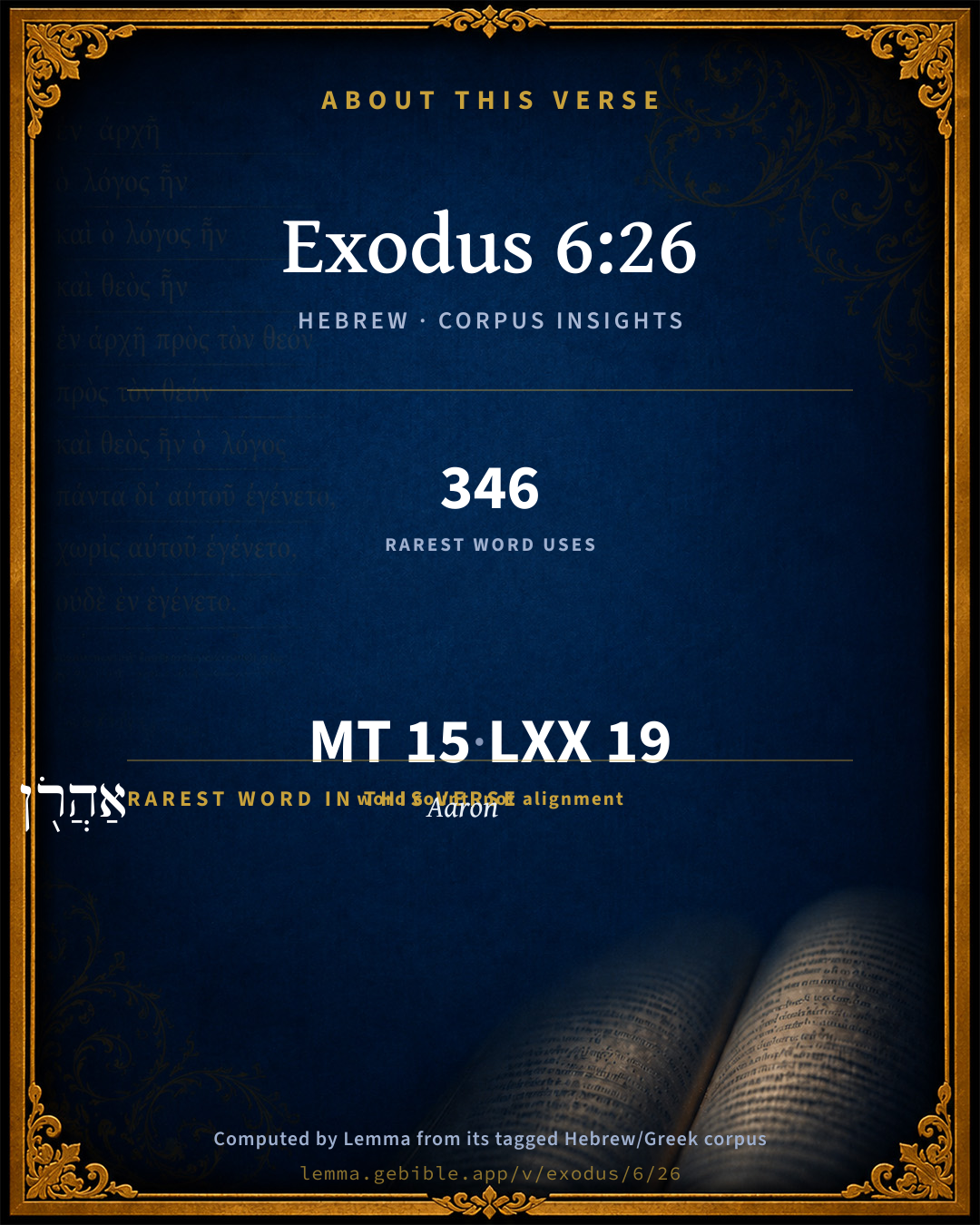
אַהֲרֹ֖ן
ʼAhărôwn
H175
“Aaron”
Noun, Proper
Part of Speech
Noun
Type
Proper
Full BDB Definition

Origin: of uncertain derivation

TWOT: 35

Aaron = "light bringer" - brother of Moses, a Levite and the first high priest
  1. ה֥וּא hûwʼ H1931 “he” Pronoun, Personal, 3rd Person, Masculine, Singular
  2. וּמֹשֶׁ֑ה Môsheh H4872 “and · Moses” Conjunction + Noun, Proper
  3. אֲשֶׁ֨ר ʼăsher H834 “which” Particle, Relative
  4. אָמַ֤ר ʼâmar H559 “to say” Verb, Qal, Perfect, 3rd Person, Masculine, Singular
  5. יְהוָה֙ Yᵉhôvâh H3068 “LORD” Noun, Proper
  6. הוֹצִ֜יאוּ yâtsâʼ H3318 “go out” Verb, Hiphil, Imperative, 2nd Person, Masculine, Plural
  7. אֶת ʼêth H853 “-” Particle, Direct Object
  8. בְּנֵ֧י bên H1121 “sons of” Noun, Common, Masculine, Plural, Construct
  9. יִשְׂרָאֵ֛ל Yisrâʼêl H3478 “Israel” Noun, Proper
  10. מֵאֶ֥רֶץ ʼerets H776 “from · land of” Preposition + Noun, Common, Both, Singular, Construct
  11. מִצְרַ֖יִם Mitsrayim H4714 “Egypt” Noun, Proper
  12. עַל ʻal H5921 “upon” Preposition
  13. צִבְאֹתָֽם tsâbâʼ H6635 “armies · their” Noun, Common, Both, Plural, Construct + Suffix, Personal, 3rd Person, Masculine, Plural

About this verse

These counts appear in no published source. They are computed here, from the morphology-tagged text and Lemma’s own curated glosses. What Lemma adds →

15
words
14
distinct lemmas
Pentateuch
section

Grammatical profile

  • 2 verbs
  • 8 nouns
  • 1 pronoun
  • 2 prepositions
  • 2 particles

Verb forms

  • אָמַ֤ר Qal · Perfect
  • הוֹצִ֜יאוּ Hiphil · Imperative

Hebrew & Septuagint length

In English translation the verse runs 25 words from the Hebrew and 24 from the Septuagint (LXX English) — closely comparable.

A rough comparison of the two English renderings, which tokenize alike — not a word-level alignment.

Word counts can differ between the Hebrew and the Greek without any difference in meaning — e.g. the Hebrew direct-object marker אֵת has no separate Greek word, and Greek often adds the article ὁ.

In the original languages it is 15 Hebrew tokens and 19 Greek tokens — but the two are counted differently (Hebrew bundles its prefixes and suffixes into one token; the Greek is in lemma form), so that isn’t a like-for-like length.

Cross-references

22

Topical passages linked to Exodus 6:26 in the Treasury of Scripture Knowledge — connected by theme and wording, ordered by reader-vote popularity; previews shown in the World English Bible.

  • Exodus 7:4 But Pharaoh will not listen to you, and I will lay my hand on Egypt, and bring forth my hosts, my people the children of Israel, out of the land of Egypt by great judgments.
  • Exodus 12:17 You shall observe the feast of unleavened bread; for in this same day have I brought your hosts out of the land of Egypt: therefore shall you observe this day throughout your generations by an ordinance forever.
  • Exodus 12:51 It happened the same day, that Yahweh brought the children of Israel out of the land of Egypt by their hosts.
  • Exodus 6:13 Yahweh spoke to Moses and to Aaron, and gave them a charge to the children of Israel, and to Pharaoh king of Egypt, to bring the children of Israel out of the land of Egypt.
  • Numbers 33:1 These are the journeys of the children of Israel, when they went forth out of the land of Egypt by their hosts under the hand of Moses and Aaron.
  • Genesis 2:1 The heavens and the earth were finished, and all the host of them.
  • Exodus 3:10–11 Come now therefore, and I will send you to Pharaoh, that you may bring forth my people, the children of Israel, out of Egypt."
  • Exodus 6:7 and I will take you to me for a people, and I will be to you a God; and you shall know that I am Yahweh your God, who brings you out from under the burdens of the Egyptians.
  • Exodus 6:20 Amram took Jochebed his father's sister to himself as wife; and she bore him Aaron and Moses: and the years of the life of Amram were a hundred and thirty-seven years.
  • Exodus 13:18 but God led the people around by the way of the wilderness by the Red Sea; and the children of Israel went up armed out of the land of Egypt.
  • Exodus 20:2 "I am Yahweh your God, who brought you out of the land of Egypt, out of the house of bondage.
  • Exodus 32:1 When the people saw that Moses delayed to come down from the mountain, the people gathered themselves together to Aaron, and said to him, "Come, make us gods, which shall go before us; for as for this Moses, the man who brought us up out of the land of Egypt, we don't know what has become of him."
  • Exodus 32:7 Yahweh spoke to Moses, "Go, get down; for your people, who you brought up out of the land of Egypt, have corrupted themselves!
  • Exodus 32:11 Moses begged Yahweh his God, and said, "Yahweh, why does your wrath burn hot against your people, that you have brought forth out of the land of Egypt with great power and with a mighty hand?
  • Joshua 24:5 I sent Moses and Aaron, and I plagued Egypt, according to that which I did in the midst of it: and afterward I brought you out.
  • 1 Samuel 12:6 Samuel said to the people, It is Yahweh who appointed Moses and Aaron, and that brought your fathers up out of the land of Egypt.
  • 1 Samuel 12:8 When Jacob was come into Egypt, and your fathers cried to Yahweh, then Yahweh sent Moses and Aaron, who brought forth your fathers out of Egypt, and made them to dwell in this place.
  • 1 Chronicles 6:3 The children of Amram: Aaron, and Moses, and Miriam. The sons of Aaron: Nadab, and Abihu, Eleazar, and Ithamar.
  • Psalms 77:20 You led your people like a flock, By the hand of Moses and Aaron.
  • Psalms 99:6 Moses and Aaron were among his priests, Samuel among those who call on his name; They called on Yahweh, and he answered them.
  • Micah 6:4 For I brought you up out of the land of Egypt, And redeemed you out of the house of bondage. I sent before you Moses, Aaron, and Miriam.
  • Acts 7:35–36 "This Moses, whom they refused, saying, 'Who made you a ruler and a judge?'--God has sent him as both a ruler and a deliverer by the hand of the angel who appeared to him in the bush.

Cross-references courtesy of OpenBible.info (CC BY 4.0).

Hebrew and Greek witnesses Masoretic Hebrew ↔ Greek Septuagint

The same verse in the two great witnesses to the Old Testament, shown verse-for-verse.

These are two independent witnesses, not word-aligned to each other, and the Septuagint is shown in lemma (dictionary) form.

Hebrew Exodus 6:26 Masoretic · Westminster Leningrad Codex

ה֥וּא אַהֲרֹ֖ן וּמֹשֶׁ֑ה אֲשֶׁ֨ר אָמַ֤ר יְהוָה֙ לָהֶ֔ם הוֹצִ֜יאוּ אֶת בְּנֵ֧י יִשְׂרָאֵ֛ל מֵאֶ֥רֶץ מִצְרַ֖יִם עַל צִבְאֹתָֽם

These are that Aaron and Moses, to whom Yahweh said, "Bring out the children of Israel from the land of Egypt according to their hosts."

World English Bible · Public Domain

Greek LXX Exodus 6:26 Septuagint · lemma form

οὗτος ααρων καί μωυσῆς ὅς εἶπον αὐτός ὁ θεός ἐκἄγω ὁ υἱός ἰσραήλ ἐκ γῆ αἴγυπτος σύν δύναμις αὐτός

This is Aaron and Moses, whom God told to bring out the children of Israel out of the land of Egypt with their forces.

LXX2012 (modern English Septuagint) · Public Domain

Hebrew: Westminster Leningrad Codex (CC BY 4.0). Greek: Septuagint (public domain); English from LXX2012 (modern English Septuagint) (Public Domain). How the Septuagint differs from the Hebrew →

Targum (Aramaic paraphrase)

2

The Targum is the ancient Jewish Aramaic paraphrase of the Hebrew Scriptures — an interpretive translation, not the Hebrew text itself. Onkelos (literal) and Pseudo-Jonathan (expansive) render the Torah, and Jonathan the Prophets. Coverage is partial: where no permissively-licensed English translation exists for a verse, only the Aramaic is shown. This is verse-level text, not a word-by-word alignment to the Hebrew.

  1. Targum Onkelos Torah (Genesis–Deuteronomy)
    הוּא אַהֲרֹן וּמשֶׁה דִי אֲמַר יְיָ לְהוֹן אַפִּיקוּ יָת בְּנֵי יִשְׂרָאֵל מֵאַרְעָא דְמִצְרַיִם עַל חֵילֵיהוֹן:

    (no public-domain English translation for this verse)

    Targum Onkelos — Aramaic: “Onkelos Genesis” (public domain); “Onkelos Exodus” (public domain); “Onkelos Leviticus” (public domain); “Onkelos Numbers” (public domain); “Onkelos Deuteronomy” (public domain). English: “Sefaria Community Translation” (CC0 1.0 (public-domain dedication)); “J.W. Etheridge. The Targums of Onkelos and Jonathan Ben Uzziel on the Pentateuch. London: Longmans, Green, 1862” (public domain). Text via Sefaria.

  2. Targum Pseudo-Jonathan Torah (Genesis–Deuteronomy)
    אִיהוּ אַהֲרן וּמשֶׁה דַאֲמַר יְיָ לְהוֹן הַנְפִּיקוּ יַת בְּנֵי יִשְרָאֵל פְּרִיקִין מֵאַרְעָא דְמִצְרַיִם עַל חֵילֵיהוֹן

    These are Aharon and Mosheh, to whom the Lord said, Bring forth the sons of Israel free from the land of Mizraim, according to their hosts;

    Targum Pseudo-Jonathan — Aramaic: “Targum Jonathan on Genesis” (public domain); “Targum Jonathan on Exodus” (public domain); “Targum Jonathan on Leviticus” (public domain); “Targum Jonathan on Numbers” (public domain); “Targum Jonathan on Deuteronomy” (public domain). English: “The Targum of Jonathan ben Uzziel, trans. J. W. Etheridge, London, 1862” (public domain). Text via Sefaria.

Commentary

Notes on Exodus 6:26 from classic Christian and Jewish commentators (each source and its license shown beneath its notes). The classic Christian expositions comment on the surrounding passage and are grouped to its opening verse, so a note may address several verses; the Jewish commentaries on the Tanakh (Rashi and others) are per-verse, so they appear only where the commentator wrote on this verse.

Lemma curates 59 commentaries, every one of them public domain or Creative Commons licensed, each selected and text-cleaned for this edition rather than reprinted as found. About our sources →

Trapp's Complete Commentary

John Trapp

Exo 6:26 These [are] that Aaron and Moses, to whom the LORD said, Bring out the children of Israel from the land of Egypt according to their armies.

Ver. 26, 27. These are that Aaron and Moses: And again, These are that Moses and Aaron.] That famous couple. This is better than "This is that Dathan," {Num 26:9} and "This is that Ahaz." {2Ch 28:22} They are stigmatised with a mark of infamy: these are eternised for good, to all posterity.

John Trapp, A Commentary or Exposition upon All the Books of the Old and New Testament (1647–1656) — public domain. Text from a community e-Sword module.

Albert Barnes' Notes on the Bible

This emphatic repetition shows the reason for inserting the genealogy. The names of Moses and Aaron are given twice and in a different order; used in Exo 6:26 probably to mark Aaron as the older in the genealogy, and used in Exo 6:27 to denote the leadership of Moses.

Albert Barnes' Notes on the Bible (1834–1885) — public domain. Text from a community e-Sword/MySword module.

Joseph Benson's Commentary

Exo 6:26. According to their armies — Like numerous armies, in military order, and with great power. In the close of the chapter he returns to his narrative, from which he had broken off some-what abruptly, (Exo 6:13,) and repeats the charge God had given him to deliver his message to Pharaoh, Exo 6:29.

Joseph Benson's Commentary on the Old and New Testaments (1811–1818) — public domain. Text from a community e-Sword module.

Geneva Bible (1599)

Geneva Bible translators

For their families were so great, that they might be compared to armies.

Geneva Bible (1599) marginal notes — public domain. Text via Bolls.life.

Adam Clarke's Commentary

Verse 26. According to their armies.] צבאתם tsibotham, their battalions-regularly arranged troops. As God had these particularly under his care and direction, he had the name of יהוה צבאות Yehovah tsebaoth, Lord of hosts or armies.

"The plain and disinterested manner," says Dr. Dodd, "in which Moses speaks here of his relations, and the impartiality wherewith he inserts in the list of them such as were afterwards severely punished by the Lord, are striking proofs of his modesty and sincerity. He inserts the genealogy of Reuben and Simeon, because they were of the same mother with Levi; and though he says nothing of himself, yet he relates particularly what concerns Aaron, Ex 6:23, who married into an honourable family, the sister of a prince of the tribe of Judah."

Adam Clarke's Commentary on the Bible (1810–1826) — public domain. Text from a community e-Sword/MySword module.

Ellicott's Commentary for English Readers

(26) Their armies.—This expression is here used of the Israelites for the first time. It seems to refer to that organisation, of a quasi-military character, which was given to the people by the order of Moses during the long struggle with Pharaoh, and which enabled them at last to quit Egypt, not a disorderly mob, but “harnessed,” or “in military array” (Exo_13:18). The expression is repeated in Exo_7:4; Exo_12:17; Exo_12:51.

A Bible Commentary for English Readers, edited by Charles John Ellicott (1878–1897) — public domain. Text from a community e-Sword module.

The Cambridge Bible for Schools and Colleges

gen. ed. J. J. S. Perowne

26. These] The men whose genealogy has just been stated.

Bring out, &c.] as vv. 6, 13.

according to their hosts] The expression hosts (i.e. armies: 2Sa_2:8, &c.), of the Israelites at the Exodus, is peculiar to P (Exo_7:4, Exo_12:7, SD 41, 51, Num_1:3; Num_2:3-4; Num_2:6, &c., Exo_9:10; Exo_9:16, &c., Exo_10:14-16, &c., Exo_33:1): as Dillm. remarks, it is part of the picture that he had formed of Israel at the Exodus, as marching out and journeying through the wilderness in battle array (cf. Numbers 1, 2, 10).

26, 27. At the close of the genealogy the writer refers emphatically to Moses and Aaron, the two men on whose account the entire genealogy has been introduced.

The Cambridge Bible for Schools and Colleges (gen. ed. J. J. S. Perowne; Cambridge University Press, 1878–1918) — public domain. Text from a community e-Sword module.

John Gill's Exposition

And Moses said before the Lord, behold, I am of uncircumcised lips,.... As he had done, Exo 6:13, and this is only a repetition of what is there said, in order to lead on to what is related in the following chapter:

how shall Pharaoh hearken unto me? so mean a person, and so poor a speaker, and he a mighty king, surrounded with wise counsellors and eloquent orators.

Next: Exodus Chapter 7

John Gill's Exposition of the Whole Bible (1746–1763) — public domain (CC PDM 1.0). Text via the HelloAO Bible API.

Haydock's Catholic Bible Commentary

Aaron is sometimes placed first, as the elder; sometimes last, as inferior in dignity, ver. 27. --- Companies, or bands, in order of battle, chap. xiii. 18. (Calmet)

George Leo Haydock (1774–1849), Haydock's Catholic Family Bible and Commentary, 1859 edition — public domain. Excludes Psalms (Douay-Rheims chapter numbering differs from Protestant) and Deuterocanonical books (Catholic canon only).

Matthew Poole's English Annotations

i.e. According to their numerous families, which were equal to great armies, and which went out of Egypt like several armies in military order, and with great power. See Exo 12:41,51; 13:18; 14:8.

Matthew Poole's English Annotations on the Holy Bible (1683–1685) — public domain. Text from a community e-Sword/MySword module.

The Pulpit Commentary

Vers. 26, 27. The genealogy being concluded as a separate document, its author appends a notice that the Aaron and Moses mentioned in it (ver. 20) are the very Aaron and Moses who received the Divine command to lead the children of Israel out of Egypt, and who appeared before Pharaoh, and "spoke to him" on their behalf. As the heading of the document was kept upon its insertion into the narrative of the Exodus (see the comment on ver. 13), so its concluding sentences were kept, though (according to modem ideas) superfluous.

According to their armies. The term "armies" had not been previously used of the Israelitish people; but it occurs in Exo_7:4, which was probably in the mind of the writer who drew up the genealogy

The Pulpit Commentary (1880–1919), ed. H.D.M. Spence-Jones & Joseph S. Exell — public domain. Text from a community e-Sword module.

John Wesley's Explanatory Notes

According to their armies - Like numerous armies, in military order, and with great power. In the close of the chapter, he returns to his narrative, from which he had broken off somewhat abruptly ver. 13, and repeats, the charge God had given him to deliver his message to Pharaoh, ver. 29.

John Wesley, Explanatory Notes Upon the Whole Bible (1754–1765) — public domain. Text via the GEBible commentary corpus.

unfoldingWord translationNotes

Door43 World Missions Community

by their groups of fighting men

"one tribe at a time" or "one family group after another"

translationWords

Aaron

Moses

unfoldingWord translationNotes — © Distant Shores Media and the Door43 World Missions Community, licensed CC BY-SA 4.0. Source: git.door43.org/Door43/en_tn.

Rashi

Rabbi Shlomo Yitzchaki (Rashi)

הוא אהרן ומשה THESE ARE THAT AARON AND MOSES who are mentioned above where it states (v. 20) that Jochebed bore them to Amram. הוא אהרן ומשה There are some passages where Scripture mentions Aaron before Moses (as here) and other passages where it mentions Moses before Aaron; this is done in order to indicate that they were equal in all respects (more lit., that they weighed alike) (Mekhilta).

על צבאתם — This is the same as בצבאותם with their hosts — all their hosts according to their tribes. Sometimes the word על is merely used in place of a single letter (ב as a prefix); e. g., (Genesis 27:40) “על חרבך shalt thou live” which is the same as בחרבך, by thy sword; (Ezekiel 33:26) “Ye stand על חרבכם” which is the same as בחרבכם, by your sword.

Rashi on the Tanakh — English translations: “The Judaica Press complete Tanach with Rashi, translated by A. J. Rosenberg” (CC BY 4.0); “Pentateuch with Rashi's commentary by M. Rosenbaum and A.M. Silbermann, 1929-1934” (public domain); “The Metsudah Tanach series, Lakewood, N.J” (CC BY 4.0); and “The Book of Joshua, Metsudah Publications, 1997” (CC BY 4.0). Text via Sefaria.

Lesson kit

Teaching starters — assembled from the data on this page, not authored interpretation. Every prompt links to the verse data it draws on. Edit before teaching.

Exodus, in the Pentateuch, opens this verse with 15 words (14 distinct Hebrew lemmas). Its most distinctive word is ʼAhărôwn (“Aaron”). A historical commentator’s framing appears above. Read the whole chapter for the surrounding context.

Discussion questions

  1. How does “Aaron” (ʼAhărôwn) shape what this verse is saying?
  2. Exodus 7:4 shares this passage’s theme. How do the two illuminate each other?
  3. These translations render this verse differently; the difference is in the English rendering, not the original. What questions does that raise?
  4. The verb «אָמַ֤ר» is Qal Perfect. How does its form color the action?
  5. Reading how Trapp's Complete Commentary and Albert Barnes' Notes on the Bible read this verse, where do the two commentators agree and where do they part?

Things to notice

Reading settings

Reading text

Shown beneath each verse's original-language words.

Old Testament
Old Testament edition

Read the OT as the Masoretic Hebrew (MT) or the Greek Septuagint (LXX).

English shown for the Greek Septuagint (in the Hebrew ↔ Greek comparison).

Comparing translations? Open the Compare panel on any verse page to stack up to four side by side.