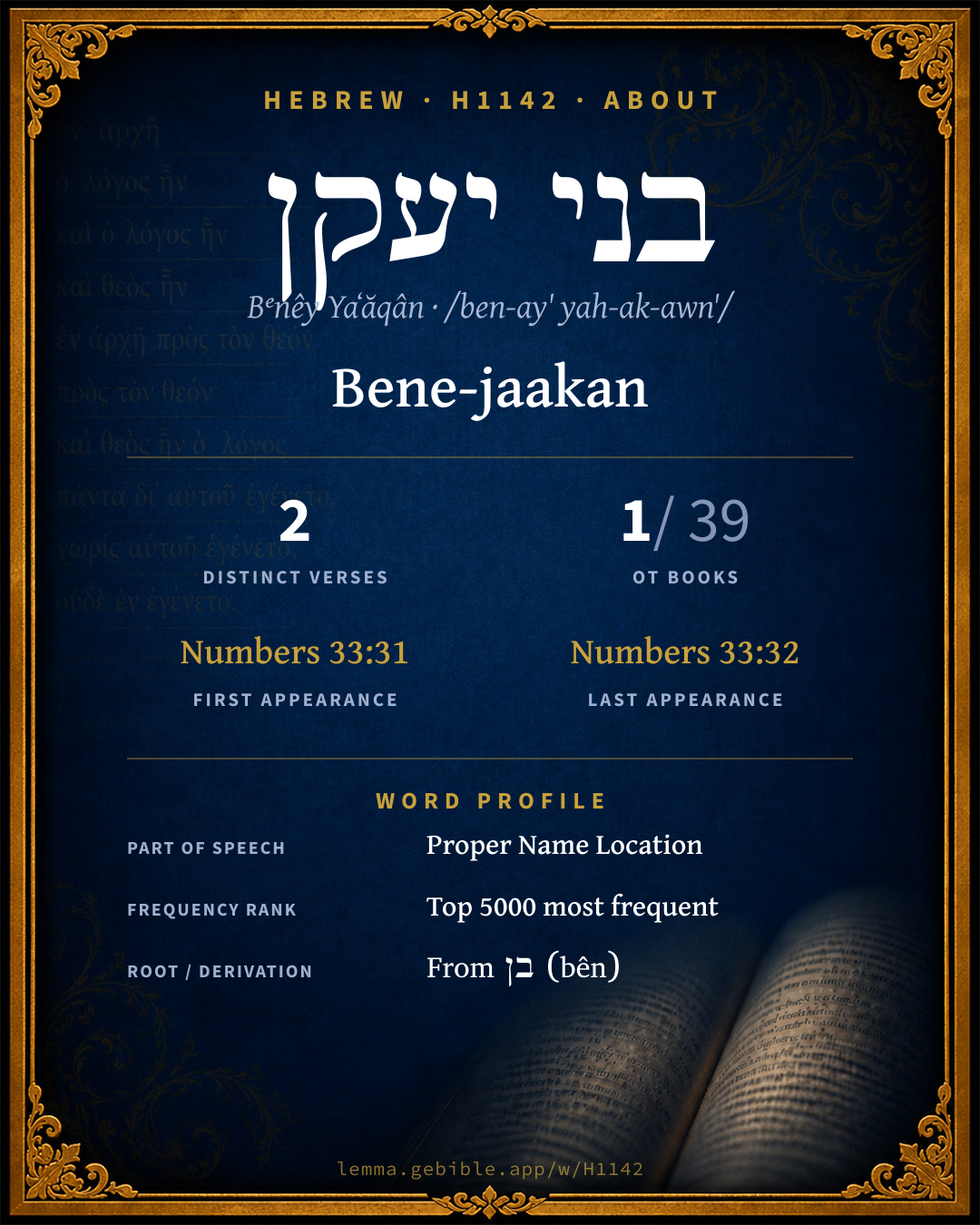
בְּנֵי יַעֲקָ֑ן
Bene-jaakan
BDB lists 2 entries for ‘Bene-jaakan’ fuller range ↓
Full lexicon entry — Brown-Driver-Briggs (BDB)
From Brown-Driver-Briggs (BDB)
Where this word appears
Grammar key — what these labels mean
Part of speech
- Noun
- A naming word — a person, place, thing, or idea.
Noun type
- Proper
- A name of a specific person, place, or people (e.g. Abraham, Zion, Israel).
Every verse where H1142 appears — 2 distinct verses across 1 book. Click any verse to open its interlinear word-by-word view. Verse text shown in the World English Bible for context — . Each verse’s Hebrew form is shown with its reference; the English is not keyword-highlighted, since the data carries no word-level English alignment. Use “Compare translations” on any verse to read it across multiple English versions. This concordance covers the Hebrew Bible; Septuagint (Greek Old Testament) occurrences are not indexed here.
Numbers 2 verses
About this entry
At a glance — auto-summarized from this page’s data, not written by a person. Every figure links to its source below. This summary describes the numbers; it doesn’t interpret them.
בני יעקן — transliterated Bᵉnêy Yaʻăqân — is a Hebrew name carrying the sense “Bene-jaakan.” The Hebrew Bible uses it only 2 verses. Its uses cluster heavily in Numbers (100% of all occurrences). Its earliest occurrence is Numbers 33:31. See 2-verse concordance and the renderings breakdown below.
Gloss history
Strong's 1890 vs modern scholarship
About this word
Strong's H1142 catalogs a Hebrew word from the Hebrew Old Testament.
These counts are not copied from any lexicon or concordance. They are computed here, from the morphology-tagged Hebrew Old Testament. What Lemma adds →
- 2
- distinct verses
- The word appears in 2 distinct verses.
- 1 / 39
- OT books
- The word appears in 1 of 39 Old Testament books.
- #3,696
- by frequency
- Top 5000 most frequent Hebrew words (rank 3,696 of 8,640 Hebrew words by occurrence).
View all 2 occurrences in the concordance →
Most concentrated in
- Numbers 2 verses 100%
By section of the Old Testament
By traditional corpus
Conventional, traditional groupings — biblical authorship is debated, so this is a traditional corpus grouping, not an authorship claim. Each share is this word’s portion of its verses in that division of the Hebrew canon. Each figure is a share of the word’s 2 distinct verses.
- Torah (Pentateuch) 2 verses · 100%
How translations render this word
Counts come from each version’s own published word-to-Strong’s tagging or interlinear alignment — an approximate guide to how each version renders this word, not a word-level alignment the data otherwise carries. Because each total is that version’s own tagged count, the per-version totals vary from one another and need not match the appearance or distinct-verse counts above. These counts may also differ from a printed concordance because Lemma counts each distinctly tagged rendering and does not collapse phrase taggings into a single head-word total. This is a fixed set of word-tagged versions (KJV, ASV, BSB, ULT) and does not change with the reading translation you choose elsewhere. Each version’s license is shown beside its name below (and on Sources).
- King James Version: Benejaakan 2×
- American Standard Version: Bene-jaakan 2×
- Berean Standard Bible: Bene-jaakan 2×
- unfoldingWord Literal Text: Bene jaakan 4×
King James Version Public Domain
Renders H1142 across 2 tagged occurrences — most commonly:
American Standard Version Public Domain
Renders H1142 across 2 tagged occurrences — most commonly:
Berean Standard Bible Public Domain
Renders H1142 across 4 tagged occurrences — most commonly:
Plus 2 renderings that appear only once — usually multi-word phrases or single function words the recovered tagging swept in, not distinct renderings.
unfoldingWord Literal Text CC BY-SA 4.0
Renders H1142 across 4 tagged occurrences — most commonly:
Senses in BDB
The 2 senses BDB distinguishes for this word, in lexicon order (not ranked by frequency or importance). The full entry — with sub-senses — is in the Lexicon Entry tab.
- Bene-jaakan = "sons of twisting"
- an Israelite place of encampment in the wilderness (same as H885 )
Word origin
בְּנֵי יַעֲקָ֑ן n.pr.loc. a station of Israel in wilderness
— Brown-Driver-Briggs (Oxford 1906, public domain), digitized via Sefaria, supplemented by the OpenScriptures HebrewLexicon (CC BY 4.0). See Sources.
Derived from בן (bên) (H1121) — son.
Jastrow Dictionary
A second Hebrew/Aramaic lexicon for comparison, covering Aramaic and post-biblical (Talmudic, Targumic, Midrashic) usage that the biblical-Hebrew BDB does not. Matched by lemma rather than by Strong’s number, so a lemma may carry more than one Jastrow headword (shown separately below), and the entries cover usage well beyond the Bible.
בני
- [to combine,] to build. Sabb. XII, 1 הַבּוֹנֶה he who builds (on the Sabbath). Ib.] 102ᵇ משום בונה (isguilty) because it is one of the labors classified under ‘building’; a. fr.—Metaph. to educate, train. Ber. 64ᵃ (ref. to Is. LIV, 93) א"ת בָּנַיִךְ אלא בוֹנַיִּךְ read not banayikh (thy children), but bonayikh (thy builders, trainers); v. בַּנָּאִים.—Ex. R. s. 23 (play on b’noth, Cant. I, 5) בּוֹנוֹת וכ׳ the authorities directing the building of Jerusalem; v. Pi.—Ḥull. 78ᵇ זה בנה אב, v. אָב, a. בִּנְיָן. [Tosef. Par. VII (VI), 4 בְּנָאוֹ ed. Zuck., v. כָּנַן.] e.g. Isaiah 54:93
- 1. to be built up. Y. B. Bath. III, 14ᵇ, a. fr. לְהִיבָּנוֹת, לִיבָּנוֹת.
- 2. (denom. of בֵּן) to get children. Gen. R. s. 71.
- (denom. of בֵּן) to be adopted, naturalized. Pesik. R. s. 43 נִתְבַּנּוּ בישראל they became full Israelitish citizens.
- to lay out, plan a city, determine its limits. Ex. R. l. c. the Great Sanedrin held sessions ומְבַנָּים אותה (not אותם) and determined the limits of Jerusalem; v. Snh. I, 5.—Part. Pu. מְבוּנֶּה cultivated; built (of human stature), well-proportioned. Keth. 112ᵃ; Sot. 34ᵇ היתה מְבוּנָּה על וכ׳ it (Hebron, in spite of the rocky nature of its soil) was seven times better cultivated than Zoan (one measure of its land yielding as much as did seven measures of the soil of Zoan). Ib. 42ᵇ (play on benayim, I Sam. XVII, 4) מב׳ מכל מום his build was without blemish. e.g. 1 Samuel 17:4
בְּנֵי
- ch. = h. בָּנָה. Targ. Deut. XXV, 9 (Y. יִבְנֶה); a. fr.—Part. בָּנֵי. Targ. Gen. IV, 17.—M. Kat. 10ᵇ מִיבְנֵי to erect; a. e.
- as h. Nif.
- 1. a. 2). Targ. I Kings III, 2; a. fr.—Targ. Gen. XVI, 2; a. e.—Y. Ber. II, 5ᵃ מִתְבַּנְיֵי will be rebuilt; a. e.
A Dictionary of the Targumim, the Talmud Babli and Yerushalmi, and the Midrashic Literature (Marcus Jastrow; London, Luzac, 1903) — Public Domain. Digitized via Sefaria. Digitized via Sefaria. Full attribution on Sources.
Forms in the corpus
The 4 distinct written forms H1142 takes in the Hebrew Bible, most frequent first — each parse links to that state’s occurrences in the concordance. Hebrew forms include their vowel points and cantillation, so a single lemma takes many written forms.
| Form | Parsing | Example | Uses |
|---|---|---|---|
| בִּ/בְנֵ֥י | Noun, Proper | Numbers 33:31 | 1 |
| יַעֲקָ֑ן | Noun, Proper | Numbers 33:32 | 1 |
| יַעֲקָֽן | Noun, Proper | Numbers 33:31 | 1 |
| מִ/בְּנֵ֣י | Noun, Proper | Numbers 33:32 | 1 |
Same root — word family
Other BDB entries built from the same root as H1142, grouped by Strong’s listed origin. These share a root / origin per the lexicon — not necessarily a shared meaning. Each links to that word’s own entry.
Derives from
Shares the same root
Proper names from this root
People and places named from this root — a name, not an additional meaning of the word.
- בן Bên H1122 Ben
- בןאבינדב Ben-ʼĂbîynâdâb H1125 Ben-Abinadab
- בןאוני Ben-ʼÔwnîy H1126 Ben-oni
- בןגבר Ben-Geber H1127 Ben-geber
- בןדקר Ben-Deqer H1128 Ben-dekar
- בןהדד Ben-Hădad H1130 Ben-hadad
- בןזוחת Ben-Zôwchêth H1132 Ben-zoheth
- בןחור Ben-Chûwr H1133 Ben-hur
- בןחיל Ben-Chayil H1134 Ben-hail
- בןחנן Ben-Chânân H1135 Ben-hanan
- בןחסד Ben-Cheçed H1136 Ben-hesed
- בניברק Bᵉnêy-Bᵉraq H1139 Bene-barak
- בנימין Binyâmîyn H1144 Benjamin
- בנינו Bᵉnîynûw H1148 Beninu
- בןעמי Ben-ʻAmmîy H1151 Ben-ami
Compare all same-root words → Showing 4 of 19 — not the complete family. 15 of the same-root words are proper names (people or places). They share a root, not necessarily a meaning.
Bible dictionary
Public-domain dictionary articles matched to this entry by name (Bene-jaakan). A biblical name can be shared by more than one person or place, so an article may treat several.
Easton's Bible Dictionary · M. G. Easton, 1897
Children of Jaakan (Num. 33:31, 32), the same as Beeroth.
Smith's Bible Dictionary · William Smith, 1863
(sons of Jaakan), a tribe who gave their name to certain wells in the desert which formed one of the halting-places of the Israelites on their journey to Canaan. [Beeroth Of The Children Of Jaakan BENE-JAAKAN] Also given in (Genesis 36:27) as Akan.
Hitchcock's Bible Names Dictionary · Roswell D. Hitchcock, 1869
sons of sorrow
Classic public-domain reference works; full attribution on Sources.
Septuagint verse parallels
This word appears in 2 verses that also exist in the Greek Old Testament (Septuagint), out of the 2 Hebrew verses it occurs in. You can read those verses in Greek by switching the Old Testament edition to the Septuagint.
Read these verses in the Septuagint
This is a verse-level parallel only — the same verses exist in both the Hebrew and Greek Old Testaments. No word-level Hebrew↔Greek correspondence is claimed: the data carries no such alignment, so no Greek word is shown as this Hebrew word’s translation. Coverage is not total — the Septuagint omits the deuterocanon and renumbers the Psalms, so some Hebrew verses have no direct Greek parallel.