1 Kings 20:35

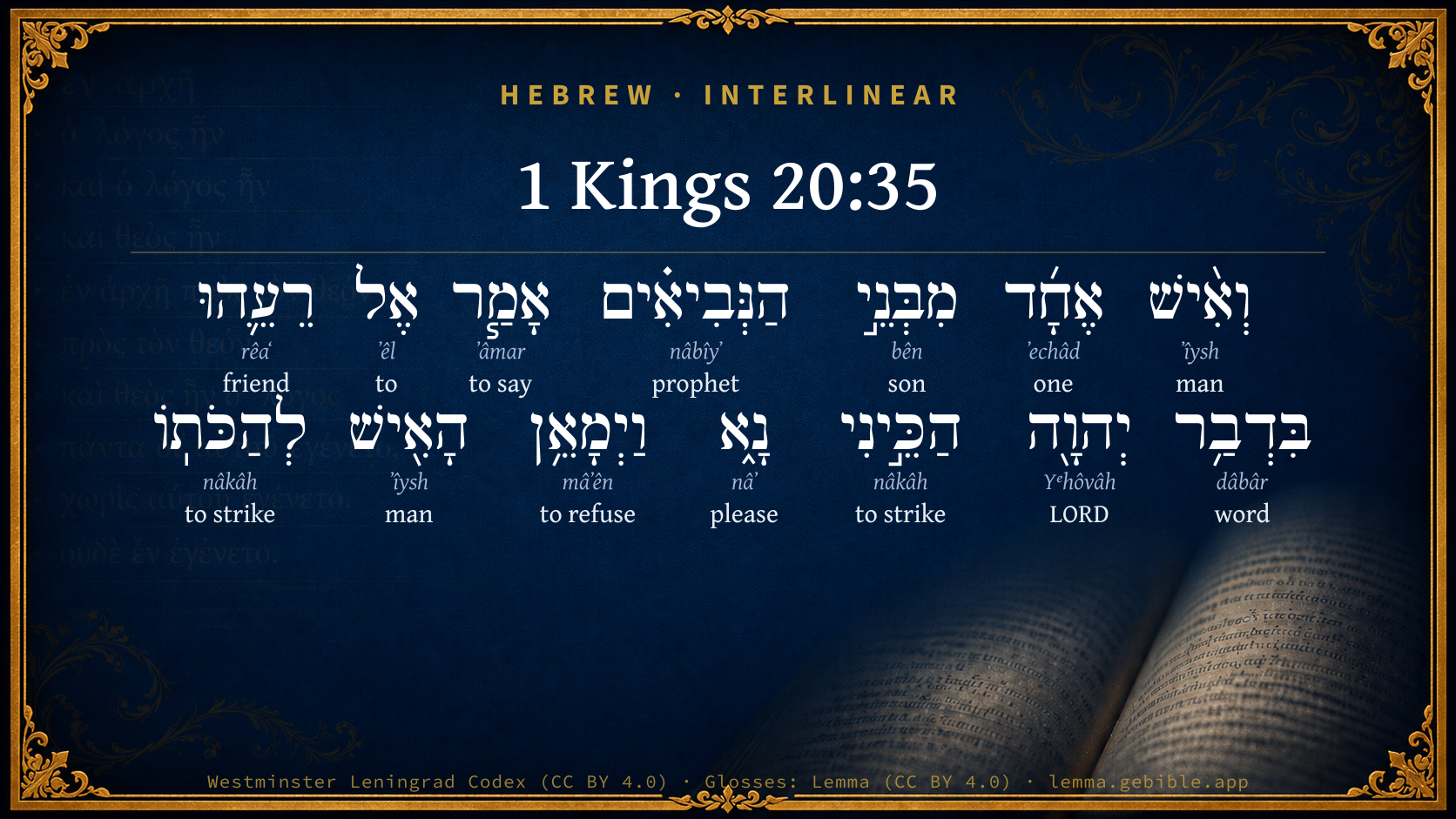
Hebrew (Westminster Leningrad Codex) 1 Kings 20:35 appears in the Hebrew Old Testament. The text above is from the Westminster Leningrad Codex. Each word links to its Strong’s number, a concise gloss, and parsing drawn from the Open Scriptures Hebrew Bible morphology. Click any word for its full Brown-Driver-Briggs (BDB) entry.
Download image
Cite this verse

1 Kings 20:35 (World English Bible). Public Domain. Lemma interlinear Bible study tool, https://lemma.gebible.app/v/1-kings/20/35.

Show BibTeX & RIS
BibTeX
RIS
English Translation
A certain man of the sons of the prophets said to his fellow by the word of Yahweh, Please strike me. The man refused to strike him.
World English Bible · Public Domain
Download a study sheet

One document with this verse’s original text, its word-by-word gloss line, the meaning frame, cross-references with their text, attributed commentary, and full source and license credits — printable, and it pastes into notes with its structure intact.

This verse Autodidact and up

Study sheet (.html) Plain text (.txt)

A passage Seminary Student

Up to 50 verses in one chapter. A passage sheet keeps up to 6 commentary sources and 12 cross-references per verse, in the order this page ranks them, and says so on the sheet whenever that leaves anything out. Ask for a single verse and you get the Autodidact verse sheet above.

Everything on this page stays free to read, with no account — the sheet is a download of what is already on screen, not access to it.

Want to remove ads? Support Godless Engineer
Compare translations 3

The same verse in 3 English versions, stacked beneath the original-language interlinear above. Click any original word for its lexicon entry.

Each is an independent rendering of the whole verse — the interlinear is not word-aligned to these translations.

Highlighted words mark where these versions differ — a whole-verse word diff, not a word-by-word alignment.

  • World English Bible Public Domain
    A certain man of the sons of the prophets said to his fellow by the word of Yahweh, Please strike me. The man refused to strike him.
  • King James Version Public Domain
    And a certain man of the sons of the prophets said unto his neighbor in the word of the LORD, Smite me, I pray thee. And the man refused to smite him.
  • unfoldingWord Literal Text CC BY-SA 4.0
    And a man from the sons of the prophets said to his fellow, “By the word of Yahweh, strike me, please.” But the man refused to strike him.

unfoldingWord Literal Text — © unfoldingWord, licensed CC BY-SA 4.0. Word-aligned USFM3 via Door43 (git.door43.org/unfoldingWord/en_ult).

Versions to compare (up to 4)

3 of 4 selected

Show all 18 translations

Every available English version of this verse, each an independent rendering of the whole verse.

  • World English Bible Public Domain
    A certain man of the sons of the prophets said to his fellow by the word of Yahweh, Please strike me. The man refused to strike him.
  • Berean Standard Bible Public Domain
    Meanwhile, by the word of the LORD, one of the sons of the prophets said to his companion, “Strike me, please!” But the man refused to strike him.
  • Majority Standard Bible Public Domain
    Meanwhile, by the word of the LORD, one of the sons of the prophets said to his companion, “Strike me, please!” But the man refused to strike him.
  • King James Version Public Domain
    And a certain man of the sons of the prophets said unto his neighbor in the word of the LORD, Smite me, I pray thee. And the man refused to smite him.
  • American Standard Version (1901) Public Domain
    And a certain man of the sons of the prophets said unto his fellow by the word of Jehovah, Smite me, I pray thee. And the man refused to smite him.
  • Revised Version (1885) Public Domain
    And a certain man of the sons of the prophets said unto his fellow by the word of the LORD, Smite me, I pray thee. And the man refused to smite him.
  • Geneva Bible (1599) Public Domain
    Then a certaine man of the children of the Prophets sayd vnto his neighbour by the comandement of the Lord, Smite me, I pray thee. But the man refused to smite him.
  • Douay-Rheims (1899) Public Domain
    Then a certain man of the sons of the prophets said to his companion in the word of the Lord: Strike me. But he would not strike.
  • Young's Literal Translation Public Domain
    And a certain man of the sons of the prophets said unto his neighbour by the word of Jehovah, `Smite me, I pray thee;' and the man refuseth to smite him,
  • Literal Standard Version CC BY-SA 4.0
    And a certain man of the sons of the prophets said to his neighbor by the word of YHWH, “Please strike me”; and the man refuses to strike him,
  • Unlocked Literal Bible CC BY-SA 4.0
    A certain man, one of the sons of the prophets, said to one of his fellow prophets by the word of Yahweh, “Please hit me.” But the man refused to hit him.
  • unfoldingWord Literal Text CC BY-SA 4.0
    And a man from the sons of the prophets said to his fellow, “By the word of Yahweh, strike me, please.” But the man refused to strike him.
  • Darby Bible Public Domain
    And a certain man of the sons of the prophets said to another by the word of Jehovah, Smite me, I pray thee. But the man refused to smite him.
  • World Messianic Bible Public Domain
    A certain man of the sons of the prophets said to his fellow by the LORD’s word, “Please strike me!” The man refused to strike him.
  • Webster's Bible Public Domain
    And a certain man of the sons of the prophets said to his neighbor in the word of the LORD, Smite me, I pray thee. And the man refused to smite him.
  • Free Bible Version CC BY-SA 4.0
    Following a message he received from the Lord, one of the sons of the prophets said to his colleague, “Please hit me.” But the man refused to hit him.
  • Bible in Basic English Public Domain
    And a certain man of the sons of the prophets said to his neighbour by the word of the Lord, Give me a wound. But the man would not.
  • JPS Tanakh (1917) Public Domain
    And a certain man of the sons of the prophets said unto his fellow by the word of the LORD: 'Smite me, I pray thee.' And the man refused to smite him.

Literal Standard Version (2020), Covenant Press — licensed CC BY-SA 4.0. Text via the HelloAO Bible API (eBible.org). Unlocked Literal Bible (unfoldingWord) — licensed CC BY-SA 4.0. Text via the HelloAO Bible API (eBible.org). unfoldingWord Literal Text — © unfoldingWord, licensed CC BY-SA 4.0. Word-aligned USFM3 via Door43 (git.door43.org/unfoldingWord/en_ult). Free Bible Version, Dr. Jonathan Gallagher — licensed CC BY-SA 4.0. Text via the HelloAO Bible API (eBible.org).

Word by word

More ways to search: Search by grammar → Find every occurrence → Compare this word →

Practice this passage: Drill this verse → Learn its vocabulary →

וַיְמָאֵ֥ן
mâʼên
H3985
“and · to refuse”
Conjunction + Verb, Piel, Sequential Imperfect, 3rd Person, Masculine, Singular
Part of Speech
Conjunction + Verb
Stem
Piel
Form
Sequential Imperfect
Person
3rd Person
Gender
Masculine
Number
Singular
Full BDB Definition

Origin: a primitive root

TWOT: 1138

(Piel) to refuse
  1. וְאִ֨ישׁ ʼîysh H376 “and · man” Conjunction + Noun, Common, Masculine, Singular, Absolute
  2. אֶחָ֜ד ʼechâd H259 “one” Adjective, Cardinal number, Masculine, Singular, Absolute
  3. מִבְּנֵ֣י bên H1121 “from · sons of” Preposition + Noun, Common, Masculine, Plural, Construct
  4. הַנְּבִיאִ֗ים nâbîyʼ H5030 “the · prophets” Particle, Definite Article + Noun, Common, Masculine, Plural, Absolute
  5. אָמַ֧ר ʼâmar H559 “to say” Verb, Qal, Perfect, 3rd Person, Masculine, Singular
  6. אֶל ʼêl H413 “to” Preposition
  7. רֵעֵ֛הוּ rêaʻ H7453 “friend · his” Noun, Common, Masculine, Singular, Construct + Suffix, Personal, 3rd Person, Masculine, Singular
  8. בִּדְבַ֥ר dâbâr H1697 “in/at · word of” Preposition + Noun, Common, Masculine, Singular, Construct
  9. יְהוָ֖ה Yᵉhôvâh H3068 “LORD” Noun, Proper
  10. הַכֵּ֣ינִי nâkâh H5221 “strike · me” Verb, Hiphil, Imperative, 2nd Person, Masculine, Singular + Suffix, Personal, 1st Person, Common, Singular
  11. נָ֑א nâʼ H4994 “please” Particle, Exhortation
  12. הָאִ֖ישׁ ʼîysh H376 “the · man” Particle, Definite Article + Noun, Common, Masculine, Singular, Absolute
  13. לְהַכֹּתֽוֹ nâkâh H5221 “to strike · him” Preposition + Verb, Hiphil, Infinitive Construct + Suffix, Personal, 3rd Person, Masculine, Singular

About this verse

These counts appear in no published source. They are computed here, from the morphology-tagged text and Lemma’s own curated glosses. What Lemma adds →

14
words
12
distinct lemmas
Historical
section

Shared distinctive vocabulary

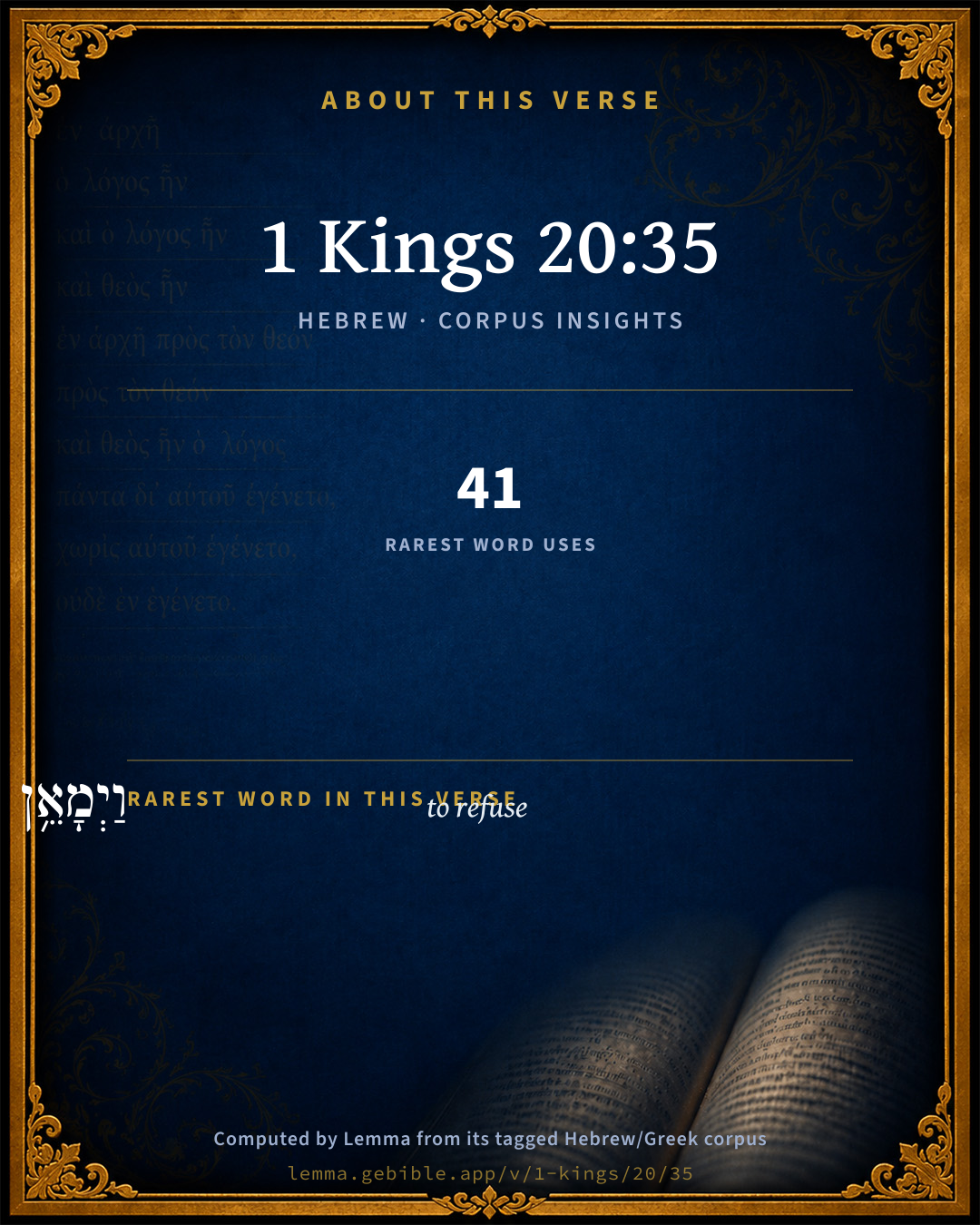
וַיְמָאֵ֥ן to refuse H3985 occurs in 39 verses of the Hebrew Bible. Also found in:

Grammatical profile

  • 4 verbs
  • 7 nouns
  • 1 adjective
  • 1 preposition
  • 1 particle

Verb forms

  • אָמַ֧ר Qal · Perfect
  • הַכֵּ֣ינִי Hiphil · Imperative
  • וַיְמָאֵ֥ן Piel · Sequential Imperfect
  • לְהַכֹּתֽוֹ Hiphil · Infinitive Construct

Repetition

Words recur within this verse — often emphatic in Hebrew:

  • וְאִ֨ישׁ man H376 ×2
  • הַכֵּ֣ינִי to strike H5221 ×2

Cross-references

14

Topical passages linked to 1 Kings 20:35 in the Treasury of Scripture Knowledge — connected by theme and wording, ordered by reader-vote popularity; previews shown in the World English Bible.

  • 1 Kings 13:17–18 for it was said to me by the word of Yahweh, You shall eat no bread nor drink water there, nor turn again to go by the way that you came.
  • 2 Kings 2:15 When the sons of the prophets who were at Jericho over against him saw him, they said, The spirit of Elijah does rest on Elisha. They came to meet him, and bowed themselves to the ground before him.
  • 2 Kings 4:1 Now there cried a certain woman of the wives of the sons of the prophets to Elisha, saying, Your servant my husband is dead; and you know that your servant did fear Yahweh: and the creditor is come to take to him my two children to be bondservants.
  • 1 Samuel 10:12 One of the same place answered, Who is their father? Therefore it became a proverb, Is Saul also among the prophets?
  • 1 Kings 13:1–2 Behold, there came a man of God out of Judah by the word of Yahweh to Beth El: and Jeroboam was standing by the altar to burn incense.
  • 1 Kings 20:37–38 Then he found another man, and said, Please strike me. The man struck him, smiting and wounding him.
  • 2 Kings 2:3–7 The sons of the prophets who were at Bethel came forth to Elisha, and said to him, "Do you know that Yahweh will take away your master from your head today?" He said, "Yes, I know it; hold your peace."
  • 2 Kings 4:38 Elisha came again to Gilgal. There was a dearth in the land; and the sons of the prophets were sitting before him; and he said to his servant, Set on the great pot, and boil stew for the sons of the prophets.
  • Isaiah 8:18 Behold, I and the children whom Yahweh has given me are for signs and for wonders in Israel from Yahweh of Hosts, who dwells in Mount Zion.
  • Isaiah 20:2–3 at that time Yahweh spoke by Isaiah the son of Amoz, saying, Go, and loose the sackcloth from off your loins, and put your shoe from off your foot. He did so, walking naked and barefoot.
  • Jeremiah 27:2–3 Thus says Yahweh to me: Make you bonds and bars, and put them on your neck;
  • Ezekiel 4:3 Take for yourself an iron pan, and set it for a wall of iron between you and the city: and set your face toward it, and it shall be besieged, and you shall lay siege against it. This shall be a sign to the house of Israel.
  • Amos 7:14 Then Amos answered Amaziah, "I was no prophet, neither was I a prophet's son; but I was a herdsman, and a farmer of sycamore trees;
  • Matthew 16:24 Then Jesus said to his disciples, "If anyone desires to come after me, let him deny himself, and take up his cross, and follow me.

Cross-references courtesy of OpenBible.info (CC BY 4.0).

Hebrew and Greek witnesses Masoretic Hebrew ↔ Greek Septuagint

The same verse in the two great witnesses to the Old Testament, shown verse-for-verse.

These are two independent witnesses, not word-aligned to each other, and the Septuagint is shown in lemma (dictionary) form.

Hebrew 1 Kings 20:35 Masoretic · Westminster Leningrad Codex

וְאִ֨ישׁ אֶחָ֜ד מִבְּנֵ֣י הַנְּבִיאִ֗ים אָמַ֧ר אֶל רֵעֵ֛הוּ בִּדְבַ֥ר יְהוָ֖ה הַכֵּ֣ינִי נָ֑א וַיְמָאֵ֥ן הָאִ֖ישׁ לְהַכֹּתֽוֹ

A certain man of the sons of the prophets said to his fellow by the word of Yahweh, Please strike me. The man refused to strike him.

World English Bible · Public Domain

Hebrew: Westminster Leningrad Codex (CC BY 4.0). Greek: Septuagint (public domain); English from a public-domain English Septuagint. How the Septuagint differs from the Hebrew →

Targum (Aramaic paraphrase)

1

The Targum is the ancient Jewish Aramaic paraphrase of the Hebrew Scriptures — an interpretive translation, not the Hebrew text itself. Onkelos (literal) and Pseudo-Jonathan (expansive) render the Torah, and Jonathan the Prophets. Coverage is partial: where no permissively-licensed English translation exists for a verse, only the Aramaic is shown. This is verse-level text, not a word-by-word alignment to the Hebrew.

  1. Targum Jonathan Prophets (Joshua–Malachi)
    וְגַבְרָא חַד מִבְּנֵי תַּלְמִידֵי נְבִיַיָא אֲמַר לְחַבְרֵיהּ בְפִתְגָמָא דַייָ מְחֵינִי כְעַן וְלָא אֲבָא גַבְרָא לְמִימְחֵיהּ:

    (no public-domain English translation for this verse)

    Targum Jonathan — Aramaic: “Mikraot Gedolot” (public domain). English: “Sefaria Community Translation” (CC0 1.0 (public-domain dedication)); “London "Chaldee Paraphrase," 1871” (public domain). Text via Sefaria.

Commentary

Notes on 1 Kings 20:35 from classic Christian and Jewish commentators (each source and its license shown beneath its notes). The classic Christian expositions comment on the surrounding passage and are grouped to its opening verse, so a note may address several verses; the Jewish commentaries on the Tanakh (Rashi and others) are per-verse, so they appear only where the commentator wrote on this verse.

Lemma curates 59 commentaries, every one of them public domain or Creative Commons licensed, each selected and text-cleaned for this edition rather than reprinted as found. About our sources →

Jamieson, Fausset & Brown

Robert Jamieson, A. R. Fausset & David Brown

A PROPHET REPROVES HIM. (Kg1 20:35-42)

Smite me--This prophet is supposed (Kg1 20:8) to have been Micaiah. The refusal of his neighbor to smite the prophet was manifestly wrong, as it was a withholding of necessary aid to a prophet in the discharge of a duty to which he had been called by God, and it was severely punished [Kg1 20:36], as a beacon to warn others (see on 1Ki. 13:2-24). The prophet found a willing assistant, and then, waiting for Ahab, leads the king unconsciously, in the parabolic manner of Nathan (Sa2 12:1-4), to pronounce his own doom; and this consequent punishment was forthwith announced by a prophet (see on Kg1 21:17).

Jamieson, Fausset & Brown — Commentary Critical and Explanatory on the Whole Bible (1871) — public domain (CC PDM 1.0). Text via the HelloAO Bible API.

Trapp's Complete Commentary

John Trapp

1Ki 20:35 And a certain man of the sons of the prophets said unto his neighbour in the word of the LORD, Smite me, I pray thee. And the man refused to smite him.

Ver. 35. And a certain man of the sons of the prophets.] This was Michaiah, saith Josephus, and other Jewish doctors, whom Ahab therefore had cast into prison, and therefore so readily knew where to have him, {1Ki 22:9} and whither to resend him. {1Ki 22:26}

Smite me, I pray thee.] (1.) That hereby I may show Ahab how he hath wounded his own soul by sparing Benhadad; (2.) What a wound both he and his people shall hereafter receive hereby; (3.) That I may seem a wounded soldier, and so may have the easier access to Ahab.

John Trapp, A Commentary or Exposition upon All the Books of the Old and New Testament (1647–1656) — public domain. Text from a community e-Sword module.

Joseph Benson's Commentary

1Ki 20:35. A certain man said to his neighbour — Hebrew, אל רעהו, eel regnehu, to his companion, as St. Hierom translates it, that is, to a prophet bred in the same school with himself, who well understood the importance of obeying the command. In the word of the Lord — In the name and by the command of God, whereof, doubtless, he had informed him. Smite me, I pray thee — So as to wound me, 1Ki 20:37. He speaks what God commanded him, though it was to his own hurt; by which obedience to God, he secretly reproacheth Ahab’s disobedience in a far easier matter. And this the prophet desires, by God’s appointment, that, looking like a wounded soldier, he might have the more free access to the king. And the man refused to smite him — Not out of contempt to God’s command, but probably, in tenderness to his brother.

Joseph Benson's Commentary on the Old and New Testaments (1811–1818) — public domain. Text from a community e-Sword module.

Whedon's Commentary on the Bible

Daniel D. Whedon

AHAB’S REPROOF, 1Ki_20:35-43.

35. A certain man of the sons of the prophets — A member of one of the schools of the prophets. The head of one of these schools was a spiritual father. See note on 1Sa_10:5.

His neighbour — A fellow-student among the sons of the prophets.

Smite me — Here we first meet with an example of those symbolical actions of the prophets which occur so often in the subsequent history of Israel and Judah. This demand was made in the word of the Lord. It was positively required by Jehovah, and was to be symbolical. The wonderful interposition of Divine power, by which the Syrians had been defeated and Ben-hadad made a captive, was a sufficient indication to Ahab that God had appointed the king of Syria to utter destruction. 1Ki_20:42. His letting him go, therefore, was a disobedience of the Divine will.

The man refused to smite him — And so became a representative of Ahab in his refusal to obey the word of the Lord. The prophets mentioned 1Ki_20:13; 1Ki_20:22; 1Ki_20:28 had said enough to show Ahab that when his royal enemy fell into his power, he must not covenant with him, but smite and utterly destroy him. But his making a covenant with him, and sending him away, was a refusal to smite him.

Daniel D. Whedon (gen. ed.), Commentary on the Old and New Testaments (1874–1909) — public domain. Text from a community e-Sword module.

Keil & Delitzsch

C. F. Keil & F. Delitzsch

The verdict of God upon Ahab's conduct towards Benhadad. - Kg1 20:35, Kg1 20:36. A disciple of the prophets received instructions from God, to announce to the king that God would punish him for letting Benhadad go, and to do this, as Nathan had formerly done in the case of David (Sa2 12:1.), by means of a symbolical action, whereby the king was led to pronounce sentence upon himself. The disciples of the prophets said to his companion, "in the word of Jehovah," i.e., by virtue of a revelation from God (see at Kg1 13:2), "Smite me;" and when the friend refused to smite him, he announced to him that because of this disobedience to the voice of the Lord, after his departure from him a lion would meet him and smite him, i.e., would kill him; a threat which was immediately fulfilled. This occurrence shows with how severe a punishment all opposition to the commandments of God to the prophets was followed, as a warning for others; just as in the similar occurrence in Kg1 13:24.

Keil & Delitzsch — Biblical Commentary on the Old Testament (1861–1891) — public domain (CC PDM 1.0). Text via the HelloAO Bible API. (Old Testament only.)

Tyndale Open Study Notes

Tyndale Open Resources

20:35-43 Ahab’s leniency toward Ben-hadad met with God’s disfavor, portrayed in the symbolic actions of an unidentified prophet. God’s prophets often conveyed the Lord’s message through symbolic actions (Isa 20; Jer 27:1-7; Ezek 4:1-3, 9-17; 5:1-4). Ahab had brought judgment upon himself and his people by sparing an untrustworthy enemy rather than trusting further in the Lord.

Tyndale Open Study Notes — © Tyndale Open Resources, licensed CC BY-SA 4.0. Text via the HelloAO Bible API.

Geneva Bible (1599)

Geneva Bible translators

By this external sign he would more lively touch the king’s heart.

Or, of the disciples.

Geneva Bible (1599) marginal notes — public domain. Text via Bolls.life.

Adam Clarke's Commentary

Verse 35. In the word of the Lord] By the word or command of the Lord; that is, God has commanded thee to smite me. Refusing to do it, this man forfeited his life, as we are informed in the next verse.

By this emblematical action he intended to inform Ahab that, as the man forfeited his life who refused to smite him when he had the Lord's command to do it; so he (Ahab) had forfeited his life, because he did not smite Ben-hadad when he had him in his power.

Adam Clarke's Commentary on the Bible (1810–1826) — public domain. Text from a community e-Sword/MySword module.

Ellicott's Commentary for English Readers

(35) A certain man—according to Josephus, Micaiah, the son of Imlah. This tradition, or conjecture, agrees well with the subsequent narrative in 1 Kings 22.

The sons of the prophets.—This phrase, constantly recurring in the history of Elijah and Elisha, first appears here. But the thing designated is apparently as old as the days of Samuel who is evidently surrounded by “a company” of disciples. (See 1Sa_10:5; 1Sa_10:10; 1Sa_19:20.) The prophetic office seems never to have been, like the priesthood or kingship, hereditary. “Sonship,” therefore, no doubt means simply discipleship; and it is likely enough that the schools of the sons of the prophets were places of higher religious education, including many who did not look for the prophetic vocation; although the well-known words of Amos (Amo_7:14), “I was no prophet, neither was I a prophet’s son,” clearly indicate that from their ranks, generally though not invariably, the prophets were called. Probably the institution had fallen into disuse, and had been revived to seal and to secure the prophetic victory over Baal-worship. To Elijah the “sons of the prophets” look up with awe and some terror; to Elisha, with affectionate respect and trust.

A Bible Commentary for English Readers, edited by Charles John Ellicott (1878–1897) — public domain. Text from a community e-Sword module.

The Cambridge Bible for Schools and Colleges

gen. ed. J. J. S. Perowne

35–43. A prophetic message rebuking Ahab because he had let Ben-hadad go (Not in Chronicles)

35. a certain man of the sons of the prophets] It is clear from what follows in the history (2 Kings 2) about the taking of Elijah into heaven, that in spite of Jezebel’s persecution, the prophets and their schools were not put down, but still flourished in various places. Josephus represents this ‘son of the prophets’ as Micaiah, spoken of in 1Ki_22:8, and says that it was in consequence of this message about Ben-hadad’s deliverance that Ahab put him in prison. (Ant. viii. 14. 5.)

said unto his neighbour in [R.V. fellow by] the word of the Lord] The man to whom he made the request was probably one who like himself dwelt in one of the prophetic societies, and he ought therefore to have understood that there was some purpose in his companion’s request. Hence his sin in refusing to comply with it. ‘Fellow’ gives the idea of men of the same guild better than ‘neighbour’. The expression ‘by the word of the Lord’ is found in a similar passage (1Ki_13:17), and is the more usual form.

Smite me] He wished to personate a man who had been engaged in the battle and had suffered something from the enemy.

the man refused] Such a refusal was utterly at variance with the character of a prophet, who was to be prepared to obey at all costs a message which came as the word of the Lord. His companion puts the case very strongly in the next verse when he calls his own request ‘the voice of the Lord’.

The Cambridge Bible for Schools and Colleges (gen. ed. J. J. S. Perowne; Cambridge University Press, 1878–1918) — public domain. Text from a community e-Sword module.

John Gill's Exposition

And a certain man of the sons of the prophets,.... Which the Jews take to be Micaiah, and so Josephus (u), which is probable; the same that had been with Ahab more than once; and, whoever he was, it is not unlikely that he was the same, since Ahab knew him when his disguise was off, Kg1 20:41,

said unto his neighbour, in the word of the Lord, smite me, I pray thee; told his neighbour, that by the command of God he was ordered to bid him smite him, so as to wound him:

and the man refused to smite him; being his neighbour, and perhaps a fellow prophet, and having an affection for him.

(u) Antiqu. l. 8. c. 14. sect, 5.

John Gill's Exposition of the Whole Bible (1746–1763) — public domain (CC PDM 1.0). Text via the HelloAO Bible API.

Albert Barnes' Notes on the Bible

The sons of the prophets - The expression occurs here for the first time. It signifies (marginal references), the schools or colleges of prophets which existed in several of the Israelite, and probably of the Jewish, towns, where young men were regularly educated for the prophetical office. These “schools” make their first appearance under Samuel 1Sa 19:20. There is no distinct evidence that they continued later than the time of Elisha; but it is on the whole most probable that the institution survived the captivity, and that the bulk of the “prophets,” whose works have come down to us belonged to them. Amos Amo 7:14-15 seems to speak as if his were an exceptional case.

Said unto his neighbor - Rather, “to his friend” or “companion “ - to one who was, like himself, “a prophet’s son,” and who ought therefore to have perceived that his colleague spoke “in the word of the Lord.”

Albert Barnes' Notes on the Bible (1834–1885) — public domain. Text from a community e-Sword/MySword module.

Haydock's Catholic Bible Commentary

In the word, or by the authority. The person who refused to comply, out of a false compassion, displeased God. The wound of the prophet was a symbol of what would happen to Achab. It was a prophetic action, chap. xi. 30. (Calmet)

George Leo Haydock (1774–1849), Haydock's Catholic Family Bible and Commentary, 1859 edition — public domain. Excludes Psalms (Douay-Rheims chapter numbering differs from Protestant) and Deuterocanonical books (Catholic canon only).

Matthew Poole's English Annotations

Unto his neighbour, or brother; another son of the prophets.

In the word of the Lord; in the name and by the command of God, whereof doubtless he had informed him.

Smite me, so as to wound me, 1Ki 20:37. He speaks what God commanded him, though it was to his own hurt; by which obedience to God he secretly reproacheth Ahab’s disobedience in a far easier matter. And this the prophet by God’s appointment desires, that looking like a wounded soldier, he might have the more free access to the king, and discourse with him; which it was very hard for a prophet to obtain, that sort of men being hateful to Ahab, 1Ki 22:8, and to his courtiers.

The man refused to smite him; not out of contempt of God’s command, but most probably in tenderness and compassion to his brother.

Matthew Poole's English Annotations on the Holy Bible (1683–1685) — public domain. Text from a community e-Sword/MySword module.

The Pulpit Commentary

And a certain man Heb. one man; of. (1Ki_13:11, note) of the sons of the prophets Here mentioned for the first time, though the prophetic schools probably owed their existence, certainly their development, to Samuel. The Nh; yneB are of course not the children, but the pupils of the prophets. For this use of "son," cf.; 1Sa_20:1 ("a son of death 2Sa_12:5; Deu_25:2 Mt

23. 1Ki_4:30; Ezr_2:1; Joh_17:12, and Amo_7:14. Gesenius refers to the Greek iJatrwn uiJoi rJhtorwn uiJoi, etc., and says that among the Persians "the disciples of the Magi are called, "Sons of Magi." The word, again, does not necessarily imply youth. That they were sometimes married men appears from 2Ki_6:1, though this was probably after their collegiate life was ended. As they were called "sons," so their instructor, or head, was called "father" (1Sa_10:12) said unto his neighbour or companion. Another prophet is implied. It was because this "neighbour" was a prophet that his disregard of the word of the Lord was so sinful, and received such severe punishment, in the word of the Lord, (see on 1Ki_13:1) Smite me, I pray thee. Why the prophet, in order to the accomplishment of his mission which was to obtain from Ahab"s own lips a confession of his deserts why he should have been smitten, i.e., bruised and wounded, is not quite clear. For it is obvious that he might have sustained his part, told his story, and obtained a judgment from the king, without proceeding to such painful extremities. It is quite true that a person thus wounded would perhaps sustain the part of one who had been in battle better, but the wounds were in no way necessary to his disguise, and men do not court pain without imperious reasons. Besides, it was "in the word of the Lord" that these wounds were sought and received. It is quite clear, therefore, that it cannot have been merely to give him a claim to an audience with the king (Ewald) he could easily have simulated wounds by means of bandages, which would at the same time have helped to disguise him or that he might foreshadow in his own person the wounding which Ahab would receive, (1Ki_22:11) for of that he says nothing, or for any similar reason. The wounding, we may be quite sure, and the tragical circumstances connected therewith, are essential parts of the parable this prophet had to act, of the lesson he had to teach. 1%w the great lesson he had to convey, not to the king alone, but to the prophetic order and to the whole country, the lesson most necessary in that lawless age, was that of implicit unquestioning obedience to the Divine law. Ahab had just transgressed that law. He had "let go a man whom God had appointed to utter destruction;" he had heaped honours on the oppressor of his country, and in gratifying benevolent impulses had ignored the will and counsel of God (see on ver. 42). No doubt it seemed to him, as it has seemed to others since, that he had acted with rare magnanimity, and that his generosity in that age, an age which showed no mercy to the fallen, was unexampled. But he must be taught that he has no right to be generous at the expense of others; that God"s will must be done even when it goes against the grain, when it contradicts impulses of kindness, and demands painful sacrifices. He is taught this by the prophetic word (ver. 42), but much more effectively by the actions which preceded it. A prophet required to smite a brother prophet, and that for no apparent reason, would no doubt find it repugnant to his feelings to do so; it would seem to him hard and cruel and shameful to smite a companion. But the prophet who refused to do this, who followed his benevolent impulses in preference to the word of the Lord, died for his sin died forthwith by the visitation of God. What a lesson was this to king and country for no doubt the incident would be bruited abroad, and the very strangeness of the whole proceeding would heighten the impression it made. Indeed, it is hardly possible to conceive a way in which the duty of unquestioning obedience could be more emphatically taught. When this prophet appeared before the king, a man had smitten and wounded him, disagreeable and painful as the task must have been, because of the word of the Lord; whilst a brother prophet, who declined the office because it was painful, had been slain by a wild beast. It is easy to see that there was here a solemn lesson for the king, and that the wounding gave it its edge. And the man refused to smite him.

The Pulpit Commentary (1880–1919), ed. H.D.M. Spence-Jones & Joseph S. Exell — public domain. Text from a community e-Sword module.

John Wesley's Explanatory Notes

In the word - ln the name, and by the command of God, whereof doubtless he had informed him. Smite me - So as to wound me, ver. 37. He speaks what God commanded him, though it was to his own hurt; by which obedience to God, he secretly reproacheth Ahab's disobedience in a far easier matter. And this the prophet by God's appointment desires, that looking like a wounded soldier, he might have the more free access to the king. Refused - Not out of contempt of God's command, but probably, in tenderness to his brother.

John Wesley, Explanatory Notes Upon the Whole Bible (1754–1765) — public domain. Text via the GEBible commentary corpus.

unfoldingWord translationNotes

Door43 World Missions Community

one of the sons of the prophets

"a member of the group of prophets"

the word of Yahweh

"the message of Yahweh" or "Yahweh's message"

you have not obeyed the voice of Yahweh

"The voice" is metonymy for what Yahweh commanded. AT: "you have not obeyed Yahweh" (See: Metonymy)

translationWords

son

prophet

word of God

obey

voice

Yahweh

lions

unfoldingWord translationNotes — © Distant Shores Media and the Door43 World Missions Community, licensed CC BY-SA 4.0. Source: git.door43.org/Door43/en_tn.

Rashi

Rabbi Shlomo Yitzchaki (Rashi)

Hit me now. This sign was bad for Achov, for the prophet said to him by the word of the Almighty to kill Ben-Hadad, and he did not kill him. Also, this one to whom the prophet said by the word of God, “Hit me,” and he did not hit him, just as He punished him, He would punish Achov.

By the word of Adonoy. The Holy One Blessed Is He, said that you should hit me.

Rashi on the Tanakh — English translations: “The Judaica Press complete Tanach with Rashi, translated by A. J. Rosenberg” (CC BY 4.0); “Pentateuch with Rashi's commentary by M. Rosenbaum and A.M. Silbermann, 1929-1934” (public domain); “The Metsudah Tanach series, Lakewood, N.J” (CC BY 4.0); and “The Book of Joshua, Metsudah Publications, 1997” (CC BY 4.0). Text via Sefaria.

Lesson kit

Teaching starters — assembled from the data on this page, not authored interpretation. Every prompt links to the verse data it draws on. Edit before teaching.

1 Kings, in the Historical, opens this verse with 14 words (12 distinct Hebrew lemmas). Its most distinctive word is mâʼên (“to refuse”). A historical commentator’s framing appears above. Read the whole chapter for the surrounding context.

Discussion questions

  1. The word mâʼên carries the sense “to refuse.” How does it shape the verse?
  2. How does Genesis 37:35, which shares the word «to refuse», read alongside this verse?
  3. What does the repetition of “man” (2× in this one verse) do in this verse?
  4. The translations on this page render this verse differently — a whole-verse word diff, not a word-by-word alignment. What might account for the different wordings?
  5. «אָמַ֧ר» is a Qal Perfect verb. How does that grammatical form shape the action described?
  6. Compare how Jamieson, Fausset & Brown and Trapp's Complete Commentary read this verse. Where do they agree or differ?

Things to notice

Reading settings

Reading text

Shown beneath each verse's original-language words.

Old Testament
Old Testament edition

Read the OT as the Masoretic Hebrew (MT) or the Greek Septuagint (LXX).

English shown for the Greek Septuagint (in the Hebrew ↔ Greek comparison).

Comparing translations? Open the Compare panel on any verse page to stack up to four side by side.