
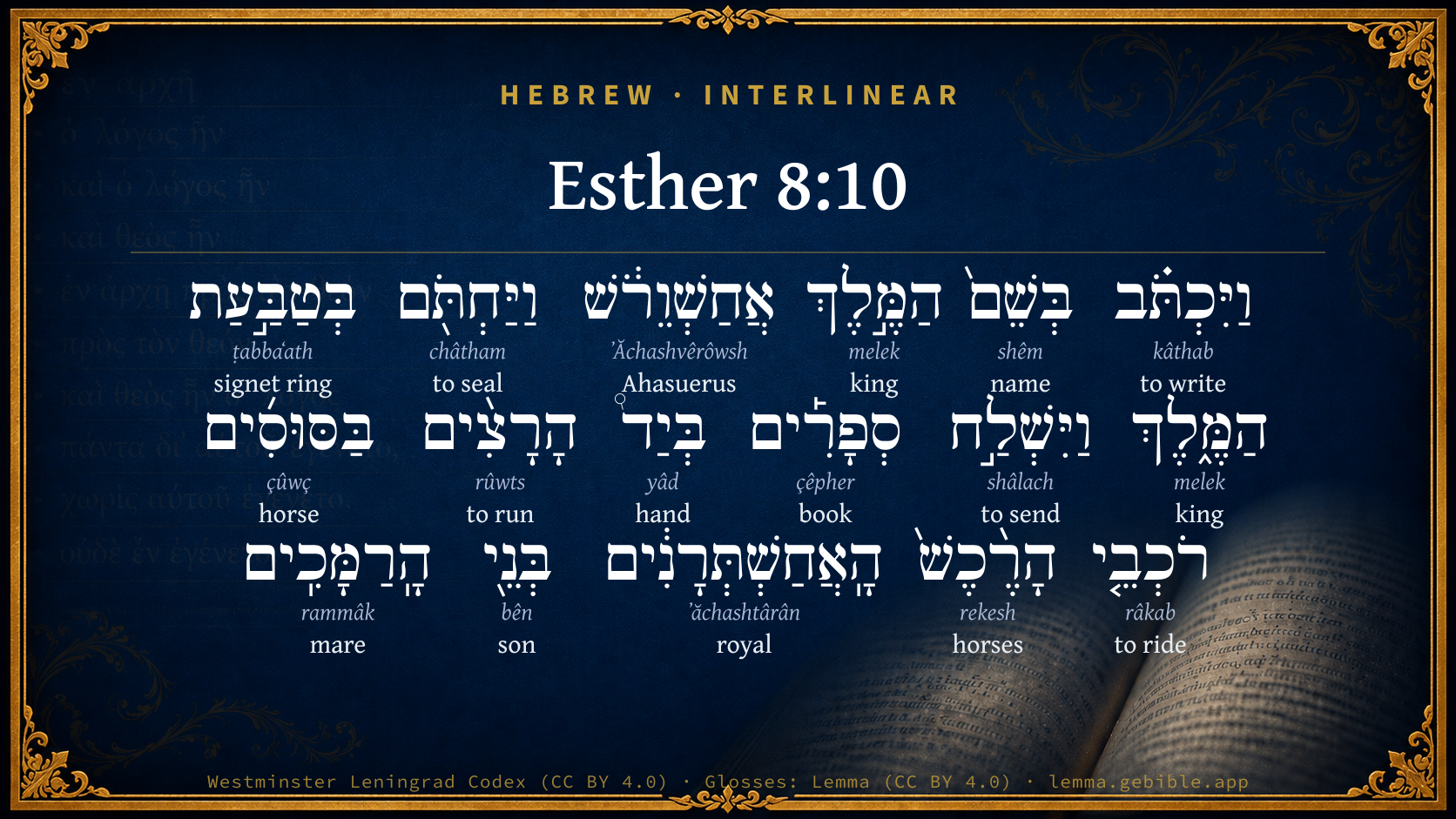
Esther 8:10

Hebrew (Westminster Leningrad Codex) Esther 8:10 appears in the Hebrew Old Testament. The text above is from the Westminster Leningrad Codex. Each word links to its Strong’s number, a concise gloss, and parsing drawn from the Open Scriptures Hebrew Bible morphology. Click any word for its full Brown-Driver-Briggs (BDB) entry.
Download image
Cite this verse

Esther 8:10 (World English Bible). Public Domain. Lemma interlinear Bible study tool, https://lemma.gebible.app/v/esther/8/10.

Show BibTeX & RIS
BibTeX
RIS
English Translation
He wrote the name of king Ahasuerus, and sealed it with the king's ring, and sent letters by post on horseback, riding on swift steeds that were used in the king's service, bred of the stud:
World English Bible · Public Domain
Highlights Full analysis ↓
Download a study sheet

One document with this verse’s original text, its word-by-word gloss line, the meaning frame, cross-references with their text, attributed commentary, and full source and license credits — printable, and it pastes into notes with its structure intact.

This verse Autodidact and up

Study sheet (.html) Plain text (.txt)

A passage Seminary Student

Up to 50 verses in one chapter. A passage sheet keeps up to 6 commentary sources and 12 cross-references per verse, in the order this page ranks them, and says so on the sheet whenever that leaves anything out. Ask for a single verse and you get the Autodidact verse sheet above.

Everything on this page stays free to read, with no account — the sheet is a download of what is already on screen, not access to it.

Want to remove ads? Support Godless Engineer
Compare translations 3

The same verse in 3 English versions, stacked beneath the original-language interlinear above. Click any original word for its lexicon entry.

Each is an independent rendering of the whole verse — the interlinear is not word-aligned to these translations.

Highlighted words mark where these versions differ — a whole-verse word diff, not a word-by-word alignment.

  • World English Bible Public Domain
    He wrote the name of king Ahasuerus, and sealed it with the king's ring, and sent letters by post on horseback, riding on swift steeds that were used in the king's service, bred of the stud:
  • King James Version Public Domain
    And he wrote in the king Ahasuerus' name, and sealed it with the king's ring, and sent letters by posts on horseback, and riders on mules, camels, and young dromedaries:
  • unfoldingWord Literal Text CC BY-SA 4.0
    And he wrote in the name of the king Ahasuerus, and he sealed with the signet ring of the king. And he sent letters (by the hand of runners on horses, riders of the royal pack horses, sons of the mares)

unfoldingWord Literal Text — © unfoldingWord, licensed CC BY-SA 4.0. Word-aligned USFM3 via Door43 (git.door43.org/unfoldingWord/en_ult).

Versions to compare (up to 4)

3 of 4 selected

Show all 18 translations

Every available English version of this verse, each an independent rendering of the whole verse.

  • World English Bible Public Domain
    He wrote the name of king Ahasuerus, and sealed it with the king's ring, and sent letters by post on horseback, riding on swift steeds that were used in the king's service, bred of the stud:
  • Berean Standard Bible Public Domain
    Mordecai wrote in the name of King Xerxes and sealed it with the royal signet ring. He sent the documents by mounted couriers riding on swift horses bred from the royal mares.
  • Majority Standard Bible Public Domain
    Mordecai wrote in the name of King Xerxes and sealed it with the royal signet ring. He sent the documents by mounted couriers riding on swift horses bred from the royal mares.
  • King James Version Public Domain
    And he wrote in the king Ahasuerus' name, and sealed it with the king's ring, and sent letters by posts on horseback, and riders on mules, camels, and young dromedaries:
  • American Standard Version (1901) Public Domain
    And he wrote the name of king Ahasuerus, and sealed it with the king's ring, and sent letters by post on horseback, riding on swift steeds that were used in the king's service, bred of the stud:
  • Revised Version (1885) Public Domain
    And he wrote in the name of king Ahasuerus, and sealed it with the king’s ring, and sent letters by posts on horseback, riding on swift steeds that were used in the king’s service, bred of the stud:
  • Geneva Bible (1599) Public Domain
    And hee wrote in the King Ahashuerosh name, and sealed it with the Kings ring: and he sent letters by postes on horsebacke and that rode on beastes of price, as dromedaries and coltes of mares.
  • Douay-Rheims (1899) Public Domain
    And these letters which were sent in the king's name, were sealed with his ring, and sent by posts: who were to run through all the provinces, to prevent the former letters with new messages.
  • Young's Literal Translation Public Domain
    And he writeth in the name of the king Ahasuerus, and sealeth with the signet of the king, and sendeth letters by the hand of the runners with horses, riders of the dromedary, the mules, the young mares,
  • Literal Standard Version CC BY-SA 4.0
    And he writes in the name of King Ahasuerus, and seals with the signet of the king, and sends letters by the hand of the runners with horses, riders of the dromedary, the mules, the young mares,
  • Unlocked Literal Bible CC BY-SA 4.0
    Mordecai wrote in the name of King Ahasuerus and sealed it with the king's signet ring. He sent the documents by couriers riding on the fast horses that were used in the king's service, bred from the royal stud.
  • unfoldingWord Literal Text CC BY-SA 4.0
    And he wrote in the name of the king Ahasuerus, and he sealed with the signet ring of the king. And he sent letters (by the hand of runners on horses, riders of the royal pack horses, sons of the mares)
  • Darby Bible Public Domain
    And he wrote in the name of king Ahasuerus, and sealed [it] with the king's ring, and sent letters by couriers on horseback riding on coursers, horses of blood reared in the breeding studs:
  • World Messianic Bible Public Domain
    He wrote in the name of King Ahasuerus, and sealed it with the king’s ring, and sent letters by courier on horseback, riding on royal horses that were bred from swift steeds.
  • Webster's Bible Public Domain
    And he wrote in the king Ahasuerus's name, and sealed it with the king's ring, and sent letters by posts on horseback, and riders on mules, camels, and young dromedaries:
  • Free Bible Version CC BY-SA 4.0
    He wrote in the name of King Xerxes and sealed it with the king's signet ring. He sent the letters by messenger on horseback, who rode fast thoroughbred horses of the king.
  • Bible in Basic English Public Domain
    The letters were sent in the name of King Ahasuerus and stamped with his ring, and they were taken by men on horseback, going on the quick-running horses used for the king's business, the offspring of his best horses:
  • JPS Tanakh (1917) Public Domain
    And they wrote in the name of king Ahasuerus, and sealed it with the king's ring, and sent letters by posts on horseback, riding on swift steeds that were used in the king's service, bred of the stud;

Literal Standard Version (2020), Covenant Press — licensed CC BY-SA 4.0. Text via the HelloAO Bible API (eBible.org). Unlocked Literal Bible (unfoldingWord) — licensed CC BY-SA 4.0. Text via the HelloAO Bible API (eBible.org). unfoldingWord Literal Text — © unfoldingWord, licensed CC BY-SA 4.0. Word-aligned USFM3 via Door43 (git.door43.org/unfoldingWord/en_ult). Free Bible Version, Dr. Jonathan Gallagher — licensed CC BY-SA 4.0. Text via the HelloAO Bible API (eBible.org).

Word by word

More ways to search: Search by grammar → Find every occurrence → Compare this word →

Practice this passage: Drill this verse → Learn its vocabulary →

הָֽרַמָּכִֽים
rammâk
H7424
“the · mares”
Particle, Definite Article + Noun, Common, Masculine, Plural, Absolute
Part of Speech
Particle + Noun
Type
Common
Gender
Masculine
Number
Plural
State
Absolute
Full BDB Definition

Origin: of foreign origin

TWOT: 2173

mare - meaning dubious
  1. וַיִּכְתֹּ֗ב kâthab H3789 “and · to write” Conjunction + Verb, Qal, Sequential Imperfect, 3rd Person, Masculine, Singular
  2. בְּשֵׁם֙ shêm H8034 “in/at · name of” Preposition + Noun, Common, Masculine, Singular, Construct
  3. הַמֶּ֣לֶךְ melek H4428 “the · king” Particle, Definite Article + Noun, Common, Masculine, Singular, Absolute
  4. אֲחַשְׁוֵרֹ֔שׁ ʼĂchashvêrôwsh H325 “Ahasuerus” Noun, Proper
  5. וַיַּחְתֹּ֖ם châtham H2856 “and · to seal” Conjunction + Verb, Qal, Sequential Imperfect, 3rd Person, Masculine, Singular
  6. בְּטַבַּ֣עַת ṭabbaʻath H2885 “in/at · signet ring of” Preposition + Noun, Common, Feminine, Singular, Construct
  7. הַמֶּ֑לֶךְ melek H4428 “the · king” Particle, Definite Article + Noun, Common, Masculine, Singular, Absolute
  8. וַיִּשְׁלַ֣ח shâlach H7971 “and · to send” Conjunction + Verb, Qal, Sequential Imperfect, 3rd Person, Masculine, Singular
  9. סְפָרִ֡ים çêpher H5612 “books” Noun, Common, Masculine, Plural, Absolute
  10. בְּיַד֩ yâd H3027 “in/at · hand of” Preposition + Noun, Common, Both, Singular, Construct
  11. הָרָצִ֨ים rûwts H7323 “the · running” Particle, Definite Article + Verb, Qal, Participle Active, Masculine, Plural, Absolute
  12. בַּסּוּסִ֜ים çûwç H5483 “in/at the · horses” Preposition, Determined + Noun, Common, Masculine, Plural, Absolute
  13. רֹכְבֵ֤י râkab H7392 “riding” Verb, Qal, Participle Active, Masculine, Plural, Construct
  14. הָרֶ֨כֶשׁ֙ rekesh H7409 “the · horses” Particle, Definite Article + Noun, Common, Masculine, Singular, Absolute
  15. הָֽאֲחַשְׁתְּרָנִ֔ים ʼăchashtârân H327 “the · royal” Particle, Definite Article + Adjective, Adjective, Masculine, Plural, Absolute
  16. בְּנֵ֖י bên H1121 “sons of” Noun, Common, Masculine, Plural, Construct

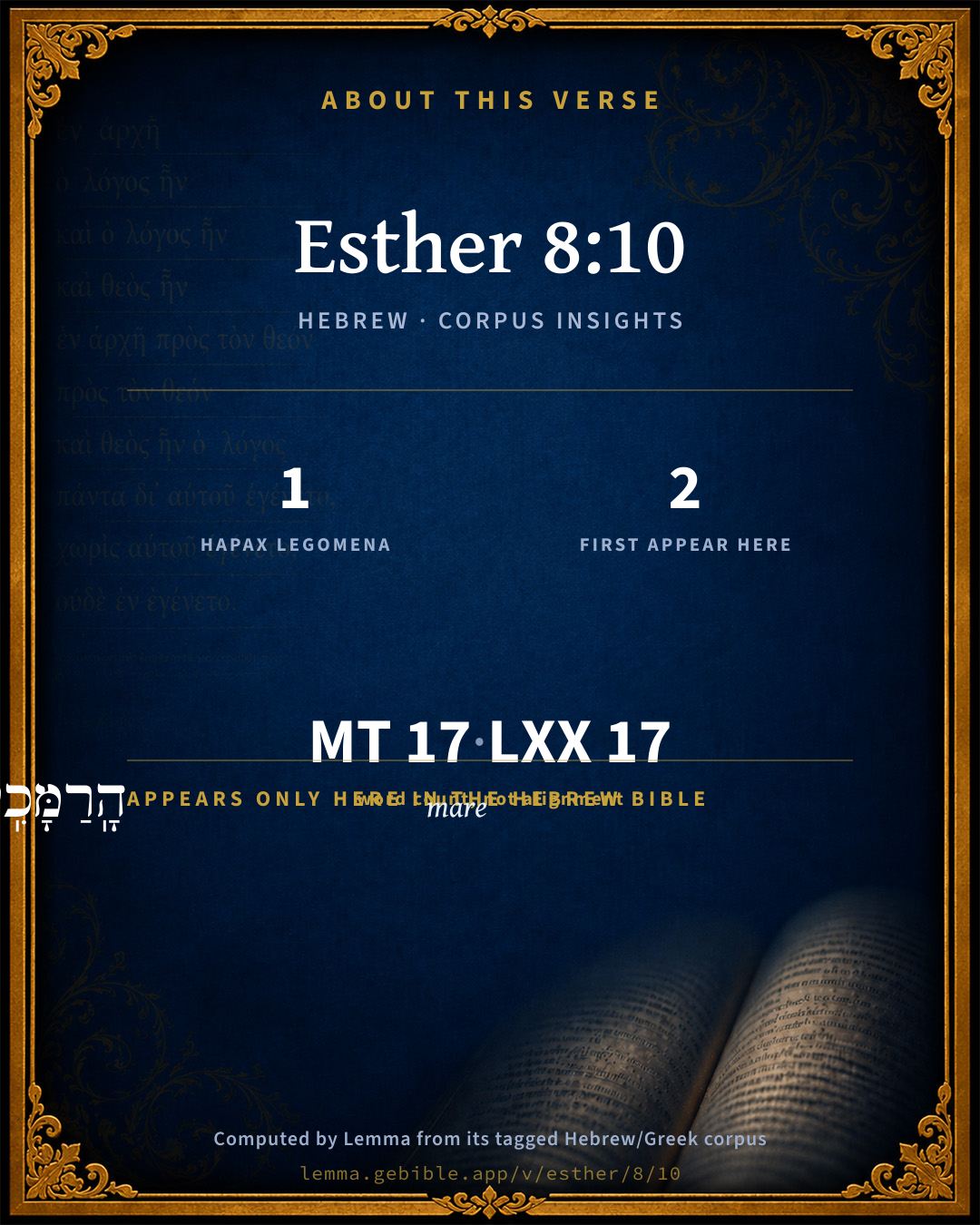
About this verse

These counts appear in no published source. They are computed here, from the morphology-tagged text and Lemma’s own curated glosses. What Lemma adds →

17
words
16
distinct lemmas
Historical
section

Notable vocabulary

1 hapax legomenon — a word that appears only here in the entire Hebrew Bible:

  • הָֽרַמָּכִֽים mare H7424

First appearance in Scripture

These words make their first canonical appearance in the Hebrew Bible here:

  • הָֽאֲחַשְׁתְּרָנִ֔ים royal H327
  • הָֽרַמָּכִֽים mare H7424

Shared distinctive vocabulary

הָֽאֲחַשְׁתְּרָנִ֔ים royal H327 occurs in 2 verses of the Hebrew Bible. Also found in:

Grammatical profile

  • 5 verbs
  • 11 nouns
  • 1 adjective

Verb forms

  • וַיִּכְתֹּ֗ב Qal · Sequential Imperfect
  • וַיַּחְתֹּ֖ם Qal · Sequential Imperfect
  • וַיִּשְׁלַ֣ח Qal · Sequential Imperfect
  • הָרָצִ֨ים Qal · Participle Active
  • רֹכְבֵ֤י Qal · Participle Active

Repetition

A word recurs within this verse — often emphatic in Hebrew:

  • הַמֶּ֣לֶךְ king H4428 ×2

Hebrew & Septuagint length

In English translation the verse runs 36 words from the Hebrew and 22 from the Septuagint (LXX English) — the Septuagint runs noticeably shorter here. See the side-by-side →

A rough comparison of the two English renderings, which tokenize alike — not a word-level alignment.

Word counts can differ between the Hebrew and the Greek without any difference in meaning — e.g. the Hebrew direct-object marker אֵת has no separate Greek word, and Greek often adds the article ὁ.

In the original languages it is 17 Hebrew tokens and 17 Greek tokens — but the two are counted differently (Hebrew bundles its prefixes and suffixes into one token; the Greek is in lemma form), so that isn’t a like-for-like length.

Cross-references

11

Topical passages linked to Esther 8:10 in the Treasury of Scripture Knowledge — connected by theme and wording, ordered by reader-vote popularity; previews shown in the World English Bible.

  • Ecclesiastes 8:4 for the king's word is supreme. Who can say to him, "What are you doing?"
  • Isaiah 60:6 The multitude of camels shall cover you, the dromedaries of Midian and Ephah; all they from Sheba shall come; they shall bring gold and frankincense, and shall proclaim the praises of Yahweh.
  • Isaiah 66:20 They shall bring all your brothers out of all the nations for an offering to Yahweh, on horses, and in chariots, and in litters, and on mules, and on dromedaries, to my holy mountain Jerusalem, says Yahweh, as the children of Israel bring their offering in a clean vessel into the house of Yahweh.
  • Jeremiah 2:23 How can you say, I am not defiled, I have not gone after the Baals? see your way in the valley, know what you have done: [you are] a swift dromedary traversing her ways;
  • Jeremiah 51:21 and with you will I break in pieces the horse and his rider;
  • Daniel 4:1 Nebuchadnezzar the king, to all the peoples, nations, and languages, who dwell in all the earth: Peace be multiplied to you.
  • 1 Kings 4:28 Barley also and straw for the horses and swift steeds brought they to the place where [the officers] were, every man according to his charge.
  • 1 Kings 21:8 So she wrote letters in Ahab's name, and sealed them with his seal, and sent the letters to the elders and to the nobles who were in his city, [and] who lived with Naboth.
  • 2 Chronicles 30:6 So the posts went with the letters from the king and his princes throughout all Israel and Judah, and according to the commandment of the king, saying, You children of Israel, turn again to Yahweh, the God of Abraham, Isaac, and Israel, that he may return to the remnant that have escaped of you out of the hand of the kings of Assyria.
  • Esther 3:12–13 Then were the king's scribes called in the first month, on the thirteenth day of it; and there was written according to all that Haman commanded to the king's satraps, and to the governors who were over every province, and to the princes of every people, to every province according to the writing of it, and to every people after their language; in the name of king Ahasuerus was it written, and it was sealed with the king's ring.
  • Job 9:25 "Now my days are swifter than a runner. They flee away, they see no good,

Cross-references courtesy of OpenBible.info (CC BY 4.0).

Hebrew and Greek witnesses Masoretic Hebrew ↔ Greek Septuagint

The same verse in the two great witnesses to the Old Testament, shown verse-for-verse.

Here the Septuagint runs noticeably shorter than the Hebrew — LXX2012 (modern English Septuagint) 22 words vs World English Bible 36. A rough length comparison of the two English translations, not a word-level alignment — read both below.

These are two independent witnesses, not word-aligned to each other, and the Septuagint is shown in lemma (dictionary) form.

Hebrew Esther 8:10 Masoretic · Westminster Leningrad Codex

וַיִּכְתֹּ֗ב בְּשֵׁם֙ הַמֶּ֣לֶךְ אֲחַשְׁוֵרֹ֔שׁ וַיַּחְתֹּ֖ם בְּטַבַּ֣עַת הַמֶּ֑לֶךְ וַיִּשְׁלַ֣ח סְפָרִ֡ים בְּיַד֩ הָרָצִ֨ים בַּסּוּסִ֜ים רֹכְבֵ֤י הָרֶ֨כֶשׁ֙ הָֽאֲחַשְׁתְּרָנִ֔ים בְּנֵ֖י הָֽרַמָּכִֽים

He wrote the name of king Ahasuerus, and sealed it with the king's ring, and sent letters by post on horseback, riding on swift steeds that were used in the king's service, bred of the stud:

World English Bible · Public Domain

Greek LXX Esther 8:10 Septuagint · lemma form

γράφω δέ διά ὁ βασιλεύς καί σφραγίζω ὁ δακτύλιος αὐτός καί ἐκ ἀποστέλλω ὁ γράμμα διά βιβλιαφόρος

And they were written by order of the king, and sealed with his ring, and they sent the letters by the posts:

LXX2012 (modern English Septuagint) · Public Domain

On this verse, The Cambridge Bible for Schools and Colleges discusses the Septuagint’s reading. Read the note in Commentary ↓

Hebrew: Westminster Leningrad Codex (CC BY 4.0). Greek: Septuagint (public domain); English from LXX2012 (modern English Septuagint) (Public Domain). How the Septuagint differs from the Hebrew →

Commentary

Notes on Esther 8:10 from classic Christian and Jewish commentators (each source and its license shown beneath its notes). The classic Christian expositions comment on the surrounding passage and are grouped to its opening verse, so a note may address several verses; the Jewish commentaries on the Tanakh (Rashi and others) are per-verse, so they appear only where the commentator wrote on this verse.

Lemma curates 59 commentaries, every one of them public domain or Creative Commons licensed, each selected and text-cleaned for this edition rather than reprinted as found. About our sources →

Trapp's Complete Commentary

John Trapp

Est 8:10 And he wrote in the king Ahasuerus’ name, and sealed [it] with the king’s ring, and sent letters by posts on horseback, [and] riders on mules, camels, [and] young dromedaries:

Ver. 10. And he wrote in the king Ahasuerus’s name] For he knew that "where the word of a king is, there is power: and who may say unto him, What doest thou?" Ecc 8:4; see Dan 5:19. Mordecai, as he was careful not to abuse his authority, so he spareth not to improve it to the utmost for the Church’s good. We may also lawfully and comfortably improve the benefits and privileges granted us by princes and other benefactors. Constantine’s donation and Peter’s patrimony is much boasted of by that antichrist of Rome. A mere fiction, as various learned men of their own side have proved (Cusanus, Ficinus, Volater, Otho Frising). But if it were never so true, what power had Constantine to give away and alienate such a considerable part of the empire (might he not well have been therefore called Pupillus, as he was in scorn by some heathen historians for his bounty to poor Christians)? or with what conscience could the bishop of Rome have accepted of such a gift, and left it to his successors. But it was neither so nor so. Not Constantine, but Pepin, enlarged the pope’s territories; as not Peter, but Phocas, is the right craggy rock upon which is founded the pope’s supremacy.

And sealed it with the king’s ring] See Est 3:12, and observe what a strange turn of things here was all on the sudden. Merlin from this clause gathereth, that the king perused and approved whatsoever the scribes wrote by the appointment of Mordecai, he saw it, and signed it.

And sent letters by posts] See Est 3:15. That was a witty speech of him, who said of secretaries that pretend much to Scripture: they were like posts, that bring truth in their letters and lies in their mouths. And of another, that they do angariare, make posts of the Holy Scriptures; compelling them to go two miles, which of themselves would go but one.

And riders on mules] Which are counted swifter than horses, and yet a horse is so swift a creature, that the Argives consecrated a horse to the sun, as the swiftest beast to the swiftest planet, Equitantes in equis angariis riding on the public couriers horse (Tremel.), O ταχιστος τω ταχυτατω.

Camels] These were large strong beasts, that could endure long and hard travel. It is said of them, that they do drink, in praesens et in posterum, for the present and the future, and can hold out travelling three days together without food.

And young dromedaries] These were also swift beasts, Jer 2:23, and therefore it is by antiphrasis that among us a slow person is called a dromedary, Ut lucus a non lucendo, bellum quasi minime bellum.

John Trapp, A Commentary or Exposition upon All the Books of the Old and New Testament (1647–1656) — public domain. Text from a community e-Sword module.

Joseph Benson's Commentary

Est 8:10. And he wrote in King Ahasuerus’s name — Josephus has given us a true copy, as he says, of this decree; or, as he terms it, of the letters which Artaxerxes sent to all nations which lie between India and Ethiopia; wherein he represents the abuse which favourites are wont to make of their power and credit with their prince, by insulting their inferiors, by flying in the face of those who raised them, and, to gratify their resentments, calumniating the innocent, and putting honest men in danger of their lives, &c. And sent letters by posts, and riders on mules, &c. — Which were not employed in the sending of the former letters; but these, coming later, required more care and speed, that the Jews might be eased from their present fears, and have time to provide for their own defence.

Joseph Benson's Commentary on the Old and New Testaments (1811–1818) — public domain. Text from a community e-Sword module.

Geneva Bible (1599)

Geneva Bible translators

Or, mules.

Geneva Bible (1599) marginal notes — public domain. Text via Bolls.life.

Jamieson, Fausset & Brown

Robert Jamieson, A. R. Fausset & David Brown

sent . . . by posts . . . and riders on . . . camels, and young dromedaries--The business being very urgent, the swiftest kind of camel would be employed, and so the word in the original denotes the wind-camel. Young dromedaries also are used to carry expresses, being remarkable for the nimbleness and ease of their movements. Animals of this description could convey the new rescript of Ahasuerus over the length and breadth of the Persian empire in time to relieve the unhappy Jews from the ban under which they lay.

Jamieson, Fausset & Brown — Commentary Critical and Explanatory on the Whole Bible (1871) — public domain (CC PDM 1.0). Text via the HelloAO Bible API.

Adam Clarke's Commentary

Verse 10. On mules, camels, and young dromedaries] What these beasts were is difficult to say. The word רכש rechesh, which we translate mules, signifies a swift chariot horse.

The strange word אחשתרנים achashteranim is probably a Persian word, but perhaps incurably corrupted. The most likely derivation is that of Bochart, from the Persian [Persian] akhash, huge, large, rough, and [Persian] aster, a mule; large mules.

The words בני הרמכים beney harammachim, the sons of mares, which we translate dromedaries, are supposed to signify mules, produced between the he ass and the mare, to distinguish them from those produced between the stallion and the ass, But there is really so much confusion about these matters, and so little consent among learned men as to the signification of these words, and even the true knowledge of them is of such little importance, that we may well rest contented with such names as our modern translations have given us. They were, no doubt, the swiftest and hardiest beasts that the city or country could produce.

Adam Clarke's Commentary on the Bible (1810–1826) — public domain. Text from a community e-Sword/MySword module.

Ellicott's Commentary for English Readers

(10) Posts.—The posts. Literally, the runners. (See Note on Est_1:22.)

Riders on mules.—Rather, on horses of great speed; the “swift beast “of Mic_1:13.

Camels, and young dromedaries.—The words thus translated occur only here, and there is much doubt as to the meaning. It may suffice to mention two renderings :—(1) “Mules, the offspring of royal mares “—so Gesenius; or (2) we may connect the former word with the Persian word meaning royal—so Canon Rawlinson, who translates the whole clause, riders upon coursers of the king’s stud, offspring of high-bred steeds.”

A Bible Commentary for English Readers, edited by Charles John Ellicott (1878–1897) — public domain. Text from a community e-Sword module.

The Cambridge Bible for Schools and Colleges

gen. ed. J. J. S. Perowne

10. riding on swift steeds] As time was an object, it was important that the messengers should be well mounted. Both Herodotus (viii. 98) and Xenophon (Cyrop. viii. 6. 17) speak of horses only as being used in Persia to carry despatches.

that were used in the king’s service] This corresponds to but one word in the original, which occurs only in this passage, and is a Hebraised form adapted from the Persian khshatra, lordship, realm, or khshatram, a crown, which is also the source of kether, a crown (Est_1:11, Est_2:17, Est_6:8), and of the Greek κίδαρις.

bred of the stud] perhaps literally, sons of the (royal) mares. The word rendered ‘stud’ occurs here only in the Bible. In later Hebrew it means a mule born of a mare and he-ass. The LXX. and Vulgate, probably having no clue to the meaning of the words, much abbreviate the latter part of this verse, having merely, they sent the letters (Vulg. the letters were sent) by couriers.

The Cambridge Bible for Schools and Colleges (gen. ed. J. J. S. Perowne; Cambridge University Press, 1878–1918) — public domain. Text from a community e-Sword module.

John Gill's Exposition

Wherein the king granted the Jews which were in every city to gather themselves together,.... In some part of the city they should choose, and remain in a body, being sufficiently armed:

and to stand for their life; to defend themselves, and fight for their life, should any attack them, or attempt to take it away; in such case they might act offensively:

so as to destroy, to slay, and to cause to perish, all the power of the people and province that would assault them; every army of them, or as many as should join in a body to attack them, any mighty or powerful mob; and not men only:

but both little ones and women, and to take the spoil of them for a prey; the same words are used, and the same power is given them as were to their enemies, Est 3:13, not that they made use of it to the utmost extremity, it is certain they did not in one point, in taking the spoil, Est 9:10, and, since they spared that, it is highly probable they spared women and children.

John Gill's Exposition of the Whole Bible (1746–1763) — public domain (CC PDM 1.0). Text via the HelloAO Bible API.

Albert Barnes' Notes on the Bible

Riders on mules, camels and young dromedaries - Most moderns translate “riders upon coursers and mules, the offspring of mares;” but the words translated “mules” and “mares,” are of very doubtful signification, since they scarcely occur elsewhere. The real meaning of the clause must remain doubtful; perhaps the true translation is, “riders upon coursers of the king’s stud, offspring of high-bred steeds.” So Est 8:14.

Albert Barnes' Notes on the Bible (1834–1885) — public domain. Text from a community e-Sword/MySword module.

Haydock's Catholic Bible Commentary

Posts, who had a right to make use of any person’s horse, &c. (Menochius) --- Who. Protestants, "on horseback, and riders on mules, camels, and young dromedaries." (Haydock) --- The original terms greatly embarrass interpreters. (Calmet) --- Septuagint have simply, "he sent the writings by letter-carriers, ordering them to follow their own laws in every city, to help themselves, and treat their adversaries and opponents as they pleased, on one day....the 13th....of Adar. This is a copy," &c., chap. xvi. (Haydock)

George Leo Haydock (1774–1849), Haydock's Catholic Family Bible and Commentary, 1859 edition — public domain. Excludes Psalms (Douay-Rheims chapter numbering differs from Protestant) and Deuterocanonical books (Catholic canon only).

Matthew Poole's English Annotations

Which were not employed in the sending of the former letter; but this coming later required more care and speed, that the Jews might be eased from the torment of their present fears, and have time to furnish themselves with necessaries for their own defence.

Matthew Poole's English Annotations on the Holy Bible (1683–1685) — public domain. Text from a community e-Sword/MySword module.

Whedon's Commentary on the Bible

Daniel D. Whedon

10. Posts on horseback — See notes on Est_1:22; Est_3:13.

Riders on mules — Rather, on swift coursers. See note on 1Ki_4:28. The word is here a collective.

Camels — The word אחשׁתרנים is of Persian origin, and means royal, or pertaining to the government. The most probable meaning is royal steeds. The word occurs only here and in Est_8:14.

Young dromedaries — Hebrews sons of the rammachim. The word רמכים is found only here, and is of doubtful meaning. According to Gesenius and Furst, it means mares. But, as it has the masculine termination, others understand it to mean stallions. Rawlinson gives it the more general sense of highbred steeds. Perhaps the best version of all the words would be, riders of the swift coursers, the royal steeds, offspring of the thoroughbreds.

Daniel D. Whedon (gen. ed.), Commentary on the Old and New Testaments (1874–1909) — public domain. Text from a community e-Sword module.

The Pulpit Commentary

He wrote in the king"s name. As Haman had done. (Est_2:12) And riders on mules, camels, and young dromedaries. There is no "and" before "riders" in the original, and the clause is clearly exegetical of the preceding, Neither "mules," nor "camels," nor "young dromedaries" are mentioned in it, and the best translation would seem to be riders on coursers of the royal stud, the offspring of thoroughbreds." It is noticeable that both Herodotus (8:98) and Xenophon ("Cyrop.," 8:6, speak of horses as alone employed in carrying the Persian despatches.

The Pulpit Commentary (1880–1919), ed. H.D.M. Spence-Jones & Joseph S. Exell — public domain. Text from a community e-Sword module.

John Wesley's Explanatory Notes

Riders - Which were not employed in sending the former letter: but this coming later required more care and speed, that the Jews might be eased from their present fears, and have time to provide for their own defense.

John Wesley, Explanatory Notes Upon the Whole Bible (1754–1765) — public domain. Text via the GEBible commentary corpus.

unfoldingWord translationNotes

Door43 World Missions Community

wrote in the name of King Ahasuerus

Writing something in the king's name represents writing it with his authority, or writing it as his representative. (See: Metonymy)

signet ring

See how you translated this phrase in Esther 8:2

couriers

people who carry messages

bred from the royal stud

The royal stud was the king's best male horse. The horses that were used in the king's service were its offspring. AT: "the offspring of the king's best horse" (See: Assumed Knowledge and Implicit Information)

gave to the Jews ... permission to gather

"told the Jews ... that he was allowing them to gather"

make a stand

This is a metaphor for fighting back and not running away. AT: "fight back" (See: Metaphor)

the thirteenth day of the twelfth month, which is the month of Adar

See how you translated this in Esther 3:13

translationWords

seal

people group

possess

unfoldingWord translationNotes — © Distant Shores Media and the Door43 World Missions Community, licensed CC BY-SA 4.0. Source: git.door43.org/Door43/en_tn.

Rashi

Rabbi Shlomo Yitzchaki (Rashi)

by the couriers the horsemen, whom the king commanded to hasten (lit. to run).

the camels Heb. הָאֲחַשְּׁתְּרָנִים. a type of camel that runs swiftly.

Rashi on the Tanakh — English translations: “The Judaica Press complete Tanach with Rashi, translated by A. J. Rosenberg” (CC BY 4.0); “Pentateuch with Rashi's commentary by M. Rosenbaum and A.M. Silbermann, 1929-1934” (public domain); “The Metsudah Tanach series, Lakewood, N.J” (CC BY 4.0); and “The Book of Joshua, Metsudah Publications, 1997” (CC BY 4.0). Text via Sefaria.

Lesson kit

Teaching starters — assembled from the data on this page, not authored interpretation. Every prompt links to the verse data it draws on. Edit before teaching.

Esther, in the Historical, opens this verse with 17 words (16 distinct Hebrew lemmas). Its most distinctive word is rammâk (“mare”). The Greek Septuagint runs shorter here. A historical commentator’s framing appears above. Read the whole chapter for the surrounding context.

Discussion questions

  1. The word rammâk carries the sense “mare.” How does it shape the verse?
  2. This verse holds 1 word here found nowhere else in the Hebrew Bible. What might the rare word draw attention to?
  3. 2 words here appear for the first time in Scripture. What is being introduced at this debut?
  4. Esther 8:14 shares the word «royal» with this verse. How do the two illuminate each other?
  5. “king” occurs 2× in this one verse. What is the effect of the repetition?
  6. Compared with the Hebrew, the Septuagint runs shorter here. What questions does that raise?
  7. These translations render this verse differently. What is at stake in choosing one wording over another?
  8. The verb «וַיִּכְתֹּ֗ב» is Qal Sequential Imperfect. How does its form color the action?

Things to notice

  • 1 word in this verse appears nowhere else in the Hebrew Bible.
  • 2 words make their first canonical appearance in Scripture here.
  • This verse counts 17 Hebrew ↔ 17 Greek words.
  • These translations choose different wording for 24 words in this verse.
  • “king” occurs 2× in this single verse.

Reading settings

Reading text

Shown beneath each verse's original-language words.

Old Testament
Old Testament edition

Read the OT as the Masoretic Hebrew (MT) or the Greek Septuagint (LXX).

English shown for the Greek Septuagint (in the Hebrew ↔ Greek comparison).

Comparing translations? Open the Compare panel on any verse page to stack up to four side by side.