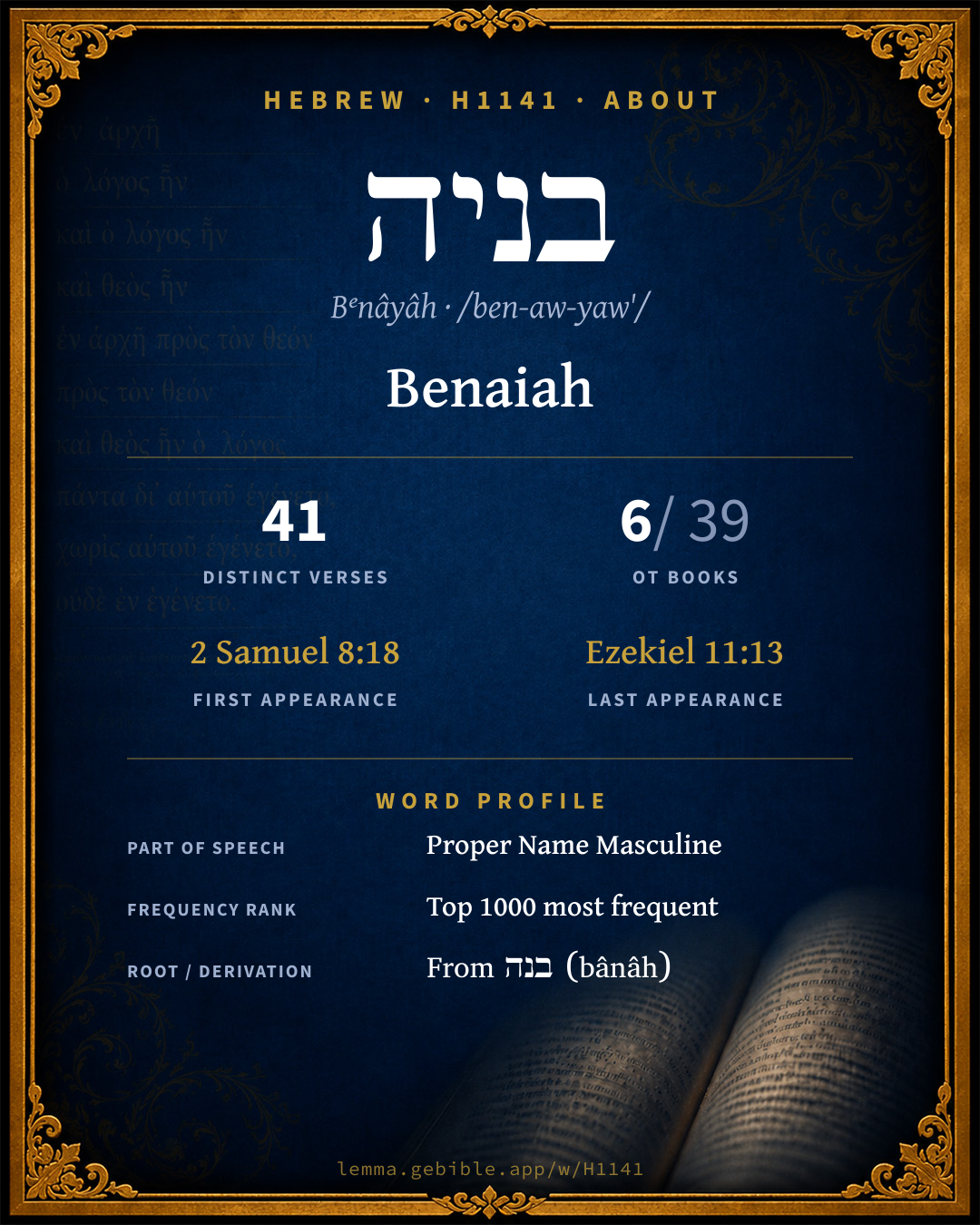
בְּנָיָ֫הוּ
Benaiah
BDB lists 10 entries for ‘Benaiah’ fuller range ↓
Full lexicon entry — Brown-Driver-Briggs (BDB)
From Brown-Driver-Briggs (BDB)
Where this word appears
Grammar key — what these labels mean
Part of speech
- Noun
- A naming word — a person, place, thing, or idea.
Noun type
- Proper
- A name of a specific person, place, or people (e.g. Abraham, Zion, Israel).
Every verse where H1141 appears — 41 distinct verses across 6 books. Click any verse to open its interlinear word-by-word view. Verse text shown in the World English Bible for context — . Each verse’s Hebrew form is shown with its reference; the English is not keyword-highlighted, since the data carries no word-level English alignment. Use “Compare translations” on any verse to read it across multiple English versions. This concordance covers the Hebrew Bible; Septuagint (Greek Old Testament) occurrences are not indexed here.
2 Samuel 5 verses
- 2 Samuel 8:18 וּ/בְנָיָ֨הוּ֙ conj + n Proper and Benaiah the son of Jehoiada [was over] the Cherethites and the Pelethites; and David's sons were chief ministers.
- 2 Samuel 20:23 וּ/בְנָיָה֙ conj + n Proper Now Joab was over all the host of Israel; and Benaiah the son of Jehoiada was over the Cherethites and over the Pelethites;
- 2 Samuel 23:20 וּ/בְנָיָ֨הוּ conj + n Proper Benaiah the son of Jehoiada, the son of a valiant man of Kabzeel, who had done mighty deeds, he killed the two [sons of] Ariel of Moab: he went down also and killed a lion in the midst of a pit in time of snow.
- 2 Samuel 23:22 בְּנָיָ֖הוּ n Proper These things did Benaiah the son of Jehoiada, and had a name among the three mighty men.
- 2 Samuel 23:30 בְּנָיָ֨הוּ֙ n Proper Benaiah a Pirathonite, Hiddai of the brooks of Gaash.
1 Kings 14 verses
- 1 Kings 1:8 וּ/בְנָיָ֨הוּ conj + n Proper But Zadok the priest, and Benaiah the son of Jehoiada, and Nathan the prophet, and Shimei, and Rei, and the mighty men who belonged to David, were not with Adonijah.
- 1 Kings 1:10 וּ/בְנָיָ֜הוּ conj + n Proper but Nathan the prophet, and Benaiah, and the mighty men, and Solomon his brother, he didn't call.
- 1 Kings 1:26 וְ/לִ/בְנָיָ֧הוּ conj + prep + n Proper But he hasn't called me, even me your servant, and Zadok the priest, and Benaiah the son of Jehoiada, and your servant Solomon.
- 1 Kings 1:32 וְ/לִ/בְנָיָ֖הוּ conj + prep + n Proper King David said, Call to me Zadok the priest, and Nathan the prophet, and Benaiah the son of Jehoiada. They came before the king.
- 1 Kings 1:36 בְּנָיָ֧הוּ n Proper Benaiah the son of Jehoiada answered the king, and said, Amen: Yahweh, the God of my lord the king, say so [too].
- 1 Kings 1:38 וּ/בְנָיָ֣הוּ conj + n Proper So Zadok the priest, and Nathan the prophet, and Benaiah the son of Jehoiada, and the Cherethites and the Pelethites, went down, and caused Solomon to ride on king David's mule, and brought him to Gihon.
- 1 Kings 1:44 וּ/בְנָיָ֨הוּ֙ conj + n Proper and the king has sent with him Zadok the priest, and Nathan the prophet, and Benaiah the son of Jehoiada, and the Cherethites and the Pelethites; and they have caused him to ride on the king's mule;
- 1 Kings 2:25 בְּנָיָ֣הוּ n Proper King Solomon sent by Benaiah the son of Jehoiada; and he fell on him, so that he died.
- 1 Kings 2:29 בְּנָיָ֧הוּ n Proper It was told king Solomon, Joab is fled to the Tent of Yahweh, and, behold, he is by the altar. Then Solomon sent Benaiah the son of Jehoiada, saying, Go, fall on him.
- 1 Kings 2:30 בְנָיָ֜הוּ בְּנָיָ֤הוּ n Proper n Proper Benaiah came to the Tent of Yahweh, and said to him, Thus says the king, Come forth. He said, No; but I will die here. Benaiah brought the king word again, saying, Thus said Joab, and thus he answered me.
- 1 Kings 2:34 בְּנָיָ֨הוּ֙ n Proper Then Benaiah the son of Jehoiada went up, and fell on him, and killed him; and he was buried in his own house in the wilderness.
- 1 Kings 2:35 בְּנָיָ֧הוּ n Proper The king put Benaiah the son of Jehoiada in his room over the host; and Zadok the priest did the king put in the room of Abiathar.
- 1 Kings 2:46 בְּנָיָ֨הוּ֙ n Proper So the king commanded Benaiah the son of Jehoiada; and he went out, and fell on him, so that he died. The kingdom was established in the hand of Solomon.
- 1 Kings 4:4 וּ/בְנָיָ֥הוּ conj + n Proper and Benaiah the son of Jehoiada was over the host; and Zadok and Abiathar were priests;
1 Chronicles 14 verses
- 1 Chronicles 4:36 וּ/בְנָיָֽה conj + n Proper and Elioenai, and Jaakobah, and Jeshohaiah, and Asaiah, and Adiel, and Jesimiel, and Benaiah,
- 1 Chronicles 11:22 בְּנָיָ֨ה n Proper Benaiah the son of Jehoiada, the son of a valiant man of Kabzeel, who had done mighty deeds, he killed the two [sons of] Ariel of Moab: he went down also and killed a lion in the midst of a pit in time of snow.
- 1 Chronicles 11:24 בְּנָיָ֖הוּ n Proper These things did Benaiah the son of Jehoiada, and had a name among the three mighty men.
- 1 Chronicles 11:31 בְּנָיָ֖ה n Proper Ithai the son of Ribai of Gibeah of the children of Benjamin, Benaiah the Pirathonite,
- 1 Chronicles 15:18 וּ/בְנָיָ֡הוּ conj + n Proper and with them their brothers of the second degree, Zechariah, Ben, and Jaaziel, and Shemiramoth, and Jehiel, and Unni, Eliab, and Benaiah, and Maaseiah, and Mattithiah, and Eliphelehu, and Mikneiah, and Obed-edom, and Jeiel, the doorkeepers.
- 1 Chronicles 15:20 וּ/בְנָיָ֑הוּ conj + n Proper and Zechariah, and Aziel, and Shemiramoth, and Jehiel, and Unni, and Eliab, and Maaseiah, and Benaiah, with psalteries set to Alamoth;
- 1 Chronicles 15:24 וּ/בְנָיָ֤הוּ conj + n Proper Shebaniah, and Joshaphat, and Nethanel, and Amasai, and Zechariah, and Benaiah, and Eliezer, the priests, did blow the trumpets before the ark of God: and Obed-edom and Jehiah were doorkeepers for the ark.
- 1 Chronicles 16:5 וּ/בְנָיָהוּ֩ conj + n Proper Asaph the chief, and second to him Zechariah, Jeiel, and Shemiramoth, and Jehiel, and Mattithiah, and Eliab, and Benaiah, and Obed-edom, and Jeiel, with psalteries and with harps; and Asaph with cymbals, sounding aloud;
- 1 Chronicles 16:6 וּ/בְנָיָ֥הוּ conj + n Proper and Benaiah and Jahaziel the priests with trumpets continually, before the ark of the covenant of God.
- 1 Chronicles 18:17 וּ/בְנָיָ֨הוּ֙ conj + n Proper and Benaiah the son of Jehoiada was over the Cherethites and the Pelethites; and the sons of David were chief about the king.
- 1 Chronicles 27:5 בְּנָיָ֧הוּ n Proper The third captain of the host for the third month was Benaiah, the son of Jehoiada the priest, chief: and in his division were twenty-four thousand.
- 1 Chronicles 27:6 בְנָיָ֛הוּ n Proper This is that Benaiah, who was the mighty man of the thirty, and over the thirty: and [of] his division was Ammizabad his son.
- 1 Chronicles 27:14 בְּנָיָ֥ה n Proper The eleventh [captain] for the eleventh month was Benaiah the Pirathonite, of the children of Ephraim: and in his division were twenty-four thousand.
- 1 Chronicles 27:34 בְּנָיָ֨הוּ֙ n Proper and after Ahithophel was Jehoiada the son of Benaiah, and Abiathar: and the captain of the king's host was Joab.
2 Chronicles 2 verses
- 2 Chronicles 20:14 בְּ֠נָיָה n Proper Then on Jahaziel the son of Zechariah, the son of Benaiah, the son of Jeiel, the son of Mattaniah, the Levite, of the sons of Asaph, came the Spirit of Yahweh in the midst of the assembly;
- 2 Chronicles 31:13 וּ/בְנָיָ֑הוּ conj + n Proper Jehiel, and Azaziah, and Nahath, and Asahel, and Jerimoth, and Jozabad, and Eliel, and Ismachiah, and Mahath, and Benaiah, were overseers under the hand of Conaniah and Shimei his brother, by the appointment of Hezekiah the king, and Azariah the ruler of the house of God.
Ezra 4 verses
- Ezra 10:25 וּ/בְנָיָֽה conj + n Proper Of Israel: Of the sons of Parosh: Ramiah, and Izziah, and Malchijah, and Mijamin, and Eleazar, and Malchijah, and Benaiah.
- Ezra 10:30 בְּנָיָ֤ה n Proper Of the sons of Pahath-moab: Adna, and Chelal, Benaiah, Maaseiah, Mattaniah, Bezalel, and Binnui, and Manasseh.
- Ezra 10:35 בְּנָיָ֥ה n Proper Benaiah, Bedeiah, Cheluhi,
- Ezra 10:43 בְּנָיָֽה n Proper Of the sons of Nebo: Jeiel, Mattithiah, Zabad, Zebina, Iddo, and Joel, Benaiah.
Ezekiel 2 verses
- Ezekiel 11:1 בְּנָיָ֖הוּ n Proper Moreover the Spirit lifted me up, and brought me to the east gate of Yahweh's house, which looks eastward: and see, at the door of the gate twenty-five men; and I saw in the midst of them Jaazaniah the son of Azzur, and Pelatiah the son of Benaiah, princes of the people.
- Ezekiel 11:13 בְּנָיָ֖ה n Proper It happened, when I prophesied, that Pelatiah the son of Benaiah died. Then fell I down on my face, and cried with a loud voice, and said, Ah Lord Yahweh! will you make a full end of the remnant of Israel?
About this entry
At a glance — auto-summarized from this page’s data, not written by a person. Every figure links to its source below. This summary describes the numbers; it doesn’t interpret them.
בניה — transliterated Bᵉnâyâh — is a Hebrew name carrying the sense “Benaiah.” It first appears in 2 Samuel 8:18. The Hebrew Bible uses it across 41 verses — moderately common. More than a third of its appearances fall in 1 Kings. See 41-verse concordance and the renderings breakdown below.
Gloss history
Strong's 1890 vs modern scholarship
About this word
Strong's H1141 catalogs a Hebrew word from the Hebrew Old Testament.
These counts are not copied from any lexicon or concordance. They are computed here, from the morphology-tagged Hebrew Old Testament. What Lemma adds →
- 41
- distinct verses
- The word appears in 41 distinct verses.
- 6 / 39
- OT books
- The word appears in 6 of 39 Old Testament books.
- #864
- by frequency
- Top 1000 most frequent Hebrew words (rank 864 of 8,640 Hebrew words by occurrence).
View all 41 occurrences in the concordance →
Most concentrated in
- 1 Kings 14 verses 34%
- 1 Chronicles 14 verses 34%
- 2 Samuel 5 verses 12%
By section of the Old Testament
By traditional corpus
Conventional, traditional groupings — biblical authorship is debated, so this is a traditional corpus grouping, not an authorship claim. Each share is this word’s portion of its verses in that division of the Hebrew canon. Each figure is a share of the word’s 41 distinct verses.
- Prophets (Nevi'im) 21 verses · 51%
- Writings (Ketuvim) 20 verses · 49%
How translations render this word
Counts come from each version’s own published word-to-Strong’s tagging or interlinear alignment — an approximate guide to how each version renders this word, not a word-level alignment the data otherwise carries. Because each total is that version’s own tagged count, the per-version totals vary from one another and need not match the appearance or distinct-verse counts above. These counts may also differ from a printed concordance because Lemma counts each distinctly tagged rendering and does not collapse phrase taggings into a single head-word total. This is a fixed set of word-tagged versions (KJV, ASV, BSB, ULT) and does not change with the reading translation you choose elsewhere. Each version’s license is shown beside its name below (and on Sources).
- King James Version: Benaiah 39×, Was benaiah 2×
- American Standard Version: Benaiah 38×, Was benaiah 2×
- Berean Standard Bible: Benaiah 40×, Was benaiah 2×
- unfoldingWord Literal Text: Benaiah 39×, Was benaiah 2×
King James Version Public Domain
Renders H1141 across 42 tagged occurrences — most commonly:
Plus 1 rendering that appears only once — usually multi-word phrases or single function words the recovered tagging swept in, not distinct renderings.
American Standard Version Public Domain
Renders H1141 across 42 tagged occurrences — most commonly:
Plus 2 renderings that appear only once — usually multi-word phrases or single function words the recovered tagging swept in, not distinct renderings.
Berean Standard Bible Public Domain
Renders H1141 across 42 tagged occurrences — most commonly:
unfoldingWord Literal Text CC BY-SA 4.0
Renders H1141 across 42 tagged occurrences — most commonly:
Plus 1 rendering that appears only once — usually multi-word phrases or single function words the recovered tagging swept in, not distinct renderings.
13 senses and sub-senses in the full BDB
What do BDB’s symbols mean?
BDB uses these scholarly abbreviations:
| Symbol | Meaning |
|---|---|
| 𝔊 | the Septuagint (the ancient Greek translation, LXX) |
| 𝔙 | the Vulgate (the Latin translation) |
| 𝔖 | the Syriac version (the Peshitta) |
| 𝔗 | the Targum (the Aramaic translation) |
| ψ | the Psalms |
| √ | root (the underlying root or stem) |
| ‖ | parallel passage (a synonymous or contrasted parallel) |
| † | the dagger: every passage where the word occurs is cited |
The 13 senses and sub-senses the full Brown-Driver-Briggs lexicon distinguishes for this word, in lexicon order (not ranked by frequency), with BDB’s own verbatim wording and sub-sense lettering. Shown in Hebrew script with BDB’s own scholarly abbreviations. The condensed entry is in the Lexicon Entry tab. See also the Forms in the corpus table below.
- 1. one of David’s captains and heroes, son of Jehoiada, בניהו 2 S 8:18; 23:20, 22 1 K 1:8, 10, 26, 32, 36, 38, 44; 2:25, 29, 30(×2), 34, 35, 46; 4:4 1 Ch 11:24; 18:17; 27:5, 6 cf. v 34 (v. Be); = בניה 2 S 20:23 1 Ch 11:22. e.g. 2 Samuel 8:18
- 2. one of David’s thirty, בניהו 2 S 23:30 = בניה 1 Ch 11:31; 27:14. e.g. 2 Samuel 23:30
- 3. a Simeonite, בניה 1 Ch 4:36. e.g. 1 Chronicles 4:36
- 4. Levites,
- a. בניהו 1 Ch 15:18, 20, 24; e.g. 1 Chronicles 15:18
- b. (id.) 2 Ch 31:13; e.g. 2 Chronicles 31:13
- c. בניה 2 Ch 20:14. e.g. 2 Chronicles 20:14
- 5. Israelites, בניה,
- a. Ezr 10:25; e.g. Ezra 10:25
- b. v 30; e.g. Ezra 10:30
- c. v 35; e.g. Ezra 10:35
- d. v 43; e.g. Ezra 10:43
- e. Ez 11:13 = בניהו v 1. e.g. Ezekiel 11:13
Senses from the full Brown-Driver-Briggs lexicon (Brown, Driver, Briggs; Oxford 1906 — public domain), digitized via Sefaria, supplemented by the OpenScriptures HebrewLexicon (CC BY 4.0). Full attribution on Sources.
Word origin
n.pr.m. (Yah hath built up, cf. יבנאל, Sab. בנאל DHMZMG 1883, 15)—
— Brown-Driver-Briggs (Oxford 1906, public domain), digitized via Sefaria, supplemented by the OpenScriptures HebrewLexicon (CC BY 4.0). See Sources.
Derived from בנה (bânâh) (H1129) — to build.
Jastrow Dictionary
A second Hebrew/Aramaic lexicon for comparison, covering Aramaic and post-biblical (Talmudic, Targumic, Midrashic) usage that the biblical-Hebrew BDB does not. Matched by lemma rather than by Strong’s number, so a lemma may carry more than one Jastrow headword (shown separately below), and the entries cover usage well beyond the Bible.
בַּנָּיָה
- , builder. Y. Yoma III, 40ᶜ; Y. Gitt. VII, 48ᵈ bot.; Y. B. Bath. VIII, 16ᶜ top ב׳ דאורייתא a builder of the law (forming ingenious conclusions).—Pl. בַּנָּיִין. Y. Ber. IX, 13ᵃ top; v. אוּמַן.
A Dictionary of the Targumim, the Talmud Babli and Yerushalmi, and the Midrashic Literature (Marcus Jastrow; London, Luzac, 1903) — Public Domain. Digitized via Sefaria. Digitized via Sefaria. Full attribution on Sources.
Forms in the corpus
The 26 distinct written forms H1141 takes in the Hebrew Bible, most frequent first — each parse links to that state’s occurrences in the concordance. Hebrew forms include their vowel points and cantillation, so a single lemma takes many written forms.
| Form | Parsing | Example | Uses |
|---|---|---|---|
| בְּנָיָ֧הוּ | Noun, Proper | 1 Chronicles 27:5 | 4 |
| בְּנָיָ֨הוּ֙ | Noun, Proper | 1 Chronicles 27:34 | 4 |
| בְּנָיָ֖הוּ | Noun, Proper | Ezekiel 11:1 | 3 |
| וּ/בְנָיָ֨הוּ֙ | Noun, Proper | 1 Chronicles 18:17 | 3 |
| בְּנָיָ֖ה | Noun, Proper | Ezekiel 11:13 | 2 |
| בְּנָיָ֥ה | Noun, Proper | Ezra 10:35 | 2 |
| וּ/בְנָיָ֑הוּ | Noun, Proper | 1 Chronicles 15:20 | 2 |
| וּ/בְנָיָ֥הוּ | Noun, Proper | 1 Chronicles 16:6 | 2 |
| וּ/בְנָיָ֨הוּ | Noun, Proper | 1 Kings 1:8 | 2 |
| וּ/בְנָיָֽה | Noun, Proper | Ezra 10:25 | 2 |
| בְנָיָ֛הוּ | Noun, Proper | 1 Chronicles 27:6 | 1 |
| בְנָיָ֜הוּ | Noun, Proper | 1 Kings 2:30 | 1 |
| בְּ֠נָיָה | Noun, Proper | 2 Chronicles 20:14 | 1 |
| בְּנָיָ֣הוּ | Noun, Proper | 1 Kings 2:25 | 1 |
| בְּנָיָ֤ה | Noun, Proper | Ezra 10:30 | 1 |
| בְּנָיָ֤הוּ | Noun, Proper | 1 Kings 2:30 | 1 |
| בְּנָיָ֨ה | Noun, Proper | 1 Chronicles 11:22 | 1 |
| בְּנָיָֽה | Noun, Proper | Ezra 10:43 | 1 |
| וְ/לִ/בְנָיָ֖הוּ | Noun, Proper | 1 Kings 1:32 | 1 |
| וְ/לִ/בְנָיָ֧הוּ | Noun, Proper | 1 Kings 1:26 | 1 |
| וּ/בְנָיָ֜הוּ | Noun, Proper | 1 Kings 1:10 | 1 |
| וּ/בְנָיָ֡הוּ | Noun, Proper | 1 Chronicles 15:18 | 1 |
| וּ/בְנָיָ֣הוּ | Noun, Proper | 1 Kings 1:38 | 1 |
| וּ/בְנָיָ֤הוּ | Noun, Proper | 1 Chronicles 15:24 | 1 |
| וּ/בְנָיָה֙ | Noun, Proper | 2 Samuel 20:23 | 1 |
| וּ/בְנָיָהוּ֩ | Noun, Proper | 1 Chronicles 16:5 | 1 |
Same root — word family
Other BDB entries built from the same root as H1141, grouped by Strong’s listed origin. These share a root / origin per the lexicon — not necessarily a shared meaning. Each links to that word’s own entry.
Derives from
Shares the same root
- אבן ʼeben H68 stone
- בית bayith H1004 house
- בן bên H1121 son
- בנא bᵉnâʼ H1124 to build
- בניה binyâh H1140 building
- בנין binyân H1146 building
- בת bath H1323 daughter
- מבנה mibneh H4011 building
- תבן teben H8401 stubble
- תבנית tabnîyth H8403 pattern
Proper names from this root
People and places named from this root — a name, not an additional meaning of the word.
- בנוי Binnûwy H1131 Binnui
- בני Bânîy H1137 Bani
- בני Bunnîy H1138 Bunni
- יבנאל Yabnᵉʼêl H2995 Jabneel
- יבנה Yabneh H2996 Jabneh
- יבניה Yibnᵉyâh H2997 Ibneiah
- יבניה Yibnîyâh H2998 Ibnijah
- מבני Mᵉbunnay H4012 Mebunnai
Compare all same-root words → Showing 4 of 20 — not the complete family. 8 of the same-root words are proper names (people or places). They share a root, not necessarily a meaning.
Bible dictionary
Public-domain dictionary articles matched to this entry by name (Benaiah). A biblical name can be shared by more than one person or place, so an article may treat several.
Easton's Bible Dictionary · M. G. Easton, 1897
Built up by Jehovah. (1.) The son of Jehoiada, chief priest (1 Chr. 27:5). He was set by David over his body-guard of Cherethites and Pelethites (2 Sam. 8:18; 1 Kings 1:32; 1 Chr. 18:17). His exploits are enumerated in 2 Sam. 23:20, 21, 22; 1 Chr. 11:22. He remained faithful to Solomon (1 Kings 1:8, 10, 26), by whom he was raised to the rank of commander-in-chief (1 Kings 2:25, 29, 30, 34, 35; 4:4).
(2.) 2 Sam. 23:30; 1 Chr. 11:31.
(3.) A musical Levite (1 Chr. 15:18, 20).
(4.) A priest (1 Chr. 15:24; 16:6).
(5.) The son of Jeiel (2 Chr. 20:14).
Smith's Bible Dictionary · William Smith, 1863
(made by the Lord).
+ The son of Jehoiada the chief priest, (1 Chronicles 27:5) of the tribe of Levi, though a native of Kabzeel, (2 Samuel 23:20) set by David, (1 Chronicles 11:25) over his body-guard. (2 Samuel 8:18; 20:23; 1 Kings 1:38; 1 Chronicles 18:17) One of the mighty men. (2 Samuel 23:22,23; 1 Chronicles 11:25; 27:6) The exploits which gave him this rank are narrated in (2 Samuel 23:20,21; 1 Chronicles 11:22) He was captain of the host for the third month. (1 Chronicles 27:5) Benaiah remained faithful to Solomon during Adonijah's attempt on the crown, (1 Kings 1:8,10,32,38,44) and was raised unto the place of Joab as commander-in-chief of the whole army. (1 Kings 2:35; 4:4) (B.C. 1005.) + Benaiah the Pirathonite, an Ephraimite, one of David's thirty mighty men, (2 Samuel 23:30; 1 Chronicles 11:31) and the captain of the eleventh monthly course. (1 Chronicles 27:14) + A Levite in the time of David, who "played with a psaltry on Alamoth." (1 Chronicles 15:18,20; 16:5) + A priest in the time of David, appointed to blow the trumpet before the ark. (1 Chronicles 15:24; 16:6) + A Levite of the sons of Asaph. (2 Chronicles 20:14) + A Levite in the time of Hezekiah. (2 Chronicles 31:13) + One of the "princes" of the families of Simeon. (1 Chronicles 4:36) + Four laymen in the time of Ezra who had taken strange wives. (Ezra 10:25,30,35,43) + The father of Pelatiah. (Ezekiel 11:1,13)
Hitchcock's Bible Names Dictionary · Roswell D. Hitchcock, 1869
son of the Lord
Classic public-domain reference works; full attribution on Sources.
Septuagint verse parallels
This word appears in 41 verses that also exist in the Greek Old Testament (Septuagint), out of the 41 Hebrew verses it occurs in. You can read those verses in Greek by switching the Old Testament edition to the Septuagint.
Read these verses in the Septuagint
This is a verse-level parallel only — the same verses exist in both the Hebrew and Greek Old Testaments. No word-level Hebrew↔Greek correspondence is claimed: the data carries no such alignment, so no Greek word is shown as this Hebrew word’s translation. Coverage is not total — the Septuagint omits the deuterocanon and renumbers the Psalms, so some Hebrew verses have no direct Greek parallel.