
2 Kings 10:29

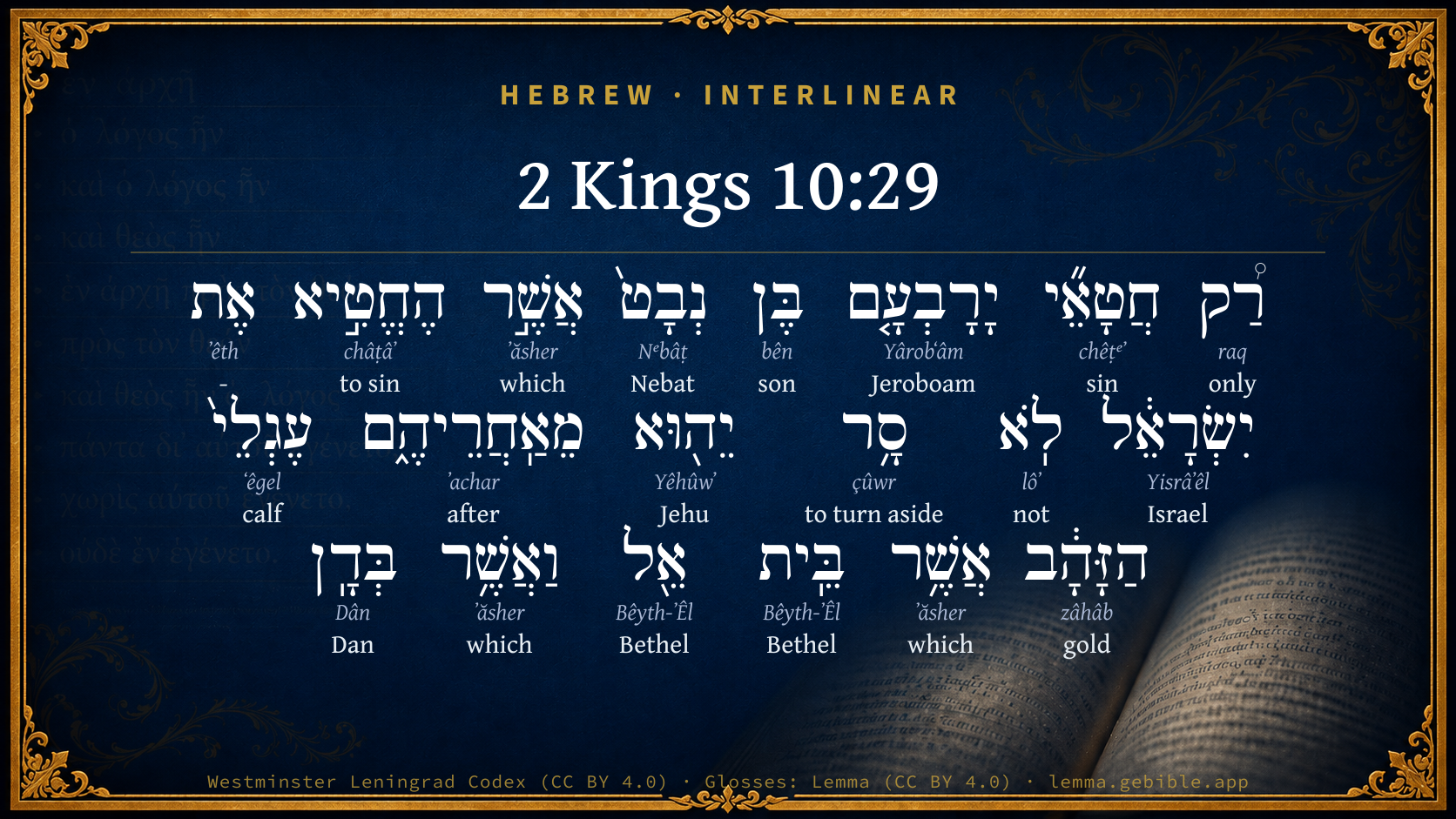
Hebrew (Westminster Leningrad Codex) 2 Kings 10:29 appears in the Hebrew Old Testament. The text above is from the Westminster Leningrad Codex. Each word links to its Strong’s number, a concise gloss, and parsing drawn from the Open Scriptures Hebrew Bible morphology. Click any word for its full Brown-Driver-Briggs (BDB) entry.
Download image
Cite this verse

2 Kings 10:29 (World English Bible). Public Domain. Lemma interlinear Bible study tool, https://lemma.gebible.app/v/2-kings/10/29.

Show BibTeX & RIS
BibTeX
RIS
English Translation
However from the sins of Jeroboam the son of Nebat, with which he made Israel to sin, Jehu didn't depart from after them, [to wit], the golden calves that were in Bethel, and that were in Dan.
World English Bible · Public Domain
Download a study sheet

One document with this verse’s original text, its word-by-word gloss line, the meaning frame, cross-references with their text, attributed commentary, and full source and license credits — printable, and it pastes into notes with its structure intact.

This verse Autodidact and up

Study sheet (.html) Plain text (.txt)

A passage Seminary Student

Up to 50 verses in one chapter. A passage sheet keeps up to 6 commentary sources and 12 cross-references per verse, in the order this page ranks them, and says so on the sheet whenever that leaves anything out. Ask for a single verse and you get the Autodidact verse sheet above.

Everything on this page stays free to read, with no account — the sheet is a download of what is already on screen, not access to it.

Want to remove ads? Support Godless Engineer
Compare translations 3

The same verse in 3 English versions, stacked beneath the original-language interlinear above. Click any original word for its lexicon entry.

Each is an independent rendering of the whole verse — the interlinear is not word-aligned to these translations.

Highlighted words mark where these versions differ — a whole-verse word diff, not a word-by-word alignment.

  • World English Bible Public Domain
    However from the sins of Jeroboam the son of Nebat, with which he made Israel to sin, Jehu didn't depart from after them, [to wit], the golden calves that were in Bethel, and that were in Dan.
  • King James Version Public Domain
    Howbeit from the sins of Jeroboam the son of Nebat, who made Israel to sin, Jehu departed not from after them, to wit, the golden calves that were in Bethel, and that were in Dan.
  • unfoldingWord Literal Text CC BY-SA 4.0
    Only the sins of Jeroboam, the son of Nebat, who caused Israel to sin, Jehu did not turn away from after them, the calves of gold that Bethel and that in Dan.

unfoldingWord Literal Text — © unfoldingWord, licensed CC BY-SA 4.0. Word-aligned USFM3 via Door43 (git.door43.org/unfoldingWord/en_ult).

Versions to compare (up to 4)

3 of 4 selected

Show all 18 translations

Every available English version of this verse, each an independent rendering of the whole verse.

  • World English Bible Public Domain
    However from the sins of Jeroboam the son of Nebat, with which he made Israel to sin, Jehu didn't depart from after them, [to wit], the golden calves that were in Bethel, and that were in Dan.
  • Berean Standard Bible Public Domain
    but he did not turn away from the sins that Jeroboam son of Nebat had caused Israel to commit—the worship of the golden calves at Bethel and Dan.
  • Majority Standard Bible Public Domain
    but he did not turn away from the sins that Jeroboam son of Nebat had caused Israel to commit—the worship of the golden calves at Bethel and Dan.
  • King James Version Public Domain
    Howbeit from the sins of Jeroboam the son of Nebat, who made Israel to sin, Jehu departed not from after them, to wit, the golden calves that were in Bethel, and that were in Dan.
  • American Standard Version (1901) Public Domain
    Howbeit from the sins of Jeroboam the son of Nebat, wherewith he made Israel to sin, Jehu departed not from after them, `to wit', the golden calves that were in Beth-el, and that were in Dan.
  • Revised Version (1885) Public Domain
    Howbeit from the sins of Jeroboam the son of Nebat, wherewith he made Israel to sin, Jehu departed not from after them, to wit, the golden calves that were in Beth-el, and that were in Dan.
  • Geneva Bible (1599) Public Domain
    But from the sinnes of Ieroboam the sonne of Nebat which made Israel to sinne, Iehu departed not from them, neither from the golden calues that were in Beth-el and that were in Dan.
  • Douay-Rheims (1899) Public Domain
    But yet he departed not from the sills of Jeroboam the son of Nabat, who made Israel to sin, nor did he forsake the golden calves that were in Bethel and Dan.
  • Young's Literal Translation Public Domain
    only -- the sins of Jeroboam son of Nebat, that he caused Israel to sin, Jehu hath not turned aside from after them -- the calves of gold that `are' at Beth-El, and in Dan.
  • Literal Standard Version CC BY-SA 4.0
    only [not]—the sins of Jeroboam son of Nebat, that he caused Israel to sin, Jehu has not turned aside from after them—the calves of gold that [are] at Beth-El and in Dan.
  • Unlocked Literal Bible CC BY-SA 4.0
    But Jehu did not leave the sins of Jeroboam son of Nebat, by which he made Israel sin—that is, the worship of the golden calves in Bethel and Dan.
  • unfoldingWord Literal Text CC BY-SA 4.0
    Only the sins of Jeroboam, the son of Nebat, who caused Israel to sin, Jehu did not turn away from after them, the calves of gold that Bethel and that in Dan.
  • Darby Bible Public Domain
    Only, the sins of Jeroboam the son of Nebat, who made Israel to sin, from them Jehu departed not: [from] the golden calves that were in Bethel, and that were in Dan.
  • World Messianic Bible Public Domain
    However, Jehu didn’t depart from the sins of Jeroboam the son of Nebat, with which he made Israel to sin—the golden calves that were in Bethel and that were in Dan.
  • Webster's Bible Public Domain
    Yet from the sins of Jeroboam the son of Nebat, who made Israel to sin, Jehu departed not from after them, to wit, the golden calves that were in Beth-el, and that were in Dan.
  • Free Bible Version CC BY-SA 4.0
    but he did not end the sins that Jeroboam, son of Nebat, had made Israel commit—the worship of the golden calves at Bethel and Dan.
  • Bible in Basic English Public Domain
    But Jehu did not keep himself from all the sins of Jeroboam, the son of Nebat, and the evil he made Israel do; the gold oxen were still in Beth-el and in Dan.
  • JPS Tanakh (1917) Public Domain
    Howbeit from the sins of Jeroboam the son of Nebat, wherewith he made Israel to sin, Jehu departed not from after them, the golden calves that were in Beth-el, and that were in Dan.

Literal Standard Version (2020), Covenant Press — licensed CC BY-SA 4.0. Text via the HelloAO Bible API (eBible.org). Unlocked Literal Bible (unfoldingWord) — licensed CC BY-SA 4.0. Text via the HelloAO Bible API (eBible.org). unfoldingWord Literal Text — © unfoldingWord, licensed CC BY-SA 4.0. Word-aligned USFM3 via Door43 (git.door43.org/unfoldingWord/en_ult). Free Bible Version, Dr. Jonathan Gallagher — licensed CC BY-SA 4.0. Text via the HelloAO Bible API (eBible.org).

Word by word

More ways to search: Search by grammar → Find every occurrence → Compare this word →

Practice this passage: Drill this verse → Learn its vocabulary →

נְבָט֙
Nᵉbâṭ
H5028
“Nebat”
Noun, Proper
Part of Speech
Noun
Type
Proper
Full BDB Definition

Origin: from H5027

TWOT: None

Nebat = "aspect" - an Ephraimite of Zereda, father of king Jeroboam I of the northern kingdom of Israel
  1. רַ֠ק raq H7535 “only” Particle, Accusative
  2. חֲטָאֵ֞י chêṭᵉʼ H2399 “sins of” Noun, Common, Masculine, Plural, Construct
  3. יָרָבְעָ֤ם Yârobʻâm H3379 “Jeroboam” Noun, Proper
  4. בֶּן bên H1121 “son of” Noun, Common, Masculine, Singular, Construct
  5. אֲשֶׁ֣ר ʼăsher H834 “which” Particle, Relative
  6. הֶחֱטִ֣יא châṭâʼ H2398 “to sin” Verb, Hiphil, Perfect, 3rd Person, Masculine, Singular
  7. אֶת ʼêth H853 “-” Particle, Direct Object
  8. יִשְׂרָאֵ֔ל Yisrâʼêl H3478 “Israel” Noun, Proper
  9. לֹֽא lôʼ H3808 “not” Particle, Negative
  10. סָ֥ר çûwr H5493 “to turn aside” Verb, Qal, Perfect, 3rd Person, Masculine, Singular
  11. יֵה֖וּא Yêhûwʼ H3058 “Jehu” Noun, Proper
  12. מֵאַֽחֲרֵיהֶ֑ם ʼachar H310 “from · after · them” Preposition + Preposition + Suffix, Personal, 3rd Person, Masculine, Plural
  13. עֶגְלֵי֙ ʻêgel H5695 “calves of” Noun, Common, Masculine, Plural, Construct
  14. הַזָּהָ֔ב zâhâb H2091 “the · gold” Particle, Definite Article + Noun, Common, Masculine, Singular, Absolute
  15. אֲשֶׁ֥ר ʼăsher H834 “which” Particle, Relative
  16. בֵּֽית Bêyth-ʼÊl H1008 “Bethel” Noun, Proper
  17. אֵ֖ל Bêyth-ʼÊl H1008 “Bethel” Noun, Proper
  18. וַאֲשֶׁ֥ר ʼăsher H834 “and · which” Conjunction + Particle, Relative
  19. בְּדָֽן Dân H1835 “in/at · Dan” Preposition + Noun, Proper

About this verse

These counts appear in no published source. They are computed here, from the morphology-tagged text and Lemma’s own curated glosses. What Lemma adds →

20
words
17
distinct lemmas
Historical
section

Notable vocabulary

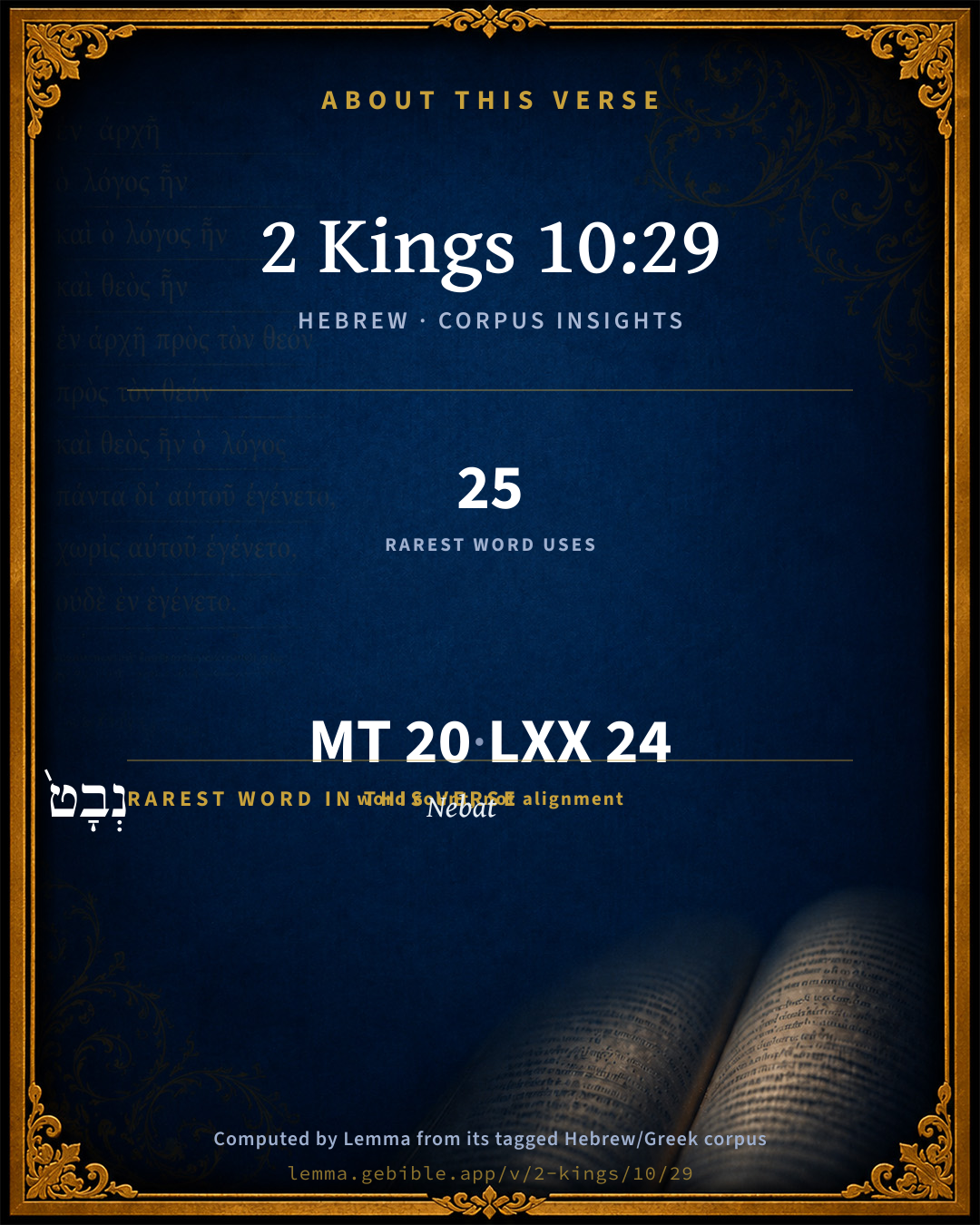
The rarest word here is נְבָט֙ Nebat H5028 — appearing just 25 times in the whole Hebrew Bible.

Shared distinctive vocabulary

נְבָט֙ Nebat H5028 occurs in 25 verses of the Hebrew Bible. Also found in:

Grammatical profile

  • 2 verbs
  • 11 nouns
  • 1 preposition
  • 6 particles

Verb forms

  • הֶחֱטִ֣יא Hiphil · Perfect
  • סָ֥ר Qal · Perfect

Repetition

Words recur within this verse — often emphatic in Hebrew:

  • בֵּֽית Bethel H1008 ×2
  • אֲשֶׁ֣ר which H834 ×3

Hebrew & Septuagint length

In English translation the verse runs 37 words from the Hebrew and 29 from the Septuagint (LXX English) — closely comparable.

A rough comparison of the two English renderings, which tokenize alike — not a word-level alignment.

Word counts can differ between the Hebrew and the Greek without any difference in meaning — e.g. the Hebrew direct-object marker אֵת has no separate Greek word, and Greek often adds the article ὁ.

In the original languages it is 20 Hebrew tokens and 24 Greek tokens — but the two are counted differently (Hebrew bundles its prefixes and suffixes into one token; the Greek is in lemma form), so that isn’t a like-for-like length.

Cross-references

21

Topical passages linked to 2 Kings 10:29 in the Treasury of Scripture Knowledge — connected by theme and wording, ordered by reader-vote popularity; previews shown in the World English Bible.

  • 1 Kings 12:28–30 Whereupon the king took counsel, and made two calves of gold; and he said to them, It is too much for you to go up to Jerusalem: see your gods, Israel, which brought you up out of the land of Egypt.
  • 1 Kings 13:33–34 After this thing Jeroboam didn't return from his evil way, but made again from among all the people priests of the high places: whoever would, he consecrated him, that there might be priests of the high places.
  • 1 Kings 14:16 He will give Israel up because of the sins of Jeroboam, which he has sinned, and with which he has made Israel to sin.
  • Genesis 20:9 Then Abimelech called Abraham, and said to him, "What have you done to us? How have I sinned against you, that you have brought on me and on my kingdom a great sin? You have done deeds to me that ought not to be done!"
  • Exodus 32:4 He received what they handed him, and fashioned it with an engraving tool, and made it a molten calf; and they said, "These are your gods, Israel, which brought you up out of the land of Egypt."
  • Exodus 32:21 Moses said to Aaron, "What did these people do to you, that you have brought a great sin on them?"
  • 1 Samuel 2:24 No, my sons; for it is no good report that I hear: you make Yahweh's people to disobey.
  • 2 Kings 13:2 He did that which was evil in the sight of Yahweh, and followed the sins of Jeroboam the son of Nebat, with which he made Israel to sin; he didn't depart from it.
  • 2 Kings 13:11 He did that which was evil in the sight of Yahweh; he didn't depart from all the sins of Jeroboam the son of Nebat, with which he made Israel to sin; but he walked therein.
  • 2 Kings 14:24 He did that which was evil in the sight of Yahweh: he didn't depart from all the sins of Jeroboam the son of Nebat, with which he made Israel to sin.
  • 2 Kings 15:9 He did that which was evil in the sight of Yahweh, as his fathers had done: he didn't depart from the sins of Jeroboam the son of Nebat, with which he made Israel to sin.
  • 2 Kings 15:18 He did that which was evil in the sight of Yahweh: he didn't depart all his days from the sins of Jeroboam the son of Nebat, with which he made Israel to sin.
  • 2 Kings 15:24 He did that which was evil in the sight of Yahweh: he didn't depart from the sins of Jeroboam the son of Nebat, with which he made Israel to sin.
  • 2 Kings 15:28 He did that which was evil in the sight of Yahweh: he didn't depart from the sins of Jeroboam the son of Nebat, with which he made Israel to sin.
  • 2 Kings 17:22 The children of Israel walked in all the sins of Jeroboam which he did; they didn't depart from them;
  • Hosea 8:5–6 Let Samaria throw out his calf-idol! My anger burns against them! How long will it be before the are capable of purity?
  • Hosea 10:5 The inhabitants of Samaria will be in terror for the calves of Beth Aven; For its people will mourn over it, Along with its priests who rejoiced over it, For its glory, because it has departed from it.
  • Hosea 13:2 Now they sin more and more, And have made themselves molten images of their silver, Even idols according to their own understanding, All of them the work of the craftsmen. They say of them, "They offer human sacrifice and kiss the calves."
  • Mark 6:24–26 She went out, and said to her mother, "What shall I ask?" She said, "The head of John the Baptizer."
  • 1 Corinthians 8:9–13 But be careful that by no means does this liberty of yours become a stumbling block to the weak.
  • Galatians 2:12–13 For before some people came from James, he ate with the Gentiles. But when they came, he drew back and separated himself, fearing those who were of the circumcision.

Cross-references courtesy of OpenBible.info (CC BY 4.0).

Hebrew and Greek witnesses Masoretic Hebrew ↔ Greek Septuagint

The same verse in the two great witnesses to the Old Testament, shown verse-for-verse.

These are two independent witnesses, not word-aligned to each other, and the Septuagint is shown in lemma (dictionary) form.

Hebrew 2 Kings 10:29 Masoretic · Westminster Leningrad Codex

רַ֠ק חֲטָאֵ֞י יָרָבְעָ֤ם בֶּן נְבָט֙ אֲשֶׁ֣ר הֶחֱטִ֣יא אֶת יִשְׂרָאֵ֔ל לֹֽא סָ֥ר יֵה֖וּא מֵאַֽחֲרֵיהֶ֑ם עֶגְלֵי֙ הַזָּהָ֔ב אֲשֶׁ֥ר בֵּֽית אֵ֖ל וַאֲשֶׁ֥ר בְּדָֽן

However from the sins of Jeroboam the son of Nebat, with which he made Israel to sin, Jehu didn't depart from after them, [to wit], the golden calves that were in Bethel, and that were in Dan.

World English Bible · Public Domain

Greek LXX 2 Kings 10:29 Septuagint · lemma form

πλήν ἁμαρτία ιεροβοαμ υἱός ναβατ ὅς ἐκἁμαρτάνω ὁ ἰσραήλ οὐ ἀποἵστημι ιου ἀπό ὄπισθε αὐτός ὁ δάμαλις ὁ χρυσοῦς ἐν βαιθηλ καί ἐν δαν

Nevertheless Ju departed not from following the sins of Jeroboam the son of Nabat, who led Israel to sin: these were the golden heifers in Baethel and in Dan.

LXX2012 (modern English Septuagint) · Public Domain

Hebrew: Westminster Leningrad Codex (CC BY 4.0). Greek: Septuagint (public domain); English from LXX2012 (modern English Septuagint) (Public Domain). How the Septuagint differs from the Hebrew →

Targum (Aramaic paraphrase)

1

The Targum is the ancient Jewish Aramaic paraphrase of the Hebrew Scriptures — an interpretive translation, not the Hebrew text itself. Onkelos (literal) and Pseudo-Jonathan (expansive) render the Torah, and Jonathan the Prophets. Coverage is partial: where no permissively-licensed English translation exists for a verse, only the Aramaic is shown. This is verse-level text, not a word-by-word alignment to the Hebrew.

  1. Targum Jonathan Prophets (Joshua–Malachi)
    לְחוֹד בְּחוֹבֵי יְרָבְעָם בַּר נְבָט דְחַיֵיב יַת יִשְׂרָאֵל לָא סְטָא יֵהוּא מִבַּתְרֵיהוֹן אִשְׁתַּעְבֵיד לְעֶגְלֵי דַהֲבָא דִי בְבֵית אֵל וְדִי בְדָן:

    (no public-domain English translation for this verse)

    Targum Jonathan — Aramaic: “Mikraot Gedolot” (public domain). English: “Sefaria Community Translation” (CC0 1.0 (public-domain dedication)); “London "Chaldee Paraphrase," 1871” (public domain). Text via Sefaria.

Commentary

Notes on 2 Kings 10:29 from classic Christian and Jewish commentators (each source and its license shown beneath its notes). The classic Christian expositions comment on the surrounding passage and are grouped to its opening verse, so a note may address several verses; the Jewish commentaries on the Tanakh (Rashi and others) are per-verse, so they appear only where the commentator wrote on this verse.

Lemma curates 59 commentaries, every one of them public domain or Creative Commons licensed, each selected and text-cleaned for this edition rather than reprinted as found. About our sources →

Trapp's Complete Commentary

John Trapp

2Ki 10:29 Howbeit [from] the sins of Jeroboam the son of Nebat, who made Israel to sin, Jehu departed not from after them, [to wit], the golden calves that [were] in Bethel, and that [were] in Dan.

Ver. 29. Howbeit from the sins of Jeroboam … Jehu departed not.] Because if he had, it might have cost him his kingdom, to the settling whereof he had a hawk’s eye in all his reformations. Principes regionem potius quam religionem quaerunt, saith Chemnitius. It is said {a} that Selymus, the great Turk, and Hismael, the Persian, did, under the colour and zeal of their religion, as they would have it, both pretend just causes of war; although their evil dissembled ambitious desires plainly declared unto the world, that they both shot at one and the same mark: namely, by confirming their power and strength, to extend the bounds of their great empires.

{a} Turk. Hist., fol. 515.

John Trapp, A Commentary or Exposition upon All the Books of the Old and New Testament (1647–1656) — public domain. Text from a community e-Sword module.

Joseph Benson's Commentary

2Ki 10:29. Jehu departed not from them — He was partial in his reformation, and did not put away all the evil, because his heart was not right with God. He departed from the sins of Ahab, but not from the sins of Jeroboam: discarded Baal, but adhered to the calves. The worship of Baal was indeed the greater evil, and more heinous in the sight of God, but the worship of the calves was a great evil; and true religion not only implies conversion from gross sin, but from all sin, and not only from false gods, but from false modes of worshipping the true God. The worship of Baal, being upheld by the house of Ahab, also contributed to uphold that house, the numerous ministers of that idolatry being, of course, engaged to support the family which supported them, and with which they must stand or fall; hence Jehu could easily part with that worship, and labour to destroy it; but the worship of the calves was a politic idolatry, begun and kept up for reasons of state, to prevent the return of the ten tribes to the house of David, and therefore Jehu clave to it. But true religion is not only a conversion from those sins which are hostile to our secular interests, but from those that appear to be friendly to them; in forsaking which is the great trial, whether we can deny ourselves For God, and trust in him.

Joseph Benson's Commentary on the Old and New Testaments (1811–1818) — public domain. Text from a community e-Sword module.

Whedon's Commentary on the Bible

Daniel D. Whedon

JEHU’S SINS, MISFORTUNES, AND DEATH, 2Ki_10:29-36.

29. Howbeit — While the Scripture history makes prominent the fact that Jehu was God’s instrument to punish the wicked house of Ahab, and overthrow his dynasty, it conceals not his shortcomings and his sins. Jehu, as Kitto very justly remarks, “was one of those decisive, terrible, ambitious, yet prudent, calculating, and passionless men, whom God from time to time raises up to change the fate of empires and to execute his judgments on the earth. He boasted of his zeal — ’Come and see my zeal for the Lord’ — but at the bottom it was zeal for Jehu. His zeal was great so long as it led to acts which squared with his own interests, but it cooled marvellously when required to take a direction in his judgment less favourable to them.”

Daniel D. Whedon (gen. ed.), Commentary on the Old and New Testaments (1874–1909) — public domain. Text from a community e-Sword module.

The Preacher's Complete Homiletical Commentary

Joseph S. Exell (gen. ed.)

CRITICAL AND EXPLANATORY NOTES.—

2Ki_10:29. The golden calves that were in Bethel—Political reasons led to the origin of calf-worship (1Ki_12:28), and doubtless for political reasons Jehu continued it.

2Ki_10:32. To cut Israel short—Instead of לְקַצּוֹת, to cut off from, the Targum and others read לִקְצוֹף, to be enraged, wrath. In all the coasts of Israel—i.e., along the entire frontier, the land beyond Jordan belonging to the tribes of Reuben, Gad, and Manasseh.—W. H. J.

HOMILETICS OF 2Ki_10:29-36

THE IMPERFECTIONS OF A GREAT REFORMING WORK

THE fearless and energetic efforts of Jehu at the beginning of his reign, while they filled many with dismay, excited in others the highest hopes. There were the hidden ones, the secret worshippers of Jehovah, who mourned over the degeneracy of the times, and sighed and prayed for a brighter day to dawn. It seemed as if their prayers were heard, and they recognised in the man who had dealt such fierce and summary justice to the adherents of Baal, one who would again establish the worship of Jehovah, and thus save the nation from the whirlpool of ruin into which it was rapidly sinking. It was therefore a bitter disappointment to all lovers of the truth when Jehu stayed his reforming hand, and gave his public sanction to the calf-worship of Jeroboam, putting back the nation to where it was ninety years before. The paragraph suggests the imperfections of a great reforming work.

I. That reform is imperfect when it does not thoroughly root out the evil against which it is directed (2Ki_10:29). If the worship of the golden calves was not so gross as that of Baal, still it was idolatry, and as such should have been abolished. It was a standing insult to Jehovah, a violation of the Divine law, and a source of moral enfeeblement to the people, weighing upon them like chains of habit which are generally too small to be felt till they are too strong to be broken. It was an opportunity for Jehu to rid the nation once and for ever of the terrible curse. The hand that struck down Baal could also crush the calves of Dan and Bethel It was here the reformer failed; his work was ineffectual because it lacked thoroughness. Half reforms are always unsatisfactory. An admitted evil can be cured only by complete eradication.

II. That reform is commendable as far as it goes (2Ki_10:30).

1. It has the Divine approval. “The Lord said unto Jehu, thou hast done well in executing that which is right in mine eyes.” Every attempt at reformation is encouraged by the Divine favour. It is this that sustains the courage of the reformer in the midst of formidable difficulties. We may well hesitate to touch any work of reformation that has not the Divine sanction, and on which we cannot ask the Divine blessing. Jehu was an instrument of Divine vengeance on the house of Ahab, and was commended so far as he carried out his commission.

2. It has the Divine reward. “Thy children of the fourth generation shall sit on the throne of Israel.” This was a favour not vouchsafed to any other king of Israel since the division of the kingdom. Lange supposes that the succession is limited to the fourth generation because Jehu still retained the calf worship; but we prefer the prima facie teaching of the text, which clearly indicates a promise of reward, rather than a threat of limitation. God will not be indebted to any man, nor shall those who do or suffer aught for Him complain of a hard bargain. The final reward of the Christian victor will be to share the throne and honours of his Lord (Rev_3:21).

III. That reform is imperfect when it is not personal and sincere (2Ki_10:31). “Jehu took no heed to walk in the law of the Lord God of Israel with all his heart.” It was not with him so much a question of religion as of politics. He was not anxious first to have his own heart right with God, and to render sincere obedience to His law, as he was to secure a firm footing as king, and to compel obedience to his authority. Jehu, as Kitto justly remarks, “was one of those decisive, terrible, ambitious yet prudent, calculating, passionless men whom God from time to time raises up to change the fate of empires, and to execute His judgments on the earth. He boasted of his zeal—Come and see my zeal for the Lord—but at the bottom, it was zeal for Jehu. His zeal was great so long as it led to acts which squared with his own interests, but it cooled marvellously when required to take a direction in his judgment less favourable to them.” All true and permanent reformation begins with the individual. If the heart be renewed, the whole man is reformed: the heart right with God is the motive-force that effects all necessary outward reformation.

IV. That reform is imperfect when it is not national and general (2Ki_10:32-33). Had the nation been wholly delivered from idolatry, neither Hazael nor any other enemy would have been permitted to invade the kingdom and harass the people. The national spirit was broken, its prestige dimmed, even the love of fatherland was not strong enough to bind all the people together to resist and repel invasion. In the latter part of Jehu’s reign, Israel began to suffer those fearful punishments of invasion and conquest from the North and North East, which finally ended in the total captivity of the land. Jehu’s name occurs on the Assyrian monuments among others who paid tribute to the king of Assyria, and Rawlinson inclines to the opinion that from this date both the Jewish and the Israelitish kings held their crowns as fiefs, dependent on the will of the Assyrian monarch, with whom it formally lay to confirm each new prince in his kingdom (chap. 2Ki_14:5). Partial and incomplete reforms always leave elements of weakness and discord behind them. When a nation is united in acknowledging and serving God, it is invincible; it is respected and feared by its enemies.

V. That reform is imperfect when it is employed for selfish ends (2Ki_10:34-36). Jehu carried on the revolution, and wrought out reforms with an Iron hand, to serve his own purposes—that he might reign securely and peacefully—might acquire fame and power—might establish his throne for years, and be able to leave his own son in unquestioned and undisturbed possession of the kingdom. He reigned longer than any of his predecessors, and his successors reigned seventy-six years. If his zeal and ambition were expended in founding a royal dynasty, he gained his end; but that was all he did gain. The nation was not permanently benefited, nor was it long arrested in its downfall. It destroys the dignity and efficacy of reform when it is carried on from selfish motives; and yet God can work out His just retribution upon evil-doers through the violence and selfishness of human passions.

LESSONS:—

1. It is a solemn responsibility to be a public reformer.

2. It is disappointing and disastrous when reform is not radical.

3. Every step of reform in the right direction is pleasing to God, and shall not go unrewarded.

GERM NOTES ON THE VERSES

2Ki_10:29-33. Jehu is a type of those who show great zeal in tearing down and destroying superstition and false worship, but do nothing to build up the faith, because they themselves have no living faith, and do not walk before God with all their hearts. Jehu did indeed destroy idolatry, but he did not touch the chief sin of Israel, because he considered it the chief support of his own authority. So many a one renounces gross, external sins, but will not think of denying himself, of sacrificing his own interests, and of turning his heart to the living God. He who remains standing half-way goes backward in spite of himself. Jehu would not desist from the sins of Jeroboam because he thought it would cost him his crown, but on that very account he lost one province after another.—Lange.

2Ki_10:29. The exigencies of government.

1. Cannot ignore the influence of religion upon a people.

2. Will sanction an imperfect religion rather than lose power.

3. In danger of placing politics and dynastic interests above religious reformation.

2Ki_10:30. Zachariah, of the fourth generation, was slain by Shallum, and thus was this word of the Lord fulfilled (compare chap. 2Ki_15:12); and thus, too, according to the prophecy of Hosea (2Ki_1:4), did the Lord “avenge the blood of Jezreel upon the house of Jehu.” For when the minister of Divine judgment himself turned to idolatry, the very blood of his guilty victims might well call for vengeance on him for doing the same things for which he had executed the Divine judgment on them (Rom_2:1).—Whedon.

—The strict impartiality of Divine Justice.

1. Recognises and commends what is good in the worst characters.

2. Apportions to every action its exact measure of reward.

3. Does not interfere with the exercise of individual freedom.

—Jehu first receives praise for the work which he has done, and afterwards is denounced, in his posterity at least, for the same action (compare 2Ki_10:30 and Hos_1:4). The first of these two points throws much light upon the second. The defection of Jehu showed that he had other ends in view than the pleasing of God Personal ambition had been at the bottom of his heart, and he had destroyed that form of idolatry which was identified with the house of Ahab. But having achieved his end, he took no heed to walk in the law of the Lord. The vengeance which had fallen upon Ahab’s house had been the righteous retribution upon Ahab’s sins; but the executioner gloated over and rejoiced in his work. He had his reward in the establishment of his dynasty for four generations. What was righteous in his spirit—his steadiness of purpose and hatred of injustice—all this God blessed. But the brutal ferocity, the remorseless indifference to agony and bloodshed, these evil elements prevailed over the better, and when the fire against Baal had burnt itself out for want of fuel, nought was left but dull ashes. His zeal for righteousness did not turn inwards and burn up his own sins. When there was nothing left to destroy, his occupation was gone. The same thirst for blood which had marked him, passed down, a ghastly bequeathment, to his children, and brought the Divine curse upon them.—The Bible Educator.

2Ki_10:31. The seductive power of unbelief.

1. Arrests and paralyzes the efforts of the most zealous reformers.

2. Creates indifference to the most sublime revelations of God’s word.

3. Unfits the soul for the highest spiritual experiences.

4. Leads to the practice of the basest idolatry.

—It is an entire goodness that God cares for. Perhaps, such is the bounty of our God, a partial obedience may be rewarded with a temporal blessing, as Jehu’s severity to Ahab shall carry the crown to his seed for four generations; but we can never have any comfortable assurance of an eternal retribution if our hearts and ways be not perfect with God. Woe be to us, O God, if we be not all thine! We cannot but everlastingly depart from Thee, if we depart not from every sin. Thou hast purged our hearts from the Baal of our gross idolatries. O clear us from the golden calves of our petty corruptions, also that Thou mayst take pleasure in our uprightness, and we may reap the sweet comforts of Thy glorious remuneration!—Bp. Hall.

2Ki_10:32-33. National apostacy from God.

1. Will be Divinely punished.

2. Leaves the nation a prey to violent enemies.

3. Brings national loss and degradation.

—The reign of Jehu closed in disaster. The Syrian invasion, from combating which he had hastened on becoming king, had been vigorously pushed forward by Hazael, and was now successful. The whole country east of Jordan, comprising half of the kingdom of Israel, was wrested away. And this had been done with the accompaniment of horrible cruelty on the part of Hazael (2Ki_8:12-13). The reign of Jehu, therefore, was one of misery and calamity. He was the first Israelite king, too, who is recorded to have paid tribute to the king of Assyria. But one feature of his reign we must not forget. While he stands before us the one figure in the picture, red-handed and remorseless, we might, at first sight, take him as the embodiment of the whole monarchy and people. But he is not so. There was another emissary of God at work in the kingdom, though his name does not appear, his hand doubtless busy with healing and binding up the broken places. Elisha, the son of Shaphan, was he. Many years afterwards he lay dying, and Jehu’s grandson came to bid him farewell. “My father,” cried the king, “the chariots of Israel and the horsemen thereof;” that is, the defence and protection of the kingdom art thou, and thou art passing away. Joash was hereby confessing the truth that deeds of violence and oppression like Jehu’s have no power, and leave no advantage, but the Lord’s delight is in them that fear Him and put their trust in His mercy.—The Bible Educator.

—The character of Jehu is not difficult to understand, if we take it as a whole, and consider the general impression left us by the Biblical account. He is exactly one of those men whom we are compelled to recognize, not for what is good or great in themselves, but as instruments for destroying evil and preparing the way for good; such as Augustus Cæsar at Rome, Sultan Mahmond II. in Turkey, or one closer at hand in the revolutions of our own time and neighbourhood. A destiny, long kept in view by himself or others—inscrutable secresy and reserve in carrying out his plans—a union of cold, remorseless tenacity, with occasional bursts of furious, wayward, almost fanatical zeal; this is Jehu, as he is set before us in the historical narrative, the worst type of a son of Jacob, the “supplanter,” as he is called, without the noble and princely qualities of Israel—the most unlovely and the most coldly commended of all the heroes of his country. It is a striking instance of the gradually increasing light, even in the Jewish dispensation, that in the wider and more evangelical revelations of the later prophets the commendation on Jehu’s acts is repealed. It is declared through the voice of Hosea, that for the blood even of Jezebel and Ahaziah an account must be rendered; “I will avenge the blood of Jezreel upon the house of Jehu” (Hos_1:4). Their blood, like the blood which has been shed again and again in the convulsions of nations and churches, was a righteous retribution, is at last exacted by the just judgment which punishes the wrong-doer, not only of one party in the church or state but of both. And the accursed spot of the ancient dynasty, the very title and site of Jezreel, seemed to draw down upon itself a kind of Divine compassion. The innocent child of the prophet was to bear the name of Jezreel, and “the vow” of Jehu’s house “was to be broken.… in the great “day of Jezreel” (Hos_1:4-5; Hos_1:11). It is the same touching thought of life growing out of death which has so often forced itself on those who have seen the rich harvest springing up out of a battlefield, that out of that time and place of humiliation the name is to go back to its original signification as derived from the beauty and fertility of the rich plain, and to become a pledge of the revived beauty and richness of Israel. “I will hear and answer the heavens, and they will hear and answer the earth, and the earth shall hear and answer, and the wine and the oil of that fruitful plain, and they shall hear and answer Jezreel (that is, the seed of God), and I will sow her unto me in the earth.” And from this time the image seems to have been continued as a prophetical expression for sowing the blessings of God, and the people of Israel, as it were broadcast, as though the whole of Palestine and the world were to become, in a spiritual sense, one rich plain of Jezreel.—Stanley.

The Preacher's Complete Homiletical Commentary (gen. ed. Joseph S. Exell; Funk & Wagnalls, c. 1892) — public domain (pre-1929). A full-Bible homiletical/sermon-outline anthology covering 65 of 66 books (2 John is absent from the source module). Text from a community e-Sword module.

Matthew Henry's Commentary

Here is all the account of the reign of Jehu, though it continued twenty-eight years. The progress of it answered not to the glory of its beginning. We have here,

I. God's approbation of what Jehu had done. Many, it is probable, censured him as treacherous and barbarous - called him a rebel, a usurper, a murderer, and prognosticated ill concerning him, that a family thus raised would soon be ruined; but God said, Well done (Kg2 10:30), and then it signified little who said otherwise. 1. God pronounced that to be right which he had done. It is justly questionable whether he did it from a good principle and whether he did not take some false steps in the doing of it; and yet (says God), Thou hast done well in executing that which is right in my eyes. The extirpating of idolaters and idolatry was a thing right in God's eyes, for it is an iniquity he visits as surely and severely as any: it was according to all that was in his heart, all he desired, all he designed. Jehu went through with his work. 2. God promised him a reward, that his children of the fourth generation from him should sit upon the throne of Israel. This was more than what took place in any of the dignities or royal families of that kingdom; of the house of Ahab there were indeed four kings, Omri, Ahab, Ahaziah, and Joram, but the last two were brothers, so that it reached but to the third generation, and that whole family continued but about forty-five years in all, whereas Jehu's continued in four, besides himself, and in all about 120 years. Note, No services done for God shall go unrewarded.

II. Jehu's carelessness in what he was further to do. By this it appeared that his heart was not right with God, that he was partial in his reformation. 1. He did not put away all the evil. He departed from the sins of Ahab, but not from the sins of Jeroboam - discarded Baal, but adhered to the calves. The worship of Baal was indeed the greater evil, and more heinous in the sight of God, but the worship of the calves was a great evil, and true conversion is not only from gross sin, but from all sin - not only from false gods, but from false worships. The worship of Baal weakened and diminished Israel, and made them beholden to the Sidonians, and therefore he could easily part with that; but the worship of the calves was a politic idolatry, was begun and kept up for reasons of state, to prevent the return of the ten tribes to the house of David, and therefore Jehu clave to that. True conversion is not only from wasteful sins, but from gainful sins - not only from those sins that are destructive to the secular interest, but from those that support and befriend it, in forsaking which is the great trial whether we can deny ourselves and trust God. 2. He put away evil, but he did not mind that which was good (Kg2 10:31): He took no heed to walk in the law of the Lord God of Israel. He abolished the worship of Baal, but did not keep up the worship of God, nor walk in his law. He had shown great care and zeal for the rooting out of a false religion; but in the true religion, (1.) He showed no care, took no heed, lived at large, was not at all solicitous to please God and to do his duty, took no heed to the scriptures, to the prophets, to his own conscience, but walked at all adventures. Those that are heedless, it is to be feared, are graceless; for, where there is a good principle in the heart, it will make men cautious and circumspect, desirous to please God and jealous of doing any thing to offend him. (2.) He showed no zeal; what he did in religion he did not do with his heart, with all his heart, but did it as if he did it not, without any liveliness or concern. It seems, he was a man that had little religion himself, and yet God made use of him as an instrument of reformation in Israel. It is a pity but that those that do good to others should always be good themselves.

III. The judgment that came upon Israel in his reign. We have reason to fear that when Jehu took no heed himself to walk in God's law the people were generally as careless as he, both in their devotions and in their conversations. There was a general decay of piety and increase of profaneness; and therefore it is not strange that the next news we hear is, In those days the Lord began to cut Israel short, Kg2 10:32. Their neighbours encroached upon them on every side; they were short in their duty to God, and therefore God cut them short in their extent, wealth, and power. Hazael king of Syria was, above any other, vexatious and mischievous to them, smote them in all the coasts of Israel, particularly the countries on the other side Jordan, which lay next him, and most exposed; on these he made continual inroads, and laid them waste. Now the Reubenites and Gadites smarted for the choice which their ancestors made of an inheritance on that side Jordan, which Moses reproved them for, Num. 32. Now Hazael did what Elisha foresaw and foretold he would do. Yet, for doing it, God had a quarrel with him and with his kingdom, as we may find, Amo 1:3, Amo 1:4. Because those of Damascus have threshed Gilead with threshing instruments of iron, therefore (says God) I will send a fire into the house of Hazael, which shall devour the palaces of Benhadad.

Lastly, The conclusion of Jehu's reign, Kg2 10:34-36. Notice is taken, in general, of his might; but, because he took no heed to serve God, the memorials of his mighty enterprises and achievements are justly buried in oblivion.

Matthew Henry's Commentary on the Whole Bible (1708–1710) — public domain (CC PDM 1.0). Text via the HelloAO Bible API.

Jamieson, Fausset & Brown

Robert Jamieson, A. R. Fausset & David Brown

Howbeit from the sins of Jeroboam . . . Jehu departed not from after them--Jehu had no intention of carrying his zeal for the Lord beyond a certain point, and as he considered it impolitic to encourage his subjects to travel to Jerusalem, he re-established the symbolic worship of the calves.

Next: 2 Kings Chapter 11

Jamieson, Fausset & Brown — Commentary Critical and Explanatory on the Whole Bible (1871) — public domain (CC PDM 1.0). Text via the HelloAO Bible API.

Ellicott's Commentary for English Readers

(29) Howbeit from the sins of Jeroboam.—Comp. 1Ki_12:28, seq., 1Ki_15:26; 1Ki_15:30; 1Ki_15:34. Jehu maintained the worship at Bethel and Dan on the same grounds of state policy as the kings who preceded him.

Howbeit.—Only; the word constantly used by the redactor to qualify his estimate of the conduct of the kings. (Comp. 2Ki_12:3; 2Ki_14:4; 2Ki_15:4.) The verse is, therefore, a parenthetic qualification of the approval implied in 2Ki_10:28.

(29-36) Jehu’s reign and death.

A Bible Commentary for English Readers, edited by Charles John Ellicott (1878–1897) — public domain. Text from a community e-Sword module.

The Cambridge Bible for Schools and Colleges

gen. ed. J. J. S. Perowne

29. who [R.V. wherewith he] made Israel to sin] See above on 2Ki_2:3. The same change is to be made in verse 31.

golden calves that were] From 1Ki_12:28-29, we see that only one image was in each place.

The Cambridge Bible for Schools and Colleges (gen. ed. J. J. S. Perowne; Cambridge University Press, 1878–1918) — public domain. Text from a community e-Sword module.

John Gill's Exposition

But Jehu took no heed to walk in the law of the Lord God of Israel with all his heart,.... As to his moral conversation, he was not careful that it was according to the law of God, and what he did agreeable to it, it was not sincerely, and from the right principle:

for he departed not from the sins of Jeroboam, which made Israel to sin; which he would, if he had had a cordial respect to all the commandments of the law.

John Gill's Exposition of the Whole Bible (1746–1763) — public domain (CC PDM 1.0). Text via the HelloAO Bible API.

Albert Barnes' Notes on the Bible

To abolish the calf-worship was a thought which had probably never occurred to Jehu. He had religious feeling enough, and patriotism enough, to detest the utterly debasing Astarte worship; but the pure worship of Yahweh was altogether beyond and above him.

Albert Barnes' Notes on the Bible (1834–1885) — public domain. Text from a community e-Sword/MySword module.

Haydock's Catholic Bible Commentary

Dan. This wicked policy, which was designed to prevent his subjects from submitting again to the kings of Juda, proved his ruin.

George Leo Haydock (1774–1849), Haydock's Catholic Family Bible and Commentary, 1859 edition — public domain. Excludes Psalms (Douay-Rheims chapter numbering differs from Protestant) and Deuterocanonical books (Catholic canon only).

Matthew Poole's English Annotations

Jehu departed not from after them: herein he discovers his hypocrisy, that he follows God as far as his interest would permit; namely, in destroying the house of Ahab, and the worship of Baal, but no further; for he still resolves to keep up the worship of the calves; partly lest he should disoblige and irritate his own nobles and subjects, who had been long inured, and were heartily affected to it; and partly lest he should open a door for his people to return to their obedience to the house of David. And his sin and folly is the more inexcusable, both because he durst not trust that God with the keeping of his kingdom, of whose power, and faithfulness, and kindness to him he had such ample experience in his giving him the kingdom; and because he had so great and uncontrollable a power in the matters of religion; having first pretended, and seemed to set up, the worship of Baal with all his might, and then destroying it with no less vehemency, none daring to mutter against him in either case; and because the house of David, and kingdom of Judah, his competitor, now was, and was likely to be, in a feeble and declining condition, and much more likely to fall into his hands, than that his kingdom should come into theirs.

Matthew Poole's English Annotations on the Holy Bible (1683–1685) — public domain. Text from a community e-Sword/MySword module.

The Pulpit Commentary

Vers. 29-31. Jehu"s shortcomings.

Howbeit from the sins of Jeroboam the son of Nebat, who made Israel to sin, Jehu departed not from after them. It was a crucial test of Jehu"s faithfulness to Jehovah; would he maintain the calf-worship of Jeroboam or not? With whatever intent the worship had been set up by its author, the curse of God had been pronounced against it by the chief prophet of the time, (1Ki_13:2) and his word had been attired as from heaven by two miracles. (1Ki_13:4, 1Ki_13:5) Jehu ought to have known that the calf-worship, if not as hateful to God as the Baal-worship, at any rate was hateful, was a standing act of rebellion against Jehovah, and laid the nation under his displeasure. But, while his own interests were entirely detached from the one, they were, or at least would seem to him to be, bound up with the other. The calf-worship was thought to be essential to the matureance of the divided kingdom. Abolish it, and all Israel would "return to the house of David". (1Ki_12:26-30) Jehu was not prepared to risk this result. His "zeal for Jehovah" did not reach so far. Thus his "reformation of religion" was but a half-reformation, a partial turning to Jehovah, which brought no permanent blessing upon the nation. To wit, the golden calves that were in Bethel, and that were in Dan. The erection of the calves (1Ki_12:29) was the initial sin, their worship the persistent one. (On the nature of the calf-worship, see the comment on 1Ki_12:28, and compare the "Speaker"s Commentary" on the same passage.)

Vers. 29-33. Half-heartedness punished by God as severely as actual apostasy from true religion.

The temper of the Laodiceans is no uncommon one. Men may even think that they have a "zeal for the Lord" (ver. 16), and yet show by their acts that it is every half-hearted zeal a zeal that goes a certain length, and then stops suddenly. There is no reason to doubt that Jehu honestly disliked, nay, perhaps detested, the religion of Baal. It was an effeminate, sensual, weakening, debasing system, which a rough soldier might well view with abhorrence. Jehu was honest and earnest in his opposition to it, as he showed by the measures which he took to put it down. They were no half-measures they stamped out the religion, for the time at any rate (ver. 28). But with this destructive process his zeal terminated. He did not go on to consider what he could do to reintroduce and stimulate the true worship of Jehovah. Had his thoughts moved in this direction, he would have been brought face to face with the calf-worship, and would have had to consider seriously the question of its maintenance or abolition. But this question probably never presented itself to his mind. He was not possessed by any real love of God, or desire to worship him in spirit and in truth. Had he been, he would have called in the advice and help of Elisha, and taken counsel with him as to what was best to be done. But this is exactly what he does not do. He comes into no contact with Elisha. After delivering his one great attack upon Baalism, he rests upon his oars, and is "neither cold nor hot". (Rev_3:15) Consequently, punishment fails upon him. Hazael smites him in all his coasts." While the apostate Ahab and his dynasty had maintained the kingdom, on the whole, without serious loss or diminution of power, Jehu loses province after province to Syria, is deprived of all his trans-Jordanic territories, and induced to submit to the indignity of paying tribute to Assyria. God punishes his lukewarmness as severely may we not say more severely than Ahab"s open rebellion?

Vers. 29-36. The reign of Jehu.

Under this head we note

I JEHU"S REWARD.

1. Four generations on the throne. Jehu had outwardly fulfilled the commission given him by God, and had wrought a great deliverance for Israel. This public service God acknowledged by the promise that his sons should sit upon the throne to the fourth generation. The service was outward, and the reward was outward. Approval of Jehu"s deeds did not extend to approval of every detail in his conduct. The limit generation already implies that Jehu was not all he should have been, and anticipates that his sons would not be morally better, else the line would have been continued.

2. The stain of blood. Jehu had shed much blood. Guilt could not be imputed to him in this, so far as he was acting under an express Divine command. He "delivered his soul", (Eze_33:9) however, only if this Divine command furnished the actual motive of his conduct. If the Divine mandate but covered designs of selfish ambition, the stain of blood came back on him. Hence the different judgment passed on these deeds in Hos_1:4, "I will avenge the blood of Jezreel upon the house of Jehu." In 2 Kings Jehu"s acts are regarded on their outward side, while in Hosea they are considered on their inner and spiritual side. His real character was made apparent by his subsequent deeds. He obeyed God only so far as he could at the same time serve himself. He would willingly have shed the same amount of blood to secure the throne for himself, had there been no Divine command at all. It hence became impossible to exonerate him from a measure of blood-guiltiness. By making himself one with Ahab in his sins, Jehu fell back to the position of an ordinary manslayer.

II JEHU"S FAILURE.

1. His sin. Generally it is affirmed that, after his elevation to the throne, "he took no heed to walk in the Law of the Lord God of Israel with all his heart," and particularly it is charged against him that he did not remove the golden calves of Jeroboam. He continued that idolatrous and schismatic worship at Bethel and at Dan. This means that his "zeal for the Lord" stopped short at the point needed for the consolidation of his own power. Once seated on the throne, with no more blood of Ahab"s house to shed, he became indifferent to religious reform. The self-will that underlay his pretended zeal for God thus became apparent. It seemed to him politically prudent to keep up the division of the kingdoms by perpetuating the calf-worship of Jeroboam; so, though he knew it was wrong, he refrained from interfering with it. We see in this the distinction between true and false zeal. True zeal for God is careful above all things to walk in God"s ways. It honors his commandment above considerations of expediency. It is not spasmodic, but persists in well-doing. False zeal, on the contrary, is fitful and willful. It is moved when self-interest, or private passion, or inclination, or the praise of men, coincides with the Divine command; it throws off the mask when religion and interest point in opposite directions. It is time alone can test the quality of zeal.

2. His punishment. We find that after his declension Jehu suffered severe losses of territory. Hazael and the Syrians pressed in, and took from him most of the land on the east side of Jordan. It is not difficult to connect the two things as cause and effect. Had Jehu remained faithful to God, it is not to be thought that he would have suffered these losses. Because he did not remain faithful, he was scourged more severely than perhaps another man would have been. He was raised up to punish others, and, foreseeing his declension, an instrument had been prepared to punish him. (2Ki_8:12) When God was against him, his generalship and valor were of no avail. We are thus taught that true self-interest and irreligion do not coincide. Jehu sought his own ends, and, as a politic ruler, thought it wiser to disobey God than to run the risk of putting down a popular idolatry. The result showed how short-sighted his calculations were. The wisest course, even for our own interests, is to do what God requires. Nothing more is told of the twenty-eight years" reign of Jehu. He was buried in Samaria, and his son Jehoahaz succeeded him. J.O.

The Pulpit Commentary (1880–1919), ed. H.D.M. Spence-Jones & Joseph S. Exell — public domain. Text from a community e-Sword module.

John Wesley's Explanatory Notes

Jehu departed not - So that it is plain, his religion was but superficial: otherwise it would not have given way to his policy.

John Wesley, Explanatory Notes Upon the Whole Bible (1754–1765) — public domain. Text via the GEBible commentary corpus.

Kretzmann's Popular Commentary

Paul E. Kretzmann

The Reign of Jehu

v. 29. Howbeit, in spite of this excellent showing, from the sins of Jeroboam, the son of Nebat, who made Israel to sin, Jehu departed not from after them, to wit, the golden calves that were in Bethel and that were in Dan; he did not abolish the steer-worship, his knowledge of the true God not extending to that point.

v. 30. And the Lord said unto Jehu, most likely by a prophet, Because thou hast done well in executing that which is right in Mine eyes, and hast done unto the house of Ahab according to all that was in Mine heart, accomplishing thereby a deed which is here readily recognized and acknowledged, thy children of the fourth generation shall sit on the throne of Israel.

v. 31. But Jehu took no heed to walk in the Law of the Lord God of Israel with all his heart; his zeal for the Lord had not been an expression of unmixed devotion, but had largely been influenced by his own personal ambition; for he departed not from the sins of Jeroboam, which made Israel to sin.

v. 32. In those days, in consequence of the prevalent idolatry, the Lord began to cut Israel short, to cut off parts, by permitting hostile nations to take possession of remote districts. And Hazael smote them in all the coasts of Israel, his raids being carried out with boldness and meeting with success:

v. 33. from Jordan eastward, all the land of Gilead, the Gadites, and the Reubenites, and the Manassites, from Aroer, which is by the river Arnon, the river which formed the southern boundary, even Gilead and Bashan, all the territory of the two and one half tribes east of Jordan.

v. 34. Now, the rest of the acts of Jehu, and all that he did, and all his might, his political and military exploits, are they not written in the Book of the Chronicles of the Kings of Israel?

v. 35. And Jehu slept with his fathers; and they buried him in Samaria. And Jehoahaz, his son, reigned in his stead.

v. 36. And the time that Jehu reigned over Israel in Samaria was twenty and eight years. Even if a person has performed important services in the kingdom of God, all this will be overlooked and forgotten if he afterward opposes the will and the Word of God. By denying or ignoring better knowledge the guilt is merely increased.

Paul E. Kretzmann, Popular Commentary of the Bible (1921–1924) — public domain. Text from a community e-Sword module.

unfoldingWord translationNotes

Door43 World Missions Community

did not leave the sins of Jeroboam son of Nebat

This speaks of Jehu committing the same sins that Jeroboam committed, as if Jeroboam's sins were a place that Jehu did not leave. AT: "did not stop committing the kinds of sins that Jeroboam son of Nebat had committed" (See: Metaphor)

Nebat

See how you translated this man's name in 2 Kings 3:3. (See: How to Translate Names)

Israel sin

Here "Israel" refers to the people who live there. AT: "the people of Israel sin" (See: Metonymy)

in executing

"in carrying out" or "in accomplishing"

what was right in my eyes

The eyes represent seeing, and seeing represents thoughts or judgment. AT: "what I judge to be right" or "what I consider to be right" (See: Metaphor)

the house of Ahab

Here Ahab's "house" refers to his "family." AT: "the family of Ahab" (See: Metonymy)

all that was in my heart

Here the "heart" represents "desire." AT: "all that I desired for you to do" or "all that I wanted you to do" (See: Metonymy)

sit on the throne

Sitting on the throne represents ruling as king. AT: "be the kings" (See: Metonymy)

to the fourth generation

This refers to his son, grandson, great-grandson, and great-great-grandson. AT: "to the 4th generation" or "for four more generations" (See: Ordinal Numbers)

Jehu took no care to walk in the law of Yahweh

Here "walking" refers to "living." AT: "Jehu was not careful to live according to the law of Yahweh" (See: Idiom)

with all his heart

Here the "heart" refers to a person's will and desire. AT: "in everything that he did" or "with all of his will" (See: Metonymy)

He did not turn away from the sins of Jeroboam

To "turn away" from something means to stop doing it. AT: "Jehu did not stop from sinning in the same ways as Jeroboam" (See: Idiom)

translationWords

sin

Jeroboam

kingdom of Israel

gold

cow

Bethel

Dan

generation

walk

law

Yahweh

God

Israel

heart

turn

unfoldingWord translationNotes — © Distant Shores Media and the Door43 World Missions Community, licensed CC BY-SA 4.0. Source: git.door43.org/Door43/en_tn.

Rashi

Rabbi Shlomo Yitzchaki (Rashi)

However, from the sins of Yerovom, etc. Out of fear, that the kingdom return to the House of Dovid, as Yerovom had feared.

Rashi on the Tanakh — English translations: “The Judaica Press complete Tanach with Rashi, translated by A. J. Rosenberg” (CC BY 4.0); “Pentateuch with Rashi's commentary by M. Rosenbaum and A.M. Silbermann, 1929-1934” (public domain); “The Metsudah Tanach series, Lakewood, N.J” (CC BY 4.0); and “The Book of Joshua, Metsudah Publications, 1997” (CC BY 4.0). Text via Sefaria.

Lesson kit

Teaching starters — assembled from the data on this page, not authored interpretation. Every prompt links to the verse data it draws on. Edit before teaching.

2 Kings, in the Historical, opens this verse with 20 words (17 distinct Hebrew lemmas). Its most distinctive word is Nᵉbâṭ (“Nebat”). A historical commentator’s framing appears above. Read the whole chapter for the surrounding context.

Discussion questions

  1. The word Nᵉbâṭ carries the sense “Nebat.” How does it shape the verse?
  2. 1 Kings 11:26 shares the word «Nebat» with this verse. How do the two illuminate each other?
  3. “Bethel” occurs 2× in this one verse. What is the effect of the repetition?
  4. These translations render this verse differently; the difference is in the English rendering, not the original. What questions does that raise?
  5. The verb «הֶחֱטִ֣יא» is Hiphil Perfect. How does its form color the action?
  6. Reading how Trapp's Complete Commentary and Joseph Benson's Commentary read this verse, where do the two commentators agree and where do they part?

Things to notice

Reading settings

Reading text

Shown beneath each verse's original-language words.

Old Testament
Old Testament edition

Read the OT as the Masoretic Hebrew (MT) or the Greek Septuagint (LXX).

English shown for the Greek Septuagint (in the Hebrew ↔ Greek comparison).

Comparing translations? Open the Compare panel on any verse page to stack up to four side by side.