
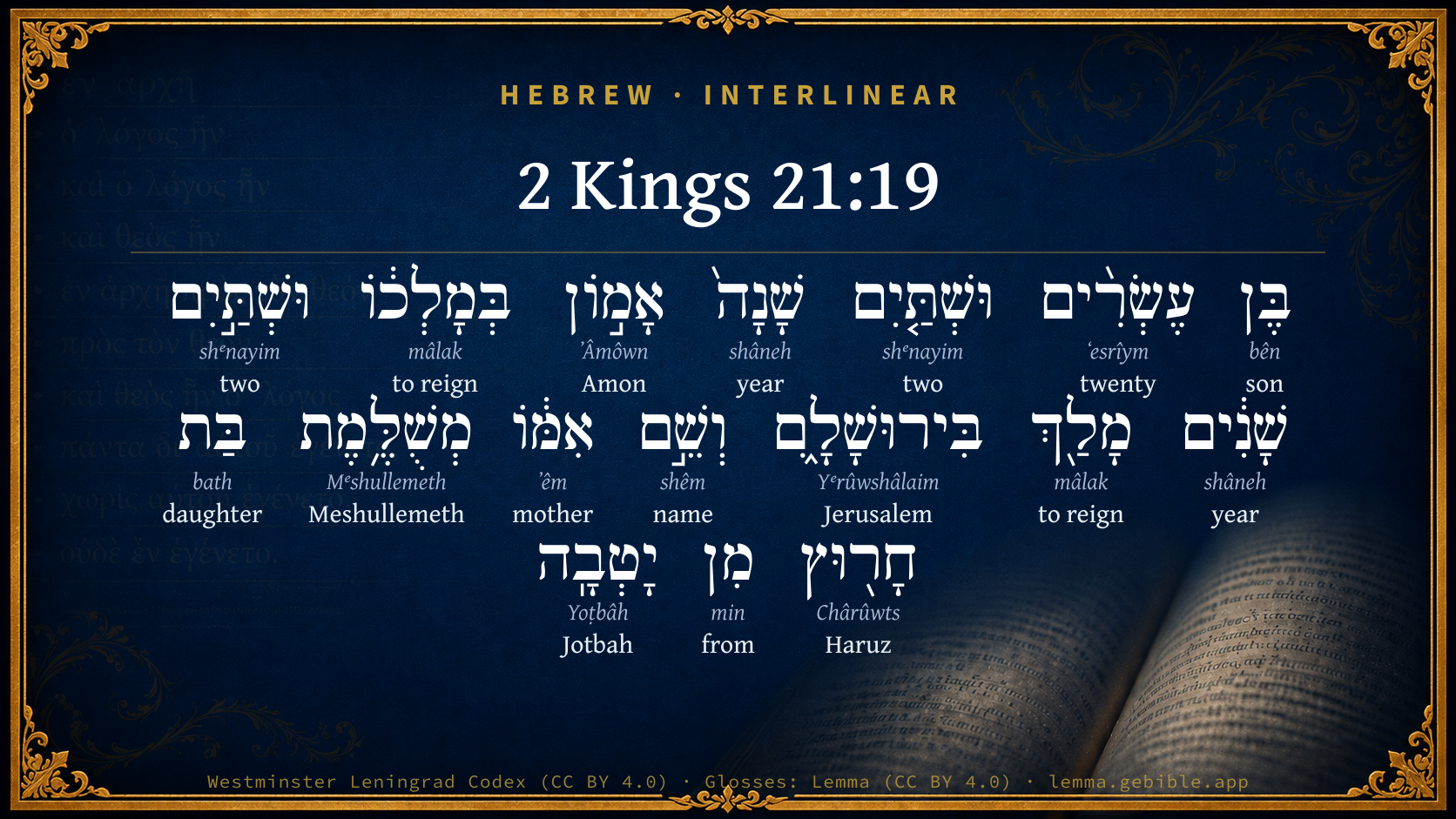
2 Kings 21:19

Hebrew (Westminster Leningrad Codex) 2 Kings 21:19 appears in the Hebrew Old Testament. The text above is from the Westminster Leningrad Codex. Each word links to its Strong’s number, a concise gloss, and parsing drawn from the Open Scriptures Hebrew Bible morphology. Click any word for its full Brown-Driver-Briggs (BDB) entry.
Download image
Cite this verse

2 Kings 21:19 (World English Bible). Public Domain. Lemma interlinear Bible study tool, https://lemma.gebible.app/v/2-kings/21/19.

Show BibTeX & RIS
BibTeX
RIS
English Translation
Amon was twenty-two years old when he began to reign; and he reigned two years in Jerusalem: and his mother's name was Meshullemeth the daughter of Haruz of Jotbah.
World English Bible · Public Domain
Highlights
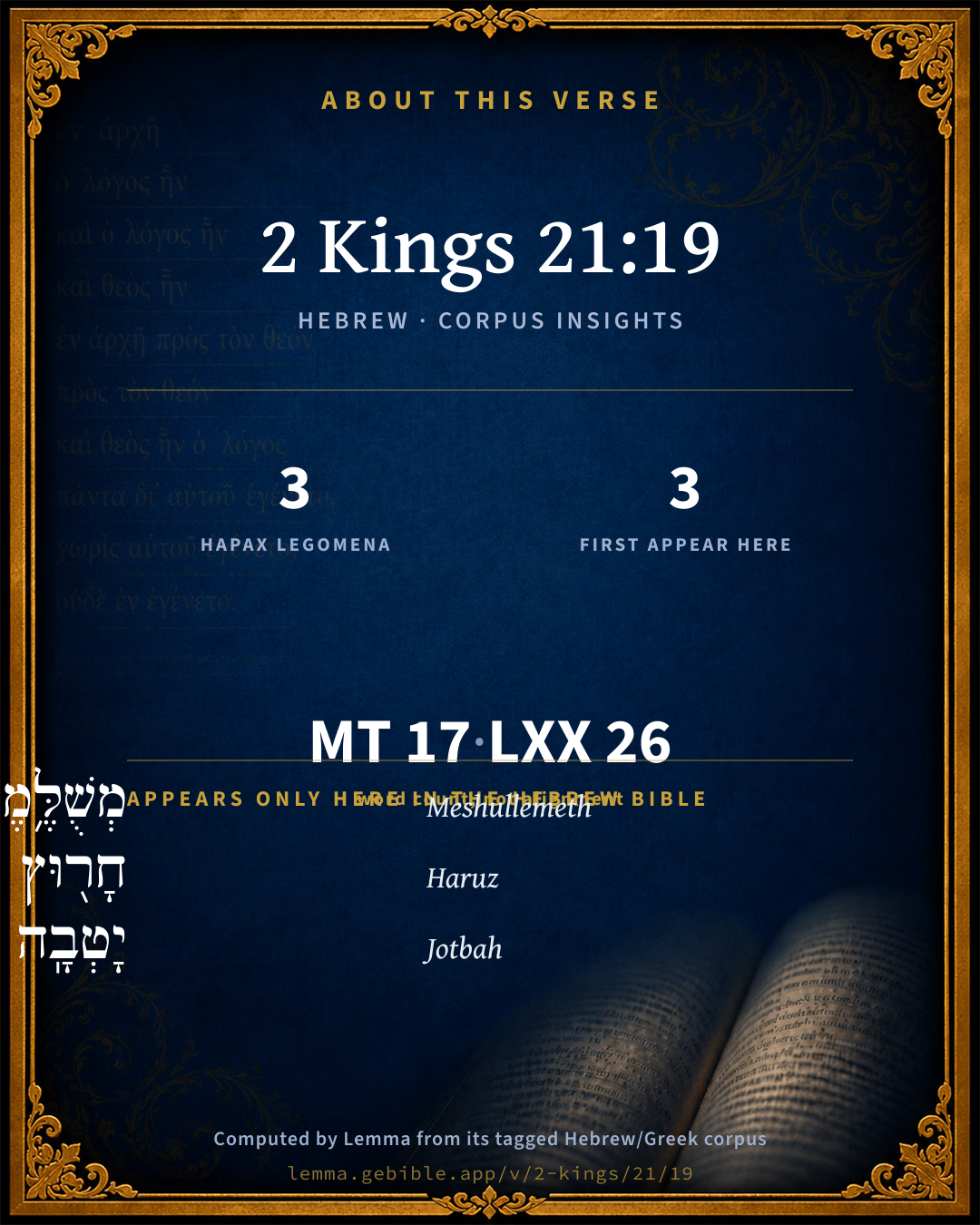
  • 3 hapax legomena — only here in the Hebrew Bible
  • 3 first appearances in the Hebrew Bible
Full analysis ↓
Download a study sheet

One document with this verse’s original text, its word-by-word gloss line, the meaning frame, cross-references with their text, attributed commentary, and full source and license credits — printable, and it pastes into notes with its structure intact.

This verse Autodidact and up

Study sheet (.html) Plain text (.txt)

A passage Seminary Student

Up to 50 verses in one chapter. A passage sheet keeps up to 6 commentary sources and 12 cross-references per verse, in the order this page ranks them, and says so on the sheet whenever that leaves anything out. Ask for a single verse and you get the Autodidact verse sheet above.

Everything on this page stays free to read, with no account — the sheet is a download of what is already on screen, not access to it.

Want to remove ads? Support Godless Engineer
Compare translations 3

The same verse in 3 English versions, stacked beneath the original-language interlinear above. Click any original word for its lexicon entry.

Each is an independent rendering of the whole verse — the interlinear is not word-aligned to these translations.

Highlighted words mark where these versions differ — a whole-verse word diff, not a word-by-word alignment.

  • World English Bible Public Domain
    Amon was twenty-two years old when he began to reign; and he reigned two years in Jerusalem: and his mother's name was Meshullemeth the daughter of Haruz of Jotbah.
  • King James Version Public Domain
    Amon was twenty and two years old when he began to reign, and he reigned two years in Jerusalem. And his mother's name was Meshullemeth, the daughter of Haruz of Jotbah.
  • unfoldingWord Literal Text CC BY-SA 4.0
    Amon a son of 22 years when he reigned, and he reigned two years in Jerusalem. And the name of his mother Meshullemeth, the daughter of Haruz, from Jotbah.

unfoldingWord Literal Text — © unfoldingWord, licensed CC BY-SA 4.0. Word-aligned USFM3 via Door43 (git.door43.org/unfoldingWord/en_ult).

Versions to compare (up to 4)

3 of 4 selected

Show all 18 translations

Every available English version of this verse, each an independent rendering of the whole verse.

  • World English Bible Public Domain
    Amon was twenty-two years old when he began to reign; and he reigned two years in Jerusalem: and his mother's name was Meshullemeth the daughter of Haruz of Jotbah.
  • Berean Standard Bible Public Domain
    Amon was twenty-two years old when he became king, and he reigned in Jerusalem two years. His mother’s name was Meshullemeth daughter of Haruz; she was from Jotbah.
  • Majority Standard Bible Public Domain
    Amon was twenty-two years old when he became king, and he reigned in Jerusalem two years. His mother’s name was Meshullemeth daughter of Haruz; she was from Jotbah.
  • King James Version Public Domain
    Amon was twenty and two years old when he began to reign, and he reigned two years in Jerusalem. And his mother's name was Meshullemeth, the daughter of Haruz of Jotbah.
  • American Standard Version (1901) Public Domain
    Amon was twenty and two years old when he began to reign; and he reigned two years in Jerusalem: and his mother's name was Meshullemeth the daughter of Haruz of Jotbah.
  • Revised Version (1885) Public Domain
    Amon was twenty and two years old when he began to reign; and he reigned two years in Jerusalem: and his mother’s name was Meshullemeth the daughter of Haruz of Jotbah.
  • Geneva Bible (1599) Public Domain
    Amon was two and twentie yere olde, when he began to reigne, and hee reygned two yeere in Ierusalem: his mothers name also was Meshullemeth the daughter of Haruz of Iotbah.
  • Douay-Rheims (1899) Public Domain
    Two and twenty years old was Amen when he began to reign, and he reigned two years in Jerusalem: the name of his mother was Messalemeth the daughter of Harus of Jeteba.
  • Young's Literal Translation Public Domain
    A son of twenty and two years `is' Amon in his reigning, and two years he hath reigned in Jerusalem, and the name of his mother `is' Meshullemeth daughter of Haruz of Jotbah,
  • Literal Standard Version CC BY-SA 4.0
    Amon [is] a son of twenty-two years in his reigning, and he has reigned two years in Jerusalem, and the name of his mother [is] Meshullemeth daughter of Haruz of Jotbah,
  • Unlocked Literal Bible CC BY-SA 4.0
    Amon was twenty-two years old when he began to reign; he reigned two years in Jerusalem. His mother's name was Meshullemeth; she was the daughter of Haruz of Jotbah.
  • unfoldingWord Literal Text CC BY-SA 4.0
    Amon a son of 22 years when he reigned, and he reigned two years in Jerusalem. And the name of his mother Meshullemeth, the daughter of Haruz, from Jotbah.
  • Darby Bible Public Domain
    Amon was twenty-two years old when he began to reign; and he reigned two years in Jerusalem; and his mother's name was Meshullemeth, daughter of Haruz of Jotbah.
  • World Messianic Bible Public Domain
    Amon was twenty-two years old when he began to reign; and he reigned two years in Jerusalem. His mother’s name was Meshullemeth the daughter of Haruz of Jotbah.
  • Webster's Bible Public Domain
    Amon was twenty and two years old when he began to reign, and he reigned two years in Jerusalem. And his mother's name was Meshullemeth, the daughter of Haruz of Jotbah.
  • Free Bible Version CC BY-SA 4.0
    Amon was twenty-two when he became king, and he reigned in Jerusalem for two years. His mother's name was Meshullemeth, daughter of Haruz. She came from Jotbah.
  • Bible in Basic English Public Domain
    Amon was twenty-two years old when he became king, ruling in Jerusalem for two years; his mother's name was Meshullemeth, the daughter of Haruz of Jotbah.
  • JPS Tanakh (1917) Public Domain
    Amon was twenty and two years old when he began to reign; and he reigned two years in Jerusalem; and his mother's name was Meshullemeth the daughter of Haruz of Jotbah.

Literal Standard Version (2020), Covenant Press — licensed CC BY-SA 4.0. Text via the HelloAO Bible API (eBible.org). Unlocked Literal Bible (unfoldingWord) — licensed CC BY-SA 4.0. Text via the HelloAO Bible API (eBible.org). unfoldingWord Literal Text — © unfoldingWord, licensed CC BY-SA 4.0. Word-aligned USFM3 via Door43 (git.door43.org/unfoldingWord/en_ult). Free Bible Version, Dr. Jonathan Gallagher — licensed CC BY-SA 4.0. Text via the HelloAO Bible API (eBible.org).

Word by word

More ways to search: Search by grammar → Find every occurrence → Compare this word →

Practice this passage: Drill this verse → Learn its vocabulary →

מְשֻׁלֶּ֥מֶת
Mᵉshullemeth
H4922
“Meshullemeth”
Noun, Proper
Part of Speech
Noun
Type
Proper
Full BDB Definition

Origin: from H4918

TWOT: None

Meshullemeth = "friend" - daughter of Haruz of Jotbah, wife of king Manasseh of Judah, and mother of king Amon of Judah
  1. בֶּן bên H1121 “son of” Noun, Common, Masculine, Singular, Construct
  2. עֶשְׂרִ֨ים ʻesrîym H6242 “twenty” Adjective, Cardinal number, Both, Plural, Absolute
  3. וּשְׁתַּ֤יִם shᵉnayim H8147 “and · two” Conjunction + Adjective, Cardinal number, Feminine, Dual, Absolute
  4. שָׁנָה֙ shâneh H8141 “year” Noun, Common, Feminine, Singular, Absolute
  5. אָמ֣וֹן ʼÂmôwn H526 “Amon” Noun, Proper
  6. בְּמָלְכ֔וֹ mâlak H4427 “in/at · to reign · him” Preposition + Verb, Qal, Infinitive Construct + Suffix, Personal, 3rd Person, Masculine, Singular
  7. וּשְׁתַּ֣יִם shᵉnayim H8147 “and · two” Conjunction + Adjective, Cardinal number, Feminine, Dual, Absolute
  8. שָׁנִ֔ים shâneh H8141 “years” Noun, Common, Feminine, Plural, Absolute
  9. מָלַ֖ךְ mâlak H4427 “to reign” Verb, Qal, Perfect, 3rd Person, Masculine, Singular
  10. בִּירוּשָׁלִָ֑ם Yᵉrûwshâlaim H3389 “in/at · Jerusalem” Preposition + Noun, Proper
  11. וְשֵׁ֣ם shêm H8034 “and · name of” Conjunction + Noun, Common, Masculine, Singular, Construct
  12. אִמּ֔וֹ ʼêm H517 “mother · his” Noun, Common, Feminine, Singular, Construct + Suffix, Personal, 3rd Person, Masculine, Singular
  13. בַּת bath H1323 “daughter of” Noun, Common, Feminine, Singular, Construct
  14. חָר֖וּץ Chârûwts H2743 “Haruz” Noun, Proper
  15. מִן min H4480 “from” Preposition
  16. יָטְבָֽה Yoṭbâh H3192 “Jotbah” Noun, Proper

About this verse

These counts appear in no published source. They are computed here, from the morphology-tagged text and Lemma’s own curated glosses. What Lemma adds →

17
words
14
distinct lemmas
Historical
section

Notable vocabulary

3 hapax legomena — words that appear only here in the entire Hebrew Bible:

  • מְשֻׁלֶּ֥מֶת Meshullemeth H4922
  • חָר֖וּץ Haruz H2743
  • יָטְבָֽה Jotbah H3192

First appearance in Scripture

These words make their first canonical appearance in the Hebrew Bible here:

  • מְשֻׁלֶּ֥מֶת Meshullemeth H4922
  • חָר֖וּץ Haruz H2743
  • יָטְבָֽה Jotbah H3192

Shared distinctive vocabulary

אָמ֣וֹן Amon H526 occurs in 17 verses of the Hebrew Bible. Also found in:

Grammatical profile

  • 2 verbs
  • 11 nouns
  • 3 adjectives
  • 1 preposition

Verb forms

  • בְּמָלְכ֔וֹ Qal · Infinitive Construct
  • מָלַ֖ךְ Qal · Perfect

Repetition

Words recur within this verse — often emphatic in Hebrew:

  • וּשְׁתַּ֤יִם two H8147 ×2
  • שָׁנָה֙ year H8141 ×2
  • בְּמָלְכ֔וֹ to reign H4427 ×2

Hebrew & Septuagint length

In English translation the verse runs 29 words from the Hebrew and 30 from the Septuagint (LXX English) — closely comparable.

A rough comparison of the two English renderings, which tokenize alike — not a word-level alignment.

Word counts can differ between the Hebrew and the Greek without any difference in meaning — e.g. the Hebrew direct-object marker אֵת has no separate Greek word, and Greek often adds the article ὁ.

In the original languages it is 17 Hebrew tokens and 26 Greek tokens — but the two are counted differently (Hebrew bundles its prefixes and suffixes into one token; the Greek is in lemma form), so that isn’t a like-for-like length.

Cross-references

7

Topical passages linked to 2 Kings 21:19 in the Treasury of Scripture Knowledge — connected by theme and wording, ordered by reader-vote popularity; previews shown in the World English Bible.

  • 2 Chronicles 33:21–23 Amon was twenty-two years old when he began to reign; and he reigned two years in Jerusalem.
  • 1 Kings 15:25 Nadab the son of Jeroboam began to reign over Israel in the second year of Asa king of Judah; and he reigned over Israel two years.
  • 1 Kings 16:8 In the twenty-sixth year of Asa king of Judah began Elah the son of Baasha to reign over Israel in Tirzah, [and reigned] two years.
  • 1 Kings 22:51 Ahaziah the son of Ahab began to reign over Israel in Samaria in the seventeenth year of Jehoshaphat king of Judah, and he reigned two years over Israel.
  • 2 Kings 15:23 In the fiftieth year of Azariah king of Judah Pekahiah the son of Menahem began to reign over Israel in Samaria, [and reigned] two years.
  • 1 Chronicles 3:14 Amon his son, Josiah his son.
  • Matthew 1:10 Hezekiah became the father of Manasseh. Manasseh became the father of Amon. Amon became the father of Josiah.

Cross-references courtesy of OpenBible.info (CC BY 4.0).

Hebrew and Greek witnesses Masoretic Hebrew ↔ Greek Septuagint

The same verse in the two great witnesses to the Old Testament, shown verse-for-verse.

These are two independent witnesses, not word-aligned to each other, and the Septuagint is shown in lemma (dictionary) form.

Hebrew 2 Kings 21:19 Masoretic · Westminster Leningrad Codex

בֶּן עֶשְׂרִ֨ים וּשְׁתַּ֤יִם שָׁנָה֙ אָמ֣וֹן בְּמָלְכ֔וֹ וּשְׁתַּ֣יִם שָׁנִ֔ים מָלַ֖ךְ בִּירוּשָׁלִָ֑ם וְשֵׁ֣ם אִמּ֔וֹ מְשֻׁלֶּ֥מֶת בַּת חָר֖וּץ מִן יָטְבָֽה

Amon was twenty-two years old when he began to reign; and he reigned two years in Jerusalem: and his mother's name was Meshullemeth the daughter of Haruz of Jotbah.

World English Bible · Public Domain

Greek LXX 2 Kings 21:19 Septuagint · lemma form

υἱός εἴκοσι καί δύο ἔτος αμων ἐν ὁ βασιλεύω αὐτός καί δύο ἔτος βασιλεύω ἐν ἰερουσαλήμ καί ὄνομα ὁ μήτηρ αὐτός μεσολλαμ θυγάτηρ αρους ἐκ ιετεβα

Twenty and two years old was Amos when he began to reign, and he reigned two years in Jerusalem: and his mother's name was Mesollam, daughter of Arus of Jeteba.

LXX2012 (modern English Septuagint) · Public Domain

On this verse, Ellicott's Commentary for English Readers discusses the Septuagint’s reading. Read the note in Commentary ↓

Hebrew: Westminster Leningrad Codex (CC BY 4.0). Greek: Septuagint (public domain); English from LXX2012 (modern English Septuagint) (Public Domain). How the Septuagint differs from the Hebrew →

Targum (Aramaic paraphrase)

1

The Targum is the ancient Jewish Aramaic paraphrase of the Hebrew Scriptures — an interpretive translation, not the Hebrew text itself. Onkelos (literal) and Pseudo-Jonathan (expansive) render the Torah, and Jonathan the Prophets. Coverage is partial: where no permissively-licensed English translation exists for a verse, only the Aramaic is shown. This is verse-level text, not a word-by-word alignment to the Hebrew.

  1. Targum Jonathan Prophets (Joshua–Malachi)
    בַּר עַסְרִין וְתַרְתֵּין שְׁנִין אָמוֹן כַּד מְלַךְ וְתַרְתֵּין שְׁנִין מְלַךְ בִּירוּשְׁלֵם וְשׁוּם אִמֵיהּ מְשֻׁלֶמֶת בַּת חָרוּץ מִן יָטְבָה:

    (no public-domain English translation for this verse)

    Targum Jonathan — Aramaic: “Mikraot Gedolot” (public domain). English: “Sefaria Community Translation” (CC0 1.0 (public-domain dedication)); “London "Chaldee Paraphrase," 1871” (public domain). Text via Sefaria.

Commentary

Notes on 2 Kings 21:19 from classic Christian and Jewish commentators (each source and its license shown beneath its notes). The classic Christian expositions comment on the surrounding passage and are grouped to its opening verse, so a note may address several verses; the Jewish commentaries on the Tanakh (Rashi and others) are per-verse, so they appear only where the commentator wrote on this verse.

Lemma curates 59 commentaries, every one of them public domain or Creative Commons licensed, each selected and text-cleaned for this edition rather than reprinted as found. About our sources →

Jamieson, Fausset & Brown

Robert Jamieson, A. R. Fausset & David Brown

AMON'S WICKED REIGN. (Kg2 21:19-26)

Amon was twenty and two years old when he began to reign--This prince continued the idolatrous policy of his father; and, after an inglorious reign of two years, he was massacred by some of his own domestics. The people slew the regicide conspirators and placed his son Josiah on the throne.

Next: 2 Kings Chapter 22

Jamieson, Fausset & Brown — Commentary Critical and Explanatory on the Whole Bible (1871) — public domain (CC PDM 1.0). Text via the HelloAO Bible API.

Adam Clarke's Commentary

Verse 19. He reigned two years in Jerusalem.] The remark of the rabbins is not wholly without foundation, that the sons of those kings who were idolaters, and who succeeded their fathers, seldom reigned more than two years. So Nadab, the son of Jeroboam, 1Kg 15:25; Elah, the son of Baasha, 1Kg 16:8; Ahaziah, the son of Ahab, 1Kg 22:51; and Amon, the son of Manasseh, as mentioned here, 2Kg 21:19.

Adam Clarke's Commentary on the Bible (1810–1826) — public domain. Text from a community e-Sword/MySword module.

Ellicott's Commentary for English Readers

THE REIGN OF AMON (2Ki_21:19-26).

(19) Amon.—The Vatican LXX. reads Αμώς, Amos (So Josephus Άμωσός). The name is perhaps that of the Egyptian sun-god Amen (Greek Αμμών), as Anion’s father was an idolater.

Meshullemeth.—Feminine form of Meshullam, “friend” i.e. of God; Isa_42:19. Ewald compares the Latin Pius, Pia, as a proper name.

Jotbah.—Thenius imitates the name with Gutstadi. St. Jerome says it was in Judah. A similar name occurs in Num_33:33; Deu_10:7

A Bible Commentary for English Readers, edited by Charles John Ellicott (1878–1897) — public domain. Text from a community e-Sword module.

Trapp's Complete Commentary

John Trapp

2Ki 21:19 Amon [was] twenty and two years old when he began to reign, and he reigned two years in Jerusalem. And his mother’s name [was] Meshullemeth, the daughter of Haruz of Jotbah.

Ver. 19. And he reigned two years in Jerusalem.] He was soon cut off for his great wickedness. Some grievous sinners God soon punisheth, lest his providence - but not all, lest his patience and promise of judgment - should be called into question. {a} Glycas saith that Amon hardened himself in sin by his father’s example, who took his swing in sin, and yet at length repented. So, thought he, will I do; wherefore he was soon sent out of the world for his presumption, dying in his sins, as 2Ch 33:23.

{a} August.

John Trapp, A Commentary or Exposition upon All the Books of the Old and New Testament (1647–1656) — public domain. Text from a community e-Sword module.

The Biblical Illustrator

Joseph S. Exell

2Ki_21:19-26

Amon was twenty and two years old when he began to reign.

Amon

The brief reign of Amon is only a sort of unimportant and miserable annex to that of his father. As he was twenty-two years old when he began to reign, he must have witnessed the repentance and reforming zeal of his father, if, in spite of all difficulties, we assume that narrative to be historical. In that ease, however, the young man was wholly untouched by the latter phase of Manassehs life, and flung himself headlong into the career of the kings earlier idolatries. He walked in all the ways that his father walked in, and served the idols that his father served, and worshipped them--which was the more extraordinary if Manassehs last acts had been to dethrone and destroy these strange gods. He even multiplied trespass, so that in his sons reign we find every form of abomination as triumphant as though Manasseh had never attempted to check the tide of evil. We know nothing more of Amon. Apparently he only reigned two years. He is the only Jewish king who bears the name of a foreign--an Egyptian--deity. For pictures of the state of things in this reign we may look to the prophets Zephaniah and Jeremiah, and they are forced to use the darkest colours. (Dexter Farrar.)

The Biblical Illustrator, edited by Joseph S. Exell (c. 1880s–1900s) — public domain. Text from a community e-Sword module.

Whedon's Commentary on the Bible

Daniel D. Whedon

REIGN OF AMOS, 2Ki_21:19-26.

19. Two years — The rabbies say, that the sons of idolatrous kings who succeeded their fathers seldom reigned more than two years, and Nadab, (1Ki_15:25,) Elah, (2Ki_16:8,) and Ahaziah, (2 Kings 22:51,) are cited as instances. The site of Jotbah is unknown.

Daniel D. Whedon (gen. ed.), Commentary on the Old and New Testaments (1874–1909) — public domain. Text from a community e-Sword module.

The Preacher's Complete Homiletical Commentary

Joseph S. Exell (gen. ed.)

HOMILETICS OF 2Ki_21:19-26

THE CRIME OF ASSASSINATION

I. Is but lightly regarded where religions principle is demoralized (2Ki_21:20-22). When the bonds of religious obligations are relaxed, the way is opened for the commission of the worst crimes. Every sin blunts the moral sense and makes it easier to sin again, until the lowest grade of crime is reached. The peace, safety, and prosperity of a nation are more indebted to the prevalence of true religion than the majority are inclined to admit. Religion is the curb that holds in check the fierce monster of crime, that would otherwise stalk through the land and work irreparable mischief.

II. Is unjustifiable, notwithstanding the wickedness of its victim. We stand aghast at the wickedness of those in power, and are apt to think any means justifiable that will put an end to it. Even the unjust detest the injustice of others. A hatred of evil may tempt one into hasty and excessive punishment of wrong, forgetting that “when our hatred is violent it sinks us even boneath those we hate.” It is difficult to restrain the national thirst for revenge when in the midst of injustice and suffering. “If the wicked flourish,” says Fuller, “and thou suffer, be not discouraged; they are fatted for destruction, thou art dieted for health.” We may safely leave the wicked in the hands of God. We may create greater evils by the way in which we strive to redress one single offence.

III. Is aggravated when committed by those whose duty it is to guard and protect (2Ki_21:23). Amon was slain by his court attendants, who took advantage of the confidence and trust reposed in them. In the most unguarded moment, and when least suspecting treachery, he was slain in the privacy of his palace; his servants, towards whom he had shown kindness and honour, became traitors and murderers.

Is there a crime

Beneath the roof of heaven that staius the soul

With more infernal hue than damned

Assassination!

Cibber.

And it certainly adds to the heinousness of the crime when the fatal blow is prompted by a false heart.

IV. Sooner or later meets with terrible punishment (2Ki_21:24). The conspirators and assassins met with a similar fate to their victim. Sin carries within it its own punishment. The most cleverly devised mischief is sure to return in some shape or other to plague the inventors.

This even-handed justice

Commends the ingredients of our poisoned chalice

To our own lips.

In the history of the kings we are now studying, there is nothing more frequently and impressively revealed than the operation of the inexorable law of retribution. The triumph of the wicked is brief. The gains of sin are not worth the ingenuity and toil. The wages of sin is death.

LESSONS:—

1. Assassination is not only a savage, but a useless, policy.

2. A wrong is never rectified by inflicting a greater wrong.

3. True religion teaches the sacredness of human life.

GERM NOTES ON THE VERSES.

2Ki_21:19-26. How wretchedly a king appears of whom history has nothing more to record than godleesness! As ithe king, so are his officers; as is the governor, so are the citizens. A depraved king ruins his country. Unfaithfulness is punished by unfaithfulness. Amon was not faithful to God: unfaithfulness was his punishment. He was murdered by his own servants, and these in their turn were punished by their own sin—they also were murdered (Mat_26:52; Luk_6:28). Tumult and murder, perpetrated now by the authorities, now by the people—those are the natural fruits which are produced in a land which has abandoned God, and in which His word is no longer respected.—Lange.

2Ki_21:20-24. Amon himself seems to have been popular; but, from whatever cause, he roused the enmity of the court party. It could not be laid to his charge that he refused to comply with the established heathenism, for it is expressly said that he walked in his father’s steps, and served and worshipped the idols he had set up, multiplying his trespasses, and showing some of the penitent humility of Manasseh’s late years. It may be, however, that signs of a serious thoughtfulness, not as yet carried into outward act, alarmed the dominant faction, for within two years he was cut off by a palace conspiracy, like that by which his ancestor, king Joash, perished.—Geikie.

2Ki_21:23-24. Conspiracy and murder.

1. Reveal a melancholy picture of national demoralization.

2. May occasion a worse state of misrule than that which is sought to be removed.

3. Recoil in terrible vengeance on the actors themselves.

The Preacher's Complete Homiletical Commentary (gen. ed. Joseph S. Exell; Funk & Wagnalls, c. 1892) — public domain (pre-1929). A full-Bible homiletical/sermon-outline anthology covering 65 of 66 books (2 John is absent from the source module). Text from a community e-Sword module.

Tyndale Open Study Notes

Tyndale Open Resources

21:19-22 Amon’s brief reign (642–640 BC) simply perpetuated his father’s wickedness. Manasseh’s repentance and reforms came too late to have any effect on Amon or on the people of Judah. • He abandoned the Lord: Amon became a total apostate (see also 2 Chr 33:23).

Tyndale Open Study Notes — © Tyndale Open Resources, licensed CC BY-SA 4.0. Text via the HelloAO Bible API.

Matthew Henry's Commentary

Here is a short account of the short and inglorious reign of Amon, the son of Manasseh. Whether Manasseh, in his blind and brutish zeal for his idols, had sacrificed his other sons - or whether, having been dedicated to his idols, they were refused by the people - so it was that his successor was a son not born till he was forty-five years old. And of him we are here told, 1. That his reign was very wicked: He forsook the God of his fathers (Kg2 21:22), disobeyed the commands given to his fathers, and disclaimed the covenant made with his fathers, and walked not in the way of the Lord, but in all the way which his father walked in, Kg2 21:20, Kg2 21:21. He trod in the steps of his father's idolatry, and revived that which he, in the latter end of his days, had put down. Note, Those who set bad examples, though they may repent themselves, yet cannot be sure that those whom they have drawn into sin by their example will repent; it is often otherwise. 2. That his end was very tragical. He having rebelled against God, his own servants conspired against him and slew him, probably upon some personal disgust, when he had reigned but two years, Kg2 21:23. His servants, who should have guarded him, murdered him; his own house, that should have been his castle of defence, was the place of his execution. He had profaned God's house with his idols, and now God suffered his own house to be polluted with his blood. How unrighteous soever those were that did it, God was righteous who suffered it to be done. Two things the people of the land did, by their representatives, hereupon: - (1.) They did justice on the traitors that had slain the king, and put them to death; for, though he was a bad king, he was their king, and it was a part of their allegiance to him to avenge his death. Thus they cleared themselves from having any hand in the crime, and did what was incumbent on them to deter others from the like villainous practices. (2.) They did a kindness to themselves in making Josiah his son king in his stead, whom probably the conspirators had a design to put by, but the people stood by him and settled him in the throne, encouraged, it may be, by the indications he gave, even in his early days, of a good disposition. Now they made a happy change from one of the worst to one of the best of all the kings of Judah. "Once more," says God, "they shall be tried with a reformation; and, if that succeed, well; if not, then after that I will cut them down." Amon was buried in the same garden where his father was, Kg2 21:26. If his father put himself under that humiliation, the people will put him under it.

Matthew Henry's Commentary on the Whole Bible (1708–1710) — public domain (CC PDM 1.0). Text via the HelloAO Bible API.

The Cambridge Bible for Schools and Colleges

gen. ed. J. J. S. Perowne

19–26. Amon king of Judah. His wicked reign and death (2Ch_33:21-25)

19. Jotbah] This place is not mentioned elsewhere in the Bible. It is generally thought to be the same as Jotbath or Jotbathah, mentioned (Num_33:33; Deu_10:7) as a station of the Israelites in their wanderings. It is called ‘a land of torrents of water’, so that it would be most likely a sort of oasis in the desert.

The Cambridge Bible for Schools and Colleges (gen. ed. J. J. S. Perowne; Cambridge University Press, 1878–1918) — public domain. Text from a community e-Sword module.

John Gill's Exposition

And Amon was twenty two years old when he began to reign,.... Being born in the forty fifth of his father's life, and in the thirty third of his reign:

and he reigned two years in Jerusalem; which, as Abarbinel observes, was the usual time the sons of wicked kings reigned, and instances in the son of Jeroboam, Baasha, and Ahab, Kg1 15:25. An Arabic writer (k) says, he reigned twelve years, but according to the Jews only two:

and his mother's name was Meshullemeth, the daughter of Haruz of Jotbah; there was a place called Jotbath, which was one of the stations of the children of Israel in the wilderness, Num 33:33 but it can scarcely be thought to be the same place.

(k) Abulpharag. Hist. Dynast. Dyn. 3. p. 67.

John Gill's Exposition of the Whole Bible (1746–1763) — public domain (CC PDM 1.0). Text via the HelloAO Bible API.

The Pulpit Commentary

Vers. 19-26. REIGN OF AMON. The short reign of Amen, the son and successor of Manasseh, was distinguished by only two events:

(1) his restoration of all the idolatrous and wicked practices which his father had upheld during the earlier portion of his reign; and

(2) his untimely death, in consequence of a conspiracy which was formed against him among the officers of his court. The writer of Kings is therefore able to dispatch his history in eight verses.

Amon was twenty and two years old when he began to reign. So Josephus ("Ant. Jud:," 10:4. and the author of Chronicles. (2Ch_33:21) He must have been born in B.C. 664, early in the reign of Asshur-bani-pal, probably in the year of that monarch"s expedition against Tyro. And he reigned two years in Jerusalem. The "twelve years" assigned to Amen By the Duke of Manchester ("Times of Daniel") are wholly devoid of foundation, and would throw the entire chronology into confusion. As it is, there is a very exact accordance in this part of the history between the profane and the scriptural dates. And his mother"s name was Meshullemeth, the daughter of Haruz of Jotbah. Jotbah is probably the same city as the "Jotbath" of Deu_10:7, and the "Jotbathah" of Num_33:33, which was in the neighborhood of Ezion-geber, and therefore probably in the Arabah. Josephus, however, says that Jot-bah was "a city of Judah.

Vers. 19-24. Amon"s wicked reign.

We have here more than one instructive lesson.

I THE POWER OF EVIL OFTEN COUNTERACTS THE GOOD. Manasseh had humbled himself before God. He obtained pardon. But he could not undo the guilty past. He could not undo the effects of his evil example and influence. We see how his sins were imitated and continued by his son Amen. How careful we should be what influence we exercise, what an example we leave behind us! Many a penitent sinner would give worlds if he could undo the consequences to others of his own past sins.

II THE LAW OF RETRIBUTION ONCE MORE. "With what measure ye mete, it shall be measured to you again." Every case of disobedience against God on the part of Israel and her kings brought its corresponding penalty. Amen was very defiant in his sin. "He humbled not himself before the Lord... but trespassed more and more". (2Ch_33:23) He cast off the authority of God. The day came when his own servants rose in rebellion against his authority, and conspired against him, and slew him. The conspirators also met with their punishment. "The people of the land slew all them that had conspired against King Amen" (ver. 24). Amid all its corruptions, the nation had not yet utterly lost the sense of justice. "Whatsoever a man soweth, that shall he also reap. C.H.I.

Vers. 19-26. Amon.

was twenty and two years old when he began to reign, and he reigned two years in Jerusalem." This is a short account of the brief and wicked reign of Amon the son of Manasseh.

I HIS REIGN WAS VERY SHORT. "He reigned two years," etc. The wonder is that such a man should have been permitted to breathe the breath of life. The sooner a bad king dies the better.

1. The better for his own sake. It restrains his own responsibilities and the aggravation of his guilt.

2. The better for his race. A fountain of moral poison has been dried up for him; the social air is less poisonous.

II HIS REIGN WAS VERY WICKED. "And he walked in all the way that his father walked in, and served the idols that his father served, and worshipped them." Of the wickedness of kings we have had abundant examples in these sketches. It is, indeed, a fire that burns athwart the ages.

III THE REIGN WAS VERY TRAGICAL. "And the servants of Amon conspired against him, and slew the king in his own house." How tragic the end of this man! His "servants," who should have guarded him, murdered him. "His own house," that should have been his castle of defense, was the place of his execution. In this verse the people:

1. Did justice to the traitors who murdered their king.

2. Did kindness to themselves in preparing the way for Josiah. D.T.

Vers. 19-26. The reign of Amon.

In this king we have

I A PALER COPY OF HIS FATHER. The only noteworthy facts about Amen, during his brief two years" reign, are:

1. His imitation of Manassehs wickedness. His father, during the greater part of his reign, had set an evil example, but towards its close he had repented. Amen did not imitate the repentance, but imitated the sin. He walked in all the ways his father had walked in, apparently setting up again the idols which his father had latterly removed. (2Ch_33:15)

2. He was the father of a good son, viz. Josiah, his successor. This is another of the surprising alternations of character already alluded to. How Josiah came out of such a home with the character he did must remain inexplicable, unless we are to attribute it to his grandfather"s influence after his return from Babylon.

II ANOTHER VICTIM OF COURT CONSPIRACY. Joash and Amaziah among the kings of Judah had met their death by conspiracy, (2Ki_12:20, 21 14:19) and many of the king of Israel had thus perished. But no king of Judah came to this end till he had first fallen away from God. Amen had a like miserable death. His servants conspired against him, and slew him in his own house. The fact that they dared to do so may indicate a tendency to reaction in the public mind against the excesses of idolatry in which the king indulged. The people, however, had no intention of allowing conspirators to seize the throne, so they slew the murderers, and set up Josiah as king. This, again, for a time led to a great reaction for the better. J.O.

The Pulpit Commentary (1880–1919), ed. H.D.M. Spence-Jones & Joseph S. Exell — public domain. Text from a community e-Sword module.

Keil & Delitzsch

C. F. Keil & F. Delitzsch

Reign of Amon (cf. Ch2 33:21-25). - Amon reigned only two years, and that in the spirit of his father, that is to say, worshipping all his idols. The city of Jotbah, from which his mother sprang, was, according to Jerome (in the Onom. s. v. Jethaba), urbs antiqua Judaeae; but it is not further known.

Keil & Delitzsch — Biblical Commentary on the Old Testament (1861–1891) — public domain (CC PDM 1.0). Text via the HelloAO Bible API. (Old Testament only.)

Kretzmann's Popular Commentary

Paul E. Kretzmann

Amon’s Reign

v. 19. Amon was twenty and two years old when he began to reign, and he reigned two years in Jerusalem. And his mother’s name was Meshullemeth, the daughter of Haruz of Jothbah, a city in Judah.

v. 20. And he did that which was evil in the sight of the Lord, as his father Manasseh did, namely, during the greater part of his reign.

v. 21. And he walked in all the way that his father walked in, and served the idols that his father served, not only those of Canaan and Phoenicia, but also of Assyria and Chaldea, and worshiped them.

v. 22. And he forsook the Lord God of his fathers, and walked not in the way of the Lord.

v. 23. And the servants of Amon, evidently his attendants, since it was a conspiracy in the palace only, conspired against him, and slew the king in his own house.

v. 24. And the people of the land, the inhabitants of Judah, slew all them that had conspired against King Amon, evidently with the intention of placing a man from their midst on the throne; and the people of the land made Josiah, his son, king in his stead.

v. 25. Now, the rest of the acts of Amon which he did, are they not written in the Book of the Chronicles of the Kings of Judah?

v. 26. And he was buried in his sepulcher in the garden of Uzza, his resting-place being next to that of his father; and Josiah, his son, reigned in his stead. The example of evil is always powerful, more so than the example of good. All the more is it necessary for us to resist evil in every form and not to allow it to gain the ascendancy.

Paul E. Kretzmann, Popular Commentary of the Bible (1921–1924) — public domain. Text from a community e-Sword module.

unfoldingWord translationNotes

Door43 World Missions Community

Amon ... Haruz

These are names of men. (See: How to Translate Names)

Meshullemeth

This is the name of a woman. (See: How to Translate Names)

Jotbah

This is the name of a city. (See: How to Translate Names)

what was evil in the sight of Yahweh

The sight of Yahweh represents Yahweh's judgment or evaluation. See how you translated this in 2 Kings 3:2. AT: "what was evil in Yahweh's judgment" or "what Yahweh considers to be evil" (See: Metaphor)

translationWords

reign

name

Manasseh

unfoldingWord translationNotes — © Distant Shores Media and the Door43 World Missions Community, licensed CC BY-SA 4.0. Source: git.door43.org/Door43/en_tn.

Lesson kit

Teaching starters — assembled from the data on this page, not authored interpretation. Every prompt links to the verse data it draws on. Edit before teaching.

2 Kings, in the Historical, opens this verse with 17 words (14 distinct Hebrew lemmas). Its most distinctive word is Mᵉshullemeth (“Meshullemeth”). A historical commentator’s framing appears above. Read the whole chapter for the surrounding context.

Discussion questions

  1. What does “Meshullemeth” (Mᵉshullemeth) contribute to the verse as a whole?
  2. 3 words here appear nowhere else in the Hebrew Bible. Why might the author reach for such rare wording?
  3. 3 words make their first appearance in Scripture here. What does this debut establish?
  4. How does 1 Kings 22:26, which shares the word «Amon», read alongside this verse?
  5. What does the repetition of “two” (2× in this one verse) do in this verse?
  6. These translations render this verse differently. What is at stake in choosing one wording over another?
  7. «בְּמָלְכ֔וֹ» is a Qal Infinitive Construct verb. How does that grammatical form shape the action described?
  8. Compare how Jamieson, Fausset & Brown and Adam Clarke's Commentary read this verse. Where do they agree or differ?

Things to notice

  • 3 words in this verse appear nowhere else in the Hebrew Bible.
  • 3 words make their first canonical appearance in Scripture here.
  • This verse counts 17 Hebrew ↔ 26 Greek words.
  • These translations choose different wording for 9 words in this verse.
  • “two” occurs 2× in this single verse.

Reading settings

Reading text

Shown beneath each verse's original-language words.

Old Testament
Old Testament edition

Read the OT as the Masoretic Hebrew (MT) or the Greek Septuagint (LXX).

English shown for the Greek Septuagint (in the Hebrew ↔ Greek comparison).

Comparing translations? Open the Compare panel on any verse page to stack up to four side by side.