
2 Kings 23:6

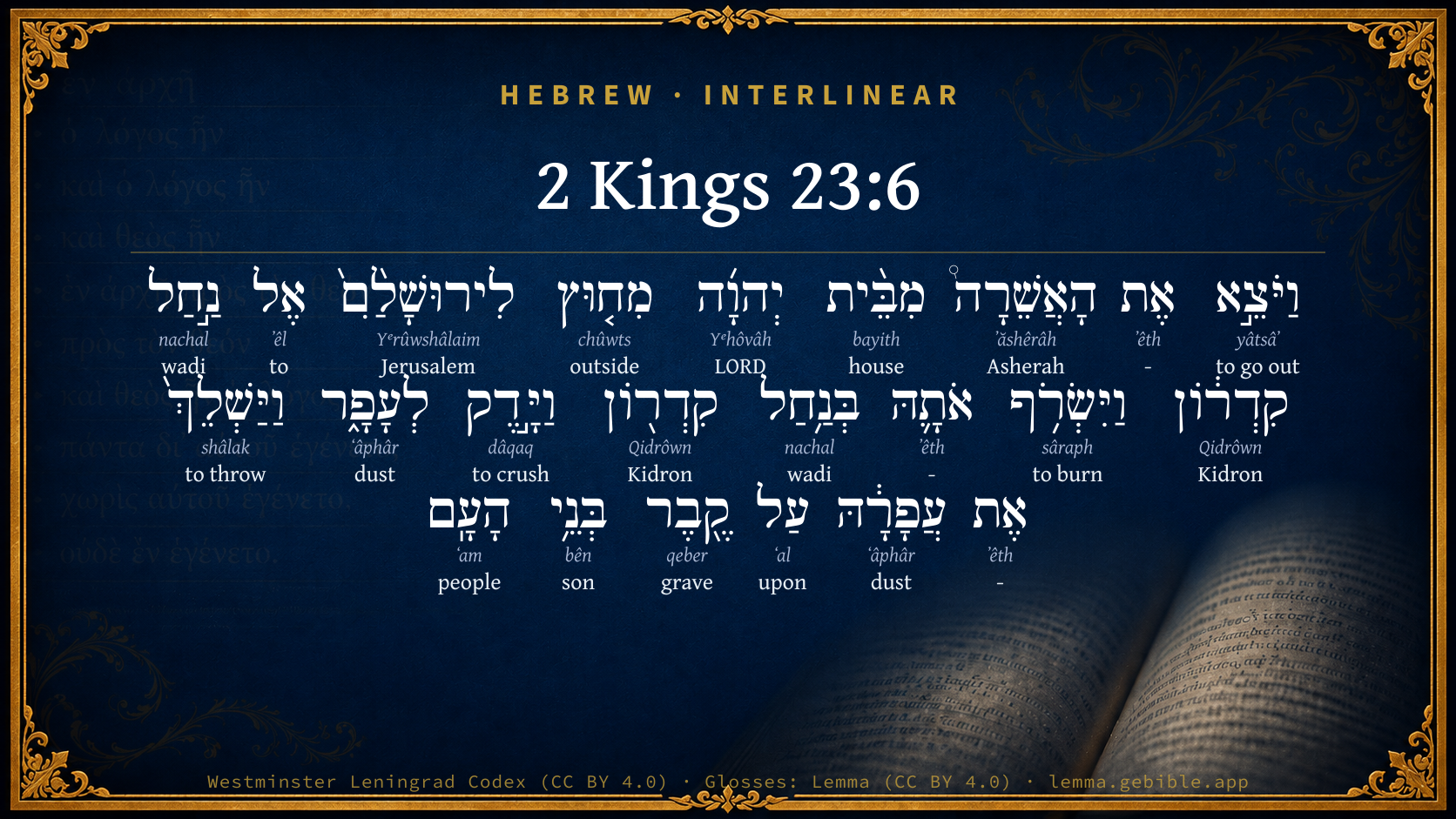
Hebrew (Westminster Leningrad Codex) 2 Kings 23:6 appears in the Hebrew Old Testament. The text above is from the Westminster Leningrad Codex. Each word links to its Strong’s number, a concise gloss, and parsing drawn from the Open Scriptures Hebrew Bible morphology. Click any word for its full Brown-Driver-Briggs (BDB) entry.
Download image
Cite this verse

2 Kings 23:6 (World English Bible). Public Domain. Lemma interlinear Bible study tool, https://lemma.gebible.app/v/2-kings/23/6.

Show BibTeX & RIS
BibTeX
RIS
English Translation
He brought out the Asherah from the house of Yahweh, outside of Jerusalem, to the brook Kidron, and burned it at the brook Kidron, and beat it to dust, and cast the dust of it on the graves of the common people.
World English Bible · Public Domain
Download a study sheet

One document with this verse’s original text, its word-by-word gloss line, the meaning frame, cross-references with their text, attributed commentary, and full source and license credits — printable, and it pastes into notes with its structure intact.

This verse Autodidact and up

Study sheet (.html) Plain text (.txt)

A passage Seminary Student

Up to 50 verses in one chapter. A passage sheet keeps up to 6 commentary sources and 12 cross-references per verse, in the order this page ranks them, and says so on the sheet whenever that leaves anything out. Ask for a single verse and you get the Autodidact verse sheet above.

Everything on this page stays free to read, with no account — the sheet is a download of what is already on screen, not access to it.

Want to remove ads? Support Godless Engineer
Compare translations 3

The same verse in 3 English versions, stacked beneath the original-language interlinear above. Click any original word for its lexicon entry.

Each is an independent rendering of the whole verse — the interlinear is not word-aligned to these translations.

Highlighted words mark where these versions differ — a whole-verse word diff, not a word-by-word alignment.

  • World English Bible Public Domain
    He brought out the Asherah from the house of Yahweh, outside of Jerusalem, to the brook Kidron, and burned it at the brook Kidron, and beat it to dust, and cast the dust of it on the graves of the common people.
  • King James Version Public Domain
    And he brought out the grove from the house of the LORD, without Jerusalem, unto the brook Kidron, and burned it at the brook Kidron, and stamped it small to powder, and cast the powder thereof upon the graves of the children of the people.
  • unfoldingWord Literal Text CC BY-SA 4.0
    And he brought out the Asherah from the house of Yahweh to outside of Jerusalem, to the Valley of Kidron, and he burned it in the Valley of Kidron. And he crushed to dust, and he threw its dust over the grave of the sons of the people.

unfoldingWord Literal Text — © unfoldingWord, licensed CC BY-SA 4.0. Word-aligned USFM3 via Door43 (git.door43.org/unfoldingWord/en_ult).

Versions to compare (up to 4)

3 of 4 selected

Show all 18 translations

Every available English version of this verse, each an independent rendering of the whole verse.

  • World English Bible Public Domain
    He brought out the Asherah from the house of Yahweh, outside of Jerusalem, to the brook Kidron, and burned it at the brook Kidron, and beat it to dust, and cast the dust of it on the graves of the common people.
  • Berean Standard Bible Public Domain
    He brought the Asherah pole from the house of the LORD to the Kidron Valley outside Jerusalem, and there he burned it, ground it to powder, and threw its dust on the graves of the common people.
  • Majority Standard Bible Public Domain
    He brought the Asherah pole from the house of the LORD to the Kidron Valley outside Jerusalem, and there he burned it, ground it to powder, and threw its dust on the graves of the common people.
  • King James Version Public Domain
    And he brought out the grove from the house of the LORD, without Jerusalem, unto the brook Kidron, and burned it at the brook Kidron, and stamped it small to powder, and cast the powder thereof upon the graves of the children of the people.
  • American Standard Version (1901) Public Domain
    And he brought out the Asherah from the house of Jehovah, without Jerusalem, unto the brook Kidron, and burned it at the brook Kidron, and beat it to dust, and cast the dust thereof upon the graves of the common people.
  • Revised Version (1885) Public Domain
    And he brought out the Asherah from the house of the LORD, without Jerusalem, unto the brook Kidron, and burned it at the brook Kidron, and stamped it small to powder, and cast the powder thereof upon the graves of the common people.
  • Geneva Bible (1599) Public Domain
    And he brought out the groue from the Temple of the Lord without Ierusalem vnto the valley of Kedron, and burnt it in the valley Kedron, and stampt it to pouder, and cast the dust thereof vpon the graues of the children of the people.
  • Douay-Rheims (1899) Public Domain
    And he caused the grove to be carried out from the house of the Lord without Jerusalem to the valley of Cedron, and he burnt it there, and reduced it to dust, and cast the dust upon the graves of the common people.
  • Young's Literal Translation Public Domain
    And he bringeth out the shrine from the house of Jehovah to the outside of Jerusalem, unto the brook Kidron, and burneth it at the brook Kidron, and beateth it small to dust, and casteth its dust on the grave of the sons of the people.
  • Literal Standard Version CC BY-SA 4.0
    And he brings out the Asherah from the house of YHWH to the outside of Jerusalem, to the Brook of Kidron, and burns it at the Brook of Kidron, and beats it small to dust, and casts its dust on the grave of the sons of the people.
  • Unlocked Literal Bible CC BY-SA 4.0
    He brought out the Asherah pole from the temple of Yahweh, outside Jerusalem to the Kidron Valley and burned it there. He beat it to dust and threw that dust onto the graves of the common people.
  • unfoldingWord Literal Text CC BY-SA 4.0
    And he brought out the Asherah from the house of Yahweh to outside of Jerusalem, to the Valley of Kidron, and he burned it in the Valley of Kidron. And he crushed to dust, and he threw its dust over the grave of the sons of the people.
  • Darby Bible Public Domain
    And he brought out the Asherah from the house of Jehovah, outside Jerusalem, to the torrent of Kidron, and burned it at the torrent of Kidron, and stamped it small to powder, and cast the powder upon the graves of the children of the people.
  • World Messianic Bible Public Domain
    He brought out the Asherah from the LORD’s house, outside of Jerusalem, to the brook Kidron, and burned it at the brook Kidron, and beat it to dust, and cast its dust on the graves of the common people.
  • Webster's Bible Public Domain
    And he brought out the grove from the house of the LORD, without Jerusalem, to the brook Kidron, and burned it at the brook Kidron, and stamped it small to powder, and cast the powder of it upon the graves of the children of the people.
  • Free Bible Version CC BY-SA 4.0
    He removed the Asherah pole from the Lord's Temple and took it to the Kidron Valley outside Jerusalem. He burned it there, ground it into dust, and threw its dust over the graves of the ordinary people.
  • Bible in Basic English Public Domain
    And he took the Asherah from the house of the Lord, outside Jerusalem to the stream Kidron, burning it by the stream and crushing it to dust, and he put the dust on the place where the bodies of the common people were put to rest.
  • JPS Tanakh (1917) Public Domain
    And he brought out the Asherah from the house of the LORD, without Jerusalem, unto the brook Kidron, and burned it at the brook Kidron, and stamped it small to powder, and cast the powder thereof upon the graves of the common people.

Literal Standard Version (2020), Covenant Press — licensed CC BY-SA 4.0. Text via the HelloAO Bible API (eBible.org). Unlocked Literal Bible (unfoldingWord) — licensed CC BY-SA 4.0. Text via the HelloAO Bible API (eBible.org). unfoldingWord Literal Text — © unfoldingWord, licensed CC BY-SA 4.0. Word-aligned USFM3 via Door43 (git.door43.org/unfoldingWord/en_ult). Free Bible Version, Dr. Jonathan Gallagher — licensed CC BY-SA 4.0. Text via the HelloAO Bible API (eBible.org).

Word by word

More ways to search: Search by grammar → Find every occurrence → Compare this word →

Practice this passage: Drill this verse → Learn its vocabulary →

קִדְר֔וֹן
Qidrôwn
H6939
“Kidron”
Noun, Proper
Part of Speech
Noun
Type
Proper
Full BDB Definition

Origin: from H6937

TWOT: None

Kidron = "dark" - a stream east of Jerusalem
  1. וַיֹּצֵ֣א yâtsâʼ H3318 “and · to go out” Conjunction + Verb, Hiphil, Sequential Imperfect, 3rd Person, Masculine, Singular
  2. אֶת ʼêth H853 “-” Particle, Direct Object
  3. הָאֲשֵׁרָה֩ ʼăshêrâh H842 “the · Asherah” Particle, Definite Article + Noun, Proper
  4. מִבֵּ֨ית bayith H1004 “from · house of” Preposition + Noun, Common, Masculine, Singular, Construct
  5. יְהוָ֜ה Yᵉhôvâh H3068 “LORD” Noun, Proper
  6. מִח֤וּץ chûwts H2351 “from · outside” Preposition + Noun, Common, Masculine, Singular, Absolute
  7. לִירוּשָׁלִַ֨ם֙ Yᵉrûwshâlaim H3389 “to/for · Jerusalem” Preposition + Noun, Proper
  8. אֶל ʼêl H413 “to” Preposition
  9. נַ֣חַל nachal H5158 “wadi of” Noun, Common, Masculine, Singular, Construct
  10. וַיִּשְׂרֹ֥ף sâraph H8313 “and · to burn” Conjunction + Verb, Qal, Sequential Imperfect, 3rd Person, Masculine, Singular
  11. אֹתָ֛הּ ʼêth H853 “- · her” Particle, Direct Object + Suffix, Personal, 3rd Person, Feminine, Singular
  12. בְּנַ֥חַל nachal H5158 “in/at · wadi of” Preposition + Noun, Common, Masculine, Singular, Construct
  13. קִדְר֖וֹן Qidrôwn H6939 “Kidron” Noun, Proper
  14. וַיָּ֣דֶק dâqaq H1854 “and · to crush” Conjunction + Verb, Hiphil, Sequential Imperfect, 3rd Person, Masculine, Singular
  15. לְעָפָ֑ר ʻâphâr H6083 “to/for · dust” Preposition + Noun, Common, Masculine, Singular, Absolute
  16. וַיַּשְׁלֵךְ֙ shâlak H7993 “and · to throw” Conjunction + Verb, Hiphil, Sequential Imperfect, 3rd Person, Masculine, Singular
  17. אֶת ʼêth H853 “-” Particle, Direct Object
  18. עֲפָרָ֔הּ ʻâphâr H6083 “dust · her” Noun, Common, Masculine, Singular, Construct + Suffix, Personal, 3rd Person, Feminine, Singular
  19. עַל ʻal H5921 “upon” Preposition
  20. קֶ֖בֶר qeber H6913 “grave of” Noun, Common, Masculine, Singular, Construct
  21. בְּנֵ֥י bên H1121 “sons of” Noun, Common, Masculine, Plural, Construct
  22. הָעָֽם ʻam H5971 “the · people” Particle, Definite Article + Noun, Common, Masculine, Singular, Absolute

About this verse

These counts appear in no published source. They are computed here, from the morphology-tagged text and Lemma’s own curated glosses. What Lemma adds →

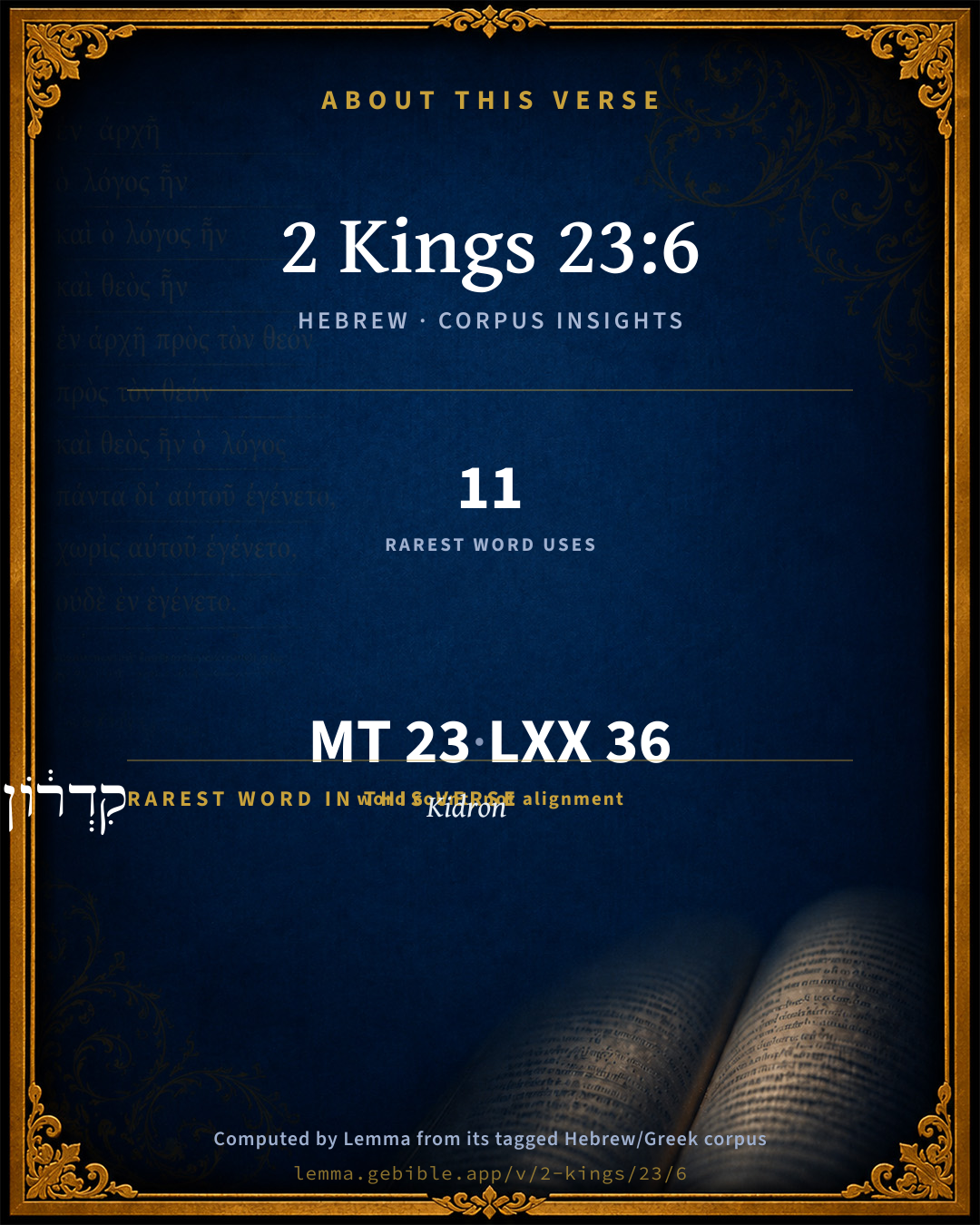
23
words
18
distinct lemmas
Historical
section

Notable vocabulary

The rarest word here is קִדְר֔וֹן Kidron H6939 — appearing just 11 times in the whole Hebrew Bible.

Shared distinctive vocabulary

קִדְר֔וֹן Kidron H6939 occurs in 10 verses of the Hebrew Bible. Also found in:

Grammatical profile

  • 4 verbs
  • 14 nouns
  • 2 prepositions
  • 3 particles

Verb forms

  • וַיֹּצֵ֣א Hiphil · Sequential Imperfect
  • וַיִּשְׂרֹ֥ף Qal · Sequential Imperfect
  • וַיָּ֣דֶק Hiphil · Sequential Imperfect
  • וַיַּשְׁלֵךְ֙ Hiphil · Sequential Imperfect

Repetition

Words recur within this verse — often emphatic in Hebrew:

  • נַ֣חַל wadi H5158 ×2
  • קִדְר֔וֹן Kidron H6939 ×2
  • לְעָפָ֑ר dust H6083 ×2

Hebrew & Septuagint length

In English translation the verse runs 42 words from the Hebrew and 41 from the Septuagint (LXX English) — closely comparable.

A rough comparison of the two English renderings, which tokenize alike — not a word-level alignment.

Word counts can differ between the Hebrew and the Greek without any difference in meaning — e.g. the Hebrew direct-object marker אֵת has no separate Greek word, and Greek often adds the article ὁ.

In the original languages it is 23 Hebrew tokens and 36 Greek tokens — but the two are counted differently (Hebrew bundles its prefixes and suffixes into one token; the Greek is in lemma form), so that isn’t a like-for-like length.

Cross-references

11

Topical passages linked to 2 Kings 23:6 in the Treasury of Scripture Knowledge — connected by theme and wording, ordered by reader-vote popularity; previews shown in the World English Bible.

  • 2 Kings 23:15 Moreover the altar that was at Bethel, and the high place which Jeroboam the son of Nebat, who made Israel to sin, had made, even that altar and the high place he broke down; and he burned the high place and beat it to dust, and burned the Asherah.
  • 2 Chronicles 34:4 They broke down the altars of the Baals in his presence; and the sun-images that were on high above them he hewed down; and the Asherim, and the engraved images, and the molten images, he broke in pieces, and made dust of them, and strewed it on the graves [of those] who had sacrificed to them.
  • Exodus 32:20 He took the calf which they had made, and burnt it with fire, ground it to powder, and scattered it on the water, and made the children of Israel drink of it.
  • Deuteronomy 7:25 The engraved images of their gods shall you burn with fire: you shall not covet the silver or the gold that is on them, nor take it to you, lest you be snared therein; for it is an abomination to Yahweh your God.
  • Deuteronomy 9:21 I took your sin, the calf which you had made, and burnt it with fire, and stamped it, grinding it very small, until it was as fine as dust: and I cast the dust of it into the brook that descended out of the mountain.
  • Judges 3:7 The children of Israel did that which was evil in the sight of Yahweh, and forgot Yahweh their God, and served the Baals and the Asheroth.
  • 1 Kings 14:23 For they also built them high places, and pillars, and Asherim, on every high hill, and under every green tree;
  • 1 Kings 16:33 Ahab made the Asherah; and Ahab did yet more to provoke Yahweh, the God of Israel, to anger than all the kings of Israel who were before him.
  • 2 Kings 10:27 They broke down the pillar of Baal, and broke down the house of Baal, and made it a latrine, to this day.
  • 2 Kings 21:7 He set the engraved image of Asherah, that he had made, in the house of which Yahweh said to David and to Solomon his son, In this house, and in Jerusalem, which I have chosen out of all the tribes of Israel, will I put my name forever;
  • Jeremiah 17:2 while their children remember their altars and their Asherim by the green trees on the high hills.

Cross-references courtesy of OpenBible.info (CC BY 4.0).

Hebrew and Greek witnesses Masoretic Hebrew ↔ Greek Septuagint

The same verse in the two great witnesses to the Old Testament, shown verse-for-verse.

These are two independent witnesses, not word-aligned to each other, and the Septuagint is shown in lemma (dictionary) form.

Hebrew 2 Kings 23:6 Masoretic · Westminster Leningrad Codex

וַיֹּצֵ֣א אֶת הָאֲשֵׁרָה֩ מִבֵּ֨ית יְהוָ֜ה מִח֤וּץ לִירוּשָׁלִַ֨ם֙ אֶל נַ֣חַל קִדְר֔וֹן וַיִּשְׂרֹ֥ף אֹתָ֛הּ בְּנַ֥חַל קִדְר֖וֹן וַיָּ֣דֶק לְעָפָ֑ר וַיַּשְׁלֵךְ֙ אֶת עֲפָרָ֔הּ עַל קֶ֖בֶר בְּנֵ֥י הָעָֽם

He brought out the Asherah from the house of Yahweh, outside of Jerusalem, to the brook Kidron, and burned it at the brook Kidron, and beat it to dust, and cast the dust of it on the graves of the common people.

World English Bible · Public Domain

Greek LXX 2 Kings 23:6 Septuagint · lemma form

καί ἐκφέρω ὁ ἄλσος ἐκ οἶκος κύριος ἔξωθεν ἰερουσαλήμ εἰς ὁ χειμάρρους κεδρων καί κατακαίω αὐτός ἐν ὁ χειμάρρους κεδρων καί λεπτύνω εἰς χοῦς καί ῥίπτω ὁ χοῦς αὐτός εἰς ὁ τάφος ὁ υἱός ὁ λαός

And he carried out the grove from the house of the Lord to the brook Kedron, and burned it at the brook Kedron, and reduced it to powder, and cast its powder on the sepulchres of the sons of the people.

LXX2012 (modern English Septuagint) · Public Domain

On this verse, John Gill's Exposition discusses the Septuagint’s reading. Read the note in Commentary ↓

Hebrew: Westminster Leningrad Codex (CC BY 4.0). Greek: Septuagint (public domain); English from LXX2012 (modern English Septuagint) (Public Domain). How the Septuagint differs from the Hebrew →

Targum (Aramaic paraphrase)

1

The Targum is the ancient Jewish Aramaic paraphrase of the Hebrew Scriptures — an interpretive translation, not the Hebrew text itself. Onkelos (literal) and Pseudo-Jonathan (expansive) render the Torah, and Jonathan the Prophets. Coverage is partial: where no permissively-licensed English translation exists for a verse, only the Aramaic is shown. This is verse-level text, not a word-by-word alignment to the Hebrew.

  1. Targum Jonathan Prophets (Joshua–Malachi)
    וְאַפֵיק יַת אֲשֵׁירָתָא מִבֵּית מַקְדְשָׁא דַייָ מִבָּרָא לִירוּשְׁלֵם לְמֵישַׁר קִדְרוֹן וְאוֹקִיד יָתָהּ בְּנַחְלָא דְקִדְרוֹן וְאַדְקָהּ לְעַפְרָא וּרְמָא יַת עַפְרָהּ לְקִבְרֵי בְּנֵי גָלַיָא:

    (no public-domain English translation for this verse)

    Targum Jonathan — Aramaic: “Mikraot Gedolot” (public domain). English: “Sefaria Community Translation” (CC0 1.0 (public-domain dedication)); “London "Chaldee Paraphrase," 1871” (public domain). Text via Sefaria.

Commentary

Notes on 2 Kings 23:6 from classic Christian and Jewish commentators (each source and its license shown beneath its notes). The classic Christian expositions comment on the surrounding passage and are grouped to its opening verse, so a note may address several verses; the Jewish commentaries on the Tanakh (Rashi and others) are per-verse, so they appear only where the commentator wrote on this verse.

Lemma curates 59 commentaries, every one of them public domain or Creative Commons licensed, each selected and text-cleaned for this edition rather than reprinted as found. About our sources →

Trapp's Complete Commentary

John Trapp

2Ki 23:6 And he brought out the grove from the house of the LORD, without Jerusalem, unto the brook Kidron, and burned it at the brook Kidron, and stamped [it] small to powder, and cast the powder thereof upon the graves of the children of the people.

Ver. 6. And he brought out the grove.] See on 2Ki 21:7.

Upon the graves of the children of the people.] The vulgar sort, the rascality, who are usually most irrational, and so most idolatrous. "Thou knowest the people, that they are set on mischief," said Aaron of those that said unto him, "Make us gods," &c. {Exo 32:22-23}

John Trapp, A Commentary or Exposition upon All the Books of the Old and New Testament (1647–1656) — public domain. Text from a community e-Sword module.

Joseph Benson's Commentary

2Ki 23:6. And cast the powder thereof upon the graves — By the law, a ceremonial uncleanness was contracted by the touch of a grave, so that by casting these ashes here, he declared them most impure, and that none could touch them without making themselves unclean thereby. The Chaldee renders it, He cast it into the graves, to signify that he would have all idolatry buried out of his sight, as a loathsome thing. Of the children of the people — The common people, whose graves were made together in some common place, which was generally accounted very impure and contemptible, and therefore a fit place for this filth to be thrown into. But the Hebrew here is more properly rendered, Of that people; that is, those idolatrous people, as it is expressed 2Ch 34:4.

Joseph Benson's Commentary on the Old and New Testaments (1811–1818) — public domain. Text from a community e-Sword module.

Geneva Bible (1599)

Geneva Bible translators

He removed the grove which idolaters for devotion had planted near unto the Temple, contrary to the commandment of the Lord, Deut. 16:21, or as some read, the similitude of a grove which was hung in the Temple.

Both in contempt of the idols and reproach of them which had worshipped them in their lives.

Geneva Bible (1599) marginal notes — public domain. Text via Bolls.life.

Jamieson, Fausset & Brown

Robert Jamieson, A. R. Fausset & David Brown

brought out the grove--that is, Asherah, the mystic tree, placed by Manasseh in the temple [Kg2 21:5; Ch2 33:5], removed by him after his conversion [Ch2 33:15], but replaced in the sanctuary by his wicked son Amon [Kg2 21:20-21]. Josiah had it taken to Kidron, burnt the wood, ground the metal about it to powder, and strewed the ashes "on the graves of the children of the people." The poor were buried in a common on part of the valley of Kidron. But reference is here made to the graves "of those that had sacrificed" (Ch2 34:4).

Jamieson, Fausset & Brown — Commentary Critical and Explanatory on the Whole Bible (1871) — public domain (CC PDM 1.0). Text via the HelloAO Bible API.

Adam Clarke's Commentary

Verse 6. He brought out the grove] He brought out the idol Asherah. 2Kg 21:26.

Upon the graves of the children of the people.] I believe this; means the burial-place of the common people.

Adam Clarke's Commentary on the Bible (1810–1826) — public domain. Text from a community e-Sword/MySword module.

Ellicott's Commentary for English Readers

(6) And he brought out the grove . . .—The Asherah set up by Manasseh (2Ki_21:3; 2Ki_21:7), and removed by him on his repentance (2Ch_33:15), but restored (probably) by Amon (2Ki_21:21).

Unto the brook . . . at the brook.—Unto the ravine . . . in the ravine, or wady.

The graves of the children (sons) of the people—i.e., the common graves (Jer_26:23); a mark of utter contempt: 2Ch_34:4 paraphrases, “the graves of them that sacrificed unto them.”

A Bible Commentary for English Readers, edited by Charles John Ellicott (1878–1897) — public domain. Text from a community e-Sword module.

The Cambridge Bible for Schools and Colleges

gen. ed. J. J. S. Perowne

6. without Jerusalem, unto the brook Kidron] So that nothing of the polluting idol might remain, even in its destruction, within the holy city. On the brook Kidron, and its connexion with the destruction of other idols, see note on 1Ki_15:13.

upon the graves of the children of the people] R.V. of the common people. The A.V. renders the same words thus in Jer_26:23. Those who could not afford to have graves cut out of the rocks and made secure by a stone at the entrance, were laid in the ground at some distance from the city. The reason for desiring a grave in the rock was lest the prowling wild beasts, which were not uncommon in the land, might disturb the dead bodies. The Chronicler (2Ch_34:4) says the dust was strewn ‘on the graves of them that had sacrificed’ unto the idols. This would imply that a special burying-place had been made for those who had adopted the idolatries that had been introduced; a thing which is very improbable.

The Cambridge Bible for Schools and Colleges (gen. ed. J. J. S. Perowne; Cambridge University Press, 1878–1918) — public domain. Text from a community e-Sword module.

John Gill's Exposition

And he brake down the houses of the Sodomites that were by the house of the Lord,.... Near the temple were apartments, in which men, the worshippers of idols, prostituted their bodies to each other; committing that unnatural sin with one another, which has its name from Sodom, and from which those are so called, and which sin they committed in honour of the idols they worshipped; to such vile affections were they, in a judicial manner, delivered up, because of their idolatry; see Rom 1:27 the word signifies "Holy Ones", they being called so by an antiphrasis; though Abarbinel thinks these were the idolatrous priests, whom the worshippers of idols reckoned "holy", and so built houses for them near the temple to lodge in; the Targum is,"and broke down the houses of things consecrated to idols,''where they were put; and Theodoret on the place observes, that by an homonymy, they called the demons or idols themselves "Holy Ones"; and it is not likely, indeed, that the Sodomites should be

where the women wove hangings for the grove; that is, for Astarte, as the same writer observes: or "curtains", as the Jewish writers generally interpret it, in which either the idol was enclosed, or these made apartments for the idolaters to commit their abominable wickedness privately; though the Syriac and Arabic versions are,"they wove garments for the idols that were there;''and so the Septuagint version, of the Complutensian edition; that is, they wove garments for the goddess Astarte, which they dressed her with: the word signifies "houses", and may mean the shrines of the idol made of woven work.

John Gill's Exposition of the Whole Bible (1746–1763) — public domain (CC PDM 1.0). Text via the HelloAO Bible API.

Haydock's Catholic Bible Commentary

Grove. The idol of Astarte, or the representation of a grove in sculpture. (Haydock) --- People, who were not rich enough to have a sepulchre. Jeremias (xix. 11.) threatens the people of Jerusalem with such a burial. (Calmet) --- The common people here means the idolaters, 2 Paralipomenon xxxiv. 4. (Haydock)

George Leo Haydock (1774–1849), Haydock's Catholic Family Bible and Commentary, 1859 edition — public domain. Excludes Psalms (Douay-Rheims chapter numbering differs from Protestant) and Deuterocanonical books (Catholic canon only).

Matthew Poole's English Annotations

The grove: See Poole "2Ki 23:4". Of the children of the people, i.e. of the common people, whose graves were made together in some common place, which was generally accounted very impure and contemptible, and therefore a fit place for this filth to be thrown into. Or, of bastards, who are oft called

the children of the people; who as they had this brand of infamy laid upon them, that they might not enter into the congregation of the Lord, Deu 23:2; so possibly they were exposed to this further ignominy, to be buried in a peculiar, and in the most infamous place. Or rather, as it is in the Hebrew, of that people, i.e. those idolatrous people, as it is explained, 2Ch 34:4, and here sufficiently implied in this and the foregoing verse.

Matthew Poole's English Annotations on the Holy Bible (1683–1685) — public domain. Text from a community e-Sword/MySword module.

Whedon's Commentary on the Bible

Daniel D. Whedon

6. Brought out the grove — Rather, the Asherah image, mentioned in 2Ki_21:7.

Kidron — See on 2Ki_23:4.

Graves of the children of the people — That is, of the common people. See Jer_26:23. 2Ch_34:4, says, “Upon the graves of them that had sacrificed unto them;” but that passage seems to refer to other images of Asherah, to which, however, many of the common people may have often sacrificed. The object of casting the powder, or dust, of these images on the graves may have been either to defile them as the graves of idolaters, or, what is more probable, to dishonour the dust of the idols.

Daniel D. Whedon (gen. ed.), Commentary on the Old and New Testaments (1874–1909) — public domain. Text from a community e-Sword module.

The Pulpit Commentary

And he brought out the grove from the house of the Lord. The Asherah set up by Manasseh, (2Ki_21:3 and 7) and if removed, (2Ch_33:15) then replaced by Amon, (2Ch_33:22) is intended. (On its probable form, see the comment upon 2Ki_21:7) Without Jerusalem, unto the brook Kidron (see the comment on ver. 4), and burned it at the brook Kidron. After the example of Asa, who had treated in the same way the idol of the queen-mother Maachah. (1Ki_15:13) Asa followed the example of Moses, (Exo_32:20) when he destroyed the golden calf. And stamped it small to powder. Metals may be calcined by intense heat, and reduced into a state in which a very small application of force will crush them into a fine powder. It is clear from the present passage, that Manasseh"s Asherah was made of metal, at any rate in part. And cast the powder thereof upon the graves of the children of the people; i.e. "upon the graves of the common people". (comp. Jer_26:23, where the expression used in the Hebrew is the same) The common people were not buried, like the better sort, in rock-hewn sepulchers, but in graves of the ordinary description. Burial-places were regarded as unclean, and were thus fit receptacles for any kind of impurity.

The Pulpit Commentary (1880–1919), ed. H.D.M. Spence-Jones & Joseph S. Exell — public domain. Text from a community e-Sword module.

John Wesley's Explanatory Notes

The people - Of that people, those idolatrous people, as it is explained, 2 Chron. xxxiv, 4.

John Wesley, Explanatory Notes Upon the Whole Bible (1754–1765) — public domain. Text via the GEBible commentary corpus.

Scofield Reference Notes

C. I. Scofield

grove

(See Scofield "Deu 16:21").

The Scofield Reference Bible (1917 edition), notes by C. I. Scofield — public domain. Text from a community e-Sword module.

unfoldingWord translationNotes

Door43 World Missions Community

General Information:

This continues to tell what King Josiah did in response to the message from Yahweh.

He brought out ... and burned it ... He beat it ... and threw ... He cleared

The word "he" refers to Josiah. He would have commanded his workers to do these things. Hilkiah and the priests who assisted him did these things. AT: "He had them bring out ... and burn it ... He had them beat it ... and throw ... He had them clear" (See: Metonymy)

wove garments

"made clothes"

translationWords

temple

Yahweh

grave

prostitute

unfoldingWord translationNotes — © Distant Shores Media and the Door43 World Missions Community, licensed CC BY-SA 4.0. Source: git.door43.org/Door43/en_tn.

Lesson kit

Teaching starters — assembled from the data on this page, not authored interpretation. Every prompt links to the verse data it draws on. Edit before teaching.

2 Kings, in the Historical, opens this verse with 23 words (18 distinct Hebrew lemmas). Its most distinctive word is Qidrôwn (“Kidron”). A historical commentator’s framing appears above. Read the whole chapter for the surrounding context.

Discussion questions

  1. What does “Kidron” (Qidrôwn) contribute to the verse as a whole?
  2. How does 2 Samuel 15:23, which shares the word «Kidron», read alongside this verse?
  3. What does the repetition of “wadi” (2× in this one verse) do in this verse?
  4. These translations render this verse differently; the difference is in the English rendering, not the original. What questions does that raise?
  5. «וַיֹּצֵ֣א» is a Hiphil Sequential Imperfect verb. How does that grammatical form shape the action described?
  6. Compare how Trapp's Complete Commentary and Joseph Benson's Commentary read this verse. Where do they agree or differ?

Things to notice

Reading settings

Reading text

Shown beneath each verse's original-language words.

Old Testament
Old Testament edition

Read the OT as the Masoretic Hebrew (MT) or the Greek Septuagint (LXX).

English shown for the Greek Septuagint (in the Hebrew ↔ Greek comparison).

Comparing translations? Open the Compare panel on any verse page to stack up to four side by side.