Amos 7:14

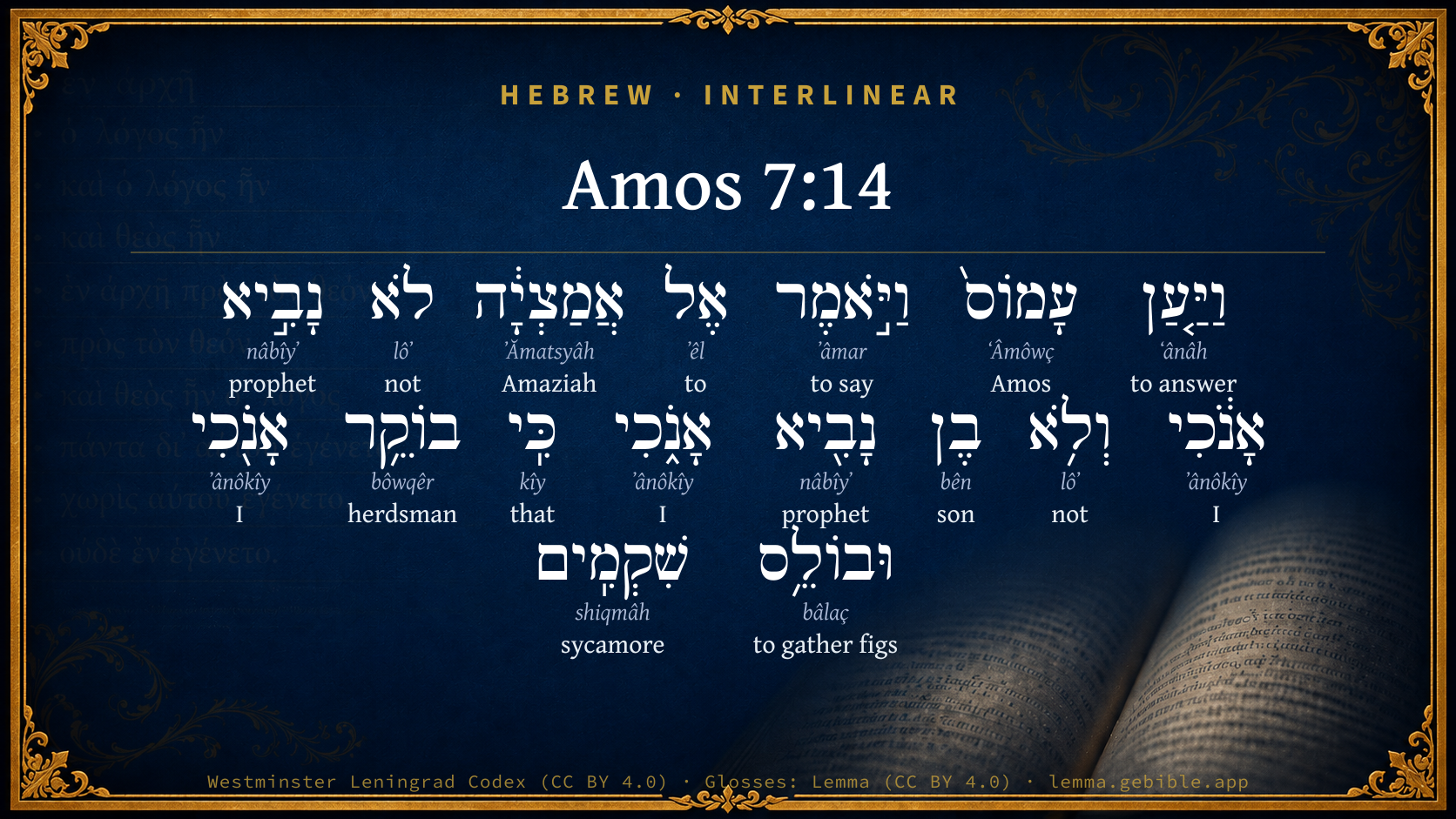
Hebrew (Westminster Leningrad Codex) Amos 7:14 appears in the Hebrew Old Testament. The text above is from the Westminster Leningrad Codex. Each word links to its Strong’s number, a concise gloss, and parsing drawn from the Open Scriptures Hebrew Bible morphology. Click any word for its full Brown-Driver-Briggs (BDB) entry.
Download image
Cite this verse

Amos 7:14 (World English Bible). Public Domain. Lemma interlinear Bible study tool, https://lemma.gebible.app/v/amos/7/14.

Show BibTeX & RIS
BibTeX
RIS
English Translation
Then Amos answered Amaziah, "I was no prophet, neither was I a prophet's son; but I was a herdsman, and a farmer of sycamore trees;
World English Bible · Public Domain
Highlights
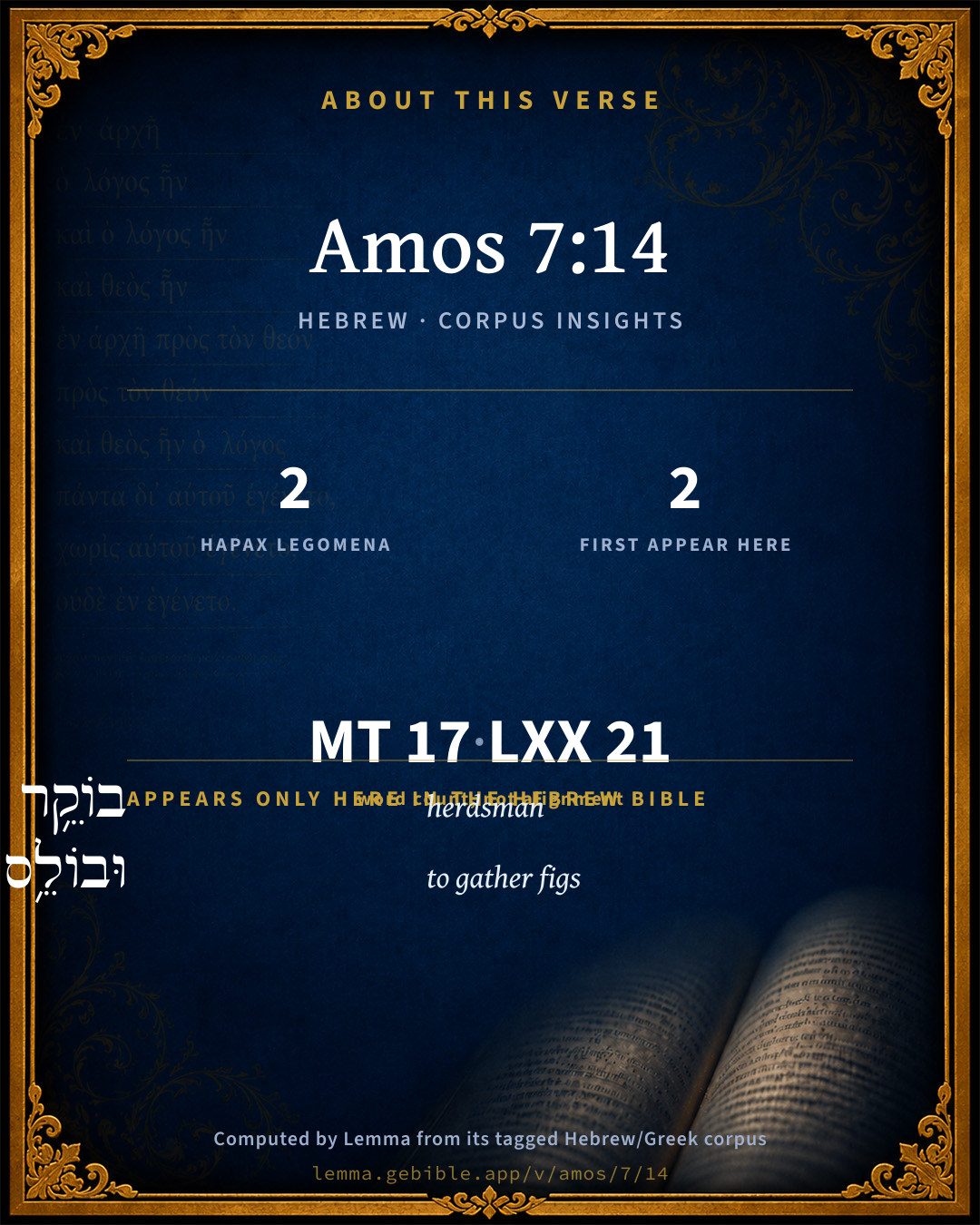
  • 2 hapax legomena — only here in the Hebrew Bible
  • 2 first appearances in the Hebrew Bible
Full analysis ↓
Download a study sheet

One document with this verse’s original text, its word-by-word gloss line, the meaning frame, cross-references with their text, attributed commentary, and full source and license credits — printable, and it pastes into notes with its structure intact.

This verse Autodidact and up

Study sheet (.html) Plain text (.txt)

A passage Seminary Student

Up to 50 verses in one chapter. A passage sheet keeps up to 6 commentary sources and 12 cross-references per verse, in the order this page ranks them, and says so on the sheet whenever that leaves anything out. Ask for a single verse and you get the Autodidact verse sheet above.

Everything on this page stays free to read, with no account — the sheet is a download of what is already on screen, not access to it.

Want to remove ads? Support Godless Engineer
Compare translations 3

The same verse in 3 English versions, stacked beneath the original-language interlinear above. Click any original word for its lexicon entry.

Each is an independent rendering of the whole verse — the interlinear is not word-aligned to these translations.

Highlighted words mark where these versions differ — a whole-verse word diff, not a word-by-word alignment.

  • World English Bible Public Domain
    Then Amos answered Amaziah, "I was no prophet, neither was I a prophet's son; but I was a herdsman, and a farmer of sycamore trees;
  • King James Version Public Domain
    Then answered Amos, and said to Amaziah, I was no prophet, neither was I a prophet's son; but I was an herdman, and a gatherer of sycomore fruit:
  • unfoldingWord Literal Text CC BY-SA 4.0
    Then Amos answered and said to Amaziah, “I am not a prophet nor am I a prophet’s son, for I am a herdsman, and I take care of sycamore fig trees.

unfoldingWord Literal Text — © unfoldingWord, licensed CC BY-SA 4.0. Word-aligned USFM3 via Door43 (git.door43.org/unfoldingWord/en_ult).

Versions to compare (up to 4)

3 of 4 selected

Show all 18 translations

Every available English version of this verse, each an independent rendering of the whole verse.

  • World English Bible Public Domain
    Then Amos answered Amaziah, "I was no prophet, neither was I a prophet's son; but I was a herdsman, and a farmer of sycamore trees;
  • Berean Standard Bible Public Domain
    “I was not a prophet,” Amos replied, “nor was I the son of a prophet; rather, I was a herdsman and a tender of sycamore-fig trees.
  • Majority Standard Bible Public Domain
    “I was not a prophet,” Amos replied, “nor was I the son of a prophet; rather, I was a herdsman and a tender of sycamore-fig trees.
  • King James Version Public Domain
    Then answered Amos, and said to Amaziah, I was no prophet, neither was I a prophet's son; but I was an herdman, and a gatherer of sycomore fruit:
  • American Standard Version (1901) Public Domain
    Then answered Amos, and said to Amaziah, I was no prophet, neither was I a prophet's son; but I was a herdsman, and a dresser of sycomore-trees:
  • Revised Version (1885) Public Domain
    Then answered Amos, and said to Amaziah, I was no prophet, neither was I a prophet’s son; but I was an herdman, and a dresser of sycomore trees:
  • Geneva Bible (1599) Public Domain
    Then answered Amos, and said to Amaziah, I was no Prophet, neither was I a prophets sonne, but I was an herdman, and a gatherer of wilde figs.
  • Douay-Rheims (1899) Public Domain
    And Amos answered and said to Amasias: I am not a prophet, nor am I the son of a prophet: but I am a herdsman plucking wild figs.
  • Young's Literal Translation Public Domain
    And Amos answereth and saith unto Amaziah, `I `am' no prophet, nor a prophet's son `am' I, but a herdsman I `am', and a cultivator of sycamores,
  • Literal Standard Version CC BY-SA 4.0
    And Amos answers and says to Amaziah, “I [am] no prophet, nor [am] I a prophet’s son, but I [am] a herdsman, and a cultivator of sycamores,
  • Unlocked Literal Bible CC BY-SA 4.0
    Then Amos said to Amaziah, “I am not a prophet nor a prophet's son. I am a herdsman, and I take care of sycamore fig trees.
  • unfoldingWord Literal Text CC BY-SA 4.0
    Then Amos answered and said to Amaziah, “I am not a prophet nor am I a prophet’s son, for I am a herdsman, and I take care of sycamore fig trees.
  • Darby Bible Public Domain
    And Amos answered and said to Amaziah, I was no prophet, neither was I a prophet's son; but I was a herdman, and a gatherer of sycamore fruit.
  • World Messianic Bible Public Domain
    Then Amos answered Amaziah, “I was no prophet, neither was I a prophet’s son, but I was a herdsman, and a farmer of sycamore figs;
  • Webster's Bible Public Domain
    Then answered Amos, and said to Amaziah, I was no prophet, neither was I a prophet's son; but I was a herdman, and a gatherer of sycamore fruit:
  • Free Bible Version CC BY-SA 4.0
    But Amos replied, “I'm not a trained prophet, or the son of a prophet. I was just a shepherd, and also took care of fig trees.
  • Bible in Basic English Public Domain
    Then Amos in answer said to Amaziah, I am no prophet, or one of the sons of the prophets; I am a herdman and one who takes care of sycamore-trees:
  • JPS Tanakh (1917) Public Domain
    Then answered Amos, and said to Amaziah: 'I was no prophet, neither was I a prophet's son; but I was a herdman, and a dresser of sycamore-trees;

Literal Standard Version (2020), Covenant Press — licensed CC BY-SA 4.0. Text via the HelloAO Bible API (eBible.org). Unlocked Literal Bible (unfoldingWord) — licensed CC BY-SA 4.0. Text via the HelloAO Bible API (eBible.org). unfoldingWord Literal Text — © unfoldingWord, licensed CC BY-SA 4.0. Word-aligned USFM3 via Door43 (git.door43.org/unfoldingWord/en_ult). Free Bible Version, Dr. Jonathan Gallagher — licensed CC BY-SA 4.0. Text via the HelloAO Bible API (eBible.org).

Word by word

More ways to search: Search by grammar → Find every occurrence → Compare this word →

Practice this passage: Drill this verse → Learn its vocabulary →

בוֹקֵ֥ר
bôwqêr
H951
“herdsman”
Noun, Common, Masculine, Singular, Absolute
Part of Speech
Noun
Type
Common
Gender
Masculine
Number
Singular
State
Absolute
Full BDB Definition

Origin: active part. from H1239 as denominative from H1241

TWOT: 274b

herdsman
  1. וַיַּ֤עַן ʻânâh H6030 “and · to answer” Conjunction + Verb, Qal, Sequential Imperfect, 3rd Person, Masculine, Singular
  2. עָמוֹס֙ ʻÂmôwç H5986 “Amos” Noun, Proper
  3. וַיֹּ֣אמֶר ʼâmar H559 “and · to say” Conjunction + Verb, Qal, Sequential Imperfect, 3rd Person, Masculine, Singular
  4. אֶל ʼêl H413 “to” Preposition
  5. אֲמַצְיָ֔ה ʼĂmatsyâh H558 “Amaziah” Noun, Proper
  6. לֹא lôʼ H3808 “not” Particle, Negative
  7. נָבִ֣יא nâbîyʼ H5030 “prophet” Noun, Common, Masculine, Singular, Absolute
  8. אָנֹ֔כִי ʼânôkîy H595 “I” Pronoun, Personal, 1st Person, Common, Singular
  9. וְלֹ֥א lôʼ H3808 “and · not” Conjunction + Particle, Negative
  10. בֶן bên H1121 “son of” Noun, Common, Masculine, Singular, Construct
  11. נָבִ֖יא nâbîyʼ H5030 “prophet” Noun, Common, Masculine, Singular, Absolute
  12. אָנֹ֑כִי ʼânôkîy H595 “I” Pronoun, Personal, 1st Person, Common, Singular
  13. כִּֽי kîy H3588 “that” Conjunction
  14. אָנֹ֖כִי ʼânôkîy H595 “I” Pronoun, Personal, 1st Person, Common, Singular
  15. וּבוֹלֵ֥ס bâlaç H1103 “and · gathering figs” Conjunction + Verb, Qal, Participle Active, Masculine, Singular, Construct
  16. שִׁקְמִֽים shiqmâh H8256 “sycamores” Noun, Common, Feminine, Plural, Absolute

About this verse

These counts appear in no published source. They are computed here, from the morphology-tagged text and Lemma’s own curated glosses. What Lemma adds →

17
words
13
distinct lemmas
Prophets
section

Notable vocabulary

2 hapax legomena — words that appear only here in the entire Hebrew Bible:

  • בוֹקֵ֥ר herdsman H951
  • וּבוֹלֵ֥ס to gather figs H1103

First appearance in Scripture

These words make their first canonical appearance in the Hebrew Bible here:

  • בוֹקֵ֥ר herdsman H951
  • וּבוֹלֵ֥ס to gather figs H1103

Shared distinctive vocabulary

עָמוֹס֙ Amos H5986 occurs in 7 verses of the Hebrew Bible. Also found in:

Grammatical profile

  • 3 verbs
  • 7 nouns
  • 3 pronouns
  • 1 preposition
  • 1 conjunction
  • 2 particles

Verb forms

  • וַיַּ֤עַן Qal · Sequential Imperfect
  • וַיֹּ֣אמֶר Qal · Sequential Imperfect
  • וּבוֹלֵ֥ס Qal · Participle Active

Repetition

Words recur within this verse — often emphatic in Hebrew:

  • נָבִ֣יא prophet H5030 ×2
  • אָנֹ֔כִי I H595 ×3
  • לֹא not H3808 ×2

Hebrew & Septuagint length

In English translation the verse runs 25 words from the Hebrew and 29 from the Septuagint (LXX English) — closely comparable.

A rough comparison of the two English renderings, which tokenize alike — not a word-level alignment.

Word counts can differ between the Hebrew and the Greek without any difference in meaning — e.g. the Hebrew direct-object marker אֵת has no separate Greek word, and Greek often adds the article ὁ.

In the original languages it is 17 Hebrew tokens and 21 Greek tokens — but the two are counted differently (Hebrew bundles its prefixes and suffixes into one token; the Greek is in lemma form), so that isn’t a like-for-like length.

Cross-references

12

Topical passages linked to Amos 7:14 in the Treasury of Scripture Knowledge — connected by theme and wording, ordered by reader-vote popularity; previews shown in the World English Bible.

  • Amos 1:1 The words of Amos, who was among the herdsmen of Tekoa, which he saw concerning Israel in the days of Uzziah king of Judah, and in the days of Jeroboam the son of Joash king of Israel, two years before the earthquake.
  • Zechariah 13:5 but he will say, 'I am no prophet, I am a tiller of the ground; for I have been made a bondservant from my youth.'
  • 2 Kings 2:5 The sons of the prophets who were at Jericho came near to Elisha, and said to him, "Do you know that Yahweh will take away your master from your head today?" He answered, "Yes, I know it. Hold your peace."
  • 2 Kings 4:38 Elisha came again to Gilgal. There was a dearth in the land; and the sons of the prophets were sitting before him; and he said to his servant, Set on the great pot, and boil stew for the sons of the prophets.
  • 1 Corinthians 1:27 but God chose the foolish things of the world that he might put to shame those who are wise. God chose the weak things of the world, that he might put to shame the things that are strong;
  • 2 Kings 2:3 The sons of the prophets who were at Bethel came forth to Elisha, and said to him, "Do you know that Yahweh will take away your master from your head today?" He said, "Yes, I know it; hold your peace."
  • 2 Chronicles 19:2 Jehu the son of Hanani the seer went out to meet him, and said to king Jehoshaphat, Should you help the wicked, and love those who hate Yahweh? for this thing wrath is on you from before Yahweh.
  • 1 Kings 20:35 A certain man of the sons of the prophets said to his fellow by the word of Yahweh, Please strike me. The man refused to strike him.
  • 2 Kings 2:7 Fifty men of the sons of the prophets went, and stood over against them afar off: and they two stood by the Jordan.
  • 2 Kings 6:1 The sons of the prophets said to Elisha, See now, the place where we dwell before you is too strait for us.
  • 2 Chronicles 16:7 At that time Hanani the seer came to Asa king of Judah, and said to him, Because you have relied on the king of Syria, and have not relied on Yahweh your God, therefore is the host of the king of Syria escaped out of your hand.
  • 2 Chronicles 20:34 Now the rest of the acts of Jehoshaphat, first and last, behold, they are written in the history of Jehu the son of Hanani, which is inserted in the book of the kings of Israel.

Cross-references courtesy of OpenBible.info (CC BY 4.0).

Hebrew and Greek witnesses Masoretic Hebrew ↔ Greek Septuagint

The same verse in the two great witnesses to the Old Testament, shown verse-for-verse.

These are two independent witnesses, not word-aligned to each other, and the Septuagint is shown in lemma (dictionary) form.

Hebrew Amos 7:14 Masoretic · Westminster Leningrad Codex

וַיַּ֤עַן עָמוֹס֙ וַיֹּ֣אמֶר אֶל אֲמַצְיָ֔ה לֹא נָבִ֣יא אָנֹ֔כִי וְלֹ֥א בֶן נָבִ֖יא אָנֹ֑כִי כִּֽי בוֹקֵ֥ר אָנֹ֖כִי וּבוֹלֵ֥ס שִׁקְמִֽים

Then Amos answered Amaziah, "I was no prophet, neither was I a prophet's son; but I was a herdsman, and a farmer of sycamore trees;

World English Bible · Public Domain

Greek LXX Amos 7:14 Septuagint · lemma form

καί ἀποκρίνω αμως καί εἶπον πρός αμασιαν οὐ εἰμί προφήτης ἐγώ οὐδέ υἱός προφήτης ἀλλά ἤ αἰπόλος εἰμί καί κνίζω συκάμινον

And Amos answered, and said to Amasias, I was not a prophet, nor the son of a prophet; but I was a herdman, and a gatherer of sycamore fruits.

LXX2012 (modern English Septuagint) · Public Domain

On this verse, Ellicott's Commentary for English Readers discusses the Septuagint’s reading. Read the note in Commentary ↓

Hebrew: Westminster Leningrad Codex (CC BY 4.0). Greek: Septuagint (public domain); English from LXX2012 (modern English Septuagint) (Public Domain). How the Septuagint differs from the Hebrew →

Targum (Aramaic paraphrase)

1

The Targum is the ancient Jewish Aramaic paraphrase of the Hebrew Scriptures — an interpretive translation, not the Hebrew text itself. Onkelos (literal) and Pseudo-Jonathan (expansive) render the Torah, and Jonathan the Prophets. Coverage is partial: where no permissively-licensed English translation exists for a verse, only the Aramaic is shown. This is verse-level text, not a word-by-word alignment to the Hebrew.

  1. Targum Jonathan Prophets (Joshua–Malachi)
    וַאֲתֵיב עָמוֹס וַאֲמַר לַאֲמַצְיָה לָא נְבִיָא אֲנָא וְלָא בַר נְבִיָא אֲנָא אֲרֵי מָרֵי גֵיתֵי אֲנָא וְשִׁקְמִין אִית לִי בַשְׁפֶלְתָּא מִן קֳדָם חוֹבֵי עַמָא יִשְׂרָאֵל אֲנָא מַסְגִיף נַפְשִׁי:

    (no public-domain English translation for this verse)

    Targum Jonathan — Aramaic: “Mikraot Gedolot” (public domain). English: “Sefaria Community Translation” (CC0 1.0 (public-domain dedication)); “London "Chaldee Paraphrase," 1871” (public domain). Text via Sefaria.

Commentary

Notes on Amos 7:14 from classic Christian and Jewish commentators (each source and its license shown beneath its notes). The classic Christian expositions comment on the surrounding passage and are grouped to its opening verse, so a note may address several verses; the Jewish commentaries on the Tanakh (Rashi and others) are per-verse, so they appear only where the commentator wrote on this verse.

Lemma curates 59 commentaries, every one of them public domain or Creative Commons licensed, each selected and text-cleaned for this edition rather than reprinted as found. About our sources →

Trapp's Complete Commentary

John Trapp

Amo 7:14 Then answered Amos, and said to Amaziah, I [was] no prophet, neither [was] I a prophet’s son; but I [was] an herdman, and a gatherer of sycomore fruit:

Ver. 14. Then answered Amos and said to Amaziah] With no less courage, I suppose, than Paul and Barnabas used to the stubborn Jews, Act 13:46; see Joh 1:19; Joh 1:21; or Basil to Valent, the emperor, or Johannes Sarisburieusis to the Pope, A.D. 1540; or Bishop Ridley, when offering to preach before the Lady Mary, and receiving a repulse, he was brought by Sir Thomas Wharton, her servant, to the dining place, and desired to drink, which after he had done, he paused a while, looking very sadly; and suddenly broke out into these words: Surely I have done amiss. Why so? quoth the knight. For I have drunk, said he, in that place where God’s word offered hath been refused; whereas, if I had remembered my duty, I had departed immediately and shaken off the dust of my shoes for a testimony against this house. These words were by the said bishop spoken with such a vehemence, that some of the hearers afterwards confessed the hairs to stand upright on their heads.

I was no prophet, neither was I a prophet’s son] Neither born nor bred a prophet; neither have I rashly or ambitiously put myself upon this tremend employment; my call thereto was extraordinary. The prophet’s scholars were called their sons, 2Ki 2:8; 2Ki 2:5; 2Ki 2:7; 2Ki 2:15 Isa 8:18 Mar 10:24 1Co 4:14; 1Co 4:17.

But I was a herdman, and a gatherer of sycamore fruit] Of low condition, and hardly bred; so that I could live with a little, and needed not to turn prophet, ventris causa, for food sake. When one said to the philosopher, If you will but please Dionysius you need not feed upon green herbs, he presently replied. And if you can feed upon green herbs you need not please Dionysius. Nature is content with a little, grace with less. It is not for a servant of God to be a slave to his palate: Luther made many a meal of a herring.

John Trapp, A Commentary or Exposition upon All the Books of the Old and New Testament (1647–1656) — public domain. Text from a community e-Sword module.

Joseph Benson's Commentary

Amo 7:14-15. I was no prophet — Not originally, or by study, or by any human designation; neither was I a prophet’s son — Neither was I bred up at the schools of the prophets; as those usually were who took that office upon them. But I was a herdman — By breeding and occupation I was, and still am, a herdman; and a gatherer of sycamore fruit — I got my livelihood also in part by gathering wild figs for those who had occasion for them. The Lord took me, &c. — As I was following my flock, and thinking of nothing else; and said unto me — By an extraordinary irradiation, or impulse of his Divine Spirit; Go, prophesy unto my people — Go, and as a prophet divinely commissioned, reprove, instruct, exhort, and warn my people of the calamities impending over them, and which will assuredly fall upon them, unless they avert them by turning to me in true repentance.

Joseph Benson's Commentary on the Old and New Testaments (1811–1818) — public domain. Text from a community e-Sword module.

Whedon's Commentary on the Bible

Daniel D. Whedon

14-17. The prophet’s reply. 14, 15. Amos was a prophet not by profession, but by divine call.

I was no prophet — Better, throughout Amo_7:14, with margin, “I am.” I am not a professional prophet, guided by mercenary motives.

A prophet’s son — This expression is not to be understood in the sense that the father of Amos was not a prophet, but in the sense, “I am not a member of a prophetic guild.” Son is used in that sense of the companies of prophets at Beth-el, Gilgal, and other places (1Ki_20:35; 2Ki_2:3; 2Ki_2:5; 2Ki_2:7, etc.). This interpretation is supported also by the use of the word son in the general sense of belonging to in other Semitic languages.

Herdman — Literally, tender of cattle (Introduction, p. 192).

Gatherer of sycomore fruit — R.V., “dresser of sycomore trees” (Introduction, p. 192).

Jehovah took me… said — While he was following his ordinary occupation the divine call came to forsake all and become a prophet of Jehovah to Israel. This call he could not resist (Amo_3:8). Of these verses G.A. Smith says, “It is the protest of a new order of prophecy, the charter of a spiritual religion.” Amos was indeed “the founder and the purest type of the new order of prophecy.”

Daniel D. Whedon (gen. ed.), Commentary on the Old and New Testaments (1874–1909) — public domain. Text from a community e-Sword module.

Tyndale Open Study Notes

Tyndale Open Resources

7:14 Amos was not a professional prophet or even a disciple in training. He had no financial incentive to leave his livelihood in order to prophesy. • shepherd: The Hebrew word here is not the same as in 1:1 and is not found elsewhere in the Old Testament. It is related to a word for cattle, suggesting that Amos may have raised cattle as a breeder or herder (see Amos Book Introduction, “The Prophet Amos”). • The sycamore-fig was gathered for cattle feed.

Tyndale Open Study Notes — © Tyndale Open Resources, licensed CC BY-SA 4.0. Text via the HelloAO Bible API.

Geneva Bible (1599)

Geneva Bible translators

Thus he showeth by his extraordinary vocation, that God had given him a charge, which he must needs execute.

Geneva Bible (1599) marginal notes — public domain. Text via Bolls.life.

Jamieson, Fausset & Brown

Robert Jamieson, A. R. Fausset & David Brown

I was no prophet--in answer to Amaziah's insinuation (Amo 7:12), that he discharged the prophetical office to earn his "bread" (like Israel's mercenary prophets). So far from being rewarded, Jehovah's prophets had to expect imprisonment and even death as the result of their prophesying in Samaria or Israel: whereas the prophets of Baal were maintained at the king's expense (compare Kg1 18:19). I was not, says Amos, of the order of prophets, or educated in their schools, and deriving a livelihood from exercising the public functions of a prophet. I am a shepherd (compare Amo 7:15, "flock"; the Hebrew for "herdsman" includes the meaning, shepherd, compare Amo 1:1) in humble position, who did not even think of prophesying among you, until a divine call impelled me to it.

prophet's son--that is, disciple. Schools of prophets are mentioned first in First Samuel; in these youths were educated to serve the theocracy as public instructors. Only in the kingdom of the ten tribes is the continuance of the schools of the prophets mentioned. They were missionary stations near the chief seats of superstition in Israel, and associations endowed with the Spirit of God; none were admitted but those to whom the Spirit had been previously imparted. Their spiritual fathers travelled about to visit the training schools, and cared for the members and even their widows (Kg2 4:1-2). The pupils had their common board in them, and after leaving them still continued members. The offerings which in Judah were given by the pious to the Levites, in Israel went to the schools of the prophets (Kg2 4:42). Prophecy (for example, Elijah and Elisha) in Israel was more connected with extraordinary events than in Judah, inasmuch as, in the absence of the legal hierarchy of the latter, it needed to have more palpable divine sanction.

sycamore--abounding in Palestine. The fruit was like the fig, but inferior; according to PLINY, a sort of compound, as the name expresses, of the fig and the mulberry. It was only eaten by the poorest (compare Kg1 10:27).

gatherer--one occupied with their cultivation [MAURER]. To cultivate it, an incision was made in the fruit when of a certain size, and on the fourth day afterwards it ripened [PLINY, Natural History, 13.7,14]. GROTIUS from JEROME says, if it be not plucked off and "gathered" (which favors English Version), it is spoiled by gnats.

Jamieson, Fausset & Brown — Commentary Critical and Explanatory on the Whole Bible (1871) — public domain (CC PDM 1.0). Text via the HelloAO Bible API.

Adam Clarke's Commentary

Verse 14. I was no prophet] I am an extraordinary messenger of God. I am not called to the prophetic office but for this occasion. I have no message to Judah, and therefore need not go there. I have a message to Israel alone, and I must faithfully deliver it.

For the account which Amos gives here of himself, see the introduction. See Clarke on Am 1:1.

Adam Clarke's Commentary on the Bible (1810–1826) — public domain. Text from a community e-Sword/MySword module.

John Calvin's Commentaries

The Prophet Amos first pleads for himself, that he was not at liberty to obey the counsel of Amaziah, because he could not renounce a calling to which he was appointed. As then he had been sent by God, he proves that he was bound by necessity to prophesy in the land of Israel. In the first place, he indeed modestly says, that he was not a prophet, nor the son of a prophet: why did he say this? To render himself contemptible? By no means, though the words apparently have this tendency; but it was to gain for himself more authority; for his extraordinary call gave him greater weight than if he had been brought up from his childhood in the schools of the prophets. He then shows that he became a prophet by a miraculous interposition, and that the office was not committed to him by human authority, and in the usual way; but that he had been led to it as it were by force, so that he could not cast aside the office of teaching, without openly shaking off the yoke laid upon him by God.

This account then which Amos gives of himself ought to be noticed, I was not a Prophet, nor the son of a Prophet Had he said simply that he was not a Prophet, he might have been accused of presumption: how so? No one takes to himself this honor in the Church of God; a call is necessary; Were an angel to descend from heaven, he ought not to subvert public order; (Galatians 1:8) for all things, as Paul reminds us, ought to be done decently and in lawful order in the Church; for the God of peace presides over us. Had Amos then positively denied that he was a Prophet, he might on this account have been thrust away from his office of teaching, for he wanted a call. But he means that he was not a Prophet who had been from his childhood instructed in God’s law, to be an interpreter of Scripture: and for the same reason he says that he was not the son of a Prophet; for there were then, we know, colleges for Prophets; and this is sufficiently evident from sacred history. As then these colleges were instituted for this end — that there might be always seminaries for the Church of God, so that it might not be destitute of good and faithful teachers, Amos says that he was not of that class. He indeed honestly confesses that he was an illiterate man: but by this as I have already said, he gained to himself more authority inasmuch as the Lord had seized on him as it were by force, and set him over the people to teach them: “See, thou shalt be my Prophet, and though thou hast not been taught from thy youth for this office, I will yet in an instant make thee a Prophet.” It was a greater miracle, that Christ chose rude and ignorant men as his apostles, than if he had at first chosen Paul or men like him who were skillful in the law. If then Christ had at the beginning selected such disciples, their authority would have appeared less: but as he had prepared by his Spirit those who were before unlearned, it appeared more evident that they were sent from above. And to this refers the expression the Prophet uses, when he says, Jehovah took me away: for it intimates that his calls as we have said, was extraordinary. The rest we shall defer till to-morrow.

John Calvin's Commentaries (1540-1563) — public domain. Text from the Calvin Translation Society English edition (1840s-50s) via the Christian Classics Ethereal Library (ccel.org). Calvin's coverage is partial (roughly two-thirds of the Bible); uncommented books and verses are honest gaps, never fabricated. The 19th-century editor's footnotes and remarks are omitted so the notes are faithfully Calvin's own voice.

Ellicott's Commentary for English Readers

(14) I was . . .—An interesting biographical touch. Prophecy, like other occupations, tended to form a hereditary guild, but Amos was not by birth a prophet. The word for “gatherer” is rendered in the LXX. and Vulg. “nipper,” or “pincher.” There was a custom mentioned in Theophrastus, Hist. Plant., iv. 2, Pliny, Hist. Nat., xiii. 14, of pinching or scratching the mulberry-fig in order to make it ripen. But it is very doubtful whether this is the meaning of the Hebrew word here, which is nowhere else employed.

A Bible Commentary for English Readers, edited by Charles John Ellicott (1878–1897) — public domain. Text from a community e-Sword module.

The Cambridge Bible for Schools and Colleges

gen. ed. J. J. S. Perowne

14. I was no prophet, and I was no prophet’s son] i.e. not one of the “sons of the prophets,” as the companies, or guilds, of prophets, at Beth-el, Gilgal, and other places, are called in the Book of Kings (1Ki_20:35; 2Ki_2:3; 2Ki_2:5; 2Ki_2:7; 2Ki_2:15; 2Ki_4:1; 2Ki_4:38; 2Ki_5:22; 2Ki_6:1; 2Ki_9:1). In Semitic languages ‘son’ is often used in the figurative sense of belonging to: thus in Syriac bar naggârê, ‘a son of the carpenters,’ means a member of a carpenters’ guild. Amos disclaims being a prophet by trade or profession, who might, for instance, have adopted his vocation without any special fitness, or inward call, or who might have even prosecuted it solely with a view to the material advantages accruing from it: no motives such as these had actuated him; he was a simple herdsman, and cultivator of sycomore trees; and he was following the flock, at the moment when the summons came, bidding him be a prophet to Jehovah’s people.

an herdman] Lit. a cow- (or ox-) herd; but it is very possible, especially in view of the next verse (“from following the flock”), that bôḳçr (בקר) is here an error for nôḳçd (נקד), the rare word used in Amo_1:1 to describe Amos as a keeper of the peculiar breed of sheep called naḳad.

and a dresser (R.V.) of sycomores] The sycomore (or “fig-mulberry”)—not our tree of the same name—was a common (Isa_9:10; 1Ki_10:27), but useful tree, which grew abundantly in the mild climate of the Shephçlâh, or Maritime Plain (1 Ki. l.c.; 1Ch_27:28), as it does still in that of the deep Jordan valley: in Egypt, where it also grew (Psa_78:47), and where it is found still, its wood was used for doors, boxes, coffins, and articles of furniture (Wilkinson-Birch, Anc. Eg., ii. 416). It attains the size of a walnut-tree, has wide-spreading branches, and, on account of its shade, is often planted by the way-side (cf. Luk_19:4). The fruit grows, not on the branches, but on little sprigs rising directly out of the stem, and in clusters like the grape (see the representation in the Dict. of the Bible, s.v.): it is something like a small fig, in shape and size, but insipid and woody in taste. The fruit is infested with an insect (the Sycophaga crassipes), and till the ‘eye’ or top has been punctured, so that the insects may escape, it is not eatable[185]. This operation, it is probable, is what is here alluded to. Bôlçs is a verb derived from balas, which in Ethiopic means a fig, or (sometimes) a sycomore (see Dillmann’s Lex. Aeth., col. 487), and in Arabic denotes a species of fig; in Hebrew, it may be inferred that it denoted the similarly shaped fruit of the sycomore, and the derived verb will have signified to deal with, handle, or dress the fruit of the sycomore. The LXX. having no doubt in view the method of rendering the fruit edible, referred to above, render by κνίζων, pricking or nipping (hence Vulg. vellicans)[186].

[185] Cheyne, ap. W. R. Smith, Proph., ed. 2, p. 396.

[186] Theophrastus and Dioscorides, in their descriptions of the process, use a compound of the same verb, ἐπικνίζω. Theoph. iv. 2 πέττειν οὐ δύναται ἐὰν μὴ ἐπικνισθῇ· ἀλλʼ ἔχοντες ὄνυχας σιδηρᾶς ἐπικνίζουσιν ἆ δʼ ἆν ἐπικνισθῇ· τεταρταῖα πεττεται: Diosc. i. 180 φέρει δὲ κάρπον μὴ πεπαινόμενον δίχα τοῦ ἐπικνισθῆναι ὄνυχι, ἢ σιδήρφ. Cf. Bochart, Hieroz. ii. 39. (p. 384; 406 Rosenm.).

Tekoa is however much too cold for sycomores to have ever grown there: the tree is not found in Syria above 1000 ft. above the sea, and Tekoa is more than twice as high as that. We must suppose the “naḳad-keepers of Tekoa” (Amo_1:1) to have owned lands in the ‘wilderness’ or pasture-ground, stretching down to the Dead Sea on the east (above, p. 126); and here, in some sufficiently sheltered situation, must have grown the sycomore-trees, which the prophet ‘dressed.’

14–17. Amos’ retort.

The Cambridge Bible for Schools and Colleges (gen. ed. J. J. S. Perowne; Cambridge University Press, 1878–1918) — public domain. Text from a community e-Sword module.

John Gill's Exposition

Then answered Amos, and said to Amaziah,.... With much freedom, boldness, and intrepidity, and yet with modesty and humility; not at all moved by his frowns or his flattery:

I was no prophet, neither was I a prophet's son: he was not a prophet originally, or from his youth, as Kimchi; he was not born and bred one; neither his father was a prophet, by whom he could get any instructions in the mystery of prophesying; nor was he a disciple of any of the prophets, or brought up in any of their schools as some were; he was no prophet till the Lord called him immediately, at once, from his secular employment to this office; and therefore did not take it up to get a livelihood by Jarchi and Aben Ezra interpret it, that he was not one of the false prophets that prophesied for hire, and took a reward:

but I was an herdsman, and a gatherer of sycamore fruit; that is, originally: this was the employment he was brought up in from his youth, and was in it when he was called to be a prophet; he looked after cattle, both great and small; and at a certain time of the year used, to gather sycamore fruit, which was a kind of figs; and by, its name had the resemblance both of figs and mulberries. Some take it to be what were called Egyptian figs; these he gathered, either for the use of his masters, or for food for himself, or for the cattle, or both: or he was an "opener" of them, as the Septuagint; he cut, them, and made incisions in them; for, as Pliny (l), Dioscorides (m), and Theophrastus (n) observe, this fruit must be cut or scratched, either with the nail, or with iron, or it will not ripen; but, four days after being scratched or cut, will become ripe. Mr. Norden (o), a late traveller in Egypt, has given us a very particular account of this tree and its fruit.

"This sycamore (he says) is of the height of a beech, and bears its fruit in a manner quite different from other trees; it has them on the trunk itself, which shoots out little sprigs in form of grape stalks; at the end of which grow the fruit close to one another, almost like bunches of grapes. The tree is always green, and bears fruit several times in the year, without observing any certain seasons: for I have seen (says he) some sycamores that have given fruit two months after others. The fruit has the figure and smell of real figs, but is inferior to them in the taste, having a disgusting sweetness. Its colour is a yellow, inclining to an ochre, shadowed by a flesh colour. In the inside it resembles the common figs, excepting that it has a blackish colouring with yellow spots. This sort of tree is pretty common in Egypt; the people for the greater part live upon its fruit, and think themselves well regaled when they have a piece of bread, a couple of sycamore figs, and a pitcher filled with water from the Nile.''

This account in several things agrees with what Pliny (p) and Solinus (q) relate of this tree and its fruit; very likely there might be many of these trees in Judea; there seem to have been great numbers of them in Solomon's time, Kg1 10:27; and perhaps it was one of these that Zacchaeus climbed, in order to see Christ, Luk 19:4; for this sort of trees delight in vales and plains, such as were the plains of Jericho; and in the Talmud (r) we read of sycamore trees in Jericho; and of the men of Jericho allowing the branches of them to be cut down for sacred uses. These also grew in lower Galilee, but not in upper Galilee; and that they were frequent in the land of Israel appears from the rules the Misnic doctors (s) give about the planting, and cutting them down; and in the opening of these trees, and making incisions in them, and in gathering the fruit of them, Amos might be concerned. Kimchi and Ben Melech say the word signifies to "mix", and that his business was to mix these together with other fruit. Aben Ezra observes, that in the Arabic language it signifies to dry; and then his work was, after he had gathered them, to lay them a drying. Some render the word a "searcher" (t) of them; as if his employment was to look out for them, and seek them where they were to be got: however, be this as it will, the prophet suggests that he had been used to a low life, and to mean fare, with which he was contented, and did not take up this business of prophesying for bread, and could return to his former employment without any regret, to get a maintenance, if so was the will of God. The Targum gives it a different sense,

"for I am a master of cattle, and have sycamores in the fields;''

and so Jarchi, Kimchi, and Ben Melech, represent him as suggesting that he was rich, and had no need of bread to be given him, or to prophesy for that.

(l) Nat. Hist. l. 13. c. 7. (m) L. 1. c. 143. (n) Hist. l. 4. c. 2. (o) Travels in Egypt and Nubis, vol. 1. p. 79, 80. (p) Nat. Hist. l. 13. c. 7. (q) Polyhistor. c. 45. (r) T. Bab Pesachim, fol. 56. 1. & 57. 1. & Menachot, fol. 71. 1. (s) Misn. Shevath, c. 9. sect. 2. & Bava Bathra, c. 2. sect. 7. (t) "disquirens", Montanus, Vatablus; "perquirens", Junius & Tremellius, Piscator, Cocceius, Burkius. So R. Sol. Urbin Ohel Moed, fol. 31. 2.

John Gill's Exposition of the Whole Bible (1746–1763) — public domain (CC PDM 1.0). Text via the HelloAO Bible API.

Albert Barnes' Notes on the Bible

I was no prophet - The order of the words is emphatic. “No prophet I, and no prophet’s son I, for a herdsman I, and dresser of sycamores.” It may be, Amos would meet, for the people’s sake, Amaziah’s taunt. He had a living, simple indeed, yet that of the prophets was as simple. But chiefly he tells them of the unusual character of his mission. He did not belong to the order of the prophets, nor had he been educated in the schools of the prophets, nor had he any human training. He was thinking of nothing less; he was doing the works of his calling, until “God took him from following the flock,” and gave him his commission. Rup.: “He promises humbly what he had been, what he had been made, not by merits, but by grace, that he had not assumed the prophetic office by hereditary right, nor had he begun to prophesy out of his own mind, but, being under the necessity of obeying, he had fulfilled the grace and the command of God who inspired and sent Him.” Twice he repeats, “The Lord took me; the Lord said unto me;” inculcating that, what Amaziah forbade, God bade. All was of God. “He” had but obeyed. Jerome: “As then the Apostles, when the Scribes and Pharisees forbade them to teach in the Name of Jesus, answered, ‘We must obey God rather than man’ Act 5:29, so Amos, when forbidden by the idol-priests to prophesy, not only prophesies, shewing that he feared God bidding, more than their forbidding, but he boldly and freely denounces the punishment of him who endeavored to forbid and hinder the word of God.” Rup.: “heaven thundered and commanded him to prophesy; the frog croaked in answer out of his marsh, ‘prophesy no more. ‘“

Albert Barnes' Notes on the Bible (1834–1885) — public domain. Text from a community e-Sword/MySword module.

Haydock's Catholic Bible Commentary

I am not a prophet. That is, I am not a prophet by education: nor is prophesying my calling or profession: but I am a herdsman, whom God was pleased to send hither to prophesy to Israel. (Challoner) --- He speaks with the like humility as [John] the baptist, John i. 21., and Luke vii. 26. It seems the prophets usually left their trade, and applied to meditation, Zacharias viii. 5. Septuagint, "I was not a prophet, nor," &c. --- Plucking. Septuagint (Theodotion), "pricking." (Calmet) --- This was requisite to make the fruit ripen in four days’ time. (Pliny, [Natural History?] xiii. 7., and xvi. 27. --- Wild fig-trees have three sorts of fruits. The flies which proceed from some of them, prick the sweet figs, and make them ripen. (Tourefort i. let. 8.) --- Amos probably conveyed such wild figs to be near those of the garden, while at other times he fed his cattle.

George Leo Haydock (1774–1849), Haydock's Catholic Family Bible and Commentary, 1859 edition — public domain. Excludes Psalms (Douay-Rheims chapter numbering differs from Protestant) and Deuterocanonical books (Catholic canon only).

Matthew Poole's English Annotations

Then answered Amos: so soon as this false accuser had under the vizard of friendship given advice, and withal intimated his resolution to use his authority to make Amos desist if he did not do it voluntarily, Amos gives him answer readily, boldly, and yet smoothly, and outshoots the court pontiff in his own bow.

Said to Amaziah; not fearing his person or his power.

I was no prophet; not originally, or by succession, or by study, or by any human designation and preparation, as many have been;

neither was I a prophet’s son; my father was no prophet, nor was I bred up in the school of the prophets, such as 2Ki 2:3,5,7,15; 4:38; 6:1. Though you call me seer, whether ironically or seriously, I matter not, but assure you I am not such by art, or trade, or for a livelihood.

But I was a herdman; by breeding, choice, and occupation I was and still am a herdman, and have my concerns in that mystery in or near Tekoa in Judah, on which I can live; though I prophesy without stipend or salary, I needed not to run into the prophet’s work for my bread.

And a gatherer of sycomore fruit: the tree and fruit is known by one name; Palestine abounded with both; and the fruit was sweet, not large, yet good for food for man or cattle, as some fruits are with us; on these I could still, as I formerly did, live, and be content.

Matthew Poole's English Annotations on the Holy Bible (1683–1685) — public domain. Text from a community e-Sword/MySword module.

The Pulpit Commentary

The prophet, undaunted by Amaziah"s threats, in simple language declares that he does not practise prophecying as a profession or to gain a livelihood, but in obedience to the voice of God. The exercise of the prophetical office was restricted neither to sex nor rank. There were many prophetesses in Israel, e.g. Deborah, (Jud_1:4) Huldah, (2Ki_22:14) Noadiah; (Neh_6:14) and besides a large number of nameless prophets there are twenty-three whose names are preserved in Holy Writ, omitting those whose writings have come down to us (Ladd, "Doctrine of Scripture," 1:117, etc.). A prophet"s son; i.e. brought up in the schools of the prophets, the pupils of which were called "sons of the prophets". (see 1Ki_20:35 2Ki_2:5) Amos was neither self-commissioned nor trained in any human institution. A herdman (boger); usually "a cowherd;" here "a shepherd;" aipolov (Septuagint). A gatherer of sycomore fruit. The phrase, boles shiqmim, may mean either one who plucks mulberry figs for his own sustenance, or one who cultivates them for others. The latter is probably the meaning of the term here. The Septuagint rendering, knizwn sukamina , "pricking sycamore fruit," and that of the Vulgate, vellicans sycomoros, indicate the artificial means for ripening the fruit, which was done by scraping, scratching, or puncturing it, as is sometimes done to the figs of commerce. As the tree bore many crops of fruit in the year, it would afford constant employment to the dresser (see "Dict. of the Bible," 3. p. 1394; "Bible Educator," 4, p. 343).

Vers. 14, 15. The herdsman becomes a prophet.

The simple dignity of Amos"s reply to Amaziah must strike every reader with admiration. The priest of Bethel treated him as a professional prophet, who had a calling which he was Constrained to fulfil in some place or other. But Amos did not prophesy because he had been trained to the prophetic vocation; he prophesied because the Lord constrained him to do so. The Lord had made him very sensitive to the prevailing sins of his countrymen, had sent him with a message of warning to the court of Samaria, and had imparted to him supernatural qualifications for the fulfilment of this sacred ministry.

I GOD IS NOT DEPENDENT UPON EDUCATION OR LEARNING FOR THE QUALIFICATION OF THE AGENTS HE SELECTS. Amos was not the first or the last unlettered, intellectually uncultivated man employed by Infinite Wisdom upon a high and sacred ministry of usefulness. There were in Palestine schools of the prophets," but in these Amos was not trained. The spiritual power, which is the true "note" of a prophetic calling, is not confined to those who are reared in seats of learning, who have acquired the scholarship which is imparted by the intellectual discipline of school and university.

II GOD CAN, HOWEVER, GIVE AN EDUCATION AND TRAINING OF HIS OWN, EFFECTIVE FOR THE PURPOSES OF A SPIRITUAL MINISTRY. It is a common mistake to suppose that those who have not been educated in the way which is familiar to us have not been educated at all The Lord taught Amos in the solitude of the fields, the valleys, the hills of Judea, as he tended the cattle, as he gathered the fruit of the sycomore. His education was, in a sense, very thorough. It gave him insight into the mighty works of the Creator, into his wonderful ways in dealing with the children of men, into the secrets of the human heart. His writings are a sufficient proof of his familiarity with the works and ways of God. His sublime descriptions of natural scenery, of the heavens and the earth, his minute acquaintance with the processes of growth and of husbandry, his knowledge of the human heart and all its conflicts, these are evidences that his mind was not uninformed or untrained.

III AN UNLETTERED BUT DIVINELY TAUGHT NATURE MAY BE A BLESSING TO MEN, AND MAY BRING GLORY TO GOD. The service which Amos rendered to Israel, to Judah, to the Church of God in subsequent ages, is a proof that God can use instruments, which seem to man"s wisdom unsuitable, in order to effect his own purposes. The power of this prophet"s ministry is unquestionable. To some extent his message was heeded; and that it was not more effective was not owing to any fault in him, but rather to the hardness of heart which distinguished those to whom he was sent. At the same time, there was so manifest an evidence of Divine power in the life and work of Amos as must have impressed all who knew him with the conviction that the power of God was upon him. A Divine election, Divine qualifications, may be as really present in the case of a minister of religion who has enjoyed every social and educational advantage, as in the case of him who is called from the plough to prophesy in the name of the Lord. But the impression upon the popular mind is in the former case far more deep, and naturally so. Thus God is honoured, whilst witness is borne to him before men, and the cause of righteousness is maintained and advanced. T.

The Pulpit Commentary (1880–1919), ed. H.D.M. Spence-Jones & Joseph S. Exell — public domain. Text from a community e-Sword module.

John Wesley's Explanatory Notes

No prophet - Not originally, or by study, or by any human designation. An herdman - By breeding and occupation I was and still am, an herdman. Sycamore fruit - This fruit was good food for man, or cattle.

John Wesley, Explanatory Notes Upon the Whole Bible (1754–1765) — public domain. Text via the GEBible commentary corpus.

Keil & Delitzsch

C. F. Keil & F. Delitzsch

Amos first of all repudiates the insinuation that he practises prophesying as a calling or profession, by which he gets his living. "I am no prophet," sc. by profession, "and no prophet's son," i.e., not a pupil or member of the prophets' schools, one who has been trained to prophesy (on these schools, see the comm. on Sa1 19:24); but (according to my proper calling) a bōqēr, lit., a herdsman of oxen (from bâqâr); then in a broader sense, a herdsman who tends the sheep (צאן), a shepherd; and a bōlēs shiqmı̄m, i.e., one who plucks sycamores or mulberry-figs, and lives upon them. The ἁπ. λεγ. bōlēs is a denom. from the Arabic name for the mulberry-fig, and signifies to gather mulberry-figs and live upon them; like συκάζειν and ἀποσυκάζειν, i.e., according to Hesych. τὰ σῦκα τρώγειν, to eat figs. The rendering of the lxx κνίζων, Vulg. vellicans, points to the fact that it was a common custom to nip or scratch the mulberry-figs, in order to make them ripen (see Theophr. Hist. plant. iv. 2; Plin. Hist. nat. 13, 14; and Bochart, Hieroz. i. 384, or p. 406 ed. Ros.); but this cannot be shown to be the true meaning of bōlēs. And even if the idea of nipping were implied in the word bōlēs, it would by no means follow that the possession of a mulberry plantation was what was intended, as many commentators have inferred; for "the words contain an allusion to the 'eating of bread' referred to in Amo 7:12, and the fruit is mentioned here as the ordinary food of the shepherds, who lived at the pasture grounds, and to whom bread may have been a rarity" (Hitzig). From this calling, which afforded him a livelihood, the Lord had called him away to prophesy to His people Israel; so that whoever forbade him to do so, set himself in opposition to the Lord God.

Keil & Delitzsch — Biblical Commentary on the Old Testament (1861–1891) — public domain (CC PDM 1.0). Text via the HelloAO Bible API. (Old Testament only.)

unfoldingWord translationNotes

Door43 World Missions Community

herdsman

This here probably means "one who takes care of sheep" since he is called a "shepherd" in Amos 1:1.

sycamore fig trees

Sycamores are broad trees that grow up to 15 meters tall. AT: "fig trees" (See: Translate Unknowns)

translationWords

fig

Yahweh

flocks

people of God

Israel

unfoldingWord translationNotes — © Distant Shores Media and the Door43 World Missions Community, licensed CC BY-SA 4.0. Source: git.door43.org/Door43/en_tn.

Rashi

Rabbi Shlomo Yitzchaki (Rashi)

I am neither a prophet—I am not one of your false prophets, who take pay for prophesying. I do not need all this, and I never behaved in that manner, for I am wealthy and an owner of cattle and property, as Jonathan renders: For I am an owner of cattle and I have sycamores in the plain.

a cattle herder Heb. בוֹקֵר

and an inspector of sycamores Heb. וּבוֹלֵס. One who searches the sycamores to see which one has reached its time to cut in order to increase the branches, and which one is fit for beams, for so was the custom to cut the virgin sycamores. וּבוֹלֵס is like וּבוֹלֵש, a searcher, but Amos was a stammerer, for so they said: Why was he named Amos? Because he was burdened (עָמוּס) by his tongue, and Israel would call him pesilus (Greek for tongue-tied) as it is stated in Pesikta. [from Pesikta de-Rav Kahana p.125]

Rashi on the Tanakh — English translations: “The Judaica Press complete Tanach with Rashi, translated by A. J. Rosenberg” (CC BY 4.0); “Pentateuch with Rashi's commentary by M. Rosenbaum and A.M. Silbermann, 1929-1934” (public domain); “The Metsudah Tanach series, Lakewood, N.J” (CC BY 4.0); and “The Book of Joshua, Metsudah Publications, 1997” (CC BY 4.0). Text via Sefaria.

Lesson kit

Teaching starters — assembled from the data on this page, not authored interpretation. Every prompt links to the verse data it draws on. Edit before teaching.

Amos, in the Prophets, opens this verse with 17 words (13 distinct Hebrew lemmas). Its most distinctive word is bôwqêr (“herdsman”). A historical commentator’s framing appears above. Read the whole chapter for the surrounding context.

Discussion questions

  1. How does “herdsman” (bôwqêr) shape what this verse is saying?
  2. This verse holds 2 words here found nowhere else in the Hebrew Bible. What might the rare words draw attention to?
  3. 2 words here appear for the first time in Scripture. What is being introduced at this debut?
  4. Amos 1:1 shares the word «Amos» with this verse. How do the two illuminate each other?
  5. “prophet” occurs 2× in this one verse. What is the effect of the repetition?
  6. These translations render this verse differently; the difference is in the English rendering, not the original. What questions does that raise?
  7. The verb «וַיַּ֤עַן» is Qal Sequential Imperfect. How does its form color the action?
  8. Reading how Trapp's Complete Commentary and Joseph Benson's Commentary read this verse, where do the two commentators agree and where do they part?

Things to notice

  • 2 words in this verse appear nowhere else in the Hebrew Bible.
  • 2 words make their first canonical appearance in Scripture here.
  • This verse counts 17 Hebrew ↔ 21 Greek words.
  • These translations choose different wording for 16 words in this verse.
  • “prophet” occurs 2× in this single verse.

Reading settings

Reading text

Shown beneath each verse's original-language words.

Old Testament
Old Testament edition

Read the OT as the Masoretic Hebrew (MT) or the Greek Septuagint (LXX).

English shown for the Greek Septuagint (in the Hebrew ↔ Greek comparison).

Comparing translations? Open the Compare panel on any verse page to stack up to four side by side.