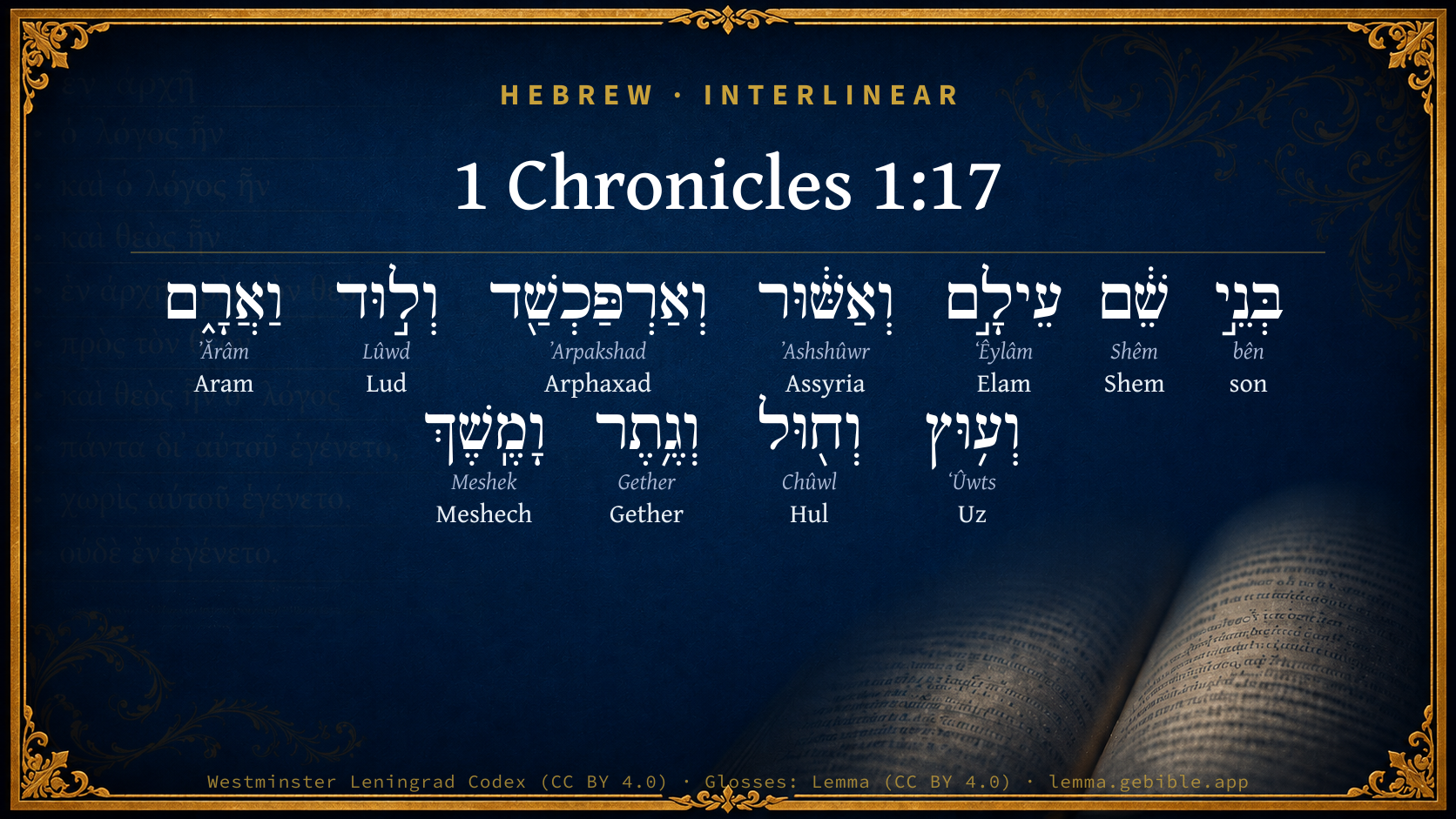
1 Chronicles 1:17

Hebrew (Westminster Leningrad Codex) 1 Chronicles 1:17 appears in the Hebrew Old Testament. The text above is from the Westminster Leningrad Codex. Each word links to its Strong’s number, a concise gloss, and parsing drawn from the Open Scriptures Hebrew Bible morphology. Click any word for its full Brown-Driver-Briggs (BDB) entry.
Download image
Cite this verse

1 Chronicles 1:17 (World English Bible). Public Domain. Lemma interlinear Bible study tool, https://lemma.gebible.app/v/1-chronicles/1/17.

Show BibTeX & RIS
BibTeX
RIS
English Translation
The sons of Shem: Elam, and Asshur, and Arpachshad, and Lud, and Aram, and Uz, and Hul, and Gether, and Meshech.
World English Bible · Public Domain
Download a study sheet

One document with this verse’s original text, its word-by-word gloss line, the meaning frame, cross-references with their text, attributed commentary, and full source and license credits — printable, and it pastes into notes with its structure intact.

This verse Autodidact and up

Study sheet (.html) Plain text (.txt)

A passage Seminary Student

Up to 50 verses in one chapter. A passage sheet keeps up to 6 commentary sources and 12 cross-references per verse, in the order this page ranks them, and says so on the sheet whenever that leaves anything out. Ask for a single verse and you get the Autodidact verse sheet above.

Everything on this page stays free to read, with no account — the sheet is a download of what is already on screen, not access to it.

Want to remove ads? Support Godless Engineer
Compare translations 3

The same verse in 3 English versions, stacked beneath the original-language interlinear above. Click any original word for its lexicon entry.

Each is an independent rendering of the whole verse — the interlinear is not word-aligned to these translations.

Highlighted words mark where these versions differ — a whole-verse word diff, not a word-by-word alignment.

  • World English Bible Public Domain
    The sons of Shem: Elam, and Asshur, and Arpachshad, and Lud, and Aram, and Uz, and Hul, and Gether, and Meshech.
  • King James Version Public Domain
    The sons of Shem; Elam, and Asshur, and Arphaxad, and Lud, and Aram, and Uz, and Hul, and Gether, and Meshech.
  • unfoldingWord Literal Text CC BY-SA 4.0
    The sons of Shem: Elam and Asshur and Arpachshad and Lud and Aram and Uz and Hul and Gether and Meshech.

unfoldingWord Literal Text — © unfoldingWord, licensed CC BY-SA 4.0. Word-aligned USFM3 via Door43 (git.door43.org/unfoldingWord/en_ult).

Versions to compare (up to 4)

3 of 4 selected

Show all 18 translations

Every available English version of this verse, each an independent rendering of the whole verse.

  • World English Bible Public Domain
    The sons of Shem: Elam, and Asshur, and Arpachshad, and Lud, and Aram, and Uz, and Hul, and Gether, and Meshech.
  • Berean Standard Bible Public Domain
    The sons of Shem: Elam, Asshur, Arphaxad, Lud, and Aram. The sons of Aram: Uz, Hul, Gether, and Meshech.
  • Majority Standard Bible Public Domain
    The sons of Shem: Elam, Asshur, Arphaxad, Lud, and Aram. The sons of Aram: Uz, Hul, Gether, and Meshech.
  • King James Version Public Domain
    The sons of Shem; Elam, and Asshur, and Arphaxad, and Lud, and Aram, and Uz, and Hul, and Gether, and Meshech.
  • American Standard Version (1901) Public Domain
    The sons of Shem: Elam, and Asshur, and Arpachshad, and Lud, and Aram, and Uz, and Hul, and Gether, and Meshech.
  • Revised Version (1885) Public Domain
    The sons of Shem; Elam, and Asshur, and Arpachshad, and Lud, and Aram, and Uz, and Hul, and Gether., and Meshech.
  • Geneva Bible (1599) Public Domain
    The sonnes of Shem were Elam and Asshur, and Arpachshad, and Lud, and Aram, and Vz, and Hul, and Gether, and Meshech.
  • Douay-Rheims (1899) Public Domain
    The sons of Sem: Elam and Asur, and Arphaxad, and Lud, and Aram, and Hus, and Hul, and Gether, and Mosoch.
  • Young's Literal Translation Public Domain
    Sons of Shem: Elam and Asshur, and Arphaxad, and Lud, and Aram, and Uz, and Hul, and Gether, and Meshech.
  • Literal Standard Version CC BY-SA 4.0
    Sons of Shem: Elam and Asshur, and Arphaxad, and Lud, and Aram, and Uz, and Hul, and Gether, and Meshech.
  • Unlocked Literal Bible CC BY-SA 4.0
    The sons of Shem were Elam, Ashur, Arphaxad, Lud, Aram, Uz, Hul, Gether, and Meshek.
  • unfoldingWord Literal Text CC BY-SA 4.0
    The sons of Shem: Elam and Asshur and Arpachshad and Lud and Aram and Uz and Hul and Gether and Meshech.
  • Darby Bible Public Domain
    The sons of Shem: Elam, and Asshur, and Arphaxad, and Lud, and Aram, and Uz, and Hul, and Gether, and Meshech.
  • World Messianic Bible Public Domain
    The sons of Shem: Elam, Asshur, Arpachshad, Lud, Aram, Uz, Hul, Gether, and Meshech.
  • Webster's Bible Public Domain
    The sons of Shem; Elam, and Asshur, and Arphaxad, and Lud, and Aram, and Uz, and Hul, and Gether, and Meshech.
  • Free Bible Version CC BY-SA 4.0
    The sons of Shem: Elam, Asshur, Arphaxad, Lud, and Aram. The sons of Aram: Uz, Hul, Gether, and Meshech.
  • Bible in Basic English Public Domain
    The sons of Shem: Elam and Asshur and Arpachshad and Lud and Aram and Uz and Hul and Gether and Meshech.
  • JPS Tanakh (1917) Public Domain
    The Sons of Shem: Elam, and Asshur, and Arpachshad, and Lud, and Aram, and Uz, and Hul, and Gether, and Meshech.

Literal Standard Version (2020), Covenant Press — licensed CC BY-SA 4.0. Text via the HelloAO Bible API (eBible.org). Unlocked Literal Bible (unfoldingWord) — licensed CC BY-SA 4.0. Text via the HelloAO Bible API (eBible.org). unfoldingWord Literal Text — © unfoldingWord, licensed CC BY-SA 4.0. Word-aligned USFM3 via Door43 (git.door43.org/unfoldingWord/en_ult). Free Bible Version, Dr. Jonathan Gallagher — licensed CC BY-SA 4.0. Text via the HelloAO Bible API (eBible.org).

Word by word

More ways to search: Search by grammar → Find every occurrence → Compare this word →

Practice this passage: Drill this verse → Learn its vocabulary →

About this verse

These counts appear in no published source. They are computed here, from the morphology-tagged text and Lemma’s own curated glosses. What Lemma adds →

11
words
11
distinct lemmas
Historical
section

Notable vocabulary

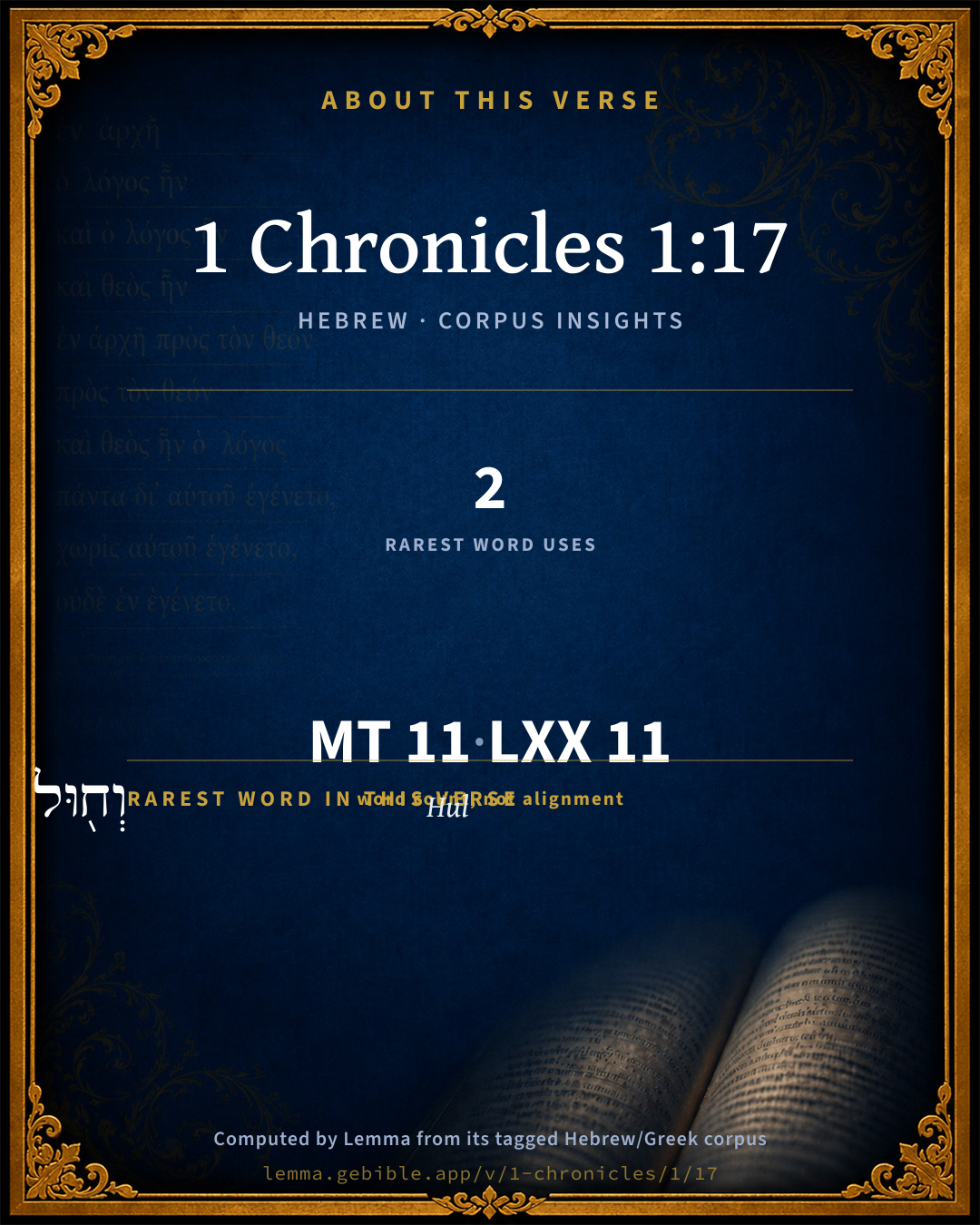
The rarest word here is וְח֖וּל Hul H2343 — appearing just 2 times in the whole Hebrew Bible.

Shared distinctive vocabulary

וְח֖וּל Hul H2343 occurs in 2 verses of the Hebrew Bible. Also found in:

Grammatical profile

  • 11 nouns

Hebrew & Septuagint length

In English translation the verse runs 21 words from the Hebrew and 7 from the Septuagint (LXX English) — the Septuagint runs noticeably shorter here. See the side-by-side →

A rough comparison of the two English renderings, which tokenize alike — not a word-level alignment.

Word counts can differ between the Hebrew and the Greek without any difference in meaning — e.g. the Hebrew direct-object marker אֵת has no separate Greek word, and Greek often adds the article ὁ.

In the original languages it is 11 Hebrew tokens and 11 Greek tokens — but the two are counted differently (Hebrew bundles its prefixes and suffixes into one token; the Greek is in lemma form), so that isn’t a like-for-like length.

Cross-references

18

Topical passages linked to 1 Chronicles 1:17 in the Treasury of Scripture Knowledge — connected by theme and wording, ordered by reader-vote popularity; previews shown in the World English Bible.

  • Genesis 10:22–32 The sons of Shem: Elam, Asshur, Arpachshad, Lud, and Aram.
  • Genesis 11:10 This is the history of the generations of Shem. Shem was one hundred years old, and became the father of Arpachshad two years after the flood.
  • Genesis 14:1 It happened in the days of Amraphel, king of Shinar, Arioch, king of Ellasar, Chedorlaomer, king of Elam, and Tidal, king of Goiim,
  • Numbers 23:7 He took up his parable, and said, From Aram has Balak brought me, The king of Moab from the mountains of the East: Come, curse me Jacob, Come, defy Israel.
  • Numbers 24:22–24 Nevertheless Kain shall be wasted, Until Asshur shall carry you away captive.
  • Ezra 4:2 then they drew near to Zerubbabel, and to the heads of fathers' [houses], and said to them, Let us build with you; for we seek your God, as you do; and we sacrifice to him since the days of Esar Haddon king of Assyria, who brought us up here.
  • Psalms 83:8 Assyria also is joined with them. They have helped the children of Lot. Selah.
  • Isaiah 11:11 It shall happen in that day, that the Lord will set his hand again the second time to recover the remnant of his people, who shall remain, from Assyria, and from Egypt, and from Pathros, and from Cush, and from Elam, and from Shinar, and from Hamath, and from the islands of the sea.
  • Isaiah 21:2 A grievous vision is declared to me; the treacherous man deals treacherously, and the destroyer destroys. Go up, Elam; besiege, Media; all the sighing of it have I made to cease.
  • Isaiah 22:6 Elam bore the quiver, with chariots of men [and] horsemen; and Kir uncovered the shield.
  • Isaiah 66:19 I will set a sign among them, and I will send such as escape of them to the nations, to Tarshish, Pul, and Lud, who draw the bow, to Tubal and Javan, to the isles afar off, who have not heard my fame, neither have seen my glory; and they shall declare my glory among the nations.
  • Jeremiah 25:25 and all the kings of Zimri, and all the kings of Elam, and all the kings of the Medes;
  • Ezekiel 27:10 Persia and Lud and Put were in your army, your men of war: they hanged the shield and helmet in you; they set forth your comeliness.
  • Ezekiel 27:23 Haran and Canneh and Eden, the traffickers of Sheba, Asshur [and] Chilmad, were your traffickers.
  • Ezekiel 32:22 Asshur is there and all her company; her graves are round about her; all of them slain, fallen by the sword;
  • Ezekiel 32:24 There is Elam and all her multitude round about her grave; all of them slain, fallen by the sword, who are gone down uncircumcised into the lower parts of the earth, who caused their terror in the land of the living, and have borne their shame with those who go down to the pit.
  • Hosea 14:3 Assyria can't save us. We won't ride on horses; Neither will we say any more to the work of our hands, 'Our gods!' For in you the fatherless finds mercy."
  • Daniel 8:2 I saw in the vision; now it was so, that when I saw, I was in Shushan the palace, which is in the province of Elam; and I saw in the vision, and I was by the river Ulai.

Cross-references courtesy of OpenBible.info (CC BY 4.0).

Hebrew and Greek witnesses Masoretic Hebrew ↔ Greek Septuagint

The same verse in the two great witnesses to the Old Testament, shown verse-for-verse.

Here the Septuagint runs noticeably shorter than the Hebrew — LXX2012 (modern English Septuagint) 7 words vs World English Bible 21. A rough length comparison of the two English translations, not a word-level alignment — read both below.

These are two independent witnesses, not word-aligned to each other, and the Septuagint is shown in lemma (dictionary) form.

Hebrew 1 Chronicles 1:17 Masoretic · Westminster Leningrad Codex

בְּנֵ֣י שֵׁ֔ם עֵילָ֣ם וְאַשּׁ֔וּר וְאַרְפַּכְשַׁ֖ד וְל֣וּד וַאֲרָ֑ם וְע֥וּץ וְח֖וּל וְגֶ֥תֶר וָמֶֽשֶׁךְ

The sons of Shem: Elam, and Asshur, and Arpachshad, and Lud, and Aram, and Uz, and Hul, and Gether, and Meshech.

World English Bible · Public Domain

Greek LXX 1 Chronicles 1:17 Septuagint · lemma form

οὗτος δέ ὁ γένεσις πρωτότοκος ισμαηλ ναβαιωθ καί κηδαρ ναβδεηλ μαβσαν

The sons of Sem, Aelam, and Assur,

LXX2012 (modern English Septuagint) · Public Domain

On this verse, Ellicott's Commentary for English Readers discusses the Septuagint’s reading. Read the note in Commentary ↓

Hebrew: Westminster Leningrad Codex (CC BY 4.0). Greek: Septuagint (public domain); English from LXX2012 (modern English Septuagint) (Public Domain). How the Septuagint differs from the Hebrew →

Commentary

Notes on 1 Chronicles 1:17 from classic Christian and Jewish commentators (each source and its license shown beneath its notes). The classic Christian expositions comment on the surrounding passage and are grouped to its opening verse, so a note may address several verses; the Jewish commentaries on the Tanakh (Rashi and others) are per-verse, so they appear only where the commentator wrote on this verse.

Lemma curates 59 commentaries, every one of them public domain or Creative Commons licensed, each selected and text-cleaned for this edition rather than reprinted as found. About our sources →

Ellicott's Commentary for English Readers

THE SONS OF SHEM, OR THE SEMITES (1Ch_1:17-23).

(17) Blam.—The Elamtum of the Assyrian inscription, the classic Susiana, a mountainous land eastward of Babylonia, to which it was subject in the days of Abraham (Genesis 14). The names Assurû, Elamû, Kassû, and Accadû occur together in an old Assyrian list of nations. Êlama, from which the Assyrian and Hebrew names are derived, is Accadian. The native designation was Ansan. The Sargonide kings of Assyria had frequent wars with Elam.

Asshur.—Assyria proper, i.e., a district on the Tigris, about twenty-five miles long, between the thirty-sixth and thirty-seventh parallels of latitude. Asshur was the name of its older capital and tutelar god. The Semitic Assyrians appear to have been settled at Asshur as early as the nineteenth century B.C. They were emigrants from Babylonia (Gen_10:11). The original name was A-usar, “water-meadow.”

Arphaxad apparently means Babylonia, or, at least, includes it. Babylonian monarchs styled themselves “King of the Four Quarters” (of heaven); and Arphaxaa may perhaps mean land of the four quarters or sides, and be derived from the Assyrian arba-kisâdi “four sides” (Friedrich Delitzsch). More probably it is Arph-chesed, “boundary of Chaldea.”

Lud, usually identified with the Lydians (Assyrian Luddi), perhaps their original home in Armenia. The name has also been compared with Rutennu, the Egyptian name of the Syrians (I and r being confused in Egyptian). But comp. Eze_27:10; Eze_30:5.

Aram.—The high land—that is, eastern and western Syria, extending from the Tigris to the Great Sea. The name is constantly used for the Arameans, or Syrians.

Uz.—An Arab tribe, called Hâsu by Esarhaddon, who reduced them. Perhaps, however, Uz (Heb., Ûç), is the Assyrian Uçça, a district on the Orontes, mentioned by Shalmaneser II. (B.C. 860-825). Job lived in the “land of Uz.” The remaining names appear to be also those of Arab tribes, who must have lived northward in the direction of Aram; these are called sons of Aram in Genesis 10

Hul is the Assyrian Hûlî’a, which formed a part of the mountain land of Kasiar or Mash (Inscription of Assurnâçirpal, B.C. 885-860). For Meshech Genesis 10 has Mash, which is compared with Mount Masius, near Nisibin. (So the Syriac and some Heb. MSS.)

(18) Eber.—The land on the other side (Gr., ἡ πέραν) Peræa. Here the land beyond the Euphrates is meant, from which “Abraham, the Hebrew” (i.e., Eberite), migrated.

(19) Two sons.—This indicates the ancient consciousness that the Hebrew and Arabian peoples were akin.

The earth was divided.—Or, divided itself. (Comp. Deu_32:7-9.) The words probably refer to a split in the population of Mesopotamia.

(20) Joktan begat Almodad.—The Joktanite tribes lived along the coast of Hadhramaut (Hazarmaveth) and Yemen, in southern Arabia. The tribes of Yemen call their ancestor Qahtân (= Joktan). The names in 1Ch_1:20-21, are all explicable from Arabic sources.

(22) Ebal.—Gen_10:28. Obal, where, however, the LXX. read Εὐάλ (Ebal). The different spelling is due to the common confusion in MSS. of the Hebrew letters w and y. Both Ebal and Abimael are unknown.

(23) Ophir.—Abhîra, at the mouth of the Indus.

Jobab.—Probably a tribe of Arabia Deserta. (Comp. the Arabic yabâb, a desert.)

All these were the sons of Joktan.—Gen_10:30 adds a definition of their territory: “Their dwelling was from Mesha” (Maisânu, at the head of the Persian Gulf), “until thou comest to Sephar” (probably Zafâru or Isfor, in South Arabia) “and the mountains of the east” (i.e., Nejd, a range parallel to the Red Sea).

From the whole section we learn that the Elamites, Assyrians, Chaldees, Arameans, Hebrews, and Arabs, were regarded as belonging to the great Semitic family. In regard to Elam, modern philologers have questioned the correctness of this view. It is, however, quite possible that at the time when the original of this table of nations was composed, some Semitic tribes were known to have effected a settlement in Elam, just as kindred tribes occupied Babylonia and Assyria.

The fourteen sons of Japheth and the thirty sons of Ham, and the twenty-six sons of Shem, make a total of seventy eponyms of nations. The number seventy is probably not accidental. Comp. the seventy elders (Num_11:16); the seventy members of the Sanhedrin; and even the seventy disciples of Christ (Luk_10:1). The seventy nations of the world are often mentioned in the Talmud. Ezekiel’s prophecy concerning Tyre, and the peoples that had commerce with her (Ezekiel 27), is a valuable illustration of the table.

A Bible Commentary for English Readers, edited by Charles John Ellicott (1878–1897) — public domain. Text from a community e-Sword module.

Joseph Benson's Commentary

1Ch 1:17-19. The sons of Shem — Either the name of sons is so taken here as to include grandsons, or the children of Aram are understood before Uz, out of Gen 10:23, where they are expressed. Arphaxad begat — Either immediately, or mediately by his son Canaan, who is expressed Luk 3:35. Divided — In their languages and habitations.

Joseph Benson's Commentary on the Old and New Testaments (1811–1818) — public domain. Text from a community e-Sword module.

Geneva Bible (1599)

Geneva Bible translators

Of whom came the Syrians, and therefore they are called Aramites throughout all the Scripture.

Geneva Bible (1599) marginal notes — public domain. Text via Bolls.life.

Jamieson, Fausset & Brown

Robert Jamieson, A. R. Fausset & David Brown

Uz, and Hul, and Gether, and Meshech--or, "Mash"; these were the children of Aram, and grandsons of Shem (Gen 10:23).

Jamieson, Fausset & Brown — Commentary Critical and Explanatory on the Whole Bible (1871) — public domain (CC PDM 1.0). Text via the HelloAO Bible API.

The Cambridge Bible for Schools and Colleges

gen. ed. J. J. S. Perowne

17 (= Gen_10:22-23). The Sons of Shem

17. The sons of Shem] These occupied the middle geographical “zone.”

Elam] “Semites neither in blood nor in speech” (Sayce, Higher Criticism, p. 122). If this be so, the reason of their being reckoned to Shem must be that they were in the geographical zone which belonged to the Semites.

Asshur] The Assyrians, who spoke a Semitic dialect and were doubtless Semites.

Arphaxad] R.V. Arpachshad. The second half of the word (“chshad”) contains the name of the Casdim, the “Chaldeans” or “Chaldees” of the A.V.

Lud] Perhaps the Lydians. In 1Ch_1:11, which is an extract from an earlier document (“J”), Ludim (“the Lydians”) are reckoned as the children of Mizraim (Egypt). Lydia itself was in the Japhetic “zone,” but the people may have been recognised as Semites independently of their geographical position.

Aram] the “Syrians” of the A.V.; better called Aramaeans. In Damascus they held an independent power for centuries and were constantly at war with Israel. Further north they seem to have been under the hegemony of the Hittites.

Uz] From Gen_10:23 it appears that in Chron. the words “And the children of Aram[1]” have dropped out, so that “Uz” etc. appear as the immediate descendants of Shem.

[1] The Alexandrine MS (A) of the LXX. has the words.

Neither Uz nor the three following names have been satisfactorily identified. For “Meshech” Gen_10:2 (Heb. not LXX.) reads “Mash.”

The Cambridge Bible for Schools and Colleges (gen. ed. J. J. S. Perowne; Cambridge University Press, 1878–1918) — public domain. Text from a community e-Sword module.

Albert Barnes' Notes on the Bible

The sons of Shem - i. e., descendants. Uz, Hul, Gether, and Meshech (or Mash), are stated to have been “sons of Aram” Gen 10:23. Meshech is the reading of all the MSS., and is supported by the Septuagint here and in Gen 10:23. It seems preferable to “Mash,” which admits of no very probable explanation. Just as Hamites and Semites were intermingled in Arabia (Gen 10:7, note; Gen 10:29, note), so Semites and Japhethites may have been intermingled in Cappadocia - the country of the Meshech or Moschi (Gen 10:2 note); and this Aramaean ad-mixture may have been the origin of the notion, so prevalent among the Greeks, that the Cappadocians were Syrians.

Albert Barnes' Notes on the Bible (1834–1885) — public domain. Text from a community e-Sword/MySword module.

Haydock's Catholic Bible Commentary

Hus and Hul were the immediate sons of Aram, as well as....Mosoch, or Mes; (Genesis x. 23.; Calmet) so that there seems to be here some transposition. (Du Hamel)

George Leo Haydock (1774–1849), Haydock's Catholic Family Bible and Commentary, 1859 edition — public domain. Excludes Psalms (Douay-Rheims chapter numbering differs from Protestant) and Deuterocanonical books (Catholic canon only).

Matthew Poole's English Annotations

The sons of Shem; either the name of sons is so taken here as to include grandsons, who are called sons, Gen 29:5; 2Sa 19:21; or, these words, the children of Aram, are understood and inserted before

Uz, out of Gen 10:23, where they are expressed.

Matthew Poole's English Annotations on the Holy Bible (1683–1685) — public domain. Text from a community e-Sword/MySword module.

The Pulpit Commentary

Vers. 17-27. D. THE LIST OF SHEM"S DESCENDANTS TO ABRAM. This list is broken in two; it pauses a moment exactly halfway to Abram, at the name Peleg, to mention Peleg"s brother Joktan and Joktan"s thirteen sons. Then, repeating the first five names of lineal descent, and picking up the thread at Peleg, the list gives the remaining five to Abram. In the first half of this list, we have apparently the names of nine sons of Shem, but, as Genesis explains, really the names of five sons, and through Aram, the last of them, the names of four grandsons. Another grandson, through Arphaxad the third son, follows, and through this grandson two consecutive lineal descents bring us, in the name Peleg, half-way to Abram. It is here the lineal table pauses to give Joktan and his thirteen sons. The names then in this portion of the list are twenty-six in number. In the Authorized Version they correspond with those in Genesis, except that Meschech ( here is called Mash (vmw;) there; Shelah here is spelled Salah there; and Ebal (lbye) here is written Obal (lbwO) there. The difference between the Hebrew texts justifies the first and last of these variations in the Authorized Version, but in all other respects those texts are in entire accord with one another, for this paragraph. The Septuagint gives very little of this portion of the list. It corresponds, whether with the Hebrew or the Authorized Version, only as far as to the name Arphaxad, after which it carries down the line at once to Abram by the remaining eight names as given in our twenty-fourth to twenty-seventh verses. Nor is it in agreement with its own version in Genesis, which has points of important variation with the Hebrew text also. It is then at this break of the list that, after the names of Joktan"s sons, we have in Genesis these words, "And their dwelling was from Mesha, as thou goest unto Sephar a mount of the east. These are the sons of Shem, after their families, after their tongues, in their lauds, after their nations. These are the families of the sons of Noah, after their generations, in their nations; and by these were the nations divided in the earth after the Flood." Upon this follows the account of Babel, in nine long verses, and then a chronological summary is furnished in lineal descent only from Shem to Abram. It is with the names in this chronological summary that those in this second part of our list (vers. 24-27) are found to agree. But any attempt at reproduction of the chronology found in Genesis is again absent here. At this point a significant stage of these genealogies is reached. The ever-broadening stream of population now narrows again. Two thousand years have flown by, then Abraham appears on the stream and tide of human life. Of that long period the life of Adam himself spanned nearly the half. So far we learn without partiality of all his descendants in common. But henceforth, the real, the distinct purpose of the genealogy becomes apparent, in that the line of the descendants of Abraham, and that by one family, alone is maintained, and proves to be a purpose leading by one long straight line to Christ himself. With Abraham "the covenant of innoceney," long forfeited in Adam, is superseded by the everlasting "covenant of grace," and we lose sight in some measure of Adam, the "common father of our flesh," to think of a happier parentage found in Abraham, the "common father of the faithful."

The Pulpit Commentary (1880–1919), ed. H.D.M. Spence-Jones & Joseph S. Exell — public domain. Text from a community e-Sword module.

John Wesley's Explanatory Notes

The sons - Either the name of sons is so taken here as to include grandsons, or, these words, the children of Aram, are understood before Uz, out of Gen. x, 23, where they are expressed.

John Wesley, Explanatory Notes Upon the Whole Bible (1754–1765) — public domain. Text via the GEBible commentary corpus.

unfoldingWord translationNotes

Door43 World Missions Community

General Information:

All of the names here are names of men. (See: How to Translate Names)

translationWords

Shem

Elam

Aram

Meshech

unfoldingWord translationNotes — © Distant Shores Media and the Door43 World Missions Community, licensed CC BY-SA 4.0. Source: git.door43.org/Door43/en_tn.

Lesson kit

Teaching starters — assembled from the data on this page, not authored interpretation. Every prompt links to the verse data it draws on. Edit before teaching.

1 Chronicles, in the Historical, opens this verse with 11 words (11 distinct Hebrew lemmas). Its most distinctive word is Chûwl (“Hul”). The Greek Septuagint runs shorter here. A historical commentator’s framing appears above. Read the whole chapter for the surrounding context.

Discussion questions

  1. What does “Hul” (Chûwl) contribute to the verse as a whole?
  2. Genesis 10:23 shares the word «Hul» with this verse. How do the two illuminate each other?
  3. Compared with the Hebrew, the Septuagint runs shorter here. What questions does that raise?
  4. These translations render this verse differently. What is at stake in choosing one wording over another?
  5. Reading how Ellicott's Commentary for English Readers and Joseph Benson's Commentary read this verse, where do the two commentators agree and where do they part?

Things to notice

Reading settings

Reading text

Shown beneath each verse's original-language words.

Old Testament
Old Testament edition

Read the OT as the Masoretic Hebrew (MT) or the Greek Septuagint (LXX).

English shown for the Greek Septuagint (in the Hebrew ↔ Greek comparison).

Comparing translations? Open the Compare panel on any verse page to stack up to four side by side.