Deuteronomy 2:33

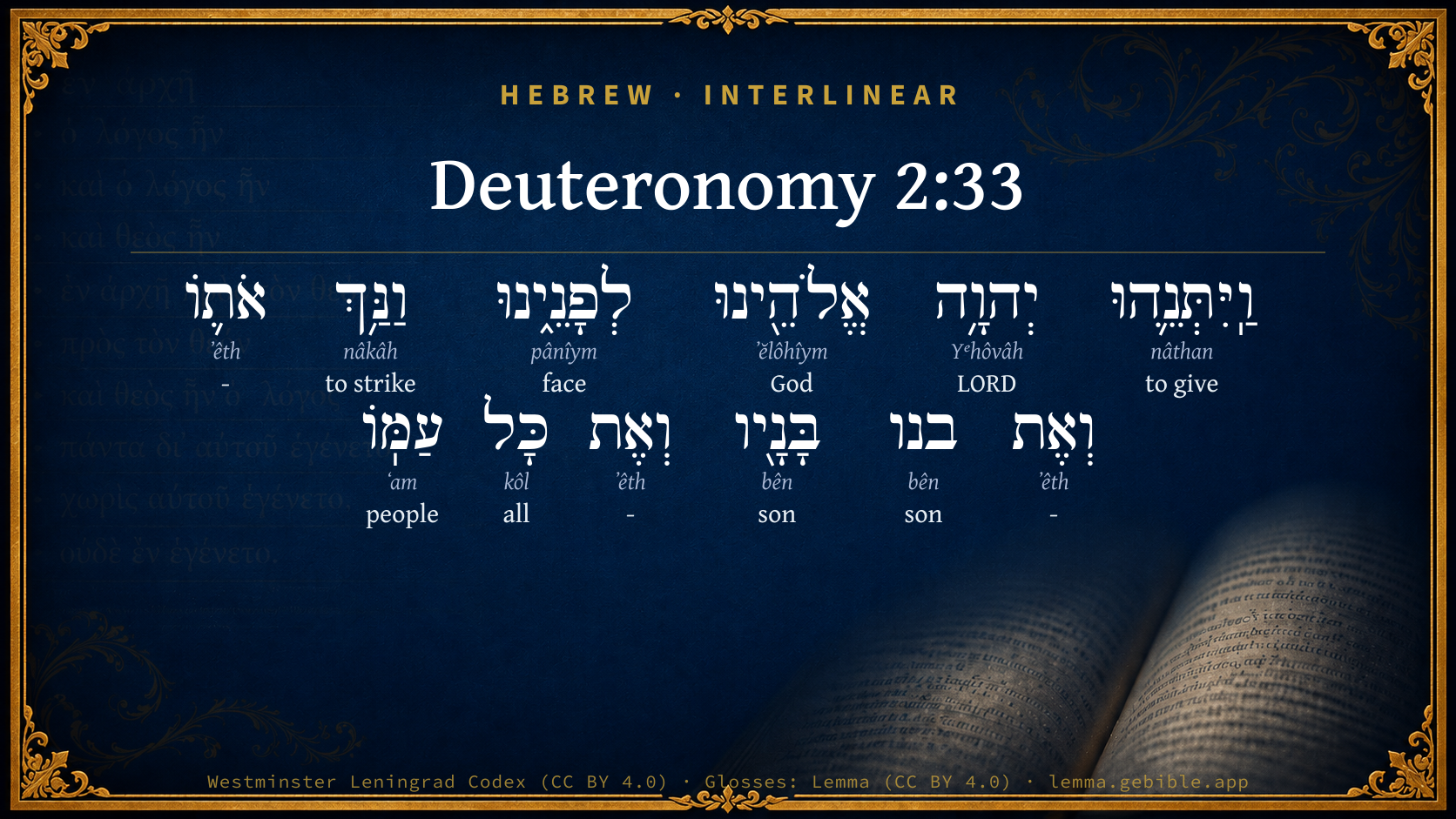
Hebrew (Westminster Leningrad Codex) Deuteronomy 2:33 appears in the Hebrew Old Testament. The text above is from the Westminster Leningrad Codex. Each word links to its Strong’s number, a concise gloss, and parsing drawn from the Open Scriptures Hebrew Bible morphology. Click any word for its full Brown-Driver-Briggs (BDB) entry.
Download image
Cite this verse

Deuteronomy 2:33 (World English Bible). Public Domain. Lemma interlinear Bible study tool, https://lemma.gebible.app/v/deuteronomy/2/33.

Show BibTeX & RIS
BibTeX
RIS
English Translation
Yahweh our God delivered him up before us; and we struck him, and his sons, and all his people.
World English Bible · Public Domain
Download a study sheet

One document with this verse’s original text, its word-by-word gloss line, the meaning frame, cross-references with their text, attributed commentary, and full source and license credits — printable, and it pastes into notes with its structure intact.

This verse Autodidact and up

Study sheet (.html) Plain text (.txt)

A passage Seminary Student

Up to 50 verses in one chapter. A passage sheet keeps up to 6 commentary sources and 12 cross-references per verse, in the order this page ranks them, and says so on the sheet whenever that leaves anything out. Ask for a single verse and you get the Autodidact verse sheet above.

Everything on this page stays free to read, with no account — the sheet is a download of what is already on screen, not access to it.

Want to remove ads? Support Godless Engineer
Compare translations 3

The same verse in 3 English versions, stacked beneath the original-language interlinear above. Click any original word for its lexicon entry.

Each is an independent rendering of the whole verse — the interlinear is not word-aligned to these translations.

Highlighted words mark where these versions differ — a whole-verse word diff, not a word-by-word alignment.

  • World English Bible Public Domain
    Yahweh our God delivered him up before us; and we struck him, and his sons, and all his people.
  • King James Version Public Domain
    And the LORD our God delivered him before us; and we smote him, and his sons, and all his people.
  • unfoldingWord Literal Text CC BY-SA 4.0
    And Yahweh our God gave him to our faces, and we struck him down and his son and all his people.

unfoldingWord Literal Text — © unfoldingWord, licensed CC BY-SA 4.0. Word-aligned USFM3 via Door43 (git.door43.org/unfoldingWord/en_ult).

Versions to compare (up to 4)

3 of 4 selected

Show all 18 translations

Every available English version of this verse, each an independent rendering of the whole verse.

  • World English Bible Public Domain
    Yahweh our God delivered him up before us; and we struck him, and his sons, and all his people.
  • Berean Standard Bible Public Domain
    And the LORD our God delivered him over to us, and we defeated him and his sons and his whole army.
  • Majority Standard Bible Public Domain
    And the LORD our God delivered him over to us, and we defeated him and his sons and his whole army.
  • King James Version Public Domain
    And the LORD our God delivered him before us; and we smote him, and his sons, and all his people.
  • American Standard Version (1901) Public Domain
    And Jehovah our God delivered him up before us; and we smote him, and his sons, and all his people.
  • Revised Version (1885) Public Domain
    And the LORD our God delivered him up before us; and we smote him, and his sons, and all his people.
  • Geneva Bible (1599) Public Domain
    But the Lord our God deliuered him into our power, and we smote him, and his sonnes, and all his people.
  • Douay-Rheims (1899) Public Domain
    And the Lord our God delivered him to us: and we slew him with his sons and all his people.
  • Young's Literal Translation Public Domain
    and Jehovah our God giveth him before us, and we smite him, and his sons, and all his people;
  • Literal Standard Version CC BY-SA 4.0
    and our God YHWH gives him before our faces, and we strike him, and his sons, and all his people;
  • Unlocked Literal Bible CC BY-SA 4.0
    Yahweh our God gave him over to us and we defeated him and his sons and all his people.
  • unfoldingWord Literal Text CC BY-SA 4.0
    And Yahweh our God gave him to our faces, and we struck him down and his son and all his people.
  • Darby Bible Public Domain
    But Jehovah our God gave him up before us; and we smote him, and his sons, and his whole people.
  • World Messianic Bible Public Domain
    The LORD our God delivered him up before us; and we struck him, his sons, and all his people.
  • Webster's Bible Public Domain
    And the LORD our God delivered him before us; and we smote him, and his sons, and all his people.
  • Free Bible Version CC BY-SA 4.0
    The Lord our God handed him over to us, and we killed him, his sons, and all his army.
  • Bible in Basic English Public Domain
    And the Lord our God gave him into our hands; and we overcame him and his sons and all his people.
  • JPS Tanakh (1917) Public Domain
    And the LORD our God delivered him up before us; and we smote him, and his sons, and all his people.

Literal Standard Version (2020), Covenant Press — licensed CC BY-SA 4.0. Text via the HelloAO Bible API (eBible.org). Unlocked Literal Bible (unfoldingWord) — licensed CC BY-SA 4.0. Text via the HelloAO Bible API (eBible.org). unfoldingWord Literal Text — © unfoldingWord, licensed CC BY-SA 4.0. Word-aligned USFM3 via Door43 (git.door43.org/unfoldingWord/en_ult). Free Bible Version, Dr. Jonathan Gallagher — licensed CC BY-SA 4.0. Text via the HelloAO Bible API (eBible.org).

Word by word

More ways to search: Search by grammar → Find every occurrence → Compare this word →

Practice this passage: Drill this verse → Learn its vocabulary →

וַנַּ֥ךְ
nâkâh
H5221
“and · to strike”
Conjunction + Verb, Hiphil, Sequential Imperfect, 1st Person, Common, Plural
Part of Speech
Conjunction + Verb
Stem
Hiphil
Form
Sequential Imperfect
Person
1st Person
Gender
Common
Number
Plural
Full BDB Definition

Origin: a primitive root

TWOT: 1364

to strike, smite, hit, beat, slay, kill - (Niphal) to be stricken or smitten - (Pual) to be stricken or smitten - (Hiphil) - to smite, strike, beat, scourge, clap, applaud, give a thrust - to smite, kill, slay (man or beast) - to smite, attack, attack and destroy, conquer, subjugate, ravage - to smite, chastise, send judgment upon, punish, destroy - (Hophal) to be smitten - to receive a blow - to be wounded - to be beaten - to be (fatally) smitten, be killed, be slain - to be attacked and captured - to be smitten (with disease) - to be blighted (of plants)

  1. וַֽיִּתְּנֵ֛הוּ nâthan H5414 “and · to give · him” Conjunction + Verb, Qal, Sequential Imperfect, 3rd Person, Masculine, Singular + Suffix, Personal, 3rd Person, Masculine, Singular
  2. יְהוָ֥ה Yᵉhôvâh H3068 “LORD” Noun, Proper
  3. אֱלֹהֵ֖ינוּ ʼĕlôhîym H430 “God(s) · our” Noun, Common, Masculine, Plural, Construct + Suffix, Personal, 1st Person, Common, Plural
  4. לְפָנֵ֑ינוּ pânîym H6440 “to/for · face(s) · our” Preposition + Noun, Common, Both, Plural, Construct + Suffix, Personal, 1st Person, Common, Plural
  5. אֹת֛וֹ ʼêth H853 “- · him” Particle, Direct Object + Suffix, Personal, 3rd Person, Masculine, Singular
  6. וְאֶת ʼêth H853 “and · -” Conjunction + Particle, Direct Object
  7. בנו bên H1121 “sons · his” Noun, Common, Masculine, Plural, Construct + Suffix, Personal, 3rd Person, Masculine, Singular
  8. בָּנָ֖יו bên H1121 “sons · his” Noun, Common, Masculine, Plural, Construct + Suffix, Personal, 3rd Person, Masculine, Singular
  9. וְאֶת ʼêth H853 “and · -” Conjunction + Particle, Direct Object
  10. כָּל kôl H3605 “all of” Noun, Common, Masculine, Singular, Construct
  11. עַמּֽוֹ ʻam H5971 “people · his” Noun, Common, Masculine, Singular, Construct + Suffix, Personal, 3rd Person, Masculine, Singular

About this verse

These counts appear in no published source. They are computed here, from the morphology-tagged text and Lemma’s own curated glosses. What Lemma adds →

12
words
9
distinct lemmas
Pentateuch
section

Grammatical profile

  • 2 verbs
  • 7 nouns
  • 3 particles

Verb forms

  • וַֽיִּתְּנֵ֛הוּ Qal · Sequential Imperfect
  • וַנַּ֥ךְ Hiphil · Sequential Imperfect

Repetition

A word recurs within this verse — often emphatic in Hebrew:

Hebrew & Septuagint length

In English translation the verse runs 19 words from the Hebrew and 21 from the Septuagint (LXX English) — closely comparable.

A rough comparison of the two English renderings, which tokenize alike — not a word-level alignment.

Word counts can differ between the Hebrew and the Greek without any difference in meaning — e.g. the Hebrew direct-object marker אֵת has no separate Greek word, and Greek often adds the article ὁ.

In the original languages it is 12 Hebrew tokens and 22 Greek tokens — but the two are counted differently (Hebrew bundles its prefixes and suffixes into one token; the Greek is in lemma form), so that isn’t a like-for-like length.

Cross-references

10

Topical passages linked to Deuteronomy 2:33 in the Treasury of Scripture Knowledge — connected by theme and wording, ordered by reader-vote popularity; previews shown in the World English Bible.

  • Deuteronomy 7:2 and when Yahweh your God shall deliver them up before you, and you shall strike them; then you shall utterly destroy them: you shall make no covenant with them, nor show mercy to them;
  • Joshua 21:44 Yahweh gave them rest round about, according to all that he swore to their fathers: and there stood not a man of all their enemies before them; Yahweh delivered all their enemies into their hand.
  • Genesis 14:20 and blessed be God Most High, who has delivered your enemies into your hand." Abram gave him a tenth of all.
  • Numbers 21:24 Israel struck him with the edge of the sword, and possessed his land from the Arnon to the Jabbok, even to the children of Ammon; for the border of the children of Ammon was strong.
  • Deuteronomy 3:2–3 Yahweh said to me, Don't fear him; for I have delivered him, and all his people, and his land, into your hand; and you shall do to him as you did to Sihon king of the Amorites, who lived at Heshbon.
  • Deuteronomy 20:16 But of the cities of these peoples, that Yahweh your God gives you for an inheritance, you shall save alive nothing that breathes;
  • Deuteronomy 29:7–8 When you came to this place, Sihon the king of Heshbon, and Og the king of Bashan, came out against us to battle, and we struck them:
  • Joshua 10:30–42 and Yahweh delivered it also, and the king of it, into the hand of Israel; and he struck it with the edge of the sword, and all the souls who were therein; he left none remaining in it; and he did to the king of it as he had done to the king of Jericho.
  • Judges 1:4 Judah went up; and Yahweh delivered the Canaanites and the Perizzites into their hand: and they struck of them in Bezek ten thousand men.
  • Judges 7:2 Yahweh said to Gideon, The people who are with you are too many for me to give the Midianites into their hand, lest Israel vaunt themselves against me, saying, My own hand has saved me.

Cross-references courtesy of OpenBible.info (CC BY 4.0).

Hebrew and Greek witnesses Masoretic Hebrew ↔ Greek Septuagint

The same verse in the two great witnesses to the Old Testament, shown verse-for-verse.

These are two independent witnesses, not word-aligned to each other, and the Septuagint is shown in lemma (dictionary) form.

Hebrew Deuteronomy 2:33 Masoretic · Westminster Leningrad Codex

וַֽיִּתְּנֵ֛הוּ יְהוָ֥ה אֱלֹהֵ֖ינוּ לְפָנֵ֑ינוּ וַנַּ֥ךְ אֹת֛וֹ וְאֶת בנו בָּנָ֖יו וְאֶת כָּל עַמּֽוֹ

Yahweh our God delivered him up before us; and we struck him, and his sons, and all his people.

World English Bible · Public Domain

Greek LXX Deuteronomy 2:33 Septuagint · lemma form

καί παραδίδωμι αὐτός κύριος ὁ θεός ἐγώ πρό πρόσωπον ἐγώ καί πατάσσω αὐτός καί ὁ υἱός αὐτός καί πᾶς ὁ λαός αὐτός

And the Lord our God delivered him before our face, and we struck him, and his sons, and all his people.

LXX2012 (modern English Septuagint) · Public Domain

On this verse, The Cambridge Bible for Schools and Colleges discusses the Septuagint’s reading. Read the note in Commentary ↓

Hebrew: Westminster Leningrad Codex (CC BY 4.0). Greek: Septuagint (public domain); English from LXX2012 (modern English Septuagint) (Public Domain). How the Septuagint differs from the Hebrew →

Targum (Aramaic paraphrase)

2

The Targum is the ancient Jewish Aramaic paraphrase of the Hebrew Scriptures — an interpretive translation, not the Hebrew text itself. Onkelos (literal) and Pseudo-Jonathan (expansive) render the Torah, and Jonathan the Prophets. Coverage is partial: where no permissively-licensed English translation exists for a verse, only the Aramaic is shown. This is verse-level text, not a word-by-word alignment to the Hebrew.

  1. Targum Onkelos Torah (Genesis–Deuteronomy)
    וּמָסְרֵהּ יְיָ אֱלָהָנָא קֳדָמָנָא וּמְחֵנָא יָתֵהּ וְיָת בְּנוֹהִי וְיָת כָּל עַמֵהּ

    (no public-domain English translation for this verse)

    Targum Onkelos — Aramaic: “Onkelos Genesis” (public domain); “Onkelos Exodus” (public domain); “Onkelos Leviticus” (public domain); “Onkelos Numbers” (public domain); “Onkelos Deuteronomy” (public domain). English: “Sefaria Community Translation” (CC0 1.0 (public-domain dedication)); “J.W. Etheridge. The Targums of Onkelos and Jonathan Ben Uzziel on the Pentateuch. London: Longmans, Green, 1862” (public domain). Text via Sefaria.

  2. Targum Pseudo-Jonathan Torah (Genesis–Deuteronomy)
    וּמְסַר יָתֵיהּ יְיָ אֱלָהָנָא קֳדָמָנָא וּמְחֵינָא יָתֵיהּ וְיַת בְּנוֹי וְיַת כָּל עַמֵּיהּ

    And the Lord our God delivered him up before us, and we smote him, and his children, and all his people.

    Targum Pseudo-Jonathan — Aramaic: “Targum Jonathan on Genesis” (public domain); “Targum Jonathan on Exodus” (public domain); “Targum Jonathan on Leviticus” (public domain); “Targum Jonathan on Numbers” (public domain); “Targum Jonathan on Deuteronomy” (public domain). English: “The Targum of Jonathan ben Uzziel, trans. J. W. Etheridge, London, 1862” (public domain). Text via Sefaria.

Commentary

Notes on Deuteronomy 2:33 from classic Christian and Jewish commentators (each source and its license shown beneath its notes). The classic Christian expositions comment on the surrounding passage and are grouped to its opening verse, so a note may address several verses; the Jewish commentaries on the Tanakh (Rashi and others) are per-verse, so they appear only where the commentator wrote on this verse.

Lemma curates 59 commentaries, every one of them public domain or Creative Commons licensed, each selected and text-cleaned for this edition rather than reprinted as found. About our sources →

Geneva Bible (1599)

Geneva Bible translators

Hebrew, before us.

Geneva Bible (1599) marginal notes — public domain. Text via Bolls.life.

Ellicott's Commentary for English Readers

(33) And his sons.—As the Hebrew is written, it should be his son (possibly a person of distinction).

A Bible Commentary for English Readers, edited by Charles John Ellicott (1878–1897) — public domain. Text from a community e-Sword module.

The Cambridge Bible for Schools and Colleges

gen. ed. J. J. S. Perowne

33. delivered him up before us] See on Deu_1:8.

his sons] So the Heb. vowels, LXX, Sam. E, Num_21:24 a: smote him with the edge of the sword.

The Cambridge Bible for Schools and Colleges (gen. ed. J. J. S. Perowne; Cambridge University Press, 1878–1918) — public domain. Text from a community e-Sword module.

John Gill's Exposition

And the Lord our God delivered him before us,.... With their lands:

and we smote him and his sons, and all his people; with the edge of the sword; slew them all: the Cetib or textual reading is "his son", though the Keri or margin is "his sons", which we follow. So Jarchi observes, it is written "his son", because he had a son mighty as himself, he says.

John Gill's Exposition of the Whole Bible (1746–1763) — public domain (CC PDM 1.0). Text via the HelloAO Bible API.

The Pulpit Commentary

Vers. 33, 34And (Num_22:24, 25 32:34, 35, etc.) utterly destroyed the men, and the women, and the little ones.... we left none to remain. As the Amorites came out of Canaan, they belonged to the race which God had doomed to destruction. The Israelites, therefore, had a commission to extirpate them. Utterly destroyed; literally, devoted or placed under a ban, which of course implied utter destruction. The men, and the women, and the little ones, of every city; literally, every city of men and women and little children. The phrase "city of men" can hardly mean, as Rosenm affirms, "men of a city;" the hypallage here would be too violent. It rather means "a peopled city," "a city inhabited by men." The word rendered "men" ( does not designate males as opposed to females, but is a designation of human beings in general (cf. Job_11:3 Job_24:12; Job_20:4-8 Job_31:31; Psa_26:4, "vain persons," Authorized Version, literally, men of emptiness or of falsehood, etc.) The passage might be rendered, every inhabited city, even the women and the little children.

The Pulpit Commentary (1880–1919), ed. H.D.M. Spence-Jones & Joseph S. Exell — public domain. Text from a community e-Sword module.

Rashi

Rabbi Shlomo Yitzchaki (Rashi)

ואת בנו [AND WE SMOTE HIM] AND HIS SONS — It is written בנו, "his son" (although read as בניו "his sons"), for he had a son who was as mighty as himself (Midrash Tanchuma, Chukat 25).

Rashi on the Tanakh — English translations: “The Judaica Press complete Tanach with Rashi, translated by A. J. Rosenberg” (CC BY 4.0); “Pentateuch with Rashi's commentary by M. Rosenbaum and A.M. Silbermann, 1929-1934” (public domain); “The Metsudah Tanach series, Lakewood, N.J” (CC BY 4.0); and “The Book of Joshua, Metsudah Publications, 1997” (CC BY 4.0). Text via Sefaria.

Lesson kit

Teaching starters — assembled from the data on this page, not authored interpretation. Every prompt links to the verse data it draws on. Edit before teaching.

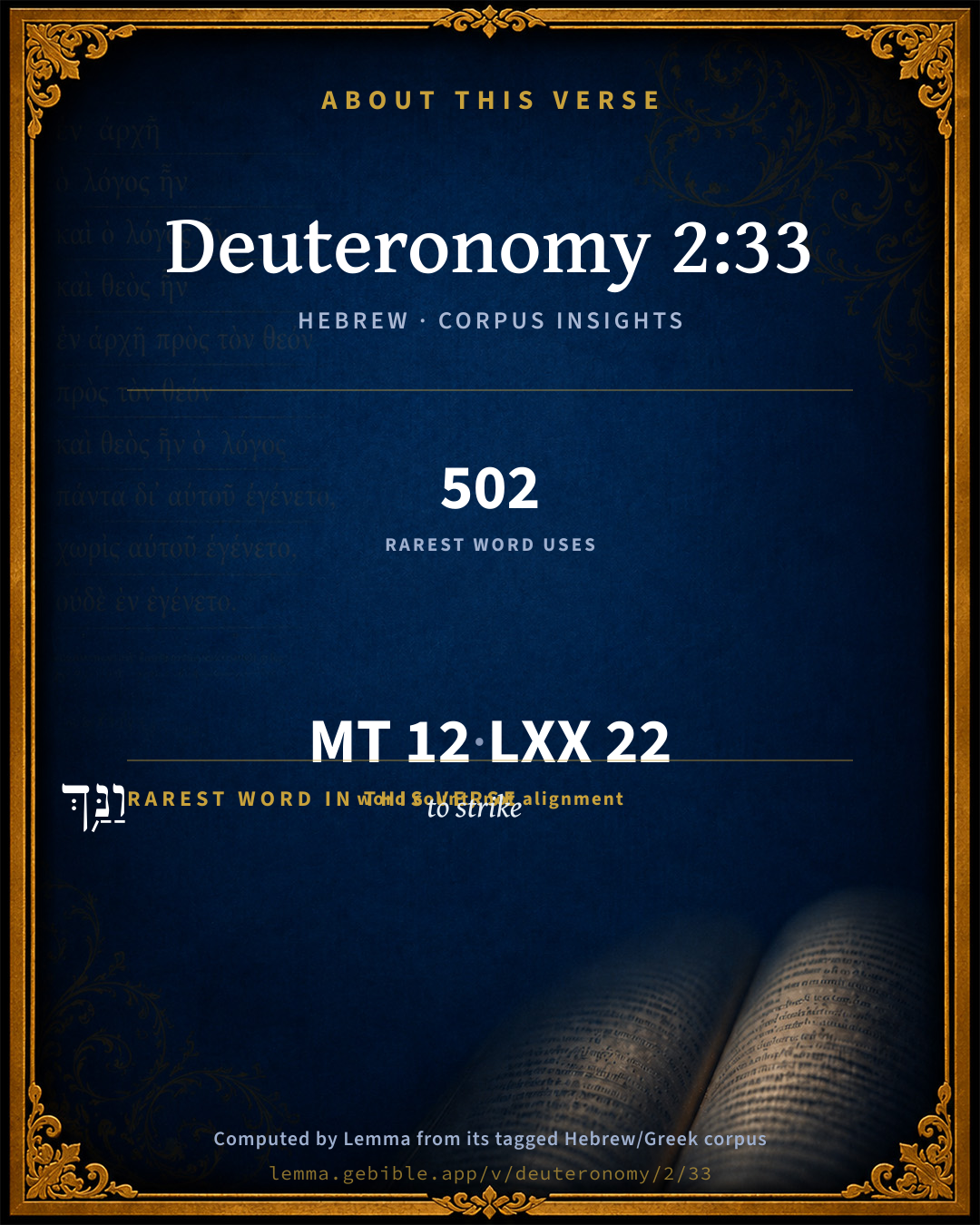
Deuteronomy, in the Pentateuch, opens this verse with 12 words (9 distinct Hebrew lemmas). Its most distinctive word is nâkâh (“to strike”). A historical commentator’s framing appears above. Read the whole chapter for the surrounding context.

Discussion questions

  1. How does “to strike” (nâkâh) shape what this verse is saying?
  2. How does Deuteronomy 7:2, which shares this passage’s theme, read alongside this verse?
  3. What does the repetition of “son” (2× in this one verse) do in this verse?
  4. These translations render this verse differently; the difference is in the English rendering, not the original. What questions does that raise?
  5. «וַֽיִּתְּנֵ֛הוּ» is a Qal Sequential Imperfect verb. How does that grammatical form shape the action described?
  6. Compare how Geneva Bible (1599) and Ellicott's Commentary for English Readers read this verse. Where do they agree or differ?

Things to notice

Reading settings

Reading text

Shown beneath each verse's original-language words.

Old Testament
Old Testament edition

Read the OT as the Masoretic Hebrew (MT) or the Greek Septuagint (LXX).

English shown for the Greek Septuagint (in the Hebrew ↔ Greek comparison).

Comparing translations? Open the Compare panel on any verse page to stack up to four side by side.