
1 Chronicles 1:43

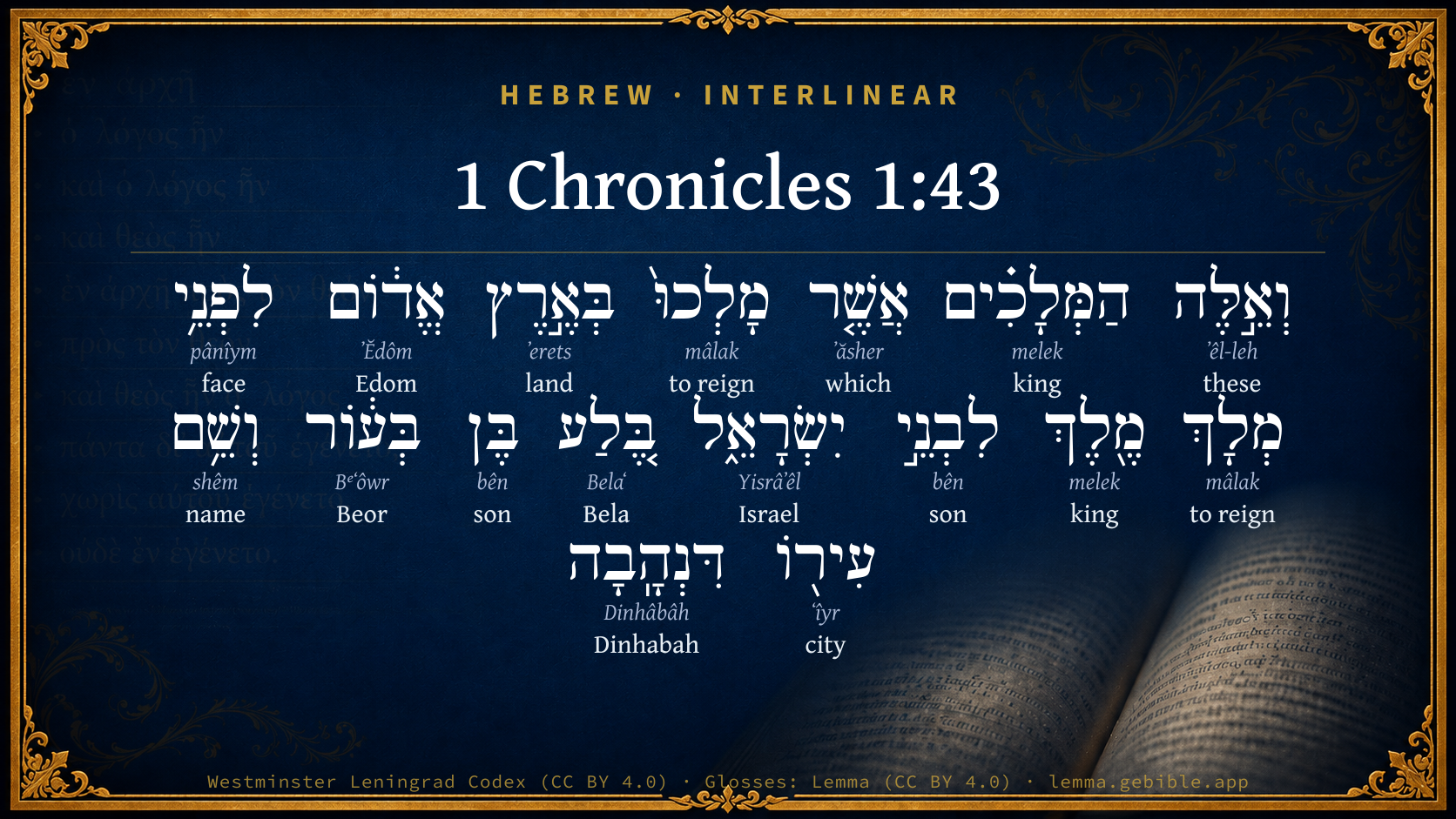
Hebrew (Westminster Leningrad Codex) 1 Chronicles 1:43 appears in the Hebrew Old Testament. The text above is from the Westminster Leningrad Codex. Each word links to its Strong’s number, a concise gloss, and parsing drawn from the Open Scriptures Hebrew Bible morphology. Click any word for its full Brown-Driver-Briggs (BDB) entry.
Download image
Cite this verse

1 Chronicles 1:43 (World English Bible). Public Domain. Lemma interlinear Bible study tool, https://lemma.gebible.app/v/1-chronicles/1/43.

Show BibTeX & RIS
BibTeX
RIS
English Translation
Now these are the kings who reigned in the land of Edom, before there resigned any king over the children of Israel: Bela the son of Beor; and the name of his city was Dinhabah.
World English Bible · Public Domain
Download a study sheet

One document with this verse’s original text, its word-by-word gloss line, the meaning frame, cross-references with their text, attributed commentary, and full source and license credits — printable, and it pastes into notes with its structure intact.

This verse Autodidact and up

Study sheet (.html) Plain text (.txt)

A passage Seminary Student

Up to 50 verses in one chapter. A passage sheet keeps up to 6 commentary sources and 12 cross-references per verse, in the order this page ranks them, and says so on the sheet whenever that leaves anything out. Ask for a single verse and you get the Autodidact verse sheet above.

Everything on this page stays free to read, with no account — the sheet is a download of what is already on screen, not access to it.

Want to remove ads? Support Godless Engineer
Compare translations 3

The same verse in 3 English versions, stacked beneath the original-language interlinear above. Click any original word for its lexicon entry.

Each is an independent rendering of the whole verse — the interlinear is not word-aligned to these translations.

Highlighted words mark where these versions differ — a whole-verse word diff, not a word-by-word alignment.

  • World English Bible Public Domain
    Now these are the kings who reigned in the land of Edom, before there resigned any king over the children of Israel: Bela the son of Beor; and the name of his city was Dinhabah.
  • King James Version Public Domain
    Now these are the kings that reigned in the land of Edom before any king reigned over the children of Israel; Bela the son of Beor: and the name of his city was Dinhabah.
  • unfoldingWord Literal Text CC BY-SA 4.0
    Now these the kings who reigned in the land of Edom to the face of the reigning of a king over the sons of Israel: Bela, the son of Beor. And the name of his city Dinhabah.

unfoldingWord Literal Text — © unfoldingWord, licensed CC BY-SA 4.0. Word-aligned USFM3 via Door43 (git.door43.org/unfoldingWord/en_ult).

Versions to compare (up to 4)

3 of 4 selected

Show all 18 translations

Every available English version of this verse, each an independent rendering of the whole verse.

  • World English Bible Public Domain
    Now these are the kings who reigned in the land of Edom, before there resigned any king over the children of Israel: Bela the son of Beor; and the name of his city was Dinhabah.
  • Berean Standard Bible Public Domain
    These are the kings who reigned in the land of Edom before any king reigned over the Israelites: Bela son of Beor. His city was named Dinhabah.
  • Majority Standard Bible Public Domain
    These are the kings who reigned in the land of Edom before any king reigned over the Israelites: Bela son of Beor. His city was named Dinhabah.
  • King James Version Public Domain
    Now these are the kings that reigned in the land of Edom before any king reigned over the children of Israel; Bela the son of Beor: and the name of his city was Dinhabah.
  • American Standard Version (1901) Public Domain
    Now these are the kings that reigned in the land of Edom, before there resigned any king over the children of Israel: Bela the son of Beor; and the name of his city was Dinhabah.
  • Revised Version (1885) Public Domain
    Now these are the kings that reigned in the land of Edom, before there reigned any king over the children of Israel: Bela the son of Beor; and the name of his city was Dinhabah,
  • Geneva Bible (1599) Public Domain
    And these were the Kings that reigned in the land of Edom, before a King reigned ouer the children of Israel, to wit, Bela the sonne of Beor, and the name of his citie was Dinhabah.
  • Douay-Rheims (1899) Public Domain
    Now these are the kings that reigned in the land of Edom, before there was a king over the children of Israel: Bale the son of Beer: and the name of his city was Denaba.
  • Young's Literal Translation Public Domain
    And these `are' the kings who reigned in the land of Edom before the reigning of a king of the sons of Israel: Bela son of Beor, and the name of his city `is' Dinhabah.
  • Literal Standard Version CC BY-SA 4.0
    And these [are] the kings who reigned in the land of Edom before the reigning of a king of the sons of Israel: Bela son of Beor, and the name of his city [is] Dinhabah.
  • Unlocked Literal Bible CC BY-SA 4.0
    These were the kings who reigned in the land of Edom before any king reigned over the Israelites: Bela son of Beor, and the name of his city was Dinhabah.
  • unfoldingWord Literal Text CC BY-SA 4.0
    Now these the kings who reigned in the land of Edom to the face of the reigning of a king over the sons of Israel: Bela, the son of Beor. And the name of his city Dinhabah.
  • Darby Bible Public Domain
    And these are the kings that reigned in the land of Edom before there reigned a king over the children of Israel: -- Bela the son of Beor; and the name of his city was Dinhabah.
  • World Messianic Bible Public Domain
    Now these are the kings who reigned in the land of Edom, before any king reigned over the children of Israel: Bela the son of Beor; and the name of his city was Dinhabah.
  • Webster's Bible Public Domain
    Now these are the kings that reigned in the land of Edom before any king reigned over the children of Israel; Bela the son of Beor: and the name of his city was Dinhabah.
  • Free Bible Version CC BY-SA 4.0
    These were the kings who reigned over Edom before any Israelite king reigned over them: Bela son of Beor, the name of whose city was Dinhabah.
  • Bible in Basic English Public Domain
    Now these are the kings who were ruling in the land of Edom, before there was any king over Israel: Bela, the son of Beor; his town was named Dinhabah.
  • JPS Tanakh (1917) Public Domain
    Now these are the kings that reigned in the land of Edom, before their reigned any king over the children of Israel: Bela the son of Beor; and the name of his city was Dinhabah.

Literal Standard Version (2020), Covenant Press — licensed CC BY-SA 4.0. Text via the HelloAO Bible API (eBible.org). Unlocked Literal Bible (unfoldingWord) — licensed CC BY-SA 4.0. Text via the HelloAO Bible API (eBible.org). unfoldingWord Literal Text — © unfoldingWord, licensed CC BY-SA 4.0. Word-aligned USFM3 via Door43 (git.door43.org/unfoldingWord/en_ult). Free Bible Version, Dr. Jonathan Gallagher — licensed CC BY-SA 4.0. Text via the HelloAO Bible API (eBible.org).

Word by word

More ways to search: Search by grammar → Find every occurrence → Compare this word →

Practice this passage: Drill this verse → Learn its vocabulary →

דִּנְהָֽבָה
Dinhâbâh
H1838
“Dinhabah”
Noun, Proper
Part of Speech
Noun
Type
Proper
Full BDB Definition

Origin: of uncertain derivation

TWOT: None

Dinhabah = "give thou judgement" - capital city of Bela, king of Edom
  1. וְאֵ֣לֶּה ʼêl-leh H428 “and · these” Conjunction + Pronoun, Demonstrative, Common, Plural
  2. הַמְּלָכִ֗ים melek H4428 “the · kings” Particle, Definite Article + Noun, Common, Masculine, Plural, Absolute
  3. אֲשֶׁ֤ר ʼăsher H834 “which” Particle, Relative
  4. מָלְכוּ֙ mâlak H4427 “to reign” Verb, Qal, Perfect, 3rd Person, Common, Plural
  5. בְּאֶ֣רֶץ ʼerets H776 “in/at · land of” Preposition + Noun, Common, Both, Singular, Construct
  6. אֱד֔וֹם ʼĔdôm H123 “Edom” Noun, Proper
  7. לִפְנֵ֥י pânîym H6440 “to/for · face(s) of” Preposition + Noun, Common, Both, Plural, Construct
  8. מְלָךְ mâlak H4427 “to reign” Verb, Qal, Infinitive Construct
  9. מֶ֖לֶךְ melek H4428 “king” Noun, Common, Masculine, Singular, Absolute
  10. לִבְנֵ֣י bên H1121 “to/for · sons of” Preposition + Noun, Common, Masculine, Plural, Construct
  11. יִשְׂרָאֵ֑ל Yisrâʼêl H3478 “Israel” Noun, Proper
  12. בֶּ֚לַע Belaʻ H1106 “Bela” Noun, Proper
  13. בֶּן bên H1121 “son of” Noun, Common, Masculine, Singular, Construct
  14. בְּע֔וֹר Bᵉʻôwr H1160 “Beor” Noun, Proper
  15. וְשֵׁ֥ם shêm H8034 “and · name of” Conjunction + Noun, Common, Masculine, Singular, Construct
  16. עִיר֖וֹ ʻîyr H5892 “city · his” Noun, Common, Feminine, Singular, Construct + Suffix, Personal, 3rd Person, Masculine, Singular

About this verse

These counts appear in no published source. They are computed here, from the morphology-tagged text and Lemma’s own curated glosses. What Lemma adds →

17
words
14
distinct lemmas
Historical
section

Notable vocabulary

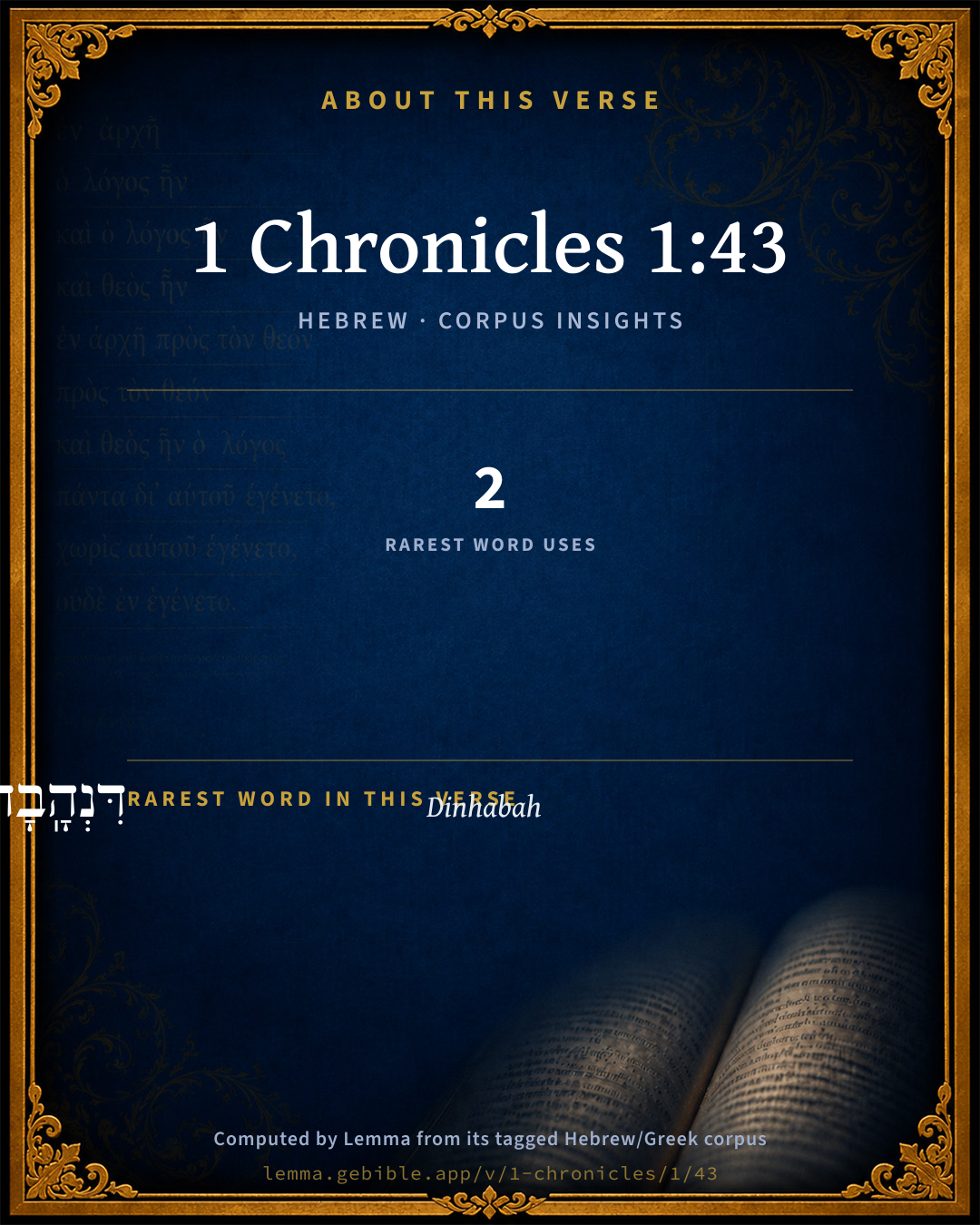
The rarest word here is דִּנְהָֽבָה Dinhabah H1838 — appearing just 2 times in the whole Hebrew Bible.

Shared distinctive vocabulary

דִּנְהָֽבָה Dinhabah H1838 occurs in 2 verses of the Hebrew Bible. Also found in:

Grammatical profile

  • 2 verbs
  • 13 nouns
  • 1 pronoun
  • 1 particle

Verb forms

  • מָלְכוּ֙ Qal · Perfect
  • מְלָךְ Qal · Infinitive Construct

Repetition

Words recur within this verse — often emphatic in Hebrew:

  • הַמְּלָכִ֗ים king H4428 ×2
  • מָלְכוּ֙ to reign H4427 ×2
  • לִבְנֵ֣י son H1121 ×2

Hebrew & Septuagint length

In English translation the verse runs 35 words from the Hebrew and 18 from the Septuagint (LXX English) — the Septuagint runs noticeably shorter here. See the side-by-side →

A rough comparison of the two English renderings, which tokenize alike — not a word-level alignment.

Word counts can differ between the Hebrew and the Greek without any difference in meaning — e.g. the Hebrew direct-object marker אֵת has no separate Greek word, and Greek often adds the article ὁ.

Cross-references

3

Topical passages linked to 1 Chronicles 1:43 in the Treasury of Scripture Knowledge — connected by theme and wording, ordered by reader-vote popularity; previews shown in the World English Bible.

  • Genesis 36:31–43 These are the kings who reigned in the land of Edom, before any king reigned over the children of Israel.
  • Genesis 49:10 The scepter will not depart from Judah, Nor the ruler's staff from between his feet, Until he comes to whom it belongs. To him will the obedience of the peoples be.
  • Numbers 24:17–19 I see him, but not now; I see him, but not near: There shall come forth a star out of Jacob, A scepter shall rise out of Israel, Shall strike through the corners of Moab, Break down all the sons of tumult.

Cross-references courtesy of OpenBible.info (CC BY 4.0).

Hebrew and Greek witnesses Masoretic Hebrew ↔ Greek Septuagint

The same verse in the two great witnesses to the Old Testament, shown verse-for-verse.

Here the Septuagint runs noticeably shorter than the Hebrew — LXX2012 (modern English Septuagint) 18 words vs World English Bible 35. A rough length comparison of the two English translations, not a word-level alignment — read both below.

These are two independent witnesses, not word-aligned to each other, and the Septuagint is shown in lemma (dictionary) form.

Hebrew 1 Chronicles 1:43 Masoretic · Westminster Leningrad Codex

וְאֵ֣לֶּה הַמְּלָכִ֗ים אֲשֶׁ֤ר מָלְכוּ֙ בְּאֶ֣רֶץ אֱד֔וֹם לִפְנֵ֥י מְלָךְ מֶ֖לֶךְ לִבְנֵ֣י יִשְׂרָאֵ֑ל בֶּ֚לַע בֶּן בְּע֔וֹר וְשֵׁ֥ם עִיר֖וֹ דִּנְהָֽבָה

Now these are the kings who reigned in the land of Edom, before there resigned any king over the children of Israel: Bela the son of Beor; and the name of his city was Dinhabah.

World English Bible · Public Domain

Greek LXX 1 Chronicles 1:43 Septuagint · lemma form
And these are their kings, Balac the son of Beor; and the name of his city was Dennaba.

LXX2012 (modern English Septuagint) · Public Domain

Hebrew: Westminster Leningrad Codex (CC BY 4.0). Greek: Septuagint (public domain); English from LXX2012 (modern English Septuagint) (Public Domain). How the Septuagint differs from the Hebrew →

Commentary

Notes on 1 Chronicles 1:43 from classic Christian and Jewish commentators (each source and its license shown beneath its notes). The classic Christian expositions comment on the surrounding passage and are grouped to its opening verse, so a note may address several verses; the Jewish commentaries on the Tanakh (Rashi and others) are per-verse, so they appear only where the commentator wrote on this verse.

Lemma curates 59 commentaries, every one of them public domain or Creative Commons licensed, each selected and text-cleaned for this edition rather than reprinted as found. About our sources →

Trapp's Complete Commentary

John Trapp

1Ch 1:43 Now these [are] the kings that reigned in the land of Edom before [any] king reigned over the children of Israel; Bela the son of Beor: and the name of his city [was] Dinhabah.

Ver. 43. Now these are the kings.] {See Trapp on "Gen 36:31"} Kings were crowned, dukes were not. Israel had first judges, who were as dukes; after that, kings; and then dukes again, or governors, viz., after the captivity. So had Edom. See 1Ch 1:51-52.

John Trapp, A Commentary or Exposition upon All the Books of the Old and New Testament (1647–1656) — public domain. Text from a community e-Sword module.

Geneva Bible (1599)

Geneva Bible translators

He maketh mention of the Kings that came of Esau according to God’s promise made to Abraham concerning him, that kings should come of him. These eight kings reigned one after another in Idumea unto the time of David, who conquered their country.

Geneva Bible (1599) marginal notes — public domain. Text via Bolls.life.

Adam Clarke's Commentary

Verse 43. Before any king reigned over - Israel] See Ge 36:31, c., where the same verses occur, as I have supposed borrowed from this place and see the notes there.

Bela the son of Beor] "Balaam the impious son of Beor, the same as Laban the Syrian, who formed a confederacy with the sons of Esau, to destroy Jacob and his children; and he studied to destroy them utterly. Afterwards he reigned in Sodom; and the name of his royal city was Dinhabah, because it was undeservedly given to him." - T.

Adam Clarke's Commentary on the Bible (1810–1826) — public domain. Text from a community e-Sword/MySword module.

Ellicott's Commentary for English Readers

(43) Before any king reigned over the children of Israel.—Comp. Num_20:14-21, the message of Moses to the king of Edom, asking for a free passage for Israel through his domains. As the older people, and as having been earlier established in its permanent home, Edom was naturally a stage beyond Israel in political development. Unhappily brief as it is, this notice is very appropriately inserted here in an introduction to the history of the kings of the house of David.

Bela the son of Beor.—Curiously like “Balaam the son of Beor,” Num_22:5. In Hebrew, Bela and Balaam are essentially similar words, the terminal m of the latter being possibly a mere formative. (Perhaps, however, Balaam—Heb. Bil’am = “Bel is a kinsman”) comp. Eliam. The prophet whose strange story is read in Numbers 22-24 may, like Isaiah, have been of royal extraction.

Dinhabah.—Doom-giving, that is, the place where the king gave judgment (1Sa_8:5).

(43-54) The ancient kings and chiliarchs of Edom, a transcript of Gen_36:31-43, with only such differences as are incidental to transcribing.

A Bible Commentary for English Readers, edited by Charles John Ellicott (1878–1897) — public domain. Text from a community e-Sword module.

The Cambridge Bible for Schools and Colleges

gen. ed. J. J. S. Perowne

43–51a. The early Kings of Edom. (Cp. Gen_36:31-39.)

43. in the land of Edom] Edom continued to play an important part in the history of Israel till long after the Chronicler’s lifetime. See (e.g.) 1Ma_5:65; 2Ma_10:14-17. Moreover the Herods were of Edomite descent.

The Cambridge Bible for Schools and Colleges (gen. ed. J. J. S. Perowne; Cambridge University Press, 1878–1918) — public domain. Text from a community e-Sword module.

Albert Barnes' Notes on the Bible

The slight differences favor the view, that the writer of Chronicles has here, as elsewhere, abridged from Genesis (see the marginal references).

Albert Barnes' Notes on the Bible (1834–1885) — public domain. Text from a community e-Sword/MySword module.

Haydock's Catholic Bible Commentary

Israel. The same remark had been made in Genesis xxxvi. 31. It is wonderful that the author of this work gives us no further information, when so many revolutions had since occurred. (Calmet) --- But he might content himself with repeating the words of Moses. (Haydock) --- The eight kings here specified must have reigned each 50 years, which is not impossible. David conquered the country under Adad.

George Leo Haydock (1774–1849), Haydock's Catholic Family Bible and Commentary, 1859 edition — public domain. Excludes Psalms (Douay-Rheims chapter numbering differs from Protestant) and Deuterocanonical books (Catholic canon only).

Matthew Poole's English Annotations

Of this and the following verses, See Poole "Gen 36:31", &c., whence this whole relation is taken.

Matthew Poole's English Annotations on the Holy Bible (1683–1685) — public domain. Text from a community e-Sword/MySword module.

The Pulpit Commentary

The relations of Edom and Israel.

The historical and geographical relations of the two nations may be given. Those of Israel are familiar, those of Edom may be thus indicated: Mount Seir, where Esau settled, was a rugged tract, east of the great valley of the Arabah. It consisted of limestone hills, with red and variegated sandstone cliffs and ridges, marked by that peculiar ruddy tinge of colour so consonant with the name of Edom (red). Kings reigned in Edom long before any descendant of Jacob occupied a throne. Eight Edomitish monarchs are enumerated in the early records. The refusal of Edom to allow Israel to march through the country on the route to Canaan both expressed and intensified the family enmity which came as the fruitage of Jacob"s deception. No friendly intercourse could be expected between the nations. The relations between the two peoples, descended from one parent, may be used to illustrate the way in which family and social wrongdoing will work out into practical evil in the succeeding generations. And, so treating the history of these two peoples, we may learn the valuable and impressive lesson that the sinner may be forgiven and personally accepted with God, but the natural and necessary fruitage of his wrong-doing cannot be stopped, and cannot always even be checked. Vindicate the Divine goodness and righteousness in thus permanently attaching penalties of suffering to sin, and letting these come upon others beside the wrong-doer. From the history the following topics may be fully detailed:

I THE ORIGINAL WRONG. It was a double wrong. Esau was meanly defrauded of his birthright by his brother taking unfair advantage of his fatigue and hunger. And he was, by a wicked scheme, dodged out of his paternal blessing. Because he was so manifestly the wronged party, we may fail to appraise aright Esau"s personal character; but we cannot wonder that he went forth to life with the sense of the grievous wrong done to him rankling in his mind. It was a grievous and shameful wrong, which nothing can extenuate or excuse; an utterly selfish and unbrotherly act. Such an act as bears its natural penalty in hatred, and all the mischief that hatred can contrive to do.

II THE DIVINE FORGIVENESS. Give the scene at Mananaim, and show how it bore relation to the sin as against God. Scripture urges that sin seemingly committed against our brother is really committed against God. "Thou hast not lied unto men, but unto God." So Divine forgiveness has ever to be sought first.

III THE BROTHERLY RECONCILIATION. This seems to have been complete and satisfactory, yet it was too much a matter of impulse. Jacob was afraid to presume on it. And too often such reconciliations only prove temporary, and the old enmities come back again; and the "last state is worse than the first.

IV THE NATIONAL ENMITIES AND ENVIES. These had been started before the reconciliation of the brothers, and they could not be stopped. They grew in strength as the years rolled by. They formed a predisposition to judge each other unworthily, and see each other on the bad side only. And as time wore on the evil broke out into open war, and brother races shed each other"s blood (see 1Sa_14:47 2Sa_8:14 1Ki_11:15, 1Ki_11:16, etc.) In some of these wars and sieges such cruelties were practised as can only be explained by the intensity of the national feud and hatred. So the early wrong worked out into misery for both parties. "He that soweth to the flesh ever reaps corruption." Earnestly warn against wrong-doing in family and in social relationships; they are often the secret cause of long feud, war, and woe. We need to "think, not on our own things, but on the things of others;" we should be found jealous of our brother"s rights. In the way of righteousness and. brotherliness and charity ever flow life and peace and fellowship, all human blessedness, and the all-hallowing Divine favour.

R.T.

The Pulpit Commentary (1880–1919), ed. H.D.M. Spence-Jones & Joseph S. Exell — public domain. Text from a community e-Sword module.

unfoldingWord translationNotes

Door43 World Missions Community

Bela ... Beor ... Jobab ... Zerah ... Husham

These are the names of men. (See: How to Translate Names)

Dinhabah ... Bozrah

These are the names of places. (See: How to Translate Names)

Husham of the land of the Temanites reigned in his place

"Husham, from the land where Teman's descendants lived, reigned after him"

Temanites

This is the name of a people group. (See: How to Translate Names)

translationWords

king

reign

Edom

Israel

unfoldingWord translationNotes — © Distant Shores Media and the Door43 World Missions Community, licensed CC BY-SA 4.0. Source: git.door43.org/Door43/en_tn.

Rashi

Rabbi Shlomo Yitzchaki (Rashi)

Now these are the kings It is explained (Gen. Rab. 83:2): Rabbi Aibu said: This was before a king reigned in Israel, but since a king reigned in Israel, a governor reigned in Edom. Rabbi Jose the son of Hanina says: When this one [Edom] appoints kings, this one [Israel] appoints judges; when this one appoints chiefs, this one appoints princes. Said Rabbi Joshua the son of Levi: This one [Edom] appointed eight [kings] and this one: [Israel] appointed eight [kings], and I heard [people ask]: Did Edom have only these eight kings, and did Israel have only eight? Were there not more? Joram, Ahaziah, Joash, etc. Rather, the statement that this one appointed eight kings means that when they [Edom] appointed those eight kings of Edom, they [Israel] did not appoint the kings of Israel, because they were before David, and the chiefs of the heads of his fathers’ houses.

Rashi on the Tanakh — English translations: “The Judaica Press complete Tanach with Rashi, translated by A. J. Rosenberg” (CC BY 4.0); “Pentateuch with Rashi's commentary by M. Rosenbaum and A.M. Silbermann, 1929-1934” (public domain); “The Metsudah Tanach series, Lakewood, N.J” (CC BY 4.0); and “The Book of Joshua, Metsudah Publications, 1997” (CC BY 4.0). Text via Sefaria.

Lesson kit

Teaching starters — assembled from the data on this page, not authored interpretation. Every prompt links to the verse data it draws on. Edit before teaching.

1 Chronicles, in the Historical, opens this verse with 17 words (14 distinct Hebrew lemmas). Its most distinctive word is Dinhâbâh (“Dinhabah”). The Greek Septuagint runs shorter here. A historical commentator’s framing appears above. Read the whole chapter for the surrounding context.

Discussion questions

  1. How does “Dinhabah” (Dinhâbâh) shape what this verse is saying?
  2. How does Genesis 36:32, which shares the word «Dinhabah», read alongside this verse?
  3. What does the repetition of “king” (2× in this one verse) do in this verse?
  4. The Septuagint runs shorter here than the Hebrew. What might account for the difference?
  5. These translations render this verse differently. What is at stake in choosing one wording over another?
  6. «מָלְכוּ֙» is a Qal Perfect verb. How does that grammatical form shape the action described?
  7. Compare how Trapp's Complete Commentary and Geneva Bible (1599) read this verse. Where do they agree or differ?

Things to notice

Reading settings

Reading text

Shown beneath each verse's original-language words.

Old Testament
Old Testament edition

Read the OT as the Masoretic Hebrew (MT) or the Greek Septuagint (LXX).

English shown for the Greek Septuagint (in the Hebrew ↔ Greek comparison).

Comparing translations? Open the Compare panel on any verse page to stack up to four side by side.