
Deuteronomy 2:8

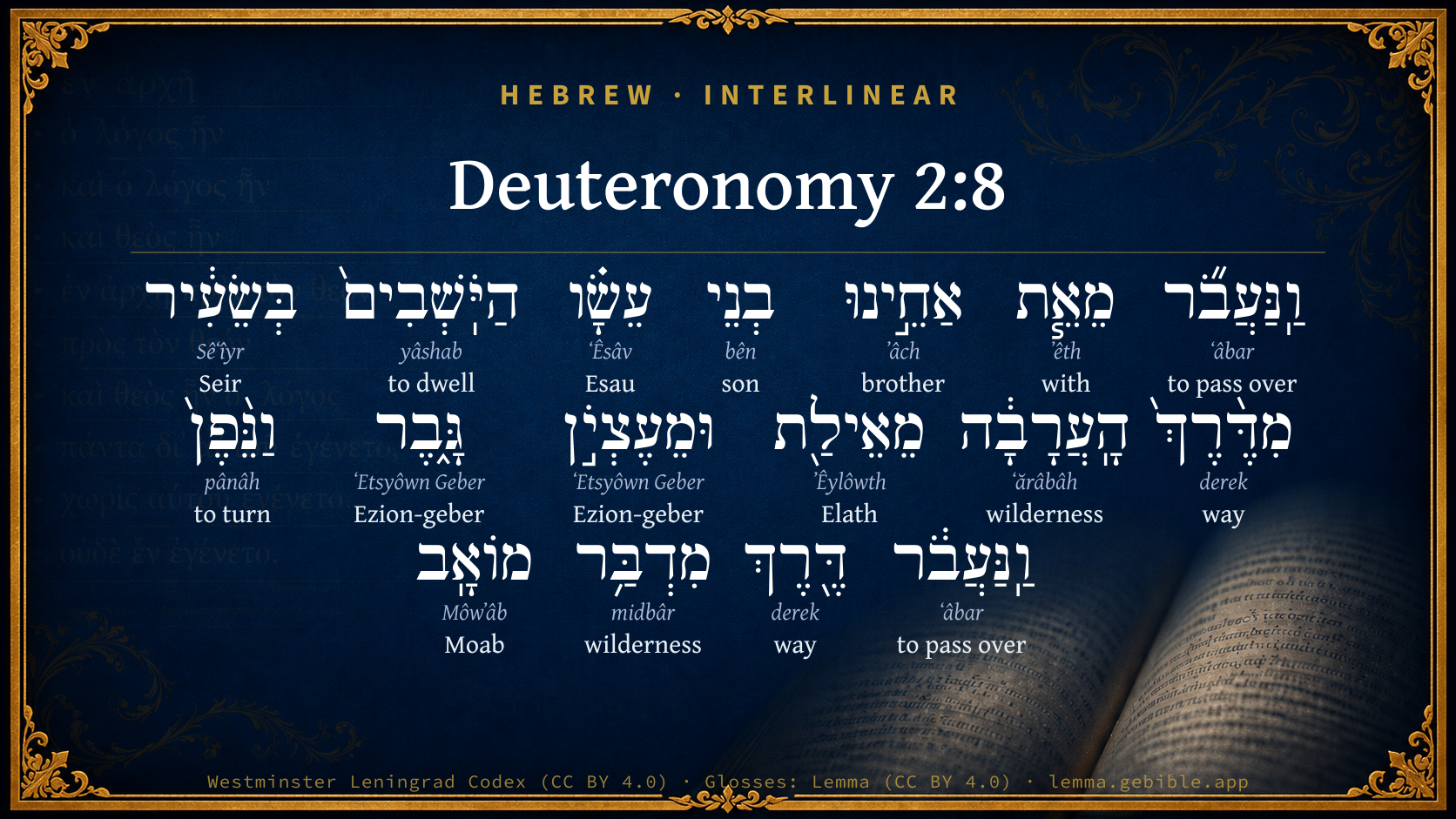
Hebrew (Westminster Leningrad Codex) Deuteronomy 2:8 appears in the Hebrew Old Testament. The text above is from the Westminster Leningrad Codex. Each word links to its Strong’s number, a concise gloss, and parsing drawn from the Open Scriptures Hebrew Bible morphology. Click any word for its full Brown-Driver-Briggs (BDB) entry.
Download image
Cite this verse

Deuteronomy 2:8 (World English Bible). Public Domain. Lemma interlinear Bible study tool, https://lemma.gebible.app/v/deuteronomy/2/8.

Show BibTeX & RIS
BibTeX
RIS
English Translation
So we passed by from our brothers the children of Esau, who dwell in Seir, from the way of the Arabah from Elath and from Ezion Geber. We turned and passed by the way of the wilderness of Moab.
World English Bible · Public Domain
Highlights
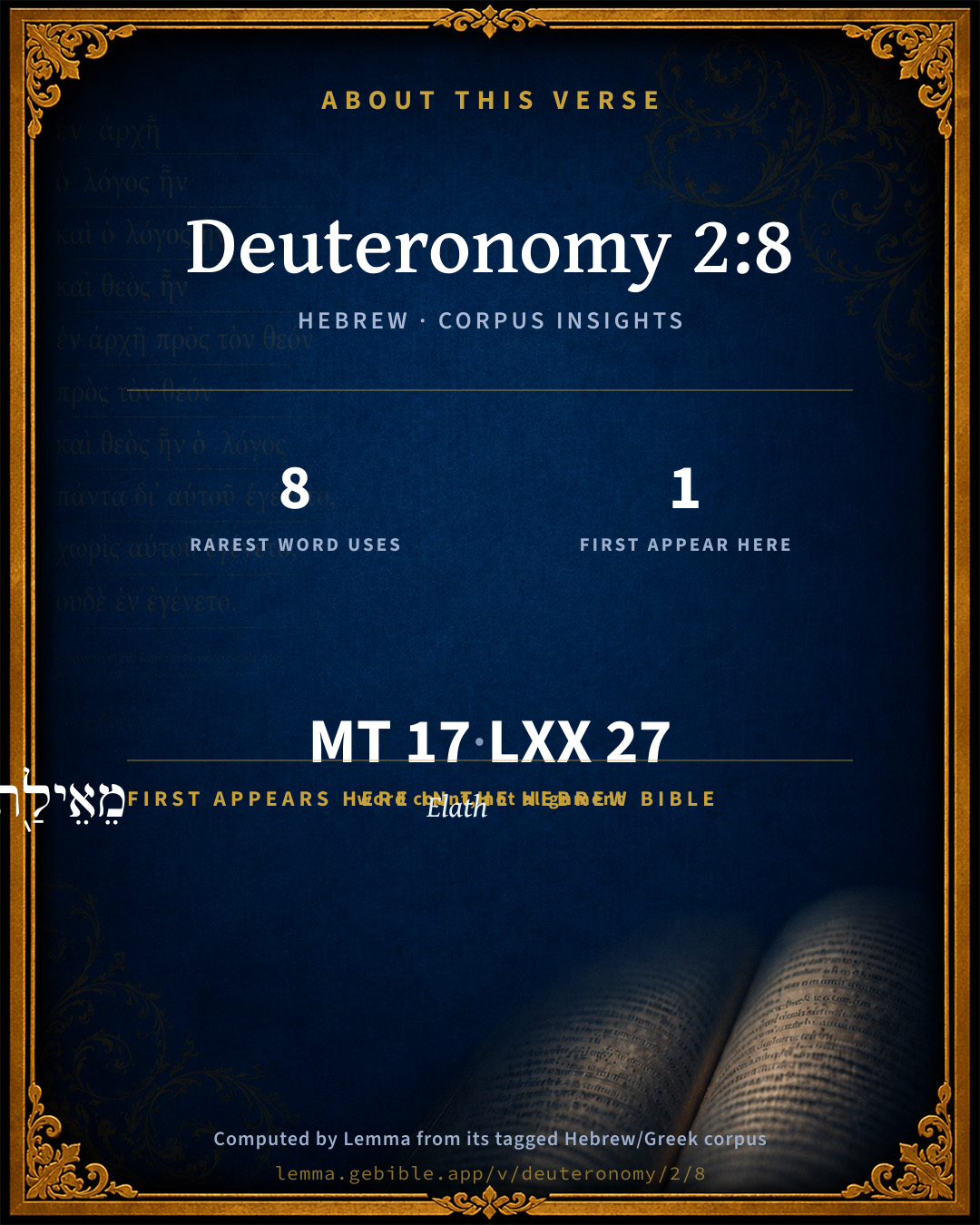
  • 1 first appearance in the Hebrew Bible
Full analysis ↓
Download a study sheet

One document with this verse’s original text, its word-by-word gloss line, the meaning frame, cross-references with their text, attributed commentary, and full source and license credits — printable, and it pastes into notes with its structure intact.

This verse Autodidact and up

Study sheet (.html) Plain text (.txt)

A passage Seminary Student

Up to 50 verses in one chapter. A passage sheet keeps up to 6 commentary sources and 12 cross-references per verse, in the order this page ranks them, and says so on the sheet whenever that leaves anything out. Ask for a single verse and you get the Autodidact verse sheet above.

Everything on this page stays free to read, with no account — the sheet is a download of what is already on screen, not access to it.

Want to remove ads? Support Godless Engineer
Compare translations 3

The same verse in 3 English versions, stacked beneath the original-language interlinear above. Click any original word for its lexicon entry.

Each is an independent rendering of the whole verse — the interlinear is not word-aligned to these translations.

Highlighted words mark where these versions differ — a whole-verse word diff, not a word-by-word alignment.

  • World English Bible Public Domain
    So we passed by from our brothers the children of Esau, who dwell in Seir, from the way of the Arabah from Elath and from Ezion Geber. We turned and passed by the way of the wilderness of Moab.
  • King James Version Public Domain
    And when we passed by from our brethren the children of Esau, which dwelt in Seir, through the way of the plain from Elath, and from Eziongaber, we turned and passed by the way of the wilderness of Moab.
  • unfoldingWord Literal Text CC BY-SA 4.0
    And we passed by beyond our brothers, the sons of Esau who live in Seir, from the Arabah road, from Elath and from Ezion Geber. And we turned and passed by the way of the wilderness of Moab.

unfoldingWord Literal Text — © unfoldingWord, licensed CC BY-SA 4.0. Word-aligned USFM3 via Door43 (git.door43.org/unfoldingWord/en_ult).

Versions to compare (up to 4)

3 of 4 selected

Show all 18 translations

Every available English version of this verse, each an independent rendering of the whole verse.

  • World English Bible Public Domain
    So we passed by from our brothers the children of Esau, who dwell in Seir, from the way of the Arabah from Elath and from Ezion Geber. We turned and passed by the way of the wilderness of Moab.
  • Berean Standard Bible Public Domain
    So we passed by our brothers, the descendants of Esau, who live in Seir. We turned away from the Arabah road, which comes up from Elath and Ezion-geber, and traveled along the road of the Wilderness of Moab.
  • Majority Standard Bible Public Domain
    So we passed by our brothers, the descendants of Esau, who live in Seir. We turned away from the Arabah road, which comes up from Elath and Ezion-geber, and traveled along the road of the Wilderness of Moab.
  • King James Version Public Domain
    And when we passed by from our brethren the children of Esau, which dwelt in Seir, through the way of the plain from Elath, and from Eziongaber, we turned and passed by the way of the wilderness of Moab.
  • American Standard Version (1901) Public Domain
    So we passed by from our brethren the children of Esau, that dwell in Seir, from the way of the Arabah from Elath and from Ezion-geber. And we turned and passed by the way of the wilderness of Moab.
  • Revised Version (1885) Public Domain
    So we passed by from our brethren the children of Esau, which dwell in Seir, from the way of the Arabah from Elath and from Ezion-geber. And we turned and passed by the way of the wilderness of Moab.
  • Geneva Bible (1599) Public Domain
    And when we were departed from our brethren the children of Esau which dwelt in Seir, through the way of the plaine, from Elath, and from Ezion-gaber, we turned and went by the way of the wildernes of Moab.
  • Douay-Rheims (1899) Public Domain
    And when we had passed by our brethren the children of Esau, that dwelt in Seir, by the way of the plain from Elath and from Asiongaber, we came to the way that leadeth to the desert of Moab.
  • Young's Literal Translation Public Domain
    `And we pass by from our brethren, sons of Esau, who are dwelling in Seir, by the way of the plain, by Elath, and by Ezion-Gaber; and we turn, and pass over the way of the wilderness of Moab;
  • Literal Standard Version CC BY-SA 4.0
    And we pass by from our brothers, sons of Esau, who are dwelling in Seir, by the way of the plain, by Elath and by Ezion-Gaber, and we turn and pass over the way of the wilderness of Moab;
  • Unlocked Literal Bible CC BY-SA 4.0
    So we passed by our brothers, the descendants of Esau who live in Seir, away from the Arabah road, from Elath and from Ezion Geber. Then we turned and passed by the way of the wilderness of Moab.
  • unfoldingWord Literal Text CC BY-SA 4.0
    And we passed by beyond our brothers, the sons of Esau who live in Seir, from the Arabah road, from Elath and from Ezion Geber. And we turned and passed by the way of the wilderness of Moab.
  • Darby Bible Public Domain
    And we passed by from our brethren the children of Esau, who dwelt in Seir, by the plain, by Elath, and by Ezion-geber, and we turned and passed by the way of the wilderness of Moab.
  • World Messianic Bible Public Domain
    So we passed by from our brothers, the children of Esau, who dwell in Seir, from the way of the Arabah from Elath and from Ezion Geber. We turned and passed by the way of the wilderness of Moab.
  • Webster's Bible Public Domain
    And when we passed by from our brethren the children of Esau, who dwelt in Seir, through the way of the plain from Elath, and from Ezion-gaber, we turned and passed by the way of the wilderness of Moab.
  • Free Bible Version CC BY-SA 4.0
    So we passed by our relatives, the descendants of Esau, who live in Seir. We didn't take the Arabah road from Elath and Ezion-geber. Instead we used the road that goes through the desert of Moab.
  • Bible in Basic English Public Domain
    So we went on past our brothers, the children of Esau, living in Seir, by the road through the Arabah, from Elath and Ezion-geber. And turning, we went by the road through the waste land of Moab.
  • JPS Tanakh (1917) Public Domain
    So we passed by from our brethren the children of Esau, that dwell in Seir, from the way of the Arabah, from Elath and from Ezion-geber. And we turned and passed by the way of the wilderness of Moab.

Literal Standard Version (2020), Covenant Press — licensed CC BY-SA 4.0. Text via the HelloAO Bible API (eBible.org). Unlocked Literal Bible (unfoldingWord) — licensed CC BY-SA 4.0. Text via the HelloAO Bible API (eBible.org). unfoldingWord Literal Text — © unfoldingWord, licensed CC BY-SA 4.0. Word-aligned USFM3 via Door43 (git.door43.org/unfoldingWord/en_ult). Free Bible Version, Dr. Jonathan Gallagher — licensed CC BY-SA 4.0. Text via the HelloAO Bible API (eBible.org).

Word by word

More ways to search: Search by grammar → Find every occurrence → Compare this word →

Practice this passage: Drill this verse → Learn its vocabulary →

מֵאֵילַ֖ת
ʼÊylôwth
H359
“from · Elath”
Preposition + Noun, Proper
Part of Speech
Preposition + Noun
Type
Proper
Full BDB Definition

Origin: from H352

TWOT: None

Elath or Eloth = "grove of lofty trees" - a port on the north-east arm of the Red Sea
  1. וַֽנַּעֲבֹ֞ר ʻâbar H5674 “and · to pass over” Conjunction + Verb, Qal, Sequential Imperfect, 1st Person, Common, Plural
  2. מֵאֵ֧ת ʼêth H854 “from · with” Preposition + Preposition
  3. אַחֵ֣ינוּ ʼâch H251 “brothers · our” Noun, Common, Masculine, Plural, Construct + Suffix, Personal, 1st Person, Common, Plural
  4. בְנֵי bên H1121 “sons of” Noun, Common, Masculine, Plural, Construct
  5. עֵשָׂ֗ו ʻÊsâv H6215 “Esau” Noun, Proper
  6. הַיֹּֽשְׁבִים֙ yâshab H3427 “the · dwelling” Particle, Definite Article + Verb, Qal, Participle Active, Masculine, Plural, Absolute
  7. בְּשֵׂעִ֔יר Sêʻîyr H8165 “in/at · Seir” Preposition + Noun, Proper
  8. מִדֶּ֨רֶךְ֙ derek H1870 “from · way of” Preposition + Noun, Common, Both, Singular, Construct
  9. הָֽעֲרָבָ֔ה ʻărâbâh H6160 “the · wilderness” Particle, Definite Article + Noun, Common, Feminine, Singular, Absolute
  10. וּמֵעֶצְיֹ֣ן ʻEtsyôwn Geber H6100 “and · from · Ezion-geber” Conjunction + Preposition + Noun, Proper
  11. גָּ֑בֶר ʻEtsyôwn Geber H6100 “Ezion-geber” Noun, Proper
  12. וַנֵּ֨פֶן֙ pânâh H6437 “and · to turn” Conjunction + Verb, Qal, Sequential Imperfect, 1st Person, Common, Plural
  13. וַֽנַּעֲבֹ֔ר ʻâbar H5674 “and · to pass over” Conjunction + Verb, Qal, Sequential Imperfect, 1st Person, Common, Plural
  14. דֶּ֖רֶךְ derek H1870 “way of” Noun, Common, Both, Singular, Construct
  15. מִדְבַּ֥ר midbâr H4057 “wilderness of” Noun, Common, Masculine, Singular, Construct
  16. מוֹאָֽב Môwʼâb H4124 “Moab” Noun, Proper

About this verse

These counts appear in no published source. They are computed here, from the morphology-tagged text and Lemma’s own curated glosses. What Lemma adds →

17
words
14
distinct lemmas
Pentateuch
section

Notable vocabulary

The rarest word here is מֵאֵילַ֖ת Elath H359 — appearing just 8 times in the whole Hebrew Bible.

First appearance in Scripture

This word makes its first canonical appearance in the Hebrew Bible here:

  • מֵאֵילַ֖ת Elath H359

Shared distinctive vocabulary

מֵאֵילַ֖ת Elath H359 occurs in 6 verses of the Hebrew Bible. Also found in:

Grammatical profile

  • 4 verbs
  • 12 nouns
  • 1 preposition

Verb forms

  • וַֽנַּעֲבֹ֞ר Qal · Sequential Imperfect
  • הַיֹּֽשְׁבִים֙ Qal · Participle Active
  • וַנֵּ֨פֶן֙ Qal · Sequential Imperfect
  • וַֽנַּעֲבֹ֔ר Qal · Sequential Imperfect

Repetition

Words recur within this verse — often emphatic in Hebrew:

  • וַֽנַּעֲבֹ֞ר to pass over H5674 ×2
  • מִדֶּ֨רֶךְ֙ way H1870 ×2
  • וּמֵעֶצְיֹ֣ן Ezion-geber H6100 ×2

Hebrew & Septuagint length

In English translation the verse runs 39 words from the Hebrew and 38 from the Septuagint (LXX English) — closely comparable.

A rough comparison of the two English renderings, which tokenize alike — not a word-level alignment.

Word counts can differ between the Hebrew and the Greek without any difference in meaning — e.g. the Hebrew direct-object marker אֵת has no separate Greek word, and Greek often adds the article ὁ.

In the original languages it is 17 Hebrew tokens and 27 Greek tokens — but the two are counted differently (Hebrew bundles its prefixes and suffixes into one token; the Greek is in lemma form), so that isn’t a like-for-like length.

Cross-references

7

Topical passages linked to Deuteronomy 2:8 in the Treasury of Scripture Knowledge — connected by theme and wording, ordered by reader-vote popularity; previews shown in the World English Bible.

  • 1 Kings 9:26 King Solomon made a navy of ships in Ezion Geber, which is beside Eloth, on the shore of the Red Sea, in the land of Edom.
  • Judges 11:18 Then they went through the wilderness, and went around the land of Edom, and the land of Moab, and came by the east side of the land of Moab, and they encamped on the other side of the Arnon; but they didn't come within the border of Moab, for the Arnon was the border of Moab.
  • 2 Kings 16:6 At that time Rezin king of Syria recovered Elath to Syria, and drove the Jews from Elath; and the Syrians came to Elath, and lived there, to this day.
  • 2 Kings 14:22 He built Elath, and restored it to Judah, after that the king slept with his fathers.
  • Numbers 20:20–21 He said, You shall not pass through. Edom came out against him with much people, and with a strong hand.
  • Numbers 33:35 They traveled from Abronah, and encamped in Ezion Geber.
  • Deuteronomy 1:1 These are the words which Moses spoke to all Israel beyond the Jordan in the wilderness, in the Arabah over against Suph, between Paran, and Tophel, and Laban, and Hazeroth, and Dizahab.

Cross-references courtesy of OpenBible.info (CC BY 4.0).

Hebrew and Greek witnesses Masoretic Hebrew ↔ Greek Septuagint

The same verse in the two great witnesses to the Old Testament, shown verse-for-verse.

These are two independent witnesses, not word-aligned to each other, and the Septuagint is shown in lemma (dictionary) form.

Hebrew Deuteronomy 2:8 Masoretic · Westminster Leningrad Codex

וַֽנַּעֲבֹ֞ר מֵאֵ֧ת אַחֵ֣ינוּ בְנֵי עֵשָׂ֗ו הַיֹּֽשְׁבִים֙ בְּשֵׂעִ֔יר מִדֶּ֨רֶךְ֙ הָֽעֲרָבָ֔ה מֵאֵילַ֖ת וּמֵעֶצְיֹ֣ן גָּ֑בֶר וַנֵּ֨פֶן֙ וַֽנַּעֲבֹ֔ר דֶּ֖רֶךְ מִדְבַּ֥ר מוֹאָֽב

So we passed by from our brothers the children of Esau, who dwell in Seir, from the way of the Arabah from Elath and from Ezion Geber. We turned and passed by the way of the wilderness of Moab.

World English Bible · Public Domain

Greek LXX Deuteronomy 2:8 Septuagint · lemma form

καί παραἔρχομαι ὁ ἀδελφός ἐγώ υἱός ησαυ ὁ καταοἰκέω ἐν σηιρ παρά ὁ ὁδός ὁ ἀραβά ἀπό αιλων καί ἀπό γασιωνγαβερ καί ἐπιστρέφω παραἔρχομαι ὁδός ἔρημος μωαβ

And we passed by our brethren the children of Esau, who lived in Seir, by the way of Araba from Aelon and from Gesion Gaber; and we turned and passed by the way of the desert of Moab.

LXX2012 (modern English Septuagint) · Public Domain

On this verse, The Cambridge Bible for Schools and Colleges discusses the Septuagint’s reading. Read the note in Commentary ↓

Hebrew: Westminster Leningrad Codex (CC BY 4.0). Greek: Septuagint (public domain); English from LXX2012 (modern English Septuagint) (Public Domain). How the Septuagint differs from the Hebrew →

Targum (Aramaic paraphrase)

2

The Targum is the ancient Jewish Aramaic paraphrase of the Hebrew Scriptures — an interpretive translation, not the Hebrew text itself. Onkelos (literal) and Pseudo-Jonathan (expansive) render the Torah, and Jonathan the Prophets. Coverage is partial: where no permissively-licensed English translation exists for a verse, only the Aramaic is shown. This is verse-level text, not a word-by-word alignment to the Hebrew.

  1. Targum Onkelos Torah (Genesis–Deuteronomy)
    וַעֲבַרְנָא מִלְוַת אֲחוּנָא בְנֵי עֵשָׂו דְיָתְבִין בְּשֵׂעִיר מֵאוֹרַח מֵישְׁרָא מֵאֵילַת וּמֶעְצְיוֹן גָבֶר וְאִתְפְּנֵינָא וַעֲבַרְנָא אוֹרַח מַדְבְּרָא דְמוֹאָב

    (no public-domain English translation for this verse)

    Targum Onkelos — Aramaic: “Onkelos Genesis” (public domain); “Onkelos Exodus” (public domain); “Onkelos Leviticus” (public domain); “Onkelos Numbers” (public domain); “Onkelos Deuteronomy” (public domain). English: “Sefaria Community Translation” (CC0 1.0 (public-domain dedication)); “J.W. Etheridge. The Targums of Onkelos and Jonathan Ben Uzziel on the Pentateuch. London: Longmans, Green, 1862” (public domain). Text via Sefaria.

  2. Targum Pseudo-Jonathan Torah (Genesis–Deuteronomy)
    וְעָבַרְנָא מִלְוַת אָחָנָא בְּנֵי עֵשָו דְּיַתְבוּן בְּגַבְלָא מֵאֵילַת וּמִכְּרַךְ תַּרְנְגוֹלָא וְאִתְפְּנִינָא וְעָבַרְנָא אוֹרַח מַדְבְּרָא דְמוֹאָב

    So we passed by our brethren the sons of Esau, who dwell in Gebala, from Elath and the fortress of Tarnegola and turned and went by the way of the wilderness of Moab

    Targum Pseudo-Jonathan — Aramaic: “Targum Jonathan on Genesis” (public domain); “Targum Jonathan on Exodus” (public domain); “Targum Jonathan on Leviticus” (public domain); “Targum Jonathan on Numbers” (public domain); “Targum Jonathan on Deuteronomy” (public domain). English: “The Targum of Jonathan ben Uzziel, trans. J. W. Etheridge, London, 1862” (public domain). Text via Sefaria.

Commentary

Notes on Deuteronomy 2:8 from classic Christian and Jewish commentators (each source and its license shown beneath its notes). The classic Christian expositions comment on the surrounding passage and are grouped to its opening verse, so a note may address several verses; the Jewish commentaries on the Tanakh (Rashi and others) are per-verse, so they appear only where the commentator wrote on this verse.

Lemma curates 59 commentaries, every one of them public domain or Creative Commons licensed, each selected and text-cleaned for this edition rather than reprinted as found. About our sources →

Matthew Henry's Commentary

It is observable here that Moses, speaking of the Edomites (Deu 2:8), calls them, "our brethren, the children of Esau." Though they had been unkind to Israel, in refusing them a peaceable passage through their country, yet he calls them brethren. For, though our relations fail in their duty to us, we must retain a sense of the relation, and not be wanting in our duty to them, as there is occasion. Now in these verses we have,

I. The account which Moses gives of the origin of the nations of which he had here occasion to speak, the Moabites, Edomites, and Ammonites. We know very well, from other parts of his history, whose posterity they were; but here he tells us how they came to those countries in which Israel found them; they were not the aborigines, or first planters. But, 1. The Moabites dwelt in a country which had belonged to a numerous race of giants, called Emim (that is, terrible ones), as tall as the Anakim, and perhaps more fierce, Deu 2:10, Deu 2:11. 2. The Edomites in like manner dispossessed the Horim from Mount Seir, and took their country (Deu 2:12. and again Deu 2:22), of which we read, Gen 36:20. 3. The Ammonites likewise got possession of a country that had formerly been inhabited by giants, called Zamzummim, crafty men, or wicked men (Deu 2:20, Deu 2:21), probably the same that are called Zuzim, Gen 14:5. He illustrates these remarks by an instance older than any of these; the Caphtorim (who were akin to the Philistines, Gen 10:14) drove the Avim out of their country, and took possession of it, Deu 2:23. The learned bishop Patrick supposes these Avites, being expelled hence, to have settled in Assyria, and to be the same people we read of under that name, Kg2 17:31. Now these revolutions are recorded, (1.) To show how soon the world was peopled after the flood, so well peopled that, when a family grew numerous, they could not find a place to settle in, at least in that part of the world, but they must drive out those that were already settled. (2.) To show that the race is not to the swift, nor the battle to the strong. Giants were expelled by those of ordinary stature; for probably these giants, like those before the flood (Gen 6:4), were notorious for impiety and oppression, which brought the judgments of God upon them, against which their great strength would be on defence. (3.) To show what uncertain things worldly possessions are, and how often they change their owners; it was so of old, and ever will be so. Families decline, and from them estates are transferred to families that increase; so little constancy or continuance is there in these things. (4.) To encourage the children of Israel, who were now going to take possession of Canaan, against the difficulties they would meet with, and to show the unbelief of those that were afraid of the sons of Anak, to whom the giants, here said to be conquered, are compared, Deu 2:11, Deu 2:21. If the providence of God had done this for the Moabites and Ammonites, much more would his promise do it for Israel his peculiar people.

II. The advances which Israel made towards Canaan. They passed by the way of the wilderness of Moab (Deu 2:8), and then went over the brook or vale of Zered (Deu 2:13), and there Moses takes notice of the fulfilling of the word which God had spoken concerning them, that none of those that were numbered at Mount Sinai should see the land that God had promised, Num 14:23. According to that sentence, now that they began to set their faces towards Canaan, and to have it in their eye, notice is taken of their being all destroyed and consumed, and not a man of them left, Deu 2:14. Common providence, we may observe, in about thirty-eight years, ordinarily raises a new generation, so that in that time few remain of the old one; but here it was entirely new, and none at all remained but Caleb and Joshua: for indeed the hand of the Lord was against them, v. 15. Those cannot but waste, until they were consumed, who have the hand of God against them. Observe, Israel is not called to engage with the Canaanites till all the men of war, the veteran regiments, that had been used to hardship, and had learned the art of war from the Egyptians, were consumed and dead from among the people (v. 16), that the conquest of Canaan, being effected by a host of new-raised men, trained up in a wilderness, the excellency of the power might the more plainly appear to be of God and not of men.

III. The caution given them not to meddle with the Moabites or Ammonites, whom they must not disseize, nor so much as disturb in their possessions: Distress them not, nor contend with them, v. 9. Though the Moabites aimed to ruin Israel (Num 22:6), yet Israel must not aim to ruin them. If others design us a mischief, this will not justify us in designing them a mischief. But why must not the Moabites and Ammonites be meddled with? 1. Because they were the children of Lot (v. 9, 19), righteous Lot, who kept his integrity in Sodom. Note, Children often fare the better in this world for the piety of their ancestors: the seed of the upright, though they degenerate, yet are blessed with temporal good things. 2. Because the land they were possessed of was what God had given them, and he did not design it for Israel. Even wicked men have a right to their worldly possessions, and must not be wronged. The tares are allowed their place in the field, and must not be rooted out until the harvest. God gives and preserves outward blessings to wicked men, to show that these are not the best things, but he has better in store for his own children.

Matthew Henry's Commentary on the Whole Bible (1708–1710) — public domain (CC PDM 1.0). Text via the HelloAO Bible API.

Joseph Benson's Commentary

Deu 2:8-9. We turned — From our direct road, which lay through Edom. Ar — The chief city of the Moabites, here put for the whole country which depended upon it. The children of Lot — So called to signify that this preservation was not for their sakes, for they were a wicked people, but for Lot’s sake, whose memory God yet honoured.

Joseph Benson's Commentary on the Old and New Testaments (1811–1818) — public domain. Text from a community e-Sword module.

Tyndale Open Study Notes

Tyndale Open Resources

2:8 our relatives: Isaac had two sons, Esau, the firstborn, and Jacob, who obtained Esau’s birthright and blessing as the firstborn (Gen 25:27-34; 27:1-36). The result was intense hostility between Esau and Jacob and between their descendants. Israel still recognized and honored the kinship, however; out of fraternal good faith, if not affection, Israel bypassed Edom and did not engage the Edomites in battle (see Num 20:14-21). • Arabah Valley: See study note on Deut 1:1. • Elath and Ezion-geber were twin port cities on the Red Sea. They later harbored the merchant ships of Solomon (1 Kgs 9:26), Jehoshaphat (1 Kgs 22:48), and Uzziah (2 Kgs 14:22).

Tyndale Open Study Notes — © Tyndale Open Resources, licensed CC BY-SA 4.0. Text via the HelloAO Bible API.

Geneva Bible (1599)

Geneva Bible translators

Or, wilderness.

Geneva Bible (1599) marginal notes — public domain. Text via Bolls.life.

Jamieson, Fausset & Brown

Robert Jamieson, A. R. Fausset & David Brown

we passed . . . through the way of the plain--the Arabah or great valley, from Elath ("trees") (the Ailah of the Greeks and Romans). The site of it is marked by extensive mounds of rubbish.

Ezion-geber--now Akaba, both were within the territory of Edom; and after making a circuit of its southeastern boundary, the Israelites reached the border of Moab on the southeast of the Salt Sea. They had been forbidden by divine command to molest the Moabites in any way; and this special honor was conferred on that people not on their own account, for they were very wicked, but in virtue of their descent from Lot. (See on Deu 23:3). Their territory comprised the fine country on the south, and partly on the north of the Arnon. They had won it by their arms from the original inhabitants, the Emims, a race, terrible, as their name imports, for physical power and stature (Gen 14:5), in like manner as the Edomites had obtained their settlement by the overthrow of the original occupiers of Seir, the Horims (Gen 14:6), who were troglodytes, or dwellers in caves. Moses alluded to these circumstances to encourage his countrymen to believe that God would much more enable them to expel the wicked and accursed Canaanites. At that time, however, the Moabites, having lost the greater part of their possessions through the usurpations of Sihon, were reduced to the small but fertile region between the Zered and the Arnon.

Jamieson, Fausset & Brown — Commentary Critical and Explanatory on the Whole Bible (1871) — public domain (CC PDM 1.0). Text via the HelloAO Bible API.

Ellicott's Commentary for English Readers

(8) When we passed . . . from . . . Esau . . . through the way of the plain from Elath.—The route from Seir, after Esau’s refusal, was southward to Ezion-geber, at the head of the Gulf of Akabah, and Elath, a few miles south-east of Ezion-geber, on the same coast. They then turned northward, and going round the territory of Edom, reached the country of Moab.

A Bible Commentary for English Readers, edited by Charles John Ellicott (1878–1897) — public domain. Text from a community e-Sword module.

The Cambridge Bible for Schools and Colleges

gen. ed. J. J. S. Perowne

8. So we passed by from our brethren, etc.] The Heb. prep. me’eth is from with; but probably we should read merely ’eth the sign of the accus.: we crossed or passed through our brethren (cp. 4 and 29). So LXX. Sam. readings are various.

from the way of the Arabah] The ‘Arabah itself forms in winter the most convenient passage from ’Elath and the Gulf of ‘Aḳabah to the Dead Sea, with branch roads to Ḥebron and Kerak; but suffers from want of water and great heat in summer. It was much used in the early Moslem period, and probably by Hebrew commerce with the Red Sea under the monarchy.

Elath] A port on the N. end of the Gulf of ‘Aḳabah (1Ki_9:26; 2Ki_14:22), perhaps the same as El-Paran (Gen_14:6). The name, translated by LXX Ailôn, and probably meaning palms, has persisted. Strabo, XVI. iv. 4, Ailana; Josephus, Ailana, Ilanis and Elathous (‘now called Berenice’?); Ptolemy, Elana; the Christian Fathers, Aila and Ailia; Moslem Geographers, Wailah, Aila and ‘Aḳabat Aila (Idrisi, ZDPV, viii. 121); now el-‘Aḳabah, a village amid ancient ruins on the N.E. corner of the Gulf, with Turkish fort and garrison. To the N.W. is a large grove of palms with numerous ruins, called Îla (Robinson, B.R. i. 250 ff.; Doughty Ar. Des. i. 44 f.; Musil, Edom, i. 256, 259 f.; ‘the culture of the palm flourishes … the types of the settled families are quite Jewish’). In Greek times it gave its name to the Gulf as its successor ‘Aḳabah does to-day.

Ezion-geber] Beside Elath on the Red Sea in Edom’s land; there Solomon built ships, 1Ki_9:26, and a ship (so LXX) of Jehoshaphat was wrecked, 1Ki_22:49. LXX Γασιὼν Γάβερ, and Ἐμαεσειὼν Γάβερ, 1Ki_9:26, probably waters of ‘Eṣion-Geber. Eusebius states that in his day it was Αἰσία (Jerome Essia); Makrizi, 15th century, ‘a once important town ‘Aṣiûn.’ Robinson (B. R. i. 251) noted the corresponding consonants in the name W. Ghaḍiân, and Musil (Edom, i. 254, 2. 183 ff., 189) describes the oasis Ma’ Ghaḍiân in the ‘Arabah. This lies 18 miles N. of the Sea; while the O.T. data place ‘Eṣion-Geber beside Elath, whose site, as we have seen, is certainly on the present N.E. coast of the Gulf. Musil, however, reports that a tongue of the sea may once have reached Ma’ Ghaḍiân; there are remains of fortifications and gardens across what is now desert (II. 199). His guide told of a town there whose inhabitants had many ships; but a violent rain brought down such masses of stone from some of the wâdies that the sea was pushed back to el-‘Aḳaba (ii. 187). If the Ar. name be derived from the tree ghaḍa’, abundant in this region, it may have been attached to more places than one; or may have drifted as names easily do in Syria. The likeness between the LXX Ἐμαεσειὼν and Musil’s Ma’ Ghaḍiân is noteworthy. The meaning of the second half of ‘Eṣion-geber is uncertain, the transliteration of Josephus Γ. Γαβελός (viii. Ant. iv. 4) may be due to confusion with Γεβάλ, i.e. Edom or Mt Se‘îr.

8 b. And we turned] See Deu_1:7.

and passed by the way of] Rather, crossed (the land of Edom) in the direction of. Having come up N.E. by the W. el ’Ithm to the plateau they would turn due N. as the Hajj route does towards Moab.

the wilderness of Moab] More exactly JE, Num_21:11 : the w. which is before Moab towards the sunrising. For this region, see Doughty, Ar. Des. I; Musil, Moab, passim, full descriptions with map. Israel kept so far E. not only to avoid the fertile and settled districts of Edom and Moab, but for the same reason also as the Hajj does, so as not to have to cross the lower stretches of the great canon between Edom and Moab, the present Wâdy el-Ḥsa or ’Aḥsa. These lower stretches are deep, the sides steep and the roads over them difficult for laden caravans. The route of the Hajj, apparently that of Israel, crosses the much shallower head of this Wâdy on the desert border. Once over it they were in the wilderness E. of Moab. Probably in the Wâdy itself lay their station ‘Iyê ha-‘Abarim on the border of Moab, P, Num_21:11 a; cp. Num_33:44. For here lie still cairns or stone-heaps known by the same name, placed to show the way across the damp, sunken soil. This tempts one to emend ‘Iyê ha-‘Abarim, usually interpreted as heaps of the regions across Jordan (cp. Mts of the ‘Abarim), to distinguish the place from ‘Iyîm and ‘Ai in W. Palestine, to ‘Iyê-ha-‘Oberim, heaps of the passengers.

8b–15. Arrival on the Border of Moab

Israel, having crossed Edom from the ‘Arabah towards the wilderness of Moab (8 b), is charged not to treat Moab as a foe. Jehovah gave ‘Ar, their land, to the children of Lot: this is in Sg. address (9); and there follow notes on the predecessors of Moab in ‘Ar, and of Edom in Mt Se‘îr (10–12). The Pl. is resumed in a charge to Israel to cross the Wâdy Zered, which they did (13); their time from Ḳadesh to the Zered being 38 years, and all the condemned generation being now dead under Jehovah’s hand (14 f.).

For the parallels in JE and P (some of which have been already given) see below on the separate verses.

The Cambridge Bible for Schools and Colleges (gen. ed. J. J. S. Perowne; Cambridge University Press, 1878–1918) — public domain. Text from a community e-Sword module.

John Gill's Exposition

And when we passed by from our brethren the children of Esau, which dwelt in Self,.... Along their coasts, by the borders of their country:

through the way of the plain; the wilderness of Zin, where Kadesh was:

from Elath and Eziongeber; the two ports on the shore of the Red sea in the land of Edom; it was from the latter they came to Kadesh; see Num 33:35. Elath was ten miles from Petra, the metropolis of Edom, to the east of it, as Jerom says (z); it is by Josephus (a) called Aelana, and by the Septuagint here Ailon; from whence the Elanitic bay has its name; he speaks of it as not far from Eziongeber, which he says was then called Berenice:

we turned and passed by the way of the wilderness of Moab; the wilderness which is before Moab, towards the sun rising or the east, Num 21:11.

(z) De loc. Heb. fol. 91. E. (a) Antiqu. l. 8. c. 6. sect. 4.

John Gill's Exposition of the Whole Bible (1746–1763) — public domain (CC PDM 1.0). Text via the HelloAO Bible API.

Albert Barnes' Notes on the Bible

Elath (Akaba) is at the northern extremity of the eastern arm of the Red Sea, and gives to that arm the name of the Elanitic Gulf. The name means “trees;” and is still justified by the grove of palm-trees at Akaba.

Albert Barnes' Notes on the Bible (1834–1885) — public domain. Text from a community e-Sword/MySword module.

Matthew Poole's English Annotations

Ezion-gaber; of which see Num 33:35, which may be either that place upon the Red Sea, 1Ki 9:26, or another of the same name.

We turned, to wit, from our direct road which lay through Edom’s land.

Matthew Poole's English Annotations on the Holy Bible (1683–1685) — public domain. Text from a community e-Sword/MySword module.

Whedon's Commentary on the Bible

Daniel D. Whedon

8. The way of the plain — The Arabah.

From Elath and Elzion-gaber — See Num_33:35. Both places are mentioned in 1Ki_9:26. They were on the AElanitic Gulf.

The wilderness of Moab — Comp. Jdg_11:16-18.

Daniel D. Whedon (gen. ed.), Commentary on the Old and New Testaments (1874–1909) — public domain. Text from a community e-Sword module.

The Pulpit Commentary

And when we passed by from our brethren the children of Esau, which dwelt in Seir, through the way of the plain from Elath, and from Ezion-gaber, we, etc. Rather, And we passed by from (away from) our brethren the sons of Esau, who dwelt in Self, from (off from, i.e. alongside, but at some distance from) the way of the Arabah, from (off from) Elath and from Ezion-geber. And so, in obedience to the Divine command, the Israelites passed from the territory of the Edomites without entering it, and went by their border on the east side of the "Arabah, and from beside Elath and Ezion-geber, both ports at the northern extremity of the Elanitie Gulf of the Red Sea. (Num_33:35) Thus they came to where they were then encamped, in the steppes of Moab. "Probably they followed the still used caravan route to Damascus, between the east side of the cultivated laud, and the west side of Arabia Deserta" (Schroeder). Elath or Eloth (tlyae twOlyae, palmgrove) the Aijlaq of Josephus, "Antiq.," 9:12; the Elana of Ptolemy (v. 17) was a city of Idumea, situated on the eastern gulf of the Red Sea. Its ruins are still traceable near the modern fortress of Akabah, on the northwest (Burckhardt, p. 509; Robinson, 1:241). Ezion-geber (rbg, wOyx, backbone of a man, so called probably from the rugged and jagged rocks in its vicinity), a seaport near to Elath (cf. 1Ki_9:26; 2Ch_20:36)

The Pulpit Commentary (1880–1919), ed. H.D.M. Spence-Jones & Joseph S. Exell — public domain. Text from a community e-Sword module.

John Wesley's Explanatory Notes

We turned - From our direct road which lay through Edom.

John Wesley, Explanatory Notes Upon the Whole Bible (1754–1765) — public domain. Text via the GEBible commentary corpus.

unfoldingWord translationNotes

Door43 World Missions Community

General Information:

Moses continues to speak to the people of Israel.

by our brothers

"by our relatives"

Elath ... Ezion Geber

These are names of cities. (See: How to Translate Names)

we turned

This is an idiom. AT: "we kept going" (See: Idiom)

translationWords

brother

descend

Esau

Arabah

desert

Moab

unfoldingWord translationNotes — © Distant Shores Media and the Door43 World Missions Community, licensed CC BY-SA 4.0. Source: git.door43.org/Door43/en_tn.

Rashi

Rabbi Shlomo Yitzchaki (Rashi)

ונפן ונעבר AND WE TURNED AND PASSED, towards the north; we turned our faces to proceed along the eastern side (see Rashi on v. 3).

Rashi on the Tanakh — English translations: “The Judaica Press complete Tanach with Rashi, translated by A. J. Rosenberg” (CC BY 4.0); “Pentateuch with Rashi's commentary by M. Rosenbaum and A.M. Silbermann, 1929-1934” (public domain); “The Metsudah Tanach series, Lakewood, N.J” (CC BY 4.0); and “The Book of Joshua, Metsudah Publications, 1997” (CC BY 4.0). Text via Sefaria.

Lesson kit

Teaching starters — assembled from the data on this page, not authored interpretation. Every prompt links to the verse data it draws on. Edit before teaching.

Deuteronomy, in the Pentateuch, opens this verse with 17 words (14 distinct Hebrew lemmas). Its most distinctive word is ʼÊylôwth (“Elath”). A historical commentator’s framing appears above. Read the whole chapter for the surrounding context.

Discussion questions

  1. What does “Elath” (ʼÊylôwth) contribute to the verse as a whole?
  2. This is the first place “Elath” appears in Scripture (first appears here). What does its debut here establish?
  3. How does 1 Kings 9:26, which shares the word «Elath», read alongside this verse?
  4. What does the repetition of “to pass over” (2× in this one verse) do in this verse?
  5. These translations render this verse differently. What is at stake in choosing one wording over another?
  6. «וַֽנַּעֲבֹ֞ר» is a Qal Sequential Imperfect verb. How does that grammatical form shape the action described?
  7. Compare how Matthew Henry's Commentary and Joseph Benson's Commentary read this verse. Where do they agree or differ?

Things to notice

Reading settings

Reading text

Shown beneath each verse's original-language words.

Old Testament
Old Testament edition

Read the OT as the Masoretic Hebrew (MT) or the Greek Septuagint (LXX).

English shown for the Greek Septuagint (in the Hebrew ↔ Greek comparison).

Comparing translations? Open the Compare panel on any verse page to stack up to four side by side.