
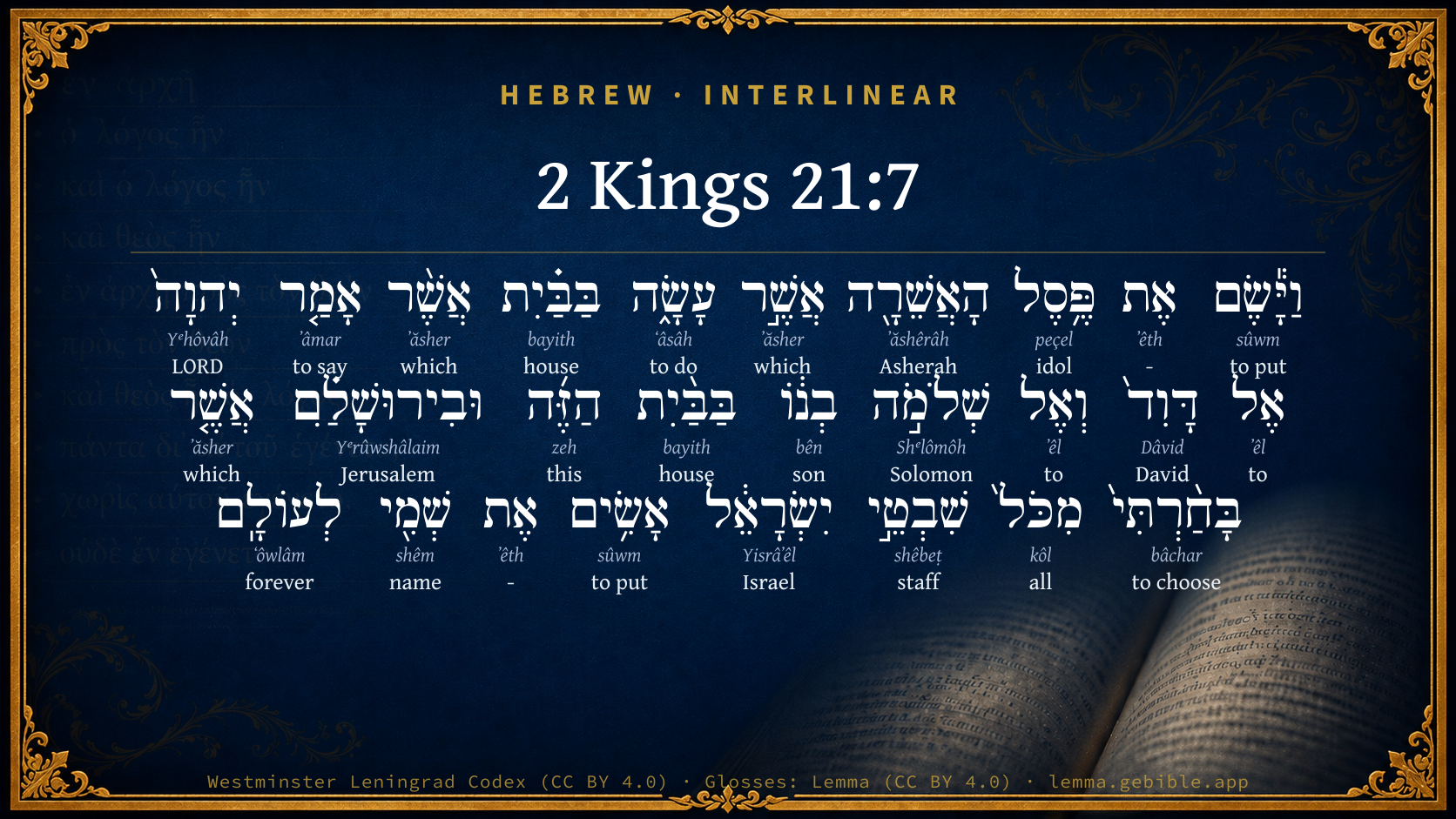
2 Kings 21:7

Hebrew (Westminster Leningrad Codex) 2 Kings 21:7 appears in the Hebrew Old Testament. The text above is from the Westminster Leningrad Codex. Each word links to its Strong’s number, a concise gloss, and parsing drawn from the Open Scriptures Hebrew Bible morphology. Click any word for its full Brown-Driver-Briggs (BDB) entry.
Download image
Cite this verse

2 Kings 21:7 (World English Bible). Public Domain. Lemma interlinear Bible study tool, https://lemma.gebible.app/v/2-kings/21/7.

Show BibTeX & RIS
BibTeX
RIS
English Translation
He set the engraved image of Asherah, that he had made, in the house of which Yahweh said to David and to Solomon his son, In this house, and in Jerusalem, which I have chosen out of all the tribes of Israel, will I put my name forever;
World English Bible · Public Domain
Download a study sheet

One document with this verse’s original text, its word-by-word gloss line, the meaning frame, cross-references with their text, attributed commentary, and full source and license credits — printable, and it pastes into notes with its structure intact.

This verse Autodidact and up

Study sheet (.html) Plain text (.txt)

A passage Seminary Student

Up to 50 verses in one chapter. A passage sheet keeps up to 6 commentary sources and 12 cross-references per verse, in the order this page ranks them, and says so on the sheet whenever that leaves anything out. Ask for a single verse and you get the Autodidact verse sheet above.

Everything on this page stays free to read, with no account — the sheet is a download of what is already on screen, not access to it.

Want to remove ads? Support Godless Engineer
Compare translations 3

The same verse in 3 English versions, stacked beneath the original-language interlinear above. Click any original word for its lexicon entry.

Each is an independent rendering of the whole verse — the interlinear is not word-aligned to these translations.

Highlighted words mark where these versions differ — a whole-verse word diff, not a word-by-word alignment.

  • World English Bible Public Domain
    He set the engraved image of Asherah, that he had made, in the house of which Yahweh said to David and to Solomon his son, In this house, and in Jerusalem, which I have chosen out of all the tribes of Israel, will I put my name forever;
  • King James Version Public Domain
    And he set a graven image of the grove that he had made in the house, of which the LORD said to David, and to Solomon his son, In this house, and in Jerusalem, which I have chosen out of all tribes of Israel, will I put my name for ever:
  • unfoldingWord Literal Text CC BY-SA 4.0
    And he put the image of Asherah that he made in the house which Yahweh had said to David and to Solomon his son, “In this house and in Jerusalem, which I have chosen from all of the tribes of Israel, I will put my name forever.

unfoldingWord Literal Text — © unfoldingWord, licensed CC BY-SA 4.0. Word-aligned USFM3 via Door43 (git.door43.org/unfoldingWord/en_ult).

Versions to compare (up to 4)

3 of 4 selected

Show all 18 translations

Every available English version of this verse, each an independent rendering of the whole verse.

  • World English Bible Public Domain
    He set the engraved image of Asherah, that he had made, in the house of which Yahweh said to David and to Solomon his son, In this house, and in Jerusalem, which I have chosen out of all the tribes of Israel, will I put my name forever;
  • Berean Standard Bible Public Domain
    Manasseh even took the carved Asherah pole he had made and set it up in the temple, of which the LORD had said to David and his son Solomon, “In this temple and in Jerusalem, which I have chosen out of all the tribes of Israel, I will establish My Name forever.
  • Majority Standard Bible Public Domain
    Manasseh even took the carved Asherah pole he had made and set it up in the temple, of which the LORD had said to David and his son Solomon, “In this temple and in Jerusalem, which I have chosen out of all the tribes of Israel, I will establish My Name forever.
  • King James Version Public Domain
    And he set a graven image of the grove that he had made in the house, of which the LORD said to David, and to Solomon his son, In this house, and in Jerusalem, which I have chosen out of all tribes of Israel, will I put my name for ever:
  • American Standard Version (1901) Public Domain
    And he set the graven image of Asherah, that he had made, in the house of which Jehovah said to David and to Solomon his son, In this house, and in Jerusalem, which I have chosen out of all the tribes of Israel, will I put my name for ever;
  • Revised Version (1885) Public Domain
    And he set the graven image of Asherah, that he had made, in the house of which the LORD said to David and to Solomon his son, In this house, and in Jerusalem, which I have chosen out of all the tribes of Israel, will I put my name for ever:
  • Geneva Bible (1599) Public Domain
    And he set the image of the groue, that he had made, in the house, whereof ye Lord had saide to Dauid and to Salomon his sonne, In this house and in Ierusalem, which I haue chosen out of all the tribes of Israel, will I put my Name for euer.
  • Douay-Rheims (1899) Public Domain
    He set also an idol of the grove, which he had made, in the temple of the Lord: concerning which the Lord said to David, and to Solomon his son: In this temple, and in Jerusalem, which I have chosen out of all the tribes of Israel, I will put my name for ever.
  • Young's Literal Translation Public Domain
    And he setteth the graven image of the shrine that he made in the house of which Jehovah said unto David and unto Solomon his son, `In this house, and in Jerusalem, that I have chosen out of all the tribes of Israel, I put My name -- to the age;
  • Literal Standard Version CC BY-SA 4.0
    And he sets the carved image of the Asherah that he made in the house of which YHWH said to David and to his son Solomon, “In this house, and in Jerusalem, that I have chosen out of all the tribes of Israel, I put My Name for all time;
  • Unlocked Literal Bible CC BY-SA 4.0
    The carved figure of Asherah that he had made, he placed it in the house of Yahweh. It was about this house that Yahweh had spoken to David and Solomon his son; he had said: “It is in this house and in Jerusalem, which I have chosen from all the tribes of Israel, that I will put my name forever.
  • unfoldingWord Literal Text CC BY-SA 4.0
    And he put the image of Asherah that he made in the house which Yahweh had said to David and to Solomon his son, “In this house and in Jerusalem, which I have chosen from all of the tribes of Israel, I will put my name forever.
  • Darby Bible Public Domain
    And he set the graven image of the Asherah that he had made, in the house of which Jehovah had said to David and to Solomon his son, In this house, and in Jerusalem, which I have chosen out of all the tribes of Israel, will I put my name for ever;
  • World Messianic Bible Public Domain
    He set the engraved image of Asherah that he had made in the house of which the LORD said to David and to Solomon his son, “In this house, and in Jerusalem, which I have chosen out of all the tribes of Israel, I will put my name forever;
  • Webster's Bible Public Domain
    And he set a graven image of the grove that he had made in the house, of which the LORD said to David, and to Solomon his son, In this house, and in Jerusalem, which I have chosen out of all tribes of Israel, will I put my name for ever:
  • Free Bible Version CC BY-SA 4.0
    He took the Asherah idol pole he had made and placed in the Temple. This was the place referred to by the Lord when he told David and Solomon, his son, “In this Temple and in Jerusalem, which I have chosen from all the tribes of Israel, I will place my name forever.
  • Bible in Basic English Public Domain
    He put the image of Asherah which he had made in the house of which the Lord had said to David and to Solomon his son, In this house, and in Jerusalem, the town which I have made mine out of all the tribes of Israel, I will put my name for ever.
  • JPS Tanakh (1917) Public Domain
    And he set the graven image of Asherah, that he had made, in the house of which the LORD said to David and to Solomon his son: 'In this house, and in Jerusalem, which I have chosen out of all the tribes of Israel, will I put My name for ever;

Literal Standard Version (2020), Covenant Press — licensed CC BY-SA 4.0. Text via the HelloAO Bible API (eBible.org). Unlocked Literal Bible (unfoldingWord) — licensed CC BY-SA 4.0. Text via the HelloAO Bible API (eBible.org). unfoldingWord Literal Text — © unfoldingWord, licensed CC BY-SA 4.0. Word-aligned USFM3 via Door43 (git.door43.org/unfoldingWord/en_ult). Free Bible Version, Dr. Jonathan Gallagher — licensed CC BY-SA 4.0. Text via the HelloAO Bible API (eBible.org).

Word by word

More ways to search: Search by grammar → Find every occurrence → Compare this word →

Practice this passage: Drill this verse → Learn its vocabulary →

פֶּ֥סֶל
peçel
H6459
“idol of”
Noun, Common, Masculine, Singular, Construct
Part of Speech
Noun
Type
Common
Gender
Masculine
Number
Singular
State
Construct
Full BDB Definition

Origin: from H6458

TWOT: 1788a

idol, image
  1. וַיָּ֕שֶׂם sûwm H7760 “and · to put” Conjunction + Verb, Qal, Sequential Imperfect, 3rd Person, Masculine, Singular
  2. אֶת ʼêth H853 “-” Particle, Direct Object
  3. הָאֲשֵׁרָ֖ה ʼăshêrâh H842 “the · Asherah” Particle, Definite Article + Noun, Proper
  4. אֲשֶׁ֣ר ʼăsher H834 “which” Particle, Relative
  5. עָשָׂ֑ה ʻâsâh H6213 “to do” Verb, Qal, Perfect, 3rd Person, Masculine, Singular
  6. בַּבַּ֗יִת bayith H1004 “in/at the · house” Preposition, Determined + Noun, Common, Masculine, Singular, Absolute
  7. אֲשֶׁ֨ר ʼăsher H834 “which” Particle, Relative
  8. אָמַ֤ר ʼâmar H559 “to say” Verb, Qal, Perfect, 3rd Person, Masculine, Singular
  9. יְהוָה֙ Yᵉhôvâh H3068 “LORD” Noun, Proper
  10. אֶל ʼêl H413 “to” Preposition
  11. דָּוִד֙ Dâvid H1732 “David” Noun, Proper
  12. וְאֶל ʼêl H413 “and · to” Conjunction + Preposition
  13. שְׁלֹמֹ֣ה Shᵉlômôh H8010 “Solomon” Noun, Proper
  14. בְנ֔וֹ bên H1121 “son · his” Noun, Common, Masculine, Singular, Construct + Suffix, Personal, 3rd Person, Masculine, Singular
  15. בַּבַּ֨יִת bayith H1004 “in/at the · house” Preposition, Determined + Noun, Common, Masculine, Singular, Absolute
  16. הַזֶּ֜ה zeh H2088 “the · this” Particle, Definite Article + Pronoun, Demonstrative, Masculine, Singular
  17. וּבִירוּשָׁלִַ֗ם Yᵉrûwshâlaim H3389 “and · in/at · Jerusalem” Conjunction + Preposition + Noun, Proper
  18. אֲשֶׁ֤ר ʼăsher H834 “which” Particle, Relative
  19. בָּחַ֨רְתִּי֙ bâchar H977 “to choose” Verb, Qal, Perfect, 1st Person, Common, Singular
  20. מִכֹּל֙ kôl H3605 “from · all of” Preposition + Noun, Common, Masculine, Singular, Construct
  21. שִׁבְטֵ֣י shêbeṭ H7626 “staffs of” Noun, Common, Masculine, Plural, Construct
  22. יִשְׂרָאֵ֔ל Yisrâʼêl H3478 “Israel” Noun, Proper
  23. אָשִׂ֥ים sûwm H7760 “to put” Verb, Qal, Imperfect, 1st Person, Common, Singular
  24. אֶת ʼêth H853 “-” Particle, Direct Object
  25. שְׁמִ֖י shêm H8034 “name · my” Noun, Common, Masculine, Singular, Construct + Suffix, Personal, 1st Person, Common, Singular
  26. לְעוֹלָֽם ʻôwlâm H5769 “to/for · forever” Preposition + Noun, Common, Masculine, Singular, Absolute

About this verse

These counts appear in no published source. They are computed here, from the morphology-tagged text and Lemma’s own curated glosses. What Lemma adds →

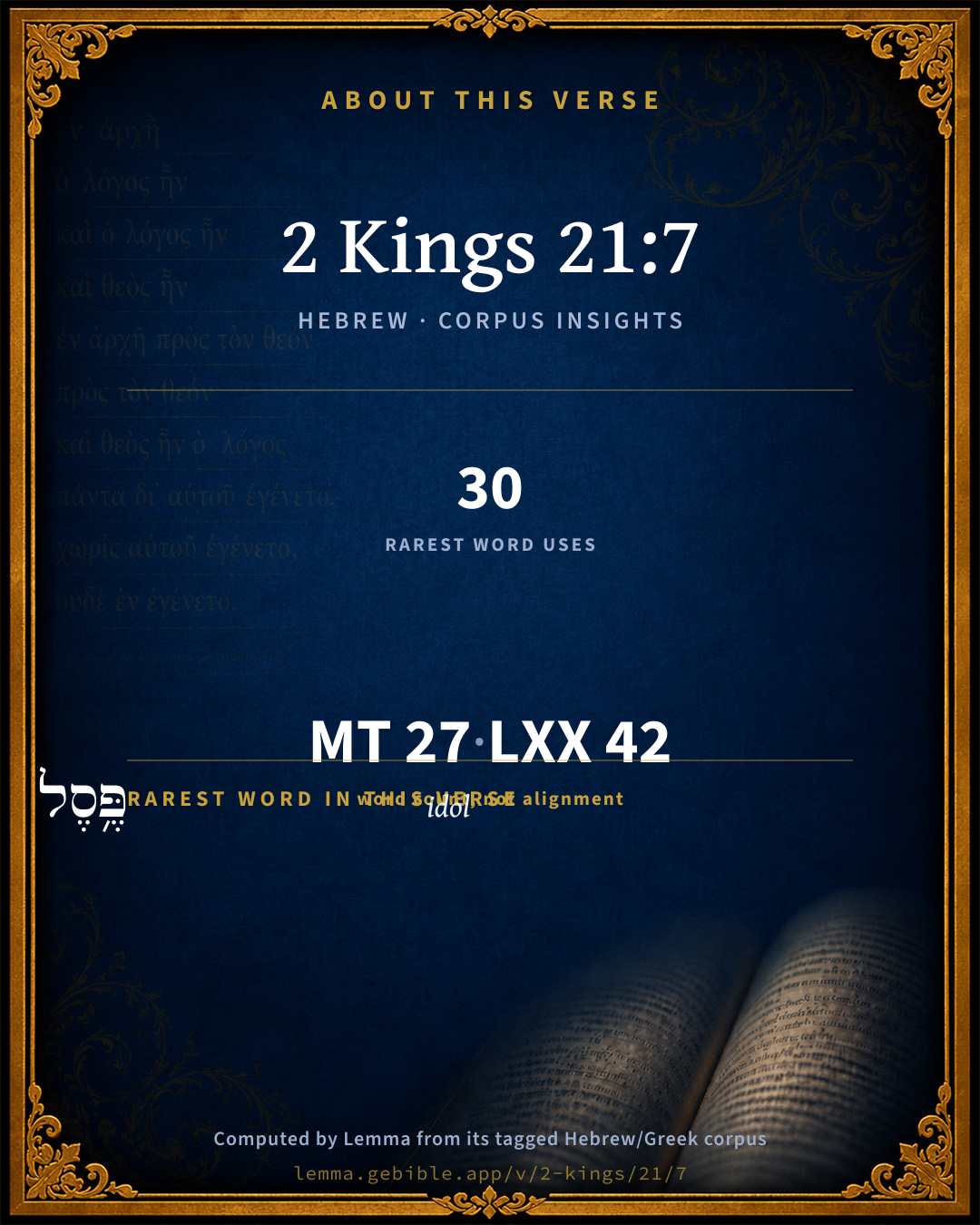
27
words
21
distinct lemmas
Historical
section

Shared distinctive vocabulary

פֶּ֥סֶל idol H6459 occurs in 30 verses of the Hebrew Bible. Also found in:

Grammatical profile

  • 5 verbs
  • 14 nouns
  • 1 pronoun
  • 2 prepositions
  • 5 particles

Verb forms

  • וַיָּ֕שֶׂם Qal · Sequential Imperfect
  • עָשָׂ֑ה Qal · Perfect
  • אָמַ֤ר Qal · Perfect
  • בָּחַ֨רְתִּי֙ Qal · Perfect
  • אָשִׂ֥ים Qal · Imperfect

Repetition

Words recur within this verse — often emphatic in Hebrew:

  • וַיָּ֕שֶׂם to put H7760 ×2
  • בַּבַּ֗יִת house H1004 ×2
  • אֲשֶׁ֣ר which H834 ×3
  • אֶל to H413 ×2

Hebrew & Septuagint length

In English translation the verse runs 48 words from the Hebrew and 50 from the Septuagint (LXX English) — closely comparable.

A rough comparison of the two English renderings, which tokenize alike — not a word-level alignment.

Word counts can differ between the Hebrew and the Greek without any difference in meaning — e.g. the Hebrew direct-object marker אֵת has no separate Greek word, and Greek often adds the article ὁ.

In the original languages it is 27 Hebrew tokens and 42 Greek tokens — but the two are counted differently (Hebrew bundles its prefixes and suffixes into one token; the Greek is in lemma form), so that isn’t a like-for-like length.

Cross-references

19

Topical passages linked to 2 Kings 21:7 in the Treasury of Scripture Knowledge — connected by theme and wording, ordered by reader-vote popularity; previews shown in the World English Bible.

  • 2 Chronicles 7:16 For now have I chosen and made this house holy, that my name may be there forever; and my eyes and my heart shall be there perpetually.
  • 2 Samuel 7:13 He shall build a house for my name, and I will establish the throne of his kingdom forever.
  • 1 Kings 8:29 that your eyes may be open toward this house night and day, even toward the place of which you have said, My name shall be there; to listen to the prayer which your servant shall pray toward this place.
  • 1 Kings 9:3 Yahweh said to him, I have heard your prayer and your supplication, that you have made before me: I have made this house holy, which you have built, to put my name there forever; and my eyes and my heart shall be there perpetually.
  • 2 Chronicles 7:12 Yahweh appeared to Solomon by night, and said to him, I have heard your prayer, and have chosen this place to myself for a house of sacrifice.
  • Deuteronomy 16:21 You shall not plant you an Asherah of any kind of tree beside the altar of Yahweh your God, which you shall make you.
  • 2 Kings 21:4 He built altars in the house of Yahweh, of which Yahweh said, In Jerusalem will I put my name.
  • 2 Kings 23:6 He brought out the Asherah from the house of Yahweh, outside of Jerusalem, to the brook Kidron, and burned it at the brook Kidron, and beat it to dust, and cast the dust of it on the graves of the common people.
  • 2 Kings 23:27 Yahweh said, I will remove Judah also out of my sight, as I have removed Israel, and I will cast off this city which I have chosen, even Jerusalem, and the house of which I said, My name shall be there.
  • 2 Chronicles 7:20 then will I pluck them up by the roots out of my land which I have given them; and this house, which I have made holy for my name, will I cast out of my sight, and I will make it a proverb and a byword among all peoples.
  • 2 Chronicles 33:7 He set the engraved image of the idol, which he had made, in the house of God, of which God said to David and to Solomon his son, In this house, and in Jerusalem, which I have chosen out of all the tribes of Israel, will I put my name forever:
  • 2 Chronicles 33:15 He took away the foreign gods, and the idol out of the house of Yahweh, and all the altars that he had built in the mountain of the house of Yahweh, and in Jerusalem, and cast them out of the city.
  • Nehemiah 1:9 but if you return to me, and keep my commandments and do them, though your outcasts were in the uttermost part of the heavens, yet will I gather them from there, and will bring them to the place that I have chosen, to cause my name to dwell there.
  • Psalms 132:13–14 For Yahweh has chosen Zion. He has desired it for his habitation.
  • Jeremiah 32:34 But they set their abominations in the house which is called by my name, to defile it.
  • 1 Kings 8:44 If your people go out to battle against their enemy, by whatever way you shall send them, and they pray to Yahweh toward the city which you have chosen, and toward the house which I have built for your name;
  • 1 Kings 9:7 then will I cut off Israel out of the land which I have given them; and this house, which I have made holy for my name, will I cast out of my sight; and Israel shall be a proverb and a byword among all peoples.
  • Psalms 74:2 Remember your congregation, which you purchased of old, Which you have redeemed to be the tribe of your inheritance; Mount Zion, in which you have lived.
  • Psalms 78:68–69 But chose the tribe of Judah, Mount Zion which he loved.

Cross-references courtesy of OpenBible.info (CC BY 4.0).

Hebrew and Greek witnesses Masoretic Hebrew ↔ Greek Septuagint

The same verse in the two great witnesses to the Old Testament, shown verse-for-verse.

These are two independent witnesses, not word-aligned to each other, and the Septuagint is shown in lemma (dictionary) form.

Hebrew 2 Kings 21:7 Masoretic · Westminster Leningrad Codex

וַיָּ֕שֶׂם אֶת פֶּ֥סֶל הָאֲשֵׁרָ֖ה אֲשֶׁ֣ר עָשָׂ֑ה בַּבַּ֗יִת אֲשֶׁ֨ר אָמַ֤ר יְהוָה֙ אֶל דָּוִד֙ וְאֶל שְׁלֹמֹ֣ה בְנ֔וֹ בַּבַּ֨יִת הַזֶּ֜ה וּבִירוּשָׁלִַ֗ם אֲשֶׁ֤ר בָּחַ֨רְתִּי֙ מִכֹּל֙ שִׁבְטֵ֣י יִשְׂרָאֵ֔ל אָשִׂ֥ים אֶת שְׁמִ֖י לְעוֹלָֽם

He set the engraved image of Asherah, that he had made, in the house of which Yahweh said to David and to Solomon his son, In this house, and in Jerusalem, which I have chosen out of all the tribes of Israel, will I put my name forever;

World English Bible · Public Domain

Greek LXX 2 Kings 21:7 Septuagint · lemma form

καί τίθημι ὁ γλυπτός ὁ ἄλσος ἐν ὁ οἶκος ὅς εἶπον κύριος πρός δαυίδ καί πρός σαλωμών ὁ υἱός αὐτός ἐν ὁ οἶκος οὗτος καί ἐν ἰερουσαλήμ ὅς ἐκλέγω ἐκ πᾶς φυλή ἰσραήλ καί τίθημι ὁ ὄνομα ἐγώ ἐκεῖ εἰς ὁ αἰών

And he set up the graven image of the grove in the house of which the Lord said to David, and to Solomon his son, In this house, and in Jerusalem which I have chosen out of all the tribes of Israel, will I even place my name for ever.

LXX2012 (modern English Septuagint) · Public Domain

Hebrew: Westminster Leningrad Codex (CC BY 4.0). Greek: Septuagint (public domain); English from LXX2012 (modern English Septuagint) (Public Domain). How the Septuagint differs from the Hebrew →

Targum (Aramaic paraphrase)

1

The Targum is the ancient Jewish Aramaic paraphrase of the Hebrew Scriptures — an interpretive translation, not the Hebrew text itself. Onkelos (literal) and Pseudo-Jonathan (expansive) render the Torah, and Jonathan the Prophets. Coverage is partial: where no permissively-licensed English translation exists for a verse, only the Aramaic is shown. This is verse-level text, not a word-by-word alignment to the Hebrew.

  1. Targum Jonathan Prophets (Joshua–Malachi)
    וְשַׁוֵי יַת צְלַם אֲשֵׁירָתָא דַעֲבַד בְּבֵיתָא דַאֲמַר יְיָ לְדָוִד וְלִשְׁלֹמֹה בְרֵיהּ בְּבֵיתָא הָדֵין וּבִירוּשְׁלֵם דְאִיתְרְעֵיתִי מִכֹּל שִׁבְטַיָא דְיִשְׂרָאֵל אַשְׁרֵי יַת שְׁכִנְתִּי לַעֲלָם:

    (no public-domain English translation for this verse)

    Targum Jonathan — Aramaic: “Mikraot Gedolot” (public domain). English: “Sefaria Community Translation” (CC0 1.0 (public-domain dedication)); “London "Chaldee Paraphrase," 1871” (public domain). Text via Sefaria.

Commentary

Notes on 2 Kings 21:7 from classic Christian and Jewish commentators (each source and its license shown beneath its notes). The classic Christian expositions comment on the surrounding passage and are grouped to its opening verse, so a note may address several verses; the Jewish commentaries on the Tanakh (Rashi and others) are per-verse, so they appear only where the commentator wrote on this verse.

Lemma curates 59 commentaries, every one of them public domain or Creative Commons licensed, each selected and text-cleaned for this edition rather than reprinted as found. About our sources →

Trapp's Complete Commentary

John Trapp

2Ki 21:7 And he set a graven image of the grove that he had made in the house, of which the LORD said to David, and to Solomon his son, In this house, and in Jerusalem, which I have chosen out of all tribes of Israel, will I put my name for ever:

Ver. 7. And he set a graven image of the grove, &c:] An image with a carved grove about it, {2Ki 23:6} that not God in the temple, but the devil in the grove, might there be worshipped.

John Trapp, A Commentary or Exposition upon All the Books of the Old and New Testament (1647–1656) — public domain. Text from a community e-Sword module.

Joseph Benson's Commentary

2Ki 21:7. He set an image of the grove, &c. — The image of that Baal which was worshipped in the grove, or of some other of his idols. The word Asherah, here rendered grove, is nearly the same with Ashtaroth, or Astarte, the imaginary female deities, which were worshipped along with Baalim. This image seems to have been set up in the very temple itself, probably in the holy place; as if designed purposely to affront the Lord to his face, and set him at defiance: “desecrating,” says Henry, “what had been consecrated to God, and, in effect, turning him out of his own house, and putting the rebels in possession of it.”

Joseph Benson's Commentary on the Old and New Testaments (1811–1818) — public domain. Text from a community e-Sword module.

Jamieson, Fausset & Brown

Robert Jamieson, A. R. Fausset & David Brown

And he set a graven image--The placing of the Asherah within the precincts of the temple, which was dedicated to the worship of the true God, is dwelt upon as the most aggravated outrage of the royal idolater.

Jamieson, Fausset & Brown — Commentary Critical and Explanatory on the Whole Bible (1871) — public domain (CC PDM 1.0). Text via the HelloAO Bible API.

Adam Clarke's Commentary

Verse 7. He set a graven image of the grove that he had made in the house] Every one may see that Asherah here must signify an idol, and not a grove; and for the proof of this see the observations at the end of the chapter. 2Kg 21:26.

Adam Clarke's Commentary on the Bible (1810–1826) — public domain. Text from a community e-Sword/MySword module.

Ellicott's Commentary for English Readers

(7) A graven image of the grove.—The graven image of the Ashçrah (2Ki_21:3).

In the house of which the Lord said . . .—See 1Ki_8:16; 1Ki_9:3. It is meant that the Asherah was erected within the Temple itself, probably in the holy place—an act which was the climax of Manasseh’s impiety. (Comp. 23:4; Eze_43:7; Jer_7:30 seq.)

A Bible Commentary for English Readers, edited by Charles John Ellicott (1878–1897) — public domain. Text from a community e-Sword module.

The Cambridge Bible for Schools and Colleges

gen. ed. J. J. S. Perowne

7. A graven image of the grave] R.V. the graven image of Asherah. Though usually of wood, such images were also made of silver and carved in stone. The image in question here would be specially grand in view of the position it was to occupy.

the Lord said to David] For the words to David cf. 2Sa_7:13; and to Solomon 1Ki_8:20.

The Cambridge Bible for Schools and Colleges (gen. ed. J. J. S. Perowne; Cambridge University Press, 1878–1918) — public domain. Text from a community e-Sword module.

John Gill's Exposition

Which was either an image that had been placed in a grove planted by him, and now removed into the house or temple of the Lord; or, as some think, this was a representation of a grove, a carved grove of gold or silver, in the midst of which an image was placed in the temple; though what Selden observes (b), seems best of all, that this was an image of Asherah, as in the original text; that is, of Astarte or Ashtoreth, the goddess of the Zidonians, Kg1 11:5, the same the Phoenicians are said to call Astroarche, and affirm it to be the moon (c): in Ch2 33:7 it is called a carved image the idol he had made; and an Arabic writer (d) says, it had four faces, which seems to be a figure of the cherubim; but, according to Suidas (e), it was the statue of Jupiter, who also says it had four faces:

of which the Lord said to David, and to Solomon his son: that is, of which house or temple:

in this house, and in Jerusalem, which I have chosen out of all the tribes of Israel, will I put my name forever; see Kg1 8:29; see Gill on Kg2 21:3.

(b) De Dis Syris, Syntagm. 2. c. 2. p. 233. (c) Herodian. l. 5. c. 15. (d) Abulpharag. Hist. Dynast. Dyn. 3. p. 66. (e) In voce

John Gill's Exposition of the Whole Bible (1746–1763) — public domain (CC PDM 1.0). Text via the HelloAO Bible API.

Albert Barnes' Notes on the Bible

A graven image of the grove - Rather, “the carved work of the Asherah.” This Asherah which Manasseh placed in the very temple itself, from where it was afterward taken by Josiah to be destroyed 2Ki 23:6. Such a profanation was beyond anything that had been done either by Athaliah 2Ki 11:18, or by Ahaz 2Ki 16:14-18; 2Ch 29:5-7.

Albert Barnes' Notes on the Bible (1834–1885) — public domain. Text from a community e-Sword/MySword module.

Haydock's Catholic Bible Commentary

Of the grove. Hebrew, "a graven thing of Ashera," the grove or Astarte, (Haydock) ver. 3. This was an engraving in sculpture of a sacred grove. (Sa) (Chap. xxiii. 6.) (Tirinus) --- My name. I alone will be adored, and there allow an altar to be erected. (Haydock)

George Leo Haydock (1774–1849), Haydock's Catholic Family Bible and Commentary, 1859 edition — public domain. Excludes Psalms (Douay-Rheims chapter numbering differs from Protestant) and Deuterocanonical books (Catholic canon only).

Matthew Poole's English Annotations

He set a graven image of the grove; either, first, The image of that Baal which was worshipped in the grove. Or, secondly, A representation of the grove, as may seem by comparing 2Ki 23:6. Or, thirdly, The graven image of Asherah, a god or goddess so called, possibly the same called elsewhere Ashtaroth. See Jdg 6:25,28; 2Ki 23:6; 2Ch 15:16.

Matthew Poole's English Annotations on the Holy Bible (1683–1685) — public domain. Text from a community e-Sword/MySword module.

Whedon's Commentary on the Bible

Daniel D. Whedon

7. A graven image of the grove — Rather, the image of the Asherah; that is, the Asherah-pillar, or image, already mentioned in 2Ki_21:3. (English version, incorrectly, “grove.”) He refrained not even from setting up this abominable image in the very temple which had been consecrated to the pure worship of Jehovah.

Daniel D. Whedon (gen. ed.), Commentary on the Old and New Testaments (1874–1909) — public domain. Text from a community e-Sword module.

The Pulpit Commentary

And he set a graven image of the grove that he had made in the house. He introduced into the temple, and set up there for adoration, an elaborately wrought Asherah, or "sacred tree," probably copied from the elaborate sacred trees of the Assyrians ("Ancient Monarchies," vol. 2. p. 236). These had, in the center, the essential stele, or pillar, ornamented with rams" horns, symbols of fecundity, and crowned with a representation of a palm tree, the whole being encircled by a framework of metal, twined about it, and throwing out from the circumference, at intervals, either palms or blossoms, or in some instances pomegranates or fir-cones. All the parts represented either animal or vegetable productiveness. Of which the Lord said to David, and to Solomon his son, In this house, and in Jerusalem, which I have chosen out of all the tribes of Israel, will I put my Name forever. It was the extremest aggravation of Manasseh"s wickedness that he was not content to introduce his new religions into the land in other places, but brought them to God"s special city which he had chosen, namely, Jerusalem, and there established them, not on the opposite hills, as Solomon had done, (1Ki_11:7) or in a rival temple within the walls, as had been done by Athaliah, (2Ki_11:18) but within God"s holy temple itself. In each of the two courts he placed an idolatrous altar, whereon the people were invited to deposit their offerings; and probably in the temple building itself, perhaps in the very holy of holies, he placed that lust-exciting emblem of Astarte, which was the most horrible profanation of all true religion, turning the truth and grace of God into lasciviousness (Jud_1:4). What practical consequences followed on this profanation, we are not distinctly told; but we may readily surmise, especially in the light of 2Ki_23:7.

The Pulpit Commentary (1880–1919), ed. H.D.M. Spence-Jones & Joseph S. Exell — public domain. Text from a community e-Sword module.

John Wesley's Explanatory Notes

An image - The image of that Baal which was worshipped in the grove.

John Wesley, Explanatory Notes Upon the Whole Bible (1754–1765) — public domain. Text via the GEBible commentary corpus.

unfoldingWord translationNotes

Door43 World Missions Community

General Information:

The story of King Manasseh's reign continues.

that he had made

Manasseh probably did not do the work. His servants would have done the work. AT: "that Manasseh had ordered his servants to make" (See: Metonymy)

that I will put my name forever

Here Yahweh putting his "name" on the temple represents him designating it as the place to worship him. AT: "where I want people to worship me forever" (See: Metonymy)

the feet of Israel

The feet are a synecdoche for the person. AT: "the people of Israel" or "the Israelites" (See: Synecdoche)

even more than the nations that Yahweh had destroyed before the people of Israel

Here "nations" refers to the people who had lived in the land of Canaan before the Israelites had arrived. AT: "even more than the people whom Yahweh had destroyed as the people of Israel advanced through the land" (See: Metonymy)

translationWords

image

David

Solomon

tribe

Israel

obey

command

law

servant

Moses

unfoldingWord translationNotes — © Distant Shores Media and the Door43 World Missions Community, licensed CC BY-SA 4.0. Source: git.door43.org/Door43/en_tn.

Lesson kit

Teaching starters — assembled from the data on this page, not authored interpretation. Every prompt links to the verse data it draws on. Edit before teaching.

2 Kings, in the Historical, opens this verse with 27 words (21 distinct Hebrew lemmas). Its most distinctive word is peçel (“idol”). A historical commentator’s framing appears above. Read the whole chapter for the surrounding context.

Discussion questions

  1. How does “idol” (peçel) shape what this verse is saying?
  2. Exodus 20:4 shares the word «idol» with this verse. How do the two illuminate each other?
  3. “to put” occurs 2× in this one verse. What is the effect of the repetition?
  4. These translations render this verse differently. What is at stake in choosing one wording over another?
  5. The verb «וַיָּ֕שֶׂם» is Qal Sequential Imperfect. How does its form color the action?
  6. Reading how Trapp's Complete Commentary and Joseph Benson's Commentary read this verse, where do the two commentators agree and where do they part?

Things to notice

Reading settings

Reading text

Shown beneath each verse's original-language words.

Old Testament
Old Testament edition

Read the OT as the Masoretic Hebrew (MT) or the Greek Septuagint (LXX).

English shown for the Greek Septuagint (in the Hebrew ↔ Greek comparison).

Comparing translations? Open the Compare panel on any verse page to stack up to four side by side.