
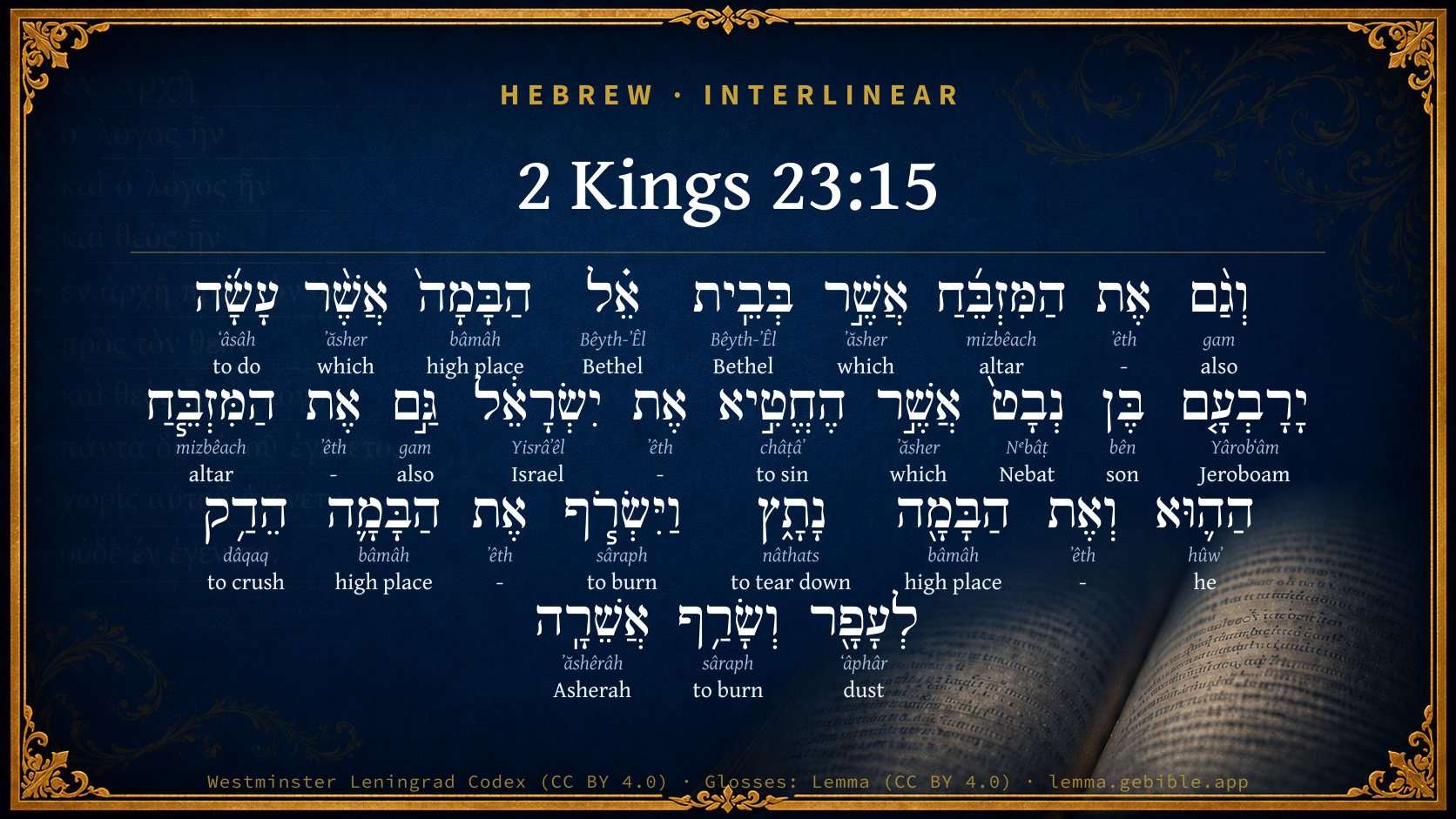
2 Kings 23:15

Hebrew (Westminster Leningrad Codex) 2 Kings 23:15 appears in the Hebrew Old Testament. The text above is from the Westminster Leningrad Codex. Each word links to its Strong’s number, a concise gloss, and parsing drawn from the Open Scriptures Hebrew Bible morphology. Click any word for its full Brown-Driver-Briggs (BDB) entry.
Download image
Cite this verse

2 Kings 23:15 (World English Bible). Public Domain. Lemma interlinear Bible study tool, https://lemma.gebible.app/v/2-kings/23/15.

Show BibTeX & RIS
BibTeX
RIS
English Translation
Moreover the altar that was at Bethel, and the high place which Jeroboam the son of Nebat, who made Israel to sin, had made, even that altar and the high place he broke down; and he burned the high place and beat it to dust, and burned the Asherah.
World English Bible · Public Domain
Download a study sheet

One document with this verse’s original text, its word-by-word gloss line, the meaning frame, cross-references with their text, attributed commentary, and full source and license credits — printable, and it pastes into notes with its structure intact.

This verse Autodidact and up

Study sheet (.html) Plain text (.txt)

A passage Seminary Student

Up to 50 verses in one chapter. A passage sheet keeps up to 6 commentary sources and 12 cross-references per verse, in the order this page ranks them, and says so on the sheet whenever that leaves anything out. Ask for a single verse and you get the Autodidact verse sheet above.

Everything on this page stays free to read, with no account — the sheet is a download of what is already on screen, not access to it.

Want to remove ads? Support Godless Engineer
Compare translations 3

The same verse in 3 English versions, stacked beneath the original-language interlinear above. Click any original word for its lexicon entry.

Each is an independent rendering of the whole verse — the interlinear is not word-aligned to these translations.

Highlighted words mark where these versions differ — a whole-verse word diff, not a word-by-word alignment.

  • World English Bible Public Domain
    Moreover the altar that was at Bethel, and the high place which Jeroboam the son of Nebat, who made Israel to sin, had made, even that altar and the high place he broke down; and he burned the high place and beat it to dust, and burned the Asherah.
  • King James Version Public Domain
    Moreover the altar that was at Bethel, and the high place which Jeroboam the son of Nebat, who made Israel to sin, had made, both that altar and the high place he brake down, and burned the high place, and stamped it small to powder, and burned the grove.
  • unfoldingWord Literal Text CC BY-SA 4.0
    And also the altar that in Bethel, the high place that Jeroboam, the son of Nebat, made, who caused Israel to sin, both that altar and the high place, he tore down, and he burned the high place. He crushed to dust, and he burned the Asherah.

unfoldingWord Literal Text — © unfoldingWord, licensed CC BY-SA 4.0. Word-aligned USFM3 via Door43 (git.door43.org/unfoldingWord/en_ult).

Versions to compare (up to 4)

3 of 4 selected

Show all 18 translations

Every available English version of this verse, each an independent rendering of the whole verse.

  • World English Bible Public Domain
    Moreover the altar that was at Bethel, and the high place which Jeroboam the son of Nebat, who made Israel to sin, had made, even that altar and the high place he broke down; and he burned the high place and beat it to dust, and burned the Asherah.
  • Berean Standard Bible Public Domain
    He even pulled down the altar at Bethel, the high place set up by Jeroboam son of Nebat, who had caused Israel to sin. Then he burned the high place, ground it to powder, and burned the Asherah pole.
  • Majority Standard Bible Public Domain
    He even pulled down the altar at Bethel, the high place set up by Jeroboam son of Nebat, who had caused Israel to sin. Then he burned the high place, ground it to powder, and burned the Asherah pole.
  • King James Version Public Domain
    Moreover the altar that was at Bethel, and the high place which Jeroboam the son of Nebat, who made Israel to sin, had made, both that altar and the high place he brake down, and burned the high place, and stamped it small to powder, and burned the grove.
  • American Standard Version (1901) Public Domain
    Moreover the altar that was at Beth-el, and the high place which Jeroboam the son of Nebat, who made Israel to sin, had made, even that altar and the high place he brake down; and he burned the high place and beat it to dust, and burned the Asherah.
  • Revised Version (1885) Public Domain
    Moreover the altar that was at Beth-el, and the high place which Jeroboam the son of Nebat, who made Israel to sin, had made, even that altar and the high place he brake down; and he burned the high place and stamped it small to powder, and burned the Asherah.
  • Geneva Bible (1599) Public Domain
    Furthermore the altar that was at Beth-el, and the hie place made by Ieroboam the sonne of Nebat, which made Israel to sinne, both this altar and also the hie place, brake he downe, and burnt the hie place, and stampt it to powder and burnt the groue.
  • Douay-Rheims (1899) Public Domain
    Moreover the altar also that was at Bethel, and the high place, which Jeroboam the son of Nabat, who made Israel to sin, had made: both the altar, and the high place he broke down and burnt, and reduced to powder, and burnt the grove.
  • Young's Literal Translation Public Domain
    and also the altar that `is' in Beth-El, the high place that Jeroboam son of Nebat made, by which he made Israel sin, both that altar and the high place he hath broken down, and doth burn the high place -- he hath beat it small to dust, and hath burnt the shrine.
  • Literal Standard Version CC BY-SA 4.0
    and also the altar that [is] in Beth-El, the high place that Jeroboam son of Nebat made, by which he made Israel sin, both that altar and the high place he has broken down, and burns the high place—he has beat it small to dust, and has burned the Asherah.
  • Unlocked Literal Bible CC BY-SA 4.0
    Josiah also completely destroyed the altar that was at Bethel and the high place that Jeroboam son of Nebat (the one who made Israel to sin) had constructed. He also burned that altar and the high place and beat it to dust. He also burned the Asherah pole.
  • unfoldingWord Literal Text CC BY-SA 4.0
    And also the altar that in Bethel, the high place that Jeroboam, the son of Nebat, made, who caused Israel to sin, both that altar and the high place, he tore down, and he burned the high place. He crushed to dust, and he burned the Asherah.
  • Darby Bible Public Domain
    Moreover the altar that was at Bethel, the high place that Jeroboam the son of Nebat, who caused Israel to sin, had made, both that altar and the high place he broke down; and burned the high place, stamped it small to powder, and burned the Asherah.
  • World Messianic Bible Public Domain
    Moreover the altar that was at Bethel and the high place which Jeroboam the son of Nebat, who made Israel to sin, had made, even that altar and the high place he broke down; and he burned the high place and beat it to dust, and burned the Asherah.
  • Webster's Bible Public Domain
    Moreover, the altar that was at Beth-el, and the high place which Jeroboam the son of Nebat, who made Israel to sin, had made, both that altar and the high place he broke down, and burned the high place, and stamped it small to powder, and burned the grove.
  • Free Bible Version CC BY-SA 4.0
    He also demolished the altar at Bethel, the high place set up by Jeroboam, son of Nebat, who had made Israel sin. Then he burned the high place, ground it to dust, and burned the Asherah pole.
  • Bible in Basic English Public Domain
    And the altar at Beth-el, and the high place put up by Jeroboam, the son of Nebat, who made Israel do evil, that altar and that high place were pulled down; and the high place was burned and crushed to dust and the Asherah was burned.
  • JPS Tanakh (1917) Public Domain
    Moreover the altar that was at Beth-el, and the high place which Jeroboam the son of Nebat, who made Israel to sin, had made, even that altar and the high place he broke down; and he burned the high place and stamped it small to powder, and burned the Asherah.

Literal Standard Version (2020), Covenant Press — licensed CC BY-SA 4.0. Text via the HelloAO Bible API (eBible.org). Unlocked Literal Bible (unfoldingWord) — licensed CC BY-SA 4.0. Text via the HelloAO Bible API (eBible.org). unfoldingWord Literal Text — © unfoldingWord, licensed CC BY-SA 4.0. Word-aligned USFM3 via Door43 (git.door43.org/unfoldingWord/en_ult). Free Bible Version, Dr. Jonathan Gallagher — licensed CC BY-SA 4.0. Text via the HelloAO Bible API (eBible.org).

Word by word

More ways to search: Search by grammar → Find every occurrence → Compare this word →

Practice this passage: Drill this verse → Learn its vocabulary →

הֵדַ֥ק
dâqaq
H1854
“to crush”
Verb, Hiphil, Perfect, 3rd Person, Masculine, Singular
Part of Speech
Verb
Stem
Hiphil
Form
Perfect
Person
3rd Person
Gender
Masculine
Number
Singular
Full BDB Definition

Origin: a primitive root [compare H1915 ]

TWOT: 448

to crush, pulverise, thresh - (Qal) - to crush - to be fine - (Hiphil) to pulverise, make dust of - (Hophal) to be crushed
  1. וְגַ֨ם gam H1571 “and · also” Conjunction + Particle, Accusative
  2. אֶת ʼêth H853 “-” Particle, Direct Object
  3. הַמִּזְבֵּ֜חַ mizbêach H4196 “the · altar” Particle, Definite Article + Noun, Common, Masculine, Singular, Absolute
  4. אֲשֶׁ֣ר ʼăsher H834 “which” Particle, Relative
  5. בְּבֵֽית Bêyth-ʼÊl H1008 “in/at · Bethel” Preposition + Noun, Proper
  6. אֵ֗ל Bêyth-ʼÊl H1008 “Bethel” Noun, Proper
  7. הַבָּמָה֙ bâmâh H1116 “the · high place” Particle, Definite Article + Noun, Common, Feminine, Singular, Absolute
  8. אֲשֶׁ֨ר ʼăsher H834 “which” Particle, Relative
  9. עָשָׂ֜ה ʻâsâh H6213 “to do” Verb, Qal, Perfect, 3rd Person, Masculine, Singular
  10. יָרָבְעָ֤ם Yârobʻâm H3379 “Jeroboam” Noun, Proper
  11. בֶּן bên H1121 “son of” Noun, Common, Masculine, Singular, Construct
  12. נְבָט֙ Nᵉbâṭ H5028 “Nebat” Noun, Proper
  13. אֲשֶׁ֣ר ʼăsher H834 “which” Particle, Relative
  14. הֶחֱטִ֣יא châṭâʼ H2398 “to sin” Verb, Hiphil, Perfect, 3rd Person, Masculine, Singular
  15. אֶת ʼêth H853 “-” Particle, Direct Object
  16. יִשְׂרָאֵ֔ל Yisrâʼêl H3478 “Israel” Noun, Proper
  17. גַּ֣ם gam H1571 “also” Particle, Accusative
  18. אֶת ʼêth H853 “-” Particle, Direct Object
  19. הַמִּזְבֵּ֧חַ mizbêach H4196 “the · altar” Particle, Definite Article + Noun, Common, Masculine, Singular, Absolute
  20. הַה֛וּא hûwʼ H1931 “the · he” Particle, Definite Article + Pronoun, Personal, 3rd Person, Masculine, Singular
  21. וְאֶת ʼêth H853 “and · -” Conjunction + Particle, Direct Object
  22. הַבָּמָ֖ה bâmâh H1116 “the · high place” Particle, Definite Article + Noun, Common, Feminine, Singular, Absolute
  23. נָתָ֑ץ nâthats H5422 “to tear down” Verb, Qal, Perfect, 3rd Person, Masculine, Singular
  24. וַיִּשְׂרֹ֧ף sâraph H8313 “and · to burn” Conjunction + Verb, Qal, Sequential Imperfect, 3rd Person, Masculine, Singular
  25. אֶת ʼêth H853 “-” Particle, Direct Object
  26. הַבָּמָ֛ה bâmâh H1116 “the · high place” Particle, Definite Article + Noun, Common, Feminine, Singular, Absolute
  27. לְעָפָ֖ר ʻâphâr H6083 “to/for · dust” Preposition + Noun, Common, Masculine, Singular, Absolute
  28. וְשָׂרַ֥ף sâraph H8313 “and · to burn” Conjunction + Verb, Qal, Perfect, 3rd Person, Masculine, Singular
  29. אֲשֵׁרָֽה ʼăshêrâh H842 “Asherah” Noun, Proper

About this verse

These counts appear in no published source. They are computed here, from the morphology-tagged text and Lemma’s own curated glosses. What Lemma adds →

30
words
18
distinct lemmas
Historical
section

Notable vocabulary

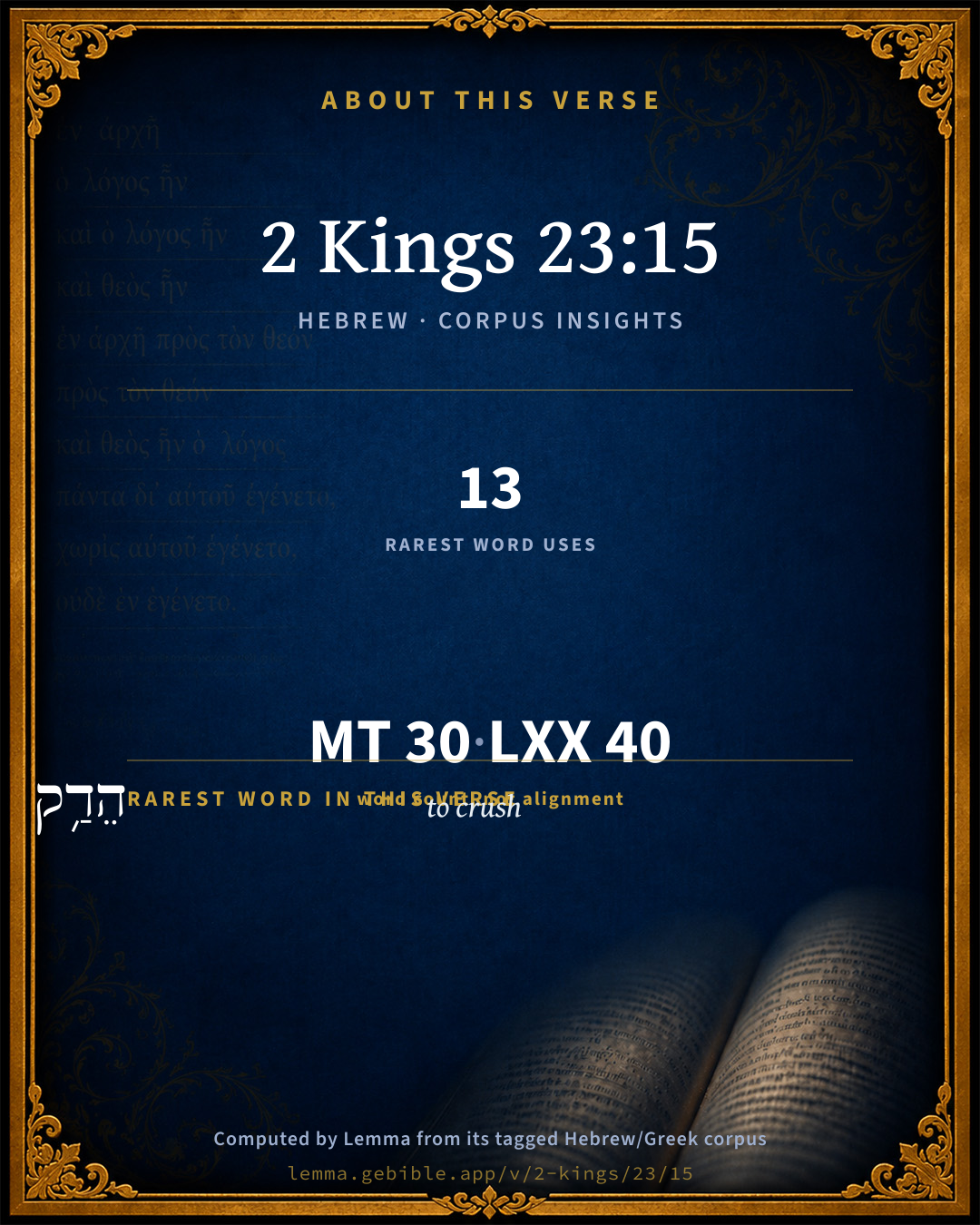
The rarest word here is הֵדַ֥ק to crush H1854 — appearing just 13 times in the whole Hebrew Bible.

Shared distinctive vocabulary

הֵדַ֥ק to crush H1854 occurs in 12 verses of the Hebrew Bible. Also found in:

Grammatical profile

  • 6 verbs
  • 13 nouns
  • 1 pronoun
  • 10 particles

Verb forms

  • עָשָׂ֜ה Qal · Perfect
  • הֶחֱטִ֣יא Hiphil · Perfect
  • נָתָ֑ץ Qal · Perfect
  • וַיִּשְׂרֹ֧ף Qal · Sequential Imperfect
  • הֵדַ֥ק Hiphil · Perfect
  • וְשָׂרַ֥ף Qal · Perfect

Repetition

Words recur within this verse — often emphatic in Hebrew:

  • הַבָּמָה֙ high place H1116 ×3
  • וְגַ֨ם also H1571 ×2
  • הַמִּזְבֵּ֜חַ altar H4196 ×2
  • בְּבֵֽית Bethel H1008 ×2
  • וַיִּשְׂרֹ֧ף to burn H8313 ×2
  • אֲשֶׁ֣ר which H834 ×3

Hebrew & Septuagint length

In English translation the verse runs 49 words from the Hebrew and 43 from the Septuagint (LXX English) — closely comparable.

A rough comparison of the two English renderings, which tokenize alike — not a word-level alignment.

Word counts can differ between the Hebrew and the Greek without any difference in meaning — e.g. the Hebrew direct-object marker אֵת has no separate Greek word, and Greek often adds the article ὁ.

In the original languages it is 30 Hebrew tokens and 40 Greek tokens — but the two are counted differently (Hebrew bundles its prefixes and suffixes into one token; the Greek is in lemma form), so that isn’t a like-for-like length.

Cross-references

6

Topical passages linked to 2 Kings 23:15 in the Treasury of Scripture Knowledge — connected by theme and wording, ordered by reader-vote popularity; previews shown in the World English Bible.

  • 1 Kings 14:16 He will give Israel up because of the sins of Jeroboam, which he has sinned, and with which he has made Israel to sin.
  • 2 Kings 23:6 He brought out the Asherah from the house of Yahweh, outside of Jerusalem, to the brook Kidron, and burned it at the brook Kidron, and beat it to dust, and cast the dust of it on the graves of the common people.
  • 1 Kings 12:28–13:1 Whereupon the king took counsel, and made two calves of gold; and he said to them, It is too much for you to go up to Jerusalem: see your gods, Israel, which brought you up out of the land of Egypt.
  • 1 Kings 15:30 for the sins of Jeroboam which he sinned, and with which he made Israel to sin, because of his provocation with which he provoked Yahweh, the God of Israel, to anger.
  • 1 Kings 21:22 and I will make your house like the house of Jeroboam the son of Nebat, and like the house of Baasha the son of Ahijah for the provocation with which you have provoked me to anger, and have made Israel to sin.
  • 2 Kings 10:31 But Jehu took no heed to walk in the law of Yahweh, the God of Israel, with all his heart: he didn't depart from the sins of Jeroboam, with which he made Israel to sin.

Cross-references courtesy of OpenBible.info (CC BY 4.0).

Hebrew and Greek witnesses Masoretic Hebrew ↔ Greek Septuagint

The same verse in the two great witnesses to the Old Testament, shown verse-for-verse.

These are two independent witnesses, not word-aligned to each other, and the Septuagint is shown in lemma (dictionary) form.

Hebrew 2 Kings 23:15 Masoretic · Westminster Leningrad Codex

וְגַ֨ם אֶת הַמִּזְבֵּ֜חַ אֲשֶׁ֣ר בְּבֵֽית אֵ֗ל הַבָּמָה֙ אֲשֶׁ֨ר עָשָׂ֜ה יָרָבְעָ֤ם בֶּן נְבָט֙ אֲשֶׁ֣ר הֶחֱטִ֣יא אֶת יִשְׂרָאֵ֔ל גַּ֣ם אֶת הַמִּזְבֵּ֧חַ הַה֛וּא וְאֶת הַבָּמָ֖ה נָתָ֑ץ וַיִּשְׂרֹ֧ף אֶת הַבָּמָ֛ה הֵדַ֥ק לְעָפָ֖ר וְשָׂרַ֥ף אֲשֵׁרָֽה

Moreover the altar that was at Bethel, and the high place which Jeroboam the son of Nebat, who made Israel to sin, had made, even that altar and the high place he broke down; and he burned the high place and beat it to dust, and burned the Asherah.

World English Bible · Public Domain

Greek LXX 2 Kings 23:15 Septuagint · lemma form

καί γέ ὁ θυσιαστήριον ὁ ἐν βαιθηλ ὁ ὑψηλός ὅς ποιέω ιεροβοαμ υἱός ναβατ ὅς ἐκἁμαρτάνω ὁ ἰσραήλ καί γέ ὁ θυσιαστήριον ἐκεῖνος καί ὁ ὑψηλός κατασπάω καί συντρίβω ὁ λίθος αὐτός καί λεπτύνω εἰς χοῦς καί κατακαίω ὁ ἄλσος

Also the high altar in Baethel, which Jeroboam the son of Nabat, who made Israel to sin, had made, even that high altar he tore down, and broke in pieces the stones of it, and reduced it to powder, and burnt the grove.

LXX2012 (modern English Septuagint) · Public Domain

On this verse, Ellicott's Commentary for English Readers discusses the Septuagint’s reading. Read the note in Commentary ↓

Hebrew: Westminster Leningrad Codex (CC BY 4.0). Greek: Septuagint (public domain); English from LXX2012 (modern English Septuagint) (Public Domain). How the Septuagint differs from the Hebrew →

Targum (Aramaic paraphrase)

1

The Targum is the ancient Jewish Aramaic paraphrase of the Hebrew Scriptures — an interpretive translation, not the Hebrew text itself. Onkelos (literal) and Pseudo-Jonathan (expansive) render the Torah, and Jonathan the Prophets. Coverage is partial: where no permissively-licensed English translation exists for a verse, only the Aramaic is shown. This is verse-level text, not a word-by-word alignment to the Hebrew.

  1. Targum Jonathan Prophets (Joshua–Malachi)
    וְאַף יַת אֱגוֹרָא דִי בְבֵית אֵל בָּמָתָא דַעֲבַד יָרָבְעָם בַּר נְבָט דְחַיֵב יַת יִשְׂרָאֵל אַף יַת אֱגוֹרָא הַהִיא וְיָת בָּמָתָא תָּרַע וְאוֹקִיד יַת בָּמָתָא אַדְקָה לְעַפְרָא וְאוֹקִיד אֲשֵׁירָתָא:

    (no public-domain English translation for this verse)

    Targum Jonathan — Aramaic: “Mikraot Gedolot” (public domain). English: “Sefaria Community Translation” (CC0 1.0 (public-domain dedication)); “London "Chaldee Paraphrase," 1871” (public domain). Text via Sefaria.

Commentary

Notes on 2 Kings 23:15 from classic Christian and Jewish commentators (each source and its license shown beneath its notes). The classic Christian expositions comment on the surrounding passage and are grouped to its opening verse, so a note may address several verses; the Jewish commentaries on the Tanakh (Rashi and others) are per-verse, so they appear only where the commentator wrote on this verse.

Lemma curates 59 commentaries, every one of them public domain or Creative Commons licensed, each selected and text-cleaned for this edition rather than reprinted as found. About our sources →

Trapp's Complete Commentary

John Trapp

2Ki 23:15 Moreover the altar that [was] at Bethel, [and] the high place which Jeroboam the son of Nebat, who made Israel to sin, had made, both that altar and the high place he brake down, and burned the high place, [and] stamped [it] small to powder, and burned the grove.

Ver. 15. Moreover the altar that was at Bethel.] It is probable that the king of Babylon, when he sent home Manasseh, gave him also dominion of the greatest part of the country of Samaria, indenting with him to defend the same against the Egyptian. Howsoever, good Josiah faileth not to root out idolatry in all those parts also, {2Ki 23:19} it being an abandoned country, which, in a manner, had no lord at all.

John Trapp, A Commentary or Exposition upon All the Books of the Old and New Testament (1647–1656) — public domain. Text from a community e-Sword module.

Joseph Benson's Commentary

2Ki 23:15. The altar that was at Beth-el he brake down — Probably this city was now under the kingdom of Judah, to which it was added by Abijah long before this time. And it is probable, since the ten tribes were carried away, many cities had put themselves under the protection of Judah. The golden calf, it seems, was gone; but Josiah would leave no remains of that idolatry.

Joseph Benson's Commentary on the Old and New Testaments (1811–1818) — public domain. Text from a community e-Sword module.

Tyndale Open Study Notes

Tyndale Open Resources

23:15-17 Jeroboam had built the altar at Bethel to encourage Israelites to worship at centers closer to home rather than going to Jerusalem (1 Kgs 12:26-31). Josiah’s desecration of the site followed the stipulations of the law (Deut 7:5; 12:3) and fulfilled the earlier prophecy of the man of God who had denounced the altar (1 Kgs 13:1-3).

Tyndale Open Study Notes — © Tyndale Open Resources, licensed CC BY-SA 4.0. Text via the HelloAO Bible API.

Geneva Bible (1599)

Geneva Bible translators

Which Jeroboam had built in Israel, 1 Kings 12:28, 29.

Geneva Bible (1599) marginal notes — public domain. Text via Bolls.life.

Jamieson, Fausset & Brown

Robert Jamieson, A. R. Fausset & David Brown

Moreover the altar that was at Beth-el, &c.--Not satisfied with the removal of every vestige of idolatry from his own dominion, this zealous iconoclast made a tour of inspection through the cities of Samaria and all the territory formerly occupied by the ten tribes, destroying the altars and temples of the high places, consigning the Asherim to the flames, putting to death the priests of the high places, and showing his horror at idolatry by ransacking the sepulchers of idolatrous priests, and strewing the burnt ashes of their bones upon the altars before he demolished them.

Jamieson, Fausset & Brown — Commentary Critical and Explanatory on the Whole Bible (1871) — public domain (CC PDM 1.0). Text via the HelloAO Bible API.

Ellicott's Commentary for English Readers

(15) The altar . . . and the high place.—The and is wanting in the Hebrew, LXX., and Targum.It is supplied in the Syriac, Vulgate, and Arabic, correctly as regards the sense; see below. Grammatically, “the high place” may be in apposition to “the altar,” and may include it, as being a more general term.

Which Jeroboam the son of Nebat . . .—See 1Ki_12:28 seq.

Burned the high place.—Was it, then, a wooden structure, as Thenius supposes? Perhaps it resembled a dolmen (many hundred such have been found in Palestine); and fire may have been kindled under it, by way of cracking the huge slabs of stone of which it was built. The fragments might then be more easily crushed.

Burned the grove.—The present text is, burned an ashçrah. Perhaps the article has fallen out; especially as this is not the only indication that the text has suffered in this place. Thenius understands the word in the general sense of an idol-image, comparing 2Ki_17:29 seq. But it is doubtful whether the word Ashçrah is so used. It is noteworthy that the present passage indirectly agrees with Hos_10:6, for no mention is made of what used to be the chief object of worship at Beth-el; viz., the golden bullock. It had been carried away to Assyria, as the prophet foretold.

A Bible Commentary for English Readers, edited by Charles John Ellicott (1878–1897) — public domain. Text from a community e-Sword module.

The Cambridge Bible for Schools and Colleges

gen. ed. J. J. S. Perowne

15–20. Josiah destroys the high place at Beth-el, and defiles the altar. He finds the tomb of the man of God who had foretold all these things. He also slays the priests at Beth-el (Not in Chronicles)

the altar that was at Beth-el] i.e. which Jeroboam, the son of Nebat, had erected when the ten tribes revolted from Rehoboam (1Ki_12:28-29). Having purged his own kingdom from idolatry he now turns his thoughts to those Israelites who were left in the northern kingdom. The Chronicler, who omits the history of Israel almost entirely, probably omits the striking incident noticed in these verses because it was not connected directly with Judah. He does tell of the collection of money from Manasseh, Ephraim and the remnant of Israel (2Ch_34:8) at this time, but this was for the restoration of the temple in Jerusalem and so came properly within his subject.

both [R.V. even] that altar and the high place] The ‘high place’ means here, and often in other passages, ‘the house of the high place’, which was some sort of chapel near to the spot where the altar stood.

and [R.V. adds he] burnt the high place … and burnt the grove] R.V. Asherah. As from the cutting down (verse 14), so here from the burning we learn that the Asherim were wooden even if they were overlaid with metal.

The Cambridge Bible for Schools and Colleges (gen. ed. J. J. S. Perowne; Cambridge University Press, 1878–1918) — public domain. Text from a community e-Sword module.

John Gill's Exposition

And as Josiah turned himself,.... From the high place, and the altar at Bethel; for he not only gave orders for the destroying of idolatrous places and idols, but he saw them executed himself:

he spied the sepulchres that were there in the mount; the graves of idolatrous priests and worshippers, who chose to be buried near those places of idolatry; nor was it unusual for persons to be buried on hills and mountains, see Jos 24:30 and this was a custom in other nations formerly (t), particularly among the Indians (u) now, who in many things agree with the Jews:

and sent and took the bones out of the sepulchres, and burnt them upon the altar; where they had sacrificed to idols:

and polluted it; with their bones, which, according to the law, were defiling, and which was done in contempt of their idolatrous worship there:

according to the word of the Lord which the man of God proclaimed, who proclaimed these words; or things; foretold that such a king by name would arise, and burn men's bones upon the altar, and which had been foretold more than three hundred and fifty years before this time.

(t) Vid. Servium in Virgil. Aeneid. 11. ver 849. "fuit ingens monte sub alto". (u) Manasseh ben Israel Spes Israelis. sect 6. p. 29.

John Gill's Exposition of the Whole Bible (1746–1763) — public domain (CC PDM 1.0). Text via the HelloAO Bible API.

Haydock's Catholic Bible Commentary

Bethel had perhaps fallen into the hands of Juda, after the Israelites had been led away. (Calmet) --- Josias exercised the like authority throughout all Samaria, (ver. 19.) as the country properly belonged to the house of David, and was God’s peculiar inheritance. (Haydock) --- We may, therefore conclude that He authorized Josias to act in this manner; and the new inhabitants had no interest in maintaining the superstition of those who had lived there before them. The priest sent by Asarhaddon, had taken up his residence at Bethel; whence it is inferred that the town, at that time, was in the hands of the Samaritans, (Calmet) as it might be still, though Josias might exercise dominion in it as lord paramount. (Haydock)

George Leo Haydock (1774–1849), Haydock's Catholic Family Bible and Commentary, 1859 edition — public domain. Excludes Psalms (Douay-Rheims chapter numbering differs from Protestant) and Deuterocanonical books (Catholic canon only).

Matthew Poole's English Annotations

The altar that was at Beth-el.

Question. How could he rightly do this, seeing Beth-el was a part of the kingdom of Israel, not of Judah?

Answer. Either, first, This city was now under the kingdom of Judah, to which it was added by Abijah long since, 2Ch 13:19. Or, secondly, He did this by virtue of that ancient right which David and his posterity had to the kingdom of Israel, which though suspended for a time by God’s grant of the ten tribes to Jeroboam, and the succeeding kings of Israel; yet these being all extinct, it might seem to return to him, at least so far as to pluck up idolatry out of the land of Israel, as he had opportunity, and especially out of those parts of it which bordered upon Judah. Or, thirdly, The king of Babylon having engaged in a war with the Assyrian, Hezekiah’s great enemy, and having thereupon occasion for Hezekiah’s friendship, did (as some suppose) enlarge his dominion, and give him some power over the kingdom of Israel, at least as to matters of religion; which may seem not improbable from 2Ch 30:1-6. And the same power seems to have been continued, and some kind of league made, between the king of Babylon and Manasseh, (who thereupon was restored to his kingdom, 2Ch 33:13) and after him Josiah, who therefore was so zealous in his quarrel against the king of Egypt, 2Ch 35:20, &c. Or, fourthly, He did it in pursuance of God’s prediction concerning this action, 1Ki 13:2, which (in a matter so good, and so agreeable to God’s will and word, as the extirpation of idolatry unquestionably was) had the force of a warrant or command upon him to do it, as God’s prediction of the conversion of the Gentiles by the Messias was a command to his apostles to preach to them, Act 13:47.

The high place; which seems to have been some little temple or house erected for that worship, or for the priests attending upon it.

Matthew Poole's English Annotations on the Holy Bible (1683–1685) — public domain. Text from a community e-Sword/MySword module.

Whedon's Commentary on the Bible

Daniel D. Whedon

15. The altar… at Beth-el — See 1Ki_13:1-2. Having destroyed idolatry in Judah, the king proceeds northward to the chief seat of the calf-worship, where Jeroboam… made Israel to sin. Josiah seems to have assumed that after the kingdom of Samaria ceased he was the rightful ruler of the whole land of Israel.

Burned the high place — Every thing that pertained to the false worship there — buildings, altars, images. The calf which had been set up at Beth-el had been carried into Assyria, (Hos_10:6,) and the remaining inhabitants seem to have devoted the house and altars to the worship of Baal and Ashtoreth. Hence the grove, or Asherah image (1Ki_14:15, note) mentioned here.

Daniel D. Whedon (gen. ed.), Commentary on the Old and New Testaments (1874–1909) — public domain. Text from a community e-Sword module.

The Pulpit Commentary

Moreover the altar that was at Bethel, and the high place; rather, the altar that was at Bethel, the high place, without any "and." hmbh is in apposition with jBezMih. By setting up an altar at Bethel, Jeroboam constituted Bethel a "high place." Which Jeroboam the son of Nebat, who made Israel to sin, had made, (comp. 1Ki_12:33 1Ki_13:2) both that altar end the high place he brake down. "The high place" is here equivalent to the "house of high places" in 1Ki_12:31, and designates "the buildings of this sanctuary" (Keil) At such a national center as Bethel a temple would, of course, accompany the altar. Whether the temple and altar were in use or not at the time when Josiah destroyed them, is uncertain. The mixed race which had superseded the Israelites in the country (2Ki_17:24-41) may have continued the worship, or may have set it aside. And burned the high place, and stamped it small to powder. It is not clear that this latter clause applies to the high place. Perhaps we should translateAnd stamped small to\\ powder, and burned, the grove. It is for the most part only comparatively small objects that are "stamped small to powder". (see vers. 6, 12, and 2Ch 15:21)

Vers. 15-20. The altar at Bethel.

From Judah Josiah passed on to Israel, continuing his work of idol-demolition. Everywhere he went he proved himself a veritable "hammer of God leveling, defacing, dishonoring, destroying.

I AN ANCIENT PROPHECY FULFILLED.

1. Iconoclasm at Bethel. Bethel had been the chief scene of Israel"s idolatry the head and front of its offending (cf. Hos_4:15 Hos_10:4-9, etc.) On it Josiah"s zeal first expended itself. Hosea had prophesied its desolation, the destruction of its high places, the carrying away of its calf, the cessation of its mirth and feasts, its abandonment to thorns and nettles. (Hos_2:11 Hos_9:6 Hos_10:8, etc.) But an older voice had foretold the end from the beginning. Scarcely had the schismatic altar, with its calf, been set up, when a prophet out of Judah denounced Jeroboam"s sin to his face, and proclaimed that a future king would stain the altar-stones with the blood of the priests, and defile it by burning dead men"s bones upon it. A sign had been given in confirmation of the truth of the prediction. (1Ki_13:1-10) That oracle stood at the head of the way of transgression, warning men away from it; but its voice had been unheeded. Now, centuries after, the prediction was fulfilled. Idolatry in some form still held its ground on the ancient spot, but Josiah put an end to it. The altar and high place he broke down, and burned the high place, and reduced it to powder, and burned the Asherah. The idolatry at Bethel had wrought out its effects in the ruin of the state. That evil was irremediable, but Josiah could show at least his detestation of the sin, and his determination that no more evil should be wrought, by totally demolishing the sanctuary. Special regard should be paid to the removal of centers of wickedness. It is useless to capture outworks, if strongholds are left standing. We should not rest content till the very name and memory of sin has perished in places that were conspicuous for it.

2. The sepulcher invaded. Josiah would have no half-measures. It was part of his settled policy, not simply to break down the high places, but to defile them, and unfit them for future use. In looking round him at Bethel for means to accomplish this end, he spied the sepulchers that were in the mount, and sent and took bones out of the sepulchers, and polluted the altar by burning them upon it. His immediate design was to defile the altar, but in taking the bones to burn, he dishonored also the ashes of the dead. In his consuming zeal against idolatry he felt that no respect was due to the bones of those who, by their sins, had brought death upon the nation. It is easy to blame the act, and to compare it with the ruthless violations of the sanctity of the grave of which persecutors have often been guilty. It seems a paltry and vindictive proceeding to wreak one"s vengeance on the dead. To Josiah, however, no sanctity attached to these graves, but only a curse. His very object was to do deeds which would make men feel, as they had never felt before, the hateful nature of idolatry, and the certainty of a Nemesis attending it. In having their bones dragged out and burned upon the altar, the dead idolaters were, in a sense, making atonement to God"s insulted majesty (cf. Jer_8:1-3) The feeling, nevertheless, is one which might easily go too far, and be mixed up with mean and purely spiteful motives. However it might be under Jewish law, it can hardly be right now. None the less is it the case that a curse rests upon the very bones of the wicked dead. Death to them is the penal stroke of God"s displeasure, and, when they rise, it is to the resurrection of damnation. (Joh_5:29)

II THE BONES OF THE PROPHET RESPECTED.

1. A monument in a wicked place to a good man. Among the tombs which Josiah beheld was one with a monument before it. He asked whose it was, and was told it was the monument of the man of God who prophesied of these things which had been done to the altar. That monument had, perhaps, been built by the hands of the very men whose sins "the prophet had denounced, so great oftentimes is human inconsistency (cf. Mat_23:28-30) In any case, it stood there for centuries a silent witness against the iniquities that were perpetrated in its presence. Monuments to prophets, martyrs, saints, still crowd our burial and public places; we pay external honor to their memories; but what God will ask of us is Do we imitate their spirit? As great men recede into the distance, it becomes easy to pay them reverence. These idolatrous Israelites no doubt magnified their descent from Abraham, and boasted of their great lawgiver Moses, at the very time that they were breaking his commandments. When the prophets were among them, they sought to kill them; then they built monuments in their honor.

2. A solitary witness for truth justified by the event. This prophet in his day stood alone. Even among the dead he lay alone. The multitudes around him were not those who believed, but those who had disregarded his word. If ever man was in a minority, he was. Century after century rolled by, and still the word he had spoken remained unfulfilled. Did it not seem as if the oracle were about to fail? But Wisdom in the end is justified of her children. (Mat_11:19) The prophet"s word came true at last, and it was seen and acknowledged of all that he was right. Thus is it with all God"s true servants. We should not concern ourselves too much with man"s gainsaying. We have but to bear our testimony and leave the issues with God. He will at length vindicate us.

3. Discrimination between good and bad. When Josiah learned whose the sepulcher was, he gave command that his bones should not be touched, nor yet the bones of the old prophet who was buried along with him. (1Ki_13:31) The righteous was discriminated from the sinners. So shall it be at the last day. No confusion will be made in the resurrection between good and bad. While the wicked come forth to the resurrection of judgment, the good shall come forth to the resurrection of life. (Joh_5:29) A gracious Savior watches over their dust.

III THE SLAUGHTER OF THE PRIESTS.

1. General demolition. The wave of destruction spread from Bethel over all the other high places in the cities of Samaria. Josiah"s procession through the land was the signal for the overthrow of every species of idolatry. "So did he," we are told, "in the cities of Manasseh, and Ephraim, and Simeon, even unto Naphtali, in their ruins round about". (2Ch_34:6)

2. Priests of the high places slain. In connection with this progress of Josiah through Israel is mentioned the fact that "he slew all the priests of the high places that were there upon the altars," If this stern policy had been confined to Israel, it would have been difficult to exculpate Josiah from partiality in his carrying out of the provisions of the Law; but the words in Chronicles imply that the like was, at least in some places, done in Judah also. (2Ch_34:5) In what he did he was no doubt strictly within the letter of the Law, which he and the people had sworn to obey, for that undeniably denounced death against idolaters (De 13, etc.). To equal his act, therefore, with Manasseh"s shedding of innocent blood is to miss the essential fact of the situation. This was not innocent blood by the fundamental law of the constitution. It is probably with reference to this, as to ether parts of his conduct, that Josiah gets special praise for the fidelity of his obedience to the Law of Moses (ver. 25). It does not follow that his conduct is such as Christians, living under a milder and better dispensation, should now imitate. It does not even follow that every individual act which Josiah did was beyond blame. His human judgment may have erred at times on the side of severity. The holiest movements are not free from occasional excesses; but we should judge the movement by the soul which actuates it, and not by its superficial excrescences. J.O.

The Pulpit Commentary (1880–1919), ed. H.D.M. Spence-Jones & Joseph S. Exell — public domain. Text from a community e-Sword module.

John Wesley's Explanatory Notes

Beth-el - Probably this city was now under the kingdom of Judah, to which it was added by Abijah long since. And it is probable, since the ten tribes were carried away, many cities had put themselves under the protection of Judah. The golden calf, it seems, was gone; but Josiah would leave no remains of that idolatry.

John Wesley, Explanatory Notes Upon the Whole Bible (1754–1765) — public domain. Text via the GEBible commentary corpus.

unfoldingWord translationNotes

Door43 World Missions Community

Josiah also completely destroyed ... He also burned ... and beat ... He also burned

It might be best to translate so that the reader understands that other people, perhaps Hilkiah and "the priests under him" (2 Kings 23:4), might have helped Josiah do these things. (See: Assumed Knowledge and Implicit Information)

spoke of these things beforehand

"had said that these things would happen"

translationWords

altar

Bethel

Jeroboam

kingdom of Israel

sin

grave

defile

word of God

God

unfoldingWord translationNotes — © Distant Shores Media and the Door43 World Missions Community, licensed CC BY-SA 4.0. Source: git.door43.org/Door43/en_tn.

Lesson kit

Teaching starters — assembled from the data on this page, not authored interpretation. Every prompt links to the verse data it draws on. Edit before teaching.

2 Kings, in the Historical, opens this verse with 30 words (18 distinct Hebrew lemmas). Its most distinctive word is dâqaq (“to crush”). A historical commentator’s framing appears above. Read the whole chapter for the surrounding context.

Discussion questions

  1. What does “to crush” (dâqaq) contribute to the verse as a whole?
  2. How does Exodus 30:36, which shares the word «to crush», read alongside this verse?
  3. What does the repetition of “high place” (3× in this one verse) do in this verse?
  4. These translations render this verse differently; the difference is in the English rendering, not the original. What questions does that raise?
  5. «עָשָׂ֜ה» is a Qal Perfect verb. How does that grammatical form shape the action described?
  6. Compare how Trapp's Complete Commentary and Joseph Benson's Commentary read this verse. Where do they agree or differ?

Things to notice

Reading settings

Reading text

Shown beneath each verse's original-language words.

Old Testament
Old Testament edition

Read the OT as the Masoretic Hebrew (MT) or the Greek Septuagint (LXX).

English shown for the Greek Septuagint (in the Hebrew ↔ Greek comparison).

Comparing translations? Open the Compare panel on any verse page to stack up to four side by side.