2 Kings 14:21

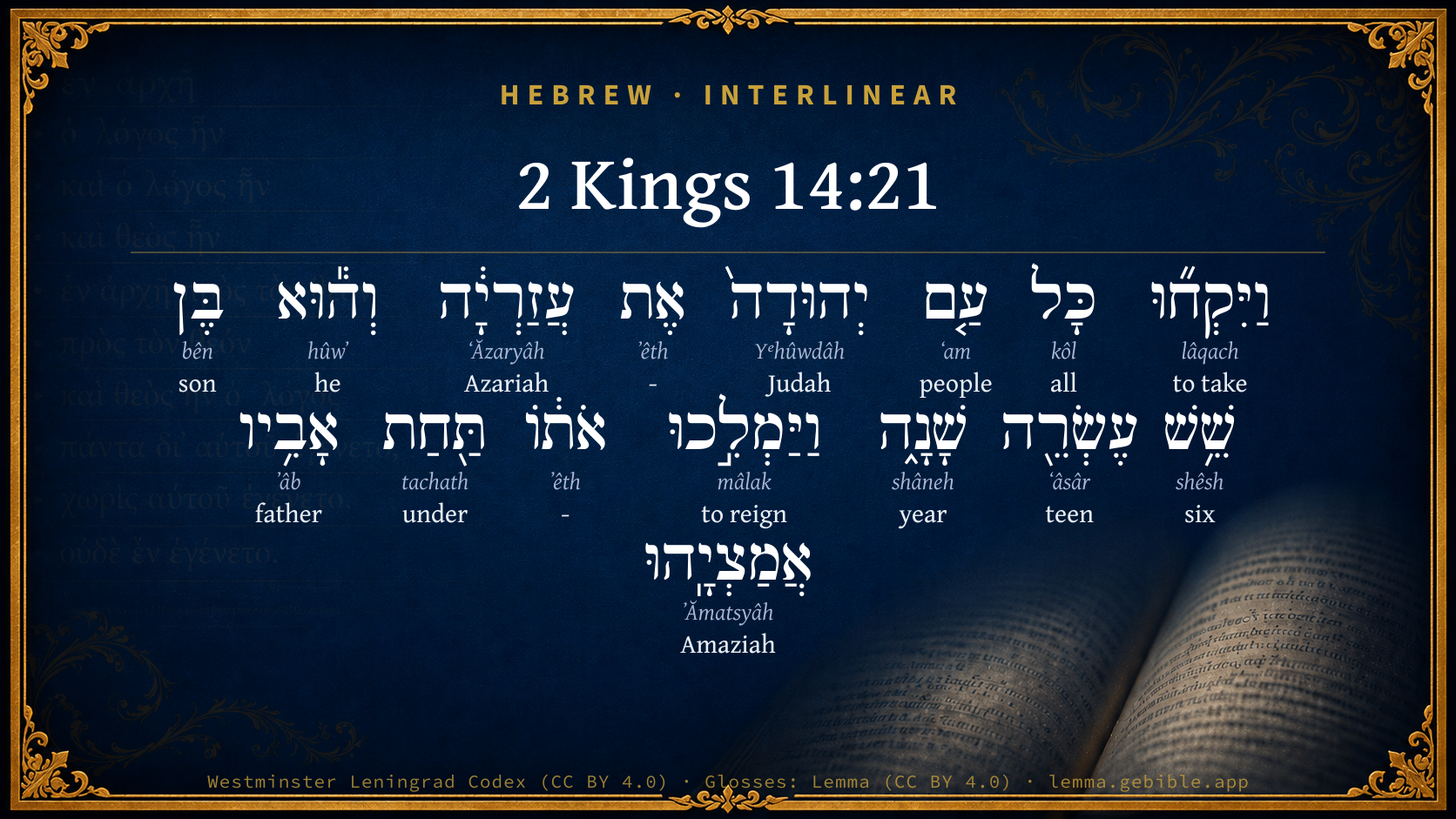
Hebrew (Westminster Leningrad Codex) 2 Kings 14:21 appears in the Hebrew Old Testament. The text above is from the Westminster Leningrad Codex. Each word links to its Strong’s number, a concise gloss, and parsing drawn from the Open Scriptures Hebrew Bible morphology. Click any word for its full Brown-Driver-Briggs (BDB) entry.
Download image
Cite this verse

2 Kings 14:21 (World English Bible). Public Domain. Lemma interlinear Bible study tool, https://lemma.gebible.app/v/2-kings/14/21.

Show BibTeX & RIS
BibTeX
RIS
English Translation
All the people of Judah took Azariah, who was sixteen years old, and made him king in the room of his father Amaziah.
World English Bible · Public Domain
Download a study sheet

One document with this verse’s original text, its word-by-word gloss line, the meaning frame, cross-references with their text, attributed commentary, and full source and license credits — printable, and it pastes into notes with its structure intact.

This verse Autodidact and up

Study sheet (.html) Plain text (.txt)

A passage Seminary Student

Up to 50 verses in one chapter. A passage sheet keeps up to 6 commentary sources and 12 cross-references per verse, in the order this page ranks them, and says so on the sheet whenever that leaves anything out. Ask for a single verse and you get the Autodidact verse sheet above.

Everything on this page stays free to read, with no account — the sheet is a download of what is already on screen, not access to it.

Want to remove ads? Support Godless Engineer
Compare translations 3

The same verse in 3 English versions, stacked beneath the original-language interlinear above. Click any original word for its lexicon entry.

Each is an independent rendering of the whole verse — the interlinear is not word-aligned to these translations.

Highlighted words mark where these versions differ — a whole-verse word diff, not a word-by-word alignment.

  • World English Bible Public Domain
    All the people of Judah took Azariah, who was sixteen years old, and made him king in the room of his father Amaziah.
  • King James Version Public Domain
    And all the people of Judah took Azariah, which was sixteen years old, and made him king instead of his father Amaziah.
  • unfoldingWord Literal Text CC BY-SA 4.0
    And all of the people of Judah took Azariah (now he a son of 16 years), and they made him king in place of his father Amaziah.

unfoldingWord Literal Text — © unfoldingWord, licensed CC BY-SA 4.0. Word-aligned USFM3 via Door43 (git.door43.org/unfoldingWord/en_ult).

Versions to compare (up to 4)

3 of 4 selected

Show all 18 translations

Every available English version of this verse, each an independent rendering of the whole verse.

  • World English Bible Public Domain
    All the people of Judah took Azariah, who was sixteen years old, and made him king in the room of his father Amaziah.
  • Berean Standard Bible Public Domain
    Then all the people of Judah took Azariah, who was sixteen years old, and made him king in place of his father Amaziah.
  • Majority Standard Bible Public Domain
    Then all the people of Judah took Azariah, who was sixteen years old, and made him king in place of his father Amaziah.
  • King James Version Public Domain
    And all the people of Judah took Azariah, which was sixteen years old, and made him king instead of his father Amaziah.
  • American Standard Version (1901) Public Domain
    And all the people of Judah took Azariah, who was sixteen years old, and made him king in the room of his father Amaziah.
  • Revised Version (1885) Public Domain
    And all the people of Judah took Azariah, who was sixteen years old, and made him king in the room of his father Amaziah.
  • Geneva Bible (1599) Public Domain
    Then all the people of Iudah tooke Azariah which was sixteene yeere olde, and made him King for his father Amaziah.
  • Douay-Rheims (1899) Public Domain
    And all the people of Juda took Azarias, who was sixteen years old, and made him king instead of his father Amasias.
  • Young's Literal Translation Public Domain
    And all the people of Judah take Azariah, and he `is' a son of sixteen years, and cause him to reign instead of his father Amaziah;
  • Literal Standard Version CC BY-SA 4.0
    And all the people of Judah take Azariah, and he [is] a son of sixteen years, and cause him to reign instead of his father Amaziah;
  • Unlocked Literal Bible CC BY-SA 4.0
    All the people of Judah took Azariah, who was sixteen years old, and made him king in place of his father Amaziah.
  • unfoldingWord Literal Text CC BY-SA 4.0
    And all of the people of Judah took Azariah (now he a son of 16 years), and they made him king in place of his father Amaziah.
  • Darby Bible Public Domain
    And all the people of Judah took Azariah, who was sixteen years old, and made him king instead of his father Amaziah.
  • World Messianic Bible Public Domain
    All the people of Judah took Azariah, who was sixteen years old, and made him king in the place of his father Amaziah.
  • Webster's Bible Public Domain
    And all the people of Judah took Azariah, who was sixteen years old, and made him king instead of his father Amaziah.
  • Free Bible Version CC BY-SA 4.0
    Then all the people of Judah made Amaziah's son Azariah king to replace his father. Azariah was sixteen years old.
  • Bible in Basic English Public Domain
    Then all the people of Judah took Azariah, who was sixteen years old, and made him king in place of his father Amaziah.
  • JPS Tanakh (1917) Public Domain
    And all the people of Judah took Azariah, who was sixteen years old, and made him king in the room of his father Amaziah.

Literal Standard Version (2020), Covenant Press — licensed CC BY-SA 4.0. Text via the HelloAO Bible API (eBible.org). Unlocked Literal Bible (unfoldingWord) — licensed CC BY-SA 4.0. Text via the HelloAO Bible API (eBible.org). unfoldingWord Literal Text — © unfoldingWord, licensed CC BY-SA 4.0. Word-aligned USFM3 via Door43 (git.door43.org/unfoldingWord/en_ult). Free Bible Version, Dr. Jonathan Gallagher — licensed CC BY-SA 4.0. Text via the HelloAO Bible API (eBible.org).

Word by word

More ways to search: Search by grammar → Find every occurrence → Compare this word →

Practice this passage: Drill this verse → Learn its vocabulary →

אֲמַצְיָֽהוּ
ʼĂmatsyâh
H558
“Amaziah”
Noun, Proper
Part of Speech
Noun
Type
Proper
Full BDB Definition

Origin: from H553 and H3050

TWOT: None

Amaziah = "Jehovah is mighty" - a king of Judah, son Joash, father of Azariah - a priest of Bethel under Jeroboam II - father of Joshah, of the tribe of Simeon - a Levite tabernacle singer in David's day
  1. וַיִּקְח֞וּ lâqach H3947 “and · to take” Conjunction + Verb, Qal, Sequential Imperfect, 3rd Person, Masculine, Plural
  2. כָּל kôl H3605 “all of” Noun, Common, Masculine, Singular, Construct
  3. עַ֤ם ʻam H5971 “people of” Noun, Common, Masculine, Singular, Construct
  4. יְהוּדָה֙ Yᵉhûwdâh H3063 “Judah” Noun, Proper
  5. אֶת ʼêth H853 “-” Particle, Direct Object
  6. עֲזַרְיָ֔ה ʻĂzaryâh H5838 “Azariah” Noun, Proper
  7. וְה֕וּא hûwʼ H1931 “and · he” Conjunction + Pronoun, Personal, 3rd Person, Masculine, Singular
  8. בֶּן bên H1121 “son of” Noun, Common, Masculine, Singular, Construct
  9. שֵׁ֥שׁ shêsh H8337 “six” Adjective, Cardinal number, Feminine, Singular, Absolute
  10. עֶשְׂרֵ֖ה ʻâsâr H6240 “teen” Adjective, Cardinal number, Feminine, Singular, Absolute
  11. שָׁנָ֑ה shâneh H8141 “year” Noun, Common, Feminine, Singular, Absolute
  12. וַיַּמְלִ֣כוּ mâlak H4427 “and · to reign” Conjunction + Verb, Hiphil, Sequential Imperfect, 3rd Person, Masculine, Plural
  13. אֹת֔וֹ ʼêth H853 “- · him” Particle, Direct Object + Suffix, Personal, 3rd Person, Masculine, Singular
  14. תַּ֖חַת tachath H8478 “under” Preposition
  15. אָבִ֥יו ʼâb H1 “father · his” Noun, Common, Masculine, Singular, Construct + Suffix, Personal, 3rd Person, Masculine, Singular

About this verse

These counts appear in no published source. They are computed here, from the morphology-tagged text and Lemma’s own curated glosses. What Lemma adds →

16
words
15
distinct lemmas
Historical
section

Shared distinctive vocabulary

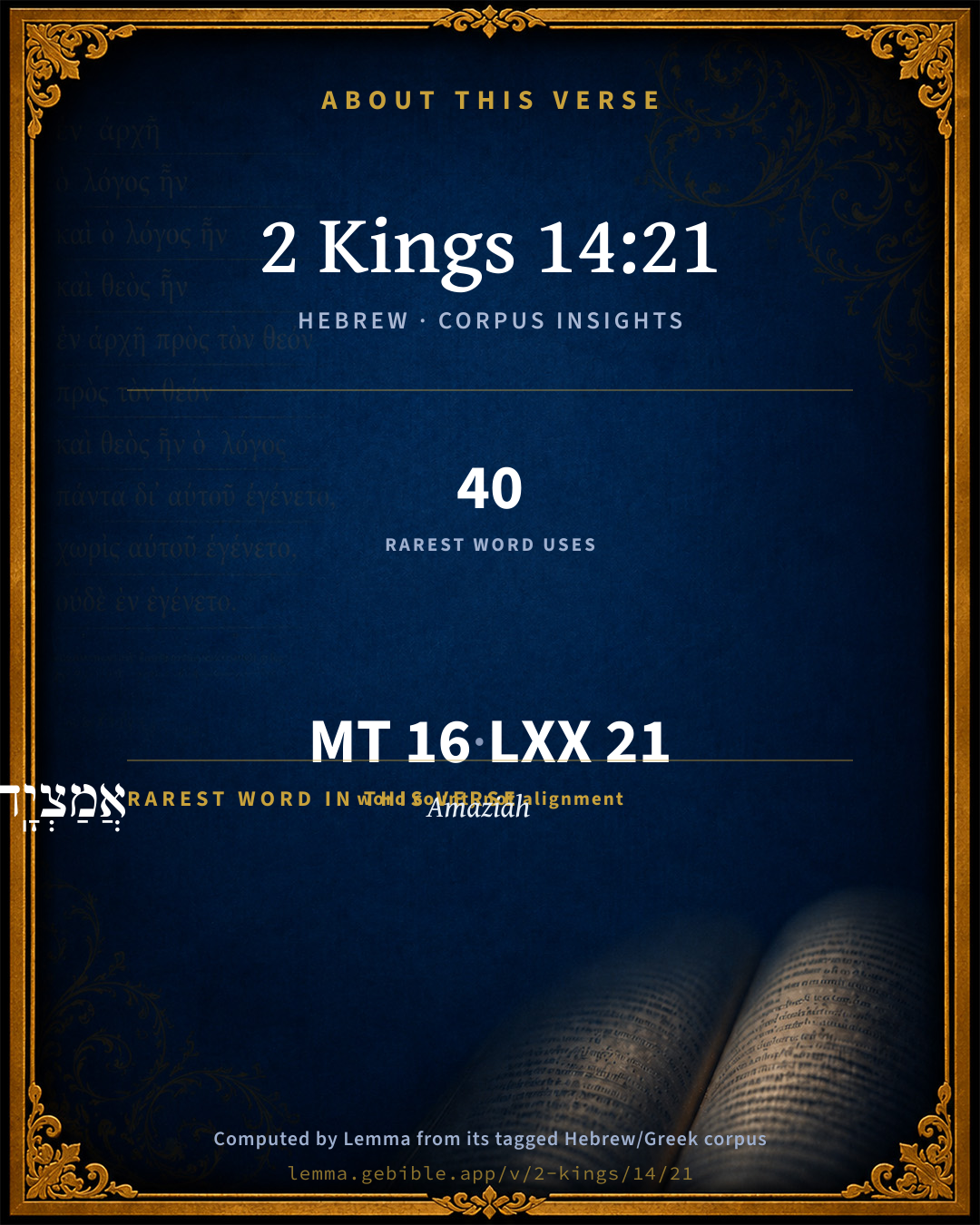
אֲמַצְיָֽהוּ Amaziah H558 occurs in 39 verses of the Hebrew Bible. Also found in:

Grammatical profile

  • 2 verbs
  • 8 nouns
  • 2 adjectives
  • 1 pronoun
  • 1 preposition
  • 2 particles

Verb forms

  • וַיִּקְח֞וּ Qal · Sequential Imperfect
  • וַיַּמְלִ֣כוּ Hiphil · Sequential Imperfect

Hebrew & Septuagint length

In English translation the verse runs 23 words from the Hebrew and 25 from the Septuagint (LXX English) — closely comparable.

A rough comparison of the two English renderings, which tokenize alike — not a word-level alignment.

Word counts can differ between the Hebrew and the Greek without any difference in meaning — e.g. the Hebrew direct-object marker אֵת has no separate Greek word, and Greek often adds the article ὁ.

In the original languages it is 16 Hebrew tokens and 21 Greek tokens — but the two are counted differently (Hebrew bundles its prefixes and suffixes into one token; the Greek is in lemma form), so that isn’t a like-for-like length.

Cross-references

5

Topical passages linked to 2 Kings 14:21 in the Treasury of Scripture Knowledge — connected by theme and wording, ordered by reader-vote popularity; previews shown in the World English Bible.

  • 2 Kings 15:13 Shallum the son of Jabesh began to reign in the nine and thirtieth year of Uzziah king of Judah; and he reigned the space of a month in Samaria.
  • 2 Kings 21:24 But the people of the land killed all those who had conspired against king Amon; and the people of the land made Josiah his son king in his place.
  • 1 Chronicles 3:12 Amaziah his son, Azariah his son, Jotham his son,
  • Matthew 1:8–9 Asa became the father of Jehoshaphat. Jehoshaphat became the father of Joram. Joram became the father of Uzziah.
  • 2 Chronicles 26:1 All the people of Judah took Uzziah, who was sixteen years old, and made him king in the room of his father Amaziah.

Cross-references courtesy of OpenBible.info (CC BY 4.0).

Hebrew and Greek witnesses Masoretic Hebrew ↔ Greek Septuagint

The same verse in the two great witnesses to the Old Testament, shown verse-for-verse.

These are two independent witnesses, not word-aligned to each other, and the Septuagint is shown in lemma (dictionary) form.

Hebrew 2 Kings 14:21 Masoretic · Westminster Leningrad Codex

וַיִּקְח֞וּ כָּל עַ֤ם יְהוּדָה֙ אֶת עֲזַרְיָ֔ה וְה֕וּא בֶּן שֵׁ֥שׁ עֶשְׂרֵ֖ה שָׁנָ֑ה וַיַּמְלִ֣כוּ אֹת֔וֹ תַּ֖חַת אָבִ֥יו אֲמַצְיָֽהוּ

All the people of Judah took Azariah, who was sixteen years old, and made him king in the room of his father Amaziah.

World English Bible · Public Domain

Greek LXX 2 Kings 14:21 Septuagint · lemma form

καί λαμβάνω πᾶς ὁ λαός ιουδα ὁ αζαριας καί αὐτός υἱός ἑκκαίδεκα ἔτος καί βασιλεύω αὐτός ἀντί ὁ πατήρ αὐτός αμεσσιας

And all the people of Juda took Azarias, and he was sixteen years old, and made him king in the room of his father Amessias.

LXX2012 (modern English Septuagint) · Public Domain

Hebrew: Westminster Leningrad Codex (CC BY 4.0). Greek: Septuagint (public domain); English from LXX2012 (modern English Septuagint) (Public Domain). How the Septuagint differs from the Hebrew →

Targum (Aramaic paraphrase)

1

The Targum is the ancient Jewish Aramaic paraphrase of the Hebrew Scriptures — an interpretive translation, not the Hebrew text itself. Onkelos (literal) and Pseudo-Jonathan (expansive) render the Torah, and Jonathan the Prophets. Coverage is partial: where no permissively-licensed English translation exists for a verse, only the Aramaic is shown. This is verse-level text, not a word-by-word alignment to the Hebrew.

  1. Targum Jonathan Prophets (Joshua–Malachi)
    וְדַבָּרוּ כָּל עַמָא דִיהוּדָה יַת עֲזַרְיָה וְהוּא בַּר שִׁית עַסְרֵי שְׁנִין וְאַמְלִיכוּ יָתֵיהּ תְּחוֹת אֲבוּהִי אֲמַצְיָהוּ:

    (no public-domain English translation for this verse)

    Targum Jonathan — Aramaic: “Mikraot Gedolot” (public domain). English: “Sefaria Community Translation” (CC0 1.0 (public-domain dedication)); “London "Chaldee Paraphrase," 1871” (public domain). Text via Sefaria.

Commentary

Notes on 2 Kings 14:21 from classic Christian and Jewish commentators (each source and its license shown beneath its notes). The classic Christian expositions comment on the surrounding passage and are grouped to its opening verse, so a note may address several verses; the Jewish commentaries on the Tanakh (Rashi and others) are per-verse, so they appear only where the commentator wrote on this verse.

Lemma curates 59 commentaries, every one of them public domain or Creative Commons licensed, each selected and text-cleaned for this edition rather than reprinted as found. About our sources →

Jamieson, Fausset & Brown

Robert Jamieson, A. R. Fausset & David Brown

AZARIAH SUCCEEDS HIM. (Kg2 14:21-22)

all the people of Judah took Azariah--or Uzziah (Kg2 15:30; Ch2 26:1). The popular opposition had been personally directed against Amaziah as the author of their calamities, but it was not extended to his family or heir.

Jamieson, Fausset & Brown — Commentary Critical and Explanatory on the Whole Bible (1871) — public domain (CC PDM 1.0). Text via the HelloAO Bible API.

Trapp's Complete Commentary

John Trapp

2Ki 14:21 And all the people of Judah took Azariah, which [was] sixteen years old, and made him king instead of his father Amaziah.

Ver. 21. And all the people of Judah took Azariah.] Called also Uzziah. {2Ch 26:1} Itaque hic duo nomina habuit confinia, Consilium Domini et Auxilium Dei, saith Vatablus: His two names were suitable, God’s counsel, and God’s help.

John Trapp, A Commentary or Exposition upon All the Books of the Old and New Testament (1647–1656) — public domain. Text from a community e-Sword module.

Joseph Benson's Commentary

2Ki 14:21. The people of Judah took Azariah — Called Uzziah, chap. 2Ki 15:30, and 2Ch 26:1. The two names signify nearly the same thing, the former meaning the help of God, and the latter, the strength of God. And made him king — Either in opposition to the conspirators, or to show their affection to the house of David, and signify that their quarrel was only personal against Amaziah, whom they considered as the author of all their late calamities. But, it must be observed, the people did not do this till twelve years after Amaziah’s death. For Amaziah died in the fifteenth year of Jeroboam, (compare 2Ki 14:23 with 2Ki 14:1,) but Azariah did not begin his reign till the twenty-seventh of Jeroboam, (2Ki 15:1,) for he was but four years old at the death of his father: so that, for twelve years, till he came to be sixteen, the government was in the hands of protectors.

Joseph Benson's Commentary on the Old and New Testaments (1811–1818) — public domain. Text from a community e-Sword module.

Tyndale Open Study Notes

Tyndale Open Resources

14:21 The fifty-two year reign of Uzziah ended in 740 BC; he was sixteen years old when he became co-regent with his father in 792 BC. Apparently both Jehoash and Amaziah made their sons co-regents before going to war, in order to assure a smooth succession of government.

Tyndale Open Study Notes — © Tyndale Open Resources, licensed CC BY-SA 4.0. Text via the HelloAO Bible API.

Geneva Bible (1599)

Geneva Bible translators

Who is also called Uzziah, 2 Chron. 26:1.

Geneva Bible (1599) marginal notes — public domain. Text via Bolls.life.

Adam Clarke's Commentary

Verse 21. Took Azariah] He is also called Uzziah, 2Ch 26:1. The former signifies, The help of the Lord; the latter, The strength of the Lord.

Adam Clarke's Commentary on the Bible (1810–1826) — public domain. Text from a community e-Sword/MySword module.

Ellicott's Commentary for English Readers

(21) All the people of Judah.—Thenius explains, all the men of war, as in 2Ki_13:7.

Took.—The expression seems to imply that Azariah was not the eldest son. As Amaziah was fifty-nine years old at his death he probably had sons older than sixteen. Azariah was therefore chosen as a popular, or perhaps military, favourite.

Azariah.—See Note on 2Ch_26:1. Thenius thinks the soldiery gave Azariah the name of Uzziah. At all events, the king may have taken a new name on his accession, though which of the two it was we cannot; say. (Comp. 2Ki_24:17.) Sennacherib on investing Esarhaddon with sovereignty named him Asshurebil-mukin-pal.

A Bible Commentary for English Readers, edited by Charles John Ellicott (1878–1897) — public domain. Text from a community e-Sword module.

The Cambridge Bible for Schools and Colleges

gen. ed. J. J. S. Perowne

21. All the people of Judah took Azariah] The people were all of one mind. They had rid themselves of the idolatrous father, but there was hope in the sixteen year old son. In Chronicles the name of this king is spelt Uzziah. This variation also occurs in the next chapter of 2 Kings (2Ki_15:13; 2Ki_15:30; 2Ki_15:32; 2Ki_15:34). With this may be compared Azareel (1Ch_25:18), which is found in verse 4 of the same chapter to be the person who is also called Uzziel. There is not much difference in the signification of the two forms.

The Cambridge Bible for Schools and Colleges (gen. ed. J. J. S. Perowne; Cambridge University Press, 1878–1918) — public domain. Text from a community e-Sword module.

John Gill's Exposition

And he did that which was evil in the sight of the Lord,.... Was guilty of idolatry:

he departed not from all the sins of Jeroboam the son of Nebat, who made Israel to sin; the worship of the calves is especially meant; he was in all respects of the same cast with his ancestor of the same name, from whom he had it, in veneration of him.

John Gill's Exposition of the Whole Bible (1746–1763) — public domain (CC PDM 1.0). Text via the HelloAO Bible API.

Albert Barnes' Notes on the Bible

All the people of Judah - The words imply that the conspiracy was one in which the general mass of the people did not participate. There was no confusion and trouble as on the occasion of the murder of Joash. Azariah (“the strength of Yahweh”), and Uzziah (“whom Yahweh assists”), were mere variants of one name.

Albert Barnes' Notes on the Bible (1834–1885) — public domain. Text from a community e-Sword/MySword module.

Haydock's Catholic Bible Commentary

Azarias. Hebrew Hazarya. Sometimes printed more correctly Azieu, at others Azrien, (Haydock) by the blundering of transcribers, who have confounded the name of the king Ozihu (Azieu or Ozias) with that of the priest Ozrichu. (Azrien.) Carpzovius maintains that Azarias and Usias are two names of the same person. (Crit. p. 789.) But if he should find Carpzovius, Carpzorvius, and Carpzoviu, in the same book, would he not think them the same name erroneously printed? Kennicott, (Dis. i. p. 478.) who observes that the Syriac and Arabic versions have here, as in the sequel, Uzia, and St. Matthew (i. 8.) calls the king Ozias, conformably to 2 Paralipomenon xxvi. 1., &c. The manuscripts also vary. (Kennicott)

George Leo Haydock (1774–1849), Haydock's Catholic Family Bible and Commentary, 1859 edition — public domain. Excludes Psalms (Douay-Rheims chapter numbering differs from Protestant) and Deuterocanonical books (Catholic canon only).

Matthew Poole's English Annotations

Which they did, either in opposition to the conspirators, or to show their affection to the house of David, and that their quarrel was only personal against Amaziah, whom they looked upon as thee author of all their late calamities. This Azariah is called Uziah, 2Ki 15:30; 2Ch 26:1, both names signifying the same thing for substance; that God’s help, and this God’s strength.

Matthew Poole's English Annotations on the Holy Bible (1683–1685) — public domain. Text from a community e-Sword/MySword module.

Whedon's Commentary on the Bible

Daniel D. Whedon

21. Azariah — Called also Uzziah. See note on 2Ki_15:1.

Daniel D. Whedon (gen. ed.), Commentary on the Old and New Testaments (1874–1909) — public domain. Text from a community e-Sword module.

The Pulpit Commentary

Vers. 21, 22. SUCCESSION OF AZARIAH AND RESUMPTION OF THE WAR WITH EDOM. Though reserving his account of the reign of Azariah to the next chapter (vers. 1-7), the writer is led by the circumstances of Amaziah"s death to mention at once the fact of his son Azariah"s succession, and the first important act of his reign, the resumption of war with Edom. He then breaks off suddenly, in order to interpose an account of the reign of Jeroboam II, who was contemporary with Amaziah during fourteen years of his reign,

And all the people of Judah took Azariah. This is a new expression, and implies a new, perhaps a tumultuary, proceeding. The people, uncertain probably of the intentions of the conspirators, and fearful that they might set up a king not of the house of David, took the initiative, went to the royal palace, and finding there a son of Amaziah whether his eldest son or not, we cannot say proclaimed him king and placed him upon the throne. The author of Chronicles (2Ch_16:1) agrees. Josephus is silent. Which was sixteen years old. Young certainly, considering that his father was fifty-four (see ver. 2), but not necessarily "a younger son," since Amaziah"s earlier children may have been daughters, or he may have married late in life. It is not doubted that Manasseh was Hezekiah"s eldest son, yet he was only twelve when Hezekiah died at the same age as Amaziah, viz. fifty-four. And made him king instead of his father Amaziah. There are two forms of the king"s name, Azariah and Uzziah. The difference between them is not so great in the Hebrew, where they both begin with the same letter; but still it is considerable. One name is not a mere contraction of the other. Some suppose that the king changed one name for the other upon his accession; others, that he was called indifferently by either, since they were very similar in meaning. "Azariah" is "he whose help is Jehovah;" "Uzziah," "he whose strength is Jehovah." "Uzziah" is the predominant form, occurring four times in 2 Kings, twelve times in 2 Chronicles, three times in Isaiah, once in Hoses, once in Amos, and once in Zechariah; while "Azariah" occurs only in 2 Kings (eight times). (1Ch_3:12) (once) Josephus uses the form "Ozias" (equivalent to, Uzziah), and so does St. Matthew. (Mat_1:8, Mat_1:9)

The Pulpit Commentary (1880–1919), ed. H.D.M. Spence-Jones & Joseph S. Exell — public domain. Text from a community e-Sword module.

John Wesley's Explanatory Notes

Azariah - This Azariah is called Uzziah, chap. xv, 30, both names signifying the same thing for substance; that, God's help; and this, God's strength. But this was not done till twelve years after his father's death: so long the government was in the hands of protectors.

John Wesley, Explanatory Notes Upon the Whole Bible (1754–1765) — public domain. Text via the GEBible commentary corpus.

Scofield Reference Notes

C. I. Scofield

Azariah

Called Uzziah, 2Ch 26:1; Isa 1:1.

The Scofield Reference Bible (1917 edition), notes by C. I. Scofield — public domain. Text from a community e-Sword module.

Lesson kit

Teaching starters — assembled from the data on this page, not authored interpretation. Every prompt links to the verse data it draws on. Edit before teaching.

2 Kings, in the Historical, opens this verse with 16 words (15 distinct Hebrew lemmas). Its most distinctive word is ʼĂmatsyâh (“Amaziah”). A historical commentator’s framing appears above. Read the whole chapter for the surrounding context.

Discussion questions

  1. What does “Amaziah” (ʼĂmatsyâh) contribute to the verse as a whole?
  2. 2 Kings 12:21 shares the word «Amaziah» with this verse. How do the two illuminate each other?
  3. These translations render this verse differently; the difference is in the English rendering, not the original. What questions does that raise?
  4. The verb «וַיִּקְח֞וּ» is Qal Sequential Imperfect. How does its form color the action?
  5. Reading how Jamieson, Fausset & Brown and Trapp's Complete Commentary read this verse, where do the two commentators agree and where do they part?

Things to notice

Reading settings

Reading text

Shown beneath each verse's original-language words.

Old Testament
Old Testament edition

Read the OT as the Masoretic Hebrew (MT) or the Greek Septuagint (LXX).

English shown for the Greek Septuagint (in the Hebrew ↔ Greek comparison).

Comparing translations? Open the Compare panel on any verse page to stack up to four side by side.