
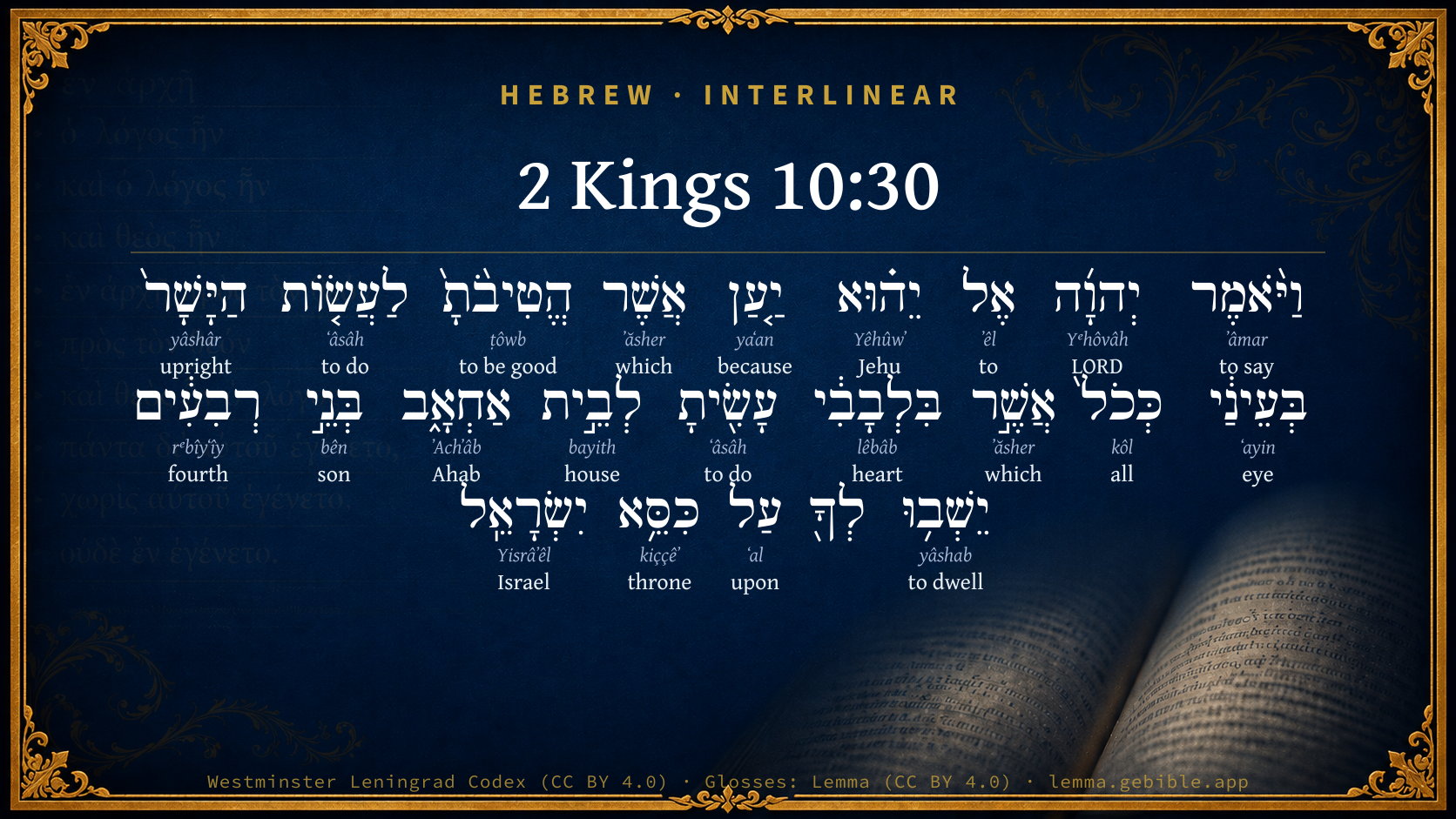
2 Kings 10:30

Hebrew (Westminster Leningrad Codex) 2 Kings 10:30 appears in the Hebrew Old Testament. The text above is from the Westminster Leningrad Codex. Each word links to its Strong’s number, a concise gloss, and parsing drawn from the Open Scriptures Hebrew Bible morphology. Click any word for its full Brown-Driver-Briggs (BDB) entry.
Download image
Cite this verse

2 Kings 10:30 (World English Bible). Public Domain. Lemma interlinear Bible study tool, https://lemma.gebible.app/v/2-kings/10/30.

Show BibTeX & RIS
BibTeX
RIS
English Translation
Yahweh said to Jehu, Because you have done well in executing that which is right in my eyes, [and] have done to the house of Ahab according to all that was in my heart, your sons of the fourth generation shall sit on the throne of Israel.
World English Bible · Public Domain
Download a study sheet

One document with this verse’s original text, its word-by-word gloss line, the meaning frame, cross-references with their text, attributed commentary, and full source and license credits — printable, and it pastes into notes with its structure intact.

This verse Autodidact and up

Study sheet (.html) Plain text (.txt)

A passage Seminary Student

Up to 50 verses in one chapter. A passage sheet keeps up to 6 commentary sources and 12 cross-references per verse, in the order this page ranks them, and says so on the sheet whenever that leaves anything out. Ask for a single verse and you get the Autodidact verse sheet above.

Everything on this page stays free to read, with no account — the sheet is a download of what is already on screen, not access to it.

Want to remove ads? Support Godless Engineer
Compare translations 3

The same verse in 3 English versions, stacked beneath the original-language interlinear above. Click any original word for its lexicon entry.

Each is an independent rendering of the whole verse — the interlinear is not word-aligned to these translations.

Highlighted words mark where these versions differ — a whole-verse word diff, not a word-by-word alignment.

  • World English Bible Public Domain
    Yahweh said to Jehu, Because you have done well in executing that which is right in my eyes, [and] have done to the house of Ahab according to all that was in my heart, your sons of the fourth generation shall sit on the throne of Israel.
  • King James Version Public Domain
    And the LORD said unto Jehu, Because thou hast done well in executing that which is right in mine eyes, and hast done unto the house of Ahab according to all that was in mine heart, thy children of the fourth generation shall sit on the throne of Israel.
  • unfoldingWord Literal Text CC BY-SA 4.0
    And Yahweh said to Jehu, “Because you did well by doing right in my eyes, according to all that in my heart you did to the house of Ahab, sons of the fourth will sit for you on the throne of Israel.”

unfoldingWord Literal Text — © unfoldingWord, licensed CC BY-SA 4.0. Word-aligned USFM3 via Door43 (git.door43.org/unfoldingWord/en_ult).

Versions to compare (up to 4)

3 of 4 selected

Show all 18 translations

Every available English version of this verse, each an independent rendering of the whole verse.

  • World English Bible Public Domain
    Yahweh said to Jehu, Because you have done well in executing that which is right in my eyes, [and] have done to the house of Ahab according to all that was in my heart, your sons of the fourth generation shall sit on the throne of Israel.
  • Berean Standard Bible Public Domain
    Nevertheless, the LORD said to Jehu, “Because you have done well in carrying out what is right in My sight and have done to the house of Ahab all that was in My heart, four generations of your sons will sit on the throne of Israel.”
  • Majority Standard Bible Public Domain
    Nevertheless, the LORD said to Jehu, “Because you have done well in carrying out what is right in My sight and have done to the house of Ahab all that was in My heart, four generations of your sons will sit on the throne of Israel.”
  • King James Version Public Domain
    And the LORD said unto Jehu, Because thou hast done well in executing that which is right in mine eyes, and hast done unto the house of Ahab according to all that was in mine heart, thy children of the fourth generation shall sit on the throne of Israel.
  • American Standard Version (1901) Public Domain
    And Jehovah said unto Jehu, Because thou hast done well in executing that which is right in mine eyes, `and' hast done unto the house of Ahab according to all that was in my heart, thy sons of the fourth generation shall sit on the throne of Israel.
  • Revised Version (1885) Public Domain
    And the LORD said unto Jehu, Because thou hast done well in executing that which is right in mine eyes, and hast done unto the house of Ahab according to all that was in mine heart, thy sons of the fourth generation shall sit on the throne of Israel.
  • Geneva Bible (1599) Public Domain
    And the Lord sayde vnto Iehu, Because thou hast diligently executed that which was right in mine eyes, and hast done vnto the house of Ahab according to all things that were in mine heart, therefore shall thy sonnes vnto the fourth generation sit on the throne of Israel.
  • Douay-Rheims (1899) Public Domain
    And the Lord said to Jehu: Because thou hast diligently executed that which was right and pleasing in my eyes, and hast done to the house of Achab according to all that was in my heart: thy children shall sit upon the throne of Israel to the fourth Generation.
  • Young's Literal Translation Public Domain
    And Jehovah saith unto Jehu, `Because that thou hast done well, to do that which `is' right in Mine eyes -- according to all that `is' in My heart thou hast done to the house of Ahab -- the sons of the fourth `generation' do sit for thee on the throne of Israel.'
  • Literal Standard Version CC BY-SA 4.0
    And YHWH says to Jehu, “Because that you have done well, to do that which [is] right in My eyes—according to all that [is] in My heart you have done to the house of Ahab—the sons of the fourth [generation] sit on the throne of Israel for you.”
  • Unlocked Literal Bible CC BY-SA 4.0
    So Yahweh said to Jehu, “Because you have done well in executing what was right in my eyes, and have done to the house of Ahab according to all that was in my heart, your descendants will sit on the throne of Israel to the fourth generation.”
  • unfoldingWord Literal Text CC BY-SA 4.0
    And Yahweh said to Jehu, “Because you did well by doing right in my eyes, according to all that in my heart you did to the house of Ahab, sons of the fourth will sit for you on the throne of Israel.”
  • Darby Bible Public Domain
    And Jehovah said to Jehu, Because thou hast executed well that which is right in my sight, [and] hast done unto the house of Ahab according to all that was in my heart, thy children of the fourth [generation] shall sit on the throne of Israel.
  • World Messianic Bible Public Domain
    The LORD said to Jehu, “Because you have done well in executing that which is right in my eyes, and have done to Ahab’s house according to all that was in my heart, your descendants shall sit on the throne of Israel to the fourth generation.”
  • Webster's Bible Public Domain
    And the LORD said to Jehu, Because thou hast done well in executing that which is right in my eyes, and hast done to the house of Ahab according to all that was in my heart, thy children of the fourth generation shall sit on the throne of Israel.
  • Free Bible Version CC BY-SA 4.0
    The Lord said to Jehu, “Since you have done well, and have carried out what is right in my sight, and have accomplished all that I planned for the house of Ahab, your descendants will sit on the throne of Israel to the fourth generation.”
  • Bible in Basic English Public Domain
    And the Lord said to Jehu, Because you have done well in doing what is right in my eyes and effecting all my purpose for the family of Ahab, your sons will be kings of Israel to the fourth generation.
  • JPS Tanakh (1917) Public Domain
    And the LORD said unto Jehu: 'Because thou hast done well in executing that which is right in Mine eyes, and hast done unto the house of Ahab according to all that was in My heart, thy sons of the fourth generation shall sit on the throne of Israel.'

Literal Standard Version (2020), Covenant Press — licensed CC BY-SA 4.0. Text via the HelloAO Bible API (eBible.org). Unlocked Literal Bible (unfoldingWord) — licensed CC BY-SA 4.0. Text via the HelloAO Bible API (eBible.org). unfoldingWord Literal Text — © unfoldingWord, licensed CC BY-SA 4.0. Word-aligned USFM3 via Door43 (git.door43.org/unfoldingWord/en_ult). Free Bible Version, Dr. Jonathan Gallagher — licensed CC BY-SA 4.0. Text via the HelloAO Bible API (eBible.org).

Word by word

More ways to search: Search by grammar → Find every occurrence → Compare this word →

Practice this passage: Drill this verse → Learn its vocabulary →

הֱטִיבֹ֨תָ֙
ṭôwb
H2895
“to be good”
Verb, Hiphil, Perfect, 2nd Person, Masculine, Singular
Part of Speech
Verb
Stem
Hiphil
Form
Perfect
Person
2nd Person
Gender
Masculine
Number
Singular
Full BDB Definition

Origin: a primitive root

TWOT: 793

to be good, be pleasing, be joyful, be beneficial, be pleasant, be favourable, be happy, be right - (Qal) - to be pleasant, be delightful - to be glad, be joyful - to be better - to be well with, be good for - to be pleasing - (Hiphil) to do well, do good, act right, act rightly
  1. וַיֹּ֨אמֶר ʼâmar H559 “and · to say” Conjunction + Verb, Qal, Sequential Imperfect, 3rd Person, Masculine, Singular
  2. יְהוָ֜ה Yᵉhôvâh H3068 “LORD” Noun, Proper
  3. אֶל ʼêl H413 “to” Preposition
  4. יֵה֗וּא Yêhûwʼ H3058 “Jehu” Noun, Proper
  5. יַ֤עַן yaʻan H3282 “because” Conjunction
  6. אֲשֶׁר ʼăsher H834 “which” Particle, Relative
  7. לַעֲשׂ֤וֹת ʻâsâh H6213 “to do” Preposition + Verb, Qal, Infinitive Construct
  8. הַיָּשָׁר֙ yâshâr H3477 “the · upright” Particle, Definite Article + Adjective, Adjective, Masculine, Singular, Absolute
  9. בְּעֵינַ֔י ʻayin H5869 “in/at · eyes · my” Preposition + Noun, Common, Both, Dual, Construct + Suffix, Personal, 1st Person, Common, Singular
  10. כְּכֹל֙ kôl H3605 “like/as · all” Preposition + Noun, Common, Masculine, Singular, Absolute
  11. אֲשֶׁ֣ר ʼăsher H834 “which” Particle, Relative
  12. בִּלְבָבִ֔י lêbâb H3824 “in/at · heart · my” Preposition + Noun, Common, Masculine, Singular, Construct + Suffix, Personal, 1st Person, Common, Singular
  13. עָשִׂ֖יתָ ʻâsâh H6213 “to do” Verb, Qal, Perfect, 2nd Person, Masculine, Singular
  14. לְבֵ֣ית bayith H1004 “to/for · house of” Preposition + Noun, Common, Masculine, Singular, Construct
  15. אַחְאָ֑ב ʼAchʼâb H256 “Ahab” Noun, Proper
  16. בְּנֵ֣י bên H1121 “sons of” Noun, Common, Masculine, Plural, Construct
  17. רְבִעִ֔ים rᵉbîyʻîy H7243 “fourth” Adjective, Ordinal number, Masculine, Plural, Absolute
  18. יֵשְׁב֥וּ yâshab H3427 “to dwell” Verb, Qal, Imperfect, 3rd Person, Masculine, Plural
  19. עַל ʻal H5921 “upon” Preposition
  20. כִּסֵּ֥א kiççêʼ H3678 “throne of” Noun, Common, Masculine, Singular, Construct
  21. יִשְׂרָאֵֽל Yisrâʼêl H3478 “Israel” Noun, Proper

About this verse

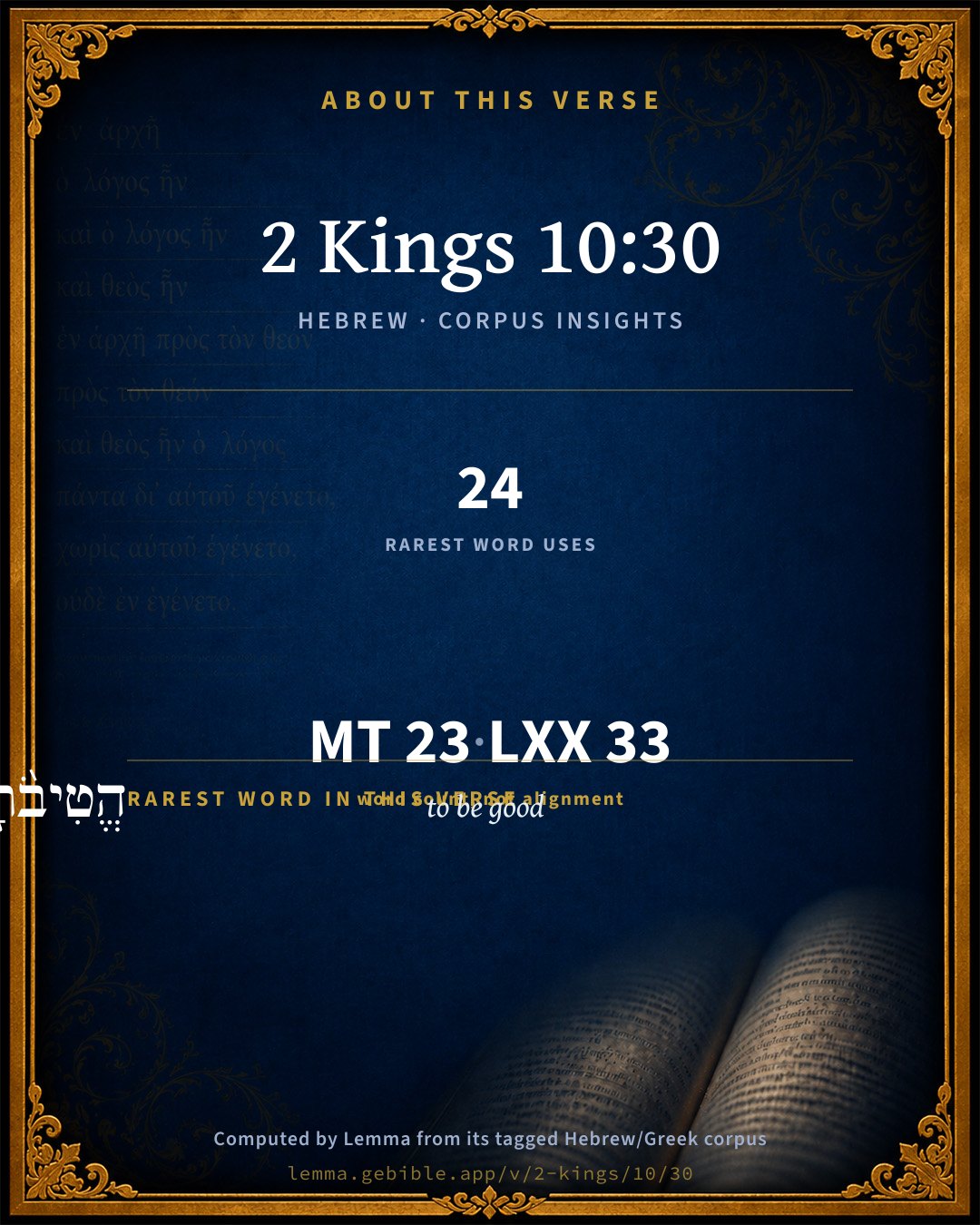
These counts appear in no published source. They are computed here, from the morphology-tagged text and Lemma’s own curated glosses. What Lemma adds →

23
words
20
distinct lemmas
Historical
section

Notable vocabulary

The rarest word here is הֱטִיבֹ֨תָ֙ to be good H2895 — appearing just 24 times in the whole Hebrew Bible.

Shared distinctive vocabulary

הֱטִיבֹ֨תָ֙ to be good H2895 occurs in 24 verses of the Hebrew Bible. Also found in:

Grammatical profile

  • 5 verbs
  • 10 nouns
  • 2 adjectives
  • 3 prepositions
  • 1 conjunction
  • 2 particles

Verb forms

  • וַיֹּ֨אמֶר Qal · Sequential Imperfect
  • הֱטִיבֹ֨תָ֙ Hiphil · Perfect
  • לַעֲשׂ֤וֹת Qal · Infinitive Construct
  • עָשִׂ֖יתָ Qal · Perfect
  • יֵשְׁב֥וּ Qal · Imperfect

Repetition

Words recur within this verse — often emphatic in Hebrew:

  • לַעֲשׂ֤וֹת to do H6213 ×2
  • אֲשֶׁר which H834 ×2

Hebrew & Septuagint length

In English translation the verse runs 47 words from the Hebrew and 57 from the Septuagint (LXX English) — closely comparable.

A rough comparison of the two English renderings, which tokenize alike — not a word-level alignment.

Word counts can differ between the Hebrew and the Greek without any difference in meaning — e.g. the Hebrew direct-object marker אֵת has no separate Greek word, and Greek often adds the article ὁ.

In the original languages it is 23 Hebrew tokens and 33 Greek tokens — but the two are counted differently (Hebrew bundles its prefixes and suffixes into one token; the Greek is in lemma form), so that isn’t a like-for-like length.

Cross-references

11

Topical passages linked to 2 Kings 10:30 in the Treasury of Scripture Knowledge — connected by theme and wording, ordered by reader-vote popularity; previews shown in the World English Bible.

  • 2 Kings 10:35 Jehu slept with his fathers; and they buried him in Samaria. Jehoahaz his son reigned in his place.
  • 2 Kings 13:1 In the three and twentieth year of Joash the son of Ahaziah, king of Judah, Jehoahaz the son of Jehu began to reign over Israel in Samaria, [and reigned] seventeen years.
  • 2 Kings 13:10 In the thirty-seventh year of Joash king of Judah began Jehoash the son of Jehoahaz to reign over Israel in Samaria, [and reigned] sixteen years.
  • 2 Kings 14:23 In the fifteenth year of Amaziah the son of Joash king of Judah Jeroboam the son of Joash king of Israel began to reign in Samaria, [and reigned] forty-one years.
  • 1 Samuel 15:18–24 and Yahweh sent you on a journey, and said, 'Go, and utterly destroy the sinners the Amalekites, and fight against them until they are consumed.'
  • 1 Kings 20:42 He said to him, Thus says Yahweh, Because you have let go out of your hand the man whom I had devoted to destruction, therefore your life shall go for his life, and your people for his people.
  • 1 Kings 21:22 and I will make your house like the house of Jeroboam the son of Nebat, and like the house of Baasha the son of Ahijah for the provocation with which you have provoked me to anger, and have made Israel to sin.
  • 1 Kings 21:29 See you how Ahab humbles himself before me? because he humbles himself before me, I will not bring the evil in his days; but in his son's days will I bring the evil on his house.
  • 2 Kings 15:8–12 In the thirty-eighth year of Azariah king of Judah did Zechariah the son of Jeroboam reign over Israel in Samaria six months.
  • Ezekiel 29:18–20 Son of man, Nebuchadrezzar king of Babylon caused his army to serve a great service against Tyre: every head was made bald, and every shoulder was worn; yet had he no wages, nor his army, from Tyre, for the service that he had served against it.
  • Hosea 1:4 Yahweh said to him, "Call his name Jezreel; for yet a little while, and I will avenge the blood of Jezreel on the house of Jehu, and will cause the kingdom of the house of Israel to cease.

Cross-references courtesy of OpenBible.info (CC BY 4.0).

Hebrew and Greek witnesses Masoretic Hebrew ↔ Greek Septuagint

The same verse in the two great witnesses to the Old Testament, shown verse-for-verse.

These are two independent witnesses, not word-aligned to each other, and the Septuagint is shown in lemma (dictionary) form.

Hebrew 2 Kings 10:30 Masoretic · Westminster Leningrad Codex

וַיֹּ֨אמֶר יְהוָ֜ה אֶל יֵה֗וּא יַ֤עַן אֲשֶׁר הֱטִיבֹ֨תָ֙ לַעֲשׂ֤וֹת הַיָּשָׁר֙ בְּעֵינַ֔י כְּכֹל֙ אֲשֶׁ֣ר בִּלְבָבִ֔י עָשִׂ֖יתָ לְבֵ֣ית אַחְאָ֑ב בְּנֵ֣י רְבִעִ֔ים יֵשְׁב֥וּ לְךָ֖ עַל כִּסֵּ֥א יִשְׂרָאֵֽל

Yahweh said to Jehu, Because you have done well in executing that which is right in my eyes, [and] have done to the house of Ahab according to all that was in my heart, your sons of the fourth generation shall sit on the throne of Israel.

World English Bible · Public Domain

Greek LXX 2 Kings 10:30 Septuagint · lemma form

καί εἶπον κύριος πρός ιου ἀντί ὅς ὅσος ἀγαθύνω ποιέω ὁ εὐθής ἐν ὀφθαλμός ἐγώ καί πᾶς ὅσος ἐν ὁ καρδία ἐγώ ποιέω ὁ οἶκος αχααβ υἱός τέταρτος καταἵημι σύ ἐπί θρόνος ἰσραήλ

And the Lord said to Ju, Because of all your deeds wherein you have acted well in doing that which was right in my eyes, according to all things which you have done to the house of Achaab as they were in my heart, your sons to the fourth generation shall sit upon the throne of Israel.

LXX2012 (modern English Septuagint) · Public Domain

Hebrew: Westminster Leningrad Codex (CC BY 4.0). Greek: Septuagint (public domain); English from LXX2012 (modern English Septuagint) (Public Domain). How the Septuagint differs from the Hebrew →

Targum (Aramaic paraphrase)

1

The Targum is the ancient Jewish Aramaic paraphrase of the Hebrew Scriptures — an interpretive translation, not the Hebrew text itself. Onkelos (literal) and Pseudo-Jonathan (expansive) render the Torah, and Jonathan the Prophets. Coverage is partial: where no permissively-licensed English translation exists for a verse, only the Aramaic is shown. This is verse-level text, not a word-by-word alignment to the Hebrew.

  1. Targum Jonathan Prophets (Joshua–Malachi)
    וַאֲמַר יְיָ לְיֵהוּא חֲלַף דְאַתְקִינְתָּא לְמֶעְבַּד דְכָשַׁר קֳדָמַי כְּכֹל דְבִרְעוּתִי עַבַדְתָּא לְבֵית אַחְאָב בְּנִין רְבִיעִין יֵתְבוּן לָךְ עַל כּוּרְסֵי מַלְכוּתָא דְיִשְׂרָאֵל:

    (no public-domain English translation for this verse)

    Targum Jonathan — Aramaic: “Mikraot Gedolot” (public domain). English: “Sefaria Community Translation” (CC0 1.0 (public-domain dedication)); “London "Chaldee Paraphrase," 1871” (public domain). Text via Sefaria.

Commentary

Notes on 2 Kings 10:30 from classic Christian and Jewish commentators (each source and its license shown beneath its notes). The classic Christian expositions comment on the surrounding passage and are grouped to its opening verse, so a note may address several verses; the Jewish commentaries on the Tanakh (Rashi and others) are per-verse, so they appear only where the commentator wrote on this verse.

Lemma curates 59 commentaries, every one of them public domain or Creative Commons licensed, each selected and text-cleaned for this edition rather than reprinted as found. About our sources →

Trapp's Complete Commentary

John Trapp

2Ki 10:30 And the LORD said unto Jehu, Because thou hast done well in executing [that which is] right in mine eyes, [and] hast done unto the house of Ahab according to all that [was] in mine heart, thy children of the fourth [generation] shall sit on the throne of Israel.

Ver. 30. And the Lord said unto Jehu,] sc., By some prophet, but by whom, it skilleth not.

Because thou hast done well.] Well in its kind, for the matter not amiss; but for the motive, manner, and end, no whit well. To speak properly, Bonum non fit nisi ex integra causa, malum ex quolibet defectu.

The children of the fourth generation.] This was a favour not vouchsafed to any other king of Israel, since the division of the kingdom. God will not be indebted to any man; nor shall those that do or suffer aught for him, complain of a hard bargain.

John Trapp, A Commentary or Exposition upon All the Books of the Old and New Testament (1647–1656) — public domain. Text from a community e-Sword module.

Joseph Benson's Commentary

2Ki 10:30. The Lord said unto Jehu — By some prophet. Because thou hast done well, &c. — That is, in part. The extirpating of idolaters and idolatry was a thing so far right in God’s eyes, idolatry being an iniquity which he visits as surely and severely as any other, and which is a source of a variety of other abominations. Thy children of the fourth generation shall sit on the throne — Which they did, namely, Jehoahaz, Joash, Jeroboam, and Zachariah. This was more than took place in any of the other royal families of that kingdom. Of the house of Ahab, indeed, there were four kings, but the last two, namely, Ahaziah and Joram, were brothers, so that its reign reached only to the third generation, and that whole family continued but about forty-five years in all: whereas Jehu’s house continued in power for four generations after himself, and in all about a hundred and twenty years: for no services done for God shall go unrewarded.

Joseph Benson's Commentary on the Old and New Testaments (1811–1818) — public domain. Text from a community e-Sword module.

Tyndale Open Study Notes

Tyndale Open Resources

10:30 God fulfilled his promise of a royal line to the fourth generation; four generations of Jehu’s descendants reigned as kings of Israel (Jehoahaz, Jehoash, Jeroboam II, and Zechariah).

Tyndale Open Study Notes — © Tyndale Open Resources, licensed CC BY-SA 4.0. Text via the HelloAO Bible API.

Geneva Bible (1599)

Geneva Bible translators

Thus God approveth and rewardeth his zeal, in executing God’s judgment, albeit his wickedness was afterward punished.

Geneva Bible (1599) marginal notes — public domain. Text via Bolls.life.

Adam Clarke's Commentary

Verse 30. Thy children of the fourth generation] These four descendants of Jehu were Jehoahaz, Jehoash, Jeroboam the second, and Zechariah; see 2 Kings 14 and 15. This was all the compensation Jehu had in either world, as a recompense of his zeal for the Lord.

Adam Clarke's Commentary on the Bible (1810–1826) — public domain. Text from a community e-Sword/MySword module.

Ellicott's Commentary for English Readers

(30) And the Lord said.—Perhaps through Elisha.

And hast done.—So the Syriac and Arabic versions. The Hebrew wants the and.

Thy children of the fourth generation.—The fulfilment of this oracle is noticed in 2Ki_15:12. (Comp. the words of the commandment, “visiting the sins of the fathers upon the children unto the third and fourth generation;” Exo_20:5.)

A Bible Commentary for English Readers, edited by Charles John Ellicott (1878–1897) — public domain. Text from a community e-Sword module.

The Cambridge Bible for Schools and Colleges

gen. ed. J. J. S. Perowne

30. Because thou hast done well] i.e. To a certain extent. When David strives to do God’s will perfectly with a true heart, the promise is that ‘he shall not be without a lamp before God for ever’. The partial obedience of Jehu obtains the gift of a succession for four generations.

thy children [R.V. sons] of the fourth generation] For the fulfilment see chap. 2Ki_15:12. The son of Jehu was Jehoahaz who was succeeded by his son Joash, and he by Jeroboam II, with whose son Zechariah the fourth generation and the sovereignty of Jehu’s family terminated.

The Cambridge Bible for Schools and Colleges (gen. ed. J. J. S. Perowne; Cambridge University Press, 1878–1918) — public domain. Text from a community e-Sword module.

John Gill's Exposition

In those days the Lord began to cut Israel short,.... To bring their dominions into a narrower compass; this was done in the days of Jehu, though he was so active and courageous, wherefore the hand of God was the more seen in it:

and Hazael smote them in all the coasts of Israel; which bordered on his country, when he did what Elisha foretold he would, Kg2 8:12.

John Gill's Exposition of the Whole Bible (1746–1763) — public domain (CC PDM 1.0). Text via the HelloAO Bible API.

Albert Barnes' Notes on the Bible

And the Lord said unto Jehu - Probably by the mouth of Elisha. To a certain extent Jehu’s measures were acts of obedience, for which God might see fit to assign him a temporal reward.

Thy children ... - This was accomplished in the persons of Jehoahaz, Joash, Jeroboam, and Zachariah, the son, grandson, great-grandson, and great-great-grandson of Jehu (compare the marginal references). No other family sat upon the throne of Israel so long. The house of Omri, which furnished four kings, held the crown for three generations only and for less than 50 years - that of Jehu reigned for five generations and for more than 100 years.

Albert Barnes' Notes on the Bible (1834–1885) — public domain. Text from a community e-Sword/MySword module.

Haydock's Catholic Bible Commentary

Generation. So Joachaz, Joas, Jeroboam II, and Zacharias, succeeded to the throne. This small temporal reward he obtained for the little good which he had done; while, on the other hand, he was punished for his manifold transgressions. Osee (i. 4,) reproaches him even for the blood which he had spilt in Jezrahel; for, though Achab and Joram were guilty, was Jehu innocent? Can this murder of Ochozias be justified? (Calmet) --- "What advantage was it to him that he received some little transitory reward of a temporal kingdom, for his obedience in exterminating the house of Achab; which he indeed exhibited to gratify his own lust of dominion?" (St Augustine, contra mend. ii. c. 2.) This holy doctor observes, that moral good works are thus rewarded. (Worthington)

George Leo Haydock (1774–1849), Haydock's Catholic Family Bible and Commentary, 1859 edition — public domain. Excludes Psalms (Douay-Rheims chapter numbering differs from Protestant) and Deuterocanonical books (Catholic canon only).

Matthew Poole's English Annotations

The Lord said unto Jehu; by some prophet, as above, 2Ki 9:7.

Executing that which is right in mine eyes, i.e. in part, and so far as is here expressed, these actions were good and right, though his heart was not so.

Thy children of the fourth generation shall sit on the throne of Israel; and so they did; namely, Jehoahaz, below, 2Ki 10:35; Joash, 2Ki 13:10 Jeroboam, 2Ki 14:24; and Zachariah, 2Ki 5:8.

Matthew Poole's English Annotations on the Holy Bible (1683–1685) — public domain. Text from a community e-Sword/MySword module.

Whedon's Commentary on the Bible

Daniel D. Whedon

30. The Lord said unto Jehu — Probably by one of the prophets of the time.

Children of the fourth generation — Jehu’s son Jehoahaz reigned seventeen years; Jehoash, sixteen; Jeroboam, forty-one; and Zachariah, six months. Zachariah, of the fourth generation, was slain by Shallum, and thus was this word of the Lord fulfilled; (compare 2Ki_15:12;) and thus, too, according to the prophecy of Hosea, (Hos_1:4,) did the Lord “avenge the blood of Jezreel upon the house of Jehu.” For when the minister of Divine judgment himself turned to idolatry, the very blood of his guilty victims might well call for vengeance on him for doing the same things for which be had executed the Divine judgment on them. Rom_2:1.

Daniel D. Whedon (gen. ed.), Commentary on the Old and New Testaments (1874–1909) — public domain. Text from a community e-Sword module.

The Pulpit Commentary

And the Lord said unto John scarcely by direct revelation, rather by the mouth of a prophet, most probably of Elisha, as Thenius supposesBecause thou hast done well in executing that which is right in mine eyes. In making himself the executor of God"s will with respect to the house of Ahab, and utterly destroying it, as he had been commanded, (2Ki_9:7) Jehu had "done well;" he had also done well in putting down the worship of Baal, and slaying the idolaters, for the destruction of idolaters was distinctly commanded in the Law (Exo_22:20 Exo_32:27; Num_25:5) These acts of his are praised; but nothing is said of his motives in doing them. They were probably to a great extent selfish. And hath done unto the house of Ahab all that was in mine heart, (see 2Ki_9:26-37 2Ki_10:1-7, 2Ki_10:11, 2Ki_10:14) thy children of the fourth generation shall sit on the throne of Israel. External obedience was suitably rewarded by an external, earthly honor the honor of having his dynasty settled upon the throne during five generations, and for a period of above a hundred years. No other Israelite dynasty held the throne longer than three generations, or for so much as fifty years. The "children" or descendants of Jehu who sat upon the throne after him were Jehoahaz, his son, Jehoash or Joash, his grandson, Jeroboam II, his great-grandson, and Zachariah, son of Jeroboam II, his great-great-grandson

The Pulpit Commentary (1880–1919), ed. H.D.M. Spence-Jones & Joseph S. Exell — public domain. Text from a community e-Sword module.

John Wesley's Explanatory Notes

Done well - In part, and so far as is here expressed.

John Wesley, Explanatory Notes Upon the Whole Bible (1754–1765) — public domain. Text via the GEBible commentary corpus.

Keil & Delitzsch

C. F. Keil & F. Delitzsch

Jehu is promised the possession of the throne to the fourth generation of his sons for having exterminated the godless royal house of Ahab (vid., Kg2 15:12). The divine sentence, "because thou hast acted well to do right in mine eyes. (because thou) hast done as it was in my heart to the house of Ahab," refers to the deed as such, and not to the subjective motives by which Jehu had been actuated. For it is obvious that it had not sprung from pure zeal for the honour of the Lord, from the limitation added in Kg2 10:31 : "but Jehu did not take heed to walk in the law of Jehovah with all his heart, and did not depart from the sins of Jeroboam."

Keil & Delitzsch — Biblical Commentary on the Old Testament (1861–1891) — public domain (CC PDM 1.0). Text via the HelloAO Bible API. (Old Testament only.)

Rashi

Rabbi Shlomo Yitzchaki (Rashi)

Adonoy said to Yeihu. Through Yonah.

Four generations of your sons. Four generations [as reward] for your having destroyed the house of Achov, which reigned for four generations: Omri, Achov, Achazyoh, and Yehorom.

Rashi on the Tanakh — English translations: “The Judaica Press complete Tanach with Rashi, translated by A. J. Rosenberg” (CC BY 4.0); “Pentateuch with Rashi's commentary by M. Rosenbaum and A.M. Silbermann, 1929-1934” (public domain); “The Metsudah Tanach series, Lakewood, N.J” (CC BY 4.0); and “The Book of Joshua, Metsudah Publications, 1997” (CC BY 4.0). Text via Sefaria.

Lesson kit

Teaching starters — assembled from the data on this page, not authored interpretation. Every prompt links to the verse data it draws on. Edit before teaching.

2 Kings, in the Historical, opens this verse with 23 words (20 distinct Hebrew lemmas). Its most distinctive word is ṭôwb (“to be good”). A historical commentator’s framing appears above. Read the whole chapter for the surrounding context.

Discussion questions

  1. The word ṭôwb carries the sense “to be good.” How does it shape the verse?
  2. Numbers 11:18 shares the word «to be good» with this verse. How do the two illuminate each other?
  3. “to do” occurs 2× in this one verse. What is the effect of the repetition?
  4. These translations render this verse differently. What is at stake in choosing one wording over another?
  5. The verb «וַיֹּ֨אמֶר» is Qal Sequential Imperfect. How does its form color the action?
  6. Reading how Trapp's Complete Commentary and Joseph Benson's Commentary read this verse, where do the two commentators agree and where do they part?

Things to notice

Reading settings

Reading text

Shown beneath each verse's original-language words.

Old Testament
Old Testament edition

Read the OT as the Masoretic Hebrew (MT) or the Greek Septuagint (LXX).

English shown for the Greek Septuagint (in the Hebrew ↔ Greek comparison).

Comparing translations? Open the Compare panel on any verse page to stack up to four side by side.