
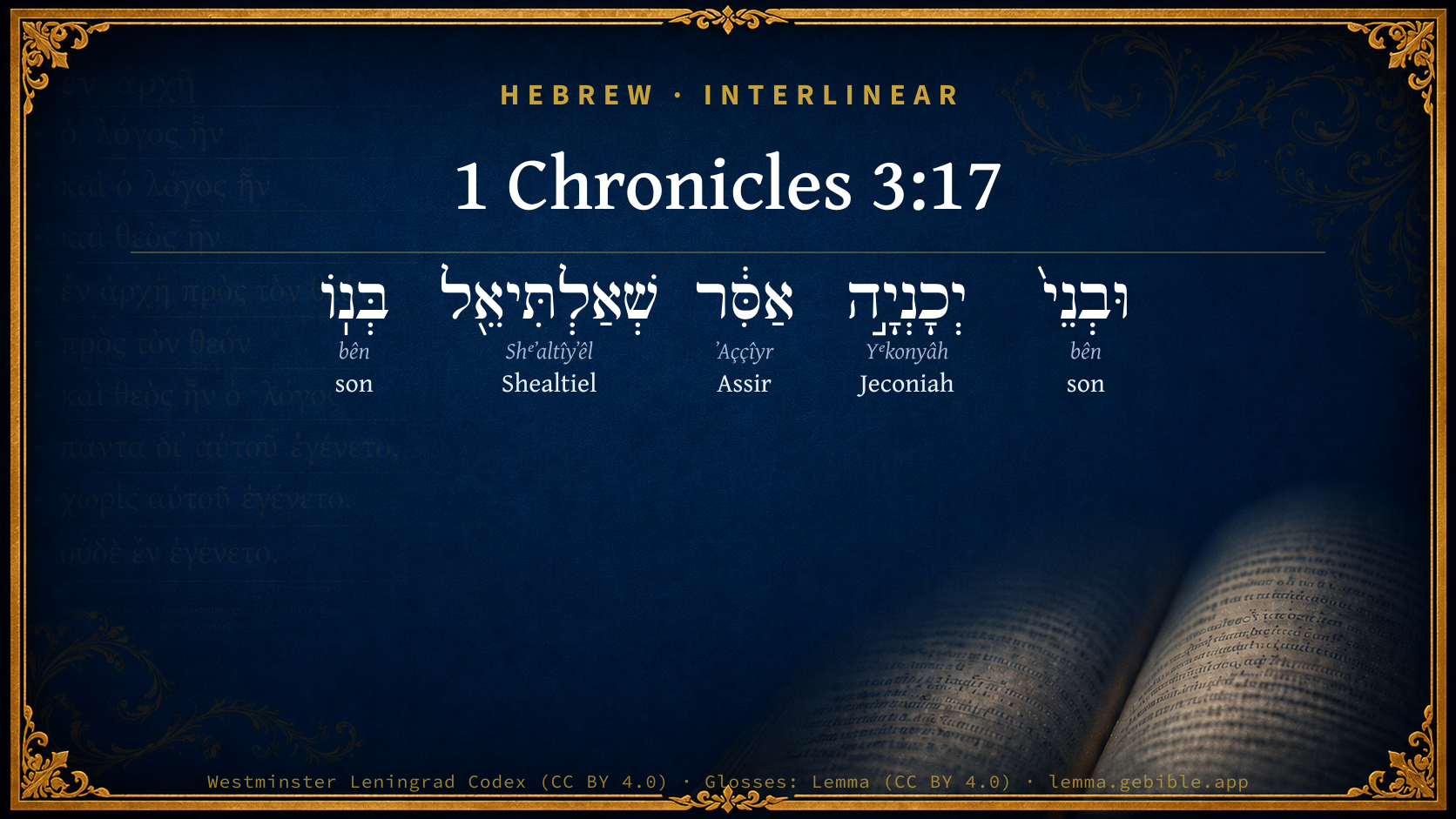
1 Chronicles 3:17

Hebrew (Westminster Leningrad Codex) 1 Chronicles 3:17 appears in the Hebrew Old Testament. The text above is from the Westminster Leningrad Codex. Each word links to its Strong’s number, a concise gloss, and parsing drawn from the Open Scriptures Hebrew Bible morphology. Click any word for its full Brown-Driver-Briggs (BDB) entry.
Download image
Cite this verse

1 Chronicles 3:17 (World English Bible). Public Domain. Lemma interlinear Bible study tool, https://lemma.gebible.app/v/1-chronicles/3/17.

Show BibTeX & RIS
BibTeX
RIS
English Translation
The sons of Jeconiah, the captive: Shealtiel his son,
World English Bible · Public Domain
Highlights
  • 1 first appearance in the Hebrew Bible
Full analysis ↓
Download a study sheet

One document with this verse’s original text, its word-by-word gloss line, the meaning frame, cross-references with their text, attributed commentary, and full source and license credits — printable, and it pastes into notes with its structure intact.

This verse Autodidact and up

Study sheet (.html) Plain text (.txt)

A passage Seminary Student

Up to 50 verses in one chapter. A passage sheet keeps up to 6 commentary sources and 12 cross-references per verse, in the order this page ranks them, and says so on the sheet whenever that leaves anything out. Ask for a single verse and you get the Autodidact verse sheet above.

Everything on this page stays free to read, with no account — the sheet is a download of what is already on screen, not access to it.

Want to remove ads? Support Godless Engineer
Compare translations 3

The same verse in 3 English versions, stacked beneath the original-language interlinear above. Click any original word for its lexicon entry.

Each is an independent rendering of the whole verse — the interlinear is not word-aligned to these translations.

Highlighted words mark where these versions differ — a whole-verse word diff, not a word-by-word alignment.

  • World English Bible Public Domain
    The sons of Jeconiah, the captive: Shealtiel his son,
  • King James Version Public Domain
    And the sons of Jeconiah; Assir, Salathiel his son,
  • unfoldingWord Literal Text CC BY-SA 4.0
    And the sons of Jeconiah, a prisoner: Shealtiel, his son,

unfoldingWord Literal Text — © unfoldingWord, licensed CC BY-SA 4.0. Word-aligned USFM3 via Door43 (git.door43.org/unfoldingWord/en_ult).

Versions to compare (up to 4)

3 of 4 selected

Show all 18 translations

Every available English version of this verse, each an independent rendering of the whole verse.

  • World English Bible Public Domain
    The sons of Jeconiah, the captive: Shealtiel his son,
  • Berean Standard Bible Public Domain
    The descendants of Jeconiah the captive: Shealtiel his son,
  • Majority Standard Bible Public Domain
    The descendants of Jeconiah the captive: Shealtiel his son,
  • King James Version Public Domain
    And the sons of Jeconiah; Assir, Salathiel his son,
  • American Standard Version (1901) Public Domain
    And the sons of Jeconiah, the captive: Shealtiel his son,
  • Revised Version (1885) Public Domain
    And the sons of Jeconiah, the captive; Shealtiel his son,
  • Geneva Bible (1599) Public Domain
    And the sonnes of Ieconiah, Assir and Shealtiel his sonne:
  • Douay-Rheims (1899) Public Domain
    The sons of Jechonias were Asir, Salathiel,
  • Young's Literal Translation Public Domain
    And sons of Jeconiah: Assir; Salathiel his son;
  • Literal Standard Version CC BY-SA 4.0
    And sons of Jeconiah: Assir; Salathiel his son;
  • Unlocked Literal Bible CC BY-SA 4.0
    The sons of Jehoiachin, the captive, were Shealtiel,
  • unfoldingWord Literal Text CC BY-SA 4.0
    And the sons of Jeconiah, a prisoner: Shealtiel, his son,
  • Darby Bible Public Domain
    And the sons of Jeconiah: Assir; Salathiel his son,
  • World Messianic Bible Public Domain
    The sons of Jeconiah, the captive: Shealtiel his son,
  • Webster's Bible Public Domain
    And the sons of Jeconiah; Assir, Salathiel his son.
  • Free Bible Version CC BY-SA 4.0
    The sons of Jehoiachin who were taken into captivity: Shealtiel,
  • Bible in Basic English Public Domain
    And the sons of Jeconiah, who was taken prisoner: Shealtiel his son,
  • JPS Tanakh (1917) Public Domain
    And the sons of Jeconiah — the same is Assir — Shealtiel his son;

Literal Standard Version (2020), Covenant Press — licensed CC BY-SA 4.0. Text via the HelloAO Bible API (eBible.org). Unlocked Literal Bible (unfoldingWord) — licensed CC BY-SA 4.0. Text via the HelloAO Bible API (eBible.org). unfoldingWord Literal Text — © unfoldingWord, licensed CC BY-SA 4.0. Word-aligned USFM3 via Door43 (git.door43.org/unfoldingWord/en_ult). Free Bible Version, Dr. Jonathan Gallagher — licensed CC BY-SA 4.0. Text via the HelloAO Bible API (eBible.org).

Word by word

More ways to search: Search by grammar → Find every occurrence → Compare this word →

Practice this passage: Drill this verse → Learn its vocabulary →

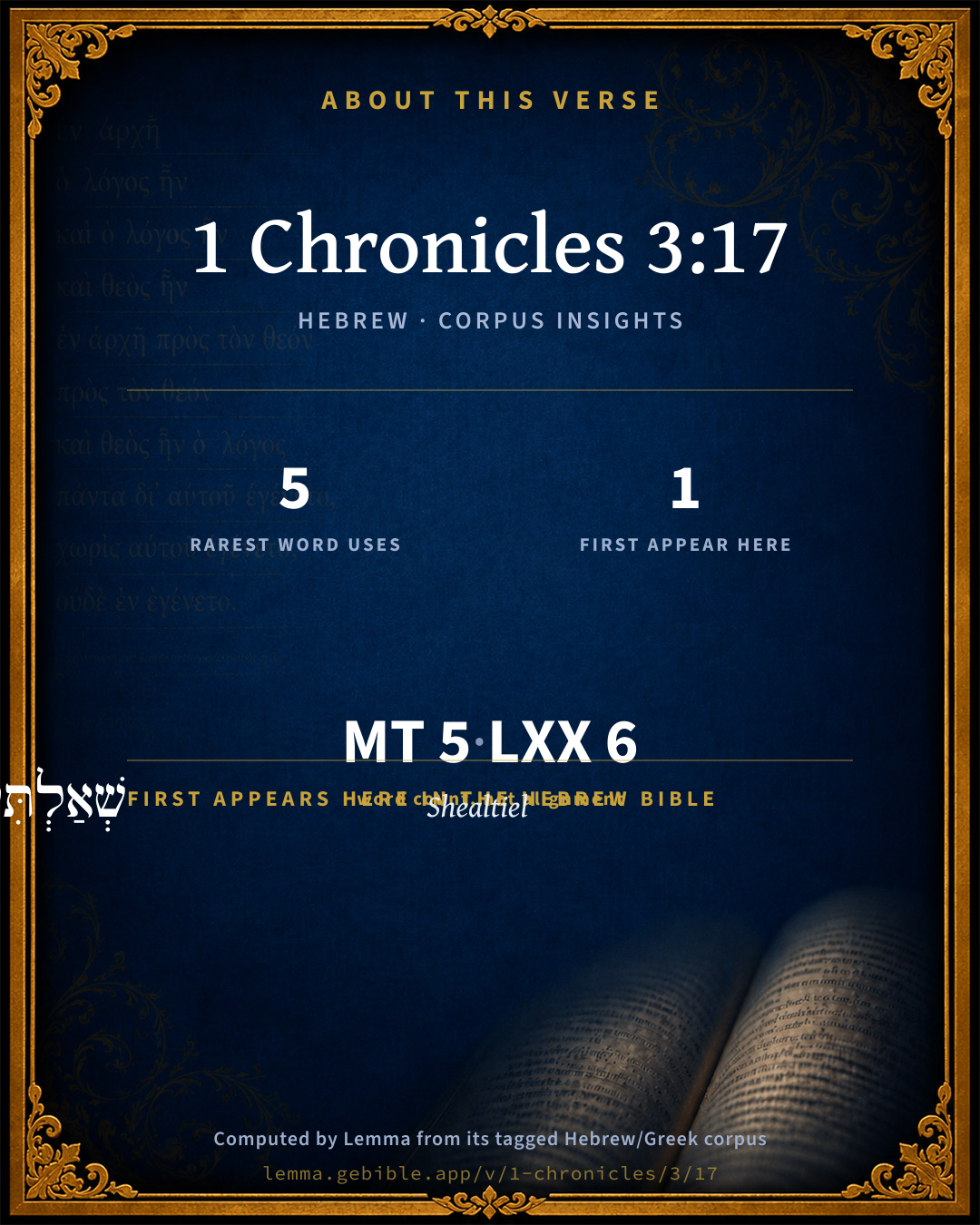
About this verse

These counts appear in no published source. They are computed here, from the morphology-tagged text and Lemma’s own curated glosses. What Lemma adds →

5
words
4
distinct lemmas
Historical
section

Notable vocabulary

The rarest word here is אַסִּ֔ר Assir H617 — appearing just 5 times in the whole Hebrew Bible.

First appearance in Scripture

This word makes its first canonical appearance in the Hebrew Bible here:

  • שְׁאַלְתִּיאֵ֖ל Shealtiel H7597

Shared distinctive vocabulary

אַסִּ֔ר Assir H617 occurs in 5 verses of the Hebrew Bible. Also found in:

Grammatical profile

  • 5 nouns

Repetition

A word recurs within this verse — often emphatic in Hebrew:

  • וּבְנֵי֙ son H1121 ×2

Hebrew & Septuagint length

In English translation the verse runs 9 words from the Hebrew and 9 from the Septuagint (LXX English) — the same length.

A rough comparison of the two English renderings, which tokenize alike — not a word-level alignment.

Word counts can differ between the Hebrew and the Greek without any difference in meaning — e.g. the Hebrew direct-object marker אֵת has no separate Greek word, and Greek often adds the article ὁ.

In the original languages it is 5 Hebrew tokens and 6 Greek tokens — but the two are counted differently (Hebrew bundles its prefixes and suffixes into one token; the Greek is in lemma form), so that isn’t a like-for-like length.

Cross-references

4

Topical passages linked to 1 Chronicles 3:17 in the Treasury of Scripture Knowledge — connected by theme and wording, ordered by reader-vote popularity; previews shown in the World English Bible.

  • Ezra 3:2 Then stood up Jeshua the son of Jozadak, and his brothers the priests, and Zerubbabel the son of Shealtiel, and his brothers, and built the altar of the God of Israel, to offer burnt offerings thereon, as it is written in the law of Moses the man of God.
  • Ezra 5:2 Then rose up Zerubbabel the son of Shealtiel, and Jeshua the son of Jozadak, and began to build the house of God which is at Jerusalem; and with them were the prophets of God, helping them.
  • Matthew 1:12 After the exile to Babylon, Jechoniah became the father of Shealtiel. Shealtiel became the father of Zerubbabel.
  • Ezra 3:8 Now in the second year of their coming to the house of God at Jerusalem, in the second month, began Zerubbabel the son of Shealtiel, and Jeshua the son of Jozadak, and the rest of their brothers the priests and the Levites, and all those who were come out of the captivity to Jerusalem, and appointed the Levites, from twenty years old and upward, to have the oversight of the work of the house of Yahweh.

Cross-references courtesy of OpenBible.info (CC BY 4.0).

Hebrew and Greek witnesses Masoretic Hebrew ↔ Greek Septuagint

The same verse in the two great witnesses to the Old Testament, shown verse-for-verse.

These are two independent witnesses, not word-aligned to each other, and the Septuagint is shown in lemma (dictionary) form.

Hebrew 1 Chronicles 3:17 Masoretic · Westminster Leningrad Codex

וּבְנֵי֙ יְכָנְיָ֣ה אַסִּ֔ר שְׁאַלְתִּיאֵ֖ל בְּנֽוֹ

The sons of Jeconiah, the captive: Shealtiel his son,

World English Bible · Public Domain

Greek LXX 1 Chronicles 3:17 Septuagint · lemma form

καί υἱός ιεχονια σαλαθιηλ υἱός αὐτός

And the sons of Jechonias; Asir, Salathiel his son,

LXX2012 (modern English Septuagint) · Public Domain

On this verse, Ellicott's Commentary for English Readers discusses the Septuagint’s reading. Read the note in Commentary ↓

Hebrew: Westminster Leningrad Codex (CC BY 4.0). Greek: Septuagint (public domain); English from LXX2012 (modern English Septuagint) (Public Domain). How the Septuagint differs from the Hebrew →

Commentary

Notes on 1 Chronicles 3:17 from classic Christian and Jewish commentators (each source and its license shown beneath its notes). The classic Christian expositions comment on the surrounding passage and are grouped to its opening verse, so a note may address several verses; the Jewish commentaries on the Tanakh (Rashi and others) are per-verse, so they appear only where the commentator wrote on this verse.

Lemma curates 59 commentaries, every one of them public domain or Creative Commons licensed, each selected and text-cleaned for this edition rather than reprinted as found. About our sources →

Jamieson, Fausset & Brown

Robert Jamieson, A. R. Fausset & David Brown

SUCCESSORS OF JECONIAH. (Ch1 3:17-24)

the sons of Jeconiah; Assir--rather, "Jeconiah the prisoner," or "captive." This record of his condition was added to show that Salathiel was born during the captivity in Babylon (compare Mat 1:12). Jeconiah was written childless (Jer 22:30), a prediction which (as the words that follow explain) meant that this unfortunate monarch should have no son succeeding him on the throne.

Jamieson, Fausset & Brown — Commentary Critical and Explanatory on the Whole Bible (1871) — public domain (CC PDM 1.0). Text via the HelloAO Bible API.

Ellicott's Commentary for English Readers

III.—The posterity of Jeconiah after the exile (1Ch_3:17-24). This section is peculiar to the chronicle.

(17) Assir.—This word means prisoner, captive; literally, bondman. It so occurs in Isa_10:2; Isa_24:22. Accordingly the verse may be rendered, “And the sons of Jeconiah when captive—Shealtiel (was) his son.” This translation (1) accords with the Masoretic punctuation, which connects the term assir with Jeconiah; and (2) accounts for the double reference to the offspring of Jeconiah, first in 1Ch_3:16, “Zedekiah his son,” and then again here. Zedekiah is thus separated from the sons born to Jeconiah in captivity. The strongest apparent objection against such a rendering is that the expression “the sons of Jeconiah the captive” would require the definite article to be prefixed to the word assir. No doubt it would; but then “the sons of Jeconiah the captive” is not what the chronicler intended to say. He has said what he meant—viz., “the sons of Jeconiah when in captivity” or “as a captive.” The Talmudic treatise, Sanhedrin, gives “Assir his son;” but another, the Sedw Olam, does not mention Assir, who is likewise wanting in the genealogy of our Lord (Mat_1:12; see the Notes there).

Salathiel.—The form in the LXX., Σαλαθιήλ; and Mat_1:12, Heb., Shealti-el (“request of God”): Hag_1:12, Shalti-el.

A Bible Commentary for English Readers, edited by Charles John Ellicott (1878–1897) — public domain. Text from a community e-Sword module.

Trapp's Complete Commentary

John Trapp

1Ch 3:17 And the sons of Jeconiah; Assir, Salathiel his son,

Ver. 17. And the sons of Jeconiah.] Natural sons Jeconiah had, {Jer 22:28} but because none of them succeeded him in the kingdom, therefore he is said to be written childless. {Jer 22:30}

Assir, Salathiel his son.] Salathiel might be called Assir, that is, one in bonds; because Jeconiah begat him in his bonds. See the like, Exo 2:22.

John Trapp, A Commentary or Exposition upon All the Books of the Old and New Testament (1647–1656) — public domain. Text from a community e-Sword module.

Joseph Benson's Commentary

1Ch 3:17. The sons of Jeconiah, Assir — The word אסר, Assir, means captive, or prisoner, and does not appear to be a person’s name here, but to be added to signify that Jeconiah begat his son Salathiel when he was a captive in Babylon, according to Mat 1:12.

Joseph Benson's Commentary on the Old and New Testaments (1811–1818) — public domain. Text from a community e-Sword module.

Tyndale Open Study Notes

Tyndale Open Resources

3:17-23 This portion of the list of David’s descendants extends to around 400 BC.

Tyndale Open Study Notes — © Tyndale Open Resources, licensed CC BY-SA 4.0. Text via the HelloAO Bible API.

Adam Clarke's Commentary

Verse 17. The sons of Jeconiah] Jeremiah has said (Jer 22:30) that Jeconiah, or, as he calls him, Coniah, should be childless; but this must refer to his posterity being deprived of the throne, and indeed thus the prophet interprets it himself: For no man of his seed shall prosper, sitting upon the throne of David, and ruling any more in Judah.

Assir] Salathiel was not the son of Assir, but of Jeconiah, Mt 1:12. Who then was Assir? Possibly nobody; for as the Hebrew אסר assir signifies a prisoner, it may be considered as an epithet of Jeconiah, who we know was a very long time prisoner in Babylon. See 2Kg 24:15 and Calmet.

Adam Clarke's Commentary on the Bible (1810–1826) — public domain. Text from a community e-Sword/MySword module.

The Cambridge Bible for Schools and Colleges

gen. ed. J. J. S. Perowne

17. the sons of Jeconiah; Assir, Salathiel] R.V. the sons of Jeconiah, the captive (mg., Assir); Shealtiel. Assir is a significant name of Jeconiah given him after his removal to Babylon. Salathiel (cp. Luk_3:27 A.V.) is the Greek form of Shealtiel.

It should be noted that the fact that Jeconiah had sons is not at variance with Jeremiah’s denunciation of him (Jer_22:30). That passage gives the answer to Jeconiah’s expectation of a speedy return to his kingdom (ib. Jer_22:27); Jeremiah says that neither he nor any of his seed shall recover the lost throne: “Reckon him childless, for no son of his shall succeed him on his throne.”

17–19 a. The Davidic Line from Jeconiah to Zerubbabel

A difficulty arises from the fact that whereas Zerubbabel is here represented apparently as the son of Pedaiah and consequently nephew of Salathiel (= Shealtiel), he is elsewhere called the son of Shealtiel (Ezr_3:2; Hag_1:1; Hag_2:2; cp. Luk_3:27-31). The LXX. solves the difficulty by reading Salathiel (= Shealtiel) in 1Ch_3:19. It may be however that the names given in 1Ch_3:18 (including Pedaiah) are the names of the sons of Shealtiel. Another possible solution is that Zerubbabel was grand-son both to Shealtiel and Pedaiah, according to such a scheme as the following:—

Pedaiah

Shealtiel||a daughter=a son

|

Zerubbabel.

A minor difficulty arises from the fact that Salathiel (= Shealtiel) is here connected with David through Solomon, whereas in Luk_3:27-31 his descent is traced through Solomon’s brother Nathan. However, intermarriage at some point in the genealogy between the two Davidic families would explain the difficulty.

The Cambridge Bible for Schools and Colleges (gen. ed. J. J. S. Perowne; Cambridge University Press, 1878–1918) — public domain. Text from a community e-Sword module.

John Gill's Exposition

And the sons of Pedaiah were, Zerubbabel and Shimei,.... Here arises a difficulty, since elsewhere Zerubbabel is said to be the son of Shealtiel, Hag 1:1 some think this is not the same Zerubbabel here as there; so Grotius (u); but I see no reason for that; but this difficulty may be removed by observing, that if Pedaiah was a son of Salathiel, as Kimchi thinks, then Zerubbabel, being his grandson, may be called his son, as grandsons are sometimes called sons in Scripture; or rather, Salathiel, having no children, adopted Zerubbabel, his brother's son, and made him successor in the government; so that he was the son of Pedaiah by birth, and of Salathiel by adoption; or else Salathiel dying without children, his brother Pedaiah, according to the law, married his widow, and by her had Zerubbabel, who was the proper son of Pedaiah, and the legal son of Salathiel:

and the sons of Zerubbabel; Meshullam: who is called Abiud, Mat 1:13 another son of his, with their father, is mentioned in this verse, and five more in the next. From hence to the end of the chapter, the genealogy is carried on from the captivity of Babylon, out of which Zerubbabel came, to the coming of Christ; and if Ezra was the writer of this book, as is generally thought, who was contemporary with Zerubbabel, this account must be written by another hand: and it may be observed, that it is carried on in the same number of generations as in Matthew; and here it stands thus:

Zerubbabel, Hananiah, Jesaiah, Rephaiah, Arnan, Obadiah, Shecaniah, Shemaiah, Neariah, Elioenai, Anani; in Matthew thus, "Zerubbabel, Abiud, Eliakim, Azor, Sadoc, Achim, Eliud, Eleazar, Matthan, Jacob, Joseph"; the difference in names may be accounted for by their having two names; and it is remarkable that the Targum makes Anani to be the King Messiah, who was to be revealed; which, though it makes one generation less to his time, yet plainly shows that the Jews expected the Messiah to come at the end of this genealogy, and about the time Jesus the true Messiah did. Anani is reckoned by other Jews a name of the Messiah, who is said to come in the clouds of heaven, which "Anani" signifies; see Gill on Dan 7:13.

(u) In Luc. 3.

Next: 1 Chronicles Chapter 4

John Gill's Exposition of the Whole Bible (1746–1763) — public domain (CC PDM 1.0). Text via the HelloAO Bible API.

Albert Barnes' Notes on the Bible

Assir - Perhaps born in the captivity, and therefore so named, who either (died young, or was made a eunuch (Isa 39:7; compare Jer 22:30). After Assir’s decease, or mutilation, the line of Solomon became extinct, and according to the principles of the Jewish law Num 27:8-11 the inheritance passed to the next of kin, who were Salathiel and his brethren, descendants from David by the line of Nathan. Luke in calling Salathiel “the son of Neri” Luk 3:27, gives his real, or natural, descent; since no genealogy would assign to the true son and heir of a king any inferior and private parentage. Hence, “Malchiram,” etc., i. e. not Salathiel only, but his brothers also were reckoned “sons” of Jeconiah.

Albert Barnes' Notes on the Bible (1834–1885) — public domain. Text from a community e-Sword/MySword module.

Haydock's Catholic Bible Commentary

Asir, means a "prisoner," so that we might translate, Hebrew ,"and the sons of Jechoias, the prisoner, (at Babylon, 4 Kings xxiv. 15.) were Salathiel." (Calmet) --- Protestants, "Assir, Salathiel his son." (Haydock) --- Some think that the following were the adopted children, or successors of Jechonias; as St. Luke (iii. 24.) insinuates that Neri was the father of Salathiel, and Jeremias (xxii. 30.) seems to declare that Jechonias should have no children. But he means such as should sit on the throne, as he explains himself, and St. Matthew (i. 12.) expressly says, Jechonias begot Salathiel.

George Leo Haydock (1774–1849), Haydock's Catholic Family Bible and Commentary, 1859 edition — public domain. Excludes Psalms (Douay-Rheims chapter numbering differs from Protestant) and Deuterocanonical books (Catholic canon only).

Matthew Poole's English Annotations

Of Jeconiah; Assir, or, of Jeconiah the captive, or prisoner; which is added to show that he begat his son when he was captive in Babylon, as it is noted, Mat 1:12, whither he was carried captive, 2Ki 24:15.

Object. It is said of this Jeconiah, Jer 22:30. Write this man childless.

Answ. So he is called, because he was an unhappy prince, and had no son that succeeded him in the throne, as the next words explain it. See more on that place.

Salathiel his son; either his legal or his natural son; of which See Poole "Jer 22:30"; See Poole "Mat 1:12"; See Poole "Luk 3:27".

Matthew Poole's English Annotations on the Holy Bible (1683–1685) — public domain. Text from a community e-Sword/MySword module.

The Pulpit Commentary

Vers. 17-24. These verses contain a line of descent brought down to a point not merely posterior to the Exile, but possibly reaching to the time of Alexander. This line, however, through Solomon is lost so soon as the first name, that of Assir, is passed; Salathiel (Authorized Version)or Shealtiel, being descended from David, not through Solomon, but through Nathan, whole brother to Solomon. This Assir is not known from any parallel passage; and Luther, Starke, Bertheau, and others, followed by Zoekler (in Lange, "Comm. O.T.") translate the name as captive, applying it to Jeconiah. Not all their reasons, however, for this, outweigh one which must be pronounced against it, viz. the absence of the article. The Septuagint and Vulgate versions agree with our own. The greater probability might be that Assir derived his name from being born after Jeconiah was in captivity, and such passages as Isa_39:7, Jer_22:30, may throw some light upon the extinction of Solomon"s line here, and the transfer of the succession, (comp. Num_27:11 and see interesting note on the present place in "Speaker"s Commentary Salathiel is the Authorized Version incorrect rendering of the Hebrew Shealtiel. In Mat_1:12 it is said, "And after they were brought to Babylon, Jechonias begat Salathiel;" and in Luk_3:27, "Salathiel, which was the son of Neri." Now, Neri was in the direct line of Nathan. There seems only one way of reconciling these statements and the method removes similar difficulties in other places also viz, to distinguish between the descent natural and the descent royal, and then acknowledge that the former was swallowed up, where necessary, of the latter. One as decisive instance of this kind as that before us is most useful to rule other cases. (For an important allusion to the house and family of Nathan"s descendants, as well known at the time, see, Zec_12:12 a passage probably dating a few years previous to the destruction of Jerusalem by Nebuchadnezzar.)

The Pulpit Commentary (1880–1919), ed. H.D.M. Spence-Jones & Joseph S. Exell — public domain. Text from a community e-Sword module.

John Wesley's Explanatory Notes

Assir - Or, of Jechoniah the captive, which is added to shew that he begat his son when he was captive in Babylon.

John Wesley, Explanatory Notes Upon the Whole Bible (1754–1765) — public domain. Text via the GEBible commentary corpus.

Keil & Delitzsch

C. F. Keil & F. Delitzsch

And the sons of Pedaiah were, Zerubbabel and Shimei,.... Here arises a difficulty, since elsewhere Zerubbabel is said to be the son of Shealtiel, Hag 1:1 some think this is not the same Zerubbabel here as there; so Grotius (u); but I see no reason for that; but this difficulty may be removed by observing, that if Pedaiah was a son of Salathiel, as Kimchi thinks, then Zerubbabel, being his grandson, may be called his son, as grandsons are sometimes called sons in Scripture; or rather, Salathiel, having no children, adopted Zerubbabel, his brother's son, and made him successor in the government; so that he was the son of Pedaiah by birth, and of Salathiel by adoption; or else Salathiel dying without children, his brother Pedaiah, according to the law, married his widow, and by her had Zerubbabel, who was the proper son of Pedaiah, and the legal son of Salathiel:

and the sons of Zerubbabel; Meshullam: who is called Abiud, Mat 1:13 another son of his, with their father, is mentioned in this verse, and five more in the next. From hence to the end of the chapter, the genealogy is carried on from the captivity of Babylon, out of which Zerubbabel came, to the coming of Christ; and if Ezra was the writer of this book, as is generally thought, who was contemporary with Zerubbabel, this account must be written by another hand: and it may be observed, that it is carried on in the same number of generations as in Matthew; and here it stands thus:

Zerubbabel, Hananiah, Jesaiah, Rephaiah, Arnan, Obadiah, Shecaniah, Shemaiah, Neariah, Elioenai, Anani; in Matthew thus, "Zerubbabel, Abiud, Eliakim, Azor, Sadoc, Achim, Eliud, Eleazar, Matthan, Jacob, Joseph"; the difference in names may be accounted for by their having two names; and it is remarkable that the Targum makes Anani to be the King Messiah, who was to be revealed; which, though it makes one generation less to his time, yet plainly shows that the Jews expected the Messiah to come at the end of this genealogy, and about the time Jesus the true Messiah did. Anani is reckoned by other Jews a name of the Messiah, who is said to come in the clouds of heaven, which "Anani" signifies; see Gill on Dan 7:13.

(u) In Luc. 3.

Next: 1 Chronicles Chapter 4

Keil & Delitzsch — Biblical Commentary on the Old Testament (1861–1891) — public domain (CC PDM 1.0). Text via the HelloAO Bible API. (Old Testament only.)

Kretzmann's Popular Commentary

Paul E. Kretzmann

From Jeconiah to Anani

v. 17. And the sons of Jeconiah, whom Evil-merodach elevated from his position of dishonor, 2Ki 25:27-30; Assir, the captive, the word modifying Jeconiah, Salathiel (or Sealthiel), his son,

v. 18. Malchiram also, and Pedaiah, and Shenazar, Jecamiah, Hoshama, and Nedabiah.

v. 19. And the sons of Pedaiah were Zerubbabel and Shimei; and the sons of Zerubbabel: Meshullam, and Hananiah, and Shelomith, their sister;

v. 20. and Hashubah, and Ohel, and Berechiah, and Hasadiah, Jushab-hesed, five.

v. 21. And the sons of Hananiah: Pelatiah and Jesaiah; the sons of Rephaiah, the sons of Arnan, the sons of Obadiah, the sons of Shechaniah;

v. 22. and the sons of Shechaniah: Shemaiah; and the sons of Shemaiah: Hatush, and Igeal, and Bariah, and Neariah, and Shaphat, six.

v. 23. And the sons of Neariah: Elioenai, and Hezekiah, and Azrikam, three.

v. 24. And the sons of Elioenai were Hodaiah, and Eliashib and Pelaiah, and Akkub, and Johanan, and Delaiah, and Anani, seven. Although this list offers various difficulties, some of which we are not able to solve in the absence of further authentic records, it is clear that the family of David was continued through the exile, and the great number of Zerubbabel’s sons at once suggests that one of these was the ancestor of the line from which Mary and therefore Jesus sprang, according to the genealogical lists in Matthew 1 and Luke 3.

Paul E. Kretzmann, Popular Commentary of the Bible (1921–1924) — public domain. Text from a community e-Sword module.

unfoldingWord translationNotes

Door43 World Missions Community

General Information:

All of the names in this list are the names of men. (See: How to Translate Names)

Jehoiachin

Some versions have "Jeconiah," which is a variation of "Jehoiachin."

the captive

This may be a title that was given to Jehoiachin because he was taken into captivity. However, some versions regard the word as "Assir," the name of one of his sons.

translationWords

captive

unfoldingWord translationNotes — © Distant Shores Media and the Door43 World Missions Community, licensed CC BY-SA 4.0. Source: git.door43.org/Door43/en_tn.

Lesson kit

Teaching starters — assembled from the data on this page, not authored interpretation. Every prompt links to the verse data it draws on. Edit before teaching.

1 Chronicles, in the Historical, opens this verse with 5 words (4 distinct Hebrew lemmas). Its most distinctive word is ʼAççîyr (“Assir”). A historical commentator’s framing appears above. Read the whole chapter for the surrounding context.

Discussion questions

  1. The word ʼAççîyr carries the sense “Assir.” How does it shape the verse?
  2. The word “Shealtiel” first appears here in Scripture. What is being introduced at this debut?
  3. Exodus 6:24 shares the word «Assir» with this verse. How do the two illuminate each other?
  4. “son” occurs 2× in this one verse. What is the effect of the repetition?
  5. The translations on this page render this verse differently — a whole-verse word diff, not a word-by-word alignment. What might account for the different wordings?
  6. Reading how Jamieson, Fausset & Brown and Ellicott's Commentary for English Readers read this verse, where do the two commentators agree and where do they part?

Things to notice

Reading settings

Reading text

Shown beneath each verse's original-language words.

Old Testament
Old Testament edition

Read the OT as the Masoretic Hebrew (MT) or the Greek Septuagint (LXX).

English shown for the Greek Septuagint (in the Hebrew ↔ Greek comparison).

Comparing translations? Open the Compare panel on any verse page to stack up to four side by side.