
Deuteronomy 3:18

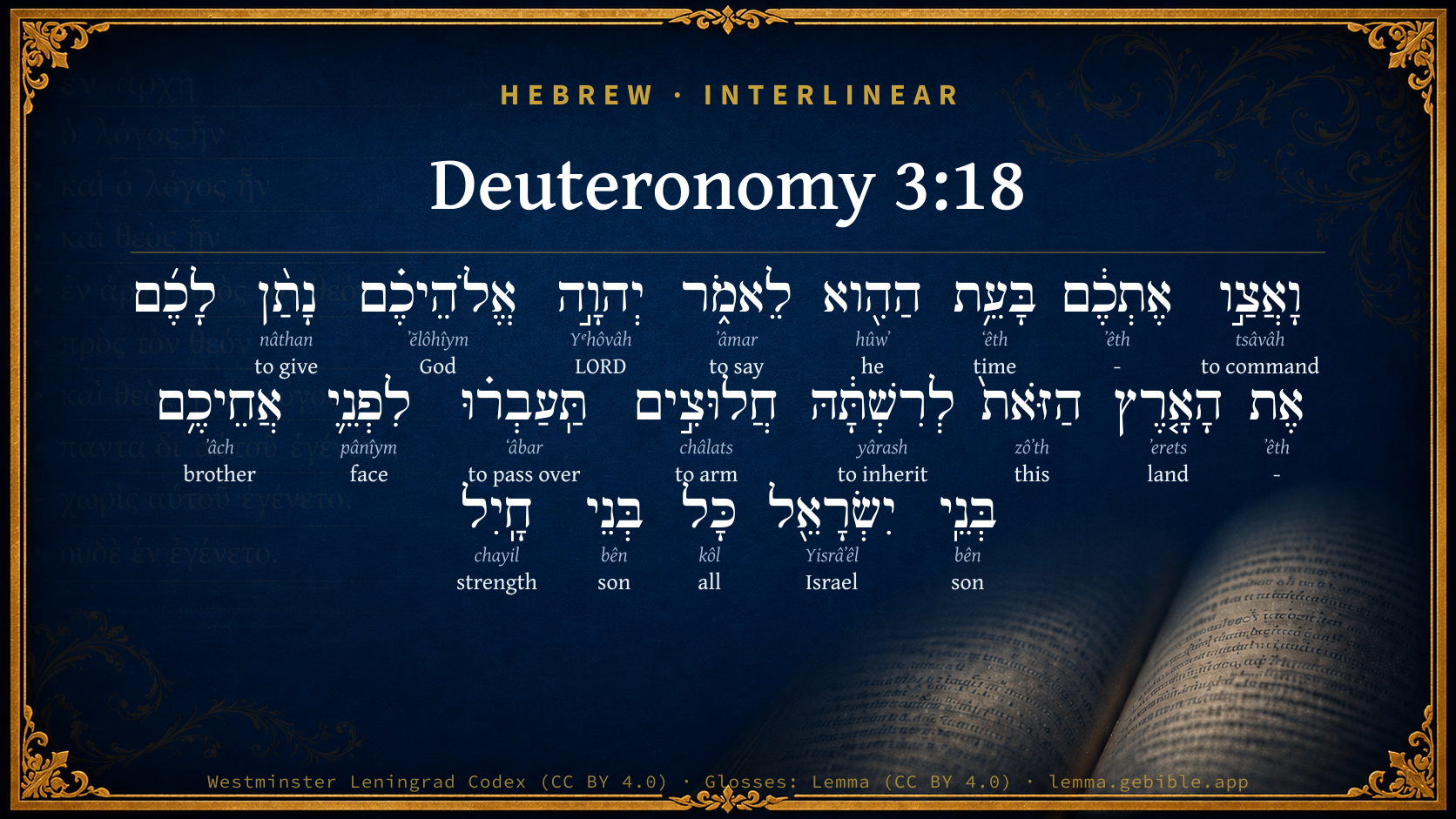
Hebrew (Westminster Leningrad Codex) Deuteronomy 3:18 appears in the Hebrew Old Testament. The text above is from the Westminster Leningrad Codex. Each word links to its Strong’s number, a concise gloss, and parsing drawn from the Open Scriptures Hebrew Bible morphology. Click any word for its full Brown-Driver-Briggs (BDB) entry.
Download image
Cite this verse

Deuteronomy 3:18 (World English Bible). Public Domain. Lemma interlinear Bible study tool, https://lemma.gebible.app/v/deuteronomy/3/18.

Show BibTeX & RIS
BibTeX
RIS
English Translation
I commanded you at that time, saying, Yahweh your God has given you this land to possess it: you shall pass over armed before your brothers the children of Israel, all the men of valor.
World English Bible · Public Domain
Download a study sheet

One document with this verse’s original text, its word-by-word gloss line, the meaning frame, cross-references with their text, attributed commentary, and full source and license credits — printable, and it pastes into notes with its structure intact.

This verse Autodidact and up

Study sheet (.html) Plain text (.txt)

A passage Seminary Student

Up to 50 verses in one chapter. A passage sheet keeps up to 6 commentary sources and 12 cross-references per verse, in the order this page ranks them, and says so on the sheet whenever that leaves anything out. Ask for a single verse and you get the Autodidact verse sheet above.

Everything on this page stays free to read, with no account — the sheet is a download of what is already on screen, not access to it.

Want to remove ads? Support Godless Engineer
Compare translations 3

The same verse in 3 English versions, stacked beneath the original-language interlinear above. Click any original word for its lexicon entry.

Each is an independent rendering of the whole verse — the interlinear is not word-aligned to these translations.

Highlighted words mark where these versions differ — a whole-verse word diff, not a word-by-word alignment.

  • World English Bible Public Domain
    I commanded you at that time, saying, Yahweh your God has given you this land to possess it: you shall pass over armed before your brothers the children of Israel, all the men of valor.
  • King James Version Public Domain
    And I commanded you at that time, saying, The LORD your God hath given you this land to possess it: ye shall pass over armed before your brethren the children of Israel, all that are meet for the war.
  • unfoldingWord Literal Text CC BY-SA 4.0
    And I commanded you at that time, saying, ‘Yahweh your God has given to you this land to possess it. The girded ones, all sons of bravery, will cross over to the faces of your brothers, the sons of Israel.

unfoldingWord Literal Text — © unfoldingWord, licensed CC BY-SA 4.0. Word-aligned USFM3 via Door43 (git.door43.org/unfoldingWord/en_ult).

Versions to compare (up to 4)

3 of 4 selected

Show all 18 translations

Every available English version of this verse, each an independent rendering of the whole verse.

  • World English Bible Public Domain
    I commanded you at that time, saying, Yahweh your God has given you this land to possess it: you shall pass over armed before your brothers the children of Israel, all the men of valor.
  • Berean Standard Bible Public Domain
    At that time I commanded you: “The LORD your God has given you this land to possess. All your men of valor are to cross over, armed for battle, ahead of your brothers, the Israelites.
  • Majority Standard Bible Public Domain
    At that time I commanded you: “The LORD your God has given you this land to possess. All your men of valor are to cross over, armed for battle, ahead of your brothers, the Israelites.
  • King James Version Public Domain
    And I commanded you at that time, saying, The LORD your God hath given you this land to possess it: ye shall pass over armed before your brethren the children of Israel, all that are meet for the war.
  • American Standard Version (1901) Public Domain
    And I commanded you at that time, saying, Jehovah your God hath given you this land to possess it: ye shall pass over armed before your brethren the children of Israel, all the men of valor.
  • Revised Version (1885) Public Domain
    And I commanded you at that time, saying, The LORD your God hath given you this land to possess it: ye shall pass over armed before your brethren the children of Israel, all the men of valour.
  • Geneva Bible (1599) Public Domain
    And I commanded you the same time, saying, The Lord your God hath giuen you this lande to possesse it: ye shall goe ouer armed before your brethren the children of Israel, all men of warre.
  • Douay-Rheims (1899) Public Domain
    And I commanded you at that time, saying: The Lord your God giveth you this land for an inheritance, go ye well appointed before your brethren the children of Israel, all the strong men of you,
  • Young's Literal Translation Public Domain
    `And I command you, at that time, saying, Jehovah your God hath given to you this land to possess it; armed ye pass over before your brethren the sons of Israel, all the sons of might.
  • Literal Standard Version CC BY-SA 4.0
    And at that time I command you, saying, Your God YHWH has given this land to you to possess it; you pass over armed before your brothers the sons of Israel, all the sons of might.
  • Unlocked Literal Bible CC BY-SA 4.0
    I commanded you at that time, saying, 'Yahweh your God has given you this land to possess it; you, all the men of war, will pass over armed before your brothers, the people of Israel.
  • unfoldingWord Literal Text CC BY-SA 4.0
    And I commanded you at that time, saying, ‘Yahweh your God has given to you this land to possess it. The girded ones, all sons of bravery, will cross over to the faces of your brothers, the sons of Israel.
  • Darby Bible Public Domain
    And I commanded you at that time, saying, Jehovah your God hath given you this land to take possession of it: ye shall pass over armed before your brethren the children of Israel, all [who are] combatants.
  • World Messianic Bible Public Domain
    I commanded you at that time, saying, “The LORD your God has given you this land to possess it. All of you men of valor shall pass over armed before your brothers, the children of Israel.
  • Webster's Bible Public Domain
    And I commanded you at that time, saying, The LORD your God hath given you this land to possess it; ye shall pass over armed before your brethren the children of Israel, all that are meet for the war.
  • Free Bible Version CC BY-SA 4.0
    This was when I gave you these instructions: “The Lord your God has given you this country as yours to own. All your warriors are to cross over, ready for battle, leading your fellow Israelites.
  • Bible in Basic English Public Domain
    At that time I gave you orders, saying, The Lord has given you this land for your heritage: all the men of war are to go over armed before your brothers the children of Israel.
  • JPS Tanakh (1917) Public Domain
    And I commanded you at that time, saying: 'The LORD your God hath given you this land to possess it; ye shall pass over armed before your brethren the children of Israel, all the men of valour.

Literal Standard Version (2020), Covenant Press — licensed CC BY-SA 4.0. Text via the HelloAO Bible API (eBible.org). Unlocked Literal Bible (unfoldingWord) — licensed CC BY-SA 4.0. Text via the HelloAO Bible API (eBible.org). unfoldingWord Literal Text — © unfoldingWord, licensed CC BY-SA 4.0. Word-aligned USFM3 via Door43 (git.door43.org/unfoldingWord/en_ult). Free Bible Version, Dr. Jonathan Gallagher — licensed CC BY-SA 4.0. Text via the HelloAO Bible API (eBible.org).

Word by word

More ways to search: Search by grammar → Find every occurrence → Compare this word →

Practice this passage: Drill this verse → Learn its vocabulary →

חֲלוּצִ֣ים
châlats
H2502
“armed”
Verb, Qal, Participle Passive, Masculine, Plural, Absolute
Part of Speech
Verb
Stem
Qal
Form
Participle Passive
Gender
Masculine
Number
Plural
State
Absolute
Full BDB Definition

Origin: a primitive root

TWOT: 667 , 668

to remove, draw out, draw off, take off, withdraw, equip (for war), arm for war, rescue, be rescued - (Qal) equipped (participle) - (Niphal) - to be equipped - to go equipped - to be armed - (Hiphil) - to make strong, brace up - to invigorate - to draw off or out, withdraw - (Qal) - to draw, draw off - to withdraw - (Niphal) - to be delivered - to be saved - (Piel) - to pull out, tear out - to rescue, deliver, set free - to take away, plunder
  1. וָאֲצַ֣ו tsâvâh H6680 “and · to command” Conjunction + Verb, Piel, Sequential Imperfect, 1st Person, Common, Singular
  2. אֶתְכֶ֔ם ʼêth H853 “- · you” Particle, Direct Object + Suffix, Personal, 2nd Person, Masculine, Plural
  3. בָּעֵ֥ת ʻêth H6256 “in/at the · time” Preposition, Determined + Noun, Common, Both, Singular, Absolute
  4. הַהִ֖וא hûwʼ H1931 “the · he” Particle, Definite Article + Pronoun, Personal, 3rd Person, Feminine, Singular
  5. לֵאמֹ֑ר ʼâmar H559 “to say” Preposition + Verb, Qal, Infinitive Construct
  6. יְהוָ֣ה Yᵉhôvâh H3068 “LORD” Noun, Proper
  7. אֱלֹהֵיכֶ֗ם ʼĕlôhîym H430 “God(s) · your” Noun, Common, Masculine, Plural, Construct + Suffix, Personal, 2nd Person, Masculine, Plural
  8. נָתַ֨ן nâthan H5414 “to give” Verb, Qal, Perfect, 3rd Person, Masculine, Singular
  9. אֶת ʼêth H853 “-” Particle, Direct Object
  10. הָאָ֤רֶץ ʼerets H776 “the · land” Particle, Definite Article + Noun, Common, Both, Singular, Absolute
  11. הַזֹּאת֙ zôʼth H2063 “the · this” Particle, Definite Article + Pronoun, Demonstrative, Feminine, Singular
  12. לְרִשְׁתָּ֔הּ yârash H3423 “to inherit · her” Preposition + Verb, Qal, Infinitive Construct + Suffix, Personal, 3rd Person, Feminine, Singular
  13. תַּֽעַבְר֗וּ ʻâbar H5674 “to pass over” Verb, Qal, Imperfect, 2nd Person, Masculine, Plural
  14. לִפְנֵ֛י pânîym H6440 “to/for · face(s) of” Preposition + Noun, Common, Both, Plural, Construct
  15. אֲחֵיכֶ֥ם ʼâch H251 “brothers · your” Noun, Common, Masculine, Plural, Construct + Suffix, Personal, 2nd Person, Masculine, Plural
  16. בְּנֵֽי bên H1121 “sons of” Noun, Common, Masculine, Plural, Construct
  17. יִשְׂרָאֵ֖ל Yisrâʼêl H3478 “Israel” Noun, Proper
  18. כָּל kôl H3605 “all of” Noun, Common, Masculine, Singular, Construct
  19. בְּנֵי bên H1121 “sons of” Noun, Common, Masculine, Plural, Construct
  20. חָֽיִל chayil H2428 “strength” Noun, Common, Masculine, Singular, Absolute

About this verse

These counts appear in no published source. They are computed here, from the morphology-tagged text and Lemma’s own curated glosses. What Lemma adds →

22
words
19
distinct lemmas
Pentateuch
section

Shared distinctive vocabulary

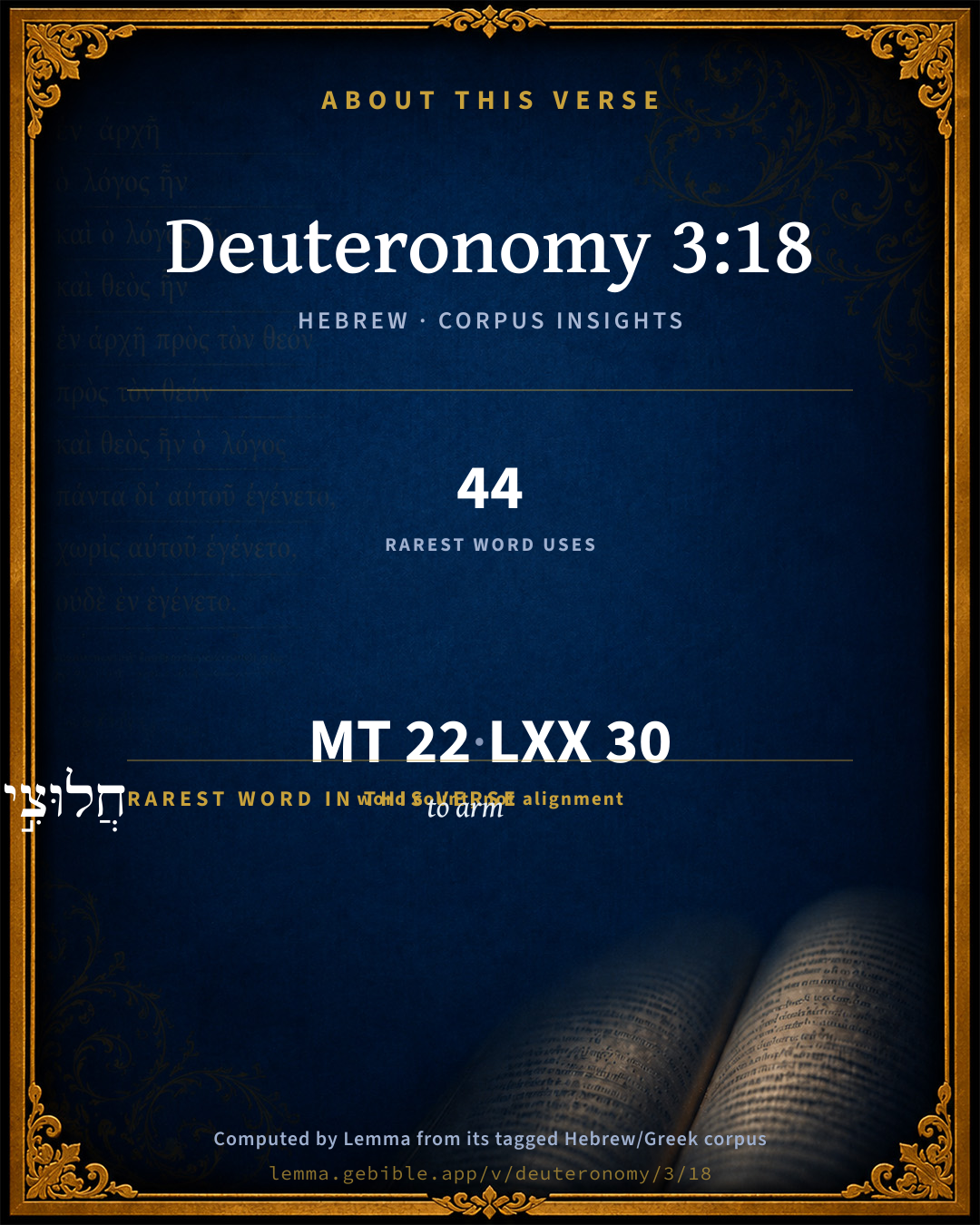
חֲלוּצִ֣ים to arm H2502 occurs in 44 verses of the Hebrew Bible. Also found in:

Grammatical profile

  • 6 verbs
  • 11 nouns
  • 2 pronouns
  • 1 preposition
  • 2 particles

Verb forms

  • וָאֲצַ֣ו Piel · Sequential Imperfect
  • לֵאמֹ֑ר Qal · Infinitive Construct
  • נָתַ֨ן Qal · Perfect
  • לְרִשְׁתָּ֔הּ Qal · Infinitive Construct
  • חֲלוּצִ֣ים Qal · Participle Passive
  • תַּֽעַבְר֗וּ Qal · Imperfect

Repetition

A word recurs within this verse — often emphatic in Hebrew:

  • בְּנֵֽי son H1121 ×2

Hebrew & Septuagint length

In English translation the verse runs 35 words from the Hebrew and 35 from the Septuagint (LXX English) — the same length.

A rough comparison of the two English renderings, which tokenize alike — not a word-level alignment.

Word counts can differ between the Hebrew and the Greek without any difference in meaning — e.g. the Hebrew direct-object marker אֵת has no separate Greek word, and Greek often adds the article ὁ.

In the original languages it is 22 Hebrew tokens and 30 Greek tokens — but the two are counted differently (Hebrew bundles its prefixes and suffixes into one token; the Greek is in lemma form), so that isn’t a like-for-like length.

Cross-references

4

Topical passages linked to Deuteronomy 3:18 in the Treasury of Scripture Knowledge — connected by theme and wording, ordered by reader-vote popularity; previews shown in the World English Bible.

  • Numbers 32:20–24 Moses said to them, If you will do this thing, if you will arm yourselves to go before Yahweh to the war,
  • Joshua 4:12–13 The children of Reuben, and the children of Gad, and the half-tribe of Manasseh, passed over armed before the children of Israel, as Moses spoke to them:
  • Joshua 1:12–15 To the Reubenites, and to the Gadites, and to the half-tribe of Manasseh, spoke Joshua, saying,
  • Joshua 22:1–9 Then Joshua called the Reubenites, and the Gadites, and the half-tribe of Manasseh,

Cross-references courtesy of OpenBible.info (CC BY 4.0).

Hebrew and Greek witnesses Masoretic Hebrew ↔ Greek Septuagint

The same verse in the two great witnesses to the Old Testament, shown verse-for-verse.

These are two independent witnesses, not word-aligned to each other, and the Septuagint is shown in lemma (dictionary) form.

Hebrew Deuteronomy 3:18 Masoretic · Westminster Leningrad Codex

וָאֲצַ֣ו אֶתְכֶ֔ם בָּעֵ֥ת הַהִ֖וא לֵאמֹ֑ר יְהוָ֣ה אֱלֹהֵיכֶ֗ם נָתַ֨ן לָכֶ֜ם אֶת הָאָ֤רֶץ הַזֹּאת֙ לְרִשְׁתָּ֔הּ חֲלוּצִ֣ים תַּֽעַבְר֗וּ לִפְנֵ֛י אֲחֵיכֶ֥ם בְּנֵֽי יִשְׂרָאֵ֖ל כָּל בְּנֵי חָֽיִל

I commanded you at that time, saying, Yahweh your God has given you this land to possess it: you shall pass over armed before your brothers the children of Israel, all the men of valor.

World English Bible · Public Domain

Greek LXX Deuteronomy 3:18 Septuagint · lemma form

καί ἐντέλλομαι σύ ἐν ὁ καιρός ἐκεῖνος λέγω κύριος ὁ θεός σύ δίδωμι σύ ὁ γῆ οὗτος ἐν κλῆρος ἐνὀπλίζω προπορεύομαι πρό πρόσωπον ὁ ἀδελφός σύ υἱός ἰσραήλ πᾶς δυνατός

And I charged you at that time, saying, The Lord your God has given you this land by lot; arm yourselves, every one that is powerful, and go before your brethren the children of Israel.

LXX2012 (modern English Septuagint) · Public Domain

Hebrew: Westminster Leningrad Codex (CC BY 4.0). Greek: Septuagint (public domain); English from LXX2012 (modern English Septuagint) (Public Domain). How the Septuagint differs from the Hebrew →

Targum (Aramaic paraphrase)

2

The Targum is the ancient Jewish Aramaic paraphrase of the Hebrew Scriptures — an interpretive translation, not the Hebrew text itself. Onkelos (literal) and Pseudo-Jonathan (expansive) render the Torah, and Jonathan the Prophets. Coverage is partial: where no permissively-licensed English translation exists for a verse, only the Aramaic is shown. This is verse-level text, not a word-by-word alignment to the Hebrew.

  1. Targum Onkelos Torah (Genesis–Deuteronomy)
    וּפַקֵדִית יָתְכוֹן בְּעִדָנָא הַהִיא לְמֵימָר יְיָ אֱלָהֲכוֹן יְהַב לְכוֹן יָת אַרְעָא הָדָא לְמֵירְתַהּ מְזָרְזִין תַּעְבְּרוּן קֳדָם אֲחֵיכוֹן בְּנֵי יִשְׂרָאֵל כָּל מְזָרְזֵי חֵילָא

    (no public-domain English translation for this verse)

    Targum Onkelos — Aramaic: “Onkelos Genesis” (public domain); “Onkelos Exodus” (public domain); “Onkelos Leviticus” (public domain); “Onkelos Numbers” (public domain); “Onkelos Deuteronomy” (public domain). English: “Sefaria Community Translation” (CC0 1.0 (public-domain dedication)); “J.W. Etheridge. The Targums of Onkelos and Jonathan Ben Uzziel on the Pentateuch. London: Longmans, Green, 1862” (public domain). Text via Sefaria.

  2. Targum Pseudo-Jonathan Torah (Genesis–Deuteronomy)
    וּפַקֵּידִית יַתְכוֹן שֵׁבֶט רְאוּבֵן וְשֵׁבֶט גָּד וּפַלְגוּת שֵׁבֶט מְנַשֶּׁה בְּעִידָנָא הַהִיא לְמֵימָר יְיָ אֱלָהָכוֹן יָהִיב לְכוֹן יַת אַרְעָא הָדָא לְמֵירְתָהּ מְזַיְנִין תַּעַבְרוּן קֳדָם אֲחוּכוֹן בְּנֵי יִשְרָאֵל כָּל מְזַרְזֵי חֵילָא

    And I commanded you, the tribe of Reuben, and of Gad, and the half tribe of Menasheh, at that time, saying: The Lord your God hath given this land to you to possess it; but you are to go over armed before your brethren, every one girded for the host.

    Targum Pseudo-Jonathan — Aramaic: “Targum Jonathan on Genesis” (public domain); “Targum Jonathan on Exodus” (public domain); “Targum Jonathan on Leviticus” (public domain); “Targum Jonathan on Numbers” (public domain); “Targum Jonathan on Deuteronomy” (public domain). English: “The Targum of Jonathan ben Uzziel, trans. J. W. Etheridge, London, 1862” (public domain). Text via Sefaria.

Commentary

Notes on Deuteronomy 3:18 from classic Christian and Jewish commentators (each source and its license shown beneath its notes). The classic Christian expositions comment on the surrounding passage and are grouped to its opening verse, so a note may address several verses; the Jewish commentaries on the Tanakh (Rashi and others) are per-verse, so they appear only where the commentator wrote on this verse.

Lemma curates 59 commentaries, every one of them public domain or Creative Commons licensed, each selected and text-cleaned for this edition rather than reprinted as found. About our sources →

Joseph Benson's Commentary

Deu 3:18. I commanded you — Namely, the Reubenites and Gadites. All that are meet — In such number as your brethren shall judge necessary. They were in all above a hundred thousand. Forty thousand of them went over Jordan before their brethren.

Joseph Benson's Commentary on the Old and New Testaments (1811–1818) — public domain. Text from a community e-Sword module.

Geneva Bible (1599)

Geneva Bible translators

That is, the Reubenites, Gadites, and half Manasseh, as Num. 32:28.

Geneva Bible (1599) marginal notes — public domain. Text via Bolls.life.

Ellicott's Commentary for English Readers

(18, 19) This is a summary of the agreement made and described in Num_32:20—-32. (See also Note on Jos_1:12.)

A Bible Commentary for English Readers, edited by Charles John Ellicott (1878–1897) — public domain. Text from a community e-Sword module.

The Cambridge Bible for Schools and Colleges

gen. ed. J. J. S. Perowne

18. And I commanded you] Them would be more natural, which some read; retain you, a symptom of the want of absolute preciseness in the writer’s style.

armed] It is doubtful whether that is the original meaning of the Heb. word or with loins girt, or stripped of superfluous clothing, expeditus; the same word in Num_32:21 ff. (JE?): P also uses it but with a following noun id. 27, 29 and Jos_4:13.

children of Israel] Not deuteronomic. See on Deu_4:44.

all the men of valour] Heb. sons of strength or valour. Like our force the Heb. ḥail is also used for army, but with the article (e.g. 2Sa_24:2), which does not occur in this phrase. The meaning is all capable of bearing arms.

18–22. Directions to the Two-and-a-Half Tribes and to Joshua

At that time Moses charged the two-and-a-half tribes to send their warriors over Jordan till the conquest there was completed, leaving their families and cattle in the cities already given them (18–20). At that time, too, he charged Joshua (21 f.).—To the charge to the two-and-a-half tribes the parallel is Num_32:16-32, which says that Reuben and Gad (these alone) offered to send their warriors to the W. campaign after building or fortifying cities for their children, and folds for their cattle E. of Jordan; and that Moses enforced this plan with threats of disaster if it was not carried out. Of this composite passage various analyses have been made; all that is clear is that JE narrated some such episode.—To the charge to Joshua, at that time, the Pent has no parallel. On the ground that it anticipates 28 f. and Deu_31:7 ff. it is removed by some after Deu_3:28, where indeed it is suitable, but by others has been taken to be no original part of the First Discourse by Moses. Yet the Discourse is not so compact and free of repetition that we need deny to its author such an anticipation of his own words; nor would it be surprising that in the traditions with which he worked there were recorded more than one charge to Joshua or at least several emphases of the fact that Joshua was exhorted by Moses; cp. Deu_1:38. On the mixed forms of address, thou and you, see notes below.

The Cambridge Bible for Schools and Colleges (gen. ed. J. J. S. Perowne; Cambridge University Press, 1878–1918) — public domain. Text from a community e-Sword module.

John Gill's Exposition

But your wives, and your little ones, and your cattle,.... These were to be left behind: for

I know that ye have much cattle; which made the countries of Gilead and Bashan, so famous for pasturage, agreeable to them; see Num 32:1 these, under the care of servants, and also their wives and children:

shall abide in your cities which I have given you; and which they rebuilt and repaired, Num 32:34.

John Gill's Exposition of the Whole Bible (1746–1763) — public domain (CC PDM 1.0). Text via the HelloAO Bible API.

Matthew Poole's English Annotations

I commanded you, to wit, the Reubenites and Gadites, mentioned Deu 3:16, to whom he now turns his speech by an apostrophe.

Meet for the war; in such number as your brethren shall judge necessary. See Jos 1:14; 4:13.

Matthew Poole's English Annotations on the Holy Bible (1683–1685) — public domain. Text from a community e-Sword/MySword module.

Whedon's Commentary on the Bible

Daniel D. Whedon

18-20. Moses herein reminds the people of the conditions under which the territory spoken of had been given to the tribes of Reuben and Gad and the half tribe of Manasseh. Comp. Num_32:20-32.

Daniel D. Whedon (gen. ed.), Commentary on the Old and New Testaments (1874–1909) — public domain. Text from a community e-Sword module.

The Pulpit Commentary

CONCLUSION OF HISTORICAL RECAPITULATION. Vers. 18-29.

Vers. 18-20. Moses reminds the two and a half tribes of the conditions on which they had received the possessions they had desired beyond Jordan. (Num_32:20-32) All that are meet for the war ; literally, all the sons of might (lyij yneB), i.e. not all who were men of war or of age to go to war, but men specially powerful and fitted for warlike enterprise. Until the Lord hath given rest auto your brethren. (corer Exo_33:14)

Vers. 18-20. The pioneers of the invasion of Palestine.

Here the Reubenites, Gadites, and Manassites are directed to "intern" their wives, little ones, and cattle in the cities of Bashan, which were now literally free from the race of the giants, and then to go armed across the Jordan before their fellows, the van of the invading host. These pioneers become thus the least encumbered of the invaders. Their noncombatants are safe in the cities of Bashan, their cattle are in good pastures, they may go with easy minds and light hearts to the war. Their purpose in the invasion is not selfish, but perfectly disinterested. They go to fight for their brethren, and to carve out homes for them beyond the river. We have here a Divine law, as it seems to us, of very practical application. To sketch this let us notice

I GOD GIVES REST AND INHERITANCE TO INDIVIDUALS THAT THEY MAY INTEREST THEMSELVES IN SECURING SIMILAR BLESSINGS FOR OTHERS. Beginning with the lowest inheritance, we would observe that, when God gives individuals riches , it is not that they may be excused from public work, but enabled for it. A servant of God who finds himself wealthy is not superannuated, but supported for public ends. He is bound to do all he can with and by his means. But this law has a still happier spiritual side. When God blesses us with assurance of salvation, it is that his way may be known on earth, and his saving health among all nations. (Psa_67:1, Psa_67:2) He makes us peaceful and happy in Christ that we may, with unburdened spirits, seek the salvation of those around us,

II ASSURANCE OF SALVATION SHOULD THEREFORE BE SOUGHT BY EACH OF US ON PUBLIC GROUNDS. It is not a personal matter only, but a public interest as well. The world will be less benefited by us if we are constantly in doubt about personal salvation. We are in such a case marching without a base. It is a risky kind of warfare. Let us seek from God, on public grounds, the priceless blessing of assurance, and then we shall be able to lose sight of self in seeking the common weal.

III DISINTERESTEDNESS IS THE SECRET OF SUCCESSFUL WARFARE. The Reubenites and their fellows in the van must have commanded the respect not only of those behind them, but of the Canaanites with whom they had to contend. It was the first time, since Abraham"s rescue of Lot, that warriors had appeared from purely disinterested motives in the field of battle. And in matters spiritual it is the same. The ministry of Christ is, speaking generally, an ill-paid profession. There is the less chance, then, of men entering this service for a piece of bread. Disinterestedness is more likely to be the rule. With other Christians it is the same. When people are compelled to recognize disinterestedness, the chief part of the battle is won.

IV THE THOUGHT OF HAVING HELPED OTHERS TO REST IN THE LORD ENHANCES OUR OWN REST IN HIM. The Reubenites, etc., must have come back to their homes in Bashan with great satisfaction. They felt that they had done a good, unselfish work in the campaign. They were not fighting for their own hand, but for the welfare of others. So in the spiritual warfare, when we become instruments in God"s hand in leading others to rest in him, we find our rest deepened and made more glorious. May it be the joy of many! R.M.E.

The Pulpit Commentary (1880–1919), ed. H.D.M. Spence-Jones & Joseph S. Exell — public domain. Text from a community e-Sword module.

John Wesley's Explanatory Notes

You - Namely, the Reubenites and Gadites. All that are meet - In such number as your our brethren shall judge necessary. They were in all above an hundred thousand. Forty thousand of them went over Jordan before their brethren.

John Wesley, Explanatory Notes Upon the Whole Bible (1754–1765) — public domain. Text via the GEBible commentary corpus.

unfoldingWord translationNotes

Door43 World Missions Community

General Information:

Moses continues to speak to the people of Israel.

I commanded you at that time

Moses reminds the tribe of Reuben, the tribe of Gad, and the half tribe of Manasseh that they must help the other Israelites conquer the rest of the land God promised them. (See: Assumed Knowledge and Implicit Information)

will pass over armed before

"will take your weapons and cross the Jordan River ahead of"

your brothers, the people of Israel

"your fellow Israelites"

translationWords

command

Yahweh

God

possess

brother

Israel

unfoldingWord translationNotes — © Distant Shores Media and the Door43 World Missions Community, licensed CC BY-SA 4.0. Source: git.door43.org/Door43/en_tn.

Rashi

Rabbi Shlomo Yitzchaki (Rashi)

ואצו אתכם AND I COMMANDED YOU — He now addresses himself to the sons of Reuben and the sons of Gad.

לפני אחיכם [YE SHALL PASS OVER EQUIPPED] BEFORE YOUR BRETHREN — they used to go in front of the other Israelites into battle because they were mighty men, and the enemy fell before them, as it is said of Gad, (Deuteronomy 33:20) "He tears the arm together with the crown” (cf. Rashi on Numbers 32:17).

Rashi on the Tanakh — English translations: “The Judaica Press complete Tanach with Rashi, translated by A. J. Rosenberg” (CC BY 4.0); “Pentateuch with Rashi's commentary by M. Rosenbaum and A.M. Silbermann, 1929-1934” (public domain); “The Metsudah Tanach series, Lakewood, N.J” (CC BY 4.0); and “The Book of Joshua, Metsudah Publications, 1997” (CC BY 4.0). Text via Sefaria.

Lesson kit

Teaching starters — assembled from the data on this page, not authored interpretation. Every prompt links to the verse data it draws on. Edit before teaching.

Deuteronomy, in the Pentateuch, opens this verse with 22 words (19 distinct Hebrew lemmas). Its most distinctive word is châlats (“to arm”). A historical commentator’s framing appears above. Read the whole chapter for the surrounding context.

Discussion questions

  1. What does “to arm” (châlats) contribute to the verse as a whole?
  2. How does Leviticus 14:40, which shares the word «to arm», read alongside this verse?
  3. What does the repetition of “son” (2× in this one verse) do in this verse?
  4. These translations render this verse differently. What is at stake in choosing one wording over another?
  5. «וָאֲצַ֣ו» is a Piel Sequential Imperfect verb. How does that grammatical form shape the action described?
  6. Compare how Joseph Benson's Commentary and Geneva Bible (1599) read this verse. Where do they agree or differ?

Things to notice

Reading settings

Reading text

Shown beneath each verse's original-language words.

Old Testament
Old Testament edition

Read the OT as the Masoretic Hebrew (MT) or the Greek Septuagint (LXX).

English shown for the Greek Septuagint (in the Hebrew ↔ Greek comparison).

Comparing translations? Open the Compare panel on any verse page to stack up to four side by side.