
2 Kings 17:31

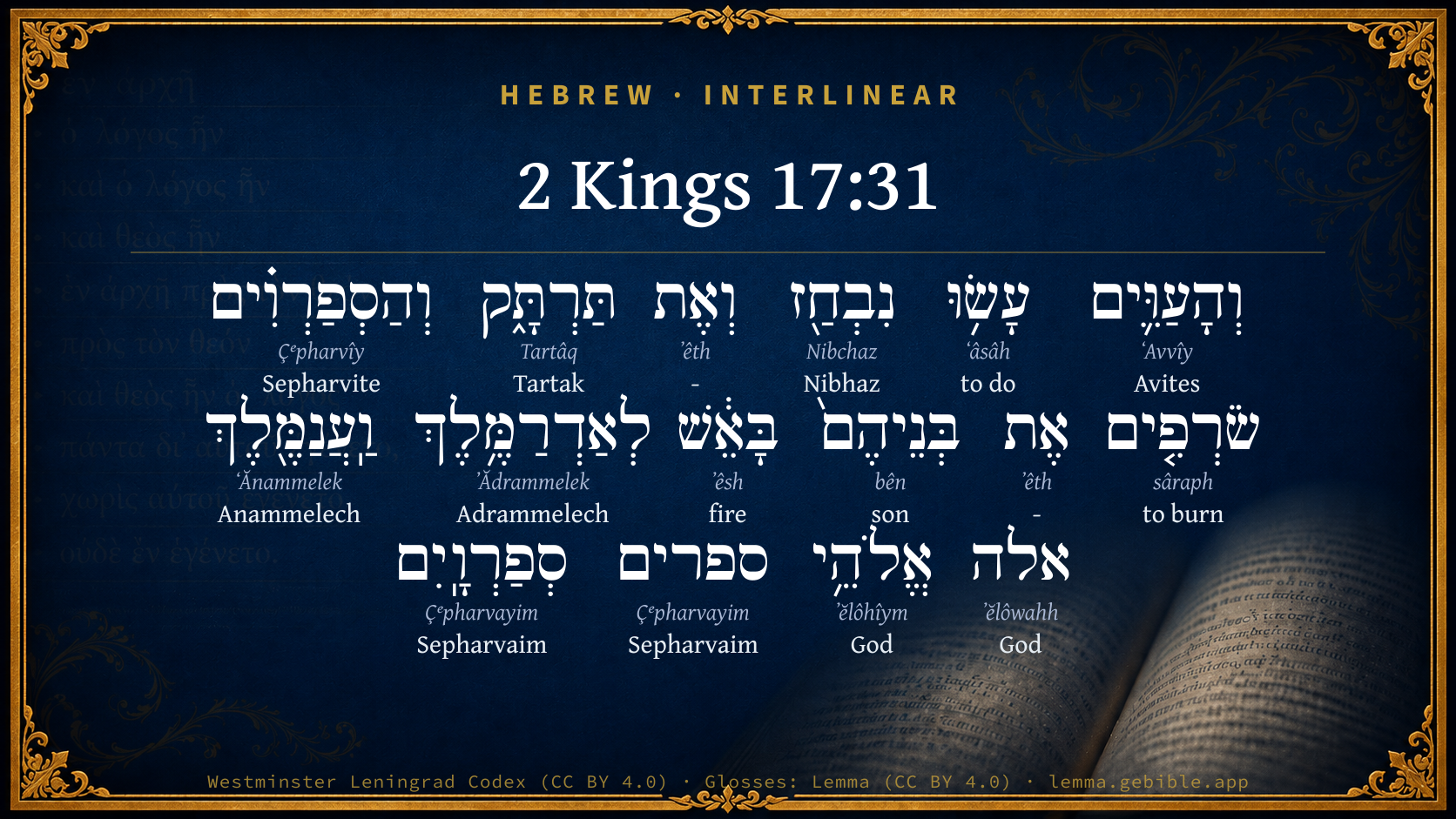
Hebrew (Westminster Leningrad Codex) 2 Kings 17:31 appears in the Hebrew Old Testament. The text above is from the Westminster Leningrad Codex. Each word links to its Strong’s number, a concise gloss, and parsing drawn from the Open Scriptures Hebrew Bible morphology. Click any word for its full Brown-Driver-Briggs (BDB) entry.
Download image
Cite this verse

2 Kings 17:31 (World English Bible). Public Domain. Lemma interlinear Bible study tool, https://lemma.gebible.app/v/2-kings/17/31.

Show BibTeX & RIS
BibTeX
RIS
English Translation
and the Avvites made Nibhaz and Tartak; and the Sepharvites burnt their children in the fire to Adrammelech and Anammelech, the gods of Sepharvaim.
World English Bible · Public Domain
Highlights
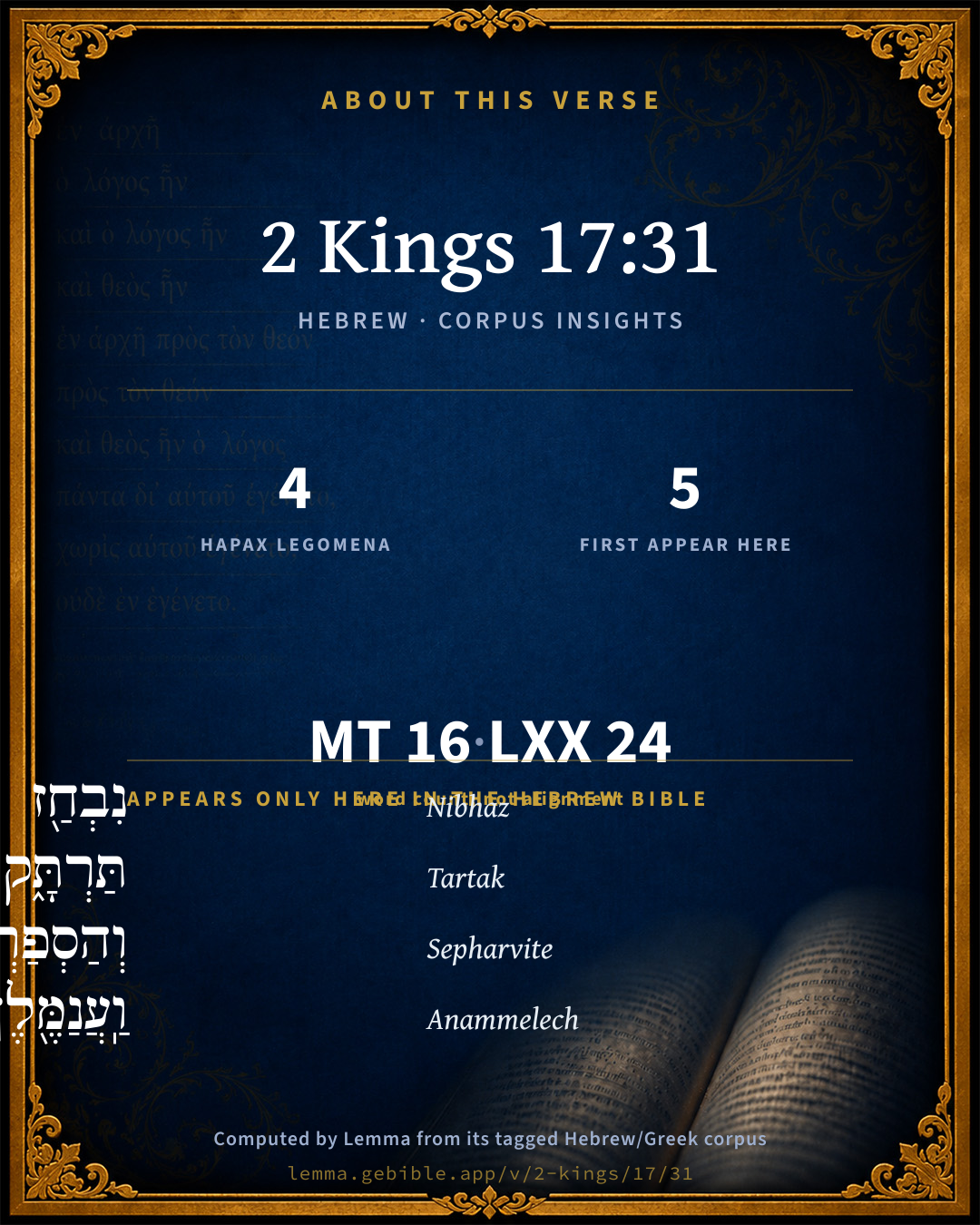
  • 4 hapax legomena — only here in the Hebrew Bible
  • 5 first appearances in the Hebrew Bible
Full analysis ↓
Download a study sheet

One document with this verse’s original text, its word-by-word gloss line, the meaning frame, cross-references with their text, attributed commentary, and full source and license credits — printable, and it pastes into notes with its structure intact.

This verse Autodidact and up

Study sheet (.html) Plain text (.txt)

A passage Seminary Student

Up to 50 verses in one chapter. A passage sheet keeps up to 6 commentary sources and 12 cross-references per verse, in the order this page ranks them, and says so on the sheet whenever that leaves anything out. Ask for a single verse and you get the Autodidact verse sheet above.

Everything on this page stays free to read, with no account — the sheet is a download of what is already on screen, not access to it.

Want to remove ads? Support Godless Engineer
Compare translations 3

The same verse in 3 English versions, stacked beneath the original-language interlinear above. Click any original word for its lexicon entry.

Each is an independent rendering of the whole verse — the interlinear is not word-aligned to these translations.

Highlighted words mark where these versions differ — a whole-verse word diff, not a word-by-word alignment.

  • World English Bible Public Domain
    and the Avvites made Nibhaz and Tartak; and the Sepharvites burnt their children in the fire to Adrammelech and Anammelech, the gods of Sepharvaim.
  • King James Version Public Domain
    And the Avites made Nibhaz and Tartak, and the Sepharvites burnt their children in fire to Adrammelech and Anammelech, the gods of Sepharvaim.
  • unfoldingWord Literal Text CC BY-SA 4.0
    and the Avvites made Nibhaz and Tartak. And the Sepharvites were burning their sons in the fire to Adrammelech and Anammelech, the gods of Sepharvim.

unfoldingWord Literal Text — © unfoldingWord, licensed CC BY-SA 4.0. Word-aligned USFM3 via Door43 (git.door43.org/unfoldingWord/en_ult).

Versions to compare (up to 4)

3 of 4 selected

Show all 18 translations

Every available English version of this verse, each an independent rendering of the whole verse.

  • World English Bible Public Domain
    and the Avvites made Nibhaz and Tartak; and the Sepharvites burnt their children in the fire to Adrammelech and Anammelech, the gods of Sepharvaim.
  • Berean Standard Bible Public Domain
    the Avvites made Nibhaz and Tartak, and the Sepharvites burned their children in the fire to Adrammelech and Anammelech the gods of Sepharvaim.
  • Majority Standard Bible Public Domain
    the Avvites made Nibhaz and Tartak, and the Sepharvites burned their children in the fire to Adrammelech and Anammelech the gods of Sepharvaim.
  • King James Version Public Domain
    And the Avites made Nibhaz and Tartak, and the Sepharvites burnt their children in fire to Adrammelech and Anammelech, the gods of Sepharvaim.
  • American Standard Version (1901) Public Domain
    and the Avvites made Nibhaz and Tartak; and the Sepharvites burnt their children in the fire to Adrammelech and Anammelech, the gods of Sepharvaim.
  • Revised Version (1885) Public Domain
    and the Avvites made Nibhaz and Tartak, and the Sepharvites burnt their children in the fire to Adrammelech and Anammelech, the gods of Sepharvaim.
  • Geneva Bible (1599) Public Domain
    And the Auims made Nibhaz, and Tartak: and the Sepharuims burnt their children in the fire to Adrammelech, and Anammelech the gods of Sepharuaim.
  • Douay-Rheims (1899) Public Domain
    And the Hevites made Nebahaz and Tharthac. And they that were of Sepharvaim burnt their children in fire, to Adramelech and Anamelech the gods of Sepharvaim.
  • Young's Literal Translation Public Domain
    and the Avites have made Nibhaz and Tartak, and the Sepharvites are burning their sons with fire to Adrammelech and Anammelech, gods of Sepharvim.
  • Literal Standard Version CC BY-SA 4.0
    and the Avites have made Nibhaz and Tartak, and the Sepharvites are burning their sons with fire to Adrammelech and Anammelech, gods of Sepharvim.
  • Unlocked Literal Bible CC BY-SA 4.0
    the Avvites made Nibhaz and Tartak. The Sepharvites burned their children in the fire to Adrammelek and Anammelek, the gods of the Sepharvites.
  • unfoldingWord Literal Text CC BY-SA 4.0
    and the Avvites made Nibhaz and Tartak. And the Sepharvites were burning their sons in the fire to Adrammelech and Anammelech, the gods of Sepharvim.
  • Darby Bible Public Domain
    and the Avvites made Nibhaz and Tartak, and the Sepharvites burned their children in the fire to Adrammelech and Anammelech the gods of Sepharvaim.
  • World Messianic Bible Public Domain
    and the Avvites made Nibhaz and Tartak; and the Sepharvites burned their children in the fire to Adrammelech and Anammelech, the gods of Sepharvaim.
  • Webster's Bible Public Domain
    And the Avites made Nibhaz and Tartak, and the Sepharvites burnt their children in the fire to Adrammelech and Anammelech, the gods of Sepharvaim.
  • Free Bible Version CC BY-SA 4.0
    The Avvites made Nibhaz and Tartak, and the Sepharvites sacrificed their children as burnt offerings to their gods Adrammelech and Anammelech.
  • Bible in Basic English Public Domain
    The Avvites made Nibhaz and Tartak, and the Sepharvites gave their children to be burned in the fire to Adrammelech and Anammelech, the gods of Sepharvaim.
  • JPS Tanakh (1917) Public Domain
    and the Avvites made Nibhaz and Tartak, and the Sepharvites burnt their children in the fire to Adrammelech and Anammelech, the gods of Sepharvaim.

Literal Standard Version (2020), Covenant Press — licensed CC BY-SA 4.0. Text via the HelloAO Bible API (eBible.org). Unlocked Literal Bible (unfoldingWord) — licensed CC BY-SA 4.0. Text via the HelloAO Bible API (eBible.org). unfoldingWord Literal Text — © unfoldingWord, licensed CC BY-SA 4.0. Word-aligned USFM3 via Door43 (git.door43.org/unfoldingWord/en_ult). Free Bible Version, Dr. Jonathan Gallagher — licensed CC BY-SA 4.0. Text via the HelloAO Bible API (eBible.org).

Word by word

More ways to search: Search by grammar → Find every occurrence → Compare this word →

Practice this passage: Drill this verse → Learn its vocabulary →

נִבְחַ֖ז
Nibchaz
H5026
“Nibhaz”
Noun, Proper
Part of Speech
Noun
Type
Proper
Full BDB Definition

Origin: of foreign origin

TWOT: None

Nibhaz = "the barker" - a deity of the Avites introduced by them into Samaria in the time of Shalmaneser; idol had the figure of a dog
  1. וְהָעַוִּ֛ים ʻAvvîy H5757 “and · the · Avites” Conjunction + Particle, Definite Article + Noun, Gentilic, Masculine, Plural, Absolute
  2. עָשׂ֥וּ ʻâsâh H6213 “to do” Verb, Qal, Perfect, 3rd Person, Common, Plural
  3. וְאֶת ʼêth H853 “and · -” Conjunction + Particle, Direct Object
  4. תַּרְתָּ֑ק Tartâq H8662 “Tartak” Noun, Proper
  5. וְהַסְפַרְוִ֗ים Çᵉpharvîy H5616 “and · the · Sepharvites” Conjunction + Particle, Definite Article + Noun, Gentilic, Masculine, Plural, Absolute
  6. שֹׂרְפִ֤ים sâraph H8313 “burning” Verb, Qal, Participle Active, Masculine, Plural, Absolute
  7. אֶת ʼêth H853 “-” Particle, Direct Object
  8. בְּנֵיהֶם֙ bên H1121 “sons · their” Noun, Common, Masculine, Plural, Construct + Suffix, Personal, 3rd Person, Masculine, Plural
  9. בָּאֵ֔שׁ ʼêsh H784 “in/at the · fire” Preposition, Determined + Noun, Common, Both, Singular, Absolute
  10. לְאַדְרַמֶּ֥לֶךְ ʼĂdrammelek H152 “to/for · Adrammelech” Preposition + Noun, Proper
  11. וַֽעֲנַמֶּ֖לֶךְ ʻĂnammelek H6048 “and · Anammelech” Conjunction + Noun, Proper
  12. אלה ʼĕlôwahh H433 “God of” Noun, Common, Masculine, Singular, Construct
  13. אֱלֹהֵ֥י ʼĕlôhîym H430 “God(s) of” Noun, Common, Masculine, Plural, Construct
  14. ספרים Çᵉpharvayim H5617 “Sepharvaim” Noun, Proper
  15. סְפַרְוָֽיִם Çᵉpharvayim H5617 “Sepharvaim” Noun, Proper

About this verse

These counts appear in no published source. They are computed here, from the morphology-tagged text and Lemma’s own curated glosses. What Lemma adds →

16
words
14
distinct lemmas
Historical
section

Notable vocabulary

4 hapax legomena — words that appear only here in the entire Hebrew Bible:

  • נִבְחַ֖ז Nibhaz H5026
  • תַּרְתָּ֑ק Tartak H8662
  • וְהַסְפַרְוִ֗ים Sepharvite H5616
  • וַֽעֲנַמֶּ֖לֶךְ Anammelech H6048

First appearance in Scripture

These words make their first canonical appearance in the Hebrew Bible here:

  • נִבְחַ֖ז Nibhaz H5026
  • תַּרְתָּ֑ק Tartak H8662
  • וְהַסְפַרְוִ֗ים Sepharvite H5616
  • לְאַדְרַמֶּ֥לֶךְ Adrammelech H152
  • וַֽעֲנַמֶּ֖לֶךְ Anammelech H6048

Shared distinctive vocabulary

וְהָעַוִּ֛ים Avites H5757 occurs in 2 verses of the Hebrew Bible. Also found in:

Grammatical profile

  • 2 verbs
  • 12 nouns
  • 2 particles

Verb forms

  • עָשׂ֥וּ Qal · Perfect
  • שֹׂרְפִ֤ים Qal · Participle Active

Repetition

A word recurs within this verse — often emphatic in Hebrew:

  • ספרים Sepharvaim H5617 ×2

Hebrew & Septuagint length

In English translation the verse runs 24 words from the Hebrew and 30 from the Septuagint (LXX English) — closely comparable.

A rough comparison of the two English renderings, which tokenize alike — not a word-level alignment.

Word counts can differ between the Hebrew and the Greek without any difference in meaning — e.g. the Hebrew direct-object marker אֵת has no separate Greek word, and Greek often adds the article ὁ.

In the original languages it is 16 Hebrew tokens and 24 Greek tokens — but the two are counted differently (Hebrew bundles its prefixes and suffixes into one token; the Greek is in lemma form), so that isn’t a like-for-like length.

Cross-references

7

Topical passages linked to 2 Kings 17:31 in the Treasury of Scripture Knowledge — connected by theme and wording, ordered by reader-vote popularity; previews shown in the World English Bible.

  • 2 Kings 17:24 The king of Assyria brought men from Babylon, and from Cuthah, and from Avva, and from Hamath and Sepharvaim, and placed them in the cities of Samaria instead of the children of Israel; and they possessed Samaria, and lived in the cities of it.
  • 2 Kings 17:17 They caused their sons and their daughters to pass through the fire, and used divination and enchantments, and sold themselves to do that which was evil in the sight of Yahweh, to provoke him to anger.
  • 2 Kings 19:37 It happened, as he was worshipping in the house of Nisroch his god, that Adrammelech and Sharezer struck him with the sword: and they escaped into the land of Ararat. Esar Haddon his son reigned in his place.
  • Leviticus 18:21 "'You shall not give any of your children to sacrifice to Molech; neither shall you profane the name of your God: I am Yahweh.
  • Deuteronomy 12:28 Observe and hear all these words which I command you, that it may go well with you, and with your children after you forever, when you do that which is good and right in the eyes of Yahweh your God.
  • Deuteronomy 12:31 You shall not do so to Yahweh your God: for every abomination to Yahweh, which he hates, have they done to their gods; for even their sons and their daughters do they burn in the fire to their gods.
  • Ezra 4:9 then [wrote] Rehum the chancellor, and Shimshai the scribe, and the rest of their companions, the Dinaites, and the Apharsathchites, the Tarpelites, the Apharsites, the Archevites, the Babylonians, the Shushanchites, the Dehaites, the Elamites,

Cross-references courtesy of OpenBible.info (CC BY 4.0).

Hebrew and Greek witnesses Masoretic Hebrew ↔ Greek Septuagint

The same verse in the two great witnesses to the Old Testament, shown verse-for-verse.

These are two independent witnesses, not word-aligned to each other, and the Septuagint is shown in lemma (dictionary) form.

Hebrew 2 Kings 17:31 Masoretic · Westminster Leningrad Codex

וְהָעַוִּ֛ים עָשׂ֥וּ נִבְחַ֖ז וְאֶת תַּרְתָּ֑ק וְהַסְפַרְוִ֗ים שֹׂרְפִ֤ים אֶת בְּנֵיהֶם֙ בָּאֵ֔שׁ לְאַדְרַמֶּ֥לֶךְ וַֽעֲנַמֶּ֖לֶךְ אלה אֱלֹהֵ֥י ספרים סְפַרְוָֽיִם

and the Avvites made Nibhaz and Tartak; and the Sepharvites burnt their children in the fire to Adrammelech and Anammelech, the gods of Sepharvaim.

World English Bible · Public Domain

Greek LXX 2 Kings 17:31 Septuagint · lemma form

καί ὁ ευαῖος ποιέω ὁ εβλαζερ καί ὁ θαρθακ καί ὁ σεπφαρουαιν κατακαίω ὁ υἱός αὐτός ἐν πῦρ ὁ αδραμελεχ καί ανημελεχ θεός σεπφαρουαιν

And the Evites made Eblazer and Tharthac, and the inhabitant of Seppharvaim did evil when they burnt their sons in the fire to Adramelech and Anemelech, the gods of Seppharvaim.

LXX2012 (modern English Septuagint) · Public Domain

On this verse, Ellicott's Commentary for English Readers discusses the Septuagint’s reading. Read the note in Commentary ↓

Hebrew: Westminster Leningrad Codex (CC BY 4.0). Greek: Septuagint (public domain); English from LXX2012 (modern English Septuagint) (Public Domain). How the Septuagint differs from the Hebrew →

Targum (Aramaic paraphrase)

1

The Targum is the ancient Jewish Aramaic paraphrase of the Hebrew Scriptures — an interpretive translation, not the Hebrew text itself. Onkelos (literal) and Pseudo-Jonathan (expansive) render the Torah, and Jonathan the Prophets. Coverage is partial: where no permissively-licensed English translation exists for a verse, only the Aramaic is shown. This is verse-level text, not a word-by-word alignment to the Hebrew.

  1. Targum Jonathan Prophets (Joshua–Malachi)
    וַעֲוָאֵי עֲבַדוּ נִבְחַז וְיַת תַּרְתָּק וֶאֱנַשׁ סְפַרְוָאֵי מוֹקְדִין יַת בְּנֵיהוֹן בְּנוּרָא לְאַדְרַמֶלֶךְ וַעֲנַמֶלֶךְ טַעֲוַת סְפַרְוָיִם:

    (no public-domain English translation for this verse)

    Targum Jonathan — Aramaic: “Mikraot Gedolot” (public domain). English: “Sefaria Community Translation” (CC0 1.0 (public-domain dedication)); “London "Chaldee Paraphrase," 1871” (public domain). Text via Sefaria.

Commentary

Notes on 2 Kings 17:31 from classic Christian and Jewish commentators (each source and its license shown beneath its notes). The classic Christian expositions comment on the surrounding passage and are grouped to its opening verse, so a note may address several verses; the Jewish commentaries on the Tanakh (Rashi and others) are per-verse, so they appear only where the commentator wrote on this verse.

Lemma curates 59 commentaries, every one of them public domain or Creative Commons licensed, each selected and text-cleaned for this edition rather than reprinted as found. About our sources →

Trapp's Complete Commentary

John Trapp

2Ki 17:31 And the Avites made Nibhaz and Tartak, and the Sepharvites burnt their children in fire to Adrammelech and Anammelech, the gods of Sepharvaim.

Ver. 31. Made Nibhaz and Tartak.] A dog and an ass, as 2Ki 17:30. So the Africans worshipped a dog; the Persians, a cock; the Mendesians, a goat, &c. The people of the East Indies, in the isle Ceylon, having an ape’s tooth got from them which they had consecrated, offered an incredible mass of treasure to recover it.

John Trapp, A Commentary or Exposition upon All the Books of the Old and New Testament (1647–1656) — public domain. Text from a community e-Sword module.

Jamieson, Fausset & Brown

Robert Jamieson, A. R. Fausset & David Brown

Nibhaz--under that of a dog--that Egyptian form of animal-worship having prevailed in ancient Syria, as is evident from the image of a large dog at the mouth of the Nahr-el-Kelb, or Dog river.

Tartak--According to the rabbis, it was in the form of an ass, but others understand it as a planet of ill-omen, probably Saturn.

Adrammelech--supposed by some to be the same as Molech, and in Assyrian mythology to stand for the sun. It was worshipped in the form of a mule--others maintain in that of a peacock.

Anammelech--worshipped in the form of a hare; others say in that of a goat.

Jamieson, Fausset & Brown — Commentary Critical and Explanatory on the Whole Bible (1871) — public domain (CC PDM 1.0). Text via the HelloAO Bible API.

Adam Clarke's Commentary

Verse 31. The Avites made Nibhaz] This was supposed to be the same as the Anubis of the Egyptians; and was in form partly of a dog, and partly of a man. A very ancient image of this kind now lies before me: it is cut out of stone, about seven inches high; has the body, legs, and arms, of a man; the head and feet of a dog; the thighs and legs covered with scales; the head crowned with a tiara; the arms crossed upon the breasts, with the fingers clenched. The figure stands upright, and the belly is very protuberant. See below. 2Kg 17:41.

And Tartak] This is supposed by some to be another name of the same idol; Jarchi says it was in the shape of an ass. Some think these were the representations of the sun in his chariot; Nibhaz representing the solar orb, and Tartak the chariot. See below. 2Kg 17:41.

Adrammelech] From אדר adar, glorious, and מלך melech, king. Probably the sun.

Anammelech] From anah, to return, and מלך melech, king. Probably, the Moloch of the Ammonites. Jarchi says, the first was in the form of a mule, the second in the form of a horse; this was probably the moon.

Adam Clarke's Commentary on the Bible (1810–1826) — public domain. Text from a community e-Sword/MySword module.

Ellicott's Commentary for English Readers

(31) Nibhaz and Tartak are unknown, but the forms have an Assyrio-Babylonian cast. (Comp. Nimrod, Nergal with the former, and Ishtar, Namtar, Merodach, Shadrach, with the latter.) Before Nibhaz the LXX. have another name, Abaazar, or Eblazer (? ’abal Assûr “the Son of Assur”).

Adrammelech.—Comp. 2Ki_19:37. Identified by Schrader with the Assyrian Adar-mâlik, “Adar is prince” (? Adrum).

Anammelech—i.e., Anum-mâlik, “Anu is prince.” Adar and Anu are well-known Assyrian gods.

A Bible Commentary for English Readers, edited by Charles John Ellicott (1878–1897) — public domain. Text from a community e-Sword module.

The Cambridge Bible for Schools and Colleges

gen. ed. J. J. S. Perowne

31. And the Avites [R.V. Avvites] made Nibhaz] Of Nibhaz (for which the LXX. gives a very different word, Ἐβλαζὲρ) nothing is known with certainty. The Jewish commentators explain the word as connected with a root signifying ‘to bark’, and say that the idol was a human figure with a dog’s head. The dog was worshipped, or rather some divinity represented with a dog’s head, by the Egyptians. And the want of any better information forces us to be content with supposing that the explanation of the Rabbis may be correct. The varied form of the name in the LXX. seems however to throw doubt on the form Nibhaz.

and Tartak] The same Jewish tradition represents Tartak as worshipped under the form of an ass. But there is very little evidence that such a form was used anywhere as a representation of a divinity. The ass in hieroglyphics is the symbol of the Egyptian Typho, but there is no proof that Typho was worshipped under this form. Others suggest that the word is of Persian origin and signifies ‘intense darkness’. Thus they arrive at the idea that Tartak represents the planet of ill-luck.

the Sepharvites burnt their children in fire] This was a species of Moloch-worship, and the names given to the divinities indicate this. Adrammelech is explained as the male power of the Sun, and Anammelech as the female power. So that the worship of the Sepharvites would be that of the Sun-god. This agrees with what Berosus (Frag. 7) says in explanation of the name Sippara, which is identified with Sepharvaim. He calls it ἡλίου πόλιν, the city of the Sun.

The Cambridge Bible for Schools and Colleges (gen. ed. J. J. S. Perowne; Cambridge University Press, 1878–1918) — public domain. Text from a community e-Sword module.

John Gill's Exposition

So they feared the Lord,.... Worshipped the God of Israel in the manner they were taught:

and made unto themselves of the lowest of them priests of the high places, which sacrificed for them in the houses of the high places; these were made after the manner of Jeroboam's priests, Kg1 12:31, and were to sacrifice to the God of Israel in the high places, and temples built there; for otherwise they had, no doubt, priests of their own to sacrifice to their gods, and which they brought with them.

John Gill's Exposition of the Whole Bible (1746–1763) — public domain (CC PDM 1.0). Text via the HelloAO Bible API.

Albert Barnes' Notes on the Bible

Nibhaz and Tartak are either gods of whom no other notice has come down to us, or intentional corruptions of the Babylonian names Nebo and Tir, the great god of Borsippa, who was the tutelar deity of so many Babylonian kings. The Jews, in their scorn and contempt of polytheism, occasionally and purposely altered, by way of derision, the names of the pagan deities. Anammelech is possibly an instance of the same contemptuous play upon words.

Adrammelech, “the glorious king,” signifies the sun. The Assyrian inscriptions commonly designate Tsipar, or Sepharvaim 2Ki 17:24, “Sippara of the Sun.” The title “Adrammelech” has not yet been found in the inscriptions hitherto; but it would plainly be a fitting epithet of the great luminary.

The sun-god of the Babylonians, Shamas, was united at Sippara and elsewhere with a sun-goddess, Anunit, whose name may be represented in the Anammelech of the text. The Hebrews, taking enough of this name to show what they meant, assimilated the termination to that of the male deity, thus producing a ridiculous effect, regarded as insulting to the gods in question.

Albert Barnes' Notes on the Bible (1834–1885) — public domain. Text from a community e-Sword/MySword module.

Haydock's Catholic Bible Commentary

Hevites, who came from Ava. --- Nebahaz. "Nebo the seeing, or living and possessing." Nebo was a famous idol of Babylon. --- Tharthac; perhaps Sar, (prince) Sak, or Sesac, (Jeremias xxv. 26., and li. 41.) the sun, &c. --- Adramelech, "the magnificent king," and Anamelech, "the king of clemency," may denote the sun and moon; as these were the divinities commonly adored in the East, under various names. The same victims were offered to these as to Moloc and Saturn; whence we may infer, that they were the same idols. St. Jerome translates the work of Eusebius on the Hebrews, (Calmet) and places without any disapprobation of his opinion, that Socoth-benoth, &c., were the names of towns, which the people built in Samaria. (Haydock)

George Leo Haydock (1774–1849), Haydock's Catholic Family Bible and Commentary, 1859 edition — public domain. Excludes Psalms (Douay-Rheims chapter numbering differs from Protestant) and Deuterocanonical books (Catholic canon only).

Whedon's Commentary on the Bible

Daniel D. Whedon

31. Nibhaz and Tartak, idols of the Avites, are also unknown, save that rabbinical conjecture assigns to Nibhaz the form of a dog, and to Tartak the form of an ass. Of the character of the gods of Sepharvaim more can be said. The sacrifice of children as burnt offerings to them clearly indicate that they were fire-gods, akin to Molech. Hence Adrammelech and Anammelech would obviously seem to be respectively the male and female deities of fire. “The male and female powers of the sun,” says Rawlinson, “whose worship at Sippara was celebrated throughout the East, were with more than their usual accuracy identified by the Greeks with the Apollo and Diana of their own mythology; and they are, of course, represented in Scripture by the Adrammelech and Anammelech to whom the Sepharvites burnt their children in the fire. The meaning of these Hebrew names is not very certain. Adrammelech may be ‘the fire-king,’ or it may be ‘the royal arranger,’ ediru and gamilu, ‘the arranger’ and ‘benefactor,’ being epithets which, together, are frequently applied to the gods, and which are sufficiently applicable to the sun. Anammelech, for the female sun, cannot be explained, unless it be connected with the name Anunit. The female power of the sun is named Gula or Anunit; but her primitive Babylonian name seems to have been Ai, and it is under that form that she is found in most Babylonian documents to be associated as an object of worship with the sun. It is possible that Ai, Gula, and Anunit may represent the female power of the sun in his three different phases of rising, culminating, and setting, for the names do not appear to be interchangeable, and yet they are equally associated with the sun-god.” — Herodotus, vol. i, p. 497.

Daniel D. Whedon (gen. ed.), Commentary on the Old and New Testaments (1874–1909) — public domain. Text from a community e-Sword module.

The Pulpit Commentary

And the Avites made Nibhaz and Tartak. "Nibhaz" and "Tartak" are very obscure. The Sabians are said to have acknowledged an evil demon, whom they called Nib"az or Nabaz (Norberg, "Onomastieen," p. 100); and Tartak has been derived by Gesenius from the Pehlevi Tarthak, "hero of darkness;" but these guesses cannot be regarded as entitled to much attention. We do not know what the religion of the Avites was, and need not be surprised that the names of their gods are new to us. The polytheism of the East was prolific of deities, and still more of divine names. Nibhaz and Tartak may have been purely local gods, or they may have been local names for gods worshipped under other appellations in the general pantheon of Babylonia. And the Sepharvites burnt their children in fire to Adrammelech and Anammelech, the gods of Sepharvaim. The god principally worshipped at Sippara was Shamas, "the sun." It is probable that "Adrammelech" (equivalent to adir-melek, "the glorious king," or edir-malek, "the arranging king") was one of his titles. Shamas, in the Babylonian mythology, was always closely connected with Anunit, a sun-goddess; and it is probably this name which is represented by Anammelech, which we may regard as an intentional corruption, derisive and contemptuous.

The Pulpit Commentary (1880–1919), ed. H.D.M. Spence-Jones & Joseph S. Exell — public domain. Text from a community e-Sword module.

Rashi

Rabbi Shlomo Yitzchaki (Rashi)

Nivchaz. [This idol was in] the form of a dog.

Tartok. [This idol was in] the form of a donkey.

To Adramelech. [This idol was in] the form of a mule.

Anamelech. [This idol was in] the form of a horse.

Rashi on the Tanakh — English translations: “The Judaica Press complete Tanach with Rashi, translated by A. J. Rosenberg” (CC BY 4.0); “Pentateuch with Rashi's commentary by M. Rosenbaum and A.M. Silbermann, 1929-1934” (public domain); “The Metsudah Tanach series, Lakewood, N.J” (CC BY 4.0); and “The Book of Joshua, Metsudah Publications, 1997” (CC BY 4.0). Text via Sefaria.

Lesson kit

Teaching starters — assembled from the data on this page, not authored interpretation. Every prompt links to the verse data it draws on. Edit before teaching.

2 Kings, in the Historical, opens this verse with 16 words (14 distinct Hebrew lemmas). Its most distinctive word is Nibchaz (“Nibhaz”). A historical commentator’s framing appears above. Read the whole chapter for the surrounding context.

Discussion questions

  1. The word Nibchaz carries the sense “Nibhaz.” How does it shape the verse?
  2. This verse holds 4 words here found nowhere else in the Hebrew Bible. What might the rare words draw attention to?
  3. 5 words here appear for the first time in Scripture. What is being introduced at this debut?
  4. Joshua 13:3 shares the word «Avites» with this verse. How do the two illuminate each other?
  5. “Sepharvaim” occurs 2× in this one verse. What is the effect of the repetition?
  6. These translations render this verse differently. What is at stake in choosing one wording over another?
  7. The verb «עָשׂ֥וּ» is Qal Perfect. How does its form color the action?
  8. Reading how Trapp's Complete Commentary and Jamieson, Fausset & Brown read this verse, where do the two commentators agree and where do they part?

Things to notice

  • 4 words in this verse appear nowhere else in the Hebrew Bible.
  • 5 words make their first canonical appearance in Scripture here.
  • This verse counts 16 Hebrew ↔ 24 Greek words.
  • These translations choose different wording for 8 words in this verse.
  • “Sepharvaim” occurs 2× in this single verse.

Reading settings

Reading text

Shown beneath each verse's original-language words.

Old Testament
Old Testament edition

Read the OT as the Masoretic Hebrew (MT) or the Greek Septuagint (LXX).

English shown for the Greek Septuagint (in the Hebrew ↔ Greek comparison).

Comparing translations? Open the Compare panel on any verse page to stack up to four side by side.