
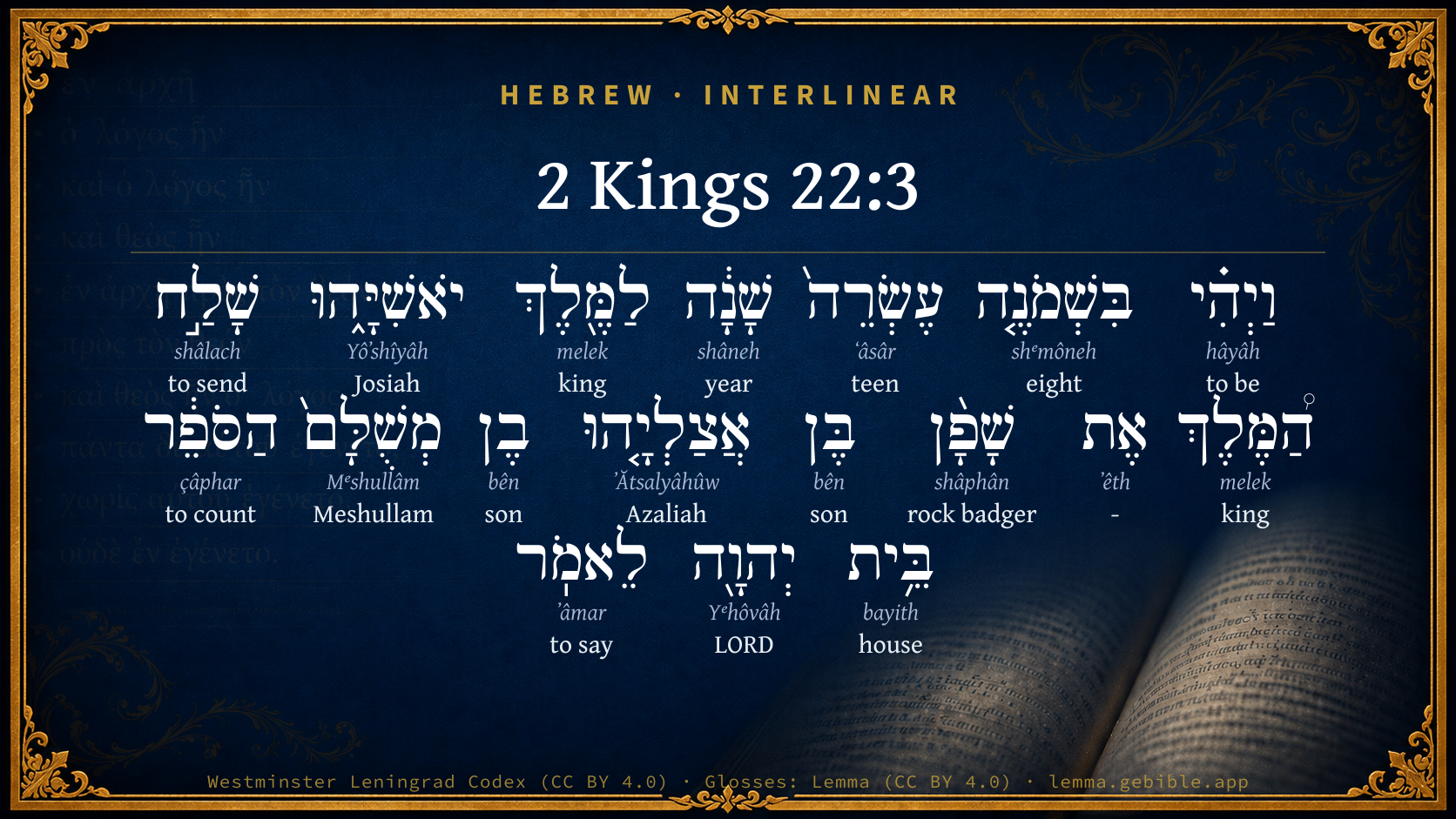
2 Kings 22:3

Hebrew (Westminster Leningrad Codex) 2 Kings 22:3 appears in the Hebrew Old Testament. The text above is from the Westminster Leningrad Codex. Each word links to its Strong’s number, a concise gloss, and parsing drawn from the Open Scriptures Hebrew Bible morphology. Click any word for its full Brown-Driver-Briggs (BDB) entry.
Download image
Cite this verse

2 Kings 22:3 (World English Bible). Public Domain. Lemma interlinear Bible study tool, https://lemma.gebible.app/v/2-kings/22/3.

Show BibTeX & RIS
BibTeX
RIS
English Translation
It happened in the eighteenth year of king Josiah, that the king sent Shaphan, the son of Azaliah the son of Meshullam, the scribe, to the house of Yahweh, saying,
World English Bible · Public Domain
Highlights
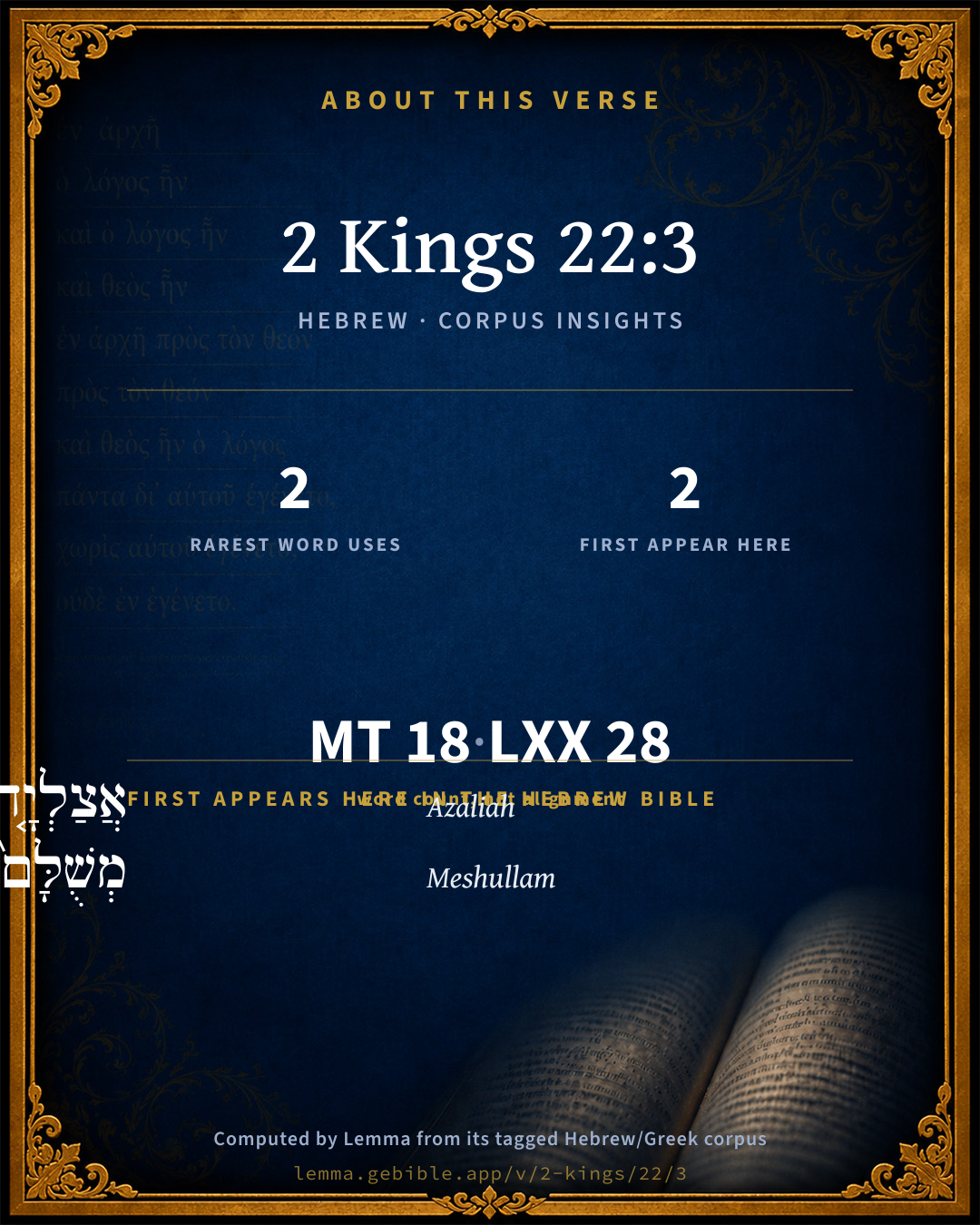
  • 2 first appearances in the Hebrew Bible
Full analysis ↓
Download a study sheet

One document with this verse’s original text, its word-by-word gloss line, the meaning frame, cross-references with their text, attributed commentary, and full source and license credits — printable, and it pastes into notes with its structure intact.

This verse Autodidact and up

Study sheet (.html) Plain text (.txt)

A passage Seminary Student

Up to 50 verses in one chapter. A passage sheet keeps up to 6 commentary sources and 12 cross-references per verse, in the order this page ranks them, and says so on the sheet whenever that leaves anything out. Ask for a single verse and you get the Autodidact verse sheet above.

Everything on this page stays free to read, with no account — the sheet is a download of what is already on screen, not access to it.

Want to remove ads? Support Godless Engineer
Compare translations 3

The same verse in 3 English versions, stacked beneath the original-language interlinear above. Click any original word for its lexicon entry.

Each is an independent rendering of the whole verse — the interlinear is not word-aligned to these translations.

Highlighted words mark where these versions differ — a whole-verse word diff, not a word-by-word alignment.

  • World English Bible Public Domain
    It happened in the eighteenth year of king Josiah, that the king sent Shaphan, the son of Azaliah the son of Meshullam, the scribe, to the house of Yahweh, saying,
  • King James Version Public Domain
    And it came to pass in the eighteenth year of king Josiah, that the king sent Shaphan the son of Azaliah, the son of Meshullam, the scribe, to the house of the LORD, saying,
  • unfoldingWord Literal Text CC BY-SA 4.0
    And it happened in the eighteenth year of King Josiah, the king sent Shaphan, the son of Azaliah, the son of Meshullam, the scribe, to the house of Yahweh, saying,

unfoldingWord Literal Text — © unfoldingWord, licensed CC BY-SA 4.0. Word-aligned USFM3 via Door43 (git.door43.org/unfoldingWord/en_ult).

Versions to compare (up to 4)

3 of 4 selected

Show all 18 translations

Every available English version of this verse, each an independent rendering of the whole verse.

  • World English Bible Public Domain
    It happened in the eighteenth year of king Josiah, that the king sent Shaphan, the son of Azaliah the son of Meshullam, the scribe, to the house of Yahweh, saying,
  • Berean Standard Bible Public Domain
    Now in the eighteenth year of his reign, King Josiah sent the scribe, Shaphan son of Azaliah, the son of Meshullam, to the house of the LORD, saying,
  • Majority Standard Bible Public Domain
    Now in the eighteenth year of his reign, King Josiah sent the scribe, Shaphan son of Azaliah, the son of Meshullam, to the house of the LORD, saying,
  • King James Version Public Domain
    And it came to pass in the eighteenth year of king Josiah, that the king sent Shaphan the son of Azaliah, the son of Meshullam, the scribe, to the house of the LORD, saying,
  • American Standard Version (1901) Public Domain
    And it came to pass in the eighteenth year of king Josiah, that the king sent Shaphan, the son of Azaliah the son of Meshullam, the scribe, to the house of Jehovah, saying,
  • Revised Version (1885) Public Domain
    And it came to pass in the eighteenth year of king Josiah, that the king sent Shaphan the son of Azaliah, the son of Meshullam, the scribe, to the house of the LORD, saying,
  • Geneva Bible (1599) Public Domain
    And in the eighteenth yeere of King Iosiah, the King sent Shaphan the sonne of Azaliah the sonne of Meshullam the chanceller to ye house of the Lord, saying,
  • Douay-Rheims (1899) Public Domain
    And in the eighteenth year of b king Josias, the king sent Saphan the son of Assia, the son of Messulam, the scribe of the temple of the Lord, saying to him:
  • Young's Literal Translation Public Domain
    And it cometh to pass, in the eighteenth year of king Josiah, the king hath sent Shaphan son of Azaliah, son of Meshullam, the scribe, to the house of Jehovah, saying,
  • Literal Standard Version CC BY-SA 4.0
    And it comes to pass, in the eighteenth year of King Josiah, the king has sent Shaphan son of Azaliah, son of Meshullam, the scribe, to the house of YHWH, saying,
  • Unlocked Literal Bible CC BY-SA 4.0
    It came about that in the eighteenth year of King Josiah, he sent Shaphan son of Azaliah son of Meshullam, the scribe, to the house of Yahweh, saying,
  • unfoldingWord Literal Text CC BY-SA 4.0
    And it happened in the eighteenth year of King Josiah, the king sent Shaphan, the son of Azaliah, the son of Meshullam, the scribe, to the house of Yahweh, saying,
  • Darby Bible Public Domain
    And it came to pass in the eighteenth year of king Josiah, [that] the king sent Shaphan the son of Azaliah, son of Meshullam, the scribe, to the house of Jehovah, saying,
  • World Messianic Bible Public Domain
    In the eighteenth year of King Josiah, the king sent Shaphan, the son of Azaliah the son of Meshullam, the scribe, to the LORD’s house, saying,
  • Webster's Bible Public Domain
    And it came to pass in the eighteenth year of king Josiah, that the king sent Shaphan the son of Azaliah, the son of Meshullam, the scribe, to the house of the LORD, saying,
  • Free Bible Version CC BY-SA 4.0
    In the eighteenth year of his reign, Josiah sent Shaphan, son of Azaliah, son of Meshullam, to the Lord's Temple. He said,
  • Bible in Basic English Public Domain
    Now in the eighteenth year after he became king, Josiah sent Shaphan, the son of Azaliah, the son of Meshullam, the scribe, to the house of the Lord, saying to him,
  • JPS Tanakh (1917) Public Domain
    And it came to pass in the eighteenth year of king Josiah, that the king sent Shaphan the son of Azaliah, the son of Meshullam, the scribe, to the house of the LORD, saying.

Literal Standard Version (2020), Covenant Press — licensed CC BY-SA 4.0. Text via the HelloAO Bible API (eBible.org). Unlocked Literal Bible (unfoldingWord) — licensed CC BY-SA 4.0. Text via the HelloAO Bible API (eBible.org). unfoldingWord Literal Text — © unfoldingWord, licensed CC BY-SA 4.0. Word-aligned USFM3 via Door43 (git.door43.org/unfoldingWord/en_ult). Free Bible Version, Dr. Jonathan Gallagher — licensed CC BY-SA 4.0. Text via the HelloAO Bible API (eBible.org).

Word by word

More ways to search: Search by grammar → Find every occurrence → Compare this word →

Practice this passage: Drill this verse → Learn its vocabulary →

אֲצַלְיָ֤הוּ
ʼĂtsalyâhûw
H683
“Azaliah”
Noun, Proper
Part of Speech
Noun
Type
Proper
Full BDB Definition

Origin: from H680 and H3050 prolonged

TWOT: None

Azaliah = "Jehovah (Yahweh) has reserved (set apart)" - the father of Shaphan the scribe
  1. וַיְהִ֗י hâyâh H1961 “and · to be” Conjunction + Verb, Qal, Sequential Imperfect, 3rd Person, Masculine, Singular
  2. בִּשְׁמֹנֶ֤ה shᵉmôneh H8083 “in/at · eight” Preposition + Adjective, Cardinal number, Feminine, Singular, Absolute
  3. עֶשְׂרֵה֙ ʻâsâr H6240 “teen” Adjective, Cardinal number, Feminine, Singular, Absolute
  4. שָׁנָ֔ה shâneh H8141 “year” Noun, Common, Feminine, Singular, Absolute
  5. לַמֶּ֖לֶךְ melek H4428 “to/for the · king” Preposition, Determined + Noun, Common, Masculine, Singular, Absolute
  6. יֹאשִׁיָּ֑הוּ Yôʼshîyâh H2977 “Josiah” Noun, Proper
  7. שָׁלַ֣ח shâlach H7971 “to send” Verb, Qal, Perfect, 3rd Person, Masculine, Singular
  8. הַ֠מֶּלֶךְ melek H4428 “the · king” Particle, Definite Article + Noun, Common, Masculine, Singular, Absolute
  9. אֶת ʼêth H853 “-” Particle, Direct Object
  10. שָׁפָ֨ן shâphân H8227 “rock badger” Noun, Proper
  11. בֶּן bên H1121 “son of” Noun, Common, Masculine, Singular, Construct
  12. בֶן bên H1121 “son of” Noun, Common, Masculine, Singular, Construct
  13. מְשֻׁלָּם֙ Mᵉshullâm H4918 “Meshullam” Noun, Proper
  14. הַסֹּפֵ֔ר çâphar H5608 “the · scribe” Particle, Definite Article + Noun, Common, Masculine, Singular, Absolute
  15. בֵּ֥ית bayith H1004 “house of” Noun, Common, Masculine, Singular, Construct
  16. יְהוָ֖ה Yᵉhôvâh H3068 “LORD” Noun, Proper
  17. לֵאמֹֽר ʼâmar H559 “to say” Preposition + Verb, Qal, Infinitive Construct

About this verse

These counts appear in no published source. They are computed here, from the morphology-tagged text and Lemma’s own curated glosses. What Lemma adds →

18
words
16
distinct lemmas
Historical
section

Notable vocabulary

The rarest word here is אֲצַלְיָ֤הוּ Azaliah H683 — appearing just 2 times in the whole Hebrew Bible.

First appearance in Scripture

These words make their first canonical appearance in the Hebrew Bible here:

  • אֲצַלְיָ֤הוּ Azaliah H683
  • מְשֻׁלָּם֙ Meshullam H4918

Shared distinctive vocabulary

אֲצַלְיָ֤הוּ Azaliah H683 occurs in 2 verses of the Hebrew Bible. Also found in:

Grammatical profile

  • 3 verbs
  • 12 nouns
  • 2 adjectives
  • 1 particle

Verb forms

  • וַיְהִ֗י Qal · Sequential Imperfect
  • שָׁלַ֣ח Qal · Perfect
  • לֵאמֹֽר Qal · Infinitive Construct

Repetition

Words recur within this verse — often emphatic in Hebrew:

  • לַמֶּ֖לֶךְ king H4428 ×2
  • בֶּן son H1121 ×2

Hebrew & Septuagint length

In English translation the verse runs 30 words from the Hebrew and 37 from the Septuagint (LXX English) — closely comparable.

A rough comparison of the two English renderings, which tokenize alike — not a word-level alignment.

Word counts can differ between the Hebrew and the Greek without any difference in meaning — e.g. the Hebrew direct-object marker אֵת has no separate Greek word, and Greek often adds the article ὁ.

In the original languages it is 18 Hebrew tokens and 28 Greek tokens — but the two are counted differently (Hebrew bundles its prefixes and suffixes into one token; the Greek is in lemma form), so that isn’t a like-for-like length.

Cross-references

1

Topical passages linked to 2 Kings 22:3 in the Treasury of Scripture Knowledge — connected by theme and wording, ordered by reader-vote popularity; previews shown in the World English Bible.

  • 2 Chronicles 34:3–33 For in the eighth year of his reign, while he was yet young, he began to seek after the God of David his father; and in the twelfth year he began to purge Judah and Jerusalem from the high places, and the Asherim, and the engraved images, and the molten images.

Cross-references courtesy of OpenBible.info (CC BY 4.0).

Hebrew and Greek witnesses Masoretic Hebrew ↔ Greek Septuagint

The same verse in the two great witnesses to the Old Testament, shown verse-for-verse.

These are two independent witnesses, not word-aligned to each other, and the Septuagint is shown in lemma (dictionary) form.

Hebrew 2 Kings 22:3 Masoretic · Westminster Leningrad Codex

וַיְהִ֗י בִּשְׁמֹנֶ֤ה עֶשְׂרֵה֙ שָׁנָ֔ה לַמֶּ֖לֶךְ יֹאשִׁיָּ֑הוּ שָׁלַ֣ח הַ֠מֶּלֶךְ אֶת שָׁפָ֨ן בֶּן אֲצַלְיָ֤הוּ בֶן מְשֻׁלָּם֙ הַסֹּפֵ֔ר בֵּ֥ית יְהוָ֖ה לֵאמֹֽר

It happened in the eighteenth year of king Josiah, that the king sent Shaphan, the son of Azaliah the son of Meshullam, the scribe, to the house of Yahweh, saying,

World English Bible · Public Domain

Greek LXX 2 Kings 22:3 Septuagint · lemma form

καί γίγνομαι ἐν ὁ ὀκτωκαιδέκατος ἔτος ὁ βασιλεύς ιωσιας ἐν ὁ μήν ὁ ὄγδοος ἀποστέλλω ὁ βασιλεύς ὁ σαφφαν υἱός εσελιας υἱός μεσολλαμ ὁ γραμματεύς οἶκος κύριος λέγω

And it came to pass in the eighteenth year of king Josias, in the eighth month, the king sent Sapphan the son of Ezelias the son of Mesollam, the scribe of the house of the Lord, saying,

LXX2012 (modern English Septuagint) · Public Domain

On this verse, Ellicott's Commentary for English Readers discusses the Septuagint’s reading. Read the note in Commentary ↓

Hebrew: Westminster Leningrad Codex (CC BY 4.0). Greek: Septuagint (public domain); English from LXX2012 (modern English Septuagint) (Public Domain). How the Septuagint differs from the Hebrew →

Targum (Aramaic paraphrase)

1

The Targum is the ancient Jewish Aramaic paraphrase of the Hebrew Scriptures — an interpretive translation, not the Hebrew text itself. Onkelos (literal) and Pseudo-Jonathan (expansive) render the Torah, and Jonathan the Prophets. Coverage is partial: where no permissively-licensed English translation exists for a verse, only the Aramaic is shown. This is verse-level text, not a word-by-word alignment to the Hebrew.

  1. Targum Jonathan Prophets (Joshua–Malachi)
    וַהֲוָה בְּתַמְנֵי עַסְרֵי שְׁנִין לְמַלְכָּא יֹאשִׁיָהוּ שְׁלַח מַלְכָּא יַת שָׁפָן בַּר אֲצַלְיָה בַר מְשֻׁלָם סַפְרָא לְבֵית מַקְדְשָׁא דַייָ לְמֵימָר:

    (no public-domain English translation for this verse)

    Targum Jonathan — Aramaic: “Mikraot Gedolot” (public domain). English: “Sefaria Community Translation” (CC0 1.0 (public-domain dedication)); “London "Chaldee Paraphrase," 1871” (public domain). Text via Sefaria.

Commentary

Notes on 2 Kings 22:3 from classic Christian and Jewish commentators (each source and its license shown beneath its notes). The classic Christian expositions comment on the surrounding passage and are grouped to its opening verse, so a note may address several verses; the Jewish commentaries on the Tanakh (Rashi and others) are per-verse, so they appear only where the commentator wrote on this verse.

Lemma curates 59 commentaries, every one of them public domain or Creative Commons licensed, each selected and text-cleaned for this edition rather than reprinted as found. About our sources →

Jamieson, Fausset & Brown

Robert Jamieson, A. R. Fausset & David Brown

HE PROVIDES FOR THE REPAIR OF THE TEMPLE. (Kg2 22:3-7)

in the eighteenth year of king Josiah--Previous to this period, he had commenced the work of national reformation. The preliminary steps had been already taken; not only the builders were employed, but money had been brought by all the people and received by the Levites at the door, and various other preparations had been made. But the course of this narrative turns on one interesting incident which happened in the eighteenth year of Josiah's reign, and hence that date is specified. In fact the whole land was thoroughly purified from every object and all traces of idolatry. The king now addressed himself to the repair and embellishment of the temple and gave directions to Hilkiah the high priest to take a general survey, in order to ascertain what was necessary to be done (see on Ch2 34:8-15).

Jamieson, Fausset & Brown — Commentary Critical and Explanatory on the Whole Bible (1871) — public domain (CC PDM 1.0). Text via the HelloAO Bible API.

Trapp's Complete Commentary

John Trapp

2Ki 22:3 And it came to pass in the eighteenth year of king Josiah, [that] the king sent Shaphan the son of Azaliah, the son of Meshullam, the scribe, to the house of the LORD, saying,

Ver. 3. In the eighteenth year of king Josiah.] That is, In the eighteenth year of his reign; after that, with a great deal of zeal, he had purged the land and the house. {2Ch 34:8} In which time also it seemeth that a collection was made for the repairing of the temple, which now this pious king taketh order to have done, and herein he proceedeth aequabiliter, iuste, prudenter. {a} And from this famous eighteenth year of Josiah’s reign, both those thirty years, {Eze 1:1} and those forty days or years of the sin of Judah, {Eze 6:6} seem to take their rise and reckoning.

{a} Ussher., Annal. Vet. Testam., p. 115.

John Trapp, A Commentary or Exposition upon All the Books of the Old and New Testament (1647–1656) — public domain. Text from a community e-Sword module.

Joseph Benson's Commentary

2Ki 22:3-4. In the eighteenth year of King Josiah — Not of his life, but of his reign, as it is expressed, 2Ch 34:3; 2Ch 34:8. The king sent Shaphan — The secretary of state; saying, Go up to Hilkiah, that he may sum the silver — Take an exact account how much it is, and then dispose of it in the manner following. Which the keepers of the door have gathered — Who were priests or Levites, 2Ki 8:9; 2Ch 8:14. It seems, they took much the same way of raising the money that Joash took, 2Ki 12:9. The people giving by a little at a time, the burden was not felt, and giving by voluntary contribution, it was not complained of. This money, so collected, he ordered Hilkiah to lay out for the repairs of the temple, 2Ki 22:5-6. And now the workmen, as in the days of Joash, acquitted themselves so well, that there was no reckoning made with them. This is certainly mentioned to the praise of the workmen, that they gained such a reputation for honesty, but whether to the praise of them that employed them may well be doubted. Many will think it would not have been amiss to have reckoned with them, had it been only that others might be satisfied.

Joseph Benson's Commentary on the Old and New Testaments (1811–1818) — public domain. Text from a community e-Sword module.

Whedon's Commentary on the Bible

Daniel D. Whedon

PREPARATIONS MADE TO REPAIR THE TEMPLE, 2Ki_22:3-7.

3. The eighteenth year of king Josiah — This is a memorable date, and made especially prominent by the writer of Kings, because it was in this year that the book of the law was discovered, and the celebrated passover held. Hence he repeats the mention of this date in 2Ki_23:23, and seems to fasten all his narrative upon it. But from the parallel history in 2 Chronicles 34, 35, we learn that in his eighth year Josiah “began to seek after the God of his father David,” and in his twelfth year he began to destroy the idolatrous images not only in “Judah and Jerusalem,” but also “in the cities of Manasseh, and Ephraim, and Simeon, even unto Naphtali.” Hence we conclude that various reforms and extensive destruction of images were commenced by Josiah before this eighteenth year, but after the discovery of the law the work was carried out with far greater zeal and thoroughness.

Shaphan… the scribe — He was also the father of Ahikam, mentioned 2Ki_22:12; 2Ki_22:14. On the office and work of scribe, see note on 2Sa_8:17.

Daniel D. Whedon (gen. ed.), Commentary on the Old and New Testaments (1874–1909) — public domain. Text from a community e-Sword module.

Keil & Delitzsch

C. F. Keil & F. Delitzsch

Repairing of the temple, and discovery of the book of the law (cf. Ch2 34:8-18). - When Josiah sent Shaphan the secretary of state (סופר, see at Sa2 8:17) into the temple, in the eighteenth year of his reign, with instructions to Hilkiah the high priest to pay to the builders the money which had been collected from the people for repairing the temple by the Levites who kept the door, Hilkiah said to Shaphan, "I have found the book of the law." Kg2 22:3-8 form a long period. The apodosis to וגו ויהי, "it came to pass in the eighteenth year of king Josiah-the king had sent Shaphan," etc., does not follow till Kg2 22:8 : "that Hilkiah said," etc. The principal fact which the historian wished to relate, was the discovery of the book of the law; and the repairing of the temple is simply mentioned because it was when Shaphan was sent to Hilkiah about the payment of the money to the builders that the high priest informed the king's secretary of state of the discovery of the book of the law in the temple, and handed it over to him to take to the king. המּלך שׁלח, in Kg2 22:3, forms the commencement to the minor clauses inserted within the principal clause, and subordinate to it: "the king had sent Shaphan," etc. According to Ch2 34:8, the king had deputed not only Shaphan the state-secretary, but also Maaseiah the governor of the city and Joach the chancellor, because the repairing of the temple was not a private affair of the king and the high priest, but concerned the city generally, and indeed the whole kingdom. In Kg2 22:4, Kg2 22:5 there follows the charge given by the king to Shaphan: "Go up to Hilkiah the high priest, that he may make up the money, ... and hand it over to the workmen appointed over the house of Jehovah," etc. יתּם, from תּמם, Hiphil, signifies to finish or set right, i.e., not pay out (Ges., Dietr.), but make it up for the purpose of paying out, namely, collect it from the door-keepers, count it, and bind it up in bags (see Kg2 12:11). יתּם is therefore quite appropriate here, and there is no alteration of the text required. The door-keepers had probably put the money in a chest placed at the entrance, as was the case at the repairing of the temple in the time of Joash (Kg2 12:10). In Kg2 22:5 the Keri יתנהוּ is a bad alteration of the Chethb יתנה, "and give (it) into the hand," which is perfectly correct. המּלאכה עשׁי might denote both the masters and the workmen (builders), and is therefore defined more precisely first of all by יי בּבית המּפקדים, "who had the oversight at the house of Jehovah," i.e., the masters or inspectors of the building, and secondly by יי בּבית אשׁר, who were (occupied) at the house of Jehovah, whilst in the Chronicles it is explained by י עשׂים ב אשׁר. The Keri יי בּית is an alteration after Kg2 22:9, whereas the combination בּבית מפקדים is justified by the construction of הפקיד c. acc. pers. and בּ rei in Jer 40:5. The masters are the subject to ויתּנוּ; they were to pay the money as it was wanted, either to the workmen, or for the purchase of materials for repairing the dilapidations, as is more precisely defined in Kg2 22:6. Compare Kg2 12:12-13; and for Kg2 22:7 compare Kg2 12:16. The names of the masters or inspectors are given in Ch2 34:12. - The execution of the king's command is not specially mentioned, that the parenthesis may not be spun out any further.

Keil & Delitzsch — Biblical Commentary on the Old Testament (1861–1891) — public domain (CC PDM 1.0). Text via the HelloAO Bible API. (Old Testament only.)

Tyndale Open Study Notes

Tyndale Open Resources

22:3-4 By the eighteenth year of his reign (621 BC), Josiah had been devoted to the Lord for ten years (see 2 Chr 34:3-7). • Hilkiah the high priest was from the line of Zadok (1 Chr 9:10-11). Some scholars suggest that this Hilkiah was Jeremiah’s father (Jer 1:1). • Apparently the money was collected in a large chest convenient to the people as they came to the Temple (cp. 12:9).

Tyndale Open Study Notes — © Tyndale Open Resources, licensed CC BY-SA 4.0. Text via the HelloAO Bible API.

Ellicott's Commentary for English Readers

(3) In the eighteenth year.—See the Notes on 2Ch_34:3, seq. The discourses of Jeremiah, who began his prophetic ministry in the thirteenth year of Josiah, to which Thenius refers as incomprehensible on the assumption that idolatry was extirpated throughout the country in the twelfth year of this king, would be quite reconcilable even with that assumption, which, however, it is not necessary to make, as is shown in the Notes on Chronicles. Josiah did not succeed, any more than Hezekiah, in rooting out the spirit of apostasy. (See Jer_2:1; Jer_4:2). The young king was, no doubt influenced for good by the discourses of Jeremiah and Zephaniah; but it is not easy to account for his heeding the prophetic teachings, considering that, as the grandson of a Manasseh and the son of an Amon he must have been brought up under precisely opposite influences (Thenius).

The king sent Shaphan . . . the scribe.—Chronicles mentions beside Maaseiah, the governor of the city, and Joah the recorder. Thenius pronounces these personages fictitious, because (1) only the scribe is mentioned in 2Ki_12:10 (?); (2) Joshua was the then governor of the city (but this is not quite clear: the Joshua of 2Ki_23:8 may have been a former governor; or, as Maaseiah and Joshua are very much alike in Hebrew, one name may be a corruption of the other); (3) Maaseiah seems to have been manufactured out of the Asahiah of 2Ki_22:12 (but Asahiah is mentioned as a distinct person in 2Ch_34:20); and (4) Joah the recorder seems to have been borrowed from 2Ki_18:18 (as if anything could be inferred from a recurrence of the same name; and that probably in the same family !). Upon such a basis of mere conjecture, the inference is raised that the chronicler invented these names, in order “to give a colour of genuine history to his narrative.” It is obvious to reply that Shaphan only is mentioned here, as the chief man in the business. (Comp, also 2Ki_18:17; 2Ki_19:8).

Go up to Hilkiah the priest.—The account of the repair of the Temple under Josiah naturally resembles that of the same proceeding under Joash (2Ki_12:10, seq.) More than 200 years had since elapsed, so that the fabric might well stand in need of repair, apart from the defacements which it had undergone at the hands of heathenish princes (2Ch_34:2). The text does not say that the repair of the Temple had been “longtemps négligée par l’incurie des prêtres” (Reuss),

Hilkiah.—See 1Ch_6:13 for this high priest. He is a different person from Hilkiah, the father of Jeremiah, who was a priest, but not high priest (Jer_1:1).

That he may sum—i.e., make up, ascertain the amount of . . . The LXX. reads, seal up (σφράγισον), which implies a Hebrew verb, of which that in the present Hebrew text might be a corruption.

Which the keepers of the door.—See the Notes on 2Ki_12:9; 2Ki_12:11-12, as to the contents of this and the next verse.

A Bible Commentary for English Readers, edited by Charles John Ellicott (1878–1897) — public domain. Text from a community e-Sword module.

The Cambridge Bible for Schools and Colleges

gen. ed. J. J. S. Perowne

3. And it came to pass in the eighteenth year] The Chronicler gives two dates anterior to this for events in the course of Josiah’s life. He says (2Ch_34:3-7 R.V.) ‘In the eighth year of his reign while he was yet young, he began to seek after the God of David his father, and in the twelfth year he began to purge Judah and Jerusalem from the high places, and the Asherim, and the graven images and the molten images. And they brake down the altars of the Baalim in his presence, and the sun-images that were on high above them he hewed down, and the Asherim and the graven images and the molten images he brake in pieces, and made dust of them and strewed it upon the graves of them that had sacrificed unto them. And he burnt the bones of the priests upon their altars and purged Judah and Jerusalem. And so did he in the cities of Manasseh and Ephraim and Simeon, even unto Naphtali, in their ruins round about. And he brake down the altars and beat the Asherim and the graven images into powder, and hewed down all the sun-images throughout all the land of Israel, and returned to Jerusalem’. It is clear that we have here, a most comprehensive summary of the destruction of idolatry in the whole of Josiah’s reign and not what he began to do in his twelfth year. The Chronicler however having given us the date at which Josiah first manifested his disposition to destroy the idols out of the land, includes in the same sentences all that was done by the king in the after part of his reign. We cannot but think that the chief impulse toward the utter destruction of the idols was given, as the writer of Kings tells us (2Ki_23:3) when the king made a covenant to walk after the Lord, according to the words of the book of the Law, and all the people stood to the covenant. Then began the extermination of all remaining traces of idolatry, which the king himself had begun to remove in some degree in his twelfth year.

The LXX. adds to the date given in this verse, ἐν τῷ μηνὶ τῷ ὀγδόῳ, ‘in the eighth month’, but with no warrant from the original.

the king sent Shaphan … the scribe] The event on which all else in Josiah’s reformation seems to hinge is the restoration of the temple. There it was that the book of the Law was discovered which stirred both king and people to attempt a thorough reformation. Therefore the writer of Kings passes to that undertaking without pausing over minor matters which preceded it.

Shaphan … the scribe] Shaphan whose father and grandfather are here mentioned, was the father of Ahikam mentioned below (verse 12) and of Gemariah (Jer_36:10-12), and the grandfather of Gedaliah (Jer_39:14; Jer_40:5; Jer_40:9; Jer_40:11, &c.). The office of Scribe in his time was clearly an important one. He is sent by the king to take oversight of the funds for the restoration of the temple, and seems to have ranked with the governor of the city and the recorder. We have no notice of Shaphan’s afterlife. He must have been advanced in years at this time, for thirty-five years after this date his grandson Gedaliah was set by the Chaldæans to be governor of the country.

The Cambridge Bible for Schools and Colleges (gen. ed. J. J. S. Perowne; Cambridge University Press, 1878–1918) — public domain. Text from a community e-Sword module.

John Gill's Exposition

And it came to pass in the eighteenth year of King Josiah,.... Not of his age, but of his reign, as appears from Ch2 34:8 nor is what follows the first remarkable act he did in a religious way; for elsewhere we read of what he did in the eighth and twelfth years of his reign, Ch2 34:3,

that the king sent Shaphan the son of Azaliah, the son of Meshullam the scribe, to the house of the Lord; the king's secretary; the Septuagint version is, the scribe of the house of the Lord, and so the Vulgate Latin version; that kept the account of the expenses of the temple; with him two others were sent, Ch2 34:8,

saying: as follows.

John Gill's Exposition of the Whole Bible (1746–1763) — public domain (CC PDM 1.0). Text via the HelloAO Bible API.

Albert Barnes' Notes on the Bible

In the eighteenth year - This is the date of the finding of the Book of the Law and of the Passover (marginal reference, and 2Ki 23:23), but is not meant to apply to all the various reforms of Josiah as related in 2 Kings 23:4-20. The true chronology of Josiah’s reign is to be learned from 2Ch 34:3-8; 2Ch 35:1. From these places it appear that at least the greater part of his reforms preceded the finding of the Book of the Law. He began them in the 12th year of his reign, at the age of 20, and had accomplishied all, or the greater part, by his 18th year, when the Book of the Law was found.

Shaphan is mentioned frequently by Jeremiah. He was the father of Ahikam, Jeremiah’s friend and protector at the court of Jehoiakim Jer 26:24, and the grandfather of Gedaliah, who was made governor of Judaea by the Babylonians after the destruction of Jeruslem 2Ki 25:22. Several others of his sons and grandsons were in favor with the later Jewish kings Jer 29:3; Jer 36:10-12, Jer 36:25; Eze 8:11. Shaphan’s office was one of great importance, involving very confidential relations with the king 1Ki 4:3.

Albert Barnes' Notes on the Bible (1834–1885) — public domain. Text from a community e-Sword/MySword module.

Haydock's Catholic Bible Commentary

Scribe of. Hebrew, "to the temple." (Chaldean; Syriac, &c.) It is not certain that there was such an officer as scribe of the temple; but the king’s secretary was ordered by Joas to take an account of the money contributed, chap. xii. 10. (Calmet) --- Josias followed the same plan. (Tirinus)

George Leo Haydock (1774–1849), Haydock's Catholic Family Bible and Commentary, 1859 edition — public domain. Excludes Psalms (Douay-Rheims chapter numbering differs from Protestant) and Deuterocanonical books (Catholic canon only).

Matthew Poole's English Annotations

In the eighteenth year, not of his life, but of his reign, as it is expressed, 2Ch 34:3,8. What he did before this time, see 2Ch 34:3, &c. The scribe; the king’s secretary.

Matthew Poole's English Annotations on the Holy Bible (1683–1685) — public domain. Text from a community e-Sword/MySword module.

The Pulpit Commentary

And it came to pass in the eighteenth year of King Josiah. (2Ch_34:8) The writer of Kings, bent on abbreviating as much as possible, omits the early reforms of Josiah, which are related in 2Ch_34:3-7, with perhaps some anticipation of what happened later. The young king gave marked indications of personal piety and attachment to true religion as early as the eighth year of his reign, when he was sixteen, and had just attained his majority (Ewald, "History of Israel," vol. 4. p. 232, note). Later, in his twelfth year, he began the purging of the temple and of Jerusalem, at the same time probably commencing the repairs spoken of in ver. 9. Jeremiah"s prophesying, begun in the same or in the next year, (Jer_1:2) must have been a powerful assistance to his reformation. That the king sent Shaphan the son of Azaliah, the son of Meshullam, the scribe, to the house of the Lord, saying. Shaphan held the office, which Shebna had held in the later part of Hezekiah"s reign, (2Ki_18:18) an office of much importance and dignity. According to the author of Chronicles, (2Ch_34:8) there were associated with him on this occasion two other personages of importance, viz. Maaseiah, the governor of the city, (comp. 1Ki_22:26) and Joah the son of Joahaz, the "recorder," or "remembrancer."

The Pulpit Commentary (1880–1919), ed. H.D.M. Spence-Jones & Joseph S. Exell — public domain. Text from a community e-Sword module.

John Wesley's Explanatory Notes

The scribe - The secretary of state.

John Wesley, Explanatory Notes Upon the Whole Bible (1754–1765) — public domain. Text via the GEBible commentary corpus.

unfoldingWord translationNotes

Door43 World Missions Community

It came about that

If your language has a way to mark the beginning of a new part of the story, consider using it here.

the eighteenth year

"Eighteenth" is the ordinal form of 18. AT: "year 18" (See: Ordinal Numbers)

Shaphan ... Azaliah ... Meshullam ... Hilkiah

These are men's names. (See: How to Translate Names)

house of Yahweh ... in the temple

Here "house of Yahweh" and "temple" mean the same thing.

Go up to Hilkiah

The phrase "Go up" is used because Yahweh's temple was higher in elevation than where King Josiah was located. AT: "Go to Hilkiah"

that has been brought into the house of Yahweh, which the temple guards have gathered from the people

This can be stated in active form. AT: "that the temple guards who gathered the money from the people brought into the temple of Yahweh" (See: Active or Passive)

Let it be given into the hand of the workmen

Here "hand" represents the workmen as a whole. This can be stated in active form. AT: "Tell Hilkiah to give the money to the workmen" (See: Synecdoche and Active or Passive)

translationWords

king

scribe

house of God

high priest

temple

unfoldingWord translationNotes — © Distant Shores Media and the Door43 World Missions Community, licensed CC BY-SA 4.0. Source: git.door43.org/Door43/en_tn.

Lesson kit

Teaching starters — assembled from the data on this page, not authored interpretation. Every prompt links to the verse data it draws on. Edit before teaching.

2 Kings, in the Historical, opens this verse with 18 words (16 distinct Hebrew lemmas). Its most distinctive word is ʼĂtsalyâhûw (“Azaliah”). A historical commentator’s framing appears above. Read the whole chapter for the surrounding context.

Discussion questions

  1. The word ʼĂtsalyâhûw carries the sense “Azaliah.” How does it shape the verse?
  2. 2 words make their first appearance in Scripture here. What does this debut establish?
  3. How does 2 Chronicles 34:8, which shares the word «Azaliah», read alongside this verse?
  4. What does the repetition of “king” (2× in this one verse) do in this verse?
  5. These translations render this verse differently. What is at stake in choosing one wording over another?
  6. «וַיְהִ֗י» is a Qal Sequential Imperfect verb. How does that grammatical form shape the action described?
  7. Compare how Jamieson, Fausset & Brown and Trapp's Complete Commentary read this verse. Where do they agree or differ?

Things to notice

Reading settings

Reading text

Shown beneath each verse's original-language words.

Old Testament
Old Testament edition

Read the OT as the Masoretic Hebrew (MT) or the Greek Septuagint (LXX).

English shown for the Greek Septuagint (in the Hebrew ↔ Greek comparison).

Comparing translations? Open the Compare panel on any verse page to stack up to four side by side.