2 Kings 15:37

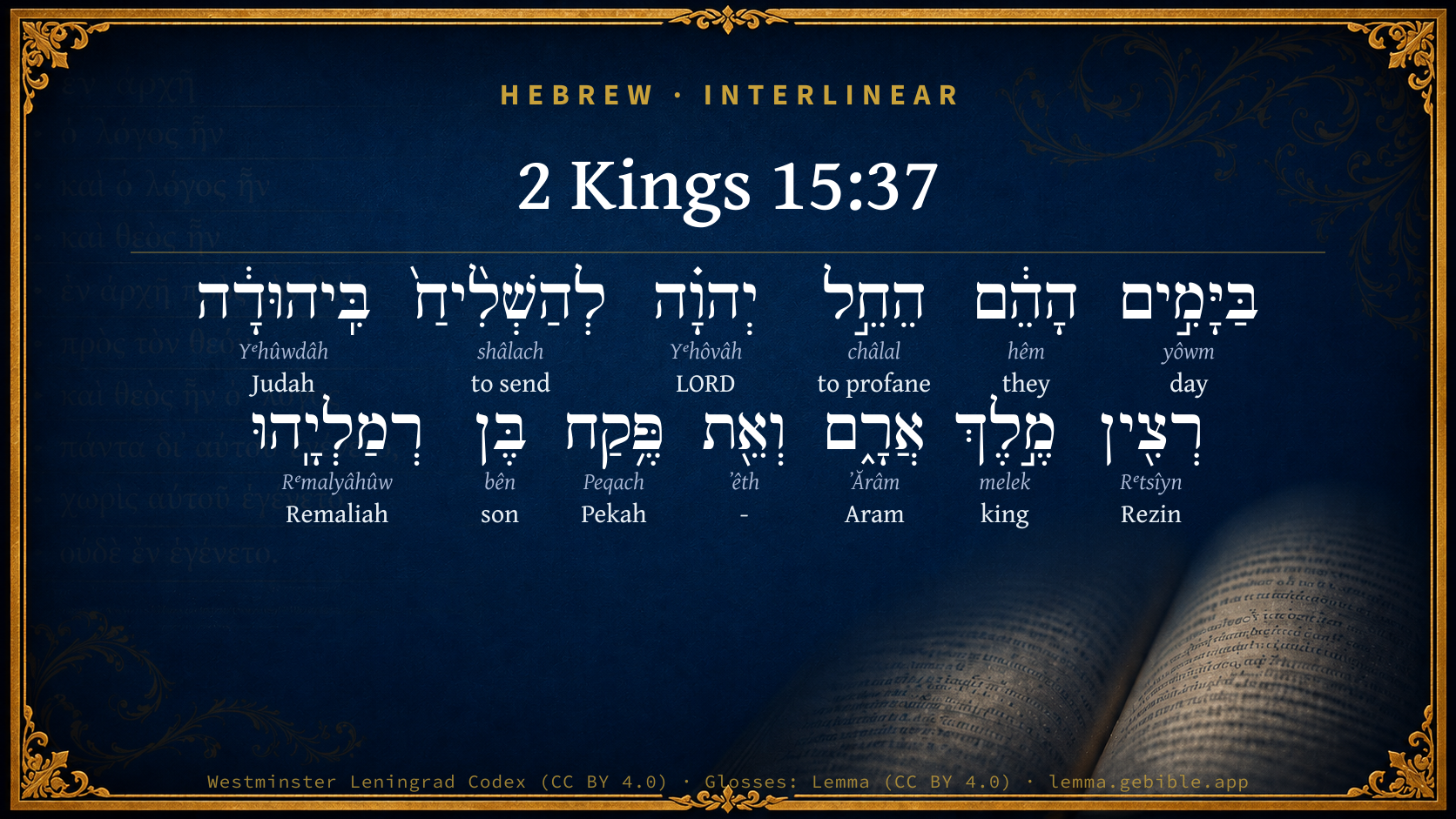
Hebrew (Westminster Leningrad Codex) 2 Kings 15:37 appears in the Hebrew Old Testament. The text above is from the Westminster Leningrad Codex. Each word links to its Strong’s number, a concise gloss, and parsing drawn from the Open Scriptures Hebrew Bible morphology. Click any word for its full Brown-Driver-Briggs (BDB) entry.
Download image
Cite this verse

2 Kings 15:37 (World English Bible). Public Domain. Lemma interlinear Bible study tool, https://lemma.gebible.app/v/2-kings/15/37.

Show BibTeX & RIS
BibTeX
RIS
English Translation
In those days Yahweh began to send against Judah Rezin the king of Syria, and Pekah the son of Remaliah.
World English Bible · Public Domain
Highlights
  • 1 first appearance in the Hebrew Bible
Full analysis ↓
Download a study sheet

One document with this verse’s original text, its word-by-word gloss line, the meaning frame, cross-references with their text, attributed commentary, and full source and license credits — printable, and it pastes into notes with its structure intact.

This verse Autodidact and up

Study sheet (.html) Plain text (.txt)

A passage Seminary Student

Up to 50 verses in one chapter. A passage sheet keeps up to 6 commentary sources and 12 cross-references per verse, in the order this page ranks them, and says so on the sheet whenever that leaves anything out. Ask for a single verse and you get the Autodidact verse sheet above.

Everything on this page stays free to read, with no account — the sheet is a download of what is already on screen, not access to it.

Want to remove ads? Support Godless Engineer
Compare translations 3

The same verse in 3 English versions, stacked beneath the original-language interlinear above. Click any original word for its lexicon entry.

Each is an independent rendering of the whole verse — the interlinear is not word-aligned to these translations.

Highlighted words mark where these versions differ — a whole-verse word diff, not a word-by-word alignment.

  • World English Bible Public Domain
    In those days Yahweh began to send against Judah Rezin the king of Syria, and Pekah the son of Remaliah.
  • King James Version Public Domain
    In those days the LORD began to send against Judah Rezin the king of Syria, and Pekah the son of Remaliah.
  • unfoldingWord Literal Text CC BY-SA 4.0
    In those days, Yahweh began to send Rezin, the king of Aram, and Pekah, the son of Remaliah, against Judah.

unfoldingWord Literal Text — © unfoldingWord, licensed CC BY-SA 4.0. Word-aligned USFM3 via Door43 (git.door43.org/unfoldingWord/en_ult).

Versions to compare (up to 4)

3 of 4 selected

Show all 18 translations

Every available English version of this verse, each an independent rendering of the whole verse.

  • World English Bible Public Domain
    In those days Yahweh began to send against Judah Rezin the king of Syria, and Pekah the son of Remaliah.
  • Berean Standard Bible Public Domain
    (In those days the LORD began to send Rezin king of Aram and Pekah son of Remaliah against Judah.)
  • Majority Standard Bible Public Domain
    (In those days the LORD began to send Rezin king of Aram and Pekah son of Remaliah against Judah.)
  • King James Version Public Domain
    In those days the LORD began to send against Judah Rezin the king of Syria, and Pekah the son of Remaliah.
  • American Standard Version (1901) Public Domain
    In those days Jehovah began to send against Judah Rezin the king of Syria, and Pekah the son of Remaliah.
  • Revised Version (1885) Public Domain
    In those days the LORD began to send against Judah Rezin the king of Syria, and Pekah the son of Remaliah.
  • Geneva Bible (1599) Public Domain
    In those dayes the Lord began to send against Iudah Rezin the king of Aram, and Pekah the sonne of Remaliah.
  • Douay-Rheims (1899) Public Domain
    In those days the Lord began to send into Juda Basin king of Syria, and Phacee the son of Romelia.
  • Young's Literal Translation Public Domain
    In those days hath Jehovah begun to send against Judah Rezin king of Amram and Pekah son of Remaliah.
  • Literal Standard Version CC BY-SA 4.0
    In those days YHWH has begun to send Rezin king of Amram and Pekah son of Remaliah against Judah.
  • Unlocked Literal Bible CC BY-SA 4.0
    In those days Yahweh began to send against Judah Rezin the king of Aram, and Pekah son of Remaliah.
  • unfoldingWord Literal Text CC BY-SA 4.0
    In those days, Yahweh began to send Rezin, the king of Aram, and Pekah, the son of Remaliah, against Judah.
  • Darby Bible Public Domain
    In those days Jehovah began to send against Judah Rezin the king of Syria, and Pekah the son of Remaliah.
  • World Messianic Bible Public Domain
    In those days, the LORD began to send Rezin the king of Syria and Pekah the son of Remaliah against Judah.
  • Webster's Bible Public Domain
    In those days the LORD began to send against Judah, Rezin the king of Syria, and Pekah the son of Remaliah.
  • Free Bible Version CC BY-SA 4.0
    During that time the Lord started sending Rezin, king of Aram, and Pekah, son of Remaliah, to attack Judah.
  • Bible in Basic English Public Domain
    In those days the Lord first sent against Judah, Rezin, the king of Aram, and Pekah, the son of Remaliah.
  • JPS Tanakh (1917) Public Domain
    In those days the LORD began to send against Judah Rezin the king of Aram, and Pekah the son of Remaliah.

Literal Standard Version (2020), Covenant Press — licensed CC BY-SA 4.0. Text via the HelloAO Bible API (eBible.org). Unlocked Literal Bible (unfoldingWord) — licensed CC BY-SA 4.0. Text via the HelloAO Bible API (eBible.org). unfoldingWord Literal Text — © unfoldingWord, licensed CC BY-SA 4.0. Word-aligned USFM3 via Door43 (git.door43.org/unfoldingWord/en_ult). Free Bible Version, Dr. Jonathan Gallagher — licensed CC BY-SA 4.0. Text via the HelloAO Bible API (eBible.org).

Word by word

More ways to search: Search by grammar → Find every occurrence → Compare this word →

Practice this passage: Drill this verse → Learn its vocabulary →

רְצִ֖ין
Rᵉtsîyn
H7526
“Rezin”
Noun, Proper
Part of Speech
Noun
Type
Proper
Full BDB Definition

Origin: probably for H7522

TWOT: None

Rezin = "firm" - king of Damascus during the reigns of kings Jotham and Ahaz of Judah - the progenitor of a family of temple slaves who returned from captivity with Zerubbabel
  1. בַּיָּמִ֣ים yôwm H3117 “in/at the · days” Preposition, Determined + Noun, Common, Masculine, Plural, Absolute
  2. הָהֵ֔ם hêm H1992 “the · they” Particle, Definite Article + Pronoun, Personal, 3rd Person, Masculine, Plural
  3. הֵחֵ֣ל châlal H2490 “to profane” Verb, Hiphil, Perfect, 3rd Person, Masculine, Singular
  4. יְהוָ֗ה Yᵉhôvâh H3068 “LORD” Noun, Proper
  5. לְהַשְׁלִ֨יחַ֙ shâlach H7971 “to send” Preposition + Verb, Hiphil, Infinitive Construct
  6. בִּֽיהוּדָ֔ה Yᵉhûwdâh H3063 “in/at · Judah” Preposition + Noun, Proper
  7. מֶ֣לֶךְ melek H4428 “king of” Noun, Common, Masculine, Singular, Construct
  8. אֲרָ֑ם ʼĂrâm H758 “Aram” Noun, Proper
  9. וְאֵ֖ת ʼêth H853 “and · -” Conjunction + Particle, Direct Object
  10. פֶּ֥קַח Peqach H6492 “Pekah” Noun, Proper
  11. בֶּן bên H1121 “son of” Noun, Common, Masculine, Singular, Construct
  12. רְמַלְיָֽהוּ Rᵉmalyâhûw H7425 “Remaliah” Noun, Proper

About this verse

These counts appear in no published source. They are computed here, from the morphology-tagged text and Lemma’s own curated glosses. What Lemma adds →

13
words
13
distinct lemmas
Historical
section

Notable vocabulary

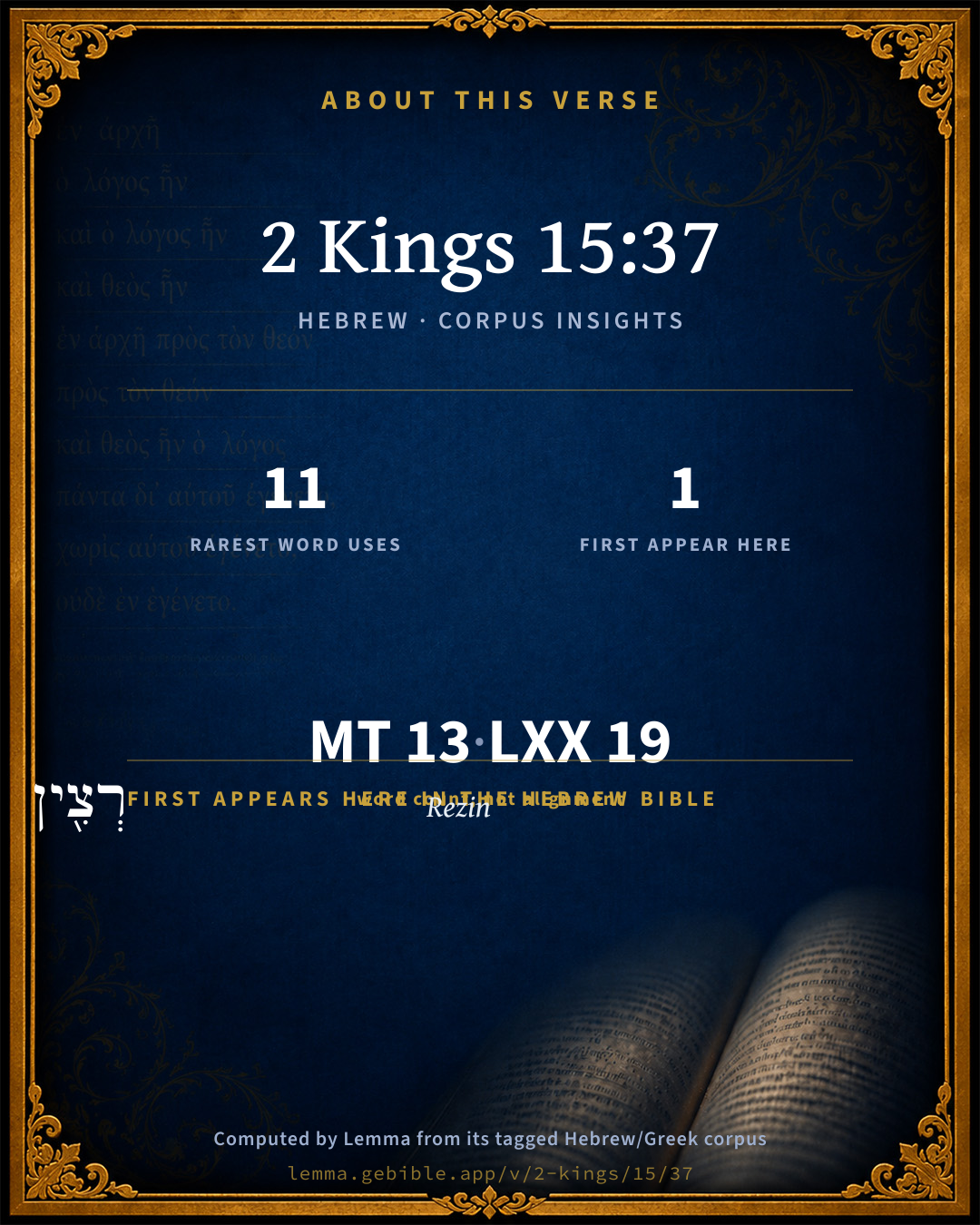
The rarest word here is רְצִ֖ין Rezin H7526 — appearing just 11 times in the whole Hebrew Bible.

First appearance in Scripture

This word makes its first canonical appearance in the Hebrew Bible here:

  • רְצִ֖ין Rezin H7526

Shared distinctive vocabulary

רְצִ֖ין Rezin H7526 occurs in 11 verses of the Hebrew Bible. Also found in:

Grammatical profile

  • 2 verbs
  • 9 nouns
  • 1 pronoun
  • 1 particle

Verb forms

  • הֵחֵ֣ל Hiphil · Perfect
  • לְהַשְׁלִ֨יחַ֙ Hiphil · Infinitive Construct

Hebrew & Septuagint length

In English translation the verse runs 20 words from the Hebrew and 20 from the Septuagint (LXX English) — the same length.

A rough comparison of the two English renderings, which tokenize alike — not a word-level alignment.

Word counts can differ between the Hebrew and the Greek without any difference in meaning — e.g. the Hebrew direct-object marker אֵת has no separate Greek word, and Greek often adds the article ὁ.

In the original languages it is 13 Hebrew tokens and 19 Greek tokens — but the two are counted differently (Hebrew bundles its prefixes and suffixes into one token; the Greek is in lemma form), so that isn’t a like-for-like length.

Cross-references

15

Topical passages linked to 2 Kings 15:37 in the Treasury of Scripture Knowledge — connected by theme and wording, ordered by reader-vote popularity; previews shown in the World English Bible.

  • 2 Kings 16:5 Then Rezin king of Syria and Pekah son of Remaliah king of Israel came up to Jerusalem to war: and they besieged Ahaz, but could not overcome him.
  • Isaiah 7:1 It happened in the days of Ahaz the son of Jotham, the son of Uzziah, king of Judah, that Rezin the king of Syria, and Pekah the son of Remaliah, king of Israel, went up to Jerusalem to war against it, but could not prevail against it.
  • Deuteronomy 28:48 therefore shall you serve your enemies whom Yahweh shall send against you, in hunger, and in thirst, and in nakedness, and in want of all things: and he shall put a yoke of iron on your neck, until he have destroyed you.
  • 1 Samuel 3:12 In that day I will perform against Eli all that I have spoken concerning his house, from the beginning even to the end.
  • 2 Kings 10:32 In those days Yahweh began to cut off from Israel: and Hazael struck them in all the borders of Israel;
  • 2 Chronicles 28:6 For Pekah the son of Remaliah killed in Judah one hundred twenty thousand in one day, all of them valiant men; because they had forsaken Yahweh, the God of their fathers.
  • Psalms 78:49 He threw on them the fierceness of his anger, Wrath, indignation, and trouble, And a band of angels of evil.
  • Isaiah 7:8 For the head of Syria is Damascus, and the head of Damascus is Rezin; and within sixty-five years Ephraim shall be broken in pieces, so that it shall not be a people;
  • Isaiah 10:5–7 Ho Assyrian, the rod of my anger, the staff in whose hand is my indignation!
  • Isaiah 38:1–22 In those days was Hezekiah sick to death. Isaiah the prophet the son of Amoz came to him, and said to him, Thus says Yahweh, Set your house in order; for you shall die, and not live.
  • Jeremiah 16:16 Behold, I will send for many fishermen, says Yahweh, and they shall fish them up; and afterward I will send for many hunters, and they shall hunt them from every mountain, and from every hill, and out of the clefts of the rocks.
  • Jeremiah 25:29 For, behold, I begin to work evil at the city which is called by my name; and should you be utterly unpunished? You shall not be unpunished; for I will call for a sword on all the inhabitants of the earth, says Yahweh of Hosts.
  • Jeremiah 43:10 and tell them, Thus says Yahweh of Hosts, the God of Israel: Behold, I will send and take Nebuchadrezzar the king of Babylon, my servant, and will set his throne on these stones that I have hidden; and he shall spread his royal pavilion over them.
  • Hosea 5:12–13 Therefore I am to Ephraim like a moth, And to the house of Judah like rottenness.
  • Luke 21:28 But when these things begin to happen, look up, and lift up your heads, because your redemption is near."

Cross-references courtesy of OpenBible.info (CC BY 4.0).

Hebrew and Greek witnesses Masoretic Hebrew ↔ Greek Septuagint

The same verse in the two great witnesses to the Old Testament, shown verse-for-verse.

These are two independent witnesses, not word-aligned to each other, and the Septuagint is shown in lemma (dictionary) form.

Hebrew 2 Kings 15:37 Masoretic · Westminster Leningrad Codex

בַּיָּמִ֣ים הָהֵ֔ם הֵחֵ֣ל יְהוָ֗ה לְהַשְׁלִ֨יחַ֙ בִּֽיהוּדָ֔ה רְצִ֖ין מֶ֣לֶךְ אֲרָ֑ם וְאֵ֖ת פֶּ֥קַח בֶּן רְמַלְיָֽהוּ

In those days Yahweh began to send against Judah Rezin the king of Syria, and Pekah the son of Remaliah.

World English Bible · Public Domain

Greek LXX 2 Kings 15:37 Septuagint · lemma form

ἐν ὁ ἡμέρα ἐκεῖνος ἄρχω κύριος ἐκ ἀποστέλλω ἐν ιουδα ὁ ραασσων βασιλεύς συρία καί ὁ φακεε υἱός ρομελιας

In those days the Lord began to send forth against Juda Raasson king of Syria, and Phakee son of Romelias.

LXX2012 (modern English Septuagint) · Public Domain

Hebrew: Westminster Leningrad Codex (CC BY 4.0). Greek: Septuagint (public domain); English from LXX2012 (modern English Septuagint) (Public Domain). How the Septuagint differs from the Hebrew →

Targum (Aramaic paraphrase)

1

The Targum is the ancient Jewish Aramaic paraphrase of the Hebrew Scriptures — an interpretive translation, not the Hebrew text itself. Onkelos (literal) and Pseudo-Jonathan (expansive) render the Torah, and Jonathan the Prophets. Coverage is partial: where no permissively-licensed English translation exists for a verse, only the Aramaic is shown. This is verse-level text, not a word-by-word alignment to the Hebrew.

  1. Targum Jonathan Prophets (Joshua–Malachi)
    בְּיוֹמַיָא הָאִינוּן שָׁרֵי יְיָ לְגָרָאָה בִּדְבֵית יְהוּדָה רְצִין מַלְכָּא דַאֲרָם וְיַת פֶּקַח בַּר רְמַלְיָהוּ:

    (no public-domain English translation for this verse)

    Targum Jonathan — Aramaic: “Mikraot Gedolot” (public domain). English: “Sefaria Community Translation” (CC0 1.0 (public-domain dedication)); “London "Chaldee Paraphrase," 1871” (public domain). Text via Sefaria.

Commentary

Notes on 2 Kings 15:37 from classic Christian and Jewish commentators (each source and its license shown beneath its notes). The classic Christian expositions comment on the surrounding passage and are grouped to its opening verse, so a note may address several verses; the Jewish commentaries on the Tanakh (Rashi and others) are per-verse, so they appear only where the commentator wrote on this verse.

Lemma curates 59 commentaries, every one of them public domain or Creative Commons licensed, each selected and text-cleaned for this edition rather than reprinted as found. About our sources →

Trapp's Complete Commentary

John Trapp

2Ki 15:37 In those days the LORD began to send against Judah Rezin the king of Syria, and Pekah the son of Remaliah.

Ver. 37. In those days.] But not till good Jotham was laid up in peace.

John Trapp, A Commentary or Exposition upon All the Books of the Old and New Testament (1647–1656) — public domain. Text from a community e-Sword module.

Joseph Benson's Commentary

2Ki 15:37. In those days — That is, toward the end of Jotham’s reign; the Lord began to send against Judah, Rezin and Pekah — As he bid Shimei curse David, when he gave him an opportunity of doing it, without fear of punishment. Wicked men are the sword, the rod in God’s hand, which he makes use of as he pleases, to serve his own righteous counsels, though they be unrighteous in their intentions. This storm was gathered in the reign of pious Jotham, but he came to his grave in peace, and it fell upon his degenerate son Ahaz, whose heart, upon notice of it, was moved, as were the hearts of the people, as the trees of the wood are moved by the wind, Isa 7:2.

Joseph Benson's Commentary on the Old and New Testaments (1811–1818) — public domain. Text from a community e-Sword module.

Tyndale Open Study Notes

Tyndale Open Resources

15:37 Rezin . . . Pekah: See 16:5.

Tyndale Open Study Notes — © Tyndale Open Resources, licensed CC BY-SA 4.0. Text via the HelloAO Bible API.

unfoldingWord translationNotes

Door43 World Missions Community

In those days

This refers to a time period. What time period this refers to can be stated clearly. AT: "During that time" or "While Jotham was king of Judah" (See: Assumed Knowledge and Implicit Information)

Rezin

This is a man's name. (See: How to Translate Names)

Pekah ... Remaliah

These are men's names. Pekah was the king of Israel. See how you translated them in 2 Kings 15:37. (See: How to Translate Names)

Jotham slept with his ancestors

Sleeping represents dying. AT: "Jotham died as his ancestors had" or "Like his ancestors, Jotham died" (See: Metaphor and Euphemism)

became king in his place

The phrase "in his place" is a metaphor meaning "instead of him." AT: "became king instead of Jotham" (See: Metaphor)

translationWords

send

Aram

city of David

Ahaz

unfoldingWord translationNotes — © Distant Shores Media and the Door43 World Missions Community, licensed CC BY-SA 4.0. Source: git.door43.org/Door43/en_tn.

Geneva Bible (1599)

Geneva Bible translators

Which slew of Judah in one day sixscore thousand fighting men, 2 Chron. 28:6, because they had forsaken the true God.

After the death of Jotham.

Geneva Bible (1599) marginal notes — public domain. Text via Bolls.life.

Jamieson, Fausset & Brown

Robert Jamieson, A. R. Fausset & David Brown

the Lord began to send against Judah Rezin the king of Syria, &c.--This is the first intimation of the hostile feelings of the kings of Israel and Syria, to Judah, which led them to form an alliance and make joint preparations for war. [See on Ch2 27:5.] However, war was not actually waged till the reign of Ahaz.

Next: 2 Kings Chapter 16

Jamieson, Fausset & Brown — Commentary Critical and Explanatory on the Whole Bible (1871) — public domain (CC PDM 1.0). Text via the HelloAO Bible API.

Adam Clarke's Commentary

Verse 37. In those days the Lord began to send] It was about this time that the Assyrian wars, so ruinous to the Jews, began; but it was in the following reigns that they arrived at their highest pitch of disaster to those unfaithful and unfortunate people. However much we may blame the Jews for their disobedience and obstinacy, yet we cannot help feeling for them under their severe afflictions. Grievously they have sinned, and grievously have they suffered for it. And if they be still objects of God's judgments, there is revelation to believe that they will yet be objects of God's goodness. Many think the signs of the times are favourable to this ingathering; but there is no evidence among the people themselves that the day of their redemption is at hand. They do not humble themselves; they do not seek the Lord.

Adam Clarke's Commentary on the Bible (1810–1826) — public domain. Text from a community e-Sword/MySword module.

The Cambridge Bible for Schools and Colleges

gen. ed. J. J. S. Perowne

37. In those days] In the days of Jotham the confederacy between Israel and Syria against Judah was formed, though the effects were not felt to the full till the days of Jotham’s son Ahaz. In Isaiah 7 we find that Rezin king of Syria, and Pekah king of Israel, had come up against Jerusalem to fight against it, and were minded to set up a king in Judah of their own choosing, who is there spoken of as ‘the son of Tabeel’. At that time for the consolation and encouragement of Ahaz the oracle concerning ‘Immanuel’ was sent to him through Isaiah.

the Lord began to send] Though He began to send enemies upon Judah, yet the Lord did not, as Isaiah’s prophecy shews us, leave His people without hope, but in the midst of their chastisement He was thinking upon mercy, and spake by the mouth of the prophet concerning that greatest mercy, the sending of His Son.

Rezin the king of Syria] The name of this king appears several times in the Assyrian records. His country had before this time been made tributary to Assyria. The policy of Rezin appears not only to have embraced a conquest of Judah in alliance with Pekah, but also, after making himself more powerful in that way, the shaking off the yoke of Assyria. For this reason the Assyrian power was the more easily induced to help Ahaz in resisting Israel and Syria. The history of that help is given in the next chapter where the acts of Pekah against Judah are more fully dwelt upon.

The Cambridge Bible for Schools and Colleges (gen. ed. J. J. S. Perowne; Cambridge University Press, 1878–1918) — public domain. Text from a community e-Sword module.

Albert Barnes' Notes on the Bible

The recent invasions of Pul and Tiglath-Pileser had effectually alarmed Pekah and Rezin, and had induced them to put aside the traditional jealousies which naturally kept them apart, and to make a league offensive and defensive. Into this league they were anxious that Judaea should enter; but they distrusted the house of David, which had been so long hostile both to Damascus and to Samaria. They consequently formed the design of transferring the Jewish crown to a certain Ben-Tabeal Isa 7:6, probably a Jewish noble, perhaps a refugee at one of their courts, whom they could trust to join heartily in their schemes (2Ki 16:5 note).

Albert Barnes' Notes on the Bible (1834–1885) — public domain. Text from a community e-Sword/MySword module.

Haydock's Catholic Bible Commentary

Began. Achaz was much more infested by these princes.

George Leo Haydock (1774–1849), Haydock's Catholic Family Bible and Commentary, 1859 edition — public domain. Excludes Psalms (Douay-Rheims chapter numbering differs from Protestant) and Deuterocanonical books (Catholic canon only).

Matthew Poole's English Annotations

In those days i.e. towards the end of Jotham’s reign.

The Lord began to send, i.e. disposed their hearts to unite their forces together, and to make preparation for a war against Judah; which yet they did not execute till Ahaz’s reign.

Matthew Poole's English Annotations on the Holy Bible (1683–1685) — public domain. Text from a community e-Sword/MySword module.

Whedon's Commentary on the Bible

Daniel D. Whedon

REIGN OF JOTHAM, KING OF JUDAH, 2Ki_15:32-38.

37. In those days — Evidently near the close of Jotham’s reign.

Began to send… Rezin… and Pekah — That is, the Syro-Israelitish war against Judah only began in Jotham’s day. It belonged rather to the reign of Ahaz. See notes on chap. 2Ki_16:5-9.

The reign of Jotham is more fully detailed in 2 Chronicles 27, where see notes.

Daniel D. Whedon (gen. ed.), Commentary on the Old and New Testaments (1874–1909) — public domain. Text from a community e-Sword module.

The Pulpit Commentary

In those days the Lord began to send against Judah Resin the King of Syria. Rezin"s name occurs in the Assyrian inscriptions early in the reign of Tigiath-pileser, probably in the year B.C. 743. At that time he pays to the Assyrians a heavy tribute, consisting of eighteen talents of gold, three hundred talents of silver, two hundred talents of copper, and twenty talents of spices. Subsequently, about the year B.C. 734, he is found in revolt. His alliance with Pekah, here implied, is directly stated by Isa_7:2. Begun in Jotham"s reign, it continued, and came to a head, in the reign of Ahaz. (see 2Ki_16:5 and Isa_7:1-9 Isa_8:6) And Pekah the son of Remaliah. Pekah and Rezin intended to establish on the Jewish throne a certain Ben-Tabeal, (Isa_7:6) a creature of their own, with whose aid they thought to offer an effectual resistance to Assyria.

The Pulpit Commentary (1880–1919), ed. H.D.M. Spence-Jones & Joseph S. Exell — public domain. Text from a community e-Sword module.

Keil & Delitzsch

C. F. Keil & F. Delitzsch

In those days the Lord began to send against Judah Rezin, etc. It is evident from the position of this verse at the close of the account of Jotham, that the incursions of the allied Syrians and Israelites into Judah under the command of Rezin and Pekah commenced in the closing years of Jotham, so that these foes appeared before Jerusalem at the very beginning of the reign of Ahaz. - It is true that the Syrians had been subjugated by Jeroboam II (Kg2 14:28); but in the anarchical condition of the Israelitish kingdom after his death, they had no doubt recovered their independence. They must also have been overcome by the Assyrians under Pul, for he could never have marched against Israel without having first of all conquered Syria. But as the power of the Assyrians was greatly weakened for a time by the falling away of the Medes and Babylonians, the Syrians had taken advantage of this weakness to refuse the payment of tribute to Assyria, and had formed an alliance with Pekah of Israel to conquer Judah, and thereby to strengthen their power so as to be able to offer a successful resistance to any attack from the side of the Euphrates. - But as Kg2 16:6. and 2 Kings 17 show, it was otherwise decreed in the counsels of the Lord.

Keil & Delitzsch — Biblical Commentary on the Old Testament (1861–1891) — public domain (CC PDM 1.0). Text via the HelloAO Bible API. (Old Testament only.)

Rashi

Rabbi Shlomo Yitzchaki (Rashi)

In those days. At the end of Yosam's life.

To incite. To incite.

Rashi on the Tanakh — English translations: “The Judaica Press complete Tanach with Rashi, translated by A. J. Rosenberg” (CC BY 4.0); “Pentateuch with Rashi's commentary by M. Rosenbaum and A.M. Silbermann, 1929-1934” (public domain); “The Metsudah Tanach series, Lakewood, N.J” (CC BY 4.0); and “The Book of Joshua, Metsudah Publications, 1997” (CC BY 4.0). Text via Sefaria.

Lesson kit

Teaching starters — assembled from the data on this page, not authored interpretation. Every prompt links to the verse data it draws on. Edit before teaching.

2 Kings, in the Historical, opens this verse with 13 words (13 distinct Hebrew lemmas). Its most distinctive word is Rᵉtsîyn (“Rezin”). A historical commentator’s framing appears above. Read the whole chapter for the surrounding context.

Discussion questions

  1. How does “Rezin” (Rᵉtsîyn) shape what this verse is saying?
  2. The word “Rezin” first appears here in Scripture. What is being introduced at this debut?
  3. 2 Kings 16:5 shares the word «Rezin» with this verse. How do the two illuminate each other?
  4. These translations render this verse differently; the difference is in the English rendering, not the original. What questions does that raise?
  5. The verb «הֵחֵ֣ל» is Hiphil Perfect. How does its form color the action?
  6. Reading how Trapp's Complete Commentary and Joseph Benson's Commentary read this verse, where do the two commentators agree and where do they part?

Things to notice

Reading settings

Reading text

Shown beneath each verse's original-language words.

Old Testament
Old Testament edition

Read the OT as the Masoretic Hebrew (MT) or the Greek Septuagint (LXX).

English shown for the Greek Septuagint (in the Hebrew ↔ Greek comparison).

Comparing translations? Open the Compare panel on any verse page to stack up to four side by side.