
2 Kings 19:2

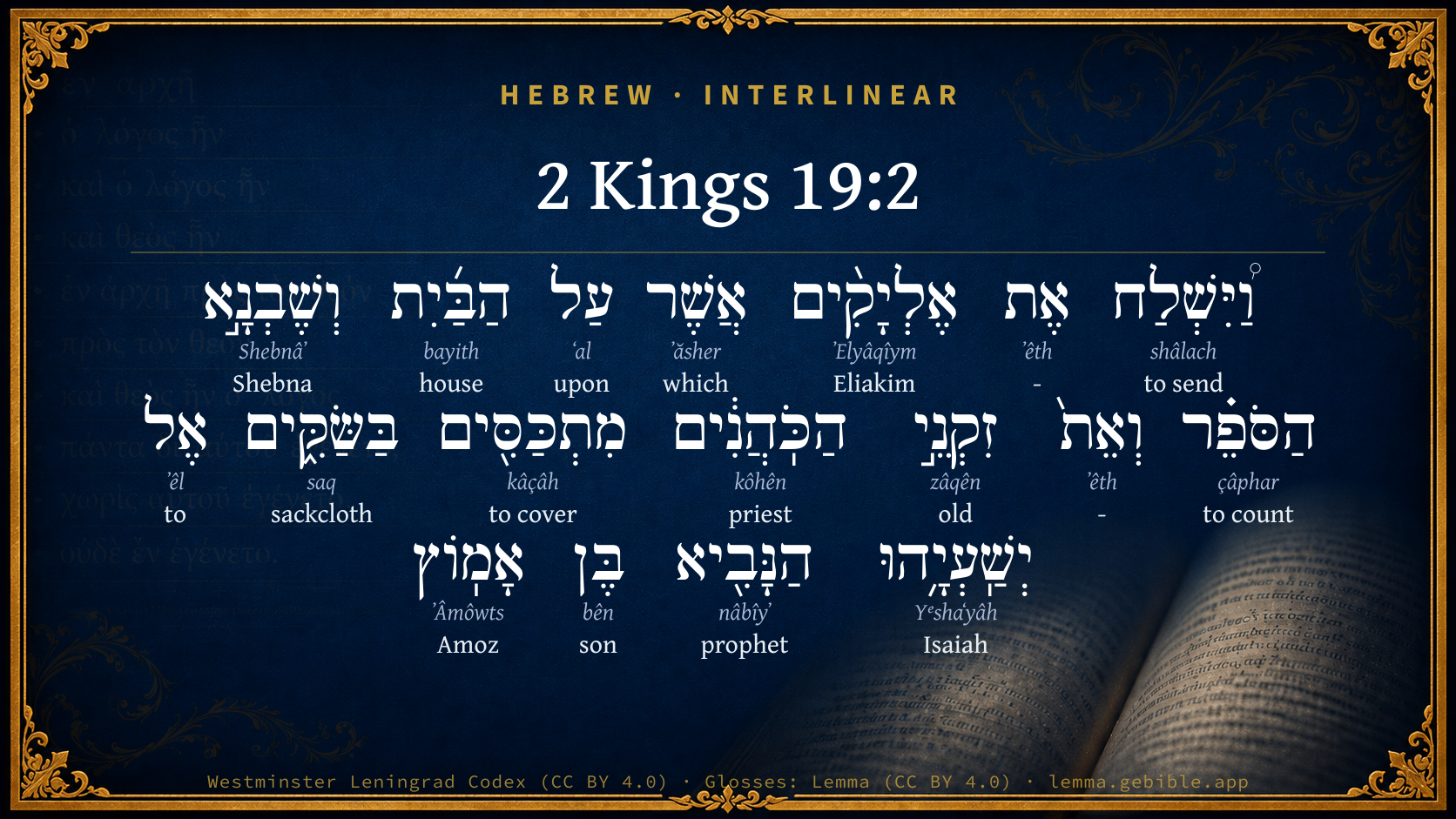
Hebrew (Westminster Leningrad Codex) 2 Kings 19:2 appears in the Hebrew Old Testament. The text above is from the Westminster Leningrad Codex. Each word links to its Strong’s number, a concise gloss, and parsing drawn from the Open Scriptures Hebrew Bible morphology. Click any word for its full Brown-Driver-Briggs (BDB) entry.
Download image
Cite this verse

2 Kings 19:2 (World English Bible). Public Domain. Lemma interlinear Bible study tool, https://lemma.gebible.app/v/2-kings/19/2.

Show BibTeX & RIS
BibTeX
RIS
English Translation
He sent Eliakim, who was over the household, and Shebna the scribe, and the elders of the priests, covered with sackcloth, to Isaiah the prophet the son of Amoz.
World English Bible · Public Domain
Highlights
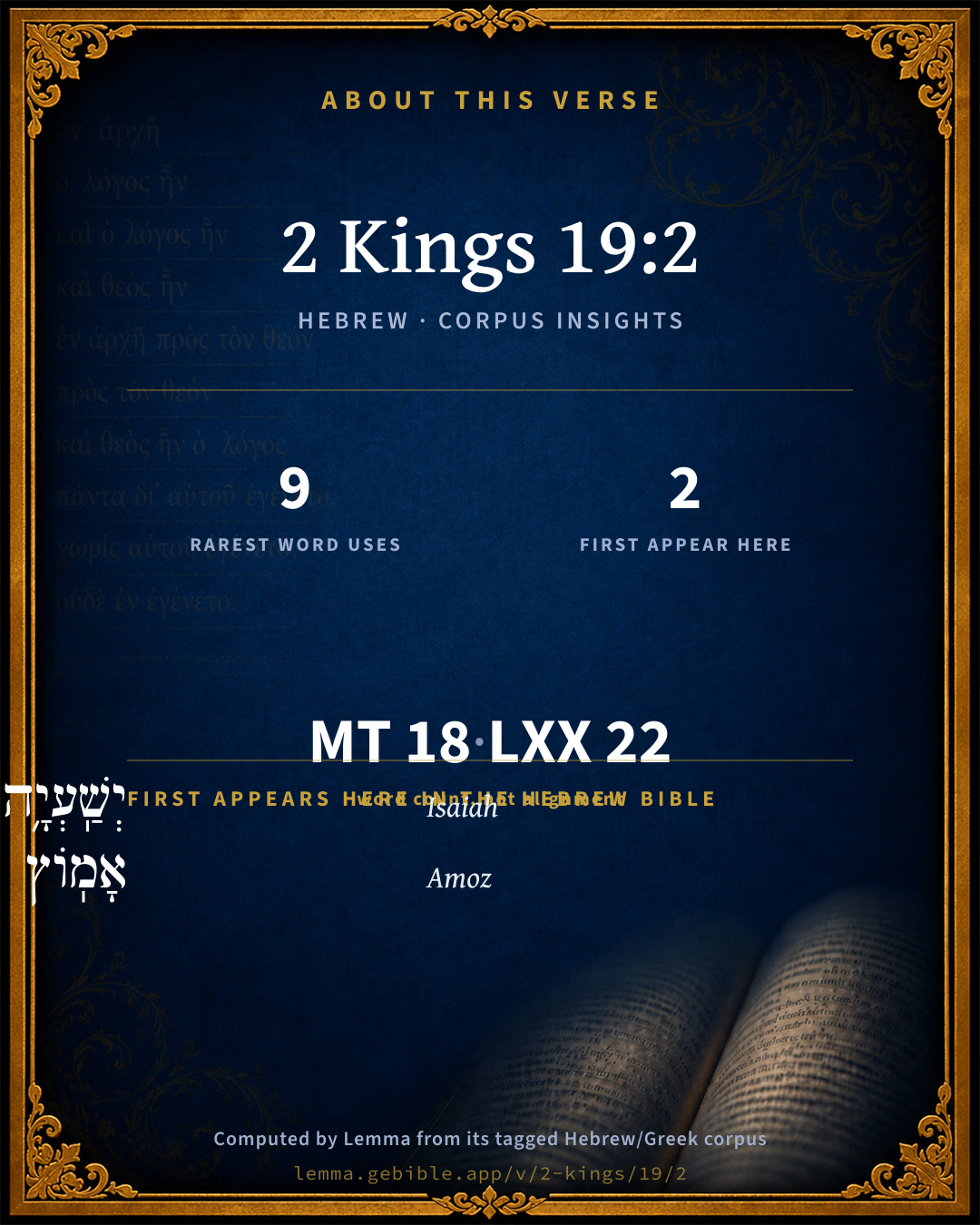
  • 2 first appearances in the Hebrew Bible
Full analysis ↓
Download a study sheet

One document with this verse’s original text, its word-by-word gloss line, the meaning frame, cross-references with their text, attributed commentary, and full source and license credits — printable, and it pastes into notes with its structure intact.

This verse Autodidact and up

Study sheet (.html) Plain text (.txt)

A passage Seminary Student

Up to 50 verses in one chapter. A passage sheet keeps up to 6 commentary sources and 12 cross-references per verse, in the order this page ranks them, and says so on the sheet whenever that leaves anything out. Ask for a single verse and you get the Autodidact verse sheet above.

Everything on this page stays free to read, with no account — the sheet is a download of what is already on screen, not access to it.

Want to remove ads? Support Godless Engineer
Compare translations 3

The same verse in 3 English versions, stacked beneath the original-language interlinear above. Click any original word for its lexicon entry.

Each is an independent rendering of the whole verse — the interlinear is not word-aligned to these translations.

Highlighted words mark where these versions differ — a whole-verse word diff, not a word-by-word alignment.

  • World English Bible Public Domain
    He sent Eliakim, who was over the household, and Shebna the scribe, and the elders of the priests, covered with sackcloth, to Isaiah the prophet the son of Amoz.
  • King James Version Public Domain
    And he sent Eliakim, which was over the household, and Shebna the scribe, and the elders of the priests, covered with sackcloth, to Isaiah the prophet the son of Amoz.
  • unfoldingWord Literal Text CC BY-SA 4.0
    And he sent Eliakim, who over the house, and Shebna the scribe and the elders of the priests, having covered themselves with sackcloth, to Isaiah the prophet, the son of Amoz.

unfoldingWord Literal Text — © unfoldingWord, licensed CC BY-SA 4.0. Word-aligned USFM3 via Door43 (git.door43.org/unfoldingWord/en_ult).

Versions to compare (up to 4)

3 of 4 selected

Show all 18 translations

Every available English version of this verse, each an independent rendering of the whole verse.

  • World English Bible Public Domain
    He sent Eliakim, who was over the household, and Shebna the scribe, and the elders of the priests, covered with sackcloth, to Isaiah the prophet the son of Amoz.
  • Berean Standard Bible Public Domain
    And he sent Eliakim the palace administrator, Shebna the scribe, and the leading priests, all wearing sackcloth, to the prophet Isaiah son of Amoz
  • Majority Standard Bible Public Domain
    And he sent Eliakim the palace administrator, Shebna the scribe, and the leading priests, all wearing sackcloth, to the prophet Isaiah son of Amoz
  • King James Version Public Domain
    And he sent Eliakim, which was over the household, and Shebna the scribe, and the elders of the priests, covered with sackcloth, to Isaiah the prophet the son of Amoz.
  • American Standard Version (1901) Public Domain
    And he sent Eliakim, who was over the household, and Shebna the scribe, and the elders of the priests, covered with sackcloth, unto Isaiah the prophet the son of Amoz.
  • Revised Version (1885) Public Domain
    And he sent Eliakim, which was over the household, and Shebna the scribe, and the elders of the priests, covered with sackcloth, unto Isaiah the prophet, the son of Amoz.
  • Geneva Bible (1599) Public Domain
    And sent Eliakim which was the stewarde of the house, and Shebnah the chanceller, and the Elders of the Priestes clothed in sackecloth to Isaiah the Prophet the sonne of Amoz.
  • Douay-Rheims (1899) Public Domain
    And he sent Eliacim, who was over the house, and Sobna the scribe, and the ancients of the priests covered with sackcloths, to Isaias the prophet the son of Amos,
  • Young's Literal Translation Public Domain
    and sendeth Eliakim, who `is' over the house, and Shebna the scribe, and the elders of the priests, covering themselves with sackcloth, unto Isaiah the prophet, son of Amoz,
  • Literal Standard Version CC BY-SA 4.0
    and sends Eliakim, who [is] over the house, and Shebna the scribe, and the elderly of the priests, covering themselves with sackcloth, to Isaiah the prophet, son of Amoz,
  • Unlocked Literal Bible CC BY-SA 4.0
    He sent Eliakim, who was over the household, and Shebna the scribe, and the elders of the priests, all covered with sackcloth, to Isaiah son of Amoz, the prophet.
  • unfoldingWord Literal Text CC BY-SA 4.0
    And he sent Eliakim, who over the house, and Shebna the scribe and the elders of the priests, having covered themselves with sackcloth, to Isaiah the prophet, the son of Amoz.
  • Darby Bible Public Domain
    And he sent Eliakim, who was over the household, and Shebna the scribe, and the elders of the priests, covered with sackcloth, to the prophet Isaiah the son of Amoz.
  • World Messianic Bible Public Domain
    He sent Eliakim, who was over the household, Shebna the scribe, and the elders of the priests, covered with sackcloth, to Isaiah the prophet the son of Amoz.
  • Webster's Bible Public Domain
    And he sent Eliakim, who was over the household, and Shebna the scribe, and the elders of the priests, covered with sackcloth, to Isaiah the prophet the son of Amoz.
  • Free Bible Version CC BY-SA 4.0
    He sent Eliakim the palace manager, Shebna, the scribe, and the leading priests, all wearing sackcloth, to see the prophet Isaiah, son of Amoz.
  • Bible in Basic English Public Domain
    And he sent Eliakim, who was over the house, and Shebna the scribe, and the chief priests, dressed in haircloth, to Isaiah the prophet, the son of Amoz.
  • JPS Tanakh (1917) Public Domain
    And he sent Eliakim, who was over the household, and Shebna the scribe, and the elders of the priests, covered with sackcloth, unto Isaiah the prophet the son of Amoz.

Literal Standard Version (2020), Covenant Press — licensed CC BY-SA 4.0. Text via the HelloAO Bible API (eBible.org). Unlocked Literal Bible (unfoldingWord) — licensed CC BY-SA 4.0. Text via the HelloAO Bible API (eBible.org). unfoldingWord Literal Text — © unfoldingWord, licensed CC BY-SA 4.0. Word-aligned USFM3 via Door43 (git.door43.org/unfoldingWord/en_ult). Free Bible Version, Dr. Jonathan Gallagher — licensed CC BY-SA 4.0. Text via the HelloAO Bible API (eBible.org).

Word by word

More ways to search: Search by grammar → Find every occurrence → Compare this word →

Practice this passage: Drill this verse → Learn its vocabulary →

וְשֶׁבְנָ֣א
Shebnâʼ
H7644
“and · Shebna”
Conjunction + Noun, Proper
Part of Speech
Conjunction + Noun
Type
Proper
Full BDB Definition

Origin: from an unused root meaning to grow

TWOT: None

Shebna = "vigour" - a person of high position in the court of king Hezekiah of Judah; subsequently the secretary of Hezekiah
  1. וַ֠יִּשְׁלַח shâlach H7971 “and · to send” Conjunction + Verb, Qal, Sequential Imperfect, 3rd Person, Masculine, Singular
  2. אֶת ʼêth H853 “-” Particle, Direct Object
  3. אֶלְיָקִ֨ים ʼElyâqîym H471 “Eliakim” Noun, Proper
  4. אֲשֶׁר ʼăsher H834 “which” Particle, Relative
  5. עַל ʻal H5921 “upon” Preposition
  6. הַבַּ֜יִת bayith H1004 “the · house” Particle, Definite Article + Noun, Common, Masculine, Singular, Absolute
  7. הַסֹּפֵ֗ר çâphar H5608 “the · scribe” Particle, Definite Article + Noun, Common, Masculine, Singular, Absolute
  8. וְאֵת֙ ʼêth H853 “and · -” Conjunction + Particle, Direct Object
  9. זִקְנֵ֣י zâqên H2205 “old of” Adjective, Adjective, Masculine, Plural, Construct
  10. הַכֹּֽהֲנִ֔ים kôhên H3548 “the · priests” Particle, Definite Article + Noun, Common, Masculine, Plural, Absolute
  11. מִתְכַּסִּ֖ים kâçâh H3680 “covering” Verb, Hithpael, Participle Active, Masculine, Plural, Absolute
  12. בַּשַּׂקִּ֑ים saq H8242 “in/at the · sacks” Preposition, Determined + Noun, Common, Masculine, Plural, Absolute
  13. אֶל ʼêl H413 “to” Preposition
  14. יְשַֽׁעְיָ֥הוּ Yᵉshaʻyâh H3470 “Isaiah” Noun, Proper
  15. הַנָּבִ֖יא nâbîyʼ H5030 “the · prophet” Particle, Definite Article + Noun, Common, Masculine, Singular, Absolute
  16. בֶּן bên H1121 “son of” Noun, Common, Masculine, Singular, Construct
  17. אָמֽוֹץ ʼÂmôwts H531 “Amoz” Noun, Proper

About this verse

These counts appear in no published source. They are computed here, from the morphology-tagged text and Lemma’s own curated glosses. What Lemma adds →

18
words
17
distinct lemmas
Historical
section

Notable vocabulary

The rarest word here is וְשֶׁבְנָ֣א Shebna H7644 — appearing just 9 times in the whole Hebrew Bible.

First appearance in Scripture

These words make their first canonical appearance in the Hebrew Bible here:

  • יְשַֽׁעְיָ֥הוּ Isaiah H3470
  • אָמֽוֹץ Amoz H531

Shared distinctive vocabulary

וְשֶׁבְנָ֣א Shebna H7644 occurs in 9 verses of the Hebrew Bible. Also found in:

Grammatical profile

  • 2 verbs
  • 10 nouns
  • 1 adjective
  • 2 prepositions
  • 3 particles

Verb forms

  • וַ֠יִּשְׁלַח Qal · Sequential Imperfect
  • מִתְכַּסִּ֖ים Hithpael · Participle Active

Hebrew & Septuagint length

In English translation the verse runs 29 words from the Hebrew and 27 from the Septuagint (LXX English) — closely comparable.

A rough comparison of the two English renderings, which tokenize alike — not a word-level alignment.

Word counts can differ between the Hebrew and the Greek without any difference in meaning — e.g. the Hebrew direct-object marker אֵת has no separate Greek word, and Greek often adds the article ὁ.

In the original languages it is 18 Hebrew tokens and 22 Greek tokens — but the two are counted differently (Hebrew bundles its prefixes and suffixes into one token; the Greek is in lemma form), so that isn’t a like-for-like length.

Cross-references

8

Topical passages linked to 2 Kings 19:2 in the Treasury of Scripture Knowledge — connected by theme and wording, ordered by reader-vote popularity; previews shown in the World English Bible.

  • Isaiah 1:1 The vision of Isaiah the son of Amoz, which he saw concerning Judah and Jerusalem, in the days of Uzziah, Jotham, Ahaz, and Hezekiah, kings of Judah.
  • Isaiah 2:1 This is what Isaiah the son of Amoz saw concerning Judah and Jerusalem.
  • 2 Kings 18:18 When they had called to the king, there came out to them Eliakim the son of Hilkiah, who was over the household, and Shebnah the scribe, and Joah the son of Asaph the recorder.
  • 2 Kings 22:13–14 Go you, inquire of Yahweh for me, and for the people, and for all Judah, concerning the words of this book that is found; for great is the wrath of Yahweh that is kindled against us, because our fathers have not listened to the words of this book, to do according to all that which is written concerning us.
  • 2 Chronicles 26:22 Now the rest of the acts of Uzziah, first and last, did Isaiah the prophet, the son of Amoz, write.
  • Isaiah 37:2–5 He sent Eliakim, who was over the household, and Shebna the scribe, and the elders of the priests, covered with sackcloth, to Isaiah the prophet the son of Amoz.
  • Matthew 4:14 that it might be fulfilled which was spoken through Isaiah the prophet, saying,
  • Luke 3:4 As it is written in the book of the words of Isaiah the prophet, "The voice of one crying in the wilderness, 'Make ready the way of the Lord. Make his paths straight.

Cross-references courtesy of OpenBible.info (CC BY 4.0).

Hebrew and Greek witnesses Masoretic Hebrew ↔ Greek Septuagint

The same verse in the two great witnesses to the Old Testament, shown verse-for-verse.

These are two independent witnesses, not word-aligned to each other, and the Septuagint is shown in lemma (dictionary) form.

Hebrew 2 Kings 19:2 Masoretic · Westminster Leningrad Codex

וַ֠יִּשְׁלַח אֶת אֶלְיָקִ֨ים אֲשֶׁר עַל הַבַּ֜יִת וְשֶׁבְנָ֣א הַסֹּפֵ֗ר וְאֵת֙ זִקְנֵ֣י הַכֹּֽהֲנִ֔ים מִתְכַּסִּ֖ים בַּשַּׂקִּ֑ים אֶל יְשַֽׁעְיָ֥הוּ הַנָּבִ֖יא בֶּן אָמֽוֹץ

He sent Eliakim, who was over the household, and Shebna the scribe, and the elders of the priests, covered with sackcloth, to Isaiah the prophet the son of Amoz.

World English Bible · Public Domain

Greek LXX 2 Kings 19:2 Septuagint · lemma form

καί ἀποστέλλω ελιακιμ ὁ οἰκονόμος καί σομναν ὁ γραμματεύς καί ὁ πρεσβύτερος ὁ ἱερεύς περιβάλλω σάκκος πρός ησαιας ὁ προφήτης υἱός αμως

And he sent Heliakim the steward, and Somnas the scribe, and the elders of the priests, clothed with sackcloth, to Esaias the prophet the son of Amos.

LXX2012 (modern English Septuagint) · Public Domain

Hebrew: Westminster Leningrad Codex (CC BY 4.0). Greek: Septuagint (public domain); English from LXX2012 (modern English Septuagint) (Public Domain). How the Septuagint differs from the Hebrew →

Targum (Aramaic paraphrase)

1

The Targum is the ancient Jewish Aramaic paraphrase of the Hebrew Scriptures — an interpretive translation, not the Hebrew text itself. Onkelos (literal) and Pseudo-Jonathan (expansive) render the Torah, and Jonathan the Prophets. Coverage is partial: where no permissively-licensed English translation exists for a verse, only the Aramaic is shown. This is verse-level text, not a word-by-word alignment to the Hebrew.

  1. Targum Jonathan Prophets (Joshua–Malachi)
    וּשְׁלַח יַת אֶלְיָקִים דִי מְמַנָא עַל בֵיתָא וְשֶׁבְנָא סַפְרָא וְסָבֵי כַהֲנַיָא כַּד מְכַסָן סַקַיָא לְוַת יְשַׁעְיָהוּ נְבִיָא בַּר אָמוֹץ:

    (no public-domain English translation for this verse)

    Targum Jonathan — Aramaic: “Mikraot Gedolot” (public domain). English: “Sefaria Community Translation” (CC0 1.0 (public-domain dedication)); “London "Chaldee Paraphrase," 1871” (public domain). Text via Sefaria.

Commentary

Notes on 2 Kings 19:2 from classic Christian and Jewish commentators (each source and its license shown beneath its notes). The classic Christian expositions comment on the surrounding passage and are grouped to its opening verse, so a note may address several verses; the Jewish commentaries on the Tanakh (Rashi and others) are per-verse, so they appear only where the commentator wrote on this verse.

Lemma curates 59 commentaries, every one of them public domain or Creative Commons licensed, each selected and text-cleaned for this edition rather than reprinted as found. About our sources →

Trapp's Complete Commentary

John Trapp

2Ki 19:2 And he sent Eliakim, which [was] over the household, and Shebna the scribe, and the elders of the priests, covered with sackcloth, to Isaiah the prophet the son of Amoz.

Ver. 2. And he sent Eliakim.] This good Josiah did not, when Pharaohnechoh came up against him - though he had at hand the famous prophets Jeremiah and Zephaniah, besides a whole college of seers - and hence he fell, and with him the whole state of Israel.

John Trapp, A Commentary or Exposition upon All the Books of the Old and New Testament (1647–1656) — public domain. Text from a community e-Sword module.

Tyndale Open Study Notes

Tyndale Open Resources

19:2-3 Leaders often consulted prophets like Isaiah in emergencies (3:11-12) or before going into battle (1 Kgs 22:8-10); Isaiah was active throughout Hezekiah’s reign (2 Kgs 20:1, 14). • The expression a day of trouble describes the heart-wrenching distress the king was experiencing because of the blasphemous insults and disgrace that God and his people were being forced to endure. Hezekiah realized that he and the people were powerless without God’s intervention.

Tyndale Open Study Notes — © Tyndale Open Resources, licensed CC BY-SA 4.0. Text via the HelloAO Bible API.

Geneva Bible (1599)

Geneva Bible translators

To hear some new prophecy, and to have comfort of him.

Geneva Bible (1599) marginal notes — public domain. Text via Bolls.life.

Adam Clarke's Commentary

Verse 2. To Isaiah the prophet] His fame and influence were at this time great in Israel; and it was well known that the word of the Lord was with him. Here both the Church and the state unite in fervent application to, and strong dependence upon, God; and behold how they succeed!

Adam Clarke's Commentary on the Bible (1810–1826) — public domain. Text from a community e-Sword/MySword module.

Ellicott's Commentary for English Readers

(2) And he sent Eliakim . . .—See the Note on 2Ki_3:12; and comp. 2Ki_13:14; 2Ki_22:14; Jer_37:3. Knobel (on Isaiah) remarks that this distinguished embassy speaks for the high estimation in which the prophet stood.

The elders of the priests—i.e., the heads of the sacerdotal caste (próceres, not senes).

A Bible Commentary for English Readers, edited by Charles John Ellicott (1878–1897) — public domain. Text from a community e-Sword module.

The Cambridge Bible for Schools and Colleges

gen. ed. J. J. S. Perowne

2. he sent … to Esai] R.V. Isaiah. The historian has up to this time never mentioned the name of the great prophet. But we know from Isaiah’s own writings that as early as the reign of Uzziah (Isa_6:1) the Lord had revealed His majesty to the son of Amoz, and had sent him to bear witness unto Judah. The reigns of Jotham and Ahaz are past, and to the latter king Isaiah had brought the message of deliverance from Pekah and Rezin, which had been fully accomplished, so that Ephraim was now broken and was no more a people (Isa_7:8). We may be sure that one so endowed with insight into the divine will had been taken at once into the councils of Hezekiah, and that no one’s words had carried more weight. It may well be that Isaiah had advised the struggle for freedom which Hezekiah undertook, and certainly during the fourteen years (2Ki_18:13) which had elapsed since Hezekiah came to the throne the God-fearing king had done much, may we not say most things, by the advice of the prophet. Hence when the days are darkest, it is to Isaiah he sends as the source of true light.

The Cambridge Bible for Schools and Colleges (gen. ed. J. J. S. Perowne; Cambridge University Press, 1878–1918) — public domain. Text from a community e-Sword module.

Albert Barnes' Notes on the Bible

Isaiah is here for the first time introduced into the history. His own writings show us how active a part he had taken in it for many years previously. This was the fourth reign since he began his prophesyings; and during two reigns at least, those of Ahaz and Hezekiah, he had been a familiar counselor of the monarch. He had probably counseled the revolt from Assyria, and had encouraged the king and people to persevere in their resistance. The exact date of prophecies can seldom be fixed with any certainty; but we can scarcely he mistaken in regarding 2 Kings 10; 30; 31 as written about the time of Hezekiah’s second revolt.

Albert Barnes' Notes on the Bible (1834–1885) — public domain. Text from a community e-Sword/MySword module.

Whedon's Commentary on the Bible

Daniel D. Whedon

2. Sent Eliakim… and Shebna — Two of the same officers who had heard Rab-shakeh’s speech, and could give an exact report. But in place of Joah, the recorder, he sends the elders of the priests, that is, the heads of the priestly families, who from their age and office would give weight to the message.

To Isaiah — Who as the prophet of Jehovah was regarded as an authorized expounder of the Divine will.

Daniel D. Whedon (gen. ed.), Commentary on the Old and New Testaments (1874–1909) — public domain. Text from a community e-Sword module.

The Pulpit Commentary

And he sent Eliakim, which was over the household, and Shebna the scribe, and the elders of the priests. "The elders of the priests" are aged men holding the priestly office, not necessarily the high priest, or the most notable or most dignified of the priests. The king felt that his best hope, so far as man was concerned, lay in the prophetical order. Isaiah, Hosed, Joel, Micah, and perhaps Obadiah, were the prophets of the time; but it is not clear that any of them were accessible except Isaiah. He had been Ahaz"s counselor, (Isa_7:4-16) and was now certainly among the regular counselors of Hezekiah. Moreover, he was in Jerusalem, and could readily be consulted. Hezekiah, therefore, sends to him in his distress, and sends a most honorable and dignified embassy. It is his intention to treat the prophet with the utmost respect and courtesy. No doubt, at this period the prophetical order stood higher than the priestly one in general estimation; and not unworthily. If any living man could give the king sound advice under the circumstances, it was the son of Amoz. Covered with sackcloth. Probably by the king"s command. Hezekiah wished to emphasize his own horror and grief in the eyes of the prophet, and could only do so by making his messengers assume the garb which he had judged suitable for himself on the occasion. To Isaiah the prophet the son of Amoz. Nothing morels known of Amoz beyond his being Isaiah"s father. He is not to be confounded with the Prophet Amos, whose name is spelt quite differently: swOm not wOma.

The Pulpit Commentary (1880–1919), ed. H.D.M. Spence-Jones & Joseph S. Exell — public domain. Text from a community e-Sword module.

Scofield Reference Notes

C. I. Scofield

Isaiah

called Esaias, Luk 3:4.

The Scofield Reference Bible (1917 edition), notes by C. I. Scofield — public domain. Text from a community e-Sword module.

Lesson kit

Teaching starters — assembled from the data on this page, not authored interpretation. Every prompt links to the verse data it draws on. Edit before teaching.

2 Kings, in the Historical, opens this verse with 18 words (17 distinct Hebrew lemmas). Its most distinctive word is Shebnâʼ (“Shebna”). A historical commentator’s framing appears above. Read the whole chapter for the surrounding context.

Discussion questions

  1. What does “Shebna” (Shebnâʼ) contribute to the verse as a whole?
  2. 2 words here appear for the first time in Scripture. What is being introduced at this debut?
  3. 2 Kings 18:18 shares the word «Shebna» with this verse. How do the two illuminate each other?
  4. The translations on this page render this verse differently — a whole-verse word diff, not a word-by-word alignment. What might account for the different wordings?
  5. The verb «וַ֠יִּשְׁלַח» is Qal Sequential Imperfect. How does its form color the action?
  6. Reading how Trapp's Complete Commentary and Tyndale Open Study Notes read this verse, where do the two commentators agree and where do they part?

Things to notice

Reading settings

Reading text

Shown beneath each verse's original-language words.

Old Testament
Old Testament edition

Read the OT as the Masoretic Hebrew (MT) or the Greek Septuagint (LXX).

English shown for the Greek Septuagint (in the Hebrew ↔ Greek comparison).

Comparing translations? Open the Compare panel on any verse page to stack up to four side by side.