
2 Kings 23:34

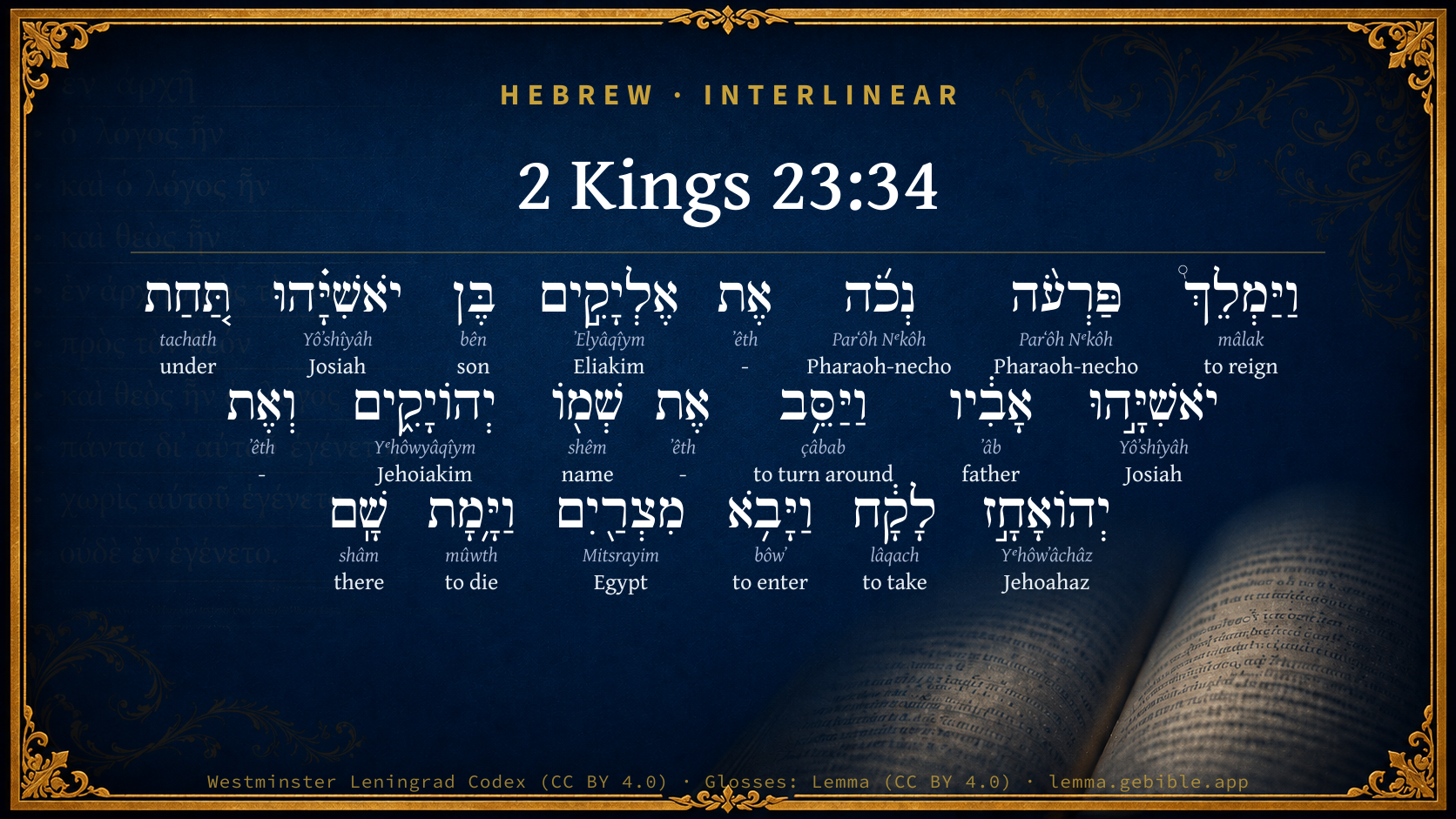
Hebrew (Westminster Leningrad Codex) 2 Kings 23:34 appears in the Hebrew Old Testament. The text above is from the Westminster Leningrad Codex. Each word links to its Strong’s number, a concise gloss, and parsing drawn from the Open Scriptures Hebrew Bible morphology. Click any word for its full Brown-Driver-Briggs (BDB) entry.
Download image
Cite this verse

2 Kings 23:34 (World English Bible). Public Domain. Lemma interlinear Bible study tool, https://lemma.gebible.app/v/2-kings/23/34.

Show BibTeX & RIS
BibTeX
RIS
English Translation
Pharaoh Necoh made Eliakim the son of Josiah king in the room of Josiah his father, and changed his name to Jehoiakim: but he took Jehoahaz away; and he came to Egypt, and died there.
World English Bible · Public Domain
Highlights
  • 1 first appearance in the Hebrew Bible
Full analysis ↓
Download a study sheet

One document with this verse’s original text, its word-by-word gloss line, the meaning frame, cross-references with their text, attributed commentary, and full source and license credits — printable, and it pastes into notes with its structure intact.

This verse Autodidact and up

Study sheet (.html) Plain text (.txt)

A passage Seminary Student

Up to 50 verses in one chapter. A passage sheet keeps up to 6 commentary sources and 12 cross-references per verse, in the order this page ranks them, and says so on the sheet whenever that leaves anything out. Ask for a single verse and you get the Autodidact verse sheet above.

Everything on this page stays free to read, with no account — the sheet is a download of what is already on screen, not access to it.

Want to remove ads? Support Godless Engineer
Compare translations 3

The same verse in 3 English versions, stacked beneath the original-language interlinear above. Click any original word for its lexicon entry.

Each is an independent rendering of the whole verse — the interlinear is not word-aligned to these translations.

Highlighted words mark where these versions differ — a whole-verse word diff, not a word-by-word alignment.

  • World English Bible Public Domain
    Pharaoh Necoh made Eliakim the son of Josiah king in the room of Josiah his father, and changed his name to Jehoiakim: but he took Jehoahaz away; and he came to Egypt, and died there.
  • King James Version Public Domain
    And Pharaohnechoh made Eliakim the son of Josiah king in the room of Josiah his father, and turned his name to Jehoiakim, and took Jehoahaz away: and he came to Egypt, and died there.
  • unfoldingWord Literal Text CC BY-SA 4.0
    And Pharaoh Neco made Eliakim, the son of Josiah, reign in place of Josiah his father, and he changed his name Jehoiakim. But he took Jehoahaz, and he came Egypt, and he died there.

unfoldingWord Literal Text — © unfoldingWord, licensed CC BY-SA 4.0. Word-aligned USFM3 via Door43 (git.door43.org/unfoldingWord/en_ult).

Versions to compare (up to 4)

3 of 4 selected

Show all 18 translations

Every available English version of this verse, each an independent rendering of the whole verse.

  • World English Bible Public Domain
    Pharaoh Necoh made Eliakim the son of Josiah king in the room of Josiah his father, and changed his name to Jehoiakim: but he took Jehoahaz away; and he came to Egypt, and died there.
  • Berean Standard Bible Public Domain
    Then Pharaoh Neco made Eliakim son of Josiah king in place of his father Josiah, and he changed Eliakim’s name to Jehoiakim. But Neco took Jehoahaz and carried him off to Egypt, where he died.
  • Majority Standard Bible Public Domain
    Then Pharaoh Neco made Eliakim son of Josiah king in place of his father Josiah, and he changed Eliakim’s name to Jehoiakim. But Neco took Jehoahaz and carried him off to Egypt, where he died.
  • King James Version Public Domain
    And Pharaohnechoh made Eliakim the son of Josiah king in the room of Josiah his father, and turned his name to Jehoiakim, and took Jehoahaz away: and he came to Egypt, and died there.
  • American Standard Version (1901) Public Domain
    And Pharaoh-necoh made Eliakim the son of Josiah king in the room of Josiah his father, and changed his name to Jehoiakim: but he took Jehoahaz away; and he came to Egypt, and died there.
  • Revised Version (1885) Public Domain
    And Pharaoh-necoh made Eliakim the son of Josiah king in the room of Josiah his father, and changed his name to Jehoiakim: but he took Jehoahaz away; and he came to Egypt, and died there.
  • Geneva Bible (1599) Public Domain
    And Pharaoh Nechoh made Eliakim the sonne of Iosiah King in steade of Iosiah his father, and turned his name to Iehoiakim, and tooke Iehoahaz away, which when he came to Egypt, dyed there.
  • Douay-Rheims (1899) Public Domain
    And Pharao Nechao made Eliacim the son of Josias king in the room of Josias his father: and turned his name to Joakim. And he took Joachaz away and carried him into Egypt, and he died there.
  • Young's Literal Translation Public Domain
    And Pharaoh-Nechoh causeth Eliakim son of Josiah to reign instead of Josiah his father, and turneth his name to Jehoiakim, and Jehoahaz he hath taken away, and he cometh in to Egypt, and dieth there.
  • Literal Standard Version CC BY-SA 4.0
    And Pharaoh Necho causes Eliakim son of Josiah to reign instead of his father Josiah, and turns his name to Jehoiakim, and he has taken Jehoahaz away, and he comes to Egypt, and dies there.
  • Unlocked Literal Bible CC BY-SA 4.0
    Pharaoh Necho made Eliakim son of Josiah king in the place of Josiah his father, and changed his name to Jehoiakim. But he took Jehoahaz away to Egypt, and Jehoahaz died there.
  • unfoldingWord Literal Text CC BY-SA 4.0
    And Pharaoh Neco made Eliakim, the son of Josiah, reign in place of Josiah his father, and he changed his name Jehoiakim. But he took Jehoahaz, and he came Egypt, and he died there.
  • Darby Bible Public Domain
    And Pharaoh-Nechoh made Eliakim the son of Josiah king instead of Josiah his father, and changed his name to Jehoiakim. And he took Jehoahaz; and he came to Egypt, and died there.
  • World Messianic Bible Public Domain
    Pharaoh Necoh made Eliakim the son of Josiah king in the place of Josiah his father, and changed his name to Jehoiakim; but he took Jehoahaz away, and he came to Egypt and died there.
  • Webster's Bible Public Domain
    And Pharaoh-nechoh made Eliakim the son of Josiah king in the room of Josiah his father, and turned his name to Jehoiakim, and took Jehoahaz away: and he came to Egypt and died there.
  • Free Bible Version CC BY-SA 4.0
    Pharaoh Neco made Eliakim, son of Josiah, king in succession to his father Josiah, and he changed Eliakim's name to Jehoiakim. Neco took Jehoahaz to Egypt, where he died.
  • Bible in Basic English Public Domain
    Then Pharaoh-necoh made Eliakim, the son of Josiah, king in place of Josiah his father, changing his name to Jehoiakim; but Jehoahaz he took away to Egypt, where he was till his death.
  • JPS Tanakh (1917) Public Domain
    And Pharaoh-necoh made Eliakim the son of Josiah king in the room of Josiah his father, and changed his name to Jehoiakim; but he took Jehoahaz away; and he came to Egypt, and died there.

Literal Standard Version (2020), Covenant Press — licensed CC BY-SA 4.0. Text via the HelloAO Bible API (eBible.org). Unlocked Literal Bible (unfoldingWord) — licensed CC BY-SA 4.0. Text via the HelloAO Bible API (eBible.org). unfoldingWord Literal Text — © unfoldingWord, licensed CC BY-SA 4.0. Word-aligned USFM3 via Door43 (git.door43.org/unfoldingWord/en_ult). Free Bible Version, Dr. Jonathan Gallagher — licensed CC BY-SA 4.0. Text via the HelloAO Bible API (eBible.org).

Word by word

More ways to search: Search by grammar → Find every occurrence → Compare this word →

Practice this passage: Drill this verse → Learn its vocabulary →

פַּרְעֹ֨ה
Parʻôh Nᵉkôh
H6549
“Pharaoh-necho”
Noun, Proper
Part of Speech
Noun
Type
Proper
Full BDB Definition

Origin: of Egyptian derivation

TWOT: None

Pharaoh-necho = "great house-he is smitten" - the Pharaoh of Egypt who fought king Josiah of Judah at Megiddo and killed him
  1. וַיַּמְלֵךְ֩ mâlak H4427 “and · to reign” Conjunction + Verb, Hiphil, Sequential Imperfect, 3rd Person, Masculine, Singular
  2. נְכֹ֜ה Parʻôh Nᵉkôh H6549 “Pharaoh-necho” Noun, Proper
  3. אֶת ʼêth H853 “-” Particle, Direct Object
  4. אֶלְיָקִ֣ים ʼElyâqîym H471 “Eliakim” Noun, Proper
  5. בֶּן bên H1121 “son of” Noun, Common, Masculine, Singular, Construct
  6. יֹאשִׁיָּ֗הוּ Yôʼshîyâh H2977 “Josiah” Noun, Proper
  7. תַּ֚חַת tachath H8478 “under” Preposition
  8. יֹאשִׁיָּ֣הוּ Yôʼshîyâh H2977 “Josiah” Noun, Proper
  9. אָבִ֔יו ʼâb H1 “father · his” Noun, Common, Masculine, Singular, Construct + Suffix, Personal, 3rd Person, Masculine, Singular
  10. וַיַּסֵּ֥ב çâbab H5437 “and · to turn around” Conjunction + Verb, Hiphil, Sequential Imperfect, 3rd Person, Masculine, Singular
  11. אֶת ʼêth H853 “-” Particle, Direct Object
  12. שְׁמ֖וֹ shêm H8034 “name · his” Noun, Common, Masculine, Singular, Construct + Suffix, Personal, 3rd Person, Masculine, Singular
  13. יְהוֹיָקִ֑ים Yᵉhôwyâqîym H3079 “Jehoiakim” Noun, Proper
  14. וְאֶת ʼêth H853 “and · -” Conjunction + Particle, Direct Object
  15. יְהוֹאָחָ֣ז Yᵉhôwʼâchâz H3059 “Jehoahaz” Noun, Proper
  16. לָקָ֔ח lâqach H3947 “to take” Verb, Qal, Perfect, 3rd Person, Masculine, Singular
  17. וַיָּבֹ֥א bôwʼ H935 “and · to enter” Conjunction + Verb, Qal, Sequential Imperfect, 3rd Person, Masculine, Singular
  18. מִצְרַ֖יִם Mitsrayim H4714 “Egypt” Noun, Proper
  19. וַיָּ֥מָת mûwth H4191 “and · to die” Conjunction + Verb, Qal, Sequential Imperfect, 3rd Person, Masculine, Singular
  20. שָֽׁם shâm H8033 “there” Adverb

About this verse

These counts appear in no published source. They are computed here, from the morphology-tagged text and Lemma’s own curated glosses. What Lemma adds →

21
words
17
distinct lemmas
Historical
section

Notable vocabulary

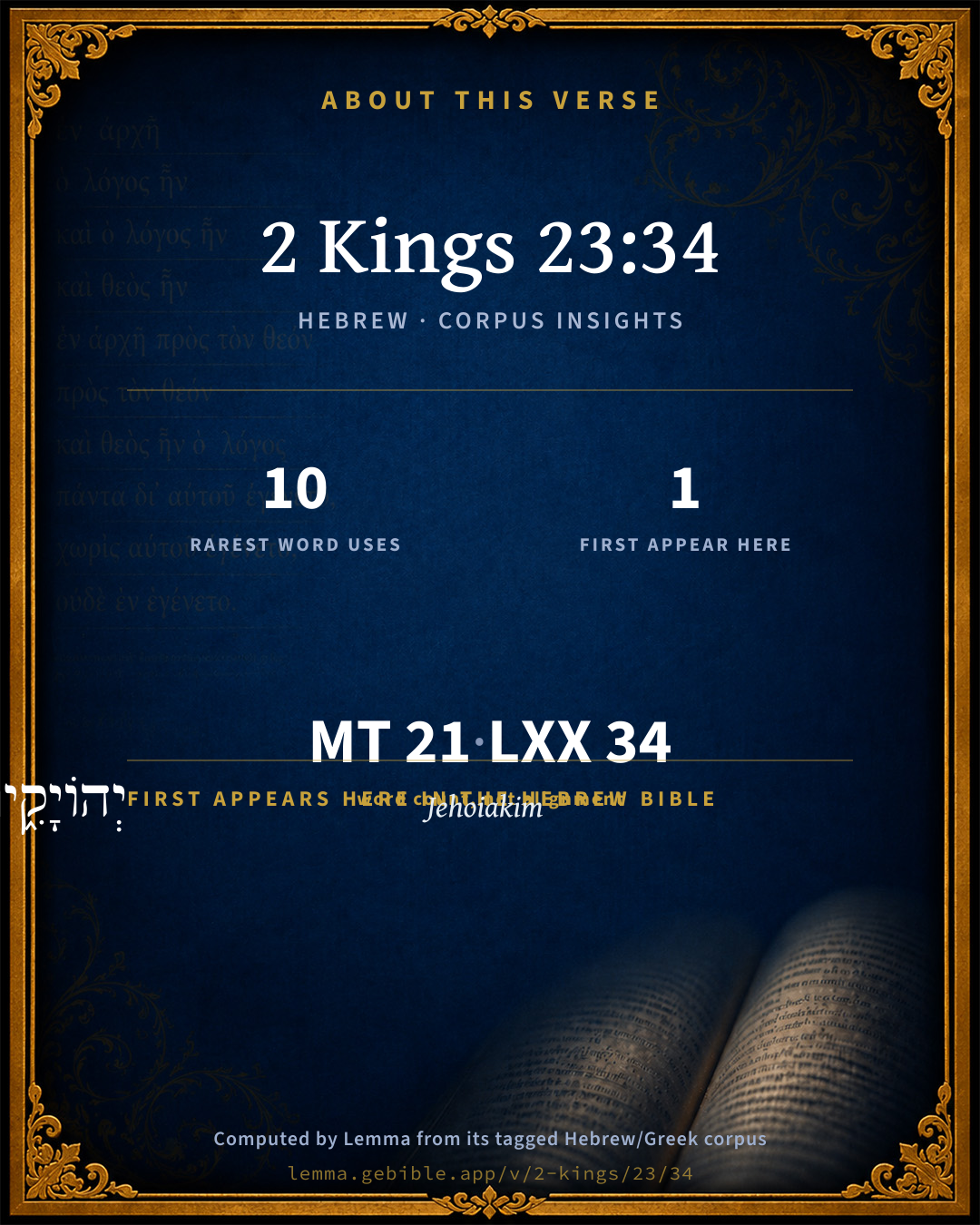
The rarest word here is פַּרְעֹ֨ה Pharaoh-necho H6549 — appearing just 10 times in the whole Hebrew Bible.

First appearance in Scripture

This word makes its first canonical appearance in the Hebrew Bible here:

  • יְהוֹיָקִ֑ים Jehoiakim H3079

Shared distinctive vocabulary

פַּרְעֹ֨ה Pharaoh-necho H6549 occurs in 5 verses of the Hebrew Bible. Also found in:

Grammatical profile

  • 5 verbs
  • 11 nouns
  • 1 preposition
  • 1 adverb
  • 3 particles

Verb forms

  • וַיַּמְלֵךְ֩ Hiphil · Sequential Imperfect
  • וַיַּסֵּ֥ב Hiphil · Sequential Imperfect
  • לָקָ֔ח Qal · Perfect
  • וַיָּבֹ֥א Qal · Sequential Imperfect
  • וַיָּ֥מָת Qal · Sequential Imperfect

Repetition

Words recur within this verse — often emphatic in Hebrew:

  • פַּרְעֹ֨ה Pharaoh-necho H6549 ×2
  • יֹאשִׁיָּ֗הוּ Josiah H2977 ×2

Hebrew & Septuagint length

In English translation the verse runs 35 words from the Hebrew and 41 from the Septuagint (LXX English) — closely comparable.

A rough comparison of the two English renderings, which tokenize alike — not a word-level alignment.

Word counts can differ between the Hebrew and the Greek without any difference in meaning — e.g. the Hebrew direct-object marker אֵת has no separate Greek word, and Greek often adds the article ὁ.

In the original languages it is 21 Hebrew tokens and 34 Greek tokens — but the two are counted differently (Hebrew bundles its prefixes and suffixes into one token; the Greek is in lemma form), so that isn’t a like-for-like length.

Cross-references

8

Topical passages linked to 2 Kings 23:34 in the Treasury of Scripture Knowledge — connected by theme and wording, ordered by reader-vote popularity; previews shown in the World English Bible.

  • Ezekiel 19:3–4 She brought up one of her cubs: he became a young lion, and he learned to catch the prey; he devoured men.
  • 2 Kings 24:17 The king of Babylon made Mattaniah, [Jehoiachin's] father's brother, king is his place, and changed his name to Zedekiah.
  • 1 Chronicles 3:15 The sons of Josiah: the firstborn Johanan, the second Jehoiakim, the third Zedekiah, the fourth Shallum.
  • Jeremiah 22:11–12 For thus says Yahweh touching Shallum the son of Josiah, king of Judah, who reigned instead of Josiah his father, [and] who went forth out of this place: He shall not return there any more.
  • Daniel 1:7 The prince of the eunuchs gave names to them: to Daniel he gave [the name of] Belteshazzar; and to Hananiah, [of] Shadrach; and to Mishael, [of] Meshach; and to Azariah, [of] Abednego.
  • Genesis 41:45 Pharaoh called Joseph's name Zaphenath-paneah; and he gave him Asenath, the daughter of Potiphera priest of On as a wife. Joseph went out over the land of Egypt.
  • Joshua 18:18 and it passed along to the side over against the Arabah northward, and went down to the Arabah;
  • 2 Chronicles 36:3–4 The king of Egypt deposed him at Jerusalem, and fined the land one hundred talents of silver and a talent of gold.

Cross-references courtesy of OpenBible.info (CC BY 4.0).

Hebrew and Greek witnesses Masoretic Hebrew ↔ Greek Septuagint

The same verse in the two great witnesses to the Old Testament, shown verse-for-verse.

These are two independent witnesses, not word-aligned to each other, and the Septuagint is shown in lemma (dictionary) form.

Hebrew 2 Kings 23:34 Masoretic · Westminster Leningrad Codex

וַיַּמְלֵךְ֩ פַּרְעֹ֨ה נְכֹ֜ה אֶת אֶלְיָקִ֣ים בֶּן יֹאשִׁיָּ֗הוּ תַּ֚חַת יֹאשִׁיָּ֣הוּ אָבִ֔יו וַיַּסֵּ֥ב אֶת שְׁמ֖וֹ יְהוֹיָקִ֑ים וְאֶת יְהוֹאָחָ֣ז לָקָ֔ח וַיָּבֹ֥א מִצְרַ֖יִם וַיָּ֥מָת שָֽׁם

Pharaoh Necoh made Eliakim the son of Josiah king in the room of Josiah his father, and changed his name to Jehoiakim: but he took Jehoahaz away; and he came to Egypt, and died there.

World English Bible · Public Domain

Greek LXX 2 Kings 23:34 Septuagint · lemma form

καί βασιλεύω φαραώ νεχαω ἐπί αὐτός ὁ ελιακιμ υἱός ιωσιας βασιλεύς ιουδα ἀντί ιωσιας ὁ πατήρ αὐτός καί ἐπιστρέφω ὁ ὄνομα αὐτός ιωακιμ καί ὁ ιωαχας λαμβάνω καί εἰςφέρω εἰς αἴγυπτος καί ἀποθνήσκω ἐκεῖ

And Pharao Nechao made Eliakim son of Josias king of Juda king over them in the place of his father Josias, and he changed his name to Joakim, and he took Joachaz and brought him to Egypt, and he died there.

LXX2012 (modern English Septuagint) · Public Domain

On this verse, Ellicott's Commentary for English Readers discusses the Septuagint’s reading. Read the note in Commentary ↓

Hebrew: Westminster Leningrad Codex (CC BY 4.0). Greek: Septuagint (public domain); English from LXX2012 (modern English Septuagint) (Public Domain). How the Septuagint differs from the Hebrew →

Targum (Aramaic paraphrase)

1

The Targum is the ancient Jewish Aramaic paraphrase of the Hebrew Scriptures — an interpretive translation, not the Hebrew text itself. Onkelos (literal) and Pseudo-Jonathan (expansive) render the Torah, and Jonathan the Prophets. Coverage is partial: where no permissively-licensed English translation exists for a verse, only the Aramaic is shown. This is verse-level text, not a word-by-word alignment to the Hebrew.

  1. Targum Jonathan Prophets (Joshua–Malachi)
    וְאַמְלִיךְ פַרְעֹה חֲגִירָא יַת אֶלְיָקִים בַּר יֹאשִׁיָהוּ תְּחוֹת יֹאשִׁיָהוּ אֲבוּהִי וְשַׁוִי יַת שְׁמֵיהּ יְהוֹיָקִים וְיַת יְהוֹאָחָז דְבַר וַאֲתָא לְמִצְרַיִם וּמִית תַּמָן:

    (no public-domain English translation for this verse)

    Targum Jonathan — Aramaic: “Mikraot Gedolot” (public domain). English: “Sefaria Community Translation” (CC0 1.0 (public-domain dedication)); “London "Chaldee Paraphrase," 1871” (public domain). Text via Sefaria.

Commentary

Notes on 2 Kings 23:34 from classic Christian and Jewish commentators (each source and its license shown beneath its notes). The classic Christian expositions comment on the surrounding passage and are grouped to its opening verse, so a note may address several verses; the Jewish commentaries on the Tanakh (Rashi and others) are per-verse, so they appear only where the commentator wrote on this verse.

Lemma curates 59 commentaries, every one of them public domain or Creative Commons licensed, each selected and text-cleaned for this edition rather than reprinted as found. About our sources →

Ellicott's Commentary for English Readers

THE REIGN OF JEHOAHAZ (31-34).

(34) Jehoahaz.—Called Shallum (Jer_22:11; 1Ch_3:15), which may have been his name before his accession. (Comp. 2Ki_23:34; 2Ki_24:17.) Hitzig suggested that he was so called by Jeremiah in allusion to his brief reign, as if he were a second Shallum (2Ki_15:13). It is against this that Shallum was not a Judean prince, but an obscure adventurer who usurped the throne of Samaria a hundred and fifty years previously, so that the allusion would not be very clear.

Hamutal.—“Akin to dew.” (Comp. Abital, “father of dew,” or perhaps, “the father is dew.”) Tal, however, may be a divine name; the meaning then is, “Tal is a kinsman.” (Comp. Hamuel, “El is a kinsman.”)

(34) Turned his name to Jehoiakim.—A slight change. Eliakim is “El setteth up;” Jehoiakim, “Jah setteth up.” Necho meant to signify that the new king was his creature. Eliakim, the elder son, may have paid court to Necho; or the Egyptian may have deposed Jehoahaz, as elected without his consent, and perhaps as likely to prove a stronger king than his brother. Necho may have fancied a resemblance between the name Yahû (i.e., Jah; so it was then pronounced) and Aah, the name of the Egyptian moon-god. (See Note on 1Ch_4:18.)

And he came to Egypt, and died there.—LXX. and Vulg. as Chronicles: and he brought him to Egypt (by a slight change of the pointing in the Hebrew.) Jeremiah had foretold the fact (Jer_22:10-12).

A Bible Commentary for English Readers, edited by Charles John Ellicott (1878–1897) — public domain. Text from a community e-Sword module.

Trapp's Complete Commentary

John Trapp

2Ki 23:34 And Pharaohnechoh made Eliakim the son of Josiah king in the room of Josiah his father, and turned his name to Jehoiakim, and took Jehoahaz away: and he came to Egypt, and died there.

Ver. 34. Made Eliakim.] That is, God shall arise: so his good father Josiah named him, but he proved a degenerate plant; his father trembled and humbled himself at the hearing of the law, but he cut in pieces the prophecy of Jeremiah, and sought for him and Baruch to the shambles; but the Lord hid them.

And turned his name.] Memoriae causa, saith one interpreter; to show his sovereignty, saith another. {a}

And died there.] According to the prophecy of Jeremiah, {Jer 22:11-12} who taxeth him there for covetousneas, ambition, and other vices, hastening the consummation or consumption of all, according to the signification of his other name, Shallum.

{a} Ut Iehovae victoriam acceptam se referre testaretur, &c. - Ussher.

John Trapp, A Commentary or Exposition upon All the Books of the Old and New Testament (1647–1656) — public domain. Text from a community e-Sword module.

Joseph Benson's Commentary

2Ki 23:34. Pharaoh-nechoh made Eliakim king — Whom he probably perceived to be of a more mild and peaceable disposition. And turned his name to Jehoiakim — It was usual for conquerors to change the names of the persons they vanquished in war, in testimony of their absolute power over them. Thus we find the king of Babylon changing the name Mattaniah into Zedekiah, when he constituted him king of Judah, chap. 2Ki 24:17. Archbishop Usher further remarks, that the king of Egypt gave Eliakim the name of Jehoiakim, which signifies, God hath made, or shall make it to prosper; thereby to testify, that he ascribed his victory over the Babylonians to Jehovah, the God of Israel, who had excited him, as he pretended, (2Ch 35:21,) to undertake the expedition. And took Jehoahaz away — That he might give no disturbance to his brother, and also probably as a punishment for him. And he came to Egypt, and died there — According to the prophecy of Jeremiah, whom God sent to call this new king and the people to repentance. See Jer 22:1-3; Jer 22:10; Jer 22:12.

Joseph Benson's Commentary on the Old and New Testaments (1811–1818) — public domain. Text from a community e-Sword module.

Tyndale Open Study Notes

Tyndale Open Resources

23:34 Eliakim . . . Jehoiakim: Neco continued the Assyrian practice of requiring an oath of loyalty and assigning a new name to the local head of state.

Tyndale Open Study Notes — © Tyndale Open Resources, licensed CC BY-SA 4.0. Text via the HelloAO Bible API.

Adam Clarke's Commentary

Verse 34. Turned his name to Jehoiakim] These names are precisely the same in signification: ELIAKIM is God shall arise; JEHOIAKIM, Jehovah shall arise; or, the resurrection of God; the resurrection of Jehovah. That is, God's rising again to show his power, justice, c. The change of the name was to show Nechoh's supremacy, and that Jehoiakim was only his vassal or viceroy. Proofs of this mode of changing the name, when a person of greater power put another in office under himself, may be seen in the case of Mattaniah, changed into Zedekiah Daniel, Mishael, Hananiah, and Azariah, into Belteshazzar, Shadrach, Meshach, and Abed-nego; and Joseph into Zaphnath-paaneah. See Da 1:6-7; Ge 41:45.

Adam Clarke's Commentary on the Bible (1810–1826) — public domain. Text from a community e-Sword/MySword module.

The Cambridge Bible for Schools and Colleges

gen. ed. J. J. S. Perowne

34. Eliakim … and turned his name to Jehoiakim] We can hardly think that this change was made by Pharaoh. He probably insisted on a change of name, but allowed the new king to suggest what it should be. So the change was made from El (God) iakim (will establish), to Jeho (i.e. Jehovah) will establish. On the custom of changing the names of subject persons and slaves, cf. the change of Joseph’s name in Egypt (Gen_41:45, also chap. 2Ki_24:17 below). To these may be added the changes mentioned in the book of Daniel (Dan_1:7).

and [R.V. but he] took Jehoahaz away] i.e. From Riblah, and carried him with him prisoner into Egypt, where he died. On his death see Jer_22:11-12.

The Cambridge Bible for Schools and Colleges (gen. ed. J. J. S. Perowne; Cambridge University Press, 1878–1918) — public domain. Text from a community e-Sword module.

John Gill's Exposition

Jehoiakim was twenty and five years old when he began to reign,.... And therefore must be two years older than his brother Jehoahaz, who was deposed:

and he reigned eleven years in Jerusalem; and therefore must die at the age of thirty and six:

and his mother's name was Zebudah, the daughter of Pedaiah of Rumah; which Josephus (l) calls Abuma; but he speaks of a village in Galilee called Ruma (m); but whether the same with this is not certain.

(l) Antiqu. l. 10. c. 5. sect. 2. (m) De Bello Jud l. 3. c. 6. sect. 21.

John Gill's Exposition of the Whole Bible (1746–1763) — public domain (CC PDM 1.0). Text via the HelloAO Bible API.

Albert Barnes' Notes on the Bible

In the room of Josiah his father - Not “in the room of Jehoahaz his brother;” the phrase is intended to mark the fact, that Neco did not acknowedge that Jehoahaz had ever been king.

Turned his name to Jehoiakim - Compare 2Ki 23:30 and 2Ki 24:17. It seems likely, from their purely Jewish character, that the new names of the Jewish kings, though formally imposed by the suzerain, were selected by the individuals themselves. The change now made consisted merely in the substitution of יהוה yehovâh for אל 'êl (“God, Yahweh, will set up”). Both names alike refer to the promise which God made to David 2Sa 7:12 and imply a hope that, notwithstanding the threats of the prophets, the seed of David would still be allowed to remain upon the throne.

Albert Barnes' Notes on the Bible (1834–1885) — public domain. Text from a community e-Sword/MySword module.

Haydock's Catholic Bible Commentary

Joakim. Thus he asserted his dominion over him, as Nabuchodonosor did afterwards over Matthanias, chap. xxiv. 17., and Daniel i. 6. (Calmet) --- Eliacim means nearly the same as Joakim, "the Lord’s strength," or "appointment." (Menochius)

George Leo Haydock (1774–1849), Haydock's Catholic Family Bible and Commentary, 1859 edition — public domain. Excludes Psalms (Douay-Rheims chapter numbering differs from Protestant) and Deuterocanonical books (Catholic canon only).

Matthew Poole's English Annotations

Eliakim the son of Josiah; whom he perceived to be of a more mild and peaceable disposition.

Turned his name to Jehoiakim; because the giving of names was accounted an act and sign of dominion; which therefore parents did to their children, and conquerors to their vassals or tributaries. Compare 2Ki 24:17; Dan 1:7.

Took Jehoahaz away; partly as a punishment for him, and partly that he might give no disturbance to his brother.

Matthew Poole's English Annotations on the Holy Bible (1683–1685) — public domain. Text from a community e-Sword/MySword module.

Whedon's Commentary on the Bible

Daniel D. Whedon

34. Made Eliakim… king — Some suppose that Eliakim had appealed to Necho to interfere, and had urged that he himself, being the elder son of the deceased Josiah, was the only proper heir to the kingdom. It is possible, also, that Necho took offence at the popular election of Jehoahaz immediately after his father’s fall, and without consulting him as his sovereign.

Turned his name to Jehoiakim — This changing the name of a captive or vassal king was to show the conqueror’s absolute authority over him. “The alteration of the name was a sign of dependence. In ancient times princes were accustomed to give new names to the persons whom they took into their service, and masters to give new names to their slaves.

Gen_41:45; Ezr_5:14; Dan_1:7. But while these names were generally borrowed from heathen deities, Eliakim, and at a later period Mattaniah, (2Ki_24:17,) received genuine Israelitish names, Jehoiakim, ‘Jehovah will set up,’ and Zedekiah, ‘Righteousness of Jehovah;’ — from which we may infer that Necho and Nebuchadnezzar did not treat their vassal kings, installed by them, exactly as their slaves, but allowed them to choose the new names for themselves, and simply confirmed them as a sign of their supremacy.” — Keil.

Daniel D. Whedon (gen. ed.), Commentary on the Old and New Testaments (1874–1909) — public domain. Text from a community e-Sword module.

The Pulpit Commentary

Vers. 34-37. ACCESSION AND EARLY YEARS OF JEHOIAKIM. Pharaoh-Nechoh, when he deposed Jehoahaz, at once supplied his place by another king. He had no intention of altering the governmental system of Palestine, or of ruling his conquests in any other way than through dependent monarchs. His choice fell on Josiah"s eldest surviving son, (1Ch_3:15) Eliakim, who was the natural successor of his father. Eliakim, on ascending the throne, changed his name, as Jehoahaz appears to have done (see the comment on ver. 31), and reigned as Jehoiakim. For three years (B.C. 608-605) he continued a submissive vassal of the Egyptian monarch, and remitted him his tribute regularly (ver. 36). But his rule was in all respects an evil one. He "did that which was evil in the sight of the Lord" (ver. 37). He leant towards idolatry; (2Ch_36:8) he was oppressive and irreligious (Josephus, "Ant. Jud:" 10:5. he "shed innocent blood"; (Jer_22:17) he was luxurious (Jer_22:14, Jer_22:15) covetous, (Jer_22:17) and tyrannical. (Eze_19:6)

And Pharaoh-Nechoh made Eliakim the son of Josiah king in the room of Josiah his father. (On the general inclination of Oriental monarchs to support the hereditary principle, and to establish sons in their fathers" governments, even when the father"s had been rebels or enemies, see Herod., 3:15.) And turned his name to Jehoiakim. We may understand that Nechoh required him to take a new name, as a mark of subjection. (comp. Gen_41:45; Ezr_5:14; Dan_1:7; and, 2Ki_24:17) but left the choice of the name to himself. He made the change as slight as possible, merely substituting "Jehovah" for "El" as the initial element. The sense of the name remained the same, "God will set up." The idea that Nechoh was pleased with the new name on account of its apparent connection with the Egyptian moon-god, Aah (Menzel), is very fanciful. And took Jehoahaz away i.e. carried him captive to Egypt (see Jer_22:10, Jer_22:11; Eze_19:4) a very common practice of Egyptian conquerors, and one often accompanied by extreme severitiesand he cams to Egypt, and died there. (see Jer_22:12, where this is prophesied)

The Pulpit Commentary (1880–1919), ed. H.D.M. Spence-Jones & Joseph S. Exell — public domain. Text from a community e-Sword module.

John Wesley's Explanatory Notes

Jehoiakim - The giving of names was accounted an act of dominion; which therefore parents did to their children, and conquerors to their vassals or tributaries.

John Wesley, Explanatory Notes Upon the Whole Bible (1754–1765) — public domain. Text via the GEBible commentary corpus.

Keil & Delitzsch

C. F. Keil & F. Delitzsch

From the words "Necho made Eliakim the son of Josiah king in the place of his father Josiah," it follows that the king of Egypt did not acknowledge the reign of Jehoahaz, because he had been installed by the people without his consent. "And changed his name into Jehoiakim." The alteration of the name was a sign of dependence. In ancient times princes were accustomed to give new names to the persons whom they took into their service, and masters to give new names to their slaves (cf. Gen 41:45; Ezr 5:14; Dan 1:7, and Hvernick on the last passage). - But while these names were generally borrowed from heathen deities, Eliakim, and at a later period Mattaniah (Kg2 24:17), received genuine Israelitish names, Jehoiakim, i.e., "Jehovah will set up," and Zidkiyahu, i.e., "righteousness of Jehovah;" from which we may infer that Necho and Nebuchadnezzar did not treat the vassal kings installed by them exactly as their slaves, but allowed them to choose the new names for themselves, and simply confirmed them as a sign of their supremacy. Eliakim altered his name into Jehoiakim, i.e., El (God) into Jehovah, to set the allusion to the establishment of the kingdom, which is implied in the name, in a still more definite relation to Jehovah the covenant God, who had promised to establish the seed of David (Sa2 7:14), possibly with an intentional opposition to the humiliation with which the royal house of David was threatened by Jeremiah and other prophets. - "But Jehoahaz he had taken (לקח, like יקּח in Kg2 24:12), and he came to Egypt and died there" - when, we are not told. - In Kg2 23:35, even before the account of Jehoiakim's reign, we have fuller particulars respecting the payment of the tribute which Necho imposed upon the land (Kg2 23:33), because it was the condition on which he was appointed king. - "The gold and silver Jehoiakim gave to Pharaoh; yet (אך = but in order to raise it) he valued (העריך as in Lev 27:8) the land, to give the money according to Pharaoh's command; of every one according to his valuation, he exacted the silver and gold of the population of the land, to give it to Pharaoh Necho." נגשׂ, to exact tribute, is construed with a double accusative, and בּערכּו אישׁ placed first for the sake of emphasis, as an explanatory apposition to הערץ את־עם.

Keil & Delitzsch — Biblical Commentary on the Old Testament (1861–1891) — public domain (CC PDM 1.0). Text via the HelloAO Bible API. (Old Testament only.)

Scofield Reference Notes

C. I. Scofield

Jehoiakim

Called Jakim. Mat 1:10; Mat 1:11. (See Scofield "Mat 1:10").

The Scofield Reference Bible (1917 edition), notes by C. I. Scofield — public domain. Text from a community e-Sword module.

unfoldingWord translationNotes

Door43 World Missions Community

Jehoikim taxed the land

"Jehoikim collected taxes from the people who owned land"

people of the land

"people of the land of Judah." Possible meanings are 1) "the people who lived in the land of Judah" or 2) "the richest and most powerful of those who lived in Judah."

translationWords

Eliakim

Josiah

king

Jehoiakim

obey

unfoldingWord translationNotes — © Distant Shores Media and the Door43 World Missions Community, licensed CC BY-SA 4.0. Source: git.door43.org/Door43/en_tn.

Lesson kit

Teaching starters — assembled from the data on this page, not authored interpretation. Every prompt links to the verse data it draws on. Edit before teaching.

2 Kings, in the Historical, opens this verse with 21 words (17 distinct Hebrew lemmas). Its most distinctive word is Parʻôh Nᵉkôh (“Pharaoh-necho”). A historical commentator’s framing appears above. Read the whole chapter for the surrounding context.

Discussion questions

  1. How does “Pharaoh-necho” (Parʻôh Nᵉkôh) shape what this verse is saying?
  2. The word “Jehoiakim” first appears here in Scripture. What is being introduced at this debut?
  3. 2 Kings 23:29 shares the word «Pharaoh-necho» with this verse. How do the two illuminate each other?
  4. “Pharaoh-necho” occurs 2× in this one verse. What is the effect of the repetition?
  5. The translations on this page render this verse differently — a whole-verse word diff, not a word-by-word alignment. What might account for the different wordings?
  6. The verb «וַיַּמְלֵךְ֩» is Hiphil Sequential Imperfect. How does its form color the action?
  7. Reading how Ellicott's Commentary for English Readers and Trapp's Complete Commentary read this verse, where do the two commentators agree and where do they part?

Things to notice

Reading settings

Reading text

Shown beneath each verse's original-language words.

Old Testament
Old Testament edition

Read the OT as the Masoretic Hebrew (MT) or the Greek Septuagint (LXX).

English shown for the Greek Septuagint (in the Hebrew ↔ Greek comparison).

Comparing translations? Open the Compare panel on any verse page to stack up to four side by side.